Everyone Called Her Cursed—Until the Alpha King’s Wolf Refused to Accept Any Mate but Her Alone
In the small pack of Ashfall, there was a woman everyone called cursed.
Her real name did not matter anymore, because nobody used it. They called her Marrow. And they said the word the way people say the name of a sickness, not the name of a person.
The story about her was old, but people still told it.
When she was 6 years old, a wild wolf attacked the watchtower at the edge of the pack’s land. Everyone inside the tower died. Only Marrow walked out alive, 3 days later, with no wounds and no clear memory of what had happened.
For one strange week after that, her eyes were not brown like before. They were gold. Then, just as suddenly, they turned brown again, and stayed that way for the rest of her life.
Nobody could explain how a small child survived when grown warriors did not. So the elders of the pack decided there must be something wrong with her. They said she carried a curse. Something dark that had entered her that night in the tower.
From that day on, people kept their distance. Mothers pulled their children away when she walked past.
Other wolves in the pack found mates by the time they were 20. But Marrow reached 24 with no one beside her, and a permanent seat at the very end of the dining table, closest to the door. As if everyone silently agreed she might need to leave in a hurry. Or that they might need her to.
She did not fight the story anymore.
She had tried, when she was younger, to explain that she remembered nothing frightening. Only a feeling of warmth before everything went dark. Nobody listened. So she stopped trying, and instead spent her days working in the tanning sheds, cleaning animal hides. A job that suited someone the pack preferred to keep at a distance.
Then, one autumn day, King Rurik Vane came to Ashfall.
He was the ruler of a much larger pack, a man known across many lands for his strength and his fairness. Wolves said his own wolf spirit was so powerful that other wolves went quiet just standing near him, the way a small flame settles down near a large fire.
He had traveled through many packs over the years. And in each one, families had offered him their daughters and sons as possible mates. He had turned down every single one. His wolf never showed interest in anyone, no matter how beautiful, wealthy, or skilled they were.
On the day he arrived in Ashfall, the whole pack gathered to see him pass, the way people gather to watch an important storm arrive.
Marrow did not join the crowd.
She was working, hauling hides across the yard, when his procession passed nearby. She did not even look up. Looking at kings had never done her any good in the past.
But King Rurik’s wolf looked at her.
And then it stopped walking.
Rurik felt it happen inside his own chest before he understood what it meant. His wolf, a creature that had never once reacted to any of the many people offered to him over the years, suddenly planted itself still, like a stubborn animal refusing to take another step forward.
Her, his wolf said.
Not a question. Not a suggestion. It was certain.
Rurik stopped the entire procession, right there in the middle of the road, just to look again at a woman scraping fat off a deer hide.
She did not stop what she was doing. She did not even notice him watching.
Word of what happened spread through the pack quickly, the way bad news always travels faster than good news.
By evening, everyone in Ashfall had heard that the king’s wolf refused to move. That he had stared at the tanning sheds for almost an hour. And that people were already whispering the word nobody wanted attached to Marrow.
Mate.
Marrow heard it from Ione, the woman who managed the tannery, and who enjoyed sharing gossip more than she enjoyed being kind.
“They’re saying it’s a mate bond,” Ione told her, watching closely to see how she would react.
Marrow’s hand slipped slightly on the knife she was using to clean a hide. She did not answer right away.
She could already hear, in her mind, the jokes the pack would make about this by the next morning. Not sympathy. Calculation. What did it mean, they would ask each other, that a king who could have chosen anyone had somehow chosen the one person nobody wanted?
That evening, Rurik found her behind the tanning sheds, washing tallow from her hands in a bucket of water that had turned a dull, cloudy color from use.
“You should tell your wolf no,” she said, before he had spoken a single word. “Wolves do not get the final decision. People do.”
“My wolf has not been this certain about anything since I was 19 years old,” he said quietly.
It did not sound like a boast. It sounded more like a confession.
“I am not sure how to argue with it.”
“Then learn quickly,” she said, drying her hands on her apron.
She turned to walk past him. But he raised his hand. Not to grab her. Only to offer something. A small pause. A chance for her to stop, if she wanted to.
Something about the careful distance in that gesture made her pause anyway.
“They call you cursed,” he said.
“They call me many things. Cursed is simply the one that stayed.”
“My wolf does not smell anything cursed on you.”
“Your wolf,” she said, “was not at the Eastern Watchtower.”
She expected that to end the conversation. It usually did, with other men who had shown interest in her before and quickly lost their nerve.
But Rurik did not walk away. Instead, he asked her the one question that no one in 18 years had ever bothered to ask directly.
“What happened at the tower?”
So she told him.
Not everything. She never told anyone everything. But enough.
She explained that the wolf who attacked the tower had not been an ordinary wild wolf. She remembered a dying watchman. Someone who used his very last moments to push something into her. An old kind of protection, passed from his failing body into hers.
She remembered warmth, not violence.
She believed her eyes turned gold because something very old and very strong had settled inside a body too small and too young to hold it comfortably at first.
There had been no curse, she said. Only a slaughter and a gift, arriving together, wearing the exact same shape. The pack had needed to believe it was something evil. Because a good gift did not explain why she alone survived when everyone else in that tower had died.
Rurik’s wolf, silent through the whole story, made a low sound in his chest. It was not anger. It was something closer to sadness.
The pack elders did not accept the situation easily.
An alpha king choosing his mate is never only a personal decision. It is a political one, too. And for the following week, the elders of Ashfall found many different polite ways to ask Rurik if he was truly certain about his choice.
Every question really meant the same thing underneath: We are not certain. And we do not think you should be, either.
Rurik answered each question the same way.
“My wolf has chosen. My wolf has never been wrong before about anything that mattered. I will not change my mind simply because the choice makes you uncomfortable.”
It was not a romantic answer. It was closer to something firm and practical. The kind of statement a leader makes when he has already decided something and is simply informing everyone else of the outcome.
But for a woman who had spent 18 years being managed like a problem to be handled, that kind of firm and practical loyalty meant more to her than any flowery declaration ever could.
She did not fall in love with him suddenly, in one dramatic moment. It happened slowly, in small pieces, the way real feelings usually grow.
It happened one afternoon, when he sat beside her at the tanning bench and deliberately cleaned a hide badly, just so she would have something small to correct him about. Something that was not her own painful history.
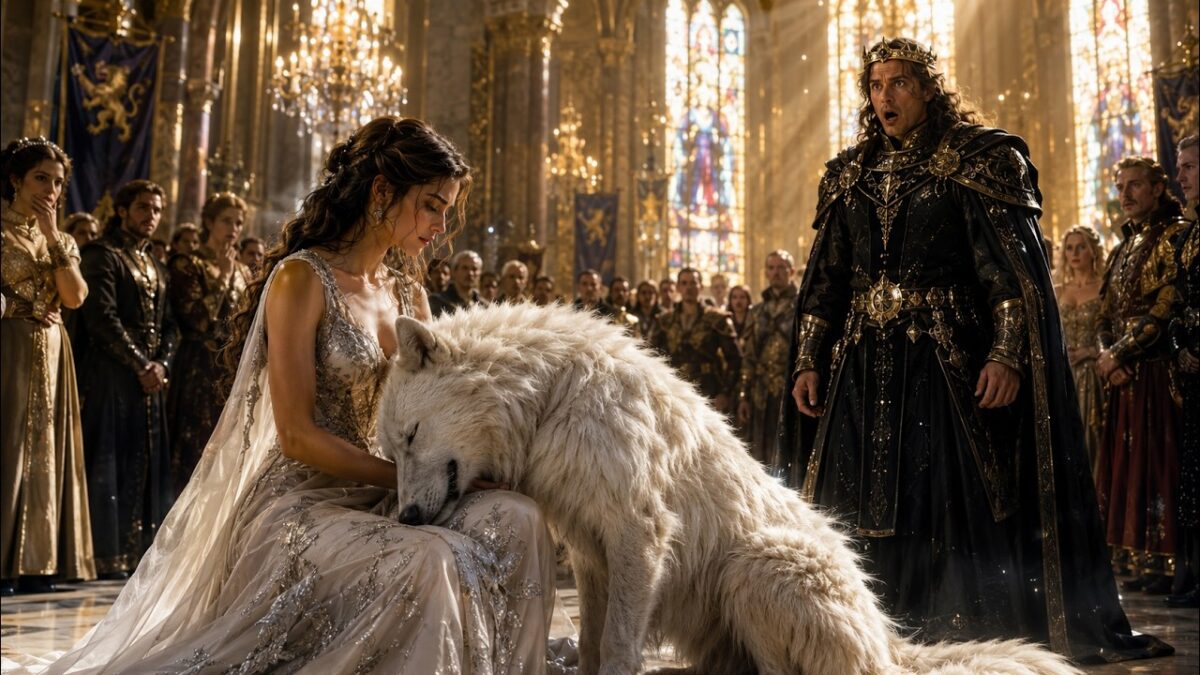
It happened one night, when his wolf, without anyone asking, rested its large head gently in her lap while she cried about the tower for the very first time in front of another living person. The wolf simply stayed there, warm and patient, asking nothing from her except that she allow the moment to happen.
Mostly, it happened because of something she slowly began to notice was missing.
He never once asked her to prove that the curse was not real.
He had already made his decision. His wolf had already made it for both of them, the very first time it refused to walk another step away from her. And Rurik, despite his crown and his long history of an unmoved wolf, turned out to be a man who trusted his own instincts far more than he trusted a roomful of nervous elders.
The gold returned to her eyes only one more time.
It was on the night she stood at the gate of Ashfall and finally allowed the old protection to surface on purpose, instead of by accident. She called it up the way a person finally uses a gift they had spent their whole life apologizing for having.
The very same pack that had spent 18 years calling her cursed watched golden light surround her as she helped defend their home. And they understood, all at once, and much too late, exactly what they had been afraid of the entire time.
It was never a curse.
It was something they had never deserved, and had failed to recognize, even while it sat quietly at the far end of their table, cleaning deer hides, closest to the door.
Rurik’s wolf did not react with any surprise to the golden light. It never had. It had understood exactly what it was looking at from that very first afternoon, back when everyone else in Ashfall was still using the wrong name for her.
They did not have a large or fancy wedding.
Rurik asked her plainly, the same direct way he approached everything in his life. No music. No performance. Only the same calm certainty he had used with his own elders.
“My wolf will not change its mind. Neither will I. Marry me.”
“You could have chosen anyone,” she said.
It was an old habit. One final check before she allowed the door to close behind her for good.
“I did not want anyone else,” Rurik answered. “My wolf understood that before I did. It is usually right about the things that matter most.”
She said yes right there at the tanning bench. Her hands still faintly stained from her work. Her apron still on. No gold in her eyes at all. Just plain brown. Ordinary. And entirely her own.
Within a year, the pack began calling her Marrow the Queen.
This time, when she stopped correcting people about her name, it was not because she had given up on herself. It was because, for the very first time in 18 years, the name finally felt like it belonged to her.








