She Married America’s Richest Man. Then His Will Told Her Exactly What She Was Worth: Delia Caton
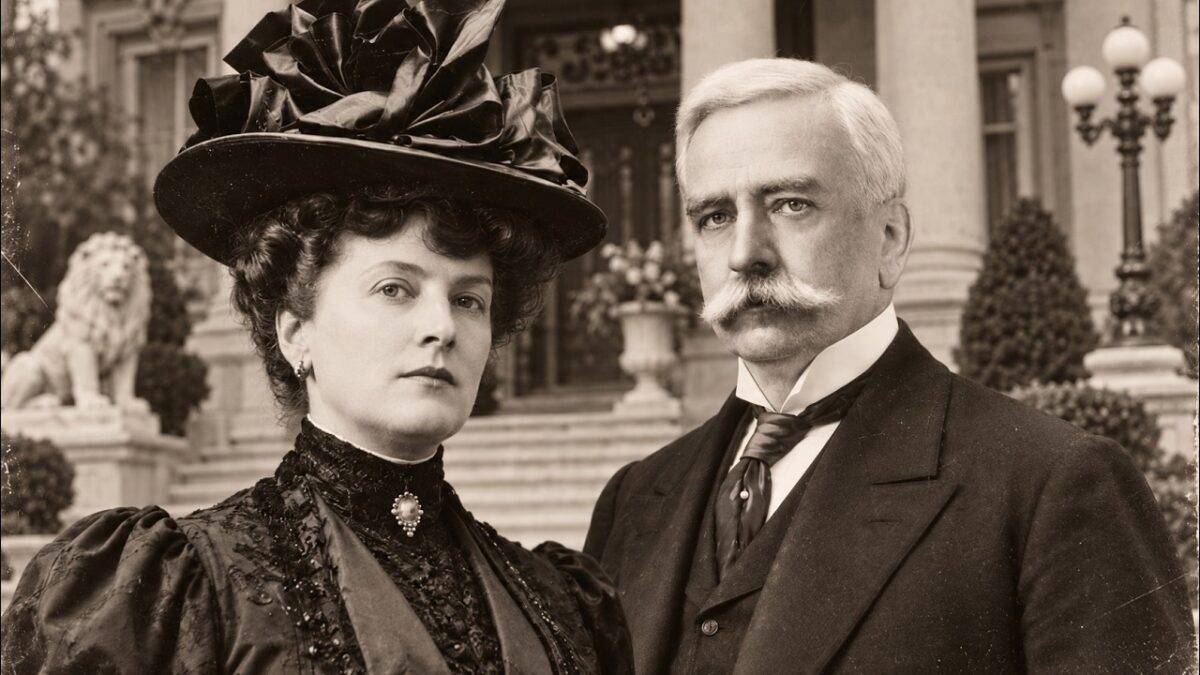
For 30 years, Dileia Kaitton watched one house from her own back window. The only house in Chicago wired for electric light belonging to a man who wasn’t hers to have. His name was Marshall Field, and Chicago’s grandest store still carries it today.
Everyone in the city was certain he loved her. Nobody could ever say if she loved him back. She finally became his wife in 195.
She was his widow 133 days later, and his will told her in exact figures precisely what he thought 30 years of waiting had been worth. Ladies and gentlemen, welcome. In the Newbury Library in Chicago, there is a box of family papers.
Inside it, folder 84 holds a single printed card, a menu from a wedding breakfast served in London on the 5th of September, 195. 20 guests sat down to it. The bride was 52 years old.
The groom was 70 and he was the richest merchant in America. His name was Marshall Field. If you are old enough to remember the clock on State Street or the Christmas windows or the young cler named Selfridge who learned the trade in that store and carried it to London, then you already know the name.
The bride’s name was Dileia Spencer Kaitton. Almost no one remembers hers.
By the time that menu was printed, those two had known one another for nearly 30 years. Their houses stood back to back, one street apart. And in all that time, they had never once hidden.
They went to parties together. They traveled to Europe together. Chicago watched them do it season after season and said nothing to their faces.
Which raises the question that hangs over everything that follows. If neither of them was hiding, what exactly had they been waiting for? Tonight we tell her story. Not the story of the store.
That story has been told and told well. This is the story of the woman standing just outside the frame of it. What she waited for, what she finally received, and what one sentence in a dead man’s will revealed about the whole long arrangement.
A sentence repeated in Chicago drawing rooms for the next 30 years. Crown Files tells the stories of the women who stood beside power and paid the private price for very public lives. Dileia Kaitton paid hers in years.
It began at a dinner table in a silence that lasted a few seconds too long. The silence lasted just long enough to become dangerous. It was a dinner party on Calumet Avenue sometime in the early 1890s.
The kind of evening the Kaitens were already famous for. 20 places, good wine, a table that ran long into the night. Custom required the men to rise one by one and say a few words.
Marshall Field did not rise. He sat very still, the way he always did when a room turned its attention toward him, and the pause stretched past polite into something the other guests could feel in their own chests. Before it could tip into humiliation, the hostess was on her feet.
“Mr. Field just wants me to remind you,” she said, that the white sail starts next Monday.
The table laughed. The moment closed as if it had never opened. Marshall Field said nothing.
He did not have to. Dileia Spencer Kaitton had just spoken for a man who was not her husband in a room full of people who understood exactly what that meant. And no one at that table considered it strange.
To understand why she had the right to do that, why an entire dinner party would let her. You have to go back 9 years earlier to two houses built one street apart. In 1876, Marshall Field finished a mansion at 1905 Prairie Avenue.
Red brick, stone trim, a mansard roof, and something no other house in Chicago yet had. Electric light in every room. At night, the windows glowed.
A shade no gas lamp could match, visible for blocks. A year later, a young bride named Dileia Spencer moved into a house on Calumet Avenue with her new husband, Arthur Kaitton, son of one of Illinois’s first Supreme Court justices, a man more devoted to golf, horses, and his club chair than to the law he had trained for. Their house stood directly behind the fields.
from her own back windows. On any clear evening, Dileia could see that particular light. Arthur Kaitton was, by every account, easy company and little else.
The kind of husband people described as a clubman when they meant a man who was rarely at home. He played, he socialized, he grew old comfortably on money that was largely his father’s. He was not cruel to Dia.
He simply left a great deal of room in the marriage, and over the following decades, Marshall Field would come to fill most of it. Marshall Field’s own marriage was not what it appeared from the street. He and his wife, Nanny, fought loudly enough that the servants learned to leave the room before the shouting started.
Nanny preferred the south of France to Chicago, and over the years was in Chicago less and less. Dia, meanwhile, had no children of her own, a fact that freed her, as one family friend later put it, to spend her considerable energy entertaining everyone else’s. She became instead an aunt in the fullest sense to her sister’s children, and especially to a niece named Catherine, who adored her without reservation.
Decades later, that niece would still remember the summers at the Kaitton farm outside Ottawa, Illinois. The long breakfast table, the potatoes sliced thin and fried in cream, and the aunt everyone simply called Aunt Dell, who ran the household with the same unhurrieded authority she brought to a Chicago ballroom. Aunt Dell kept up the traditions of the house, Catherine Eddie would write, remembering a woman who never seemed to raise her voice and never seemed to need to.
It was the same skill that had rescued Marshall Field at his own dinner table. Dileia Kaitton had spent a lifetime keeping up the traditions of houses that were not entirely her own. It was in the gap between one restless husband and one absent wife that something else began.
No one, not even the people closest to both families, could later say exactly when. What is certain is that for years afterward, wherever the Kaitens went, Marshall Field went to to the opera, to Newport, across the Atlantic more than once, on the same crossing, sometimes with Arthur along, sometimes as the years went on, without him. According to those who knew both households, it was Dia, not Nanny, who came to arrange the seating and choose the flowers whenever Marshall Field entertained at home.
Nanny by then rarely troubled herself with such things, and no one in Chicago seemed to think it odd that the neighbor did the work of the wife. It was a small enough arrangement to overlook. It was also, if anyone had stopped to notice, exactly the shape of a marriage, borrowed a garden away.
By the 1890s, the arrangement had a shape Chicago could describe in detail without ever writing a word of it down. The three of them dined together so often that hostesses simply set a third place without asking. They summered together.
Society columns which recorded everything else about the city’s grandest families down to the color of a hem noted the field Katon trio only in passing and never together at the same table twice in the same sentence as if an agreement had been reached that this particular fact would be observed but never printed. It was in exactly that silence that the story of the tunnel took root. Somewhere beneath Prairie Avenue, it was said a passage ran from the field cellar to the Kaitton cellar, so that the master of one house might visit the mistress of the other without the inconvenience of a front door.
Some told it with enough confidence to name the cellar wall it supposedly began behind. No one who told it had ever seen it. Arthur Mika, who knew both families personally and wrote about them decades later, called the idea absurd and then admitted that nobody still living could say one way or another whether Dia Kaitton had ever loved Marshall Field back.
The tunnel did not need to be real. What Chicago wanted was a reason for what it watched every night. one lit house, one dark garden between them, and two people who behaved in every particular but the legal one, like a married couple.
For a long while that was simply how things were. Marshall Field grew richer. His store grew larger.
Dia Katton became, by general agreement, the finest hostess in a city that took its hostesses seriously. Outshawn, people said, by only one other woman in Chicago, Mrs. Potter Palmer, whose social reign no one in the city thought to question, and a few miles behind all of it, quietly, Nanny Field kept getting farther away. She had been unwell for years by then, not dramatically, not with any single diagnosis anyone spoke of, but steadily.
the kind of decline that simply relocates a person a little further from home each season until one day they are living in it. By the start of the new decade, she was no longer visiting Europe. She was living there.
Chicago did not know it yet, sitting comfortably at its long dinner tables. But the waiting, 30 years of it in total, had already begun somewhere, to run out its clock. Not everyone in Chicago found the arrangement charming.
One Chicagoan, quoted years later, and never named, summed up what the whispers really meant. What existed between the three of them, this person said, was leery without levity, an affair with none of the lightness an affair was supposed to have, conducted by people too dignified to call it what it was. It was a hard thing to say about a woman most of the city adored.
It was also, some thought, closer to the truth than the dinner party laughter ever let on. Dileia gave the gossips nothing further to work with. She kept her households running her own and increasingly in small quiet ways the one behind it.
She wrote the invitations. She smoothed the seating charts. She never once in public looked at Marshall Field a moment longer than propriety allowed.
Whatever she was waiting for, she waited for it in full view with her back straight at every party in Chicago that mattered. The waiting had an ending built into it, though almost no one said so aloud. In a marriage like nannies, a woman by then living permanently on the Riviera, attended by nurses, seen by her husband only rarely, the door out was not divorce.
For people of the Fields and Kaitton’s position in that decade, divorce was not merely difficult. It was, as one biographer of the family later put it, simply unthinkable. A scandal so total it would have cost both families everything they had spent their lives building.
There was only one door out of a marriage like that. And everyone standing behind it knew exactly what it was. They were waiting, all of them, for someone to die.
There was a particular unfairness built into that waiting. One Chicago society never seemed to notice out loud. When a wife died, custom entitled a husband to grieve her publicly, a full year of black, of drawn curtains, of a widowerower’s dignified sorrow, whether he had loved her or not.
Marshall Field would be granted all of that for Nanny. Dileia Kaitton, who had spent two decades quietly running the traditions of his house, would be granted none of it for anyone. Whatever she felt about anyone, she would have to feel it exactly as she always had, behind a face arranged for other people’s comfort.
Two lives stood behind that particular door, not one, and only one of them was failing. Arthur Kaitton that same year was in his early 50s and by every account still robust, still at his club most afternoons, still keen for a round of golf, still in no particular hurry to go anywhere. Whatever the door out of these marriages required, he showed no sign of walking toward it.
If the arrangement’s entire timeline depended on two separate deaths arriving in a convenient order, only half of that timeline was cooperating.
By the middle of the decade, the letters reaching Chicago from the south of France had grown shorter, further apart, and written more and more often in a hand that was not Nanny’s own. A nurses, a companions, someone paid to hold the pen when she no longer could. Marshall Field crossed the Atlantic himself more than once during those years, always described in the papers as a matter of business, though few who watched him board the ship believed business was the whole of it.
He returned each time within a month or two, said little about the trip, and the pattern of dinners on Prairie Avenue and Calumet Avenue resumed exactly as before, because on paper nothing had changed yet. Chicago had learned by then to read the length of his absences the way it once read Tea Leaves, as a kind of forecast, without ever quite admitting that was what it was doing. Dileia through all of it gave no outward sign of watching the calendar the way the rest of the city privately was.
She continued exactly as she always had, hosting, arranging, smoothing over the small social frictions that came with two households run in one another’s shadow. If she was waiting for a telegram from a coastline she had never visited, she waited for it the same way she waited for everything else in this story. correctly, silently, and in full view of a city that had long since stopped pretending not to watch.
The telegram came from Nice in February of 1896. Nanny Field had been unwell for so long that Chicago had stopped asking after her health in any specific way. The Chicago Tribune, reporting her death, would describe her simply as having been practically an invalid for 15 years.
What no one expected was the speed of the end. The illness that finally took her, peritonitis, the doctors said, lasted only about 48 hours. One week, she was simply unwell in the way she had been unwell for a decade and a half.
The next, she was gone in a villa on a coastline she had chosen over her own house on Prairie Avenue. Word crossed the Atlantic by cable faster than a coffin could follow it. The newspapers had already reported the death before her family had settled, where in the city she had left behind, she would finally be laid to rest.
Marshall Field observed the year that followed, exactly as convention required. He wore the black. He kept the curtains drawn at Prairie Avenue.
It was by every visible measure a proper mourning for a wife he had by every private measure already lost long before the telegram came. For the length of that winter Chicago held its breath. Half of the equation that had kept two houses waiting for 30 years had just been solved.
Marshall field was for the first time since anyone could remember a free man. Nothing happened. Those who knew Marshall Field well were not entirely surprised.
This was, after all, a man who could not bring himself to rise at his own dinner table and say a few words without his voice failing him. A man for whom every public gesture, even a small one, seemed to cost something. Freedom for a man built that way was not the same thing as readiness.
Grief lifted on schedule as etiquette required, and Field quietly returned to the dinner tables he had always occupied. Dileia Kaitton returned there, too. Still Mrs. Kaitton, still married, still on paper, no different from the woman she had been the week before the telegram arrived.
The pattern simply resumed, minus one name at the table, whatever she wanted. In the winter of 1896, she wanted it in silence, exactly as she always had, because the other half of the equation was still very much alive, and would remain so for 8 years, yet patient, healthy, and entirely unaware that his own continued existence had quietly become to an entire city the last thing standing between two people, and everything they had spent three decades wanting. Nanny Field was laid to rest in the Field family plot at Graceand Cemetery, the first grave of what would in time become three, all standing together in the same quiet ground.
It would be eight more years before Chicago got the rest of what it was waiting for. And when it finally came, it would not come the way anyone expected.
Those eight years did not feel to the two people living inside them like waiting at all. With mourning behind them, and no one left to answer to, but propriety itself, Marshall Field and Dia Kaitton grew, if anything, less careful. They crossed the Atlantic together more openly than before, without Arthur, without explanation, without the pretense of a third place setting arranged to make it look accidental.
Hotel registers in London and Paris in those years show the two of them arriving within days of one another, sometimes on the same crossing, and no one in either family thought it necessary to remark on it anymore. A friend who traveled in the same circles later recalled the sight of them at breakfast in a Paris hotel dining room, reading separate newspapers at the same table, as unremarkable to the other guests as any long married couple. The secret, if it had ever truly been one, had worn itself smooth with age.
Chicago had stopped whispering. It had simply started waiting differently, not for permission anymore, but for a formality. Dia’s own standing in Chicago, if anything, only grew larger during these years.
With Nanny gone, and no scandal ever quite attaching itself to her name, she settled more fully than ever into the role the city had already unofficially given her. first hostess, keeper of the calendar, every other Chicago hostess quietly checked before setting her own dinner date. It was, by any outside measure, a full and admired life.
It simply also happened to be a life still waiting at its center on one piece of unfinished business. By the turn of the century, neither of them was young by any ordinary measure. Marshall Field was closing in on 70.
Dileia, in her late 40s, had spent very nearly the whole of her adult life circling the same unanswered question. If either of them ever spoke, even privately, about growing old inside an arrangement that still had no proper name, no record of that conversation survives. What survives instead is simply the pattern itself repeating one more season in Europe, one more winter of dinners, one more year added to a weight that had already outlasted most marriages.
That unfinished business had a name, and the name was Arthur Kaitton. He remained through all of it exactly as he had always been, pleasant, unbothered, entirely his own man, growing old at his own unhurrieded pace, while two other lives quietly organized themselves around the question of when his would end. He had aged, as everyone ages, but nothing in his manner suggested someone who understood himself to be standing in anyone’s way.
Some who knew him privately wondered whether he understood a great deal more than he ever let show. If he knew what Chicago was waiting for, he gave no sign of minding. He died on the 18th of November 194 in a room at the Waldorf Histori Hotel in New York, a city he had traveled to often for reasons no one thought to record on business that no longer survives in any letter or ledger.
The cause was never settled with any certainty. Some accounts said liver failure, the slow kind that had likely been building for years in a man who dined as well and as often as Arthur Kaitton did. Others said peritonitis, the same word that had ended Nanny Field’s life 8 years earlier in a different country under entirely different circumstances.
A strange unplanned echo between the two people whose absence this story had been quietly waiting on. and one newspaper printed in Ottawa, Illinois, the small town where the Katton family name had meant something for generations, where Arthur’s own father had once sat as a judge, suggested a third possibility, that no other paper repeated, and no biographer has ever been able to confirm that he had taken his own life. No note survives, if one was ever written.
No family member ever spoke of it publicly then or later, and the story never traveled beyond that single small town paper. Whether the man everyone had spent three decades waiting to outlive somehow understood exactly what his death would finally permit and chose in the end to give it to them is a question with no answer that has come down through history. News of it reached Chicago within a day.
This time there was no ocean to cross first. No confusion over where to bury him, only a body coming home by rail, a much shorter distance than the one that had carried Nanny Field back 8 years before. And somehow, for those who had to receive it, no less of a shock.
There was a funeral in Chicago. Family and old friends gathered in the same drawing rooms that had hosted 30 years of dinners, and the correct interval of black, that etiquette required of a widow twice over in less than a decade. Stanley Field and the rest of the family, arranged what needed arranging.
Dileia stood where a widow stands. No newspaper account of the day records her saying anything at all. It is only once all of that is laid out plainly, the ship crossings, the settled routine, the sudden and disputed death, the funeral conducted in careful silence, that the real shape of those 8 years becomes visible, and it is not the shape most versions of this story choose to show.
Arthur Mika, who wrote about the family decades later with real affection for both women involved, chose one particular word for how long it took. Chicago, he said, had to wait distressingly long for Arthur Kaitton to die. It is a small word to sit at the center of 30 years, but it says more plainly than anything else written about this story what the waiting had actually become by its final decade.
This had stopped being framed, even privately, as a tragic love held back by cruel circumstance. It had become something colder than that. An inconvenience, a delay, an appointment kept waiting.
A living, breathing, perfectly harmless man whose only offense in this story was continuing to exist had become to an entire city, and very possibly to the two people who cared for each other across his garden, something to be gotten past. No one wrote that down while he was alive to read it. Mika only found the honesty for it decades later once every person in the story was already dead and could no longer be embarrassed by the truth.
Every account of this romance told at the time and most accounts told since prefer the gentler version. Two people kept apart by circumstance, patiently waiting for their chance at happiness. Mika’s one word breaks that version quietly in half.
Patience is what you call waiting when you can still pretend not to be waiting for anything in particular. What Chicago actually did for the better part of a decade was measure a man’s remaining years the way a merchant measures inventory as a quantity to be gotten through. Whether Dia Kaitton herself ever thought of her own husband that way is a question nobody who loved her was willing to ask, and one she never answered.
Neither Marshall Field nor Dia Kaitton left behind so much as a sentence about what that November actually meant to either of them. She observed the mourning as she had observed every other rule that had governed her adult life, without a single documented word of grief or relief. If 30 years of careful, correct behavior had been building towards some private moment of feeling, this would have been the moment for it to surface.
Nothing surfaced. Chicago, which had spent three decades certain it understood this woman completely, still could not have told you with any confidence what was actually in her heart. For the first time in 30 years, neither house had anyone left to wait for.
And that left a harder question, standing exactly where the easier one used to be. For three decades, the story Chicago told itself was simple. Two good people trapped by circumstance deserved their chance.
But if the waiting had truly curdled into impatience, if a harmless man’s continued life had genuinely become, in Mika’s word, something distressing to endure, then his death did not just clear the way for a wedding. It left behind a question neither Marshall Field nor Dia Kaitton would ever have to answer out loud, but one that would follow the marriage into every room it ever occupied. What kind of beginning is it when the ending you needed was someone else’s life running out.
What happened next moved faster than anyone in Chicago quite believed. Faster certainly than 30 years of patience should reasonably have allowed. 9 months.
That was all it took. From an obituary in Chicago to a wedding announcement in London for a courtship three decades in the making. Almost no one in Chicago could later recall having been told anything in advance.
The engagement, when word of it finally crossed the Atlantic in the summer of 195, seemed to catch even close friends of both families offguard, which was in its own way the strangest detail of the entire 30 years. Everyone had known. No one had actually been told.
There is a particular kind of secret that survives precisely because everyone agrees never to test whether it is still one. And this had been exactly that kind right up until a wedding date made it impossible to pretend any longer. On the 5th of September 195 in the quiet stone interior of St. Margaret’s Westminster, Marshall Field and Dileia Kaitton were married.
There was no crowd, no announcement sent ahead to the Chicago papers, no display befitting the richest merchant in America. It was by design a small affair a handful of old friends, the American ambassador to Great Britain among them, and afterward a wedding breakfast for 20 at Clarages. The groom, 70 years old, gave his bride diamonds and pearls.
She was 46 on paper. Old friends who had known him for decades, watching him that afternoon across a hotel dining room in a city neither of them called home, said afterward that they had never seen him look so happy. 30 years of waiting had produced in the end an ordinary wedding, small, correct, and by every account genuinely joyful.
No tunnel had been necessary. No third place setting, just a church, a breakfast, and a name that finally legally matched the life they had already been living for decades. They returned to Chicago as husband and wife.
And for the first time in nearly 30 years, Dia walked through the front door of the house at 1905 Prairie Avenue, not as a caller, not as a neighbor arranging someone else’s flowers, but as its mistress. The room still held traces of the woman who had lived and suffered there before her, a marriage Dia had watched from a distance for decades, without ever once setting foot past the front hall. Now those same rooms were hers to rearrange as she liked.
The electric bulbs she had studied from her own back garden for three decades. The ones that used to burn behind a marriage that was never hers to enter, now lit rooms she could finally call her own. She had spent half her life admiring that particular light from a distance.
Now it was simply the light in her own front hall. She had it for 11 weeks before the house learned what kind of year this would actually be. On the 78th day of the marriage, a gunshot was heard a few doors up the same street.
It came from the private residence of Marshall Field Jr., the new bridegroom’s only son. And the coroner’s jury that convened afterward returned a verdict that the wound had been accidentally inflicted by a revolver in the hand of the deceased. He died 5 days later at Mercy Hospital, 25 years old.
Whatever exactly happened that November night has never been fully settled, and this is not that story. What matters here is smaller and sadder. A woman 11 weeks into her marriage, still learning the rhythms of a new household, found herself instead learning the rhythms of a funeral.
The wedding china had barely been put away. The black came out instead. For the second time in less than a decade, Dileia found herself observing the correct interval of mourning.
This time not for a husband of 30 years quiet acquaintance and not for a neighbor’s wife she had scarcely known but for a young man who had for 11 weeks technically been her stepson. Chicago watching the household from the outside could not have said whether the year felt to her like a curse arriving on schedule or simple ordinary bad luck. No one asked.
No one by that point in the story expected an answer. 6 weeks after that, on New Year’s Day of 1906, still in mourning, the family tried to return to something resembling ordinary life. Marshall Field went out to the Chicago Golf Club in Weaton for a round with three companions.
his nephew Stanley Field, the Chicago lawyer Robert Todd Lincoln, son of the murdered president, and the businessman James Simpson. It was bitterly cold, the kind of Illinois winter day that turns a golf course into something closer to an endurance exercise than a game. The ground frozen hard enough that the ball skittered rather than rolled.
Field was 71 that winter, still walking the course himself rather than riding. Still determined, as he had always been, not to make a fuss about his own comfort in front of younger men, he caught a chill that afternoon that he could not quite shake, the kind of ordinary winter cold that, in a body less tired, might have amounted to nothing at all. There was a trip to New York already on the calendar.
business, the kind he had made a hundred times before without incident. Dileia is not recorded as having tried to stop him. Perhaps no one thought there was reason to.
He had survived worse winters than this one, and a man who had just buried his only son was, if anything, more determined than usual to keep to his ordinary habits. The trip was not cancelled. He died in New York 2 weeks later on the 16th of January in a suite at the Holland House at 4:00 in the afternoon.
Pneumonia settling into a body already worn thin by two months of grief it had not been given time to recover from in Chicago. At that same hour, a gong sounded inside the store on State Street. Clerks pulled down the shades floor by floor.
The lights went off. The staff who had spent their working lives under his name put on their coats and went quietly home. The way employees do when the person whose name is over the door is no longer there to see whether they stayed late.
His body came back to Chicago by train. The same journey his sons had made only weeks before. On the day of the funeral, 900 Chicago businesses closed their own doors in his honor.
the entire city for one afternoon, arranged around the absence of a single man, the way it had once arranged its dinner tables around his presence. The house at 1905 Prairie Avenue, which for 30 years had meant a light Dia could not enter, and for 11 brief weeks had meant a home she finally could, now meant only one thing. Twice in a single year it had become a house in mourning, and this time the black she wore was for a husband whose name she had barely finished learning to sign.
She had waited 30 years for a marriage that had just lasted a season. What she had not yet seen, what no one outside a lawyer’s office in Chicago had yet seen, was what that marriage was actually worth on paper to the man who had just spent it loving her. She had been his wife for 133 days.
That was the number a Chicago court would eventually have reason to note in passing, among the arithmetic of a very large estate. 30 years of waiting compressed into a single figure small enough to fit inside one sentence. No one had planned it that way.
No one could have. But there it was in black and white the exact distance between everything Dia Katton had spent her adult life hoping for and what she had actually briefly been allowed to hold. The will itself was read in a Chicago law office not long after the funeral.
Family members present. The room quiet in the particular way. Rooms go quiet when everyone already suspects the numbers are about to matter more than the grief.
It had been drawn up under the direction of Field’s longtime attorney, William G. be and it revealed a fortune large enough that even the newspapers which had covered the family’s every wedding and funeral in careful detail declined to settle on a single figure for it. Estimates ran anywhere from the tens of millions to well over a hundred.
What mattered more than the total was how it had been divided. The overwhelming bulk of it went into a trust for Field’s two young grandsons, Marshall Field III, and Henry Field, sons of the boy who had died in his own house 11 weeks into his father’s second marriage. Money the grandsons would not be permitted to touch in full until they turned 50.
Marshall Field, it seemed, trusted very few people with money outright. He had built an empire on exact figures and firm terms. And in death, he extended the same caution to almost everyone he loved.
Almost everyone. To his widow, the woman who had waited three decades for a marriage that had barely outlasted a season, he left 1 million, a fortune by any ordinary measure, and set against the scale of everything else in that document, a figure that landed in Chicago, drawing rooms less like generosity and more like a verdict. Arthur Mika’s own mother is said to have summed up the reaction of an entire social class in a single sentence repeated in Chicago for years afterward.
Poor Dia was cut off with a million. It is worth sitting with that sentence for a moment because of what it assumes. Chicago did not read that figure and think Dia Kaitton had been treated generously.
It read the same number and understood instantly that she had been treated as a category, as a widow to be provided for, rather than a partner to be trusted with the fortune she had spent 30 years quietly helping him carry. A woman of her own social standing, married to a man of his wealth under different terms, might reasonably have expected outright control of a fortune many times the size. Instead, she received a fixed sum.
And the sentence Chicago chose to remember was not about the sums size. It was about what the size implied. Pity, not admiration.
A verdict on her position, not a tribute to her 30 years of devotion. The line traveled through Chicago drawing rooms for years afterward, repeated at the same dinner tables where Dia herself had once rescued Marshall Field from an awkward silence with a joke about a sale. Whether she ever heard it repeated to her face, no record says.
It would have been in its own quiet way exactly the kind of thing no one would have dared say directly to a woman who had spent three decades commanding every room she entered. And then there was the clause almost no one expected. Buried in the same document was a second smaller provision, an additional million dollars to be paid not to Dia but to whatever man she might one day marry.
When Beal, drawing up the papers, reportedly asked Field why such a clause was necessary, the answer that came back was simple and almost unbearably plain. The man would need it, Field is said to have replied, because he would need it presumably to take on a wife who could not be trusted to manage her own second fortune, exactly as her first husband and now her second had each in their own way quietly assumed. Here at last is what the marriage had actually been built on.
Not merely love interrupted by circumstance, though it had certainly been that too. Underneath 30 years of patient devotion sat the same careful transactional caution that had shaped nearly everything else about how these two families understood money, women, and trust. A man could wait three decades for a woman, could grow old, wanting nothing more than to make her his wife, and could still, in the final legal act of his life, write her into his will, the way he might have priced an item for one of his own stores counters.
Valuable certainly, but requiring careful handling, and not fully trusted to stand on her own. That was the answer to the question this chapter opened with, and it was not a comfortable one. A marriage that began with someone else’s life quietly running out had carried that same cold arithmetic forward into its own ending.
Love, in this particular story, had never been separate from the ledger. It had simply been one more entry in it. Dia Kaitton did not contest the will.
She said nothing publicly about the codicil. then or ever. She gave no interview, wrote no rebuttal, made no scene in any Chicago drawing room, though she had spent 30 years learning exactly how to command one.
What she did instead was quieter and in its own way far more telling. Within the year, she let go of the house at 1905 Prairie Avenue, the house she had watched glow from her own back windows for three decades. the house she had finally entered as its mistress for less than 3 months.
She did not stay to preside over it as the great widow of Prairie Avenue, the role Chicago had all but written for her. She packed what she wanted, left the rest behind, and did not come back. It is the closest thing to an answer this story has to offer.
Chicago spent 30 years certain that Marshallfield loved Dia Kaitton. What it never learned, what no letter, no diary, no witness ever recorded, was whether she loved him back or simply understood better than anyone what a woman in her position was permitted to want out loud. But a woman who had waited three decades for a house, and who walked away from it within a year of finally owning it, was not a woman settling comfortably into a windfall.
She had every reason to stay. the name, the address, the social position Chicago had all but reserved for her since the funeral. She left anyway.
Whatever she felt walking out of that house for the last time, it was not simple. It was not for sale. And it was not in the end anything Chicago or a lawyer or a million dollars or a second million waiting for whoever came next ever actually managed to price.
She was 52 years old when she closed that door behind her. She had 31 years still ahead of her and not one more day of them would be spent as Marshall Field’s wife. behind her.
The house at 1905 Prairie Avenue went dark for the last time under her name. It would pass within the year to Marshall Field III. A 13-year-old boy inheriting a mansion he had barely had time to visit as a grandson before it became on paper entirely his.
And no one in Chicago heard from Dia Kaitton Field again for a very long while. Washington. Several years later, on 16th Street, not far from the White House, stood a four-story Venetian palazzo of cream stucco and terra cotta, the kind of building that turned faintly pink when the afternoon light hit it a certain way.
Dileia had it built a new ballroom onto the north face. The menus at her dinners were written in French. Padreski played there.
So did Chrysler. When the Prince of Wales visited Washington in the autumn of 1919, it was said by a single account, never independently confirmed, that hers was among the houses he was received in. The Chicago Tribune, watching from a distance, reported that in these Washington years, her fame as a hostess acquired its brightest luster.
She built all of it herself on her own name in a city where nobody had spent 30 years watching her from a window one street away. For 25 years she presided over that pink house the way she had once presided over dinner tables on Calumet Avenue. With the same unhurrieded authority, the same instinct for rescuing a dull evening with exactly the right remark.
Only now there was no one left beside her whose silence she needed to fill. She never remarried. The second million dollars waiting on her hand from the day the will was read went unclaimed for the rest of her life.
31 years in which no man ever collected it because she never gave one the chance to. Whatever that silence meant, it meant it for three full decades, longer even than the weight that had come before it. In Chicago, the house at 1905 Prairie Avenue passed to a grandson who had barely known his own father, and the light Dia had once watched every night from her own back garden, simply became, for her a thing she no longer had any reason to look for.
Millions of people in the decades since have walked through the doors of the store that carried his name. A great many of them could tell you who Marshall Field was without a moment’s hesitation. Almost none of them have ever heard of the woman who spent 30 years waiting for him and 31 more learning to live without him, which is in its own quiet way exactly the ending this particular story was always going to have.
She died on the 23rd of July 1937 at her niece’s summer home in Pride’s Crossing, Massachusetts. She was 84. She left everything she had to Catherine Eddie Beverage, the niece who decades earlier as a girl at a farm outside Ottawa had called her simply Aunt Dell and had never once needed her to explain herself.
It was in the end the same niece who had once written down the small ordinary kindness of watching her aunt keep up the traditions of a house. the only person in this entire long story who ever left behind a private account of what it felt like to be loved by Dia Kaitton rather than simply to watch her from a distance. She was loved longest and married shortest, 30 years of waiting, a marriage that barely outlasted a season and 31 years spent as his widow.
She chose to be buried at Graceand Cemetery in the field family plot. Not in a plot of her own, not a part at a polite distance, the way a second wife sometimes chooses when a first wife’s grave already occupies the ground. She asked to lie there among them Marshall Field, who had waited 30 years to marry her and then measured her worth in a lawyer’s office, and Nanny Field, the wife who had left Chicago for the South of France and never really come back, dying an ocean away from a marriage that had already ended in every way but the legal one.
Three graves in the same small patch of ground, closer to one another in death than any of them had ever officially been allowed to stand in life. No letter survives to say why she chose it. No diary explains what she wanted people to understand by lying down.
Finally, beside a man who had once written a codil about what she might be worth to someone else, she simply went there and stayed.








