Bride Vanished on Her Wedding Night in 1996 — 21 Years Later, Her Family Found One Hidden Photo
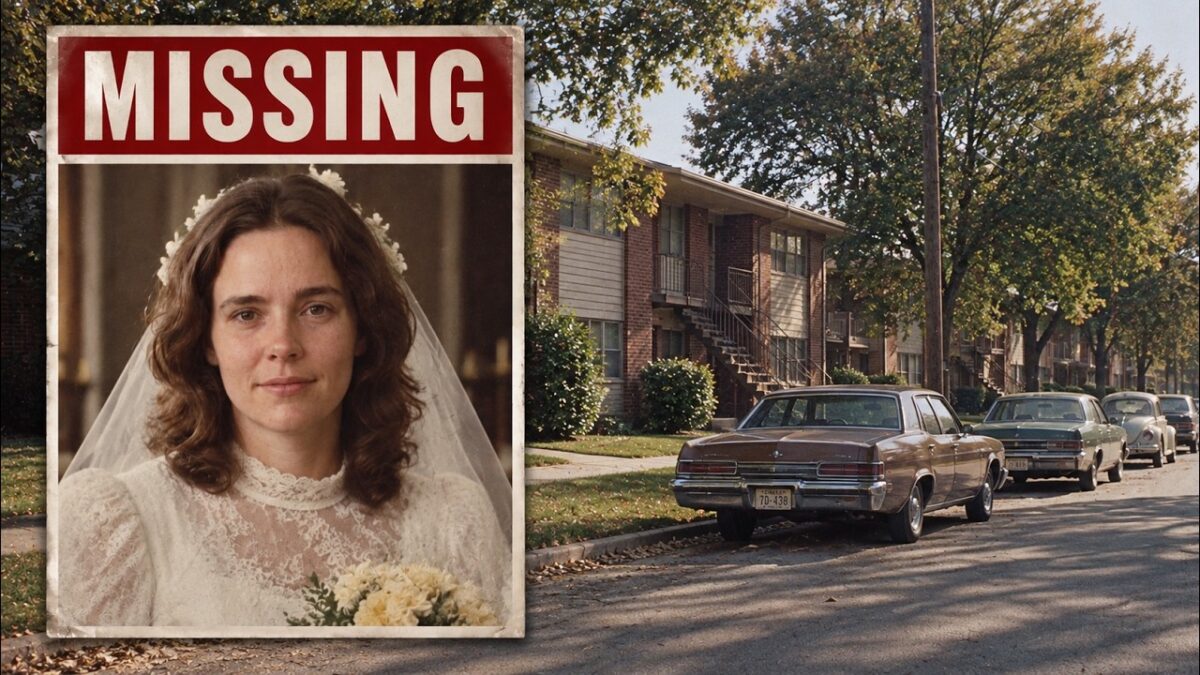
The photograph had been hidden for 21 years. Not in a safe, not behind a wall, not in some forgotten police evidence locker. It was sitting inside an ordinary family storage box, mixing with papers and photographs from a wedding that had taken place more than two decades earlier.
At first, Elise Warren’s brother thought it was just another picture. Elise in her wedding dress, Matthew standing beside her, family members gathered behind him, the church in the background. nothing unusual until he noticed a man at the edge of the frame.
The man wasn’t part of the wedding party. He wasn’t smiling and he wasn’t looking at the camera. He was holding another photograph, a white house.
Then Evan turned the wedding photograph over for numbers had been written on the back. 17 4 92. For 21 years, nobody had known what those numbers meant, and nobody had realized that the photograph had been connected to the reason Elise Warren disappeared on her wedding night in 1996.
By the time her family understood what they were looking at, the man in the photograph was dead. The groom had moved away, and Elise herself was gone forever. But the photograph had survived, and so had the question it was apparently meant to answer.
October 12th, 1996. Elise Warren was 27 years old when she married Matthew Hail. The ceremony took place on October 12th, 1996 at a small church outside a logging town in Northern Oregon.
It wasn’t a large wedding. There were fewer than 40 guests. Elise wore a simple white dress and carried yellow roses.
Matthew was 29. People who knew them described the couple as quiet and close. There was nothing about the wedding that suggested disaster.
No public argument, no obvious threat, no reason for anyone to believe that before midnight, Elise would be missing. But there was something Elise had been thinking about for years. Her father’s death.
Victor Warren had died in September 1992. The official explanation was an accident. For several years, Elise accepted that explanation.
Then she began looking through old records connected to her father’s work. Victor had been involved in the timber industry and shortly before his death, he had become interested in the dispute involving timber removed from a piece of land whose ownership was being contested. The property was located along a remote road called Alderlane.
Victor had visited the property on April 9th, 1992. The address was 17. 5 months later, Victor was dead.
There was never enough evidence to establish that the visit and his death were connected. But Elise became convinced that something about her father’s final months didn’t make sense. She started asking questions.
She searched through old property documents. She spoke to people who had known her father. And eventually one of the names connected to the older lane property came back to her.
Caleb Shaw. Caleb Shaw. Caleb was a younger brother of Victor Shaw, a man whose family had once been connected to the older lane property.
Caleb knew the area. He knew the people involved in the timber dispute. And he knew details about the property that were difficult for Elise to find in public records.
That didn’t make him a criminal. It didn’t even make him a suspect, but it meant Elise had a reason to speak with him. And sometime before her wedding, she did.
Nobody knew exactly what they discussed. The conversation wasn’t long.
There was no confrontation, no dramatic warning, no witness who could later say, “That’s when I knew something was wrong.
It was simply one more conversation in a case that wouldn’t become a case until later. That was the problem with the event surrounding Elise. Almost every important clue looked insignificant when it happened.
Only afterward did the pieces begin to fit together. The wedding night, the wedding went normally. Photographs were taken outside the church.
Guests said goodbye. Elise and Matthew eventually returned to their rented house. For a short time, everything appeared ordinary.
Then sometime after 10:30 that night, a neighbor saw Elise outside. She was still wearing her wedding dress. She appeared to be waiting for someone.
The neighbor assumed she was waiting for Matthew, but Matthew wasn’t outside.
Later that night, Elise was gone. Her purse was still inside. Her clothes were still there.
Her suitcase hadn’t been packed. She hadn’t taken the normal thing someone would need if they intended to leave for good. There was no note, no obvious sign of violence, no broken window, no blood, nothing that immediately explained what had happened.
Matthew reported her missing. Police were contacted. Elise’s family was notified.
Searches began around nearby roads, wooded areas, and places investigators thought she might have gone, but nothing was found. The first possibility was that Elise had left voluntarily. That explanation was difficult for her family to accept.
If she had planned to disappear, why had she taken almost nothing? And if she hadn’t planned to leave, then who had she been waiting for outside the house? Those questions would remain unanswered for years. The questions about Victor. As investigators looked into Elise’s background, they discovered that she had recently been asking questions about her father.
That brought them back to Alderlane. The property was remote. A white house stood on the land, surrounded by trees.
Old records showed that Victor Warren had visited the property on April 9th, 1992. The visit itself wasn’t proof of anything. Victor had legitimate reasons to be in the area.
The timber dispute was real. The property records existed, but there was no evidence proving that Victor had been attacked there. There was no evidence that Elise had been involved in anything illegal, and there was no evidence directly tying Caleb Shaw to Victor’s death.
The investigation couldn’t turn suspicion into a case. Eventually, the trail went cold, but Elise had apparently believed there was still something worth finding, and that mattered because she disappeared only a few weeks after spending time with people connected to the same property. 21 years of nothing.
The years that followed produced very little. No body was found. No confirmed sighting of Elise emerged.
No credible explanation appeared. Matthew continued cooperating with investigators. He answered questions.
He participated in searches. He contacted people who might have known where Lee had gone, but eventually there was nothing more to search. The case became one of those disappearances that remained open without actively moving forward.
Matthew eventually left the area. He never remarried. He kept several photographs from the wedding.
One photograph remained framed, Elise smiling beside him. For a family, the photograph became a painful reminder of a life that had ended without an explanation. They had photographs of the ceremony, photographs of the guests, photographs of Elise and Matthew, but one photograph was missing.
Nobody knew that yet. 2017, 21 years after Elise disappeared, her brother Evan was clearing old family storage. The box contained documents that hadn’t been touched in years.
Old receipts, family papers, envelopes, photographs. Then Evan found a small photograph that wasn’t in the wedding album. He recognized a church immediately.
Elise was standing beside Matthew. Several relatives were behind them. Then he saw the man at the edge, Caleb Shaw.
Evan had heard the name before. He knew Caleb had some connection to the Alder Lane property. But what caught his attention wasn’t Caleb’s face.
It was his hand. He was holding another photograph. Evan enlarged the image.
A white house. The same house that appeared in the older lane property records. Then he turned the photograph over.
17 49 92. For the first time, the family had something concrete, but they didn’t immediately know how to read it. The number 17 seemed familiar.
Evan went back through the property records. There it was. 17 Odelain.
That explained the first number. The other three were harder. Then Evan returned to Victor Warren’s old documents.
One date appeared repeatedly. April 9th, 1992. The day Victor had visited the Alder Lane property.
The four numbers suddenly formed a single reference. 17. Alderlane.
April 9th, 1992. It was the address and it was a date. The photograph had connected Elise’s wedding directly to the investigation surrounding her father.
But that created a much bigger question. Why had Caleb Shaw been holding a photograph of that house at Elise’s wedding? And why was Elise looking at it? a photograph within a photograph. The family stuttered the image again.
Caleb wasn’t looking at the camera. He wasn’t looking at Matthew. He was looking toward Elise.
And Elise wasn’t looking at Caleb. She was looking at the photograph in his hand. That detail changed the way the family understood the picture.
It didn’t look like Caleb had accidentally been caught holding some unrelated photograph. He appeared to be showing Elise something, something she recognized, but that still didn’t prove what it was. The family considered the possibility that Caleb had been involved in her disappearance.
It was an obvious theory. He knew all the lane. He knew about the timber dispute.
He had spoken privately with the lease before the wedding. He had appeared at the church without being listed as a formal guest, and he left the area afterward. But when the family checked his history, the theory became less certain.
Caleb had moved for work. There was no evidence placing him at Alisa’s house that night, no evidence that he had forced her to leave, and no evidence directly connecting him to Victor Warren’s death. The photograph made him suspicious, but it didn’t make him guilty.
The detail Matthew remembered. There was one person who might have known more. Matthew.
By 2017, Matthew had spent decades avoiding public discussion of Elise. When Evan contacted him, he initially didn’t want to talk. Then Evan described the hidden photograph.
That changed his mind. Matthew agreed to meet. At first he remembered the wedding in ordinary terms.
The church, the guests, the flowers, Alles’s dress. Then Evan asked him a different question. Had Elise behaved strangely that day? Matthew became quiet.
He remembered something he hadn’t understood in 1996. Before the ceremony, Elise had asked him whether he trusted her. He had laughed.
He thought she was nervous. Then she told him something that stayed with him for the next 21 years. If she left that night, he shouldn’t follow her.
Matthew had asked what she meant. Elise wouldn’t explain. He asked whether someone had threatened her.
She didn’t answer. She simply told him that there were things he didn’t know. At the time, Matthew thought she was talking about her father’s death.
He didn’t realize she might be preparing him for her own disappearance. Then she was gone. And Matthew did what he could.
He reported her missing. He cooperated with investigators. He participated in the search.
He contacted people she knew, but he did not personally go chasing after her, not because he didn’t want to find her. Because he remembered what she had asked him to do. Don’t follow me.
For Matthew, that wasn’t an easy instruction to obey. He had married Elise that afternoon. By nightfall, she was missing.
Every instinct told him to search for himself. But he had to consider the possibility that Elise had left for a reason. And if that reason involves someone watching her, a public search by the person closest to her might make things worse.
So he waited and he never learned whether that decision had saved Elise. The photograph she wanted kept. Matthew then remembered another detail before the wedding photographs were placed into albums.
Elise had asked him to keep the pictures taken outside the church. She said they might matter later. He had assumed she meant sentimental photographs.
He hadn’t questioned it. Most of the photographs went into the family album. One didn’t.
The photograph Evan found in 2017. The photograph showing Caleb. The photograph showing the White House.
The photograph carrying the four numbers. Now, Matthew understood why Lee had singled out those pictures. She hadn’t been asking him to preserve a memory.
She had been asking him not to lose a clue. But there was still no explanation for what happened after she left. And there was still no proof that Caleb had helped her until something else surfaced.
the box. Caleb Shaw had died in March 2017. That fact had initially seemed like the end of the trail.
The family couldn’t question him. Whatever he knew had gone with him, but after his death, his daughter began sorting through his belongings. She didn’t find anything immediately connected to Elise.
Then, months later, she found a locked wooden box. Inside were old timber documents, several photographs, and an envelope. The envelope contained a letter.
The date on it was October 13th, 1996, the morning after Elise Warren disappeared. The letter was written by Caleb. And for the first time, the family had something written by the man who had appeared in the wedding photograph.
But the letter wasn’t a confession. It didn’t say Caleb had killed anyone. It didn’t name Victor Warren’s killer.
It didn’t provide a complete explanation of the Alder Lane dispute. Instead, it confirmed something the family had already begun to suspect. Elise had contacted Caleb before the wedding.
She believed her father’s death might be connected to what he had discovered at Aldain. She had found information that frightened her, and Caleb knew enough about the property to understand why, so he agreed to help her leave. What the White House meant, the photograph of the White House was part of that arrangement.
It wasn’t meant to explain the entire plan. It was simply a location Elise could recognize after leaving. She had been given the information before the wedding.
The photograph served as confirmation. If she reached the right place, she would know it. If she didn’t, she would know she had taken the wrong route.
Caleb deliberately kept the rest of the arrangement out of the letter. That was all the family could establish, but it was enough to answer one important question. The photograph hadn’t been a warning from Caleb, and it hadn’t been a random picture.
It had been something Elise needed. The woman in the wedding photograph wasn’t looking at a stranger’s house. She was looking at information that had already become part of her plan.
What the letter couldn’t prove. The discovery solved one part of the mystery. It created another.
If Elise had planned to leave, then the disappearance wasn’t entirely spontaneous. But what exactly had frightened her? Caleb’s letter gave only part of the answer. Victor had discovered information connected to timber being removed from disputed land.
Elise believed his death might have been connected to that discovery. Caleb had shared some of what he knew, but he never identified a killer. He never claimed to know exactly what happened to Victor, and he never provided enough evidence to turn suspicion into certainty.
That distinction mattered. The letter explained why Elise was afraid. It didn’t solve the death of her father.
That mystery remained where it had been for decades, in fragments, in incomplete records, in questions nobody could answer. The last piece of Alzi’s story. The letter did confirm one thing.
and the family had spent 21 years hoping to learn. Elise had survived. She had asked Caleb not to tell her family where she was.
Matthew’s memory suddenly made sense. He had reported her disappearance. He had allowed the official search to continue, but he had not personally followed her.
He had respected the one request she had made before leaving. Years passed. Matthew died in 2009.
Elise died in 2017. They never saw each other again. And when the family finally learned what had happened, the people who could have explained the most were already gone.
Caleb was dead, Matthew was dead, Elise was dead. What remained with documents, photographs, and a letter written the morning after a bride disappeared. The hidden photograph.
For 21 years, the Warren family had looked at photograph from Elise’s wedding. They had remembered the dress, the flowers, the church, Matthew standing beside her. They had remembered the people behind them, but they had missed a man standing almost outside the frame.
They had missed a photograph in his hand, and they had missed the four numbers written on the back. 17 Oldane, April 9th, 1992. A property, a date, a connection to the investigation Elise had been carrying with her into her marriage.
The photograph didn’t reveal exactly what happened to Victor Warren. It didn’t reveal every person who may have known more than they admitted, and it didn’t show where Elise ultimately spent the years that followed, but it revealed something else. The wedding wasn’t the moment Elise decided to disappear.
By the time that photograph was taken, the decision had already been made. The family had spent 21 years believing they were looking at a photograph of a bride on the happiest day of her life. In reality, they had been looking at a moment just before everything changed.
And they had been looking at it without knowing what they were seeing. It was a photograph of the moment she had already decided








