A Black Girl Dug for Water as Her Crops Died—Then Her Shovel Hit Something That Changed Everything
“Nineteen years old, and you think you can run this place? Your grandmother was a farmer. You’re just a girl playing dress-up.”
“I’m not selling.”
“This is my offer. Take some time and think about it. $210,000. Take it. Go back to school. This land will be mine either way.”
Grant Holloway walked away from that meeting certain he had already won.
He had done this before: waited out struggling farmers, watched the drought do his work for him, then arrived with a number just large enough to feel like mercy. To him, Amara Reed was no different. A 19-year-old with no capital, no experience, and a dying farm she had inherited from a woman who was no longer there to protect her.
What he didn’t account for was the envelope she never opened. Not because she couldn’t use the money, but because she had spent three days walking that land and noticed something Grant, with all his 6,000 acres, had stopped paying attention to: a narrow strip of grass that refused to die.
What was Amara already looking for? And what had she already decided before Grant ever walked through that door?
Grant Holloway left that morning the same way he always did: unhurried, confident, already thinking about something else. The envelope stayed on the kitchen table where he had set it.
Amara didn’t touch it. She stood at the window and watched his truck disappear down the dirt road. And when the dust finally settled, she turned around and looked at the farm her grandmother had left her.
Thirty-eight acres of crops were dying. The reservoir sat at less than a quarter of its capacity. The well that fed the irrigation lines had slowed to something barely above a trickle. And the bank had called twice that week, both times leaving messages she hadn’t returned.
By every visible measure, Grant was right. The land was failing, and she was 19 years old, and there was no obvious reason anyone should believe she could stop it.
But Evelyn Reed had not raised a girl who made decisions based on what was visible.
Amara had spent her entire childhood walking this land at her grandmother’s side. Not as a passenger, but as a student. Evelyn would stop without warning, crouch down, press two fingers into the soil, and ask what Amara noticed. Not what she saw. What she noticed.
The difference mattered. Seeing was passive. Noticing required you to pay attention to what didn’t fit, to what seemed wrong, to the small things that broke the pattern everyone else had accepted as normal.
By the time Amara was 12, she could read a field the way other kids read a book. By the time she left for her first year at the community college to study agriculture, she had already absorbed more practical knowledge than most people accumulate in a career.
Then Evelyn died, quietly, in her sleep, in the middle of Amara’s first year away. And everything changed.
Amara came home to a farm in the middle of a drought that the local news was already calling historic. The timing was brutal. The land she had grown up on was showing signs of stress she had never seen before. And the people in town who might have offered guidance were instead offering something else: sympathy that felt uncomfortably close to resignation, and advice that always seemed to end in the same direction.
Sell before it gets worse. Take the money while someone’s still offering it. You’re young. Start over somewhere else.
Even the loan officer at the bank, a man named Gerald, who had known her grandmother for decades, had suggested, gently but clearly, that a single operator her age might not be able to sustain the carrying costs through an extended dry season.
She was not called a farmer. She was called “Evelyn’s granddaughter.” And there was a difference in the way people said it: a softness in the voice that was not kindness so much as lowered expectation.
Amara started walking the property every morning, before the heat set in. It was partly practical, and partly something she couldn’t fully explain: a need to stay connected to the land even as it struggled, to keep looking even when there was nothing obvious to find.
She checked the soil at the field edges. She tracked which rows were losing moisture fastest. She watched where the cattle drifted when they weren’t being directed anywhere. Evelyn had told her once that animals don’t overthink. They go where the land tells them to go. And if you pay attention, you can follow the same logic.
It was on the ninth morning that she noticed the grass.
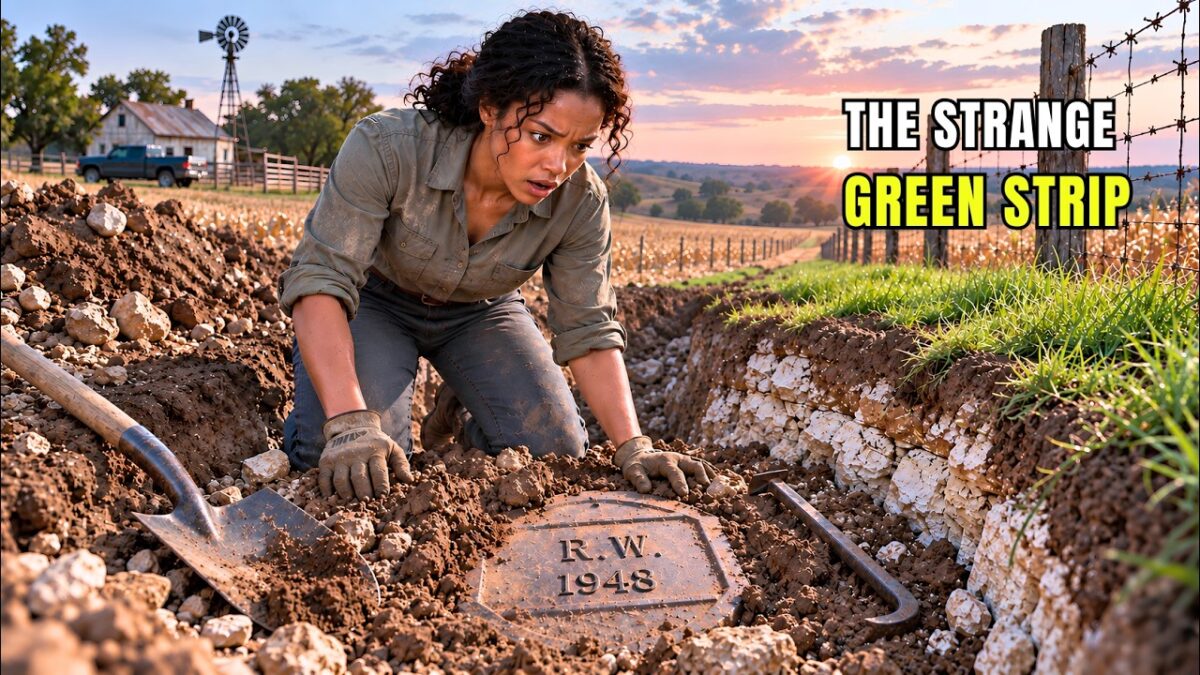
A narrow strip, maybe four feet wide, running diagonally across the eastern edge of the property, near the old fence line. Everything around it was yellow and brittle. But this strip was green. Not thriving green, but still holding color and texture while the rest of the field had given up.
Amara crouched down and pressed her fingers into the soil, the way her grandmother had taught her. The surface was dry. But below the surface (further down than made any sense, given the conditions) there was moisture. Real moisture. Not residual dampness, but something that felt active, like the ground below was still connected to something alive.
She didn’t tell anyone.
She went back the next morning and walked the strip again, this time more carefully, tracing where the green began and where it faded. It didn’t follow the irrigation lines. It didn’t follow the natural slope of the land, in the direction water would drain. It ran at a slight angle that didn’t correspond to anything in the surface geography. Which meant whatever was feeding it was coming from below, not above.
She brought a shovel.
The first day, she went down about two feet and found nothing but clay and rock. The second day, she extended the trench and hit a layer of limestone. Her hands were blistered by the afternoon, but she kept going, working slowly, following the line of moisture she could feel in the soil around the edges of the hole.
The third day, she came back before sunrise. She had told no one what she was doing, and the few neighbors who spotted her from a distance apparently reported back to Grant, because he made a comment at the feed store that reached her by the end of the day. Something about a girl too proud to cash a check, digging holes in a dead field.
She kept digging.
On the afternoon of the third day, her shovel hit something that wasn’t rock. The sound was unmistakable: a flat, dense clang of metal against metal.
She dropped to her knees and cleared the soil with her hands. What she uncovered was a cast-iron cover, large and heavy, stamped with the letters RW and the year 1948.
She looked at it for a long moment. Then she looked around. No one in sight.
She got the pry bar from the truck and worked the cover loose. Below it was a stone-and-concrete collection chamber, old but structurally intact, built with the kind of deliberate craftsmanship that suggested someone had put serious thought into this long before she was born.
And at the bottom of the chamber, rising steadily through a fracture in the limestone base, was water.
Not much at first. A modest upwelling, slow and quiet, but continuous.
Amara climbed down into the chamber, stood in it, and watched the water come in.
She called Dr. Malcolm Pierce the same evening.
Malcolm had taught a hydrogeology seminar during her first year at the college, and she had stayed after class twice to ask questions that clearly surprised him. He was the only person she trusted with what she had found, and the only person she believed could tell her what it actually meant. She made him promise not to mention it to anyone before she told him where she was and what she needed him to bring.
Malcolm arrived two days later, with testing equipment and a careful expression that shifted into something closer to disbelief within the first hour.
They cleaned the intake, removed decades of sediment from the collection channel, and ran a flow measurement. Fifty gallons per minute.
Then they cleared more of the outlet channel, and the number climbed. One hundred ten.
They worked through the afternoon and into early evening. And when Malcolm read the final figure off his meter, he checked it twice before he said it out loud.
Four hundred twenty gallons per minute.
Malcolm said it was one of the most significant private spring sources he had encountered in thirty years of fieldwork. The fracture system feeding it appeared to extend well beyond the Reed property, which meant the subsurface geology of the entire area might be more water-rich than anyone had assessed. He wanted to write it up. He wanted to contact the county water authority. He started listing the institutions that would want to know.
Amara told him no.
She told him clearly, without apology, and with enough certainty in her voice that he stopped mid-sentence. No reports. No calls. No one else. Not yet.
Malcolm looked at her for a moment, with an expression somewhere between admiration and concern. And then he nodded.
That night, Amara sat at the kitchen table, where Grant’s envelope was still sitting, and thought about what she had found.
She could announce it. She could call the bank, tell them the land had a water source, and watch the loan conversation change in real time. She could tell the neighbors. She could do all of those things, and by morning, everyone in the area would know that the Reed farm wasn’t dying after all.
But if they knew, they would also start asking questions about the land around it.
She pulled out the topographic map she had been studying since she came home. Then she laid Malcolm’s preliminary sketches of the fracture system next to it.
She had already been doing this intuitively: reading the slope, the vegetation patterns, the soil color variations across the surrounding properties. Now, with the subsurface data Malcolm had begun compiling, the picture became much clearer.
The limestone formation didn’t stop at her property line. It ran beneath a substantial portion of the surrounding area, including parcels that had been sitting idle or semi-abandoned for the better part of a year, their owners worn down by the drought, their assessed values dropping with every dry week.
Amara looked at Grant’s envelope. $210,000 for 64 acres that sat directly above what might be one of the most significant water sources in the region.
She put the envelope in the drawer and didn’t open it.
The next morning, she began making calls of a different kind. Not to banks. Not to water authorities.
She started calling neighbors: the ones who owned the parcels adjacent to hers, the ones she had seen at the feed store looking tired, the ones she knew were behind on property taxes or carrying loans they had originally taken out expecting a normal season.
She didn’t lead with anything dramatic. She just asked if they had ever considered selling, and if so, whether they’d be willing to sit down and talk about what that might look like.
Most of them said yes, because most of them had been waiting for someone to ask.
The first conversation was with a man named Dale Whitfield, who owned 82 acres directly east of the Reed property. Dale was in his mid-60s, had been farming that land for thirty years, and had spent the last fourteen months watching it turn the color of sand. He met Amara at his kitchen table, with the expression of someone who had already made peace with a decision he didn’t want to make.
She didn’t push. She asked questions, listened more than she spoke, and by the end of the conversation, she had proposed something he hadn’t expected. Not a purchase, but an option agreement.
She would pay him a modest sum up front for the right to buy the land within twelve months, at a price they agreed on that day. Dale got immediate cash without having to commit to leaving. Amara got time. And, more importantly, she got a locked price before anyone else understood what that land might be worth.
Dale signed within the week. The agreed price was $118,000 for 82 acres that had been appraised at nearly double that figure two years earlier.
She moved to the next parcel. Then the next.
A woman named Carol Voss owned 104 acres to the north, most of it unplanted that season. A retired couple named the Hendersons held 67 acres along the western edge that they hadn’t actively farmed in three years and were quietly desperate to stop paying taxes on.
A fourth parcel, 139 acres belonging to a man named Roy Samson, sat directly over what Malcolm’s preliminary mapping suggested was the deepest and most productive section of the limestone formation. Roy had received two offers from Grant’s company in the past year and turned both down, out of stubbornness more than strategy. When Amara knocked on his door, he looked at her for a long moment, then said he was glad it wasn’t Holloway again. And that was enough to get them to the table.
Within less than two months, Amara had secured option agreements on 487 acres of surrounding land. The total locked purchase price across all five parcels came to just under $640,000.
Every seller believed they were unloading dead weight at a fair price in a terrible market. None of them had any reason to think otherwise.
Grant Holloway, who by this point had largely written off the Reed farm as a problem that would resolve itself through financial pressure, didn’t notice what was happening at the neighbor level. To him, a 19-year-old without capital or credit history couldn’t possibly be assembling anything that mattered.
That assumption was the first serious mistake he made. Though not yet the last.
Back on the Reed property, Amara had already begun the careful work of bringing the spring source into functional use.
She ran underground pipe from the collection chamber to the main irrigation trunk line, working at night and covering the trench by morning, so the surface looked undisturbed. She converted the irrigation system from overhead sprinklers to drip lines, which used a fraction of the water and delivered it directly to the root zone, where it mattered most.
The visible effect on the farm was gradual enough that it didn’t immediately attract attention: a slow recovery that could plausibly be explained by careful water management and the partial use of her remaining reservoir supply.
But the crops responded. The tomato rows that had been at the edge of total loss came back with unexpected vigor.
Amara made a decision that season to shift the farm’s production profile away from commodity crops and toward varieties that commanded significantly higher prices: specialty tomatoes, high-grade peppers, fresh herbs, and a selection of small-volume seed crops for which regional demand consistently outpaced supply. It required more labor per acre and more precise management. But it also meant that each acre she brought back into production returned far more revenue than the farm had ever generated under its previous model.
When the harvest came in, the numbers were not what anyone in town had predicted. The farm generated just under $870,000 in revenue that season.
A regional food distributor who had been watching the quality of her output reached out to propose a longer arrangement. And after two rounds of negotiation, Amara signed a supply contract worth $3.8 million over three years.
She took that contract to an agricultural lender and used it, alongside her land assets, as collateral for a loan that gave her the capital to begin exercising her land options.
She moved through them methodically. Dale Whitfield’s 82 acres first. Then Carol Voss’s parcel to the north. Then the Hendersons. Then Roy Samson’s 139 acres, which she prioritized because of its position over the deepest part of the limestone formation.
By the time she had worked through all the agreements, she controlled just over 550 acres. She had paid locked prices, negotiated during the worst period of the drought, using revenue and financing built on a water source that none of the sellers knew existed beneath their feet.
The land development came next. And this was where the full scope of what Amara had been building became visible, though only to her and Malcolm, who had by now completed a detailed subsurface survey that confirmed the formation was even more extensive than their initial estimates had suggested.
She brought in contractors for the infrastructure work, giving each one a partial scope that didn’t reveal the full picture.
Underground distribution lines went in first, extending the water network from the Reed property across the newly acquired parcels. Holding reservoirs were constructed at three points across the combined landholding. Drip irrigation infrastructure followed, acre by acre. And where the soil conditions and water access were strong enough to support it, Amara began putting in high-tunnel greenhouse structures that could extend the growing season and support the premium crops her distributor was already asking for more of.
The fields that had been yellow and abandoned began turning green. Not all at once. The development moved in phases, and Amara was careful to expand at a pace that her financing could support without overextension.
But the transformation was visible enough that people started asking questions. Neighbors who had sold her options drove past and noticed that the land they had walked away from was suddenly productive again. People in town started talking about it.
By the end of the second full year of operation, Reed Farms had grown to more than 780 acres under active management and generated $4.6 million in revenue.
The year after that, the number nearly doubled: $9.8 million.
The farm had a processing facility, a cold-storage operation, a small fleet of refrigerated transport vehicles, and supply relationships with distributors, restaurant groups, and a regional grocery chain that was in serious discussions about a long-term exclusive arrangement.
At the county agricultural association’s annual meeting that year, Amara was invited to present. She stood at the front of a room that included most of the people who had watched her inherit a failing farm three years earlier and counseled her to walk away from it.
She talked about soil management, and water efficiency, and the economics of specialty crop production. She kept it practical and specific, the way her grandmother had always kept things: focused on what the land could tell you, if you were willing to pay attention to it.
Grant Holloway sat near the back of the room. He watched the presentation without expression and left before the reception.
It was three weeks later, while finalizing paperwork for a 116-acre parcel that sat between her original property and the parcels she had acquired to the east, that the attorney handling the title search flagged something unusual in the ownership chain.
A document from the early 1950s: an easement that had been recorded and then apparently overlooked in every subsequent transaction involving land in that corridor. The attorney read it to her over the phone, in a tone that suggested he wasn’t sure what to make of it.
Reed Spring Collection Corridor.
Amara sat very still.
She told him to pull every document connected to that easement and to the original spring designation, going back as far as the records went.
Then she called Helen Brooks, a woman she had met at the county offices while pulling land records earlier in the year. Helen was semi-retired, but still consulted on historical property research, and she had a reputation for finding things in the county archive that other researchers consistently missed. Amara asked if she was available for a project. Helen said she had some time.
They met at the county records office the following morning. And what they found over the next several days rewrote everything Amara thought she understood about the land she had been living on her entire life.
The spring she had uncovered was not an accidental discovery. It had a recorded history going back to 1948, when her great-grandfather, Robert Wesley Reed, had constructed the collection system and documented the source as a permanent flow.
The maps from 1951 showed it clearly labeled, measured, and assessed as a long-term water asset. It had appeared in county agricultural water surveys through the mid-1960s. And then, without explanation, it vanished from every document that came after.
No record of the source going dry. No permit for closure. No notation of any kind explaining why a documented permanent water source had simply ceased to appear in any official survey for the next four decades.
Helen found the explanation on a Tuesday afternoon, buried in a folder of contractor invoices that had been misfiled under a general infrastructure category.
A billing record from 2004: Services rendered for the sealing of an abandoned spring access point and the restoration of surface grade at the Reed property boundary.
The payment had come from Holloway Agricultural Holdings.
Amara read the invoice twice. Then she set it down on the table and looked at the wall for a long moment. Helen watched her and didn’t speak, understanding instinctively that this was not a moment that needed commentary.
The document was not complicated, but its meaning was precise and devastating. Grant Holloway’s company had paid to seal the access point to a spring that sat on Reed family land, without any recorded permission from the property owner, and without filing any of the permits that such work would legally require.
The spring had then disappeared from every subsequent survey of the area. Not because it had dried up, but because the only visible access to it had been deliberately buried.
Helen pulled additional records over the following two days. What emerged was a timeline that Amara had to sit with carefully.
In 2001, Holloway Agricultural Holdings had commissioned a private hydrogeological assessment of the Eastern Valley corridor. That assessment (which Helen located through a public records request to a state environmental office that had received a courtesy copy) identified the Reed property as sitting above a significant fractured limestone aquifer, with estimated flow capacity well in excess of what any single farming operation would require.
In 2002, Grant’s company made its first offer to purchase the Reed farm. Evelyn turned it down. A second offer came in 2003. A third followed within six months. A fourth, in early 2004. All four declined.
And then, later that same year, the contractor invoice.
Grant had known about the aquifer for more than two decades. He had tried four times to acquire the land above it. When those attempts failed, he had paid to bury the only surface evidence of what the land contained. He had calculated that if the spring was invisible, the land’s true value would stay invisible with it, and that eventually, through drought, or debt, or simple exhaustion, the Reed family would sell at a price that reflected what the land appeared to be worth, rather than what it actually was.
What he had not anticipated was Evelyn Reed refusing to sell for the rest of her life.
And he had not anticipated Amara.
The legal challenge arrived on a Thursday morning, delivered by a process server to the Reed Farms office.
Grant’s attorneys had filed a complaint with the county water authority, alleging that Amara’s operation was extracting groundwater from a shared aquifer system without appropriate permits, and in quantities that constituted an unreasonable interference with adjacent water rights. The filing requested an immediate temporary restriction on her expanded irrigation operations, pending a full review.
The county issued the temporary order within 48 hours.
The timing was surgical. Amara had just broken ground on a new greenhouse complex, representing an investment of $7.5 million, with construction crews already on site. A grocery chain she had been negotiating with for eight months was weeks away from finalizing a supply contract valued at $12 million over four years.
The temporary restriction introduced enough legal uncertainty that the grocery chain’s legal team called and asked to defer the signing until the water rights question was resolved. The construction lenders on the greenhouse project called the same day, with similar concerns.
Grant gave a statement to the county agricultural reporter that ran the following morning. He said that one operator should not be permitted to control the water access of an entire region, and that the pattern of land acquisition surrounding the Reed operation raised serious questions about whether competitive advantage had been gained through the withholding of material information from sellers.
He used the word monopoly. He used it more than once.
The statement landed. People who had watched Amara’s rise with uncomplicated admiration started asking questions they hadn’t thought to ask before. Some of the farmers who had sold her option agreements began wondering aloud whether they had been fully informed. The atmosphere in town shifted, in a way that was difficult to quantify but impossible to miss.
Amara had a water rights attorney named Sandra Okafor, recommended by Malcolm, who had agreed to take the case given the strength of the underlying facts. Sandra was methodical and unflappable: the kind of attorney who communicated in precise, declarative sentences and never promised outcomes she couldn’t support with evidence.
She told Amara the legal position was strong, but that strong positions still required time, and that the next 60 to 90 days were going to be uncomfortable.
Grant’s final offer arrived on a Friday evening, hand-delivered to the farm office in a sealed envelope.
$18 million for the Reed Farms operation, in its entirety. The original property, all acquired parcels, all infrastructure, all supply contracts, all water rights claims.
The offer letter managed to sound almost generous, noting that the figure represented a significant premium over assessed value, and that acceptance would allow Amara to move forward without the burden of protracted litigation.
She took the envelope to the kitchen of the main house: the same kitchen where his first envelope had sat unopened on the table four years earlier. She set it down, made coffee, and sat with it for a long time.
$18 million was a number that had no natural reference point in her life. She could sign it and walk away, and no one could reasonably say she had lost.
She was still sitting there when she noticed the toolbox.
Her grandmother’s toolbox: blue metal, worn at the corners, sitting on the shelf near the back door, where it had always sat. Amara had moved it there when she converted the equipment barn into an office space. Not because she needed it in the kitchen, but because she hadn’t been able to put it in storage.
She lifted it down from the shelf. She had opened it dozens of times since coming home. She knew every tool in it. But she had never noticed that the base sat slightly higher than the interior depth suggested it should.
She ran her thumb along the inner edge of the bottom panel and felt a seam. It took her ten minutes and a thin flathead screwdriver to work it loose.
Inside the false bottom was a small collection of items, placed there with great care. A key. A folded set of bank documents. A hand-drawn map of the Eastern Valley corridor, showing the limestone formation in detail Amara hadn’t seen in any public record. And a letter, written in her grandmother’s handwriting, on three pages of plain white paper.
The bank documents corresponded to a safe-deposit box at the county branch where Evelyn had kept her accounts for forty years. Amara went the next morning.
The box contained a bound hydrogeological report, commissioned privately in the late 1990s by a retired state geologist named Dr. Arthur Webb, who had done the work as a personal favor to Evelyn after she became suspicious of the interest Grant’s company was showing in her land.
The report confirmed everything Malcolm had mapped: the fractured limestone formation, the primary recharge zones, the estimated flow capacity, the geographic extent of the system across the surrounding parcels. It also contained a section titled Additional Observations, in which Dr. Webb noted that whoever controlled the primary access point on the Reed property effectively controlled the water availability of several hundred surrounding acres.
Evelyn had understood exactly what she was sitting on. And she had spent years making sure that when the right moment came, the right person would be standing on it.
The letter made that clear.
Evelyn wrote that she had spent years watching Grant acquire land across the valley, and that she had understood early on that his interest in her property was not about the farming. She had hired an attorney to research the easement history. She had kept her own research private. She had added a conservation notation to the spring corridor documentation, through a process Grant’s team had apparently never discovered. And she had structured her estate documents so the farm passed directly to Amara, without the intermediate probate process that might have created a window for a legal challenge.
She had chosen Amara specifically. Not as an afterthought. The letter was clear about this.
Evelyn wrote that she had watched many people look at this land over the years and see what it appeared to be. She had watched Amara, from the time she was a small girl, look at the same land and ask what it actually was. She wrote that she had seen Amara stop at the green strip along the eastern fence line and crouch down to feel the soil when she was eight years old, before anyone had told her there was anything there worth noticing.
The letter ended simply. Evelyn wrote that whatever Grant Holloway or anyone else said about Amara’s age, or her experience, or her right to be standing on that land, he had known about the water for twenty years and had spent twenty years trying to get it away from the Reed family. And he had failed, because Evelyn had made sure that the person who came after her would be harder to fool than he expected.
Amara folded the letter and put it in her jacket pocket.
The hearing was held in the county administrative building on a Wednesday morning.
Sandra Okafor presented the evidence methodically.
The 1951 survey documentation, establishing the historical water right.
The Webb report, confirming the aquifer configuration and the Reed property’s position within it. Malcolm had reviewed and verified the technical findings, and Sandra submitted his supporting affidavit alongside the original report.
The contractor invoice, showing that Holloway Agricultural Holdings had paid to seal the access point without permit or owner consent.
The four purchase offers, establishing that Grant had known the land’s value and had attempted to acquire it through negotiation before resorting to other methods.
And finally, the conservation easement notation that Evelyn had quietly filed, which established a recorded legal interest in the spring corridor that no subsequent transaction had properly addressed.
Helen Brooks attended the hearing as a records witness. She sat in the second row with a folder of the documents she had located, available if Sandra needed to trace any chain-of-custody questions during testimony. She had refused payment for her research work, saying only that the county’s land records existed to be found, and that it had been a long time since anyone had come in asking questions worth answering.
Grant’s legal team had prepared for a water rights dispute. They had not prepared for a suppression case.
The contractor invoice changed the nature of the proceeding in a way their filings had not anticipated. By mid-morning, it was clear that the theoretical argument about shared aquifer access was secondary to the documented fact that a party to the dispute had paid to physically alter access to a water source on land they did not own, without authorization, and had then proceeded to acquire surrounding properties while the affected landowner and her successors remained unaware of what had been done.
The hearing officer took two days to issue findings.
The temporary restriction on Reed Farms operations was lifted. The water rights associated with the primary spring access were confirmed as belonging to the Reed property, under the historical easement documentation. A referral was made to the county district attorney’s office regarding the 2004 sealing work and the circumstances surrounding it.
Grant did not make a public statement after the hearing.
The grocery chain signed the supply contract for $12 million over four years the following week. Construction on the greenhouse complex resumed immediately, and the crews made up most of the lost time within a month.
Outside the administrative building on the morning the findings were issued, Sandra shook Amara’s hand and said the outcome was as clean as the evidence had warranted.
Malcolm, who had driven down for the hearing, stood nearby and said nothing for a moment. Then he told Amara that when she had called him to that field and made him promise not to tell anyone, he had wondered if she fully understood what she had found. He said he was glad she had understood it better than he had.
Amara thanked them both and drove back to the farm.
Five years after the morning Grant Holloway left his envelope on her kitchen table, a group of agricultural students from the state university came to Reed Farms on a field visit arranged through their department.
There were fourteen of them, mostly in their early 20s, carrying notebooks and wearing the slightly self-conscious expressions of people trying to look more comfortable in a working environment than they actually were. Their professor, Dr. Claire Hensley, had been trying to arrange the visit for two years.
Amara met them at the main gate and walked them through the operation herself.
They moved through the processing facility first, where the sorting and packing lines were running at full capacity for the morning’s harvest. Then through the cold-storage building, where the temperature-controlled bays held produce destined for distribution across four states. Then out into the fields, where the drip lines ran in long, parallel rows beneath crops that had no business being this healthy in a valley still technically in its fourth consecutive year of below-average rainfall.
The students asked good questions, and Amara answered each one directly, without the performed modesty she had noticed some successful operators used when they talked about what they had built.
The numbers were not a secret anymore. Reed Farms covered 1,480 acres. The greenhouse complex now ran across 40 acres of climate-controlled growing space. Annual revenue had reached $24.7 million in the most recent fiscal year. The total assessed value of the operation had been independently estimated at just over $58 million.
Grant Holloway had offered her $210,000 to walk away from it.
Near the end of the morning, a student named Theo looked out at the expansive fields running toward the eastern property line and asked how she had known, in the beginning, that the surrounding land would become worth acquiring.
Amara led the group to the old equipment shed on the original Reed property. Inside, on the far wall, she had mounted the cast-iron cover she had pulled from the ground on the third day of digging: the heavy disc stamped with the initials RW and the year 1948. Below it, on a piece of plain wood, a single line of text:
Pay attention.
A young woman near the back of the group asked if finding the water was what had made the difference.
Amara considered that for a moment before she answered.
The water had been there in 1948, when her great-grandfather built the collection system. It had been there when Grant’s company commissioned their private assessment in 2001. It had been there when a contractor sealed the access point three years later. It had been there through every year the land sat undervalued, and the people who owned it were told, in various ways and with various degrees of politeness, that they were holding something that wasn’t worth very much.
The water had been there the entire time. What changed was not the water. What changed was that someone finally looked at a strip of green grass in a yellow field and decided that the explanation for it mattered.
Amara told them that the most expensive mistake a person could make, in farming or in anything else, was to accept what something appeared to be worth without asking why it appeared that way. Markets made that mistake. Lenders made it. People who had been looking at the same landscape for so long that they had stopped actually seeing it made it most of all.
The land around her had been called dead and worthless for the better part of a decade. And that description had been repeated so many times, by people with enough authority to make it feel like fact, that almost everyone had eventually accepted it.
Almost.
Before the students left, Amara showed them something else, something she had funded with a portion of what she had built. She took them to the east edge of the property and pointed toward the north, where a series of holding reservoirs sat above a shared distribution line she had constructed for small family farming operations in the valley.
The Reed Water Reserve had supported eleven farms through drought stress in its first two years. A technical assistance program she had funded gave young operators access to irrigation-efficiency consulting and soil-monitoring support, with priority given to applicants who were trying to hold on to land that larger operators had expressed interest in acquiring.
She knew what it felt like to have someone stand across a table and tell you, in polished and reasonable-sounding language, that the thing you were trying to protect wasn’t worth the effort. She had decided early on that if she ever had resources to direct, some of them were going to go toward making sure other people in that position had more options than she had been given.
On the drive back to campus, Theo sent a message to his classmates, saying the Reed Farms visit had been the most useful three hours of his agricultural education so far, and that whatever they ended up doing after graduation, they should probably spend some time thinking about what they kept walking past without noticing.
Back at the farm, after the university van had disappeared down the county road, Amara walked back through the equipment shed alone. She stood in front of the cast-iron cover for a moment.
Robert Wesley Reed had put that cover in the ground in 1948, with no way of knowing it would stay buried until his great-granddaughter dug it up more than seven decades later. He had built the collection system carefully, documented it properly, and trusted that the land would hold its value, whether or not anyone around him understood what that value was.
She had inherited that trust, along with the farm.
Outside, the afternoon light was moving across the fields the way it did in early autumn: low and amber, catching the tops of the crop rows and making the whole expanse look, briefly, like something out of a painting.
The refrigerated trucks were loading at the dock. The greenhouse fans were cycling. Somewhere on the north parcel, a crew was finishing the installation of a new sensor network that would feed soil and moisture data to the farm management system in real time.
The green was everywhere now, as far as she could see in any direction. The land that had been written off was producing. The land that had been called worthless was worth more than the people who had called it worthless could have comfortably imagined.
And the woman who had been told she was too young, too inexperienced, and too naive to hold on to any of it was the one who had known, from the moment she pressed two fingers into the soil beside a strip of grass that refused to die, that the right question was never what something appeared to be.
The right question was always what it actually was.
She went inside as the light faded, and the farm kept running behind her: quiet, and steady, and rooted in ground that had never been as empty as anyone had claimed.








