She Was America’s Rising Badminton Star — Her Agent Controlled Every Dollar, Then Her Life
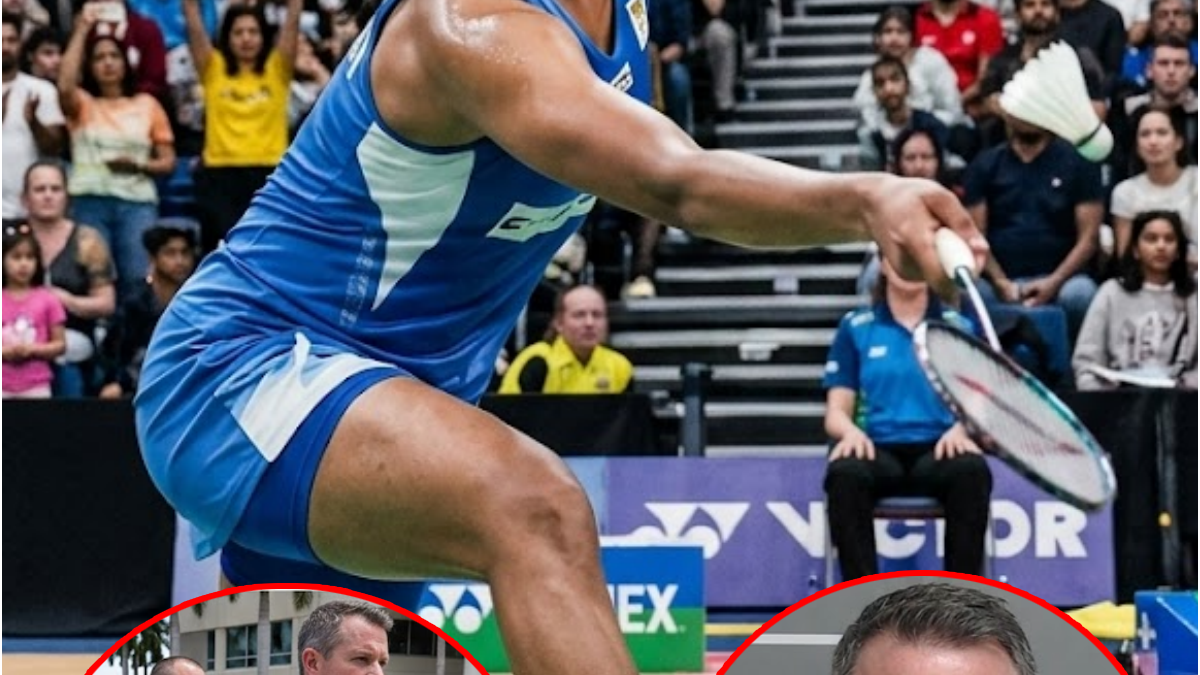
There is a particular arrangement in professional sports that rarely gets examined until something has already gone wrong inside it: an athlete’s entire financial life, prize money, endorsement income, appearance fees, routed through a single manager who also happens to be the person whose sponsorship keeps that athlete legally in the country at all. Nobody designs it to be dangerous. It simply concentrates, in one person, two forms of power that were never meant to sit together — control over where the money goes, and control over whether the athlete gets to stay.
This is a story about a twenty-four-year-old badminton player who built that arrangement with a man she trusted for four years, began, quietly, to stop trusting him, and did not live long enough to finish acting on it.
Ananya Deshpande was born in Pune, Maharashtra, in 2000, the daughter of two mechanical engineers who had met playing badminton themselves, recreationally, at a company sports club, and who enrolled their daughter in formal coaching at age six less out of any grand ambition than because it was the one activity that reliably tired her out before bedtime. The ambition arrived later, on its own, once it became clear by age eleven that she was winning district tournaments against girls three years older, and by fourteen that a national academy coach had flagged her as a serious prospect.
She trained through her teenage years at the Pullela Gopichand Badminton Academy in Hyderabad, boarding away from home for months at a stretch, building a junior international record strong enough that by nineteen she had turned professional and begun competing on the lower tiers of the international circuit — the unglamorous, financially precarious part of a sport that looks, from television coverage of its top events, far more lucrative than it actually is for anyone outside the top twenty in the world. She shared hotel rooms with two or three other players to split costs, flew economy on redeye connections to save what a direct flight would have cost, and kept a running spreadsheet, from age nineteen onward, tracking every rupee of prize money against every expense, a habit her father had insisted on and that would later strike investigators, once they saw it, as strangely at odds with how completely she’d eventually hand that same tracking over to someone else.
In 2021, an American sports management agent named Brett Calloway approached her after a tournament in Bangkok. Calloway ran a boutique agency in Orlando representing a handful of racquet-sport athletes, mostly tennis players well past their competitive peak, and saw in Ananya, correctly, an opportunity — a genuinely talented young player, still building her ranking, who could be developed with better training access, better sponsorship exposure, and a US base offering far more year-round competition opportunities than she could easily access training out of India alone. He offered to sponsor a P-1 visa, the category for internationally recognized athletes, structure her US-based training and competition schedule, and manage all her commercial and prize income through his agency in exchange for a standard 20 percent commission, a figure he described, in their first meeting, as “well below market,” a claim her family’s lawyer had no independent way to verify at the time.
Ananya’s parents, after consulting that same sports lawyer friend in Mumbai, who reviewed the contract and found nothing alarming in its terms on paper, agreed. She landed in Orlando in August 2021, twenty-one years old, training at a private academy Calloway had arranged access to, competing on a circuit schedule he built for her, and receiving, from his agency, a monthly stipend drawn against her own earnings — prize money, a small sponsorship from an Indian sportswear brand, and appearance fees from exhibition matches — all of which flowed first into an agency-controlled account before any portion of it reached her directly.
For the first two years, this arrangement worked, or appeared to. Ananya’s ranking climbed steadily. She reached her first WTA-equivalent semifinal in early 2023, a career milestone that came with a modest but real prize purse, and Calloway secured her a second, larger sponsorship deal with an American sportswear company later that year. She called her parents twice a week, described Calloway, in those calls, as demanding but fair, and did not, through most of this period, examine closely how much of her own earnings she was actually seeing versus how much was being retained, reinvested, or explained away as covering training costs, travel, and the agency’s own operating expenses.
The questions started in late 2023, prompted by a conversation with another player on the circuit, a Danish athlete managed by a different, larger agency, who mentioned, in passing, the percentage of her own earnings she typically saw after commission and expenses — a figure noticeably higher than what Ananya had been receiving under an identical 20 percent commission structure. Ananya began, quietly, asking Calloway’s agency for a full accounting of her earnings and expenses going back to 2021, a request that was met, over several months, with partial statements, vague explanations about “reinvestment in her training infrastructure,” and increasingly long delays between her asking and anyone responding at all.
By March 2024, she had hired an independent accountant in Orlando, on her own, without telling Calloway, to review what documentation she’d been able to obtain. The accountant’s preliminary findings, delivered in a phone call Ananya recorded on her own phone — a habit her sister later said she’d picked up after the delays started, “just in case,” without either of them at the time understanding what the phrase might come to mean — identified roughly $187,000 in prize money and sponsorship income received by the agency on Ananya’s behalf between 2021 and 2023 that did not appear, in any form, in the statements she’d eventually been given, along with a pattern of transfers from the agency’s client trust account into two LLCs Calloway had formed and controlled personally, neither of which had any documented business relationship to Ananya’s career at all.
Ananya scheduled a meeting with Calloway for April 9th, 2024, to confront him with the accountant’s findings and to inform him, regardless of his response, that she intended to terminate the agency agreement and find new representation — a step that, under the terms of her P-1 sponsorship, would require an entirely new visa petition from any future sponsor, a process with no guarantee of a seamless transition and every possibility of a gap in status severe enough to interrupt her competitive season entirely. She discussed this risk with her parents by phone the night before, and her mother, in testimony given later, recalled her daughter saying, “I would rather go home for a year than keep pretending I don’t see this.”
She did not survive to have that meeting. Ananya Deshpande was found dead in her Orlando apartment on the morning of April 8th, 2024, the day before it was scheduled, by her training partner, who had come to pick her up for a scheduled practice session and found the front door unlocked.
The Orlando Police Department’s initial investigation treated the death, for its first several weeks, as a probable accident or a medical event — Ananya had no known health conditions, but a preliminary toxicology screen, run as a matter of routine, returned negative for anything obviously suspicious, and the scene showed no signs of forced entry or struggle. It was the medical examiner’s more detailed follow-up findings, returned in May, that reopened the case as a homicide: a specific injury pattern to the back of the skull, consistent with a fall staged to look accidental rather than one that had actually occurred the way the positioning of her body suggested it should have.
Detective Priya Nolan of the Orlando Police Department — no relation to the victim, a coincidence of surnames several early news reports mistakenly treated as significant — took over the reopened case in June 2024 and requested Ananya’s full financial and communication records as a matter of course, standard practice in any case involving a victim with an active professional dispute in progress. What the records turned up was the recorded accountant’s call, still sitting in Ananya’s phone backup, along with a partially drafted email to the Women’s Tennis-adjacent racquet sports players’ association — badminton’s international governing body maintaining a formal athlete grievance process — outlining the discrepancies and requesting a formal investigation into Calloway’s agency, a draft saved but never sent, time-stamped 11:52 p.m. on April 7th, roughly twelve hours before her death.
Cell tower data placed Calloway’s phone in Ananya’s apartment complex parking lot at 6:15 a.m. on April 8th, a detail he had not disclosed during his first, voluntary interview with detectives in May, in which he stated he had not seen her in the days immediately preceding her death. Financial records subpoenaed from the two LLCs confirmed the $187,000 discrepancy the independent accountant had identified, along with evidence that Calloway had, in the two weeks before Ananya’s death, begun quietly transferring the remaining balance of those accounts into a third entity registered in his wife’s name — a transfer detectives characterized in their affidavit as consistent with someone anticipating imminent exposure and moving to protect what remained of it before that exposure arrived.
Calloway was arrested on August 14th, 2024, and charged with first-degree murder and multiple counts of wire fraud and grand theft. His trial opened at the Ninth Judicial Circuit Court in Orange County in March 2025. He did not testify. His attorney argued the financial evidence established motive for fraud but not for murder, and that the parking lot sighting, unexplained as it was, did not by itself place him inside the apartment at the time of death, which the medical examiner’s own estimate placed within a two-hour window his own testimony could not fully account for either way. A defense expert challenged the skull injury analysis directly, arguing the pattern was equally consistent with an unwitnessed accidental fall against the apartment’s granite kitchen counter, a claim the prosecution’s own forensic pathologist spent the better part of a day methodically dismantling on cross-examination, walking the jury through angle and force calculations that, he testified, simply did not match the counter’s height or edge profile.
The prosecution’s case turned substantially on the unsent draft email — read into the record in full, its final unfinished sentence trailing off mid-clause, a detail the lead prosecutor returned to twice in closing argument, framing it not as evidence of what Ananya had done, but of what she had been twelve hours away from doing when someone made certain she never would.
The jury deliberated for four days and convicted Calloway on all counts. He was sentenced in June 2025 to life imprisonment without parole for the murder charge, with a concurrent twenty-year sentence for the financial crimes. The recovered funds — a portion of the original $187,000, traced and frozen before the final transfer to his wife’s account could be completed — were returned to Ananya’s family through a restitution order finalized that autumn, a sum her parents have said, through a family spokesperson, they intend to use to establish a scholarship in her name at the academy in Hyderabad where she first trained.
We tend to think of an athlete’s success as something that happens to them individually, a story with one protagonist. It rarely is. Somewhere behind every ranking and every sponsorship deal sits an arrangement most fans never see and most athletes are encouraged, gently but persistently, not to examine too closely — an arrangement that, in Ananya Deshpande’s case, controlled not only where her money went, but, in the end, how long she had left to notice.








