Ali Khamenei’s English Interpreter Goes Viral for Her Testimony: ‘JESUS Saved Me From the Airstrike’
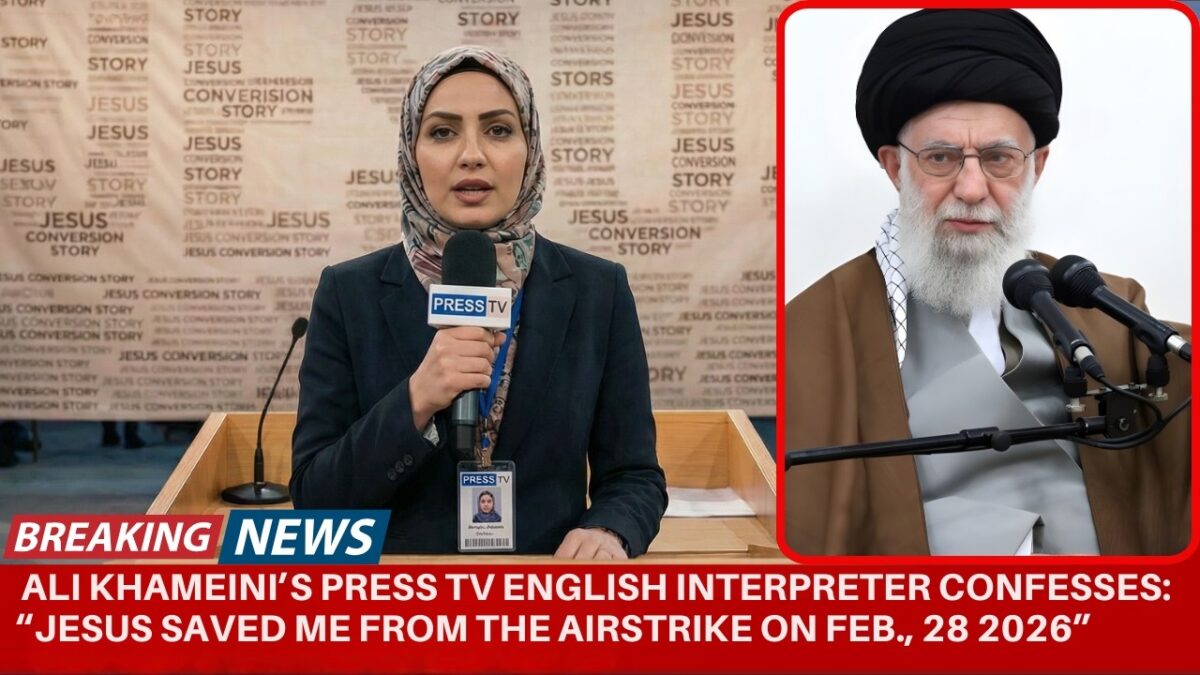
I was the official English interpreter for Ali Khamenei before his death. I would have died with him, but Jesus saved me.
But I recorded this testimony on March 2nd, 2026, from my mother’s living room in Los Angeles, California, especially for this channel.
Three days ago, I should have died. Three days ago, the man I served for six years was killed in a massive military strike, along with dozens of people I worked with every day. I was supposed to be there. I was supposed to be standing beside him, as I had done countless times before.
But I was not there. I was here, thousands of miles away, sitting with the mother I had rejected for years.
I do not know how to explain what happened. I do not know if it was faith or coincidence or something else entirely. My mother says it was Jesus. She says her prayer saved my life. I am not ready to believe that yet. But I cannot deny that something miraculous happened. Something pulled me out of Iran exactly one week before death came for everyone in my world.
And I need to tell this story, because I need to understand it myself.
My name is Daria Farhadi. I am 34 years old. I was born in Los Angeles, California, in the summer of 1992. My father was Iranian. My mother was American.
They met in the late 1980s, when my father was living in California, working as a journalist for a small Persian-language newspaper that served the Iranian immigrant community. He had left Iran years earlier, during the chaos of the Islamic Revolution, seeking opportunities in the West.
My mother was a librarian at a public library in Santa Monica. She was kind and curious and fascinated by other cultures. When she met my father at a community event, she was drawn to his intelligence and passion. He was drawn to her warmth and openness. They fell in love quickly and married within a year. I came along three years later: their only child, a bridge between two very different worlds.
My earliest memories are filled with sunshine and happiness. We lived in a modest apartment in West Los Angeles, not far from the beach. My mother would take me to the Santa Monica Pier on weekends, buying me ice cream and letting me ride the carousel until I was dizzy with joy. My father would read me Persian poetry at bedtime, translating the ancient words into English so I could understand their beauty.
I grew up speaking both Farsi and English, switching between them effortlessly depending on who I was talking to. At home, we celebrated both American holidays and Persian traditions. We had Christmas trees and Nowruz tables. We ate turkey on Thanksgiving and ghormeh sabzi on ordinary Tuesdays.
I did not feel torn between my two heritages. I felt lucky to have both of them. I was a happy child living a happy life, with parents who loved me and loved each other.
But there were things happening beneath the surface that I was too young to understand.
My father never fully adjusted to life in America. He missed Iran deeply. Even though he had chosen to leave, he followed Iranian politics obsessively, reading newspapers and listening to radio broadcasts from Tehran. He had friends in the Iranian immigrant community who shared his views: men who gathered in living rooms to debate politics and dream about their homeland.
Some of them hated the Islamic Republic and wanted it overthrown. But my father was different. Over the years, his views had shifted. He began to see the Islamic Republic not as an oppressive regime, but as a necessary force protecting Iran from Western imperialism.
He admired the Supreme Leader, Ayatollah Ali Khamenei, whom he had actually known briefly in his youth, before leaving Iran. They had moved in the same political circles as young men. My father spoke of Khamenei with respect and even affection, calling him a principled leader who truly cared about the Iranian people.
My mother did not share these views. She was a typical American liberal who believed in democracy and human rights and separation of church and state. She did not understand how my father could support a theocratic government that oppressed women and executed dissidents.
They argued about it sometimes. Late at night, when they thought I was asleep, I would hear their voices rising through the thin walls of our apartment: my mother’s voice, pleading and confused; my father’s voice, defensive and passionate.
I did not understand what they were arguing about at the time. I just knew that something was wrong between them.
The arguments grew more frequent as I got older. The tension in our home thickened like fog. I started to dread dinnertime, because that was when the political discussion would begin, and the warmth between my parents would freeze into cold silence.
Everything changed in 2002, when I was 10 years old.
My father received a phone call that transformed our lives forever. Someone from the Iranian government had reached out to him through intermediaries in the immigrant community. They knew about his journalism background. They knew about his support for the Islamic Republic. They knew about his old connections to people now in positions of power.
They were offering him a position in Tehran, working in the regime’s media apparatus, helping to shape Iran’s message to the world.
It was everything my father had dreamed of: a chance to return home, a chance to serve his country, a chance to be part of something he believed in. He accepted without hesitation.
He told my mother that he was going back to Iran and that he was taking me with him.
The conversation that followed was the worst night of my childhood. I remember hiding in my bedroom, pressing my ear against the door, listening to my parents scream at each other.
My mother was sobbing, begging my father not to take me away from her. She said Iran was dangerous for a girl raised in America. She said I would never adjust to life under Islamic law. She said he was destroying our family for his political fantasies.
My father shouted back that Iran was his home and would be my home, too. He said I needed to know my roots, my culture, my heritage. He said America was corrupting me with its materialism and immorality. He said he was saving me, not destroying me.
The argument went on for hours. I cried silently in my room, clutching my stuffed animals, not understanding why my world was falling apart. When they finally stopped shouting, the silence was even worse. I knew that something had broken between them that could never be repaired.
The divorce was finalized within months. My mother fought for custody, but my father had resources she did not. He had connections in the Iranian community who helped him navigate the legal system. He argued that I needed a father’s guidance, and that he could provide me with a better education and a more moral upbringing in Iran.
I do not know exactly how he won, but he did. The court granted him primary custody, with visitation rights for my mother.
I remember the day we left for the airport. My mother was standing in the doorway of our apartment, tears streaming down her face, her arms wrapped around herself as if she was trying to hold herself together. I ran to her and hugged her so tight, I thought I would never let go.
She whispered in my ear that she loved me more than anything in the world. She said she would come for me as soon as she could. She said this was not goodbye forever.
But it was. I would not see her again for many years.
The flight to Tehran was long and confusing. I slept most of the way, exhausted from crying.
When we landed, I stepped off the plane into a world I did not recognize. The airport was crowded and loud, and everyone was speaking Farsi so fast I could barely understand them. Women were covered in black chadors and headscarves. Men with beards and stern faces moved through the terminal with purpose. Signs in Arabic script that I could not read hung from the ceilings.
I gripped my father’s hand tightly, terrified of getting lost in this strange place. He smiled down at me and said, “Welcome home.”
But it did not feel like home. It felt like a foreign country, because that is exactly what it was to a 10-year-old girl who had spent her entire life in sunny California, eating hamburgers and watching Disney movies.
Those first months in Iran were the hardest of my life. Everything was different: the food, the language, the clothes, the rules.
I had to learn to wear hijab whenever I left the house. I had to learn to lower my eyes when speaking to men outside my family. I had to learn that the freedom I had taken for granted in America did not exist here. Girls could not wear shorts or tank tops. Girls could not sing or dance in public. Girls could not question their teachers or challenge authority.
I made mistakes constantly in the beginning. I would forget to cover my hair properly. I would speak too loudly in public. I would express opinions that girls were not supposed to have. My teachers scolded me. My classmates mocked me. They called me “the American girl with the loose tongue.”
I would come home crying, and my father would hold me and tell me to be patient. He said I would learn. He said I would adapt. He said Iran would become my home if I gave it a chance.
And slowly, painfully, it did.
Months turned into years. I learned the rules and followed them. I learned to pray five times a day, facing Mecca. I learned to fast during Ramadan until my stomach ached with hunger. I learned to recite Quran verses in Arabic, even though I did not fully understand what they meant. I learned to be invisible, modest, obedient.
The American girl who had run freely on California beaches disappeared. In her place emerged an Iranian girl who covered her hair and lowered her eyes and never questioned the system that controlled every aspect of her life.
I buried my American self so deep inside me that sometimes I forgot she had ever existed. I became what Iran wanted me to be, because that was the only way to survive.
And somewhere along the way, I stopped pretending, and I started believing. Islam became my truth. The Islamic Republic became my home. And my mother became a distant memory I tried not to think about, because thinking about her hurt too much.
By the time I finished high school in Tehran, I had transformed completely. The frightened American girl who had arrived at 10 years old was gone. In her place stood an 18-year-old Iranian woman who believed fully in the Islamic Republic and its values.
I wore my hijab with pride. I prayed with sincerity. I fasted with devotion. I had absorbed everything my teachers and my father had taught me about Islam, about Iran, about the corrupt West that I had once called home.
I no longer missed California, or the beach, or the carousel at Santa Monica Pier. Those memories felt like scenes from someone else’s life. I was Iranian now. I was Muslim now. I was a daughter of the revolution, and I was ready to dedicate my life to serving my country.
When it came time to choose a university and a career path, I knew exactly what I wanted. I wanted to work in media. I wanted to be a voice for Iran on the world stage.
I enrolled in the Faculty of Communication at a prestigious university in Tehran. My father was proud of my choice. He said journalism was a noble calling, a way to fight for truth against the lies of the Western media. He said Iran needed intelligent young people who could tell our side of the story to the world. He used his connections to ensure I had access to the best professors and the best opportunities.
I threw myself into my studies with fierce determination. I learned about mass communication theory, about propaganda techniques, about how to shape narratives and influence public opinion. I studied the history of Western media and how it had been used to demonize Iran for decades.
I learned to see America and Israel not as distant powers, but as active enemies working constantly to undermine my country. Every lecture reinforced what I already believed. The West was evil. Iran was righteous. And I was being trained to be a soldier in the information war.
I graduated in 2014 with the highest honors in my class. My professors recommended me for positions at several government media organizations, but I wanted something specific. I wanted to work at Press TV, Iran’s English-language news channel that broadcast to international audiences.
Press TV was the regime’s primary tool for reaching Western viewers and countering the narratives of CNN, BBC, and other foreign networks. It was where the most talented English-speaking journalists in Iran worked. It was where I could use my fluent American English to fight against the country that had once been my home.
When I applied, my qualifications were perfect. I had the education, the language skills, and, most importantly, the ideological commitment. I was hired immediately as a junior correspondent.
On my first day at the Press TV studios in Tehran, I felt like I had finally found my purpose. I was going to make my father proud. I was going to make Iran proud. I was going to show the world the truth.
My early years at Press TV were exciting and demanding. I started with small assignments, writing scripts for news segments and conducting research for senior correspondents. But I quickly proved myself capable of much more.
My English was flawless, better than most of my colleagues’, who had learned it as a second language. I could speak with an American accent that made me sound authentic and relatable to Western audiences.
And I had something else that set me apart: I had actually lived in America. I knew its culture, its weaknesses, its hypocrisies. I could criticize the United States with the authority of someone who had seen it from the inside.
My supervisors recognized this advantage and began giving me more prominent assignments. Within two years, I was appearing on camera, delivering commentary segments that attacked American foreign policy and defended Iran’s position on everything from nuclear negotiations to regional conflicts.
I became known for my sharp tongue and my fearless critiques of Western governments. I called out American presidents for their lies about weapons of mass destruction in Iraq. I exposed British hypocrisy in claiming to support human rights while selling weapons to Saudi Arabia. I mocked European leaders for lecturing Iran about democracy while their own societies crumbled under economic inequality and racism.
My segments were popular with Iranian audiences and with the international community of people who shared our skepticism. I received fan mail from viewers around the world who appreciated hearing a different perspective from the mainstream media. I was invited to speak at conferences and universities in Russia, China, and other friendly nations.
My star was rising rapidly. By the time I was 26 years old, I was one of the most recognizable faces on Press TV. My father would call me after my broadcasts and tell me how proud he was. He said I was fulfilling the destiny he had always imagined for me.
The work was not always easy. There were things I had to say on camera that I was not entirely sure I believed. There were stories I had to spin in ways that felt uncomfortable. There were moments when I wondered if I was telling the truth, or just a different kind of lie.
But I pushed those doubts aside. I reminded myself that every media organization had an agenda. CNN had an agenda. BBC had an agenda. Fox News had an agenda. At least my agenda was to defend my country against enemies who wished to destroy us. At least I was fighting for something I believed in.
The doubts would surface occasionally, usually late at night when I was alone in my apartment, but I became skilled at silencing them. I would pray and ask Allah for guidance. I would read the Quran and find comfort in its certainties. I would remember everything my father had taught me about loyalty and service, and the doubts would fade back into the shadows where they belonged.
My dedication and talent did not go unnoticed by the highest levels of the regime.
In 2020, when I was 28 years old, I received news that changed the trajectory of my career forever. I was being promoted to a position that most journalists could only dream of. I was being appointed as a personal translator and interpreter for the Supreme Leader himself, Ayatollah Ali Khamenei: the man my father had known decades ago, the most powerful person in the Islamic Republic.
I would be part of his inner entourage, translating his speeches for English-speaking audiences, interpreting during meetings with foreign dignitaries, traveling with him wherever he went.
It was an honor beyond anything I had imagined. It was also a tremendous responsibility. Any mistake I made would reflect on the Supreme Leader himself. Any mistranslation could cause diplomatic incidents. The pressure would be immense. But I accepted without hesitation. This was what I had been working toward my entire adult life.
I remember my first day in the Supreme Leader’s presence. I was nervous beyond words. My hands were shaking as I entered the room where he sat, surrounded by advisors and guards.
He was older than I expected, his beard white and his shoulders slightly stooped with age, but his eyes were sharp and intelligent, taking in everything around him with quiet intensity. When he looked at me, I felt like he could see into my soul.
One of his aides introduced me as the new translator, mentioning my background and my work at Press TV. The Supreme Leader nodded slowly and asked if I was the daughter of Masud Farhadi.
I said yes, surprised that he remembered my father.
He smiled faintly and said my father had been a good friend many years ago. He said he was glad to see that loyalty ran in the family. Then he turned back to his work, and I understood that the conversation was over.
But in that brief exchange, I felt a connection to history, to my father’s past, to the revolution itself. I belonged here. I was meant to be here.
The years that followed were the most intense of my life. I became part of the Supreme Leader’s inner circle, one of only a handful of people trusted to be in his presence daily.
I traveled with him across Iran, accompanying him to religious ceremonies, military installations, political rallies, and private meetings. I translated his speeches into English for international broadcast, carefully choosing words that conveyed both his meaning and his authority. I interpreted during his rare meetings with foreign officials, standing silently beside him while he negotiated matters of state and war and peace.
I saw him in his public persona: the stern and uncompromising defender of Islam. I also glimpsed his private moments, when he seemed tired and human and burdened by the weight of leading a nation under constant threat.
I did not worship him, as some did, but I respected him deeply. I believed he was doing what he thought was best for Iran, and I was honored to serve him.
Being part of the entourage meant sacrificing any normal personal life. I worked long hours, often starting before dawn and finishing after midnight. My schedule was dictated entirely by the Supreme Leader’s movements and needs. I could not make plans with friends, because I never knew when I would be called to duty. I could not maintain relationships, because no man wanted a wife who was never available.
My apartment in Tehran was just a place to sleep between assignments. My life was my work, and my work was my life. I told myself this was a worthy sacrifice. I told myself I was serving something greater than myself. I told myself that personal happiness was less important than national duty.
It was a Thursday evening in March 2023 when my phone rang with an American number I had not seen in years.
I was sitting in my apartment in Elahieh, reviewing documents for an upcoming press conference. The Supreme Leader was scheduled to address foreign journalists the following week, and I needed to prepare translations for his expected remarks.
My phone buzzed on the coffee table, and I glanced at the screen. The number had a California area code. My heart stopped for a moment. I knew immediately who it was.
I had not spoken to my mother in almost three years. Our last conversation had been brief and awkward. She had called to wish me a happy birthday, and I had rushed her off the phone, claiming I was busy with work.
The truth was, I did not know what to say to her anymore. We lived in different worlds now. She was a stranger who shared my blood, but nothing else.
I stared at the phone as it continued to ring. Part of me wanted to ignore it and return to my documents. But something made me reach for it. Something made me press the green button and lift the phone to my ear.
I said hello and heard her voice for the first time in three years. She sounded older than I remembered. There was a tremor in her words that had not been there before. But there was also something else: a warmth and a peace that seemed to flow through the phone line like sunshine.
She asked me how I was doing, and I gave her short, polite answers. I told her work was going well. I told her I was healthy and comfortable. I did not tell her about my position with the Supreme Leader. I did not tell her about the power and prestige I had accumulated. I did not tell her anything real, because I did not trust her with my truth.
She listened patiently to my empty words. And then she said something that caught me completely off guard.
She said she had something important to tell me. She said her life had changed completely over the past year. She said she had found something she had been searching for her entire life.
I asked her what she meant, and she took a deep breath before answering.
She said she had given her life to Jesus Christ. She said she had been attending a church in Pasadena and had accepted Jesus as her Lord and Savior. She said she had been baptized in the Pacific Ocean on Easter Sunday, and it was the most beautiful day of her life. She said she was born again and filled with the Holy Spirit. She said she finally understood the purpose of her existence. She said Jesus had set her free from years of pain and loneliness and regret.
And she said she wanted to share this gift with me.
I listened to her words in stunned silence. My mother had always been a nominal Christian when I was a child. She went to church on Christmas and Easter, but religion was never the center of her life. She never talked about Jesus the way she was talking now. There was passion in her voice. There was conviction. There was joy that seemed almost supernatural, and it made me deeply uncomfortable.
I had spent nearly 20 years being taught that Christianity was a corrupted faith. I had been told that the Bible had been changed and that Christians worshiped three gods instead of one. I had been taught that Islam was the final and perfect revelation from Allah, and that all other religions were false paths leading to hell.
My mother was telling me she had given her soul to a religion I had been trained to reject. She was telling me she had found truth in a faith I considered a lie.
I did not know how to respond. I felt anger rising in my chest. I felt embarrassment that my mother had fallen for what I considered Western religious nonsense. I felt fear that she would try to pull me away from everything I had built.
I told her I was happy she had found peace, but that I was not interested in hearing about Jesus. I told her my faith was Islam and I was devoted to it completely. I told her I did not need saving, because I was not lost.
My voice was cold and sharp. I could hear her wince through the phone.
She did not argue with me. She did not try to convince me or debate theology. She simply said she understood, and that she would respect my beliefs.
But then she said something else. She said she was going to pray for me every single day. She said she was going to ask Jesus to reveal himself to me. She said she believed with all her heart that one day I would know the truth, and the truth would set me free.
Her words felt like an attack, even though her tone was gentle. I felt like she was placing a curse on me disguised as a blessing.
I told her I did not want her prayers. I told her to keep her Jesus to herself. I told her that her new religion was dangerous and foolish. I told her that if anyone in Iran knew my mother was a Christian evangelist, it could destroy my career. I told her she was being selfish by putting me at risk with her religious fanaticism.
My words were cruel and cutting. I wanted to hurt her. I wanted to make her stop. I wanted to silence this Jesus talk before it infected my carefully constructed life.
She listened quietly until I finished my rant. Then she said she loved me, and she always would, no matter what I said to her. She said goodbye and hung up the phone.
I sat alone in my apartment, holding the silent phone in my trembling hand. I had just spoken to my mother for the first time in three years, and I had used the opportunity to wound her as deeply as I could.
The phone calls continued over the following months. My mother called me every few weeks, despite my hostility.
Each time, she would ask how I was doing and share small updates about her life. And each time, she would mention Jesus. She would tell me about sermons she had heard at her church. She would share Bible verses that had touched her heart. She would describe the community of believers who had become her new family. She would tell me about prayers that had been answered and miracles she had witnessed.
I responded with irritation and dismissal every single time. I told her I did not want to hear about her religion. I told her to stop trying to convert me. I told her that Islam was the truth and Christianity was a deviation. I quoted verses from the Quran that contradicted her beliefs. I used arguments I had learned from Islamic scholars to attack her faith.
But nothing I said discouraged her. She absorbed my attacks with patience and grace. She never raised her voice or responded with anger. She simply said she loved me, and that Jesus loved me too.
Her persistence infuriated me. Why could she not just accept that I had chosen my path? Why did she keep pushing her religion on me? Why did she refuse to give up?
In the summer of 2024, I made a decision that I thought would solve the problem permanently. I told my mother that I could no longer speak with her. I told her that her constant talk about Jesus was disrespectful to my beliefs and dangerous to my position. I told her that if she could not have a conversation without mentioning Christianity, then we had nothing to talk about. I told her I was cutting off all contact until she learned to respect my boundaries.
My mother was silent for a long moment. I could hear her breathing softly through the phone. When she finally spoke, her voice was thick with tears.
She said she was sorry I felt that way. She said she would always be there for me whenever I was ready to talk again. She said she would never stop loving me, and she would never stop praying for me. She said one day I would understand why she could not stay silent about the greatest gift she had ever received.
Then she said goodbye, and I ended the call.
I blocked her number on my phone. I deleted her contact information. I erased every trace of her from my digital life. I told myself I was protecting my career and my position. I told myself I was doing what was necessary.
But late at night, when I lay alone in my expensive apartment, I felt a hollowness in my chest that I could not explain. I had just cut off the woman who had given me life. I had rejected the mother who had held me in her arms and wept when I was taken from her. I had silenced the only person in the world who loved me without wanting anything in return.
And somewhere deep inside me, in a place I refused to acknowledge, I wondered if I had made a terrible mistake.
The months that followed my decision to cut off my mother were supposed to bring me peace. I had removed the source of my discomfort. I had silenced the voice that kept challenging my beliefs. I had protected my career and my position from the dangerous influence of her Christian faith.
But peace did not come. Instead, something strange began to happen inside me.
I started thinking about my mother constantly. Her face appeared in my mind when I woke up in the morning. Her voice echoed in my ears when I tried to fall asleep at night.
I remembered the way she used to hold me when I was a child in California. I remembered the smell of her perfume and the sound of her laughter. I remembered the small silver cross she had pressed into my palm at the airport when I was 10 years old. I had thrown that cross away years ago, when I fully embraced Islam. But now I found myself wishing I still had it.
I could not understand what was happening to me. I had built walls around my heart to keep my mother out, but somehow she was breaking through those walls without even trying. I told myself it was just nostalgia. I told myself it was weakness that I needed to overcome. I threw myself deeper into my work, hoping that busyness would silence the longing in my chest.
The feeling intensified as the year 2025 came to an end. December arrived with cold winds and gray skies over Tehran. The city was busy with preparations for the new year, and I was busy with my duties as the Supreme Leader’s interpreter.
But no matter how hard I worked, the longing for my mother would not leave me alone. It was like a hand pressing against my chest, pushing me toward something I could not name. I would be sitting in meetings with government officials, and suddenly I would see her face in my mind. I would be reviewing speech transcripts, and suddenly I would hear her voice saying she loved me.
One night in late December, I woke up from a dream that shook me to my core.
In the dream, I was standing in a beautiful garden filled with flowers I had never seen before. The colors were so vivid, they seemed to glow with their own light. My mother was standing at the other end of the garden, reaching out her hand toward me. She was smiling with such pure joy that it made my heart ache.
I started walking toward her, but with every step I took, she seemed to move further away. I tried to run, but my legs would not cooperate. I called out to her, but no sound came from my mouth.
Then I woke up, gasping for breath, with tears streaming down my face.
I lay in my bed, staring at the ceiling as the first light of dawn crept through my window. The dream had felt so real. The longing to see my mother had become a physical pain in my chest that I could no longer ignore.
By the first week of January 2026, I made a decision that seemed completely irrational. I decided I needed to see my mother.
The thought came to me suddenly while I was sitting at my desk in my apartment. It was not a gradual realization. It was an overwhelming compulsion that seized my entire being. I needed to go to America. I needed to see her face. I needed to hear her voice. I needed to be near her.
The feeling was so powerful that it frightened me. This was not how I normally operated. I was calculated and careful in everything I did. I planned my decisions and weighed the consequences.
But this urge to see my mother defied all logic. It made no sense given my career and responsibilities. It made no sense given the tension between us. It made no sense given everything I believed about her religion. But I could not resist it. The pull was stronger than anything I had ever experienced.
I knew that traveling to America would not be simple. There were no direct flights between Iran and the United States. The two countries had no diplomatic relations, and travel between them was extremely complicated. Iranian citizens faced severe restrictions when trying to enter America. The visa process was long and difficult, and many applications were rejected without explanation.
But I had one advantage that most Iranian applicants did not have: I was born in the United States. I came into this world at Cedars-Sinai Medical Center in Los Angeles, California. I had an American birth certificate with my name on it. This fact would not make the process easy, but it might make it possible.
I began researching the process immediately. I learned that I would need to apply for a visa at a United States embassy or consulate in a third country. The closest options were in Dubai, or Ankara, or Istanbul. I chose Istanbul because Turkish Airlines offered connecting flights from Tehran, and because I had heard the consulate there processed Iranian applications more regularly.
I gathered all the documents I would need: my Iranian passport; my American birth certificate, which my father had kept in the safe all these years; my employment records; bank statements showing my financial stability; a letter from my employer confirming my position and salary; and an invitation letter from my mother in California.
I had to unblock her number and call her to request this letter. When she heard my voice for the first time in over a year, she burst into tears. She could barely speak through her sobs.
I told her I wanted to visit her, and that I needed her to send me an official invitation letter. She said yes immediately, without asking any questions. She said she would do anything to see me again. She said she had been praying for this moment every single day since I cut her off.
Her words stirred something in my heart, but I pushed the feeling aside. I had practical matters to focus on. I could not afford to be emotional.
The invitation letter arrived by email three days later. My mother had written it carefully, explaining that I was her daughter and that she wanted me to visit her at her home in Pasadena, California. She included copies of her American passport and proof of her address. I printed everything and added it to my growing file of documents.
In mid-January, I booked a flight to Istanbul and scheduled an appointment at the United States consulate for a visa interview. The earliest available appointment was three weeks away. I would have to wait until early February just for the chance to sit before a consular officer and plead my case.
The waiting was agony. Every day felt like a week. I continued performing my duties as the Supreme Leader’s interpreter, but my mind was constantly elsewhere. I kept thinking about my mother. I kept wondering if my visa would be approved. I kept asking myself why I was doing this.
What was this force that was driving me toward America? Why could I not simply ignore it and continue with my life? I had no answers. I only had the relentless pull that would not let me rest.
I flew to Istanbul on February 3rd and checked into a modest hotel near the Sultanahmet district. My visa interview was scheduled for February 5th at the United States consulate in the İstinye neighborhood.
I spent the day before the interview reviewing my documents and practicing answers to the questions I expected them to ask. Why did I want to visit America? How long did I plan to stay? What was my relationship with the person who invited me? Did I have any ties to the Iranian government?
This last question worried me the most. I was the personal interpreter for the Supreme Leader of Iran. I worked directly for the most powerful man in a country that America considered an enemy. If the consular officers discovered the true nature of my job, they might reject my application immediately. They might suspect I was a spy or a security threat.
I decided to describe my work vaguely. I would say I was a translator for a government broadcasting organization. I would not mention the Supreme Leader directly unless they asked specific questions. I practiced my answers in front of the bathroom mirror until they sounded natural and unrehearsed.
The morning of February 5th arrived cold and gray. I dressed conservatively in dark colors and took a taxi to the consulate. The building was surrounded by high walls and security checkpoints. Armed guards examined my documents before allowing me to enter the waiting area.
I sat among dozens of other visa applicants from various countries. Some looked nervous; others looked bored. I felt my heart pounding against my ribs as I waited for my number to be called.
When my turn finally came, I approached the window and handed my documents to a stern-faced American woman behind the glass. She examined my Iranian passport first, and her expression remained unchanged. Then I handed her my American birth certificate. She looked at it carefully, and her eyebrows rose slightly. She typed something into her computer, and I saw her expression soften just a fraction.
Being born in America clearly meant something. It established a connection to the country that went beyond a simple tourist visit. It proved that I had roots in the United States, even though I had spent most of my life elsewhere.
The woman began asking questions.
Why did I want to visit America? I said I wanted to see my mother, who lived in California.
How long had it been since I last saw her? I said over 20 years.
Why so long? I said my parents divorced when I was a child, and I moved to Iran with my father. She nodded slowly, as if this story made sense to her.
What was my occupation? I said I worked as a translator for a media organization in Tehran.
She typed something into her computer and studied the screen for a long moment. Then she asked me to wait while she consulted with the supervisor.
I stood at that window for nearly 15 minutes while the woman disappeared into a back office. My palms were sweating. My mouth was dry. I was certain they had discovered my connection to the Supreme Leader. I was certain they were going to reject my application and send me back to Iran in shame.
But when the woman returned, she did not reject me. Instead, she said my application required additional administrative processing. She said I would need to return for a second interview and provide more documentation. She gave me a list of additional items they wanted, including more detailed employment records and references from colleagues who could verify my work history. She said the process could take several more weeks.
But then she added something that gave me hope. She said my American birth was a significant factor in their consideration. She said it demonstrated a genuine connection to the United States that would be taken into account during the review.
I left the consulate feeling cautiously optimistic. They had not said no. They had only said they needed more information. And my birth certificate had clearly helped my case.
I extended my hotel stay in Istanbul and began gathering the additional documents. I called colleagues in Tehran and asked them to send letters confirming my employment. I contacted my bank and requested more detailed financial statements. I did everything they asked and submitted the additional materials to the consulate a week later.
The second interview took place on February 17th. This time, the questions were more intense.
A different officer asked me about my specific job duties. He asked about my relationship with Iranian government officials. He asked if I had ever participated in any activities against the United States.
I answered carefully and honestly, without revealing too much. I told him I translated speeches and documents for media broadcast. I told him I had no personal relationships with high-ranking officials. I told him I had never engaged in any activities that could be considered hostile to America.
The officer studied my face as I spoke. I felt like he was looking directly into my soul, searching for deception. He glanced down at my file, and I saw him looking at my birth certificate again.
He asked me about my childhood in California. He asked if I remembered living there.
I told him I remembered my mother, and our house in Glendale, and my school, and my friends. I told him I remembered being happy there, before everything changed.
Something in his expression shifted when I said this. Perhaps he saw the pain in my eyes. Perhaps he understood that my story was genuine.
After what felt like an eternity, he stamped my passport and said my visa had been approved. He said my American birth and my family connection had been important factors in the decision. He said I should enjoy my visit and spend time with my mother.
I stared at the stamp in disbelief. After weeks of stress and uncertainty, I had finally received permission to enter the United States. I thanked the officer and walked out of the consulate with tears forming in my eyes.
I was going to see my mother. After more than 20 years, I was finally going home.
I returned to Tehran briefly to settle my affairs before departing for America.
I went to my supervisor and requested two weeks of personal leave, starting February 21st. I explained that I had family matters requiring my attention abroad. He was surprised by the sudden request, but approved it without much resistance. He said I had earned a break after years of dedicated service. He said I should rest and return refreshed for the busy months ahead.
I did not tell him where I was going. I did not tell anyone the truth about my destination. My father would have been furious if he knew I was visiting my mother in America. He would have seen it as a betrayal of everything he had taught me. So I kept my plans secret and packed my suitcase in silence.
I arranged for a colleague to handle any minor translation needs that might arise in my absence. The Supreme Leader had no major events scheduled during my two weeks away. It was a rare window of calm in an otherwise packed schedule. Everything seemed to be aligning perfectly for my journey.
On the morning of February 21st, I took a taxi to Imam Khomeini International Airport. As the car drove through the streets of Tehran, I looked out the window at the city that had been my home for over 20 years. I wondered if I would see it the same way when I returned. I wondered if I would return the same person who was leaving.
The flight to America was long and exhausting. I flew Turkish Airlines from Tehran to Istanbul, and then connected to a flight to New York JFK. From New York, I boarded another flight to Los Angeles: nearly 22 hours of total travel time.
I sat in my seat, staring out the window at the clouds and ocean below. My mind was racing with questions I could not answer. What would I say to my mother when I saw her? Would she forgive me for cutting her off? Would she try to talk to me about Jesus again? What was this mysterious force that had compelled me to make this journey?
I landed at LAX on the evening of February 21st, exhausted but filled with nervous energy. I collected my luggage and walked through customs with my newly stamped visa.
The American immigration officer looked at my passport and my birth certificate. He smiled and said, “Welcome home.”
Those two words hit me like a wave. Welcome home. This was the land of my birth. This was where I had taken my first breath and spoken my first words. I had spent two decades calling Iran my home. But standing here now, I felt something stirring in my chest, something that felt like belonging.
I walked through the terminal and breathed in the California air. Everything felt foreign and familiar at the same time.
I took a taxi to a hotel in Pasadena, near where my mother lived. I checked into my room and sat on the bed, holding my phone in my hands. Now that I was finally here, the reality of the moment overwhelmed me. I was about to reunite with my mother after two decades of separation and years of hostility. I did not know if I was ready. But I had come too far to turn back now.
I called my mother that night and told her I was in Pasadena. She gasped, and then began to cry. She said my name over and over again, like she could not believe it was really me.
She asked me to come to her church the next morning. She said it was Sunday, and she would be at the worship service. She said she wanted me to meet her community of believers. She said she had been waiting for this moment for years.
I agreed without argument. I was too tired and too overwhelmed to resist anything she asked.
The next morning, I took a taxi to a small church in a quiet neighborhood of Pasadena. The building was simple and unassuming, with a white cross mounted above the entrance. I stood outside for several minutes, gathering my courage before walking through the doors.
The sanctuary was filled with people singing songs I did not recognize. They had their hands raised and their eyes closed. Some were swaying gently. Others had tears streaming down their faces.
I scanned the crowd looking for my mother, and found her standing in the third row. She saw me at the same moment, and her face transformed with pure joy. She rushed toward me and wrapped her arms around me so tightly I could barely breathe.
She whispered in my ear that God had answered her prayers. She said the Holy Spirit had spoken to her months ago and told her I was coming. She said she had been praying every single day for this moment. She said she knew it would happen, because God had promised her.
I stood there in my mother’s embrace, surrounded by singing Christians in a country I had learned to hate. And for a reason I could not explain, I did not want to leave.
I stayed for the entire service, sitting beside my mother as the pastor preached about the love of God. I did not accept anything I heard. I did not believe the words being spoken. My mind kept reminding me of all the reasons I should reject this religion. My training told me these people were deceived and lost.
But something in my heart would not let me dismiss them completely. I watched my mother worship with her eyes closed and her hands raised, and I saw a peace on her face that I had never seen before.
After the service, she took me to lunch at a small café nearby. She told me about her life and her faith and her church community. She did not pressure me or preach at me. She simply shared her joy and let me witness it.
She asked about my life in Iran, and I gave her carefully edited answers. I told her about my work as a translator, without mentioning the Supreme Leader. I told her about my apartment and my colleagues and my daily routines. I did not tell her about the power I wielded or the secrets I kept. I was still protecting the regime, even while sitting across from the mother who had prayed for my freedom.
We talked for hours that afternoon. We laughed about memories from my childhood. We cried about the years we had lost. She told me she had never stopped loving me, even when I rejected her. She said a mother’s love was unconditional and eternal. She said her heart had ached every day I was gone.
Somewhere deep inside me, a door that had been locked for 20 years began to crack open. I still did not believe in her Jesus. But I could no longer deny that something had brought me here. Something beyond my understanding had pulled me across oceans and borders to sit in this café with my mother.
And I was beginning to wonder if maybe that something had a name.
The days that followed my reunion with my mother were unlike anything I had experienced in over 20 years. I stayed in Pasadena and spent every possible moment with her.
We walked through the neighborhoods where I had played as a child. We drove past the house in Glendale where we had lived as a family, before everything fell apart. We visited the elementary school I had attended before my father took me to Iran.
Memories flooded back with every street corner and every familiar landmark. I remembered riding my bicycle on the sidewalk. I remembered the taste of ice cream from the shop near our house. I remembered the sound of my mother singing hymns in the kitchen on Sunday mornings. These memories had been buried deep inside me for two decades. Now they were rising to the surface and filling me with emotions I did not know how to process.
My mother did not pressure me about her faith during those days. She simply loved me and welcomed me back into her life without conditions. We cooked meals together in her small kitchen. We looked at old photographs and laughed at how young we both looked. We held hands and cried about the years we had lost. I felt something healing inside me that I did not even know was broken.
But even as I enjoyed this precious time with my mother, a part of my mind remained focused on my responsibilities.
Back in Iran, I had taken two weeks of leave, and my return flight was scheduled for February 29th. The Supreme Leader had a busy schedule in March, and my presence would be required.
I checked my work emails regularly and stayed in contact with colleagues in Tehran. Everything seemed normal back home. The government was preparing for the Persian New Year celebrations in late March. Security briefings indicated no unusual threats or concerns. I had no reason to worry about anything.
My plan was simple. I would spend one more week with my mother and then return to my life in Tehran. I would resume my duties as the Supreme Leader’s interpreter and continue serving the Islamic Republic, as I had done for years.
The visit to America had been emotional and meaningful, but it had not changed my fundamental commitments. I was still a devoted Muslim. I was still loyal to the regime. I was still the person I had been when I left Iran.
Or so I believed.
On the morning of February 28th, 2026, I woke up early in my hotel room. The California sun was streaming through the curtains, and I could hear birds singing outside my window.
I had planned to spend the day with my mother. We were going to visit a botanical garden in San Marino and then have dinner at her favorite restaurant. I took a shower, got dressed, and checked my phone for messages.
There were several missed calls from numbers in Iran. There were dozens of text messages from colleagues and acquaintances. My heart began to race as I scrolled through the notifications. Something was wrong. Something had happened while I was sleeping.
I opened the first message, and the words on the screen made my blood run cold.
The Supreme Leader is dead.
I stared at those five words, unable to comprehend what I was reading. It had to be a mistake. It had to be some kind of sick joke or misinformation. Ali Khamenei could not be dead. He was the most protected man in the entire country. He had layers of security that were impenetrable. Nothing could touch him.
I turned on the television in my hotel room and switched to a news channel. The images on the screen confirmed what the messages had told me.
Smoke was rising from a destroyed compound in northern Tehran. Rescue workers were sifting through rubble and debris. News anchors were speaking in urgent tones about a massive military strike that had occurred hours earlier. The headline at the bottom of the screen read: “Supreme Leader Ali Khamenei Killed in Israeli Air Strike.”
I sat on the edge of the bed with my hand over my mouth. The room was spinning around me.
The television showed aerial footage of the destruction. I recognized the compound immediately. I had been there dozens of times. I had walked through those hallways. I had sat in those meeting rooms. I had stood beside the Supreme Leader in that very building, translating his words for foreign visitors. Now it was nothing but smoking ruins.
The news reported that the strike had occurred in the early hours of February 28th, Tehran time. Israeli fighter jets, supported by American intelligence, had carried out what military analysts were calling a “decapitation strike.” The operation targeted the Supreme Leader’s residence and command center. Multiple high-ranking officials had been killed alongside him.
The Iranian government was in chaos. The Revolutionary Guards were on high alert. The entire country was in a state of shock and confusion.
I watched the coverage for hours, unable to move from my spot on the bed. More details emerged as the morning progressed. The strike had been the opening move in a coordinated US-Israeli military offensive against Iran. American intelligence agencies had provided precise location data and satellite imagery. Israeli Air Force jets had penetrated Iranian airspace using advanced stealth technology. The attack had been swift and devastating. By the time Iranian air defenses responded, the damage was already done.
The Supreme Leader was dead. The man I had served for nearly six years was gone. The voice I had translated for audiences around the world had been silenced forever.
I thought about the people who would have been with him that night: his personal staff, his security detail, his advisers and aides. People I knew. People I had worked alongside. People I had shared meals with, and laughed with, and complained about long hours with. They were all dead now, buried under tons of rubble in a compound that had been vaporized by missiles fired from jets flying thousands of feet above.
Then a thought struck me that made my entire body go numb.
I was supposed to be there.
If I had not taken this trip to America, I would have been in Tehran. I would have been at the Supreme Leader’s side, preparing for his upcoming schedule. I would have been in that compound, or nearby, when the missiles struck. I would have been one of the bodies being pulled from the wreckage.
I would be dead right now.
The realization hit me like a physical blow. My hands started shaking uncontrollably. My breath came in short, shallow gasps. I stumbled to the bathroom and splashed cold water on my face. I looked at my reflection in the mirror and saw a ghost staring back at me.
I was alive. I was alive because I had followed an inexplicable urge to visit my mother. I was alive because something had pulled me out of Iran at exactly the right moment. I was alive because I was sitting in a hotel room in Pasadena, California, instead of standing beside the Supreme Leader in Tehran.
The odds of this timing were impossible to calculate. The chances of me being here instead of there, at this exact moment in history, were astronomical. How could this be coincidence? How could this be random chance? How could this be anything other than intervention from something far greater than myself?
I called my mother with trembling hands and told her to turn on the news. She already knew. She had been watching the coverage since early morning.
She said she had been praying for me all night. She said she had woken up at three in the morning with an overwhelming burden to pray for my safety. She said she had knelt beside her bed and interceded for me for hours, without knowing why. She said the Holy Spirit had pressed upon her heart that I was in danger and that she needed to cover me in prayer. When she saw the news about the strike in Tehran, she understood why.
She said God had told her months ago that I needed to come to America. She said the urge I felt to visit her was not random. It was not nostalgia, or weakness, or coincidence. It was the Holy Spirit drawing me out of danger. It was Jesus saving my life before I even knew I needed saving.
She said this was the proof I needed. This was the evidence that God was real, and that He loved me, and that He had a plan for my life.
I listened to her words, and for the first time, I did not argue. For the first time, I did not dismiss her faith as foolishness. For the first time, I considered the possibility that everything she had been telling me was true.
I spent the next several days in a fog of confusion and grief. I mourned for the colleagues I had lost. I mourned for the life I had known, which was now shattered beyond repair.
I could not return to Iran, even if I wanted to. The country was in turmoil. The regime was scrambling to maintain control. Foreigners and dual citizens were being viewed with suspicion. My position as the Supreme Leader’s interpreter would make me a target for interrogation. They would want to know why I had left the country just days before the strike. They would suspect me of having prior knowledge. They would accuse me of being a spy or a traitor.
My career was over. My life in Iran was over. Everything I had built for 20 years had been destroyed in a single night. I had nothing left except my mother, and the strange, miraculous fact that I was still breathing.
I sat with my mother in her living room on the evening of March 1st. The television was off. The house was quiet. She held my hands in hers and looked into my eyes with a tenderness that broke down the last of my defenses.
She asked me if I was ready to admit what had really happened. She asked me if I could still believe this was all coincidence. She asked me if I was ready to meet the God who had saved my life.
I thought about everything that had led me to this moment: the inexplicable longing that had seized me in December; the dreams of my mother reaching out to me; the overwhelming compulsion to travel to America despite all the obstacles; the visa that was approved against all odds; the timing that placed me in California instead of Tehran on the night of the strike; the prayers my mother had prayed at 3:00 in the morning without knowing why.
Every piece of the puzzle fit together perfectly. Every detail pointed to something beyond human planning or understanding.
I had spent my entire adult life serving a regime that claimed to speak for God. I had devoted myself to a religion that promised paradise in exchange for submission. But that religion had never given me peace. That regime had never given me love. I had been empty and lonely and lost, even while standing at the pinnacle of power.
And now, here I was, sitting with my mother in a small house in Pasadena, California. I was alive when I should be dead. I was safe when I should be buried under rubble. I was free when I should be trapped in a country that was falling apart.
Something had saved me. Someone had saved me. And I was finally ready to ask who.
I looked at my mother and told her I wanted to know more about Jesus.
She began to weep. She pulled me into her arms and held me like she had held me when I was a little girl. She said she had been waiting for this moment for over 20 years. She said every prayer she had ever prayed for me had been answered in this single instant.
She opened her Bible and began to read to me about a God who loved the world so much that He gave His only Son. She read about a Savior who died for sinners and rose from the grave. She read about grace that could not be earned, and mercy that had no limits. She read about a Father who pursued His lost children across oceans and continents and decades of separation.
I listened with my heart open for the first time in my life. And somewhere in the middle of that conversation, in my mother’s living room, I made a decision.
I decided to stop running. I decided to stop hiding. I decided to surrender my life to the Jesus who had been chasing me since the day my mother pressed that silver cross into my palm at the airport.
I am recording this testimony now from a safe location that I cannot disclose.
My life will never be the same. I cannot return to Iran. I cannot see my father again. I have lost everything I spent 20 years building.
But I have gained something infinitely more precious. I have gained salvation. I have gained peace. I have gained a relationship with the God who pulled me out of Tehran before the missiles fell.
I do not know what my future holds. I do not know where I will live or what I will do. But I know that I am no longer alone. I know that Jesus is with me. I know that His hand guided me every step of the way: from the longing in December, to the visa approval in February, to the seat on the airplane that carried me away from death.
Some people will say this was fate. Some people will say this was luck. Some people will say this was just coincidence and timing and nothing more. But I know the truth. I know that Jesus saved my life. I know that my mother’s prayers were heard in heaven. I know that God reached into the darkness of my existence and pulled me into His marvelous light.
So I am asking you the same question I have been asking myself: Was this fate, or was it Jesus?
You have heard my story. You know the details. You know the timing. You know the impossible odds that brought me to America at exactly the right moment. What do you believe?
I will be watching the comments. I want to hear from you. I want to know if my story has touched your heart. I want to know if you are searching for the same God who found me.
If you are an Iranian watching this in secret, I want you to know that Jesus loves you. He is appearing to people all across our homeland in dreams and visions. He is calling Muslims by name and offering them a love that Islam never gave them. The fire is spreading, and no government on earth can stop it.
If my testimony has moved you, then write in the comments: “Jesus saved her.” Let it be a declaration. Let it be a prayer. Let it be the beginning of your own journey toward the truth.
I was the voice of the Supreme Leader. Now I am the voice of the One who is greater than any earthly leader. His name is Jesus, and He is waiting for you with open arms.








