A sold omega whispered her battle maps to an unridable war horse every night
The Girl Who Whispered to War Horses
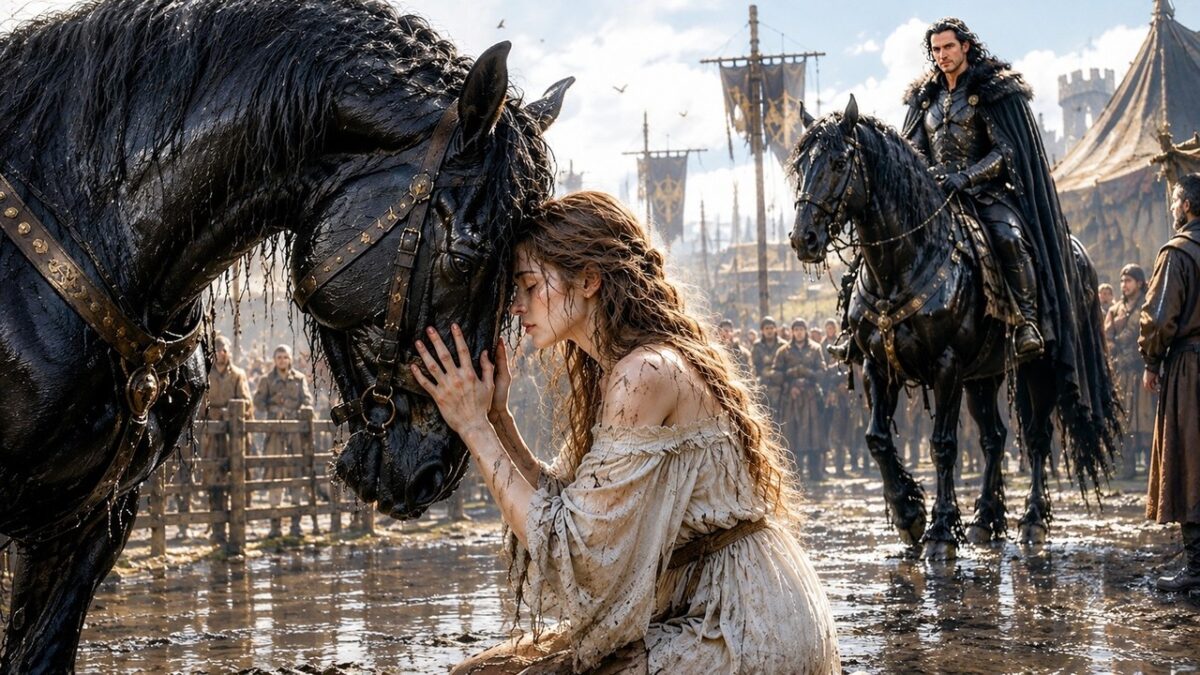
The warhorse shattered the post an hour before the auction opened. Tavia was already in the yard when it happened. She heard the crack of timber above the rain, heard the crowd scatter, heard the animals scream tear through the gray mourning like a blade dragged across iron.
She dropped the bucket she was carrying and ran toward the sound without thinking, the way she always ran toward the thing everyone else ran from. old reflex, older scar. The horse was black, not dark bay, not midnight brown, but the absolute black of a starless sky, and he was enormous, a waror built for the front line of a cavalry charge, all muscle and fury, and controlled catastrophe.
He had the brand of the Ashvain regiment on his left flank. She recognized it, the broken sword above a crown, and she understood immediately what that meant. General Ashvane had died at the Battle of Fernwall 6 months ago.
His horses had been dispersed, resold, filtered down through markets until they ended up here in Coleport’s tradeard, where the mud was ankled deep, and the rain never stopped, and everything that arrived eventually got sold to someone worse than whoever had it before. The horse had already put one handler on the ground. The man was clutching his wrist, rocking.
The other handlers had backed against the fence and were watching from a safe distance with the expressions of men, calculating how much this was worth versus how much it was going to cost them in blood. Tavia walked into the space between them. She did not wave her arms.
She did not shout. She moved the way water moves around a stone without confrontation, without haste, without the particular tight shouldered energy that horses read as threat. The mud sucked at her boots.
Rain plastered her hair to her face and turned the burlap of her dress translucent in patches. She was cold enough that her fingers had stopped registering sensation an hour ago. The horse wheeled.
His eyes showed white. She could see the welts on his shoulders where someone had used a switch and the fear foaming along his neck where the halter had been yanked, and underneath all of it, something worse, the dull, bewildered grief of an animal who had lost the human it was built to carry, and had not yet decided whether to survive that loss. She stopped 3 ft from his chest.
“I know,” she said.
Her voice was low enough that only he could hear.
“I know who you carried.
I know he is gone. I know every hand since his has been wrong. The horse snorted, his front hooves lifted, warning her back.
She didn’t move. You are allowed to grieve, but not out here, not in front of them. They will use it against you.
Come here. She extended her hand, palm up. Nothing in it.
No rope, no crop, no trick. Just the open offer of a hand that had no intention of hurting him. He stood there for a long time.
Then he lowered his nose to her palm and exhaled. The yard was silent. The auctioneer, a slope shouldered man named Dex, who smelled of pipe smoke and cheap ale, shoved through the watching crowd and grabbed Tavia by the collar of her dress.
She was so thin the fabric hung loose, and his grip found only fabric and air.
“That animal has cost me two handlers and a fence post,” he said.
You get him in the pen, or I sell you both to the rendering yard, and neither of you is worth enough to argue about. Tavia said nothing. She had learned years ago that talking back to men like Dex accomplished nothing except making the next punishment more creative.
She led the horse into the pen by walking beside him, her hand on his jaw, her mouth moving in words too quiet for anyone to catch. His name, she had decided, was Phantom. The brand said he had belonged to General Ashvain’s personal cavalry.
She had spent last night reading the auction ledger by lamplight, the way she read everything, completely, retaining every detail, building a picture from fragments that no one else bothered to assemble. The general had called this horse Phantom. His handlers had renamed him to Black Devil after the general died, trying to sell the name along with the reputation.
She called him Phantom. He walked beside her like he’d always known her name. She did not know they were being watched until the crowd moved.
She felt it before she saw it. The shift in pressure, the way a room changes when authority enters it. The rain seemed to pull back.
The mud spattered traders and farmers and handlers went quiet in the specific way that that people go quiet when they are trying to decide whether to kneel. King Saurin of Iron Hallow had come to buy cavalry horses for the northern campaign. Tavia had heard of him.
Everyone had the Iron Wolf they called him, though not to his face. 30 years old, two wars won. One treaty broken on purpose because the terms had been insulting.
a scar that crossed his right jaw from the siege at Dunrath, where he’d personally held a gate for 6 hours while his army retreated. He had not taken a queen. The rumor was that his wolf was too dangerous, too close to the surface, too honest, that he felt things with a ferocity that civilized alphas spent their whole lives learning to perform instead.
He walked through the parted crowd, and his eyes found Tavia before they found the horse. She felt it like a hand pressed flat against her sternum. His gaze was gray green and completely steady, and it moved to her with the precision of something that had been looking for this specific point in space without knowing it was looking.
His stride did not falter, but his jaw tightened. He stopped in front of the pen. Phantom pressed his nose against Tavia’s shoulder, and she felt the warmth of it through the wet burlap, and did not look away from the king.
Saurin looked at the horse, looked at Tavia, looked at the bruise along her collarbone, where Dex had grabbed her badly two days ago, the one that had gone yellow at the edges. His eyes came back to her face, and something moved through his expression like a weather system, rapid, complex, and impossible to ignore. Who does she belong to? He said.
Deck scrambled forward. She belongs to me, your majesty. Omega, stable hand, barely costs anything.
Name your price for both of them. Both, sir. She is just her.
The horse and the girl. Name the price or I walk out and you spend the next 6 months explaining to your creditors why you still have an unbiable waror taking up pen space. Dex named a price that was insulting in how high it was.
Saurin paid it without blinking. He didn’t speak to Tavia again until the column was an hour north of Coalport, moving through the Pine Valley toward the Iron Hall border. She was in the supply wagon, wedged between grain sacks and a barrel of medicinal oil.
Phantom walked loose at the back of the column, tied to the wagon by a lead he could break in 3 seconds if he chose, which meant his compliance was a choice, not a constraint. She was talking to him, not singing, not soothing nonsense. She was mapping the terrain they were crossing, describing the ridge formation to the east, the river crossing they’d passed at dusk.
The way the infantry column was stretched too thin across the valley floor, and would take 4 minutes to compress into a defensive formation if hit from the north flank. She was telling him about the supply chain, four days of provisions lean, a mistake for a campaign of this length, and about the way the king’s scouts moved in rotating pairs that left a 30inut gap in eastern coverage every time they switched. She told Phantom because there was no one else.
She had told horses things for years, horses and walls and the dark. The information piled up inside her like water behind a dam, observations and patterns and tactical conclusions that had no outlet because an omega stable hand with no pack, no rank, and no name that mattered was not supposed to look at a column of soldiers and see its weaknesses. She was not supposed to read a ridge and calculate firing angles.
She was not supposed to do any of it. But she did. She always had.
She fell asleep with her hand in Phantom’s mane and woke at dawn to the sound of her name being spoken by a voice she already recognized. Saurin was standing at the back of the wagon. His arms were crossed.
The morning light caught the scar on his jaw and made it look like a seam in something that had been broken and reforged.
“You were not talking to calm him,” he said.
She sat up, straw in her hair, blood from a small cut on her palm where she’d gripped the wagon side in her sleep. I was You were mapping my supply route. You counted the soldiers in this column.
You identified a gap in my scout rotation. He tilted his head and you told a horse. She didn’t answer.
Who taught you to read a column formation? My grandmother. The words were out before she could stop them. She was a war scribe for the Carvin order.
She recorded battle plans, mapped terrain, analyzed engagements for three campaigns. She taught me to read the land the way she read text. Something shifted in his expression, not suspicion, something more careful than that.
The Carvin order, he said, that bloodline was supposed to have died out when the Coldfin Pack disbanded. Tavia said nothing. He looked at her for a long time.
The camp was waking around them, the sounds of soldiers and fires and horses, and the pine forest carrying all of it upward into the pale sky.
“Come to my tent tonight,” he said.
“Bring whatever you know about the terrain ahead.”
She went. She laid out everything she had memorized. The river crossings, the ridge lines, the supply vulnerability at the northern pass, where a force of 300 could hold an army of 2,000 for a week if they moved first.
She drew from memory on the back of his campaign maps, adding elevation markers his cgraphers had missed, identifying three positions the Wrath Compact would almost certainly use for an ambush based on the terrain pattern and the supply routes she had identified from the intelligence dispatches she had overheard three soldiers discussing in the wagon camp. Saurin sat across from her and listened. He asked questions that told her he understood, not performing comprehension, actually grasping the logic, pulling on threads she hadn’t pulled yet, following the shape of the problem with the instinct of someone who had been fighting long enough to recognize when another mind moved at his speed.
He did not condescend. He did not look at her and see the burlap or the bruises or the pack brand she still carried on her wrist from Cold Fin. He looked at her and saw the maps.
“Tell me about Coldfen,” he said, when the lamp oil was burning low.
She did not want to. She told him anyway, the pack that had raised her after her grandmother died. The elder Aldrath Penn, who had watched her with eyes that looked like fear, dressed up as contempt.
The day she turned 16, and Penn declared her wolf broken, defective, unfit for pack resources, the slow starvation. the trader who had come through offering work contracts. The iron stamp they had put on her wrist before they handed her over.
Saurin’s hands were flat on the table. His knuckles had gone white. Aldr Penn, he said.
He is not worth. He sold a member of his pack. I heard everything else you said and I am saying this now.
When this campaign ends, he will answer for it. You do not need to do that for me. I am not doing it for you.
I am doing it because what he did was a crime and I am the king and crimes do not go unanswered in my kingdom simply because the victim had the wrong ranking. He paused. And I am doing it for you.
Both things are true. She looked at her hands. The cut had dried.
The bruise on her collarbone was still pulling when she breathed. Something cracked in the walls she kept around herself. Just a line, just enough to let air through.
The spy was caught on the ninth night. Tavia had been telling Phantom about the pass formation, about the gap in the Wrath compact supply chain, about the way the compact commanders moved in consensus. Everything agreed to, everything slow.
When the stallion’s ears went flat, and he turned his head toward the dark between the pines, she heard breathing, then the sound of something being tucked quickly into a coat.
“Stop,” she said.
The figure ran Phantom did not. The horse moved with the speed of a creature trained for cavalry engagements, 300 pounds of controlled violence in a direction, and he caught the man against a tree at the edge of camp with a force that knocked the wind out of him and pinned him there with the simple immovable fact of his own chest. Tavia took the satchel from the man’s inside coat pocket.
Inside were four dispatches written in compact cipher with the wrath seal at the bottom, a coiled serpent above an ash branch. She couldn’t decode them. She took them directly to Saurin’s tent and pushed through the flap without knocking.
He was awake. He was always awake. He read the dispatches.
His cipher specialist, a quiet woman named Bren, who kept a reading lens on a cord around her neck, decoded them within the hour. The dispatchers confirmed the ambush position Tavia had identified from terrain analysis alone and added a second one she hadn’t predicted. A force of 200 compact soldiers positioned at the goat track through the eastern slope, planning to hit the supply wagons from behind while the main force engaged at the pass.
Saurin looked at the map. He looked at Tavia. The lamp between them made the gray green of his eyes look almost gold.
You mapped the ambush position 4 days ago, he said before we had any intelligence, before we caught the spy. The terrain made it obvious. Not to anyone else in this camp.
He was quiet for a moment. Then he said without looking away from her face. I need to tell you something.
My wolf has been, he stopped, started again. I lost someone I was supposed to protect 3 years ago during the Dunrath campaign. a civilian.
I could not reach them in time and my wolf. I let my wolf forward in the grief and the rage, and I lost control of him for two days. When I came back, I locked him down.
He has been silent since. She waited. He has not been silent since the auction yard, Saurin said.
Since I touched the bruise on your collarbone, and he came forward without warning. He has not stopped pressing against my ribs. He looked at her directly.
Tell me if you feel it too. Tell me honestly. She could not lie.
The thing in her chest, the wolf she had spent years pretending did not exist, had been pressing toward him since the moment he had bought her without hesitation, and told her to bring what she knew to his table, not what she could clean or carry. What she knew. I feel it, she said.
He closed his eyes, let out a breath. When he opened them, the control was still there, but something underneath it had come loose, something ferocious and completely honest.
“You are not sleeping in the supply wagon anymore,” he said.
“And you are not wearing someone else’s clothes, and I am going to spend the rest of this campaign treating you as what you are.” He paused.
“My equal in this, not his Luna, not yet his equal in this.”
She picked up his pen. She drew the second ambush position on the map.
She said, “The Eastern Slope Force, here is how we take them.”
The battle was 4 days later. Tavia was not on the field. Saurin had been immovable about this, and they had argued about it in a way that felt like equal ground, neither of them performing deference, both of them furious, both of them right about different things.
She had the maps. She had the strategy. She did not have armor or a sword or the years of conditioning that turned a wolf’s body into a weapon.
She stayed on the ridge with Phantom. The strategy worked. Saurin’s forces hit the main compact line at dawn while a second unit cut the eastern slope approach before the hidden 200 could move.
The compact commanders, she had identified three of them from the dispatch style, each with a different tolerance for risk, fractured within the first hour. Two advanced, one pulled back. The gap between their positions widened like a door coming off its hinge.
Saurin drove through the center of that gap, and the compact line broke. She watched from the ridge and let herself breathe. Then something went wrong.
The retreating commander had not retreated. He had swung south in a wide ark that didn’t appear on any map because it hadn’t existed 3 days ago. She could see the cut branches at the treeine, the fresh chopped undergrowth, a path hacked through the forest in the night.
He was moving 150 wolves around the flank of Saurin’s position toward the reserve camp where the supply line and the offshift soldiers waited without cover. There was no time for a messenger, no time for anything except the single thing she could do. She turned to Phantom.
The stallion’s ears were already forward. His body was already trembling with the particular tension she had learned to read. not fear, readiness.
He recognized the shape of what was coming.
“I know you are not mine,” she said.
“I know General Ashvane is gone, and I am not his replacement, and I will never be.
But there are 150 wolves about to hit our reserves from behind, and I need to get there first.
I need you to run.”
She gripped his mane. She had never ridden a waror at speed. She was 24 years old and thin from years of short rations, and she had a healed fracture in her left wrist from three winters ago that achd in cold weather.
She swung up onto his back. Phantom screamed, the specific sound she now understood that a cavalry horse makes when it has found the rider it was waiting for. Then he ran, and the speed of it was unlike anything she had ever felt.
the world compressing into wind and muscle and the sound of hooves finding purchase where there should have been none. She hit the reserve camp at full gallop and screamed the warning and the reserve commander, a scarred woman named Orthur, who had been in three campaigns and had not survived them by asking questions, turned her wolves immediately and met the flanking force in the trees. The ambush failed.
Saurin found Tavia on the ridge after. She was sitting on the ground with her back against a stone and her hands in her lap and phantom standing behind her with his nose in her hair. The battle had dried on her.
She had a cut above her ear from a branch and blood tracking down her neck into her collar, and her left wrist was throbbing, and she was looking out over the valley where the last of the compact forces were retreating north. He came over the ridge at a run and stopped in front of her and looked at her for alarm without speaking. Then he dropped to one knee.
The same side, he said. He meant the blood. She always seemed to bleed on the same side.
His voice was raw in a way she had never heard from him. The flanking force, she said. I couldn’t get a message down in time.
I know what you did, Arthur told me. His hands came up to frame her face. His palms were warm, steady.
I told you I did not want to see you bleeding again. Same cut, just opened. That is not funny.
I know. It is slightly funny. He pressed his forehead to hers and his eyes closed and she could feel the tremor in his hands, the aftermath of a battle, the particular shaking that comes when the body has spent everything it has and is only now allowing itself to account for what was risked.
My wolf, he said, his voice was barely above a breath. He has a name, Shard. That is what I called him.
He has been for 3 years he has been silent. And then I heard your voice in that auction yard and he said your name. He just said your name over and over.
He pulled back enough to look at her. Marry me. She blinked.
That is not how it works. I know. I am asking anyway.
I want to do it in front of the army and in front of the pack that sold you. And I want every person who ever told you that you were broken to watch. His jaw was set.
Name the price. Name the condition. Name anything.
Tavia looked at him, the scar, the gray green eyes that had gone gold at the edges, the hands that had killed men that morning and were now holding her face as if she were made of something breakable.
“You gave me a chair at your table,” she said.
You handed me a pen and said, “Show me.
That is the condition.
That is the only one.”
She took a breath.
“Yes.”
Behind her, Phantom pushed his nose into Saurin’s hair and blew. Saurin laughed. A real laugh startled out of him, and the sound of it carried down into the valley, and Tavia felt something unlock in the deep structure of her chest, something that had been clenched for years, something she had not known she was holding.
The march to Colden took 6 days. She rode phantom at the head of the column, and she did not feel like the girl who had been handed over for a work contract and an iron brand. She felt like the end of a very long road.
Aldrath Penn came out of the pack house and saw her on the warhorse that no one could ride beside the king who did not lose wars, and the contempt on his face went through several expressions before it landed on something that looked briefly like reckoning. She did not speak to him first. She went into the pack house and found her grandmother’s map case in the storage room where Penn had put it years ago along with a leather cord she recognized, the one her grandmother had worn around her wrist, marked with the Carvin Warscribes seal.
She put the cord on. She picked up the map case. She walked back outside.
Saurin had handled Penn’s arrest with the economy of a man who had done this kind of thing before and did not particularly enjoy it. The marking ceremony happened in the Colden Great Hall, the same room where Aldrath Penn had declared her defective at 16 years old. Saurin had chosen this.
He had asked her where, and she had told him, and he had not asked why. The hall was full of Iron Hallow soldiers. Every surviving Coldfin Pack member was required to attend.
Saurin spoke first. He spoke about what had been done to her, not as the context for a romantic declaration, but as a matter of fact and record, his voice carried to every corner without effort. He told them she had won his northern campaign with maps she had memorized, and a mind that could read a battlefield the way other people read language.
He told them she had ridden an unridable warhorse into a flanking force to save a hundred lives. He told them she had been sold by this pack for the price of a work contract and that no one in his kingdom should expect that to go unressed. Then he said she was never defective.
She was the most dangerous thing in every room she ever walked into. And you were afraid of her. You should have been.
Tavier’s turn. She stood in the hall and looked at the faces of people who had watched her starve. She was wearing clean wool, dark blue, with her grandmother’s cord on her wrist, and Phantom’s lead rope looped over her shoulder because she had tied him outside the door, and he had already pulled the post loose twice.
“I believed it,” she said.
For years I believed what this pack told me I was broken, wrong, not worth feeding.
She paused, and then a king touched a bruise on my collarbone and asked, “Who put it there? Not what I was worth, who had hurt me, as if the answer mattered.” She looked at Saurin.
“I am not standing here because of the mate bond.
I am standing here because he listened. Because he handed me a pen and meant it.
That is what I choose.”
The mark burned, and then it opened into warmth. A warmth that spread through her chest and down her arms and into her fingertips, and through the bond she felt shard rise, the wolf that had been silent for 3 years, pressing toward her own wolf with the tentative, enormous energy of something that had learned to be careful with itself. Her own wolf rose to meet him.
Not the weak, barely there flicker she had spent her life suppressing the real thing. The carvin fire burning clean and steady and finally finally aloud. The hall howled.
500 voices all at once a wall of sound that shook the timber and rattled the iron fittings and sent the fire leaping. Outside, Phantom screamed, his war cry, the sound of a cavalry horse calling its rider to the charge. Tavia felt it in her sternum like a second heartbeat.
The Wrath Compact surrendered 11 days after the ceremony. Tavia had mapped the locations of their remaining supply caches from memory, cross-referenced against the decoded dispatches, and identified the four nodes that, if severed simultaneously, would collapse the compact’s ability to sustain its field operations. Saurin’s forces cut all four in a single night.
The compact lasted six more days on what it had stockpiled, and then its commanders sent terms. General Drevac called it the cleanest campaign finish in living memory. He said this to Tavia directly, standing in front of the strategy table with his hat in his hands and the expression of a man revising a significant number of prior assumptions.
She thanked him. She meant it. The war room in Iron Hall’s capital smelled of pine resin and old stone, and the particular sweetness of dried ink.
Tavia’s maps hung on the wall beside Saurin’s campaign records. Her handwriting and his overlapping on the same territory, the same border lines traced from different angles. Her chair was built to her height.
The table was large enough for both of them to work without crowding. She was thinking about the grain sack, not with grief, with the specific deliberate attention she brought to things she needed to remember. the stamp across the ribs, the weight of wet burlap, the cold of a tack room in winter.
She pressed her palm flat against the surface of her workt, solid oak, polished, anchored to the floor of the most secure building in the kingdom, and let herself feel the distance between that floor and this one. Saurin came in without knocking. He came around the table and stood behind her chair and rested his hands on her shoulders, and the warmth of them seeped through the fabric in the particular way she had learned to expect.
“You went quiet,” he said.
I was remembering the grain sack. His hands tightened.
“Not the pain, the distance.”
She tilted her head back to look at him upside down. The jaw, the scar, the eyes that had gone fully gold at the edges in the weeks since the marking ceremony. Shard no longer leashed, but present, easy, like a fire that had learned where its hearth was.
I do not want to forget how far it is. He leaned down and pressed his lips to the scar above her ear, the one that had reopened three times, the one that had finally healed. She closed her eyes.
Outside the window, the castle yard was bright with afternoon light. Phantom stood in a patch of it, his black coat picking up the sun until he looked almost bronze. A young stable hand was attempting to braid his mane.
The horse was permitting this barely, one ear cocked back in measured warning, his lower lip drooping in the particular way that meant he had decided, against all available evidence, that this hand was worth standing still for. Tavia watched him through the glass and felt the bond hum in her chest. Saurin’s heartbeat steady against her own.
Shards settled beside her wolf like a shadow finding its place. She had whispered battle secrets to a horse in the dark because there was no one else to hear them. Now the king heard everything, and the horse stood in the sunlight, patient, his ears finally








