A Hungry Lion Tried to Hunt a Young Gorilla And the Jungle Couldn’t Believe Their Eyes
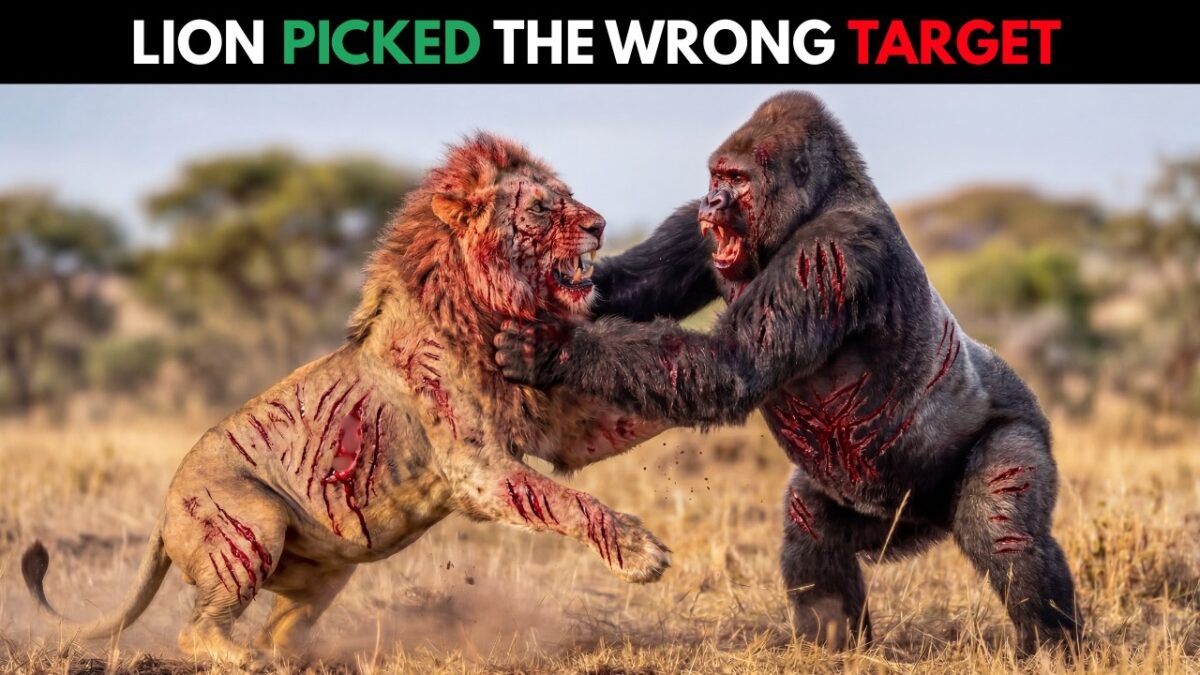
Themba and Malakai: The Boundary of Respect
There’s a moment that comes in the African wilderness when everything stops. The birds quit singing, the insects go silent, even the wind seems to hold its breath. It’s the kind of quiet that makes every living thing understand that something massive is about to change.
And on a steaming hot afternoon in the heart of the Congo, that quiet descended like a heavy blanket over everything. A young silverback gorilla, not quite full-grown yet, but already packed with muscle and attitude, was doing something he wasn’t supposed to be doing. His name was Themba, and he had just made a decision that would either make him a legend or end his life before it really started.
He had wandered away from his family group, separated himself from the protection of numbers, and found himself in a part of the rainforest he had never been before. He wasn’t looking for trouble. He was looking for food.
Specifically, he was looking for a grove of wild bananas that he had caught the scent of hours earlier. What he didn’t know was that he had drifted into the hunting grounds of something that made every other animal in that jungle nervous. He had walked into the territory of Malakai, a male lion in his prime, hungry, aggressive, and absolutely convinced that everything moving through his land was either food or a rival to be crushed.
Malakai was different from most lions. He was a loner, which made him dangerous in ways that a coalition lion could never be. He didn’t have brothers to back him up.
He didn’t have a pride structure to maintain. What he had was hunger and speed and the kind of killing instinct that comes from surviving on your own in a place where most solitary males don’t last long. He was maybe 8 years old in the absolute peak of his physical power, with a mane that was dark and thick and scarred from a hundred different battles.
He had been hunting since dawn, moving through the mixed forest territory that sat on the edge of his range, the place where the grasslands started to give way to thicker jungle. This was hunting ground he had claimed for himself, territory he had marked and defended against other males who got too ambitious. The prey was good here, buffalo, wild boar, occasional antelope.
Malachi could eat well if he was smart and fast and patient, but today his patience was wearing thin. He had chased a buffalo that morning and it had gotten away. He had spotted a group of antelope at midday and they had scattered before he could get close enough to matter.
He was hungry, he was frustrated, and he was looking for something that would answer the need burning in his stomach. When he caught the scent of the bay, he didn’t immediately know what it was. It was something large, it was something moving alone, and in Malachi’s world, those two things together meant one thing, opportunity.
He didn’t question what kind of animal it was or whether it was dangerous or safe. Those were the thoughts of a full belly. A hungry predator just sees prey.
Themba was completely unaware that he was being hunted. He had stopped in a clearing where a massive tree grew, its branches heavy with fruit that looked absolutely perfect for eating. He was so focused on the food, so intent on filling his stomach, that he didn’t catch the lion’s scent until Malachi was already moving into position, and by then it was almost too late.
The sound came first, not a roar, something worse, a low growl that seemed to come from the earth itself, the kind of sound that freezes your blood and tells your brain that something with teeth and claws has just decided you’re interesting. Themba’s head snapped up immediately. His eyes went wide.
For a split second, he felt something that gorillas don’t usually feel, real, immediate terror. Malachi stepped out of the tall grass like he owned the place, and maybe in this territory he did. The lion was huge, bigger than Themba had ever imagined an animal could be.
His mane made him look twice his actual size. His muscles rippled when he moved. Every part of him screamed power and danger and death.
What happened in the next few seconds would determine whether Themba lived to see his family again or whether this clearing would be his last place on earth. The young gorilla had a choice. He could run.
He could climb using the trees the way gorillas do when they want to escape or he could stand his ground. Themba stood his ground. It wasn’t bravery.
It wasn’t stupidity either. It was instinct pure and simple. Something in his genetics, something that had been passed down through thousands of generations of silverback gorillas who survived in a dangerous world told him that running meant death.
A lion could chase. A lion was faster. If Themba ran, Malachi would catch him from behind and it would be over in seconds.
Standing meant at least a chance. The young gorilla raised himself up on his hind legs stretching to his full height which wasn’t quite as tall as Malachi but was close enough. And then he did what young male gorillas do when they’re scared and trying not to show it.
He beat his chest. The sound was different than what Malachi expected. It wasn’t the sound of a smaller animal trying to intimidate.
It was a deep resonant drumming that seemed to come from everywhere at once. Combined with a series of rapid vocalizations that built in intensity, it created something that made even a confident lion pause. Malachi stopped his approach for just a moment reassessing.
This wasn’t prey like antelope. This wasn’t prey like buffalo. This was something that fought back.
But Malachi was hungry and hunger makes predators bold. He moved forward again slowly now understanding that this would not be a quick kill but confident that he was still the dominant animal in this clearing. He had killed bigger animals than this young gorilla.
Size wasn’t the only thing that mattered in a fight. Speed mattered. Teeth and claws mattered.
Experience mattered. What happened next was something neither animal expected. Themba charged.
Not a controlled advance. Not a show of dominance. A full speed charge.
A young silverback gorilla moving faster than something that size should be able to move. His arms raised, his face twisted with fear and aggression, his vocalization turning into something that sounded almost like a roar, but not quite. It was the sound of an animal that had decided that defending himself was worth the risk.
Malakai planted himself and prepared for impact. He lowered his body, angled his shoulders forward, got ready to take the collision and then respond with teeth and claws. He had done this before.
He knew how fights worked. He knew how to take impact and turn it into advantage. But what he didn’t account for was the sheer force of a charging gorilla.
When Themba hit him, it was like being struck by a living boulder. The impact knocked the lion backward, actually knocked him backward several feet, his feet skidding through the dirt. Malakai felt something he had never felt in a fight before.
He felt outmatched in terms of raw power. The young gorilla was already moving in again before Malakai could recover. Themba was using his momentum, his weight, trying to press the advantage.
One of his massive hands swung at the lion’s head, and Malakai barely managed to duck under it. If that hand had connected fully, it would have broken bones. Malakai responded the way he knew how to respond.
He twisted his body, opened his mouth, and tried to reach Themba’s throat. It was the move that worked against everything else, the move that could end this in seconds if he could just make it land. But Themba was already moving, pulling back, using his arms to block and parry.
The two animals engaged in a kind of combat dance, each one trying to find an opening that the other one wouldn’t give. For maybe 90 seconds, it was chaos, absolute chaos. A lion trying to use his teeth and claws, a gorilla trying to use his strength and reach.
Both animals breathing hard, both animals bleeding, both animals understanding that this could go either way. Themba took a swipe across his shoulder that burned like fire, drawing blood and creating a wound that he would carry as a scar for the rest of his life. Malakai felt the impact of a gorilla fist across his ribs that knocked the wind out of him and left a bruise that would ache for weeks.
Then something shifted. Themba caught Malakai with a strike that connected directly with the lion’s front leg. It wasn’t a killing blow, but it was enough to make the leg buckle slightly.
Enough to make Malakai understand that standing here and trading blows was not a winning strategy. Lions are predators. They’re designed to hunt prey that doesn’t fight back with equivalent force.
This gorilla was fighting back. This gorilla was hurting him. Malakai did something then that shocked Themba.
He backed away. Not in panic, not in defeat, but deliberately, measuring, reassessing. The lion moved backward until there was clear space between them, and he just stood there breathing hard, staring at Themba with eyes that were calculating something.
Themba stood his ground, still in a defensive posture, chest heaving, his shoulder bleeding, his body already understanding that it had just survived something it shouldn’t have survived. The two animals looked at each other across that clearing, and in that moment something passed between them. A recognition, an understanding that neither one was prey to the other, that this was a fight between two powerful creatures, and the outcome was genuinely uncertain.
Malakai made his decision. He turned and walked away. Not because Themba had beaten him, but because the cost of continuing was too high.
Lions, despite their reputation, are actually practical animals. They hunt prey that is worth hunting. When something starts costing more energy and risk than it returns in calories, a smart lion backs off and looks for something easier.
Themba watched him go, still in that defensive position, still ready to fight if the lion came back. But Malakai didn’t come back. The lion disappeared into the tall grass and the dense brush, and within minutes the clearing was quiet again.
The birds started singing, the insects resumed their sounds, the jungle settled back into normalcy, but everything had changed. Themba stayed in that clearing for another few minutes, his body processing what had just happened. He was alive.
He had faced the most dangerous predator in the region, and he was alive. His shoulder hurt. His body ached.
He was bleeding, but he was alive. And something had shifted inside him because of it. His fear had transformed into something else, something that felt almost like confidence.
When he finally moved to leave the clearing and head back toward his family, his movements were different. He was more alert, more defensive, more prepared. The experience of nearly being hunted, of fighting for his life, had imprinted something deep into his instincts.
From this moment forward, Themba would never again be a young gorilla who wandered unaware through the jungle. He would be a young gorilla who understood that danger was real, and that he had the capacity to survive it. The lion eventually settled in a shaded area about a kilometer away from the clearing.
His body was sore. His pride was dented, but more than that, something in him had been challenged. He had always operated under the assumption that he was the most dangerous thing in this territory.
He had always moved through the jungle with the confidence of something that was afraid of nothing. Now, he was afraid of a gorilla. Not terrified, not running away afraid, but wary, cautious.
And that was a new feeling for him.
Over the next few hours, Malachi hunted. He found a wild boar and killed it cleanly. The food took some of the edge off his hunger, but it didn’t take away the feeling that something in his world had shifted.
He had approached that boar with the same confidence he approached everything. The boar had run, as prey does. The boar had been killed, as prey is killed.
That’s how the world worked. That’s how it was supposed to work. But the gorilla had broken the rules.
Themba had made it back to his family group as the sun was getting lower in the sky. His mother was the first to notice his wound. She checked him immediately, running her hands across his shoulder, understanding instinctively that he had been in a fight.
The other members of the group crowded around him, concerned, protective. His mother didn’t ask him what happened. In gorilla society, you don’t really ask questions like that.
You understand through behavior and body language. And Themba’s body language was screaming that he had been in serious danger. The young gorilla spent the rest of the evening with his family, close to his mother, seeking reassurance through proximity.
His body was exhausted. His mind was spinning with adrenaline and relief and confusion. He had expected to be dead.
He had expected this to be his last day alive. Instead, he was here, with his family, hurting but alive.
That night, as the family settled down to sleep, Themba couldn’t stop thinking about the lion. The size of it, the power of it, the way it had moved with such certainty. But more than that, he couldn’t stop thinking about the moment when it had backed away.
That moment said something. It said that the lion had decided he wasn’t worth fighting. It said that even the most dangerous predator in the jungle had limits.
It was a lesson that would reshape how Themba understood his world.
Over the next 3 days, something subtle but profound started happening. Themba was more confident, not reckless. Confident.
He moved through the forest with a presence that the other young gorillas in his group were noticing. When he positioned himself near food sources, he seemed less defensive. When he interacted with other young males, there was something different about him.
There was something that said, “I have been tested and I survived.”
His mother noticed it. The other adult females in the group noticed it. There was a shift in how Themba carried himself.
He was still young. He was still learning how to be a gorilla, but something in him had aged rapidly. Something in him understood now that strength and courage meant something real.
Malakai, meanwhile, was dealing with his own aftermath. The wound on his ribs was bothering him. Not badly, but enough that it affected how he moved.
Every time he took a breath that went too deep, he felt it. Every time he twisted his body to the side, there was pain. It was a constant reminder of what had happened in that clearing.
But more significantly, something in his hunting behavior was changing. Without really making a conscious decision about it, Malakai was avoiding the area where he had encountered Themba. When his natural hunting patterns would have taken him toward that territory, he found himself going in different directions.
His brain was protecting him from another encounter with something that had proven to be dangerous. It’s important to understand that this wasn’t cowardice. This was actually the smart behavior of a predator that had learned something valuable.
Malakai had learned that not everything in his territory was food. Some things were threats, and a smart predator doesn’t keep attacking things that have already hurt it. A smart predator looks for easier meals.
A week after their encounter, something happened that neither animal could have predicted. Themba was moved from his family group. This wasn’t unusual.
Young male gorillas eventually leave their families to find mates and establish their own groups. In this case, Themba was still young for this kind of transition, but the opportunity had come up. There was a solitary several kilometers away who had recently separated from her group, and Themba’s family had made the decision to send him to try to establish a relationship with her.
It was the kind of decision that young male gorillas don’t get a say in. It’s just what happens. One day you’re with your family, and the next day you’re being encouraged toward unfamiliar territory with the expectation that you’ll figure things out and build a new family structure.
Themba made the journey on foot, moving through the rainforest with the skill that he had developed over his lifetime. And as he traveled, he was testing himself in new ways. He was moving with the confidence of someone who had already faced death and survived.
When he encountered a territorial barrier established by another gorilla family, he approached it with a boldness that a younger, less experienced gorilla would not have shown. He vocalized his presence. He made it clear that he was a young male with strength and courage.
Some families would have responded with aggression, but the family he encountered sensed something in Themba’s presentation. They sensed that this was not a young male to be easily dismissed, and they allowed him to pass through their territory with minimal conflict. It was a small thing, but it mattered.
Themba’s encounter with Malakai had given him something that would serve him well for the rest of his life. It had given him presence. It had given him the confidence that comes from having been tested.
Malakai’s life had taken a different turn. The territory he had claimed for himself was becoming harder to maintain. Other lions in the region, nomadic males who were looking for territory of their own, were beginning to test his boundaries.
This was normal behavior in lion society, young males constantly challenging old ones. It was how hierarchy was maintained and how the strongest genes got passed on. But Malakai was not quite old yet.
He was still in his prime. He should have been defending his territory vigorously, fighting off any challenger that came his way. Instead, he was becoming more defensive and less aggressive.
The wound on his ribs was healing, but it was healing slowly, and it was affecting his confidence in fights. Worse, other lions could sense that something had shifted in him. There’s a kind of body language that predators read in each other.
It’s not something they think about consciously. It’s just something they understand instinctively.
And other lions were reading in Malakai a message that said, “He’s not as certain as he used to be.
He’s been challenged and he’s not sure of himself anymore. Three weeks after his encounter with Themba, a young lion named Kari came into Malachi’s territory looking for a fight. Kari was about 7 years old, strong and ambitious, and convinced that he could take Malachi’s territory if he was willing to fight for it.
The confrontation that followed was brutal and it lasted nearly 20 minutes, which is a long time for a lion fight. Malachi won. He was still stronger and more experienced than Kari, but the victory was not as decisive as it should have been.
And more importantly, Malachi suffered more injuries than he should have. The fight left him with claw marks across his face, a bitten ear, and a general sense of exhaustion that went beyond the physical. He had won, but it had cost him.
And in the hierarchy of lion society, when a victory costs you that much, it sends a message. It sends a message that you’re vulnerable. It sends a message that the next challenger might be successful.
What neither Malachi nor Themba understood yet was that their single encounter was creating ripple effects throughout the entire ecosystem. Themba, moving with new confidence, was establishing himself in new territory and beginning to build a family group. The new female he had been sent to find became his mate and within months they had established a family unit.
Themba was becoming a silverback in his own right, leading his own group, making his own decisions. But more importantly, Themba was teaching young gorillas that he would eventually bring into his family would watch how he moved. They would observe his confidence.
They would learn through watching him that there was something possible that their instincts had previously told them was dangerous. They would learn that sometimes standing your ground worked better than running. Malachi’s situation had become increasingly complicated.
He had won the fight against Kari, but it had weakened him enough that within 2 weeks another challenger arrived. This lion named Jabari was even younger and more aggressive than Kari had been. The fight between Malakai and Jabari lasted only 15 minutes because Jabari was faster, more aggressive, and had not yet been tested enough to understand caution.
Malakai was defeated, not killed, but defeated thoroughly enough that it was clear to everyone watching that his time as the dominant male in this territory was over. The lion that had once been confident enough to hunt young gorillas alone was now being driven from his own territory by a younger male who hadn’t even been fully tested yet. What Malakai didn’t realize was that the confidence he had lost to Themba, the uncertainty that had taken root when a gorilla fought back instead of running, had spread through his entire behavior.
Every encounter after that had been affected. Every fight had carried with it the ghost of that clearing where a young gorilla had stood its ground. Themba, in his new territory, was doing something remarkable.
He was establishing a family structure that was different from typical gorilla groups. His mate was strong and intelligent, and instead of her being purely subordinate to him, he treated her more as a partner. He valued her input on where they should travel, what territories they should avoid, how they should move through the landscape.
When his first offspring was born, a young male that Themba named Kato, something incredible happened. Themba, carrying the memory of his encounter with Malakai, began teaching his offspring in ways that young gorillas weren’t typically taught. He took Kato near the boundaries of lion territory.
He showed him how to read signs of predator presence. He demonstrated, through his behavior, that danger could be understood and navigated without being constantly terrified. It was a kind of education that would have seemed insane to most gorilla families.
But Themba understood something that most gorillas never grasped. He understood that confidence came from knowledge, and that knowledge came from experience and teaching. Three months after his defeat at the hands of Jabari, Malachi was a completely different animal.
He was living on the edges of territories, moving through the landscape like a nomad, hunting smaller prey, avoiding confrontation. The lion that had once been confident enough to chase a young gorilla through the jungle was now the one being chased, being driven from place to place by lions that were younger and hungrier. He would eventually find a new territory in a place where he could establish himself with minimal conflict, but it would never be as good as the territory he had lost.
It would always be marginal, always contested, always a place where he had to be vigilant and careful. The irony was brutal. A single encounter with a gorilla that refused to be prey, a single fight where Malachi had backed away, had set in motion a chain of events that had completely altered his life trajectory.
He had gone from being a confident apex predator to being a marginal male struggling to find his place. Themba, by contrast, was ascending. His family was growing.
His confidence was being transmitted to his offspring. Other gorilla families in the region were beginning to acknowledge him as something special. There was something about the way he moved, the way he carried himself, that commanded respect.
Young male gorillas who encountered Themba understood instinctively that he was different from the typical silverback. He was someone who had been tested and had survived. Six months after that humid afternoon in the clearing, the territory around the boundary zone between grassland and rainforest had begun to change in ways that nobody working in the region could have fully predicted.
The changes weren’t dramatic. They weren’t the kind of thing that you’d notice if you just passed through once, but if you were paying attention, if you were studying the animals and documenting their behavior, the shifts were unmistakable. Other lions in the region had begun to hear about what had happened to Malachi.
Not through words, because animals don’t have words, but through behavior, through the way he moved now, through the way he carried himself with less certainty, through the way younger males could sense that he was vulnerable. Information travels through animal populations faster than most people realize. A lion sees another lion acting cautious about a particular territory, and through observation and instinct, it understands why.
A predator observes another predator backing away from a particular area, and it learns that there might be danger there. The story of Malakai and the gorilla had essentially become a teaching moment for every predator in the region. Themba’s family, meanwhile, was thriving in ways that caught the attention of the rangers who had been documenting the area for years.
The young silverback was ranging into territory that gorillas typically avoided. He was moving closer to the boundaries where the jungle thinned and the grassland began. Most gorilla families would have interpreted this as dangerous.
Most gorilla families would have stayed in the deep jungle where they felt safe, but Themba was teaching his family that the boundaries could be navigated. He was teaching them that standing your ground sometimes worked better than running. He was teaching them that intelligence and awareness could make a difference.
When his offspring encountered signs of lion presence, instead of immediately retreating, they would pause and assess. They would try to understand if this particular lion was a threat or just passing through. It was a fundamentally different way of being a gorilla.
The rangers began to notice something remarkable in their documentation. The gorilla population in the areas where Themba’s family ranged was showing different behavioral patterns than gorilla populations in other regions. They were ranging into mixed forest more frequently.
They were staying in open areas longer. They were demonstrating a confidence that young gorillas typically didn’t show. Dr. Samuel Maguire was one of those rangers.
He had been studying the wildlife in this region for 12 years, and he had detailed records of every significant behavioral change. He had documented the arrival of Themba’s family in the territory. He had documented the way they were changing how they moved through the landscape, and he was beginning to form a theory about why these changes were happening.
He believed that animals could learn from experience and transmit that learning to their offspring, not through genetics, which would take thousands of years, but through teaching and observation, through the way a young gorilla watches its father move confidently through dangerous territory and learns that this is possible, through the way a young lion observes an older lion avoiding a particular area and understands that there is danger there. What Mokwena was witnessing was behavioral evolution in real time. It was evolution that happened not through natural selection over thousands of years, but through learning and cultural transmission.
It was something that most scientists said wasn’t possible, but Mokwena had the data. He had the observations. He had documented proof that it was happening.
The changes in Themba’s family were profound, but they were subtle enough that they could be dismissed as anomalies. The changes in Malakai’s behavior were more obvious. He had essentially withdrawn from large portions of the territory he had previously controlled.
He was hunting in different areas. He was avoiding the boundaries where he had encountered Themba. His entire range had shifted, but something else was happening that was even more significant.
Other lions in the region, observing Malakai’s behavior, were beginning to avoid those same boundaries, not because they had personally encountered Themba, but because they understood, through watching an older lion’s caution, that there was danger there. A young lion named Jabari, the one who had defeated Malakai in combat, was establishing his own territory in a different area, away from the boundaries. He was choosing that location not because it was the best territory available, but because he was reading the signs that other lions were sending.
He was understanding that the area where Themba’s family ranged was not worth the risk. The result was something remarkable. The territory around the boundary zone, the mixed forest where the jungle gave way to grassland, was becoming a place of reduced predator pressure.
Lions were actively avoiding it. Gorillas, emboldened by Themba’s example, were using it more freely. The entire ecosystem was rebalancing based on the behavioral changes of two animals.
Buffalo herbivores began to notice the shift. Buffalo herds that had previously stayed in the pure grassland, in areas where they could escape lions through open running, began venturing into the mixed forest more frequently. They sensed that the predator pressure there had diminished.
Smaller herbivores, antelopes and wild boar and other creatures that formed the bottom level of the food chain, began grazing in patterns that took advantage of reduced lion presence. The changes rippled upward and outward in ways that affected dozens of species. Hyenas, which typically followed lions and fed on their kills, began changing their hunting and scavenging patterns because there were fewer lion kills in the boundary areas.
Leopards, which typically avoided areas where lions hunted frequently, began moving into the mixed forest more confidently because they understood that lion presence had diminished. A single encounter between a young gorilla and a hungry lion had essentially restructured the entire food web of the region. Themba was unaware of the magnitude of what he was creating.
He was just living his life, raising his family, teaching his offspring the lessons he had learned. But every day that he moved confidently through the boundary areas, he was sending a message to every other animal in the region.
He was saying, “This space is livable.
This space is survivable.
This is territory that can be used without constant fear.”
His offspring, watching him, were learning this lesson without needing to experience the trauma of a near-death encounter. They were learning it through observation, through imitation, through the way evolution really works at the cultural level, not at the genetic level. By the end of that first year, Themba’s family had expanded.
His mate had given birth to a second offspring, a female that Themba named Amara. There was also another young male who had recently joined the family, drawn by the strength and confidence that Themba was demonstrating. The young silverback was becoming a patriarch in the truest sense.
He was not just ruling through dominance and aggression, he was leading through example and wisdom. The rangers who were documenting all of this were becoming increasingly convinced that they were witnessing something revolutionary. They were watching animal intelligence in action.
They were watching animals learn from experience and apply that learning in ways that benefited their entire family group. Malachi’s second year in his diminished territory was a constant struggle. The lion was not thriving.
He was surviving, but barely. His hunting success rate had dropped by nearly 40% compared to his glory days. He was thinner.
He was scarred. He was a shadow of the confident predator he had once been. But something interesting was happening with younger lions who encountered him.
They could sense his vulnerability. Yes, but they could also sense something else. They could sense that he had experience, that he had survived things, that he carried knowledge even if he no longer carried the confidence that had once defined him.
A young lioness named Zuri approached Malachi one afternoon when he was resting near a watering hole. She was perhaps 2 years old, independent but not yet fully established in territory of her own. She positioned herself near him, but not threateningly.
It was the kind of positioning that suggested, “I respect your experience, even if you’re no longer in your prime.”
Malachi recognized this. In lion society, there’s a kind of understanding between older males and younger females. The older male has survived.
The younger female wants to learn from survival. They exchanged looks, and in those looks was a kind of communication that went beyond words. Over the following weeks, Zuri began to follow Malakai, not in a romantic or sexual way, in a learning way.
She watched how he hunted. She observed what territories he avoided. She learned through watching him where the dangers were.
When Malakai encountered another predator or competitor, she would position herself to observe how he responded. When he showed caution about a particular area, she would understand through his example that caution was justified. It was a form of mentorship that happened without intention.
Malakai was not trying to teach Zuri anything. He was just living his life, but his living, his choices, his movements were teaching her nonetheless.
By the time Zuri eventually established her own territory, she carried with her the knowledge that Malakai had given her. She understood without needing to experience it directly that certain boundaries were important, that certain areas required caution, that sometimes backing away from a fight was wisdom rather than cowardice. She also understood something that would define how she hunted for the rest of her life.
She understood that not everything moving through the jungle was prey. Some things were threats, and the intelligent predator learned the difference. Back in Themba’s territory, something remarkable was happening with his offspring.
Kato, the young male, was demonstrating capabilities that young gorillas typically didn’t show until much later in life. He was able to navigate the boundary areas with confidence. He was able to read signs of predator presence and respond appropriately.
He was able to do all of this without the trauma of a near-death experience because his father had taught him. More remarkably, Kato was beginning to challenge his father in small ways. This was normal behavior for young males.
Eventually, they would need to leave and establish their own families. But the way Kato was challenging Themba was different from typical young male behavior. He was challenging him intellectually.
He was questioning decisions. He was testing whether his father’s wisdom was actually wisdom or just habit. Then Bay responded to these challenges the way a truly confident leader responds.
He didn’t crush Kato’s independence. He didn’t respond with overwhelming displays of dominance. Instead, he engaged with his son.
He explained his reasoning through behavior and example. When Kato wanted to venture into a particular area, Themba would sometimes allow it and Kato would discover the danger himself. Other times, Themba would prevent it and Kato would have to trust his father’s judgment.
It was a form of parenting that was unusual among gorillas. It was creating a young male who would be not just strong, but intelligent. Not just physically capable, but strategically sound.
The rangers who were observing all of this were becoming more and more convinced that they needed to publish their findings. What they were documenting was not just unusual animal behavior. It was a fundamental challenge to how scientists understood animal intelligence and learning.
Dr. Makwela began writing a paper.
He titled it “Behavioral Evolution Through Cultural Transmission: A Case Study of Learning and Adaptation in Gorilla and Lion Populations”.
The paper detailed the encounter between Themba and Malakai. It documented the behavioral changes that had followed. It presented evidence that a single significant experience could alter the behavior of not just one animal, but entire populations.
The paper was immediately controversial. Some scientists dismissed it out of hand. Animals didn’t learn and teach like that.
Animals were slaves to instinct. The idea that a gorilla could learn from a near-death experience and then deliberately teach that learning to its offspring seemed absurd to many in the scientific community. But other scientists were intrigued.
They began looking at their own data, their own observations, and they started finding similar patterns. Animals were learning. Animals were adapting.
Animals were transmitting knowledge across generations through behavior and example. What had started as a single encounter between a young gorilla and a hungry lion was becoming the foundation for a paradigm shift in how scientists understood animal behavior. Themba himself was unaware of any of this academic discussion.
He was just living his life, but his life, his choices, his teaching were having impacts that rippled far beyond his family. Young gorillas from other families observing how Themba’s family moved were beginning to adopt similar patterns. Other silverbacks, seeing Themba’s success, were beginning to question whether the traditional way of keeping families strictly in deep jungle was actually the best strategy.
A subtle shift was beginning in gorilla behavior across the entire region. By the second year after the encounter, Malakai was in his final phase of life as a dominant predator. He was aging.
The constant stress of defending diminished territory was taking a toll. His body was wearing down in ways that he couldn’t reverse. He was still respected by other lions, still treated with deference based on his experience, but he was no longer a threat to younger males who wanted territory.
When Jabari, the young lion who had defeated him, encountered Malakai one afternoon near a watering hole, neither animal showed aggression. Jabari had claimed his own territory. He had nothing to prove to Malakai anymore, and Malakai understood that trying to reclaim what he had lost was not a battle he could win.
They shared the watering hole. It was a moment of peace between two predators who had once fought for territory and dominance. And in that peace was a kind of wisdom that went beyond the simple hierarchies of predator and prey.
Themba’s family continued to expand and thrive. His mate had given birth to a third offspring. The young male that had joined them had fully integrated into the family structure.
The female offspring, Amara, was beginning to show signs of leadership capability that surprised observers. She was confident in ways that young females typically weren’t. She was making decisions about movement and feeding that the family was following.
She was becoming something that was not quite a silverback, but something powerful nonetheless. The rangers were beginning to understand that what they were witnessing was the emergence of a new family structure, not the traditional hierarchy of a single dominant male ruling through aggression, but something more collaborative. Something where intelligence and wisdom were valued as much as physical dominance.
Three years after that moment in the clearing, the territory had transformed into something that nobody working in the region would have believed possible just a few years earlier. The boundary zone between jungle and grassland had become a place of genuine equilibrium. Lions still lived in the grassland, gorillas still lived in the jungle, but both species now understood something fundamental about each other.
They understood that coexistence was possible. They understood that respect for boundaries was preferable to constant conflict. Zemba was now in his full strength as a silverback.
He was larger than when he had encountered Malakai, more confident, more established. But the scar on his shoulder remained, a permanent reminder of the day a hungry lion had changed everything. That scar had become something meaningful in his family structure.
Young gorillas who joined his group would see that scar, and through it they would understand that their leader had survived something that most gorillas never survived. His offspring were thriving. Kato, the oldest, was showing every sign of becoming an exceptional silverback himself.
He possessed his father’s confidence, but with an added element of wisdom that came from being taught rather than forced to learn through trauma. When other young males encountered Kato, they sensed something in him that made them cautious. They understood that this was not a young male to be easily challenged.
Amara, the female offspring, had continued to demonstrate leadership capabilities that were unusual for her sex. She was not a silverback. She would never have the physical dominance that came with maleness, but she had something else.
She had strategic thinking. She had the ability to read situations and make decisions that benefited the family. When her mother eventually aged out of leadership, when her father’s dominance eventually passed to Kato, Amara would continue to play a crucial role in how the family moved through the world.
The third offspring, a young female named Zara, was developing personality traits that were distinct from her siblings. She was curious in ways that her father had been. She wanted to explore.
She wanted to understand the boundaries of her world, and because her father had taught her that boundaries could be navigated with caution and wisdom, she was able to pursue this curiosity without the crushing fear that kept most young gorillas confined to the safety of deep jungle. Malachi had settled into a role that he never expected to fill. He was no longer a dominant predator.
He was no longer the undisputed king of his territory, but he had become something arguably more valuable. He had become a teacher. Young lions, female and male, sought him out.
They wanted to learn from him. They wanted to understand how a lion that had survived so much remained so confident despite his diminished status. The lion that had once tried to hunt Themba was now spending his days mentoring the next generation of predators.
He taught them where to hunt. He taught them how to read prey behavior. He taught them about respecting boundaries and understanding that some prey items were too dangerous to be worth pursuing.
He taught them, through his own example, about resilience and adaptation. Zuri, the young lioness who had first approached him years earlier, had established her own territory and begun producing offspring. Her cubs were born with an understanding of caution around the mixed forest boundaries that their mother had learned from watching Malachi.
They had never encountered a gorilla. They had never experienced the kind of fear that came from a failed hunt, but they understood through observation and imitation that certain areas required respect. The knowledge was spreading.
It was becoming encoded in the behavior of multiple animal populations. Young lions from different family groups were learning about the boundary zones through interactions with lions who had learned through Malachi’s teaching. Young gorillas from families that had no direct connection to Themba were beginning to adopt similar movement patterns because they observed other gorillas behaving that way.
It was evolution happening in real time, not genetic evolution which would take thousands of years, but behavioral evolution, cultural evolution, the kind of change that happens when intelligent creatures learn from experience and teach that learning to others. Dr. Maguire’s paper had finally been published in a respected scientific journal. It had sparked considerable debate in the academic community.
Some scientists still dismissed his findings, but others were beginning to take them seriously. Universities were sending researchers to study the territory. Documentary filmmakers were approaching the rangers wanting to capture the story on screen.
What had started as a single encounter between a young gorilla and a hungry lion was becoming international news in scientific and wildlife circles. The story of behavioral learning and cultural transmission was capturing the imagination of researchers around the world. But for Themba and Malachi, for all the animals living in that territory, the academic discussion was irrelevant.
What mattered was survival. What mattered was that they had found a way to coexist. What mattered was that families were thriving, that knowledge was being transmitted, that the next generation would inherit not just genes, but wisdom.
When Themba encountered Malachi at a watering hole one afternoon in the third year, neither animal showed aggression. The young gorilla had grown into his full power. The aging lion was still impressive, but clearly in decline.
They looked at each other across the water, and in that moment was an understanding that went beyond predator and prey. In that moment was recognition, respect, a kind of gratitude that neither animal could articulate, but both could feel. Malakai had lived longer than most male lions do.
His body was failing. His strength was diminishing, but he had lived long enough to see the consequences of that single encounter with Themba. He had lived long enough to watch younger lions learn from his caution.
He had lived long enough to see an entire ecosystem shift based on the wisdom he had learned the hard way. Themba had lived long enough to see his family thrive. He had lived long enough to watch his offspring develop into capable individuals who could navigate their world with intelligence and confidence.
He had lived long enough to understand that the scar on his shoulder was not a mark of trauma. It was a mark of transformation. The territory around the boundary zone had settled into a pattern that was stable and productive.
The buffalo herds that had learned to use the mixed forest more frequently were thriving. The smaller herbivores that had sensed the reduced predator pressure were reproducing successfully. The entire food web had rebalanced itself around the behavioral changes of two intelligent creatures.
Researchers studying the territory would eventually document something remarkable. They would find that the herbivore population in the boundary areas was significantly higher than in comparable territories where lions still hunted aggressively. They would find that gorilla family sizes in the region were larger and healthier than in other areas.
They would find evidence of behavioral transmission across multiple generations. Most importantly, they would find proof that a single significant experience, a moment when two apex predators met and learned something from each other, could create cascading effects that reshaped an entire ecosystem. Themba lived to be 27 years old, which is a long life for a gorilla.
Malakai lived to be 15, which is approaching the maximum for a wild lion. Both died naturally, their bodies giving out after years of survival in one of the most challenging environments on earth, but their legacies lived on. Cato established his own family group, maintaining his father’s philosophy of intelligent caution around the boundaries.
He had offspring of his own, and he taught them what his father had taught him. The knowledge continued to transmit across generations. Young gorillas who had never even been to the boundary zone understood, through cultural learning, that certain areas could be negotiated with intelligence and caution.
Zuri’s offspring established territories of their own, and through observation and learning, they maintained the respect for gorilla territory that their mother had learned from Malakai. The understanding that some prey items were too dangerous, that some territories were not worth controlling, became part of the behavioral inheritance of multiple lion families. The story eventually reached the ears of conservationists and wildlife protection organizations.
It became evidence that animals were capable of learning complex behaviors and transmitting that learning across generations. It became a demonstration that peaceful coexistence between apex predators and other species was possible when both sides understood the costs of conflict and the benefits of mutual respect. Scientists would continue to study that territory for decades.
They would write papers about it. They would teach it in universities. They would use it as evidence that animal intelligence was far more sophisticated than anyone had previously credited.
But, the real story was not for academic journals or scientific conferences. The real story was in how a young gorilla had stood his ground when he should have died, how a hungry lion had backed away when he should have killed, how that single moment of mutual recognition had created a new way of being in the world. The African wilderness remained harsh and unforgiving.
It remained a place where strength and intelligence were essential for survival, but it also became a place where something else was possible. It became a place where respect could exist between predators and prey, where boundaries could be understood without constant violence, where coexistence could emerge from conflict. In the end, that was the greatest lesson that Themba and Malakai taught everyone watching.
Not that the strong should dominate the weak, not that predators should rule and prey should submit, but that intelligence, wisdom, and respect for boundaries could create something better than simple dominance. They could create equilibrium. They could create peace.
And in a world as brutal and unforgiving as the African wilderness, peace was everything. Peace meant families could thrive. Peace meant knowledge could be transmitted.
Peace meant the next generation would inherit not just survival, but the possibility of flourishing. Themba and Malakai were just two animals, but their encounter, their moment of mutual recognition in a clearing where a young gorilla refused to be prey, and a hungry lion understood the cost of forcing the issue, changed everything. It changed the territory.
It changed the ecosystem. It changed how multiple animal populations understood their world. And it proved something fundamental about intelligence, learning, and the possibility of coexistence even in the most challenging circumstances.
The story of the young gorilla and the hungry lion did not end with their deaths. It continued in the behaviors of their offspring. It continued in the choices that other animals made based on what they had learned.
It continued in the transformed territory where peace had emerged from conflict. And it continues still in the way researchers understand animal behavior, in the way conservationists approach wildlife management, in the way people around the world understand that intelligence and wisdom in the animal kingdom are far more sophisticated than anyone had previously imagined. That humid afternoon in the clearing, when a young gorilla stood his ground and a hungry lion backed away, was not just a moment.
It was the beginning of something that would reshape an entire world, one intelligent choice at a time.








