A Boy Was Found on the Ice Off Mackinac in 1889 — What He Told the Keeper About the Ones Below
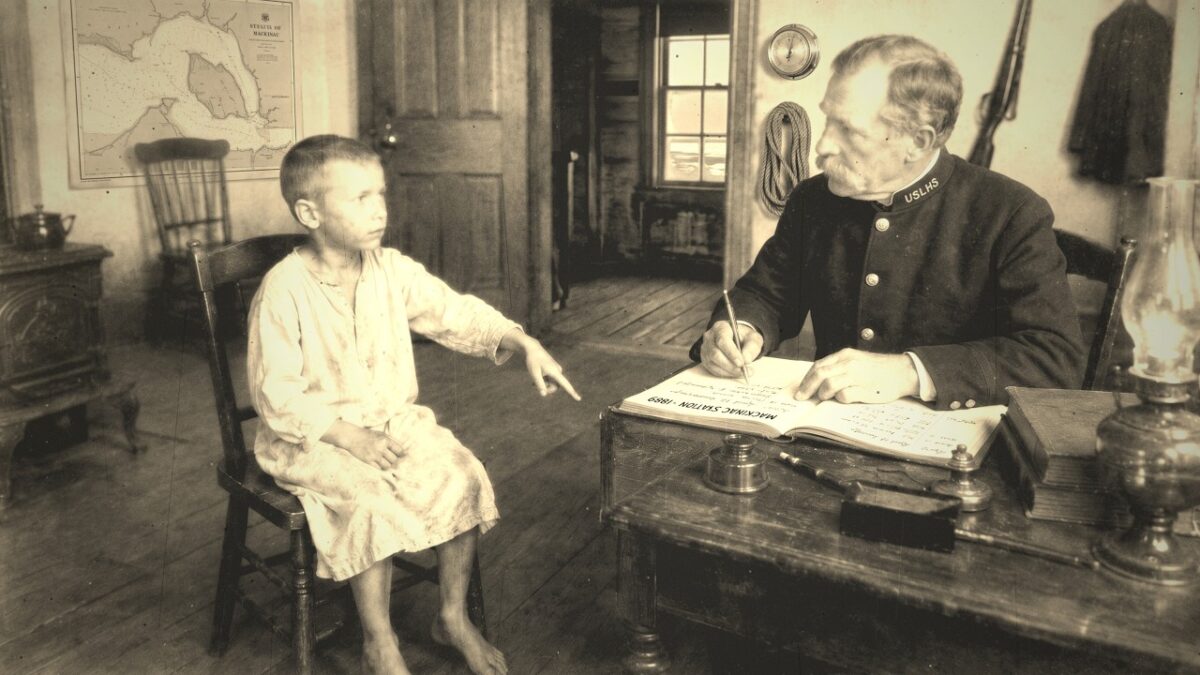
In the last week of February 1889, a male carrier named Abselandre was driving a horse and sleigh across the ice of the Straits of Machinar, following the line of cut cedar saplings that the men of the island planted every winter to mark where the ice was thick enough to hold when the horse stopped in the middle of the crossing and would not go another step. Dre got down swearing at the animal and walked around to take its head. And that is when he saw the boy sitting on a hummock of pressure ice about 40 yards off the marked line out where nobody walks.
The child was perhaps 8 years old. He was wearing a shirt and a pair of woolen trousers, both of them soaked through and frozen stiff at the cuffs, and no coat and no boots and no cap. His hair had been cut close to the scalp with something that had not been sharp.
The air that morning was 9° above zero with a wind off the open water to the east. And when Dre started toward him across the ice, the boy did not run and did not cry, and did not so much as turn his head until the man was almost on top of him. Then he looked up, and in a voice that Dre later described to three separate people as being perfectly ordinary, as if the two of them had met on a street in town.
He asked whether the ice had closed yet, Dre said he did not understand the question. The boy said it again patiently. The way a child repeats something to an adult who is being slow.
He asked whether the ice had closed all the way across and whether the ones below were still able to come up. There had been no wreck. That is the first thing that has to be said because it is the thing every person who has ever looked into this case has tried and failed to get around.
No vessel was overdue anywhere on the straits. No vessel could have been. The straits of Machina in the last week of February 1889 were frozen from Point Lab to the island and out past Round Island in a hard ice year with teams crossing daily and a marked road of cedar saplings that had been in place since the first week of January.
There was nothing on that water to fall off of. There had not been for 7 weeks. No child had been reported missing on Machenar Island or in St. Ignis or in Macheno City or anywhere in EMTT or Chboan or Machenar County.
There was no family looking. There was no notice posted. In a region where everybody knew everybody and where a missing child was the kind of news that traveled 40 miles in a day, nobody was looking for that boy.
And what he told the lightkeeper at Old Machinar Point over the 11 days that followed was written down. All of it at length on separate sheets by a federal employee with 14 years of service and a clean record and it was sealed and forwarded to the district office at Detroit in a packet with a covering letter. The packet was received.
The receipt is logged with a date and a clerk’s initials. There is no copy of what was inside it anywhere in the world. This is the story of that boy and of the four men who tried to find out where he came from and of what happened to each of them.
And by the time we are done, you are going to understand something worse than the fact that the record was destroyed. You are going to understand that somebody had a procedure ready for him before he ever came up out of the ice. To understand any of this, you have to understand the straits of Machinar in winter because the modern version of that place bears almost no resemblance to what it was in 1889.
Today, there is a bridge. 5 miles of suspension steel opened in 1957, carrying cars between the two peninsulas of Michigan in about 8 minutes. In 1889, there was nothing.
There was the water, and the water was the entire world of everyone who lived on either side of it. The straits are the narrow place where Lake Michigan and Lake Huron meet. And in the shipping season, every vessel moving between the two had to come through them, which is why the government had put a light at Old Machina Point, and a life-saving station within reach and a fog signal that could be heard for miles in thick weather.
In the season, it was one of the busiest stretches of water in the interior of the continent. And then the ice came, and it all stopped. Navigation closed.
The lights were extinguished for the winter. The orboats and the grain carriers went into layup in the harbors down the lakes. And the people of Machina Island, several hundred of them, along with the people of Saint Ignas and the small settlements along both shores, were cut off from the outside world by a sheet of ice that was too thick for a boat and in the wrong week, too thin for a horse.
What they did about it is one of the more remarkable things about that place, and they still do it today. Every winter once the ice had made, the men of the island went out with axes and cut down the discarded Christmas trees and any spare cedar they could find. And they walked the ice out toward the mainland, testing as they went, and they planted those trees upright in the snow in a line.
A green road across the white, two or 300 trees long, marking the one path where the ice had been sounded and found to hold. That was the ice bridge. It was how the mail moved.
It was how a doctor got to a sick child on the other side. It was how a man in St. Ignis got to a funeral on the island. And the rule about it, the rule that every single person on that ice understood in their bones was that you did not leave the trees.
You did not cut a corner. You did not walk out to look at something interesting. You did not step off the marked line for any reason because the ice out there was not the ice under your feet.
The straits have a current running through them and that current works at the underside of the ice all winter and there are places 200 yards apart where one is 4t thick and the other is 4 in and there is no way to tell by looking. Every year somebody went through every family in that country had a story about it. So when a male carrier finds a boy sitting on pressure ice 40 yard off the treeine in 9° weather soaked to the skin alive that is not a rescue story.
That is an impossibility with a horse standing next to it. Dre got the boy into the sleigh and wrapped him in the mail blanket and drove for the mainland shore which was closer than the island. And at about 10 in the morning, he pulled up at the light station at Old Machar Point and hammered on the door of the dwelling.
The keeper there was a man named Josiah Fen. Fen was 43 years old and had been in the United States Lighthouse Service for 14 years, five of them at that station. He was a verter by birth who had come west after the war and had never gone home.
He had a wife, Hesper, and two daughters, both grown and married on the island. And in the winter, with the light dark, and the station on caretaker status, there were the two of them alone in the dwelling from December until the tender came in April. His log books survive from three postings, and they are exactly what the service wanted them to be.
Small upright handwriting, no adjectives. Weather at six, wind direction and force, barometer, wick, trimmed, oil consumed to the quarter gallon, vessels passing, upbound and downbound by name where the glass would read them. In 14 years of writing in a government book every single day, Josiah Fen recorded exactly one personal opinion and it is four words long and it was written on the 22nd of February 1889.
The entry for that day begins in the ordinary way. Weather clear wind northnortheast force 2 barometer 30.14 station in good order. Then Dre has brought a child.
God knows from where. The first thing anybody noticed about the boy once they had him inside by the stove was that he was not cold. Hesperen stripped the frozen clothes off him, expecting to find what a person finds on a child who has been outside in 9° weather in wet wool.
Blue lips, gray fingers. The skin of the feet gone waxy and white. She found none of it.
His hands were warm. His feet were warm. He did not shiver.
Not once, not then, and not at any point in the 11 days he was in that house. His color was good. When she put him in a chair by the stove, he sat where he was put, and did not lean toward the heat, which is the detail she came back to over and over again in later years, because every cold child she had ever handled, and she had handled a great many in a place where children fell through ice, had gone for the stove like an animal.
This one sat where he was put, and looked at the fire the way a person looks at a picture of a fire.
The doctor came the next morning from Machinor City. His name was Enoch Salt and he was 51, trained at Ann Arbor, 23 years in practice, and he had served for a decade as the coroner’s physician for the county, which meant he had opened a great many people, and was not sentimental about the human body. His notes on the boy do not survive in any district file.
They survived because in 1904, 15 years later, Sult wrote a paper for a small regional medical society. A paper he read aloud at a meeting in Grand Rapids to about 40 men and then published in the society’s proceedings in which he described the case in detail without naming the child, the station, or the county. The proceedings of that society sat unread in a university medical library until a graduate student found them in 1974.
Salt’s examination is the reason this case is not simply a strange story from a strange winter. He recorded a healthy male child of approximately 8 years, nourished, well-formed, reflects his normal. He recorded no immersion injury of any kind, and he was specific about what he meant by that, because he knew his audience would object.
He wrote that there was no masseration of the hands or feet, no wrinkling of the skin, which begins within an hour in cold water, and which he stated flatly he had never once failed to find on a person recovered from the straits, alive or dead. He recorded no frostbite, not in the fingers, not in the toes, not in the ears, not at the tip of the nose. He noted that this alone would have made the case worth reporting and that he had considered the possibility that the child had been outside only briefly and had rejected it because the boy’s clothing was frozen through which takes hours.
He recorded that the boy had no scars, not one. And he made a point of this in the paper, writing that in 23 years of practice in that region he had never examined a working child of 8 years who did not carry a dozen. from stoves, from tools, from animals, from rope, from ice.
A child in that place, and that decade was a scarred child by the age of five. This one had skin, Soap wrote, like something that had been kept indoors its whole life. And then he recorded the one, finding that he could not place at all, and that he described in the flattest possible language, and that has been the center of this case ever since.
Running down the boy’s breast bone from just below the notch of the throat to the level of the lowest rib was a vertical line of seven small circular marks. They were pale, paler than the skin around them. Each was about the diameter of a pencil.
They were evenly spaced, the distance between any two of them the same as between any other two, to within what Saul could measure with a rule. They were old. That is the part he underlined in his own manuscript.
They were not injuries. They were fully healed and had been healed for years. And from the way the tissue had stretched with the child’s growth, Salt estimated that the marks had been made when the boy was an infant, and that they had been made one at a time at intervals over a period of months.
Seven marks made one at a time on a baby, and spaced with a regularity that no accident and no illness produces. The boy did not speak. For the first 14 hours he was in the keeper’s dwelling.
He was not sullen about it. He answered nothing and refused nothing. Hespen gave him bread and a bowl of soup and he ate it slowly, methodically, every crumb in careful small mouthfuls with the manners of a much older person.
When she took the bowl, he watched her carry it away. When Josiah Fen asked him his name, he looked at the man with what Fen recorded as a patient expression and said nothing at all. He slept that night in the daughter’s old room.
Hesper checked him twice. Both times he was lying on his back with his arms at his sides, perfectly straight, eyes open, looking at the ceiling. The second time she asked him whether he was all right, and he said the first words he had spoken since the ice.
He asked her whether the house was on stone or on sand. She said she did not know which was true, and asked him why he wanted to know, and he said that it mattered a great deal in the spring, and not at all in the winter. and then he closed his eyes and so far as she could tell went to sleep.
The next morning he began to talk and once he began he answered every question put to him promptly and completely for 11 days. He gave a first name Callis. He would not give a surname and when Fen pressed him he said that they would have it written down at the office and that it was not for him to say which is an unremarkable thing for a grown man in a bureaucracy to say and a very strange thing for a child of eight.
He said he had come off a vessel. He gave her name, the Elanora Mott, and her rig, which was a two-masted schooner, and her approximate length, and the name of her master, and the names of six men who had been aboard her. He gave all of it flatly and correctly, and slightly too fast, in the manner of something learned by heart, because somebody had made him learn it, and when Fen asked him what had happened to the vessel, the boy said that nothing had happened to her, Fen asked where she was.
The boy said she was still down and that she was where she had always been and that this was not a problem and that nobody should be sent to look for her. Then he asked for the second time whether the ice had closed all the way across. Then said that it had weeks ago and that a man could drive a team from the island to the mainland and had been doing so since the first week of January.
and the boy nodded the way a person nods at an answer he already expected and said that this was why he had been sent up now because the ones below could not come up while the ice was closed and somebody had to be on the surface before the Thor and he was the smallest so it was him Josiah Fen asked him what the ones below were and the boy this is in Fen’s own writing in the account that survived and it is the sentence that everybody who has ever read this case remembers the boy said that it was not a Fair question because the ones below were not a what. He said they were an arrangement. The Eleanor Mott was a real vessel.
That is the first thing Josiah Fen found out and he found it out fast because he was a careful man and there was a life-saving station within reach that kept the district’s shipping lists. And he walked down there on the second day and asked to see them. She was a two-masted schooner.
She had been on the registry. Her dimensions and her rig matched what the boy had said closely enough that any clerk with the book open in front of him would have had no objection to make. She had been lost with all hands in the autumn of 1861, 28 years before that boy was picked up off the pressure ice.
She had cleared a harbor on the Wisconsin shore in fair weather in October with a crew of seven and a cargo of pig iron bound for the straits and she had not arrived and no wreckage of her was ever recovered and no body was ever recovered. And in the way of those lakes in that decade after a few weeks of asking everybody stopped asking. The master’s name the boy gave was correct.
Five of the six crew names he gave appear on the list filed with the collector of customs in 1861. The sixth does not. The sixth is the boy’s own first name with a surname that appears nowhere in the shipping records of that year or any other.
Fen wrote to the district office at Detroit on the 24th of February. He wrote a careful letter. He did not speculate in it.
He set out the circumstances of the discovery, the physical condition of the child, the fact that no family had reported a missing boy in three counties, the name of the vessel, and the date of her loss. and he requested instructions on the disposition of a minor found on the ice within the bounds of his station. He received a reply by the 7th of March, which is fast for that era and that distance, and the reply is one of the few documents from this case that survives in an archive where anybody can go and look at it.
It is two sentences long. It instructs the keeper to retain the minor at the station, pending the arrival of authorized personnel, and to make no further communication regarding the matter by open letter. by open letter, which means that somebody at a desk in Detroit reading a letter from a lighthouse keeper about a child on the ice decided in the time it took to dictate two sentences that this was a subject that should not go through the mail.
There is a man who has to come into this story now and he is the reason we know as much as we do and he is also the first of the four to die. His name was Ivar Kettle. He was 71 years old in 1889 and he was by the reckoning of everybody in that country the oldest working ice fisherman on the straits.
Kettle had been born on the Canadian side and had come across as a young man and had spent 50 years going out onto that ice with a spud bar and a hand line. He knew the straits ice the way a farmer knows a field. Where it made first, where it went rotten early, where the current cut at it from below, which years it would hold a team, and which years it would only hold a man on foot.
Josiah Fen sent for him on the third day, because Fen had a boy in his parlor talking about the ice closing, and Ivar Kettle was the only person within 50 mi who might know what that meant.
Kettle came on the fourth day. He sat with the boy for about 2 hours in the front room of the keeper’s dwelling with the door shut, and Hesper Fen, who was in the kitchen the whole time, said afterward that she heard almost nothing. The old man’s voice low and steady, the boy answering in short pieces and long silences in between.
When Kettle came out, he asked Josiah Fen for a drink, which Fen said he had never once known him to do at that hour, and then he sat down at the kitchen table and told the keeper what he had never told anybody outside his own family. He said his father had told him about the arrangement. He said it was an old thing on that water, and that it had a name in his father’s language, and that he was not going to say the name in that house with the boy in the next room.
And he said that what it came down to, stripped of everything his father had wrapped around it, was a count. Kettle’s account, as Fen wrote it down that night, runs to about four pages in the surviving copy, and it is worth going through carefully because everything that happens for the rest of this story is a consequence of it. He said that there was something under the straits, not in the water, under it.
He said his father had described it as a place and had been very insistent on the word and had said that it was not a cave and not a wreck and not a hole in the bottom, but a place that had been made by somebody a very long time before any European came into those lakes and probably a very long time before anyone else did either. He said the place had people in it. He would not use the word people without qualifying it.
And the qualification he used, according to Fen’s transcription, was that they had been people once, and that the arrangement was what they had instead of being people now. Fen pressed him on that, because it is the kind of sentence a man of 14 years in a federal service does not simply write down and move past, and Kettle’s answer is one of the four pages. He said that his father had never described them as dead, and had corrected him sharply the one time he had used the word as a boy.
He said his father’s position held all his life and never argued for was that dead was a condition that belonged to the surface and that it required somebody up here to know about it and to write it somewhere and to put a stone up. He said that a man who goes into the straits in November and is never found and is never entered anywhere is not dead in that sense. He is only gone and gone in his father’s account was not a smaller thing than dead.
It was a different thing entirely, and it was the thing the arrangement ran on. And he said that the arrangement was this, a number was fixed. He did not know how or by whom or when, but the number of them that could be below at any time was fixed, and the number could not be exceeded, and it could not be short.
When one of them came up, one had to go down. When one went down, one could come up. The count had to balance, and it had to balance continuously.
And the entire purpose of everything his father had ever told him about that water came down to one practical instruction which was that the people on the surface should never do anything that made the count go wrong because when the count went wrong it did not stay wrong. It got corrected. Fen asked him how a person on the surface could possibly affect a count like that.
And Kettle said that his father had given him three rules, and that he had followed them for 50ish years without ever once needing to know why, and that they were these. You do not go under the ice. You do not bring up what has gone down, and you do not take a body out of that water and put it in the ground.
Fen asked about the third one because it was the strangest and because everybody on that shore did in fact recover bodies from the water when they could and bury them in consecrated ground and always had. Kettle said that was exactly the trouble. He said the count had been kept without difficulty for as long as anyone in his family had known about it in the days when a man who went into the straits stayed in the straits because the lake kept what it took and nobody argued with it.
And he told Fen to think for a moment about what that actually meant on that particular water because people who had not grown up on it never did. He said that on the ocean a drowned man comes back. He said every coastal people on earth has funeral customs built around the fact that the sea returns what it drowns usually within the week, usually close to where it took him, and that this is so ordinary that nobody thinks about it as a fact of nature at all.
He said the lakes are not like that. He said he had personally known of 11 men lost off the straits in his own working life and had seen exactly two of them again and both of those had gone in close to shore in warm months. He said the rest were still out there and that everybody on both shores knew it and that the wives and mothers of those men had held services over empty ground and had understood perfectly well that the ground was empty.
And he said that his father’s generation had not regarded that as a tragedy so much as a settlement. The lake took and the lake kept and the count stayed even and the people on the surface got on with their lives. Then came the divers and then he said the lakes filled up with steamers and dredges and divers and salvage crews and men with grapples and men with insurance policies and everything changed.
Cargo got raised, hulls got raised, bodies got recovered, dragged for, grappled for, brought up weeks and months and sometimes years afterward and taken out of the water and put in a churchyard. And Kettle said in the sentence Fen underlined in his own transcription that every single time that happened, somewhere under the straits the count came up one short, and the count did not stay short. Fen asked him the obvious question, which is the one anybody would ask, and it is to his credit that he asked it, and wrote down the answer without softening it.
He asked how the correction was made. Kettle said his father had not known, and that he did not know either, and that the only thing he had ever been told about it was that it did not take the person who had done the recovering, and that this was the part that had made his father afraid of it rather than merely respectful of it. He said the correction went to the household, not the man, the house he lived in and the people in it, and it did not appear to be in any hurry, and it did not always come in the same generation.
Fen asked how anybody could possibly know a thing like that, and Kettle said that you could not know it, and that the reason his father had given him three rules instead of an explanation, was that the rules could be followed by a man who did not believe a word of it, and that this was the entire point of a rule. Josiah Fen was not a credulous man, and the account he wrote of that conversation makes it clear that he did not believe most of it that night. What he did believe, and what he wrote down plainly, was that a 71-year-old fisherman, who had never in 5 years given him anything but weather talk, had just described in his own words, and without prompting, the same idea that an 8-year-old boy in the next room had described from an entirely different direction two days earlier.
The boy had said the ones below were an arrangement. Kettle had said the arrangement was a count. Neither of them had heard the other say it.
On the ninth day the boy Coris asked Josiah Fen a question of his own, which he had not done before. He asked whether the keeper had ever taken anybody out of the water. Fen said that he had.
Any man who had spent 14 years at light stations on those lakes had. He had helped carry bodies up a beach, and he had signed the paperwork, and he had stood at two funerals in St. Ignis for men he had helped bring in, and the boy said, without any change in his expression, that the keeper should not have done that, and that it was probably why he had been put here. Fen asked what that meant.
The boy said that the ones below did not choose houses at random. He said that when the count went wrong, the correction went where the wrongness came from, and that this was not a punishment, and he seemed to want that understood. He repeated it, according to Fen, twice.
It was not a punishment. It was just the shape of the thing. Water finds the low place.
A count finds the man who broke it, and then the boy asked whether the keeper had any children in the house. And Fen told him no, that his daughters were grown and married on the island. and the boy said that this was good and that Fen should keep it that way until the ice went out.
That afternoon, Josiah Fen walked out onto the ice with Ivar Kettle. They went out along the tree line for about a mile and a half, and then Kettle turned off it, which Fen recorded that he did not like, and they went another 600 yd to a place where the pressure ridges had built up into a broken wall two men high. Kettle took him around the end of it, and on the far side, in a flat pan of clear black ice, there was a shape under the surface.
Fen’s description of it is the most careful piece of writing he ever produced, and you can feel him trying to describe it without characterizing it, the way a man trained to write barometer readings would. He wrote that there was a slab, that it lay perhaps four feet under the ice and perhaps three feet under the water below that, that it was cut stone, rectangular, its long edge running roughly north and south, and that its surface was flat to a degree that he did not associate with anything in nature. He wrote that on the visible portion of it there was an iron ring.
The ring was set into the stone. It was not lying on it. It was set into it in a socket, and the socket had been cut for it.
He wrote that the ring was heavily corroded and that he could not estimate its age. He wrote that the water in the straits at that point should have been considerably deeper than 7 ft. And he wrote that he did not know what the slab was and would not guess.
Iva Kettle told him that his father had shown him that stone in 1836 when he was 18, and that it had looked exactly the same then, and that his father had told him that it had looked the same when his own father showed it to him. Fen asked whether anybody had ever tried to lift the ring. Kettle said that people had tried in every generation and that nobody had ever moved it, and that the last serious attempt he knew of had been made by four men with a block and tackle rigged off a timber sledge in 1871, and that they had bent the timber and not the ring.
Then he said something Fen recorded in the same flat hand and did not comment on. He said that the reason people tried was that the ring is on the top of the slab, which means it was put there to be pulled from above.
The fourth man in this story arrives at the end of the second week, and he arrives because Josiah Fen made a mistake. Fen had written a second letter, not to the district, since he had been told not to communicate by open letter, but to a private individual. He wrote to a man in Detroit named Corbin Vale whom he had met twice and knew by reputation and who was the kind of person the 19th century produced in quantity and the 20th century has almost entirely forgotten.
A wealthy amateur, a collector, a man with money and time and no formal training and an obsession. Vale’s obsession was the bottom of the Great Lakes. He had made a fortune in hardware and had spent 20 years of it, hiring dredging crews and salvage divers and fishermen with grapples to bring him things off the lake floor.
He funded wreck recoveries and kept what he liked. He corresponded with people in three countries. He had by 1889 one of the largest private collections of Great Lakes bottom material in existence, and he kept it in a locked room in his house on Jefferson Avenue.
Fen wrote to him because Vale was the only person he could think of who might know what a cut stone slab with an iron ring in it was doing under the straits.
Vale came north on the 9th of March. He came with a manservant and three trunks and a letter of introduction he did not need, and he stayed at the hotel in Machenor City, and he spent four days at the light station. He was, Fenro, courteous, tireless, and entirely mad.
He interviewed the boy for 11 hours across those four days and took verbatim notes. He interviewed Ivar Kettle, who disliked him on site, and told him almost nothing. He went out on the ice and saw the slab, and was by every account more excited by it than by anything he had ever recovered in his life.
And on the third evening, in the parlor of the keeper’s dwelling, he opened one of his trunks, and showed Josiah Fen a part of his collection, because he wanted the keeper to understand that he was not a dilitant. Fen’s inventory of what he was shown is in the surviving account, and it is short, and it is the reason this case has the reputation it has. There were fragments of dressed stone with insized markings, recovered, Vale said, from three separate locations on the bottom of Lake Huron.
There was a small metal object, not iron, that Vale said had been brought up in a dredged spoil off Thunder Bay in 1884. and there was a glass jar sealed filled with alcohol containing a preserved human hand. Vale said it had been taken from a wreck site by a hard hat diver in 1887 and that the diver had been paid well and had not worked again.
Fen recorded that the hand was in an advanced state of preservation, that the fingernails were intact, and that the skin was the color of wet paper, and he recorded in the same flat hand he used for oil consumption that it had seven fingers. To understand what Josiah Fen was beginning to work out in that parlor, you have to step back from the straits entirely and look at something much larger and much better documented and much stranger than most people realize. The Great Lakes have swallowed an enormous number of people.
The commonly cited figure for shipwrecks on the five lakes is somewhere around 6,000 vessels and the commonly cited figure for lives lost is around 30,000. Both of those numbers are estimates and both of them are almost certainly low because the recordeping before the 1870s was poor and because a great many small vessels, fishing boats, timber drogers, scows, twoman craft that nobody insured and nobody registered went out and did not come back and were never entered in any list at all. 30,000 people in freshwater in an enclosed system.
And here is the part that matters and that is not folklore and that anybody can verify. The Great Lakes do not give their dead back the way the ocean does. The reason is temperature.
In salt water and in warm fresh water, a drowned body sinks and then over a period of days the bacteria in the gut produce gas as decomposition proceeds and the body refloats and is recovered. That is the ordinary mechanism by which the drowned come back. In the deep cold of the upper Great Lakes, that process is suppressed.
Below about 40 degrees, the bacterial action slows to almost nothing. And in the deepest and coldest water, it effectively stops. The body does not generate gas.
It does not refloat. It stays down. That is why the old line about Lake Superior never giving up her dead is not a lyric.
It is a description of a physical process. And every commercial fisherman and every marine deputy on those lakes knows it. And it is why families in that country in the 19th century very often had no body to bury and knew from the start that they would not get one.
So by 1889 you have a situation that has been running for 2 and 1/2 centuries and accelerating hard. Tens of thousands of human beings on the bottom of a cold enclosed freshwater system in a state of preservation that has no real parallel in the ocean. And then in the second half of the 19th century something changes.
Diving. The closed hard hat diving dress becomes practical in the 1830s and 1840s and spreads through commercial salvage over the following decades. By the 1860s there are working divers on the Great Lakes.
By the 1870s there are salvage companies with divers under contract going down onto wrecks in 30 60 90 ft of water cutting into hulls recovering cargo recovering machinery. and because insurers paid for it and because families begged for it recovering bodies for 200 years. What went into those lakes stayed there and then within the span of about 30 years men in copper helmets started walking around down there and bringing things back up.
Now everything I have said up to this point is a matter of public record and you can check every line of it in an afternoon. What follows is not. And I want to be extremely clear about the difference because the rest of this story rests on a single document written by a single man and that man was not a scientist and the document has been argued about for a hundred years.
The document is a monograph. It was written in 1931 by a retired marine insurance investigator named Wilhelm Ostrander and it was printed privately in an addition of about 200 copies and it is titled in full Anomalous Recoveries and the Shelf a compilation. Ostrander had spent 31 years working for a marine underwriter in Cleveland, which meant his job for three decades had been to investigate claims, to go to the site of a loss, interview the survivors, examine the recovered material, and determine whether the company owed money.
He had been to hundreds of wrecks. He had read thousands of statements. He had a filing habit that his own family described as an illness.
And somewhere around 1908 he started keeping a separate file. Into that file went every case he came across in his own work and in the trade press and in correspondence with adjusters in other ports that had one specific shape. A child between roughly 6 and 12 years of age found alive in or beside the water of the Great Lakes in circumstances that ruled out an ordinary accident.
No vessel overdue, no family searching. The child physically unharmed and in the cases where a doctor was involved showing no sign whatever of immersion. The child names a vessel.
The vessel is real. The vessel was lost with all hands years or decades earlier. The child is calm and within days someone arrives with correct paperwork and takes the child away and the file on the matter cannot afterward be located.
Ostrander’s monograph documents 14 such cases between 1851 and 1927. He mapped them and the map is the reason the monograph has any reputation at all because the 14 cases do not scatter across the lakes at random. They fall along a band that Ostrander called the shelf, a corridor running from the western basin of Lake Erie up through the Detroit and St. Clare rivers across the straits of Machina and out along the north shore of Lake Superior toward Isisle Royale.
The corridor is not a random line. It follows imperfectly but suggestively the main 19th century shipping track, which is to say, it follows the water where the most people drowned. And Ostrander noted three further correlations which he set out carefully and refused to explain.
Within the corridor, and nowhere else on the lakes, there was an unusually high concentration of local prohibitions, village rules, family rules, unwritten rules about recovering bodies from the water. Within the corridor there was an unusually high rate of disappearance among salvage divers which he documented from insurance records and which he pointed out could not be entirely explained by the ordinary hazards of a dangerous trade because the disappearances clustered in the years immediately following major recovery operations rather than distributing evenly. And within the corridor between 1850 and 1920, there was an unusually high rate of gaps in official documentation.
missing files, removed reports, index cards with numbers and nothing behind them. Ostrander’s conclusion in the last four pages of the monograph is stated so cautiously that it is easy to miss. He wrote that he did not believe the 14 cases were connected by anything supernatural.
He wrote that he believed they were connected by an administrative process. That somewhere in the machinery of the federal government of the United States between about 1850 and about 1930, there existed a standing procedure for the handling of children recovered from the Great Lakes under anomalous circumstances, and that this procedure had a form and a routing rule, and personnel assigned to execute it. and he wrote the sentence that got the monograph dismissed by every serious institution that received a copy.
And that is, I think, the most frightening line in the entire literature of this subject. He wrote that a government does not create a procedure for something that has happened once. It creates one when the letters from the field will not stop arriving.
There is one more thing in the monograph that deserves saying because it is the only place where Ostrander allowed himself to sound like a man rather than a filing system. In the 11th case from 1911 on the Canadian shore of Lake Huron, the child was a girl of about 10, and the family that took her in for the 6 days before the men arrived had four children of their own, and the youngest of those was a boy of the same age. Ostrander interviewed that boy in 1929.
He was 28 by then, working in a grain elevator in Owen Sound. He said the girl had been perfectly ordinary company and that they had played together every day she was there. He said she had known games he did not know.
He said that on the fifth day he had asked her. the way a child asks with no weight on it whether it was nice where she came from. And she had said that it was not nice or not nice.
It was only very full, and that this was why she had been sent, and that she had been chosen, because she was the newest, and would be missed the least. Ostrander wrote that he had put down his pen at that point in the interview and had not picked it up again for some minutes and that in 31 years of taking statements from people who had lost ships and crews and sons, it was the only time he had needed to stop. Ostrander’s 14th case is the boy at Old Machina Point.
He got to it late in 1929 through an adjuster in Detroit who had heard about it from a retired district clerk and he was able to reconstruct only the outline. But he got three things that nobody else had. And all three of them are why we can tell this story at all.
He got the postal receipt. He got Dr. So’s paper. And he got the letter Hesper Fen wrote to her sister in Vermont in the last week of March 1889, which the sister kept and which passed down through that family until Ostrander bought it for $4 from a man in Rutland who had no idea what it was.
Here is what happened. Corbin Vale left the Straits on the 13th of March, and he did not go back to Detroit. He went to St. Ignis and hired four men and a quantity of equipment, and on the 16th he went out onto the ice to the slab.
He had told Fen what he intended, and Fen had refused to have any part of it, and had told him to his face that he was a fool. Iva Kettle had refused to go with him at any price and had, according to Hesperan’s letter, stood in the keeper’s kitchen and shouted at a wealthy stranger for the better part of an hour, which nobody had ever seen him do. Vale went anyway.
The four hired men returned to St. Ignes on the evening of the 16th. Vale did not. What the four men said, and they were interviewed because a rich man from Detroit going missing generated a great deal more official interest than anything else in this story was consistent and dull and is on the record.
They said they had cut a hole in the ice beside the pressure ridge. They said they had rigged a tripod and a block over it. They said Vale had gone down on a line in a diving dress tended by his own manservant who had done it before.
They said he was down for about 20 minutes and signaled twice on the line both times normally. They said that on the third signal the line went slack. They said they hauled it up and the dress came up empty, not torn, not cut, the helmet still attached to the corsellet, the boots still laced, the whole apparatus intact and closed and nobody in it.
The county did what a county does, which is to conclude that a man had drowned in a diving accident and that the recovery of the body was not practicable, and to close the matter. Corbin Vale’s collection was inventoried by his estate in the autumn of 1889. The stone fragments were there.
The metal object was there. The catalog survives and is held in a historical society in Michigan and can be consulted by anybody who asks. The glass jar is listed in the catalog.
Item 41. The description reads in full specimen preserved anatomical. The jar itself was not in the house.
Ivar Kettle died on the 2nd of April 1889 at the age of 71 in his own bed of what the attending physician recorded as heart failure. He had been in poor health for years. There is nothing suspicious in it, and I am not going to pretend that there is.
His grandson, interviewed in 1938, said only that the old man had not been out on the ice since the day he shouted at the man from Detroit, and that in his last week he had asked twice whether the ice had gone out yet, and had been told that it had not, and had seemed relieved both times.
The ice went out that year on the 11th of April. Josiah Fen, on the 18th of March, 2 days after Vale went into the water, did two things. First he sat down and wrote out in longhand a complete account of everything that had happened since the 22nd of February.
Everything the boy had said, everything Kettle had said, everything he had seen under the ice, everything Vale had shown him in the parlor, and everything the four hired men had reported. According to Hespen’s letter to her sister, that account ran to 51 pages. He sealed it in an oil skin packet.
He gave it to his wife with an instruction that she was to put it in a place he had chosen in the wall of the oil house and that if anything happened to him, she was to take it out and send it to her sister in Vermont by a person she trusted and not by the mail. Second, he wrote a separate document, three pages long, addressed not to the district office, but over its head, to the lighthouse board in Washington, and he sent it by registered mail from the post office at Machinor City on the morning of the 19th of March, 1889. That document has never been found in any archive.
The registered mail receipt survives. It is in Ostrander’s monograph as a photographic plate. It has a date, a serial number, and a clerk’s mark.
The receipt exists. The three pages do not.
On the 24th of March, the boy Coris stopped speaking. He did not become ill, and he did not appear distressed. He simply on the morning of that day stopped answering.
He ate his meals. He sat where he was put. He watched the window.
Hesperen wrote that he did not seem to be refusing to answer so much as to have finished. The way a man who has delivered a message stops repeating it. He remained in that state for 4 days.
On the morning of the 28th of March, two men arrived at the light station at Old Macho Point. Josiah Fen did not know them. They were not from the Detroit district office, or if they were, he had never seen either of them there in 14 years of service.
They had come up on the ice road with a hired slave from the mainland, and they were, in Hesperen’s description, well-dressed, unhurried, and extremely polite. They produced an order for the transfer of the minor to the district for placement. Fen read it.
Then he read it again. And then a third time, standing in his own doorway in the cold with the two men waiting on the step. And Hesper wrote that she had never in 22 years of marriage seen her husband look for so long at a piece of paper.
It was correctly worded. It was correctly signed. It was correctly counterigned.
It was dated the 22nd of March, which was 6 days before it arrived and 2 days before the boy had stopped speaking. He handed it back. He wrote in the station log that evening, and this is the last time the boy appears in any document written by anybody who met him, that there was nothing in it to refuse.
The boy went with them without being asked twice. He put on the coat Hesper Fen had made over for him out of one of her daughter’s old ones. He stopped in the doorway and turned around and looked back into the room at the two of them standing there, and he said the last thing he ever said in that house.
He said that the keeper had been kind and that he was sorry about what it was going to cost him and that it was not a punishment.
Josiah Fen served 11 more days at Old Machar Point. On the 8th of April 1889, 3 days before the ice went out, he walked out onto the straits alone in the early morning without telling his wife where he was going, and he did not come back. The men who went looking for him found his tracks going out along the tree line, which was by then rotten and had been declared unsafe for 3 days.
And they found where the tracks left the trees and went east toward the pressure ridge. They did not find where the tracks ended because they would not go out that far, and no reasonable person would have. No body was ever recovered.
Nobody expected one to be.
Hesen took the oil skin packet out of the wall of the oil house that same week and gave it to a woman she trusted who was traveling east and it reached her sister in Rutland, Vermont in May, and it stayed in that family for 40 years. She left the Straits and went to live with her elder daughter on the island. She lived until 1921.
She never returned to the mainland shore in 32 years, which her family put down to grief and which may well have been grief. She wrote one letter about the whole business to her sister in the last week of March 1889 before her husband died. That letter is the spine of everything I have told you.
It is careful and it is unscentimental and the only sentence in it that reads like a woman rather than a witness is the last one where she says that she has caught herself three times now counting the people in her own house. Now you can decide this is a legend. A strange child on the ice in a hard winter.
A rich amateur who drowned doing something reckless. An old fisherman with a heart condition. A keeper who went out on rotten ice in April, which men did every single year on that water, and which killed a great many of them.
That is the comfortable version, and I want to be honest with you. It is not a stupid version. Every individual death in this story has an ordinary explanation available, and if you take them one at a time, each one holds.
But before you take it, sit with four things that the comfortable version has to explain away. The icebridge is real and the rule about it is real. The cedar and Christmas tree road across the straits of Machina is a genuine practice that people on that island still carry out today.
And the one absolute rule about it has always been that you do not step off the marked line because the ice thickness varies wildly over short distances due to the current. A child sitting on pressure ice 40 yards off that line alive in February is not an unlikely event. It is a thing that does not happen.
The cold is real and it is why the lakes keep what they take. The deep water of the upper Great Lakes is cold enough year round to suppress the decomposition that would ordinarily refloat a drowned body. That is physics, not folklore.
And it means that the great majority of the tens of thousands of people who have died on those lakes are still in them. Whatever else you believe, that part is simply true, and it has been true for as long as there has been shipping up there. The diving is real, and the timing of it is the part nobody thinks about.
Practical hard hat diving arrived on the Great Lakes in the middle of the 19th century, and within a generation, men were routinely going down onto wrecks and bringing up cargo, machinery, and bodies that had been down there for years. Two centuries of one-way traffic, and then quite suddenly, traffic in both directions. And the fourth thing is the one you can check yourself and it is the one that matters most.
A keeper’s log and a district file were not private property. A man did not own his book, could not take it home, could not destroy it, and signed it over when he left a station, which means that anything missing from that system was not lost by a keeper on a beach. It was removed by an office.
Put those four things next to a registered mail receipt with nothing behind it. A district instruction not to write about a child by open letter. A transfer order dated 6 days before it arrived.
A diving dress that came up closed and empty. And a jar that is in an estate catalog and was not in the house. And the legend stops sounding like something the Straits families made up and starts sounding like the one account that survived because a woman put an oil skin packet in a wall and sent it out of the state by hand.
There is one more piece of this and it surfaced within living memory and nobody who worked on this case in the 20th century could have predicted it.
In 2004, a woman named Margarite Salt who was then 88 and living in a care home in Pski, Michigan gave a recorded interview to a graduate student named Peter Algrren who was collecting regional oral history for a thesis at Central Michigan University. She was the granddaughter of Dr. Enoch Soul. She said that when her grandfather died in 1930, his papers had gone to her father and that when her father died in 1961, they had come to her and that she had kept them in a trunk in an attic for 43 years without going through them properly because there was nothing in them but medical records and she was not a medical person.
But there was one thing in that trunk that was not a medical record, and she had looked at it many times over the years, and she brought it out for the interview. It was a single sheet of paper folded twice. Her grandfather had written a note on the outside of the fold in pencil, and the note said that the sheet had been left on the table in the keeper’s parlor at Old Machart Point on the morning after the boy was taken away, and that Mrs. Fen had given it to him because she did not want it in her house.
The writing on the sheet was in a child’s hand. childish, her grandfather’s note said, only in the sense that the letters had been made slowly and with great care by somebody concentrating on the shape of each one. How the boy had learned to write when nobody in that house had taught him, and when he had never once been observed to hold a pen, was a question Enoch Salt wrote down and did not attempt to answer.
The sheet contained two sentences. Algrren photographed it. The photograph and the recorded interview are on file in the university’s special collections and can be requested by any researcher who wants to see them.
The two sentences read as follows. Tell them we are not trying to take the surface. We are trying to make the count so large that it cannot be broken again and then there will be no above and below and no one will have to be sent up alone.
Margarite Soldow was asked what she thought it meant. She said her father had refused to speculate about it his entire life and that the only thing he had ever told her was that his own father, Dr. So, the man who had measured seven marks on a child’s breastbone and written a careful paper about it and read that paper aloud to 40 physicians in Grand Rapids, had kept that sheet in his desk for 41 years, and had never once shown it to a colleague. She died in 2007.
When her estate was inventoried, the sheet was not among her effects. The family assumed at the time that it had been mislaid in the move out of the care home. It has never been recovered.
There is no marker at Old Machar Point for Josiah Fen. The light station is still there, and it is beautiful, and it is a museum now in a park under the north end of the bridge. And in the summer you can walk through the keeper’s dwelling and stand in the parlor where a boy sat for 11 days and told a lighthouse keeper about a count.
The ice road still goes in most winters. The people of the island still cut the trees and plant them, and the rule is still the same rule, and every child up there still learns it before they learn much else. Do not leave the trees.
The slab, if it is where Fen said it was, is still out there under about 7 ft of water off a pressure ridge that forms in roughly the same place every hard year, and nobody has publicly gone looking for it, and the iron ring in the top of it has not been moved by anybody in the 137 years, since a verter and an old fisherman stood on the ice above it, and decided not to try. The older families on both shores still have the rule about the water. They do not call it a rule and they will not discuss it with an outsider.
And if you ask directly, you will be told that there is no such thing. But if you spend enough time up there and you are patient and somebody eventually trusts you, you will hear it put the way Ivar Kettle’s father put it to him in 1836, which is not as a warning and not as a superstition, but as a simple piece of local practical knowledge, the same category as knowing where the ice goes thin. What the lake takes, the lake is holding for a reason, and the reason is not about you.








