“Your First Love Is Getting Married.” — He Turned and Didn’t Recognize the Woman Behind Him
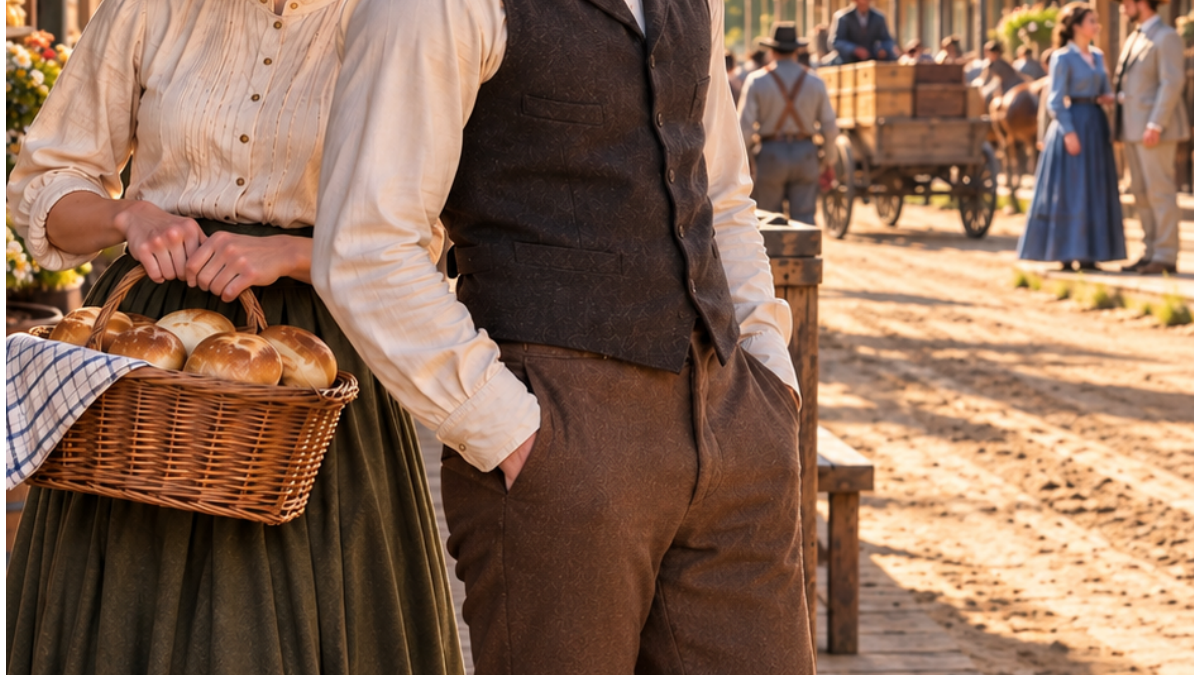
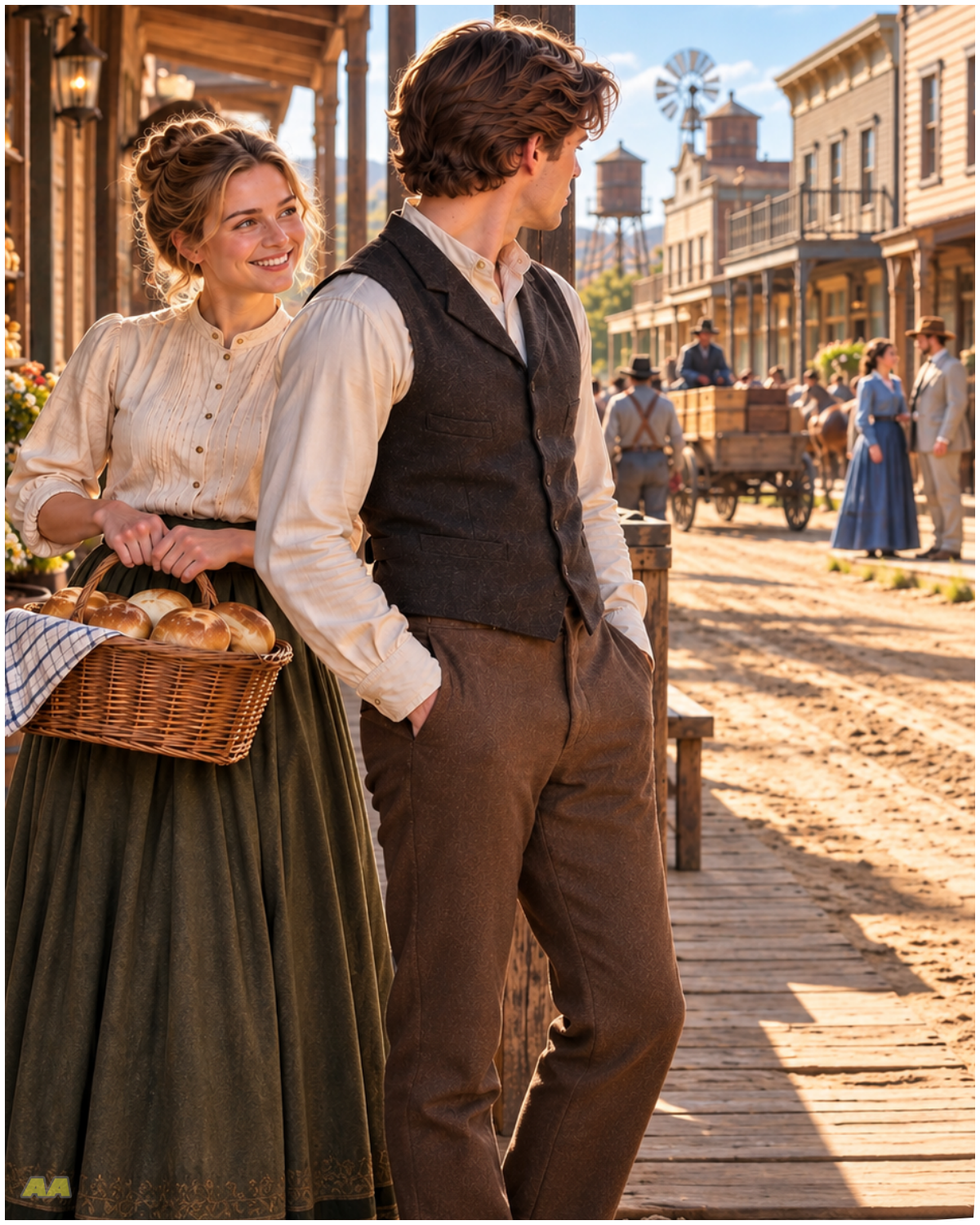
It had been a little over a week since Will Harper came back to run the new farm equipment branch, and the town still felt half unfamiliar to him.
A blur of unpacked crates, ranchers names he was still matching to faces.
But the work suited him better than he’d expected it to.
He was crossing Main Street toward the general store when he saw her.
Louisa Hartwell stepped out of the dress shop, adjusting her gloves, laughing at something over her shoulder.
Will stopped walking.
It wasn’t heartbreak. 6 years had taken care of that.
But something in him went quiet anyway.
The old reflex of noticing her the way his 17-year-old self used to notice her.
Back when he’d worn his one good tie to school on days he knew she’d be there.
Back when he’d spent money meant for books on a pocket watch because Ross Puit wore one on a bright chain.
And at 17, Will had somehow convinced himself Louisa might notice.
A man stepped up beside Louisa, said something that made her laugh again, easier this time, and put his hand lightly at her back like it belonged there.
They didn’t touch beyond that. They didn’t need to.
Will was still watching when a voice spoke up behind him.
Your first love is getting married. He turned.
A young woman stood a few feet away, a basket over one arm, the faint smell of cinnamon drifting from beneath its cloth, watching him with open amusement.
My first love? Maybe not your first, but close enough from what I remember.
Will studied her face. Nothing about it was familiar.
Do I know you? She laughed, a real laugh, surprised out of her.
Well, that answers a very old question.
What question? Whether you ever noticed anyone at school besides the boys you ran around with?
A pause just long enough to land.
And Louisa Hartwell. Will felt his ears go warm.
I’m sorry. I don’t think I caught your name.
Alice Bennett. Two years behind you,” she added, watching him puzzle it over.
Two rows back most years, if that helps.
“I remember you now,” he said slowly.
“You look different. I don’t think I would have placed you if you hadn’t told me your name.” Alice raised an eyebrow.
“Different?” She let the word sit a moment, clearly enjoying it.
“I believe the word you’re looking for is prettier.”
Will felt his ears go warm again.
That too, he admitted. You’ve changed some yourself.
She looked him over unhurried. I heard you’re running the new machinery branch.
The company owns it. I just run it.
So, you’re the boss then? Alice shifted the basket on her arm.
Then maybe the boss can help me with something.
I’m looking to buy a horsedrawn mower.
Will blinked. A mower for my father.
It’s his birthday next month and he doesn’t know I’m buying it, so I’d rather you didn’t mention it if you happen to run into him firSt. I’ve been saving toward it for a while now.
I just need to know what my money can actually buy.
Come by the shop, he said. I’ll walk you through what we’ve got.
I intend to. She was already turning to go when she added almost as an afterthought.
It was good to finally properly meet you, Will Harper.
He watched her go, and it was a long moment before he remembered what he’d been on his way to do.
By the time Alice reached the farm that evening, she was still smiling.
“Something happened in town?” Beatatrice asked. “No.” Alice set her basket down a little too carefully.
You’ve got flower on your collar,” Calvin said, not looking up from the harness strap he was mending.
“And you haven’t been near the bakery since morning.” Alice touched her collar.
There was no flower there. She caught the look on her father’s face a half second too late.
“You’re impossible,” she said. “Just checking,” Calvin said.
“And now I know I was right.” She left the kitchen before either of them could ask anything else.
That night, Alice lay awake longer than she meant to, [music] turning over the moment Willlet said, “I remember you now.” Like the [music] words had cost him something to find.
And the warmth that had climbed up his neck when she’d asked if she was prettier [music] now.
She had liked him once quietly for most of 2 years, back when he’d [music] had eyes for no one but Louisa Hartwell, and she’d been careful never to let it show.
There had been an afternoon outside the schoolhouse [music] when she’d let herself believe for three or four steps that he was walking toward her.
He [music] hadn’t been. He’d gone straight past her to reach Louisa.
And Alice had stepped out of the way as though that had always been her [music] intention.
She’d watched him after that, the way a person watches weather, carefully from a safe distance, never once saying anything aloud.
Then he’d gone east and she’d grown up into a life that had very little room left for a [music] boy who’d never known she existed.
She learned to bake. She saved. She argued [music] Calvin into helping her fix up the old foster building.
And somewhere in the middle of all that work, the memory of Will Harper [music] had settled into something small and clothed.
She had not spent 6 years waiting for him.
But whatever she’d felt at 16 had woken up again a good deal faster than she would have liked.
There was one more thing she hadn’t told him.
She’d seen him the day the branch opened, bunting strung across the front, half the town wandering through to look at machines they had no intention of buying.
She’d recognized him instantly across the room and thought for a moment about walking over to introduce herself properly on her own terms before either of them had to make anything of it.
She hadn’t done it. He probably wouldn’t remember me anyway, she told herself, and it had seemed reasonable enough at the time.
Today on Main Street, he’d proven her exactly right.
It should have stung more than it had.
Tomorrow, she’d go by the shop about the mower.
That much, at least, was entirely true.
The shop smelled like machine oil and cut hay, and Alice took a moment just inside the door to look at it properly.
Will came out from behind the counter when the bell rang.
Miss Bennett. A small deliberate correction. Alice.
Mr. Harper. She let the formality sit there just long enough to be a joke.
Will’s fine. I know. I liked watching you decide.
He gestured toward a mower near the back.
This is the one I mentioned. Come have a look.
Alice expected him to talk price firSt. He didn’t.
How much ground does your father have that needs cutting?
Enough that the old mower takes him most of a week.
What’s he cutting mostly? Timothy and Clover.
There’s a rough patch near the creek that grows something coarser.
He complains about it every summer. How many horses does he run it with?
>> Two. And the more he’s got now, what’s wrong with it?
The cutting bar doesn’t sit right anymore.
He’s had it welded twice. Says it isn’t worth trusting on rough ground.
Will nodded slowly, working through something that had nothing to do with sails.
Uneven ground is hard on the joints of a cheaper machine.
Usually the first thing to fail. He ran a hand along the frame of the heavier model.
This one has a sturdier cutter bar.
Cost more, but it’ll hold up better where you’re describing.
He named the price. Alice kept her face steady, though the number was higher than she’d let herself hope for.
That’s more than I have saved. What would the difference actually buy me?
Fewer repairs, longer life, less time your father spends fixing it instead of using it.
And if I can’t afford that, then we find what fits what you can afford and it still does the job.
I’m not going to talk you into more than you need.
He looked at her steadily. I’d rather you come back in 2 years for a better one than stretch too far now.
I’m not asking you to lower the price, Alice said.
I’m asking what my money can actually buy.
Something in Will’s expression shifted. Not surprise exactly, but something close to respect settling into place.
Fair enough. He turned to walk her through the lighter model instead.
By the time they’d gone over both machines, Will had a fair idea of what she could afford, what her father actually needed, and without quite meaning to ask, a fair idea of how she’d come to have the money at all.
You’ve been saving all this from the bakery?
Most of it. It’s slower than I’d like, but it adds up.
That’s a lot to put toward a gift.
He bought me my first oven. She said it simply, the way a fact gets said when it doesn’t need decoration.
Before I had two dimes to put together, he found the money somewhere and helped me fix up the old foster building so I’d have somewhere to put it.
I don’t know what he gave up to do that.
He’s never said. So now you’re giving something back.
It doesn’t have to be equal. It just has to be something he needs.
Will thought about that longer than the conversation strictly required.
A mower is not easy to hide in a barn a man walks through every day.
How are you planning on managing that?
I’ll think of something. Or Will said, I could bring it out myself.
Company wagon delivery for a piece of company equipment.
Nothing your father would think twice about.
We get it into the barn while he’s occupied elsewhere and you take the credit for the surprise.
Alice looked at him faintly surprised by how easily the offer had come.
You do that? It’s good business. Will said with the particular seriousness of a man who wanted the reason to sound simpler than it was.
Satisfied customers tell their neighbors. Is that the only reason?
It’s the reason I’m giving. She was already smiling as she gathered her basket to go.
Saturday after next, then try not to be conspicuous.
I run a farm equipment branch, Miss Bennett.
Driving a wagon full of machinery is about the least conspicuous thing I do all week.
She laughed. The real one again, the one that had caught him off guard on Main Street and left him standing there trying to work out exactly when this had stopped being a simple sale.
Calvin liked to spend Saturday mornings in town arguing grain prices with Ezra Puit outside the merkantile close to a religious observance by Alice’s account.
It gave Will and Alice exactly the window they needed.
Between the two of them, Beatatrice and one of the farm hands, the mower was in the barn and hidden within the hour, tucked behind a stall where it wouldn’t catch the light from the door.
Calvin came home past noon in the unhurried mood of a man who’d spent his morning well.
He walked two steps into the barn after nothing more than his own horse, and stopped.
“Alice,” she was already coming out from behind him, timed for exactly this.
Happy birthday, Paul. Calvin walked around the mower slowly, the way a man walks around something he’s not sure he’s allowed to want.
He ran a hand along the cutter bar, crouched to look at the wheels, straightened again.
You bought this with what? With the shop’s money?
My money? You spent that kind of money on me?
You spent more than that getting my shop started.
Alice matched his seriousness with her own.
I don’t know exactly how much. You never told me, “But I know it wasn’t nothing, and I know you never once made me feel like it was a debt.” That was different.
“It always is,” Alice said. “When you’re the one spending it.” Calvin opened his mouth, then closed it again, and Will, standing off to one side with his hands in his pockets, trying to look like a man who delivered farm equipment and nothing more, saw something pass over the older man’s face that had nothing to do with mowers.
Calvin seemed to notice him properly for the first time, and you’d be the one who sold it to her.
Will Harper, sir? Will offered his hand, feeling suddenly and thoroughly out of place, standing in another man’s barn on the man’s own birthday.
Calvin studied him a moment before he took it.
The unhurried onceover of a father sizing up any young man who turns up on his property without an entirely obvious reason.
Whatever he found seemed to satisfy him well enough.
“Well,” Calvin said finally, clearing his throat with more force in the moment strictly required, “it’s a fine machine.
Will picked it out. Alice said it was the best fit for what I could spend and it would still hold up better than the old one on that rough patch by the creek.
He asked more questions about that creek bank than I knew answers to.
Good, Calvin said. Man ought to know what he’s selling.
He clapped Will once on the shoulder hard enough to mean something.
Come eat then. Beatatrice doesn’t cook a bird this size for three people.
I couldn’t, sir. I wouldn’t want to intrude on the day.
Nonsense. Calvin was already turning toward the house.
The matter apparently settled as far as he was concerned.
A man who hides a mower in another man’s barn for a month has earned a plate at the table.
He means it, Alice said, falling into step beside Will before he could try again.
There’s no use arguing with him once he’s decided something.
I’ve tried. Will looked between the two of them.
Calvin already halfway to the porch, Alice watching him with open amusement, and found he didn’t have much resistance left to offer.
Dinner ran long in the way of families who weren’t in any hurry to have it end.
Will had eaten at plenty of tables since coming back, but there was something different about this one, and it took him most of the meal to place what it was.
It was Alice. Not the version he’d been getting to know over the counter, quick with a number or a question about drainage, but a version who refilled her mother’s coffee without being asked, who caught her father reaching for a second helping of potatoes he’d been told to go easy on and pointedly moved the dish an inch further away, who knew exactly which stories Calvin was about to tell and let him tell them anyway.
She used to burn everything, Calvin said, gesturing at Alice with his fork.
First two years she had that oven, half the bread came out looking like something you’d used to patch a roof.
I was learning. I ate every loaf, Calvin said entirely, unbothered by the memory.
You complained about every loaf, Alice pointed out.
A man can do both,” he said, reaching for another slice of the bread in question, which by now needed no defending at all.
Will laughed along with the rest of them, and it struck him, somewhere in the middle of it, that none of this was really about Alice being pretty.
He’d already conceded that much out loud on Main Street with considerably less composure than he would have liked.
It was something else. The way she belonged so completely to this table.
“You’re quiet, Mr. Harper,” Beatatric said, catching him midthought.
“Just thinking the food’s better than the machinery talk.” “Tell us about the East, then,” Alice said, resting her chin on her hand.
“6 years is a long time to talk so little about it.” So he did, awkwardly at first, then more easily than he expected.
The two of them falling into a conversation that left Beatatric and Calvin to their own quiet exchange at the other end of the table.
Calvin looked between the two of them with the mild unhurried interest of a man watching weather roll in from a comfortable distance and said nothing at all.
Though Will had the distinct impression he was filing something away for later.
One weekend, not long after the birthday supper, Will turned up at the Reed Ranch for dinner with a paper wrapped bundle tucked under one arm.
Grace eyed it before he’d even gotten through the door.
What’s that? Bread. From where? The bakery on Third Street.
Alice’s place. Will paused. How did you know that, Will?
She said it with the patience of someone explaining something painfully obvious.
It’s a small town and it happens to be the best bakery in it.
Everyone knows Alice’s place. She took the bundle from him and lifted the wrapping to peer inside, already breaking off a corner to taste.
Since when do you even like bread?
I don’t think I’ve heard you mention it once in the whole time I’ve known you.
I’ve had a lot on my mind.
Bread’s a recent development. Lily arrived at a run, drawn by the smell, and went up on her toes to see over the table.
Is that from the lady’s shop? It is.
Did she make the cinnamon ones? Not this time.
Bread, mostly. Her face fell with the particular tragedy only a 5-year-old can perform without irony.
Over supper, Grace watched Will with open curiosity.
She was at school with you, wasn’t she?
>> Apparently, she used to ask about you, you know, when you were away, how school was, whether the East agreed with you, whether you’d be back for summer.
Gray shrugged like it was the most ordinary thing in the world.
I never thought much of it, but she asked more than moSt. She asked you that directly?
More than once. Jonathan, who’d been quiet through most of this, spoke without looking up from his plate.
She asked me, too, about the machinery job, whether you’d taken it.
Will turned to him, surprised. You never mentioned that.
Didn’t seem important at the time, Jonathan said.
Seems more important now, I suppose. From then on, Will found himself at the bakery more often than the branch strictly required.
The first visit, Will told himself Grace had asked for a pie.
“Grace didn’t ask me for a pie,” Alice said, wrapping a slice of something that wasn’t quite in season.
“She might have if she’d thought of it.” By the second, it was bread genuinely, though he’d walked the long way past the tannery to get there, and the smell had been considerable.
“Your shop is three streets over,” Alice said.
It’s a scenic route. By the third, the excuses had worn Finn enough that even Alice noticed.
You keep being in the area, Mr.
Harper. Is there something wrong with your lunch situation, or is this something else?
I like the bread here. You’ve said that three times now.
He bought the cinnamon rolls. He told himself it was for Lily.
He ate one himself before he made it back to the shop.
By late October, he stopped bothering with excuses at all.
“No excuse today,” he said one afternoon, leaning against the counter like a man with nowhere urgent to be.
“None? I’ve run out. You’ve heard all the good ones already.
I appreciate not having to pretend I believed you about the tannery.
That one held up for a while.
It held up for exactly as long as it took me to remember where your shop actually is.
Will laughed and Alice allowed herself a smile.
She didn’t bother hiding, and neither of them said anything further about it, though something had shifted quietly into an understanding that hadn’t needed to be spoken aloud to be true.
Grace had a list of six things to buy in town, which by her own admission usually meant she’d come home with four of them and something she hadn’t planned on.
Jonathan peeled off toward the machinery branch first, looking for a belt that kept slipping.
He was back within a few minutes, looking faintly puzzled.
Shop’s not empty. Exactly. There’s a boy minding the counter who says Will stepped out.
Stepped out where? Bakery, apparently. Grace and Jonathan exchanged a look and by unspoken agreement changed direction.
Through the bakery window, Will was leaning against the counter, saying something that made Alice laugh outright.
The real laugh, the one that came from somewhere unguarded.
Jonathan raised an eyebrow. Middle of a workday.
Middle of a workday? Grace agreed. Inside, Will straightened at the sound of the bell, looking somewhat caught out.
Slow morning at the branch? Jonathan asked entirely too innocently.
I had some things to sort out at the bakery.
I had already finished up. Figured I’d stop in on my way back is all.
Grace glanced at Jonathan, not quite hiding her amusement.
Ah, just on the way then. Jonathan didn’t push further, though the look on his face suggested he intended to enjoy this for the rest of the week.
Come on then. Help me find that belt since you’re apparently not busy.
Will went without much protest and the two of them left for the branch together.
Jonathan already composing whatever he planned to say to Grace once Will was out of earshot.
Inside, Lily discovered the cinnamon rolls needed 10 more minutes and pressed her face to the glass to monitor the situation directly.
Grace watched the two men go, then turned her attention to Alice with open curiosity.
By the time Lily had talked her way through a full accounting of why cinnamon rolls were superior to every other roll, Grace had an idea.
“Come out to the ranch Saturday,” she said to Alice.
“Show me how you actually make them so I can stop disappointing my own household.
Stay for supper after. I have the shop Saturday slow.
You’ve told me that yourself.” Gray smiled, entirely too pleased with her own reasoning.
Lily added her own weight to the argument with the semnity of a much older negotiator.
And Alice recognized, not for the first time, that some requests weren’t really requests at all.
Saturday, she said, I’ll bring what I need.
Supper that Thursday, Gray sat down her fork with deliberate weight.
“If you’re coming out Saturday,” she said to Will, “pick Alice up on your way.” Will paused with his fork halfway to his plate.
Why is Alice coming? She’s teaching me to make the rolls.
That doesn’t answer why I’m fetching her.
It’s on your way. Grace’s expression was the picture of innocence, which was itself a warning sign Will had learned to recognize over the years.
I thought I’d make it a little easier for you.
Actually, easier for me. You’re welcome. We’re friends, Grace.
Friends. Grace repeated the word like she was testing its weight and finding it wanting.
Since when do you have women for friends?
I was mostly concerned with school back then.
School. She let the word sit a moment, clearly savoring it.
Was that what we called it? I remember a certain watch chain and a tie you wore so often I started to wonder if you owned a second shirt.
And Louisa Hartwell. Of course, Will felt the color climbing up his neck.
“Do we have to talk about this?” “Not particularly,” Grace said.
“I’m enjoying it, though.” She let him stew a moment longer before relenting.
“I asked her out because Lily won’t stop pestering me about those rolls, and it seems simpler to just have her stay for supper while she’s at it.” A pause and then more gently than before.
For what it’s worth, I think she’s rather good.
Suits you, Grace? I think so, too.
Jonathan put in. You’re agreeing with her now.
I generally find it’s easier. Jonathan turned to his daughter.
What do you think, Lily? Do you like Alice?
Lily considered the question with the gravity she usually reserved for matters of real consequence.
I think Alice makes very good cinnamon rolls.
The table dissolved into laughter, grace loudest of all, and Will found himself laughing along despite the color still climbing up his neck.
Will picked Alice up Saturday afternoon as instructed.
She brought a basket of ingredients from the bakery, and by the time they reached the Reed Ranch, she had already spent most of the walk teasing him about being ordered around by his own older sister.
After dropping Alice at the house, Will had gone out to help Jonathan with something in the barn.
Grace’s kitchen had never smelled quite like this before.
“I don’t understand it,” she said, watching Alice work the dough with an ease that made the whole process look considerably simpler than it had ever been in her own hands.
“I follow the same recipe. I use the same flour.” “You’re afraid of the dough.” “I am not afraid of dough.
You handle it like it might bite you.
Alice guided her hands back to the bowl.
Firmer. It won’t fall apart if you’re not gentle with it.
Mama’s rolls are always too flat. Lily offered from her stool.
Thank you, Lily. You’re welcome. Jonathan wandered in from the barn first, drawn by the smell.
Smells different in here already. That’s because someone competent is doing the work, Grace said, not looking up.
By the time Will came back in a few minutes later, Flower dusted across three separate people and the better part of the counter, and he stopped in the doorway to simply watch for a moment before anyone noticed him.
Alice laughing at something Lily had said, flower on her wrist, looking for all the world like something that had always belonged in this kitchen.
You’re just in time to be useless, Grace said.
Spotting him. You can carry the trays.
It’s the one task even you can’t ruin.
Supper afterward ran long and easy, the rolls disappearing faster than Grace could take credit for them, and it was somewhere in the middle of it that a neighbor from two farms over stopped by to return a borrowed dish and stayed considerably longer than politeness required.
She took one look at the table, Will and Alice, seated across from each other, and arrived at her own conclusions with the swiftness of a woman who considered gossip a civic duty.
Well, isn’t this cozy? I heard you two had gotten friendly.
Didn’t realize how friendly. Alice, midbite, said nothing.
“We’re friends,” Will said, mostly because it was the easiest thing to say.
The thing he’d said several times already that week without much thought behind it.
Alice does the baking for half the county.
Everyone’s friendly with her. The subject moved on soon enough.
Will didn’t think much more of it.
It was the same thing he’d said to Grace, to Jonathan, to anyone who’d asked.
It was easy. It required nothing further.
He didn’t notice until much later that Alice had gone quieter for the rest of the meal.
Alice didn’t decide to pull back. Not exactly.
It happened more the way frost happens.
Quietly overnight. She thought about the word longer than she wanted to admit.
Friends, it wasn’t even a lie. It was the truth stated plainly by a man who had no particular reason to know it would land as anything other than the truth.
He hadn’t said it unkindly. He’d simply said it the way a person says the thing that’s easiest to say because it required nothing further of him.
Alice knew that feeling. She’d built an entire adolescence around not requiring anything further of anyone.
And she did not want to be 16 again, loving someone from a careful distance and calling it patience.
So she didn’t confront him about it.
She simply quietly stopped making it so easy for him not to notice her.
The shop stayed open the same hours.
The bread was the same bread, but Alice found reasons to be in the back room when the bell rang, let her assistant handle the counter more often, kept her visits to Grace’s kitchen shorter.
Will noticed the change before he understood it.
At first, it was nothing. A busy stretch at the branch, a week where he hadn’t managed to get by the bakery.
He went eventually with no excuse prepared because he’d stopped needing one weeks ago.
Alice was polite, pleasant, but there was something careful in it now, and Will left 20 minutes later without being entirely sure what had changed, only that something had.
“She seemed fine,” he said to Grace the following week in the tone of a man trying to convince himself of something.
Did she? She’s been busy. The shop’s been busy.
Grace continued shelling peas without looking up, which Will had learned to recognize as its own kind of statement.
It took him two weeks to notice the automatic lift of attention every time a door opened somewhere in town, and smaller still to admit that the emptiness he felt when it wasn’t her had a name he wasn’t ready to say.
Alice’s pulling back didn’t stop Will from finding reasons to be at the bakery.
If anything, her going quieter only made him more determined to fill the silence, though he couldn’t have said, if pressed, what exactly he thought he was doing about it, the delivery wagon arrived without warning one such afternoon, and Will happened to be standing at the counter when the driver hauled the first sack through the door and set it down with a thud that sent up a small cloud of white duSt. Where do you want these?
>> Back room. Same as always, Mr.
Doyle. Alice was already coming around the counter to start hauling the first one herself.
You’re not doing that alone. I do it every week.
That doesn’t mean you should keep doing it alone.
Will was dressed that afternoon for a meeting with a rancher out past the county line.
Clean shirt, vest buttoned, trousers pressed. None of it suited hauling flour, and both of them knew it.
You’re not carrying flour in that. In what?
Those clothes. They’re clothes. Will set his hat on the counter anyway, then his vest beside it, and rolled up his sleeves with the unhurried confidence of a man who’ decided something and didn’t feel the need to discuss it further.
Will I know you can manage. He picked up the first sack.
I’m not doing this because I think you can’t.
I just don’t see a reason to stand here while you carry seven bags of flour by yourself.
By the fourth sack, the clean shirt had lost the argument entirely.
Flour on his forearms where his sleeves had brushed the bags.
A pale handprint on one shoulder. Dust across his knee from crouching for leverage.
What? Will said, catching Alice’s expression. Nothing.
You’re laughing. I’m smiling. There’s a difference.
She reached over, brushing at the flower on his shoulder with the flat of her hand.
It didn’t help. If anything, it spread into a wider, more deliberatl looking smear.
That helped. I thought it might. A woman he didn’t recognize stepped through the door mid- exchange, glanced at him, flower streaked, sleeves rolled, and paused.
“New baker?” “Temporary help,” Alice said. “Unpaid temporary help,” Will added.
By the time the last sack was stacked, Will’s shirt was no longer describable as clean by any reasonable standard, and he’d stopped noticing.
Alice watched him a moment and reminded herself, not for the first time that week, that she was supposed to be keeping her distance.
It was proving difficult to keep much distance at all from a man currently covered in her own flower.
“What?” he asked again when Alice kept looking at him.
“Nothing,” she said. Then, “I just don’t think anyone’s ever ruined a good shirt for me before.” “It’s not ruined.
It’ll wash.” That’s not really what I meant.
Will didn’t have a ready answer for that.
Thank you, Alice said instead simply. You didn’t have to do that.
I know. I mean it. So did I.
Later that week, Will told himself he was simply passing by.
He was still a good 10 ft from the bakery window when he saw them.
Alice was behind the counter laughing at something.
The real laugh, the one that came from somewhere unguarded, and a man he didn’t recognize was leaning against the far side of it, close enough that the conversation had clearly been going on for some time.
Well-dressed, unhurried. He said something Will couldn’t hear, and Alice laughed again and reached over to steady a stack of boxes the man had offered to carry, their hands briefly close together over the same crate.
Will stopped walking. The thought that arrived wasn’t, “I’m jealous.” It was simply, “Who is that?” The man was gone by the time Will worked up a reason to go back, carrying a crate of bolts he didn’t need.
Does he come by often? Alice looked at him faintly puzzled.
Who? The man who just left. Mr.
Calder. Sometimes something shifted in her expression.
Why? No reason. You’re asking a great many questions for no reason.
You haven’t been by the ranch lately, he said instead.
I’ve been busy. I noticed. The words came out plainer than he had intended, and something flickered across Alice’s face.
A small, startled recognition quickly smoothed back over.
She didn’t ask him what he meant.
She didn’t need to. I should get back to the ovens, she said instead.
Will left with his crate of bolts he had no use for, and thought about it the rest of the afternoon.
In the unhelpful way a man thinks about something he doesn’t yet want to name.
For the first time, he understood what it was like to stand outside and watch another man hold her attention.
To be the one left wondering where exactly he stood in it.
He didn’t like the feeling. He suspected somewhere underneath the discomfort that he should have expected it sooner.
Will found Grace in the garden pulling the last of the season’s carrots and waited until she’d filled half a basket.
Do you know a man named Calder?
Grace didn’t look up from the dirt.
Why? Just asking. Nobody asks about a specific man by maim for no reason.
Will, I’m asking for a reason. I’d just rather not say what it is.
Grace sat back on her heels, studying him with the patience of an older sister who already suspected exactly where this was going.
He’s a nice man. Runs the feed operation past the Delaney place.
Does well for himself. I didn’t ask if he was nice.
No, she agreed. You didn’t. She pulled another carrot unhurried.
He’s called on Alice a few times, took her to the social back in September.
I don’t believe anything’s come of it, but I couldn’t say for certain.
Will said nothing. You’ve gone a very particular shade of quiet, Grace said.
Why does it matter to you who calls on Alice?
It doesn’t. You walked out to my garden in the middle of a workday to ask about a man you claim doesn’t matter to you.
He didn’t have an answer for that.
Grace, for once, didn’t press him for one.
He walked back the long way, in no particular hurry to arrive anywhere, turning it over, the twist in his chest at the bakery window.
The plainness of I noticed before he’d thought better of saying it.
The hollow week when Alice had simply stopped coming by.
None of it on its own had seemed like very much.
Together, it added up to something he’d been careful not to look at directly.
He always knew when she’d walked into a room.
He found reasons to be near the bakery that had nothing to do with bread.
He missed her plainly when she wasn’t there.
Jealousy had only been the thing that finally made him look.
What he found once he did wasn’t jealousy at all.
It had stopped being friendship some time ago.
He was going to have to do something about that.
The wedding cake order had run late, and by the time Alice locked the bakery door behind her, the street outside had gone quiet and blue with early evening.
Will was waiting by the corner. You didn’t have to wait.
I know. They walked the first few blocks without much conversation.
The kind of quiet that had used to feel easy and now felt, to Alice at least, like something she was working slightly too hard to maintain.
By the time they reached her gate, she found herself reaching for something to say before the silence turned into anything more complicated.
“You know, you don’t have to worry about it,” she said, keeping her voice light.
“Whatever Grace has been implying. We’re friends, right?” A pause stretched out longer than the word should have required.
“Good,” Alice said when he didn’t add anything further.
I just wanted to make sure we understood each other.
She turned toward the gate, one hand already on the latch.
Wait. Alice turned back. Will stood there a moment working through something.
I don’t think I want to be.
Want to be what? Just your friend.
Alice’s expression didn’t change right away, though something behind it did.
That’s unfortunate, she said finally. Will blinked.
It is. I thought we were doing rather well at it.
He laughed, a short, startled sound, some of the tension breaking loose from his shoulders.
Are you going to make me say the whole thing?
I’ve waited a long time to hear you say something sensible.
I see no reason to rush you now.
A long time? Something flickered across her face.
The realization a half second too late that she’d given away more than she’d meant to.
She didn’t take it back. Say what you came to say, Will.
He took a breath. I like you more than I meant to when this started.
When you stopped coming by, I noticed every day you didn’t.
When Calder was standing at your counter making you laugh, I discovered I disliked a perfectly decent man for no sensible reason at all.
I kept calling us friends because it was simpler than admitting I wanted a great deal more than that.
Alice didn’t say anything right away. The porch light caught the side of her face and Will couldn’t quite read what was moving behind her.
You really didn’t notice me back then, did you?
She said finally. Apparently not. I liked you then for most of two years if you want the truth of it.
Will went still. “I know,” Alice said before he could find words for it.
“You were usually too busy looking at Louisa.” She said it without any of the teasing from Main Street.
Plainly, the way a fact gets said when it’s finally safe to say.
That was a long time ago. Will didn’t know what to do with any of it.
The plain unhurried honesty of what she was telling him, the years he hadn’t known enough to be sorry for.
Fortunately, Alice added, and here the smile finally reached all the way up.
I like you considerably more now than I did then.
You’ve improved somewhat. Will let out a breath he hadn’t realized he’d been holding.
Only somewhat. I haven’t decided yet. Ask me again in a year.
Neither of them moved for a moment, the whole conversation settling into something that finally felt solid instead of careful.
“You should go home, Will,” Alice said eventually.
“It’s late and I still have a cake to finish decorating before 9.” “I could walk you to the door.” “You’ve walked me considerably further than the door already.” But she didn’t tell him not to.
Winter came on early that year, and neither of them saw much reason to slow down for Will stopped needing reasons to be at the bakery and started needing reasons to leave.
He walked Alice to church on Sundays now, plainly without pretending it was on his way.
She came out to Grace’s ranch often enough that Lily stopped announcing it as news.
One afternoon in December, he closed the branch 2 hours early just to walk her home the long way past the frozen creek in no particular hurry.
Grace noticed eventually that she’d stopped needing to arrange anything.
They simply found each other now, the way people do once they’ve stopped pretending they aren’t looking.
It was Jonathan in the end who said the thing neither Will nor Grace had quite gotten around to saying directly.
They were mending fence on a cold Saturday morning when Jonathan set down his hammer.
You ought to ask her. Will didn’t look up from the post he was setting.
Ask or what? Don’t make me say it.
I’d like you to say it. You already know what I’m going to say.
Jonathan drove the next post in with a single satisfied blow, looking entirely too pleased with himself.
You could still say it. I’d rather watch you work it out yourself.
Seems fitting. Will didn’t answer that, though.
He found himself smiling despite the cold, and the two of them finished the fence line in a silence that had settled into something comfortable rather than awkward.
By late January, Will had asked Alice to marry him, and she had said yes, without requiring nearly as much ceremony as he’d privately rehearsed for.
The following Sunday, they drove out to the Bennett farm for supper, snow still deep in the yard, to tell Calvin and Beatatrice properly.
Beatatrice cried briefly and without apology, then went straight back to serving the stew as though the two activities were entirely compatible.
Calvin took the news the way he took most things, with a long pause, a slow nod, and a question that had nothing to do with sentiment at all.
So, does this mean I get a family discount at your machinery store?
Will laughed before he could stop himself.
Absolutely, sir. Calvin nodded gravely as though this settled something of genuine importance.
Well, then I can’t think of a single reason to object.
P. What? Calvin spread his hands. The picture of reasonleness.
A man ought to understand the practical advantages of marriage before he gives his blessing.
I’m simply being thorough. Beatatrice, setting down a fresh basket of bread, didn’t even look up.
He’s been planning that joke since Tuesday.
I’d let him have it. “A man needs time to get the delivery right,” Calvin said, entirely unrepentant, and reached for the bread as though the matter were now closed.
They married in early spring. “The wedding was small, the way both of them had wanted it, the church at the edge of town filled with perhaps 40 people, most of whom Will had known his entire life.
A few of whom Alice had fed more cinnamon rolls than either of them could count.
Beatatrice cried again, this time without any pretense of stopping herself.
Calvin walked Alice down the short aisle with his jaw set, and his voice caught once when he placed her hand in Wills and stepped back.
Grace sat with Lily beside her, already more interested in the flowers than the ceremony itself.
Jonathan sat with the quiet, satisfied look of a man who’d watched this arrive from a comfortable distance, and felt no particular need to say so out loud.
The vows were short. Neither of them had wanted speeches.
Will said what needed saying plainly, and Alice answered him the same way.
Afterward, the reception spilled out into the yard behind the church.
Lily found Alice within the first 10 minutes.
Did you make the cake? I did.
Is it the cinnamon kind? It’s the wedding kind, which is a little different, but I promise it’s good.
Calvin found Will near the edge of the gathering about that family discount.
Will laughed. I was afraid you’d remember.
I’m your father-in-law now. Calvin said the word like he was trying it on for size and finding it fit better than expected.
Of course, I remembered. Grace and Jonathan drifted over in time to catch the tail end of it.
Still on about the discount? Grace asked.
“A man’s allowed his priorities?” Calvin said, entirely unbothered.
Alice appeared at Will’s side, shaking her head at the whole conversation.
“He’s been planning that line since the engagement.
You could have warned me.” And spoil his delivery.
I wouldn’t dream of it. The afternoon went on that way, easy, unhurried, full of the particular warmth of people who would watch something worth watching finally arrive at where it was always going.
Somewhere behind them, Lily was already asking whether there’d be more cake later.
Alice glanced over at Will, shook her head at him, still laughing at something her father had said, and reached back without looking to find his hand.
They walked back toward the others together.
And that brings us to the end of part two and with it the end of Will’s story.
Will got to see Louisa again, his first love.
But unlike in part one when Will was still a young man figuring himself out, this time he came back to her more grounded, more sure of who he was, even if that old memory still made him pause for a beat when he saw her.
And then he met Alice again, a girl he’d never really noticed back then.
And what started there grew into something gentle and genuinely romantic.
Alice had her own side of it, too.
She’d quietly liked Will since their school days and kept that feeling to herself for years, knowing full well that back then Will only had eyes for Louisa.
Then Will left and Alice grew up, built a life of her own, opened her bakery, became someone far more confident and independent than the girl she used to be.
But when Will came back into her life, those old feelings woke up faster than she expected, and this time she decided not to hide them again.
One detail I really loved writing into this part.
Back in part one, it was Will who pushed Jonathan and Grace together.
This time around, it’s the two of them doing the pushing, trying to bring Will and Alice together.
A nice little full circle moment. Honestly, writing this one was different from my other stories.
Usually, I already have a pretty clear sense of where a story is heading before I even start.
With this one, I had nothing, no plan at all.
But then the opening scene came to me, and from there, little by little, the story just kept building on itself.
This time, I also told it in third person instead of staying locked into Will’s point of view.
I wanted every character to get their moment and I wanted this to be more than just a love story between Will and Alice.
I wanted it to be about family, too, with warm, funny scenes around the Reed and Bennett dinner tables.
Through that, I got to bring out Calvin, Beatatrice, and Grace a little more, and especially two characters who showed up in part one, but never really got their due, Jonathan, and that adorable little girl, Lily.








