“You Don’t Owe Me Money,” The Cowboy Said — “You Owe Me a Chance at Love”
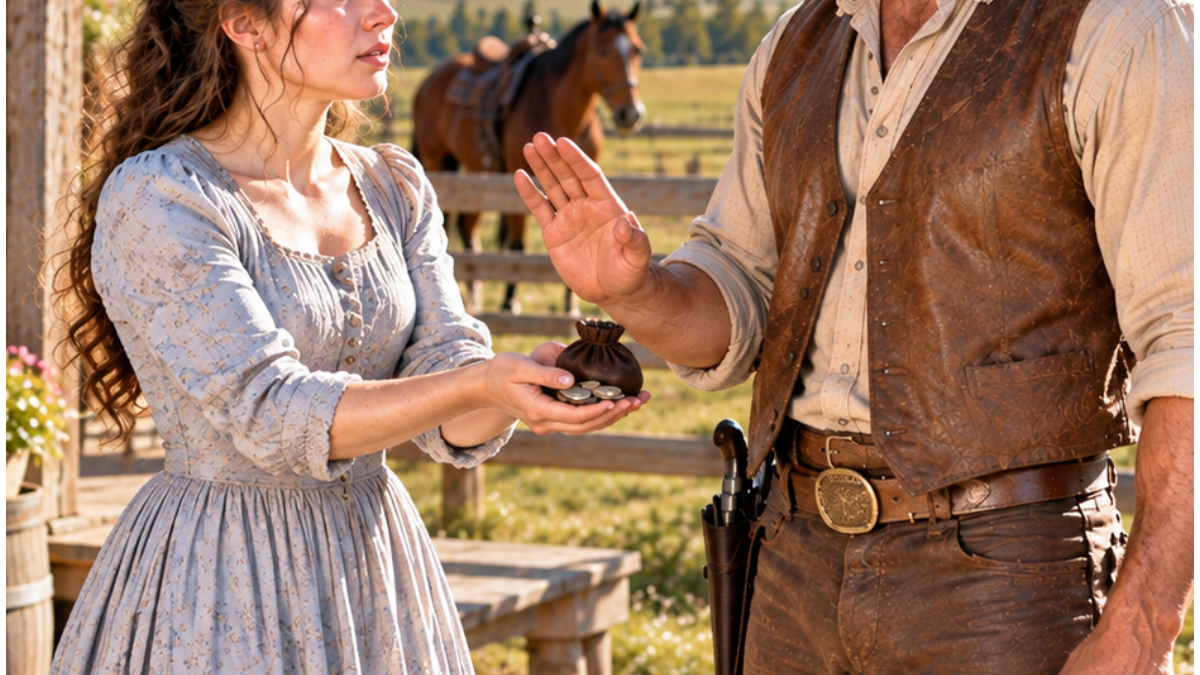
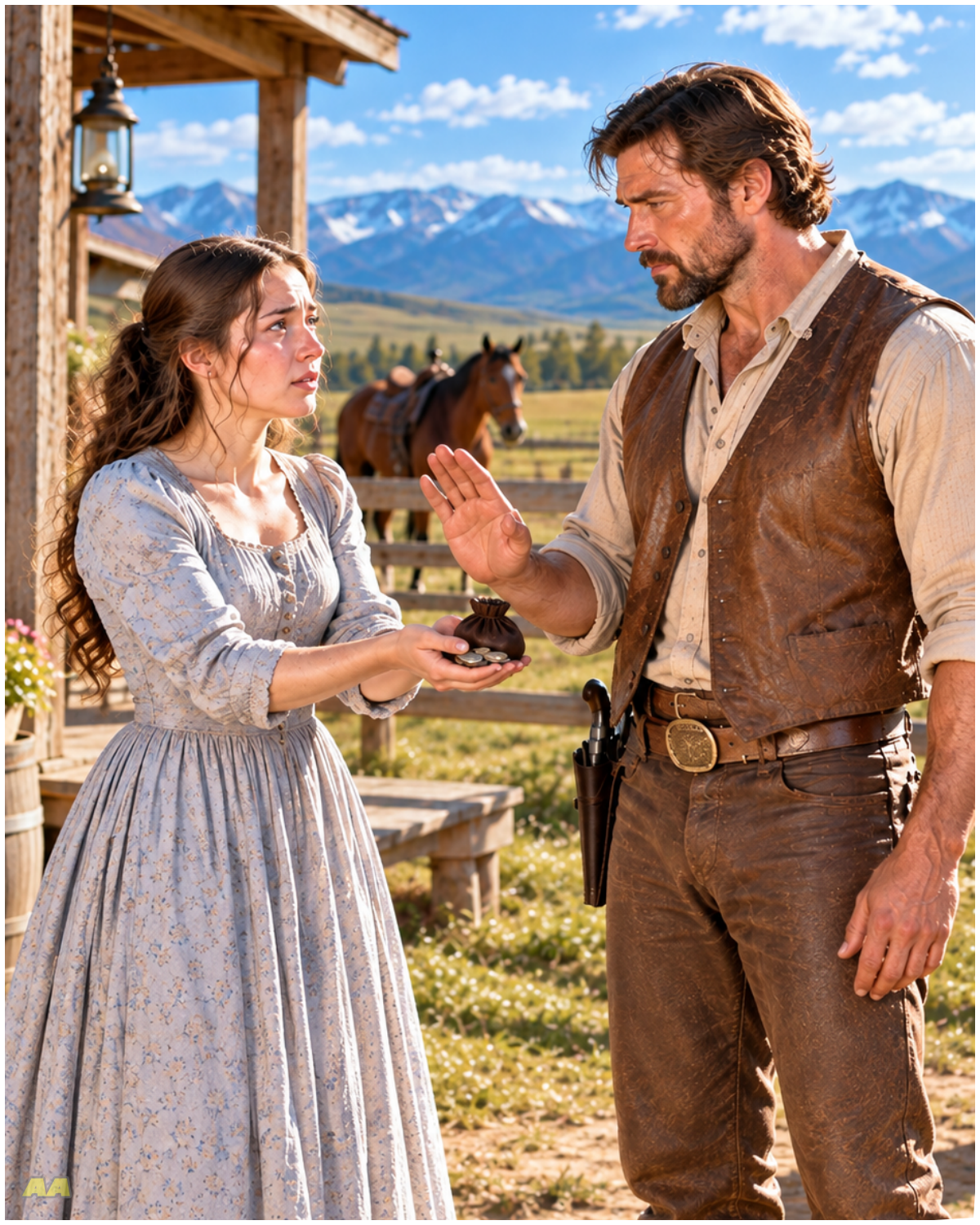
“She owes me nothing, and that’s exactly what terrifies me.” Henry Whitmore said it with a smile.
“The kind of smile a man wears when he has already decided the outcome and is simply waiting for everyone else to catch up.”
Clara Bennett had walked into William Carter’s ranch with an empty purse.
A straight back and 12 words she had rehearsed the entire ride over.
She did not come to beg.
She came to confess.
And confessing to a man who held your future in his hands was a different kind of courage than most people ever had to find.
But William Carter did not take her land.
He did not call his lawyer.
He looked at her the way no man had ever looked at her before, like she was worth more than the debt.
The road from Mil Haven to the Carter Ranch was seven miles of packed dirt and broken sky.
And Clara Bennett had ridden it three times before once with her father.
Once with a borrowed horse to deliver a bolt of blue calico and once last spring to inform William Carter that the payment she owed him would be late by 30 days.
That third visit had been the hardest thing she had ever done.
This one was going to be harder.
Her dress was clean.
She had made sure of that.
When a woman had nothing left to offer except her dignity, she kept her collar pressed and her chin level.
Those were things no fire could take.
No flood, no bankruptcy, no whispered gossip at the dry goods counter could strip a woman of the way she chose to carry herself.
Claraara’s mother had taught her that before she died and Clara had spent six years since treating it as gospel.
The wagon horse old Leonard borrowed from the livery for the fourth month in a row because her own horse had gone to pay the feed merchant plotted forward without enthusiasm.
Clara let him set the pace. She used the time to rehearse the words one more time.
Simple, honest, no begging. State the fact, accept the consequence.
Do not cry.
The Carter main gate appeared through the dust and she pulled Leonard to a halt before she had quite planned to.
The gate was tall ironhinged posts planted in stone, weathered but solid, the kind of thing a man builds when he intends to be somewhere for the rest of his life.
Beyond it, the yard was swept clean, the fence line straight, and the whole operation wore the look of a place where things were done right, even when nobody was watching.
She sat in the wagon for a moment that stretched longer than she intended.
Then she clicked her tongue at Leonard, rolled through the gate, and did not let herself stop again.
A cowboy she didn’t recognize came out of the barn before she had set the break.
He had a face like weathered saddle leather and the walk of a man who had been putting in long days since he was 15.
He tipped his hat without a word and went to hold Leonard’s bridal.
Mr. Carter in Clara climbed down without accepting the man’s hand not rudely.
Just out of habit, accepting help had a way of leading to owing it.
Up at the house, he nodded toward the long porch.
“You want me to know?” she was already walking.
“Thank you. I know the way.”
She knocked twice on the door frame of the open front door.
The house smelled of coffee and saddle oil.
Through the main room, she could see the kitchen where a black iron stove gleamed in the afternoon light, and beyond that, a long table covered with papers a ledger.
A land survey map waited at the corners by a coffee tin and a coil of wire.
William Carter appeared from the far side of the room.
He was not what popular imagination made of cowboys.
There was no theatrical swagger, no boots heel struck deliberately on the floorboards.
He moved like a man who did most of his thinking before he opened his mouth.
He was taller than she remembered from the last visit.
Or maybe it was just the light with dark eyes that took in the full scene before settling.
His shirt was clean but working. His sleeves were rolled to the elbow.
He came to a stop about 4 ft from her.
Miss Bennett, Mr. Carter. She held his gaze.
I won’t take much of your time.
He waited. That was one of the first things she had noticed about him.
Back when her father was still alive, and they had done business together across the counter of the shop.
William Carter did not fill silence with noise.
He waited. And the waiting was never aggressive.
It was simply patient, like a man who understood that most things worth saying needed a breath of room to arrive.
She drew hers now. I can’t pay you, she said.
Not by the end of the month.
Not by Christmas at the rate I’m going.
The fire took the inventory. And I have more orders than I can fill and not enough material to fill any of them.
I have $12 in the account at the bank and I owe the bank 40.
I owe you $230. She paused. I came to tell you the truth before you heard a worse version from someone else.
Something moved behind his eyes, but she couldn’t read it.
And your shop? He asked. Standing. The shop itself, the building, the machines, the counters.
None of that burned. Just the warehouse where I was keeping the bolt goods and the bolt goods were the margin.
Without the margin, I can take orders all I want.
I just can’t fill them. He stepped to the side toward the long table and picked up his coffee cup.
He didn’t pour from it, just held it.
Your father was a fair man, he said.
After a moment, he was. She kept her voice level.
He was also a better businessman than I’ve turned out to be.
He would never have stored that much inventory in a woodframe warehouse with no fire break.
You stored it there to save the rent on a stone building.
Yes, that’s what your father would have done when he was 26 and learning.
She hadn’t expected that. She felt the words try to crack something loose behind her eyes.
And she clamped down on it. Not here.
Not in front of this man who had $230 worth of claim on her life.
Be that as it may, she said, I owe you that money.
And the honest truth is, I don’t know when I can pay it.
I wanted you to know that before you made any decisions out about the property, my father’s land.
The quarter acre lot behind the shop had been her father’s only piece of ground outside the building itself.
It was the one asset she had not been able to sell without losing the shop’s staging area.
She had offered it as security on the loan.
William had accepted it without discussion because her father had been a man he trusted and she was that man’s daughter.
William put the coffee cup down. I’m not taking your land.
Miss Bennett. The sentence arrived so flat and certain that it took her a half second to understand it.
Mr. Carter, I heard you. You owe me $230 and you can’t pay it on schedule.
He moved back around the table. Not restless, just repositioning.
I’m not calling it in. And I’m not taking the land.
You have every legal right to I know what rights I have.
His voice had not changed. It remained the same quiet weight it had been from the first word.
I’m telling you what I’m choosing to do with them.
Clara felt something unfamiliar rising in her cheSt. Not relief.
Exactly. But something uncomfortable close to it, and she distrusted it.
Relief was the first step toward obligation of a different kind.
Relief made you feel you owed someone.
And if she owed this man her gratitude on top of $230.
She didn’t know what that made her.
Why? She asked. He looked at her steadily.
Because I have the money and you need time, he said.
That’s all people don’t. Reotted. Men in your position don’t generally make that calculation.
Time is money. The longer the loan sits unsecured, the longer your capital isn’t doing anything useful.
I have 2,000 acres and enough cattle to carry me through three bad winters back to back.
He said my capital is doing just fine.
That doesn’t mean Miss Bennett. He said it the way her father used to say her name when she was running herself in circles over a problem she’d already solved.
Settled clear. Stop trying to make me into the man who’s going to take your land.
I’m not him. The room held still.
Outside she could hear one of the cowboys in the yard.
A burst of laughter, someone swearing at something stubborn, the ordinary sounds of a working operation.
Inside there was just the faint creek of the house in the afternoon wind and the two of them standing on opposite sides of a table full of papers.
I want to work for it, she said.
Whatever I can do. I won’t take charity.
For the first time, something that was almost amusement crossed his face.
Not condescending, more like recognition like he had expected this particular corner of the conversation.
You’re not in a position to demand terMs. He said, “I’m not demanding.
I’m offering.” She kept her chin level.
“I’m a seamstress, but I’m also organized and I know how to manage supplies, and I know how ledgers work.” “If you have use for any of that, Clara,” he stopped.
She noticed the shift first name. “No, miss.” It surprised them both.
He looked momentarily like a man who hadn’t intended to take a step in a certain direction and found himself there anyway.
He didn’t correct it. He just continued evenly.
The debt can wait. But I’ll tell you something else.
She waited. You didn’t have to come here.
He said, “You could have let it sit.
Let me figure it out when the date came and went.
Most people would have. I’m not most people.” No.
He held her gaze in a way that was direct without being intrusive.
You’re not another silence different from the last one.
Clara looked away firSt. She turned to the door because there was no clean ending to this conversation.
And the sooner she got herself back in the wagon, the sooner she would stop feeling like the walls of this house were listening.
I’ll find a way to pay you, she said with her hand on the doorframe.
I don’t know how yet, but I will.
I know you will,” he said. Behind her, she walked out into the afternoon sun and crossed the yard to where the old livery horse stood half asleep.
The cowboy with the weathered face helped her up without being asked, and this time she let him.
She did not look back at the house on the drive out, but she thought about it all seven miles home.
She was back at her shop by supper, and the shop felt smaller than it had that morning.
The front room held three dress forms, a cutting table, two Singer machines, and the particular smell of thread dust and sizing that she had loved since she was 5 years old, and crawling under her father’s workt to sleep in the afternoons.
The back room, which had once held her neatly organized bolt inventory in rows by weight and color, now held two halfbolts of plain muslin, a crate of bone buttons she couldn’t use until she had fabric to attach them to.
And the memory of everything that had burned.
She lit the lamp on the counter and sat down with her ledger.
The numbers had not improved in the two hours she’d been gone.
They were the same numbers they’d been since September, laid out in her own handwriting in columns that refused to balance.
She stared at them for a long time without writing anything.
Then she closed the book. The debt was still there.
The deficit was still there, but something had changed, and she was trying to be exact about what it was, because she distrusted changes she couldn’t name.
William Carter had told her the land was safe.
He had not made her beg for it.
He had not made her feel small for having needed to ask.
She had expected shame. She had spent the whole ride over stealing herself against it.
And it had not come. What had come instead was something harder to manage because shame at least had the decency to be clean.
She knew what gratitude toward a creditor could become if she wasn’t careful.
She had seen it in other women.
The slow way had bent their thinking.
The small surreners that looked like grace.
She would not surrender anything. She went to bed with that decided and woke up at 4 4 in the morning with the certainty already starting to unravel.
The gossip reached Mil Haven before the end of the week.
Clara heard it from three different sources in three different registers.
Sympathetically from Helen Dre at the millinary, sourly from Georgie Prescott at the post office, and directly and without apology from Arthur Cross at the land records office, who had apparently decided that if a thing was going to be said, it might as well be said to the face of the person it concerned.
Word is Carter let you off the hook?
Cross said leaning on his counter with the studied casualness of a man who had made a habit of knowing things.
He was 45 and bald and had worked in this office since before Clara was born.
People are wondering why Mr. Carter extended my repayment schedule.
Clara said with careful precision as a business accommodation.
Business accommodation. Cross repeated the phrase with an inflection that turned it inside out.
“Is that what the young ladies are calling it now?” Clara put her hand flat on the counter and looked at him.
“I want to record an update to my property inventory,” she said.
“Can you do that or should I come back when someone competent is working?” Cross straightened up and reached for the right book without another word.
But the conversation had told her what she needed to know.
The story was already moving through the town, and it was not moving in the direction of Miss Bennett, is an honest businesswoman who spoke plainly to her creditor.
It was moving in the direction that stories like hers tended to move in, and she could not outrun it with receipts.
She walked home from the land office with her jaw set and her mind working.
By Friday, she had made a decision.
She drove back out to the Carter ranch on a morning cold enough to put frost on the fence posts and she knocked on the door frame for the second time in a week.
And when William appeared, she did not give him time to look surprised.
“I want to propose an arrangement,” she said.
He stepped back to let her in.
She came in, but she stayed near the door.
“Go ahead,” he said. Two days a week, I’ll come out here and do whatever useful work you need done that doesn’t require a cowboy.
Mending, organization, accounting, if your books need it, and you’ll reduce the debt by a dollar a day for every day I work.
She had worked out the math on the kitchen table the night before.
At that rate, it would take her the better part of a year alongside whatever cash she could scrape together from the shop.
But it was a number. It had a bottom to it.
It’s not a gift and it’s not charity.
It’s work for wages counted against the principle.
Take it or don’t. He was quiet for a moment that lasted too long.
Your reputation, he said, my reputation is already damaged.
People have already decided what they think.
Working here in the open. Doing honest work is better than sitting in the shop while the story writes itself without my input.
He looked at her the way he had looked at her in that first conversation steady, without rush, and she found herself waiting for his answer in a way that was almost uncomfortable.
She was not accustomed to waiting on men’s answers.
She was accustomed to receiving them and deciding what to do about them.
But this man had a way of making waiting feel less like powerlessness and more like patience.
Reflected back at her, “Two days a week,” he said.
Yes. Dollar a day. Yes. And you’ll take meals here while you’re working.
That’s not negotiable. A woman working on this property eats at this table.
She opened her mouth to argue. He raised one hand, not imperious, just plain.
Non-negotiable. Fine, she said it crisply. Because she could not afford to sound like the word cost her anything.
Monday and Thursday. Monday and Thursday, he nodded.
7:00 she turned to leave. Clara, she stopped.
He had used her given name twice now.
She was going to have to decide how she felt about that.
Not day, but eventually. You don’t owe me an explanation, he said.
For coming back. You don’t have to make this a business arrangement.
She turned just far enough to look at him over her shoulder.
Yes, I do, she said. That’s exactly what I have to make it.
She walked out into the cold morning and drove back to Mil Haven.
And she felt for the first time in six weeks like she was moving towards something instead of away from it.
The first Monday came with a wind that wanted to argue about everything.
Clara arrived at 7 with a cloth bag of mending supplies and a composure she had assembled and pinned into place the same way she pinned pattern pieces with care and the understanding that any single pin pulled at the wrong moment would bring the whole thing apart.
Three cowboys were already in the yard.
She recognized the weathered-faced one who had held her horse.
The other two she didn’t know. None of them said a word when she came through the gate.
But they watched the way men at a ranch always watched when something unusual arrived.
She acknowledged them with a nod. Not warm, not cold, just level and went to the house.
William was at the table with his ledger.
He looked up when she came in.
Coffeey’s on the stove, he said. I’ve got a pile of shirts that need buttons and two pairs of pants that need the knees patched.
That’s not much for a day’s work.
Inventory in the back room needs organizing.
Feed accounts are a mess. He pushed the ledger to the side and stood.
I’ll show you the back room. The back room was in fact a mess.
Not a chaotic one, more the mess of a man who knew where everything was because he was the only person who ever touched it.
But who had no system that would survive him being laid up for 2 weeks.
Clara stood in the doorway and cataloged it for about 30 seconds.
Do you want this organized for you or organized so anyone could find anything without asking?
She said he considered that distinction with the seriousness it deserved.
The second one, he said, then don’t touch it while I’m working.
I need to understand the logic of what you have before I can impose any logic on it.
He nodded once, which she was already learning meant something between agreement and respect.
She went to work. She mended the shirts first because that could be done at the kitchen table and required only her hands and her attention, and it gave her a reason to be in the main part of the house without looking like she was examining anything.
She listened, not deliberately, but sounds told you things the way a house moved.
What rooms got used and when, how the cowboys talked to each other versus how they talked to William, and how William answered, he was quiet with them, but they were not afraid of him.
That told her something. By 10:00, she had finished the shirts.
Patched the knee of one pair of pants and organized the backrooms feed account ledger into four columns by date.
Supplier, type and amount outstanding. She found three invoices that had been paid but not marked in the ledger.
And she put those in a separate stack with a note in her own handwriting explaining what she had found.
William came in from outside at 11.
Mud on his boots and stopped when he saw the note.
He picked it up. Read it. I overpaid Danner’s feed company by about $18, she said.
From across the room without looking up from the second pair of pants.
They may not notice, but you could write to them.
He was quiet for a moment. How did you The dates on the invoices didn’t match the dates in the ledger.
The ledger had them 3 days later than the invoice stamps.
Someone was reconciling by memory instead of by date.
She bit off a thread. Easy to fix.
She heard him set the paper down.
Thank you, he said. It was a simple sentence, two words that any employer might say to any employee who had done useful work.
She told herself that was all it was.
But the cowboy with the weathered face, whose name she learned later that morning was Ford, happened to be walking through the kitchen at the moment, William said it.
And Ford looked from William to Clara and back to William with the particular look of a man who has just filed something away in his memory for later.
Clara pretended not to see. She went back to the pants.
By the end of the second week, the arrangement had settled into something that could almost pass for routine.
She arrived, she worked, she ate lunch at the long table with William and whoever else happened to be working near the house.
Sometimes Ford, sometimes a younger hand named Roy, who had a habit of knocking things over and apologizing for it with excessive sincerity.
She drove home. The mending had expanded.
She had taken over the systematic mending of all the hands workclo which had been getting done in a peacemeal and insufficient way before she arrived.
Shirts missing buttons. Tears not caught before they became rips.
Canvas workpants wearing thin at the seams where a little reinforcement could have doubled their working life.
She did this quietly and without announcement, leaving the finished items folded on the bunk house porch.
And within 3 days, the cowboys had stopped watching her with their arms crossed and started tipping their hats when she walked through the yard.
Not warmly, not yet, but without the guarded measurement of the first week.
She also finished the backroom organization, cataloged the supply inventory, and started on the main ledger, which she did only with William present, and only with his direct input.
She was not going to handle a man’s financial records without him sitting across the table.
That was a line she drew and did not discuss.
She simply appeared at the table with the ledger when it was time to work on it and waited for him to sit down before she began.
He noticed the line. He didn’t comment on it.
He did start to talk more in those sessions at the table.
At first, it was just the ledger quantities.
Dates, prices, names of suppliers. Then it became other things.
A question about a supplier she had noted a discrepancy on.
Had she ever dealt with that merchant?
Did she know his reputation? A question about the price of calico, which had gone up twice in two years and which affected some of the ranch’s domestic purchases.
And then on the Thursday of the third week, something she had not anticipated.
“You ever miss your father?” he asked.
She was in the middle of cross- referencing an invoice.
She kept her eyes on the page every day, she said.
“What was he like?” She looked up then because the question hadn’t come from nowhere.
There was something behind it, some private gravity that wasn’t about her father at all.
Or not entirely. He was careful, she said.
Not cautious. There’s a difference. He thought things through before he committed.
But once he committed, that was it.
He didn’t revisit. He didn’t second guess.
She paused. He was also the kind of man who remembered what he said on Tuesday when Thursday came around and expected you to hold him to it.
William nodded slowly. Mine was the same, he said, except for the remembering part.
It was the first thing he had said to her that was not about work or logistics or the ranch.
She felt it settle into the room like something you couldn’t unsay.
She went back to the invoice. He went back to the column he was adding.
But when she drove home that evening, she was more careful than usual about keeping her mind on the road.
The end of October brought a cold snap that moved the work inside and kept everyone close to the stoves.
And it was in that compressed indoor weather that the ranch hands started to act differently around her.
Not wrong, just differently. Roy stopped knocking things over in her vicinity, which she understood was his version of effort.
Ford, who turned out to be not Tacier, but just careful about who he spent words on, started leaving small things in her working area that she hadn’t asked for a sharper pair of scissors than the one she’d been using.
A better lamp, a wooden all that was easier to grip than the bone one she’d brought from the shop.
She said nothing about the scissors or the lamp or the all.
But one morning, she arrived to find a small tin of proper beeswax near her sewing supplies, which was the thing she had been improvising without when she had to push thread through heavy canvas.
And she stopped at the table and looked at it for a moment before she sat down.
When Ford came in from the cold at noon, she said without preamble, “Thank you for the wax,” he poured himself coffee.
“Don’t know what you’re talking about,” he said.
“All right,” she said. He sat down across from her and drank his coffee.
And after a moment, he said without looking up, “You’re doing good work.
I’m doing what I’m paid to do.
That’s not what I said.” She looked at him.
He was looking at her now straight across the table with a kind of directness that older men of few words said, sometimes produced when they had decided something was worth saying.
“Carter’s been different,” he said. Since you started?
She held his gaze. I’m employed to organize the ledger and do mending, she said.
That’s all. Yes, ma’am. He nodded with the same filing something away expression he’d had the first day.
That’s all. He went back to his coffee.
Clara went back to her work. But that evening, when William was carrying in extra wood for the stove, and she was putting on her coat to leave, he paused in the doorway with the wood in his arms and said, “Quite suddenly, you could stay for supper if you wanted.
She had her coat halfb buttoned. I have work at the shop, she said.
The shop is closed by 5. She finished the top button.
Thank you, she said. I’ll see you Monday.” She walked out to the wagon and the cold air was sharp and clean and she was grateful for it.
She was also in a way she was working hard to be precise about not telling herself the full truth of why she walked away.
But she was not ready to name that not yet and probably not soon.
The second Monday of November was when Henry Whitmore rode through the Carter gate.
Clara was at the kitchen table with the ledger when she heard the horse in the yard.
Through the window she could see a hired man holding the bridal of a well-kept bay, not a working horse.
A display horse and a man in a good coat stepping down with the practiced ease of someone who had ridden horses all his life, but had not mucked out a stall in 20 years.
William came out of the back room.
Whitmore, he said, reading the yard, Clara kept her eyes on the ledger page.
Do you want me to go? She said quietly.
He glanced at her. Stay where you are, he said.
It wasn’t possessive. It was practical. She was working.
He stepped out the front door to meet his visitor.
She did not lean toward the window, but she listened.
Henry Whitmore’s voice carried the particular carrying quality of a man accustomed to being heard in large rooMs. She could not make out every word.
William was deliberately quieter than usual, she thought, but she caught the shape of the conversation.
Land expansion. A figure that sounded like an offer.
Williams voice level declining. Whitmore’s voice. Warmer now, pushing a second approach.
William, same. Then Whitmore said something she heard clearly.
I see you have domestic arrangements well in hand.
The temperature in her chest dropped about 4°.
She kept her eyes on the page.
William said something she couldn’t hear. Whitmore said pleasantly.
Of course, my mistake. A minute later, the bay horse was gone.
And William was back inside, and the way he moved across the room controlled, deliberate, but with attention in the set of his shoulders that hadn’t been there before told her that whatever Whitmore had said in the part she hadn’t heard was worse than the part she had.
What did he want? She asked without looking up.
My land, what did he say about me?
A pause. He said you were lucky to have found such a comfortable arrangement.
William said, “And that he envied me my housekeeping.” She closed the ledger.
Set the pen down, looked at the surface of the table for a moment.
“I see.” She said, “He’s wrong.” William said, “What he said about you?” “He’s wrong, and he knows he’s wrong.
That’s what makes him dangerous. She looked up at that because it was the first time he had said the word dangerous in connection with anything.
And Henry Whitmore was a man with twice the land and three times the money of anyone in Mil Haven County.
Have you done business with him before?
She asked. No. William sat down at the table, not in his usual spot, but in the chair across from hers, the one she’d never seen him use before.
He’s been buying land to the east for 2 years.
He doesn’t buy what people are willing to sell.
He waits until they’re not. She understood immediately what that meant about herself.
He knows about the loan. She said he knows about everything.
William said that’s what men like him do.
They find out everything. And then they wait for you to get tired.
She looked at him. He was looking back at her.
And the thing in his face was not pity.
It was not even concern exactly. It was something steadier than both the look of a man who has identified a threat and is deciding what to do about it without the luxury of being frightened firSt. Clara, he said, she waited.
You’re not owed me anything. He said, “You understand that whatever Whitmore tells anyone.
Whatever story runs through that town this week, you don’t owe me gratitude.
You don’t owe me good behavior. You came here.
You did honest work. You found three errors in my accounts and saved me $18 on a Danner feed invoice.
That’s the whole of what’s between us.
If it’s useful to you to say that to anyone who asks, say it.
She held his gaze for a long moment.
And if it’s not enough, she said, “If saying it doesn’t change what they believe.” He didn’t look away.
Then we deal with that when it comes, he said together.
It was a small word. Quiet. He hadn’t inflected it to make it larger than it was.
And she thought, not for the first time and not for the last, that William Carter was a man who said exactly what he meant and no more.
And that made the small things he said carry the weight of large ones.
She picked up the pen. I want to finish this column before I leave, she said.
All right, he said. He stayed at the table, she wrote.
Outside the November wind found every gap in the house and tried to come through it.
And the lamp on the table burned steady and yellow against the cold, and Clara Bennett worked on William Carter’s ledger with the feeling that something she had been bracing against for a very long time had just quietly shifted.
She wasn’t sure yet whether that frightened her or not.
She finished the column, closed the book, stood up, and put on her coat.
Monday, she said. Monday, he answered. She walked out into the dark the Monday after Henry Whitmore’s visit.
Clara arrived at the Carter Ranch to find three men she had never seen before standing in the yard.
They were not cowboys, not ranch hands.
The boots were too clean, and the coats were too deliberate.
The kind of deliberate that came not from care, but from wanting to be read a certain way.
One of them was holding a folded paper.
Ford was standing near the barn door with his arms crossed.
Roy was nowhere she could see. William was on the porch.
He was not holding anything. He didn’t need to.
He had the posture of a man who had been interrupted at something and had come out to address it without the interruption having rattled him in the slighteSt. Which Clara was beginning to understand was simply the way William Carter stood in every situation that called for standing.
She pulled Leonard to a halt before she reached the gate.
The man with the paper was talking.
She couldn’t hear the words from where she sat, but she could read the shape of it formal.
Practiced the rhythm of something recited rather than said.
William listened without moving. When the man finished, William said something short.
The man said something longer. William said something shorter than the first thing.
Then he looked past all three of them and saw her at the gate.
He raised his hand. Come in. She drove through and set the brake and climbed down and did not hurry.
Because hurrying would tell the three men something she wasn’t prepared to tell them.
The man with the paper turned to look at her.
He had the smooth assessing look of a lawyer or a land agent, someone who was paid to estimate the value of things quickly and without sentiment.
Miss Bennett Williams said from the porch.
Go on inside. Coffeey’s on. She walked past the three men without looking at any of them.
The man with the paper took a small step to the side as she passed.
Giving her room or making a point of giving her room.
She couldn’t tell which and didn’t slow down to figure it out.
Inside. She took off her coat and put on the coffee even though it was already on.
Because doing something with her hands was better than standing at the window listening to a conversation she wasn’t part of.
She was at the ledger in 4 minutes, pencil moving, eyes down.
6 minutes later, William came in and closed the door behind him.
“What was that?” she asked without looking up.
“Land agent Whites.” He hung his hat on the peg near the door.
He’s offering to buy the east quarter adjacent to the creek.
She looked up now. That’s your best grazing land.
Yes, it is. Is he going to keep sending people until I sell or until I do something that makes him stop wanting to buy?
He pulled his chair out and sat down across from her.
And she noticed that he had taken the same chair as Monday, the one he hadn’t used before her visits, the one directly across from where she worked.
He’s been buying East Creek land from three other ranchers.
Mine would connect his parcels, and you said no.
I’ll always say no. That land has been in my family since before the territory.
He said it without heat, which made it more certain than heat would have.
He knows that he’s not expecting to buy it by asking nicely.
Clara set her pencil down. Then what is he expecting?
She asked. William looked at her with the slight patient quality that meant he was deciding how direct to be.
He’s expecting to find a reason. I can’t afford to say no, he said.
The room was quiet for a moment.
She understood. She understood it in the clean cold way.
She understood things that she wished were more complicated.
Because complicated things left more room to hope she was wrong.
He knows you have an outstanding loan.
She said he knows I extended a loan.
William said he doesn’t know the terms and he doesn’t know the amount.
But he knows enough to be constructing a theory.
What kind of theory? The kind where a man who’s carrying an uncollectible debt might be persuaded to sell land at a favorable price in exchange for certain considerations.
She held his gaze. He thinks you lent me money to put yourself in a negotiating position.
She said he thinks the whole thing is a scheme and he thinks he can exploit it.
That’s his working theory. Yes. And the people in town who’ve been talking about my comfortable arrangement.
Are they getting that story from him or is he getting it from them?
Both. William said he feeds the rumor.
The rumor creates pressure on you. The pressure on you theoretically creates pressure on me.
He’s not a man who does anything for one reason.
Clara picked up the pencil again. Not to write, just to have something in her hand.
I want you to know, she said with the careful precision she used when she needed a sentence to land exactly where she intended it.
That I am aware of what my presence here is costing you.
Not just in terms of reputation, in terms of strategic exposure, don’t.
She looked up. He was looking at her with something she hadn’t seen on his face before.
Not hardness, not impatience, something closer to refusal.
The kind of refusal that was not about the argument but about the direction.
You’re about to tell me you’ll withdraw the arrangement.
He said to protect me from whatever play Whitmore is running.
Don’t. It would be the logical Clara.
He used her name the same way he always used it without flourish.
Without softening just the name itself as a kind of clarity.
I know what the logical move is.
I’m asking you not to make it.
She didn’t answer immediately. Why? She said finally.
He was quiet for a moment. The kind of quiet she had stopped reading as discomfort and started reading as the moment before he said something he meant.
Because I’m not interested in what Whitmore’s theory about me says.
He said, “I’m interested in what I know to be true.
And what I know is that you came out here six weeks ago and did the most honest thing a person in a desperate situation can do, which is tell the truth about it without asking for anything in return.
And then you came back and proposed a fair arrangement.
And then you found $18 of my money that Danner’s feed company was sitting on.
The corner of his mouth moved just slightly.
I’m not giving that up to satisfy Henry Whitmore’s land strategy.
It was she reflected. An unusual speech for him.
She could count on two hands the number of sentences he had spoken to her that weren’t directly task related.
And this was the longest she’d heard him put together at once.
She turned back to the ledger. All right, she said.
All right, he repeated. And she heard in the repetition what she was fairly sure he intended to be heard, that the matter was closed.
And they both understood it. And now there was work to do.
She opened the ledger to the supply column and began.
December came without ceremony. The cold moved in from the north and changed the quality of every morning.
The way sound traveled, the way breath hung in the air, the way a horse’s coat went thick, and the yard mud froze solid overnight and cracked underfoot like old porcelain.
Clara’s Mondays and Thursdays had become without anyone announcing it.
A kind of institution not at the ranch only in Mil Haven.
People had divided into camps about it, the way small towns divided about things that were not their business and therefore occupied them entirely.
One camp held that Clara Bennett was a smart woman who had found a way to manage an impossible situation with her head up.
And William Carter was a decent man who had found a way to be useful to a neighbor without making her smaller for needing it.
This camp was mostly composed of older women, the Methodist minister’s wife, and Ford, who didn’t state his opinion so much as communicate it through the strategic placement of his body whenever anyone said something disparaging near him.
The other camp held various versions of the same essential story which could be summarized as something improper is happening.
Someone should do something. Women of Clara Bennett’s age and circumstances ought to be more careful.
Arthur Cross at the land records office had moved from sour to openly speculative.
Helen Dre at the millinary maintained a careful neutrality that Clara trusted about as much as she trusted a fence post in a flood.
The voice she had not yet heard but knew was coming was Henry Whitmore’s.
He had not spoken to her directly since the day he called her domestic arrangements comfortable.
She had not seen him since, but she heard his name with increasing frequency at the edges of conversations that stopped when she walked into rooMs. and she had learned over the course of her life that when a man’s name was appearing at the edges of your story without the man himself, it meant he was building something, you couldn’t see it yet, but you could hear it forming.
She kept her Mondays and Thursdays. She kept her chin level.
She kept her accounts in order. And she noticed with the precise alertness of someone who had learned to notice before it was necessary to react, that William had started to watch her, not intrusively, not in the way that required her to adjust anything, just with a quality of attention that had changed in some way she couldn’t pin down with the precision she preferred.
He had always listened when she spoke.
He had always tracked what she was doing in the room.
But there was something additional now. Something that she caught only in peripheral moments.
The way he would be at the stove when she came in and would not turn around for a half second longer than the task required.
The way when Ford or Roy said something that made her laugh, which was happening more frequently now, because Royy’s particular brand of sustained accidental catastrophe had worn away her initial formal distance.
William would not quite join the laughter, but would stop whatever he was doing and become very still in the way of a man who is listening to something he did not expect to hear and does not want to interrupt.
She told herself she was reading into it.
She was not particularly convinced by this.
The Thursday she would remember longest that winter came in the second week of December and it started with a broken wagon wheel.
Leonard hit the rut two miles from the carter gate, and the front left wheel gave way at the hub with a crack loud enough to put three crows off a fence poSt. The wagon lurched, the load shifted, and Clara had one brief and total second of pure helplessness, the kind that arrived before the mine could supply options before she got both feet on the ground and stood in the cold road, assessing the damage.
The wheel was not repable on the road.
The hub had split clean. She looked at it for a moment.
Then she looked at the road in both directions.
Then she started walking. She had been walking for about 20 minutes.
Coat pulled against the wind when she heard a horse behind her.
She turned around. William was coming down the road at a caner.
Not hurrying the way someone hurries in a panic, but moving with the purposefulness of someone who had established that there was a problem and was going to address it.
Ford was behind him leading a spare horse.
She stopped walking. He pulled up and looked at her from the horse with that particular William Carter expression that conveyed a comprehensive assessment in about 2 seconds flat wheel.
She said, “I know Roy saw you from the ridge.” He dismounted.
You hurt? No cold. I’ve been walking.
He looked past her at the wagon.
Ford had ridden ahead to look at the damage, and she could tell from the angle of Ford’s head that the verdict was not going to be favorable.
“Hub split,” William said, more to himself than to her.
He looked back at her. “I can get the wagon tomorrow.
You can ride the spare back to the ranch and I’ll drive you home tonight.” She opened her mouth.
“Don’t argue about this one,” he said.
“You’ll lose.” She closed her mouth. She had over the past seven weeks developed an increasingly precise map of which arguments were worth having with William Carter and which ones were the conversational equivalent of pushing on a wall.
This was the second kind. She took the spare horses reins from Ford.
Thank you, she said to Ford. Yes, ma’am.
Ford said with an expression of total innocence, the ride back to the ranch was quiet.
The cold had the effect of simplifying everything.
Your world became the horse under you and the road ahead and the small smoke of your own breath in the air.
Clara rode without thinking about Witmore or the ledger or the column of numbers she hadn’t finished.
At the ranch, she unsaddled the spare and helped Ford put both horses up because she was not going to stand in a doorway while other people worked around her.
By the time she was inside with her hands around a cup of coffee, something in the day had shifted.
The hands had knocked off early because of the cold, and Roy had gone into town for supplies, and the house was quieter than she had heard it.
Just the wind and the stove and William at the far end of the kitchen table with one of the feed invoices she had flagged two weeks ago.
Danners wrote back, he said, about the $18.
What did they say? They’re sending a credit note.
He set the letter down. You were right about the dates.
I usually am with numbers. She said it without apology.
It’s people I’m less reliable about. He looked up at that.
How do you mean? She looked into her coffee cup.
I mean, I know how to tell when an account doesn’t add up, she said.
I’m less certain when it comes to reading what people intend, what they want from a situation.
She paused. Whitmore. For example, I understand what he wants.
The land. I understand the mechanics of how he operates.
What I can’t read is how far he’ll go.
William was quiet. Far, he said. Men like that always go further than you think they will.
It’s not about the land. It’s about the habit of winning.
Has he ever gone after your property before?
Before this, he leaned back in his chair.
But three years ago, Martin Graves rancher to the east had a bad cattle year.
Whitmore bought out his debt from the bank.
Quiet before Martin knew he’d done it.
Then he called it in. 60 days Clara set the cup down.
Martin lost his east quarter, she said.
Sold it to keep the house. Yes, that’s the same parcel you’re adjacent to.
Yes. She looked at him. He’s been building toward your land for 3 years, she said.
At least he said it without drama, which made it worse than drama would have.
I’ve been watching him since Martin. I just didn’t expect.
He stopped. She waited. I didn’t expect him to find a lever this particular, he said.
She understood what he meant without asking.
The lever was her. Not her as a person, her as a situation, a woman with a debt working on a man’s property.
Just irregular enough in the social order to be useful as a story.
Tell me something, she said. He looked at her directly.
When you extended that loan, she said, “When I came to you in October and you told me you wouldn’t call it in, did you understand then what it might cost you?
What Witmore might do with it?” A long pause, not fully, he said.
I understood there would be talk. I didn’t know Whitmore had already identified the situation.
Would you have done it differently? He held her gaze.
No, he said it was the simplest answer he had ever given her.
And it was also, she realized, the most significant.
She picked up the coffee cup again.
They sat across the table with the stove ticking between them and the wind at the window and the whole quiet weight of December, pressing on the house.
And Clara Bennett held her cup in both hands and thought with the careful precision she brought to everything that she was in a great deal of trouble, not the kind she had come prepared for.
He drove her home that evening in the ranch wagon.
Leonard on a lead behind. The town was mostly dark by the time they came down the main street, just the saloon and the hotel showing light and William pulled up in front of the shop without comment.
She climbed down. He climbed down too and walked around to take Leonard’s lead and then stood there in the cold street with the horse while she unlocked the shop door.
“You don’t have to wait,” she said.
“I know.” She turned around with the key in the door.
He was standing in the street in his long coat, hat shadowed against the lantern light from the saloon two doors down, and he looked the only word she had, for it was composed.
The same way he looked at everything.
Like a man who had found his ground a long time ago and didn’t need to keep looking for it.
William, she said it was the first time she had used his given name, and she hadn’t planned it.
It arrived before she could rout it through the part of her mind that would have stopped it.
He was very still. Don’t make this harder than it needs to be, she said.
Not to him, maybe to both of them.
I’m not making it anything, he said.
I’m standing in the street. You know what I mean?
He was quiet for a moment. I know what you’re afraid of, he said.
And I’m not going to pretend it isn’t there.
But I’ll tell you the same thing I told you the first day you came to the ranch.
I’m not trying to put you in a corner.
I’m not trying to collect anything you haven’t agreed to give.
She turned all the way around and looked at him.
And what if I told you that’s exactly what makes it difficult?
She said. He looked at her steadily.
Then I’d say I’m sorry for the difficulty, he said.
And I’d still be standing here. She pushed the door open and went inside.
And she did not watch from the window to see how long he stood in the street before he drove away.
She told herself it was because she had work to do.
She did not entirely believe herself. The week before Christmas, Mil Haven had its annual church social, which was the one event in the year that required attendance of anyone who cared at all about their standing in the community or their relationships with people they depended on for trade.
Clara went. She wore her best dress, not her finest, which she had sold two years ago, but the dark green wool that her mother had helped her cut before her mother’s hands gave out, and which she had altered twice since, to account for what years of hard work had done to the shape of her.
She put her hair up properly, and she walked to the church hall with her chin at the angle her mother had taught her.
The hall was warm and crowded and smelled of pine boughs and candle wax and the particular cedar and talcum smell of half the county in their best clothes.
Tables ran the length of the hall.
The Thornton sisters had brought their apricot preserves and the Methodists had brought a ham, and someone had strung paper stars from the ceiling the way they did every year.
And for about 45 seconds when she first walked in, Clara felt something she hadn’t felt in weeks, which was uncomplicated.
Then she saw Henry Whitmore. He was standing near the far windows with a glass of cider and the comfortable ownership of a man who had come to a gathering primarily to be seen at it.
He was not alone. Two men flanked him, not his land agents.
These were town men, prominent ones. Toss Alcott from the bank and judge Harmon.
The kind of company that announced intention.
He did not look at her when she came in.
He was looking at the room. She found her spot near the Methodist women and kept her eyes on the social distance she needed to maintain to be polite to everyone without being vulnerable to anyone.
William arrived 20 minutes later. She knew he had arrived before she saw him.
Because of the small change in the room’s energy, a slight reorientation.
The way people moved when someone significant came in.
He was wearing a dark coat and had his hat in his hand.
And he spoke to the minister’s wife for a few minutes near the door before the room sorted itself, and he moved into it.
He found her eventually, not immediately, not in a way that announced itself.
He had a conversation with Jim Harwick about cattle prices and another one with Doc Mian about something she couldn’t hear.
And then he was at her elbow with two cups of cider and the quiet practicality of a man who had noticed she was standing without a drink.
Thank you, she said quietly. Merry Christmas, he said just as quietly.
Across the room, Henry Whitmore noticed. She felt it rather than saw it the slight shift in his attention.
The recalibration. She knew that particular alertness.
It was the alertness of a man who had just received information he intended to use.
She kept her face neutral. William stood beside her and did not touch her and did not claim anything.
And she was aware in a way that made her chest tight that this just this just standing together at a church social was exactly the kind of evidence Henry Whitmore did not need to be true in order to build a story around it.
The minister stood up at the front of the room and called for a carol and everyone obliged and in the general movement Clara felt William shift slightly beside her not closer just present in a different way.
The way a person becomes present when they stop monitoring themselves.
She did not shift away. She thought about that choice for the rest of the evening.
Whitmore made his move on the last Monday before Christmas.
>> Clara was at the Carter Ranch when Witmore himself wrote in Not a Land agent this time, not a lawyer himself, and not alone.
He had a woman with him, elegant, dark-haired, about 40, with the easy posture of a woman who had never been required to stand at a ledger and make columns balance.
His wife, Clara didn’t know. She had not been aware Whitmore had a wife.
William was out on the east fence line with Ford.
Roy ran to find him. Clara stayed at the table with the ledger and waited because going to the door would be theater and hiding from it would be weakness.
And so the only option was to remain precisely where she was and continued to be exactly who she was.
Whitmore knocked. He came in without being invited, not aggressively, just with the confidence of a man who does not wait for rooms to receive him.
He stopped when he saw her. Miss Bennett, he smiled.
It was a practiced smile, wide enough to seem warm and controlled enough to remain something else entirely.
I didn’t know you’d be here. I have a regular schedule, she said.
Of course. He looked around the room with the assessing quality she had noticed the first time reading the house the way a land agent reads a property.
Is Carter about? He’ll be back shortly.
You’re welcome to wait outside. He ignored this with the grace of a man who has been dismissed many times and never once treated it as dismissal.
Allow me to introduce my sister, he said.
Mrs. Vivian Alcott. She and Thomas are in from Denver for the holiday.
The woman with the dark hair came in behind him and gave Clara a look that was perfectly civil and contained more information per square inch than a bank notice.
She sat down in the chair near the window as if she owned it.
I hear you’ve been helping Carter with his household affairs, Whitmore said, settling himself against the wall near the door in the posture of a man with nowhere particular to be.
That’s admirable. A woman of your capabilities.
It’s a shame about the shop situation.
The shop is functioning, Clara said. Of course.
Though he paused with the timing of a man who practices his pauses.
I hear the inventory losses were substantial.
A fire like that. It takes years to rebuild what you had.
I’m rebuilding. Certainly, he nodded with the generous warmth of someone agreeing to a hopeful fiction.
Carter is a fortunate man to have your help.
And you I imagine are fortunate to have the accommodation.
She set her pencil down. She looked at him.
Mr. Whitmore, she said with the level precision of someone who has decided that a wall needs to be addressed directly rather than negotiated around.
If you have something to say to me, say it.
If you have something to say to Mr.
Carter, wait for him. But I won’t sit here and be insulted in the intervals between.
The elegant woman near the window looked up with an expression that was not quite surprise and not quite approval.
But something in that neighborhood. Whitmore looked at her for a moment.
I admire your directness, he said pleasantly.
I know you do, she said. Now, would you like to wait on the porch or in the yard?
He looked at her for another moment.
Then he smiled again, a different smile, this time, smaller and more sincere, which somehow made her trust it less.
And he turned to the door. “Well wait outside,” he said, the heirs bracing this time of year.
He opened the door, then paused. “Miss Bennett, whatever Carter has told you about his circumstances, make sure you understand them fully.
A woman in your situation deserves complete information.” He went out.
His sister stood up from the chair, smoothed her skirt, and followed him.
At the door, she stopped and looked back at Clara with that civil information dense expression.
He’s not wrong, you know, she said quietly, not unkindly, about making sure you understand the situation fully.
Then she too was gone. Clara sat at the table with her pencil in her hand and the ledger open and the stove ticking and a cold feeling that had nothing to do with the weather moving through her slowly like water under ice.
She didn’t know what Whitmore’s sister meant.
She didn’t know what Witmore had meant either.
Not precisely, but she knew she was missing something.
Some piece of information that Whitmore had and she didn’t.
And that he was depending on her not having.
And she knew with the exact clear certainty of someone who has been outmaneuvered by incomplete information before that finding out what that piece was had just become the most important thing she could do.
She set the pencil down. She waited for William.
William came back from the east fence line 20 minutes after Whitmore left.
And Clara knew the moment he came through the door that Ford had told him something on the ride back.
He was not visibly different. He came in, set his hat on the peg, looked at her, and something passed through his expression that was gone before she could name it.
He was here, William said. Yes. She closed the ledger.
With his sister, Vivien Alcott, he moved to the stove and poured coffee with the practiced motion of a man thinking about something other than coffee.
What did he say? Nothing direct. She paused.
He told me I deserved complete information about your circumstances.
His sister said something similar on her way out.
William held the cup and looked at the far wall.
She watched him. William. She used his name the way he used hers without softening.
Just as a clarity, what are your circumstances?
He turned around. She held his gaze and waited because she had learned with this man that waiting was not the same as weakness and that the quality of his silence before he spoke told her almost as much as the speaking.
“There’s a note on the ranch,” he said.
She was still “How much?” she asked.
$800 due in March. He set the cup down on the table and sat in his chair, the one across from her.
The one he had made his over the past weeks.
I took it out in ‘ 83 when we had two bad winters back to back.
Most of the herd, the east fence line, and the creek well all needed work at the same time.
I’ve been paying it down. I’ve got 300 left.
300 due in March. Yes. And Whitmore knows.
He knows about the note. He probably doesn’t know the balance.
William looked at her directly. It’s not catastrophic.
I can make March if the spring cattle price holds.
It’s tight, but I’ve managed tight before.
Clara sat very still and ran through the geometry of it with the same precision she brought to the ledger.
$300 due in March. A man who bought distressed debt quietly and called it in on 60 days.
Her own outstanding loan, which was not yet at 3 months reduced payments.
He’s going to buy your note, she said.
That’s the play. Yes. No alarm in his voice, just the flat acknowledgement of a chess move seen coming.
The question is whether the bank sells it before March, would they?
Banks don’t usually sell performing notes. But Whitmore has a relationship with Alcott at the first territorial.
And Vivien is Alcott’s wife. He let that settle.
Alcott would call it a business decision, which it would be his business.
She stood up and went to the window, not to look out, just to move, because the geometry of what she was understanding had a physical weight to it that required a different posture.
He’s been building this for 3 years, she said.
Martin Graves’s east quarter was the first piece.
“Your east fence line is the piece that connects his parcels.
He couldn’t buy you out, so he waited for a pressure point.
And when he found one, he found two.
William said quietly. The note and you, she turned from the window.
Me, she said. Your situation gave him a way to complicate mine without touching the note directly.
If there’s enough talk about this ranch, about you being here, about what kind of arrangement we have.
He creates pressure from a different direction.
Social pressure. Respectable men start to distance themselves.
The bank starts to ask whether Carter’s operation is the kind of thing they want to hold dead on.
He looked at her steadily. It’s not about ruining your reputation, Clara.
It’s about using the question of your reputation to destabilize mine.
She heard it all. She sat with it for a moment.
I should have known that from the first day he came.
She said, “You couldn’t have known. I should have told you sooner.
He said it without excuse in it.
I didn’t tell you because I didn’t want you to make a decision about the arrangement based on something that wasn’t your problem to manage.
It became my problem when his sister looked at me and told me I was missing information.
Yes. He held her gaze. That’s why I’m telling you now.
She walked back to the table and sat down and looked at the closed ledger between them.
What do you need me to do?
She asked. He looked at her for a long moment.
Nothing, he said. I don’t need you to do anything.
I wanted you to know the full picture.
That’s all. That’s not all she said.
You told me because you trust me to handle information without panicking.
And because you understand whether you’ve said it to yourself in those terms or not, that I have a stake in this situation now, too.
Not just financial. If Whitmore uses me to lever you out of this land, what’s left of my reputation in this county isn’t worth the paper my shop license is printed on.
She said it without bitterness. Just the arithmetic.
So tell me what you actually need.
He was quiet for a full 10 seconds.
I need to know the note won’t be sold before March, he said.
And I need the spring cattle price to hold.
Neither of those is something you can control.
The cattle price? No. She pulled the ledger open again, but let me look at the note terMs. Do you have the original?
He got up without a word and went to the back room.
He came back with a folded document worn at the creases from having been folded and unfolded more than a few times over the past 3 years.
He set it on the table between them.
She spread it flat. She read every word.
Then she read it again. This was drawn with first territorial, she said.
Yes, the assignment clause. She pointed to a paragraph near the bottom.
It restricts assignment to another party without 30 days written notice to the borrower.
He leaned in to look. I know Whitmore still gets the 30 days if he buys it.
30 days notice, she said. Gives you 30 days to find alternative financing, which is different from 60 days to liquidate.
She looked up. Do you know anyone at another bank?
Not Alcott. Not First Territorial. He was still for a moment.
She watched him thinking. There’s a man in Cheyenne, he said.
Jackson Morse. He handled the original financing on my father’s land 40 years ago.
His son runs the operation now. I’ve never done business with them directly, but they know the Carter name.
Write to them, she said. Today, not tomorrow, today.
Explain the situation. Not all of it, just the relevant part.
You have a note coming due in March.
You’re looking to refinance at terms you can manage.
And you want to know whether they’d consider it before the month is out.
She paused. You’ll know in 2 weeks whether you have an alternative.
He looked at her. You think that simply?
He said, “No, I think about leverage, Mr.
Carter.” She heard herself use the formal address for the first time in a month and did not correct it.
Whitmore has leverage on the note. You have leverage on the response to the note.
Use yours firSt. He held her gaze across the table.
And the thing in his expression was not quite admiration.
She would have found that uncomfortable, but something adjacent to it.
Something that had more respect in it than most men managed.
All right, he said. I’ll write the letter tonight.
She went back to the ledger column.
He went to the back room and came back with paper and a pen and they worked at opposite ends of the same table in the cold December afternoon in a silence that had nothing uncomfortable in it at all.
Christmas came and went with the small practiced quietness of a woman who had learned to observe it alone.
Clara put a pine bow on the shop counter and lit an extra candle on Christmas Eve and went to the morning service at the Methodist church and came home and cooked a proper meal for herself roast chicken potatoes.
The last of the autumn apples stewed with cinnamon.
She ate it at her kitchen table with a book open beside her plate and told herself it was peaceful, which it was, and told herself she preferred it, which was a more complicated question.
She thought about Williams house where Ford and Roy and two other hands she’d come to know by name would be gathered around a table with whatever holiday fair the ranch had managed.
She thought about the kitchen, which she now knew well enough to picture without effort.
She thought about the chair across from the one she always sat in, and the particular quality of sitting across from a man who listened when you talked and didn’t feel the need to fill your silence with his own.
She finished her dinner and washed her plate and went to bed and did not think about any of it.
January arrived with a cold that was different from December’s, not sharper.
Exactly. But more committed, as if the winter had decided to stop trying and simply be what it was.
The ground froze solid and stayed that way.
The road to the Carter Ranch was hard as iron under Leonard’s hooves, and Clara could see her breath from the moment she stepped out of the shop until the moment she stepped into Williams kitchen.
The letter to Jackson Morse in Cheyenne had gone out the week before Christmas.
The reply came in the second week of January.
She was not there when it arrived.
William told her about it on the Thursday she came in, and she could tell from the way he set it on the table beside the ledger, unhurried, deliberate, the way he set things down when he had already absorbed their implications and was ready to discuss them that it was not bad news.
Morse will refinance, he said. Lower rate, same term.
They want a letter of intent by February 15th and the papers signed by the 1st of March.
She felt something release in her chest that she hadn’t realized she’d been holding tight.
That’s before the due date on the first territorial note.
She said 3 weeks before. If Whitmore buys the note between now and February, the 30-day notice window runs out after the refinance is already signed.
He held her gaze. He nodded his lowly.
He’ll know, she said. When you write to First Territorial about the payoff, the bank will know you’re refinancing and Alcott talks to Whitmore.
Yes. So, you have roughly 4 weeks before he understands the play is closed and decides whether to try something else.
William’s expression was level. What kind of something else?
She asked. I don’t know, he said.
That’s what worries me. She sat with that for a moment.
Then we move faster, she said. Can you write to Morse today and advance the letter of intent?
I can have it there by the end of the month.
Good. She opened the ledger. Then we work the next four weeks as if Whitmore is watching every move we make because he probably is.
She worked steadily through the morning. And William rode out to the east fence line.
And when he came back at noon with mud on his coat and cold in his face, Roy had lunch on the table.
And Ford was telling a story about a horse that had developed an inexplicable personal grievance against one specific fence poSt. And Clara sat down her pencil and listened to the story and laughed at the right moment.
And it felt for that hour like the simplest thing in the world.
It lasted until afternoon when she looked up from the ledger and found William watching her from across the room with the particular stillness she had learned to recognize and had not learned to manage.
She went back to the column. She did not comment on what she had seen.
It was Roy who told her without meaning to.
The thing she hadn’t known. It happened on a Thursday in late January.
In that ordinary way that significant things sometimes happened in the gap between two other conversations without warning, without anyone understanding the weight of it in the moment.
Roy was fixing a harness strap at the kitchen table while Clara worked on the ledger.
Ford had gone to town. William was out with the cattle.
You know, Carter had somebody, Roy said to no one in particular.
He said things to no one in particular frequently.
It was the way his mind worked out loud and without strict audience requirement.
Clara kept her eyes on the column.
I know he lost someone, she said.
Years ago, Eliza Vance Royce had said the name with the careful weight of someone who had heard it used with care for a long time.
She was from out east Pennsylvania, I think, came out with her family in 81 to visit her uncle who had land near here.
She and Carter, he paused, pulling at the harness.
They were going to be married in the spring.
Clara wrote a figure in the column.
The fever took her in February, Roy said.
82. Carter closed up the house for six months.
Wouldn’t see anyone. When he came back, he was different.
Not mean, not hard. Just he searched for the word with the effortful vocabulary of a man who felt things precisely and expressed them approximately.
Closed? She set the pen down. He’s been closed since then, she asked.
Until this fall, Roy simply, without weight, as if it were just a fact that happened to be true.
Ford says it different. Ford says he’s been waiting.
He finally got the harness buckle sorted and held it up to check the repair.
I don’t know. I just know he smiles more, which is it’s good.
He’s a good man. He deserves to smile.
He stood up with the harness and walked out the back door.
Clara sat at the table with the ledger open in front of her and the pen in her hand and did not write anything for a long time.
Eliza Vance, four years. The man had spent four years closing his house to the world and working the land alone.
And when Clara Bennett had walked through his gate with an empty purse and 12 words she had rehearsed, he had chosen not strategically, not practically to keep the door open.
She understood now what Witmore’s sister had meant.
Not that William was hiding something dangerous, that he was not hiding something at all, and that a woman who had spent 11 weeks telling herself this was a business arrangement was the only person in the county who hadn’t understood what it actually was.
She closed the ledger. She sat very still for a moment.
Then she put on her coat and went out to find Ford.
Ford was in the barn. She stood in the doorway.
The woman he was going to marry, she said.
Eliza Vance. Ford turned around from what he was doing.
He read her expression with the efficient precision of a man who had been watching people for 60 years and didn’t need a second look.
What about her? He said, did he love her?
She said it simply without apology. Because Ford was the kind of man who would give you a straight answer if you asked him a straight question and didn’t dress it up.
Yes, Ford said very much. And since then, Ford was quiet for a moment, turning a bridal over in his hands.
Since then, he said, “I have watched that man work this land every day without exception.
In heat and freeze and drought and flood, and never once complain, never once ask anything of anybody,” he set the bridal down.
“And then you showed up.” He looked at her without apology and he started asking Ford to fix things he’d been fixing himself for 4 years.
She held his gaze. “What kind of things?” she asked.
“Small things.” Ford almost smiled. “The kind of things a man fixes when he wants someone to notice the house is being taken care of.” She stood in the barn doorway for a moment without saying anything.
“Thank you, Ford,” she said finally. “Yes, ma’am.” He picked the bridal back up.
Though I will say you didn’t need me to tell you that.
She walked back to the house and she sat at the table with the closed ledger and the pen in her hand.
And she felt very precisely the exact shape of the thing she had been refusing to name.
It had the shape of something she wanted.
And wanting things in her experience was the first step in a long walk toward losing them.
William came back from the cattle at 4:00 and Clara was still at the table and she had opened the ledger again and was working on the February projections and she had decided that nothing she had understood that afternoon required an immediate response from her.
Understanding a thing and acting on it were two different decisions, and she was not going to make both on the same day.
He came in, shed his coat, poured coffee, sat down.
He looked at her once briefly with that peripheral quality of attention she had learned to recognize and then looked at the papers he’d brought in.
They worked in silence for 40 minutes.
Then he said without looking up from the paper, Whitmore has been talking to Alcott.
She kept her eyes on the ledger.
How do you know? Jim Harwick heard them at the hotel dining room.
Alcott and Whitmore having dinner. Harwick was at the next table.
He set the paper down. He heard my name.
Just your name and yours. She looked up.
Together, she said. Together, she sat down the pen.
This was the moment she had known was coming since the day she had watched Henry Whitmore walk through that gate.
She had simply not known exactly what shape it would arrive in.
“What did Harwick hear?” she asked. “Not enough.
He couldn’t make out the full conversation, just enough to know it was deliberate.
William looked at her with the direct undeflecting steadiness she had come to rely on.
I think Whitmore is going to do something public, something that forces a response.
He’s lost the note strategy or he’s figured out he’s losing it.
So now he moves to the other lever.
She understood the other lever was not the land note.
It was her. He’s going to say something about us, she said.
Something specific. Something that requires a response.
>> Yes. What kind of response? >> William was quiet.
The fire in the stove ticked once, twice.
I’ve been thinking about that, he said.
She waited. There’s an answer to what he’s building, he said.
A clean answer, one that takes the question completely off the table.
He held her gaze and there was something in his expression she had not seen there before.
Not the patience, not the steadiness, but underneath those something that had been there for a while and had decided apparently that today was the day it was going to be said.
But I won’t say it without your permission, and I won’t say it as a strategy.
She felt her heartbeat do something it had not done in a very long time.
Then what would you say it as?
She asked. He was quiet for a long moment.
Not the calculating quiet, the other one.
The one before he said something he meant all the way down.
Something I should have said 3 weeks ago.
He said, “If I’d been less worried about what you’d think of my timing, she held very still.” William, I know what you’re going to say.
And for the first time in all the weeks she had known him.
There was something in his voice that was not composed.
It was not raw. He was not that kind of man, but it was open, present in a way that the composed version never quite was.
You’re going to tell me this isn’t the right moment.
That we should wait until Whitmore is gone and the note is settled and you can be sure you’re thinking clearly.
She had been precisely about to say something in that neighborhood.
And she said, and I’m asking you to consider, he said, that you’ve been thinking more clearly than anyone I have ever met every single day since October.
And that the reason you keep moving the moment further forward is not because you’re uncertain about what you want.
It’s because you’re certain, and certain feels like the most dangerous thing in the world.
The kitchen was completely quiet. She looked at him across the table, across the ledger that she had built into a bridge between their two lives without quite understanding what she was building.
And she felt with absolute clarity that he was right.
He was right about all of it.
And that was the most terrifying sentence she had formed in years.
Give me time, she said. Her voice was steady.
She had made it steady. Not to decide.
I already know what I she stopped.
Started again. Give me time to do this on my own terMs. Not because Whitmore is pushing.
Not because the timing is convenient. Because it’s the right moment, and I know it’s the right moment without him in the room.
William looked at her for a long moment.
All right, he said. That’s it. She said, “That’s it.” He picked up his paper again.
I’ve waited 4 years, Clara. I can wait a little longer.
She heard what was under the sentence.
The name she hadn’t known until Roy said it this afternoon.
The four years of closed doors and early mornings and working alone.
The man who had spent those years learning how to live with grief and had apparently somewhere in between found something worth coming out of it for.
She picked up her pen. She did not open the ledger.
She just held the pen. Her name was Eliza, she said quietly.
Not a question. He went very still.
Roy told you. He said, “Yes, a silence that lasted for several breaths.
She would have liked you,” he said simply.
The way he said simple things that carried the weight of large ones.
She had no patience for nonsense either.
Clara felt something move through her chest that was not quite grief and not quite tenderness and was, she thought, some honest combination of both.
She opened the ledger. She wrote the first figure in the February column.
Outside, the January wind had picked up and somewhere on the east fence line where Witmore’s agents had been riding the perimeter for weeks, the cold pressed down without mercy on everything it could reach.
But in the kitchen, the lamp was lit and the stove was warm.
And two people who had both learned the hard way how much it cost to want something sat across the same table and did their work and did not say another word about what had just passed between them because they didn’t need to and because Henry Witmore had not yet made his public move.
And when he did when he walked into Milh Haven on a Tuesday morning in February and said the specific calculated irreversible thing he had been building toward since November Clara Bennett was going to have to make the most important decision of her life without anyone’s help including William Carter’s and she would not be ready nobody ever was Whitmore made his move on a Tuesday Clara was at the dry goods counter when it happened she had gone into town early to pick up a spool of thread she’d been waiting on since November.
And she was standing at the counter talking to the merchant’s wife about the thread order when the door opened and Henry Whitmore walked in with Thomas Alcott at his side.
He didn’t look at her immediately. That was the tell.
A man who enters a room and doesn’t look at the one person he came to deal with has already rehearsed what he’s going to do.
The not-looking is the last moment of the performance before the performance begins.
Mrs. Harlo, Whitmore said to the merchant’s wife with his wide practiced warmth.
Good morning, Mister Whitmore. The merchant’s wife was a careful woman.
She had the alertness of someone who knew that whatever was about to happen would be discussed in this room for the next two weeks.
Then Witmore looked at Clara. Miss Bennett, he said it with the kind of warmth that was designed to make the listener feel watched rather than welcomed.
I was hoping to run into you.
She held her ground at the counter.
Mr. Whitmore, she said. Alcott had moved to the side of the room near the bolts of cloth, pretending to examine something.
He wasn’t examining anything. He was positioning himself as a witness.
I want to speak plainly, Whitmore said.
I think that’s the kindest approach given the circumstances.
Then speak, she said. He glanced at Mrs. Harlo once, a glance that performed regret at having to have this conversation in front of an audience while ensuring there was one, and then looked back at Clara with the expression of a man who has arrived at a difficult duty.
There’s been a great deal of discussion in this town, he said.
About your arrangement with Carter. People are concerned.
Not maliciously, genuinely. You’re a young woman alone with a debt working on a single man’s property without any formal structure around the situation.
He spread his hands slightly. I have no personal interest in your private affairs.
But I have been asked by several prominent members of this community to raise the matter.
For your own protection, she looked at him steadily.
Who asked you? She said, a small pause.
That’s name one, she said. He adjusted his posture slightly.
The pause was a fraction too long.
The concern is genuine regardless of who articulates it.
He said, “Then you have no names,” she said, “because no one asked you, Mrs. Harlo had gone very still behind the counter.” Whitmore looked at Clara with something that shifted behind his practiced warmth, something harder, briefly visible.
The fact remains, he said, that a woman who owes money to a man and works in his home is in a precarious position.
Not because of anything Carter has done, because of what people will conclude.
And those conclusions once formed are very difficult to undo.
He let that settle. I’m offering a solution.
What solution? I’ll purchase your outstanding debt from Carter, he said.
At full value. He gets his money immediately.
Your obligation transfers to a party with no personal connection to you and the ambiguity of the current situation is resolved.
He spread his hands again. It’s a generous offer, Miss Bennett.
I would encourage you to consider it seriously.
The room was completely quiet. Clara understood with perfect geometric clarity exactly what the offer was.
If she accepted, Williams financial relationship with her disappeared, and Whitmore became her creditor.
Which meant Whitmore held the quarter acre lot behind her shop, which meant Whitmore had a stake in her property adjacent to territory he was already buying.
And the story in town would run as follows.
Clara Bennett accepted Henry Witmore’s intervention, which confirmed that there had been something to intervene in.
If she refused, the story would run differently but arrive at the same destination.
Clara Bennett refused help from a respectable man, which confirmed that her arrangement with Carter was not what she claimed.
He had built the trap with two exits and bricked them both.
She looked at him for a long moment.
No, she said. He blinked just slightly.
She didn’t think he’d expected quite that speed.
Miss Bennett, I’d encourage you to think carefully.
I have thought carefully. She turned back to Mrs. Harlo, has my thread order come in, Mrs. Harlo?
To her great credit, open the drawer behind the counter with steady hands.
Yes, just yesterday, I’ll take it. She counted out her money on the counter.
Exact. No fumbling, and picked up the wrapped spool and turned toward the door.
Whitmore stepped slightly to the side, not quite blocking her path.
Not aggressively, just present. You’re making a mistake, he said.
Quiet now. The performance voice was gone.
This was the real one. She looked up at him.
Mr. Whitmore, she said with the full careful precision of every word she had ever chosen in her life.
The mistake in this room is yours.
You walked in here with a witness and an audience and a speech you prepared in advance.
And you thought I would be embarrassed enough by the attention to take the first exit you offered me.
But I’ve been managing my own affairs since I was 20 years old, and I know the difference between a man who wants to help me and a man who wants to own a piece of my life through me.” She held his gaze.
“Good morning.” She walked out. The cold air on the street was the cleanest thing she had felt in weeks.
She walked the three blocks to her shop without looking back.
And she went inside and locked the door and stood with her back against it for a full 30 seconds.
Letting her hands stop shaking before she was required to do anything else.
Then she sat down at her counter and thought about what Witmore was going to do next.
He did it by that afternoon. She heard it from Helen Dre at the millinary who came in person to the shop because Helen Dre was the kind of woman who delivered information in person when it was bad enough to require a face.
He’s saying Carter plans to marry you.
Helen said with the delicate emphasis of someone carrying a report she wished she weren’t that the debt arrangement was the preliminary that Carter has been courting you under the guise of employment since October that you accepted it the arrangement and the intention.
Clara looked at her that’s not what he said in the dry goods store.
She said he said the arrangement was improper.
That was this morning. Helen sat down in the chair near the window with the gravity of a woman who understood that gossip moved faster than weather.
By noon, the story had changed. Now it’s that the arrangement was always matrimonial in nature.
And you’ve been conducting a courtship without declaring it.
Which is which is a different accusation.
Clara said, “Yes, she understood the shift immediately.
Whitmore had changed the story because she had refused the exit he offered and refusal in front of Mrs. Harlo meant the dry good story was already running through town at speed.
So he replaced it. He took the existing fact that she had been at the ranch twice a week since October and reframed it not as impropriety but as secret intention.
Now the question was not whether she was a woman in a compromised position.
The question was whether she was a woman who had been secretly engaged to a man of substantial property while owing him money, which made her calculating rather than compromised, which was worse because calculating women in,886 Wyoming had no community defense.
A woman who had been taken advantage of could be pied and protected.
A woman who had orchestrated something who had planned, who had maneuvered, found herself entirely alone with the reputation she’d built from the accusation.
“What are people saying?” Clara asked. “Some are angry on your behalf,” Helen said it carefully.
“Some are uncertain and some,” she paused.
“Some believe him,” Clara said. Helen looked at her with the apologetic honesty of a woman who had not come to be unkind.
“Some believe him,” she confirmed. She closed the shop early and drove to the ranch.
She had not planned to. She had told herself on the drive back from the dry goods store that she would wait until Monday that arriving unscheduled would look like panic and that she was not going to allow Henry Whitmore to turn her into a woman who acted from panic.
But the afternoon wore on and the walls of the shop got smaller, and she thought about Witmore’s shifted story making its way through every dinner table in Mil Haven County.
And she thought about what it would cost William in the days between now and whenever she finally addressed this, and she put on her coat.
She drove faSt. William was on the porch when she came through the gate.
Not waiting, he had the look of a man who had come out to check something and found something else instead.
He watched her set the brake and climb down and cross the yard with the full measured stride of a woman who had made a decision and was not slowing down for the distance between the gate and the porch.
You heard, he said. I was there for the first version.
She reached the porch steps. He changed it by noon.
He held the door open. She went in.
Ford was at the table. He stood up when she came in a gesture so automatic and complete that it struck her as it sometimes did with Ford as a form of statement.
Ma’am, he picked up his hat and coat from the chair.
I’ll be in the barn. He was out the door in 15 seconds.
She and William were alone in the kitchen.
She sat down, not at the ledger, at the head of the table, where she could see the whole room, which was the position her father had always taken when he needed to think clearly.
William sat across from her. Tell me exactly what he said, William said.
She told him, “All of it the dry goods store, the offer to purchase the debt, the exit strategy she had identified and refused, and then Helen’s account of the afternoon version.
He listened without interrupting. His expression changed once briefly when she described Whitmore’s offer and then returned to the controlled stillness she knew well.
He’s saying we’ve been conducting a covert engagement.
Williams said, “Yes, which means anything I say in denial confirms it because a woman who protests too much is obviously hiding something and anything I say in confirmation confirms it.” She looked at him directly.
He’s built a very efficient trap. The debt is part of it.
William said, “If we were secretly engaged, then the loan was never a loan.
It becomes a gift or an investment.
Either way, it establishes that your business decisions since October were not independent.” She had reached that conclusion, too.
About 10 minutes into the drive, he’s attacking not just my reputation.
She said, “He’s attacking my capacity to make decisions for myself.
If people believe I’ve been operating as a woman under the private financial and personal direction of a man nothing done in the past 4 months counts as my own work,” she said it steadily.
But it cost her something to say it, and she thought William could tell because he was quiet for a moment in a way that felt like acknowledgement.
“What do you want to do?” he asked.
She had thought about that on the road.
I want to end this, she said completely in a way that doesn’t give him any further room to operate.
She paused. But I told you. I told you in January.
I won’t do it because he’s pushing.
I won’t let him manufacture the moment, Clara.
I mean it. She held his gaze.
If we respond to this by by confirming anything, it happens on our terMs. in our time because we’ve decided it, not because Henry Whitmore maneuvered us into it.
She felt the heat of the thing she was saying and kept her voice level over it.
The moment I let him set the timing, I’ve lost something I can’t get back.
William looked at her for a long time.
You’re right, he said, and I agree with you completely.
But, she said, because she heard the butt.
But there’s something I need to tell you, he said.
Something I should have told you three weeks ago and didn’t because I didn’t know how to say it without it sounding like I was building a case.
She went very still. What is it?
She said. He stood up. He went to the back room and came back with the original note, the one from first territorial.
The one she had read in December.
He set it on the table between them.
Read the bottom, he said. She looked at him firSt. Then she picked up the document and turned to the last paragraph.
It took her 40 seconds to read it and understand it.
The note was not simply secured against the Carter ranch lands.
There was a secondary collateral clause added at the time of signing in 83 that she had not read carefully enough in December because she had been focused on the assignment clause.
The secondary collateral was a personal guarantee co-signed by a Mil Haven citizen of Standing who had vouched for Fleim Carter’s creditworthiness at the time of the loan.
The cosigner’s name was James Bennett, her father.
She sat without moving for a long moment.
Her father had co-signed William Carter’s bank note in 1,883.
3 years before he died, two years before Clara had borrowed money from William to restock the shop after the fire.
The two men had been bound by a legal document before she had walked through the ranch gate with her empty purse and her 12 rehearsed words.
“He knew my father,” she said. “Yes.” William sat back down.
They were not close friends, but they respected each other.
“Your father was one of three men in this county your bank would accept as a guarantor on a land note.” He agreed without hesitation.
She set the document down. Does this change things legally?
She asked. Her voice was doing what she needed it to do with the note with Whitmore.
It complicates the transfer, he said. If Whitmore buys the note, your father’s estate, which means you as soul heir has a claim to notification as guarantors heir.
It doesn’t block the sale, but it means you’d receive formal notice of any assignment before it happened.
30 days from the cosigned guarantees estate, she said, plus the original 30-day assignment notice from the note itself.
She worked through it. That’s 60 days total, she said before Whitmore could call anything in 60 days scrimmo from the moment he completes a purchase of the note.
William said if he’s moving on that at all.
We don’t know that he is. He will now.
She said after this morning, he knows he can’t control the narrative indefinitely.
If he’s going to use the note as leverage, he needs to move before the Morse refinance closes.
She picked up the document. When did you know about the co- signature?
He held her gaze. I’ve always known, he said.
It was part of the original arrangement with your father.
I didn’t mention it when you came to me in October because it wasn’t relevant to your debt.
Your father signed that note for me, not for you.
It wasn’t a condition of the loan I extended you.
She turned this over. But you should have told me, she said.
Yes, he said. I should have, she looked at him.
It was, she thought the most honest pair of sentences he had spoken to her in four months of honest speaking.
No defense, no explanation layered under it, just the plain acknowledgement that he had made a choice he would have made differently.
And he was not going to dress it in reasons, she thought about her father sitting across a table from this man in 9,883.
Signing his name as guarantor. Her father who had been careful but not cautious, who had committed without second-guing, who had been the kind of man who remembered what he said on Tuesday when Thursday came around.
She wondered what James Bennett had seen in William Carter 3 years before his daughter ever walked through that gate.
She thought she might already know. All right, she said.
William looked at her carefully. All right, he said.
You should have told me sooner. You know that.
I know that. She set the document back on the table.
But you told me now and it changes our position with Whitmore.
If we move fast, she looked up.
Has the letter of intent gone to Morse and Cheyenne?
It went out Friday. Then Whitmore has a narrower window than he thinks?
She stood. I need to speak to Arthur Cross at the land records office.
If there’s a co-signer’s estate notification requirement on file, I need to know whether it’s been recorded separately or if it only exists in the note itself.
Clara, he stood too. It’s nearly 5.
The records office closes. Then I’d better move.
She picked up her coat. This is my father’s signature on that document.
His name, his guarantee. If Whitmore is going to use the Carter note as a weapon, I want to know everything.
My father’s co-signature gives me before Whitmore’s lawyers figure out that it gives me anything at all.
He looked at her with the expression she now knew preceded the kind of sentence he didn’t say often.
“Your father would have been proud of you,” he said.
“She stopped at the door. She did not turn around because turning around would require her to manage her face and she was not sure she could do that in this particular moment.” “I know.” She said, “He told me so while he was alive.” When I could still hear it, she went out.
Arthur Cross was locking the land records office when she came around the corner at a pace that made him take a half step back.
“I need 5 minutes,” she said. “Miss Bennett, it’s P.” “My father cosigned a Carter ranch note at First Territorial in ‘ 83.” She said, “I need to know if there’s a separate recording of that guarantee in the county records.” Cross looked at her.
He had the expression of a man who had decided some time ago to dislike Clara Bennett and was currently finding it inconvenient.
That would be in the mortgage records, he said.
Open the book, she said. Please. He unlocked the door.
He opened the book. He found the recording in 4 minutes, which told her he already knew where it was, which told her something about how much of Mil Haven’s business had been crossing this counter in the past month.
The guarantee was recorded separately, not just in the note.
In the county mortgage records, as a matter of public filing, her father’s name, his signature, his estate, all of it formally attached to the Carter Ranch note as a matter of county record, which meant it was her name now, which meant she had legal standing as a recorded interested party in any transaction involving that note.
“I’d like a certified copy,” she said.
Cross looked at her for a long moment.
“That’ll cost you 25 cents,” he said.
“I’m aware of the fee,” she said.
“He made the copy. She paid the fee.” She folded the paper and put it inside her coat.
Against her side, she thanked Arthur Cross, which she did not particularly want to do, and walked out into the February cold.
She stood on the boardwalk for a moment.
The copy of the recording was warm against her coat from the press of his pen.
Her father had walked into First Territorial Bank in,883 and put his name on a line that said, “I stand for this man.
I believe in what he is building, and I will be accountable for it if he cannot be.” James Bennett had been dead for 2 years, but his name was still standing.
Clara walked back to her wagon and the cold was very sharp and the stars were coming out early over the Wyoming territory and she thought about legacies what men left behind when they were gone.
What daughters carried forward when there was no one left to carry it for them.
She thought about her father’s careful committed handwriting on a guaranteed document.
She thought about William Carter, who had worked that land alone for four years and never once asked anyone to stand for him again.
And she thought with the precision she brought to everything, that she understood now what her father had understood in 9,883, and that the only question left was whether she was going to be as brave about it as he had been.
She drove back through town as the last light left the sky.
She did not go to the ranch.
She went home. She lit the lamp at the kitchen table and sat with the certified copy in front of her and the ledger and the spool of thread she had picked up that morning the morning that felt like it had happened in a different season and she sat for a long time without moving.
She was still sitting there at 9:00 when she heard a knock at the shop door.
She went to the front room and looked through the window.
Ford was standing on the boardwalk. He was alone and he had his hat in his hands.
And he had the expression of a man who had ridden 7 mi in the cold because someone had asked him to, or possibly because he had decided to on his own, which with Ford was often the same thing.
She opened the door. “He didn’t send me,” Ford said immediately.
“I want to be clear about that,” she looked at him.
“Then why are you here?” she asked.
Ford held his hat by the brim and looked at the boardwalk for a moment and then looked up at her with the directness of 60 years of saying things plainly or not at all because tomorrow Whitmore is going to be at the county meeting.
He said the cattleman’s association Carter will be there.
Half the county will be there and Whitmore is going to say something that Carter won’t be able to answer without making it worse.
He paused. And Carter knows that and he won’t ask you for anything.
So I’m asking. She held the door and looked at this man who had left beeswax on her sewing table and sharper scissors and a better lamp without once acknowledging that he had done any of it.
What are you asking me to do?
She said. Ford looked at her steadily.
I’m asking you to be there, he said.
Not for him. For yourself. Because whatever you decide and that’s your decision and nobody else’s.
You should make it in the room where it matters.
Not from a distance while other people decide it for you.
She held his gaze for a long moment.
Then she stepped back from the door.
Come in, she said. I’ll put the coffee on and you can tell me what time the meeting starts.
The cattleman’s association met in the back room of the Mil Haven Hotel on the second Wednesday of each month.
And it was not a meeting that women attended.
Clara knew this. She went anyway. She arrived at 10 minutes before 9 before the bulk of the men had filed in when the room was still settling, chair scraping.
Coats hung, the particular low rumble of ranchers and landowners finding their positions before the business began.
Ford had told her the meeting started at 9:00.
He had also told her without being asked that Whitmore had requested a place on the agenda under the heading of community concerns, which was the kind of agenda item that could mean anything and was therefore the kind that meant something specific.
She came in through the side door from the hotel corridor, not the main entrance from the street.
She was not hiding. She simply did not need to make an entrance.
She found a chair at the back of the room along the wall, not a seat at the table, which would have been a claim she wasn’t making.
And she sat down and folded her hands in her lap and waited.
Three men noticed her immediately. Two of them looked away.
The third was Jim Harwick, who had heard Whitmore’s name alongside Williams at the hotel dining room, and who gave her a small brief nod that told her he understood why she was here.
William came in at 2 minutes before 9.
He came in with Roy and Ford and one of the other hands and he was talking to Roy about something involving the east fence when he came through the door and then he stopped talking.
He had seen her. She held his gaze for a moment, just a moment, just long enough for him to understand that she was here on her own terms and by her own decision.
That Ford had not acted on his instructions and she had not come because she was frightened.
He held her gaze in return. Then he turned back to Roy, said something short, and went to take his seat at the table.
Ford found a spot near the wall, two chairs down from her, and settled into it with his arms crossed and his hat in his lap.
And that was the whole of the communication between them.
The meeting opened with a regular business, a matter about the spring cattle drive route.
A question about the new railroad spur being surveyed to the south.
A complaint about fence line disputes near the creek.
Clara listened without writing anything down. She was listening for the shape of the room.
Who spoke and who listened, who deferred to whom, where the weight of opinion was likely to fall when the hard thing came.
William spoke twice during the routine business.
Both times he was direct, factual, and brief.
Both times the men around him listened with the quiet attention that indicated someone they took seriously.
Whitmore had not yet spoken at all.
He was sitting at the far end of the table with Alcott beside him.
And he was the best dressed man in the room by a margin that was deliberate.
He sat with the patience of a man who had come prepared to wait because waiting meant the room’s attention would be at its peak when he chose to use it.
She watched him. He was watching William.
He had not looked at her since she came in, which was she now understood significant.
He had known she was there within 30 seconds of her entering.
A man like Whitmore tracked a room completely, and the choice not to look at her was itself a look.
The routine business wrapped up at 9.
The association’s chairman, a gay-haired rancher named Enos Pace, who ran cattle 30 mi east and had the bearing of a man who had been the most reliable person in every room he’d occupied for 40 years, shuffled his papers and said, “Witour has a community item.” Whitmore stood.
The room resettled slightly. A particular resettling of people who know something is about to be said that they will be talking about afterward.
I’ll be brief, Whitmore said. He did not look at Clara.
There’s been a matter circulating in this community for several months that I think deserves to be addressed plainly.
Among men of standing rather than left to run through back channels, he paused.
Carter has extended a loan to a woman in town, Clara Bennett, whose family most of you know.
In exchange, she has been working on his property in an unofficial domestic capacity since October.
Now, I have no quarrel with private financial arrangements.
But when those arrangements create the appearance of something irregular, it affects not just the individuals involved, but the reputation of this entire community.
The room was very still. I’ve offered a solution, Whitmore continued.
I propose to purchase Miss Bennett’s debt from Carter, which would remove the ambiguity entirely.
She declined. Carter, he turned briefly pleasantly toward William, has not seen fit to clarify the situation through any formal action, which leaves the community in the position of carrying the question indefinitely.
He sat down. The silence lasted about 4 seconds.
Then Eno’s pace looked at William. Carter, he said, just the name, with the inflection of a man who ran an honest meeting, and was not going to make anyone say something they hadn’t been given the floor to say.
William did not stand. He sat the way he sat at his own kitchen table with the level.
Unhurried weight of a man who had been here before in different circumstances, but the same essential position, which was the position of being required to speak plainly about something he would have preferred to handle privately.
Everything Whitmore said about the facts is accurate, he said.
I extended a loan to Clara Bennett in October.
She came to me, told me the truth about her situation, and proposed a work arrangement to repay it.
I accepted. She has worked on my property 2 days a week since October, and she’s done better work than anyone I’ve paid wages to in 10 years.
He looked around the table once briefly.
There is no irregularity. There is no ambiguity.
There is a business arrangement and a woman who has honored it without complaint.
Carter Whitmore’s voice was pleasant. No one questions the work.
The question is the nature of the relationship which I think from all available evidence I’ll speak to the nature of the relationship.
Clara said every head in the room turned.
She stood up from the chair along the wall.
She had not planned precisely what she would say.
She had known she might need to say something and she had thought about it during the long night after Ford left.
And she had decided that whatever she said, she would say it only once, and she would say it straight.
“Mr. Whitmore,” she said, with the calm that came not from the absence of feeling, but from the decision to let none of it into her voice.
“You have been in this county for 3 years.
In that time, you have purchased land from four ranchers at prices that reflected the pressure you applied to the sale rather than the value of the property.
You purchased Martin Graves’s east quarter for 60 cents on the dollar after you acquired his bank note and called it in on 60 days.
You have been attempting to do the same to Mr.
Carter since November 1st through his note at first territorial.
And then when that appeared insufficient through me, the room was entirely silent.
Whitmore looked at her. The practiced warmth was gone entirely now.
Underneath it was something colder and more deliberate, and she held it without flinching.
“You offered to purchase my debt, not to protect my reputation,” she said, “but to position yourself as my creditor and to gain a recorded interest in the property behind my shop, which is adjacent to land you have already purchased on the south side of town.” And when I declined, you changed the story you were telling because a man who could not buy the note and could not buy the woman through the note needed a different kind of pressure.
She reached into her coat and drew out the certified copy from the county records office.
My father, James Bennett, cosigned Mr. Carter’s note at first territorial in 1,883.
She said as a recorded co-gartor in the county mortgage records, which means I, as sole heir to his estate, legal standing as an interested party in any proposed assignment of that note.
She held up the copy. I pulled the certified recording yesterday evening.
Any transfer of that note to a new holder requires 60 days notice 30 from the assignment clause.
30 from the guarantor’s estate provision which runs past the date of the Morse refinance that Mr.
Carter has already executed a letter of intent on she set the paper down on the nearest corner of the table Mr.
Whitmore there is no note to buy there is no lever left and there is no question about my arrangement with Mr.
Carter, that requires this room’s attention. The silence went on long enough to be its own statement.
Enospace was looking at Whitmore. Whitmore was looking at Clara.
He looked at her the way a man looks at a move he did not see coming with the calculating stillness of someone who is already building the response.
But the response she could see was going to take time to construct because the certified copy was on the table where anyone could read it.
And Martin Graves’s name was in the room in a way it hadn’t been 60 seconds ago.
And several men around that table had known Martin Graves.
This is not the proper venue for a property dispute.
Whitmore said his voice was smooth, but it was an effort.
It’s the venue you chose, Enospace said mildly.
Whitmore looked at Pace. Pace looked back at him with the untroubled clarity of a man who had been honest too long to be impressed by maneuvering.
“I’d say the ladies addressed the community concern,” Pace said.
“Is there other business?” “It was the quietest dismissal Clara had ever witnessed.
It was also total.” Two of the men at the table ranchers she recognized but didn’t know well were already looking at the certified copy on the corner of the table.
Jim Harwick was looking at Whitmore with the expression of a man who had filed something permanently.
Whitmore sat back in his chair. He was not finished.
She knew that with the certainty of someone who understood that men of his kind were never finished, but he was finished for today in this room with this audience.
He picked up his hat and his coat and he stood.
And Alcott stood with him and they went out without another word.
The door closed behind them. And then Jim Harwick laughed.
It was a short, sudden, entirely genuine laugh, the kind that arrives before a man can decide whether it’s appropriate, and it broke the room open.
Two other men followed. Eno’s pace did not laugh, but the corner of his mouth moved in a way that served the same function.
Clara sat back down in her chair.
Her hands, she noticed, were steady. She was mildly surprised by this.
She did not look at William. She looked at the certified copy on the corner of the table and she thought about her father’s signature on the original and she let herself have 10 seconds of something she could not have named precisely but that felt distantly like being less alone than she had been yesterday.
The room cleared gradually over the next quarter hour with the particular unhurried dispersal of men who had things to discuss but intended to discuss them at a more private volume.
She stayed in her chair until most of them had gone.
Ford went first with a look in her direction that was as close to delight as she had ever seen on his face and which he immediately converted back to his standard expression of total neutrality.
Roy went second, bumping the door frame on the way out and apologizing to it under his breath.
Jim Harwick paused by her chair. Your father was a good man, he said.
That’s all. He went out. Enos Pace collected the certified copy from the table corner and brought it to her with both hands.
The way you returned something you understand the value of.
Ma’am, he held it out. Keep that somewhere safe.
I will. She took it. Thank you for running a straight meeting.
He tipped his hat. He went out and then the room was empty except for her and William.
He had not moved from his chair at the table.
He was sitting with his hands flat on the table in front of him.
Looking at the door Whitmore had walked through, and his expression was something she had not seen on him before, not quite relief, not quite anger at the near thing that had just passed, something older and quieter than either, the expression of a man who has been sitting with the weight of something for a long time, and has just felt it shift.
She crossed the room and stood near the table, but not at it.
He looked up at her. “You should have told me,” he said.
Not accusatory, just true about coming here today.
Yes, she agreed. I should have a pause where even something moved through his expression.
The closest she had ever seen to a full smile on that face not performed.
Just arrived, Clara, he said. She looked at him.
I’m not going to ask you anything in this room, he said.
In a hotel meeting room 20 minutes after you’ve won a fight, you shouldn’t have had to fight.
That’s not corrected. That’s not the right moment.
And you told me the right moment matters.
She held his gaze. It does, she said.
She picked up her coat and the certified copy and she walked to the door.
She stopped with her hand on the frame.
Monday, she said. He was looking at her from across the room.
Monday, he said. She went back to the shop and she opened it and she worked through the afternoon with the particular clarity that sometimes arrived after a thing you had dreaded was behind you.
She took three orders. She finished a hem that had been waiting since January.
She organized the thread drawers by weight and color, which she had been meaning to do for 2 months.
At 4:00, Helen Dre appeared at the door.
Helen came in and sat in the chair near the window without being invited, which was a liberty she had never taken before.
And she said, “I heard what happened at the meeting.
It’s a small town.” Clara said, “What you said about Martin Graves?” Helen folded her hands in her lap.
His wife is my cousin. Clara looked up.
I didn’t know that. She said, “No reason you would.” Helen looked at her directly, which was also something she did not typically do.
Edna Graves has been saying for 2 years that what happened to their land wasn’t right.
Nobody listened much. A woman saying her husband was taken advantage of.
She paused. Well, it’s a different thing when it’s said in a room full of cattlemen by a woman who has a certified document in her hand.
Cla was quiet for a moment. I can’t undo what happened to the graves property.
She said, “No, but Edna’s been talking to a lawyer in Laramie about the terms of the sale, about whether the 60-day call was legal under the original note.” Helen looked at her steadily.
“She might benefit from knowing someone else has documentation about how Witmore operates.” Clara thought about this.
“Tell her to write to me,” she said.
Helen nodded once. She stood, smoothed her skirt, and went to the door.
She paused. “You’re braver than I gave you credit for,” she said.
“I’m not brave,” Clara said. “I’m just specific.” Helen left.
Clara [snorts] went back to the thread drawer and finished organizing it.
And in the quiet of the late afternoon, she thought about Edna Graves and her cousin, and about the things that connected people in a small county without their ever quite knowing it, and about the way her father’s name on a guarantee document had just protected a man she had not met yet when her father signed it.
Legacies, she thought, the way the things people did before they were gone kept doing things after.
The Morse refinance closed on the 28th of February.
4 days before the first territorial note came due.
Clara heard about it from William on the Monday after when she arrived at the ranch and found him at the table with a copy of the signed papers and expression of a man who has been carrying a weight for long enough that the absence of it requires some adjustment.
It’s done. He said Whitmore she asked.
He made an inquiry at first territorial about the note the week after the meeting.
William said. Alcott apparently had to tell him it was already in the process of refinancing.
He set the papers down. Alcott also told him about the guarantor’s estate provision, which he apparently hadn’t fully considered.
Did that surprise you? She asked. That he missed it.
No. William looked at her directly. It surprised me that you didn’t.
She held his gaze. I nearly did, she said.
I read that document in December and I focused on the assignment clause.
I should have read the whole bottom section.
You caught it when it mattered. He said, I caught it because his sister told me I was missing something.
She folded her hands on the table.
I’ve been thinking about that, about the fact that a woman I’d never met on her way out of this house stopped to tell me I should look more carefully at the situation I was in.
William was quiet. Why do you think she did that?
He asked. I think Clara said carefully that Vivien Alcott has spent a long time watching her husband do Whitmore’s work and she doesn’t entirely like what she’s watched.
And I think she decided on the way out the door that day that she could give me one thing without it costing Whitmore anything he was owed.
She paused. I think she knew about the co- signature and I think she expected me to find it.
William considered this. That’s a generous reading, he said.
Maybe, but she didn’t have to say anything.
She chose to. She looked down at her hands.
People don’t choose things for no reason.
He was quiet for a long moment.
She looked up. He was watching her with the particular stillness that she had learned.
Over 4 months and three seasons was not the stillness before words.
It was the stillness of a man who had decided something and was measuring the distance between where he was and where he was going to be in a moment.
Clara, he said, William, she said, the note is settled.
He said, Whitmore is finished. Your debt is your own, and you’re managing it on your own terMs. There is nothing between us right now.
That is, he searched for the precise word the way he always did strategic.
No, she agreed. There isn’t. So, I’m going to ask you something, he said.
Not because the timing is convenient. Not because the problem is solved and it would be tidy to resolve this, too.
I’m going to ask you because I’ve wanted to ask you since November, and I’ve been carrying it as carefully as I know how, and I am, the composed voice shifted just slightly.
I am not, it turns out, infinitely patient.
She felt her heartbeat do the same thing it had done in January.
In the same kitchen, but louder this time, more decided.
She waited. Will you marry me? He said, not a performance.
Not with his hat in hand or his knee on the floor.
Just across the table, direct and plain.
The way he said everything that mattered.
Not because it solves anything. Because you are the most honest person I have ever sat across a table from.
And because I have not thought about anything else with any real quality of attention since the first morning you walked into this kitchen and told me my ledger dates didn’t match the invoice stamps.
She looked at him. She thought about all the mornings she had driven this road and told herself it was obligation.
She thought about the thread drawers organized by weight and color and the beeswax on the sewing table and the way Roy knocked things over and apologized to them and the way Ford had ridden seven miles in February called because he believed it mattered.
She thought about a woman who had walked into a bank in,883 and put her name on a line that said, “I stand for this man.” She thought about what it meant to stand for someone.
Not as a transaction, not as a strategy, as a plain and irreversible choice.
Yes, she said. William went very still.
She held his gaze and said it again.
Not because he hadn’t heard her, but because it was true twice.
Yes, he stood up. She stood up.
And for the first time in four months and three seasons of sitting across the same table, William Carter came around it.
He stopped a foot from her. The way he had always stopped giving her the full authority of her own space, not claiming anything she hadn’t given, she closed the last of that foot herself.
He put one hand along her jaw carefully, the way you touch something you have been careful about for a long time, and she felt the warmth of it move through the cold she had been carrying in her chest since October.
And she thought, “There it is. That’s what I was being careful about.
He did not say anything. He did not need to.
She put her hand flat against his cheSt. Over the steady and ordinary beat of his heart, and that was the entirety of it.
No ceremony, no performance, just two people who had managed their way through a careful winter and found each other on the other side of it.
They were married in the first week of April in the small Methodist church on the east side of Mil Haven.
On a morning when the Wyoming sky was the particular blue that only appeared between the last frost and the first real warmth, when the world was neither one thing nor the other, but entirely itself.
Ford stood up for William. Clara had no family left to stand for her.
And she had said simply that she would stand for herself.
And then Roy had appeared at the church door an hour before the service and said that if nobody objected, he would like to sit in the family row.
And Clara had looked at him for a moment and said that nobody objected.
And Roy had knocked his elbow on the door frame on the way in and apologized to it.
And she had felt something unlock in her chest that she recognized as laughter and gratitude arriving at the same moment.
Helen Dre came, Enos Pace came, Jim Harwick came with his wife.
The Methodist minister’s wife brought apricot preserves, which was apparently what she brought to everything important.
And Clara thought that was a very sensible policy.
Edna Graves came too. Clara had only met her twice, once by letter and once in person in Laram.
When Clara had given her attorney the full account of Whitmore’s operations, including the certified copy of the Gabrento’s estate recording, the Laram attorney thought Edna had grounds.
The case was not settled. It would take time, but it was moving, which was more than it had been doing.
The day before, Clara put her name on a piece of correspondence to a woman she had never met.
Edna sat in the third row and cried a little during the vows, which had nothing to do with her own situation and everything to do with the fact that she was a woman who cried at weddings even when the circumstances of her own life were complicated.
And Clara respected her for that. The vows were short.
William had written his, which she had not expected from a man of such economy with language, and they were eight sentences, and every one of them was exactly what he meant, and no more.
She had written hers the night before, sitting at the kitchen table in the shop that was no longer simply her father’s shop, but hers.
And she had written them five times before she had them right.
She said, “I come to you without debt and without obligation.
I come to you because I choose to.
I come to you because I have watched you.
For one winter, be the kind of man my father believed you were.
I am here because I believe that too.
The minister pronounced them married. And William looked at her the way he had looked at her across the kitchen table steady.
Present, unhurried, and she looked back at him with the full authority of a woman who had made her own decision and it down to the bone.
They were back at the ranch by early afternoon.
The hands had decorated the porch with pine branches because it was April and there was nothing flowering yet.
And Roy had made a cake that was structurally ambitious and had apparently listed to the left somewhere in the cooling process.
And Ford had found a bottle of good whiskey that he produced without comment and poured into cups that did not match.
And that was the whole of the celebration.
It was enough. More than enough. Clara stood on the porch in the April cold and looked out at the east fence line, the line that William had rebuilt in 83.
The line that Witmore had spent 3 years trying to reach.
The line that was still standing and she felt cleanly and without qualification.
That she was where she was supposed to be, not where she had planned to be.
Not where she had managed her way toward by strategy and precision, where she had chosen freely at the end of a long winter, with full information, without debt, and without obligation, because she had looked at a man across a table for 4 months, and understood what she was seeing, and decided she was not going to be afraid of it.
William came to stand beside her on the porch.
He did not say anything. He looked out at the same fence line.
After a moment, she put her hand in his and he held it with the same care he brought to everything unhurried.
Steady certain. I have a proposal, she said.
He looked at her. I want to move the shop, she said.
Not close it. Move it. There’s space in the east wing of the house, the room off the kitchen that you’re using for storage.
I could run a proper operation from there.
Orders have been picking up since February.
And if I’m working here anyway, she stopped.
It’s a business proposal. I’ll pay fair rent for the space.
He was quiet for a moment. You realize, he said, that you just married me.
I’m aware. And you’re proposing to pay me rent for the business space, she said.
Separately, so it’s clean. He looked at her for a long time with that expression she now knew was the one before he said something he meant.
You are, he said, the most specific she offered.
The corner of his mouth moved. “I was going to say remarkable,” he said.
She turned back to the fence line.
“We can work out the rent terms Monday,” she said.
He laughed, not the almost lost she had been collecting all winter.
A full, genuine, unguarded laugh, the kind that arrived without announcement, and it was the best thing she had ever heard standing on a porch in Wyoming.
“Monday,” he said. Behind them, Roy knocked something over in the kitchen and apologized to it.
Ford said something short and dry. The cake listing to the left was produced and cut and distributed in portions that were more generous than precise, and the April sky over the Carter Ranch was the exact blue that arrived between the last frost and the first warmth.
And Clara Bennett. Clara Carter, though it would take her another week to stop being surprised by the sound of it, stood on the porch of a house that was hers now in all the ways that mattered.
And she thought about her father’s name on a guarantee document, and about what it meant to stand for someone, and about the fact that the most important decisions of her life had not been made under pressure or by strategy or in desperation.
They had been made in the full light of what she knew.
At the moment she was ready without anyone’s hand at her back.
True love does not rescue someone by taking away their choices.
It stands beside them steady and unhurried until they are free to choose.








