“WHO MADE THIS APPLE TART?” THE DUKE ASKED — THEN HE SAW THE WIDOW NO ONE HAD EVER THANKED
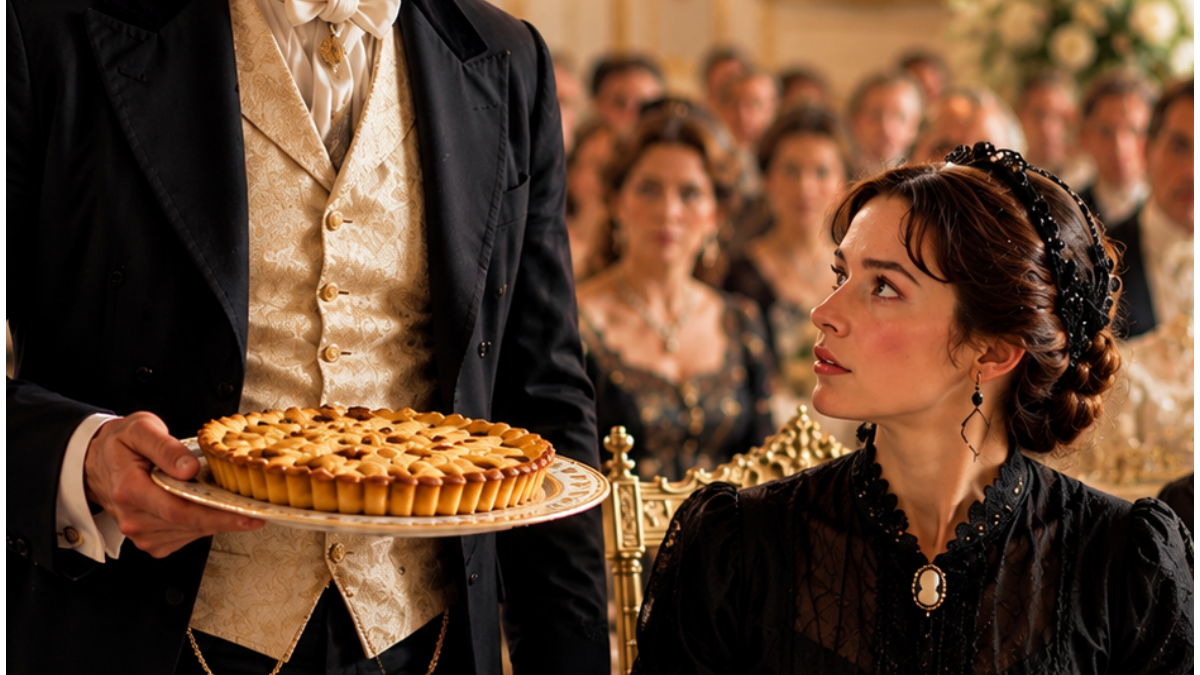
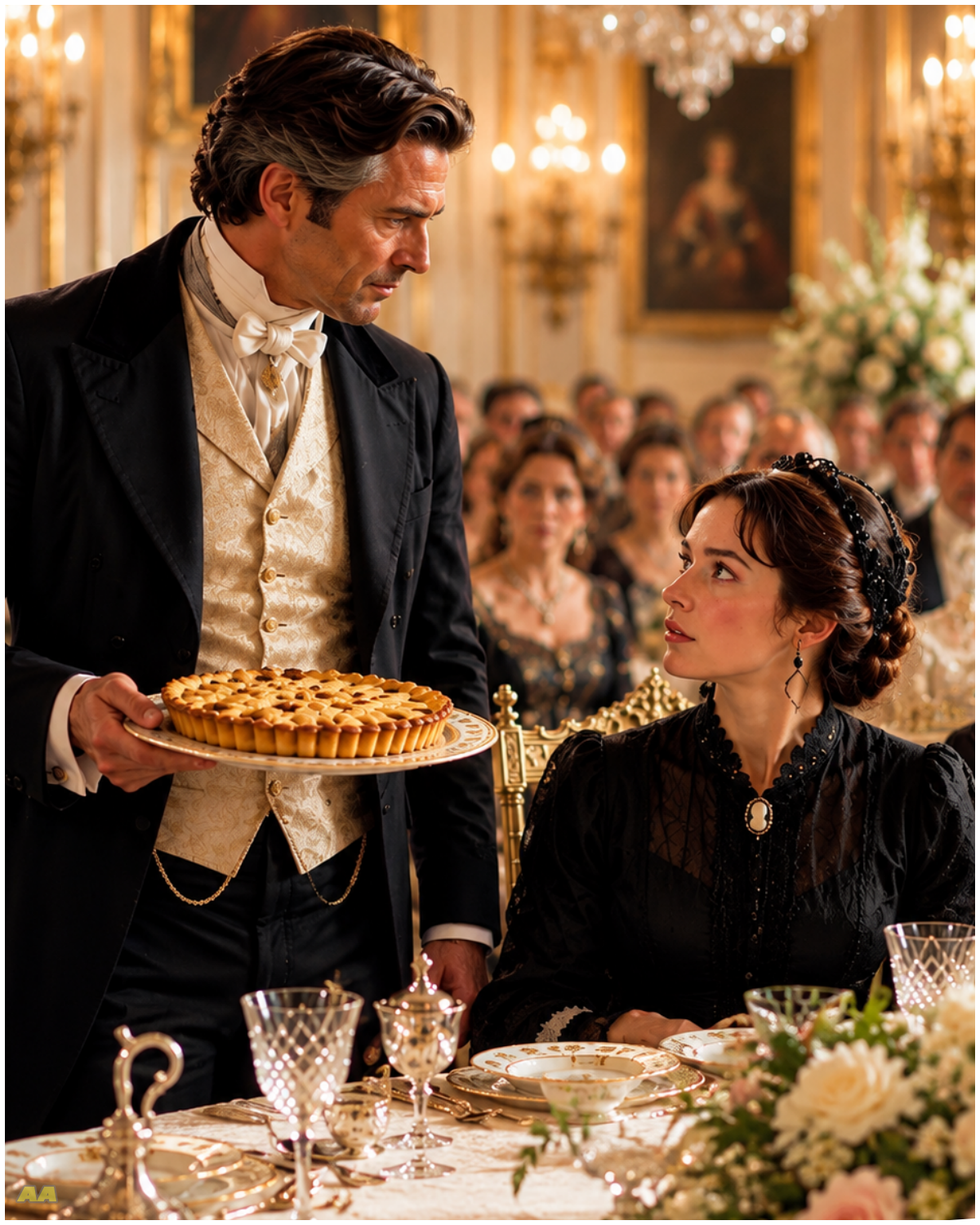
The whole county said she didn’t matter.
The widow at the last table mending her own gloves by candle light, pretending she didn’t hear them laugh.
28 years old, 18 months a widow, and not one person in that parish had thanked her for anything in all that time.
Then a duke who hadn’t smiled since he buried his wife walked into that hall.
The most untouchable man in all of Yorkshire, the one every lady in the county had spent years trying to catch.
He took one bite of something on his plate and stopped.
He put down his fork.
He asked one question and the entire room went silent, not confused silent, guilty silent, because someone in that hall knew exactly who he was asking about and she wasn’t sitting anywhere near him.
Yorkshire, autumn of 1874.
The sun fell through the tall windows of Ashkam Hall in long golden ribbons, catching the dust that drifted above polished oak floors and turning ordinary air into something that shimmerred.
Crystal glasses stood in rows along white linen, waiting to be filled.
Silver candalabbras stood unlit, saved for the hour when daylight would fade and candle light would take its place.
Portraits of dead dukes looked down from the walls with the same patient expression they had worn for a hundred years, watching another harvest thanksgiving banquet gather beneath them, the way their own had gathered once, and the one before that, and the one before that.
Footmen moved without sound, carrying platters of roasted pheasant and dishes of glazed carrots, their white gloves bright against dark silver trays.
The smell of beeswax polish mixed with nutmeg and woodsm smoke, and somewhere beneath it all, faint and sweet, the smell of baked apples and clove drifted from the kitchens, promising something worth waiting for.
Everything about the room, said Ashkam Hall was generous.
The seating told a different story.
At the grand table near the hearth sat Lady Margaret Pembbrook, who ran the parish charitable committee the way a general runs a small and obedient army, her voice always pitched to be overheard.
Beside her sat Lady Beatatrice Caendish, who treated kindness as a performance meant to be watched rather than felt, and who never gave a shilling to charity without first arranging for someone to see her give it.
Sir Frederick Blackwood held court a few chairs down, laughing too loudly at his own remarks.
His cousin Edward seated near enough to laugh along with him.
Reverend Samuel Collins and his wife Grace sat quietly near the window, the only two at that table who seemed to notice anyone beyond it.
Near the servant’s entrance, at the very last table in the hall, sat Florence Bennett.
She wore black morning silk, carefully brushed that morning until it held a soft shine despite its age.
The hem had been mended so many times that only she knew where the stitches were hidden.
Her gloves, too, had been repaired, small, even stitches at the seams, done by candle light after long days spent doing other people’s work for other people’s wages.
She kept her hands folded beneath the table, out of sight.
The way she kept most things about herself out of sight.
Now, two days she had spent on the apple tart that sat at that very moment among the desserts on the long committee table.
Apples gathered from the old north orchard before the frost could touch them.
Sugar measured carefully because sugar was never cheap for a widow living alone.
A glaze made from quint because it held its shine better than syrup, and left behind a taste like something remembered rather than something merely sweet.
Lady Margaret had taken it from her hands that morning with a brisk nod and no word of thanks, and set it among the committee’s offerings, as though the tart had simply appeared there on its own, grown overnight, like the apples themselves.
Florence had learned over 18 months of widowhood not to expect anything else.
She told herself this so often that most days she nearly believed it did not sting.
She was 28 years old.
She had been married to Thomas Bennett, Ashkam Hall’s steward and surveyor, a man the tenants trusted more than they trusted most gentlemen born into trust.
He had died on the northern boundary road, thrown from his horse in the dark, and the estate had called it an accident, and closed the matter as neatly as a ledger, balanced at month’s end.
Florence had never been able to close it so easily herself.
Something about the silence that followed his death had always felt too complete, too convenient, like a door shut a moment before someone could see what lay behind it.
Since then she had lived alone at Ivy Cottage, the small house Thomas had leased from the estate, surviving on pastries sold quietly to village families who could afford them, on preserves put up each summer against the winter to come, on the careful keeping of accounts for households too proud to admit they needed the help.
She was useful to everyone in the parish and visible to no one in it.
The village was not cruel to her in any way she could point to and name aloud.
Its cruelty wore better manners than that.
It used her hands, praised the work, and forgot the woman who had done it, all in the same breath.
At the head table, Duke Philip Ashkam ate almost nothing.
He was 42, though grief had put a few more years into the set of his shoulders than time alone would ever have managed.
Three years earlier, he had buried his wife, Charlotte, after a long illness that took first her strength, and then, slower and cruer, her hope of ever being well again.
Their infant daughter had gone before her in a winter Philip still could not think of without his chest tightening.
Since then he had kept Ashkcom Hall running with the same discipline he applied to everything he touched.
Ledgers balanced, tenants looked after, harvests brought safely in, but he had stopped in some quiet and private way, actually living inside the house he governed so well.
His housekeeper had asked him twice that week whether he intended to attend at all, and twice he had answered yes, without much conviction behind the word, the way a man answers a question he has already stopped truly considering.
He had come to the banquet tonight because his tenants expected it of him, because duty was the one language grief had never managed to take from him.
He sat through the courses with the composed patience of a man waiting for an evening to end, greeting old acquaintances with the correct number of words, and no more, until a footman set a slice of apple tart before him, and he lifted his fork more out of habit than hunger.
The first bite he took without interest, his mind already elsewhere, on tenant accounts, and a letter from London he had not yet answered.
The second he did not.
The crust was thin and crisp, holding its shape without turning hard beneath the fork.
The apples underneath had been chosen for tartness rather than sweetness, so that the fruit still tasted like itself under the sugar rather than dissolving into syrup, the way lesser tarts always did.
There was a warmth of clove hidden beneath the cinnamon, and over the top, instead of the heavy sugar glaze every kitchen in the county seemed to favor that season, a thin brush of something sharper, Quint, though he could not yet have named it, that cut cleanly through the richness, and left the tongue wanting a third bite before the second was even finished.
For one unguarded moment, the taste carried him somewhere else entirely.
An autumn kitchen from his boyhood.
His mother’s laugh drifting through an open door years before grief had turned Ashkam Hall into a house of careful silence and closed doors.
He set down his fork slowly, as though he might lose the memory if he moved too quickly.
Who made this apple tart?
The words were quiet, but they landed in the hall like a dropped glass, and every conversation within hearing stopped at once.
The room did not merely go still.
It went guilty. Lady Margaret’s smile stayed fixed on her face a moment too long before she began smoothly to explain that the parish committee had arranged the dessert table that evening, that so many good ladies had contributed their efforts, that the harvest itself had been.
I did not ask who arranged the table, Philip said, not unkindly, but without room for retreat.
I asked who made this particular tart.
The silence stretched longer this time, thick enough to feel.
A young maid near the sideboard glanced instinctively toward the last table, and the housekeeper beside her caught the look and killed it with a single glance of her own, sharp as a slap.
Philillip followed the maid’s eyes anyway.
He saw her then, the woman seated apart from everyone, hands folded beneath the table, spine straight in a way that looked less like pride and more like a habit built from years of being watched and dismissed in the same breath.
She was not beautiful in the practiced ornamental way the ladies near him were beautiful, all curled hair and studied smiles.
Her face carried something else entirely.
A particular stillness that belonged only to people who have learned to carry weight without ever letting it show on the surface.
He is looking at me, Florence thought, and felt the old instinct rise in her to lower her eyes and let the moment pass her by unnoticed, the way every such moment had passed her by for 18 months.
But something in the directness of his gaze would not let her disappear this time.
“I did your grace,” she said.
Her voice did not shake, though something in her chest had drawn very tight.
What happened next unsettled the room far more than the question had.
Philip rose from the head table, the head table where a duke belonged by every rule of the evening, and crossed the full length of the hall, while a hundred pairs of eyes followed him in disbelief.
He drew out the empty chair across from Florence without asking anyone’s leave, and sat.
No rule of etiquette forbade it, and yet every guest in the hall watched as though he had broken one anyway.
Lady Beatatric’s fan stilled mid-motion.
Sir Frederick set down his glass without drinking from it.
“The apples,” Philillip said. “Where do they come from?” Florence, startled into honesty by the plainness of the question, answered before caution could stop her.
“The old orchard to the north, your grace.
Several of the trees were planted in your grandfather’s time.
They keep better than the newer stock, sharper, less watery when they cook down.
I pick them a little early and let them finish ripening indoors out of the wet or the frost takes half the crop before December.
She spoke of harvest timing and storage and the balance of acid to sugar with the easy confidence of someone who had thought about these things for years, not because she wished to impress him, but because no one had asked her a real question in longer than she could remember, and the words came out of her like water finally finding a crack in a dam that had held far too long.
Philip listened as though there were no one else in the hall at all.
You know this estate, he said.
My husband did, she answered.
I learned it from watching him love it.
Your name? Mrs. Thomas Bennett.
Something shifted behind his eyes at once.
He remembered the name. Remembered Thomas Bennett as one of the few men on the estate who had told him uncomfortable truths simply because they were true.
Back when Philillip still had the patience and the will to hear them.
He remembered too with a small cold jolt the thin and hurried report of his death, filed and forgotten within a fortnight.
Florence noticed the flower still caught in the seam of her own sleeve, and embarrassed, tried to fold her arm out of sight.
Philip noticed the small movement before she managed it, and something in him, some old buried instinct toward gentleness he had not exercised in years, softened further than he intended.
Lady Margaret appeared at Florence’s shoulder, her voice pitched deliberately for public hearing.
“Mrs. Bennett, you’re needed to help clear the dishes.” “Mrs. Bennett and I have not finished our conversation,” Philillip said without raising his voice at all.
The quiet of it made it impossible for anyone in the hall to argue.
He asked her before she rose to leave that night how long she had lived at Ivy Cottage, and whether the lease was a fair one, and she answered both questions plainly, without complaint, in the way of a woman long practiced at making the truth sound smaller than it was, so that no one would think her ungrateful.
It was only when he asked one final question that the evening changed shape entirely.
Why was your husband on the northern road so late that evening?
Florence’s hands stilled in her lap.
For a moment she said nothing at all, and Philip wondered if he had pressed too far, too soon, into a grief that was not his to disturb.
He said there was something in the tenant accounts that could not wait until morning, she said at laSt. Across the hall, a silver spoon slipped from Edward Blackwood’s fingers and struck the table with a sound too loud for the sudden quiet.
He smiled a moment too late to make the smile look like nothing.
Philip watched him for a long moment, filing the smile away, the way he had once filed away every careless, honest thing Thomas Bennett had told him over the years.
Walking home that night along the dark lane, her shawl drawn tight against the chill, Florence turned the whole strange evening over in her mind, like a coin she could not quite believe she had found lying in the road.
A duke had crossed his own dining hall for her.
A duke had asked her name, and listened to her answer as though it mattered more than anything else spoken in that room all evening.
She told herself firmly that it meant nothing beyond ordinary courtesy, that men of his rank often noticed small things, and forgot them again well before mourning, and she almost managed to believe it by the time she reached her own gate.
Behind her, in the warm and glittering hall she had left, Philillip sat a long while after the last carriage had gone, staring at the empty chair across from his own place at the head table.
He had not meant when the evening began to feel anything at all.
Grief had taught him to expect very little from any gathering, and he had come prepared only to endure it.
Instead, he found himself remembering the particular steadiness in her voice when she spoke of storage and acid and ripening fruit, as though she had built a small fortress of ordinary knowledge to stand inside.
And he found he wanted very much to know what else that fortress held.
When Florence finally left through the servants’s door, murmuring her thanks and her apologies for keeping his grace so long from his other guests, the grandest doors of Ashkam Hall stood open behind her for guests who had done far less to deserve them than the quiet woman walking out into the cold autumn dark.
Hey, quick question. How are you feeling today?
Thank you so much for being here.
It really means the world to me.
I’m working toward 11,000 subscribers.
And if you’re already invested in Florence, please hit that subscribe button.
For Ariela Duke Romance Stories, smash the like and drop a comment telling me where you’re watching from.
It helps more than you know.
All right, thank you. Now, let’s get back to what happens when the widow they overlooked becomes the woman a duke can’t forget.
By morning, Philillip had already sent for the estate’s old records laid out across his study desk before the household had fully woken.
Thomas Bennett’s death report was thinner than it should have been for a man who had run half the business of Ashkam Hall in his lifetime.
A horse that slipped, a fall near the northern boundary, no witness present, papers he had reportedly been carrying, ruined beyond reading by rain that same night.
The report was signed, Philip noticed with a slow and unpleasant certainty by Edward Blackwood himself, the same steward who had grown so smoothly into Thomas’s old duties, as though water had simply filled an empty space left behind.
When Philillip summoned him, Blackwood arrived composed and faintly wounded, as a man might arrive who felt an old grief was being needlessly disturbed for no good reason.
He suggested delicately that sorrow had made the widow imaginative, prone to seeing conspiracy in ordinary misfortune.
He mentioned, almost as an aside, that Thomas had seemed unsettled in his final weeks, distracted, perhaps overworked.
Philip did not like the word.
Unsettled was the kind of word a careful man reached for when he wanted a death to sound like weakness instead of murder.
“Thomas Bennett was the steadiest man on this estate,” Philip said quietly once Blackwood had gone.
He said it to the empty room because there was no one else left who would say it for Thomas now.
He rode to Ivy Cottage that afternoon under the entirely proper excuse of discussing the North Orchard’s yield for the coming season.
Mrs. Agnes Walker, Florence’s elderly neighbor, was already there when he arrived, seated with her knitting near the window, which meant propriety was satisfied, and nothing improper could be whispered of the visit.
Though the air between Philillip and Florence carried attention no chaperone in the world could account for or explain away.
The cottage was small, but every corner of it spoke of care.
Copper pans gleamed on their hooks along the wall.
Jars of preserve stood in neat rows beside stacks of borrowed household ledgers Florence kept for families too proud to hire a proper cler.
Dried lavender hung near the window, filling the small room with a faint, clean sweetness.
Beneath the stairs, Thomas’s old boots still waited, polished, though never worn, as though he might yet come in from the fields at dusk.
One chair at the small table stood empty.
Florence had never been able to move it, though she told herself often enough that she meant to.
Philip understood, looking at that chair, that she had not kept the cottage exactly as Thomas had left it, because she could not let go of grief.
She had kept it because it was the one room in her life that still belonged entirely to her, untouched by parish committees or borrowed silk or other people’s opinions of what a widow ought to be.
“Would you show me the orchard?” he asked.
I find I remember it poorly, though I was raised beneath those very trees.
They walked out together, Mrs. Walker, trailing at a discrete and dutiful distance, the autumn trees nearly bare above them, wet leaves clinging to the grass, like something that refused to be swept away, no matter how hard the wind tried.
Florence spoke of how Thomas had loved this stretch of land above all others on the estate.
Because the old roots, he used to say, told the truth of a place more honestly than any painted portrait hanging in the great hall ever could.
The orchard remembers, she said, half to herself.
The way one repeats a thing a beloved voice once said too many times to forget the shape of it.
Remembers what? Every promise made over it, Florence said, and every betrayal.
Philip asked what she meant by it.
And it was there, beneath the bare branches, that Florence finally admitted what she had never told a living soul, that Thomas had left behind several locked notebooks in his writing desk, and that on the last morning she had seen him alive, he had gripped her hand at the door, and said, “Whatever happens, do not let Blackwood take these.” She had never opened them since.
They felt, she said, like estate business that was not hers to touch, and touching them had felt too much like admitting he was truly gone.
“They may be justice now,” Philip said gently, “which makes them everyone’s business, including yours most of all.” Florence hesitated a moment longer, her hand resting flat against the locked drawer, as though she might still change her mind.
Then she drew out the small brass key she had kept hidden inside a jar of dried lavender for 18 months, never once turning it, and set it on the table between them.
“He trusted me with this,” she said quietly.
“I have always been afraid that opening it meant admitting he was never coming back to explain it himself.
He is not here to explain it,” Philip said just as quietly.
But you are here to finish what he began.
That is not a smaller thing, Mrs. Bennett.
I suspect it is a braver one.
Florence turned the key over once in her fingers before finally fitting it to the lock.
Her breath held, and when the small drawer finally gave way with a soft click, she felt something in her chest loosen that had been held tight for 18 months, as though she had finally been given permission to grieve properly at last, rather than merely endure.
They opened the notebooks together that evening at her small table, Mrs. walker sewing quietly by the fire nearby, the rain beginning to tap softly against the window glass.
At first the pages seemed ordinary enough, acorage, rents, repairs, names written in Thomas’s careful, upright hand, but Florence, turning through them with a baker’s [clears throat] patient eye for pattern and proportion, noticed something Philillip had entirely missed.
Thomas had used the first letter of each tenant’s surname to build a second hidden column of figures folded inside the first coded accounts kept in plain sight and seen by no one who did not already know to look and the code told an ugly story once it began to unfold.
Families recorded in the official books as delinquent had in truth paid every shilling owed.
Rents had been quietly diverted somewhere they were never meant to go.
Tenants had been pushed off valuable land under false pretenses of unpaid debt, and that same land leased out again through relatives of the very man who had pushed them off it.
The profit disappearing into pockets that were never meant to hold it at all.
One of the properties listed for review in 6 weeks time, Florence realized with a cold drop in her stomach, was Ivy Cottage itself.
It was while turning a page together that Philip’s fingers brushed against hers.
Neither of them moved for a long moment.
Florence felt the warmth of his hand linger against her skin long after he had withdrawn it, a small heat that spread through her like sun through cold glass.
Philillip, for his part, became suddenly and completely aware of how close she stood beside him at the small table, of the soft rise and fall of her breath, of the faint scent of apples and lavender that clung to her sleeve, of how easily, if he only leaned a fraction closer, the careful distance between them, could close entirely and never be recovered.
He stepped back instead, though every part of him resisted the movement, not because he wished to put distance between them, because he respected her too much to close it without first earning the right.
The restraint, if anything, made the wanting between them worse rather than better.
Later, beneath the bare orchard trees, with the last light going violet over the hills, and Mrs. Walker’s lantern glowing faintly some distance behind them.
Florence spoke of Thomas’s kindness, how he had once walked three miles in the rain to fetch a doctor for a tenant’s sick child, who was not even his responsibility to look after.
Philillip, in turn, spoke aloud of Charlotte for the first time in 3 years.
Not the illness, not the ending, but the way she used to laugh at his seriousness, and call him fondly the dulllest man in Yorkshire.
Neither of them compared their losses.
Neither made the others grief into a rival to be measured and weighed.
It became instead something they held together between them, each recognizing in the other’s face the particular bone deep exhaustion of having survived something they had never chosen to survive in the first place.
People speak of grief as though time simply carries it away, Philip said.
Time does not carry it, Florence answered.
It teaches us how to carry it ourselves without dropping everything else we still have to hold.
He looked at her differently after that, not as a widow to be quietly pied from a comfortable distance, but as a woman who had already done the hardest thing there was to do in this life, and had done it entirely alone, without a single hand offered to help her.
“Does it frighten you?” he asked, speaking of him so plainly to a stranger.
You are not entirely a stranger anymore, Florence said.
And no, it frightens me more to say nothing at all, as though pretending he never lived might somehow make his absence easier to bear.
It never has. Charlotte’s name still catches in my throat most days, Philip admitted, watching the last light fade over the hills.
I thought silence might dull the ache eventually.
It has only made the house quieter.
Then let us agree to be less quiet with each other,” Florence said, surprising herself with the boldness of it, whatever the county might make of two grieving people, speaking honestly beneath an orchard.
Mrs. Walker’s lantern bobbed closer through the dusk, a gentle reminder that the hour had grown late, and they turned back toward the cottage together, neither hurrying the walk more than the falling darkness required.
It was near the last page of the second notebook that they found the name written twice in Thomas’s careful hand, tucked deep into the coded margin, where no casual reader would ever think to look.
F. Blackwood. Florence assumed at once it meant Frederick, Edward’s wealthy and well-connected cousin.
Philip felt something colder settle in his chest at the thought.
If the corruption reached beyond one dishonest estate steward and into the county’s wider circles of respectable men, then Thomas had not stumbled onto a single dishonest man working alone.
He had stumbled onto a whole quiet arrangement of them, protected by name and rank and old friendship.
That night, while Florence sat in the small stone church for evening service, someone entered Ivy Cottage.
Nothing of any value was taken.
Only Thomas’s writing desk had been forced open.
The old wood splintered ugly at the lock.
The notebooks survived only because Florence had carried them with her to Ashkcom Hall that very morning, tucked safely beneath her shawl.
On the desk where the notebook should have sat, someone had left a burned apple branch, blackened and brittle, laid out with careful, deliberate precision, as though it had been placed there and not simply dropped.
Florence stood in the doorway a long time before she could make herself step inside her own home.
Mrs. Walker, arriving breathless behind her at the sound of her cry, pressed a steadying hand to her shoulder, and murmured that nothing else seemed disturbed, that whoever had come had wanted only the desk and nothing more.
It was small comfort. Florence spent that night with every lamp in the cottage burning, the notebooks locked in a strong box she did not entirely trust, listening to every creek of wind against the shutters, as though it might be a footstep.
By morning she had made up her mind that fear, however reasonable, would not be allowed to decide anything for her.
She sent word to Ashkcom Hall before she had even finished her tea.
And when Philip arrived within the hour, his face drawn tight with a concern he did not trouble to hide, she found she was glad of it, in a way that unsettled her nearly as much as the breakin itself had done.
The orchard remembered, and someone very much wanted it to stop remembering.
Edward Blackwood was not a stupid man.
He understood within a matter of days that the Duke and the widow were no longer two separate concerns to be managed apart from one another.
He could not accuse them of investigating him without confirming by the very act of accusation that there was something worth investigating in the first place.
So he did what men like him had always done when the truth threatened to reach them.
He turned his attention to Florence’s reputation instead of his own carefully hidden ledgers.
The rumors moved faster than any fire he could have set with his own two hands.
In drawing rooms and parish meetings, and the small shops along the high street, the story took shape and reshaped itself with each fresh telling, that Florence had baked the tart to catch the Duke’s eye on purpose, that she had exaggerated her husband’s old suspicions purely for her own gain, that she had visited his grace privately and improperly, that a woman still in mourning had no earthly business being noticed by a duke, unless she meant to trade her black silk for a coronet before the year was out.
Lady Margaret, more afraid of losing her own standing than of committing any real injustice, removed Florence from the parish kitchen committee until the unpleasant attention passes, dressing plain cruelty in the soft, forgiving language of concern.
Florence learned of it at the very next charitable meeting, arriving to find her usual chair, had simply vanished from the room without explanation.
The ladies discussed her situation freely as though she were not standing only 3 ft away, listening to every careless word.
“A woman in Mrs. Bennett’s position,” Lady Beatatrice said, without troubling to lower her voice at all, must be especially careful not to misunderstand courtesy.
“It is difficult to misunderstand courtesy,” Florence answered evenly, “when one has received so very little of it to begin with.
She left the room with her back straight and her chin level, and it was only once she reached the empty lane outside, well beyond any window that might catch her face, that her composure finally broke.
She did not weep because she had lost a seat on a committee that had never once valued her presence beyond her usefulness.
She wept because the very same women who had eaten years of her labor without a single word of thanks now made her quiet gratitude sound like calculated ambition.
Made her private grief sound like scheming.
Made 18 months of solitary endurance sound like a trap she had cunningly set for a lonely grieving widowerower.
I made them their bread, she thought bitterly, wiping her eyes with the back of one mended glove.
I made them their comfort, and still it was never enough to earn my own name spoken aloud.
Word of the rumors reached Philillip within the day.
His solicitor, Arthur Wickliffe, a careful and sensible man, advised distance above all else.
Any public defense on the Duke’s part, he warned, would only feed the story further and give it more weight than it already carried.
Philillip refused to issue some grand public declaration that would only make Florence look like a woman sheltering behind a duke’s protection rather than standing on her own two feet.
Instead, he built her something sturdier than any declaration could ever be.
Ashkam Hall was already expanding its charitable food program for the county’s workhouses and orphanages that winter, and Philip formally appointed Florence to oversee the whole of it, purchasing, kitchen accounts, preservation, baking contracts, distribution to every parish in need, with a salary equal to that of a senior estate clerk, paid quarterly, and recorded openly in the estate books for anyone to see.
Florence, when he told her of it in his study, was furious rather than grateful.
“You are dressing charity as employment,” she said.
“So that the whole county will pity me twice over instead of once.
You are the most capable person available for the task,” he answered.
“And I have the ledgers to prove it, should you require proof.
You cannot possibly know that with such certainty.” He set three old ledgers before her on the desk, ones she had corrected during Thomas’s lifetime, her own small, precise notes visible in the margins, notes that had saved the estate several hundred over the years through nothing more than careful arithmetic and an honest eye.
I know precisely what I am purchasing, Mrs. Bennett, he said quietly.
Not charity, respect. She accepted the position only after negotiating her own salary downward to a figure she considered fair rather than generous, which made Philillip privately admire her all the more for the stubbornness of it rather than less.
At the Winter County Assembly some weeks later, Florence appeared in deep green silk borrowed from Grace Collins for the occasion, modest in its cut, but lovely in a way that made her presence impossible to overlook.
Even among gowns that had cost 10 times as much.
She had come because her new position required it of her, not because she wished in the least to be seen or admired.
Philillip saw her at once across the crowded ballroom, and for the first time his awareness of her turned openly, undeniably physical.
The graceful line of her throat above the collar, the candle light caught warm in her dark hair, the calm she wore like armor against every whispering glance, sent her way from behind painted fans.
He crossed the floor without hesitation and asked her to dance.
The room quieted around them the way it had quieted once before, over a slice of apple tart.
His hand found her waist with careful, deliberate restraint.
Her gloved fingers rested lightly in his.
Each slow turn of the walts drew them nearer than propriety strictly allowed, near enough that she could hear the steadiness of his breath beneath the music, and she found herself entirely unable to look away from the quiet intensity in his eyes.
“You are trembling,” he said, low enough for only her to hear.
I am being watched by half the county tonight.
Then look at me instead of them.
She did, and for the length of that single dance, the rest of the glittering ballroom simply ceased to exist for either of them.
The wanting between them was unmistakable now, a current neither dared to name aloud, though it lived plainly in the space between their joined hands, and in the careful distance he kept from closing entirely, no matter how badly some part of him wished to.
When the music finally released them from the dance, Philip did not return her at once to the edge of the room where the watching eyes waited.
He walked her instead along the tall windows overlooking the dark garden, where the candle light was thinner, and the gossip could not so easily reach them.
“They will say a great deal about this before the night is finished,” Florence said, glancing back toward the ballroom.
“They will say a great deal regardless of what I do,” Philip answered.
“I find I would rather they had something true to talk about than something invented.
And if the true thing is worse for my reputation than the invented one, he considered this longer than she expected, then we shall have to make the true thing worth the cost, he said finally.
Because I find I am no longer willing to pretend I did not notice you, Mrs. Bennett, simply to spare either of us an inconvenient evening.
It was that same evening that Arthur Wickliffe drew Philillip quietly aside with news that could not wait.
A tenant named Josiah Marsh had come forward with receipts bearing Blackwood’s own signature.
Proof beyond doubt that his rent had been paid in full, though the estate’s official books claimed otherwise.
Before Marsh could carry the receipts to the county magistrate, his barn burned to the ground in the dead of night.
He survived the fire himself, badly shaken.
The receipts did not survive at all.
Philip confronted Blackwood directly the following morning.
In the cold and formal quiet of his own study, Blackwood did not confess to anything.
Of course, he simply smiled the same smile he had worn when he dropped the spoon at the banquet and said with a calm that chilled Philillip more than any threat shouted aloud, “A duke can survive scandal, your grace.
A widow cannot.” The threat sat in Philip’s chest like a stone for the whole of that long day.
She had spent that particular afternoon at the charitable kitchens, humming the same old tune her mother once sang, pleased with a batch of preserves that had turned out better than she’d hoped.
And it was that small, ordinary contentment that made the walk home feel so much longer once she saw what waited for her.
That evening, Florence returned to Ivy Cottage to find an eviction notice nailed crudely to her own front door, claiming Thomas’s lease had expired before his death, and giving her 14 days to vacate the only home she had left in the world.
At the bottom, Edward Blackwood’s signature curled with false, careful politeness, as though the man who signed it had done her some small kindness rather than the opposite.
Behind the notice scratched deep into the wood where only she would ever find it in the fading light.
Two words waited for her in the dark.
Stop reading. She stood very still on her own doorstep for a long time, the cold wind pulling at her shawl, and found that fear this time had begun to curdle into something far harder to frighten away.
She thought of Thomas, of the boots still waiting beneath the stairs, of the empty chair she had never once moved from its place at her small table.
She thought of every charitable supper where her hands had done the work, and another woman’s name had received the thanks, 14 days.
She counted them on her fingers in the dark, and then she went inside, latched the door behind her, and sat down to write to Philillip by candle light, because she had decided, somewhere in the cold minutes on that doorstep, that she would not face Edward Blackwood’s threats the way she had once faced her own grief, quietly, alone, and without a single word spoken in her own defense.
Florence did not stop reading.
She did not stop anything at all.
Despite the eviction hanging over her like a blade waiting to fall, she continued supervising the charitable kitchens without pause.
And it was in the middle of that steady work that the largest test of her new position arrived.
An order for 200 apple tarts bound for orphanages and workhouses scattered across Yorkshire before the first hard frost of the season closed the roads.
The commission mattered more than its size alone suggested.
It would prove the entire program worth keeping.
It would put honest paid work into the hands of village women who badly needed it before winter.
It would, if it succeeded, give Florence income enough of her own to fight the eviction on solid footing rather than borrowed kindness.
And if it failed, every whisper about favor and flattery would be proven true in the eyes of the whole watching county.
A violent storm broke the night before delivery was due, rain coming down in sheets that turned the estate road to churning mud within the hour.
A chimney above the kitchens collapsed under the combined weight of wind and water, and two of the great ovens lost their heat almost at once.
The kitchen staff began to panic, frightened voices rising over the crash of rain against the windows and the groaning of old timber somewhere overhead.
Florence did not panic. She could not afford to.
She divided the frightened women into steady groups, recalculated baking times against the ovens still working, moved trays where they were needed most, and sent the kitchen boys running out into the storm for whatever dry timber could still be found under the eaves.
Then word came, shouted through the kitchen door by a soaked and shivering messenger, that the cold delivery, delayed by flooded roads outside the village, would not arrive at all that night.
In the hours before the storm broke fully, Florence had allowed herself, for the first time since the eviction notice, to believe that something in her life might finally go right.
The trays were prepared, the fruit sorted, the sugar measured in careful rows of small dishes along the workt.
She had even hummed a little as she worked, an old tune her mother used to sing while kneading dough, and one of the younger kitchen girls had smiled to hear it.
Then the wind changed, and the first crack of the collapsing chimney sounded like the sky itself had split open above them, and every careful plan she had built came apart within the space of a single terrible hour.
Philip heard of the crisis past midnight and came at once without waiting for his coat to be properly fastened against the rain.
He walked into the kitchen already rolling his sleeves above the elbow.
What do you need? He asked his voice cutting cleanly through the noise and the fear.
Cole, Florence said without looking up from the tray in her hands, her hair already coming loose from its pins.
Dry wood and six more hours than God has seen fit to give us tonight.
I cannot negotiate with God,” he answered, already reaching for a shovel someone had abandoned near the door, but the other two may yet be managed between us.
He worked through the long night beside the estate men, hauling coal through driving rain from the storehouse, repairing the broken flu with his own bare hands, using his own carriage horses to drag a stranded supply wagon free of the deep mud on the estate road.
Soot blackened his hands and forearms until they were nearly unrecognizable.
His shirt clung wet and heavy to his shoulders, outlining the strength beneath it in a way that made Florence’s breath catch more than once when she thought herself unobserved.
She tried again and again through that long night not to look at him.
She failed every single time.
Once their eyes caught across the steam and fire light of the crowded kitchen, and neither looked away quickly enough to pretend afterward that it had not happened at all.
Near dawn, exhausted past careful thought, Florence cut her palm on the broken edge of a tart tin.
Philip took her hand without asking permission, and cleaned the wound himself at the wash basin.
His careful, deliberate movements betraying a restraint that had begun, finally, after weeks of holding steady to fray badly at the edges.
“You ask too much of yourself,” he said quietly, not looking up from her hand.
“There has been no one else to ask it of me,” she said.
“Not for a long while now.” “There is now,” Philillip said, and meant it more completely than he had meant anything in three long years.
The words settled over both of them like a weight neither felt entirely ready to carry, and for a moment neither spoke at all.
His thumb rested lightly against the inside of her wrist as he bandaged the small cut, where he could feel the quick, unsteady beat of her pulse beneath his fingers.
She did not pull her hand away from him.
For one long dangerous moment, standing so close in the warm fire light while the storm still raged outside, he lowered his head as though he meant to close the last distance between them entirely, and the whole noisy kitchen seemed to fall away around the two of them.
“Phillip,” she whispered, the very first time she had ever said his given name aloud, without any title attached to soften it.
A door banged open somewhere behind them.
A kitchen boy stumbling in with fresh timber, and they stepped quickly apart before anyone could see what had nearly happened between them.
The interruption did nothing at all to cool what had almost occurred.
If anything, it sharpened the wanting into something neither of them could easily set aside again.
Later, with the worst of the crisis finally behind them, and the ovens roaring steadily once more, Florence noticed a streak of flour dusted white across his soot darkened cheek, and reached up without thinking to brush it away with her fingers.
Her hand lingered there a moment longer than it needed to, near the corner of his mouth.
He turned his face slightly into her touch, and for the space of a single held breath, neither of them moved at all.
Then one of the failing ovens roared suddenly and gloriously back to full life behind them, and they broke apart, laughing.
Real laughter, unguarded and warm, the kind neither of them had known in years of careful, dignified grief.
While the kitchen’s attention was elsewhere, caught up in the sudden relief of working ovens, a young maid named Elsie Walker slipped quietly in from the corridor, pale and out of breath from running, to tell Florence privately that she had seen Edward Blackwood leaving Thomas’s old estate office not an hour before, moving quickly through the dark, glancing back over his shoulder more than once.
The final tart came out of the oven as the first gray light of morning finally touched the kitchen windows.
All 200 were finished, cooling in neat rows along every available surface.
The carts left for the orphanages before the sun had fully cleared the hills.
Florence stood alone at last in the quiet, exhausted kitchen, her hands trembling now with the sudden release of a night finally over, and survived.
Philip found her there beside the cooling ovens.
The storm outside finally spending its last strength against the windows.
“You saved the commission,” he said softly.
“We saved it.” She corrected him, too tired now to guard her own voice carefully.
He stepped close, closer than propriety would ever have allowed in daylight.
In company, this time neither of them looked away from the other.
He touched her face gently.
A question rather than any kind of claim upon her.
Florence closed the last small distance between them herself, rising slightly onto her toes.
Their first kiss was careful at the start, almost reverent, as though either of them might still choose, even now, to step back and stop.
Then months of denied feeling broke loose all at once between them, and the kiss deepened into something aching and unhurried.
Longing and grief and relief all tangled together, tender rather than reckless, patient rather than hurried, despite the hunger beneath it.
Florence’s hand gripped the front of his damp, soot stained shirt, as though she meant to anchor herself against him.
Philip held her the way a man holds warmth after a long and bitter winter he was never entirely certain he would survive to see the end of.
They broke apart only when footsteps sounded again in the corridor outside, and even then neither moved very far from the other.
Florence pressed her fingers briefly to her own lips, as though she might hold the warmth of the moment there a little longer, and Philillip watched her do it with an expression she had never seen on him before, something unguarded, almost boyish, entirely at odds with the composed duke the county believed it knew.
“I have wanted to do that,” he admitted quietly.
Since the evening you told me about Quint’s glaze as though it were the most natural subject in the world to discuss with a duke, you hid it remarkably well.
I have had a great deal of practice hiding things I want, he said, though I find myself far less interested in the practice than I once was.
That afternoon, returning to Thomas’s old office on a small matter of the charity accounts, Florence noticed a floorboard sitting slightly a skew beneath the window.
Out of place in a way it had never been before.
Beneath it, wrapped carefully in oil cloth against the damp, she found what she had never known to look for, the original tenant ledger, copies of the forged leases, letters bearing Frederick Blackwood’s own signature, and folded separately from the rest, Thomas’s final written statement in his own careful hand.
The last line of it made her blood run suddenly, entirely cold.
Should I fail to return, Edward Blackwood must answer for it.
She sat on the floor of Thomas’s old office a long while, the parcel open in her lap, the afternoon light shifting slowly across the boards.
She did not weep this time.
Something past weeping had settled over her, cold and clear as the first frost on the orchard grass.
For 18 months she had carried a grief she believed was simple.
A husband lost to careless fortune.
A road grown slick with autumn rain.
A horse that stumbled in the dark.
Now she understood the grief had never been simple at all.
It had been waiting, patient as the orchard itself, for someone to finally read what Thomas had left behind.
She wrapped the parcel again exactly as she had found it.
Tucked it beneath her arm and walked the long corridor to find Philillip.
Her footsteps echoing off walls hung with portraits of men who had never once had to fight for the right to be believed.
Florence read the statement twice through before she could make herself fully believe what it said.
Thomas had discovered everything it seemed in the weeks before his death.
Invented arars used deliberately to force honest tenants off good land.
Leases resold quietly through a chain of intermediaries.
Estate money bled away year after year in amounts small enough never to be missed by a grieving duke too occupied elsewhere to check closely.
A scheme was already forming, the papers showed, to sell the whole of the northern acreage to a railway syndicate for a price far below its true worth.
The difference to be pocketed quietly by men who had no right to touch it at all.
He had uncovered every piece of it, while Philillip sat at his dying wife’s bedside, too consumed by grief to notice the estate slipping quietly out from beneath his own feet.
On the night he died, Blackwood had summoned him to meet on the northern road, alone after dark.
Thomas had known from the careful way he hid his notebooks before leaving that evening that the meeting might not end safely for him.
The statement did not say outright that Blackwood had meant to kill him that night.
It did not need to say so plainly.
Motive and opportunity and fear were written clearly enough between the careful measured lines of Thomas’s own hand.
For 18 months, Florence had believed her husband died in an accident she could not possibly have prevented, no matter how she turned it over in her mind at night.
Now she understood all at once that he had died trying to protect families who would never even know what he had sacrificed for them.
And her grief turned in an instant into something far harder and sharper than grief had ever been before.
She wanted to confront Blackwood that very hour without waiting for anything or anyone.
Philip stopped her, not by commanding her to stay, which she would never have accepted from him or any man, but by explaining gently and firmly that an accusation made without proper witnesses, would only give Blackwood the time he needed to destroy what remained of the evidence, and flee the county entirely, beyond any reach of justice.
Florence resented the caution, even as some steadier part of her understood the sense in it.
“You treat me as though I might break apart at the first hard push,” she said, her voice tight.
“I do not think you fragile,” Philip answered carefully.
“I think you precious, and I do not yet know how to protect one without insulting the other in the process.” The words silenced them both for a long moment.
Florence feared in the difficult days that followed that his love, however genuine, might one day become another kind of cage, however gently and lovingly it was built around her.
Philip feared, in turn, that his own rank made every act of care, look like ownership rather than devotion freely given.
They agreed at last, with more quiet sorrow than either of them admitted aloud to the other, that Florence would remain at Ivy Cottage, while Arthur Wickliffe prepared their legal case in full, and the distance between them stretched tight and painful, as a wire pulled too far.
Philip wrote her several letters in those long evenings that he never once sent.
Florence lay awake, remembering the exact weight and warmth of his hand around hers in the kitchen that night, and found the memory did nothing at all to ease the sharp ache of missing him now.
She busied herself instead with the ordinary rhythms of the cottage, mending, preserving, keeping the small accounts that had once been her whole world before a duke had ever tasted her apple tart.
But every task now carried the shadow of his absence beside it.
She would reach for the good knife on the shelf, and remember his hands blackened with soot from the ovens.
She would pass the empty chair at her table, and think, unbidden, of how easily he might one day sit in it, if the world ever allowed them the peace, to simply be together, without danger circling close behind them.
At Ashkcom Hall, Philip found the great house colder than it had been, even in the worst months after Charlotte’s death.
He had grown used in the brief weeks since the harvest banquet to a particular kind of warmth that had nothing to do with fires or candles, and its absence now made every corridor feel longer than it had before.
He threw himself into the legal preparations with Arthur Wliffe, as though sheer diligence might somehow shorten the distance between himself and Ivy Cottage, though he knew, in the honest part of his mind, that grief had trained to expect very little, that only Blackwood’s downfall would truly bring her safely back to him.
Blackwood, learning somehow that the ledger had surfaced at last, moved quickly to protect himself.
He used the standing eviction order as cover to send men into Ivy Cottage while Florence was away at Ashkcom Hall meeting with Arthur over the coming case.
She had already moved the true evidence elsewhere for safekeeping, but his men found instead a single copied page suggesting falsely that Philip himself had personally authorized several of the disputed leases years before.
Blackwood intended to use it to make the Duke appear just as guilty as his own steward, and so buy himself both silence and protection in one stroke.
Florence proposed the trap herself, calmly and without flinching, once she understood the danger they were in.
A message, deliberately allowed to reach Blackwood through a servant known to carry gossip, claimed the recovered ledger would be delivered to the county magistrate by rail the following morning.
Blackwood took the bait exactly as they had hoped he would, slipping alone into the abandoned cider house, standing in the north orchard, believing he would find Florence there, waiting with the evidence, unguarded and afraid.
Philip wanted her nowhere near the cider house that night.
She refused entirely to be kept away from it.
“Thomas died because men assumed his wife would never understand his work well enough to be dangerous,” she said.
I will not reward that same assumption now by hiding away while others finish what he started.
Philip agreed at last, reluctantly, only once constables and reliable witnesses had been arranged quietly nearby, close enough to reach her, the instant she needed them, and not a moment later.
Before she walked out into the dark toward the orchard, he fastened his own cloak around her shoulders against the knight’s chill, his hands lingering a moment longer than the task strictly required at her collar.
When this is finished, he said quietly, his voice rough.
I have something important I mean to ask you.
Then come back to me alive enough to ask it properly,” she answered, managing a small, unsteady smile, despite the fear sitting cold in her cheSt. He bent his head and pressed a kiss to her forehead, restrained and gentle, and heavier with love and fear, both than any dramatic farewell speech could ever have carried.
Inside the old cider house, Blackwood, believing himself entirely alone with her at last, said far more than he had ever meant to say aloud.
He admitted in a rush of nervous, self-justifying words that the meeting on the northern road years ago had only been intended to frighten Thomas into silence, nothing more, that a struggle between them in the dark had caused the fatal fall, and that he had left him there afterward rather than call for a doctor, because saving him would have meant exposing everything he had so carefully built since.
When he saw Philillip step forward at last from the shadows behind her, Blackwood understood too late that he had confessed his crime to a witness who mattered a great deal more than a frightened widow alone.
In his sudden panic, he struck the hanging lamp from its hook without thinking, and the flame caught the dry old timber of the building almost at once.
Smoke began to fill the small, close space between them with frightening speed.
Blackwood seized the ledger from the table where he had set it and fled deeper into the burning building rather than let the evidence go, even as the fire spread around him.
Florence went after him without a second’s hesitation.
Thomas’s final statement was folded inside those very pages, and she would not let fire finish in one careless moment what Blackwood had started so deliberately years before.
A support beam gave way overhead with a sudden groan and crashed down between her and Philillip.
And through the roar and crackle of the growing fire, he heard her cry out once sharply from the other side of it.
For one unbearable second, Philillip stood frozen, the heat of the flames pressing against his face, unable to see anything through the thickening smoke, but the orange glow where the beam had fallen.
Every calm, careful instinct that had carried him through three years of quiet grief deserted him at once.
There was only the sound of her voice, and the terrible silence that followed it, and the certainty settling cold and absolute in his chest, that he would not survive losing another person he loved to a fire he could not stop in time.
“Florence!” he shouted, already moving toward the flames without a single thought for his own safety.
Philip did not wait for the constables to reach him.
He went into the burning cider house himself before anyone could catch his arm to stop him, the smoke already thick enough near the doorway to swallow a man whole.
He found Florence pinned beneath the fallen timber, conscious still, coughing hard against the smoke, but alive and fighting to free herself.
Blackwood had reached almost to the rear door by then, the ledger clutched tight against his chest, its edges already curling and blackening in the growing heat.
“Save the ledger,” Florence gasped out, struggling against the weight pinning her down.
Philip did not so much as glance toward it.
I have already buried enough people I have loved.
He said the first time he had ever said the word aloud to her without a single moment’s hesitation, and it steadied something deep in her chest, even through the choking smoke and rising fear.
With the desperate help of estate workers who had followed him in through the smoke, he lifted the beam just enough to free her and carried her out into the cold, wet, blessedly clean air of the orchard.
Arthur Wickliffe managed to reach Blackwood as he finally collapsed near the rear door, overcome by smoke, and pulled the scorched ledger free from his weakening grip before the fire could finish it.
Most of the pages survived intact, protected by the same oil cloth Thomas had wrapped them in so carefully years before, as though he had somehow known even then that they would one day need to survive exactly this.
Blackwood was arrested in front of the gathered tenants the following morning in the very same open ground where so many of them had once stood accused wrongly as dishonest debtors before the whole watching parish.
This time it was the real thief who stood exposed before them all.
Frederick Blackwood tried weakly to deny any part in the scheme when questioned, but the recovered letters and the banking records left him nowhere left to stand.
The wrongfully seized leases were restored to their rightful holders within the month.
Families who had been driven from their land under false pretenses received fair compensation from the funds finally recovered.
Ivy Cottage was transferred legally once and for all into Florence’s own name, not as any gift from the Duke, but in clear recognition of Thomas’s years of unpaid service and her own long proven right to the home she had never truly stopped fighting for.
In the days between the fire and the arrest, Florence found she could not stop her hands from trembling whenever she recalled the smoke and the weight of the fallen beam.
Philillip stayed near her more often than propriety strictly demanded, not hovering, never treating her as something broken, but simply present in the way a person is present for someone they cannot bear to have out of sight so soon after nearly losing them.
It was in those quiet, unremarkable days, sharing tea in the cottage kitchen, walking the orchard path slowly while her strength returned, that Florence understood the difference between being protected and being cherished, a distinction she had once feared did not exist at all.
Philip ordered a memorial stone set into the earth beneath the old orchard trees where Thomas had loved to walk.
Thomas Bennett, who kept faith when others sold it.
At the tenants gathering that followed the arrest, Florence was asked to stand and speak a few words.
She did not soften her husband’s death into something easy and noble to hear.
She told the assembled crowd plainly that he had been afraid that night, and that he had acted anyway, despite his fear, and in the telling, Thomas Bennett stopped being merely a name half remembered on an old, thin estate report, and became instead, before all of them, the quiet moral center of everything that had happened since his death.
Afterward, Florence found Philillip standing alone beneath the orchard trees, the autumn light fading gently around him.
He half expected, after everything that had happened between them, that she might now choose to leave Ashkam altogether, her business here finished at laSt. Instead, she told him the plain truth of it, that she had feared his protection, not because it was ever unkind in itself, but because she had spent 18 months defending the last small pieces of a life that were entirely her own to keep, and she was not yet ready to lose even one of them to anyone, not even to a love as steady and as patient as his had proven to be.
“I do not want your dependence,” Philillip said quietly.
Then what is it you do want from me?
Every difficult opinion you have ever kept carefully to yourself around me.
Every refusal you might someday give me.
Every room in this house made less empty simply because you have walked into it.
He told her plainly and without any grand flourish that he loved her not because she needed rescuing by a man of his rank and fortune, but because she looked at him without the title ever standing between them, and refused always to flatter whatever she found there instead.
Florence admitted in turn, her voice unsteady now for the first time in months of careful composure, that she loved him too, and that she was frightened, deeply frightened, of becoming a duchess, and quietly disappearing entirely beneath another family’s grand name, the way so many capable women before her had disappeared without a trace.
“Then do not disappear,” Philip said simply.
Make all of Ashkham learn your name instead of forgetting it.
And if I am clumsy at it, Florence asked, “I have spent 18 months being invisible on purpose.
I am not certain I remember how to be seen without flinching.” “Then we shall be clumsy together,” he said.
“For as long as it takes.
I promise you, I have no more practice at this than you do.
I have only ever been good at grieving quietly.
Loving you plainly is an entirely new skill, and I intend to learn it properly, whatever the cost in dignity along the way.” She laughed, then, surprised by her own laughter, bright and unguarded in the cold evening air, and the sound of it seemed to loosen something in his chest that had been drawn tight for three long years.
He kissed her then, beneath the bare autumn branches where Thomas’s memorial stone now stood, and this kiss carried none of the careful hesitation of their firSt. Months of restraint gave way at last to something warm and unhurried and full of quiet relief.
Florence pressing close against him without any fear left of what she truly wanted.
Philip’s hand resting firm at her waist to draw her nearer while still leaving her every freedom in the world to step back if she chose to.
She did not step back from him.
They parted only when breath itself demanded it, foreheads still resting together, the orchard silent and patient all around them in the fading light.
Several days later, Philip asked her to meet him in the library, with Arthur Wickliffe present as a formal witness to what would follow.
On the table between them lay legal documents already fully drawn and signed on his part.
Florence’s outright and permanent ownership of Ivy Cottage, a personal income entirely her own, regardless of any marriage, full authority over the charitable kitchens she herself had built from nothing, protection for every shilling she earned through her own labor, the standing right to keep using the name Bennett in connection with Thomas’s memorial trust for as long as she wished, and above everything else laid upon that table, her plain and simple right to refuse the Duke of Ashkam entirely without losing a single one of those things.
Only once she had read every page carefully and understood the whole of it did he finally ask her the question, “Florence Bennett, will you allow me the privilege of walking beside you?
Not ahead of you, as so many men in my position might expect.
Only,” she answered, a small smile breaking through despite herself.
“If you understand clearly that I shall occasionally walk exactly where you have specifically advised me not to go,” Philip almost smiled at that, something rare and genuine breaking briefly across his composed face.
“I have already begun to depend upon it happening.” She accepted him.
Word of the engagement moved through the county faster than the fire had ever moved through the old cider house.
The very same ladies who had once refused even to speak Florence’s name aloud in polite company now competed openly for the privilege of congratulating her at every gathering.
She accepted their sudden courtesies without cruelty in return, but she did not pretend, even for a moment, to have forgotten how little courtesy she had once been shown by the very same hands.
Lady Margaret, to her credit, came to Florence privately, and offered what sounded like a genuinely sincere apology.
“Apologies matter most,” Florence told her gently.
When they change what happens next rather than only what has already passed.
That evening, alone in Ivy Cottage for what she knew would be one of her last nights there as a widow rather than a wife, Florence sat for a long while in the chair beside Thomas’s, the one she had never been able to move.
She spoke to him quietly, the way she sometimes still did when the house was empty and the fire burned low.
She told him the truth had finally been told, that the families he had died protecting were safe again, that his name would stand carved in stone beneath the trees he had loved beSt. And she told him too of Philillip, not as a betrayal of what she and Thomas had shared, but as proof that a heart broken once, could still, given time and patience and the right kind of courage, learn to hold two loves without either one crowding out the other.
Philip and Florence married the following spring in the small stone chapel at Ashkam Hall, where generations of the family had married before them.
Florence wore ivory silk embroidered with delicate apple blossoms at the cuffs and carried branches cut fresh from the north orchard mixed together with white roses.
It was entirely her own decision, and Philip supported it fully without ever making any public announcement of the fact that the tenant families were seated ahead of the county’s more distant aristocratic guests that day.
Ivy Cottage remained hers alone, entirely untouched by the marriage that followed.
Thomas’s portrait was hung, not hidden away in some forgotten corridor as convention might have preferred, but placed openly in the estate’s records office, honored there as part of Ashkam’s own true history, rather than a quiet footnote to be overlooked.
Their marriage did not erase what either of them had already lost along the way.
On their wedding evening, alone together at last, Florence admitted quietly that she felt almost disloyal for being so entirely happy after everything.
Love, Philip told her gently, taking her hand and pressing a slow kiss to her fingers, is not a room with only one chair in it.
What passed between them that night was tender and unhurried, full of trust rather than any urgency.
Florence learning at last and for the first time what it truly felt like to be wanted without ever being owned in return.
Philillip learning to hope again without the old familiar fear that any joy he allowed himself always demanded a price paid later in grief.
The candle light burned low and steady in the quiet room.
Soft laughter drifted gently into comfortable silence between them.
Two people who had each spent years merely enduring their own lives finally quietly chose together to live them instead.
In the weeks that followed, Ashkam Hall began slowly to feel less like a museum kept in careful order and more like a home lived in by people who intended to stay in it.
Florence moved through its corridors without apology.
Her ledgers spread openly across the same tables where portraits of stiff, unsmiling ancestors looked down as though still deciding whether to approve of her.
She found, to her quiet surprise, that she did approve of herself, and that this alone was worth more than any title she now carried before her name.
Philillip, for his part, discovered that a house could still hold grief and laughter both at once, without either one crowding out the other, exactly as Florence had once told him, beneath the bare orchard trees.
He kept Charlotte’s memory the way a man keeps an old, well-loved book on a high shelf, present, honored, never hidden away, but no longer the only story the house had left to tell.
A full year passed. The harvest Thanksgiving banquet returned to Ashkam Hall exactly as it always had before.
The same glittering chandeliers, the same watchful portraits along the walls, the same golden autumn light pouring through the tall windows onto polished floors.
But the arrangement of the room itself had changed in ways that mattered far more than any decoration ever could.
The village women who had prepared that year’s feast were introduced to the assembled guests by name one by one with real thanks given aloud.
Every hour of their labor was recorded honestly and paid in full.
The household servants ate their own supper before the last dishes were even cleared from the tables.
No one at all sat forgotten and unseen near the servants’s entrance that evening, waiting quietly to be noticed by people too busy to look.
Florence, now Duchess of Ashkam, still ran the charitable kitchens herself, with the same careful hand she always had.
What had begun as a single estates small program had grown over that one remarkable year across three counties entirely, and she had built alongside it paid apprenticeships for widows who otherwise had nowhere else in the world left to turn for honest work.
At dessert that evening, a fresh slice of apple tart was set down before Philillip.
He tasted it and paused exactly as he had paused a full year before, fork lowered slowly.
Those in the hall who remembered that first banquet began, quietly and warmly to smile at one another across the tables.
Philillip lifted his voice for the whole hall to hear.
Who made this apple tart?
The silence that followed was warm this time, not guilty in the leaSt. Before Florence could even answer for herself, the whole room answered for her at once, voices rising together.
Her grace, the Duchess of Ashcom.
Florence looked across the hall at her husband, smiling despite herself.
“I did,” she said simply.
Philillip took another slow bite, savoring it.
“It remains, I think, the finest apple tart in all of Yorkshire.
You said exactly that last year, if I recall.
I was entirely right last year, as it happens.
Warm laughter moved through the hall at that, easy and unforced.
Florence rose from her place and crossed the room toward him, and this time she did not sit alone at the last chair by the servant’s entrance, waiting to be found.
Philip rose at once to meet her halfway across the floor, and that single small movement between them, completed everything the story had been quietly building toward from its very first page.
A year ago, he had crossed the length of that same hall alone to finally see her.
Now they crossed it together as true equals, meeting each other in the middle ground neither had ever quite trusted before.
Outside, beyond the tall windows, the old orchard stood heavy and full with autumn fruit.
And beneath its bare, familiar branches, Thomas’s memorial stone kept its own quiet watch over the land he had died protecting so many months before.
The orchard remembered him still, exactly as it always had.
The great hall at long last remembered her.
Philip had learned across the space of one difficult and transforming year that power was most honorable of all when it made room for the plain truth to stand firmly on its own two feet.
Florence had learned in turn that accepting love freely offered did not require surrendering the hard oneself she had fought so long and so quietly to keep whole.
A duke once asked, without any grand purpose in mind, who had made an apple tart.
He asked only because it was truly excellent, and the room fell silent that night, because excellence had come from a woman it had carefully trained itself, for years without end, never to see at all.
His simple question did not create Florence Bennett’s worth from nothing.
It merely forced everyone gathered around her at long last to acknowledge openly what had always quietly been there.
The very best things inside Ashkam Hall, it turned out, were never only found beneath the great chandeliers, or inside the gilded picture frames lining the walls.
Sometimes they were seated quietly at the very last table in the room, wearing carefully mended gloves, patiently waiting for just one honest person to finally ask them the right question.
Long after the guests had gone that evening, and the candles had burned low in their silver holders, Florence walked out alone into the orchard, drawn by habit toward the memorial stone she visited most nights before sleep.
The autumn air was cold and clean.
The fruit heavy on the branches above her, and she found herself smiling at nothing in particular, simply glad.
Philillip found her there a few minutes later, his coat already off, and settled around her shoulders before she could protest the chill.
He did not speak at firSt. He only stood beside her, looking at the stone in the moonlight, and then at her.
“Thomas would have liked you,” Florence said softly, breaking the quiet.
I hope so,” Philillip answered.
“I have spent a great deal of this year trying to be a man worth his good opinion, even secondhand.” She slipped her hand into his, and together they walked back toward the lit windows of the great hall, leaving the orchard to keep its own quiet watch behind them, patient as it had always been, remembering everything it had ever been asked to hold.








