“Who Bought You Those Flowers” the Jealous Mafia Boss Asked – Then Locked the Office Door
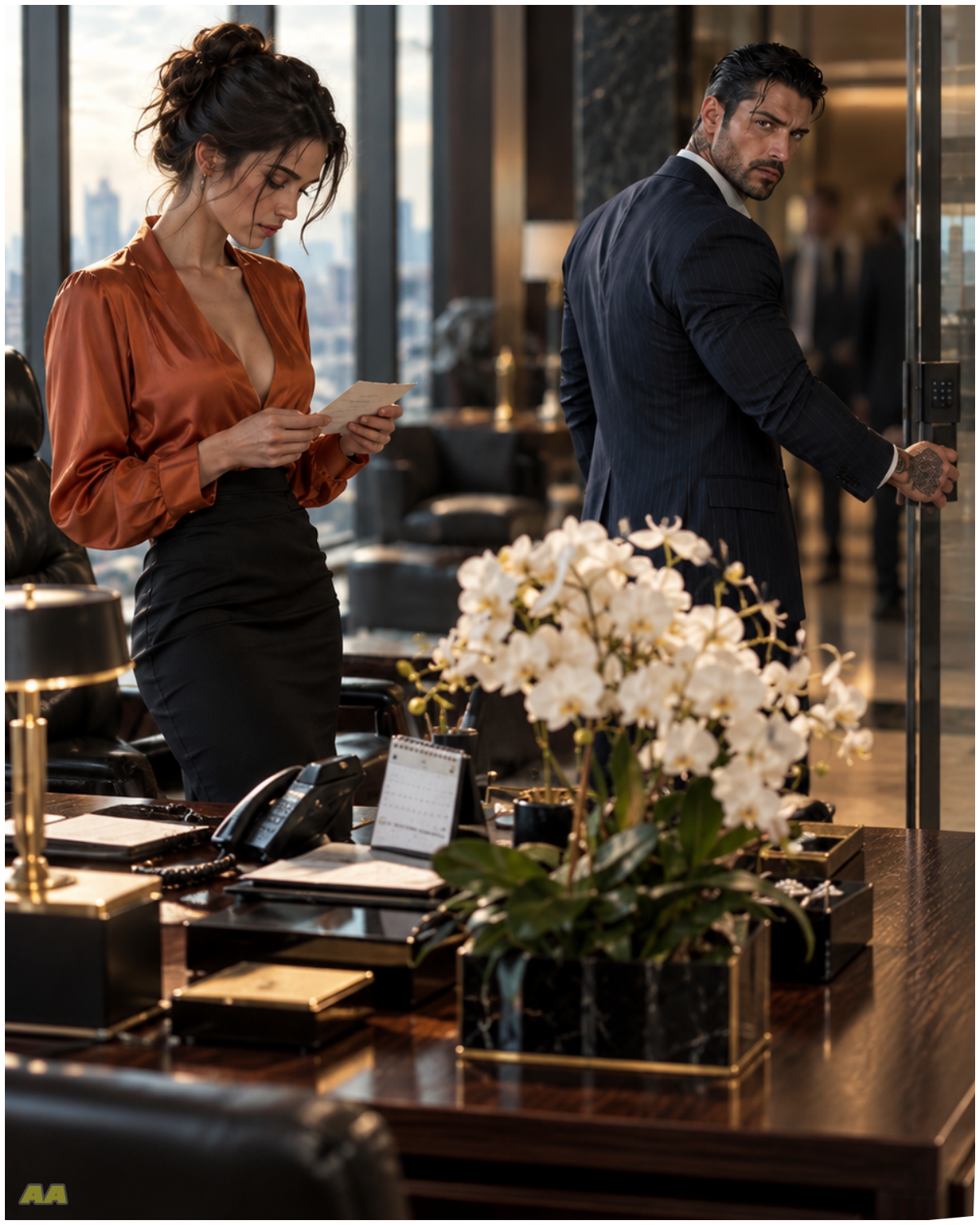
Alden caught Hazel with the white irises in her hands before she could hide the card beneath them.
The bouquet was enormous, wrapped in cream paper and tied with a silver ribbon, its blossoms bright against the dark wood of Alden Bellini’s private headquarters office.
Whitey Reese’s filled the room with a clean, almost sweet fragrance, but Alden noticed only the small envelope tucked between the stems.
Hazel Rossi stood beside the receiving desk, one hand still resting on the bouquet while Margaret Veil’s delivery clerk waited near the doorway with a clipboard.
“Who sent those?” Alden asked.
Margaret glanced from him to Hazel, then quietly withdrew, closing the outer door behind her.
Hazel did not answer at once.
That pause changed the air in the office.
Alden had spent years reading silence in crowded rooms, and Hazel’s silence was sharper than any spoken name.
His gaze moved from the flowers to Hazel’s face.
Searching for a reaction, she refused to give him.
Hazel, he said, “Lower this time.”
“Who sent you the flowers?” Hazel set the bouquet on the desk with careful hands.
She did not flinch, but her fingers remained on the ribbon as though the arrangement belonged to a question she had not decided to share.
The delivery record has the sender’s name, she said.
Then read it. Not yet.
Alden’s expression tightened. The answer was simple, but the delay was not.
White irises were expensive, rare enough to make a statement, and arranged with the kind of attention that suggested the cinder knew exactly what Hazel liked.
Alden had seen business partners attempt charm, rivals attempt influence, and ambitious people mistake Hazel’s courtesy for an invitation.
None of them had ever sent anything this personal to his office.
Hazel lifted her eyes to him.
That is not an answer.
Neither is waiting. Her refusal sharpened his jealousy into something he could no longer disguise as concern.
The headquarters remained busy beyond the walls with captains moving through corridors and phones ringing at the security desk.
Yet the office seemed to narrow around the bouquet.
Alden walked to the door.
Hazel watched him, recognizing the decision before his hand reached the lock.
Alden, do not. He turned the lock.
The clicks sounded small, but the headquarters responded immediately.
A red indicator above the door flashed once, followed by a clear electronic tone.
Across the building, the emergency communication protocol activated.
Interior phones switched to restricted mode.
Hallway access lights changed from green to amber, and a recorded notice instructed senior personnel to remain at their stations until the locked office cleared the alert.
Hazel’s face changed as she looked toward the ceiling speaker.
You triggered the emergency channel.
I secured the room. You trapped both of us inside it.
Alden faced her, one hand still near the lock.
Then tell me who sent the bouquet.
Hazel studied him for several seconds.
She could have answered immediately, but the emergency protocol had sealed more than a door.
It had turned a private question into a headquarters event, one that Russell Bellini’s senior captains would soon notice and Margaret Vale would be required to record.
Hazel understood the cost of giving Alden the name before she understood why the flowers had arrived.
Alden saw her hesitation and stepped closer to the desk.
Stopping before the bouquet.
“You knew they were coming,” he said.
Hazel’s eyes moved to the envelope, then back to him.
No, you knew enough to protect the card.
That is different.
The speaker crackled overhead, announcing that communication from the office was temporarily restricted while the emergency channel remained active.
Alden looked at the locked door, then at Hazel, and realized that his demand had created a situation neither of them could casually leave.
Hazel drew the bouquet toward herself, keeping the envelope covered beneath the white irises.
Alden’s jealousy had asked the question, but the flowers had left him with a larger one.
Why had Hazel decided the sender’s name was safer hidden from him?
Hazel kept one hand over the envelope while Alden remained beside the locked office door, his expression fixed somewhere between suspicion and restraint.
The white irises rested on the edge of her desk, their stems wrapped in damp paper and their petals still bright from the waterfront market.
Alden’s question had changed the air in the room, but Hazel refused to let jealousy decide what happened next.
She lifted the bouquet and examined the delivery card without opening the envelope.
This cannot remain an unregistered delivery, she said.
Alden’s eyes narrowed. It was addressed to Hazel Rossi.
That does not make it personal property.
Hazel crossed to the filing cabinet and removed the red security ledger used for uncertain packages, restricted credentials, and deliveries whose sender could not be immediately verified.
She placed the ledger beside the flowers, opened it to a clean page, and wrote the time for 18 p.m.
She recorded the location, the condition of the wrapping, the number of stems, and the absence of a verified sender.
Alden watched every movement.
“You are logging flowers as if they were a security concern.”
“Anything entering headquarters without a confirmed chain of custody is a security concern,” Hazel replied.
The rule applies whether the package contains invoices, keys, or flowers.
The locked door gave a faint click as the emergency channel continued holding it shut.
Alden glanced toward it, then back to the ledger.
His authority had created the restriction, but Hazel was the one controlling the record.
She called the Waterfront Flower Market staff through the internal line and asked for the delivery registration connected to the bouquet.
Margaret Vale answered from the market office.
Hazel kept the call on speaker.
Margaret Vale confirmed the order number and Cinder listed on the delivery card.
A pause followed filled by the distant hum of refrigeration units and market traffic.
The order was paid in cash.
Margaret Vale said the purchaser used a temporary credential and the credential was accepted at the desk.
Alden stepped closer. Whose credential?
Margaret Vale hesitated. The record shows only the access sequence, not a registered name.
Hazel’s attention sharpened. She turned the bouquet slowly, feeling the paper beneath the ribbon.
One fold was thicker than the others.
She slid a clean letter opener under the outer wrapping and separated the layers without damaging the steMs. A narrow strip of pale blue paper slipped free and landed across the ledger.
It was no wider than half an inch and carried four groups of marks.
W 3 720 C 14 and a final sequence of numbers.
Alden read it before Hazel could cover the strip.
His face hardened. That is not a florist note.
Hazel placed a paper weight over the bouquet wrapper and studied the code.
No, it is a delivery fragment.
A private message hidden in flowers, Alden said.
From someone who knows how to reach you.
His jealousy returned with quiet force, no longer hidden behind the original question.
Hazel looked at him. You think this came from a secret lover?
What else should I think?
That someone wanted the message discovered by the person responsible for deliveries.
She pointed to the first mark.
W 3 may identify a waterfront route.
720 is likely a time.
C4 could be a container position, a loading bay, or a crate number.
The final sequence may be a confirmation code.
Alden’s gaze moved from the strip to Hazel’s face.
You are defending the sender.
I am separating evidence from assumption.
Hazel requested the market registration again and asked Margaret Vale to verify whether the delivery had entered through the normal flower route.
Margaret Vale checked the ledger at her end.
Then answered carefully. No, the order was added after the morning schedule closed.
The temporary credential was presented at the side entrance.
That detail changed the room.
Hazel closed the security ledger over the delivery card, preserving the strip between its pages.
This must stay logged under professional security rules.
She said the original wrapping card and code remain together.
Russell Bellini needs the record before anyone moves the bouquet.
Alden’s expression remained guarded and you still believe it is a warning.
Hazel looked at the hidden strip.
A warning does not need affection.
It only needs timing. Outside the office, footsteps passed and faded.
Inside, Alden studied the flowers as though they had personally challenged him.
Hazel secured the ledger beneath the desk latch while the coated fragment waited between its pages, proving that the bouquet carried something more dangerous to their trust than a lover’s name.
A message neither of them yet understood.
By 6:15 the next morning, rain had turned the waterfront street silver, and the flower market was already awake beneath a ceiling of rattling tin.
Delivery carts rolled between narrow stalls, their wheels leaving dark tracks across the concrete while six market employees moved crates of roses, liies, and seasonal branches under Hazel Rossy’s logistical oversight.
The bouquet from the locked office sat in her mind like a sentence missing its final word.
The flowers had arrived without a sender’s name, without a personal note, and without any ordinary reason to be inside Alden Bellini’s headquarters.
Yet, the delivery had passed through every official channel.
That fact made it more troubling, not less.
Alden Bellini had forbidden all outside communication until the coded strip could be understood.
So Hazel could not call the market, contact a driver, or send a message beyond the headquarters.
She had to reconstruct the route using records already inside the organization.
Margaret Vale stood behind the market’s central registration desk surrounded by ledgers, stamped invoices, and a wall clock that ran 3 minutes faSt. The bouquet was entered at 4:12 yesterday afternoon, Margaret said, turning a page.
Marked as a priority delivery for the Bellini headquarters.
The paperwork is complete. Hazel studied the entry.
The order listed 12 white roses, six stems of eucalyptus, and a delivery charge of $14.
The bouquet in Alden’s office contained 11 white roses, no eucalyptus, and a narrow green ribbon tied beneath the paper.
“Who accepted the order?” Hazel asked.
“The request came through the headquarters account,” Margaret replied.
The authorization code was valid.
The signature was copied from the usual delivery register.
“Copied?” Margaret’s expression tightened. “Not forged badly.
Whoever signed knew exactly how Hazel Rossy’s approval mark should look.
Hazel moved to the next page.
The flower order had been assigned to stall 7 where two of the market employees had prepared it.
The stall’s inventory sheet showed 12 white roses removed.
At 3:41, a loading ticket placed the finished bouquet on a cart.
At 3:49. The official route listed the headquarters as the only destination with an estimated arrival of 408, but the receiving log at Alden’s building recorded the delivery at 4:26.
14 minutes had disappeared between the market gate and the headquarters entrance.
Hazel followed the route on foot, staying within the market’s covered walkways and the streets controlled by Alden’s organization.
She examined the stall markers, the cart lane, and the clock above the west gate.
At stall 7, the remaining flower paper showed a faint line of green pollen near the cutting table.
The bouquet had not been assembled there in its final form.
Someone had removed one rose and added the ribbon later.
At the west gate, Russell Bellini waited with a clipboard under one arm.
The cart passed through here at 3:55.
He said. The gate captain recorded it.
Then why does the loading ticket say 3:49?
Hazel asked. Russell checked the page, then looked toward the market clock.
The time had been corrected in blue ink, changing 355 to 349 without altering the original initials.
Hazel compared the gate sheet with the headquarters receiving lock.
The same blue ink appeared on both records.
The paperwork had not been replaced.
It had been adjusted after the signatures were already in place.
When Hazel returned to the office, Alden Bellini had spread copies of the organization’s procedure manuals across his desk.
For headquarters, captain stood nearby, each holding a different section of the delivery protocol.
Alden read the route sheets in silence while Hazel placed the market records beside them.
No rule was broken. Russell said the authorization code worked.
The gate captain signed. The receiving clerk signed.
The delivery was accepted. That is exactly the problem.
Hazel said the procedure was used correctly, but the timing was changed inside the procedure.
Alden looked from the blue corrections to the missing rows listed on the inventory sheet.
His expression hardened, not with anger at Hazel, but with the realization that someone had studied the organization’s habits closely enough to move through them without raising an alarm.
Morning light filtered through the high windows of the waterfront market, turning the damp concrete silver as Margaret Vale unlocked the eastern receiving gate.
The six market staff had already begun sorting crates beneath Hazel Rossy’s logistical oversight, but the usual rhythm had changed.
Every flower bucket was being checked twice, every delivery slip compared against the registar, and every sealed arrangement placed where three different people could see it.
For of Alden’s headquarters, captains stood near the loading corridor, their attention divided between the market entrances and the documents spread across a folding table.
Hazel kept her focus on the inventory sheets until Margaret stopped beside the last delivery cart.
A narrow arrangement of white liies rested inside a glass-sided box tied with gray ribbon instead of the usual green cord.
No card appeared among the steMs. No cinder had been listed.
This one was left behind the rose shipment.
Margaret said the clerk who signed the delivery was certain it belonged with the morning order, but the manifest does not include it.
Alden Bellini crossed the market floor without touching the flowers.
His eyes moved from the arrangement to Hazel, then to Russell Bellini, who had taken position beside the table.
“Open it,” Alden said. Hazel lifted the lid carefully.
Beneath the lilies, hidden under a layer of folded tissue, lay a strip of dark green paper.
It carried only three lines in blue ink where the family vines drank below the tide.
The missing bloom waits beneath the market.
A second mark had been drawn beneath the words.
A crooked outline resembling the old Bellini creSt. The mention of family vines changed the air around the table.
Alden’s abandoned greenhouse had been built beneath the waterfront market decades earlier before the property became a distribution hub.
The structure had been sealed after his family stopped using it, and only a few people still knew the entrance existed.
Russell’s expression tightened as he studied the paper.
That location was never placed on the current floor plans.
He said. It was removed from the security records.
Hazel turned the fragment over.
A faint line of moisture darkened the paper’s edge, carrying the sharp scent of soil and crushed leaves.
It came from below, she said.
“Not from the market floor.” Alden looked at her.
“You sound certain. Because I checked the first delivery route before dawn.
The admission landed more heavily than the fragment.” Hazel reached into the inner pocket of her work jacket and removed a small notebook filled with dates, times, initials, and short observations.
The entries began 3 days earlier before the first bouquet had appeared.
She had recorded the rose shipment arriving 40 minutes ahead of schedule, the altered blue corrections on the registars’s copy, and the second delivery cart stopping near a service stairwell that no longer appeared on the public map.
Alden read the pages in silence.
You tracked every delivery, he asked.
Every unusual one without telling me.
Yes. Hazel did not lower her eyes.
Because your first question would have been, “Who gave me permission?
Not what I found.” The captains remained still, but the market staff continued working at a slower pace, listening without turning their heads.
Alden closed the notebook. For years, he had believed Hazel’s value came from her precision, her ability to make complicated routes appear simple, and her habit of noticing problems before they reached his desk.
He had never asked what she did when she found something that frightened her.
“You were afraid of my reaction,” he said.
Hazel’s fingers tightened around the notebook.
“I was afraid you would shut down the entire market, remove everyone connected to the deliveries, and call caution a solution.” Alden glanced toward the sealed service corridor leading beneath the building.
“You thought I would punish the procedure instead of finding the person using it.
I thought you might do both.
The answer carried no accusation, only a tired honesty that left him with nothing easy to dismiss.
Russell took the green fragment from the table and pointed to the creSt. The greenhouse is under the old auction room.
Morning light filtered through the greenhouse glass, turning the damp stone floor silver beneath the hanging vines.
Russell Bellini stood beside the old auction room entrance with the green fragments still between his fingers while Hazel Rossi studied the rows of flowers arranged along the central tables.
Nothing about the display looked accidental now.
White liies formed a narrow line beside blue irises and small clusters of yellow roses appeared at measured intervals.
Each group tied with a different shade of green thread.
Margaret Vale had followed them inside with the delivery registar pressed against her chest, her expression tight with concern.
Those flowers were logged as separate deliveries, Margaret said, but the requests came through the same credential.
Hazel moved closer to the nearest arrangement without touching it.
The thread colors match the market’s route tags, she said.
Green means a change in Hazel’s schedule.
Yellow means a public stop.
Blue means a private meeting.
Alden Bellini’s gaze shifted from the flowers to Hazel.
“You knew the system could be read this way?
I knew the system could be read by someone who understood our records,” Hazel answered.
“I did not know anyone was using the flowers to record movement.” Margaret opened the registar and turned several pages.
Each entry contained a delivery time, a destination, and a reference to an old Bellini security pattern.
One delivery had been scheduled for the headquarters at 8:10 a.m.
When Hazel was expected to review the waterfront inventory.
Another had arrived at 10:30 a.m.
Just before Hazel’s meeting with the market staff.
A third had been marked for the old auction room at noon, the same location where Russell had found the hidden greenhouse route.
The flowers were not romantic gifts.
They were markers placed where Hazel would notice them and arranged so another person could interpret her movements without asking a single question.
Russell turned a page and stopped.
“This code predates Hazel’s assignment,” he said.
“It predates most of the current captains.” His finger rested on a faded notation at the bottom of the entry.
“This is from the Bellini family security archive.” The words settled over the greenhouse like a sudden drop in temperature.
Alden reached for the page, but Russell held it open instead of handing it over.
The cinder knows the old patterns, Russell continued.
Not just the route names, the original timing system, the one used before the headquarters moved to the waterfront.
Hazel looked toward the back wall where a rusted brass plate carried the Bellini creSt. That system was built around family movements, she said.
House entrances, private corridors, meeting rooms, safe schedules.
Alden’s face hardened. My family stopped using it years ago.
Someone did not, Margaret said.
She turned another page and revealed a second symbol beneath the delivery record, a small bell crossed by three lines.
That mark belonged to Russell Bellini’s first security rotation.
Russell’s expression changed. Only five people had access to those patterns.
And how many still have access?
Hazel asked. Russell looked toward Alden before answering.
The authority remained active even after the archive was sealed.
The admission drew every eye to Alden.
His security authority had protected the organization, but it had also preserved the old pathways that made the hidden code possible.
The greenhouse had not merely exposed a thief’s knowledge.
It had shown how Alden’s own structure could be turned against Hazel.
Alden studied the arrangements again, seeing the pattern with painful clarity.
A white lily marked her morning inspection.
A yellow rose marked her route to the market office.
Blue irises marked the periods when she worked alone.
The sender had not been sending affection.
The sender had been documenting Hazel’s schedule, one bouquet at a time.
They were watching the calendar, Alden said.
“No,” Hazel replied, lifting her eyes to the old security plate.
“They were watching me through your authority.” The sentence struck harder than an accusation because it contained no anger, only fact.” Alden looked at Russell, then at the sealed corridor leading back toward headquarters.
For the first time, the authority he carried no longer appeared to be a shield.
“Hazel kept her hand on the old security plate, feeling the faint vibration of machinery behind the wall.
They were not trying to reach the headquarters,” she said.
“They were trying to make me look like the doorway.” She lifted the green fragments from the desk and placed them beside the receipt.
I finally deciphered them. They are not market codes.
They marked the dates, routes, and access points for a planned abduction aimed at me.
Alden’s expression tightened. Russell Bellini stepped closer to the corridor, but Hazel raised one hand, stopping him without looking away from the plate.
Every delivery record passed through my schedule.
Every flower order gave someone a reason to ask where I would be, which route I would take, and when Alden Bellini would be expecting me.
Alden looked down at the receipt in his hand.
The paper listed a bouquet, a delivery window, and a handwritten authorization mark that appeared ordinary until Hazel turned it toward the light.
A second impression showed beneath the ink, pressed into the paper by the edge of a credential.
“That mark is not mine,” she said.
“It copies the access pattern used by the headquarters captains.” Russell’s jaw tightened.
For captains have that level of access.
And six Waterfront Flower Market staff handle the records under my oversight, Hazel replied.
But the person who copied the mark needed more than a schedule.
He needed the order to look legitimate after it left the market.
Alden turned to her. So the flowers were never the message.
They were the cover. The answers settled over the office with a quiet finality.
Alden had asked who bought her the flowers because jealousy had made the bouquets feel personal.
Now the receipts showed something colder.
Each arrangement had been placed to move information through the same route without attracting attention.
The flowers gave the thief a reason to enter the market, access the delivery register, and study Hazel’s movements.
While everyone assumed the deliveries concerned Alden’s attention, Hazel lowered her eyes.
I withheld evidence, she admitted.
I kept two fragments and one delivery slip from the earlier review because I thought revealing them would make you treat me like a liability.
I was wrong. When I aligned the fragments with the dates, the pattern became clear.
Every mark pointed to a place where I was expected to be alone.
Alden’s face changed as the meaning reached him.
His jealousy had kept him focused on the flowers and on the imagined person behind them, while a coordinated threat had been mapping Hazel’s movements through his own security system.
“I was watching the wrong danger,” he said quietly.
“Russell reached for the receipt, but Hazel folded it once and held it out to Alden instead.
The target was not your office,” she said.
It was your authority over the route between the market, the greenhouse, and headquarters.
Alden did not take the paper immediately.
Why target the route? Because whoever controls the schedule can redirect more than flowers.
They can redirect staff, credentials, security coverage, and truSt. She finally met his eyes.
They wanted you to believe I was using your name.
Then they wanted everyone else to believe your name was being used by me.
Russell looked toward the sealed corridor.
That would create a gap between the boss and the people carrying out his instructions.
Exactly, Hazel said. A gap wide enough for someone else to step through.
Alden’s attention shifted to the receipt.
Zeke Marlo. Hazel nodded once.
She did not say the name with certainty born from suspicion.
She said it because the copied access pattern matched the credential theft already uncovered in the earlier records.
Zeke had not needed to command anyone at the waterfront market.
He had only needed to borrow the appearance of permission.
He is the credential thief, Russell said.
But why use flowers? Because flowers arrive without causing alarm, Hazel answered.
A crate of equipment gets inspected.
A bouquet gets carried through a door by someone who expects to be welcomed.
Alden’s gaze hardened, yet his voice remained controlled.
And the rival syndicate operatives, they were not the real target either.
They were pressure. Their presence made every unexplained delivery look like a threat from outside.
While the actual theft remained inside the paperwork, the discovery changed the shape of the danger.
It was no longer a question of who had sent Hazel a bouquet.
It was a question of who had wanted Alden to distrust Hazel before either of them understood why.
Hazel placed the remaining receipts on the desk in a careful line.
They were building a record that would make my decisions appear unauthorized.
If you removed me, the route would become easier to control.
If you protected me without checking the records, they could claim you were shielding a compromised aid.
Alden stared at the papers.
They wanted me to choose between you and my authority.
No, Hazel said. They wanted you to think those were the same thing.
For several seconds, no one moved.
Then Alden picked up the receipt and handed it back to Hazel.
Keep the records, he said.
From this moment, you report what you find directly to me, not through my authority.
Russell looked at him, surprised by the order.
Hazel’s eyes narrowed. That sounds like another door.
Alden met her gaze. Then I will stop locking you behind it.
The words did not erase what he had done, but they changed the direction of the room.
Somewhere beyond the corridor, the flower market staff continued following the schedule they believed was safe.
Somewhere else, Zeke Marlo still believed the copied credential had hidden his trail.
Hazel gathered the receipts. If he targeted the route, he will try to move the final delivery.
Alden stood. Then we let him think the route is still open.
Russell waited for instructions, but Alden looked first to Hazel.
For the first time, the next move would not begin with his authority.
It would begin with her plan.
Morning light spilled across the headquarters windows, turning the locked office door into a pale rectangle against the dark wood on the desk.
The official delivery ledger lay open beside three marked receipts while the final bouquet rested inside a plain storage cabinet across the room.
Hazel Rossi had placed it there before dawn wrapped in brown paper and sealed with a strip of blue tape.
The message that had arrived with it was no longer in the ledger.
She had removed the page, folded it twice, and kept it beneath the insole of her right shoe.
Alden Bellini noticed the empty line before he noticed the cabinet.
His gaze moved from the ledger to Hazel, then to the untouched delivery schedule.
“Where is the final bouquet?” he asked.
Hazel remained beside the filing table, her hands calm even though the office seemed to shrink around them.
It was never entered as a completed delivery.
That is not what I asked.
Then ask the question you actually mean.
A hard silence settled between them.
Outside the office, Russell Bellini waited with the four headquarters captains while six Waterfront Flower Market staff remained in the corridor near the freight elevator.
The three rival syndicate operatives were nowhere in sight, but their absence had become its own warning.
Alden crossed to the cabinet and opened it.
The brown wrapped bouquet sat beneath a stack of clean inventory sheets.
Its stems protected in a glass jar of water.
His expression tightened when he saw the missing message.
You hid it. I secured it.
You removed evidence from the official log.
I removed a message that was meant to guide someone who had already copied our credentials.
Hazel lifted her chin. If the message stayed in the log, whoever is watching the schedule would know exactly where the bouquet was going.
Alden looked toward the locked door, you should have told me.
You would have taken control of the decision.
Yes, the answer came too quickly, too honestly.
Hazel’s composure finally cracked. That is the problem, Alden.
You keep calling it protection when what you mean is obedience.
His jaw tightened. I am responsible for keeping you safe.
You are responsible for your organization.
I am responsible for my choices, not when your choices put you in the path of a threat.
My choice kept the threat from reaching the final delivery.
She stepped closer to the desk, placing both palms against its edge.
I changed the route, removed the message, and hid the bouquet because I understood the risk.
You did not need to approve every move before I made it.
Alden’s hand closed around the ledger, but he did not raise his voice.
You will follow my instructions from now on.
No. The single word filled the room more completely than a shout.
Alden stared at her, and the possessive certainty in his face gave way to something less controlled.
“Hazel, no,” she repeated. “You can ask for information.
You can explain the danger.
You can offer protection. You cannot demand control of my safety and call that care.
The office locks clicked. Russell had engaged the security system from the corridor, sealing the headquarters office while the captains checked the outer doors.
Alden turned toward the sound.
You locked us in? Hazel asked.
I ordered a temporary lockdown without telling me because the final bouquet may be carrying a signal.
Then the lockdown is a teSt. Her eyes moved to the door, then back to him.
If protection requires trapping me, it is possession.
If protection means giving me enough room to make an informed choice, then open the door and let me decide whether I stay.
Alden stood between Hazel and the exit.
Yet, he did not reach for the handle.
Through the glass panel, Russell Bellini watched without interrupting.
Hazel pointed to the cabinet.
The bouquet stays here until we confirm the next movement.
The message stays out of the official lock.
The staff receive only the route information they need, and no one touches the delivery without my approval.
Alden’s expression hardened at the final condition.
At dawn, the greenhouse glass held the first pale light above the flower market, turning every leaf silver and every wet path into a narrow mirror.
Inside the office, Hazel Rossi spread the hidden codes across the delivery table, not as a message, but as a sequence.
Each code had been copied from a different flower tag, and each one corresponded to a minute on the greenhouse’s timed irrigation system.
She matched the first code to the east valve, the second to the overhead mist line, and the third to the drain sensor beneath the rose benches.
The arrangement did not unlock anything.
It created a witness. Whoever used the stolen credentials would trigger a route through the greenhouse and the water would reveal that route without placing any staff member in danger.
Margaret Vale stood beside the registars’s cabinet holding the original delivery ledger against her cheSt. The activation point is the old access panel.
She said only registered credentials can open it.
Then we make the panel believe it is being trusted,” Hazel replied.
She inserted the copied codes into separate envelopes and placed them at three visible stations, each one marked with a legitimate delivery number.
The real sequence remained hidden beneath a tray of white liies.
Russell Bellini watched from the doorway as four of Alden Bellini’s captains gathered behind him.
The six waterfront flower market staff stayed at their assigned counters beyond the glass, close enough to see instructions, but far enough from the greenhouse entrance to remain safe.
No one had been told to confront the thief.
Hazel had designed the trap so the system itself would speak.
Alden entered last, his expression controlled, though his attention went first to Hazel and then to the locked office door.
The question he had asked her still seemed to hang between them, but the flowers were no longer the center of the room.
Accountability was. Before this begins, Alden said, turning toward Russell and the captains.
I need to state what I failed to see.
The stolen credentials were accepted under my security authority.
Russell’s face tightened. One captain shifted uneasily.
Alden removed the security seal from his coat and placed it on the table beside the ledger.
Until this matter is resolved, I surrender that authority in front of all of you.
I will not approve access, redirect staff, or overrule the record.
If the breach happened under my command, then my command cannot be the shield that hides it.
Hazel looked at him, surprised not by the gesture, but by its coSt. He had chosen to stand without the power that had always made people listen.
No one takes control from Hazel.
Alden continued. She has not been given authority over this organization and that decision is not being made here.
She has designed the counter measure because she understands the route.
We follow the procedure, not a person’s fear.
The words settled over the room.
Then the access panel clicked.
A credential had been accepted.
Hazel pressed the first control.
Water released from the east valve in a thin, steady line, wetting the stone path beside the entrance.
A second click sounded from beneath the rose benches.
The overhead mist began at the far end of the greenhouse, leaving a trail of shining footprints on the dark floor.
Margaret opened the ledger and compared the activation time with the delivery number.
The stolen credential is moving through the false route, she said.
A shadow crossed the glass.
Zeke Marlo stepped into the greenhouse carrying a sealed flower crate and wearing the plain market vest issued to authorized couriers.
He paused when the mist reached his shoes.
The hidden codes had done exactly what Hazel intended.
The irrigation system marked his path.
The drain sensor recorded his stop and the access panel displayed the credential number he had used.
Russell moved toward the doorway, but Alden raised one hand and then lowered it.
Honoring the authority he had surrendered.
Hazel spoke instead. Do not touch the crate.
Set it down and step away from the panel.
Hazel held her position beside the irrigation panel while Zeke Marlo set the crate on the concrete floor and stepped away.
The greenhouse lights brightened as dawn reached the glass roof, revealing the damp trail that led from the service entrance to the hidden access panel.
On the panel, the credential number glowed beneath a line of recorded times.
Russell Bellini read the display, then looked toward Alden Bellini.
The number belonged to Zeke Marlo.
Russell said it was copied from the delivery register three nights ago.
Margaret Vale arrived at the greenhouse entrance with the flower market ledger pressed against her cheSt. Behind her stood the six waterfront flower market staff, silent and watchful while the four captains from Alden’s headquarters remained near the outer walkway.
Three rival syndicate operatives waited under Russell’s supervision, separated from the greenhouse by the open gate and a clear line of sight.
No one moved toward the crate.
Hazel reached inside the outer pocket of her work jacket and removed the first card that had accompanied the flowers.
She placed it beside the irrigation panel.
The white roses were not a gift, she said.
The uneven stems marked the number of the loading dock where Zeke planned to copy the next credential.
The blue irises marked the date.
The yellow tulips meant the danger had moved closer to the market.
Alden stared at the cards, then at the flowers arranged along the greenhouse shelves.
The question he had asked in his office returned with uncomfortable clarity.
He had demanded to know who bought Hazel those flowers, and he had locked the office door because jealousy had made every hidden detail look like betrayal.
Now, the same flowers formed a warning system Hazel had built when she could no longer trust the delivery records.
They were meant to save Hazel, Alden said quietly.
The realization changed his expression more than the evidence had.
The flowers had never pointed to a secret admirer or a private arrangement.
They had warned Hazel that someone was tracking her routes, studying her accounts, and using familiar deliveries to get close enough to steal access.
Hazel nodded. They were meant to give her time to protect the staff and the market.
Alden looked at the four captains who had watched him surrender his security authority and he answered with suspicion.
Russell said, not accusingly, but without softening the truth.
Alden turned toward the captains.
The security authority is no longer mine to use against Hazel Rossi.
He said it belongs under the written procedures she helped create.
He removed a folded document from the inside pocket of his coat and placed it on the nearest workt.
Margaret Vale opened the ledger while Hazel read the first page.
The document established that Hazel could control the flower market accounts, approve delivery routes, review credentials, and suspend any shipment that failed the greenhouse records.
Alden could request an audit, but he could not enter Hazel’s office, alter her routes, or question her private communications without written cause and her consent.
Russell signed as witness. Margaret signed as market registar.
Alden signed beneath them, then slid the pen across the table to Hazel.
Hazel studied him for a long moment before adding her signature.
The boundary agreement became real with the final stroke of her name.
Alden then placed a second folder in front of her.
The flower market accounts are yours, he said.
Not temporarily, not because of this morning.
You have control because you earned it and because the market needs someone who can see what others overlook.
Hazel opened the folder and found the transfer papers, the account keys, and Margaret’s updated authorization sheet.
Margaret gave a firm nod.
Every account now answers to Hazel Rossi.
The six market staff relaxed and the four captains accepted the decision without proteSt. Outside the rival operation lost its access, its copied credential and its route into Alden’s organization.
Zeke Marlo lowered his gaze as Russell collected the stolen credential record and secured the crate for the proper authorities.
The conspiracy ended without another threat or another secret waiting behind it.








