Wed by Her Uncle to a Man of Seventy — The Duke Rose When the Vicar Asked for Objections
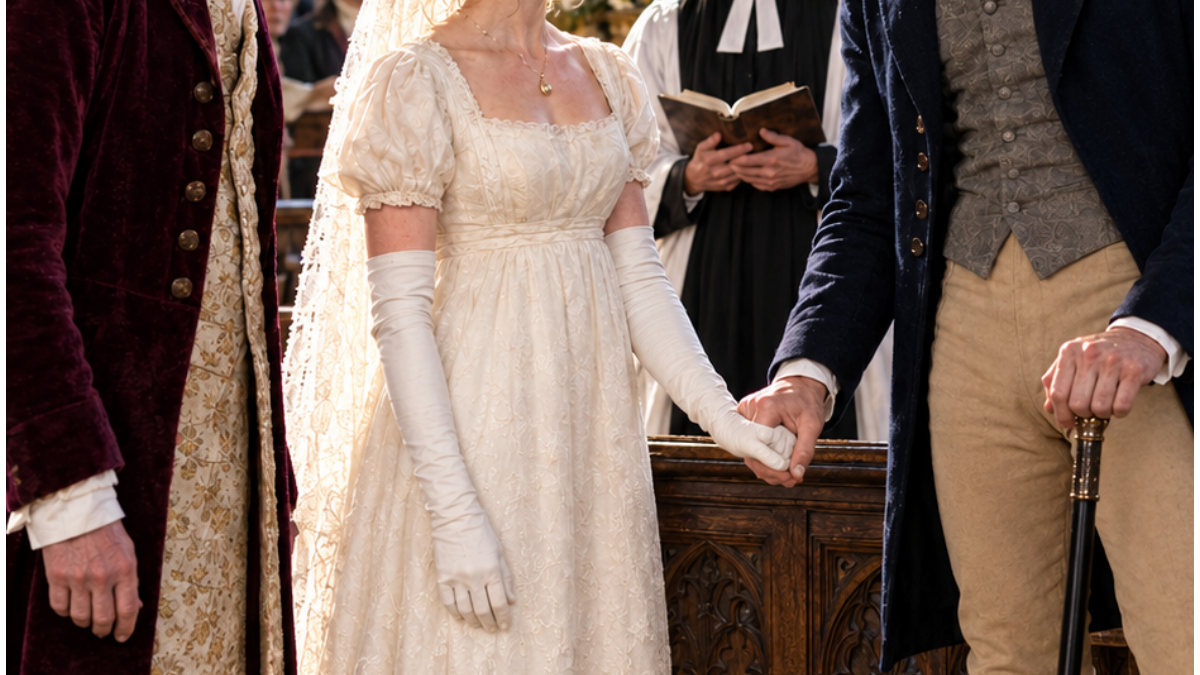
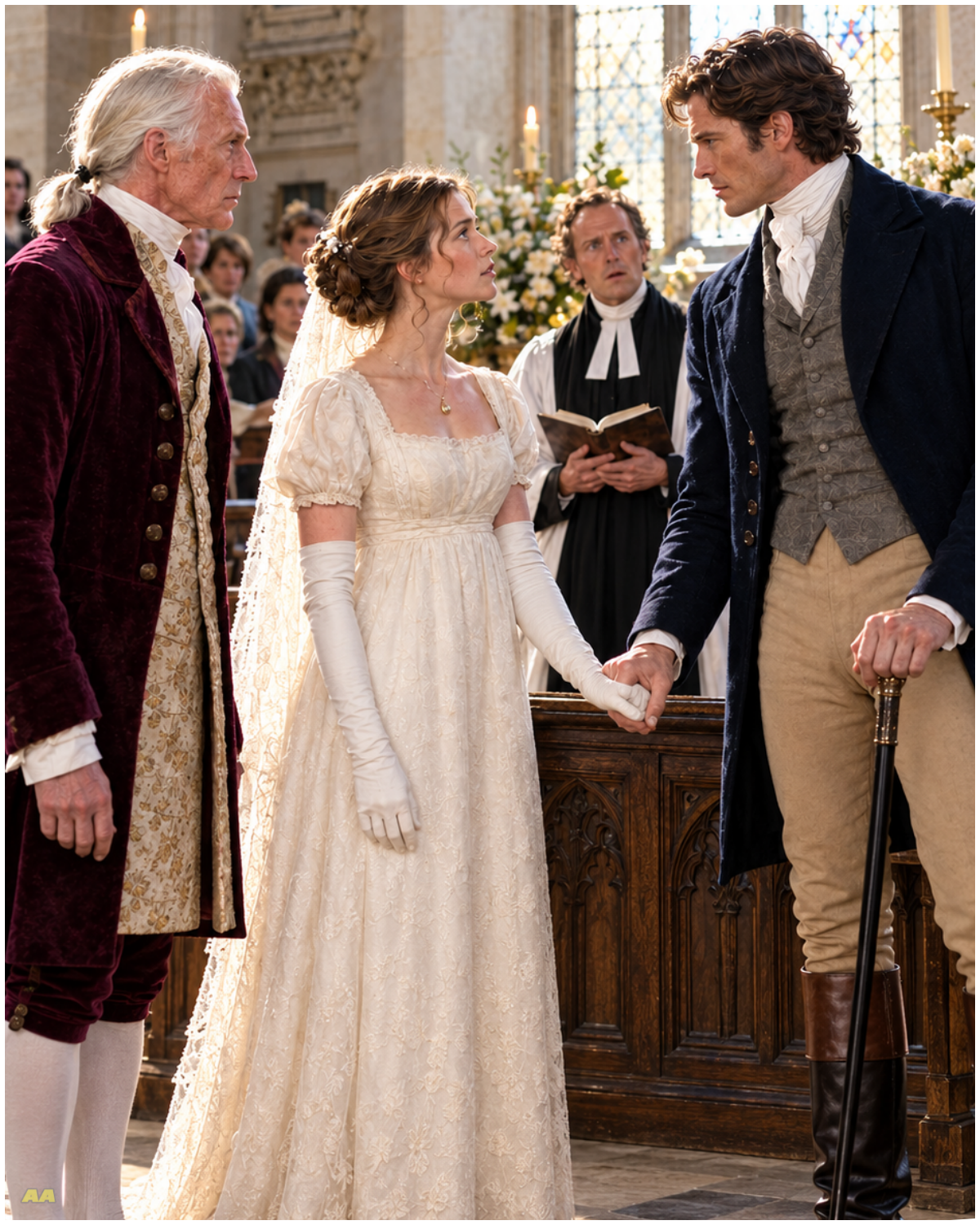
There is one moment in every English wedding when the whole church is asked to speak and everyone sitting in it has already agreed to stay silent.
When Jes Marlo’s uncle walked her up the aisle of St. Michaels in King’s Holland to marry a man of 70, every pew in the village knew why she was there, and not one of them meant to say a word about it.
They had all been fed, and they had all been warned.
Nobody had warned the Duke. The church was cold, even for August.
It smelled of damp stone, and the liies her aunt had ordered from Ambusham, which had been cut 2 days too early, and were already browning at the edges.
Jesse walked with her hand on her uncle’s sleeve because he had placed it there and pressed it down, and she could feel through her glove how pleased he was with himself.
The gown was her mother’s, taken in at the waist by her aunt’s maid, and let out nowhere, and the lace at the wrists had been yellow with age until someone had soaked it in milk the night before.
She did not look at the pews.
She looked at the altar and at the back of the man waiting in front of it.
So Mortimer Glaive stood very straight for his age, straighter than he walked.
He wore a plum coat cut in the fashion of 30 years ago, and a tall white stock that held his chin up.
And when he turned to watch her come, his watery gray eyes went over her the way a man looks over a horse he has already paid for.
Chin up, her uncle murmured. You will thank me for this before Christmas.
I will not, Jesse said quietly.
Then you will thank me before Easter.
It makes no difference to me which her aunt was in the front pew in gray silk and a new bonnet with her mouth drawn tight in the expression she wore for sermons and for jesame.
Mr. Bartholomew Dunning delivered his niece to the altar rail, lifted her hand from his arm, and laid it on Samortimus as if he were setting down a parcel.
The old man’s fingers were dry and very cold.
The vicer, Mr. Oswin Leech, did not look well.
He was a thin, earnest man with ink on his cuff, and he had read the bands three Sundays in a row in a voice that grew smaller each time.
He opened the book now, and looked at the bride for longer than was comfortable, and then down at the page.
“Dearly beloved,” he began, and his voice cracked on it, and he began again.
Jesame heard almost none of it.
She was counting the pains in the east window, which was a thing she had done since she was a child, when she needed to be somewhere other than where she stood.
There were 40 pains and one of them was cracked and she thought that if she kept counting she might get through the whole service without once hearing her own voice promise anything.
Then the vicar lifted his head and the church went still in the particular way a church does when it knows what is coming next.
Therefore, if any man can show any just cause why they may not lawfully be joined together, let him now speak, or else hereafter forever hold his peace.
He waited. He waited longer than the words required, long enough that her aunt shifted in the front pew, and her uncle cleared his throat.
Mr. Leech looked out over the congregation with something close to pleading on his face.
Nobody moved. Jesse closed her eyes and at the very back of the church, where the light from the open door fell across the last pew, a man stood up.
She heard it before she saw it, the hard knock of a walking cane on the stone floor.
And then a voice, not loud, that carried to the altar as easily as if it had been spoken at her shoulder.
I can. Every head in St. Michael’s turned.
He was tall and he stood with his weight on the cane as though he disliked needing it.
His dark hair was wet from the road and pushed back from his forehead.
His navy coat was gray with dust from the knees down, and there were three days of travel on him that no amount of good tailoring could hide.
He had gray eyes, very steady, and he was looking at nobody in the church but her.
I object to this marriage, he said.
I am this lady’s guardian, and I do not give my consent.
For a moment, nobody breathed. Then Mrs. Dunning said, “Who in heaven’s name is that?”
In a whisper that reached the rafters, and old Mr.
Crab. The church warden who had been dozing woke up and said, “Your grace,” in a voice of pure astonishment, and the whisper went through the pews like wind through barley, the Duke, the Duke of Phomir, who owned the land the church stood on and the village around it, and had not set foot in King’s Holland since he came home from the war.
He came up the aisle slowly because he could not come quickly and the sound of the cane on the stone was the only sound in the building.
So Mortimer’s hand closed on Jesame’s fingers hard enough to hurt.
This is an outrage.
The old man said this is a performance.
Dunning. Who is this man to you?
Nobody, said her uncle, who had gone the color of the liies.
Nobody at all. Your grace, forgive me.
There must be some confusion. I am the girl’s guardian.
I have been her guardian since her father died.
There is no other. There is, said the Duke.
He had reached the chancel step.
He did not look at her uncle.
He looked at the vicar and his voice became very plain and careful as if he were giving evidence.
Captain Ambrose Marlo added a codisil to his will in Spain the night before he died.
He named two guardians for his daughter, her mother’s brother, Mr. Dunning, and myself. The codisil was proved in the court at Canterbury four years ago, and a copy was sent to Mr. Dunning by my solicitor the same month.
I have the certified copy in my pocket, Mr. Leech, and you are welcome to read it.
The marriage of a lady underage by bands requires the consent of her guardians.
She has two. One of them does not consent.
Mr. Leech took the folded paper from the Duke’s hand, the way a drowning man takes a rope.
He read it standing at the altar with the whole church watching him.
And when he looked up, his face had changed.
“This is in order,” he said.
“Mr. Dunning, this is a proper copy. I cannot go on.”
“It is a forgery,” said her uncle.
“Then you will have the pleasure of proving it in court,” said the Duke.
And I will have the pleasure of watching you explain why you kept a copy of it in your desk from the week it arrived.
Jesse turned and looked at her uncle then and saw from his face that it was true.
She had not known for 4 years she had lived in his house believing that there was nobody in the world with any right to speak for her except the man who was now standing at the altar rail sweating into his crevat.
There had been somebody. He had simply never come.
You, she said to the Duke, and her voice came out low and steady and surprised her.
You were my father’s friend. I was.
He wrote to me about you, Major Ravvel.
He said you were the only officer in the regiment who could make him laugh before breakfaSt. Something moved in the Duke’s face very briefly and was gone.
He was generous. “I wrote to you after he died,” Jesse said.
“I asked you how it happened.
You never answered me. The church had gone so quiet that she could hear the jack doors on the tower roof.
The Duke looked at her for a long moment and he did not make an excuse.
No, he said, “I did not.
That was a wrong I did you, Miss Marlo, and I have not come here today to pretend it was anything else.” Samortima’s fingers were still clamped on hers, and he shook her hand with them as he spoke, [clears throat] pointing at the Duke with the other.
I have money in this, he said.
Do you understand me? I have money in this, sir.
A great deal of money. And I have Dunning’s word and Dunning’s signature, and I will not be made a fool of in front of a parish full of farm laborers by a with a piece of paper.
Mrs. Dunning gasped. Somebody at the back laughed and turned it into a cough.
The Duke only raised his eyebrows of very little.
Then we understand each other perfectly.
He said, “You have money in this.
That is precisely my objection.” Then he looked down at the old man’s hand, still locked on hers, and said, “You are hurting her, sir.” and reached out and lifted some Oortimus fingers away from hers one by one, as calmly as a man unhooking a bramble from a sleeve.
For a moment her gloved hand lay in his, warm and steady.
It was the first kind thing anyone had done for her all morning.
Then he let it go and held out his arm, and for a moment the whole church seemed to lean toward her, waiting to see her take it.
She did not. No, thank you, said Jesse Marlo.
I have been handed from one man’s arm to another’s twice already this morning, your grace, and I find I have had enough of it for one day.
And she walked down the aisle of St. Michaels on her own in her mother’s gown, past her aunt, past the staring village, past the Duke’s dusty traveling carriage, standing in the lane, and out through the lichgate to the vicorage, where Mrs. Leech was already holding the door open for her, as though she had been waiting all morning for exactly this.
Behind her in the church, the Duke of Phomir stood alone at the altar rail with the vicar, the bridegroom, and the uncle, and began very slowly to smile.
Mrs. Tabitha Leech was a small, round woman with flower on her apron, and no patience at all for anyone who deserved none.
She sat Jesame down in the vicorage kitchen, took off her wedding gloves for her finger by finger, because Jesame’s own hands had begun to shake, and put a cup of tea in front of her with so much sugar in it that the spoon nearly stood up.
“Drink that,” she said. “All of it.
You are white as a sheet, and you are going to need your strength because your aunt will be here within the hour.
How do you know? Because I have met your aunt.
Mrs. Dunning arrived in 40 minutes.
She did not knock. She came through the kitchen door with her bonnet strings flying and her husband two steps behind her, and she stopped in the middle of the flagged floor and looked at her niece the way she looked at a stain on a tablecloth.
Get up, she said. Get up this instant and come home.
You have made us a spectacle in front of the entire parish.
I did not stand up in the church.
Aunt, you encouraged it. You spoke to him.
You spoke to him in front of everyone as if you had some claim on him.
Do you know what they are saying already?
Do you know what the whole village will be saying by supper?
I imagine they will be saying that I am not married to Samortimer, said Jesse.
And I confess I find it difficult to be sorry.
Her aunt’s hand came up. Mrs. Leech stepped between them so quickly that she upset the milk jug and stood there with milk running off the edge of the table onto the floor and her small chin lifted.
“Not in my kitchen, Mrs. Dunning, she said.
Not in my husband’s house. You may say whatever you like to her, and I dare say you will, but you will keep your hands at your sides while you do it.
Her uncle took his wife’s arm and drew her back.
His face was gray and damp, and he spoke to Jesse in the reasonable wounded voice he used for asking favors.
“Jesame, my dear, think. Think what you are doing.
You do not know this man.
You do not know what he wants with you.
He has not troubled himself about you since your father was buried.
And now he appears in a church like a thief in a play.
And you are ready to trust him over your own family who have fed you and clothed you and kept you.
Samortimer is angry, very angry, but he may still be brought round if you come home with me now and show him some proper feeling.
What does s Mortimer have in it, uncle?
Her uncle blinked. In what? He said in the church that he had money in this, a great deal of money.
I would like to know what money that is.
It is nothing that need concern you.
It is a matter of business between gentlemen.
Then I am a matter of business between gentlemen, said Jesse.
And I would still like to see the accounts.
There was a knock at the front of the house.
Then three measured wraps, and a moment later the vicar’s maid put her head round the kitchen door with her eyes very wide.
Please, Mom. It’s his grace. The Duke came into the kitchen with his hat in his hand, and the room seemed to grow smaller around him.
He had not changed his coat.
He bowed to Mrs. Leech and to Jesse and to her aunt in exactly that order, and her aunt saw the order and understood it, and went red to the roots of her hair.
“Mr. Dunning. The Duke said, “I have just spent an hour with Sir Mortimer Glaive in the Vestri.
He was more forthcoming than you have been.
Would you like to explain to your niece what he told me, or shall I?” Her uncle said nothing at all.
“Very well.” The Duke turned to Jes, his voice gentled, but only a little.
He spoke to her as if she were perfectly able to hear the truth, which no one had done in a long time.
Your mother left you a settlement, Miss Marlo.
£12,000 held in trust until you come of age.
On the day you turn 1 and 20, it becomes yours outright.
But if you marry before that day with your guardian’s consent, it passes to your husband.
That was a common arrangement when your mother made it.
It is a wicked one now.
My birthday is at Miklmas. Jes said slowly.
The 29th, 6 weeks from now.
Yes. And your uncle as one of your trustees has borrowed £3,000 from Sir Mortima over the last 2 years and given your settlement as the security for it.
He had no right to do that.
And Seamorta knew he had no right.
And so they came to an arrangement.
Samortimer marries you before Miklmas. He takes the whole of your fortune as your husband.
He forgives your uncle the debt and he pays him a further sum for his trouble.
Everyone is satisfied. Except me, said Jesse.
Except you. The Duke agreed. Nobody asked you because nobody needed to.
The kitchen was very quiet. Somewhere in the house, a clock was ticking.
Mrs. Leech had both hands pressed flat on the table as if to keep herself from doing something uncchristian with them.
Jesse looked at her uncle and her uncle looked at the floor.
“You sold me,” she said. “Jesame, you do not understand money.” I understand it very well.
Papa taught me the regimental books when I was 12.
I understand that you borrowed against something that was not yours.
And when you could not pay it back, you paid it with me.
Her aunt found her voice. How dare you speak to your uncle in that tone after everything we have done for you.
You have done a great deal for me, aunt, said Jesse.
I’m only now beginning to understand how much.
The Duke let the silence stand a moment, and then he spoke to her uncle without raising his voice at all.
You will go home, Mr. Dunning.
You will not come to this house again without [clears throat] an invitation from Mrs. Leech, which I suspect you will not receive.
My solicitor, Mr. Prior will call on you on Monday for the trust papers and every letter you have received about them.
If anything is missing when he calls, I shall assume it was destroyed on purpose.
And so will the court. They went.
Her aunt went with her head high and her lips white, and she stopped in the doorway to say the last thing because she always said the last thing.
Oh, he will want something from you, girl.
Men like that always want something.
And when you find out what it is, do not come crying to my door.
When the door had shut behind them, Jesse found that her hands had stopped shaking.
She put them flat on the table beside Mrs. Leeches and looked up at the Duke.
“Is she right?” she asked. “Do you want something from me?” He did not answer at once, and she respected him a little for that.
Yes, he said, I want you safe until Miklmus.
That is all I have any right to want, and it is a great deal more than I have earned.
Why now? Why today after all this time?
Because Mr. Leech wrote to me.
He is the incumbent here, and I am the patron of the living.
And on Tuesday, he sent a letter to London that said he had been asked to marry a young woman who did not want to be married and that her guardian told him she had nobody else in the world.
He wrote the name at the bottom of the page.
Marlo. The Duke looked down at the hat in his hands.
I left London the same hour.
I would have been here yesterday, but a wheel came off at Oxford.
And the letter I wrote you after papar died.
That said the Duke is a longer story and not one for a vicorage kitchen.
I will tell you, Miss Marlo, I give you my word.
I will tell you all of it, but not today.
She considered him for a long moment.
He was a stranger and a duke, and he had failed her once already.
He had also walked the length of a church on a bad leg in front of the whole county to say two words that nobody else in it would say.
“What do you propose?” she asked.
“My aunt, Lady Dorcas Ashb, keeps house for me at Phomir.
She is 68. She has buried two husbands and frightened a bishop and she is the most respectable woman in Glosta.
If you will come to Phomir under her protection until your birthday, your uncle cannot touch you.
Sir Mortimer cannot reach you and no one in the county will dare say a word about it in her hearing.
On Michael’s day, your fortune becomes yours, and you may go wherever you like with it, and I will never trouble you again.
And if I refuse, then Mrs. Leech will keep you, I think, and I will pay for the coal.” Mrs. Leech made a small approving sound.
Jesse looked from one to the other of them.
“I have conditions,” she said. “I would expect nothing less.
I want to see every paper, the trust, the codisil, whatever my uncle signed for Seamortima.
I will not be kept in the dark about my own life for one more day.
Mr. Prior will bring them to you himself.
And you will never again speak for me without asking me firSt. Not in a church, not in a court, not in a drawing room.
If there is something to be said on my behalf, I will say it or I will tell you what to say.
The Duke looked at her and she saw something in his face she had not seen there all day.
Something that might have been amusement or might have been respect or might have been both at once.
Agreed, he said. Although I should point out that this morning you did not have a great many other people standing up.
This morning, said Jesse, I had not finished counting the window.
Phalomir Abbeby sat in a fold of the hills above the river, a long gray house with too many windows and a great deal of ivy.
And Lady Dorcas Ashb met them on the front steps as if she had been standing there since Tuesday.
She was tall and bony and dressed in dove colored silk with a lornette on a chain and a face like a well-kept knife.
She looked at Jeset for a full 10 seconds, then lowered it.
“Well,” she said, “you are not a fool at any rate.
I can see that from here.
Nicholas, you look dreadful. Go and change your coat before you frighten the servants.
Miss Marlo, you will come with me and have something to eat, and then you will tell me everything, and I shall decide whom to hate.
Aunt Dorcas, said the Duke, Miss Marlo has had a very long day.
Then she had better sit down for it.
Jesse found, rather to her own surprise, that she liked Lady Dorcas immediately.
The older lady fed her cold chicken and hot bread in a small sitting room full of books, listened to the whole story without once interrupting, and at the end of it said only, “Dunning?
I remember a Dunning. He sold my late husband a horse with one bad lung, and swore it was a cold.
She folded her hands. You will stay here until [clears throat] Miklmus.
You will have the blue room which is on my corridor and not on his because I have no intention of giving the county anything to talk about.
And you will not let my nephew be noble at you because he does it when he is tired and it is very trying.
He was not noble this morning.
Jes said he was rather rude.
Good, said Lady Dorcas. Then there is hope for him yet.
Mr. Prior came on Monday. He was a dry, precise man with spectacles and a green bag full of papers, and he had clearly expected to explain things slowly to a frightened girl.
Within half an hour, he had stopped explaining and started listening.
Jesse sat at the library table with her sleeves pushed back and the trust deed open in front of her, and she read every line of it twice, and asked him questions that made him take off his spectacles and polish them.
“This is the security my uncle gave Sir Mortimer,” she said, putting her finger on a folded sheet.
He signs it as trustee, but the deed says two trustees must sign together for anything touching the capital.
Who is the other trustee? Your mother’s cousin, a Mr.
Qualls. He died in the spring of the year your father fell.
And was he ever replaced? Mr.
Prior looked at the papers and then at her and then at the Duke who was standing at the window with his hands behind his back.
No, Miss Marlo, he was not.
Your uncle has been sole acting trustee for some years and he should not have been.
Nothing he has signed alone on the capital is worth the paper it is written on.
So some aortimer lent my uncle money against a security that does not exist just so then he has lost it unless he marries you said Mr.
Prior [snorts] in which case the whole of the settlement comes to him and the question never arises.
Jesse sat back for a moment she only looked at the paper.
Then she said very quietly, “That is why it had to be before Miklmas, not because of my birthday.
Because once I am of age, I can ask for an account, and he knew it.
I believe that is exactly why,” said the Duke from the window.
“It was the first thing he had said in an hour.
She had been aware of him the whole time, [clears throat] the way one is aware of a fire in a room without looking at it.
He had let her ask every question.
He had not once answered for her, even when Mr.
Prior had looked to him to do it.
Now he came away from the window and set a hand on the back of her chair, not touching her, only resting there.
You have a better head for this than half the attorneys in London, he said.
My father thought so. Your father, said the Duke, told me once that you could find a wrong figure in a column faster than any pay master in the army, and that when you found it, you looked exactly like him when [clears throat] he had found a French picket asleep.
Jes laughed. It startled her. She had not laughed since spring.
The days at Phomir settled into a shape she had not expected.
In the mornings she worked with Mr.
Prior, all alone, going through a whole drawer of her uncle’s letters about the trust and making lists in her small neat hand.
In the afternoons, Lady Dorcas took her driving and pointed out every house within 10 mi along with the name of everyone in it who had ever behaved badly.
In the evenings they dined, the three of them, at one end of a table built for 30, and the Duke talked about books and horses, and once a little about Spain.
She learned things about him by accident.
She learned that he rose before the servants and walked the length of the terrace and back every morning in the cold because the surgeon had told him the leg would stiffen if he did not and that he did it where no one could see him.
She learned that he never took the great staircase when there were people in the hall.
He went round by the back stairs, which were shallower, and came in by the side door as if he had simply preferred it.
She learned that he was kind to his aunt in a way that did not look like kindness, and that he answered every letter from his tenants himself.
It rained in the last week of August, 3 days of it.
And on the fourth morning, the sun came out, and the stone steps of the terrace were slick with moss and wet leaves.
Jesse was coming back from the garden with her arms full of late roses for Lady Dorcas when she saw him at the top of the steps alone with his cane in one hand and the other on the ballastrade looking down them the way a man looks at a river he must cross.
She did not think. She set the roses down on the wall and went up to him and put her hand under his elbow lightly, the way she had once helped her father up the stairs after a fever.
“He went very still.” “I do not need,” he began.
“I know you do not,” said Jesse.
“I am not doing it because you need it.
I am doing it because the steps are wet, and I should like the company.” He looked down at her and neither of them moved.
And the moment went on and on.
His arm under her hand was warm through the sleeve of his coat, and she could feel the tension in it, and then slowly she felt it go out.
They went down the steps together, one at a time, not speaking.
And at the bottom, he did not take his arm away at once.
“Thank you, Miss Marlo,” he said.
“Jesame,” she said. “I think since you stood up in a church for me, you may as well call me Jes.” He was quiet for a moment.
“Nicholas,” he said at last, as though the name was something he had not used in a long while, and had to look for.
From the window of the morning room, Lady Dorcas lowered her lawnette and smiled at nobody and went back to her letters.
The news came up from Ambusham on a Friday.
In the pocket of the undergarder whose sister cleaned the church there.
Lady Dorcas read the scrap of paper he brought at the breakfast table and put it down beside her plate as if it were something that had crawled out of the marmalade.
Sir Mortimer, she said, has had the bands put up again in his own parish this time where he appoints the curate and pays for the roof.
Marriage between Samorta Mgla of this parish and Jesse Marlo Spinster of King’s Holland.
First time of asking. Sunday next.
The Duke set down his cup very carefully.
He cannot marry her without my consent.
He means to say your consent does not exist, said Lady Dorcas.
Dunning has put it about that the codisil is a forgery and that you have carried off his niece for purposes no decent person would name at breakfaSt. I have been told the rest by three separate people since Tuesday and I have not repeated it to either of you because I was waiting to decide which of them to have horsehipped.
Jesse felt the blood leave her face and come back hot.
They are saying I am your mistress.
They are saying it in Ambusham, said Lady Dorcas.
They will not say it here.
It does not matter where they say it.
Jesse pushed back her chair and stood.
If the bands [clears throat] are read on Sunday and nobody objects, they will be read again the next Sunday and the next.
And then he will have his license or his church or whatever he needs.
And they will say that I did not object because I could not look a congregation in the face.
I will not have it said.
The Duke was already reaching for his cane.
I will ride over and speak to the curate.
No, said Jesse. The word landed in the room like a dropped plate.
He stopped with his hand on the cane and looked at her and she saw him remember.
You promised, she said, “You said you would never speak for me again without asking.
I am not asking. I am going to Ambusham on Sunday, and I am going to sit in that church, and when they read my name, I am going to answer it myself.” Lady Dorcas looked from one to the other of them, and a slow, delighted expression spread across her face.
“Oh, well done,” she said softly.
“Oh, very well done, [clears throat] Nicholas.
You will drive us. You will sit at the back.
And you will not say one word unless she tells you to, or I shall hit you with this lawnette in front of the entire congregation.” Ambusham Church was fuller than it had been since the Old King’s Jubilee.
Word had gone round. The farmer’s wives were in their best bonnets.
The shopkeepers had shut early, and there were people from three parishes who had never set foot in Ambusham on a Sunday in their lives.
When the Duke’s carriage drew up at the lich gate, the whole churchyard turned to watch.
And when Jes stepped down in a plain gray gown, with Lady Dorcas on her arm, the silence followed her all the way up the path like a dog at heel.
Samortimer was in his own pew at the front under the marble tablet to his first wife.
He turned when she came in, and his face went through surprise and alarm to a kind of thin satisfaction, as though he believed she had come to give in.
Her uncle sat two pews behind him.
Her aunt was not there. The curate, Mr.
Talis, was a young man with a weak chin and damp hands, who had clearly been told exactly what to do, and was not enjoying it.
He got through the prayers and the psalm and the first lesson in a voice that kept sliding upward.
And then he picked up the band’s book and cleared his throat twice.
I publish the bands of marriage, he said.
Between Sir Mortimer Glaive, bachelor, no, widowerower of this parish and Jesse Marlo spinster of the parish of King’s Holland.
If any of you know cause or just impediment why these two persons should not be joined together in holy matrimony, ye are to declare it.
This is the first time of asking.
He did not wait. He was already turning the page when then Jes stood up.
She did not use the pew in front of her to rise.
She simply stood straight with her gloved hands folded in front of her, and the rustle of her skirt was the loudest sound in the church.
“I declare it,” she said. Mr.
Talis’s mouth opened and closed. “Somortimer half rose from his seat.” “Sit down, girl.
I am the woman whose name you have just read,” said Jesame.
And she said it to the curate, not to him clearly and without hurry, so that the back pews could hear every word.
I did not ask for these bands.
I did not give my name to be read.
I do not consent to this marriage.
I have never consented to it, and I never will.
That is my impediment, Mr. Talis, and I believe it is the only one the law requires.
For a heartbeat, nobody moved. Then at the back of the church, an old woman in a black bonnet said, “Well, that’s plain enough.” in a carrying country voice, and somebody laughed out loud, and the whole church broke into a murmur that did not stop.
Mr. Talis closed the band’s book.
His hands were shaking. “I cannot proceed with the bands,” he said faintly.
Where the woman named objects in person.
No, said Jesse. You cannot. Thank you.
And she sat down. [clears throat] She did not look round at the back pew.
She did not need to. She could feel the Duke there the way she had felt him at the library window, a warmth at the edge of the room.
And she knew without turning that he had not moved and that he was smiling.
It was in the churchyard afterward that Sam Mortimer caught up with them.
He came down the path with his cane wrapping on the flagstones and her uncle behind him and he planted himself in front of the carriage door with half of Ambusham gathering at a respectful distance to listen.
You have made a fool of me twice, madam, he said.
You will not do it a third time.
I have Dunning’s bond. I have lent good money on it, and I will have it back from somebody if I have to take it out of his house brick by brick.
Jesse turned to the Duke. It was the first time she had looked at him all morning.
Nicholas, she said, “Will you tell Sir Mortimer what Mr.
Prior did on Thursday? With pleasure, said the Duke, since you ask.
He did not raise his voice.
He did not need to. On Thursday, Smortima, on Miss Marlo’s instructions, and not mine, my solicitor filed a bill in chancery in her name, asking that Mr.
Dunning be made to give a full account of her mother’s settlement.
The court will want to know where every penny of it has gone.
It will want to know why Mr.
Dunning signed alone as trustee when the deed required to.
And it will want to know why a gentleman of your age and experience lent £3,000 on a security that any cler could have told you was void, and then arranged to marry the lady whose fortune it was before she was old enough to ask the question herself.
Sir Mortimer’s face had gone a dull mottled red.
You would not dare drag my name into chancery.
I would not, said the Duke, but Miss Marlo would, and it is her suit, not mine.
Her uncle made a sound that was almost a sobb.
He came past Samortimer and stopped in front of her, and he looked suddenly smaller and older than she had ever seen him.
A stout man in a good coat with nothing left to bargain with.
Jesame, please. Your aunt, the house.
If this goes to court, we shall lose everything.
Jes looked at him for a long moment.
The whole churchyard was listening. You kept my father’s letter in your desk for 4 years, uncle, she said.
And let me believe there was nobody in the world who would come for me.
I will not ruin you. I do not want your house, but you will give Mr.
Prior every paper and every penny, and you will do it before Miklmas, and then you will never again tell anyone what I owe you.” She stepped past him to the carriage.
The Duke opened the door for her himself and handed her up, and then handed up Lady Dorcas, and did not once look back at Sir Mortimer Glaive, standing alone on the church path with his mouth open.
As the carriage pulled away, the old woman in the black bonnet raised a hand to them from the churchyard wall, and Jesse, after a moment’s surprise, raised hers back.
That evening the box came. Her uncle had not waited to be asked twice.
A Carter brought it up from King’s Holland at dusk.
A battered deed box with a broken hasp.
And inside it, in no order at all, were the trust papers, a sheath of Samortima’s letters to her uncle, the banker’s notes, and at the very bottom, folded small and still, bearing the solicitor’s red seal, the copy of her father’s codle.
The seal had never been broken.
Jesse sat on the library hearthrug with the box in her lap, and turned the packet over and over in her hands.
He never even opened it. She said he saw your name on the outside and he put it at the bottom of a box and left it there.
The Duke had lowered himself into the chair beside the fire.
He watched her with an expression she could not read.
Perhaps he could not bear to know what had said, or perhaps he knew perfectly well.
She broke the seal herself and unfolded the paper, and there in the lawyer’s copy hand were her father’s words, set down in a tent in Spain by candle light, that his daughter Jessimine was to have two guardians, her mother’s brother for her comfort, and his friend Nicholas Rall for her courage, and that if the two should ever disagree, she was to be asked, She read that line three times.
Then she held the paper out to him without a word, and he read it and set it down on his knee.
And for a while neither of them said anything at all.
She was to be asked, Nicholas said at laSt. That is what he wrote.
I have had that paper in my pocket for a month, and I never once read to the end of it.
It seems nobody did,” said Jesame, “except Papa.” She looked up at him from the hearthrug.
The fire light was on one side of his face, and he looked tired and younger than she had thought him, and very much like a man who had just been handed something he did not know how to hold.
“You did not need me today,” he said.
“In the church, you did not need me at all.
I needed you there, said Jesse.
That is not the same thing.
I could not have stood up if I had not known you were sitting at the back.
He looked at her for a long time.
Then he reached down and very carefully, as if it might break, he laid his hand over hers, where it rested on the edge of the deed box, and left it there.
Lady Dorcas, who had been reading in the far corner of the library the whole time and had not turned a page since the box arrived, coughed gently, and they both let go.
And Jesse laughed and went pink and did not mind in the leaSt. The fever came in the second week of September with the first cold nights.
Lady Dorcas said it happened every autumn, that the old wound in his thigh had never properly closed on the inside, and that the surgeons in Lisbon had told him it never would.
She said it briskly, the way she said everything.
But she sat up with him the first night herself.
And on the second night, when she fell asleep in the armchair by his fire, with her lawnette still in her hand, it was Jesse who stayed awake.
She did not go into the room as a nurse goes in.
She sat by the door with a candle and a book she did not read.
And Lady Dorcas snored gently in the chair, and the rain came down on the long windows.
A little after two, he woke and asked for water in a voice she hardly knew, and she brought it to him, and held the cup because his hands were not steady enough to do it himself.
“You should not be here,” he said when he had drunk.
“Your aunt is here. I am only keeping her company.
[clears throat] He almost smiled. Then he turned his head on the pillow and looked at her and his eyes were very bright with the fever and very clear.
I promised you a story, he said.
At the vicorage, I promised to tell you why I never answered your letter.
You don’t have to tell me tonight.
Tonight is the only time I think I can.
He was quiet so long that she thought he had drifted off again.
When he spoke, it was to the ceiling, not to her.
We were holding a ford on a river.
The French came across it in the early morning, far more of them than anyone had told us.
I was riding back along the line with an order when my horse was shot under me, and I went down with it, and my leg was underneath.
I could not get it free.
I could hear them coming across the water.
Jessimine did not move. Your father came back for me.
He had no business to. He had his own company to bring off.
He came back on foot through the smoke and got his shoulder under the horse and heaved it off me.
And then he got me over his back like a sack of oats and carried me up the bank.
We were nearly at the top when he was hit.
He sat me down very carefully as if I were the one who was hurt and he said, “Rall, you are going to have to crawl the reSt. I’m afraid I have come over tired.” His voice did not break, but it went very quiet.
He died before they got him back to the surgeons.
I was in hospital in Lisbon for 5 months.
Your letter found me there. You asked me how he died.
You said you wanted to know whether it had been quick and whether he had been afraid.
And you could not write it.
Jes said I could not write that he died because of me.
I sat with that letter for a month.
I wrote the answer 11 times and burned everyone.
Then my brother died and the title came to me and I told myself that your uncle’s letters said you were happy and provided for and that a man who had cost you your father had no right to trouble you again.
He turned his head and looked at her.
That was cowardice, Jesse. I have called it other things for 4 years.
It was cowardice. She set down the cup.
She did not think about it.
She simply reached out and took his hand where it lay on the coverlet, the way she had taken his arm on the wet steps.
His fingers were hot and dry, and they closed around hers at once hard, as if he had been waiting for something to hold on to.
“He was not afraid,” she said.
“I know that now because you have told me.” He came back for a friend and he carried him up the bank and he made a joke at the end so that you would not be frightened.
That was exactly like him. That is the whole of what I wanted to know.
The Duke closed his eyes. They sat like that until the rain stopped.
And when Lady Dorcas woke at 5 and found them, she looked at their joined hands for a long moment through her lawnet and said nothing whatever and went to ring for tea.
The fever broke the next day, and the next week everything changed.
It began at the Pelling’s harvest supper.
Squire Pelling gave one every year in his great barn with long tables and lanterns and a fiddler from Ambusham.
And the whole county went and Lady Dorcas said that if they did not go now people would say Jesame was hiding.
So they went. Jesame wore sage green and danced twice with farmer’s sons and once with the vicar and did not dance with the Duke at all because he did not ask her.
He did not ask her. She noticed it and noticed herself noticing it and was annoyed.
Since the night of the fever, he had been careful with her in a new way.
He was never unkind. He was never less than courteous.
But he no longer came to the library in the mornings.
He no longer lingered at the table after Lady Dorcas rose.
When she came into a room, he found a reason to leave it.
And when their hands touched by accident, passing a book, he took his away as though it had been burned.
She was standing by the barn door for air when Miss Imagigen Pelling came to stand beside her.
Miss Pellin was the squire’s only daughter, goldenhaired and handsome in crimson silk, and the whole county had expected her to be the next Duchess of Phomir for 3 years running.
She smiled at Jesse the way a cat smiles at a bird on a low branch.
“You must be so grateful to him,” she said.
“The Duke, standing up for you like that in front of everyone.
It was the talk of the county.
“I am grateful,” said Jesame carefully.
“Of course you are, and so sensible of him, too.” Miss Pelling fanned herself slowly.
“You do know about the West farMs.” “No, how would you?” His brother left the most shocking debts.
Half the estate is mortgaged to the bankers in Bristol, and the interest falls due at Lady Day.
My father has been quite worried for him.
Nicholas needs a fortune, Miss Marlo.
A very large one, and very soon.
She let that settle. And you will have £12,000 on the 29th of your own, with nobody to say how you spend it.
What a happy coincidence that he found you when he did.
Jesamese hands had gone cold inside her gloves.
He found me because Mr. The Leech wrote to him.
I am sure he did. Miss Pelling’s smile did not change at all.
Sir Mortimer wanted your money and was honest enough to be ugly about it.
The Duke has better manners and a better face.
I only wonder, Miss Marlo, whether you have asked yourself what the difference is.
She drifted away in a whisper of crimson, and Jesse stood alone in the barn door with the fiddle going behind her and the cold night air on her face.
And for the first time since the church, she was afraid.
She did not sleep that night.
She lay in the blue room and went over every word he had ever said to her, looking for the lie in it, and could not find one, and that frightened her more than finding it would have done.
In the morning she went to Lady Dorcas and asked without preamble whether the West farms were mortgaged.
Lady Dorcas put down her pen.
“Yes,” she said. “Who told you?” The Pelling Girl, I suppose.
Yes, they are. His brother was a charming man and [clears throat] a fool with money, and Nicholas has been paying for it since the day he came home.
He will pay it off in six or seven years.
If the harvests are good, and he lives like a curate, which is what he has been doing.
Why? Because I have a fortune coming to me on the 29th, said Jessie, and he has not spoken to me in a week, and I would like to know whether those two things have anything to do with each other.
Lady Dorcas looked at her for a long time.
[clears throat] “My dear,” she said at last very gently, “you had better ask him that yourself.
But I will tell you this for nothing.
If my nephew wanted your money, he would have married you himself the week he brought you here while you were still underage, and it would have passed to him the moment you said, “I will.” Your uncle would have sold you to a duke twice as fast as to a baronet, and signed the consent with a smile.
Nicholas had only to ask him.
Jes sat down rather suddenly. She had not thought of that.
Michael Mday came up clear and cold with mist lying in the river meadows and the beaches just beginning to turn.
Mr. Prior arrived at 10 with his green bag and in the library with Lady Dorcas as witness.
Jessimine Marlo signed her name on the papers that made her mother’s fortune her own.
She signed it Jesine the way her father had always written it.
And Mr. Prior blotted it and shook her hand and said with a warmth she had not known he possessed.
Many happy returns of the day, Miss Marlo.
You are your own mistress now, in every sense the law allows.
Her trunk was already strapped on behind the carriage.
Mrs. Leech’s widowed sister kept a respectable house in Bath and would be glad of a paying guest, and Jes had written to her a week ago on the night after the harvest supper in a hand that had not been quite steady.
She had told Lady Dorcas. She had not told the Duke.
She did not have to. When she came out onto the front steps in her gray traveling cloak, he was standing at the bottom of them beside the carriage door, bareheaded in the cold, with his cane in one hand.
He had been waiting, she thought, for some time.
You are going to bath, he said.
Yes, without saying goodbye. You have not said anything to me at all for nearly a fortnight, said Jes, and was dismayed to hear her voice shake.
I did not think you would notice the difference.
He came up two steps toward her slowly and stopped.
I noticed, he said, “Every hour of it, Jesse, until this morning, I was your guardian.
A guardian who courts his ward when his ward is an heirs and he is a man with mortgaged farms is not a gentleman.
He is Sir Mortimer Glaive with better tailoring.
Every person in this county would have said so and every one of them would have been right.
I could not say a word to you while you were in my keeping.
I could not even look at you across a dinner table without wondering what my aunt could see in my face.
She stared at him. Miss Pelling told me you needed my fortune.
Miss Pelling said the Duke has been telling people what I need since she was 15.
He came up the last step so that they stood level.
I do not want your fortune.
I want you to go into that library with Mr.
Prior before you answer me, and tie up every penny of it in trust for yourself and your children so tightly that no husband living could touch a shilling.
Then I want you to come back out here and tell me no, if no is what you mean.
And if it is not what you mean, he said, and stopped, and she realized she had never once heard him lose the end of a sentence before.
Then I should very much like to stand up in St. Michael’s again.
Beside you this time, “Not at the back.”
Jesse looked at him at his bare head and his dusty boots and the cane he hated at the gray eyes that had watched her from the back of a church and had not once looked away.
Why did you stand up? She asked that day.
Truly. Because your father stood up for me once when there was no reason on earth he should, said Nicholas.
And I spent every year since failing to repay it.
And then I saw you at the altar rail counting the pains in the window, and I stopped thinking about your father at all.
She held out her hand. He took it in both of his, the way he had held it in the night of the fever, and this time neither of them let go.
“I will see Mr. Prior, she said, “Because I am not a fool, and because you asked me to, and then I will come back out here.”
And and then you will have to wait and see what I say, said Jesse Marlo.
Exactly as I had to at St. Michaels.
From the library window, Lady Dorcas lowered her lawnette and said to Mr. Prior, who was still packing his green bag.
You had better take your spectacles off, Mr. Prior.
I believe you are about to draw up a marriage settlement.
They were married in St. Michaels in King’s Holland on a bright morning in late October by Mr.
Oswin Leachch, who had to stop twice during the service to blow his nose.
The church was full to the doors.
Mrs. Leech sat in the front pew in a bonnet with cherries on it.
Lady Dorcas sat beside her in dove gray silk and cried quite openly and dared anyone to mention it.
Mr. Crab, the church warden, stayed awake throughout.
The bride wore her mother’s gown, which Mrs. leech had let out at the waist and taken in nowhere.
And she walked up the aisle alone because she had asked to.
And at the altar rail she put her own hand into the dukes.
When Mr. Leech lifted his head and asked whether any man could show just cause why they might not lawfully be joined together.
He waited just as he had waited before a long time looking out over the pews.
The whole of King’s Holland looked back at him.
Nobody stood up. Nobody said a word.
And Jesse, standing with her hand in her husband’s and the sun coming through the east window, decided that there was one moment in an English wedding when a whole church could say everything it needed to by keeping perfectly silent, and that she had never in her life heard a finer sound.
That night at Falomia, the door between the Duchess’s rooms and his was left unlocked for the first time, and then very gently it was closed.








