They Sent the Rancher a “Worthless” Bride to Break His Ranch — She Built the Greatest Ranch in Wyoming
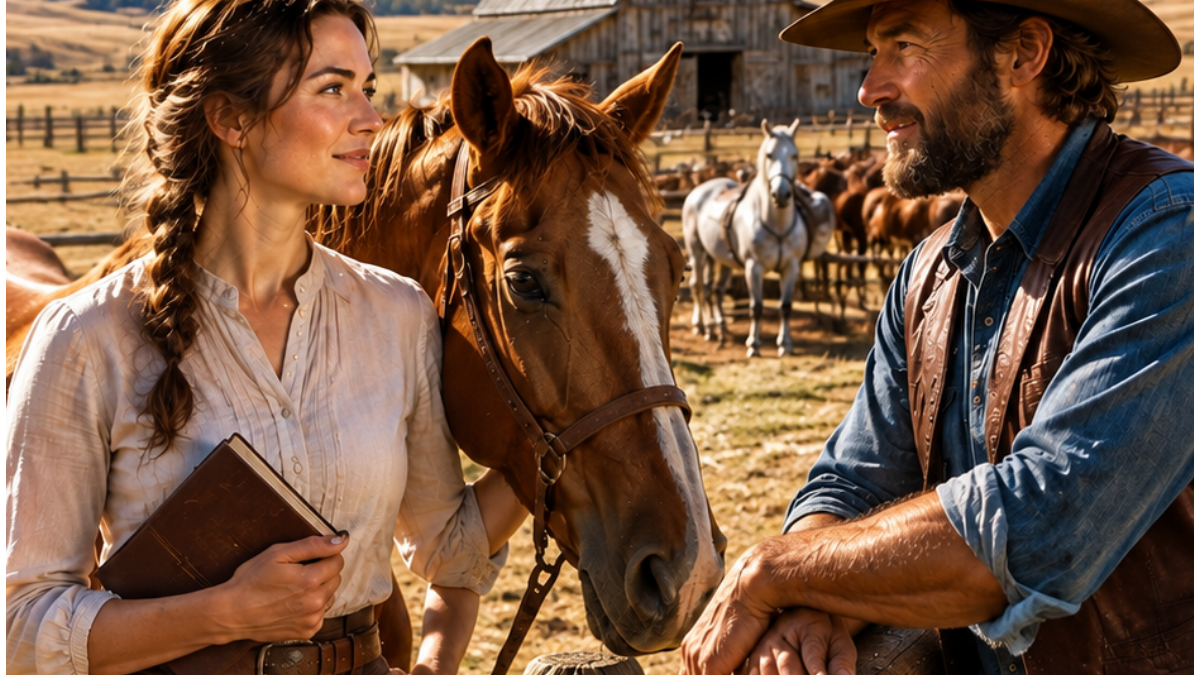
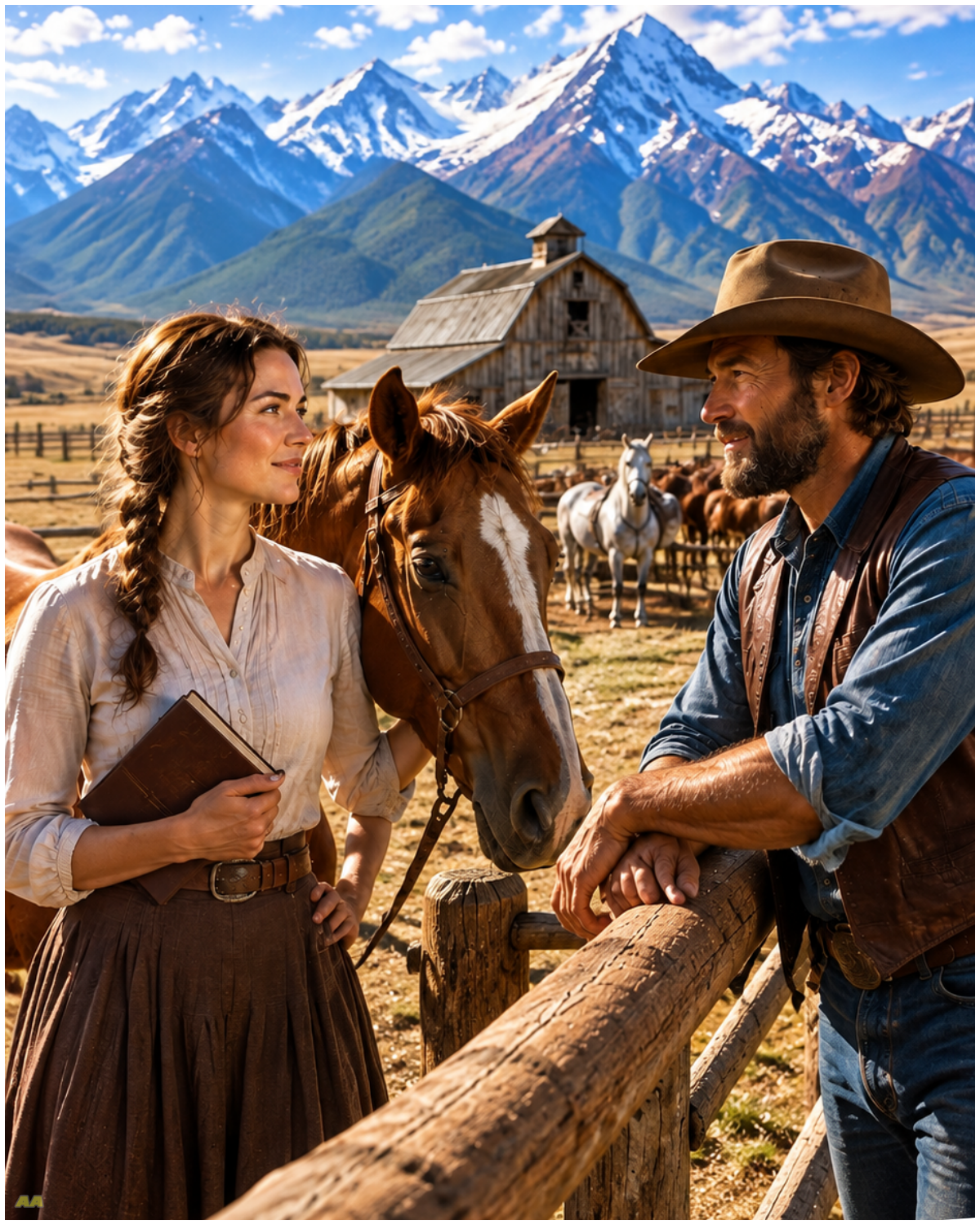
The telegram arrived on a Wednesday afternoon in early April, handed to Rafe Corwin by a boy on a spotted pony who looked like he’d ridden through the night to deliver it.
Rafe was 48 years old, and in those 48 years he had faced blizzards that killed 300 head of cattle, a grass fire that took the south pasture down to bare earth, and a drought that lasted two full seasons without mercy.
He had faced all of that and kept standing, but the telegram in his hand made his knees feel soft in a way none of those disasters ever had.
He read it twice in the pale April light, then folded it into his shirt pocket and went back to work.
Because that was the only thing Rafe Corwin knew how to do when the world handed him something bad.
The Corwin ranch spread across 12,000 acres of Wyoming territory, wedged between the Laramie Mountains and the open grasslands that rolled south toward Colorado.
Rafe had built it from the ground up, starting at 33 years old with 300 cattle, a two-room cabin, and a stubbornness that people in the territory described, depending on their mood, as either admirable or infuriating.
Now, 15 years on, the ranch ran 8,000 head, kept the finest quarter horses in the territory, and supplied beef contracts to three different rail camps.
It was, by any honest measure, a success.
But Rafe Corwin had a problem that no amount of hard work could fix.
Six years ago, during the worst financial stretch the ranch had ever seen, he had entered into an agreement with the Ashby family of Philadelphia.
Edmund Ashby ran one of the largest shipping concerns on the Eastern Seaboard, and his money had reached even into Wyoming territory through a land investment scheme that had gone sideways.
Rafe had borrowed against that investment, signed papers he perhaps should have read more slowly, and found himself contractually obligated to marry one of the Ashby daughters once his operation was solvent again.
The arrangement had seemed distant enough at the time not to worry him.
That was the particular foolishness of a desperate man.
The telegram was from Edmund Ashby himself.
It read, “Your bride departs Philadelphia May 3rd.”
Arrives Laramie station May 12th, 2:30 in the afternoon.
Miss Lenora Ashby, our youngest age 25.
She is a refined young woman of considerable education and gentle temperament.
She has no experience with ranch life and we trust you will make appropriate accommodations for her delicate nature.
She is, we will be honest with you, not our most practical daughter.
But she is lovely and she is available and she fulfills the terms of our contract.
“Regards, E. Ashby.”
“Not our most practical daughter.”
Rafe sat with that phrase for 3 weeks while May crept toward him like a slow, cold front.
He told his housekeeper, Mrs. Granger, a widowed woman of 60 who had kept the ranch house running for 6 years with the efficiency of a military quartermaster.
Mrs. Granger received the news without expression, then spent the following days quietly preparing a room on the second floor with fresh curtains and a good mattress because she was the kind of woman who addressed problems with action rather than opinion.
“What do you think she’ll be like?” Rafe asked her one evening over supper.
“I think she’ll be exactly what her father described,” Mrs. Granger said.
“Which means you should prepare yourself for the worst and hope for something in between.”
He drove to Laramie on May 12th in the ranch wagon, telling himself the whole way down that it didn’t matter.
A deal was a deal.
He’d signed papers. He was a man of his word, and his word was the one thing he’d never been willing to trade away.
The station platform was noisy with the usual crowd.
Cowboys heading north, settlers heading west, railroad men moving supplies.
Rafe stood at the edge of it all with his hat in his hands, watching the passengers come off the eastbound train.
He was looking for what he’d been promised, a delicate Philadelphia woman, probably in an elaborate traveling dress, probably with a maid in tow, and more luggage than the wagon could carry.
What he saw was a young woman in a plain wool dress the color of river clay, stepping down from the train car with a canvas bag over one shoulder and a leather satchel under her arm.
No maid, no trunks. She stood on the platform for exactly 3 seconds, scanning the crowd with dark green eyes that moved the way a surveyor’s eyes move, measuring, calculating, deciding.
Those eyes landed on Rafe, and she walked toward him without hesitating.
“Mr. Corwin,” she said, not a question.
“Miss Ashby,” he said, reaching for the canvas bag.
She let him take it.
“Lenora Ashby,” she said, extending her hand to shake rather than waiting to have it held.
“And before we spend the next hour being polite to each other, I’d rather we were just honest.”
My father told you I was impractical.
My mother told my sisters I was being sent west because nobody in Philadelphia wanted to deal with me anymore.
Both of those things are partially true.
So, you should know what you’re actually getting.” Rafe looked at Lenora Ashby, who was 25 years old and had green eyes that didn’t flinch and a jawline that said she’d made up her mind about something a long time ago and hadn’t unmade it since.
“All right,” he said, “what am I getting?”
“Someone who reads financial statements faster than most men you’ll ever meet,” she said.
“Someone who grew up watching her father run a shipping operation with 200 employees and learned more about logistics and supply management than any finishing school ever taught. And someone who is absolutely done being decorative.” She paused.
“What are you getting rid of?” He considered that for a moment.
“A debt,” he said, “and a lot of silence.”
Something shifted in her face, not quite a smile, but close.
“I can help with one of those,” she said.
The drive back to the ranch took most of the day.
Lenora sat on the wagon bench beside him and did not complain about the dust, the ruts, or the wind that came in off the mountains and smelled like pine resin and cattle.
She asked questions the whole way.
How many hands did he keep on year-round?
What his feed costs ran in winter?
Whether he bought his breeding stock locally or brought it in from further east?
What his arrangement was with the rail camp buyers and whether he had it in writing?
Rafe answered each question honestly, which was partly because he didn’t know how to answer dishonestly and partly because something about Lenora Ashby made evasion feel pointless.
“You’re carrying feed costs that are too high,” she said, “somewhere south of the mountains,” looking at the landscape like she was reading a ledger.
“If your winter pasture rotation is what I think it is from your answers, you’re losing a third of your grazing capacity every season from overuse.
That means you’re buying feed you shouldn’t need to buy.
You can see that from a wagon seat?
I can see it from the numbers you just gave me, she said.
I’d need to walk the land to confirm it.
But I’m fairly sure. They reached the ranch as the sun was dropping behind the Laramie Mountains and painting everything amber and rose.
Lenora looked at the operation the way she’d looked at everything since she stepped off the train.
Like she was seeing the thing underneath the surface.
The main house, two stories of good timber with a wide porch.
The barn, solid and well-kept.
The corrals, properly fenced. It’s a good ranch, she said.
And then, the water trough in the north corral is in the wrong place.
Rafe looked at her. She was 25 years old and had been on his property for approximately 4 minutes.
I know, he said. She turned and almost smiled again.
Good. Then we agree on something.
They were married the following morning by a circuit preacher who happened to be passing through and stayed for a plate of Mrs. Granger’s biscuits as his fee.
The ceremony took 11 minutes.
Lenora wore the same wool dress.
Rafe wore his cleanest shirt.
Mrs. Granger stood witness with the expression of a woman watching something she intended to reserve judgment on for at least another year.
That evening after supper, Lenora asked to see the account books.
Rafe put them on the table and watched her go through them.
She read the way some people pray, completely absorbed, present in a way that shut the rest of the world out.
She had a small notebook she’d produced from the leather satchel, and she wrote in it with a pencil stub that she kept tucking behind her ear when she needed both hands to turn pages.
By 10:00, she had read everything twice and filled four pages of her notebook.
“You’re profitable,” she said, “but you’re leaving money on the table in at least six different places.
Your supplier contracts haven’t been renegotiated in 3 years.
You’re paying 1880 prices for goods that cost less now because the railroad brought competition.
Your cattle rotation is costing you roughly $800 a year in unnecessary feed.
And you have two hands drawing wages for work that overlaps completely.” “They’re doing the same job.” “Those are good men,” Rafe said.
“I didn’t say fire them,” she said.
“I said reorganize the work.
Give one of them the job the other one is already doing and put the freed up man on the breeding operation, which is where you’re most understaffed.” She looked up from the notebook.
“Do you want me to stop?” He thought about it.
“No,” he said. That was the moment, though Rafe Corwin wouldn’t recognize it for months, that single word, “No,” was when everything began to change.
The transformation of the Corwin Ranch happened the way all real transformations happen, slowly, then all at once.
In the first month, Lenora renegotiated three supplier contracts and put the savings into an account she labeled the breeding fund.
In the second month, she redesigned the cattle rotation schedule, walking the pastures herself in boots she’d bought from a hand named Dupree, who had a spare pair and a charitable spirit.
By the third month, the savings on feed costs alone had paid for two new breeding bulls that Lenora had selected from a ranch in Colorado after writing a letter the rancher there described as the most professional inquiry he’d ever received from anywhere, let alone Wyoming.
She worked. That was the thing nobody had been prepared for.
Not Mrs. Granger, not the hands, and certainly not Rafe.
Lenora Ashby, the impractical youngest daughter who had never been expected to do anything useful, worked from before dawn until the light failed.
She learned to judge cattle by eye.
She learned to spot the early signs of illness in a horse.
She learned to rope, badly at first, then adequately, then with a quiet confidence that made the hands stop pretending they weren’t watching.
She got thrown from a horse named Biscuit.
No, wait, not that name.
That’s used. A horse named Copperhead in her fourth week on the ranch.
She got up, brushed the Wyoming dust off her wool dress, and got back on.
Rafe watched that from the fence rail, and felt something move in his chest that he didn’t have a word for yet.
He found the word about 6 months in.
He was fixing a hinge on the barn door when he heard her voice carrying across the yard, talking to one of the hands about the north pasture drainage.
Her voice certain and practical and warm all at once.
He stood there, holding a hinge and a hammer, and understood, with the clarity that only hits you when you’ve stopped looking for it, that he had fallen in love with his wife.
Now, I want to pause here for just a moment and speak to you directly, friends.
If you’re listening to this story tonight, wherever you are in this wide world, whether you’re in the United States, in Canada, in England, France, Australia, or somewhere else I haven’t named yet, I want to hear from you.
Drop a comment and tell me where you’re listening from.
And if this story is moving you the way I think it might, hit that like button and follow Prairie Hearts so you don’t miss what comes next.
Stories like Rafe and Lenora’s are exactly what this channel was built to tell.
Now, back to Wyoming. Rafe didn’t tell Lenora he loved her right away.
He was 48 years old and had spent the better part of two decades convincing himself that the quiet life was enough.
Old habits of silence are hard to break, but he started to show it in the ways available to a man like him.
He built a proper desk in the corner of the front room for her notebooks and ledgers.
He asked her opinion before he made any decision involving money or livestock.
He listened, truly listened, in a way he hadn’t listened to anyone in years.
One evening in September, 8 months after their wedding, Lenora found him on the porch watching the last of the light go off the mountains.
She sat down beside him in the second chair, the one that had been unoccupied for 15 years, and they watched the mountains together for a while without speaking.
“I want to tell you something,” she said finally.
“All right.” “When my father wrote that telegram about me, ‘not our most practical daughter,’ he wasn’t entirely wrong.
In Philadelphia, I wasn’t practical.
I was a woman with ideas in a family that had no use for ideas from women.
Everything I knew about business, about numbers, about running a productive operation, none of it had anywhere to go.” She was quiet for a moment.
“Until here.” Rafe looked at her profile in the fading light.
Lenora was 25 years old and had the kind of face that got more interesting the longer you looked at it.
“For what it’s worth,” he said, “I think your father was the impractical one.
He had something valuable and didn’t recognize it.” She turned and looked at him, and something in her expression shifted, softened into something he hadn’t seen there before.
“That might be the kindest thing anyone has ever said to me,” she said.
He reached over and took her hand.
She let him keep it.
Five years after Lenora Ashby arrived at Laramie Station with a canvas bag and a leather satchel, the Corwin Ranch was unrecognizable in the best possible way.
The operation had expanded to 18,000 acres.
The herd had grown to 14,000 head.
The horse breeding program Lenora had built from scratch was producing animals that ranchers came from two territories away to purchase, and the waiting list for Corwin-bred quarter horses was running 18 months long.
The money was extraordinary. Not the kind of extraordinary that makes people soft, Lenora Ashby Corwin would not have permitted that, but the kind that allows a person to sleep without fear, to plan beyond the next season, to build something that will outlast them.
They had a daughter, Maisie, who was born 3 years into the marriage with her mother’s green eyes and her father’s steadiness.
A son, Will, came the following year with a gift for horses that made the old hands shake their heads in delighted disbelief.
The boy could read an animal the way Lenora read a ledger.
A banker named Allston rode out from Cheyenne to look at the operation on the recommendation of three separate ranchers who had told him, with varying degrees of bewilderment, that the Corwin Ranch was being run by a woman from Philadelphia who had turned it into the best managed cattle operation in Wyoming territory.
Alston arrived expecting to be polite about a husband’s hobby ranch.
He spent half a day looking at the books, the breeding records, the supply contracts, and the pasture management system.
And by supper, he was sitting across from Lenora at the dining room table with his hat off and his assumptions revised.
“I’d like to invest in a partnership,” he said, “and expansion into Colorado.
Your breeding program, their grazing land.
I’d need to see their land surveys and their water rights documentation before I agreed to anything.” Lenora said.
“And the partnership terms would need to include operational control on our end.
We don’t lend our name to something we can’t manage properly.” Alston looked at Rafe, the reflex of a man accustomed to doing business with men.
Rafe looked back at him without expression.
“You’re talking to the right person,” Rafe said simply.
Alston turned back to Lenora.
“Of course,” he said, and the business conversation began in earneSt. The Colorado venture added another layer of prosperity to an operation that was already the subject of considerable attention across the territory.
Newspapers in Cheyenne wrote about the Corwin Ranch.
The Territorial Agricultural Board asked Lenora to present at their annual meeting, which she did, the first woman to do so, and which she did with such precision and such evident results that the room of old ranchers, most of them twice her age, had nothing to argue with.
Word traveled the way good things do, quietly but persistently, and one afternoon in the spring, when Maisie was four and Will was three, and the ranch was humming with the particular contentment of a well-run life, a young man rode in on a horse that had seen better seasons.
His name was Harlo Burke, and he was 27 years old, a small rancher from northern Colorado who had been struggling through two bad years and was running out of road.
He asked for Rafe at the gate, but it was Lenora who came out to meet him, Maisie on her hip and a pencil behind her ear.
“I heard you help people,” Harlo said, turning his hat in his hands.
“I heard you know how to take a ranch that’s barely breathing and show it how to work right.
I’ve got 400 head and 2,000 acres, and I owe more than I own, and I don’t know what I’m doing wrong.” Lenora looked at him for a long moment.
He was young and sunburned, and his eyes had the particular exhaustion of someone who had been afraid for a long time.
She had seen that look before in an older form on Rafe’s face the day she arrived at Laramie station.
“Come inside,” she said. “Tell me your numbers.” They spent 2 days with Harlo.
Lenora went through his situation the way she had gone through Rafe’s account books 7 years before, thoroughly, without softening the hard parts, but also without cruelty.
She rebuilt his rotation schedule.
She identified three supply contracts he could renegotiate immediately.
She wrote him a four-page summary of what to change and in what order in handwriting so clear and organized it looked like something from a textbook.
When Harlo rode out on the morning of the third day, his eyes were wet, and he kept his face pointed north so neither of them would notice.
He shook Rafe’s hand. He shook Lenora’s hand.
He said, “I don’t know how to repay this.” “Build something good,” Lenora said.
“And when somebody comes to you struggling, help them the same way.
That’s the whole repayment. Rafe watched Harlo ride out until he was a small shape against the wide Wyoming sky.
He felt Lenora come and stand beside him.
Their shoulders touched. “You know,” he said, “I used to think the best thing I’d built was this ranch.” “And now?” she asked.
He looked at her. Lenora, who was 32 years old now, with laugh lines at the corners of those green eyes and flour on her sleeve from something Mazie had talked her into baking that morning, and a pencil still perpetually behind one ear.
He thought about the man he’d been before she arrived, competent but in incomplete, successful in every measurable way and hungry in every way that couldn’t be measured.
“Now I think it’s everything else,” he said.
She took his hand the way she had on that September porch seven years ago, and they stood there together watching the Wyoming morning open up across their land.
Rafe Corwin was 55 years old by the time people started writing about the Corwin ranch as a legend.
The newspapers called it the best-run operation in the WeSt. The territorial government called it a model for modern ranching.
Other ranchers called it proof that something could be built from almost nothing if the right two people were willing to build it together.
What nobody wrote about, because nobody outside the ranch knew it, was the quieter thing.
The way Rafe and Lenora still sat on that porch every evening when the day’s work was done, watching the light change on the Laramie Mountains.
The way Will, now 12 years old, had his mother’s eye for a horse and his father’s patience with one.
The way Mazie, 13, had already started keeping her own notebook full of observations about ranch management that made both her parents quietly, privately astonished.
The Corwins built more than a ranch.
They built a proof that two people who were wrong for each other on paper can be exactly right for each other in the places that actually count.
That a woman with no frontier experience and a man with no head for business can become, together, something neither one could have become alone.
That’s the thing about true partnership.
It doesn’t work because both people bring the same things to the table.
It works because they bring different things and they are willing to trust each other with the gaps.
Rafe Corwin had signed a contract out of desperation, expecting to be saddled with a useless woman who would drain his ranch of whatever life it had left.
What he got was the person who taught him what the ranch was actually capable of.
What Lenora Ashby got was the one place in the world that was willing to find out what she was capable of.
Some deals are exactly as good as they look on paper.
And some deals, the kind that change everything, look like disasters right up until the moment they don’t.








