They Argued Over The LAST TAXI… Without Knowing They Were ALREADY Each Other’s BLIND DATE
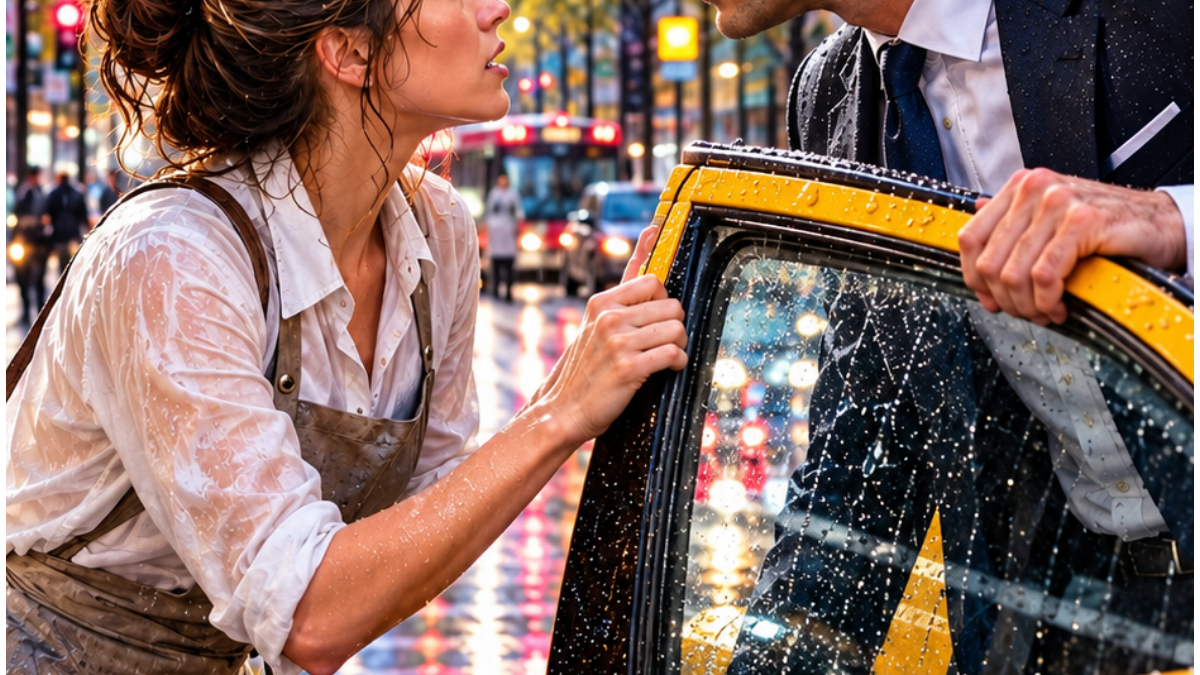
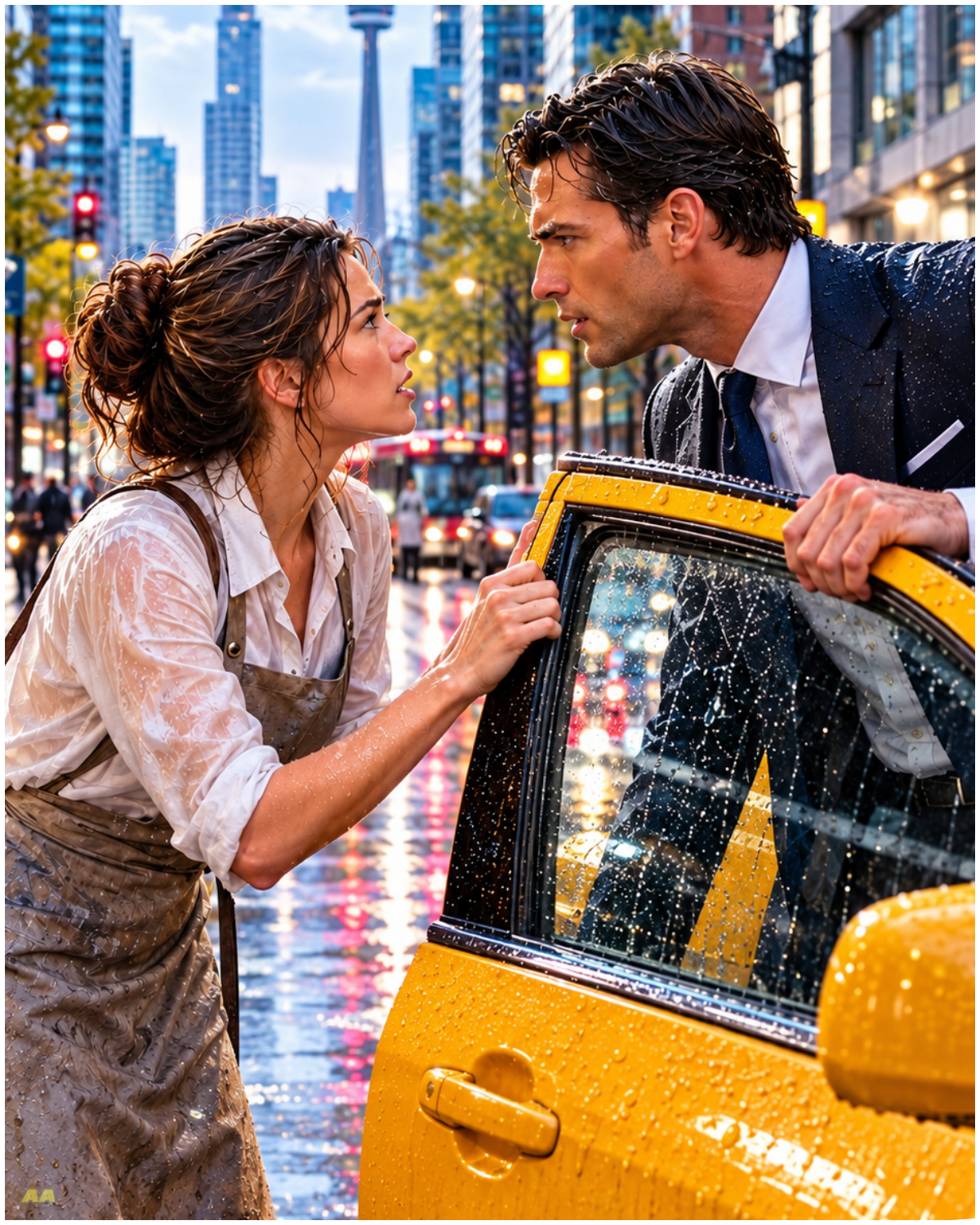
The cab appeared at the corner of King and Spadina at exactly the wrong moment, or the right one, depending on whose version of the story you believe.
Asha Dempsey had her hand flat on the wet yellow door before the taxi had fully stopped moving.
One heel wedged in the October gutter, where the drain had given up, and the puddle had spread halfway across the curb.
From the other side of the cab, a man in a dark suit had his own hand on the opposite door, and he was looking at her the way someone looks at a spreadsheet that has refused to behave.
“I flagged it,” he said.
“You pointed at it. There’s a difference.”
I waved.
I ran running beats waving.
Neither of them knew they were already 9 minutes late for the same table, at the same restaurant, for the same blind date.
That single fact was about to make them both look very foolish.
But that comes in a moment.
First, you have to understand how Asha ended up on that corner at all, soaked through her good blouse, arguing with a stranger whose shoes probably cost more than her rent.
70 minutes earlier, she had been elbowed deep in a bucket of slip glaze in the back of Dempsey Clay, the ceramic studio and teaching space she had been keeping alive in Kensington Market for the past 14 months when her phone lit up on the wedging table with Sonia’s name.
She put it on speaker and kept working.
“You’re going,” Sonia said.
No preamble, no hello.
Sonia had been her closest friend since their second year at OKAD and operated under the reasonable assumption that she knew best.
I said, “Maybe.”
You said, “Yes, I have the text.” That was a coerced yes.
You asked me at the opening when I had glaze on my hands and couldn’t type properly.
The answer still autocorrected to yes.
A pause. Usher, it’s been 14 months.
I’ve been busy. The studio is still on fire.
I know. You’ve been telling me for 14 months.
Sonia’s voice went quieter, the way it did when she stopped teasing and started meaning it.
My friend Lara has been trying to set her brother up for 2 years.
She says he’s the best man she knows and completely impossible to actually get to know.
She showed me a picture. Asha lifted her eyes from the glazed bucket.
Don’t say jaw. I wasn’t going to say jaw.
You were going to say jaw.
He has a very nice jaw.
Sonia said the restaurant’s on Wellington.
It’s the kind of place where someone else does the cooking and you don’t have to apologize for anything.
You deserve one evening like that.
Asher looked around the studio. 14 months of almost losing it.
The mismatched kils she’d salvaged from a schoolboard auction.
The long harvest table where her Thursday night beginner’s class left their handprints in the clay.
The window where the afternoon light came through and turned the drying shelves into something that looked like a museum and felt like home.
“Fine,” she said.
“One dinner. Wear the gray dress.”
The gray dress has a crack in the shoulder seam.
Stand at an angle.
I love you.
Don’t be late.
She clicked off before Asha could ask what standing at an angle had to do with anything.
By the time she had washed her hands three times, couldn’t get the gray under her nails out, given up, changed into the gray dress, and confirmed the crack was manageable.
If she held her bag on that side, she was already running behind.
The street car on Dundas had stalled in traffic for 11 minutes while the rain came down in the particular thin sideways wave of October in Toronto and Asher stood in the shelter with a man eating a samosa and a teenager whose earbuds were leaking something with a lot of bass and thought that this this exact feeling was what her love life had felt like for most of her 30s.
She came up to street level at King and Spedina into the cold, wet dark, and there, idling at the corner with its light on like a small yellow miracle in a city that had largely moved to apps, was the last available taxi on the block.
She ran. She was not the only one who had seen it.
The man came from the other direction, moving fast for someone in a suit that fit that precisely.
They arrived at the same moment.
Asher from the west, breathless, one strap of her bag slipping.
The stranger from the east, dry, composed, already reaching.
Their hands landed on the door handles at the exact same instant.
The cab rocked gently, indifferent to them both, which is how Asher Dempsey came to be standing in a Kensington gutter, dripping and furious, telling a man she had never met that running categorically beats waving.
Flynn Carowway did not, as a general rule, lose things.
He kept his days in 30-inute blocks, his inbox at 0 by9, and his composure in situations that had rattled considerably larger men.
His assistant had once described his calendar to a new colleague as a controlled demolition.
Every minute accounted for, every outcome pre-calculated.
And yet here he was, 9 minutes late for a reservation, holding a taxi door against a woman who was looking at him the way someone looks at a parking ticket they believe is unjust.
“I have a reservation,” he said.
I am already late for it and I do not have time.
Oh, a reservation. She widened her eyes.
I had no idea. Here I thought I was just standing in a puddle because I enjoy it.
Please take the cab. Take the whole intersection.
Something moved in Flynn’s face. Not amusement exactly, more like a recalibration.
She was, he processed this quickly.
Quite something. Dark hair going curly in the rain.
Clay under one fingernail. She’d missed the gray dress with a bag held at a specific angle that suggested she was protecting something.
And the particular quality of someone who had been fighting small battles for a long time and was very very good at it.
You’re soaking, he said. Perceptive. Take the cab.
He stepped back and released his door.
Asher had been braced for a fight and the sudden surrender nearly lost her.
What? I’ll find another. There are no others.
That’s the crisis. That’s the whole reason we’re doing this.
Then I’ll be late. He was already turning up his collar against the rain which had decided to commit.
That particular Lake Ontario cold that seeped through everything and made October in this city feel like a personality teSt. He was already turning away and something about that, the particular quality of it, the man who stepped back first without making it a production, got under her guard in a way she hadn’t expected.
Wait, he stopped. This is absurd.
Asha heard herself say it before she’d finished deciding to.
We’re both going somewhere presumably roughly downtown.
Split it. I’ll drop you first if your place is closer.
And I’m doing this under enormous moral protest just so we’re both clear.
Flynn Carowway looked at her for a moment in the rain doing some private calculation she couldn’t follow.
Then he got in the cab.
Inside, the taxi smelled of pine air freshener and someone’s earlier coffee, and the driver’s CBC radio station, murmuring the late headlines.
Asher slid across the vinyl to the far door, and the stranger folded himself in after her with the careful economy of a tall man who had learned to manage smaller spaces.
The doors thunked. Rain sheetated down the windows and turned the whole street into a smear of amber and red.
“Where, too?” the driver said, eyes in the mirror.
They spoke at the same moment.
Terois said Asher. Terois said Flynn.
The silence in the back seat had its own temperature.
Asher turned her head. The man was already turning his.
In the passing wash of a street light, she watched his composed face do something it clearly didn’t do often.
Fall briefly open. “You’re going to Terow,” she said slowly.
“Yes, on a Wednesday.” “On a Wednesday.” Her stomach did a slow, uncertain roll.
The feeling of a piece on the kiln shelf that hasn’t decided yet whether it’s going to hold its shape or crack.
“That’s a very popular restaurant,” she said too quickly.
“Lots of people go there. It’s probably a coincidence.” “I’m meeting someone,” Flynn said.
He was watching her with a new kind of attention.
The gray eyes moving through something she couldn’t track.
“An arrangement? My sister arranged it.” The bottom dropped out of Ash’s stomach entirely.
Your sister, she said carefully, wouldn’t happen to work in advertising and do bar class on Tuesday mornings.
The driver turned the radio down.
Flynn Carowway went very still. How?
He said in the measured voice of a man trying to keep something from tipping.
Could you possibly know my sister does bar?
I don’t know. I’m guessing. I’m having a very specific and deeply unwelcome intuition, and I would give almost anything for it to be wrong.
Asha pressed her hand over her mouth and laughed.
One helpless huff of sound. Tell me you’re meeting someone named literally anything other than Asher.
He didn’t say anything. That was the answer.
Oh no. This is terrible. You’re Asher Dempsey.
He said it the way you say a fact you’re still deciding whether to truSt. You run the ceramic studio in Kensington.
Lara sent you a paragraph. She sent me a paragraph.
I read the first line. A muscle worked in his jaw.
It said you were formidable. I’m going to have a very calm conversation with Sonia, Asha said.
After I have a slightly less calm one with myself, because you’re telling me that the entire thing on the corner, the waving, the running, the entire puddle situation.
We were already 11 minutes late, Flynn said almost to himself for the same table.
And neither of us knew. And neither of us knew.
The cab moved through the wet city.
Outside the glass towers of the financial district rose through the rain and the neon of the restaurant strips below them smeared orange on the wet road.
We could still not go in, Flynn said quietly.
Asher turned. It surprised her coming from him.
We’ve met, he said. The dry thing buried so deep you had to dig for it.
Technically, the arrangement was to meet.
We’ve met extremely thoroughly. You could take the cab.
I’ll tell Lara the rain was impossible.
That was the second time he’d offered her the exit.
Offered to be the one who disappeared so she wouldn’t have to.
Asha thought about her empty apartment and the kiln she’d left running on low.
She thought about the word she’d been carrying for 2 years.
Too much, a her former partner had said over a nice bottle of wine.
She was too much. He’d needed someone a little easier.
She’d been getting good at easier.
She’d been getting very, very good at it.
No, she said, “We’re already here and I got rained on and I’m not going home to reheat soup and pretend this didn’t happen.
I want to see the inside of this place.
Come on, reservation man. You’re buying since you made the booking.
Flynn Carowway said nothing, but he moved over.
Teroir was the kind of restaurant that made you feel the city differently when you stepped inside it.
Warm reclaimed wood, low candlelight, the smell of brown butter, and something herbaceious roasting in a back room, and the particular hush of a room where everyone has made a reservation and knows it.
The host recognized Flynn by name and led them to a corner table with a banquet of dark green leather.
And Asha slid in and thought, “This is what the inside of Sonia’s ambitions looks like.” They ordered.
The bread came firSt. Asha picked up a piece and stopped.
“Whoever baked this,” she said slowly.
“Let it ferment cold overnight, maybe longer.
You can smell it. There’s this faint sourness just under the butter and the crumbs irregular because they didn’t rush the proof.” She looked up.
Sorry, I make pottery for a living, but I’ve been feeding myself through sourdough experiments for 14 months.
Occupational proximity. Flynn had gone quiet, watching her hands on the bread the way she’d watched his face fall open in the cab.
“Don’t apologize for that,” he said.
She looked at him for bread analysis at a nice restaurant, for caring about something out loud.
It was the first thing he’d said that wasn’t a fact or a managed concession.
And it landed somewhere she hadn’t been expecting.
Your turn, she said. Tell me one true thing, not from the paragraph.
Something real. He considered it for longer than she expected.
Then I still have every piece of my grandmother’s pottery in my apartment.
All 11 pieces. I’ve moved four times in 6 years, and I’ve packed them myself every single time.
I don’t trust movers with them.
Asher set down her bread. Flynn.
M. That was quite a lot more than one thing.
You have that effect. She studied him.
The dry wit delivered so flatly it barely registered as a joke until you were already past it.
The jaw Sonia had mentioned which was in fact extraordinary.
The careful, deliberate quality of every gesture, as though he had learned to take up precisely the amount of space he intended and no more.
What do you do? She asked.
The real version, not the dinner party version.
I advise on urban development projects, site acquisitions, reszoning applications, community impact assessments.
He turned his water glass a precise quarter in on the tablecloth.
I find parcels and I build things.
What kind of things? Mixed towers, mostly some affordable housing components, a few heritage preservation retrofits when the numbers work.
The food arrived. They talked. It was in the way of things you don’t plan and can’t quite account for.
One of the better conversations Asher had had in recent memory.
He was sharp in a way that didn’t show off.
She was direct in a way that made him recalibrate in real time.
She told him about the Thursday beginner’s class and the woman who came every week and cried quietly over her bowls, which she said was fine, and which Asher suspected was the whole point.
He told her about his grandmother’s soup bowls and the weight of clay in the hands, and stopped, surprised at himself.
The room hummed, the candles did their thing.
Asher was on her second glass of wine and thinking with the sinking certainty of someone watching a thing happen that they cannot stop.
I like him. Isn’t that inconvenient?
Then the shadow fell across the table.
Carowway. The man who’d appeared was somewhere in his 50s, silver-haired, the particular pinkness of someone who ate and drank well and knew it.
He had a firm handshake already extended and a smile that had clearly navigated a great many boardrooMs. Didn’t expect to see you here, Quinn.
He added to Asha as an afterthought.
Asha Dempsey, she said. We should talk about the Kensington file, Quinn said to Flynn.
Now that it’s moved to the next stage, boards very happy.
The heritage review came back cleaner than expected.
Demolition permits are probably looking at spring.
He dropped his voice to the register men use when they think a woman won’t count it.
64 units in that assemblage. Prime Kensington frontage.
You’ve been chasing that block for 18 months.
Something happened to the air at the table.
Asha felt it before she understood it.
The way you feel the temperature drop before you understand a storm is coming.
Flynn’s eyes moved to her just once quick.
And she saw something in that flick.
A fraction of a second of calculation and something beneath the calculation.
Something worse. That made her chest go cold.
This isn’t the time. Flynn said, “It’s never the time with you.
That’s why you win.” Quinn was already backing away, pleased with himself.
I’ll send you the heritage summary, Miss Dempsey.
Enjoy your evening. Asher waited until he had gone.
Kensington, she said. Flynn had picked up his water glass.
She watched him not drink from it.
He said, a block, he said, 18 months.
Ash’s voice had gone very even.
The particular stillness that came over her when the kiln temperature started climbing past what it should.
I’ve been in Kensington Market for 14 months.
My street, the block on Augusta between Nassau and Oxford.
The building I’m in has been under some kind of review for months.
My landlord keeps sending vague letters.
She watched his face. She was good at faces.
Flynn. He set the glass down.
Is it my block? The candle between them, guttered.
From across the restaurant came the sound of someone laughing too loudly, and then the music absorbed it.
Yes, Flynn said. He said it the way he said everything he’d rather not say.
Simply without ornament because he decided he wasn’t going to lie to her even when a lie would have cost him far less.
Your building is in the assemblage.
Asher heard the word assemblage. Such a clean architectural word for something that apparently included her kils and her Thursday night beginners and the woman who cried over her bowls.
Demolition in spring, she said. Nothing is confirmed.
There are permits, reviews, a process.
Don’t, she put her hand up flat.
Don’t do the reassuring planning voice on me.
I can hear the difference. That’s the voice you use in the boardroom.
I am not aboard. She looked down at her hands on the white tablecloth.
One clay stained fingernail. 14 months of close calls and near misses and the particular exhaustion of loving something you kept almost losing.
For 18 months, she said slowly.
You’ve been trying to acquire my block.
My firm has been working the assemblage.
I didn’t know. You know now, she looked up.
When Quinn said, “Kensington, you knew.
I watched your face.” He didn’t deny it.
Of course, he didn’t. Yes, he said quietly.
I knew. And what happens to the building?
He didn’t answer. That was its own answer.
“It comes down,” Asha said. For the 64 units, doesn’t it?
The silence between them had a shape.
She stood. She was surprised at how steady her legs were.
She picked up her bag, cracked shoulder seam and all, and crossed the warm restaurant without looking back, and she made it all the way to the front door before his voice caught her.
Pitched low to reach exactly as far as her, and no further.
Asha, the bread you loved. She stopped.
“Let me walk you out, not home, just to the door, and I’ll tell you who made it, and then you never have to see me again.” The third exit offered on her behalf.
She turned around. That’s not a fair condition, and you know it.
I know. The corner of his mouth did something complicated.
I work in acquisitions. I found your weak point.
Which was, she recognized, the driest joke she’d heard all year, delivered by a man who had just told her he was in the process of demolishing her life’s work.
She laughed against her will. One helpless, furious sound.
I hate that that was funny.
So do I, he said, and reached her.
They walked out into the cold.
He did not take her arm.
He’d understood enough of her in one evening to know she wouldn’t want that right now.
The rain had softened to miSt. The street gleamed.
On the corner, because the city has a specific sense of humor, a cab appeared from nowhere.
Its light was on. It came directly to her.
“Of course,” she said. “Now there’s a cab.” She looked back at Flynn, rain darkening the shoulders of his suit, the careful architecture of him coming slightly undone at the edges.
“Come see it,” she said. “The building your firm bought.
Come see what you’re pulling down.
You should at least have to look at it.
He got in the cab. Kensington Market at 10:30 on a wet Wednesday night looked like it always did.
Lights on in the Vietnamese restaurant that never closed.
The smell of cumin from the spice shop, even through the rain.
The last of the vintage clothing racks still out under their own little canvas roofs.
The kind of neighborhood that existed by virtue of collective stubbornness and cheap rent and community agreements that nobody had written down because writing them down might have made them vulnerable to being read by the wrong people.
Ash’s studio was on Augusta handlettered sign above the door.
Dempsey clay workshops wheeltime commissions. The lights were still on inside from the kiln she’d left on low.
She could see the shelves of drying work through the glass.
A row of someone’s Thursday bowls.
A set of mugs waiting to be glazed.
A tall vase she’d been working on for a month that had finally decided to hold.
There was a letter taped to the door.
She hadn’t seen it this morning.
She’d left at noon. Flynn saw her stop.
She heard him behind her, not crowding her, keeping his distance.
She peeled the letter off the glass.
It was from a property management company she’d never heard of.
One page. Professional. Calm the way.
Only very bad news is calm.
Notice of change of ownership. Formal beginning of a lease review process.
First step toward termination of teny 60 days.
She read it twice. 60 days.
Then she unlocked the door and walked inside and didn’t say anything for a long moment.
The studio smelled of clay and the mineral sharpness of the glazes and the low heat exhale of the kiln.
Her work was on every surface.
The beginner’s shelf with its uneven beautiful hopeful bowls.
The community corner where she’d put out clay for the drop-in mornings.
Pay what you can, which was more often nothing than anything, and which she ran anyway, because the woman who cried over her bowls had told her once that it was the only hour of her week that felt like hers.
Flynn stood in the doorway and looked at it, not the way she’d feared, not measuring it, not calculating its footprint, reading it.
The handmade sign, the children’s drawings pinned to the corkboard from the school group that had visited in September.
A child’s painted clay fish mounted on the wall with a post-it underneath in crayon for Asher from Meera, age seven.
You built this, he said in 14 months on the side of whatever was keeping the lights on.
He moved to the shelf of Thursday bowls and stopped in front of them.
She watched him look at them the way she had looked at the bread in the restaurant.
Something private and precise happening in his face.
My grandmother’s 11 bowls, he said.
She made them herself in a co-op ceramic studio in Hamilton that a developer tore down in 1987 to build a parking garage.
She used to say the garage was still there and the co-op wasn’t, and that was how you knew what the city thought people were worth.
The kiln ticked in the back room.
Flynn, Asha said. She would have loved this place, he said it quietly.
That’s the part that’s hard to sit with.
Asher crossed to the long harvest table and leaned against it, arms folded.
Then why are you the one pulling it down?
Because if I own the ground, no one can move me off it, he said it simply, and it had the quality of something he’d carried for a long time without examining it closely.
I watched enough buildings go under people who trusted they’d be kept.
I decided I’d rather be the one holding the parcel.
That is the saddest reason to be good at something.
He didn’t disagree. You just described your grandmother’s co-op, Asha said.
And you are the parking garage.
She watched it land. She watched it go all the way in.
I know, Flynn said. It was barely a sound.
Then be something else right now, tonight.
You have the authority. Take this building out of the assemblage.
Build your 64 units on the lot behind Oxford Street, which has been an eyesore since the ’90s.
And everyone on this block will tell you the same thing.
Leave these streets. The flinch was small, but she caught it.
I can’t pull one parcel out of the assemblage, he said.
The financing is structured around the whole block.
The investors can’t or won’t. There are 42 other partners.
Flynn, she kept her voice level.
Your grandmother’s studio is the parking garage right now, and you know it.
I can see you knowing it.
He looked at the fish on the wall.
Mirror, age seven, crayon on post-it, cheerful and permanent.
Then he reached into his jacket and set his phone on the harvest table between them.
There’s a retail space in the proposed development, he said.
Ground floor, north facing, better light than this.
A proper ventilation system for kils.
I’d have it sped to your requirements.
5 years rentree. After that, below market for the life of your lease.
You’d keep the corner. You’d keep Kensington.
Asha looked at the phone on the table.
She wanted to say yes. The shameful part was how much she wanted to say yes.
5 years rent free a proper kilm bay not lying awake doing rent arithmetic at 2 in the morning for one breath she saw it what about the woman who cries over her bowls she said he didn’t answer the drop-in mornings pay what you can where do those people go when the whole block is gone and the rents on the new building are what rents on new buildings are do they fit in your groundf flooror retail plan or is it just me the one you feel bad about because I was standing in the rain arguing with you over a AB.
She pushed the phone back across the table.
That’s not a rescue. That’s a survivor story to put in the brochure while everyone else on this block gets the parking garage.
I’m not taking a life raft that fits one.
His face did something she hadn’t seen from him yet.
Not the guarded calculation, not the dry wit, not even the openness he’d accidentally shown in the taxi.
Something smaller and more honest than any of those.
What do you want me to do?
He said, I want you to leave.
Not the gallant leave, the real one.
I want you to walk out past that letter on my door, which has your firm’s name on it, and I want you to go home to your grandmother’s bowls, and I want you to sit with the fact that a woman who just had the best accidental first date of her life looked you in the eye and told you that you had become the parking garage, and I want you to see if you can find a way to be wrong about that.” He crossed to the door.
The studio exhaled around him. He stopped with his back to her.
There’s a city planning consultation meeting, he said.
3 weeks from Thursday. Evening session at the community center on Nassau.
It’s technically open to the public.
Anyone in the affected area can present.
A pause. These things are usually formalities.
I’ve been through 14 of them.
I’ve never lost one. Another pause, shorter.
I’m telling you where it is.
Why? He half turned and the studio light caught his profile.
The jaw Sonia had mentioned the careful set of his shoulders.
The precise amount of space he allowed himself to occupy doing something it clearly cost him because my grandmother would have come he said and she would have talked about the fish he opened the door the October cold came in he stopped once more on the threshold it was a headbaker outside Pikton who supplies teroir he said the bread 4-day cold ferment you were completely right about the overnight rest you were right about all of it the corner of his mouth did the thing the bubble before the boil you usually usually are.
I suspect that’s exhausting for everyone around you.
It’s exhausting for me, Asha said.
Good night, Asha Dempsey. The door closed.
The bell above it, a small brass one the woman who ran the spice shop next door had given her at the opening.
Rang once, small and clear. Asha stood alone in the studio for a long moment.
Then she pulled out the binder where she kept the block’s contact information.
The spice shop, the vintage clothing dealers, the repair cafe, the woman who had her drop in mornings and came every Tuesday at 10:00.
She set it on the harvest table and pulled out the wobbly stool she’d been meaning to fix for months.
And she sat down and she dialed the first number.
3 weeks from Thursday had never felt so close.
The community center on Nassau could hold 120 people if you folded the dividing wall back and put chairs to the wall.
They had done both, and it still wasn’t enough.
People stood three rows deep at the back.
Asha counted faces she hadn’t seen in months.
Former students, market neighbors, the woman who ran the community kitchen two streets over, the man who did bicycle repair from his front porch and had been on this block for 30 years.
She stood near the front with a cardboard tray of clay thumbrint cardamom cookies she had made at 2:00 in the morning because she baked when she was afraid, and she was afraid.
Sonia was at her elbow with a folder of objection letters they’d collected.
Breathe, Sonia said. I’m breathing. Breathe like you mean it.
The city planner chairing the session called the room to order.
The developer’s representative, not Flynn, stood and presented in the smooth oiled language, Asher, now recognized as the boardroom voice.
Mixeduse development, affordable housing component, percentage quoted quickly.
Revitalized neighborhood frontage. In the architectural rendering on the screen, her studio was simply not there.
Public comment. Her name was first on the liSt. Asha set down the cookies and walked to the microphone.
She had written notes. She’d written them four times on the backs of studio receipts at 1:00 in the morning.
She looked at them now and put them in her pocket.
My name is Asha Dempsey, she said.
I run the ceramic studio on Augusta.
There’s no business partner in the name.
I just like the sound of it plural.
A ripple of warmth in the room.
I’m not going to talk about the tax base because I have no idea what that means.
I’m going to tell you about what’s on the block they want to tear down.
Her voice found its footing, the one she used with beginners.
There’s a spice shop next door to me that has been open since 1991 and is run by a woman named Miss Acharia who unlocked my studio door the morning I moved in because my locksmith was late.
And she just did it because that’s the kind of block it is.
There’s a repair cafe that fixes electronics for free so people don’t throw them away.
There’s drop-in morning playtime. Pay what you can, which is mostly nothing and which matters more than I can explain in the time I’ve been given.
The proposal calls this block underutilized, she said.
I have read that word many times in 3 weeks.
We are not underutilized. We are the last few streets in this neighborhood where a woman who runs a spice shop can still afford to be here.
When we’re gone, there’ll be a groundf flooror retail bay where we used to be.
Very nice light, I’m told. And the rents will be what new building rents are.
And everyone who made this a place worth developing will have to find somewhere else to go.
I don’t know where. I suspect the proposal doesn’t either.
She picked up one of the cardamom cookies from the tray Sonia was holding and set it on the podium.
My Tuesdays are named after whoever made the best piece in the morning dropin.
Last week’s was Meera Oay who is 7 years old and made a fish that is now on my wall.
Meera’s family doesn’t own property on this block.
They use it. That’s a different thing and it’s the thing nobody accounts for.
She looked at the planner. That’s my time.
Thank you. She stepped back. The back door of the community center opened.
60 faces turned. Flynn Carowway stood in the doorway in a suit that looked like it had come from somewhere else at speed.
Tie slightly off, hair doing something the October wind had decided, a single folder under his arm.
His firm’s representative at the front table turned the color of new clay.
“Mr. Carowway,” the chair said, consulting her papers.
“You’re not on the speaker liSt. I’m not here as the applicant’s representative.
I submitted a speaker card at the desk.” He held up the folder, even unhurried.
“I grew up two streets from this block.
I believe that qualifies me as an affected resident.” The chair looked at the card, looked at the clock, looked at the representative, who had half risen with one hand out.
“Sit down,” she said to the representative.
“Everybody gets 2 minutes, Mr. Carowway, you have the floor.” Flynn’s representative said very low, “Flynn, whatever this is.” “I know what it is, David.” He handed the folder across on his way past, and Asher watched David open it and read the top sheet and lose several shades of color in quick succession.
Flynn didn’t go to the microphone.
He went to the side of the room to where Mrs. Acharia was sitting in her good blue cardigan.
He stood in front of her for a moment.
“Mrs. Acharia,” he said. “Your shop has been on Augusta since 1991.
My grandmother used to buy black cardamom from you.
She said it was the only place in the city that carried it whole.” Mrs. Acharia’s face changed slowly.
I remember her. She had your hands.
She looked down at his hands.
Pale cardamom or dark? Dark. Always dark.
She knew her spices. Mrs. Acharia’s eyes were very bright.
Flynn turned to the room, to the chair, to Asher, who had gone completely still.
18 months ago, he said, “I began working on the acquisition of the block on Augusta between Nassau and Oxford.
I advised the investors I work with that it was a sound development opportunity.
Underutilized frontage, clean bones, good reasonzoning prospects.” He looked at the chair.
I used every word on that slide up there.
I believed most of them in the abstract.
But I am here tonight because 3 weeks ago, a woman told me something I’ve been unable to stop thinking about.
She told me that the people you displace to build the thing are often the exact people who made it worth building.
His voice didn’t rise. It didn’t need to.
She told me I had become the parking garage.
I didn’t know what she meant until she showed me a fish on a wall drawn by a 7-year-old, and then I knew exactly what she meant.
The folder David was holding. David had come to the front of the room now, face very pale, holding it like it was something that might go off.
As of today, Flynn said, “I have filed to withdraw the resoning application for this block.
I have also begun buying out my partner’s positions in the assemblage at cost, which my accountant describes as elective financial self harm.
It is a considerable amount of money.
I’ve decided it is considerably less than what my grandmother’s bowls are worth.” He turned to the chair.
I’m withdrawing the application. The leases stand.
The spice shop stays. That’s my two minutes.
The room erupted. Mrs. Acharia pressed both her hands over her mouth.
The repair cafe woman burst into tears.
Sonia grabbed Asha’s arm hard enough to leave Mark, saying over and over, “Did he just, Asha?
Did he actually just?” And David from the development firm was talking very quickly at the chair, who was not listening to him.
Through all of it, Flynn stood still, looking at the floor, the particular posture of a man who has done the thing he came to do, and is now simply waiting for the noise to settle.
Asha made her way to him through the crowd.
People kept stopping her. Mrs. Achara took her hands.
The repair cafe woman hugged her.
The bicycle repair man shook her hand three times.
By the time she reached Flynn, they were near the back of the room, and the session was collapsing into productive chaos.
You withdrew the whole application? She said, “Yes, all of it.
The 64 units. I kept an option on the parking lot behind Oxford.
Six floors, mixed income, ground floor with a proper kilm bay if you were ever interested in a second location.” The corner of his mouth.
I know. I find your weak point and I build on it.
It’s a professional habit. You are a terrible person,” Asha said, and took his face in both her hands and kissed him in the back of the community center on Nassau Street, while the whole block erupted around them, and the chair called for order, and Mrs. Acharia said something to the repair cafe woman that made them both laugh.
They pulled apart after a moment.
“The bread,” Asha said. “You told me who made it on the steps of my studio, but you still owe me the cookies.”
She pressed one of the cardamom cookies into his hand.
Mrs. Zacharia suggested the cardamom, dark, not pale.
She said, “That’s how your grandmother would have wanted it.” Flynn looked down at the cookie.
Something in his face did what the grand things couldn’t do.
Opened completely all the way. No shutter left.
He ate the cookie.
“You’re right,” he said very quietly.
“Dark is better.”
The cardamom in the Kensington October Air through the propped open community center door.
Mrs. Acharia’s shop on the corner still there.
The bell above Ash’s studio door, a few streets away, waiting to ring whenever someone came in.
The k still on its low setting, patient as ever, counting down nothing.
Mirror’s fish on the wall. The woman who cried over her bowls on Tuesday mornings, the whole alive, stubborn human block of it standing.
Come back to the studio, Asha said.
The Thursday class is tomorrow. You can watch people make things and not knock them down for one evening.
That sounds, Flynn Carowway said, turning up his collar against the October night, like the best evening I’ve had in years.
She held the door. He walked through it.
The rain had finally given up for good, and above Kensington Market, the sky was doing the thing October skies do in Toronto sometimes, clearing late to show the stars through the orange city glow, cold and very far away and bright enough, just barely bright enough to see.








