The Wedding Planner Locked Me Out of My Bridal Suite — Until Imperial Guards Called Me Princess

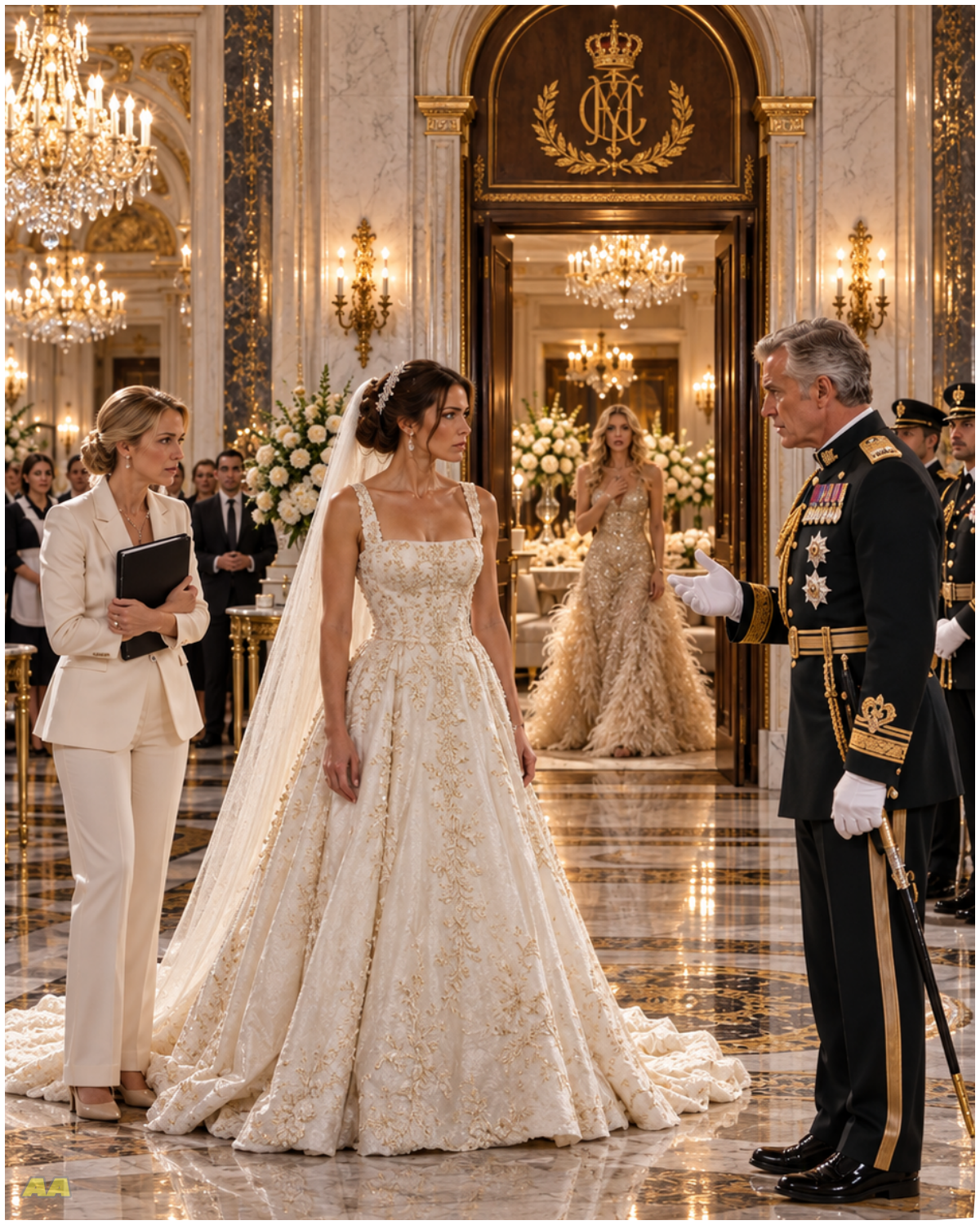
The honor guard arrived 40 minutes before the ceremony was scheduled to begin.
Six men in dark forest green coats trimmed with gold braid, their boots silent against the marble lobby floor of the Witmore Grand Hotel.
They did not announce themselves with fanfare.
They simply approached the concierge desk, and the officer at the front, a broad-shouldered man with silver at his temples, opened a slim leather folio and asked a single question that made the entire lobby seemed to hold its breath.
“We’re here to conduct the suite verification for room 401. Can you confirm the current occupant’s name?”
The concierge blinked, glanced toward the ballroom corridor, where wedding guests in silk and linen were already drifting toward their seats, and stammered that he would need to check with the event coordinator.
Regina Thakare appeared moments later, her cream Valentino suit pressed to sharp perfection, her clipboard clutched against her chest like armor.
“Sweet 401 belongs to Miss Odet Fairweather,” she said, her smile brittle.
She’s finishing her preparations there now.
Is there some kind of issue?
The officer studied his folio again, his expression unreadable.
Our registry lists a different name entirely for that sweet ma’am.
Where is Miss Vivien Callaway?
To understand why that single question turned a marble lobby full of champagne flutes and floral arrangements into a room full of held breath, we need to go back 6 months to a rainy Tuesday afternoon when a stubborn, quietly meticulous heritage architect named Vivien Callaway first walked through the Witmore Grand Hotel’s revolving doors carrying a clipboard instead of a wedding invitation.
Viven was 32 years old and she had spent the better part of a decade building a career most people found unglamorous, but she found endlessly satisfying.
Restoring protected historic properties for a conservation trust that specialized in buildings tied to old diplomatic agreements.
Buildings most modern developers wanted to gut and modernize until legal covenants stopped them cold.
She had a particular talent for reading old blueprints, for noticing where a renovation crews careless drywall had been layered over original molding, for understanding that some buildings carried obligations far older than anyone currently occupying them realized.
What almost no one at the Whitmore Grand Hotel knew, and what even Sebastian Witmore himself did not fully grasp until the day everything unraveled, was that Viven’s connection to the property ran considerably deeper than any consulting contract on file.
She had been sent there years earlier under a private arrangement with her family’s household office, tasked specifically with restoring suite 401, a room the hotel’s own records referred to only as the Stern Haven Suite, a name most staff assumed was simply decorative, a nod to some old European flourish meant to sound impressive on a rate card.
It was not decorative, it was legal.
In 1926, when the original Witmore patriarch secured the land to build his hotel, the parcel had once housed the modest diplomatic mission of the sovereign Grand Duche of Sternhaven, a small but formidably wealthy Alpine Nation, whose treasury even then rivaled institutions many times its size.
The Ashka Accord, signed quietly that same year after a minor territorial dispute nearly escalated into an international incident, granted the Witmore family the right to build on that land under one binding condition.
One suite permanently maintained according to Sternhaven’s own historic specifications would remain reserved in perpetuity for use by the Sternhaven crown line, structurally untouched by future renovation.
Its use subject to formal notification through the Sternhaven honorary consulate whenever it was occupied.
For decades, the clause had gathered dust in a filing cabinet, occasionally invoked by minor Stern Haven relatives passing through for business, mostly forgotten by hotel staff, who had never once seen the ceremonial verification actually performed.
Vivien had spent three months personally restoring that suite years earlier, stripping decades of mismatched paint from an antique mahogany writing desk, resetting handcarved crown molding, and discovering tucked into the underside of the fireplace mantle, a small carved crest she recognized instantly because she had grown up seeing it stamped into the wax of sealed letters her entire childhood.
She told no one at the hotel what that crest meant.
She simply restored it with the same careful attention she gave every other detail, and she left with a quiet, private pride that few of her professional accomplishments had ever given her.
It was during a follow-up inspection visit 18 months later that she met Sebastian Witmore properly for the first time, standing in the hotel’s original 1920s ballroom, arguing with a contractor who wanted to replace the room’s antique parquet flooring with something more practical.
Viven had interrupted, quietly pointing out that the flooring pattern matched an architectural style documented in the original building permits and that replacing it would violate at least two separate preservation clauses.
Sebastian had looked at her with something between surprise and genuine relief, as though he had been waiting for someone to finally agree with him in a room full of people telling him tradition was inconvenient.
They fell into an easy rhythm after that.
Built entirely around late afternoons spent walking through the hotel’s older wings.
Sebastian asking thoughtful questions about restoration techniques.
Viven explaining the history embedded in details most guests would never notice.
He was patient in a way she found rare, genuinely curious rather than merely polite.
And he never once pressed her about the parts of her life she kept carefully vague.
The mentions of a grandmother who insisted she build something of her own before going home to family obligations.
The absence of any photographs of family gatherings, the quiet formality that sometimes slipped into her speech when she was tired.
She loved him, she realized eventually, precisely because he had never once asked her to be anything other than the woman who noticed when floorboards had been mismatched by half an inch.
She had spent her entire life being groomed for a role she had not yet formally accepted, required by her grandmother, the reigning Grand Duchess Villmina, to complete what the family privately called the proving years, a decade of independent work meant to ensure that whoever eventually inherited Stern Haven’s crown, understood labor and consequence before understanding thrones.
Sebastian had given her the first stretch of years in her adult life, where nobody needed anything from her except competence, and competence, it turned out, she had in abundance.
Their engagement 6 months earlier had seemed for a brief window, entirely uncomplicated.
Then Winifred Whitmore, Sebastian’s mother, began speaking more frequently and more pointedly about the Fairweather Hospitality Group, a international hotel investment firm whose patriarch had been quietly courting Wifred for years, about a partnership that would fund the Witmore family’s expansion into three new international properties.
Odet Farweather, the patriarch’s only daughter, had been present at nearly every Witmore family function for the better part of a decade, and Wifred had never entirely abandoned the assumption that Odet would eventually become part of the family in a more official capacity than business partner.
Regina Thakareay, who had planned every Witmore wedding for three generations and considered herself as much family as staff, shared Winifred’s ambitions with the particular loyalty of someone who had watched a dynasty’s fortunes rise and feared watching them stagnate.
When Sebastian announced his engagement to Viven, a heritage consultant with no visible family wealth and no social standing, Regina could identify in any registry she cared to consult.
Something in her calcified into quiet, determined resistance.
The first sign came during an early planning meeting when Viven requested a small ceremony in the hotel’s original ballroom, the same room where she and Sebastian had first properly spoken.
Its restored parquet floor still bearing the faint marks of her own careful work.
Regina waved the suggestion away without much consideration.
“That room’s far too intimate for the coverage the Fairweather family’s publicity team is expecting,” she said, tapping her pen against a glossy brochure for a much larger venue across town.
“We’ll want something that photographs properly for the joint press announcement about the hotel expansion.”
Odet’s people have already sent notes.
Viven noted quietly that her own wedding planning meeting had somehow produced notes from a woman who was not marrying anyone involved.
The second sign arrived at the rehearsal dinner held in the hotel’s grand dining room beneath chandeliers dripping crystal light across white tablecloths.
Regina had arranged the seating chart herself.
And when the moment came to introduce the head table, she gestured warmly toward Odet Fairweather, respplendant in emerald silk, seated directly beside Winterfred Witmore in the position traditionally reserved for the bride’s own family.
Odette has practically been part of this family for years, Regina announced to the assembled guests, her voice carrying easily across the room.
We’re so glad she could be here to celebrate with us.
She gestured vaguely toward a side table near the kitchen doors where Viven sat with two bridesmaids she barely knew.
And of course, Vivien, thank you for joining us as well.
The comment landed with surgical precision, cutting without technically saying anything actionable, and Viven watched several guests exchange uncomfortable glances before returning to their conversations.
As though nothing unusual had occurred, she said nothing.
She had learned long ago that some battles were not won by raising your voice in a room where the opposing side controlled the microphone.
The morning of the wedding arrived crisp and golden, autumn light slanting through the hotel’s tall windows as Viven made her way toward sweet 401, garment bag over her arm, expecting to spend the next several hours preparing in the room she had personally restored with her own hands years earlier.
She found the door locked, an unfamiliar key card reader blinking red where the original brass lock had been.
Regina appeared moments later, clipboard in hand, her expression carrying practiced regret.
There’s been a plumbing issue in that suite, unfortunately.
Something with the pipes behind the bathroom wall.
We’ve had you move to the linen room down the service corridor.
It’s quiet at leaSt. Vivien said nothing for a moment, studying Regina’s face with the same careful attention she gave a suspicious support beam.
She knew that plumbing intimately. She had personally overseen its restoration, had reviewed every inch of piping when the historic bathroom fixtures were reinstalled according to code.
There was no plumbing issue behind that wall.
“Of course,” she said simply, “I’ll manage.” She did not raise her voice.
She did not demand explanations. She walked to the small linen room at the end of the service corridor, hung her garment bag on a metal shelving unit beside stacks of folded towels and began pinning her own veil in a mirror propped against a supply cart, humming quietly to herself while her bridesmaid Clara fumed on her behalf.
“This is completely unacceptable,” Clara whispered. “Should we call someone?
Your family?” Some doors open on their own schedule, Viven said, adjusting a pin.
This one will open exactly when it’s supposed to.
She knew something Regina did not. Months earlier, when her private secretary, a meticulous woman named Mrs. alders had processed the formal reservation of sweet 401 for the wedding.
Standard treaty protocol had automatically triggered a notification to the Stern Haven honorary consulate exactly as it had every single time that room changed occupants for the past 98 years.
That notification required, per the original accord ceremonial verification visit by a small honor detachment before any event involving the suite proceeded.
It was bureaucratic. It was mostly forgotten.
It was also entirely legally binding. The hotel’s compliance office had forwarded the relevant memo to Regina’s inbox weeks earlier, buried among dozens of other logistical emails about floral deliveries and parking arrangements.
Regina had glanced at it once, dismissed it as outdated red tape from some ancient real estate covenant nobody enforced anymore, and moved on without reading past the first paragraph.
Back in the marble lobby, Captain Aldrich Burn closed his leather folio and regarded Regina Thakuray with the patient, unhurried calm of a man who had performed this exact ceremonial duty dozens of times and had never once encountered resistance.
Ma’am, our records indicate suite 401 was reserved under the name Vivien Callaway, filed through this hotel’s own compliance department 11 weeks ago.
Any change of registered occupant requires formal notice to the consulate, which we have no record of receiving.
I’ll need to speak with Miss Callaway directly to confirm her status.
She’s getting dressed elsewhere, Regina said, her tone sharpening with impatience.
Frankly, Captain, I’m not sure why an outdated filing matters more than making sure the actual guest of honor has the room she deserves.
Miss Callaway isn’t exactly the most important person at this wedding socially, whatever paperwork says otherwise.
The words hung in the air of beat too long, and it was in that beat that Sebastian Witmore, arriving from the ballroom to check on final preparations, caught the tail end of the sentence.
What did you just say about Viven?
Regina turned, her composure flickering. Sebastian, darling, this is simply a scheduling matter.
Nothing to concern yourself with on your wedding day.
You locked her out of her own suite, Sebastian said slowly, understanding arriving in pieces across his face.
And gave it to Odette on our wedding day.
Without telling me. The fairweather relationship matters enormously to this hotel’s future.
And Odette has always understood that better than I don’t care what Odette understands,” Sebastian said, his voice hardening into something Regina had clearly never heard from him before.
“Where is my fiance right now?” Captain Burn, watching this exchange with professional patience, cleared his throat.
If someone could direct me to Miss Callaway, I can resolve this matter according to protocol immediately.
They found her in the linen room, veil pinned, gown half-fastened, calmly reviewing a printed order of ceremony as though nothing at all had gone wrong.
Burn stepped into the doorway, removed his cap, and studied her for a long moment before something in his expression settled into quiet, formal recognition.
“Your Royal Highness,” he said, bowing his head slightly.
My apologies for the delay in reaching you.
I have documentation confirming your registration for sweet 401 under the Ashkcom accord.
Shall we correct this immediately? Behind him in the narrow corridor, Regina Thakray made a small strangled sound.
Sebastian simply stared, several emotions crossing his face in rapid succession, confusion giving way to something like dawning, delighted understanding.
Royal Highness, Regina repeated faintly. Crown Princess Isolda Renatavon Sternhaven, Burn confirmed, his tone carrying no particular drama, simply fact.
Heir apparent to the Grand Duche of Sternhaven, currently completing her proving years under a working identity, as is her family’s tradition.
Sweet 401 has belonged to her family by treaty right for 98 years.
I’m afraid whoever authorized its reassignment has created a rather significant protocol violation.
Viven or Isolda, depending on which name the moment required, set down her order of ceremony with the same careful precision she brought to everything else.
It’s all right, Captain. I wasn’t in any particular danger from a linen closet, but I would like to know what’s happened to the room itself.
That question, it turned out, mattered a great deal more than anyone anticipated.
When Burns team entered suite 401 to conduct their verification, they found Odet Fairweather stylists had rearranged the furniture without much care for its provenence, and in doing so, had dragged the antique mahogany writing desk Viven had personally restored across the hardwood floor, cracking one carved leg clean through and gouging a deep scratch across the fireplace mantle.
Exactly where the hidden Sternhaven crest had been so carefully uncovered years earlier.
Viven stood in the doorway of her own suite for a long moment, looking at the damage with an expression that had nothing to do with wedding dresses or seating charts.
This was not about an expensive object being destroyed and replaced with something more expensive.
This desk could not simply be reordered from a catalog.
It had survived nearly a century, and it had taken her three careful months to bring it back to life.
And now it sat broken because someone had decided her preferences mattered less than a business relationship.
Wifred Whitmore arrived moments later, drawn by the commotion, her face draining of color, as Burn explained with unhurried thoroughess, the exact nature of the Ashkcom Accord, and its ongoing implications for the hotel’s heritage tax status and historic lease terms, both of which depended entirely on continued compliance with the treaty’s original conditions.
“You’re saying we could lose the preferential lease,” Winterfred said slowly.
Because Regina moved a bride into the wrong room.
I’m saying, Burn replied, that damaging protected treaty property while denying its rightful occupant access constitutes a formal breach.
The household office will need to review the hotel’s compliance history in full.
I cannot say what the outcome will be, but I would not expect it to be favorable.
Odet Farweather, who had emerged from the suite still in her half-finished hair and makeup, looked genuinely stricken, glancing between Regina and Winifred with the dawning realization that she had been positioned as a pawn in a business maneuver she hadn’t fully understood the stakes of.
“I didn’t know any of this,” she said quietly.
Regina told me the room had been reassigned.
I never asked why. Regina, for her part, had gone entirely pale, her clipboard hanging forgotten at her side.
“Your Royal Highness, I had no idea if I had simply known who you were.” “That’s precisely the problem,” Viven said, her voice calm, but carrying an edge sharp enough to silence the corridor.
“You didn’t need to know my title to treat me with basic professional respect.
You needed only to read the compliance memo sitting in your own inbox for 11 weeks.
You dismissed it because you decided entirely on your own that I wasn’t important enough to matter.
She turned to Sebastian, who had been standing quietly beside her throughout the entire exchange, his hand finding hers without hesitation.
I’m sorry you had to find out this way, she said.
I’m sorry you had to find a locked door on your wedding day, he replied.
I should have asked more questions weeks ago.
I noticed things felt wrong. I let it go because I didn’t want to cause conflict before the wedding.
That was my failure, not yours. The ceremony proceeded 3 hours later than scheduled, held not in the larger venue Regina had arranged for press photographs, but in the original 1920s ballroom with its restored parquet floor.
Suite 401 hastily but carefully returned to order by the hotel’s own preservation staff under Viven’s direct supervision.
The cracked desk leg reset temporarily until proper restoration could be arranged.
Burns honor detachment stood formally at the threshold throughout the remainder of the day, a quiet, deliberate reminder that some obligations outlive the people who forget them.
In the weeks that followed, the Stern Haven Household Office conducted a full review of the Witmore Grand Hotel’s compliance with the Ashkcom Accord.
The hotel retained its historic lease, but only after formal written apology from Wifford Whitmore and a binding commitment to annual compliance audits along with the full verified restoration of the damaged writing desk at the family’s expense undertaken this time by conservators Viven personally selected and approved.
Regina Thcker’s involvement in the incident spread quickly through the tightlyknit world of elite event planning.
And within two months, three of her longtime clients quietly withdrew their contracts.
Unwilling to risk their own reputations by association, she did not lose her home.
She lost the only thing that had ever truly defined her, the trust of the families who had built her career.
The Fairweather Hospitality Group’s investment discussions with the Wit Moors continued.
Eventually on considerably more modest terms stripped of any lingering expectation that business and marriage might be quietly interchangeable.
Odette, to her credit, sent Viven a handwritten note of apology weeks later, admitting she had let ambition and family pressure cloud judgment she should have trusted more carefully.
Viven kept the note in a drawer, neither forgiving nor pursuing further conflict, simply allowing it to exist as evidence that some people, given the chance, eventually choose honesty over convenience.
Viven never called her grandmother that day.
She never needed a convoy of armored vehicles or a dramatic entrance to reclaim what belonged to her.
The system her family had built into that agreement nearly a century earlier had done the work quietly, exactly as intended, activated not by desperation, but by paperwork.
Nobody had bothered to read closely enough.
Standing later that evening in the restored suite, her wedding ring catching candle light against the newly repaired mantle, she understood something about the nature of the power she had spent her whole life trying to understand.
It was never about grand entrances or armies arriving on Q.
It lived instead in old ink on old paper, in agreements nobody remembered until someone tried to break them in the quiet certainty that some doors, no matter how thoroughly someone changes the locks, always belong to the person the treaty was written for in the first place.








