The Secret Life of Anna Wallace: The Woman Charles Loved Before Diana
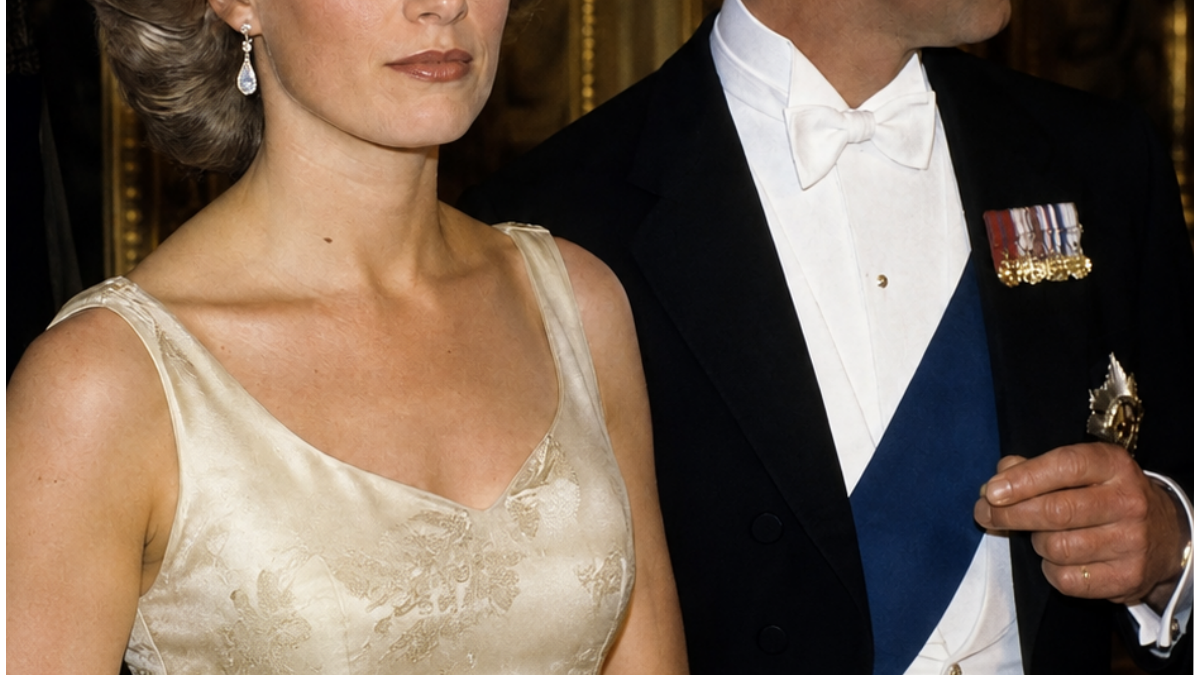
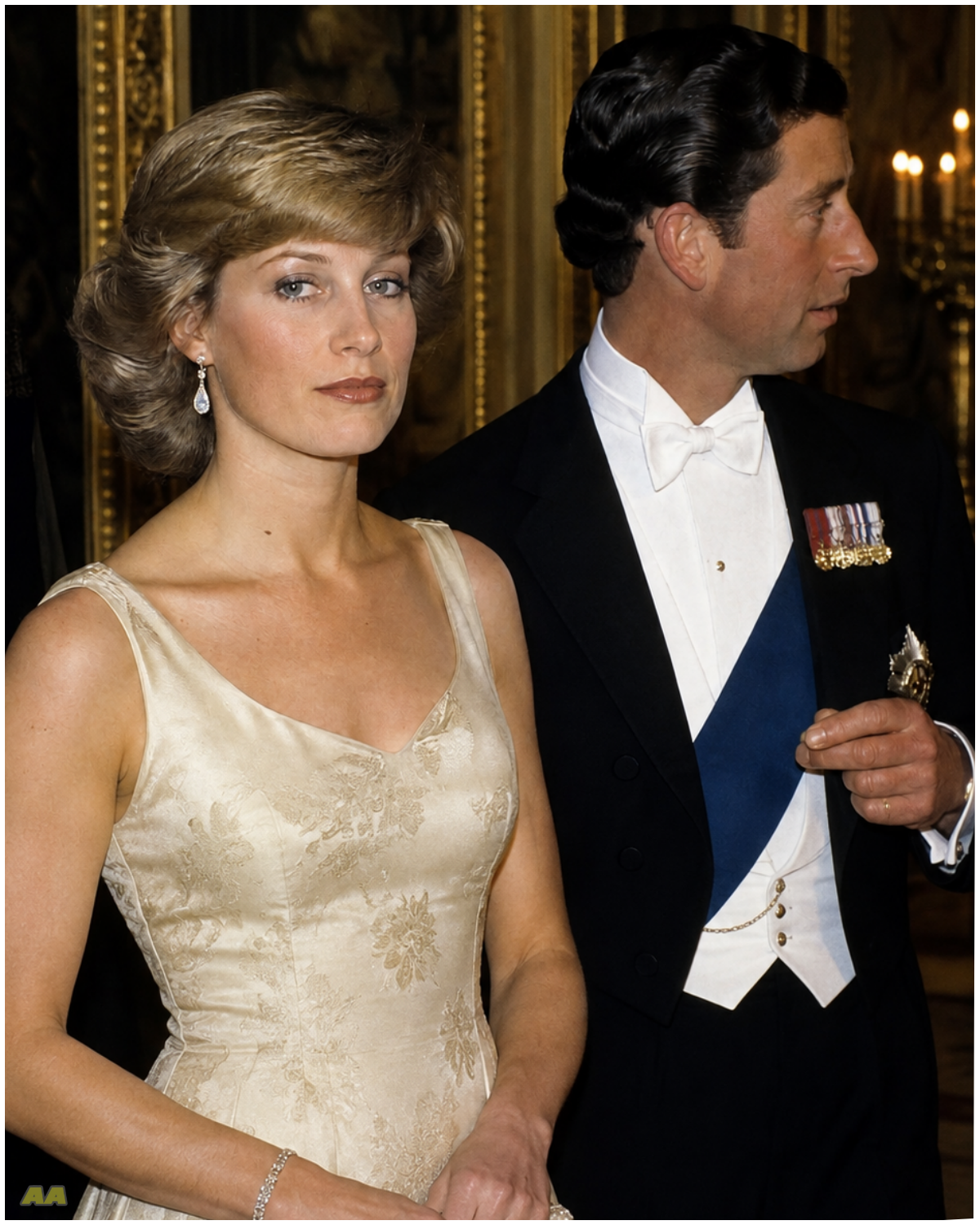
Windsor Castle.
The 6th of June, 1980.
The Queen Mother’s 80th birthday ball.
In a state apartment lit by candelabra and a thousand reflections, a tall blonde woman in a long silk gown watches her boyfriend dance again and again with another woman.
His name is Charles. The other woman is married.
The boyfriend is the Prince of Wales.
The watcher is Anna Wallace, the woman he was, by his own private admission, closest to wanting to marry.
Before the night was over, she would say nine words to him that ended the relationship, and she would never speak of him again.
Chapter 1. The girl who rode faster than the men.
She was born into a Scotland of Grousemore and Granite where the hunting field was a school for women who knew exactly who they were.
Amanda Mary Teresa Wallace arrived in the world on the 11th of January 1948, the first child of Hamish Wallace and his wife Mary.
The family seat stood in Dumbfrey in the southwest of Scotland, surrounded by farmland that had been in Wallace hands for generations.
The house was Georgian, square and gray.
The land around it ran to thousands of acres of pasture and rough shooting.
To the people of that part of the world, it was unremarkable that a family lived in such a house.
To anyone arriving from London, the size of the place announced itself before the door was even opened.
She grew up in the rhythm that defined every house of that kind.
The hunting season ran from the autumn into the spring.
The shooting season began in August.
The summer was the season for fishing and tennis parties.
The Wallacees did not chase London.
London came to them. The friends who arrived on Friday afternoons in motorcars from Edinburgh and Glasgow and for the most important weekends from Northamptonshire and Hampshire included most of the families that the crown had relied upon for two centuries for its companions in the field.
She had two younger sisters.
The Wallace girls were brought up to ride before they could read.
By the time Anna was 12, she was riding to hounds with her father.
By 14, she was riding harder than most of the men.
The Scottish hunting country is not the manicured England of the Bowfort or the Qu.
It is steep, hard, and wet.
The hedges have stone in them.
The ground gives way without warning.
A girl who could ride that country without complaint was a girl who had been forged into something specific.
She was, in the dialect of her own people, a piece of work, and that was a compliment.
She was sent to school in England.
She returned every holiday to Scotland.
She did the season in London in the late 1960s without enthusiasm.
She was by then already known to be uninterested in performing for anyone.
Her dancing was good. Her conversation was sharp.
The men who tried to charm her at Debutant balls received at most a look.
Friends from those years later remembered her as a woman who had decided early that she would not be patient with men who needed patience.
The whiplash nickname came from the hunting field.
It was given to her first by a cousin in the Egllandon country and was carried south by mutual friends.
It was not originally about her tongue.
It was about the speed at which she could turn her horse, the speed at which she could clear a fence, and the speed at which she could correct a man who had taken a line in front of her without permission.
By the time the press got hold of it, the meaning had broadened.
It had become a shorthand for a woman who did not soften.
It stuck because it was true.
She was beautiful in the specific style of the late 1970s, tall, blonde, lean, with the kind of bone structure that photographs only as itself.
She wore tweeds in the country and silk in London, and looked in both, as though she had never given the matter a moment’s thought.
She had been by the time she came into the orbit of the Prince of Wales in at least one serious relationship that had not ended well.
She had returned to Scotland and lived for periods at the family estate.
She had also in the way of women of her class in those years spent stretches in London working in galleries and editorial offices and disappearing when she wanted to into the country.
By the time she was 30 in 1978, she had developed a particular reputation.
She was, friends said, the woman in their generation who would not be talked into anything.
She was, Cortiers later said, the woman the crown ought to have wanted.
She was, in the language she used about herself in private, simply not for sale.
The Scotland that produced her had also for three centuries produced wives, mistresses and confidants for the British royal family.
The country of Mar and Kromati of Argyle and Othol had supplied the marriage market with women who arrived with their own land, their own name, and their own opinion.
The crown had often preferred them.
The crown had also often broken them.
What sort of woman would Anna Wallace be when the Prince of Wales came calling?
That was the question her cousins were already asking among themselves by the time the autumn of 1978 closed over the Dumpries Sha Hills.
They did not yet know that the answer would be the one the crown could not accommodate.
Chapter 2. The heir with three names on his heart.
By the spring of 1979, the Prince of Wales was 30 years old, unmarried, and being courted by his own grandmother for a decision he would not make.
Charles had been born on the 14th of November, 1948, the eldest son of the future Queen Elizabeth II, and Prince Phillip.
He had been the Prince of Wales since the age of nine.
He had been at Gordon Stone at Trinity College, Cambridge in the Royal Navy.
He had played polo at every fashionable ground in Southern England.
He had taken women out at one count or another into the dozens.
The pressure to marry was no longer subtle.
It was being applied from three directions at once.
Prince Phillip, his father, had begun to speak about it in private.
The queen, his mother, was concerned in the way mothers of unmarried men in their 30s become concerned.
The queen mother, his grandmother, was something else entirely.
She had identified the marriage of the heir as a dynastic question of the first order, and she was preparing, with the patience that had carried her through more than half a century of palace life, to deliver an answer.
The press by 1979 was running the question every other week.
Was it to be Lady Sarah Spencer, the elder sister of a Norfolk family whom Charles had taken to Clusters and quietly ended things with?
Was it to be Deina Sheffield, who had been briefly a serious prospect?
Was it to be Sabrina Guinness, an aires of the brewing family with whom he had been photographed on a yacht?
The names appeared and then disappeared as women came in and out of his life.
None of them stayed. The reason was already an open secret in the small world that knew the truth.
Camila Shand had married Andrew Parker BS in 1973.
She lived in Wiltshire. She was the mother of two young children and she had in some form never left Charles’s emotional life.
The pattern that had been established in the early 1970s when Charles and Camila had first been together before her marriage was not a pattern that the Prince of Wales was willing to break.
He had not married her then.
He had not been allowed to marry her in the view of his great uncle, Lord Mountbatton, who had advised him against making the choice when the chance was there.
Now he was paying for that obedience by being incapable of giving any other woman the attention she required.
Charles in 1979 was by the testimony of those who knew him best a man at war with himself.
He wanted love. He believed in the romantic register that was his most natural register in marriage and family and home.
He had a country house he was about to buy.
He had a parish he wanted to attend on Sundays.
He had ideas about gardens and architecture and most importantly about the kind of woman with whom he wanted to share his evenings.
The woman he described in those conversations was not the kind of woman his family wanted him to marry.
The woman his family wanted him to marry was not the kind of woman with whom he wanted to share his evenings.
The queen mother in particular had begun the search with method.
She had drawn up in the language of her household a list of possibles.
She had spoken with the families of those possibles.
She had begun the slow choreography by which young women were given access to the royal weekends and quietly assessed.
Her preferences were known. The candidate must be Protestant.
The candidate must be Anglican or capable of being seen as Anglican.
The candidate must be a virgin.
The word was not used aloud but was understood.
The candidate must be young enough to be shaped.
The candidate must be of a family the queen mother knew.
The candidate must ideally have known the royal household since childhood.
Anna Wallace at 30 did not match all of the specifications.
She was Protestant. She was of a family the queen mother knew.
She was certainly not young enough to be shaped.
She had been in serious relationships before.
She had a reputation for opinion.
By the strict reading of the specification, she was the wrong candidate.
By any humane reading of who would actually make Charles happy, she was the closest thing the Prince of Wales had ever found.
When she walked into the Chelinham Festival on the morning of the 14th of March, 1979, the Prince of Wales had been a prisoner of his own indecision for the best part of 7 years.
He did not yet know that the next 18 months would be the last chance he would ever have to make a different choice.
He saw a tall blonde woman in a tweed coat.
He was introduced. He smiled.
And for the first time in a very long time, the smile was not a public smile, but a real one.
Chapter 3. The Chelinham Festival, 1979.
They met where everyone in their world met on a wet March afternoon at the raceourse with the wind moving through wool coats and the smell of damp hawthorne.
The Chelenham Festival in 1979 was attended by some 70,000 people across the four days.
Among them in the private boxes belonging to the families of the racing world were Andrew and Camila Parker BS, their friends from the Buffett hunt, and a thin scattering of London friends who had come down for the meeting.
Anna had traveled south from Scotland for a weekend at a country house in the Cotswwells.
Charles had come for the racing.
They were introduced by mutual friends in the late morning of the first day.
The introduction itself was unremarkable.
The conversation that followed was not.
Anna, by the recollection of one of the men present, did not behave as the Prince of Wales’s previous girlfriends had behaved.
She did not laugh at his jokes before he had finished them.
She did not gaze at him.
She looked him in the face, answered his questions, and asked him her own.
When the racing began, she watched the racing rather than him.
He, by every account, watched her.
They saw each other again the following weekend at a private dinner in London.
They saw each other again the weekend after that at a country house in Wiltshire.
By the third week in early April 1979, Charles had asked her to H Highrove for the weekend.
He was at that point in negotiations to buy the house.
He was already spending most of his weekends there.
What unfolded over the next 12 months was the most serious relationship the Prince of Wales had so far conducted in his adult life.
Anna stayed at H Highrove every weekend she was free.
She went with him to Smith’s Lawn for the polo.
She went with him to Sandringham.
She was a guest at Wood Farm, the small house on the Sandringham estate that the royal family reserves for the privacy that even palaces cannot give them.
She went in August of 1979 to Balmoral and she went again in the spring of 1980 and she was by the unanimous testimony of the senior household staff treated as the most serious prospect Charles had brought home.
The early months had a brightness that those who watched them later remembered with melancholy.
The Prince of Wales, who had been heavy and uncertain in the late 1970s, became in those months lighter.
He laughed more. He drank a little less.
He spent time in the garden at H Highrove with Anna, planning the borders he would later make famous.
He showed her on the first visit the field where he intended to plant an avenue of limes.
She, by every account, gave him good advice.
The household began to allow itself to hope.
The senior valet who had seen many young women come and go allowed themselves to use the word she.
She is coming next weekend.
She has asked for the green room.
She is going up to Scotland on Friday.
The use of the pronoun without a name is in royal households the shest sign that a relationship has crossed a threshold.
By the end of 1979, in the small Christmas circle at Sandringham, Anna had been included.
She had ridden with Princess Anne.
She had spent an evening in conversation with the Queen, who, by the recollection of one lady in waiting, had been favorably impressed.
She had been seated next to the Duke of Edinburgh at dinner.
She had passed every test the family had silently set for her.
She had not, by any account, charmed the Queen Mother.
The Queen Mother had been polite.
The Queen Mother had been correct.
The Queen Mother had been, in the private memory of one of her ladies in waiting, watchful in the way she became watchful when she was already considering an alternative.
By the spring of 1980, after a full year together, Anna Wallace was in the eyes of every senior member of the royal household, in the eyes of every gossip columnist in London, and in the eyes of the small circle of Charles’s closest male friends, the woman he was about to marry.
He had told two of them, including one polo friend and one Cambridge contemporary, that he was thinking about asking her.
He had bought by some accounts the small piece of jewelry he intended to give her if she said yes.
He had walked her around the garden at H Highrove and said in the language of a man already imagining the years ahead that she might like to think about how she wanted the borders to look in the summer of 1982.
Anna had loved him by the testimony of every friend who has ever spoken about her on the record or off it.
She had loved him with the seriousness of a woman who did not love easily and who, when she did, gave her whole intelligence to the business.
She had begun, by the spring of 1980, to allow herself to imagine the role she would be asked to take.
She had by the same accounts begun to ask herself very quietly in the early hours of the mornings at High Grove and Balmoral whether the man she loved was actually free.
Chapter 4. The third woman in every room.
Camila was married, lived 20 minutes from Highrove, and had a particular tone of voice that made Charles answer the telephone every time.
The proximity was not accidental.
Camila and Andrew Parker BS had bought Bhide Manor in Wiltshire in 1973.
It stood within an easy drive of H Highrove, which Charles purchased for some £865,000 in the summer of 1980.
The geographical convenience was a fact that the press in 1979 and 80 had not yet learned to read.
Inside the small social circle of the Buffett hunt, it was a fact that everyone read with absolute clarity.
The telephone calls were the first thing that Anna noticed.
Charles, by the testimony of more than one weekend guest at H Highrove in this period, kept Camila’s number on his desk and answered whenever she called.
He did not, in those moments, take the call into another room.
He took it where he was.
He listened more than he spoke.
He answered Camila’s questions with a softness in his voice that was particular to those conversations.
When the call was over, he resumed whatever he had been doing.
He did not explain. He did not apologize.
He did not in any visible way see that an apology might be required.
Anna was not the kind of woman who would create a scene about a telephone call.
She watched She made her own mental notes.
She allowed herself for the early months to believe that the friendship was a long friendship between two people whose romantic history was behind them.
She wanted to believe that.
She made the effort to believe it.
The country house weekends made the belief harder to sustain.
Throughout 1979 and into 1980, the social circle of the Bowfort Hunt and its allied circles in Wiltshire and Glostershare arranged its weekends in such a way that Charles and Camila were repeatedly at the same dinners.
The hosts were the Somses, the Triions, the Romsies, the Palmer Tomkinsons, the Brabborns.
The houses were the kind of small country houses where everyone knew the timets.
The dinners began at 8.
The drawing rooms were arranged by the seating plans.
The plans were week after week arranged in such a way that Camila was placed within speaking distance of the Prince of Wales.
Lady Triion, known to her friends as Kanger, was a particular witness to these dinners.
She had been a confidant of Charles since the early 1970s.
She was Australian. She was sharp.
She did not like Camila.
She did like Anna. She watched weekend after weekend the choreography of those rooMs. And she told her own friends later that Anna’s anger in the spring of 1980 was not the anger of a difficult woman.
It was the appropriate response of an intelligent woman to a situation that was being arranged against her in plain sight.
The specific incidents that mattered were not in themselves dramatic.
They were small moments. Charles leaving the drawing room to take a telephone call and returning 15 minutes later.
Charles laughing at a remark from Camila that he had not laughed at when Anna made an almost identical remark earlier in the evening.
Charles on more than one weekend going out riding in the morning with Camila while Anna was still at breakfaSt. Camila by every account did not work to displace Anna.
She did not need to.
She simply continued to exist in the social weave and her continued existence was sufficient.
By the end of 1979, in the long, quiet days of the Christmas circle at Sandringham, Anna had begun to ask herself the question.
By the early months of 1980, she was asking it more directly of friends.
The question was not whether Charles was sleeping with Camila.
The question, in its truest form, was whether he would ever stop putting Camila firSt. The answer when Anna allowed herself to hear it was always the same.
He would not. He could not.
He had not learned to.
He would not learn to.
The friends who watched it through that spring later remembered the moment they stopped being able to encourage her.
The senior of Anna’s London friends, a woman who had been at school with her, later said in private that by April 1980, she had begun to advise Anna to consider whether the relationship could survive the structure inside which it was being conducted.
She had advised her as gently as a friend can to begin to imagine her life without him.
Anna had thanked her and changed the subject.
There is no credible suggestion that the relationship between Charles and Camila in the spring of 1980 was physical.
The biographers who have examined this question carefully, including Penny Jun and Sally Bedell Smith, have concluded that the renewal of the physical relationship between Charles and Camila, which both have privately acknowledged took place at some point in the early 1980s probably came after the Anna Wallace months rather than during them.
The emotional infidelity, however, was complete, and the emotional infidelity was, for a woman of Anna’s intelligence, the more difficult thing to forgive.
In the late spring of 1980, with the summer ahead, and the Queen Mother’s birthday celebrations beginning to take shape, Anna allowed herself a final period of trying.
She accepted every invitation. She wore every dress with care.
She rode out at High Grove and at Balmoral with the kind of grace that drew compliments from every senior member of the household.
She gave Charles, by every account, a chance to put right what had been quietly going wrong.
He did not put it right.
He did not, by any visible sign, register that anything needed putting right.
The dance at Windsor Castle was still a few weeks away.
The destination of the relationship was already by then very nearly fixed.
Chapter 5. The grandmother who decided everything.
The Queen Mother was about to turn 80 and the gift she had chosen for the dynasty would be the choice of the next Princess of Wales.
Elizabeth Angela Margarite Bose Lion, born in 1900, had been a queen consort, a widow of a king, and the mother of a reigning queen.
She had lived through the abdication of her brother-in-law, the long austerity of the war years, the death of her husband, and the slow modernization of the British monarchy from a remote and divine institution into a public family business.
She had not in any of those passages lost her absolute conviction that the survival of the institution depended upon the marriages of its principal members being arranged with care.
By 1979, she had begun in her own private register the search for a princess of Wales.
Her preferences were not stated formally.
They did not need to be.
They were known to her household, to the senior courtiers, to her closest friends, and to her grandson.
They were a set of principles that had served the dynasty for centuries, and that she did not see any reason to abandon now.
The first principle was age.
The candidate must be young.
The queen mother had been 23 when she married the Duke of York.
Her own mother had been 18 at her wedding.
Her sister Rose had been 20.
In the calculus of dynastic marriage, youth was not a question of taste.
It was a question of fertility, of trainability, and of the absence of the prior emotional commitments that older women inevitably carried.
The Queen Mother believed in her bones that a young woman could be shaped into the role.
An older woman with a history could not.
The second principle was background.
The candidate must be of a family the queen mother knew.
The British aristocracy in 1979 was no longer the closed system it had been in the Eduwardian period.
But for the marriage of the heir to the throne, the queen mother believed in the older arrangement.
She wanted a family she had known for generations.
She wanted a girl whose mother she had hunted with, whose grandmother she had received at Clarence House, whose nursery she could place inside her own memory of the nursery world.
The third principle was, in her own quiet language, the absence of complication.
The candidate must not have had what she called, when she spoke of it at all, a history.
She had not approved of Camila in 1973.
She had not approved of Deina Sheffield.
She had not approved of Sabrina Guinness.
She did not, in the early months of her acquaintance with Anna Wallace, approve of Anna either.
The reasons she gave to her own ladies in waiting, who later spoke of it to biographers, were not personal.
They were structural. Anna was 30.
Anna had been in serious relationships.
Anna had opinions. Anna would, in the Queen Mother’s private vocabulary, be too much herself.
In the autumn of 1979, while Charles was bringing Anna to Sandringham for the Christmas circle, the Queen Mother was, by every credible account, beginning the discreet promotion of an alternative.
Lady Diana Spencer was 18 years old.
She was the youngest daughter of the queen mother’s old friend Francis Shand Kidd, formerly the Vic Countess Althorp.
The Spencers were one of the oldest families in England.
They lived on the Sandringham estate during Diana’s early childhood.
Diana had played with the younger royal children.
She had been, in the Queen Mother’s mind, a familiar face from the nursery long before she became a candidate.
The promotion proceeded in the way the Queen Mother always proceeded.
She did not lobby. She arranged.
She suggested. She placed Diana in the same rooms as Charles, at the right times, in the right clothes, with the right friends.
In November 1979, Diana was at Sandreingham with her family for a shooting weekend.
In the early spring of 1980, she was at Pworth with the Queen Mother’s friends.
By the late spring of 1980, while Anna was at H Highrove every weekend, Diana was being introduced into the wider royal social life with a patience and a precision that no one outside the small circle of the Queen Mother’s confidence could yet see.
Anna did not know any of this.
Charles, by every credible account, knew at least some of it.
He understood that his grandmother had a preference.
He understood that the preference was not for the woman in whose company he was happieSt. He did not in those months do the one thing that would have closed the question.
He did not propose to Anna.
He did not announce the relationship.
He did not by any decisive public act put a stop to the alternative that was being prepared in the background.
The Queen Mother’s 80th birthday was on the 4th of August 1980.
The celebrations were scheduled to run across several events.
There would be a service of thanksgiving at St. Paul’s Cathedral with attendance from every member of the royal family and the senior household.
There would be a series of dinners at Clarence House.
And there would be a ball at Windsor Castle in June to mark the leadup to the birthday to which the senior members of the family, the senior aristocracy, and the long list of the Queen Mother’s personal friends would be invited.
The list of invitations, which was finalized in the late winter of 1980, was the moment at which the politics of the marriage question took its formal shape.
Anna Wallace was on it.
So was Camila Parker BS in attendance with her husband Andrew.
So was Lady Diana Spencer on the list of the Queen Mother’s personal friends through her family connection, although she was not yet positioned as Charles’s partner for the evening.
The invitations were sent in the early spring.
The ball was set for June.
The Queen Mother had, in her quiet way, set the table at which the next chapter of the dynasty would be decided.
What none of the guests knew in the spring of 1980 was that the ball at Windsor Castle would become not the introduction of the next Princess of Wales, but the public unmaking of the woman who had come closest to becoming her.
The Queen Mother had not arranged it.
She had only, by the steady decadesl long practice of her donastic care, created the conditions inside which it could happen.
Chapter 6. Royal Ascot in a pale blue dress.
By June 1980, she walked into the royal enclosure on his arm, and to every journalist watching, she looked like the answer.
Royal Ascot in the third week of June was the moment in the social calendar of the British year, at which the unspoken became visible.
The enclosure was the small fenced area at the heart of the racecourse to which entry was controlled by the royal household.
The list was not published.
The list did not need to be.
It was understood by every member of the racing world, every member of the press, and every member of the small London society that watched these things.
To be photographed in the royal enclosure was to be told in the only language the British press of that period understood that you mattered to the family.
Anna had been invited. She had arrived with Charles in a royal car from Windsor.
She had walked through the gates and into the enclosure on the morning of Tuesday the 17th of June 1980.
She wore a pale blue silk dress and a small straw hat.
The dress was simple. The hat had no flowers.
She looked in the long lens photographs that were taken from the press position 50 yards away, exactly like the woman that the country had been waiting for.
The papers the following morning published the photographs with the kind of captions that crossed a line in the careful coverage of royal romance.
The Times described her as a serious presence.
The Daily Mail said that she was the most plausible princess of Wales the country had so far been shown.
The Daily Express, which had given her the whiplash nickname, dropped it for the week and called her Miss Wallace.
The pale blue dress was photographed from at least three angles.
It became, for the four days of the meeting, the symbol of the unspoken.
Anna walked three paces behind Charles in the royal procession.
She stood beside him in the box.
She watched the racing. She declined to wave to the photographers.
She conducted herself by every account from those present with the precise courtesy of a woman who had been brought up to know exactly how to behave inside a structure she had not yet been formally invited to enter.
The privileges that came with that week were considerable.
She had been given access to the royal box on each of the four days.
She had been included in the dinners at Windsor Castle each evening.
She had been invited formally to the August house party at Balmoral.
The Balmoral invitation was in the private vocabulary of the household the second to last step.
The last step was the engagement.
The press coverage of Ascot ran for a full week.
The social pages of the Daily Telegraph published a feature on the Wallace family and their place in the Scottish landowning tradition.
The Tatler, which had been preparing the piece for weeks, ran a longer article on the comparative claims of the families that had supplied princesses across the previous two centuries.
The article placed Anna inside that tradition.
It noted with the particular Tatler tone of detached approval that she was a far more suitable candidate than the field had so far produced.
It did not mention Lady Diana Spencer.
The household in those weeks allowed itself the second wave of hope.
The senior valet and the senior ladies in waiting who had seen the false starts come and go began in their private conversations to plan.
There would be a press announcement.
There would be a wedding the following summer.
The wedding would, on the assumption that Charles followed his own preferences for the smaller, would be at Windsor rather than St. Paul’s.
The Queen Mother, however, was not commenting.
The Queen Mother, in the private observation of one of her ladies in waiting, was watchful in the particular way that meant she had not given up.
Anna in the privacy of the small bedroom she had been given in the Windsor residence was by the account she later gave her closest friend in two minds.
She knew by then that the public momentum of the previous week had carried the relationship past the point at which it could be retrieved into privacy.
She knew that the world was watching her as the woman who would marry the Prince of Wales.
She also knew with the absolute clarity of someone who has watched a man for 15 months that the structural problem inside the relationship had not been solved.
Camila had been at the dinner on the Wednesday evening at Windsor.
Camila had been at the polo match on the Thursday afternoon.
Camila had been throughout the week of Ascot, never quite where Anna could ignore her.
The ball at Windsor was scheduled for Friday the 20th of June.
Although in some accounts the night of the confrontation is given as the 6th of June at a separate event in the early stage of the Queen Mother’s celebrations.
The exact date is the subject of differing accounts among the biographers.
What is undisputed is that the ball took place in the state apartments at Windsor Castle during the period of the Queen Mother’s celebrations.
It is the night that became the central event of Anna Wallace’s life as the Prince of Wales’s almost fiance.
She had by the morning of the ball made no decision.
She had a dress prepared.
She had her hair done at Windsor.
She had her jewelry laid out on the dressing table.
She had, in the language of the women who later spoke of it, the demeanor of a woman who was not yet sure whether the night ahead would be the night of her engagement or the night of her departure.
The dress was long. The dress was, by every account, magnificent.
Anna walked through the door of the state apartment shortly after 8:00 in the evening.
The orchestra was tuning. The candles were lit.
The night that would be remembered for the next 40 years was about to begin.
Chapter 7. The ball.
The state apartments.
The mirrors. At Windsor Castle on the night of the 6th of June in a room full of candelabra and ancestors.
The music began at 10:00.
The state apartments at Windsor run along the north range of the castle above the lower ward, looking out across the slate gray roofs of the town toward the long walk.
The principal rooms are the Waterloo Chamber with its great portraits of the men who had defeated Napoleon, the grand reception room with its guilt moldings and Golan’s tapestries, and the state dining room with its long mahogany table set for the senior guests.
The dinner on the night of the ball was in the dining room.
The dancing was in the grand reception room where the chandeliers throw the candle light at a thousand surfaces and where the great mirrors carry every motion of every dancer back into the room a dozen times over.
The guests had begun to arrive at 7.
The drive up to the castle was lit by lanterns.
The cars were directed to the lower ward by ushers in livery.
The senior members of the royal family arrived laSt. The queen mother, the guest of honor, took her place in the garter throne room for the formal presentation of the guests.
Anna stood beside Charles for the receiving line.
She was, by the testimony of one lady in waiting, who walked through the line, more composed than any other woman who had come through it that year.
She was already, by her own private calculus, prepared for what the night might bring.
Dinner began at 8. The Prince of Wales was seated in accordance with the formal protocol of the evening, not next to Anna, but at the head of one of the senior tables.
Anna was at a different table altogether, in conversation with a senior soldier on one side, and an elderly Vic count on the other.
The seating plan was not unusual.
The seating plans of royal dinners are always conducted by rank, not by relationship.
What was unusual was that throughout dinner, the Prince of Wales rose three separate times from his place at the head table to walk across the dining room and speak with Camila Parker BS, who was seated with her husband, Andrew, at a different table on the opposite side of the room.
Each visit lasted by the count of one of the senior household staff who was present in the room several minutes.
Each time he returned to his place at the head table.
He did not at any point during dinner walk across the dining room to speak with Anna.
After dinner, the dancing began.
The grand reception room had been prepared.
The orchestra was on a small stage at the eastern end of the room.
The chandeliers were lit. The guests moved from the dining room through the crimson drawing room into the reception room.
The dancing began with the formal opening dance in which the queen mother led off with her elder grandson.
Anna stood near the doorway holding a glass of champagne watching.
The Prince of Wales danced the opening dance with the Queen Mother.
He danced the second dance with the Queen.
He danced the third dance with Princess Margaret.
The fourth dance was the dance at which the structural problem of the evening became visible.
The Prince of Wales walked in front of 200 people across the room to where Camila Parker BS was standing with her husband.
He held out his hand.
She gave it to him.
He led her onto the dance floor.
They danced. The dance ended.
He did not return Camila to her husband.
He walked her to the side of the room.
They stood together in conversation for what the witnesses later remembered as a long time.
Anna watched from the other side of the room.
She did not move. She did not speak.
She continued to hold her glass of champagne.
The senior household staff who were in the room later said that her face had gone through in the course of those minutes a series of changes.
It had moved from a careful composure into a stiller composure.
It had then settled into the particular kind of composure that in women of that type comes only after a decision has been made.
The fifth dance the prince of Wales danced with Camila.
The sixth dance he danced by some accounts with one of his cousins.
The seventh dance again with Camila.
By the end of the seventh dance, the entire room had registered what was happening.
The senior aristocratic guests, who had come into the room, expecting to see the Prince of Wales dance, principally with the woman he had brought as his partner, had instead been watching for almost an hour as he danced repeatedly with another man’s wife.
The orchestra continued to play.
The candles continued to burn.
Anna continued to watch. It was during the seventh dance, or shortly after it, that she set down the glass of champagne, walked across the grand reception room, took the Prince of Wales aside, and led him out of the room.
She was, by the testimony of every witness, perfectly calm.
She did not raise her voice.
She did not look at Camila.
She walked past her without registering her presence.
She walked out of the room with Charles a halfpace behind her.
What happened in the corridor outside the grand reception room was witnessed only by the two of them.
The substance of the conversation, however, was given by Anna to two close friends within the next 48 hours, and it has been reported in close to identical form in every serious biography written since.
The two of them stood in the long red carpeted corridor outside the state apartments.
The orchestra could be heard faintly through the closed door.
Anna spoke firSt. She gave him by every account the chance to say something.
He did not say anything.
He stood. He waited. He understood by then what was about to happen, but he did not have the words to stop it.
He had not had the words to stop it for the previous 15 months.
She delivered the line that ended it.
The exact phrasing varies across accounts.
The substance repeated and confirmed was the following.
Do not ever ignore me like that again.
No one treats me like that, not even you.
The wording was direct. The delivery was by every account quiet.
She did not shout. She did not cry.
She gave him the words in the cold final tone of a woman who has spent 15 months learning the truth.
And then she turned and she walked away from him down the long red carpeted corridor toward the staircase.
He did not by any account follow her.
He stood in the corridor.
He listened to the orchestra.
He returned after a few minutes to the grand reception room.
He danced again. By the testimony of more than one witness, he danced almost immediately with Camila.
Chapter 8. Nine words that ended a marriage that never was.
She did not shout and she did not cry and she did not give him the courtesy of asking for an explanation.
The drive from Windsor Castle in the small hours of the morning was by the recollection of one of her friends whom she telephoned later that night made by Anna in the back of a private car.
She had asked her host for the loan of a car and a driver.
She had collected her overnight case from the guest room she had been given.
She had walked out of the castle through the lower ward and into the car park beyond the gates.
She had not spoken to anyone except the driver.
She had said the address of the London friend whose house she would be staying in.
She had sat in the back of the car for the hour and a quarter that the drive into central London took.
She had not in all that time cried.
The friend, who later spoke about the night to one biographer on condition that her name not be used, said that Anna had arrived at the front door of the London house shortly after 2:00 in the morning.
She had been wearing her ball gown.
She had been carrying the overnight case.
She had asked for a brandy.
She had drunk it without sitting down.
She had said in the only sentence she gave by way of explanation that night that the relationship was over and that she would not be returning to Charles.
She had then gone upstairs to the spare bedroom and slept for 9 hours.
The following morning, she had asked for a different car to drive her north.
She had asked the friend to telephone her mother at the family estate to say that she was on her way home.
She had refused all calls.
By the late afternoon of the day after the ball, she was in Dumbfrey.
She did not return south for the rest of that summer.
The substance of the nine words she had spoken to Charles in the corridor was within a few days the property of the small social circle of the Buffett hunt.
By the end of the following week, it had reached the gossip columnists, although in a heavily veiled form.
By the end of June, it had reached the senior royal correspondents, who, by the standards of the time, declined to publish the precise phrasing, but used it as the basis of the coverage that began to suggest, with increasing confidence, that the relationship was over.
The Prince of Wales in the days after the ball behaved exactly as his pattern would have predicted.
He did not telephone Anna.
He did not, by any reliable account, write to her.
He did not, by any reliable account, ask his own friends to intervene.
He waited. He hoped, perhaps that the relationship could be allowed to drift back into the same state it had been in before.
He did not understand even now that the woman he had been with for 15 months was not the kind of woman who would drift back.
He understood at most in the language of his own emotional capacity that she had been hurt.
He did not understand that she had also made a decision.
In the second week after the ball, in the absence of any signal from Anna, Charles allowed himself to be persuaded by friends that the matter could be retrieved.
He sent, by one account, a small token through a mutual friend.
By another account, he attempted to telephone the Wallace family estate.
By a third account, he wrote a brief letter.
Whatever he did, whatever the precise form, Anna did not respond.
She did not return the telephone calls.
She did not write back.
She did not, by any account from those weeks, even discuss him with her own family.
The silence she gave him in the second half of June was, in its own way, the second confrontation.
It was the second piece of evidence that the woman he had been with was not the woman his own pattern of behavior had assumed her to be.
She had told him at Windsor what she would not tolerate.
He had not understood.
She was now telling him, by the absence of any communication, what she had meant.
He still, by the accounts available, did not entirely understand.
By the end of June 1980, Charles had been advised by his closest friends to wait.
By the middle of July, in the run-up to the Queen Mother’s birthday on the 4th of August, he had begun to accept that the relationship was finished.
By the middle of August, when he traveled to Balmoral for the family holiday, Anna was no longer on the invitation liSt. She had been the most plausible princess of Wales the country had so far been shown, and she had become, in the space of less than two months, a woman whose name was no longer mentioned in the royal residences.
In Scotland, in the long summer of 1980, Anna walked the moors.
She rode her horses. She fished in the river that runs through the estate.
She gave one quiet dinner for her closest friends in late July, at which, by the testimony of one of those present, the name of the Prince of Wales, was not mentioned.
She had decided that the silence she had begun on the night of the ball would be the silence she kept for the rest of her life.
She would not give an interview.
She would not write a memoir.
She would not, by any signal, become a public participant in the long unfolding story that her former boyfriend was about to enter.
What she could not yet know in the late summer of 1980 was that the speed at which Charles would move on from her would itself be the next blow.
By the end of August, he had been seen at Balmoral with new guests.
By November, he had been photographed at Sandringham with a teenage Lady Diana Spencer.
By February 1981, in a televised announcement from Buckingham Palace, the engagement of Charles and Diana was made public.
The total time between the night Anna walked out of Windsor Castle and the night Charles announced his engagement to another woman was less than 8 months.
Chapter 9. The engagement that came eight months later.
While Anna was already at home in Scotland, Lady Diana Spencer was being escorted to Balmoral by the Queen Mother herself.
The summer of 1980 was the summer in which the Queen Mother executed with the precise patience of a woman who had been preparing for it for a year.
The introduction of the next Princess of Wales.
The choreography was masterly. It depended upon nothing being seen to be arranged.
It depended upon Diana arriving at Balmoral in the same way that any of the family’s friends might arrive on a perfectly ordinary visit as a guest of the Queen Mother who had known her family forever.
Diana was 19. She had been working in those months as a kindergarten assistant at Young England School in Pimlo.
She had been sharing a flat in Colhern Court in Ears Court with three other young women.
Her life in the summer of 1980 was the life of any well-born young woman of 19 in the London of that period.
She was the youngest daughter of Earl Spencer.
She had grown up at Park House on the Sandringham estate before her parents’ divorce and her father’s move to Althorp.
She had known the royal children through her childhood.
She had known Princess Anne.
She had known Charles slightly.
She had been to Sandringham.
She had been invited in October of 1979 to Charles’s polo at Cowre Park.
She had begun to be noticed.
The promotion accelerated through the summer.
In July 1980, while Charles was still recovering from the loss of Anna and going through the motions of his own grief, he was invited by Robert Depass, a polo friend, to a barbecue at the family’s Sussex house.
Diana, by the careful coincidence of the Queen Mother’s planning, was also there.
She gave him, by every account, the now famous response to his mention of the funeral of Lord Mountbatton the previous year.
She told him she later remembered that he had looked so sad walking up the aisle.
She said it should have been her there with him to comfort him.
He by his own later account was moved.
The relationship began that weekend.
By September 1980, Diana was at Belmoral as a guest of the Queen Mother.
She rode. She walked the moors.
She charmed the household. She was by every account both shy and warmer than any candidate before her.
She was crucially 18 years younger than the man she was being prepared to marry.
She had no history. She had no opinions about politics or property or interior decoration.
She had not been to university.
She had not been in any relationship that the household was required to manage.
She was, in the Queen Mother’s vocabulary, perfect.
The press caught on in the early autumn.
By the end of October 1980, the son was running her photograph on the front page every other day.
By November, she was being chased through the streets of London by photographers.
By December, the engagement was being predicted by every senior royal correspondent in Fleet Street.
Charles took her to Sandringham for the Christmas weekend.
He proposed by his own account in the early days of February 1981.
She accepted. The engagement was announced from Buckingham Palace on the 24th of February 1981.
Anna in Scotland learned of the engagement the way the rest of the country learned of it through the morning radio bulletin and the newspaper headlines.
She did not, by every reliable account, react.
She made no public comment.
She made no private comment that has ever entered the record.
She continued to ride her horses, to walk her dogs, to attend the dinners of her own friends, the country house circle that had carried both her and Charles through the previous winter, understood that her name was not to be raised.
She was by then already in conversation with the Heskath family about the marriage that she would conduct the following summer.
What happened over the next four months in the leadup to the wedding of Charles and Diana on the 29th of July 1981 has been the subject of more written and televised commentary than almost any other event of late 20th century British history.
The narrative is by now familiar.
Diana, behind the public smile, was already in distress.
Camila was already by every credible account back in Charles’s emotional life.
The wedding was a public spectacle that disguised a private misalignment.
The pattern that would destroy Diana over the next 16 years was already in place by the summer evenings at Buckingham Palace before the ceremony.
Anna, by the time of the wedding, was already 4 weeks into her marriage to Johnny Heskath.
She did not by any reliable account watch the royal wedding on television.
She did not give an interview to market.
She did not by any private remark that has ever been published comment on it.
The silence she had begun in the corridor outside the grand reception room at Windsor Castle a year before had by the day of the royal wedding hardened into the silence of a lifetime.
The crown had made its choice.
Anna had made hers. The contrast between the two choices and what would happen to each of the women in the years that followed would become one of the quiet underlying stories of the next four decades of the British monarchy.
In the late spring of 1981, as Diana was being fitted for her wedding dress by David and Elizabeth Emanuel in a Mayfair studio, Anna was at home in Scotland with her own family.
The wedding she was preparing for was to be conducted in a small parish church in Dumbfrey.
The reception was to be at the Wallace family home.
The guest list ran to a few hundred.
The Prince of Wales was not invited.
The press was not invited.
The wedding would not be televised.
It would not by any measure be a national event.
It would be in every detail the opposite of what was being prepared in London, which was by then exactly what Anna wanted.
Chapter 10. A wedding Dumbfries did not tell.
In the summer of 1981, she married Johnny Heskath in a parish church near her family’s estate, and no royal photographer was there.
The wedding was held in the early summer on a Saturday morning in the small parish church that the Wallace family had attended for generations.
The church was romanesque in part, Gothic in part with the leaded windows of the small Scottish kirks that have stood for centuries on the hill above their parish.
The pews held perhaps 200 people.
The aisle was short. The flowers were from the family garden.
The hymns were the hymns that Anna had sung at every confirmation and christening of her childhood.
The bridegroom waited at the altar in morning dress.
The bridegroom was the honorable John, known to his family as Johnny Heskath.
He was the younger brother of Thomas Alexander Furmore Hesketh, the third Baron Heskeeth, the racing imprario whose passion for Formula 1 had made the family name famous in the 1970s.
The Heskiths were not by the standards of the British aristocracy, an ancient family.
The Barreny had been created in 1935.
The family seat was at Eastern Neon, a magnificent Georgian house in Northamptonshire designed in part by Nicholas Hawksmore.
The family had money. They had connections.
They had in Johnny a man who was by every account kind, unpretentious, and content to live a private life out of the public eye.
The wedding had been arranged with privacy.
The Wallace family had invited their closest friends, their relations, and a small number of the country house circle from Wiltshire and Hampshire who had known Anna through the previous years.
They had not invited the Prince of Wales.
They had not invited any member of the senior royal household.
They had not informed the press in advance.
The press, when it discovered the wedding the following week, ran a small notice and moved on.
The country was already entirely focused on the leadup to the royal wedding of Charles and Diana which was set for the 29th of July 1981.
The Wallace wedding conducted in Scotland in the early summer received perhaps a paragraph on the social pages of the more thorough newspapers and nothing in the popular press at all.
This again was exactly what Anna wanted.
The marriage of Anna Wallace and Johnny Heskath was by every available account from those who knew them a happy one.
They lived for periods at the Heskath properties in Northamptonshire and in Hampshire.
They had two children. They built over the decades the kind of quiet life that the British countryside specializes in preserving.
They traveled, they hunted, they entertained their friends.
Anna in those years was known to a small circle of friends as Mrs. Heskath and to almost no one outside that circle as anything at all.
The contrast with what was happening simultaneously inside the marriage of the prince and princess of Wales is the contrast that gives this chapter its weight.
While Anna was at home in the early years of the 80s planning the nurseries for her children, Diana was suffering the early symptoms of the eating disorder that would shadow her for the rest of her life.
While Anna was riding out with Johnny on the Hampshire Downs, Diana was being told by her husband that the role of a princess of Wales was to perform in public the marriage she could not perform in private.
While Anna was building a garden in Northamptonshire, Diana was sitting in tears in the apartments at H Highrove that Anna had once helped to plan, listening to her husband on the telephone with the woman who had never left him.
The trajectory diverged sharply across the 1980s.
By the late 80s, Diana was in her private life in a separate marriage in everything but legal form.
By the early 1990s, she was working with the journalist Andrew Morton on the book that would in 1992 blow the marriage into the public domain.
By 1996, she was divorced.
By the summer of 1997, she was dead in a Paris underpass, killed in a car chased by photographers at the age of 36.
In the same period Anna had lived by every account a quiet and ordinary life.
She had buried two of her parents.
She had raised her children.
She had been to weddings of her friend’s children.
She had not by any visible signal lived a public life of any kind.
The two stories were running simultaneously across the same country.
Anna lived in the same world Diana lived in.
Their friends overlapped. They shared cousins.
They had common acquaintances. They had each briefly in the late 1970s and early 1980s been in the same drawing rooMs. But the lives they were living by the late 1980s could not have been more different.
One was being eaten alive by the institution Anna had refused.
The other was getting on with the work of being a wife, a mother, and a citizen of her own private country.
Johnny Heskath died in 2021.
The marriage had lasted some 40 years.
It had outlasted by then the marriage of Charles and Diana, the marriage of Charles and Camila, the entire public life of more than a dozen royal romances.
It had been by every available account a love that was returned with constancy.
Anna had buried him in the quiet way she had married him with the people who mattered in the place where she had been raised.
She had not by any signal allowed the loss of him to bring her into the public eye.
By the time of his funeral she was 73 years old.
The silence she had begun on the night of the Windsor Ball was by then more than four decades old.
Chapter 11. The silence she has kept for 40 years.
Every scandal of the next four decades arrived at her door with a microphone and she did not open it.
The decision Anna had made in the corridor outside the grand reception room at Windsor Castle had been a private decision.
The execution of that decision over the next 40 years was a discipline of an entirely different order.
Every time the marriage of Charles and Diana cracked open further in public, the journalists came to her door.
Every time a book was published that touched on the period of the late 1970s, the calls came again.
Every time the long arc of the Camila story took another turn, the request for an interview was made.
Every time, without exception, Anna declined.
In 1992, the publication of Andrew Morton’s Diana Her True Story sent the long suppressed history of the marriage of the Prince and Princess of Wales into the open.
The book was serialized in the Sunday Times.
It detailed Diana’s eating disorder, her despair, her sense of having been betrayed before the marriage had begun.
It contained the now famous Camila material.
It transformed the public understanding of the previous 12 years.
In the weeks after publication, every major newspaper in Britain sent a reporter to Dumfcia or to the Heskath family addresses in Northamptonshire to attempt to speak with Anna.
She did not open the door.
She did not return calls.
She did not, by any reliable account, comment on the book in any setting that was not absolutely private.
In the same year, the formal separation of the Prince and Princess of Wales was announced in Parliament.
The cameras camped outside Anna’s various addresses for days.
She remained inside. She let the dogs out the back.
She walked across the fields without speaking to anyone.
The friends who knew her best understood that the silence was not weakness.
It was a discipline. It was the active refusal of the role of the wise other woman that the press was waiting to give her.
She would not become a chorus to the marriage that had not been hers.
In 1994, Charles’s televised interview with Jonathan Dimbleby, in which he acknowledged that he had been unfaithful only after the marriage had become irretrievably broken, set off another wave.
The journalists returned. The book by Dimbley that followed, drawn from extensive interviews, mentioned Anna briefly and with care.
The mention itself sent a fresh wave of requests through her letter box.
She remained silent. In 1995, Diana’s interview with Martin Basher on the Panorama program in which she said that there were three of us in this marriage drew the entire affair into the language of public confession.
The journalists returned to Anna again.
She remained silent again. In 1997, in the early hours of the 31st of August, Diana died in a Paris road tunnel after a car driven by a drunken hotel security manager hit a pillar at 60 mph.
The country, in the weeks that followed, conducted the largest public mourning in its modern history.
The Princess of Wales was buried at Ulthorp on the 6th of September 1997.
The journalists in the days surrounding the funeral came again to the women who had been part of the long story.
Anna did not speak. She did not appear at the funeral.
She had, by every account she did not give, paid her private respects in the only way she would allow herself, which was the way she had paid them for 16 years.
She declined to participate. In 2005, when the Prince of Wales married Camila Parker BS in a civil ceremony in Windsor and a blessing at St. George’s Chapel, the long arc of the story came to its formal end.
The woman who had been the third presence in every room of the late 1970s and early 80s had become formally the Duchess of Cornwall.
The biographers came to Anna again.
She declined. The friends who knew her best later said that her response to the news of the marriage had been in private a single word.
The word was that in essence she had told everyone how it was going to end up at Windsor in 1980 and that no one had wanted to listen.
In 2022, the death of Queen Elizabeth II placed Charles on the throne of the United Kingdom as Charles III.
The coronation followed in May 2023 with Camila as queen consort.
The cameras came again to Anna’s part of the world.
They did not again find her.
The few photographs of her that exist from the past 40 years are accidental.
The few interviews she has ever given have been about racing or about hunting or about the families of her friends.
She has not in more than four decades said a single word about the man whose engagement to her she nearly accepted.
The discipline of that silence is in its own way the most eloquent statement she has ever made.
There are several thousand women in Britain in those years who would have given much for the platform that the press was offering her for free.
There are scores of memoirs that were written.
There are dozens of friends of friends who took the money and spoke.
Anna did not. She had decided on the long red carpeted corridor outside the grand reception room at Windsor Castle on the night of the 6th of June 1980 that she would not be part of it.
She kept that decision for the rest of her life.
The question of why she kept it has been asked by every biographer who has written about her.
The answer that her friends have given off the record has the cold simplicity of the woman they remember.
She kept the silence because she had nothing to gain by speaking.
She kept the silence because she had a husband and children to protect.
She kept the silence because she had returned to her own country to live a different life.
She kept the silence because she had told the Prince of Wales the truth on the night it mattered and she did not see any reason to repeat what she had already said.
Chapter 12. The woman who was right.
In the end, the woman who walked out of Windsor Castle saw what was coming before anyone else in that room did.
The slow historical reassessment of Anna Wallace has by now made the case that her friends had been making in private for 40 years.
The biographers including Penny Jun in her 2017 book on Charles and Camila, Sally Bedell Smith in her 2017 Prince Charles, and Tina Brown in her 2022 book, The Palace Papers, have all concluded that Anna Wallace was by every measure the institution could not see, the most suitable woman the Prince of Wales had ever brought home.
She was the right age to know herself.
She was the right background to bear the role.
She was the right temperament to manage him.
The biographers have also concluded what Anna had known on the night of the ball.
A marriage between Anna and Charles would not have solved the underlying problem which was Camila.
The wife of the Prince of Wales, whichever woman it had been, would have had to live with the structural fact of the third presence.
The difference between Anna and Diana was not that one could have made the marriage work where the other failed.
The difference was that one was old enough to see the trap and walk away before stepping into it.
The other was 19 years old and could not by any reasonable expectation have been expected to see it at all.
The deeper truth that the story of Anna Wallace illuminates is the truth about what the institution of the British monarchy asks of the women it considers for marriage at the highest level.
The crown does not in its formal vocabulary ask for love.
The crown asks for compliance.
The crown asks for a willingness to absorb the existing emotional and personal arrangements of the man you are marrying without complaint.
>> >> The crown asks for the surrender of the right to be the first person in his life.
The crown asks for the surrender of the right to demand that his evenings, his loyalties, and his telephone calls belong to you rather than to another.
The crown asks, in exchange for a title, the surrender of the parts of marriage that to most women are the marriage.
The institution has for centuries preferred women who arrive at the question without enough of their own to refuse what is being asked.
The crown’s repeated preference across the marriages of the heirs of the previous two centuries has been for women too young, too inexperienced, or too constrained by their own families to refuse.
The institution has not preferred such women because such women are happier.
It has preferred them because such women cannot leave.
Anna Wallace at 32 was already in a position to leave.
She had a life. She had a family.
She had a country. She had the kind of inner resources that the crown could not buy with a title.
She had in the long catalog of women considered for the Prince of Wales in the years between the death of Princess Marina and the engagement of Catherine Middleton the strongest position from which to refuse.
She used it. The cost of the refusal in her own private accounting was the man she had loved.
There is no reliable account in which Anna did not love Charles.
She loved him in the spring of 1979.
She loved him at Christmas at Sandringham.
She loved him at Ascot in 1980.
She loved him by every available account on the night of the ball at Windsor Castle.
She did not stop loving him because he failed her.
She stopped accepting the failure as the price of the love.
The distinction is the distinction that defines a particular kind of woman.
And the institution of the British monarchy has in its long history almost never produced a marriage in which the woman has insisted upon making it.
The contrast with Diana is the contrast that gives the story its lasting weight.
Diana, who had been 19 at the engagement, 20 at the wedding, and 21 at the birth of her first child, did not have the inner resources to refuse what Anna had refused.
She had not yet had the years that build them.
She was not in a position to walk out of a corridor at Windsor Castle with nine words.
She had to learn over 15 years that what Anna had seen in one evening was the truth of the marriage she was being given.
By the time she had learned it, she had become the most famous woman in the world, and she had become also the woman who would die at 36 in a tunnel in Paris.
The crown has never in any formal statement acknowledged what it lost when Anna Wallace walked out of Windsor Castle on the night of the 6th of June 1980.
It has not had to.
The history of the crown is the history of the women who stayed, not the women who left.
The women who left have rarely been remembered.
Anna has been remembered only because Diana was remembered and because the contrast between them has across the long decades become impossible to ignore.
In the last 20 years, a quiet rehabilitation has begun.
The serious biographers have written of Anna with respect.
The friends who still know her have spoken in their careful way of a woman who knew what she was doing on the night of the ball and who has lived with the consequences without complaint.
She is by every account still riding.
She is by every account still in the country she was raised in.
She is, by every account, still the woman she was on the night she walked out of the grand reception room with the calm of someone who had already understood in advance what the night was going to require of her.
What does Anna Wallace’s story tell us about love, about monarchy, and about the cost of staying or leaving?
It tells us that the women who marry into the highest reaches of the institution have almost always paid the price of having to absorb what they cannot change.
It tells us that the women who do not marry into those reaches have almost always paid the price of being forgotten.
It tells us that in the rare case of the woman who arrives in a position to choose and chooses to leave, the cost is real, but the alternative is real also.
Anna walked away from a man she loved.
She walked into a marriage of 40 years with a man who loved her.
She walked into a country that received her and a family that protected her.
She walked into the only kind of happiness the institution had never been able to offer her, which was a life in which she did not have to share the man she loved with anyone.
She has not, in the more than four decades since the night at Windsor, ever publicly regretted it.
She has not, in the more than four decades since, ever defended it either.
She has lived. She has ridden.
She has buried Johnny Heskath.
She has watched from her quiet country the long unfolding of the story she walked out of.
She has said nothing. The silence is the answer.
The silence is the judgment.
The silence is in the end the proof of a life lived on her own terms in a country where for the women who came near to the crown that has almost never been allowed.








