The Priest Refused to Marry the “Commoner” – Then a Royal Helicopter Landed with the King’s Decree
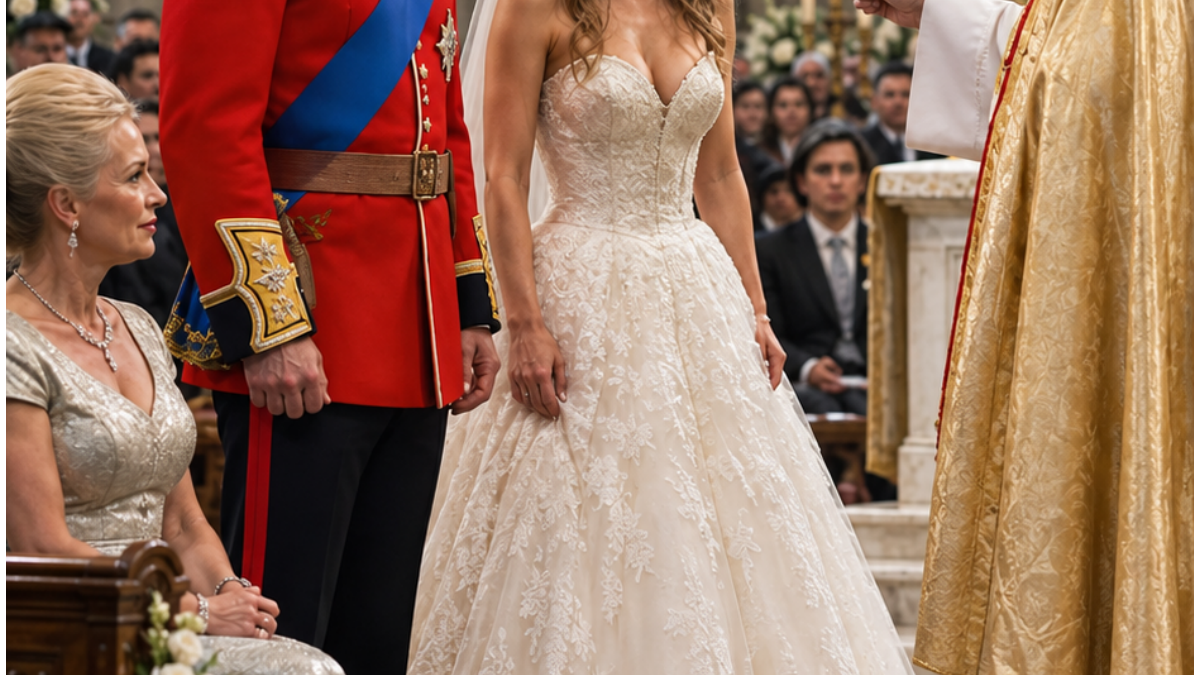
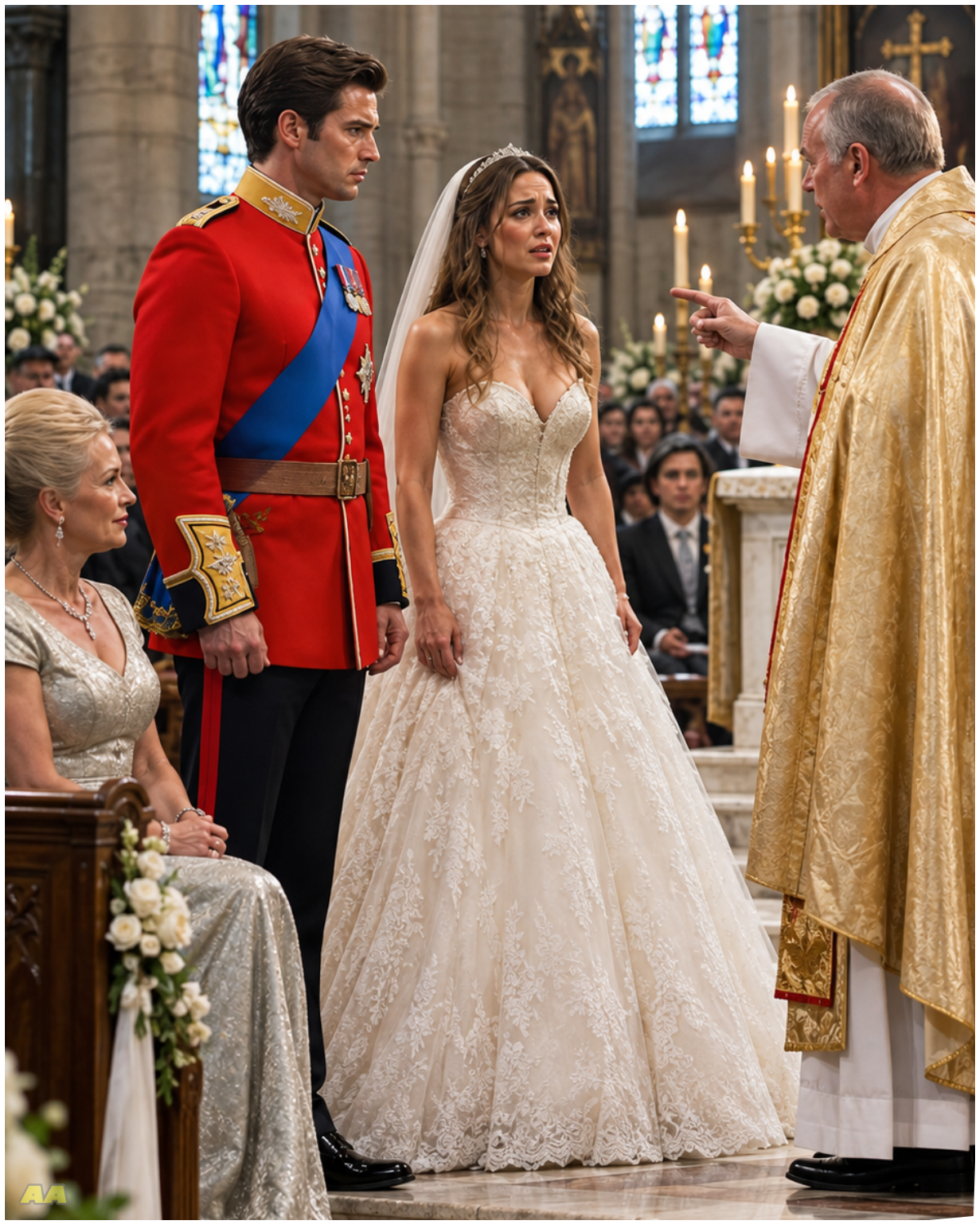
The grand oak doors of the cathedral were sealed.
The billionaire guests holding their breath.
At the altar, the high priest lowered his golden scripture, looking down his nose at the bride and her custom Vera Wang gown.
“I cannot in good conscience marry this commoner into the royal bloodline.”
He declared, his voice echoing through the shocked silence.
The groom’s mother smirked. The bride held back tears.
Then, the stained glass windows rattled as a military grade royal helicopter descended, carrying a single piece of paper that would destroy the priest’s life.
The world of high society is a walled garden, one where the gates are heavily guarded by tradition, bloodlines, and unspoken rules.
Sarah Jenkins never had any desire to scale those walls.
Born in the blue-collar neighborhoods of South Boston to a high school teacher and a mechanic, Sarah’s ambitions were entirely medical.
By the time she was 32, she was one of the youngest and most respected pediatric trauma surgeons at Massachusetts General Hospital.
She spent her days in bloody scrubs, surviving on stale breakroom coffee, and saving the lives of children.
She was brilliant, unpretentious, and entirely uninterested in the tabloids.
Then came the day the tabloids walked into her trauma ward.
William Harrington, the Duke of Oak Haven and the nephew of King Philip, was in Boston for a highly publicized philanthropic tour.
William was the golden boy of the royal family, eighth in line to the throne, fiercely intelligent, and burdened by the relentless expectations of his mother, Lady Victoria Harrington.
Who is a Lady Victoria was a woman who measured a person’s worth by their pedigree and the size of their ancestral estate.
She had spent the last decade trying to match William with various European duchesses and heiresses.
William’s tour of Mass General was supposed to be a standard photo opportunity.
He wore a tailored charcoal Brioni suit surrounded by a phalanx of security and PR managers.
But the carefully curated schedule was shattered when a massive multi-vehicle pileup on the I-93 brought a flood of critical patients into the ER.
In the chaos, the PR team tried to usher the Duke away, but William stood frozen watching the organized madness.
That was when he saw Sarah.
She was barking orders, her hands applying pressure to a young boy’s chest, completely oblivious to the royalty standing just 20 ft away.
When William’s head of security accidentally stepped into her path, Sarah didn’t hesitate.
“I don’t care if you’re the Pope.”
She snapped not even looking up.
“Move out of my trauma bay now.”
William was instantly captivated.
It’s a in a world full of people who agreed with everything he said and bowed when he entered a room, this exhausted fierce surgeon was a revelation.
Against the frantic advice of his handlers, William stayed at the hospital until Sarah’s shift ended 14 hours later.
He waited in the sterile fluorescent lit hallway, and when she finally emerged looking drained and smelling of antiseptic, he asked her to coffee.
“I don’t date suits.”
She had told him genuinely, too tired to realize who he was.
“I can take the jacket off.”
William replied with a disarming boyish smile.
That coffee turned into dinner at a hole-in-the-wall diner in Cambridge, which turned into a secret whirlwind romance that spanned two continents.
For 8 months, they managed to keep their relationship hidden from the voracious British press.
William would fly commercial under an alias just to spend weekends cooking pasta in Sarah’s cramped apartment.
For the first time in his life, he felt like a normal man.
For Sarah, William was incredibly grounded, compassionate, and entirely different from the stuffy aristocratic caricature she had imagined.
But secrets in the royal orbit have a remarkably short shelf life.
When a paparazzo caught them kissing outside a Boston bakery, the pictures exploded across the internet.
The headline of the Daily Mail screamed, “The Duke and the doctor are William’s American commoner.”
The backlash was immediate and suffocating.
Oh. But no one was more furious than Lady Victoria.
The moment William brought Sarah to London to formally introduce her, the psychological warfare began.
Lady Victoria invited Sarah to afternoon tea at her sprawling estate in Surrey.
It was an ambush. Sitting across a silver tea service that cost more than Sarah’s medical school tuition, Victoria didn’t mince words.
“You are a very impressive young woman, Dr. Jenkins,” Victoria had said, sipping her Earl Grey without breaking eye contact.
“But you must understand the reality of our world. You are not equipped for it. The press will devour you. The family will never accept you.”
You do not have the breeding, the history, or the temperament to stand beside a future leader of the crown.
“With all due respect, Lady Victoria,” Sarah had replied, keeping her voice incredibly steady.
“I deal with life and death every single day. I think I can handle a few photographers and dinner parties.”
Victoria’s eyes had narrowed to cold slits.
She slid a thick envelope across the table.
“There is 5 million pounds in a trust that will be transferred to your name by morning. Go back to Boston. Do not ruin my son’s life.”
Sarah stood up leaving the envelope untouched on the mahogany table.
“Keep your money. I’m marrying your son, not his title.”
When William found out about the bribe, it caused the most explosive fight he and his mother had ever had.
He officially proposed to Sarah the next day, presenting her with a sapphire ring that had belonged to his late grandmother.
King Philip, who had always harbored a soft spot for William, gave his reluctant but official blessing.
The wedding was set for the following spring, but Lady Victoria was not a woman who accepted defeat.
If she couldn’t buy the American commoner off, she would humiliate her so profoundly that Sarah would have no choice but to run.
And to execute her plan, Victoria needed an ally inside the church.
She found one in Father Thomas Auris.
Father Thomas Auris was not a man of God as much as he was a man of the elite.
As the head priest of the Cathedral of St. Clement in Central London, he had baptized dukes, officiated the weddings of billionaires, and delivered the last rites to politicians.
He was a man who adored the proximity to power.
He wore custom-tailored vestments and spoke with a polished theatrical baritone that commanded the attention of the upper cruSt. For years, Father Thomas had lobbied for a promotion to a prestigious bishopric, a position that required the subtle backing of influential aristocratic families.
Lady Victoria Harrington was one of the most powerful power brokers in the church’s patronage network.
Two weeks before the wedding, Lady Victoria summoned Father Thomas to her private London townhouse.
Over snifters of rare brandy, she laid out her insidious plan.
She had supposedly hired private investigators to dig into Sarah’s background and found a loophole.
Because Sarah had been baptized in a non-denominational progressive American church, and because her parents had briefly separated when she was a teenager, Victoria insisted that Sarah’s spiritual pedigree was fundamentally incompatible with the sacred vows of the royal bloodline.
It is a moral imperative, Father, Victoria had purred, her diamonds catching the firelight.
We cannot allow this dilution of our heritage.
If you were to halt the ceremony to stand firm on the sanctity of our traditions, the traditionalist wing of the family would see you as a hero.
I will personally ensure the archbishop grants you the seat in York.
Father Thomas’s ambition easily eclipsed his morals.
He agreed he would wait for the most public dramatic moment to object, ensuring Sarah was humiliated in front of the entire world, forcing William to abandon her to save face.
The morning of the wedding was a master class in tension and terrifying extravagance.
The Cathedral of Saint Clement was draped in thousands of white peonies imported from the Netherlands.
Outside, thousands of people lined the streets, waving flags while helicopters from global news networks hovered in the sky.
Inside her suite at the Savoy Hotel, Sarah stared at herself in the mirror.
She wore a custom Vera Wang gown of ivory silk and delicate French lace, a gift from William.
Her hair was styled perfectly, a sheer veil cascading down her back.
Yet, despite the fairytale aesthetic, her stomach was in knots.
The entire week leading up to the wedding had been a gauntlet of snide remarks from William’s extended family, passive-aggressive seating arrangements orchestrated by Victoria, and a brutal media campaign highlighting every flaw in Sarah’s middle-class upbringing.
You look breathtaking, Sarah, whispered her mother, who was nervously smoothing out the train of the dress.
Her parents felt entirely out of place in the opulent suite, intimidated by the army of makeup artists and royal handlers.
“Thank you, Mom.” Sarah breathed, closing her eyes.
“Just focus on William.” She told herself.
“Just get through the ceremony.” Across town, William was pacing the stone floors of the cathedral’s antechamber.
He looked striking in his ceremonial military uniform, the medals on his chest clinking faintly with his nervous movements.
He knew his mother was plotting something.
She had been far too quiet over the last 48 hours, smiling with a terrifying serenity that made William’s blood run cold.
At exactly noon, the massive pipe organ began to thunder, playing Handel’s Zadok the PrieSt. The heavy oak doors of the cathedral swung open.
The congregation stood. The guest list was a staggering assembly of global power.
European royals, tech billionaires, Hollywood titans, and political heavyweights filled the pews.
In the front row, Lady Victoria sat with her back perfectly straight, a faint venomous smirk playing on her lips.
As Sarah walked down the long, sweeping aisle, her father holding her arm, the silence in the cathedral felt heavy, almost oppressive.
She could feel the judgmental stares of the aristocracy burning into her skin.
But then [clears throat] she looked at the altar.
William was standing there, his eyes locked onto hers, filled with such profound love and reassurance that the rest of the world melted away.
Sarah reached the altar. William took her hand, giving it a firm, grounding squeeze.
They turned to face Father Thomas Erris, who stood elevated before them, holding an ornate, gold-bound scripture.
The priest’s face was unreadable, a mask of pious authority.
“Dearly beloved.” Father Thomas began, his deep voice echoing through the vaulted stone ceilings.
We are gathered here today in the sight of God and in the presence of this congregation to join together this man and this woman in holy matrimony.
The ceremony proceeded normally for the first 10 minutes.
Sarah began to let her guard down.
She recited her initial affirmations, her voice clear and unwavering.
William smiled warmly at her.
But as the moment for the exchange of vows approached, the atmosphere shifted.
Father Thomas paused. The pause stretched for 5 seconds, then 10.
The silence in the massive cathedral grew thick and uncomfortable.
The organist looked confused. William’s brow furrowed and he gave the priest a sharp, questioning look.
Father Thomas slowly closed the golden scripture.
He looked out over the congregation, his eyes briefly meeting Lady Victoria’s in the front row.
Victoria gave a microscopic nod.
Father Thomas took a deep breath, puffed out his chest, and looked down at Sarah with an expression of profound pity and disguSt. Before we proceed to the sacred vows, Father Thomas’s voice rang out louder and sharper than before.
It is the duty of the church to ensure that the union before us is built upon an unshakeable moral and spiritual foundation.
A murmur rippled through the 500 guests.
The Duke of Westminster leaned over and whispered frantically to the tech billionaire sitting next to him.
William stepped forward shielding Sarah slightly.
Father Aris, what is the meaning of this?
Proceed with the vows. The priest ignored the groom.
He kept his piercing gaze locked entirely on the bride.
Marriage into the royal house is not merely a legal contract nor a private affair.
It is a sacred trust bound by generations of pure tradition.
After much prayer and investigation into the spiritual background and familial standing of the bride, Miss Sarah Jenkins, he practically spat her surname making it sound like a disease.
I have found grievous irregularities.
Her religious upbringing lacks the canonical rigor required of the Crown.
Furthermore, her familial history does not meet the moral fortitude required to stand beside a Duke of the Blood.
Gasps echoed off the stained glass windows.
Sarah felt the blood drain from her face.
Her heart pounded violently against her ribs.
She felt completely exposed, stripped bare in front of the most powerful people on the planet.
Her father sitting in the second row half rose from his seat, his fists clenched, but Sarah’s mother pulled him back terrified of causing a scene.
“Stop this at once.” William roared, his voice cracking like a whip through the cavernous space.
He took a menacing step toward the altar.
“You will finish this ceremony, or so help me God, I will ruin you.” “I am a servant of God, Your Grace.” Father Thomas replied dripping with faux sanctity.
“And I cannot in good conscience marry this commoner into the royal bloodline.
The church officially formally objects to this union.
I will not proceed.” Pandemonium broke out.
The polite restraint of the high society guests vanished as people began to talk openly, some pointing at Sarah.
The paparazzi stationed outside hearing the commotion through the cracked doors began shouting questions.
Lady Victoria stood up adjusting her silk shawl with a look of theatrical sorrow.
“William, darling.” She called out, her voice carrying easily.
“Please, it is a sign from God.
Do not fight the will of the church.
Come away. We can handle the press.
Just let her go back to where she belongs.
Sarah felt a tear prick her eye, but she furiously blinked it away.
She would not cry, not in front of these people.
She squeezed William’s hand ready to tell him that they should just walk out, that they didn’t need this cathedral or this terrible family, but William didn’t look defeated.
He looked absolutely lethal. “You think you’ve won?” William sneered glaring at his mother and the prieSt. He turned his back on the altar and faced the congregation.
“Is there another ordained minister in this room?
Anyone?” Uh silence answered him.
No priest or bishop in the pews dared to defy Father Thomas and Lady Victoria in this setting.
“William.” Sarah whispered, her voice trembling just slightly.
“Let’s just go, please.” “No.” William said, his jaw clenched so hard a muscle twitched in his cheek.
“I am not leaving this altar without you as my wife.” Father Thomas smiled smugly, folding his hands over his stomach.
“The ceremony is terminated, your grace.
There is nothing more to be done.
Security will escort the Jenkins family from the premises.” Suddenly, the heavy muffled silence of the cathedral was broken by a sound.
It started as a low, rhythmic thumping in the distance, but within seconds it escalated into a deafening roar.
The massive stained glass windows of St. Clement’s began to vibrate in their lead frames.
The crystal chandeliers hanging from the vaulted ceiling swayed dangerously, sending fragmented light dancing wildly across the stone floors.
The sound was so intense that several guests covered their ears.
“What on earth is that?” Lady Victoria shrieked over the noise, her smug composure finally cracking.
Outside, the thousands of spectators in the streets were pointing up at the sky.
Descending rapidly toward the cathedral’s wide manicured courtyard was a massive military-grade Agusta.
Westland AW101 helicopter. It was painted in deep regal burgundy, emblazoned with the gold crest of the reigning monarch.
The downdraft from the immense rotors whipped the trees into a frenzy and sent the hats of the aristocratic guests gathered near the doors flying into the streets.
The helicopter touched down on the courtyard grass with a heavy thud, its engines whining as they began to power down.
Inside the church, the heavy oak doors were suddenly violently thrust open by a squad of royal guards in full tactical dress moving with terrifying precision.
They parted immediately creating a corridor down the center aisle.
At the altar, Father Thomas Aris dropped his scripture.
The color completely vanished from his face.
Lady Victoria clutched her pearl necklace, her mouth opening and closing in shock.
Walking down the aisle flanked by his highest ranking generals was a man who answered to no priest and no duchess.
It was King Philip himself and in his gloved hand he held a single sealed parchment bearing the royal wax crest, a decree that was about to turn Father Thomas Aris’s world to ash.
The atmosphere inside the Cathedral of St. Clement had shifted from a spectacle of humiliation to a terrifying tableau of absolute power.
King Philip was 78 years old, a man whose reign had weathered global recessions, political scandals, and two wars.
He walked with a slight limp relying heavily on a silver-headed walking stick, but his presence consumed all the oxygen in the room.
He wore a bespoke navy suit issuing his military uniforms for the cold, hard look of a head of state ready to execute a political strike.
Flanking him was Lord Chancellor David Kensington, a severe man clutching a leather dossier and six members of the elite Royal Protection Squad whose hands rested uncomfortably close to their holstered weapons.
The sharp rhythmic clicking of the King’s cane against the ancient stone floor was the only sound echoing through the cavernous hall.
The billionaire guests and European aristocrats who had been whispering viciously just moments before were now paralyzed, their eyes wide with disbelief.
A reigning monarch did not simply interrupt a wedding.
A reigning monarch did not arrive unannounced in a tactical helicopter.
This was an unprecedented breach of protocol, a physical manifestation of royal fury.
King Philip reached the steps of the altar.
He did not look at Lady Victoria, who was now trembling in the front pew, her manicured hands gripping the wooden railing so hard her knuckles were white.
He did not look at the sweating, terrified prieSt. He looked directly at Sarah.
For the first time since the ordeal began, the King’s hardened expression softened.
He reached out a weathered, age-spotted hand.
Sarah, still holding William’s arm, stepped forward and took it.
The King bowed his head slightly, a microscopic gesture, but in the rigid hierarchy of the monarchy, an earth-shattering sign of respect.
“Doctor Jenkins, King Philip said his voice gravelly but carrying effortlessly in the perfect acoustics of the cathedral.
I must offer my profound apologies.
I promised you that my family would protect you.
I see now that the wolves were allowed inside the gates.” “Your Majesty, Sarah started, her voice tight with unshed tears and adrenaline.
“Do not speak, my dear.
You have endured enough of our theatrics.” Philip interrupted gently.
He turned to William, gripping his nephew’s shoulder.
“You stood your ground, William.
Your father would be proud.” Then King Philip turned slowly to face Father Thomas Ares.
The priest looked as if he might physically collapse.
The arrogant, theatrical baritone he’d used to condemn Sarah had vanished, replaced by the ragged breathing of a cornered animal.
“Your Your Majesty,” Father Thomas stammered, attempting a clumsy bow.
“I was only acting in the best spiritual interests of the Crown.
The Canon laws Do not insult my intelligence, Thomas.” The King’s voice cracked like a rifle shot.
The sudden violence in his tone made several guests flinch.
“You speak of the Crown’s interests.
I am the Crown. And as the supreme governor of this church, I dictate its moral foundation, not you.
And certainly not the scheming harpies who frequent your confessionals.” He shot a venomous glare at Lady Victoria, who visibly shrank back into the oak pew.
The King snapped his fingers.
Lord Chancellor David Kensington stepped forward, opening the leather dossier.
He withdrew the heavy parchment bearing the royal wax seal.
Lord Kensington read the decree.
“The King commanded.” The Chancellor cleared his throat, his voice devoid of emotion.
“By the grace of the sovereign and in accordance with the Royal Marriages Act and the ecclesiastical jurisdiction at measure, it is hereby decreed that the objections raised against the union of His Grace William Harrington, Duke of Oak Haven, and Dr. Sarah Jenkins are entirely baseless, malicious, and devoid of canonical merit.” Father Thomas closed his eyes, a bead of sweat tracing down his cheek.
Kensington continued, his voice rising in volume.
“Furthermore, by the direct authority of the Crown, Thomas Ares is hereby stripped of his title, his parish, and his standing within the church.
He is to be removed from the premises immediately pending a full investigation into financial irregularities and extortion.” The cathedral erupted in gasps.
The word extortion hung in the air like a guillotine blade.
“You are a disgrace to your collar,” King Philip said to the ruined prieSt. “You sold the sanctity of my nephew’s wedding for a bishopric and a bribe.
Guards, remove this charlatan from my sight.” Two imposing royal guards ascended the altar steps.
Father Thomas didn’t fight. He was a man utterly broken by his own ambition.
As the guards gripped his arms and marched him down the side aisle, stripping him of his ornate golden scripture along the way, the silence that followed was absolute.
“Now,” King Philip said, turning back to the congregation, “we have a wedding to finish.” From the shadows of the antechamber, an older, frail man in pristine white vestments stepped forward.
It was Archbishop Geoffrey Holden, the highest-ranking cleric in the nation, a man who rarely made public appearances outside of coronations and state funerals.
He had arrived on the King’s helicopter.
He walked to the altar, taking the place where Father Thomas had stood just moments before.
Before the Archbishop could open his book, Lady Victoria could no longer contain her desperation.
Her carefully constructed reality was collapsing around her, and in a final panicked bid for control, she stood up.
“Philip, please, you cannot do this!” Victoria cried out, abandoning all royal decorum.
Her voice was shrill, echoing terribly.
“You don’t know what you are sanctioning.
This girl is a nobody.
She will drag William into the gutter.
The press will make a mockery of us.
I was trying to save the family.” King Philip turned his gaze upon his sister-in-law.
The look in his eyes was so profoundly cold that Sarah instinctively stepped closer to William.
Save the family. Philip repeated, his voice dangerously soft.
Victoria, you have been a poison in the well of this family since the day my brother foolishly married you.
The absolute bluntness of the insult delivered in front of 500 of the world’s most powerful people was staggering.
Victoria opened her mouth to protest, but Philip raised his cane, pointing the silver tip directly at her cheSt. Did you really think the intelligence services of this country would not monitor a 5 million pound offshore wire transfer?
The king asked. A collective gasp swept through the pews.
The Duke of Westminster actually covered his mouth.
Whispers ignited like wildfire. 5 million pounds.
Did you think, Philip continued stepping down one step of the altar to loom over her, that my people would not flag your private meetings with Thomas Harris?
Did you honestly believe that I would allow you to orchestrate a public coup against my nephew to satisfy your own grotesque elitism?
It was for the bloodline.
Victoria whispered, her face pale, her bravado completely shattered.
The bloodline is irrelevant without character, Philip roared.
He pointed back at Sarah.
That woman stood in an emergency room for 14 hours with her hands buried in the chests of dying children, refusing to bow to your son because she was too busy saving lives.
She has more honor, more grit, and more dignity in her little finger than you have demonstrated in 40 years of wearing our family’s jewels.
Sarah felt a tear finally spill over her lashes.
William wrapped his arm tightly around her waist, pulling her against his side.
You are finished, Victoria. The king declared his sentence final and absolute.
Your stipends are frozen. Your access to the royal properties is revoked.
You will be escorted back to your townhouse where you will pack your belongings.
You will retire to the hunting lodge in the Scottish Highlands and you will not speak to the press.
If I see your face in London again, I will release the dossier of your financial crimes to Scotland Yard.
Victoria Harrington, the terror of high society, simply crumpled.
She sank back into the pew, her hands covering her face.
A ruined woman. Two silent security officers immediately materialized at the end of her row, waiting to escort her out.
The king turned his back on her, dismissing her entirely from his reality.
He walked back up the steps and nodded to Archbishop Holden.
“Jeffrey,” the king said softly, “please marry my nephew.” The archbishop smiled warmly at Sarah and William.
“With pleasure, Your Majesty.” The tension in the room finally broke, replaced by a profound reverent Tsar.
Sarah looked up at William.
His eyes were shining with unshed tears, but his smile was radiant, triumphant.
“I told you,” William whispered, brushing a stray tear from her cheek.
I’m not leaving this altar without you.
The ceremony resumed, but the energy was entirely transformed.
When Sarah recited her vows, her voice rang out with crystal clarity, echoing off the ancient stone.
She wasn’t just marrying the man she loved.
She had survived the crucible.
She had faced the ultimate gatekeepers of the elite world and won, backed by the highest power in the land.
When William slid the heavy gold band onto her finger, the church was deathly quiet.
“By the power vested in me and under the watchful eye of God and the crown,” Archbishop Holden declared, his voice rich and full of warmth, “I now pronounce you husband and wife.
You You kiss the bride.” When William pulled Sarah in for the kiss, he didn’t just lean in, he dipped her slightly, kissing her with such fierce, unapologetic passion that a cheer actually broke out in the back of the cathedral.
It was a deeply un-royal, entirely human moment.
As they broke apart, breathless and smiling, the massive pipe organ roared to life, playing a thunderous, joyful recessional.
King Philip stood to the side, tapping his cane on the floor in a quiet, rhythmic applause.
As William and Sarah walked back down the aisle, now the Duke and Duchess of Oak Haven, the guests who had sneered at Sarah an hour before, were now clapping enthusiastically, their faces masks of desperate sycophancy.
Sarah didn’t look at them.
She kept her eyes on the heavy oak doors, the sunlight pouring in from outside, and the future waiting for them.
The wedding reception, held at the historic Lancaster House, was the most surreal event of Sarah’s life.
The power dynamics of British high society had shifted on its axis in the span of an hour.
The news of the King’s intervention, the helicopter landing, and Lady Victoria’s banishment had leaked to the press almost immediately.
The paparazzi outside the gates were in a frenzy, their telephoto lenses pressed against the iron bars.
Inside the grand ballroom, beneath glittering chandeliers, Sarah was the undisputed center of gravity.
Women who had accidentally spilled red wine on her dress at polo matches 3 months ago were now tripping over themselves to compliment her Vera Wang gown.
Men who had joked about her working-class parents in the smoking rooms of private clubs were suddenly deeply interested in the funding for pediatric trauma centers.
Sarah handled them with lethal grace.
She didn’t gloat, nor did she stoop to their level of fake pleasantries.
She smiled politely, gave non-committal answers, and kept her circle tight, spending most of the evening laughing with her parents and the few genuine friends she had brought from Boston, including Dr. Harrison Miller, her blunt, no-nonsense chief of surgery.
“I have to admit, Jenkins,” Dr. Miller said, nursing a glass of 20-year-old scotch, “off me.
When you said you were marrying a duke, I expected a stiff, boring affair.
I didn’t expect a tactical military insertion and a medieval banishment.
Best wedding I’ve ever been to.” Sarah laughed, leaning her head on William’s shoulder.
“Believe me, Harrison, neither did I.” William kissed the top of her head.
“I think you’ve terrified them, darling.” “Lady Caroline just asked me if you liked hydrangeas.” “Looking as if she feared you might have her executed if she got the answer wrong.” “Good,” Sarah said softly, her eyes tracking the glittering crowd.
“Let them be a little afraid.
It keeps them honeSt.” By Sunday morning, the world woke up to a media firestorm.
The Sunday papers were dominated by images of the king’s helicopter parked on the cathedral lawn and leaked blurry photos of Father Thomas being escorted out by royal guards.
The headlines, which just 24 hours prior had been poised to mock the jilted American commoner, completely reversed their narrative.
The king’s decree, “Monarch crushes plot against American bride, Victoria exiled the treason of the duke’s mother, surgeon duchess, the commoner who won the crown.” The public reaction was overwhelming.
In a world increasingly frustrated by wealthy elites and out-of-touch institutions, Sarah Jenkins became an overnight global icon.
She wasn’t a fragile princess waiting for a castle.
She was a trauma surgeon who had stood down a corrupt priest and a vicious duchess without flinching.
But the real shock to the system came on Monday morning.
Instead of jetting off to a 6-week honeymoon in the Maldives as royal protocol dictated, a black Range Rover pulled up to the staff entrance of St. Thomas’s Hospital in central London.
Sarah stepped out. She wasn’t wearing a tiara nor a designer gown.
She was wearing navy blue medical scrubs, sensible sneakers, and her hospital ID badge clipped to her collar.
Her hair was pulled back into a tight practical bun.
A gaggle of reporters had staked out the hospital expecting a brief wave for the cameras.
Instead, a stunned medical correspondent for the BBC thrust a microphone forward.
Your Grace, Duchess Sarah, are you are you returning to work?
Sarah paused at the sliding doors.
She looked at the cameras, her expression completely serious.
I have a scheduled pediatric cardiac bypass at 0800 hours.
A title is a privilege, but medicine is my calling.
Excuse me. She walked through the doors leaving the press corps utterly speechless.
Her return to the operating room sent a shockwave through the monarchy.
William, rather than being embarrassed by his wife’s refusal to become a traditional royal decoration, was emboldened by it.
For years he had chafed under the pointless ribbon-cutting ceremonies and hollow charity galas organized by his mother.
Watching Sarah scrub in and save a life, he realized he could no longer play the role of the passive aristocratic figurehead.
Two weeks later, William called a press conference from his private office.
With Sarah standing beside him still in her scrubs after a long shift, he announced the dissolution of his mother’s vanity charities.
In their place, he launched the Oak Haven Medical Foundation, liquidating three of his minor estates to fund an initial endowment of 40 million pounds.
The foundation was dedicated entirely to building advanced trauma centers in underserved communities across the United Kingdom and the United States.
The King approved the initiative quietly, smiling as he read the morning papers from his study.
William had finally stepped out of the shadow of his title and become a leader.
Meanwhile, the consequences of the cathedral plot continued to unfold in the dark corners of the aristocracy.
Father Thomas Harris’s life had unraveled with terrifying speed.
Without Lady Victoria’s protection, the church abandoned him.
An internal audit revealed years of misappropriated parish funds, offshore accounts in the Cayman Islands, and a history of accepting bribes to annul the marriages of wealthy congregants.
He was defrocked, publicly shamed, and facing 5 to 10 years in a federal prison for financial fraud.
Lady Victoria’s fate was quieter, but to a woman of her pride, far more agonizing.
Banished to the drafty, isolated hunting lodge in Scotland, she found herself completely cut off.
Her phone stopped ringing. Her friends in high society, who were only ever loyal to power, deleted her number the moment the King exiled her.
She spent her days walking the misty, desolate moors accompanied only by a few silent staff members who were paid directly by the Crown to ensure she didn’t speak to reporters.
She had tried to preserve her version of the royal bloodline, and in doing so, had written herself out of its history entirely.
But for Sarah and William, the drama of the wedding was merely the fiery crucible that forged the foundation of their actual lives.
They had survived the worst the aristocracy had to throw at them, but surviving was only the first step.
Now, they had to navigate a marriage where one partner belonged to the hospital wards and the other belonged to the history books, trying to bridge two worlds that were never designed to meet.
For 18 months, life for the Duke and Duchess of Oakhaven settled into a rhythm that fundamentally shattered the centuries-old protocols of the British monarchy.
Sarah Jenkins, now officially Her Royal Highness Duchess Sarah, was a walking contradiction to the establishment.
By day, she was still Dr. Jenkins, navigating the sterile, high-pressure corridors of St. Thomas’s Hospital in Central London.
She wore standard-issue NHS blue scrubs, drank lukewarm coffee from the cafeteria, and logged grueling 12-hour shifts in the pediatric and trauma surgery wards.
By night, she would occasionally swap her stethoscope for the Oakhaven diamond tiara, attending state dinners and philanthropic galas on the arm of a fiercely proud William.
The press, initially skeptical, had fallen profoundly in love with her.
The Times ran an extensive Sunday feature detailing how the surgeon Duchess had utilized Medtronic’s latest robotic surgical systems to save a 12-year-old victim of a horrific car crash, only to appear hours later at a Royal Albert Hall charity concert looking immaculate in a midnight blue Alexander McQueen gown.
She was untouchable. The public adored her relentless work ethic, and the traditionalist aristocrats who had sneered at her American roots were forced into a resentful, fearful silence.
But the intersection of raw, bleeding reality and the gilded cage of the monarchy was a fragile bridge.
And on a frigid evening in late November, that bridge was subjected to a catastrophic stress teSt. Buckingham Palace was hosting a massive state banquet in honor of French President Laurent.
The state dining room was a sensory overload of wealth and history.
Massive gold leaf chandeliers illuminated a horseshoe-shaped mahogany table set for 160 guests.
The finest Baccarat crystal caught the light, and the air was thick with the scent of roasted venison, truffles, and rare vintage Dom Perignon.
Sarah sat four seats down from King Philip.
She wore a bespoke emerald silk gown by Jenny Packham, the Cartier heirloom necklace resting heavy against her collarbone.
Across the table, William caught her eye offering a subtle, sympathetic smile.
They both knew she had barely slept.
She had been on call the previous night and had spent six hours operating on a ruptured spleen.
She was running on adrenaline and a double espresso she had downed in the back of the Bentley on the way to the palace.
King Philip, now approaching his 80th birthday, was holding court deep in a diplomatic conversation with the French president about NATO defense budgets.
Despite his age, the king possessed a sharp, commanding intellect.
But as the first course was being cleared by a synchronized army of footmen in scarlet livery, Sarah noticed something wrong.
From her vantage point, she saw the king’s left hand tremble violently as he reached for his water goblet.
The crystal glass slipped from his grip, shattering against the antique silver charger plate.
A hush rippled outward from the center of the table.
“Your Majesty?” Lord Chancellor David Kensington asked, leaning in from the king’s right.
King Philip did not answer.
His face, normally a ruddy healthy complexion, had drained to an ashen terrifying [clears throat] gray.
He raised a hand to his chest, his fingers clawing at the starched white fabric of his tuxedo shirt.
A sharp ragged gasp tore from his throat, a sound of pure agonizing pain that echoed loudly in the suddenly silent ballroom.
Before the Royal Protection Squad could even unholster their radios, the king collapsed forward, his head crashing onto the table, overturning plates and silver cutlery in a chaotic clatter.
Screams erupted from the French delegation.
The polite veneer of the state banquet shattered instantly.
“Uncle Philip!” William shouted, shoving his heavy oak chair back with such force it toppled over.
He sprinted toward the head of the table, but Sarah was faster.
The Duchess disappeared the second the king’s glass shattered the trauma surgeon’s instincts, overriding every royal protocol drilled into her.
She hiked up the skirt of her heavy silk gown, vaulted over the low floral centerpiece, and slid to her knees beside the fallen monarch, just as two heavily armed guards rushed forward to pull him from the chair to the floor.
“Back up, give him air!” Sarah commanded.
The voice that echoed through the room was not the polished quiet tone of a royal wife.
It was the barking authoritative roar of a Mass General Trauma Chief.
The guards, recognizing her immediately, formed a protective perimeter, pushing back the panicked billionaires, diplomats, and minor royals.
Sarah ripped open the king’s tuxedo jacket, sending diamond studs flying across the carpet.
She pressed two fingers hard against his carotid artery.
“Pulse is incredibly weak and thready.
He’s diaphoretic.” she muttered to William who had dropped to his knees beside her, his face pale with terror.
“Is it a heart attack?
William asked, his voice shaking.
Sarah pressed her ear to his chest and felt his abdomen.
Her face tightened. The king’s stomach was rigid and there was a terrifying pulsing mass just above his navel.
No. Sarah said, her blood running cold as the diagnostic pieces clicked together.
It’s worse. He has an abdominal aortic aneurysm and I think it’s rupturing.
He is bleeding out into his own stomach.
At that moment, the double doors of the banquet hall burst open and Sir Gregory Halston, the chief royal physician, rushed in flanked by two palace medics carrying emergency bags.
Sir Gregory was a man in his late 60s, a traditionalist who held his position through aristocratic connections rather than cutting-edge medical prowess.
He was an excellent diagnostician for the common cold, but he had not seen the inside of a chaotic trauma ward in three decades.
Step aside, your grace. Sir Gregory puffed out of breath dropping to the floor.
The ambulance is 2 minutes away.
We will transport his majesty to the private wing at King Edward the VII’s hospital.
I’ve already paged Dr. Aris Thorne from Harley Street to meet us there.
Sarah looked at Sir Gregory as if he had lost his mind.
King Edward’s? They don’t have a level one trauma team waiting on standby.
Thorne is an elective vascular surgeon.
If you put the king in an ambulance and wait for a private consultant to drive across London, he will be dead before he reaches the operating table.
Sir Gregory bristled, his ego flaring.
Duchess, I am the king’s physician.
I make the medical decisions for the sovereign.
He has a ruptured AAA, Gregory.
Sarah yelled, her hands stained with the king’s sweat.
His blood pressure is crashing.
He needs an immediate laparotomy and an aortic cross clamp.
I am diverting the ambulance to St. Thomas’s.
My surgical team is already on site.
I will operate. The entire room seemed to suck in a breath.
Lord Kensington, standing just outside the guard perimeter, intervened.
Dr. Jenkins, with all due respect, it is a breach of protocol for a member of the royal family to operate on the sovereign.
The conflict of interest The conflict of interest is that I want him to live.
Sarah snapped, her eyes blazing with a feral intensity.
She looked directly at William.
The decision legally and morally rested with the next of kin, and with the king unconscious, William was the highest-ranking royal present.
William looked at the frail, dying form of his uncle, then at Sir Gregory’s panicked, uncertain face, and finally at his wife.
In Sarah’s eyes, he saw the absolute, unshakeable confidence of a woman who cheated death for a living.
William stood up, his posture rigid, embodying the terrifying authority of a future king.
He looked directly at the head of the royal protection squad.
You take orders from me now, William commanded, his voice echoing in the silent hall.
Divert the motorcade to St. Thomas’s Hospital.
Get my wife a police escort.
If anyone interferes with her, arrest them.
He glared at Sir Gregory and Lord Kensington.
If he dies on her table, so be it, but he will not die waiting for a society doctor.
The journey from Buckingham Palace to St. Thomas’s Hospital was a blur of flashing blue lights, wailing sirens, and adrenaline-fueled chaos.
London’s Metropolitan Police shut down the Westminster Bridge, creating a sterile corridor for the royal ambulance.
Inside the back of the ambulance, Sarah was already at war.
She had shed her Cartier necklace and the top layer of her Jenny Packham gown, working in a silk slip and bare feet, her knees planted on the vibrating floorboards.
She was frantically pushing fluids into the King through two large bore IVs, trying to keep his crashing blood pressure high enough to sustain his brain, but low enough so the ruptured artery wouldn’t blow open completely.
“Hold on, Philip.” She whispered fiercely, breaking protocol to use his first name.
“Do not quit on me now.
You’re too stubborn to die at a dinner party.” They hit the ambulance bay at St. Thomas’s like a localized hurricane.
The hospital’s trauma team, alerted by Sarah’s frantic radio calls from the ambulance, was waiting.
Dr. Harrison Miller, the chief of surgery and Sarah’s mentor, caught the gurney as it was pulled from the rig.
“Ruptured abdominal aorta.” Sarah shouted as they sprinted down the sterile white hallway, the wheels of the gurney squealing against the linoleum.
“Systolic is hanging in the 60s.
We need massive transfusion protocol.
Cross-match six units of O negative.
Get the Belmont rapid infuser ready.” “OR 4 is prepped, Jenkins.” Miller barked back.
He looked at her bare feet and ruined designer slip.
“Go scrub. I’ll prep his abdomen.
You have exactly 3 minutes before he bleeds out completely.” While Sarah ran to the scrub room, tearing off the remnants of her gala attire and throwing on standard sterile scrubs, William arrived at the hospital in a blacked-out Range Rover.
The scene outside St. Thomason was already descending into madness.
News helicopters were circling overhead, their searchlights cutting through the London fog.
The BBC had interrupted its regular broadcast with breaking news of the King’s collapse.
William was immediately ushered into a secure VIP holding room adjacent to the surgical floor, surrounded by his security detail and Lord Kensington.
The political vultures were already circling.
“Your Grace.” Kensington said, pacing the room, his phone buzzing incessantly.
The Prime Minister is asking for a formal briefing.
The markets in Asia are about to open and rumors are spreading that the king is already deceased.
We need to prepare a statement invoking the Regency Act.
You must prepare yourself to assume the duties of the crown.
William stood by the window staring out at the Thames River, his hands clasped firmly behind his back.
The reflection in the glass showed a man who had aged five years in the last 30 minutes.
You will tell the Prime Minister nothing until my wife comes out of those doors, William said coldly.
Sir, the optics of the Duchess performing this surgery are highly volatile.
Kensington pressed his bureaucratic anxiety peaking.
If the king does not survive, the press will crucify her.
They will say she was unqualified, that she usurped the royal medical staff.
The traditionalists in Parliament will demand an inqueSt. William turned slowly, his eyes locking onto Kensington with the same lethal freezing glare that King Philip had used to banish Lady Victoria.
Let them demand whatever they want for William said his voice dangerously quiet.
My wife is currently up to her elbows in my uncle’s chest cavity fighting for his life while you worry about the Asian stock markets.
If you speak one more word of politics in this room while he is on that table, I will personally strip you of your title and throw you out into the Thames.
Am I understood? Kensington swallowed hard, all color draining from his face.
Yes, Your Grace. Down the hall inside operating room four, the atmosphere was a terrifying symphony of highly controlled violence.
The room smelled sharply of iodine and cauterized flesh.
Sarah stood over the operating table under the blinding glare of the surgical halogens.
The king’s abdomen was laid open.
The sheer volume of blood pooling in his retroperitoneal cavity was staggering.
The ruptured aneurysm, a ballooned weakened section of the main artery, had blown out flooding his abdomen with the lifeblood he desperately needed in his brain and heart.
>> Suction fluid. >> Sarah demanded, her voice muffled by her surgical mask, her eyes narrowed in absolute laser-like focus.
I can’t see the neck of the aorta.
Get that blood out of there faster.
>> Pressure is dropping, Sarah.
The anesthesiologist warned from behind the plastic drape.
Systolic 50, 45. We are losing him.
>> No, we’re not. Sarah growled.
She didn’t hesitate. Miller, I’m going in blind to get proximal control.
Give me a DeBakey aortic clamp.
Harrison Miller slapped the heavy stainless steel clamp into her gloved palm.
Without waiting for the suction to clear the surgical field, Sarah plunged her hands deep into the pool of blood in the king’s abdomen, navigating entirely by feel.
She traced the spine, her fingers frantically searching for the pulsing torn vessel.
Every second that ticked by was millions of brain cells dying from oxygen deprivation.
Come on, you old bastard, where are you?
She muttered under her breath.
Her fingers found the tear.
She slid her hand further up, feeling for healthy tissue just below the renal arteries.
Got it! Sarah shouted. She squeezed the DeBakey clamp hard, locking it into place.
Instantly, the massive geyser of internal bleeding stopped.
Clamp is on. Proximal control achieved, Sarah announced, exhaling a ragged breath.
Systolic is rebounding. The anesthesiologist called out a note of profound relief in his voice.
Up to 80, 90. Heart rate is stabilizing.
All right, Sarah said, rolling her shoulders to release the agonizing tension.
Let’s get this mess cleaned up and sew in a Gore-Tex tube graft.
We aren’t out of the woods yet, people.
Let’s rebuild the king. For the next 4 hours, Sarah worked with the precision of a master watchmaker.
Under the intense magnification of her surgical loops, she cut away the diseased, shredded tissue of the king’s aorta and meticulously sutured a synthetic Dacron graft into place.
It was a grueling, agonizingly delicate procedure.
One misplaced stitch, one tear in the fragile aging tissue of the surrounding vessels, and the king would bleed out on the table.
Outside the hospital, the world held its breath.
Thousands of citizens had gathered in the damp London streets holding vigils.
The news had officially broken that Duchess Sarah, the American commoner who had shocked the establishment, was the lead surgeon fighting to save the sovereign’s life.
The narrative was overwhelmingly dramatic, a modern-day fairy tale forged not in castles, but in the sterile, bloody trenches of modern medicine.
At 4:15 a.m., the heavy metal doors of operating room four swung open.
Sarah stepped out into the hallway.
She looked like she had been through a war.
Her blue scrubs were soaked with sweat and splattered with small, dark stains of the king’s blood.
Her surgical cap was pulled off and her hair fell in a messy, damp tangle around her shoulders.
She pulled down her mask, taking her first real breath of unfiltered air in 5 hours.
William, who had been pacing the secure corridor outside the OR for hours, stopped dead in his tracks.
He didn’t ask the question.
He couldn’t force the words out of his mouth.
Sarah looked at her husband, the exhaustion etched deep into the lines of her face.
Slowly, the corners of her mouth twitched upward into a small, exhausted smile.
“He’s stable,” Sarah said softly.
“The graft holds. He’s going to be incredibly grumpy when he wakes up, but he is going to live.” William let out a choked sob, closing the distance between them in two massive strides.
He wrapped his arms around her, burying his face in her neck, not caring in the slightest about the blood or the sweat.
“You absolute miracle,” William whispered fiercely into her hair.
“You beautiful, terrifying miracle.” Three days later, the intensive care unit of St. Thomas’s Hospital was the most heavily guarded piece of real estate in Europe.
Royal guards with assault rifles stood at the ends of the sterile corridors, but inside the glass-walled room, the atmosphere was surprisingly quiet.
King Philip was propped up against a bank of pillows.
He looked frail, the network of IV lines and cardiac monitors a stark contrast to his usual aura of invincibility.
But his eyes, sharp and clear, retained their customary fire.
Sarah walked into the room holding a medical chart, wearing her white lab coat over her scrubs.
William stood by the window, watching his uncle carefully.
“Your Majesty, Sarah said tapping the edge of the chart with her pen.
Your vitals are strong. The post-operative ultrasound shows the graft is perfectly seated.
However, if you try to order the nurses to bring you scotch again, I will personally increase your sedation.” A raspy, weak chuckle escaped the king’s lips.
“You are a tyrant, Duchess.” “I am your doctor,” Sarah corrected, her tone warm, but firm.
“The title comes second in this building.” King Philip looked at her for a long moment.
The silence stretched heavy with the weight of unsaid things.
He looked down at the thick surgical dressing visible just beneath his hospital gown, then back up at the American surgeon who had defied his own royal physician to save him.
When I stepped into that cathedral to stop your wedding, the king began, his voice gravelly and slow, I did it because I believed in the strength of my nephew’s character.
I believed he had found someone worthy of standing beside him.
I did not realize The king paused, taking a shallow, careful breath.
I did not realize I was securing the savior of my own life.
Sarah lowered the chart, deeply moved.
I just did my job, sir.
Do not diminish it, Philip commanded softly.
He reached out a trembling hand.
Sarah stepped forward and took it, careful not to disturb his IV lines.
You have silenced every critic, Sarah.
You have proven that nobility is not born from bloodlines and ancient titles.
It is born in the fire of service.
You have done more for the longevity of this monarchy with a scalpel than my ancestors did with swords.
He squeezed her hand. Thank you, my dear.
You’re very welcome, Philip, Sarah smiled, back.
The political fallout from the night of the banquet was immense, but it completely revolutionized the public’s perception of the crown.
Sir Gregory Halston, humiliated by his failure to recognize the acute medical crisis, quietly resigned his post, retiring to the countryside in disgrace.
In an unprecedented move, King Philip issued a royal decree appointing Dr. Harrison Miller as the new chief royal physician, effectively merging the elite royal medical protocols with the cutting-edge practices of the NHS.
As for the wider world, Sarah became an untouchable global icon.
Time magazine named her one of the most influential people of the decade.
A The image of her walking out of St. Thomas’s Hospital at dawn, exhausted in blood-stained scrubs, became an emblem of modern female empowerment.
She completely rewrote the rulebook on what it meant to marry into power.
She didn’t abandon her identity for the crown.
She forced the crown to adapt to her identity.
Five years later, the sprawling gardens of the Okehaven estate in the countryside were bathed in the golden light of a late summer afternoon.
William, dressed casually in a linen shirt and slacks, was chasing a laughing curly-haired three-year-old boy across the manicured lawn.
The boy, Prince Arthur, named for a legendary king, but possessing the wild, uncontainable energy of his American grandparents, was the joy of King Philip’s twilight years.
Sarah sat on the stone patio, a laptop open in front of her.
She was no longer just the trauma chief at St. Thomas.
She was the chairwoman of the Global Pediatric Trauma Initiative, an organization funded by the crown that built hospitals in war zones and impoverished nations.
She was reviewing architectural plans for a new facility in sub-Saharan Africa.
She looked up from her screen, watching her husband hoist their son into the air, the boy’s shrieks of laughter echoing across the estate.
Life had an odd way of dispensing justice.
Somewhere in the remote Scottish Highlands, Lady Victoria lived a bitter, isolated existence entirely forgotten by the press and the society she had worshipped.
Somewhere in a medium-security prison, Father Thomas Harris was serving his sentence, trading his golden vestments for an inmate’s uniform.
They had gambled everything on the belief that a commoner could not survive their world.
They were right. Sarah didn’t just survive their world, she completely conquered it.
William walked over to the patio, out of breath, carrying a giggling Arthur on his shoulders.
He leaned down, pressing a soft kiss to Sarah’s temple.
You’re working too hard, Doctor.
The boy demands his mother’s attention.” Sarah closed the laptop, a bright, profound happiness radiating from her eyes.
She reached up, taking her son into her arms, and holding him close against her cheSt. She looked at William the Duke, who had loved her enough to fight the world, and the king who had brought a helicopter to a cathedral to prove it.
“I have all the attention in the world for you.”
Sarah said, kissing her son’s forehead, then smiling at her husband.
“After all, I’m exactly where I belong.”
What an incredible journey of resilience, love, and defying the odds.
Sarah and William’s story proves that true nobility is defined by character, courage, and the lives we touch, not by outdated traditions or the gatekeepers of high society.








