The Plain Sister Was Sent to Apologise for Her Sister’s Scandal — The Duke Married Her Instead
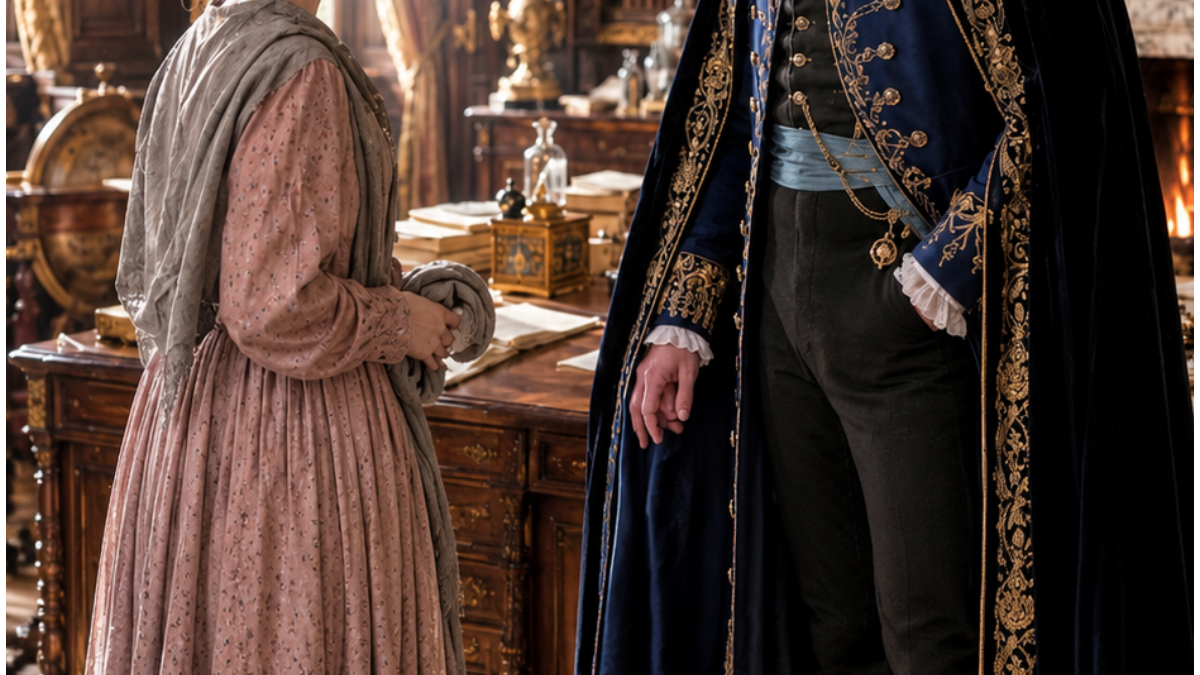
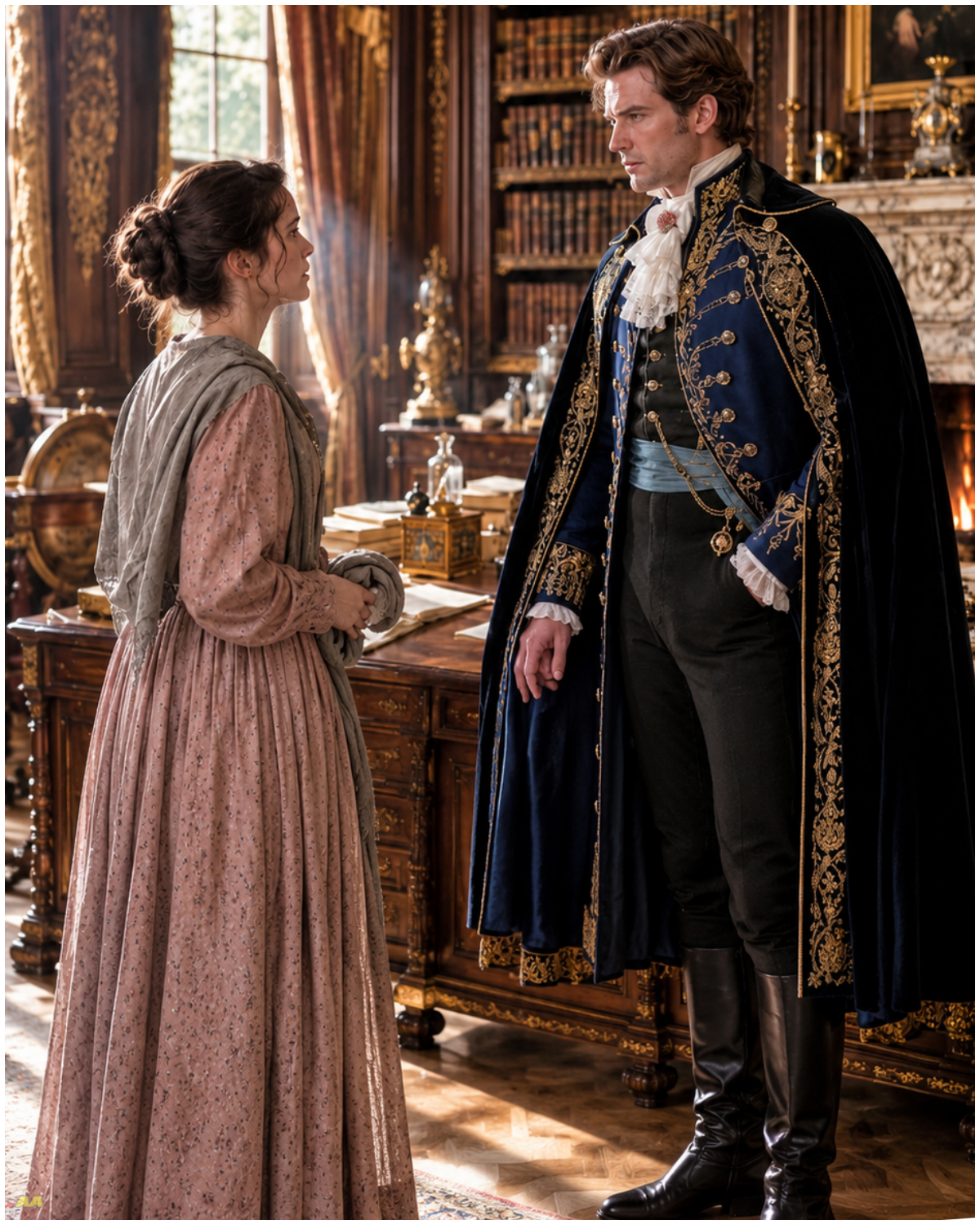
Scandals in Mayfair usually end in ruined reputations, smelling salts and hurried carriage rides to the countryside.
When Clarissa Lynfield bolted into the night with a penniles tenor, she left her family staring down the barrel of social and financial execution.
Someone had to face the wrath of the jilted duke.
Someone had to gravel. Abigail was neither beautiful nor favored, making her the perfect sacrifice.
She walked into his estate expecting to lose her pride.
She walked out with a title.
The morning the Lynfield family broke apart.
It smelled of stale lavender water and burnt toaSt. Abigail knelt on the drawing room carpet, carefully picking up the shards of a smashed Ming vase.
It had belonged to her grandmother.
10 minutes prior, it had been hurled across the room by her mother, Lady Agatha, in a fit of theatrical hysteria.
Abigail placed the jagged pieces into her apron one by one.
The porcelain was cold. It was the only quiet thing in the room.
Ruin. Lady Agatha wailed from the velvet seti pressing a damp lace handkerchief to her forehead.
Absolute unmitigated ruin. We shall be begging on the streets of Coven Garden by Tuesday.
I shall have to sell my pearls.
My own daughter a traitor to her blood.
By the window, Lord Thomas Lynfield paced.
He did not look like a baron.
He looked like a man who had just felt the hangman’s new slip around his collar.
Sweat beated at his temples, matting his thinning gray hair.
He muttered numbers under his breath.
He was calculating his debts.
A sum so vast and sprawling that only one man in England had possessed the capital to consolidate them.
That man was Caruso Pendleton, the Duke of Ashbborne.
And that man was supposed to marry Clarissa in exactly three weeks.
She left a note, Lord Thomas whispered, staring at the crumpled piece of parchment on the floor as if it were a venomous snake.
She wrote it on my good crested stationery.
She said her soul belongs to music, to a man named Lorenzo.
Hing. His name is Lawrence, Abigail said, her voice entirely flat.
She stood up, brushing dust from her faded gray skirts.
He plays the flute at the theater.
He cannot afford his own rent, let alone Clarissa’s silk ribbons.
Her mother glared at her, eyes red and vicious.
How can you be so calm, Abigail?
You stand there looking like a scullery maid while our family is destroyed.
Abigail did not point out that she looked like a scullery maid because her mother spent the entirety of the household budget on Clarissa’s wardrobe.
Clarissa was the beauty. Clarissa had spun gold hair, a laugh-like silver bells, and the moral constitution of a distracted toddler.
Abigail was 24 with dark, unmemorable hair, eyes the color of steeped tea and a pragmatic streak born of sheer survival.
She was the spinster, the shadow.
“Panic will not pay the Duke mother,” Abigail said mildly.
She walked over to the mahogany desk and deposited the broken vase shards into the waste bin.
The marriage settlements were signed on Tuesday.
The Duke paid off the promisory notes to Lord Hatherley in the bank.
He effectively owns this estate.
Lord Thomas made a sound that resembled a dying animal.
He gripped the heavy velvet drapes.
He will call the debts in.
He’s not a forgiving man.
They say he fired his own estate manager for miscounting a single bushel of wheat.
When he finds out Clarissa has absconded with a flute player, he will crush us.
The room fell silent, save for the rhythmic, miserable ticking of the grandfather clock.
Lady Agatha slowly lowered her handkerchief.
She looked at her husband, then deliberately she looked at her eldest daughter.
Abigail felt a cold, familiar weight settle in her stomach.
She knew that look. It was the look her mother gave when the butcher demanded payment or when an apology had to be written to a neighbor for Clarissa’s latest indiscretion.
“Someone must go to him,” Lady Agatha said, her voice dropping to a conspiratorial whisper.
“Someone must explain.”
“I cannot face him,” Lord Thomas stammered, stepping back.
“I am a gentleman, but I am not suicidal. The man is a brute.”
“Not you, Thomas,” Lady Agatha snapped, her gaze fixed entirely on Abigail.
Abigail will go. Abigail held her mother’s stare.
You want me to go to the Duke of Ashbborne, inform him that his bride to be as eloped with a penniles musician, and beg him not to throw you into debtor’s prison?
You have a way of blending in, dear,” her mother said, attempting a smile that looked more like a grimace.
“You are unassuming. He will not feel threatened by you. You can apologize. Throw yourself on his mercy. Weep a little if you must.”
I don’t weep.
Try.
Lady Agatha hissed.
If you do not fix this, Abigail, you will be sleeping in the workhouse alongside us.
Your fate is tied to ours.
It was a cruel thing to say, primarily because it was entirely true.
Abigail had no independent wealth, no suitors, and no escape.
If the Lynfield Barreny fell, she would be dragged down into the mud with them.
“Fine,” Abigail said. She did not sigh.
She did not argue. Arguing with her parents was like arguing with the weather.
“Have the carriage brought around. I will need 10 minutes to change.”
“Don’t wear that awful gray thing,” her mother called out as Abigail turned toward the door.
“I am going to deliver a death blow to a duke’s pride, mother,” Abigail replied without looking back.
“Gay seems exceptionally appropriate.”
The carriage ride across London was agonizingly slow.
A heavy spring rain had turned the cobblestone streets into slick, muddy rivers.
Inside the damp carriage, the leather seat smelled of mold.
Abigail sat perfectly straight, her hands folded over a worn velvet reticule.
She stared out the window, watching the bleak soot stained buildings roll paSt. She felt no anger toward Clarissa.
Clarissa was exactly who she had always been, a creature of pure, unfiltered impulse.
The fault lay with their father for thinking he could sell a wild bird in a gilded cage to a man made of iron.
But as the carriage turned onto the wide, immaculate expanse of Grovener Square, a flicker of genuine dread ignited in Abigail’s cheSt. The Duke of Ashborne was not a society dandy.
He did not attend balls to dance.
He stood at the edges of rooms, watching the aristocracy with a quiet, terrifying disdain.
He had chosen Clarissa purely for her bloodline and her beauty, a necessary acquisition to quiet his grandmother’s demands for an heir.
Abigail pulled her gray police tighter around her shoulders.
She was about to walk into the lion’s den, and she was entirely out of meat.
Ashborne House did not welcome visitors.
It tolerated them. The massive limestone facade loomed against the gray sky, stripped of any frivolous architectural adornment.
It was a fortress. When Abigail knocked, the heavy oak door swung open with silent precision.
A butler stood in the entryway, dressed in immaculate black, his expression as stiff as starch.
“Miss Lynfield,” Abigail said, her voice remarkably steady despite the heavy thumping of her pulse against her collarbone.
“To see his grace, it is a matter of urgent family business.” The butler’s eyes flicked over her drab gray police, her unfashionable bonnet, and her empty hands.
He did not ask for a calling card.
“Follow me, Miss Lynfield.” Abigail was led through a cavernous entrance hall paved with black and white marble.
The air smelled of beeswax, lemon polish, and old money.
There was no chaotic chatter here, no servants rushing with panicked expressions.
The silence was absolute. It made Abigail hyper aware of the scuff on her right boot and the slight fraying at her cuffs.
The butler stopped before a set of double mahogany doors.
He knocked once, opened one side, and announced, “Miss Lynfield, your grace.” Abigail stepped over the threshold.
The Duke’s study was a massive room lined with floor to ceiling bookshelves.
A fire snapped in a black marble hearth, fighting the chill of the rainy morning.
Behind a massive desk cluttered with ledgers and maps, sat Caruso Pendleton.
He did not immediately look up.
He was writing something. The scratch of his quill violently loud in the quiet room.
He was a large man, broad-shouldered with dark hair that lacked the pomade favored by the ton.
When he finally set the pen down and raised his head, Abigail felt the sheer uncomfortable force of his attention.
His eyes were a pale flinty gray.
They narrowed slightly as he took her in.
“Miss Lynfield,” he said. His voice was a low, resonant baritone that carried effortlessly across the room.
I was expecting your sister or your father.
We have final settlements to discuss.
Abigail did not step back, though every instinct told her to flee.
She stood firmly in the center of the Persian rug.
My father is currently in disposed your grace, Abigail said.
And my sister is gone.
Caruso leaned back in his leather chair.
He did not look angry.
He looked vaguely annoyed, like a man who had just been told his carriage had a broken wheel.
Gone where? Greta Green, I presume.
Or perhaps Italy, if they can afford the passage, though I highly doubt it.
Abigail kept her voice devoid of any emotion.
She delivered the words like a ledger entry.
She eloped early this morning with Mr.
Lawrence, a theater flawiSt. She left a note declaring her eternal devotion to art and music.
She is not coming back.
Silence crashed down onto the room.
Caruso stared at her. He didn’t blink.
The fire hissed as a log collapsed into the embers.
Abigail waited for the explosion.
She waited for him to sweep the ledgers off his desk to roar to summon the magistrates.
Instead, he picked up a silver letter opener and turned it slowly in his large hands.
A flawist, Caruso repeated, his tone dangerously quiet.
I believe he occasionally plays the loot as well, Abigail offered.
Because the silence was becoming unbearable.
Caruso dropped the letter opener.
The metallic clatter made Abigail jump, though she quickly suppressed the flinch.
He stood up. He was even taller than she remembered.
He walked slowly around the desk, stopping a few feet in front of her.
Your father, Caruso said, his voice dropping in octavy, owed me £84,000.
I absorb those debts in exchange for a quiet, respectable marriage to a woman of pristine breeding.
Now you stand in my study and tell me that my investment has run off with a loot player.
Yes. Caruso tilted his head.
He was studying her, really looking at her past the ugly gray hat in the defensive posture.
You are the older sister, Abigail.
I am. Why did they send you?
My mother is suffering from hysterics, and my father is currently drinking his way through the last of his brandy while waiting for the baiffs.
I was the only one expendable enough to face you.
A flicker of something, amusement perhaps, or surprise, flashed through Caruso’s gray eyes.
And what exactly were you sent to do, Abigail?
Were you instructed to weep, to beg for my mercy, to promise me that your father will repay me coin by coin for the rest of his miserable life?
I was told to throw myself at your mercy.
Yes, Abigail said truthfully. She lifted her chin.
But I will not insult your intelligence by making promises my family cannot keep.
My father will never repay you.
He is a terrible gambler and a worse manager of funds.
You hold the deeds. You have every legal and moral right to ruin us.
I am here merely to formally apologize for the insult to your pride and to inform you so you do not waste your time waiting for a bride at the altar.
Caruso crossed his arms over his cheSt. He looked her up and down, a slow, deliberate assessment that made Abigail’s skin prickle.
You aren’t crying, he noted.
Tears will not pay my father’s debts your grace.
Nor will they fetch back a sister who prefers poetry to a dukedom.
Crying is a luxury for people who have someone to catch them when they fall.
I do not. Caruso held her gaze for a long, agonizing moment.
The tension in the room shifted.
The hostility ebbed, replaced by a sharp, calculating atmosphere.
He turned his back to her and walked toward the window, looking out at the driving rain.
My grandmother, Caruso began, his voice devoid of the earlier edge, is on her deathbed.
She has been on her deathbed for 4 years, but this time her physician assures me it is genuine.
Her final demand is that I marry before the season ends.
My political rivals currently paint me as an unstable brute because of a past indiscretion.
I require a wife to stabilize my household, silence the gossip, and manage my estates.
Abigail frowned, confused by the sudden pivot.
I am sure you will have no trouble finding another suitable candidate, your grace.
Half the ton would push their daughters in front of a carriage to get your attention.
I do not want half the ton, Caruso said, turning back to face her.
I detest society. I despised the sering, the vanity, the endless exhausting theatrics of young women who want to be duchesses.
He walked back toward her, stopping much closer this time.
He smelled of rain, ink, and sandalwood.
Clarissa was beautiful. Yes, Caruso continued, his eyes locked onto Abigail’s.
But I suspect she would have given me a headache within a week.
You, however, you do not weep.
You do not flatter me.
You look at a disastrous reality and you state the facts.
Abigail’s mouth went suddenly dry.
Your grace. I still require a wife, Miss Lynfield.
And your family still requires a savior.
Caruso’s gaze was relentless, stripping away her defenses.
Marry me instead. Abigail stopped breathing.
She genuinely felt her lungs freeze in her cheSt. She stared at the Duke of Ashborne, waiting for the punchline.
She searched his face for a sneer for the cruel twist of a joke meant to punish her.
His face was deadly serious.
The pale gray eyes were entirely lucid.
“You are mocking me,” Abigail said, her voice dropping to a harsh whisper.
“I have far too much work on my desk to waste time mocking you, Abigail,” Caruso replied.
He leaned back against the edge of his mahogany desk, crossing his long legs at the ankles.
I made a business arrangement with the Lynfield family.
The primary asset has absconded.
I’m offering to accept a substitute to fulfill the contract.
A substitute? Abigail repeated the word, tasting the bitter reality of it.
You consider me a suitable substitute for Clarissa.
She is the toast of the season.
I am I am a spinster in a gray dress.
Uh I am aware of what you are, Caruso said bluntly.
I am also aware of what you are not.
You are not vain. You are not prone to hysterics.
You have just looked a man entirely capable of destroying your life in the eye.
And you did not flinch.
Do you know how rare that is?
I don’t need a beautiful ornament, Abigail.
I need a competent duchess.
Abigail’s mind spun. Her entire life had been defined by her invisibility.
She was the stage hand moving the props so Clarissa could shine under the lights.
Now the most powerful man in London was looking at her as if she were the only person in the room.
“It is a ridiculous proposition,” she said, her pragmatism fighting through the shock.
“Society would devour us. The scandal will be entirely mitigated,” Caruso interrupted smoothly.
“We will announce that I discovered Clarissa’s unsuitability and broke the engagement myself.
We will say that during the negotiations I found myself captivated by the elder sister’s intellect.
We marry quickly, quietly. By the time the gossip realized Clarissa has eloped with a peasant, she will be irrelevant.
Abigail looked at his hands.
They were large, strong hands, calloused from writing, stained slightly with ink.
These were not the hands of an idol aristocrat.
They were the hands of a man who built things, who controlled things.
“And my father’s debts,” she asked, will remain absorbed.
“I will not call them in.” Abigail took a slow, deep breath.
The panic was receding, replaced by a cold, calculating clarity.
“She was her father’s daughter, perhaps, but she was entirely sober.” “No,” Abigail said.
Caruso’s eyebrows pulled together in a sharp frown.
He pushed himself off the desk.
No, V. If you wish to make a business arrangement your grace, then we shall negotiate like business partners.
Abigail stood taller, unlacing her fingers from her reticule.
You will not merely absorb the debts, leaving them hanging over my father’s head as a threat.
You will clear them entirely, but you will place the Lynfield estate in a blind trust overseen by your own solicitors.
My father is to have a modest allowance if he is given control of the capital.
He will gamble it away by Christmas, and I will not spend my life watching my family teeter on the edge of ruin.” Caruso stared at her.
The silence stretched again, but this time it felt entirely different.
It was charged, electric. “You are ruthless,” he murmured, stepping a fraction closer.
“I am realistic,” she countered, her chin raised.
Furthermore, I require my own independence.
I will not be your prisoner, your grace.
I require an allowance of my own, separate from the household accounts.
If I am to be a duchess, I will not gravel for coin to buy my own books or, heaven forbid, a dress that is not gray.
A slow, terrifyingly genuine smile spread across Caruso Pendleton’s face.
It transformed him. The grim imposing duke vanished, replaced by a man who looked fiercely, violently awake.
Me 10,000 a year, Caruso countered for your personal accounts.
The Lynfield estate goes into trust tomorrow morning.
Your parents will retire to the country.
I will not have them in London causing trouble.
Fah, 500 a year is sufficient for an allowance.
Abigail corrected, frowning at the absurd sum.
I am not greedy, and the country air will do my mother’s nerves good.
Take the 10,000, Abigail. You will need it to run my charities and silence the dowagers who try to patronize you.
He extended his large, calloused hand toward her.
Do we have a bargain, Miss Lynfield?
Abigail looked at the outstretched hand.
It was a bizarre, intensely unromantic proposal.
There were no flowers, no sonnetss about the moon, no promises of eternal love.
There was only raw honesty, mutual need, and a terrifying leap into the unknown.
For the first time in her life, Abigail felt a spark of pure, unadulterated rebellion.
Clarissa had run away to find freedom.
Abigail was about to sign her name to a contract to secure hers.
She reached out and placed her small, gloved hand in his.
His grip was firm, warm, and entirely steady.
We have a bargain, your grace.
Caruso, he corrected, his thumb brushing lightly against her knuckles before he let go.
If you are to be my duchess, you must learn to call me by my name.
Abigail walked out of Ashborne house 30 minutes later.
The rain had stopped. The gray clouds were fracturing, letting pale beams of sunlight hit the wet cobblestones.
She climbed into the moldy carriage, her drab gray skirt settling around her.
She was the same plain sister who had arrived.
But as the carriage jerked forward, Abigail Lynfield looked down at her hands and smiled.
She had gone to beg for scraps.
She had walked away with the entire kingdom.
Lady Agatha Lynfield did not rejoice when she heard the news.
She wept. She wept because she was profoundly confused, terrified, and convinced the Duke of Ashburn was executing an elaborate, sadistic revenge plot.
“He’s going to murder you,” her mother sobbed into a heavily perfumed pillow later that evening.
“He will take you to his ancestral seat in Yorkshire, lock you in a tower, and starve you.
It is retribution for Clarissa’s betrayal.
We are exchanging one tragedy for a slightly more gothic one.
[sighs] He is a duke mother, not a medieval warlord, Abigail said, methodically folding her few serviceable chimees into a battered leather trunk.
And he does not have the time to lock me in a tower.
He is heavily invested in the new railway expansions.
A murder investigation would severely disrupt his portfolio.
Her father had simply stared at the signed legal documents, trembling.
The debts were gone. The Lynfield estate was placed in a blind trust, providing a modest, ungamblable income.
Lord Thomas looked at Abigail, not with gratitude, but with the weary awe of a man who had just watched a house cat bring down an ox.
3 days later, Abigail stood in the echoing damp nave of St. George’s Handover Square.
There were no flowers. There were no choirs.
The pews were entirely empty, save for Caruso’s solicitor, a man who looked as though he subsisted entirely on dry biscuits and duSt. Abigail wore a tailored dress of deep navy wool.
It was austere, practical, and entirely unsuited for a bride.
She had refused to let her mother buy a rush trousau on credit.
If she was to be a business transaction, she would dress like one.
Caruso stood beside her at the altar.
He wore a dark broadcloth coat that fit his broad shoulders flawlessly, his creat tied with severe precision.
He did not look like a man stepping into marital bliss.
He looked like a man executing a critical merger.
“Dearly beloved,” the vicer began, his voice trembling slightly under the Duke’s flat, impatient stare.
The ceremony took 14 minutes.
Abigail counted them by the rhythmic dripping of water from a leak in the high vaulted ceiling.
When it came time for the vows, she spoke clearly, her voice bouncing off the cold stone pillars.
She promised to obey. She promised to honor.
She felt nothing but the strange buzzing adrenaline of a survivor who had successfully navigated a burning building.
Caruso turned to face her.
He reached into his waste coat pocket and produced a ring.
It was not a delicate modern piece of jewelry.
It was an antique, a massive square-cut emerald surrounded by heavy oxidized gold.
It looked like it had been pried from the cold hands of a tutor queen.
He took her left hand.
His skin was warm against the chill of her fingers.
He slid the heavy gold band onto her third finger.
It was slightly too loose.
“I, Caruso William Pendleton, take the Abigail,” he said.
His voice did not waver.
It was an anchor dropping in a storm.
I pronounce you man and wife.
The vicer squeaked, closing his book with a definitive snap.
You may well ahem. Caruso did not kiss her.
He simply looked down at the heavy emerald sitting on her plain unadorned hand.
“It belonged to the first Duchess of Ashbborne,” he murmured, his voice pitched for her ears alone.
She famously defended the estate from a siege of parliamentary soldiers with a musket while her husband was away.
I thought it appropriate. Abigail looked up at him, surprised by the dry, dark humor lingering in his gray eyes.
Am I to expect a siege?
Your grace. Inevitably, Caruso replied, offering his arm.
The morning papers are going to print the marriage announcements in 3 hours.
The soldiers of Mayfair will be at the gates by noon.
He was not wrong. The gossip rags fell upon the news with the ravenous hunger of starving dogs presented with a fresh carcass.
Clarissa Lynfield, the season’s undisputed diamond, had vanished.
In her place, the terrifying, unapproachable Duke of Ashborne, had married the spinster sister in a secret, lightning fast ceremony.
The theories were spectacular. Abigail had blackmailed him.
Abigail was secretly carrying his child.
Caruso had murdered Clarissa and married Abigail to buy her silence.
Abigail read the columns the next morning in the breakfast room of Ashborne House, buttering her toast with clinical precision.
The Morning Chronicle suggests I possess a dark, bewitching hold over the occult arts,” Abigail read aloud, tapping the newsprint.
Caruso sat at the opposite end of the impossibly long mahogany table, nursing a cup of black coffee.
He looked up from a stack of parliamentary reports.
“Do you?” he asked mildly.
“No, if I did, I would have conjured better marmalade.
This is entirely too sweet.” Caruso pushed his chair back, stood, and walked the length of the table.
He picked up the jar of marmalade, inspected the label, and frowned.
I will have the housekeeper shot.
A reprimand will suffice,” Abigail said, turning the page of the paper.
Caruso did not return to his seat.
He stood next to her chair, looking down at the newspaper, and then at her.
She was entirely unbothered. She was not crying over the cruel caricatures printed on page 4, which depicted her as a haggarded witch dragging a lion by a leash.
“You’re handling the scandal remarkably well,” he noted.
I spent 24 years being entirely ignored.
Caruso, she said, using his given name smoothly.
Being universally loathed is a step up.
At least they paying attention.
A low vibrating sound came from his cheSt. It took Abigail a moment to realize it was a chuckle.
It was a rusty sound, as if he didn’t use it often.
“Finish your breakfast, Duchess,” he said, turning toward the door.
My grandmother wishes to inspect you at noon.
I suggest you wear armor.
The Dowager Duchess Augusta Pendleton resided in the west wing of Ashborne House in a suite of rooms kept at the temperature of a tropical hotouse.
She was 81 years old, legally blind in her left eye, and possessed a tongue that had made prime ministers weep.
When Abigail entered the suffocatingly warm bed chamber, she did not shrink into the shadows as the maids did.
She stood at the foot of the massive for poster bed and waited.
Augusta was propped up on a mountain of silk pillows.
She looked like a withered bird of prey, her thin white hair covered by a lace cap, her frail hands gripping a silverheaded cane.
“So?” The old woman rasped, her remaining good eye fixing on Abigail like a sniper scope.
“You are the replacement.” “I am the Duchess of Ashbborne,” Abigail corrected quietly.
Good afternoon, your grace. Caruso tells me the pretty one ran off with a fiddler.
A flawist, Abigail said. Augusta let out a sharp barking cough.
Fools the lot of them.
I told Caruso to secure a beautiful empty-headed girl with wide hips to breed the next generation.
Instead, he brings me a bruised penny.
Come closer into the light.
Let me look at you.
Abigail stepped forward, moving into the shaft of pale sunlight cutting through the heavy velvet drapes.
She kept her chin parallel to the floor, enduring the agonizingly slow scrutiny.
You are plain, Augusta concluded.
I am aware, Abigail said.
I own a mirror. Do not use that tone with me, girl.
I am dying. You’ve been dying for a decade, ma’am.
If you intend to do it today, I will fetch the doctor.
If not, I have household accounts to review.
Silence descended on the room.
The maid in the corner looked as though she was about to faint.
Augusta stared at Abigail, her knuckles white on the head of her cane.
Then the daager duchess threw her head back and laughed.
It was a wicked rusted sound.
“Oh, he chose well,” Augusta wheezed, wiping a tear from her wrinkled cheek.
“He chose very well. The beautiful ones are always brittle.
They snap the moment the wind changes.
You girl are made of iron.
You will need to be.
The ton will try to eat you alive.
I am not easily digestible, Abigail said.
Good. Augusta pointed a skeletal finger toward a heavy oak chest in the corner of the room.
Open that. Abigail walked over, unlatched the heavy iron clasp, and lifted the lid.
Inside, resting on faded black velvet, was a perure of diamonds and sapphires, so heavy and brilliant they seemed to generate their own light.
“The Ashborne sapphires,” Augusta commanded from the bed.
“Put them on. They belong to the Duchess.
If you are going to face the wolves tonight at Harrington’s ball, you will give them something to choke on.” The transition into the role of Duchess was not a fairy tale.
It was a military campaign.
Abigail spent her first week auditing the household.
She discovered that the head chef was skimming from the butcher’s bills.
The laundry maids were using inferior lie that ruined the linens, and the estate manager in Cornwall had not submitted a coherent ledger in 3 years.
She did not fire anyone immediately.
She called them into the small parlor she had commandeered as an office.
She laid the ledgers on the desk, pointed out the discrepancies with a calm, terrifying politeness, and gave them one week to rectify the errors.
Efficiency skyrocketed. Fear blossomed into a strange, grudging respect.
Caruso watched this transformation with quiet fascination.
He’d expected to hire a wife to stand quietly in the background.
Instead, he found himself sharing his study late into the evenings.
One rainy Tuesday night, Abigail was sitting across from him in the massive library, entirely engrossed in a map of the Cornwall tin mines.
She had a smudge of ink on her cheek.
She was chewing slightly on the end of her quill.
“The foreman is lying about the drainage issues,” Abigail announced suddenly, breaking the hour-long silence.
Caruso looked up from his correspondence.
“Is he?” “Yes.” She stood up, carried the map around the desk, and laid it flat over his letters.
She leaned over him, tracing a line on the parchment with an ink stained finger.
She smelled of soap, old paper, and a faint hint of rosemary.
Look at the topography. The runoff from the upper hills should naturally drain into the eastern basin.
He claims they need 2,000 lb for a steam pump.
They don’t need a pump.
They need to clear the rockfall in the old SLLE gate.
He is pocketing the budget.
Caruso looked at the map.
Then he looked at her face mere inches from his own.
He could see the faint pulse beating in her throat.
You learned all this from comparing geographical charts to expense ledgers.
He asked softly. Numbers do not lie, Caruso.
People do. He reached up.
Abigail froze as his large callous thumb brushed against her cheek.
The friction sent a sharp, involuntary shiver down her spine.
“You have ink on your face,” he murmured.
His voice was lower than usual, carrying a rough edge.
He didn’t pull his hand away immediately.
For a suspended, breathless second, the business transaction dissolved.
They were merely a man and a woman in a quiet room, the rain lashing against the glass.
Caruso’s thumb traced the line of her jaw, his gaze dropped to her mouth.
Abigail swallowed hard, her heart suddenly hammering a frantic rhythm against her ribs.
She was not used to being looked at, truly looked at.
Before the moment could snap into something irreversible, the heavy library doors opened.
The butler stood on the threshold, clearing his throat.
Caruso dropped his hand and stepped back, his expression instantly smoothing into an unreadable mask.
“Yes, Carson,” Caruso asked, his tone clipped.
Lord Harrington’s carriage is arriving for the ball.
Your grace, the coachman is waiting.
Tell him we will be down momentarily, Caruso commanded.
He looked back at Abigail.
The air between them was still humming, tight and unresolved.
It is time to face the firing squad, Abigail.
Are you ready? Abigail stepped back, smoothing the front of her skirts.
Her pulse was still racing, but she locked it down behind a wall of sheer willpower.
I have the sapphires, Caruso.
I am as ready as I will ever be.
The Harrington Ball was the pinnacle of the spring season.
The ballroom was a sea of pastel silks, glittering chandeliers, and vicious whispered gossip when the major domo struck his staff against the marble floor and announced his grace, the Duke of Ashborne and the Duchess of Ashborne.
The music did not stop, but the conversation certainly did.
Hundreds of heads turned toward the grand staircase.
They expected to see a cowed, miserable spinster draped in ill-fitting gray.
They expected to smell blood.
Instead, Abigail descended the stairs like a reigning monarch.
She had used a fraction of her 10,000 lb.
She wore a gown of heavy midnight blue velvet that fell in severe, elegant folds, entirely devoid of the frivolous ribbons and lace favored by the younger debutants.
The deep rich color made her pale skin look like porcelain.
And resting against her collarbone, heavy and dripping with light, were the legendary ashborne sapphires.
She did not look beautiful in the traditional soft way Clarissa had.
She looked striking. She looked dangerous.
Caruso walked beside her, tall and imposing in stark black evening wear.
He offered his arm and she took it, her posture ruthlessly straight.
“They are staring,” Abigail murmured, her lips barely moving as they reached the ballroom floor.
“Let them,” Caruso replied, his voice a low rumble near her ear.
“They are staring because they realize I possess a weapon they do not understand.” They wo through the crowd.
The parting of the guests was instinctual.
A herd of gazels making way for a pair of wolves.
Abigail held her head high, nodding politely to faces she recognized, faces that had ignored her existence only a month prior.
Near the punch bowl, a group of society matrons stood in a tight, judgmental circle.
At their center was Lady Harriet, a woman whose malice was as famous as her gambling debts.
As Abigail and Caruso approached, Lady Harriet’s voice carried over the string quartet, artificially loud and dripping with venom.
“It really is a tragedy about poor Clarissa,” Lady Harriet sighed, fanning herself aggressively.
“Such a radiant girl.” One can only imagine the Duke’s disappointment to order a swan and be delivered a pigeon.
A few of the surrounding women tittered nervously, glancing sideways at Caruso to see if he would explode.
Caruso stopped dead. His jaw clenched, a muscle feathering dangerously in his cheek.
He took a half step forward, ready to verbally eviscerate the woman.
Abigail tightened her grip on his arm, anchoring him in place.
She stepped forward smoothly, placing herself directly in front of Lady Harriet.
“Lady Harriet,” Abigail said pleasantly, her voice perfectly modulated to carry just far enough.
“How lovely to see you.
I was just reviewing the estate accounts this morning.
I noticed your husband’s promisory notes to the Ashborne Bank are coming due next Tuesday.
Lady Harriet’s fan snapped shut.
The color drained from her powdered face.
I uh I beg your pardon.
Yes, it seems there is a rather significant deficit, Abigail continued, her tone light, conversational, and utterly lethal.
Caruso is so busy with Parliament, he often leaves the debt collection to me.
I do hope you have the funds prepared.
It would be a terrible shame for Lord Harriet’s hunters to be repossessed just before the autumn season.
Do enjoy the punch. Abigail offered a serene, chilling smile, turned, and placed her hand back on Caruso’s arm.
“Shall we, darling?” she asked.
Caruso looked from the trembling Lady Harriet down to his wife.
A slow, predatory smile spread across his face, altering his harsh features into something genuinely breathtaking.
“We shall,” he said. He led her away from the sputtering matrons, guiding her straight toward the center of the dance floor.
The musicians were striking up a waltz.
“You,” Caruso murmured as he turned to face her, placing one large hand firmly on her waiSt. Are terrifying.
I am practical,” Abigail corrected, stepping into the rhythm of the music.
“If you strike a dog, it bites.
If you threaten its food bowl, it heals.” Caruso laughed.
It was a real laugh this time, loud enough to turn several heads.
He spun her gracefully, his grip on her waist, tightening, pulling her a fraction of an inch closer than society dictated.
I have never been so profoundly attracted to an act of financial extortion,” he confessed, his voice dropping an octave.
Abigail looked up into his gray eyes.
They weren’t cold anymore. They were burning with a dark, intense heat that made her breath hitch in her throat.
The distance between them was vanishing, eaten away by the rhythm of the walts and the heavy electric friction they generated whenever they occupied the same space.
“You flatter me. Your grace,” she whispered, her heart hammering against the sapphire necklace.
“I never flatter Abigail. I only state the facts.” He held her gaze, the rest of the crowded ballroom melting into a blur of meaningless color and noise.
For the first time in her life, Abigail was the center of someone’s gravity.
She was not the plain sister.
She was the only woman in the room.
But as the final notes of the walt swelled, the heavy oak doors at the far end of the ballroom swung open with a resounding crash.
The music faltered, heads turned.
Standing in the doorway, soaked in rain, her spun gold hair plastered to her cheeks, looking like a tragic, beautiful, ruined angel was Clarissa.
She scanned the room frantically, her wide blue eyes darting past the shocked aristocrats until they locked directly onto Abigail and Caruso.
“Kuso!” Clarissa sobbed, her voice ringing out in the sudden dead silence of the room.
She took a stumbling step forward.
“Kuso, please, I made a mistake.” Caruso did not let go of Abigail.
He stood perfectly still, his hand remaining firmly on his wife’s waiSt. But Abigail felt the sudden rigid tension shoot through his muscles.
The ghost of Mayfair had returned, and she was crying for her crown.
The silence in the Harrington ballroom was not merely quiet.
It was a physical weight pressing down on the chest of every aristocrat in the room.
The music had died a clumsy death, the chist dragging his bow across the strings in a discordant screech.
Clarissa stood in the doorway, a drenched, shivering vision of ruin.
Her pale blue traveling cloak was splashed with mud.
Her golden hair clung to her cheeks in damp, tragic tendrils.
She looked exactly like a heroine from a Gothic novel who had suffered terribly and was now returning for her rightful salvation.
She took another step, her wide, tear-filled eyes locked entirely on Caruso.
Caruso? She breathed again, the sound carrying effortlessly through the breathless room.
They told me you were here.
I have walked for miles.
She hadn’t, of course. Abigail could see the distinct dry outline of carriage wheels on the cobblestones just beyond the open doors.
Clarissa had always possessed a flare for the dramatic, and she had timed her entrance with the precision of a seasoned stage actress.
Every eye in the room flicked from the ruined beauty at the door to the imposing duke, and finally to the plain sister standing in his arMs. The society matrons leaned forward, practically salivating.
This was the moment the counterfeit Duchess would be stripped of her borrowed jewels.
Caruso did not rush forward.
He did not drop Abigail’s waiSt. The muscles in his jaw locked with such force that Abigail could see the white ridge of bone beneath his skin.
His gray eyes, which moments ago had held a burning intimate heat, turned as flat and cold as a winter sea.
Carson, Caruso said. He did not shout.
His voice was a low, dangerous whip crack that sliced through the heavy silence.
The Duke’s butler, who had been waiting in the anti-chamber, materialized from the shadows with the terrifying efficiency of a ghoSt. “Your grace!” “Retrieve my wife’s cloak,” Kuso commanded without looking away from Clarissa.
“Have the carriage brought to the front steps immediately.” Clarissa’s face crumpled in relief.
She took another unsteady step forward, holding out her mud splattered hands.
Oh, Caruso, I knew you would not cast me aside.
I was a fool. Lawrence was a monster, a complete fraud.
He had no money, no title, nothing but debts.
I have been living in a terrible inn above a tavern.
Please take me home.” Caruso finally removed his hand from Abigail’s waiSt. He stepped squarely in front of her, placing his large body between his wife and the spectacle at the door.
You are disrupting Lord Harrington’s ball, Miss Lynfield, Caruso said.
The chill in his voice was absolute.
It was the tone he used for thieving foremen and defaulting debtors.
Clarissa flinched as if he had struck her.
Miss Lynfield Caruso, it is me.
It is Clarissa. I am back.
We can fix this. You can enol whatever ridiculous arrangement you made with my sister to save face.
I am here now. A collective muffled gasp rippled through the ballroom.
The sheer breathtaking audacity of the girl was staggering.
Abigail stepped out from behind Caruso’s broad shoulders.
She did not hide. She felt the heavy weight of the ashbor sapphires against her collarbone, a cold reminder of exactly who she was.
Clarissa, Abigail said, her voice calm, clear, and devoid of any sisterly warmth.
You are making a scene.
You are wet. You are hysterical, and you are embarrassing yourself.
Clarissa blinked, noticing Abigail for the first time.
Her blue eyes swept over the magnificent midnight blue velvet, the impossible jewels, the sheer unbending authority radiating from the sister she had spent a lifetime ignoring.
A flicker of genuine shock across Clarissa’s face, quickly replaced by a petulent sneer.
“Abigail, do not take that tone with me,” Clarissa snapped, her voice losing its tragic tremor.
“You are only wearing that because of me.
You are keeping my seat warm.
Step aside.” “The seat is occupied,” Abigail replied evenly.
“And the title is taken.
Carson has the carriage. You will get into it quietly, and you will wait for us.
I will not take orders from you.” You will,” Caruso interrupted, his voice dropping into a lethal register.
“If you speak to the Duchess of Ashbborne with that tone again, I will have my footman physically drag you out of this house and leave you on the pavement.
Get in the carriage now.” Clarissa’s mouth opened, but the absolute terrifying violence in the Duke’s eyes silenced her.
She let out a wounded sob, turned, and fled down the marble steps.
The ballroom remained entirely silent.
The aristocrats stared, waiting to see if the Duke would follow his lost prize.
Caruso turned back to Abigail, his expression smoothed, the fury vanishing behind an impenetrable mask.
He offered her his arm.
“I apologize for the interruption, Abigail,” he said loud enough for Lady Harriet and the rest of the vultures to hear.
“It seems we have a stray dog to deal with.
Shall we?” Abigail placed her hand on his arm, keeping her spine ruthlessly straight.
We shall. They walked out of the ballroom at a measured, unhurried pace.
They did not run. They did not look back.
But as the heavy oak doors closed behind them, shutting out the stairs.
Abigail felt a cold, jagged crack form in her cheSt. The carriage ride back to Ashborne House was a suffocating nightmare.
Clarissa huddled in the far corner, sobbing into a lace handkerchief that was rapidly turning gray with mud.
Caruso sat opposite her, staring out the window into the dark, wet streets, his face carved from granite.
Abigail sat beside him, her hands folded tightly in her lap, staring at the floorboards.
The business arrangement had worked flawlessly when Clarissa was a ghoSt. Now the ghost was breathing, crying, and sitting 3 ft away.
He chose her firSt. A small, cynical voice whispered in Abigail’s mind.
He wanted beauty. He bought beauty.
“You are just the collateral,” Abigail ruthlessly shoved the thought down.
She was a woman of ledgers and logic.
She would not let panic rewrite the facts.
“She had a contract. She had independence.
She did not need a fairy tale.” “He sold my pearl earrings,” Clarissa wept, breaking the silence as the carriage turned onto Groner Square.
Lawrence. He took them while I was sleeping and pawned them to pay his gambling debts.
The room smelled of cabbage, Abigail.
Cabbage and wet wool. You eloped with a penniles musician, Abigail said flatly.
Did you expect him to feed you ordin?
I expected passion, Clarissa cried, looking toward Caruso for sympathy.
She found none. I expected a grand romance, but it was awful.
And then I saw the papers.
I saw that you had married her.
I knew it was a desperate ploy to save your pride, Caruso.
I came back as quickly as I could.
I know you only did it to punish me.
Caruso slowly turned his head away from the window.
He looked at Clarissa as one might look at a particularly uninteresting species of insect.
You flatter yourself, Miss Lynfield, Caruso said softly.
I do not waste my time orchestrating elaborate punishments for people I do not care about.
The carriage jolted to a halt before Ashborne House.
The footman opened the door.
Caruso stepped out first, turning to offer his hand.
He did not offer it to Clarissa.
He offered it to Abigail.
Abigail took it, stepping down onto the wet pavement, her midnight blue skirts brushed against his dark trousers.
Clarissa scrambled out behind them, entirely unassisted, her ruined cloak dragging in the muck.
Bring her to my study, Caruso commanded Carson as they entered the cavernous foyer.
And bring a mop. She is ruining the marble.
The fire in the study was burning low, casting long, erratic shadows across the bookshelves.
It was the exact room where Abigail had struck her bargain only a few weeks prior.
Clarissa stood shivering near the hearth, leaving muddy footprints on the Persian rug.
She looked pathetic. She also looked undeniably beautiful.
The dampness made her skin glow and the tears made her blue eyes look enormous.
Abigail stood behind the heavy mahogany desk, creating a physical barrier between herself and the mess unfolding in the center of the room.
Caruso leaned against the edge of the desk, his arms crossed over his chest, his face an impenetrable wall.
“Explain yourself,” Caruso demanded. “Quickly.
I have a long day tomorrow and I have no patience for theatrics.
Clarissa rung her hands. I made a mistake, Caruso.
I was terrified of you.
The gossip said you were cruel, that you were a brute.
Lawrence played his flute and quoted Byron, and I was swept away.
But I see now how wrong I was.
You are strong, you are a duke, and I am meant to be a duchess.
You are meant to be a cautionary tale, Caruso corrected coldly.
I can fix it, Clarissa insisted, taking a step toward him.
You can enol the marriage to Abigail.
It has only been a few weeks.
Say it was unconsummated. Say she is barren or mad or whatever you must say.
Cast her aside. I will marry you tomorrow.
I will be the perfect beautiful wife you paid for.
Abigail stopped breathing. Her hands gripped the edge of the mahogany desk so tightly her knuckles turned white.
It was the ultimate brutal truth spoken aloud.
Clarissa was the prize. Abigail was the placeholder.
Clarissa didn’t stop there. She lowered her voice, attempting a tone of intimate persuasion.
And if an enolment is too scandalous, I do not care.
Set her up in a country house.
Leave her there. I will stay in London with you.
I will be yours. No one will care if the Duke prefers the prettier sister in his bed.
It happens all the time.
The silence that followed was absolute.
It was the heavy pressurized quiet before a powder keg detonates.
Abigail felt a cold numbness spread through her veins.
She waited for Caruso to consider it, to look at the beautiful golden girl offering herself without condition and to look at the plain rigid woman standing behind the desk.
Caruso uncrossed his arMs. He pushed himself off the edge of the desk.
He walked slowly toward Clarissa.
Clarissa smiled through her tears, reaching a hand out to touch his lapel.
Caruso stopped just out of her reach.
He looked down at her, and the expression on his face was one of such profound, devastating disgust that Clarissa physically recoiled.
“You arrogant, empty-headed little fool,” Caruso said.
His voice was not a shout.
It was a whisper that cut bone deep.
Clarissa’s smile vanished. Caruso, address me as your grace,” he snapped, the sheer force of his authority crushing the air from her lungs.
“You do not have the right to speak my name.” Caruso took a slow, deliberate step forward, forcing Clarissa to stumble backward away from the fire.
“You think I married your sister out of spite?” Caruso asked, his voice dripping with venom.
You think I looked at Abigail, a woman who walked into my house and faced me down with more courage and intelligence in her little finger than you possess in your entire body, and thought of her as a substitute?
Abigail stared at his broad back, her heart suddenly hammering a frantic, wild rhythm against her ribs.
You left a note and ran from your obligations, Caruso continued mercilessly.
Abigail stood in the wreckage you left behind and negotiated the survival of your entire family.
While you were weeping over pawn pearls in a cabbage scented room, my wife was auditing my estates, terrifying the local gentry and wearing the ashborne sapphires like she was born to them.
Clarissa began to cry in earnest now, ugly, hitching sobs of genuine humiliation.
“She is plain. She is nothing.
She is my equal.” Caruso roared, the sudden volume making the glass in the windows rattle.
She is my duchess, and you are a soiled, pathetic inconvenience who has tracked mud into her house.” He turned away from Clarissa as if he could no longer stand the sight of her.
He looked at Abigail. The fury in his face vanished, replaced by an intensity that made Abigail’s breath catch in her throat.
“Carson!” Caruso shouted toward the door.
The butler opened the door instantly.
“Yes, your grace. Are we put Miss Lynfield in the blue guest room?
Lock the door from the outside.
Tomorrow morning at dawn, you will put her in a carriage bound for Yorkshire.
She is to be delivered to her parents with a letter from my solicitor.
If she sets foot in London again, I will personally see to it that the Lynfield trust is dissolved and her family is thrown into the debtor’s prison she so narrowly avoided.
Remove her. Carson stepped into the room, gripping Clarissa firmly by the elbow.
Come along, miss. Abigail, Clarissa shrieked, struggling against the butler’s iron grip.
Abigail, you cannot let him do this.
I am your sister. Tell him.
Tell him I am sorry.
Abigail looked at the golden girl who had spent 24 years treating her like a piece of furniture.
She felt no triumph. She felt no pity.
She felt nothing but a profound, exhausting finality.
“You should have married the flute player, Clarissa,” Abigail said quietly.
“At least he liked your ribbons.” Carson pulled Clarissa through the doors.
The heavy mahogany clicked shut, cutting off her hysterical sobbing.
The study was silent once more, save for the crackle of the dying fire.
Abigail stood rigidly behind the desk.
Her mind was racing, trying to process the violent shift in the atmosphere.
The threat was gone, but the adrenaline remained, singing loudly in her blood.
Caruso ran a hand through his dark hair, ruining the precise styling.
He walked back to the desk, stopping just on the other side of it.
He looked at her. He didn’t speak.
He just looked at her, his pale gray eyes stripping away her armor layer by layer.
Abigail’s pragmatic instincts kicked in.
She reached for the ledgers.
I will need to write to my father,” Abigail said, her voice trembling very slightly despite her best efforts.
She kept her eyes on the leatherbound book, refusing to look up.
“I will adjust the truSt. We can allocate a small stipen for Clarissa’s upkeep in Yorkshire.
She will need winter clothes, and we must draft a statement for the papers tomorrow to control the narrative of her return.” “Stop.” Caruso reached across the desk and placed his large hand flat over the ledger, trapping her fingers beneath his palm.
His skin was burning hot.
“Stop managing the crisis, Abigail,” he said roughly.
“The crisis is over.” Abigail finally looked up.
The physical proximity, the heat of his hand on hers.
It was shattering her composure.
Caruso, we must be practical.
The society columnists will have a field day.
We need a strategy. I do not care about the columnists.
I do not care about the strategy.
He moved around the desk, invading her space, forcing her to turn and face him.
He was too close. He smelled of rain, sandalwood, and raw, unrestrained power.
You thought I would consider her offer, Caruso stated.
It wasn’t a question. It was an accusation.
You stood there and waited for me to cast you aside.
Abigail’s chin shot up, defensive pride flaring.
It was a logical assumption.
She is what you originally bargained for, a beautiful, compliant wife to give you an heir and look pretty at dinner parties.
I am a spinster in a borrowed dress.
You are wearing 10,000 lb of sapphires and you just threatened a vic countest with financial ruin over a bowl of punch, Caruso countered, a dark, ragged amusement bleeding into his voice.
You’re not a spinster, Abigail.
You are a warlord in velvet.
Abigail’s breath hitched. Caruso. I did not want her, Caruso said, the amusement vanishing, replaced by a fierce driving sincerity.
He reached up, cupping her face with both hands.
His thumbs stroked the high, sharp cut of her cheekbones.
From the moment you walked into this room in that hideous gray hat and told me you were not going to cry for me, I have not thought of her once.” Abigail stared up at him, her eyes wide.
The cynical walls she had built around her heart cracking and crumbling to duSt. “We made a business arrangement.” “I lied,” Caruso whispered, his face inches from hers.
“It was never a business arrangement,” Abigail.
“It was a surrender. “You conquered me before I even knew we were at war.” He didn’t wait for her to process the words.
He leaned down and kissed her.
It was not a polite aristocratic kiss.
It was a claim. It was rough, desperate, and entirely possessive.
His hands tangled in her dark hair, pulling her flush against his cheSt. Abigail gasped against his mouth, her hands instinctively flying up to grip the lapels of his coat.
She had spent her entire life standing on the sidelines watching other people live.
Now she was caught in the center of a storm, and the man holding her was the eye of it.
She kissed him back. She kissed him with all the suppressed passion, all the sharp intelligence, and all the fierce loyalty she possessed.
She tasted smoke and expensive wine, feeling the heavy thumping of his heart against her own.
When Caruso finally pulled back, they were both breathing heavily.
He rested his forehead against hers, his eyes dark and dilated.
“You are mine,” he murmured, his voice a grally rasp.
No more separate accounts, no more ledgers between us.
You are the Duchess of Ashbborne, and you are my wife, in every conceivable way.” Abigail looked up at the man who had bought her family’s debt, who had handed her an empire, and who had just chosen her over the most beautiful woman in England.
She felt the heavy emerald ring on her left hand.
It no longer felt loose.
It felt entirely permanent. She smiled.
It was not a polite, unassuming smile.
It was a brilliant, victorious thing.
In every conceivable way, Abigail agreed softly.
But I’m keeping my allowance, Caruso.
A duchess must have her own funds for emergencies.
Caruso threw his head back and laughed, the sound echoing off the high ceilings, rich and entirely free.
He pulled her back into his arms, burying his face in her neck, holding her as if she were the most precious, irreplaceable thing in the world.
Clarissa would spend the rest of her life in the dreary rain soaked hills of Yorkshire, weeping over her lost crown.
But Abigail Lynfield, the plain sister, the gray shadow, stood in the center of Ashborne House, entirely illuminated.
She had been sent to apologize.
She had stayed to rule.
Wow, what an ending.








