The Mafia Boss Needed a Date for His Brother’s Wedding – The Woman He Chose Shocked Everyone
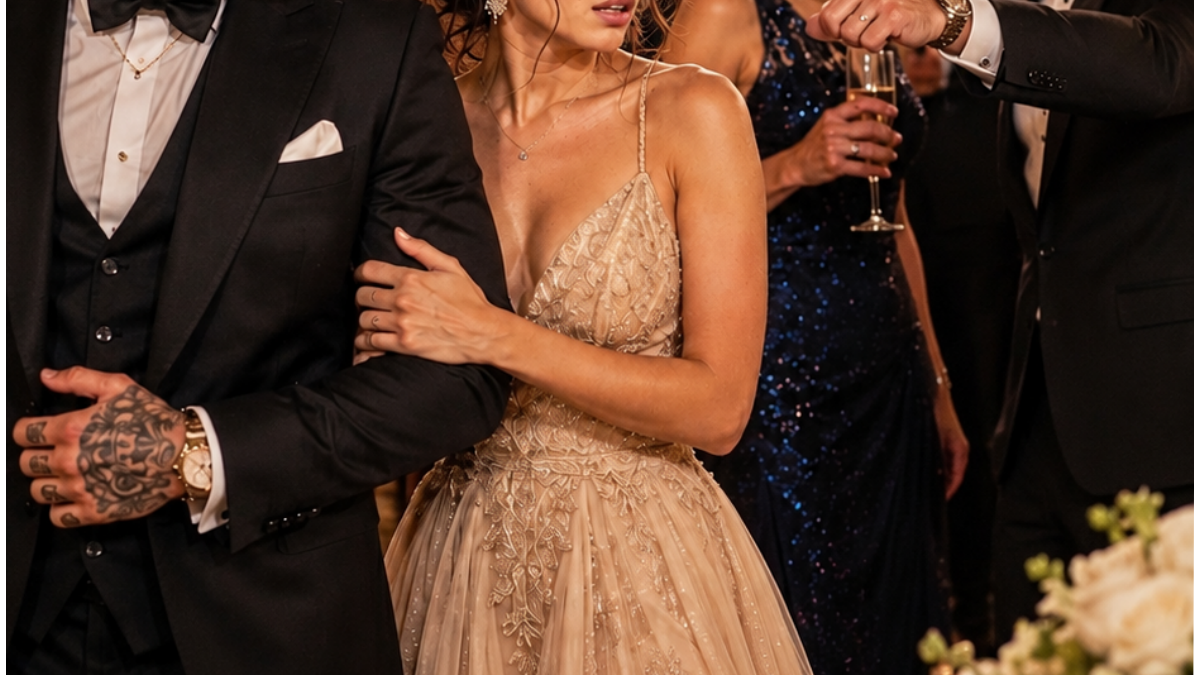

Marco Gardoni slammed his fist on the banquet table so hard the crystal glasses shook.
Get her out of my wedding.
His voice cut through 300 conversations like a blade.
Every head turned. Every breath stopped.
The woman standing beside Sylvio Gardoni didn’t flinch.
She didn’t run. She just looked at Marco the way someone looks at a painting they’ve already figured out with quiet, devastating patience.
Her name was Khloe Voss.
Her father had spent 20 years in prison for a crime the Gardoni family said he committed.
And she was standing at their wedding as the guest of the most powerful man in the room.
Ask yourself honestly, if the family that destroyed your father looked you in the eye and told you to leave, would you stay?
The conservation lab beneath the Chicago Historical Archive was the kind of place most people forgot existed.
No windows, no natural light, just the low hum of a dehumidifier, the smell of tarpentine and aged linen.
And Khloe Voss alone at 11:40 on a Tuesday night bent over a canvas that hadn’t been touched in probably 150 years.
She preferred it that way, not the isolation.
She wasn’t romantic about it.
She preferred the honesty of old things.
Damaged paintings didn’t pretend. They didn’t rearrange their faces when they felt something inconvenient.
The cracks in the paint were real cracks.
The discoloration was real damage.
You looked at a painting that had survived three centuries, and you were looking at exactly what it had survived.
Nothing more and nothing less.
People were not like that.
Kloe had learned that young.
She was working on a Renaissance portrait that had come in through a private estate donation 6 weeks ago.
No fanfare, no announcement, just a wooden crate and a custody document with a donor name that turned out to be a shell company.
The archive director had shrugged and told her to log it and find a storage rack.
Instead, she’d cleaned the surface layer and immediately knew something was wrong.
The aging on this painting was artificial, not in a clumsy way.
Whoever had done it knew what they were doing.
The crackle pattern was chemically induced, accurate enough to fool a casual eye.
Maybe accurate enough to fool someone with a decade of experience who wasn’t paying close attention.
But Kloe had been doing this for 8 years, and she paid attention the way other people breathed automatically without thinking about it, without being able to stop.
She spent 3 weeks confirming her suspicion before she told anyone.
And then she told no one because the more she looked, the more she understood that what was hidden under this fake Renaissance portrait was not a forgery in the traditional sense.
It was something much more deliberate.
She had been working under ultraviolet light for 2 hours when she found the first number.
Written in what appeared to be iron gall ink applied in a hand that was careful and small and terrified.
She could always tell when someone was writing in fear.
The letters had a particular quality of compression, as if the writer was trying to make themselves invisible.
Was a sequence of 16 digits she recognized as an account routing code.
Her hand stopped moving. She set down her brush.
She had seen her father write codes like that.
He was an accountant. He had worked for a private financial consulting firm that served, among other clients, the Gardoni family.
He had been extraordinarily good at his job, which was probably why, when $2.3 million went missing from Gardonia accounts in the summer of 2004, the investigators had looked at the man who understood the accounts best and decided he was the obvious answer.
Arthur Voss had gone to prison in 2005.
Kloe was 7 years old.
She stared at the 16-digit code under the ultraviolet light and told herself it was a coincidence.
Then she found the second sequence and the third and the symbol pressed faintly into the corner of the canvas where a painter would normally put their initials.
A small stylized G inside a ring of laurel, the Gardoni family seal, which she had memorized without meaning to during years of obsessively reading everything she could find about the case that had dismantled her childhood.
It took her another 40 minutes to understand what she was looking at.
This was a ledger. Not a painting over a ledger, not a painting with numbers hidden in the composition.
The entire work was a container.
The portrait was the wrapper.
Inside it, painted in a medium that required specific light frequencies to become visible, was a systematic record of financial transfers, dates, account numbers, the names of shell companies, and one recurring symbol that appeared at the bottom of each entry, functioning the way a signature functions, the Gardoni seal as confirmation, as authorization.
Her father had not stolen from the Gardoni family.
Someone had used his access codes and his professional reputation to move money through accounts he managed, then burned him when the structure needed to disappear.
The evidence had been hidden here, here in a painting for 20 years, waiting in the wrong kind of darkness.
She was reaching for her phone when the lights went out.
Not a power fluctuation, not a breaker.
The backup lighting didn’t activate, which meant someone had killed the main panel and also cut the secondary line.
And the only people who knew the secondary line existed were the archives facility staff.
And it was 11:45 at night.
Kloe held very still in the dark.
She could hear her own breathing.
She made herself slow it down.
There were footsteps above her.
More than one person moving with the careful, deliberate pace of people trying not to be heard and not quite managing it.
She heard a door. She heard what she was fairly sure was a metal canister being set down on the concrete floor of the ground level.
She had maybe 4 minutes.
She picked up the painting.
She looked at it in the pure dark, which was pointless, and she knew it was pointless.
She thought about what it had cost, not the painting, not the fake aging, not whatever criminal architecture had produced it.
She thought about what it had cost her father, 20 years, his reputation, her childhood, her mother, who had died in 2018, still carrying the weight of being married to a man that everyone in their neighborhood whispered about at the grocery store.
She couldn’t carry the whole painting.
It was too large and too fragile, and she needed her hands.
She did the thing that hurt her the most professionally and didn’t let herself feel it yet.
She took the conservation blade from her kit and she cut carefully, precisely, the way her training had taught her.
She removed the central section of the canvas, the portion with the densest concentration of coated entries, the portion that included the seal, and rolled it around the lightest support tube she had, wrapped it in acid-free tissue, and put it under her arm.
The smoke reached her before the fire did.
That was how it always worked.
The smoke came first, insidious and quiet, and then the heat behind it.
She found the emergency exit by memory.
She had walked this basement for 8 years, and she knew where every door was, which was the only reason she got out.
She came up from the basement stairs into the alley behind the archive, gasping, her eyes streaming, the rolled canvas pressed against her chest like something living.
The rain was cold and immediate, and she stood in it for a moment, just breathing, just existing, just being a person who had made it out.
The black car was parked at the end of the alley.
She noticed it the way you notice something that’s too still.
It had the quality of waiting, of having been there deliberately, of not belonging to chance.
The headlights were off. The engine was running.
She could see exhaust curling up through the rain.
She didn’t run. Running felt like the wrong choice, though she couldn’t immediately articulate why.
She thought about the painting under her arm.
She thought about her father.
She stood in the rain and looked at the car and waited to see what happened next.
The door opened. The man who stepped out was not what she expected, though she hadn’t known what she was expecting.
He was taller than she’d imagined from photographs, and she had seen photographs.
She had spent years collecting any public image of the Gardoni family, building the obsessive informal archive of someone who cannot let go.
He was wearing a dark suit that the rain was already beginning to damage, and he didn’t seem to notice or care.
He moved with the specific economy of someone who had long ago stopped wasting effort on things that didn’t require it.
Sylvio Gardoni stopped 3 ft from her.
He looked at the roll of canvas under her arm.
Then he looked at her face.
You got what you needed, he said.
It wasn’t a question. Who are you?
She said, which was stupid.
She knew exactly who he was.
But she needed a second to calibrate, to figure out what posture to take, what version of herself to be in this moment.
You know who I am.
I know your name. That’s not the same thing.
He studied her for a moment.
Most powerful men looked at her the way they looked at most women who worked in basements for a living with a kind of assessment that assumed the conclusion before examining the evidence.
Sylvio Gardoni looked at her differently.
He looked at her the way she looked at paintings she hadn’t figured out yet, like there was something there worth taking time with.
You’re cold, he said. Get in the car.
I’m not getting in your car.
You’re standing in the rain next to a building that’s about to have a significant fire investigation, holding what I assume is evidence that would be very inconvenient for several people who are still inside that building.
Getting in the car seems like the practical choice.
Or it’s how I disappear.
He didn’t flinch at that.
He didn’t reassure her. He just said, “If I wanted you gone, there were easier ways to arrange it than driving here myself.” Which was, she had to admit, a reasonable point.
She got in the car.
The interior was warm and quiet in the way that expensive things were quiet.
Not the absence of sound, but the management of it, the sense that the outside world had been politely but firmly turned down.
She sat on the far side of the back seat with the canvas in her lap.
And he got in on the other side, and for a moment neither of them spoke.
“My brother is getting married tomorrow,” Sylvio said.
She looked at him at him.
“Marco,” she said. “I know.
Then you know it will be attended by everyone of consequence in this city.
300 guests, people who have been waiting for years to see whether the Gardoni family is still what it used to be or whether we’ve become something easier to underestimate.
What does that have to do with me?
I need someone beside me who understands what they’re looking at.
Not a face, not a performance.
Someone who can read a room.
Chloe thought about what was on that canvas.
She thought about her father.
She thought about 20 years of a crime that wasn’t his and a family seal at the bottom of the evidence and a man from that family sitting 3 ft away from her telling her he needed her company at a wedding.
You’re asking the daughter of the man your family destroyed to be your date.
She said, I’m asking the woman who just walked out of a burning building with the most important piece of evidence in 20 years to come to a wedding where the people who sent those men tonight will also be present.
He paused. Whether that’s the same thing is a question worth sitting with.
You knew about the painting.
I knew something existed. I didn’t know what or where or whether it could be found after this much time.
Then how did they know?
Because someone inside my organization told them.
He said it without visible emotion, which was somehow worse than if he’d looked angry.
And I need to find out who.
And I need to find out without the people who already know too much understanding what I’m doing.
And I’m your cover. You’re my insurance, he said.
There’s a difference. Cover implies I’m hiding something.
Insurance implies I’m protecting something that matters.
She looked out the window.
The archive was visible from here, and she could see the first orange flicker at the third floor window.
Small yet controllable if someone got to it in the next few minutes, but growing with the specific appetite of fire that had been set deliberately, and knew it had time.
I want my father’s name cleared.
She said, “Everything on that canvas, every account number and transfer record in your family’s seal.
I want it used to prove that what happened to him was engineered.” I know.
That’s not a negotiation, Mr.
Gardoni. That’s the condition. I understand what a condition is.
She turned and looked at him.
He was watching her with that same measuring attention, and she realized she couldn’t read him.
Not the way she could usually read people.
Not the way she read the layers of a painting where patience and the right light eventually revealed everything.
He had learned somehow to keep his surface clean.
One day she said, “The wedding.
After that, I want to sit down with whatever legal structure you have access to and go through everything on this canvas.” Agreed.
And if I find out this is a setup, if you’re moving me to protect your family instead of help my father, I’ll find a way to burn it all down.
He nodded once, not dismissively.
The way someone nods when they’ve been told something they already believed was true and are not surprised to have confirmed.
“Get some sleep,” he said.
“We leave at 10:00.” The car pulled away from the alley, away from the burning building, away from the 20-year-old evidence that had just changed everything.
Khloe sat back and held the canvas against her chest and didn’t let herself think about tomorrow yet because tomorrow was too large and too complicated and she needed to survive the night firSt. She looked down at her hands.
The cut on her left palm from the conservation blade she hadn’t noticed making it in the dark had dried to a thin dark line across the lifeline.
Her father used to say that the difference between a professional and an amateur was not talent.
It was the ability to keep working when your hands were shaking.
Her hands were shaking now.
She pressed them flat against the canvas and kept them there.
And after a while, the shaking stopped.
Outside, Chicago moved past in wet neon and headlights and the ordinary business of a city that had no idea what was underneath it.
All the buried evidence, all the old crimes, all the painted over truths, waiting for someone patient enough and angry enough to find them.
Tomorrow she would walk into a room full of people who had reasons to want her gone.
She had walked out of a burning building tonight.
She told herself that was the harder thing.
She wasn’t entirely sure she believed it.
She didn’t sleep. Not really.
She lay on top of the covers in the hotel room that Sylvio’s driver had taken her to, a room that had been booked under a name that wasn’t hers on a floor that required a key card she hadn’t requested, and stared at the ceiling while the city made its ordinary nighttime sounds outside the window.
She had propped the rolled canvas against the wall beside the bed where she could see it.
She didn’t trust the room safe.
She didn’t trust anything in this building except her own ability to leave quickly if she needed to.
At 3:00 in the morning, she got up and unrolled the canvas on the desk and went through it again.
Not because she’d missed anything, because she needed to be sure she hadn’t invented it.
That was the fear she couldn’t quite shake.
The fear that 20 years of wanting her father to be innocent had finally bent her judgment.
That she was reading evidence into noise, patterns into randomness, the way a person who has been hungry long enough will see food in shapes that aren’t food.
But the numbers held. The seal held.
The handwriting was compressed and frightened and real.
And she recognized the routing codes as the kind used by offshore accounts in the early 2000s, which matched the timeline exactly.
She rolled the canvas back up.
She sat on the edge of the bed.
She thought about Marco Gardoni.
She had seen his face in photographs, too, younger than Sylvio, softer around the edges in a way that photographs of Silio never were.
The kind of man who had grown up in his brother’s shadow and arranged his personality around that fact.
He would be getting married today.
He would be at the center of something enormous and expensive and carefully constructed.
And then she was going to walk into it on his brother’s arm.
She already knew he would recognize her name.
She was counting on it.
The dress arrived at 7:15.
She hadn’t asked about a dress.
A woman she’d never met knocked on the door and handed her a garment bag without making eye contact and left before Kloe could ask a single question.
Inside the bag was a dark green dress structured at the shoulders, understated in the way that things which cost a great deal of money were understated.
A note was safety pinned to the hanger.
Your size, no jewelry, you don’t need it.
She stood in front of the mirror for a long moment.
She didn’t look like herself, which was the point, and also not the point at all because she had no intention of being someone she wasn’t today.
She looked like herself in a dress that fit correctly for the first time in recent memory.
That would have to be enough.
Sylvio knocked at 9:58. He looked at her the way he’d looked at her in the alley, taking inventory, not approving or disapproving, just cataloging what was there.
He was in a charcoal suit that made him look like what he was.
A man who had run a city’s underground economy for 12 years and had never once apologized for it.
The canvas, he said, it stays with me.
That’s not practical. Neither is trusting it to anyone I met yesterday.
She picked up the slim tube she’d fashioned from the hotel’s map folder and met his eyes.
I can carry it. Nobody will know what it is.
Something moved behind his expression.
Not quite respect, but adjacent to it.
Fine. The drive to the venue took 22 minutes.
They didn’t talk much. Kloe watched the city go by and thought about what she knew of Marco’s wedding.
She’d been following the Gardoni family and the society pages for years.
The way you follow weather patterns in a place you’re planning to travel to.
The ceremony was at a private estate in the northern suburbs.
300 guests, a sit-down dinner, a room full of people whose wealth and influence existed in the space between legal and illegal, and who had spent decades learning to make that space look like something else.
Who will be there that I should know about?
She asked. Everyone, Sylvio said.
That’s not useful, so I’ll be specific.
Dominico Ferry. He controls the port logistics on the south side and he’s been making overtures to our rivals for the past eight months.
He’ll smile and kiss me on both cheeks and mean none of it.
Sylvia Marchetti, she manages three shell companies that route through legitimate real estate.
Watch who she talks to and in what order.
And et Valente, he paused on the name just slightly.
He was my father’s adviser before he became mine.
He’ll be at the head table.
He has been with this family for 30 years.
You trust him? I trusted him yesterday, Sylvio said.
Today, I’m not sure about anything.
She turned to look at him.
His profile gave nothing away, which was a kind of answer by itself.
What do you know about the painting?
She asked. Before last night, he knew there was a financial record that my father had ordered hidden in 2003.
He believed someone inside the organization was preparing to move against him and he wanted insurance, something he could use or something his family could use if he wasn’t in a position to use it himself.
Silio kept his eyes on the road ahead.
He died in 2006. I spent 3 years after that trying to find what he’d hidden and found nothing.
I assumed it had been destroyed.
It wasn’t destroyed. It was donated to a public archive under a shell company, hidden in plain sight.
Which means whoever your father worked with knew the archive would preserve it indefinitely without examining it too closely.
My father didn’t hide it, Khloe said.
He wouldn’t have known how to fake the aging on a canvas.
Someone with art knowledge helped him.
Someone who understood that a museum basement was safer than a bank vault.
She paused. Do you know who that was?
Not yet. The estate appeared through the treeine as they turned off the main road.
It was the kind of property that announced money through restraint.
The gate was iron but not ornate.
The driveway was long without being theatrical.
The building itself was large but not aggressive.
It was the architecture of a family that had been powerful long enough to stop needing to prove it.
Kloe felt her jaw tighten.
She made herself breathe. The car stopped.
A valet appeared. Sylvio got out first and came around and opened her door, which she hadn’t expected.
Not out of gallantry, she realized immediately, but because he wanted to be standing beside her when she stepped out, wanted the first image anyone saw to be deliberate.
She understood that she was a tool being deployed.
She didn’t resent it because she was using him the same way.
She stepped out with the map tube under her arm and stood next to Sylvio Gardoni in the morning light, and she let people look.
The other guests arriving around them registered her the way a circuit registers an interruption.
Little hesitations, second glances, the polite social radar that powerful people developed.
The instinct for detecting something unfamiliar in a familiar environment, firing in every direction she could feel without being able to see.
The woman beside Sylvio Gardoni was nobody they recognized.
That was already a problem for them.
They moved through the arrival hall and Kloe did what she always did in a new environment.
She cataloged it. The flowers were fresh, which told her the wedding had been planned recently or revised recently.
The staff were wearing earpieces under their uniforms, more than a catering service required, which told her Sylvio had supplemented the venue security with his own people.
The guest seating arrangement, visible on a display board near the entrance, had her name, Ms. C.
Voss, at the headt right of center, one seat removed from where Sylvio would sit.
Someone had placed her where she could see the whole room.
She looked up at Sylvio.
You planned this, she said quietly, not accusing, observing.
I plan most things, he said.
The seat placement, the angle.
You want me watching the room.
You told me you could read people.
I told you I could read paintings.
Same skill, he said. Different medium.
She didn’t answer that, mostly because she wasn’t sure he was wrong.
The ceremony was in the garden.
She sat beside Sylvio in the third row, close enough to the front to be noticed, far enough back to watch everyone ahead of them, and observed 150 faces react to the arrival of the bride.
The bride was a woman named Elisa, dark-haired and composed, the kind of compose that was earned rather than natural, and she walked toward Marco with the careful precision of someone who had made a decision and had made peace with all of its consequences.
Marco Gardoni at the altar was not what Kloe expected.
He was nervous in a way that was almost painful to watch.
His hands wouldn’t stay still.
He kept pressing them against his thighs and then clasping them in front of him and then letting them fall to his sides.
And the whole cycle repeated every 45 seconds.
He was a man who wanted something to hold on to and couldn’t find it.
He hadn’t looked at Khloe yet.
She knew the moment he did.
She felt it. The quality of a gaze landing on you with recognition rather than casual attention, the specific weight of someone who knows your name before you’ve spoken it.
He was looking at his brother, smiling at something Silio had done with his chin in acknowledgement, and then his eyes moved right and found her face, and the smile stopped.
Not gradually, all at once.
He held her gaze for 4 seconds.
She counted. Then he looked away.
She felt the cold move through her chest and settle.
She had expected this. She was still not prepared for it because expecting a thing and experiencing it were not the same.
And 20 years of a name being associated with disgrace did not dissolve just because she was wearing a dress that fit correctly.
She kept her face neutral and looked forward.
The ceremony was 40 minutes.
The reception moved inside. Khloe stayed close to Sylvio, not because she needed him physically near her, but because proximity to the most powerful man in the room was its own form of armor, and she was not too proud to wear it.
She accepted a glass of water from a passing server and watched the room arrange itself.
Dominico Ferry found Sylvio in the first 10 minutes.
He was exactly what Sylvio had described, a man whose smile was technically present, but whose eyes were conducting a different conversation entirely.
He embraced Sylvio with both arms and said something warm about the family in the occasion.
And then his gaze moved to Khloe with the specific quality of a person completing a calculation.
“And who is this?” he said.
The warmth was still there, but it had cooled by 3°.
“Khloe Voss,” Sylvio said. Bar’s expression didn’t change, but something behind it went very still, and she watched it happen, and she filed it away.
“A pleasure,” Barry said to her.
Likewise, she said, and smiled the smile she used when she was photographing paintings for catalog.
Present but uninvested. The expression of someone who is seeing something clearly and not yet decided what it means.
Barry moved on within 2 minutes.
The moment he was gone, Khloe leaned slightly towards Sylvio.
He recognized my name, she said.
I know. He was frightened.
I know that, too. You could have told me he’d react that way.
I needed to see how you handled it.
He looked at her briefly.
You handled it correctly. She wanted to tell him that she wasn’t performing for his evaluation, but the truth was more complicated.
She was in some sense performing for exactly that, and they both knew it.
She let it go. Sylvia Marchetti came and went in a blur of silk and strategic small talk.
Khloe tracked her movement through the room afterward and noted that she spoke to Ferry within 4 minutes of leaving Sylvio’s side and that their conversation was brief and low and terminated when a server passed too closely.
The head table was seated at 7:15.
Kloe took her chair. To her left was Sylvio.
To her right was a man she didn’t know who turned out to be the bride’s uncle and who was blessedly focused on his own conversation.
Across the table, Marco sat beside Alisa, and he had been drinking since before the ceremony ended, which Khloe could assess with the professional detachment of someone who had learned to read the signs in other people before she ever let herself need them.
He waited until the first course was served.
“I’d like to say something,” Marco said.
The table quieted. It was loud enough to carry, not loud enough to reach the rest of the room yet.
He was looking at Sylvio, but the angle of his body was pointed at Khloe, and she understood before he finished the breath that this was coming for her.
I want to know why she’s here.
Silio set down his fork.
Marco. One word, flat. She’s a vos, Silio.
Her father is a man who spent 20 years in prison, Sylvio said, which is a topic I suggest you drop.
He stole from us. Her family name is Marco, still flat, but something underneath it had shifted, and the people sitting with an earshot heard it shift, and the conversations around them began to die.
Marco pushed his chair back slightly, not standing, not committing to a confrontation, but advertising the possibility of one, which was a specific kind of cowardice that Kloe recognized.
She had watched people do it to her father in courtrooms and grocery stores for most of her life.
You bring her here today on my wedding day and you expect me to just He stopped.
He was looking at her now directly.
Do you think this is a game?
Your father destroyed this family’s finances.
People loSt. Marco, it was Alisa who said it this time.
Quiet, firm. The way someone speaks who has used their voice to stop things before.
Her hand went to his arm.
He shook it off. Not violently, just enough to communicate that he was not going to be managed right now.
I want her removed. He said it to Sylvio, but looked at Khloe.
I want her out of this room today.
Now, the room had gone very quiet.
300 people, and somewhere in the accumulated silence, Kloe could hear her own pulse and the faint sound of the centerpiece candles burning.
She had known this was coming.
She had prepared for it.
She had told herself in the hotel room at 3:00 in the morning with the canvas unrolled on the desk that she would not react, that she would hold still and let it wash past her like cold water, the way she’d learned to hold still when things hurt.
But she was tired. She had been tired for 20 years.
And there was something about being publicly erased, not argued with, not engaged with, but dismissed as an object that needed to be removed that bypassed every rational preparation she had made.
She opened her mouth. Sylvio spoke firSt. She stays.
He said it with no particular emphasis.
He didn’t raise his voice.
He picked up his fork again in a gesture that managed to be both casual and deliberately final.
She is under my protection.
And anyone who speaks to her the way you just did speaks to me the same way.
Marco stared at his brother.
The silence stretched out into something that had physical weight.
Then Marco sat back in his chair and picked up his glass and drank from it and said nothing else, and the room slowly began to exhale.
Alisa looked at Chloe across the table.
Her expression was complicated, not unkind, but not simple either.
It was the look of a woman who had walked into a situation with eyes open and was still discovering what it actually contained.
Kloe looked back at her and held it for a moment.
Then she picked up her own fork and turned to the plate in front of her and focused on eating, which was the most ordinary thing she could do and therefore the most effective statement she was capable of making.
The first course passed. The second course arrived, and that was when Khloe saw the painting.
It was hung on the far wall of the reception hall, positioned between two tall windows in a place of obvious honor, the kind of placement that announced significance, that said, “This is not decoration.
This is a statement.” a Renaissance era work, or apparently so, a pastoral landscape with figures, the kind of composition that would be at home in any major European collection.
The frame was appropriate to the period.
The lighting above it was flattering.
She set down her fork.
She looked at it from across a room full of people at a distance of perhaps 35 ft in artificial light that was all wrong for proper examination.
And she looked at it for 45 seconds without blinking, and she felt the knowledge settle into her.
The way cold water settles, finding every available space.
The crackle pattern in the paint was wrong.
Not wrong in the way a forgery made by someone careless was wrong.
Wrong in the specific signature way of the painting she had cut apart the night before, the same chemical aging process, the same too regular distribution of surface cracks that real age would have made a regular.
She had spent 8 years learning to see this and she was seeing it now.
And what it meant was that whoever had sent the men to destroy the archive last night had also put a fake Renaissance painting on the wall of Marco Gardon’s wedding reception.
She needed to see it up close.
She excused herself from the table, which no one acknowledged except Sylvio, who tracked her movement with his eyes, but said nothing.
She circled the room along the wall, staying in the peripheral space that people occupied when they were going somewhere with a purpose that seemed uninteresting.
She moved like a woman who was looking for the restroom and would find it eventually.
She stopped in front of the painting.
Up close, it was better work than she had initially assessed.
The forger had real skill.
The compositional decisions were correct.
The color palette was appropriate.
The figures had the right proportion of stiffness that characterized the actual period.
If she hadn’t already spent a night staring at an identical false aging technique, she might have needed 10 minutes with it before she was certain.
She needed 30 seconds. She put her hand on the frame as if steadying herself, the gesture of a woman standing in heels at a long event, and tilted the bottom of the frame very slightly away from the wall, just enough to see the back of the canvas, just enough to see on the stretcher bar a small adhesive label with a warehouse address and a five-digit code.
She let the frame settle back.
She stood there for a moment, looking at the painted landscape, at the false age in the surface, at the gift card mounted on the wall beside it with love and congratulations from the Valente family.
And she thought about Sylvio saying that name in the car, at Valente, 30 years with this family.
She thought about what a painting could carry that wasn’t paint.
She thought about what a wedding gift in a room full of powerful people could move from one place to another without anyone looking at the contents.
She walked back to the table.
She sat down. She put her hand on Sylvio’s arm, which was the first time she had voluntarily touched him, and she felt him go still beside her with the alertness of someone who recognizes that a threshold has been crossed.
She leaned in close enough that only he could hear her.
“The painting on the far wall,” she said, the one marked as a Valente gift.
“It’s a fake, the same technique as the one from the archive.” He didn’t look at the painting.
He looked at his plate.
“Same technique,” he repeated. “Same forger, almost certainly.
And there’s a warehouse code on the stretcher bar.” She paused.
“That painting is carrying something, Silio.
Information or instructions, the same way the archive painting was carrying the ledger.
Whatever it is, it’s meant to leave this room with someone tonight.” He was quiet for a moment.
The muscle in his jaw moved once.
“Who sent it?” “It says Valente.” Another silence longer this time.
“Etur,” Sylvio said very quietly.
The word arrived in the space between them with the weight of something that had been building for a long time and had finally finally landed.
“I need to examine it properly,” she said.
“And I need to not do it in front of 300 people.
After the dinner, during the dancing, the room will redistribute.” He turned his head just slightly toward her.
“Can you get to it without being noticed?” I’ve been invisible in rooms full of people my entire life,” she said.
“Yes.” He held her gaze for a moment.
She saw something move through his expression, something she didn’t have a name for yet, something that was not gratitude and not respect, but was in the territory between them.
Then a sound cut through the room, and every thought ended.
It was glass breaking, but not in the casual way of something dropped.
It was the specific, deliberate sound of a glass being broken on purpose.
The sound Marco made as he stood up from his chair on the other side of the table.
The fragments of his champagne flute scattering across the tablecloth as he rose with the unsteady certainty of a man who had been drinking for 3 hours and had arrived at the point where caution felt like cowardice.
He was looking at Sylvio.
No, he was looking past Silio.
He was looking at Kloe.
I did some checking, he said.
His voice was too loud.
Everyone at the head table heard it.
The tables nearest to them heard it.
The sound spread outward and conversations began shutting down in concentric rings.
While we were eating, I had someone check.
He pointed at her. Your father, Arthur Voss.
He wasn’t just an accountant who stole from us.
He was the one who set up the accounts that funneled money to the people who had our father killed.
Kloe stopped breathing, not because she was afraid, because the accusation was so specific, so structurally different from anything she had been prepared for that her entire mind halted for one full second to process it.
Her father, responsible for the death of the Gardoni patriarch.
Marco, sit down. Sylvio’s voice had changed.
It was no longer flat.
It had a temperature now, low and dangerous in the way of things that are very cold rather than very hot.
It’s the truth. Marco’s hand was shaking.
Etor told me after father died.
He said Voss was the one who arranged the financial access that let them in.
He said we couldn’t prove it in court, but that we knew.
Etor told me Kloe felt everything in the room rearranged around those three words.
Etore Valente 30 years with this family.
The man who had raised Sylvio after his father died.
The man whose name was on the painting on the wall.
Who had told Marco perhaps years ago, perhaps as a piece of careful long-term architecture, that the man already in prison for financial crimes had also contributed to the death of the family patriarch, which would explain why Marco’s hostility had the specific quality of something practiced, something nursed, something that had been growing in him for longer than one conversation.
She looked at Sylvio. He was looking at Marco, and in his face, for the first time since she’d met him 16 hours ago, she could see something behind the surface.
Something that looked like a man watching a structure he had trusted collapse.
He knew, not everything, but enough.
In the space between Marco saying Etre’s name in the present moment, the same calculation she had made was running in Sylvio’s mind and arriving at the same place, and she could see it land in him like, “Wait.” “He’s lying,” Khloe said.
The room heard her. She hadn’t raised her voice, but the room was quiet enough.
Chloe, Sylvio said quietly. Not to Marco, she said.
Marco is repeating what he was told.
I mean, the person who told him is lying, and I can prove it.
She looked at Marco across the wreckage of his champagne glass and the ruin of his wedding dinner.
Not right now, not in the next 10 minutes, but I have what I need to prove it, and when I do, the name you should be saying is not my father’s.
Marco stared at her. “Whose name should I be saying?” he said.
She held his gaze. She was aware of the entire room watching.
Of Valente somewhere in this building, of the painting on the wall with the warehouse code on its stretcher bar, of the rolled canvas in the tube under her arm where she had kept it all evening like a second spine.
She made a decision. “Ask your brother,” she said, “and ask him who gave him that painting.” She reached for her water glass and drank from it and set it back down with perfect steadiness because her hands were shaking and she was not going to let anyone in this room see that.
Not tonight, not now. Not while everything she had spent 20 years waiting for was finally beginning to move.
Across the table, Marco slowly sat back down.
And in the silence that followed, Khloe heard it soft, easy, almost inaudible beneath the weight of 300 people holding their breath.
The sound of a champagne glass being set down at the far end of the room.
She didn’t look. She didn’t need to look.
Valente was watching her. She could feel it the way you feel weather changing before the temperature drops, before the first drop falls.
There’s a moment when the air knows what is coming, even if the skin doesn’t yet.
She had just declared herself in front of everyone.
There was no version of tonight now where she walked out of this room and went back to her basement and her damaged paintings and her ordinary silence.
She had known that when she got in the car.
She had told herself she’d known it.
But knowing something and arriving at the moment where it becomes irreversible were still different things.
Even when you’d prepared, even when you’d chosen it, she was in it now.
She was going to have to move firSt. That was the thought that finished itself in her mind in the silence after the champagne glass was set down somewhere behind her.
Not wait, not watch. Move, because the window between eter understanding what she’d just done and et doing something about it was measured in minutes, not hours.
And she had been passive for 20 years and look where that had gotten her father.
She leaned towards Sylvio without turning her head.
The painting. She said, “We need to get to it now before the room starts moving again.
The room is watching us.
The room is watching Marco.
There’s a difference.” She set her napkin on the table with the careful deliberateness of a woman who has decided something and is done deliberating.
“Tell me you have someone who can hold the far end of that hall.” Sylvio didn’t answer immediately.
She could feel him running the calculation.
What was visible? What was acceptable?
What would read as normal behavior to 300 people who were currently pretending they hadn’t heard everything that had just happened at the head table.
Then he touched the inside of his left wrist, a gesture so small it looked like he was checking a watch and somewhere in the room a man in a catering uniform adjusted his position near the far window.
2 minutes, Sylvio said. She stood up.
She moved toward the painting the way she always moved through unfamiliar spaces, along the edges, in the current of people rather than against it, in the behavioral register of someone with a minor purpose.
She passed a server. She paused beside a floral arrangement as if admiring it.
She arrived at the far wall.
Up close the second time, with the room redistributing itself around the disruption at the head table, she had more time than she’d expected.
She took the 30 seconds she needed.
She examined the lower left quadrant of the canvas where the crackle pattern shifted just slightly, just enough, and confirmed what she’d suspected from across the room.
The false aging was heavier there, more concentrated, the way it would be if something had been inserted beneath the paint layer in that specific area, something that created a slightly different surface tension.
She didn’t have tools. She had her thumbnail in 23 years of looking at things too closely.
She pressed gently along the frame’s inner edge in the lower left corner.
The canvas gave just fractionally in a way that stretched canvas over aged wood should not give because it wasn’t aged wood.
It was a channel and inside the channel was something flat and stiff that had been fitted there with the same precision as the false aging on the surface.
A document or something functioning as one.
She couldn’t extract it here.
Not without tools, not without time she didn’t have, not without being seen doing it.
She memorized the exact position and stepped back and turned and found that the 2 minutes Silvio had promised her were almost gone.
And also that she was being watched, not by the room, by one man standing near the entrance to the corridor that led to the kitchens holding a glass of brandy with the ease of someone who had been holding glasses in rooms like this for 30 years.
Valente was older than his photographs.
Photographs of powerful men always made them look more solid than they were.
It was something about the way cameras handled confidence, the way they read stillness as strength.
In person, actor was thinner than she’d expected.
His hair was white and precisely cut.
His face had the particular quality of a man who had learned very early in his life to look like whatever the room needed him to look like.
He was looking at her with an expression that was almost admiring that frightened her more than anger would have.
She walked back toward the head table.
She didn’t hurry. Hurrying was information, and she was done giving this room information for free.
Sylvio stood as she approached, which no one at the table had expected, and the small formality of it, a man in his position standing for a woman in hers, recalibrated something in the social atmosphere that she could feel without being able to name precisely.
She sat. He sat. Lower left corner of the frame, she said quietly.
There’s a document channel. I couldn’t get to it without tools.
What’s in it? I don’t know, but it’s flat and rigid, and it was put there by someone who knew what they were doing, she paused.
ET saw me at the painting.
Sylvio’s fork stopped moving. He didn’t approach, she said.
He just watched. He looked.
She searched for the word unsurprised.
Ator is never surprised. Silio said, “He taught me that something in his voice had the quality of a man quoting someone he trusted and realizing in real time that the trust was the wound.” He said it was the first principle of staying alive in this business.
If something surprises you, you weren’t paying attention.
Then he was paying attention tonight.
Yes. Which means he knew I’d be here.
Sylvio set the fork down entirely.
I didn’t tell him about you until this morning.
I called him from the car on the way to pick you up.
She absorbed that. What did he say when you told him?
He said it was an interesting choice.
Sylvio looked at the table in front of him.
He said the Voss name would cause probleMs. He wasn’t wrong.
No, he was exactly right, which is what bothers me.
He looked up across the room at the corridor entrance.
It had moved from his position, gone or moved deeper into the corridor.
She couldn’t tell. Etor is never exactly right by accident.
When he gives you a prediction that comes true, it’s because he made it happen.
She looked at the corridor entrance.
Empty now. He wanted Marco to react to me.
She said, “Yes, because a scene at the head table pulls attention to the center of the room and away from the walls.” Sylvia went very still.
“Away from the painting,” he said.
She was already standing. She moved faster this time, abandoning the pretense of casual navigation, cutting diagonally across the room toward the far wall.
A server stepped into her path, and she went around him without slowing.
She was aware of Sylvio moving behind her, of people turning to look, of the particular quality of attention that 300 people had been building all evening, finally finding a focus that wasn’t the head table.
She reached the wall. The painting was gone.
Not fallen, not shifted, gone.
The wall was bare except for the picture hook and a small rectangle of slightly cleaner paint where the frame had kept 20 years of ambient dust from settling.
Someone had taken it down and removed it in the she counted backward 6 minutes since she’d examined it the first time.
6 minutes. While the room’s attention was fixed on Marco’s outburst and her response to it, she stared at the clean rectangle on the wall.
Behind her, Sylvio said nothing.
She could hear him breathing, which was unusual.
His control of his own body was so complete that she’d stopped noticing his breath.
And hearing it now meant something had broken through.
“The corridor,” she said. They moved together through the kitchen entrance, past two servers who flattened themselves against the wall without being asked into a corridor that smelled of food and cleaning products and something chemical underneath that she couldn’t immediately identify.
The corridor ran the length of the building, and at the far end, a door was just closing.
Not slamming, not urgent, the careful, controlled closure of someone who did not want to be heard, but was not afraid.
Sylvio’s hand went to the inside of his jacket.
Don’t, she said. Chloe, not yet.
If you fire a weapon in a building with 300 people, we lose everything.
The canvas, the evidence, any chance of this ending in a courtroom instead of She stopped.
Please. His hand came away from his jacket.
He looked at her with an expression that was not gratitude and not agreement, but was the face of a man who was choosing to trust a judgment that wasn’t his, which was, she was learning, the most uncomfortable thing Sylvio Gardoni was capable of doing.
They pushed through the door at the end of the corridor.
The service yard behind the estate was dark, except for the utility lighting over the loading dock.
Two catering vans were parked on the left.
A third vehicle, a gray sedan with no distinguishing markings, was pulling out of the service gate with its headlights off.
And standing at the loading dock, watching the sedan leave with the specific stillness of someone who has just completed a task, was a man she didn’t recognize.
40 maybe. In a catering uniform that fit slightly wrong across the shoulders, the way borrowed clothes fit, not the way a uniform fits someone hired to wear it.
He was holding the painting under his arm with the casual confidence of someone carrying a thing they had every right to carry.
He saw them at the same moment they saw him.
For one second, nobody moved.
Then he ran, not toward the gate.
The sedan was gone, but along the back wall of the estate toward the delivery entrance on the north side, and he ran with the particular urgency of a man who understood that being caught with what he was carrying was a problem with no diplomatic solution.
Sylvio ran after him. Kloe ran after Sylvio, which she was aware was probably not the sensible choice, except that the man in the ill-fitting uniform was carrying the only physical evidence of what had been doing with the Gardoni name, and she had not come this far to watch it disappear over a wall.
The man was faSt. I mowed the delivery entrance and shoved through it onto the estate’s north lawn, which was dark and wet from the evening dew and difficult terrain in heels, which Kloe abandoned without breaking stride, running barefoot on grass that was cold and slightly slick, aware of Sylvio pulling ahead of her because his legs were longer and he was not working in bare feet on wet ground.
Silio caught him at the north fence.
She heard the impact before she saw it, the solid sound of one body overtaking another.
And when she arrived, both men were on the ground, and Sylvio had the catering uniform by the collar, and the painting was lying on the grass 3 ft away, still intact.
She went for the painting.
The man on the ground said something in a language that wasn’t English, not Italian, something else, something Eastern European in its consonant structure.
And Sylvio said something back, low and precise, and whatever he said made the man stop struggling.
Khloe picked up the painting.
She ran her hands over the frame, located the lower left corner, and found the channel immediately because she’d memorized its position, and because her hands knew what they were looking for now.
She pressed along the inner edge, the panel gave.
She extracted the document with two fingers, the way she extracted fragile material from aged frames in the conservation lab, and held it up in the weak ambient light from the estate’s exterior fixtures.
It was a photograph printed on heavy paper, the kind used for document reproduction rather than display.
It showed a warehouse interior.
In the foreground, stacked on pallets were crates, the kind used for art transport, reinforced corners, humidity controlled interior lining visible on the open examples at the front of the stack.
In the background, barely visible, but clearly identifiable to someone who had spent years cataloging historical artwork, were the edges of frames, dozens of them, stacked against the wall in the careful, systematic way of someone managing a collection.
At the bottom of the photograph, in the same handwriting as the coded entries she’d found in the archive painting, small, compressed, written in fear, was a single line, “Port terminal 7 midnight.
Everything is here.” She looked at the handwriting for a long moment.
She had spent weeks with the entries in the archive canvas.
She knew this hand. She knew the specific way the writer compressed their letters when they were afraid.
The way the pen pressed harder on consonants, the way the baseline drifted slightly downward as if the weight of what was being written was pulling the letters toward the ground.
Her throat closed. This isn’t handwriting, she said.
Sylvio looked at her from where he was holding the man on the ground.
What? The note? The one hidden in the painting.
The handwriting. She stopped. She made herself look at it again.
She had been wrong before.
She could be wrong now.
She looked at the compressed letters, the heavy consonants, the falling baseline, the specific quality of fear that she had learned to see over 8 years of examining documents that people had tried to hide.
She was not wrong. This is my father’s handwriting, she said.
The silence in the dark yard had a different quality than the silence inside the reception hall.
This one was cold and absolute and she was standing in the middle of it in bare feet on wet grass holding a photograph that her father had written a note on.
And the note directed whoever found it to a port terminal in the middle of the night and she did not understand what it meant.
But she understood that whatever she had thought was true about this situation was not the complete truth.
That’s not possible. Sylvio said, I know what my father’s handwriting looks like.
Your father has been in prison for 20 years.
People in prison can write things, she said.
The words came out with a flatness that she recognized as the sound of her own mind refusing to process something too large.
People in prison can pass documents to people on the outside.
People in prison can she stopped.
She breathed. Someone has been in contact with him.
Someone has been communicating with him while he was inside.
And he sent this and it arrived here tonight in a painting with Et’s name on the gift card.
The man on the ground said something again.
Sylvio tightened his grip. “Who gave you the painting?” Sylvio said.
His voice had dropped to something that was almost conversational, which in her experience of the past 24 hours meant he was at his most dangerous.
“Say it in English.” “I carry,” the man said.
His English was accented and minimal.
Only carry. They give me, I bring.
Who gave you? The old man, white hair.
He say bring painting. Bring this envelope.
He gestured toward the photograph in Khloe’s hands.
He say make sure the woman sees it.
The woman with the dark hair.
Khloe looked up from the photograph.
He wanted me to find it.
She said. Yes. Sylvio said slowly.
Etor put this painting here.
He told someone to make sure I examined it.
He put my father’s handwriting in it.
Or my father sent something to him or through him and he [clears throat] used it.
She stopped again. The scenario was branching in too many directions and she needed to stop following all of them simultaneously and pick one.
He’s directing me somewhere. Port terminal 7, Silio said at midnight.
She looked at the time.
It was 9:47. 2 hours and 13 minutes.
Silio released the man on the ground.
He stood and she watched him make a decision with his whole body.
The slight squaring of the shoulders, the way his weight settled differently.
This is a trap. Probably.
Then we don’t go. My father’s handwriting is on that note, she said.
Silio. She waited until he looked at her.
If there’s a chance that he’s there, that whoever has been communicating with him arranged something, used something he gave them to get me to that terminal, I cannot not go.
If it’s a trap, you die.
If I don’t go and my father is there, he she couldn’t finish the sentence.
Not because she didn’t have the words, but because the words were too specific and too terrible, and saying them out loud felt like she would be making them real.
I have to go. He looked at her for a long time.
She looked back. She was aware of the wet grass under her feet and the cold air and the distant sound of the wedding reception carrying through the estate walls.
Music starting now, the dancing beginning.
300 people in formal clothes moving through a choreography of celebration while out here in the dark.
The actual architecture of the evening was revealing itself to be something entirely different from what any of them had understood.
Not alone, he said finally.
Then come with me. They went back inside for exactly as long as it took Sylvio to exchange four words with two of his men and collect Khloe’s shoes from under the head table.
And then they left the wedding.
Marco saw them go. She looked back once from the entrance of the reception hall and he was watching them from the head table with an expression that was no longer angry.
It was frightened, the kind of frightened that lives deeper than the surface.
The kind that tells you a person has just realized they don’t actually know what’s happening around them and haven’t for a long time.
She almost felt something for him.
She filed it away for later.
The drive to the port took 40 minutes.
Sylvio made calls she couldn’t entirely follow.
Names, locations, short directives, and she sat beside him with the photograph in her lap and her shoes back on her feet and the tube containing the canvas pressed against her side.
And she went through everything she knew in the order she knew it, looking for the shape of it.
Her father had been framed by someone who had access to his professional credentials and his knowledge of the Gardoni accounts.
The frame had sent him to prison in 2005.
The evidence of the real financial movement had been hidden in a painting stored in a public archive, preserved by institutional inertia for 20 years.
Someone had known about the painting recently enough to send men to destroy it.
Sylvio had known the painting existed, but not where it was.
Et had told Marco years ago that Arthur Voss was responsible not only for financial theft, but for the death of the Gardoni patriarch, which was an escalation of the accusation in addition to the original charge.
Something that would make Marco’s hatred of the Voss name personal and permanent.
And now Etor had put her father’s handwriting in a painting and sent it to his own boss’s brother’s wedding wrapped in his own name.
He wanted her to go to Terminal 7.
He wanted Sylvio to go with her.
The question was whether her father was actually going to be there or whether the handwriting was a copy, a reproduction extracted from the letters Arthur Voss had been writing and receiving in prison for 20 years, which were monitored, which were documented, which were available to anyone with the right access to the prison’s administrative system, which included people with 30-year relationships with the criminal infrastructure that had put Arthur Voss there in the first place.
She looked at the photograph.
She looked at the handwriting.
She had been telling herself she was certain.
She was not certain. She was a woman who missed her father with the specific durable ache of someone who had been missing him since she was 7 years old.
And she was holding a piece of paper with letters in his hand.
And she was in a car going toward a port terminal at 10:30 at night.
And she was aware that these two facts were not unrelated.
She pressed her hands flat against her thighs.
“Tell me about,” she said.
Not what he does, who he is.
Sylvio was quiet for a moment.
Outside the window, the city was thinning.
Fewer lights, more industrial infrastructure, the grammar of a port area beginning to assert itself in the landscape.
He came to my father when I was four, Sylvio said.
I don’t remember a time without him.
He was the person who explained things.
My father was, he paused.
My father operated on instinct.
He was brilliant and he was brutal and he did not explain his thinking to anyone including us.
At was the one who translated.
He told me what my father meant when my father said things that I didn’t understand.
He told me what the rules were and why they existed.
He stopped. When my father died at was the one who kept me from making the mistakes that would have gotten me killed in the first year.
He knew which alliances to preserve and which debts to call and which enemies to let think they’d won so they’d lower their guard.
He was indispensable. She said he made himself indispensable.
Sylvio said it without inflection, which was the coldest way she’d ever heard someone say a true thing.
I understand that now, not because I was stupid, because he was very good at it.
How long do you think it’s been going on?
Whatever he’s been doing. If it started before my father died, he stopped.
Something moved through his face, a thought arriving that he didn’t want.
If arranged my father’s death and then spent 12 years managing the aftermath, managing me, he stopped again.
Then you’ve been running an empire that someone else has been steering, she said.
From the inside. The car stopped.
Terminal 7 was a dark mass of containers and overhead cranes and the smell of salt water and diesel lit at intervals by security lights that turned the shadows the wrong color.
The facility was supposedly decommissioned, a condemned terminal awaiting demolition that had been awaiting demolition for 11 years, which in a city like this meant someone was paying someone to keep it exactly as it was.
Sylvio’s men were already in position.
She counted three vehicles that she could see and assumed there were more she couldn’t.
He had used the 40-minute drive.
Well, “You stay with me,” Sylvio said.
“I’ll stay close,” she said, which was not the same thing, and they both knew it.
They went in through the south gate, which had a padlock that one of Silio’s men removed in under 10 seconds.
The interior of the terminal was a city of containers, 40ft steel boxes stacked four high in rows that created corridors and dead ends and the kind of spatial complexity that made navigation almost impossible without prior knowledge of the layout.
She had the warehouse address from the stretcher bar, five digits that corresponded she had worked out during the drive to a grid reference for the terminal’s internal organization.
The kind of numbering system used by port logistics, which she knew because her father had explained it to her once years ago on one of her prison visits.
When she’d asked him about his work, and he’d been in the mood to answer, she led the way.
That felt significant, and she didn’t let herself think about it.
Grid reference 47 C was deep in the terminal’s northwest quadrant.
She found it by memory and calculation and one wrong turn that she corrected without saying anything.
When they arrived at the correct row, she saw the light before anything else.
Not security lighting, but the warm directional light of interior work lamps coming from a container whose doors stood partially open.
Silio put his hand on her shoulder.
She stopped. They stood in the dark corridor between two rows of containers and listened.
No voices, no movement. The work lamps burning inside the open container and nothing else.
She moved forward. He moved with her.
Inside the container was the photograph made real.
Crates stacked on pallets, art transport cases with reinforced corners and humidity lining, frames stacked against the corrugated metal walls with the systematic care of a professional collection.
She swept her eyes over it, and her heart did something complicated.
Because these were not forgeries or not only forgeries.
Some of what she was looking at was real.
She could see it in the quality of the frames, in the visible edge of one canvas, where the paint had the particular luminosity of genuine age.
And she understood with the specific clarity of someone whose profession was the preservation of lost things, that what she was standing in was a stolen archive.
Historical treasures that had been missing from museums and private collections, removed over years, stored here, waiting.
Waiting for what? She didn’t know yet.
In the center of the container, on a folding table between two work lamps, was a single object.
A journal, old clothcovered, the binding repaired with tape that had itself aged and begun to separate.
She knew it before she touched it.
Knew the cloth. Knew the way the corner was bent from being carried in a back pocket.
Knew the tape repair because she had watched her father do it when she was six years old, sitting on the kitchen floor while he worked at the table above her.
She picked it up with both hands.
Inside the front cover in her father’s handwriting, “Real, unmistakably real, not a reproduction, were the words, “If Chloe finds this, she found everything.
That means I was right to truSt.” Her eyes burned.
She pressed them closed for exactly one second, then opened them.
She turned to the first page.
She had been reading for 40 seconds when she heard the container doors close behind her.
Not slam, close. The deliberate mechanical sound of heavy doors being pulled shut from the outside.
The sound of the locking bar engaging and then from somewhere above the sound of footsteps on the container’s roof.
She looked at Sylvio. He had his weapon out.
He was looking at the sealed doors with the controlled stillness of a man who has been in worse situations and is assessing whether this is actually one of them.
How many exits? She said one.
He was already moving toward the ventilation panel at the far end.
The roof access is welded.
Standard container modification for a voice came through the container walls.
Not muffled the way she’d expected.
Clear, amplified, the sound of someone speaking through a system that had been installed in the container’s walls for exactly this purpose.
I’ve been waiting a long time for this, etalenti said.
I want you to know that it hasn’t been easy being patient.
Khloe looked at the sealed Kloe looked at the sealed doors.
She looked at the journal in her hands.
She looked at Sylvio, who was looking at the ventilation panel with the expression of a man calculating whether the opening was large enough and had already reached the answer she didn’t want.
Sylvio’s voice through the walls was almost gentle.
I need you to understand something before this goes any further.
Everything I have done, every decision, every arrangement, every necessary removal has been for this family, your father included, especially your father.
Sylvio’s jaw tightened. He was going to destroy everything, Et said 20 years ago.
He found out about my arrangements, the alternative revenue structures, the partnerships with certain outside organizations, and he decided it was a betrayal.
He was going to dismantle 30 years of work because he had a crisis of conscience at 62 years old.
A pause. I couldn’t allow that.
You had him killed, Sylvio said, to the walls.
To the amplified voice coming through them.
His voice was completely level in the way that things are level when every available unit of control is being spent on a single task.
I made a decision that kept this family alive.
You had my father killed and framed the accountant.
Khloe said she was looking at the journal in her hands.
Because my father had the documentation because he was the only person outside your immediate circle who understood what the accounts were actually doing.
So you used him to hide it and then burned him when the structure needed to disappear.
Silence from the walls. He didn’t know what he was documenting.
Et said finally give him that credit.
Arthur Voss was an honest man.
Genuinely honeSt. It’s a remarkable quality quite inconvenient.
And the journal she said he put it together eventually.
In 20 years is a long time to think.
Ero said he’s a thorough man your father.
He documented everything he remembered.
Every account, every transfer, every instruction he received from people he thought were legitimate clients.
It took him 11 years to get it to me.
He thought you were helping him.
Another silence. He thought someone was helping him.
He didn’t know who. I intercepted the communication channel he’d established with an outside contact and redirected it.
He has been for the past 9 years sending his documentation to me while believing he was building a case with someone who would eventually free him.
Et paused. The irony is that his documentation is extraordinarily complete.
He’s a meticulous man. Khloe’s hands tightened on the journal.
9 years. Her father had spent nine years carefully, systematically building the case that would clear his name, trusting that someone was going to use it, and the person receiving it had been the man who put him there.
The anger that moved through her was not hot.
It was the opposite of hot.
It was the kind of cold that comes from something essential being removed, not taken, removed, extracted from the place where it had been keeping her functional.
She looked at the sealed doors.
She looked at the ventilation panel.
She looked at the journal.
She opened it to the last entry her father had written, which was dated 3 weeks ago, and she read the last line, which said, “I believe they’re close.
I believe someone is finally listening.
I’m not afraid anymore.” She closed the journal.
She looked at Sylvio across the work lamps, and what he saw in her face must have told him something because he stopped calculating the ventilation panel and looked at her fully with the attention of a man who has decided that whatever this woman does next, he is going to follow it.
She was done being the person things happened to.
She was done being the woman in the basement who restored other people’s damaged things while her own life stayed broken.
She pressed the journal against her chest with one arm and looked at the container walls and said loud enough for the amplification system to carry clearly.
Etor, I want you to listen to me very carefully because I’m only going to say this once and then I’m going to do it whether you believe me or not.
The walls were silent. I have the archive canvas.
I have everything on it.
I have my father’s journal with 9 years of documentation that he thought he was sending to someone who would help him, which means he was thorough, which means it’s complete, which means every arrangement you’ve built over 30 years is in my hands right now.
She paused. And I made copies before I came here tonight.
She had not made copies.
She had not had time to make copies.
She was lying with the complete steadiness of a woman who had spent 20 years being told the truth didn’t matter and had finally decided that what mattered was what you were willing to do with it.
Open the doors, she said, or I make a phone call and everything your father spent 30 years building.
The silence after her last word had a specific texture, not the silence of a room waiting for something to happen.
The silence of a structure under pressure, the kind that precedes a crack that exists in the last half second before the surface gives way and everything behind it comes through at once.
She stood in it with her hand pressed flat against her father’s journal, and her heart doing something architectural in her cheSt. Not racing, not yet, but building toward it.
Each beat laying the foundation for the next.
Silio hadn’t moved. He was watching her with the complete attention of a man who has handed control to someone else and is not accustomed to what that feels like, but is choosing it anyway.
The amplification system in the container walls crackled once.
Then the locking bar on the door moved.
The sound of it, that single mechanical chunk of metal disengaging, hit her nervous system like cold water.
She had not actually believed the bluff would work.
She had said the words because they were the only available words and because doing nothing was not something she was willing to do anymore.
But she had said them expecting to have to follow them with something else.
Something improvised. Something she hadn’t figured out yet.
The doors opened. Outside the terminal was exactly as they’d left it.
Dark industrial. The overhead cranes making enormous shadows against the security lights.
Four of Aveter’s men were arranged in a loose semicircle around the container entrance, all armed, all looking at the doors with the focused attention of people who had been told what to expect and were assessing whether what was actually emerging matched those instructions.
Et stood at the center of the semicircle.
He looked smaller outside than his voice had made him sound inside.
He was holding nothing. He needed to hold nothing.
The men around him were doing that work, and he was the kind of man who had spent 30 years making sure other people held the weapons so his own hands stayed clean.
He was looking at her.
The copies, he said. Where safe?
With whom? Someone who doesn’t know what they have, she said.
Which means if I don’t check in within she glanced at her wrist where there was no watch which eter could see and which she held for one beat too long before looking back up a certain amount of time they’ll know to open the package ereied her he had the eyes of someone who had spent decades reading people for profit and she felt the examination as a physical thing a kind of pressure targeted and methodical looking for the seam where her composure was joined to her fear her.
She kept her face still.
She was not entirely sure she was succeeding.
“You’re lying,” he said. “Maybe,” she said.
“Is that a risk you’re willing to take?” One of Et’s men shifted his weight.
The movement was small and reflexive.
The involuntary adjustment of someone receiving new information through their feet, and it told her that the men around Etor were not fully committed to whatever the plan had been before she’d opened her mouth.
They were employed, not devoted.
There was a difference and Etore knew the difference better than anyone.
Sylvio stepped forward. He stepped forward slowly, deliberately, with the measured pace of a man who is making a statement with his body rather than his voice.
And every man in the semicircle tracked him the way dogs track movement without thinking about it as pure reflex.
Sylvio said, the old man turned to him.
How long? Not a question.
A demand for the honesty that should have existed 30 years ago and didn’t.
Et looked at him with something that might have been regret in the way that a surgeon might regret the necessity of cutting.
Since before you were old enough to understand what you were part of my father.
Your father was going to dismantle everything, not just my arrangements, everything.
He had found stopped. Something moved behind his expression.
He had found something that frightened him, about what the family had become, about what I had made it into.
While he was focused on the visible operations, he wanted to burn it to the ground and start again.
He was 62 years old, and he wanted to start again.
The faint incredul in Et’s voice was genuine, which was somehow the most horrifying thing about it.
There was nothing to start again with.
I had spent 30 years building the actual structure while your father maintained the face of it.
Without what I built, there is no Gardoni family.
There is a name and a reputation and nothing behind either of them.
You killed him, Sylvio said.
Flat, final. I protected the family.
You killed my father. The second time carried something the first hadn’t.
It carried the specific weight of a man who has been loving a memory that was constructed by the person who destroyed the original.
Eter’s expression shifted. Everything I’ve done, every decision, every year of work has been for you, for Marco.
For this, don’t. Silio’s voice cut him off.
Not loud, just absolute. Don’t say that to me again.
[clears throat] The silence that followed was different from the earlier silence.
This one had grief in it, and grief was the most dangerous element in any volatile situation because it was the one that overrode calculation.
Kloe could see it happening in Sylvio’s body.
The way the grief was moving through him like a current, looking for a way out, and the way his training and his 12 years of controlled power were containing it, and the way those two forces were going to reach a point of irreconcilable pressure very soon.
She needed to move before that happened.
The journal, she said, addressing Etra directly.
My father sent you documentation for 9 years.
Everything he remembered. You have copies of everything he sent.
Et looked at her. Yes.
Then you know there’s nothing in that documentation that implicates him in your financial arrangements.
He was a conduit, not a participant.
He processed what you gave him to process without knowing what it was.
Obviously, then you know that everything you told Marco, that my father was responsible for your patriarch’s death, that he was more than an accountant, that he was complicit, was a lie constructed to make sure that if the Voss name ever surfaced again, there was someone in the Gardoni family who would destroy it on instinct before looking at it clearly.
Etor tilted his head slightly.
You’re very quick. My father spent 20 years in prison, she said.
I’ve had a long time to get smart.
She looked at the men around Et, four of them.
She looked at the ones she could see Sylvio’s people had positioned in the shadows at the terminal’s edge, two that she was certain of, possibly a third near the crane controls on the north side.
She looked at the distance between her current position and the terminal’s south gate, which was 30 seconds of running.
She probably couldn’t do in this dress, and definitely couldn’t do while carrying the journal and the canvas tube.
She looked at the container they’ just come out of.
At the locking bar on the door that had been operated from outside, at the four men around Etour, who were armed and positioned, but not crucially covering the container itself.
She took a step backward.
Casual the step of someone shifting their weight.
Et noticed. Don’t. I’m not running, she said.
I just want to be clear about what happens next.
She took another step. The contained inner doors were behind her now, and she could feel the metal edge of the door frame against her left shoulder blade.
You have four men. Sylvio has more than four.
You have copies of my father’s documentation, which implicates you and not him.
I have the original canvas and the original journal, which together constitute enough evidence for a federal case that would run for 3 years and end with this entire structure exposed.
“You’re a museum conservator,” Ru said.
“You’re not a lawyer. You’re not a prosecutor.
You don’t know what constitutes.
I know what a ledger is, she said.
I know what account numbers are.
I know what a routing record is.
My father explained all of it to me.
Visiting hours every month for 20 years.
She felt something tighten in her chest on those words and pushed through it.
I’ve been building this case in my head since I was 7 years old.
I don’t need to be a lawyer.
One of Etra’s men glanced sideways at him.
The glance was involuntary and brief, but she caught it, and the information in it was, “This is going longer than we were told it would go.” “Employed, not devoted.” She moved her left hand behind her back and found the container door handle.
“Silio,” she said. He looked at her.
She kept her eyes on Et.
“The man at the crane controls on the north side,” she said.
“Is he yours?” A pause.
“Yes.” “Tell him to run.” Chloe, tell him to run now.
She heard Sylvio make a sound she couldn’t classify.
And then she heard him speak two words into the communication device at his wriSt. And from the north side of the terminal came the sound of a heavy electrical mechanism engaging.
The crane controls activating the enormous overhead crane beginning to move on its rail with the grinding massive authority of industrial equipment that did not care about anything happening beneath it.
Every head in the semicircle went up.
The crane was moving a load.
She couldn’t see what load.
She hadn’t known there was a load on it.
Hadn’t known Sylvio’s people had prepared this, suspected they hadn’t, and that whoever was at the controls was making decisions in real time.
But the sound of it was overwhelming.
The grinding of the crane rail and then the lower resonance of the load swinging.
And in the half second that all four of Etra’s men were looking up, she pulled the container door open and put herself behind it.
The first shot hit the door, not where she’d been standing, where the door had been a second ago, which meant whoever had fired had been tracking the door and not her, which was a mistake born of noise and movement and the disorientation of a crane swinging overhead, and she pressed herself flat against the inside of the door’s edge and felt the impact of the bullet as a vibration through the metal against her back.
She heard Sylvio move. She couldn’t see him.
The door was between her and the semicircle, but she heard the specific sounds of the situation changing.
Footsteps on gravel, a shouted instruction, the sound of one of Et’s men going down hard, and then two shots from a direction that put Sylvio on the move.
She looked at what she was holding.
Journal, canvas tube, two pieces of evidence that everything depended on and that were completely useless if she didn’t get them out of this terminal.
She ran not toward the south gate, toward the container rows, into the grid, into the corridors between 40ft steel walls in bare feet again because she’d lost a heel on the container floor, and the other shoe came off in the first 10 steps of the run, and she left it without slowing.
The terminal at night was disorienting, even with the grid reference she’d memorized.
Identical corridors, identical containers, the security lights creating islands of visibility separated by stretches of pure dark.
She ran through two dark stretches and one lit one and made a left turn that she was 60% sure was correct and found herself in a longer corridor that ended in a chainlink fence with the terminals perimeter road visible on the other side.
She stopped. She breathed. She listened.
Behind her, behind her, back in the direction she’d come from.
She could hear the situation, shouting, movement, one more shot, then silence.
And the silence was worse than the shooting because she couldn’t read it.
She looked at the fence, 8 ft, barbed wire at the top, which was going to be a problem, but the post nearest to her was older than the reSt. She could see the base of it in the security light from the perimeter road, corroded at the ground level, slightly caned, old enough.
She hit it with her shoulder once.
The post gave not much, but enough to tell her what she needed to know.
She hit it again with her full weight, and the base gave another 2 in, and the fence sagged along the next three sections, creating a low point.
She went over the low point.
The barbed wire caught her forearm and tore it, and she felt it as heat rather than pain.
The specific delayed quality of an injury that the body hasn’t decided to process yet because the situation hasn’t resolved.
She came down on the perimeter road on both feet and kept running.
She made it 20 yard before headlights came around the corner of the terminal building.
She stopped running. The headlights stopped, too.
The door of Sylvio’s car opened.
Not Sylvio, the driver, one of his men, a person she’d seen twice in the past 24 hours, and whose name she didn’t know.
He looked at her torn forearm and her bare feet and the journal and tube she was holding against her chest, and said nothing, just opened the back door.
She got in. She sat in the back of the car in the dark and held her father’s journal against her chest and waited.
4 minutes and 30 seconds later, she counted.
She needed something to count.
The other door opened and Sylvio got in.
He was bleeding from below his left ear.
Not heavily. The kind of cut that came from proximity rather than contact.
Something that had passed close enough to mark him.
His jacket was gone. His shirt had a dark stain near the shoulder that she couldn’t assess in the car’s interior light.
How bad? She said, “I’ve been worse.” “That’s not an answer.” “No.” He looked at her.
“Are you hurt?” “My arm.” She held it up.
The blood had reached her elbow.
He looked at it for a moment.
Then he reached across and held her forearm with both hands in the impersonal focused way of someone assessing damage.
His fingers finding the edges of the wound and the contact was so unexpectedly careful that she had to look away from him.
It needs to be cleaned, he said later.
She pulled her arm back gently.
Etor in custody. He said it with the flatness of a man who has done something that will have consequences and has accepted the consequences and is not going to perform anything about it.
Two of his men as well.
The other two ran. He’ll have lawyers before morning.
Yes. Then we need what’s in this journal documented and corroborated before those lawyers.
Chloe. He said her name with a weight that stopped her.
She looked at him. He was looking at his own hands in the dim light which were cut across the knuckles.
She hadn’t seen that. Hadn’t noticed it until now.
Your father is at the terminal.
She stopped breathing. He was in container 39A.
Sylvio said on the east side.
My men found him when they moved through the grid.
He looked up at her.
He’s alive. He was transferred from the prison 3 weeks ago on a medical transfer arrangement that engineered.
He’s been in the terminal for, he paused, 22 days.
22 days. Her father had been 20 minutes from where she lived for 22 days, and she had been in a basement restoring other people’s damaged things, and she had not known.
She pressed her hand over her mouth.
She felt the edges of the situation trying to come apart.
And she held them together by force of pure will because she was not going to fall apart in this car.
Not tonight. Not yet. And she would allow herself one minute later when things were decided.
But not yet. Take me to him, she said.
Chloe, take me to him.
The car moved back through the service gate back into the terminal’s interior along a route that the driver seemed to know, which meant Sylvio had been in communication during those 4 and 1/2 minutes and had organized more than just the extraction.
He had organized everything, the custody of Etor, the securing of the art crates in the container, the location of her father, and he had been bleeding from below his ear while he did it, which told her something about him that she didn’t have the vocabulary for yet.
Container 39A was on the far side of the terminal’s east quadrant.
The doors were open and there was a light inside a camp lantern, the kind her father had used on the one camping trip they’d taken when she was 5 years old, and the memory of that landed in her chest without warning.
She was out of the car before it stopped.
She went through the door and she found him.
Arthur Voss was 61 years old and looked like a man who had been in a 4×8 cell for 20 years and then in a shipping container for 22 days.
I was sitting on a cot with a blanket around his shoulders and a cup of something warm in his hands, and he was thin in the way that becomes structural after a long time, the thinness of a body that has reorganized itself around a reduced supply of everything.
He looked up when she came through the door.
She had prepared for this moment approximately a thousand times.
She had imagined what she would say.
She had imagined what his face would do.
She had imagined the shape of it so many times that she had worn the imagination smooth like a stone handled too often until it had lost whatever it originally felt like.
Nothing she had imagined was this.
Chloe, he said. She crossed the container in four steps and put her arms around him with a force that would have knocked him backward on the cot if he hadn’t been bracing for it.
If he hadn’t lifted his arms to receive her with the automatic reflex of a man who had held his daughter this way 10,000 times before the world decided to intervene.
She pressed her face into his shoulder and held on and let exactly 30 seconds of it be what it was, which was 20 years of distance collapsing into a space that was four steps wide.
Then she pulled back. She held his face in her hands.
She looked at him. I have the journal, she said.
I have the canvas. I have everything.
He looked at her. His eyes were wet, which she acknowledged and then moved past because she could see that he needed her to be functional right now more than he needed her to be his daughter.
And she could be both.
She was going to have to be both.
How much? All of it.
Every account, every transfer, the seal on every entry.
She sat down on the cot beside him and reached into the tube and extracted the rolled canvas and spread it across her knees, angling it toward the camp lantern, and watched his face as he looked at what she’d preserved from the fire.
“This is what you hid.
This is what they tried to destroy.” He looked at it for a long time.
His breathing had changed. “I thought it was gone,” he said.
“I thought when they told me the archive burned, not all of it.” She put her hand over his on the canvas.
I cut it out before I left.
He looked at her hand on his.
Then he looked at her face.
He was reading her the way he’d always read her.
The way she’d learned to read everything, she understood now from watching him do it across visiting room tables for two decades.
You’re hurt, he said. My arm, it’s not bad.
It’s bleeding, Dad. She held his gaze.
I need you to tell me one thing before anything else happens tonight.
Before the lawyers and the documentation and whatever comes after all of this.
She paused. The person you were sending the journal entries to for 9 years.
Did you ever know who it was?
He shook his head slowly.
I had a name, a contact name.
I always suspected it might be.
He stopped. I suspected it might be someone from the Gardoni side, someone who had a reason to want the truth out.
I didn’t let myself think too specifically about who because if I was wrong, it would have he exhaled.
It would have taken something from me that I needed.
It was ET Valente, she said.
He was intercepting your communications and managing what you sent.
Her father went very still.
He’s in custody now, she said.
Tonight, Sylvio Gardoni put him there.
She watched her father process it.
She watched the nine years of belief that someone was listening, that someone was building toward the truth with him reorganize itself around the reality that the someone had been the architect of his imprisonment.
She watched him do in 30 seconds what might have broken another person.
And she watched him come out the other side of it.
Not broken, different, with the specific density of a man who has had everything he thought he was building taken away and has decided that the act of building still mattered.
The documentation is still good, he said.
Everything I sent is accurate.
It happened the way I wrote it.
I know. Then it doesn’t matter who was receiving it.
He looked at the canvas.
It’s still true. She looked at him.
She thought about the cut on her arm and the gravel in her bare feet and the green dress that was torn at the hem from the fence.
And she thought about 20 years of visiting rooms and 20 years of being the daughter of the man everyone whispered about.
And she thought about Sylvio outside this container organizing the pieces of an empire that had been quietly hollowed out for 30 years.
She was about to speak when a sound hit them both at once, not from inside the terminal, but from outside it, from the direction of the south gate, a sound that took her two full seconds to identify because it was outside any context she’d been preparing for.
Helicopters, more than one. The distinctive rhythmic percussion of rotor blades, not civilian, the heavier beat of something official, something that had been dispatched with purpose and was arriving with urgency, and the sound was getting louder at a rate that told her they were already close, already descending, already committed to whatever they’d been sent here to do.
She looked at the container door.
In the gap between the door and the frame, she could see the first sweep of a search light moving across the terminal’s roof, white and absolute and the specific color of government authority.
She looked at her father.
The copies, she said. She had told Etor she’d made copies.
She had lied. The lie had gotten them out of the container and it had served its purpose.
And now she was sitting in a shipping terminal holding irreplaceable evidence while official vehicles were landing in the yard outside.
And the distinction between what she had and what she’d claimed to have was about to become the most important distinction in the world.
She stood up. She looked at the canvas.
She looked at the journal.
She looked at her father’s face.
I need a phone. She said, “Right now, I need Sylvio’s phone and I need 4 minutes and I need someone who picks up on the first ring.” She went to the container door and looked out into the terminal.
Sylvia was standing 20 yard away looking at the lights descending beyond the perimeter fence and she could see from his posture that he had been expecting this.
Maybe not tonight, maybe not this specific night, but something like this, some version of official intervention at some point, and he had been calculating what it meant before she’d even known it was happening.
She crossed the distance between them at a near run.
“Your phone,” she said. He handed it to her without asking.
“Who’s the most untouchable federal prosecutor in this city?” she said.
Name me someone that eter’s lawyers cannot reach.
He looked at her. He was bleeding again.
The cut below his ear had reopened during the past 20 minutes.
I was standing in a decommissioned shipping terminal at 11:47 at night with helicopters landing in his peripheral vision and she was asking him for a prosecutor’s name and she could see the exact moment when he decided to trust her judgment again.
Patricia Morse, he said, assistant US attorney.
She has been building a case against the Port Authority corruption network for 3 years.
Et has tried twice to compromise her office.
He hasn’t managed it. Is she in your phone?
No, but I know the number.
He told her. She dialed.
It rang three times. She was aware of the helicopter’s settling of doors of voices at the perimeter with the clipped procedural quality of law enforcement executing a prepared operation.
The call connected. A woman’s voice alert, not asleep.
The voice of someone who didn’t fully sleep on nights when things were in motion.
Morse. My name is Khloe Voss, she said.
My father is Arthur Voss.
He was convicted in 2005 on financial fraud charges connected to the Gardoni family.
I’m standing in Port Terminal 7 right now with the original documentary evidence that exonerates him and implicates the actual architect of the Gardoni financial structure in both the original crime and the murder of the Gardoni patriarch in 2006.
She paused for one breath.
Federal units are landing at this terminal right now.
I need you to ensure that the chain of custody for what I’m holding is established before anyone inside this perimeter takes possession of anything.
I need your word that you’ll be here within the hour.
A silence on the line.
Not long, just four or five seconds.
Where exactly in the terminal, Morse said.
She felt Sylvio’s eyes on her.
She felt her father watching from the container doorway.
She felt the search lights moving across the roof line above her and the cold of the terminal floor through her bare feet and the blood from her forearm that had reached her wrist now and was making her grip on the phone slightly uncertain.
She told Morse the grid reference.
“Stay exactly where you are,” Morse said.
Don’t hand anything to anyone until I’m there.
If anyone tries to take possession of physical evidence before I arrive, say my name and nothing else.
Say it loudly. Understood. Miss Voss.
A pause. Is your father physically present at this location?
Yes. Another pause. She heard something in it.
Not surprised, but the recalibration of someone adding a new variable to a calculation that was already complex.
How long has he been there?
22 days. He was transferred from Stateville on a fraudulent medical order 3 weeks ago.
The man responsible for the transfer is currently in the custody of Sylvio Gardoni, who is also present at this location.
A longer silence this time.
Ms. Voss Moore said, “I’m going to need you to understand that what you’ve just described to me is going to require I understand what it requires.” Khloe said, “That’s why I called you at midnight.
Are you coming?” The silence lasted exactly 2 seconds.
“I’m coming,” Moore said. The call ended.
She handed the phone back to Sylvio.
Her hand was steadier than it had any right to be.
She looked at the phone for a moment at her own fingerprints on the screen at the slight smear of blood she’d left on the case.
And then she looked up at him.
He was watching her with an expression she still didn’t have a name for, still couldn’t find the edges of something that existed in the territory between what he’d expected and what was actually happening.
“You called a federal prosecutor,” he said.
“Yes.” While standing in a terminal containing stolen art and a man I just put in custody.
“Yes.” He looked at her for a moment.
“You understand what that means, for it means this ends in a courtroom,” she said.
“You told me tonight that Et killed your father.
I need that to end somewhere real, not here.
She held his gaze. You told me once that I had insurance.
This is yours. Patricia Morris has been trying to break this network for 3 years.
You give her Et Valente fully documented.
You give her the financial structure.
You give her the art trafficking operation in this terminal.
You give her everything that Et built.
And you give it to her before his lawyers can reach anyone in that helicopter.
And you are the man who brought it down from the inside.
Or I’m the man who handed the federal government everything they need to dismantle what’s left of my family.
What’s left of your family, she said, is Marco, who has been lied to for 20 years by the man who told him to hate mine.
And you? She didn’t look away.
What eter built is already gone.
The only question is whether you control how it falls.
Behind her, her father had come to the container doorway.
She could feel his presence without turning.
The specific quality of someone who has been waiting for 20 years to stand in open air and is doing it now carefully as if the air might change its mind.
The search lights were moving lower, boots on gravel somewhere near the south gate, instructions being communicated in the clipped efficient shortorthhand of trained units.
Sylvio looked at her. He looked past her at her father in the doorway.
He looked at the phone in his own hand.
He looked at the terminal around them, the containers, the cranes, the stolen art in 47C.
It’s architecture finally visible from the outside.
The 30-year structure that had been built in his family’s name without his knowledge.
He made a sound that was not quite a laugh and not quite anything else.
You came to my brother’s wedding, he said, as a favor.
As a condition, she said there’s a difference.
He looked at her with that expression she couldn’t name.
And then he looked at the approaching lights, and he squared his shoulders in the way she’d seen him do it once before tonight, the whole body decision, the weight settling.
And he raised his voice.
“Bring Etor out,” he said to the men who could hear him in the surrounding dark.
“And call Marco. Tell him to come.” Someone moved in the shadows.
And then the first federal agent came through the south gate, weapon-drawn, light on his vest, sweeping the terminal in a clean, professional ark.
And he found exactly what was there.
A woman in a torn green dress holding a rolled canvas and a journal, standing barefoot in a shipping terminal in the middle of the night next to a bleeding man who looked like he owned the place.
Because because he did. The federal agents light swept across Sylvio’s face and stopped there, held by the same instinct that made people stop when they encountered something they needed to assess before proceeding.
Sylvio looked back at the light with the stillness of a man who had decided somewhere in the last 4 minutes to stop running from the thing that was coming and simply stand in front of it.
My name is Sylvio Gardoni, he said.
I have a man in custody at the north end of this terminal.
His name is Etor Valente.
I’m surrendering him to your unit voluntarily.
He paused. I’d like to speak with whoever is in charge of this operation before anything else happens.
The agent didn’t move for 3 seconds.
Then he touched his earpiece and said something Khloe couldn’t hear, and behind him two more agents came through the gate, and the terminal became a place with federal authority in it, which changed the texture of the air in a way she felt on her skin.
She stood still and held the canvas and the journal and waited.
The next 40 minutes were the most structured chaos she had ever experienced.
Units moving through the container grid.
Radios, the particular bureaucratic machinery of an official operation that had been planned for one set of circumstances, arriving at a different set and adapting in real time.
She answered questions when asked, and volunteered nothing when not asked, and kept the canvas and journal in her physical possession by the simple method of not releasing them when anyone gestured toward them, which happened twice.
Patricia Morse arrived at 12:31.
She was 50, compact, wearing the clothes of a person who had been asleep 2 hours ago, and had not wasted time changing beyond what was necessary.
She moved through the terminal with the directional purpose of someone who knew exactly where they were going and had decided everything else in the environment was background.
She found Khloe standing at the entrance to container 39A.
She looked at Khloe’s arm.
The bleeding had slowed but not stopped, and the dried blood had made it look worse than it was.
A dark streak from the inside of her elbow to her wriSt. “You need medical attention,” Morse said.
“After,” Khloe said. Morse looked at her for a moment with the expression of someone who is deciding whether to push back and has decided not to.
“Show me what you have,” Khloe showed her.
She unrolled the canvas under the camp lantern light inside the container and walked Morse through it the way she would walk a client through a conservation assessment, methodically starting at the top left, moving in sequence, explaining the technique, identifying each element, noting the dates and the account structures, and the recurring seal at the bottom of each entry.
Morse asked four questions, all of them precise, none of them redundant.
She took photographs with her phone.
She looked at the canvas for a long time after Khloe stopped speaking.
“You cut this out of the original work,” Morse said.
“The building was burning. It was this or lose it.” “The original work was a complete Renaissance portrait.
Fake aging. Good work, but identifiable if you knew what to look for.” Khloe paused.
The same forger did the painting that was used as a gift at the wedding tonight.
That painting contained the photograph that brought us here.
I think the forger was hired by Et and didn’t know the full scope of what they were producing.
They were technically skilled and operationally blind, which is how et preferred to work with people.
Morse made a note on her phone.
The forger’s identity. I don’t know it, but the technique is distinctive enough that anyone with the right expertise could trace it through existing forgery cases in the federal database.
There are specific chemical markers in the aging compound that would be consistent across multiple works.
Morse looked at her. You can identify those markers.
Yes. Would you be willing to provide a formal technical assessment for the investigation?
That’s why I called you.
Kloe said. Morse nodded once, the nod of a woman who has received the answer she needed and is moving to the next item.
Then she looked at the doorway of the container where Arthur Voss was sitting on the cot with a federal medic crouched in front of him and something shifted in her professional expression.
Not enough to call it a motion, but enough to indicate that she was a person who still had one.
I’ve read his file, Morse said.
The 2005 case, then you know it was constructed.
I know it had anomalies that were not adequately explored at the time.
She said it carefully. The careful language of a lawyer acknowledging what the record showed without overclaiming what it meant.
What what you have here changes the weight of those anomalies significantly.
It changes what they are.
Kloe said, “They’re not anomalies.
They’re fingerprints.” Morse was quiet for a moment.
Outside the container, the terminal was still active.
Voices, radios, the sound of crates being documented and photographed in the container 50 yard away where the stolen art was stored.
The machinery of due process, loud and imperfect and necessary.
This is going to take time, Morris said.
Formal exoneration proceedings, a retrial motion.
Even with everything you’ve given me tonight, the legal process, I know what the legal process takes.
Khloe said, “I’ve been watching it for 20 years.” Morse met her eyes.
I want you to understand that I’m not making promises I can’t keep.
I’m not asking for promises.
I’m asking you to look at what’s there and do your job.
Another pause. I can do that, Moore said.
She went to speak to the agents outside.
Khloe sat down on the cot beside her father, and the medic finished what he was doing and moved away.
And it was just the two of them in the container with the camp lantern making its warm, insufficient light.
Her father looked at her arm.
The medic had cleaned and wrapped it.
It hurt now with the clean specific hurt of something that had been attended to.
Tell me, he said. She told him.
All of it. The archive, the canvas, the car in the alley, the wedding, Marco’s face when he saw her, Sylvio standing beside her, the painting on the wall, the service yard, the terminal, the container doors closing, the photograph with his handwriting, finding him in 39A.
She told it the way she had learned to tell things to him across visiting room tables clearly in sequence without softening the parts that were hard because he had always been a man who needed the actual facts and not a version arranged for comfort.
He listened without interrupting. When she finished, he was quiet for a moment.
The handwriting on the photograph, he said, “I wrote that 11 months ago.
I sent it through the contact channel with a note explaining the grid reference.
I thought if someone was going to use the documentation, they’d need to know where the physical evidence was being stored.
He paused. I thought the contact had arranged the storage.
Etor arranged it. He needed the art stored somewhere that could be accessed without official scrutiny.
The terminal was already his.
Your note gave him the framing he needed.
He could use your handwriting to direct someone to a location that served his purpose and make it look like you were the architect of whatever they found there.
If you hadn’t gone to the painting first, if you hadn’t already known the account structures, then the note would have looked like evidence of my father’s involvement in art trafficking, she said.
Yes. He absorbed that. He’s very good.
Good. Arthur Voss said not admiringly.
The tone of an accountant acknowledging a complex structure.
He was, she said. He looked at her.
Something in his face shifted.
The particular quality of a man looking at his daughter and finding someone he recognizes and also someone he doesn’t, someone who developed in the years he wasn’t there to watch it happen.
Your mother, he said, 2018, she said.
November. He closed his eyes.
She watched his face do the thing that faces do when grief arrives at a moment that has too many other things already in it.
The compression, the containment, the choice to hold it until there is more space.
She believed you, Kloe said.
She never stopped. I want you to know that whatever anyone else said.
He opened his eyes. They were wet and he didn’t address it.
I know, he said. She wrote every week.
I know she did. They sat in the container with that between them.
The weight of her mother’s weekly letters, the 20 years they represented, the gap that would always exist in the shape of this reunion because one of the three people who should have been in it was not.
She put her hand over his on the cot.
He turned his hand over and held hers.
They stayed like that while the federal machinery moved around them, and the terminal grew louder and then gradually quieter as the operation progressed, and units completed their tasks, and the night moved past midnight into the early hours of a Sunday morning.
At some point, Sylvio appeared in the container doorway.
He had been treated. The cut below his ear was closed, the shoulder wound wrapped, the jacket replaced with something that belonged to one of his men and fit badly.
He looked at her and her father with an expression she recognized now.
Finally, after 24 hours of not being able to name it.
It was the expression of a man standing at the edge of a space that belongs to other people and is deciding whether he has the right to enter it.
She nodded at him. He came in.
He stood across the container at a respectful distance and looked at Arthur Voss.
“Mr. Voss,” he said. Her father looked at him.
He looked at him for a long time with the thorough attention of a man who has had 20 years to think about the family that the world said destroyed him, studying the son of the man at the top of that structure.
“You put in custody,” her father said.
“Yes, he told you he killed your father.” Yes.
Arthur Voss was quiet for a moment.
I’m sorry, he said. About your father.
Silio looked at him for a beat.
He didn’t deserve what was done to him.
Neither did mine, Khloe said.
No, Silio said. He didn’t.
The three of them were quiet.
The camp lantern made its small, steady light.
Outside, the terminal was settling into the organized aftermath of a large operation.
The sounds of documentation and transport and the professional management of consequences.
What happens to you now?
Her father asked Sylvio not aggressively.
The genuine question of a man who understood financial structures and their legal implications.
That depends on what the investigation finds, Sylvio said.
And on what I’m able to demonstrate about the extent of my knowledge of ETOR’s activities, he paused.
There are legitimate operations within the family structure.
Real estate, a hospitality group, two logistics companies, none of them connected to parallel architecture.
He looked at Kloe briefly.
I’m told I gave the federal government what they needed to dismantle 30 years of hidden infrastructure.
I’m told that’s worth something.
Told by whom? Her father said.
A prosecutor named Morse. Arthur Voss made a sound that might have been a laugh.
Brief and dry. She’s been building this case since 2021.
I know her name from the prison grapevine.
She doesn’t make guarantees. She didn’t, Sylvio said.
She made representations. There’s a difference.
Her father looked at him.
You sound like a lawyer.
I’ve had a lot of them.
Her father looked at Chloe.
She looked back at him.
She could see him processing Sylvio, filing him, assessing him with the same quiet thoroughess he’d applied to everything in his life.
The professional habit of a man who lived in numbers and knew that the real information was always in the relationship between them, not the individual figures.
He didn’t say what he concluded.
He would tell her later in a room that wasn’t a shipping container, in a conversation that wasn’t the first 30 minutes of something that had been 20 years in the arriving.
She would wait for it.
Marco arrived at 2:00 in the morning.
He came in a car she didn’t recognize alone except for a driver without the wedding suit and without the 3 hours of champagne still in his system.
He was wearing ordinary clothes and he looked younger without the formal occasion around him.
Or maybe older. She couldn’t decide which.
He looked like a man who had driven 40 minutes in the dark to do something he didn’t have a script for.
He found Sylvio firSt. They stood together outside the container and she watched them through the doorway.
The two brothers, the surviving Gardoni men, standing in a decommissioned terminal in the middle of the night with the evidence of their entire architecture scattered around them, talking in voices she couldn’t hear.
At one point, Marco put his hand on the back of Sylvio’s neck, a gesture so brief and instinctive and genuinely fraternal that she had to look away from it.
Then Marco came to the container doorway.
He looked at Khloe. He looked at her father.
He was quiet for a moment.
Mr. Voss, he said. He said it carefully with the particular care of a word that has weight in it and the speaker knows it.
I owe you something I don’t know how to give back.
Her father looked at him.
You believed what you were told.
I repeated it in front of people tonight.
He glanced at Kloe. I said it about your daughter.
I know what you said.
Khloe told him. He held her gaze.
It wasn’t performing contrition. She could tell the difference.
Had learned to tell it across 20 years of watching people perform things at the edges of her father’s case.
He was simply standing in what he’d done and not trying to make it smaller.
I don’t expect you to accept an apology tonight.
Good, she said, because tonight is too busy for it, she paused.
Ask me again when it’s not.
Something moved through his face.
Not relief. It was too early for relief.
The first breath of something that might become it later with time and with work.
He nodded once and left.
Sylvio came back to the container doorway.
He looked at her. Morse wants you for another hour, he said.
Documentation of the canvas entries and a preliminary technical statement about the forgery technique.
He paused. She said it’s not optional.
It wasn’t going to be.
She stood up. She looked at her father.
I’ll be back. I’ll be here.
He said. He said it with a simplicity that had 20 years of its opposite in it, and she took that with her when she walked out into the terminal.
She spent the next 90 minutes with Morse and two of her investigators, going through the canvas entry by entry, the journal section by section, building the technical and documentary foundation of a case that Morse was already constructing in her head.
Khloe could see it happening in the way Morse’s questions built on each other.
Each answer becoming the scaffolding for the next inquiry, the structure of a prosecution assembling itself in real time.
At 3:45, Morse called a break.
They were standing outside by then, the terminal too loud inside with ongoing documentation.
The pre-dawn air cold and carrying the salt smell of the lake somewhere to the north.
Morse looked at the sky for a moment.
The specific look of someone who has been inside a building for a long time and is recalibrating to open space.
Your father’s case, Morse said, the motion for a retrial.
I’m going to file it personally.
Kloe looked at her. Why personally?
Because I read the 2005 transcript 3 years ago when I started this investigation, and I had a reaction to it that I filed away because I didn’t have what I needed to act on it.
She paused. I have it now.
She looked at Kloe directly.
It’s going to take time.
I won’t lie to you about that.
6 months minimum before we’re in front of a judge.
Possibly longer. 6 months. Kloe said.
He’s been in 20 years.
Morse said it without flinching.
I know what 6 months sounds like next to that.
It sounds like 6 months.
Kloe said. It doesn’t sound like 20 years.
Morse held her gaze. No, she said.
It doesn’t. They went back inside.
The morning came the way mornings come after long nights.
Gradually and then all at once, the dark outside the terminal skylight shifting from black to gray to the tentative uncommitted light of early dawn.
The federal operation wound down by degrees.
Units completed their work and departed.
The documentation was sealed, logged, transferred.
ET Valente was transported in a federal vehicle at 4:15 and she watched the vehicle leave from 20 yards away and felt nothing she had expected to feel and everything she hadn’t.
She had expected satisfaction. She found that what was actually there was something quieter and more durable.
Not the feeling of winning, but the feeling of something long suspended finally being allowed to land.
Like a held breath released not in triumph, but in the simple mechanics of the body needing air.
At 5 in the morning, the terminal was cleared.
She and her father and Sylvio and two of his remaining men were the last people in it.
A federal escort waited at the south gate.
Her father would need to go with them.
Medical evaluation, formal documentation of his transfer, the beginning of the legal process that would eventually, with Morse’s motion and the evidence now in federal custody, resolve in the only way it could resolve.
She walked with him to the gate.
He moved carefully with the deliberate pace of a man who had been in a confined space for 22 days and was relearning the proprioception of open ground.
She walked beside him and matched his pace and didn’t offer her arm because he hadn’t asked for it, and he was a man who had asked for what he needed.
At the gate, he stopped.
He turned and looked back at the terminal.
At the container rose, the cranes, the sprawling industrial evidence of everything that had brought them here.
He looked at it for a long time.
Your mother would have liked this,” he said.
“Not the terminal, the part where you cut the painting,” he looked at her.
“She always said you were stubborn enough to carry things out of burning buildings.” Her throat closed.
“She was right,” she said when she could.
He put his hand on her face.
His palm was warm and rougher than she remembered, and she pressed into it the way she had when she was small, before she’d learned that the world was the kind of place that took fathers away.
“6 months,” he said. 6 months, she said.
He got in the federal vehicle.
She stood at the south gate and watched the vehicle pull away into the early morning and stayed standing there until the tail lights were gone and the road was empty and the only sound was the lake wind moving through the terminal structure above and behind her.
Then she turned around. Sylvia was standing 10 yards back where he had stopped to give her the gate and the moment in it.
He was watching her with the tiredness of a man at the end of a very long night.
The kind of tired that lived in the bones rather than the eyelids.
His shoulder was hurting. She could see it in the set of it, the slight protective angle he’d been carrying for the past 2 hours.
She walked back toward him.
She stopped 2 ft away.
She looked at him. He looked at her.
They had known each other for less than 30 hours.
She was aware of how absurd that was, the compressed velocity of it, the amount of ground that had been covered in a space of time that in her ordinary life would have contained a Tuesday and a Wednesday at a conservation desk.
Your family, she said, “What’s left of it?” Marco, he said, “The legitimate operations, 30 employees who have mortgages and children and nothing to do with Eder’s architecture.” He paused.
Possibly a federal cooperation arrangement depending on what Morse decides my cooperation tonight was worth.
It was worth something. We’ll find out.
She looked at him. She thought about the wedding this morning.
She realized it was still this morning.
Marco’s wedding had been this morning.
And the green dress, which was torn and bloodstained now, and probably unreturnable, and the painting on the wall, and Sylvio standing beside her when Marco tried to remove her.
She thought about the car in the alley and the hotel room and the question she had asked him in the back seat.
You’re asking the daughter of the man your family destroyed to be your date.
You knew, she said before the wedding.
You knew it was Et.
He was quiet for a moment.
I suspected. That’s not the same as knowing.
No, it’s not. He looked at the ground briefly, then back at her.
I suspected for 8 months.
I couldn’t find anything solid.
Everything Eder touched was clean at the surface.
He’d had 30 years of practice making things clean at the surface.
I needed something from the outside, something he hadn’t built and couldn’t control.
He paused. And then someone burned your archive and left a black Maybach in the alley and you walked out of the building carrying what you’d cut out of the painting.
I was the outside thing, she said.
You were the outside thing.
She thought about that about the specific calculation it represented.
Not cynical or not only cynical, but the ruthless pragmatism of a man who had been running on suspicion for 8 months and had found in an alley behind a burning building the element he needed.
She thought about whether she resented it.
She found that she didn’t, not because it hadn’t been calculated, because she had calculated him the same way.
The evidence in the canvas, the access he represented, the protection she needed for long enough to do what she came to do.
They had used each other with complete transparency, which was, she was finding, more honest than most arrangements she’d been part of.
“What do you do now?” she said.
He considered it. “Cooperate with Morse.
Restructure what remains. Try to determine whether there is anything left in the legitimate operations worth preserving, or whether the name itself has become more liability than asset.” He looked at her.
Figure out how to tell Marco the full scope of what Et took from us, including our father, he exhaled slowly.
“That’s the conversation I’m least prepared for.” “He loved him, too,” she said.
“Eted him.” “Yes, that’s not weakness.
That’s what you do with the people who raise you.” He looked at her with an expression that was the most unguarded she’d seen on his face since the alley.
Something in it that was young, briefly.
The age you are when you find out that the structure you were raised inside was not what you were told it was.
I know, he said. It came out quieter than his other words.
She didn’t say anything. She let it stand.
After a moment, he said, “The Conservation Wing.” She looked at him.
“What?” “The Gardoni Foundation. It funds civic projects.
It was one of the legitimate operations.
One of the things my father actually built for the right reasons.
The foundation is clean.” Morse confirmed it tonight.
It’s outside the scope of the investigation.
He looked at her steadily.
There’s been a plan for 2 years to establish a museum conservation center, a facility for restoring historical works that don’t have institutional backing.
It hasn’t been funded because other things took priority.
A pause. I’d like to fund it and I’d like it to be named for your father.
She stared at him. He spent 20 years documenting an injustice from a prison cell.
Silvio said he spent 9 years sending that documentation through a channel that had been corrupted, and he kept sending it because he believed that the truth was worth the effort, even when there was no evidence it was working.
He held her gaze. That’s the kind of person a conservation center should be named for.
Someone who believed that the things worth preserving were worth the cost of preserving them.
She was quiet for a long moment.
The terminal around them was still, the morning light strengthening incrementally, the lake wind moving through the steel.
He’s not dead, she said.
You name things for people who are dead.
You name things for people who deserve to be remembered, he said.
Living or not. She looked at him.
She looked at the terminal.
She looked at her wrapped forearm and her bare feet, and the canvas tube she was still holding had been holding for 6 hours.
The piece of a painting she had cut out of a burning building because losing it was not something she was willing to do.
“Ask him,” she said. “When he’s out, ask him yourself.” “All right,” Sylvio said.
They stood in the early morning of a Sunday in a decommissioned port terminal with the sun coming up somewhere past the lake and the city beginning to reassemble itself into its ordinary shape after a night that had rearranged everything underneath it.
The people who would need to know things would find them out.
The machinery that Morse had set in motion would run at its own pace and produce what it produced.
Marco would have a day and then another, and eventually a conversation with his brother about a man they had both loved and who had taken 30 years from all of them.
None of it would be clean.
None of it would be the version where the costs were proportionate and the resolutions were satisfying, and the people who deserved peace received it in the forms they’d expected.
Her father would be out in 6 months, maybe eight, possibly less if Morse was as good as her reputation and the evidence was as complete as Kloe believed it to be.
He would be 61 years old with a body that had been in a cell for two decades and a mind that had spent that time doing the meticulous, unwitnessed work of building a case that he never stopped believing would matter.
He would walk out into a city that had changed around the hole he’d been removed from, and he would have [clears throat] to find his place in it, which would not be easy and which would not be faSt. She would help him.
That was the thing she was most certain of, standing in the terminal with the dawn coming up and the evidence in her arMs. She would help him the way she had learned to help things, not by making them what they were before, because you could not do that.
That was the first lesson of conservation and also of everything else.
You helped them become stable.
You revealed what was actually there underneath the damage.
You did the painstaking work of determining what was original and what was added later and what needed to be removed for the real thing to be visible again.
You did not make something perfect.
You made it true. Sylvio’s car was waiting at the gate.
His driver had materialized at some point in the past 10 minutes with the patience of a man accustomed to waiting in parking structures and service yards for durations that were not specified in advance.
Sylvio looked at her. Where do I take you?
He said she thought about her apartment, the conservation desk, the row of damaged paintings waiting for her attention.
Each of them someone’s lost or damaged or misrepresented thing.
Each of them needing the particular combination of expertise and patience and willingness to look at something broken without looking away from what it actually was.
Home, she said. He drove her home.
They didn’t talk much during the drive.
The city moved past in the early Sunday quiet, empty streets, yellow lights, the specific gentle emptiness of a city between what it was last night and what it would be today.
She watched it go by and held the canvas tube in her lap and felt the tiredness arriving in earnest now that the night was over and the adrenaline had finished its work.
At her building, she got out of the car.
She turned back. He was looking at her through the open door with the expression that she finally standing in the morning light of an ordinary Chicago street had a name for.
It was the expression of a man who was not accustomed to finding people he couldn’t fully account for and had found one and was not sure yet what to do with that and was willing to take the time to find out.
The foundation, she said the conservation center.
Yes, I want to run it, she said, not as a Gardoni project, as an independent facility with foundation funding and independent governance.
My terms, my staff, my methods.
He looked at her for a moment.
All right. And I want my father on the board when he’s out.
All right. And I want it to actually do the work, she said.
Not be a monument, not be a name on a building, actually restore things, actually find what’s been lost and bring it back.
That, Sylvio said, is exactly what I had in mind.
She looked at him. She thought about the alley and the dress and the wedding and the terminal and her father’s hand on her face at the south gate.
She thought about 20 years of a story she’d been waiting to finish.
And the way it had finished, not cleanly, not perfectly, not without cost, but with her standing in it, present, not hiding in a basement, not restoring other people’s things while her own life stayed broken.
I’ll be in touch, she said.
I know, he said. She went inside.
She took the elevator to the fourth floor.
She unlocked her apartment. She put the canvas tube in the journal on the kitchen table with the careful deliberateness of putting down something heavy that she had been carrying for a long time and was setting down on purpose, not dropping.
She washed her hands. She looked at her face in the bathroom mirror, the marks the night had left, the tiredness, the dried trace of blood from her arm that had reached her jaw at some point without her noticing.
She looked at herself the way she looked at paintings she was assessing for the first time.
Looking for what was actually there, not what she wanted to see, not what the damage suggested, not what the surface presented, what was actually underneath all of it there.
She was still standing there when her phone rang.
She looked at the screen, a number she didn’t recognize.
She answered, “Miss Voss, Patricia Morse, alert, direct, already working.
I’ve reviewed the preliminary documentation from tonight.
I want to begin formal proceedings on your father’s case on Monday morning.
I’ll need you available for a meeting at 9:00 a.m.
Can you do that? Yes, Kloe said.
Good. A pause. You did something significant tonight.
I want you to understand that.
I found what was there.
She said someone hit it.
I found it. Morse was quiet for a moment.
That’s one way to describe it.
It’s the accurate one. Another pause.
9:00 a.m. Monday. I’ll be there, Khloe said.
The call ended. She set the phone down on the bathroom shelf.
She looked at her reflection one more time.
Outside the window, Chicago was awake now, the Sunday morning version of it, slow and lightfilled, the city and the particular mood it held in the early hours before it remembered what it was.
She turned off the bathroom light.
She went to the kitchen table and sat down and put her hands flat on the surface next to the canvas tube and her father’s journal.
And she sat like that for a while, not thinking about anything in particular, just being a person who was very tired and had somewhere to be on Monday morning and a father who would be home in 6 months.
It was enough for right now in this kitchen on this Sunday morning with the city coming alive outside the window and the evidence on the table in front of her and the work still ahead and the cost of the night settling into her body at laSt. It was exactly enough.
She closed her eyes and for the first time in 20 years she slept without








