The Exhausted Midwife Took the Duke’s Carriage by Mistake — His Unexpected Smile Changed Everything
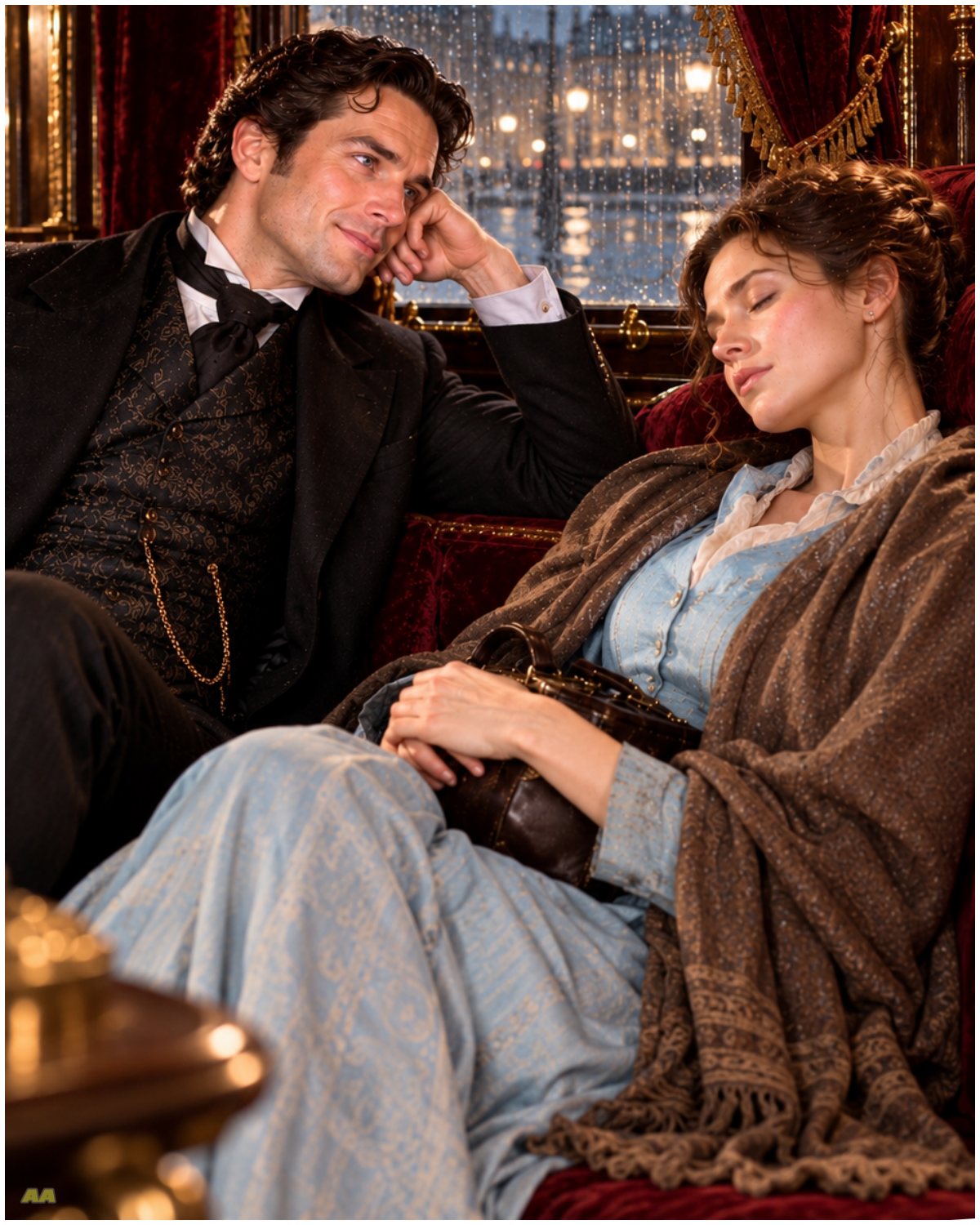
She climbed into the wrong carriage because she was too exhausted to read the crest on the door.
20 hours on her feet. One mother pulled back from the edge of death.
Two infants breathing where they had not been breathing before.
Eleanor, no.
Miriam Hail let her bag drop to the floor, pressed her back against the velvet seat, and spoke without opening her eyes.
Please take me home.
I don’t care how long it takes.
A voice came out of the dark on the opposite bench.
Lo, unhurried, faintly amused.
I would be glad to, Miss Hail.
But this carriage already has a destination, and you are not on the liSt. She opened her eyes and found herself looking at the Duke of Stonemark.
The rain had turned the road from Ashcom village into something closer to a river by the time Miriam Hail finally stepped out of the Perkins cottage.
Her boots went straight through the top layer of mud.
She didn’t stop. Stopping was a luxury she had stopped affording herself somewhere around year three of working as the only midwife between Stonemark Village and the edge of the county.
She had been called to the Perkins home the previous morning at 4:00.
The letter had been delivered by a boy no older than 10.
Running through the dark with a lantern and by the expression on his face, she had known before she read a word that it was serious.
Agnes Perkins was 31 years old and this was her fourth child and the baby was lying wrong and the local doctor had already sent word that he could not come until Thursday.
It was Tuesday. Miriam came.
What followed was 19 hours of the kind of work that people who have never done it cannot properly imagine.
Not dramatic in the way of sensation novels, not quiet in the way of drawing rooms, but something in between.
Precise, unrelenting, terrifying in its weight, requiring every fragment of skill she had accumulated over 8 years of training and practice and learning from her mistakes.
She had turned the baby by hand.
She had talked Agnes through it when Agnes had wanted to give up twice.
She had not let herself think about failure, even when failure felt like the only realistic outcome.
The baby came at 11:15 at night, a girl screaming, red-faced, and furious at the world she had been pulled into.
Miriam had wept in the corner for approximately 40 seconds and then tied off the cord and done the rest of her work.
Now it was just past midnight.
The rain was coming sideways. Her bag weighed what felt like 20 lb.
The Perkins cottage was 2 mi from the nearest covered shelter, which happened to be the small train station at the edge of the Stonemark estate grounds.
She walked it. The station was dark.
The last train had gone hours ago.
But outside the station, pulled up on the gravel with its lamps still lit.
Was a carriage, a very fine carriage, the kind with dark lacquered panels and a matched pair of horses that had clearly been fed better than most of the families Miriam visited on her rounds.
She did not look at the crest on the door.
Later she would think about that about how 20 hours of exhaustion had stripped away all the automatic social awareness she had spent her whole life developing the careful reading of rooMs. The habit of checking before entering the instinct that said a woman in her position ought always to identify who she was dealing with before she presumed anything.
She opened the door and stepped in.
The interior was warm. Velvet on the seats, a small brass lamp burning low on the forward wall.
She put her bag down on the floor, fell back against the cushion bench, pressed her eyes shut, and said the most dangerous sentence she had spoken in years.
“Please take me home. I don’t care how long it takes.”
The answering silence lasted long enough that she thought for one absurd, exhausted moment that she had imagined the carriage entirely, that she had somehow invented it out of desperation and was actually sitting in a field.
Then the voice came. I would be glad to, Miss Hail, but this carriage already has a destination, and you are not on the liSt. She opened her eyes.
A man sat on the bench across from her dark coat.
Waist coat, long legs stretched at an angle because the carriage was elegant but not designed for a man of his height.
His face was in partial shadow from the lamp’s strong jaw.
Dark eyes watching her with an expression that was not anger.
Not quite, but something more complicated, something that had started as surprise and had moved somewhere she couldn’t immediately name.
She knew who he was. Everyone in Stonemark knew the Duke of Stonemark.
Henry Caldwell, six Duke, 38 years old, master of the estate that employed a third of the county and owned the land that the other third lived on.
A man about whom the opinions were sharply divided.
Depending on who was doing the dividing, the merchants said he was fair.
The gentry said he was cold.
The servants said he was exacting but not cruel.
The women of the village didn’t say much about him directly, but they said quite a lot around him, which amounted to the same thing.
Powerful, distant, difficult to approach, and recently widowed, though the widowing had happened three years ago, and the estate gossip had moved on, while the man himself apparently had not.
Miriam sat up straight.
“Your grace,” she said.
“I owe you an apology, do you?” I boarded your carriage without looking at the crest.
“It was careless of me. I am sorry,” he said nothing for a moment.
His gaze moved from her face to the bag on the floor.
To her hands, which she noticed now, were still trembling slightly, not from cold or fear, but from the sustained effort of 20 hours of work.
The kind of trembling that comes after the body has been asked to stay precise for too long.
“How long have you been on your feet?” he asked.
The question caught her sideways. She had expected a dismissal.
At minimum, she had expected a social formality, the mild disapproval of the upper class confronted with an intrusion.
Dressed up in careful language. She had not expected him to look at her hands and ask the practical question underneath everything.
Since 4 yesterday morning, she said, “The Perkins woman.”
She looked at him.
“You know the family? They farm my land.
I was informed that Agnes Perkins was in difficulty.” He paused.
The doctor from Wexhaven sent word he couldn’t arrive until Thursday.
Miriam said, “I know. So, you came instead.
Someone had to.” He studied her for a moment with an expression she still couldn’t entirely read.
Then he turned his head toward the small window in the carriage door and said without raising his voice, “Robotham!” The carriage shifted.
A panel slid open. A man’s voice came through older steady.
The voice of someone who had been managing things for a long time.
“Your grace, Miss Hail of Stonemark Village needs to be taken home before we continue on to the estate.” “Do you know the address?” A pause.
The cottage at the end of Mil Row.
Your grace, I know it. Good.
The panel slid closed. Miriam stared at him.
You didn’t have to do that, she said.
No, he agreed. I didn’t. He looked out the window.
She looked at the floor of his carriage, the rug.
Expensive, but worn at the center, the kind of worn that comes from actual use rather than display.
She was too tired to think clearly.
She was too tired to do any of the social calculation that the situation probably required.
So she said the first honest thing that came to her.
The baby was a girl. She’s going to be all right.
Agnes too. He didn’t move, but something about the line of his shoulders changed.
Just slightly. Good. He said it was the same word he had used about the address, but it didn’t sound the same.
The carriage rolled through the rain for 11 minutes.
Miriam knew this because she watched the seconds pass the way she watched them during a difficult delivery, not impatiently, but precisely anchoring herself to the movement of time when everything else felt uncertain.
At some point during those 11 minutes, she became aware that the Duke was not, as she had initially assumed, simply tolerating her presence.
He was watching her, not in the way men sometimes watched women, assessing, cataloging, measuring worth against some interior scale.
He was watching her the way she watched a patient she hadn’t fully diagnosed yet, trying to understand something specific.
You’ve been the midwife here for how long?
He asked. 8 years. You trained with my father.
He was a physician. He died when I was 20, and I continued his practice as best I could.
Given that no medical college would accept a woman.
I learned the rest from a midwife in Devincure named Mrs. Cororum who had 40 years of experience and no patience for either sentiment or incompetence.
She paused. She was the finest teacher I ever had.
She sounds formidable. She was 81 when she died.
She delivered a baby the week before.
Formidable is exactly the right word.
He almost smiled. She saw at the beginning of it the slight softening at the corner of his mouth before it stopped and composed itself back into whatever expression he normally wore.
As if smiling were something he’d learned to catch himself doing.
You live alone, he said. Not a question.
I do. Is he stopped? Started differently.
I mean no intrusion. I was thinking practically.
If you are the only midwife for 20 m and you live alone and you are called out at 4 in the morning, who knows where you’ve gone?
She considered him. Mr. Robotham seems to know where I live.
Robotham knows everything about this county.
That’s what I pay him for.
Then I suppose he would notice if I stopped returning.
That isn’t reassuring. No, Miriam said.
It isn’t, but it’s the reality of the work.
The carriage slowed. She looked out the small window and recognized the familiar dark shape of Milroe, the narrow lane.
The stone walls, the single lamp that Mr.
Pritchard at the end house always left burning through the night.
She picked up her bag. Thank you, your grace, she said.
For the carriage and for not.
She stopped. For not what? For not being angry.
She met his eyes briefly. Most men in your position would have been.
He looked at her. A woman who just saved two lives stumbled into my carriage because she was too exhausted to focus on the door.
He said, “What exactly would I be angry about?” Miriam Hail had been managing the opinions of powerful men since she was 20 years old.
She had learned to recognize every variety of condescension, from the obvious to the exquisitly subtle.
She had learned to account for them, to work around them, to absorb them without breaking stride.
She did not know what to do with simple human decency.
She got out of the carriage.
The rain had lightened to a miSt. She was three steps from the door of her cottage when she heard the window opened behind her.
“Miss Hail,” she turned. He was leaning slightly forward from the window, the cold air coming in around him, the lamp behind making his face harder to read.
“If Agnes Perkins recovers well, I’d like to know.
You may send word through Robotham.
And if she doesn’t recover well, then I’d like to know that, too.
She stood in the wet lane and looked at the Duke of Stonemark in his expensive carriage, asking her to report back on the welfare of one of his tenant farmers, as if the answer actually mattered to him.
“All right,” she said. She went inside.
She did not sleep for another 2 hours.
She sat at her small table with a cup of tea that went cold and thought about a man who had looked at her trembling hands and asked how long she had been on her feet.
She thought about the fact that he had rerouted his carriage for for a woman he had never met.
She thought about the non-smile, the one he had started, and then stopped and wondered what it cost him.
Exactly. To hold back something as simple as that.
She thought, “Something is very wrong in that house.” Then she went to sleep.
4 days later, Robotham knocked on her door.
He was a compact man of about 60 with the upright posture of someone who had spent decades being useful and was proud of it.
He held his hat and said plainly that his grace had asked him to check on the welfare of Agnes Perkins and that since Miss Hail was the person who would know, he had come to ask.
Miriam told him that Agnes was recovering well and the baby was thriving.
Robotham wrote this down in a small leather notebook.
Then he said without looking up, “His grace has also asked me to inquire whether Miss Hail would be willing to call on the estate at her convenience.” “There is a matter he wished to discuss.” Miriam looked at the man.
“What kind of matter?” he said to tell you it was practical, not social.
Those aren’t always different things. “No,” Miss Robotham said.
“But he meant for you to understand it wasn’t a personal invitation.” She thought about that for a moment, about the specific care embedded in the distinction, the deliberateness of making clear that he was not summoning her to his estate as if she had no choice in the matter, but offering her a reason.
Tell his grace I’ll come Thursday morning, she said.
If that suits, I’ll tell him, Robotham said he left.
Miriam stood in her doorway and watched him go and thought about the fact that a duke of the realm had sent his estate manager to politely ask whether Thursday morning suited her.
She had not in 8 years of working among the wealthy and powerful of this county been asked whether anything suited her.
Stonemark estate in the morning light was a different thing from the carriage with the rain.
She had been here before twice to attend to servants in the staff quarters, but she had always come around to the back entrance and been shown directly where to go.
She had never stood at the front and looked at the whole of it.
It was grand, that was the honest word, four stories of pale stone, tall windows, a wide formal entrance with steps that had been worn at the center from a century of feet.
The grounds beyond the carriage court were clipped and maintained.
Everything was exactly as it should be.
And somehow, despite all of that, it felt profoundly empty.
Robotham met her at the door and walked her through a corridor and into a room that was clearly used as a working office rather than a formal space papers on the desk.
Maps on one wall, a window overlooking the east grounds.
A room where decisions were made, not where guests were impressed.
The Duke was already standing when she came in.
“Miss Hail,” he said. Thank you for coming, you asked,” she said.
“So I came.” He gestured to a chair across from the desk.
She sat. He sat. I’ll get directly to the point, he said.
“Because I understand your time is not unlimited.
That’s an unusually considerate opening for someone with your level of authority,” Miriam said.
Something moved in his expression. “I will take that as a compliment, even if it wasn’t entirely meant as one.
It was meant as an observation.” “Fair enough.” He folded his hands on the desk.
I have a problem on this estate that I cannot solve with money or instruction.
I’ve tried both, she waited. My tenants, he said, specifically the women and families since my wife died 3 years ago.
The estate has been managed competently.
The accounts are in order. The roofs are repaired.
The wages are paid. He paused.
But there is no one who understands what the families actually need.
A doctor comes from Wexhaven twice a month.
And he is adequate for men who have broken arms or require a tooth removed.
He does nothing for pregnant women.
He does nothing for children with fevers.
He does nothing for the things that actually kill people quietly and slowly.
He stopped. The Perkins situation should not have been a crisis.
It should have been attended to weeks earlier.
It was attended to Miriam said by me weeks ago.
I visited Agnes since her seventh month and told her the presentation was uncertain and she should send for me the moment labor began.
He looked at her. She sent for you, he said, at 4:00 in the morning.
Yes. Why not sooner? Because when I told her to send for me the moment labor began.
I didn’t mean it the way she understood it.
She thought I meant the moment the situation became serious.
By the time she thought Sirius had arrived, it already nearly was.
Miriam looked at him steadily. The gap between what I mean and what my patients understand is one of the largest problems in my work.
It’s not their fault. No one has ever taught them what to watch for.
He was quiet for a moment.
I want to change that, he said.
And I think you are the person who could help me do it.
Miriam studied the Duke of Stonemark across his working desk.
She had been in this situation before the wealthy man with good intentions and no real idea what the work actually required.
The man who imagined that money solved everything and that what the poor lacked was fundamentally a matter of resources rather than respect.
But she had also learned to look more carefully before she concluded.
I have a question for you.
She said, “Ask it. Why now?
You’ve owned this estate for 10 years.
These families have been your tenants for 10 years.
Agnes Perkins has had three previous children.
Why does their welfare suddenly concern you enough to bring me here?” The question landed in the room with the particular weight of the honest question, the kind that isn’t quite rude, but isn’t quite comfortable either.
He didn’t flinch because I stood in that carriage four nights ago and watched a woman tell me she had been awake for 20 hours alone, handling a situation that had become dangerous because no one in my employee had been watching closely enough to prevent it reaching that point.
He paused. And then I came home and looked at the accounts and I thought there’s no line item here.
No record of medical care for women and children on this estate.
There are records for cattle. There are records for machinery.
There are no records for the people who actually keep this estate running.
Miriam was quiet. I’m not asking you to forgive me for that.
He said, I’m asking you whether it can be fixed.
She looked at him for a long time.
You’re asking me to take a position on your estate.
She said, “As what exactly? Medical adviser for the women and families.
Your own schedule, your own methods.
I have no interest in telling you how to do your work.” He named a figure.
She kept her expression neutral. The figure was roughly three times what she made in a good year.
“I’d need a proper room,” she said.
“A consulting room, not the back of the laundry.
There’s a room off the east corridor that was used as a still room.
It has running water and good light.
I’d need access to Robotham’s records.
The full tenant list with family compositions and ages.
You’ll have it and I’ll tell you plainly when something is wrong and I need it fixed and I expect you to act on that rather than explain to me why it’s complicated.
He looked at her. I can agree to that.
Then I have one more question.
Miriam said, “Yes. Are you doing this because it’s the right thing to do for your tenants, or because you’d like the county to know you’re a generous and modern landlord?
The silence that followed was about 4 seconds long, long enough that she thought she had gone too far, that she had misjudged the room, that the offer was about to be withdrawn.
Then he said both, she blinked.
If I’m honest, he said, both things are true.
I don’t think that disqualifies either one.
Miriam Hail sat with that answer for a moment.
In her experience, powerful men lied about their motives constantly, not always deliberately, but because they had rarely been required to examine them.
The ones who answered a pointed question with that kind of directness were unusual.
All right, she said, I’ll take the position.
She started the following Monday. The room off the east corridor was better than a still room had any right to be.
Ra Botham had clearly anticipated her concerns because by the time she arrived it had been cleaned, shelved, fitted with a proper examination table and supplied with a set of towels that looked suspiciously new.
A small stove in the corner, a window with actual daylight.
She stood in the center of it and let herself feel briefly the very particular pleasure of a workspace that was adequate to the work.
Robotham appeared in the doorway. Anything else you need?
Miss a second lock for that cabinet,” she said, pointing at the medicine cabinet.
“And I’d like a list of every woman on the estate who is currently pregnant or has been pregnant in the last 2 years.
I can have that by this afternoon.
Make it this morning.” Robotham’s expressions did the thing that she was coming to understand was his equivalent of a smile.
Yes, miss. She was laying out her instruments when she became aware that someone else was in the doorway.
The Duke, not announced, not formally present, simply standing in the doorway the way a man stands when he’s come somewhere without entirely deciding to and isn’t sure yet whether to commit to being there.
I won’t keep you, he said.
You’re not keeping me. Come in if you want, he came in, stood with his hands behind his back, looking at the room with an expression that was attentive without quite being readable.
It looks different. I’ve only been here 20 minutes.
Yes. He looked at the instrument case.
Do you mind if I ask what that is?
She held up the piece. He was looking at a long-handled wooden device shaped for use in difficult presentations.
She explained what it was. She explained what it did.
She watched his expression move through something that started as professional interest and arrived somewhere more complicated.
I hadn’t known that instrument existed.
He said, “Most people don’t, and you use it when I have to.” She set it down carefully.
The things that go wrong in a birth are often things that no one talks about.
The mechanics of it, the real risks.
People are uncomfortable with the specifics and so they don’t speak plainly.
And then women die from things that were entirely preventable if someone had been paying attention.
He looked at her with an expression she was beginning to recognize.
The expression he used when something landed with more weight than he’d expected.
I take your point, he said quietly.
Good. A pause. I was going to ride out to the Perkins farm this afternoon, he said.
To see how Agnes is doing, Miriam stopped.
In person, she said, “Is that unusual for a Duke to ride out personally to check on a tenant who just had a baby?” “Yes, that’s unusual.” He looked slightly, not quite embarrassed.
“Something adjacent to it. I’ve been told I spend too much time at the desk.
Who told you that?” “My estate manager.” “My late wife before that?” He paused.
My wife used to say the difference between a good landlord and an indifferent one was whether you could name the people who worked for you.
He stopped. She was right. Miriam looked at him.
She thought about 3 years of an empty house.
She thought about the way he’d caught himself almost smiling in the carriage.
She sounds like she was a perceptive woman.
Miriam said she was a pause.
Her name was Catherine. She died of a fever in the winter of 81.
It was fast, faster than opted.
Started again. She would have been very interested in your work.
Why? Because it was the kind of thing she thought mattered.
The work nobody sees. The work that happens at 4 in the morning and doesn’t get recorded anywhere.
He looked at the window. She would have asked you quite a lot of questions and then insisted I fund whatever you needed without any of the discussion we’ve just had.
Miriam was quiet for a moment.
I’m sorry for your loss, she said.
Not as a social form, as a plain direct thing.
He looked at her. Thank you.
Another pause. The kind that isn’t uncomfortable, but isn’t quite comfortable either.
The pause of two people who have unexpectedly moved further into honesty than either of them planned.
I’ll let you work, he said.
You could come with me on Thursday, Miriam said.
When I do my rounds, if you want to know what’s actually happening with your tenants, that’s the most direct way to find out.
He looked at her. You’d allow that?
It’s your land, she said. And your tenants.
I’d rather have you see it directly than have you reading a report I wrote about it.
Something moved in his expression again.
That same movement. That almost thing.
Thursday, he said. All right. He left.
Miriam turned back to her instruments.
She lined them up in their proper order.
She pulled out Ral Botham’s list, which had arrived exactly as she’d requested before noon, and began reading through names.
Somewhere in the back of her mind, underneath the professional inventory, a quieter thought was happening.
She was thinking about a man who still talked about his wife in the present tense.
She was thinking about the way he said her name, Catherine, as if the word were something he kept in a specific place and brought out carefully.
She was thinking about the non-smile, the one he kept stopping himself from finishing.
She went back to work. Thursday’s rounds lasted 4 hours and covered six households.
At the first house, the Duke of Stonemark stood in the doorway of a cottage kitchen and watched Miriam examine a woman named Mrs. Doyle, who was 7 months into her fifth pregnancy and had a persistent swelling in her ankles that Miriam had been monitoring for 2 weeks.
He didn’t speak. He looked at the conditions the damp wall.
The single shared bed, the three children sitting on the floor watching the visit with wide, serious eyes, and he said nothing.
But she saw him take it in.
At the second house, he crouched down and spoke to a boy of about six who had a cough.
He did not talk down to the child.
He asked the child’s name and what he liked to do and whether the cough woke him up at night.
The mother stood in the corner with her hand pressed to her mouth, watching the Duke of Stonemark talked to her son like an ordinary person.
At the fourth house, the man of the family came in from the fields and stopped dead when he saw the Duke standing in his kitchen.
The man’s name was Grover. He had been a tenant farmer for 20 years, and he clearly expected Miriam could see it in the set of his shoulders.
The way he braced himself that the presence of the Duke in his kitchen meant something had gone wrong.
A debt, a dispute, bad news of some kind, Mr.
Grover, the Duke said. Miss Hail tells me your wife expects her confinement in about 6 weeks.
I wanted to be sure the house was in good repair before then.
Grover stared. The house your grace?
The east wall of this row has been showing damp for two seasons.
I’ve had a report about it, but I wanted to see it directly.
He paused. Robotham will send a man next week to address it.
Before the baby comes, Grover looked at him for a long moment.
Then the man said roughly, “Thank you, your grace.
Thank Miss Hail,” the Duke said.
She brought it to my attention.
Miriam looked at him across the kitchen.
He was looking at the damp wall, but she noticed that he’d done it.
He’d said it plainly in front of the tenant, giving her the credit without ceremony.
He hadn’t claimed the concern as his own initiative.
He’d named the actual chain of events.
She hadn’t expected that. They walked back toward the estate in the afternoon light.
The lane was dry today. The mud from last week’s rain had hardened into ridges.
Miriam’s bag swung at her side.
The Duke walked beside her, and for a while neither of them said anything.
Then he said quietly, “The Grover House is not the only one with a damp wall.” “No,” she said.
“It isn’t. Why didn’t Robotham’s reports capture this?
Because Robotham inspects the structures. He measures the walls and checks the roofs.
He doesn’t sit in the kitchens and watch families live in the houses.” She paused.
“The damp only shows at certain times of year, and his inspections are on a schedule.” “Mine aren’t.” He looked straight ahead.
“I want a new inspection system,” he said.
One that includes the conditions of living rather than only the conditions of building.
That would require someone to do the inspections.
I’m aware and you’d need someone the tenants would actually talk to.
Honestly also aware. He glanced at her.
Would you be willing to design it?
She stopped walking. He stopped too.
They stood in the lane with the estate gate visible 50 yards ahead.
You keep asking me to do things, Miriam said.
Yes. You keep making it sound like I have the choice to say no.
You do. She looked at him.
Is that actually true? Do I have the genuine choice or is this the kind of offer where declining has consequences I won’t be told about directly?
The question was blunt. She watched him absorb it.
No, he said it’s an actual choice.
If you decline, your position here and your work are entirely ficted.
He paused. I am not asking you because you work for me.
I’m asking you because you know things that I don’t know and I would like to know them.
Miriam looked at the gate at the estate beyond it.
I’ll think about it, she said.
That’s all I’m asking. They walked through the gate.
The trouble arrived the following Sunday, and it came in the form of a carriage even more expensive than the Dukes.
Lady Iris Thornton was 43 years old, the widow of an earl, and she had been conducting what the county referred to diplomatically as a significant friendship with the Duke of Stonemark for the past 18 months.
She was everything that Miriam Hail was not titled.
Wealthy, socially fluent in all the ways that mattered to the world the Duke inhabited, and she arrived at Stonemark estate for what was apparently a standing Sunday lunchon with the particular manner of a woman who was entirely confident of her place.
Miriam saw the carriage from the window of her consulting room.
She thought, “Right, of course.” She went back to her filing.
She heard the voices in the corridor outside her room about 20 minutes later.
Two voices, a woman’s light pleasantly modulated, practiced in the way of people who had spent their lives in drawing rooms and Robotham’s neutral, careful in the way he was always careful when he was navigating something he hadn’t been given explicit instructions about.
Simply curious, the voice was saying, “Everyone says the Duke has brought on a medical woman of some kind.
I just thought I’d see. Miss Hail is seeing patients.
My Lady Robotham said, “Oh, I won’t be a moment.” The door opened.
Miriam was seated at her desk with a ledger open in front of her.
She looked up. Lady Iris Thornton took in the room with a single comprehensive glance the way some women have of cataloging a space and everything in it instantaneously, assigning value and position and relevance before a word has been exchanged.
Then she looked at Miriam. You must be Miss Hail, she said.
I how unusual Lady Iris’s tone was pleasant.
The sort of pleasant that had edges you didn’t feel until later.
I’d heard you were quite young.
29, Miriam said. And you’ve set up here entirely in the estate.
My consulting room is here. I visit tenants directly as well.
How very dedicated. Lady Iris stepped further into the room.
Looking at the instrument case, the shelves, the ledger open on the desk.
Henry hasn’t mentioned it at length, but then he doesn’t discuss business at lunchon.
She paused as if considering something.
He seems it’s difficult to put precisely.
More present lately, more engaged. She looked at Miriam.
I suppose that’s the estate improvements.
I wouldn’t know, Miriam said. I’m not involved in the estate improvements.
Just the tenants. Just the tenants.
Lady Iris looked at her for a moment with an expression that was perfectly composed and completely unreadable.
Then she smiled a full practice smile.
Well, she said, “I think it’s admirable work.
These women need someone looking after them.” A pause.
I just hope you’re not overt taxing the Duke’s attention.
He carries quite enough. She left.
Miriam sat for a moment in the quiet of the room.
She thought about the way Lady Iris had said Henry easily without thinking.
The way you say a name when you have said it so many times, it has stopped feeling like anything at all.
She thought about the question she had asked herself in her own cottage four days ago.
Something is very wrong in that house.
She amended the thought slightly. Something is very complicated in that house.
She went back to work. She was leaving for the evening.
It was just past 6. The light failing fast in the way of late September when the Duke appeared in the corridor.
He looked, she thought, like a man who had had a pleasant enough Sunday and was now slightly uncertain about what came after it.
Miss Hail, he said, “Your grace, I understand.
Lady Thornton came by.” “She did.” He waited.
“She seemed interested in the consulting room,” Miriam said carefully.
“He stopped. She can be.” He stopped again.
Seemed to decide against whatever he’d been about to say.
“I hope she wasn’t intrusive. She was perfectly cordial.” Miriam looked at him.
She called you Henry. Something shifted in his face.
She has done so for some time.
He said, “We have known each other long.
I wasn’t asking.” Miriam said. “I was observing.” She picked up her bag.
“Good evening.” “Your grace.” She walked down the corridor behind her.
She heard him say very quietly, “Not to her, not to anyone in particular.” “Good evening, Miss Hail.” She was halfway down the drive when she realized her hands had stopped trembling.
They had not trembled since the night on the carriage, not once, and she had not noticed until now.
She noticed now. She walked home in the cold, clear air of a September evening, and she did not let herself think about why.
The rounds continued every Thursday. That was how it started.
One morning a week, the Duke of Stonemark walking beside Miriam Hail through the lanes of his own estate, knocking on doors that his father had never knocked on, and his grandfather had certainly never considered.
Raotham watched this development with an expression that said everything and articulated nothing.
The household staff watched it with considerably less restraint.
By the third Thursday, the tenants had stopped being startled when the Duke walked into their kitchens.
That in itself was something. The Grover damp wall had been repaired.
Mrs. Doyle’s ankle swelling had responded to the treatment.
Miriam prescribed reduced hours on her feet.
A specific compress, a diet adjustment that required Miriam to have a direct and somewhat blunt conversation with Robotham about what the estate kitchen could provide at no additional cost to the family.
Robotham had listened, written it down, and arranged it without comment.
Henry Caldwell noticed these things. He noticed them the way he noticed everything on the estate, methodically cataloging what was changing and what wasn’t, measuring progress against the prior condition.
But he also noticed them in a different way.
A way he didn’t have a precise word for.
A way that had something to do with watching Miriam Hail walk into a cottage and watching the people inside it rearrange themselves.
Not with deference, not with the slightly performative gratitude that he received, but with something that looked more like relief, like she was the person they had been waiting for and hadn’t known they were allowed to expect.
He said, “None of this allowed.” He kept it in the part of himself where he kept things that weren’t ready to be spoken yet.
The fourth Thursday brought rain again and something else.
They were in the middle of a visit to the Callaway family, three children.
A fourth coming, a father with a persistent chest complaint that Miriam had been monitoring with open concern when Robotham appeared in the doorway with an expression that meant the schedule had been interrupted by something he hadn’t anticipated and wasn’t pleased about.
Your grace, Robotham said, “Lord Peton has arrived at the estate.” Unannounced.
Henry kept his face still. Tell him I’ll be there within the hour he says it’s pressing.
Everything Lord Peton says is pressing.
He turned back to Mrs. Callaway.
Forgive me. I’ll let Miss Hail finish.
She knows what she’s doing better than I do.
Miriam watched him cross the room and go out.
She watched the way he moved when he was managing something that set of his shoulders.
The particular economy of it, the way he kept the irritation entirely internal and let none of it reach his face.
Mrs. Callaway watched her watching him.
He’s not what people say, Mrs. Callaway said quietly when the door had closed.
Miriam turned back to her patient.
People say quite a lot of things.
They say he’s cold. They said his wife died because he worked her into the ground.
Mrs. Callaway’s voice was matterof fact not unkind.
Just reporting. I don’t know about that.
I know he came here himself last week and looked at my husband’s chest and asked me directly what he could do.
That’s not something cold men do.
Miriam opened her case and didn’t answer because she agreed and she wasn’t sure yet what to do with agreeing.
Lord Peton was the sort of man who occupied a room by expanding into it.
He was 60, heavy set with the particular confidence of someone who had always operated from a position of social advantage and had consequently never developed the capacity to question his own assumptions.
He had known Henry Caldwell’s father and considered this sufficient grounds for a general entitlement to Henry Caldwell’s time and attention.
When Henry walked into the library, Peton was standing at the window, looking out at the grounds with his hands clasped behind his back as if he owned the view Caldwell, Peton said.
Without turning, you’ve been difficult to reach.
I’ve been on the estate, Henry said.
Doing estate work with the midwife girl, Peton turned.
His expression was not hostile, something more comfortable than hostile, which was worse.
Comfortably concerned. The expression of a man performing the duty of setting a friend straight.
People are talking, Henry. Henry sat down and said nothing.
Lady Thornton is a patient woman, Peton continued.
She has been more than patient, but a duke spending his Thursday mornings walking the tenant lanes with an unmarried woman of no particular standing.
Miss Hail has considerable standing in this community, Henry said.
Among the tenant farmers, yes, Peton spread his hands.
Not among the people whose opinion matters to your family’s future.
Henry looked at him. Whose opinion matters to my family’s future.
You know what I’m saying? I’d prefer you to say it plainly.
Compared inside the sigh of a man who had hoped to avoid the plain version.
You need to remarry. You have no heir.
Lady Thornton has been patient and correct, and she is fond of you.
The county expects it. Your family expects it.
He paused. Your continued association with this medical woman creates a distraction that benefits no one.
Henry was quiet for 4 seconds.
Miss Hail, he said, came to my attention because she spent 20 hours saving the life of a tenant woman and her child while my doctor was unavailable.
I invited her here because my estate was failing its tenants in ways I had not been measuring.
She has in four weeks identified three serious health risks that would have become genuine crises within the month.
He paused. That is why she is here.
That is the entirety of why she is here.
That may be true, Peton said.
But it is not what the county sees.
Then the county is looking at the wrong thing.
The county always looks at the wrong thing.
Peton’s voice dropped slightly into something more personal, and it still manages to damage reputations.
Yours and hers. Henry looked at him.
The last sentence landed differently from the others.
Because it wasn’t wrong and because Peton had not intended to make a point in Miriam Hail’s favor, but he had.
Thank you for coming, Henry said.
I’ll consider what you’ve said. Peton left, clearly not satisfied, but apparently concluding that pressing further was pointless.
Henry sat in the library alone for several minutes.
He thought about what Peton had said about reputation.
He thought about Miriam’s question in the lane.
Is this actually true? Do I have the genuine choice and the specific precise quality of it?
The refusal to accept the socially comfortable version of an answer.
He thought about the non-smile, the one he kept stopping himself from finishing, and he wasn’t entirely sure why he kept stopping.
He got up and went back to the east corridor.
Miriam was at her desk when he came back.
She looked up when the door opened and read his face in the way she read faces not interpreting.
Not projecting, just taking in what was actually there.
Peton, she said. You know him?
I know the type. She set down her pen.
What did he say? That the county is talking.
Henry stopped in the doorway about the rounds.
About the time you spend here.
Miriam was quiet for a moment.
Is he right? He’s right that people are talking.
A pause. Whether that constitutes a problem depends on factors I am still determining.
She looked at him steadily. You mean it depends on whether I’m worth the inconvenience.
No. His voice was sharper than he intended.
He adjusted. I mean it depends on whether I choose to allow other people’s speculation to determine how I manage my own estate.
He paused. I have not yet decided to do that.
She held his gaze for a moment.
You should know, she said, that I have no interest in causing you difficulty.
If my presence here becomes a genuine problem, it is not a problem, he said it with a finality that closed the sentence.
She looked at him. Something shifted in her expression, not quite softening.
Something more precise than that, something that said she had heard him, that she was accounting for it.
All right, she said. Then I’m going to tell you something about the Callaway situation that you’re not going to like.
He came fully into the room.
Tell me, James Callaway’s chest complaint isn’t a simple cold.
It hasn’t been for some time.
I looked at his history. Robotham had records going back four years, and the pattern is consistent with something progressive.
He needs a specialist physician, not a country doctor’s twice monthly visit.
Without proper attention in the next 6 weeks, he will be unable to work by winter.
She paused. He has four children and a fifth coming.
His wife cannot support them alone.
Henry was quiet. Can the specialist be brought here?
At cost, Miriam said. A considerable cost, but less than the cost of a family losing their primary income for a full season.
Arrange it. No hesitation. She looked at him.
I mean it, he said. Whatever it requires.
Write to the physician. Robotham will handle the logistics.
The cost is not a consideration.
Miriam wrote it down in her ledger.
When she looked up again, he was watching her, right?
You were about to argue with me, he said.
I was preparing to make the case.
You’d already made it. He paused.
When you said he will be unable to work by winter.
That was the case. You don’t need to ask twice, she set down her pen.
Most men in your position require three conversations and a written report before they authorize anything, she said.
I’ve read enough written reports about this estate.
His voice carried something in it.
Not quite bitterness, but the far edge of it.
I spent two years after Catherine died managing everything through paper.
Accounts, assessments, reports. I knew the estate entirely on paper, and I knew almost nothing about it.
In fact, he stopped. You showed me the Grover wall.
You introduced me to Mrs. Doyle and her children.
You put me in a room with James Callaway and let him explain his own situation in his own words.
That is worth more than any report.
Miriam looked at him for a long moment.
She taught you that, she said.
Didn’t she? Your wife? He didn’t answer immediately.
She tried to, he said finally.
I wasn’t always a willing student.
The room held that quiet for a moment.
Then Miriam did something she hadn’t done since she’d arrived.
She asked him a question that had nothing to do with work.
What was she like in the way that isn’t written in anyone’s memory of her?
He looked at her. She thought he might deflect that the question was too personal, that she had overstepped, that the careful, professional distance they had both been maintaining would reassert itself.
She was honest, he said, in a way that made other people uncomfortable.
She said exactly what she thought, and she didn’t soften it for anyone, including me.
And I, he paused. I didn’t always know what to do with that when we were first married.
I had spent my entire life in rooms where people said the careful version of the truth.
She never bothered. A pause. I came to rely on it entirely.
Miriam looked at her hands. I understand that, she said.
The value of directness. Most people want the softened version.
It saves trouble in the short term and costs considerably more in the long term.
Yes. He held her gaze. You’re direct in that same way.
I’ve been told it’s a liability.
By whom? Various people. Employers mostly a few patients husbands who didn’t like me telling their wives the plain truth about their health a pause and occasionally the husbands of women whose health I’d failed to save because the plain truth in those cases is also very hard to hear quiet oust patience he said I have she didn’t look away not many but enough that I know exactly what it cost to pause Agnes Perkins might have been one of them if I’d arrived 2 hours later I Don’t think about that constantly, but I think about it.
How do you He stopped. How do you continue after that when you know how close it comes?
Miriam looked at the window. Because the alternative is not doing the work, she said.
And if I’m not doing the work, someone else will have to, or no one will, and no one is worse.
Henry Caldwell looked at her with an expression that was entirely unguarded.
The composure had not gone. It was still there, the discipline of it.
But behind it, she could see something that she had not expected to find in a man of his position and history.
Something that looked very much like recognition.
The letter arrived on a Monday.
It was addressed to Miriam, sent through Robotham, which meant it had come to the estate rather than to her cottage, which meant someone knew she could be reached here.
The handwriting on the outside was unfamiliar.
The return address was a solicitor’s firm in London she had never heard of.
She opened it, standing at her desk.
She read it. She sat down.
The letter was from a firm representing one Mr.
Gerald Fenwick, a name she did not immediately recognize.
It took her three lines to place it.
Fenwick, Jeffrey Fenwick’s older brother. Jeffrey, who had been a patient of her father’s 20 years ago, who had died at 16 of a fever that no one had been able to stop, and whose death had the letter, was careful about this.
Legal careful raised questions at the time about the adequacy of care provided by the late doctor hail.
The questions the letter said were being revisited.
Mr. Gerald Fenwick had come into information.
It said information suggesting that the hail practice had been negligent in young Jeffrey’s case.
And since Miriam Hail was now practicing under the association of the Stonemark estate, those were the exact words.
Under the association, the matter had implications for her current position.
The letter requested politely that she present herself at the firm’s offices in London within the fortnight to respond to these concerns.
Miriam sat with the letter in her hands for a long time.
She thought about Jeffrey Fenwick. She had been 9 years old when he died.
She remembered him only as a peripheral presence, a boy who had come to the house with his mother who had been kind to her in the way older children are sometimes kind to younger ones without thinking about it.
She remembered her father’s face after the particular way a doctor’s face looked when a patient died young.
She thought about the phrase under the association of the Stonemark estate.
Someone had found out she was here.
Someone had specifically framed the allegation in a way that connected it to the Duke’s name.
She thought about Lord Peton, about what he’d said to Henry 4 days ago about distraction and reputation.
She folded the letter. She went to find Robotham.
She did not tell Henry immediately, not because she intended to hide it.
She had no real instinct for concealment.
It had never served her, but because she needed to think firSt. She needed to understand what she was actually dealing with before she brought it to someone else.
She spent Monday evening at her cottage with her father’s case records.
He had kept meticulous notes on every patient, every treatment, every outcome.
She had maintained the system exactly as he had left it.
The Fenwick records were in the ledger for 1,864 and 1,865 and they told the story with the plain precision of a medical record.
Jeffrey Fenwick, 16, presenting with fever and inflammation of the throat.
Five visits, two different treatments, a note in her father’s handwriting, small controlled the writing of a man choosing his words carefully.
Patient continued to decline despite treatment.
Family advised. Prognosis discussed with mother only at her request as father unavailable.
GF died at home on the evening of 14 March 1,865 cause progressive septic infection.
No treatment available at current medical understanding would have altered outcome.
She read that last sentence three times.
No treatment available at current medical understanding would have altered outcome.
That was truth. She knew it was truth.
Medicine in 9,865 could not do what medicine in 9,884 could do.
And there were things that killed people then that didn’t kill people now.
And her father had known this and written it down plainly, and still, apparently, it was not enough.
She thought about Gerald Fenwick. Jeffrey had been 16 when he died.
Gerald would be in his 50s now.
What had changed? What information had he supposedly come into that had not existed 20 years ago?
The phrase came back under the association of the Stonemark estate.
Someone had given him information. Someone had told him that Miriam Hail could be reached through the estate.
Someone had decided that this was the right moment to revisit a 20-year-old grief and turn it into a legal complaint.
She closed the ledger. She went back to the estate on Tuesday morning and she told Henry.
She laid it out exactly as she had thought it through the letter, the timeline, the Fenwick records, the phrase about the estate association.
She did not dramatize it. She did not ask for his help.
She gave him the facts and watched him, read the letter she had brought.
When he looked up, his expression had changed, not in the direction she had expected.
She had expected calculation, the assessment of risk, the weighing of inconvenience, the specific look of a man deciding whether an association was worth the complication.
She had seen that look from powerful men before, and she knew it exactly.
That was not what was on his face.
Who sent this to them? Not a question, a statement shaped like one.
I don’t know. Peton was here Monday morning.
Henry set the letter on the desk.
He came to return a book he had borrowed.
I thought it was an excuse to see whether I had taken his advice.
He was in the east corridor for approximately 10 minutes while I was called to the stables.
He paused. Rubotham’s office is off the east corridor.
He would have been able to see the visitor ledger.
Miriam looked at him. Your name was on the visitor ledger, he said.
With enough frequency that anyone looking at it would know you spent considerable time here.
And Peton has connections in London.
Miriam said. Every man of his generation has connections in London, Henry stood.
He wouldn’t have created this allegation.
He’s not creative in that direction.
But if someone with a genuine grievance or a manufactured one had been looking for a way to make noise and Peton knew that and wanted you gone, he could have made an introduction.
Miriam finished. They looked at each other.
I’m going to London, Henry said.
She stood up. Absolutely not. I beg your pardon.
If you go to London on my behalf, this stops being a medical negligence inquiry and becomes a personal matter involving the Duke of Stonemark.
She held his gaze. That gives Petton exactly what he wants.
A story that isn’t about my father’s medical records at all.
Then what do you propose? I go to London.
I answer their questions. I bring my father’s records, which are meticulous and complete, and I put them in front of whoever has raised this, and I let the documents speak.
She paused. I am very good at letting documents speak.
Henry looked at her for a long moment.
You cannot go to London alone, he said.
I’ve been to London alone, not to face a solicitor’s firm that has been activated by someone trying to damage your position.
She opened her mouth. I’m not saying you can’t handle it, he said before she could speak.
I’m saying you should not have to handle it without support.
Those are different things, he paused.
Robotham will go with you. He knows London and he knows solicitors and his presence costs you nothing in terms of the narrative.
Miriam was quiet. It was she had to admit a reasonable proposal.
Robotham was not the Duke. He was an estate manager.
His presence at her side said this matter is being taken seriously by the estate without saying anything more personal than that.
All right, she said. Robotham can come.
Henry nodded. Started to turn. I want to say something.
Miriam said. He stopped. I know what Peton thinks is happening here.
I know what the county thinks is happening here.
I want you to know that I am aware of it and I am not I have no expectation of anything beyond the terms of my employment.
She held herself straight which required slightly more effort than usual.
You have been generous and straightforward with me and I value that.
But I am not naive about how things look and I am not I am not trying to put you in a difficult position.
He turned fully toward her. Miss Hail, he said.
She waited. When I sent Robotham to your door that first day, he said slowly.
I told him to say it was a practical matter and not a personal invitation.
Do you remember? I remember. I meant it at the time.
It was genuinely true at the time.
A pause. I find that it is somewhat less entirely true now.
The room was very still. I am not asking you anything, he said.
I am not saying anything that requires you to respond.
I am telling you that what Peton thinks is happening is not entirely wrong in every particular.
And I thought you deserve to know that.
Miriam Hail stood in the consulting room of Stonemark Estate and heard the Duke of Stonemark tell her in the most careful language she had ever encountered.
Something that was not careful at all.
She thought about Lady Iris Thornton saying, “Henry, the way you say a name you’ve worn smooth with repetition.” She thought about what it would mean for him, for the estate, for everything that existed in the space between his world and hers to let this be anything other than what it was supposed to be.
She thought about her father’s records sitting in her bag.
20 years of careful, precise, honest work, the documentation of a life spent doing the thing that no one else was going to do in the places no one else was going to do it.
She thought, “I am not going to apologize for being here.
Thank you for telling me, she said.
Her voice was steady. I will let you know what happens in London.
She picked up her bag. She was three steps from the door when he spoke again.
My wife used to say he stopped.
Started differently. Catherine said the worst thing you could do was pretend something wasn’t true because the truth was inconvenient.
A pause. She was right about that, too.
Miriam stood at the door with her hand not quite on the frame.
She sounds like she was remarkable.
She said she was a pause.
So are you. She walked out.
The London trip was arranged for the following Thursday.
Ralph Botham appeared at her cottage at 6:00 in the morning with the estate carriage, not the Duke’s personal carriage, but the estate vehicle, which was large and solid, and carried the Stonemark crest without carrying the Duke’s personal presence.
Miriam climbed in with her father’s records case.
For the first 40 minutes, they drove in the kind of comfortable silence that exists between people who have found without discussing it that they understand each other reasonably well.
Then Robotham said, “I’ve dealt with Caldwell and Marshet before.” She looked at him.
“That firm specifically? They handled an estate dispute 3 years ago.
Lord Peton was a party to it.” He paused.
Not the primary party, but present.
Miriam was quiet. His grace doesn’t know that.
Robotham said. Should he? Robotham turned to look at the road.
I thought you should know it first since you’ll be in the room.
She absorbed this. The solicitor’s firm that had sent her a letter about a 20-year-old medical complaint had a prior connection to Lord Peton.
It might be coincidence. It almost certainly was not.
What was the dispute about? She asked.
A property line between Stonemark and Peton’s land to the north.
His grace resolved it in Stonemark’s favor.
Robotham’s voice carried nothing, no editorializing, no implied judgment, just the facts.
Lord Peton considered the resolution incorrect, and he’s been correct and patient ever since.
Miriam said, “He has,” Robotham said.
“Until recently,” they looked at each other.
“The medical complaint isn’t really about my father,” she said.
“No, miss.” Robotham turned back to the road.
“I don’t believe it is.” The carriage moved on toward London, and Miriam sat with her father’s case records on her lap, and thought about powerful men and their long, patient grievances, and about what it meant that she had walked into the wrong carriage on a rainy night, and had consequently become the most convenient piece on a board.
She hadn’t known she was standing on.
She thought about Henry Caldwell, saying somewhat less entirely true now.
She pressed her hand flat against the cover of the records case, and felt the weight of it.
She was ready. The offices of Caldwell and Marsh occupied the second floor of a building on Chancery Lane that had been designed to communicate permanence.
Stone floors, dark paneling, the kind of quiet that exists in places where decisions are made about other people’s lives.
Miriam sat across a table from two solicitors and a man she had never met before, and she placed her father’s records case on the table between them with the particular deliberateness of someone who has come prepared.
The man she had never met was Gerald Fenwick.
He was 56 years old, gay-haired, with the specific expression of a man who has been carrying a grief for 20 years and has recently been given permission to do something about it.
He looked at her with a kind of hungry recognition, the look of someone who has been waiting for a face to put to a name.
She met it without flinching. Mr.
Fenwick, she said, I’m sorry about your brother.
I want you to know that before we begin, he blinked.
It was clearly not how he had expected this to open.
The lead solicitor, a man named Prior, sharpeyed and formal, cleared his throat.
“Miss Hail, we appreciate your willingness to.” >> “I’ve brought my father’s complete records for Jeffrey Fenwick,” >> Miriam said.
Keeping her eyes on Gerald, every visit, every treatment, every note my father made from the first consultation to the last, she opened the case and laid the ledger flat on the table.
I’d like Mr. Fenwick to see them, not as evidence in a legal matter, as a record of what his brother’s last months actually looked like from a physician’s side.
Prior leaned forward. That’s not precisely the format this meeting, mister.
Prior, her voice was level. Your firm sent me a letter implying my father was negligent.
I have come here with 20 years of records that say otherwise.
If your client would like to proceed with a formal complaint, he is entitled to do so, but I would like him to read these firSt. Silence.
Gerald Fenwick looked at the ledger.
Then he reached across the table and pulled it toward him.
Prior began to object. The second solicitor put a hand on Prior’s arm very briefly in the way of a man who has assessed the room and decided that the objection was going to make things worse.
Gerald read. He read for 12 minutes.
The room was completely quiet. Miriam kept her hands flat on the table.
Robotham, seated behind her and to her left, did not move.
Then Gerald Fenwick turned a page and stopped.
He read the same paragraph twice.
She could tell because his eyes moved back to the top of the section.
He read the last line. No treatment available at current medical understanding would have altered outcome and something in his face moved.
Not dramatically. The slow, painful movement of a man confronting something he had been refusing to look at directly for two decades.
“Who told you?” Miriam said quietly.
“My father was negligent.” Gerald looked up.
“A man came to see me,” he said.
“6 weeks ago. He had documents he said there were medical advances that would have saved Jeffrey.
Treatments that existed at the time that your father didn’t use.” “What was this man’s name?” Gerald looked at Prior.
Prior said, “Our client’s sources are confidential, Mr.
Fenwick.” She kept her eyes on Gerald directly.
The medical advances this man described, were they specific.
Did he name the treatments? A pause.
He mentioned a surgical method for a septic throat infection in Whitin’s 865.
Miriam looked at him with complete steadiness.
The surgical intervention for that specific condition was not practiced in England until 1,871 at the earliest, 6 years after Jeffrey died.
Whatever documents this man showed you, they were not accurate.
She paused. Someone told you something false.
And that false thing brought you here to a meeting that is costing you time and money and reopening a wound that I suspect has never properly closed.
Gerald Fenwick stared at her. Why would someone do that?
He said it wasn’t a question directed at her.
It was the question a man asks the heir when the room has just rearranged itself in a way he wasn’t prepared for.
Prior stood up. I think we should take a brief sit down.
Prior. Geralds voice was suddenly tired and authoritative in the way of a man who has just understood he has been used.
I need to think. Prior sat.
Miriam waited. Gerald looked at the ledger again.
At her father’s handwriting, at the careful, meticulous record of a physician doing everything he could for a boy who was going to die regardless.
He looked after Jeffrey kindly, Gerald said very quietly.
Your father? I remember him coming to the house.
I was 36. Jeffrey was He was my younger brother.
He looked up to me. A pause.
When he died, I needed somewhere to put it.
Your father was the easiest place.
I know, Miriam said. That wasn’t right of me.
Grief rarely is. Gerald closed the ledger and pushed it back across the table.
Prior, he said, draw up whatever needs to be drawn up to close this matter.
Prior looked at him. My lords, it Miriam exhaled one quiet breath that she didn’t let anyone else hear.
She began repacking the records case with steady hands.
Miss Hail, Gerald said. She looked up.
The man who came to see me, he said.
He mentioned the estate stone mark.
He said your work there was the way he put it was overreaching.
He held her gaze. I don’t know his name.
He didn’t leave one, but he was well-dressed.
A gentleman older, perhaps 60. He had a way of speaking as if he was doing me a favor.
Miriam packed the last of the records.
Thank you, she said. That’s helpful.
She stood. Robotham stood. They were at the door when Gerald spoke once more.
Miss Hail, is your work there at Stonemark?
Is it making a difference? She paused with her hand on the frame.
Yes, she said. I believe it is good.
Gerald Fenwick said. Then don’t let anyone stop you.
Robotham did not speak for the first 10 minutes of the carriage ride back.
When he did speak, he said only Lord Peton is 61.
He speaks the way men do when they are used to being thanked.
I know. Miriam said his grace will want to know.
His grace will need more than my account of an unnamed well-dressed man.
She pressed her hand flat on the records case in her lap.
He’ll need something that can actually be used.
Robotham considered this. There are records of the property dispute of the solicitors involved.
Caldwell and Marsh appeared in that matter as well.
He paused. I did not mention this to you before the meeting as I thought it would cloud your approach.
She looked at him. It wouldn’t have.
No, the faintest adjustment at the corner of his mouth.
But I didn’t want you to walk into that room already angry.
You were more effective going in the way you went in.
Miriam looked out the window for a long moment.
Robotham, she said, “Have you been managing this situation from the beginning?” “I manage what I can,” he said simply.
“That’s what I’m paid for.” She thought about that for the rest of the ride back to Kent.
They arrived at the estate in the early evening.
Henry was in the entrance hall when they came in, not waiting, precisely, but present in the way of a man who had found reasons to be near the entrance at approximately the hour the carriage was expected.
He looked at her face first, then at Robotham.
The complaint has been closed, Miriam said.
Gerald Fenwick withdrew it. Something in Henry’s expression released a tension she hadn’t fully seen until it left.
Come into the library, he said.
She told him everything. Not the emotional version, the precise version, the way she reported a patient’s condition.
The records, Gerald’s account, the unnamed visitor who had come with false documents 6 weeks earlier.
Rob Botham’s information about Caldwell and Marsh’s prior connection to Peton.
Henry listened without interrupting. His face was still throughout, but his hands flat on the arms of his chair were not entirely still.
When she finished, he was quiet for a moment.
Then he used a grieving man’s wound to try to remove you from this estate.
Yes, using false medical information, Henry stood.
He crossed to the window and stood with his back to her for a moment, which he understood as the thing he needed in order to manage what he was feeling without letting it become the only thing in the room.
I want to confront him, he said.
I know. I want to walk to Peton Hall tomorrow morning and tell him directly what I know.
I know that, too. She waited.
And if you do, he’ll deny everything.
There’s no name, no document, nothing that places him in the room with Gerald Fenwick.
She kept her voice even. What you have is a pattern.
Motive, opportunity, method. But not proof.
He turned around. Then what do you suggest?
I suggest you do nothing yet, she said.
Let him believe it worked. Let him believe I’m shaken and that the complaint, even though it was withdrawn, has created doubt about my position here.
Henry looked at her with an expression that was somewhere between incredul and something she recognized as respect.
“You want to let him think he won?” he said.
“For now, while we find the proof,” she held his gaze.
Robotham knows where to look. Henry looked at Robotham, who had positioned himself near the door with the expression of a man who had already thought several steps ahead and was waiting for everyone else to catch up.
The solicitor’s records, Robotham said there will be correspondence.
The initial contact with Mr. Fenwick came from somewhere.
Caldwell and Marsh are careful men, but every instruction leaves a trace.
Can you get access to those records?
Henry asked. Not directly, Robotham said.
But I know who can. There’s a clerk at their office who previously worked for the Stonemark estate.
He left under good terMs. He has no loyalty to Lord Peton.
Henry was quiet for a moment.
Do it carefully, he said. I do everything carefully.
Your grace. Miriam watched the two men the easy.
Long practiced coordination of them the Duke who had learned to trust his estate manager’s judgment entirely.
And the manager who had served long enough to know when to act and when to wait.
She thought this is what it looks like when a household actually works.
Miss Hail Henry was looking at her.
Are you all right? The question caught her sideways.
She had been asked it twice today, once by Robotham in the carriage.
Once now, and both times it had required a moment to answer honestly.
Yes, she said, “I’m annoyed, but that’s not the same as not being all right.
What specifically are you annoyed about?
That someone looked at the work I’m doing here, real work, work that matters, and decided the most useful thing to do with it was turn it into leverage against you.” She paused.
Not against me specifically. I’m incidental to this.
I’m just the tool he chose.
Henry looked at her for a long still moment.
You are not incidental, he said to anyone in this house.
The room held that sentence for a moment longer than it needed to.
I should go home, Miriam said.
It’s been a long day. Stay for dinner, he said.
Not as a formal thing. Thomas is preparing supper.
You’ve been in London all day and you haven’t eaten.
She opened her mouth to decline and then didn’t because the refusal would have been the social form of the thing, the careful maintenance of appropriate distance, and she was tired of careful maintenance.
“All right,” she said. Supper was in the small dining room, not the formal one, but the room off the kitchen where the household ate when there wasn’t an occasion requiring display.
A round table, four chairs. Henry sat across from her, and Raotham was absent.
Having taken his meal in his office where he spent most evenings, the cook, a woman named Mrs. Parsons, who had been at Stonemark for 15 years, and apparently had decided within 48 hours of Miriam’s arrival, that she approved of her, had sent in a roast chicken and bread and a bowl of soup that was still steaming.
They ate for a few minutes in a silence that was neither awkward nor formal, just the particular quiet of two people who had been through something together and were letting the day settle.
My father used to say Miriam started and then paused.
What did he say? He said that medicine was 90% patience and 10% knowing what to do with what the patients turned up.
She broke a piece of bread.
I used to think that was only about medicine and now now I think it’s a reasonably accurate description of most things worth doing.
Henry turned his glass slowly in his hand.
I wasn’t patient for a long time after Catherine died.
I was efficient. I managed everything quickly and completely and without anything that wasn’t necessary.
He paused. I thought that was the correct response to keep moving to fill the space with function.
It’s a reasonable response, Miriam said.
Grief needs something to do with its hands.
He looked at her. You sound like someone who knows that from experience, he said.
My father died when I was 20.
She kept her voice even. Not the protective evenness of someone guarding emotion, but the steady evenness of someone who has learned to carry a weight without hunching under it.
I had the practice to grieve over and the patience to attend to, and I was I was very efficient for about 2 years.
I ran everything exactly as he had.
I changed nothing. I kept his chair at the same angle to the desk.
She paused. At some point, I realized I was maintaining a muse instead of living in a house.
What changed? A patient told me that I reminded her of her mother who had died three years earlier.
She meant it as a compliment.
She meant I was comforting. Miriam looked at the table.
I sat with that for a week before I understood it.
I had been so committed to keeping my father’s presence alive in the practice that I had stopped being fully present in it myself.
She met his eyes. The work needed me, not my father.
Mi Henry was quiet. I moved his chair, she said, and put mine in its place.
It sounds like nothing. It was the hardest thing I did that year.
Henry set down his glass very carefully.
I had Catherine’s rooms closed, he said after she died.
I didn’t remove anything. I didn’t change anything.
I told myself I wasn’t ready.
A pause. It’s been 3 years.
The rooms are still closed. I know, Miriam said.
He looked at her. Rotham told me, she said early on.
Not as gossip. I think he wanted me to understand the shape of the house.
The shape of the house, Henry repeated very quietly.
That’s an accurate way to describe it.
He was quiet for a moment.
Do you think in your experience of grief and the way it moves?
And the patience you spoke of, do you think it’s possible to have been still long enough that the moving becomes something you’ve forgotten how to do?
It was the most unguarded question she had heard from him.
More unguarded than anything in the library, more than the somewhat less entirely true now admission.
This was the question underneath all the other questions, the one he had been carrying.
She suspected for the entire 3 years.
No, she said, I don’t think you forget how to move.
I think you get very afraid that if you start moving, you’ll lose the last of what you’re holding.
She paused. But the holding doesn’t work the way you think it does.
It doesn’t actually keep them. It just keeps you still.
He looked at her for a long time.
Then he said very quietly, “I should have opened those rooms by now.” “Yes,” she said.
“You should.” He didn’t respond to that directly.
But something in the set of his shoulders changed a small tectonic shift, the kind of thing that doesn’t look significant from the outside and is everything from the inside.
They finished the meal. They talked about other things.
The Callaway specialist appointment which had been scheduled for the following week.
The new inspection system which Miriam had begun drafting on paper a question he had about the second trimester complication she had been tracking in one of the younger tenant wives.
They talked about work and it was somehow the most honest conversation she had been part of in years because it wasn’t only about work.
She was leaving coat on bag in hand.
Robotham having arranged the smaller carriage to take her home when Henry came to the entrance hall and stopped her with a word.
Miriam, not Miss Hail, not this time, she turned.
Thank you, he said, for today for the way you handled it.
I was protecting my father’s name, she said.
And my own position, I’d have done that regardless of whose estate I was attached to.
I know. He held her gaze.
That’s exactly what I’m thanking you for.
The proof arrived the following Wednesday.
Rob Botham came to her consulting room in the morning with an expression that was as close to satisfaction as his face permitted and he placed three documents on her table.
Two were letters. One was a receipts ledger from Caldwell and Marsh showing a consulting fee paid in early September paid not to the firm from a client but by the firm to an unnamed intermediary listed in the accounts as ref.
Stonemark inquiry introduction. Miriam read the ledger entry.
That’s not a client fee, she said.
No, Robotham sat down unusual for him.
Which told her the rest was significant.
Someone paid Caldwell and Marsh to find the Fenwick connection and develop it into a complaint.
The payment came through a private account held at a bank in Mayfair.
The clerk recognized the account number.
He paused. It belongs to Lord Peton.
She set the ledger down carefully.
He paid a law firm to dig up a dead man’s grief and weaponize it.
She said he paid a law firm to create the appearance of wrongdoing where none existed.
Robotham said with the specific goal of compromising your position on this estate, which would have allowed him to tell the Duke that the association with me had caused damage, Miriam said slowly.
And leveraged that into what? Pressure on the property matter.
That’s my reading of it, Robotham said.
Miriam looked at the three documents.
Has his grace seen these? Not yet.
I thought you should see them firSt. She understood this was a choice.
If she brought these to Henry herself, she remained the person in control of how this information landed, the shape of it, the pacing of it, the decisions that followed.
If Robotham brought them directly to Henry, it became an estate matter managed through the proper channels.
With her at one removed from the outcome, she picked up the documents.
Tell his grace I need to see him.
She laid it out on his desk the same way she had laid out the letter in the carriage without drama.
Without performance documents first, context second, conclusion laSt. Henry read the ledger entry three times.
She watched his face move through something she had not seen there before.
Not the controlled management of anger, the unmanaged thing itself moving through him with a physical quality, arriving in the tightening of his jaw and the stillness of his hands and the specific quiet way he set the ledger back on the desk with complete precision.
He paid them, Henry said. Yes.
To manufacture a complaint against your father.
To manufacture a complaint against me.
My father was the vehicle. She kept her voice steady.
The goal was my removal from Stonemark.
My removal would then give him the leverage to reopen the property negotiation from a position of he would call it concern.
Concern about your associations, concern about your judgment.
Henry looked up from the documents.
He was going to come to me, Henry said slowly.
After this had damaged you enough.
He was going to come to me as a friend and tell me that the situation had gotten out of hand and he was worried.
And he was going to recommend Lady Thornton as a stabilizing influence.
And somewhere in that conversation, the eastern parcel would have come up.
That’s my reading of it, Miriam said.
Henry was quiet for a long moment.
Lady Thornton, he said the name flatly without emotional content.
Is she part of? She held his gaze.
The documents don’t show her, but she has been patient in the way Peton described deliberately.
Publicly patient in a way that creates a particular kind of pressure.
She paused. I don’t know whether she knew.
Henry looked at the window. I don’t believe she knew, he said.
She would not, he stopped. Iris is not dishoneSt. She is ambitious in the way that women of her position are permitted to be ambitious, which is entirely through social positioning and patient endurance.
I don’t believe she would sanction this.
A pause. But Peton would act in her interest without consulting her.
Men often do, Miriam said. They believe it’s protection.
It isn’t. No, it’s management. She paused.
What are you going to do?
Henry looked at the documents for another moment.
Then he stood up, walked to the door, opened it, and said to the corridor, “Robotham.
Robotham appeared from what seemed like exactly the right distance.
Not eavesdropping, but available. Arrange for Lord Peton to come to the estate tomorrow morning,” Henry said.
“Tell him I wish to discuss the northern boundary survey.” Robotham’s expression carried the quiet satisfaction of a man watching a correctly laid plan unfold.
Yes, your grace and send word to Lady Thornton that I would like to call on her tomorrow afternoon.
He paused separately. Robotham nodded and withdrew.
Henry turned back to Miriam. I want you present tomorrow morning, he said.
When Peton comes, she looked at him.
Are you certain? He did this because he thought you were a vulnerability he could exploit.
I want him to understand in person that he was wrong about that.
He held her gaze. He should see you in this room.
He should understand that you are not going anywhere.
Miriam felt something move in her cheSt. Not the warm uncomplicated thing of a simple compliment, but something more complicated and more durable.
The specific feeling of being defended by someone who was not defending you in order to rescue you, but defending you because the principle of the thing was right and they had decided to stand on the right side of it.
All right, she said, and Miriam, he used her name again, deliberate this time.
She could feel it was deliberate what Peton wanted the property, the negotiation that is never going to go the way he imagined.
That matter is closed, he paused.
But what he was also trying to prevent, he stopped, started again.
What he was trying to prevent has nothing to do with property.
She stood very still. I am aware, he said, that I have a position and you have a position and that the world does not look at them as equivalent.
He looked at her with the particular directness that she had come to understand was his version of complete honesty.
I am also aware that I have handled several of the most complex things in my life very poorly and I have managed others with some degree of competence and I have not yet determined which category this falls into.
A pause but I know that what Peton tried to do today made me understand something about what I would and would not be willing to lose.
Miriam Hail stood across the desk from the Duke of Stonemark and heard him tell her in the most careful and least careful language she had ever encountered.
Simultaneously that she mattered to him in a way that had moved beyond the professional entirely.
She thought about 29 years of doing difficult work alone, about her father’s chair, about the 40 seconds she had wept in the Perkins cottage corner before going back to finish what needed to be done.
She thought about what it felt like to be looked at the way he was looking at her.
Not as a convenience, not as a liability, not as a symbol of anything, as a person, his particular person.
You have a meeting with Lord Peton tomorrow, she said.
And one with Lady Thornton in the afternoon.
Her voice was entirely steady. That is a great deal to manage in one day.
I’ve managed worse. I know you have.
She picked up her bag. I’ll be here at 9:00.
Thank you. She walked to the door.
At the frame, she stopped not turning fully just enough.
“Henry,” she said. “His name? Deliberate.” “His name.” She felt him still on the other side of the room.
“For what it’s worth,” she said quietly.
“I don’t think you’ve handled this poorly at all.” She walked out.
Behind her, in the library, the Duke of Stonemark stood alone in the room for a long moment before he moved.
Outside the estate in the dark lane toward the village, Miriam Hail walked with her bag over her shoulder and thought about tomorrow, about Peton’s face when he walked in and found her sitting in that room, about what it would mean to watch a man like Henry Caldwell confront the person who had tried to use her.
She thought about a name said plainly in a doorway, a single word and everything it carried.
She walked home in the dark, and she did not feel alone.
Not even slightly. Peton arrived at 9:15.
He came in the way he always came in, as if the house were already partly his, moving through the entrance hall with the comfortable possession of a man who had been a guest often enough to have stopped feeling like one, Rabbotham met him at the door and walked him to the library without ceremony, which Peton clearly took as the ordinary arrangement.
He opened the library door himself.
He stepped inside. He stopped. Miriam was seated in the chair to the left of Henry’s desk, not behind it, not subordinate to it, but beside it, in the chair that said, “This person belongs in this conversation.” She had her ledger open on her lap, and she was writing in it when Peton came in, and she looked up at exactly the moment he registered that she was there.
She held his gaze for two seconds, and then went back to writing.
Henry was standing at the window.
He turned when Peton entered, and his expression was the composed, courteous expression he wore in professional meetings.
But there was something underneath it that Peton, if he was paying attention, should have noticed, something that had been decided.
Peton, Henry said. Good morning. Sit down.
Peton looked from Henry to Miriam and back to Henry.
The comfortable possession had left his face entirely.
Something more careful had replaced it.
I wasn’t aware Miss Hail would be present, he said.
She is my estate medical adviser, Henry said.
She is present at most of my estate meetings.
He sat down. Sit down, Peton.
Peton sat. He arranged himself with the deliberate composure of a man buying time to think.
Crossing one leg over the other, settling his coat.
He looked at Miriam once more with the expression of a man recalibrating.
She didn’t look up from her ledger.
I understand you wanted to discuss the Northern Boundary Survey.
Peton said. I did want to discuss it, Henry said.
Among other things, he placed his hands flat on the desk, a gesture she had come to recognize as his version of readiness.
The physical settling before something direct.
Tell me about Gerald Fenwick. The room changed.
Not dramatically, no raised voice, no sudden movement, just the particular change that happens in a room when a man realizes he has walked into something he didn’t see coming.
And the realization arrives before he has decided how to respond to it.
Peton’s face did four things in approximately two seconds.
The first was surprise, genuine, and unguarded.
The second was the rapid calculation of someone assessing how much was known.
The third was the selection of a response.
The fourth was the construction of composure around that response.
I’m not sure I take your meaning, Peton said.
Gerald Fenwick, Henry said again. He received a visit approximately 6 weeks ago from a well-dressed gentleman of approximately 60 years old who came bearing false medical documents suggesting that Miriam’s father had been negligent in the death of Gerald’s brother 20 years ago.
He paused. This visitor did not leave his name, but he was confident enough in his information that Gerald went to a solicitor’s firm in London.
That firm happened to be Caldwell and Marsh.
Another pause. The same firm that handled your side of the northern boundary dispute three years ago.
Peton said nothing. And when I looked at Caldwell and Marsha’s accounts, which I now have access to through channels I won’t detail, I found a consulting fee paid by a private account held at a bank in Mayfair.
Henry looked at him steadily. Your account, Peton.
The clock on the mantle ticked.
Peton uncrossed his legs, crossed them again, looked at the window, then at the desk, then finally at Henry with an expression that had given up on composure, and settled for something closer to dignity.
You were never going to sell the eastern parcel, Peton said.
His voice was flat and tired.
Not to me. No, Henry said.
I wasn’t. That land is worth three times what I offered.
The river access alone, it’s not about the value, Henry’s voice was even.
It’s Blackthorn Land. My father bought it from your grandfather in 1,849.
And and Yami has been attempting to recover it ever since.
I’m aware of the history. I’ve been aware of it since I took the title.
He paused. That is not a justification for what you did.
Peton looked at Miriam for the first time since he’d sat down.
Not with hostility. She had expected hostility and could have handled it, but with something that was almost curiosity, as if he were trying to understand what exactly she was in this room that had made his calculation go so wrong.
You are a midwife, he said to her.
I am, she said. You work with tenant farmers and their wives among others.
Yes. And for this, he said with a quality in his voice that was not quite contempt, but was its well-b bred cousin.
Henry disrupts a decade of social relationship.
Miriam set her ledger on the edge of the desk and looked at him with complete steadiness.
“Lord Peton,” she said, “you paid a law firm to reopen a grieving man’s deepest wound.” “Using false documents in order to create a scandal that would benefit a property negotiation.” She kept her voice even.
“I’m not the disruption in this room you are.” Peton looked at Henry.
Henry said nothing. He let the silence be what it was.
I want to know, Henry said finally, whether Lady Thornton was aware of any part of this.
Peton’s expression shifted, and this shift was genuine.
She could see it was genuine.
A quick defensiveness that said the question mattered to him personally.
Iris knew nothing, he said. Nothing at all.
This was my This was entirely my decision.
I need you to be certain of that.
I am certain. His voice carried something real in it.
Whatever else I have done, I would not involve her in something like this.
She is Iris is not that kind of woman.
She doesn’t operate this way. Henry looked at him for a long moment.
All right, he said. I believe you.
Peton seemed slightly undone by being believed as if he had braced for something harder, and the absence of it left him without the resistance he’d prepared.
“What happens now?” Peton said. It was not quite a question.
Now, Henry said, “You are going to send a written letter to Gerald Fenwick apologizing for the contact and acknowledging that the documents you provided were fabricated.
That letter will be reviewed by Robotham before it is sent.” He paused.
“You will also send a letter to Caldwell and Marsh terminating your arrangement with them and acknowledging in writing that the inquiry was initiated at your direction on false grounds.” Another pause.
Both letters will be in Robotham’s possession within the week.
Peton stared at him. And if I refuse, then I present what I have to the county magistrate and let the process run as it will.
Henry’s voice was entirely without heat.
The outcome will be considerably more public and considerably less comfortable for everyone involved.
Including Iris Peton was quiet for a long moment.
The land, he said. Is there any circumstance?
No, Henry said. There is no circumstance.
Peton uncrossed his legs, put both feet flat on the floor, and looked at the desk between them with the expression of a man accepting a loss that he had known.
Somewhere underneath the plan was always coming.
I’ll send the letters, he said.
Good, Henry stood. Robotham will see you out, Peton stood.
He looked at Miriam one more time before he went to the door.
His expression had moved through several things and had arrived at something she hadn’t expected from a man in his position.
Something that looked like acknowledgement. He left without speaking again.
The door closed. Henry sat back down.
He was quiet for a moment, the particular quiet after something has been resolved and the body hasn’t quite registered that the tension is gone.
“Are you satisfied with that?” he asked.
Miriam looked at the closed door.
“I’ll be satisfied when the letters are sent.” She paused.
And when Gerald Fenwick reads his apology in his own house without a solicitor’s fee attached to it, that’s fair.
He looked at his hands. Miriam, I won’t need to.
I think I do. He met her eyes.
I should have seen it sooner.
Peton has been in and out of this estate for a decade, and I treated his advice as the advice of a friend.
I wasn’t looking for what he was actually doing underneath it.
He paused. I made you vulnerable by not looking.
She thought about arguing with that.
She thought about the form of the argument you couldn’t have known.
It isn’t your fault. Reasonable men trust people they’ve known for years.
And she decided against all of it.
Yes, she said you did. She held his gaze and you fixed it.
Those aren’t the same thing, and they don’t cancel each other out.
But they’re both true. He looked at her with the expression she had come to think of as his most honest one, the one beneath the composure, the one that appeared when he stopped managing and simply was.
You’re the most direct person I have ever met, he said.
I know you told me something similar in different words a week ago.
I meant it then. I mean it now.
A pause. I find it. I find you.
He stopped. She waited. He did not finish the sentence in words, but his expression finished it plainly without ambiguity, in the way that faces do when language isn’t quite equal to the thing.
Miriam looked at the desk between them, at the documents still laid out from the morning, at the careful, orderly surface of a man who ran his life, precisely because precision was the only reliable thing in a world that had taken from him, the person who made order feel like warmth rather than function.
You have an appointment this afternoon, she said.
He exhaled not frustration, more the exhale of someone stepping back from the edge of something significant because the moment requires it.
Not because the thing itself has changed, Lady Thornton, he said.
Yes, that’s a harder conversation than this one was in different ways.
He stood. Peton, I knew how to handle.
He was transactional. What he did was wrong, but the logic of it was legible.
He moved to the window. Iris is not transactional.
She has been. She has given me three years of genuine patience and real affection, and I have been.
I have not been honest with her about what I can and cannot offer.
Miriam looked at him. Because you didn’t know yet, she said.
I think I have known for some time, he said quietly.
And I chose not to examine it because examining it required decisions I wasn’t ready to make.
She said nothing for a moment.
What will you tell her the truth?
He turned from the window. That I hold her in genuine regard, that what Peton did was not her fault, and I want her to know that I understand that clearly, and that he stopped, that the affection I have for her is not the kind of affection that should become a marriage, and that she deserves to know that plainly rather than drifting in the comfortable arrangement we have had, he paused.
She will not be pleased. No, Miriam said, she won’t.
She may be angry with you.
I know. Regardless of whether she knew what Peton was doing, she wanted you gone.
She wanted the situation resolved in her favor.
She may look for a way to make this difficult.
Miriam picked up her ledger. Lady Thornton is a socially powerful woman who moves in circles I don’t move in.
She has tools I don’t have.
She looked at him. But I have been managing the disapproval of powerful people since I was 20 years old.
I’ll manage hers. He looked at her for a moment.
I don’t doubt it, he said.
He drove to Lady Thornton’s estate himself, not with the full household carriage, the smaller one, with only Robotham up front.
Miriam knew this because Robotham mentioned it on his way out, in the way he mentioned things that were relevant without being asked whether they were relevant.
She spent the afternoon in the consulting room working through the new inspection schedule she had been drafting.
She sat with the tenant list and the records Robotham had built for her.
And she went through every family, every known health concern, every condition that needed monitoring.
She worked for 3 hours without stopping.
She was good at this. This was the truest thing she knew about herself.
Not her directness, not her independence, not any of the qualities that people noticed and commented on.
The truest thing was the work.
The way it organized her. The way she could bring all of herself to it without holding anything back and come out the other side of a three-hour session feeling spent and satisfied in a way that nothing else produced.
She was closing the ledger when she heard the carriage return.
She didn’t go to the entrance hall.
She stayed in the consulting room with her coat on and her bag ready.
Robotham appeared in the doorway 7 minutes later.
His grace will be in the library, Robotham said.
If you have time before you leave, she went to the library.
Henry was standing at the desk.
He looked not diminished, not broken, but the way a person looks after a difficult conversation that went as it had to go rather than as anyone wanted.
The particular tiredness of honesty that has cost something real.
How did she take it? Miriam said.
With more grace than I deserved, he sat down.
She was angry. She made that clear directly and without softening it, which I respected.
She said she had suspected the conversation was coming for several months and had been waiting to see whether I would have the courage to initiate it or whether I would simply let the situation calcify.
He paused. She said, “If I had come to her 6 months ago and been honest, she would have been hurt, but she would have understood.
Coming now after everything was harder.
She’s right about that.” Miriam said.
“Yes.” He looked at the desk.
She also said that whoever had changed the situation at Stonemark had done her a service by forcing the conversation, even if they hadn’t intended to.
He paused. She didn’t name you.
But she was precise. Miriam looked at him.
She’s not a small woman, she said.
Despite everything. No, she isn’t. He looked up.
She asked me one question before I left.
Miriam waited. She asked whether I was certain, he said.
Whether I was certain this wasn’t whether I was mistaking something temporary and new for something that would laSt. He paused.
She said the loneliness of a grief can make people reach for things that feel like warmth without being durable.
The room held that for a moment.
What did you say? Miriam said.
I said I had been asking myself the same question for 2 months.
He met her eyes and that my answer was yes.
I am certain. Miriam looked at him, this man who had lost his wife and closed the rooms and managed everything on paper and planted roses in his own garden alone and caught himself not smiling in a carriage because he had forgotten how to receive something as simple as warmth without being suspicious of it.
“She gave me something before I left,” he said.
“A letter?” She said she had written it two weeks ago and had not been sure whether to send it.
He reached into his coat and placed a folded letter on the desk without opening it.
She said I should read it when I was alone.
Then I’ll leave you to it.
Miriam said, “No.” He looked at the letter.
She gave me permission in the carriage to share it with you if I chose to.
A pause. I’d like you to hear it.
She sat down. He opened the letter and read it aloud.
Lady Iris Thornton’s voice came through the paper in a way that was nothing like the light, pleasantly modulated voice Miriam had heard in the consulting room doorway 3 weeks ago.
This was the voice under that voice, the private one, the honest one, the one that didn’t have to be managed.
Henry, I have known for some time that what you feel for Miss Hail is not what you feel for me.
And I want you to understand that I am not destroyed by this knowledge.
I am honest enough with myself to admit that what I felt for you was partly affection and partly the comfortable arrangement of two widowed people who fit well in each other’s social landscape.
That is not nothing. But it is not what a marriage should be built on.
And I suspect we both knew that.
What I ask is that you do not let the world make her small.
It will try. It will find every category it can think of her birth, her profession, her background, and it will use each one as a reason that she doesn’t belong beside you.
Do not let it succeed. She has been doing important work in an impossible position.
And I have watched her do it with more grace than most people would manage, including me.
I am not generous by nature.
I am saying this because it is true and because I think you need to hear it from someone who has no reason left to be strategic about it.
Henry folded the letter. The room was quiet for a moment.
She wrote that two weeks ago, Miriam said.
Yes, before Peton, before London, before any of yesterday.
Yes, Miriam sat with that with the image of Lady Iris Thornton sitting alone somewhere in her estate, writing a letter she didn’t know whether she would send being more honest on paper than the situation required because she was as Miriam had said not a small woman.
She’s right that it will try.
Miriam said the world I know my my background the work I do all of it becomes ammunition if someone wants to use it.
I know that too. He looked at her steadily.
I have been thinking about how to make that more difficult for anyone inclined to try.
She looked at him. Not protection, he said quickly.
I know you well enough by now to know that framing it as protection would be exactly wrong.
A pause. A different kind of standing.
One that isn’t borrowed from my title, but is genuinely yours.
He paused again. If the medical work on this estate were formalized, if there were a recognized position, a proper structure, not just an arrangement between us, but something documented and official, it becomes considerably harder to dismiss.
She looked at him. You want to formalize the position.
I want to give you something that can’t be taken away the next time someone like Peton decides you’re a useful target.
He held her gaze. Not for my sake, for yours.
So that in 10 years if you’re still doing this work and I believe you will be the people who come after Peton will find the structure already in place and the argument already made.
Miriam was quiet for a moment.
You’re thinking about the inspection system, she said.
And beyond it, there are three other estates in the county with similar problems and no one addressing them.
If the stonemark model works, if we can show that estate-based medical care reduces cost, reduces labor loss, keeps families healthy enough to actually work the land.
He stopped. It becomes a practical argument that even the most resistant landlord in England can understand.
She looked at the desk at the documents they had laid out that morning at the letter still open in his hand.
That’s not what I came here for, she said.
No, his voice was quiet. But it’s what you’re capable of.
Miriam Hail sat in the library of Stonemark Estate in the late afternoon of a Thursday in October 1,884 and thought about her father’s chair, about moving it, about the specific, necessary, terrifying act of occupying the space that had always been hers, but that she had spent years treating as borrowed.
I want to ask you something, she said.
Ask if this goes the way you’re describing the formalized position.
The other estates, the model and the county notices.
And the people who already think this situation is inappropriate find new reasons to say so.
She looked at him directly. What do you actually intend to do about it?
He held her gaze without looking away.
I intend to be honest, he said publicly and plainly honeSt. In the way that I have not been about most things for the past 3 years, because honest felt like more than I could manage, he paused.
I intend to open Catherine’s rooms, not because I’ve stopped missing her, but because keeping them closed stopped being grief a year ago and became avoidance, and I think she would have had very little patience for avoidance, he paused.
And I intend to ask you a question that I am not going to ask today because today has been more than enough for both of us, and because when I ask it, I want you to hear it without the weight of everything else that happened this morning.
Miriam looked at him. That’s a great deal of intention for one sentence, she said.
Yes, the non-smile arrived and this time it completed itself.
The full version of it without catching and stopping.
It is, she stood. She picked up her bag.
She stood at the desk for a moment and let herself look at him.
This man who had caught himself not smiling for months and was now looking at her with the undivided, undisguised look of someone who has stopped pretending that the thing between them is only one thing.
I’ll be here Monday, she said.
I know. And I have the inspection schedule to finalize.
I know that, too. And the Callaway specialist visit is Thursday, Miriam.
Just her name. Simple and complete, she stopped.
I know, he said quietly. I know all of that.
I’m counting on all of that, he held her gaze.
Go home, she went. She was 200 yards from the estate gates when she heard Hooves behind her and Robotham’s voice from the carriage box.
Miss Hail, his grace asked me to drive you home.
She turned. The smaller carriage had followed her down the drive at a careful distance.
She looked up at Robotham. He sent you, she said.
He did. Because it’s dark. Because it’s dark and you’ve had a long day, and he is, he said, to tell you he is not trying to manage you.
He is trying to do one small useful thing.
Robotham’s expression was entirely neutral. His words.
Miriam looked at the carriage for a moment.
At the lamp burning at the corner, at the matched horses standing patient in the road.
She thought about the first carriage, the wrong one, the rainy night and the exhausted woman who hadn’t looked at the crest on the door.
She got in the carriage rolled toward Milro in the dark and Miriam sat back against the seat, the same seat, the same velvet, the same brass lamp burning low, and thought about a question that wasn’t going to be asked today.
That was going to be asked when the weight of the morning had settled and the room was quiet and the time was right.
She thought about what her answer would be.
She already knew. She had known.
She thought for some time in the way you know things that you haven’t examined directly yet peripherilally.
In the corner of the eye, the shape of it clear before you turn to look at it straight.
She looked at the dark lane moving past the window.
She thought he said he wasn’t certain it was the right category.
He examined it for 2 months and concluded that it was.
She thought, I have been examining it too.
The carriage stopped at Milroe. She got out and looked up at Robotham.
Thank you, she said. Good night, Miss Hail.
A pause in the particular Robotham way.
That meant something was being added.
He opened the east wing this afternoon.
Before he left for Lady Thornton’s, she went still.
Catherine’s rooMs. Robotham said he had Mrs. Parsons air them out.
The doors are open now. He looked at the road ahead.
I thought you’d want to know.
She stood in the lane for a long moment after the carriage pulled away.
The night was cold and clear.
The stars were out over the Kent countryside in the particular way they were out at brilliant and sharp and closer feeling than in summer.
As if the cold had pulled them nearer.
She went inside. She made tea.
She didn’t drink. And she sat at her father’s table in her father’s house.
Her house in her chair at her table and she thought about a man who had opened a door that had been closed for 3 years on the same afternoon he had told a woman who had waited patiently that he couldn’t give her what she deserved both things on the same day she thought he said he intends to be honest publicly and plainly she thought so do I she set down the cup she picked up her ledger and opened it to the inspections and schedule and went back to work because the work was always there and the work was the thing that had brought her here.
And the work was the thing that would still be here when everything else settled into the shape it was going to take.
But underneath the work, quiet and certain, the answer to the unasked question sat waiting.
She already knew what it was.
Peton’s letters arrived on Monday. Ra botham brought them to Miriam’s consulting room before she had been in the estate an hour, setting both sealed envelopes on the corner of her desk with the quiet efficiency of a man, confirming that a thing he expected to happen had happened.
She didn’t open them. They weren’t hers to open, but she held them for a moment and felt the weight of paper that represented a powerful man admitting in writing that he had been wrong.
It was not nothing. She sent them to Henry’s library with a note.
Both arrived. I have not read them.
Your decision on next steps. His reply came back in 20 minutes.
In his handwriting, which she had learned to recognize from the estate correspondence she reviewed for medical context precise, slightly compressed, the handwriting of a man who wrote a great deal and valued efficiency over flourish.
Gerald Fenwick’s letter goes today. The other stays here.
Thank you. She put the note in her ledger which was not a professional habit but which she did not examine too closely.
The week moved. The Callaway specialist came on Thursday a doctor.
Burroughs from London recommended by a physician at Guy’s Hospital who spent 3 hours with James Callaway and came out of the cottage with an expression that was serious but not hopeless.
He spoke to Miriam in the lane afterward with the collegial directness of a man who had recognized quickly that she understood more than her title suggested.
The condition is manageable, Burroughs told her.
With the right regimen, he needs to be off heavy labor for 6 weeks minimum.
Is that is that something the estate can support?
I’ll make sure of it, Miriam said.
Burroughs looked at her with the particular look that medical men sometimes gave her when they realized she actually had authority to make things happen.
The estate management is cooperative. Very, she said.
He looked at the house at the end of the lane and back at her.
You’ve built something useful here. We’re still building it, she said.
She told Henry about the Callaway outcome that evening.
He listened, asked three precise questions about the six-week restriction and what it meant for the family’s income.
And before she had finished answering, he had already called for Robotham to arrange a temporary wage supplement from the estate fund.
No deliberation, no weighing of cost against President.
She watched him do it and thought about the man.
Peton had implied he was cold.
Self-interested, managing the estate as a ledger rather than a living thing, and the distance between that description and what she was watching in real time was so large it was almost funny.
You did that immediately, she said.
Was there a reason to wait?
Most landlords would have consulted three people and written a formal assessment.
He looked up from the note he was writing to Robotham.
Most landlords haven’t spent Thursday mornings in their tenants kitchens.
He paused. That changes your relationship to abstractions.
James Callaway is not a line item.
He has four children and a fifth coming and a chest complaint that almost went untreated for another season.
He set down the pen. What’s the alternative?
Let them manage on nothing while I deliberate.
Miriam looked at him. I’m not arguing with you, she said.
I’m telling you that what you just did matters.
He held her gaze for a moment.
I know, he said quietly. That’s why I did it.
It was the following Tuesday that the county noticed.
Not all at once. These things never happened all at once.
But Miriam arrived at the estate that morning to find Robotham waiting at the consulting room door with a look that said something had developed that required her attention.
Three letters, Robotham said, arrived this morning from estate managers at Langley Park, Chelsworth, and Kern House.
He held them out. All three asking whether Stonemark would be willing to discuss its medical arrangement and how it was structured.
Miriam took the letters. Read them.
Set them on her desk. Word traveled, she said.
The burrow’s visit wasn’t quiet. He’s known in the county.
When a London specialist comes to a tenant cottage in Kent at an estates’s arrangement, people ask why Robotham paused.
The Grover wall repair also made a circuit and the new inspection schedule.
Three of the tenant families mentioned it to families at other estates.
People talk good, Miriam said. His grace will want to see these.
His grace will see them when I’ve written a response worth showing him.
She pulled out a fresh sheet of paper.
I’ve been drafting a framework for the last two weeks.
Now I have a reason to finish it.
She worked for 2 hours on the framework, a clear practical document outlining how the Stonemark medical arrangement operated, what it cost, what it prevented, and how its results could be measured.
She was not a natural bureaucrat, but she had been reading her father’s records since she was a child.
And her father had understood that if you wanted people to take something seriously, you had to write it in language they couldn’t dismiss.
She brought it to Henry at noon.
He read it carefully. He turned two pages back to reread a section.
He set it down. This is very good, he said.
It’s accurate, she said. Whether it’s good depends on what the other estates are actually willing to do.
Start with Langley Park. Lord Ashton is cautious but not obtuse.
If he sees the cost benefit, clearly he’ll engage.
He tapped the framework. May I keep this?
That’s your copy. She paused. I want to be part of the conversations with the other estates.
He looked up. Not as your adviser presenting your model, she said.
As myself, as the person who built it and can explain why it works, she held his gaze.
If this is going to become something real, the people at those other estates need to understand that the work requires someone who actually knows medicine, not just an estate manager with a checkliSt. He held her gaze for a long steady moment.
Yes, he said. Absolutely. Yes. Then with complete seriousness, I wouldn’t have suggested anything else.
She looked at him. Most men would have.
I am aware, he said, that I am not most men.
You have told me so in various ways since the night you walked into my carriage.
She almost smiled. She stopped herself, then didn’t, and let it arrive on her face the way she had been stopping it from arriving for weeks.
He saw it. His own expression did the thing she had been watching it do for 2 months, except this time it completed fully.
The real version and stayed. There it is, he said quietly.
Don’t make a document of it, she said.
I wouldn’t dream of it. The question arrived on a Wednesday evening in early November, not in the library, not at the desk.
He had asked her to walk the east grounds with him after her rounds not unusual.
They had done it twice before when the weather was clear, and the day had been long, and they were at the far edge of the formal garden near the low stone wall where the path curved when he stopped walking.
She stopped, too. The air was cold and clear.
The estate was quiet around them in the particular way of early winter evenings.
When the daylight had gone and the dark was still and everything felt both very small and very large simultaneously.
I told you Henry said that I was going to ask you a question when the weight of everything else had settled.
He turned to face her. It has settled.
Miriam looked at him. She had known this was coming.
Had known it since the library since the carriage ride home since she sat at her table with her cold tea and understood that she already knew her answer.
And still, now that it was here, she felt the full weight of it.
Not dread, something that required more steadiness than dread.
I want to ask you, he said, to stay, he paused.
Not in the position, not as the medical adviser or the estate arrangement or the framework author.
He held her gaze without looking away.
As my wife, as the person who has the best chair in this house and the first opinion on anything that matters and the right to tell me when I am wrong, which I expect will be frequently another pause.
I am not asking because of Peton or the framework or the county.
I am asking because I have been more entirely myself in the last 2 months than I have been in the last 3 years, and the difference is you.” Miriam stood in the cold garden of Stonemark Estate and heard Henry Caldwell ask her the question that she had already answered in her own kitchen at midnight 3 weeks ago.
She thought about her father, about his chair and the years it had taken her to sit in it, about the specific cost of being brave in the small daily ways that nobody sees but you.
She thought about Agnes Perkins daughter, who was 6 weeks old and healthy, and whose mother had survived because someone had come when she was called.
She thought about a man in a darkened carriage who had looked at her trembling hands and asked how long she had been on her feet.
You should know, she said that I will continue the work.
Whatever else this becomes the other estates, the inspection system, the framework, all of it.
I will not give that up.
I know that. He said, I’m counting on it and I will not become decorative.
I don’t know how and I’m not interested in learning.
I have never in my life wanted a decorative person in this house.
His voice was completely steady. I had Catherine who told me exactly what she thought every day of our marriage.
And I want I want someone who does the same.
I want you. He paused. Because you are you.
Because you climbed into the wrong carriage and told me to drive you home.
And it was the most honest thing anyone had said to me in years without even trying.
She looked at him. She thought about what it cost him to say this.
Not the words themselves. He had the vocabulary and the will, but the act of standing in a garden in November and asking a woman who worked with tenant farmers to share the title that his family held for two centuries.
She understood what that required. She understood it was not a small thing for him or for the world that surrounded him.
She understood that he had thought about it carefully and had decided.
And she had decided too. Yes, she said.
He looked at her for a moment with the expression that she had been watching complete itself for two months.
The one that started as the almost smile and was now something larger, something that had no careful name, but that she recognized as the real thing.
The undisguised version of a man who had been keeping himself at distance from his own life for 3 years and had just stepped back in.
He reached into his coat. What he produced was not elaborate a ring.
Plain gold with a small dark stone set simply in the band.
The kind of ring that didn’t perform, the kind that lasted.
It was my grandmother’s, he said.
She was not a decorative woman either.
She managed the estate through two winters when my grandfather was ill, and she never once mentioned that it was unusual for her to do so.
He held it out. I thought it was appropriate.
Miriam looked at the ring. She took it, put it on, held her hand out to look at it in the failing light.
It fits, she said. Robotham knew your size, he said.
Don’t ask how. I’m not surprised, she said.
He laughed. A real laugh full and unguarded.
The laugh of a man who had stopped catching himself, and it changed the whole cold evening around them.
The county found out in the way counties always found out, not from any announcement, but from the accumulation of small observed facts that added up to something undeniable.
Robotham mentioned it to the housekeeper.
Mrs. Parsons mentioned it to the grosser.
The grosser mentioned it to the post office.
By the end of the week, it had completed its circuit through Stonemark Village and was working its way outward to the neighboring estates.
The reactions were, as predicted, varied.
Two families who had been warm to Miriam from the beginning sent notes of genuine congratulation that she kept in her ledger.
Several county families who had never particularly noticed her existence sent carefully worded notes that communicated a rapid reassessment of her social standing.
Lady Hargroveve, who had met Miriam exactly once at a dinner where she had been introduced as the estate medical adviser, sent a note that managed to be simultaneously congratulatory and slightly astonished.
As if a piece of furniture had announced, it was taking a new position in the house.
Lord Peton sent nothing. Lady Thornton sent a single line, handwritten on plain paper, addressed to Miriam directly.
I meant what I wrote. Do not let the world make you small.
Iris. Miriam read it twice and put it with the other note in her ledger.
Henry’s response to the county’s reaction was to proceed with the framework meetings.
Within the first two weeks, he had arranged sessions with Langley Park and Chelsworth.
And Miriam attended both not as his companion, not as an appendage to his presence, but as the architect of the system being discussed.
She brought her records. She answered the estate manager’s questions directly.
When Lord Ashton at Langley Park directed a question to Henry rather than to her, Henry said pleasantly and without drama, “That’s Miss Hail’s area.
She’ll give you the better answer.” Ashton looked at her and redirected.
She gave him the answer. At Chelsworth, the discussion ran for 3 hours and produced a formal agreement to treat the Stonemark inspection model for one season.
The estate manager there, a younger man named Hartwick, who was clearly more interested in results than in conventions, asked Miriam directly whether she would be willing to advise their process during the trial period.
She said she would. She told him her terMs. He agreed without negotiating.
In the carriage back to Stonemark that evening, Henry sat across from her and watched her make notes in her ledger while the dark countryside moved past the window.
“You told him your terms,” he said.
He asked for my time. “She didn’t look up from the ledger.” “My time has a value.
I know that.” A pause. You didn’t hesitate.
“She did look up then.” “Was I too?” He shook his head slowly with the expression she had come to understand as the one he wore when something she had done simply pleased him.
No, he said, “You were not.
The wedding was in December, not a grand ceremony.
Neither of them wanted the kind of event that was more performance than meaning.” And Henry had said plainly that if the county wanted to observe, they could observe the work that was already being done rather than a display designed for their benefit.
The ceremony was in the small church in Stonemark Village.
The guests were the people who actually mattered.
Robotham, who stood near the back wall with his usual expression of confirmed expectations, Mrs. Parsons, who wept without apology, the Callaway family, James looking better than he had in months, the Grover family, the Doyle family, Mrs. Perkins, who came with the baby 6 weeks old and indignant and entirely healthy, and who pressed Miriam’s hands before the ceremony began, and didn’t need to say anything because everything was already said.
Gerald Fenwick sent a gift, a set of medical reference volumes, new additions with a card that said, “Only, your father would be proud.” She put the card in the ledger with the others.
Henry stood at the front of the church and watched her walk toward him.
And he looked at her the same way he had looked at her in the carriage that first night with the full undivided attention of someone who was not looking through or passed or around, but directly at at her the specific irreplaceable exact her.
She walked toward him and thought about her father’s chair, about the day she had moved it, about how the hardest brave things were never the ones anyone saw.
She thought about Agnes Perkins baby breathing in the cold morning air.
She thought about a rainy night and a wrong carriage and a voice out of the dark that had said with faint amusement.
This carriage already has a destination and you are not on the liSt. She stood beside Henry and the vicer asked his questions and she answered them in a voice that was entirely steady.
And Henry answered his in a voice that was the same.
Catherine’s rooms were opened before the new year.
Henry did it quietly, not as an occasion, not as a ceremony, but on an ordinary morning when Miriam was already at the estate, and the house was going about its regular business.
He came to find her in the consulting room around 10:00 and said that he was going to open the east wing rooms, and would she come?
She came. They stood in Catherine’s sitting room, everything exactly as it had been left.
The furniture uncovered now, the light coming through windows that had been sealed for 3 years.
Henry stood in the center of it and looked around slowly in the way she had watched him look at the archive room that first Thursday, taking in the whole of a space, not managing the experience of it, but actually being in it.
She stood beside him and said nothing.
After a long moment, he picked up a small object from the writing table, a silver ink stand engraved with a date she couldn’t read from where she stood.
He turned it in his hands.
She bought this herself, he said.
I didn’t know that for 2 years.
I assumed it was a family piece.
Then one of her friends mentioned in a letter that she’d found it at a market in Bath and carried it home on her lap in the carriage.
He set it back down carefully.
She liked owning the story of where things came from.
Miriam looked at the ink stand.
So do I, she said. He looked at her.
I know, he said quietly. That’s one of the things.
She reached out and straightened the ink stand slightly on the table.
Just a fraction. The way you adjust something that belongs to a room you’re learning to be in.
He watched her do it. Neither of them said anything else.
They stood in Catherine’s room in the winter morning light and let it be what it was not a replacement of anything.
Not an eraser, but a room that had been closed too long and was now open.
A space that had been grief and was now becoming memory, which is the better thing, the livable thing.
Spring came to Stonemark early that year.
The Langley Park trial had run its first full season, and the results were in Miriam’s ledger in the precise columns she had designed for exactly this purpose.
Incidents prevented, costs avoided, families that had continued working through winter without the catastrophic health losses that had been ordinary in the previous years.
Chworth had sent their estate manager to observe for 2 days in February and had extended their agreement through the following year.
Two other estates had made inquiries.
Mrs. Doyle’s fifth child, a boy, born in February without complication, watched over by Miriam from the seventh month with the methodical attention she brought to every case she had flagged as requiring extra care was thriving.
James Callaway was back on light duties.
The inspection schedule had been revised twice based on what it turned up, which was exactly what a good system did when the people using it were honest about its gaps.
Miriam was at her desk on a morning in late April when Henry appeared in the consulting room doorway, not the careful stance of the early weeks.
The man who positioned himself at the threshold because entering felt like a commitment.
He came fully in the way he had come fully into everything in the past months and he put a letter on her desk.
From the county medical society, he said.
She looked at the envelope at the name on the front.
Miss Hail, medical adviser, Stonemark Estate, Kent.
She opened it. It was an invitation to present the Stonemark Framework at the society’s autumn conference in London.
Formal addressed to her specifically using her name and her title without apology.
She read it twice. They want the framework presented.
She said they want you to present it.
He said there’s a difference. Read the second paragraph.
She read it. The society was proposing a new category of recognition certified estate medical practitioner and they were asking Miriam Hail to assist in developing its criteria.
Based on the work at Stonemark, she set the letter on the desk.
She looked at her hand steady as they had been steady since the night she climbed into the wrong carriage and let herself be driven home.
My father never got a letter like this, she said.
Her voice was even. He did this work for 30 years and no one ever asked him to help develop anything official.
Henry sat down across from her across the desk in the chair she had designated for consultations which meant he was placing himself in the position of patient and she understood this was deliberate.
“What do you want to do with it?” he asked.
She looked at the letter again.
“I want to say yes,” she said.
I want to go to London and stand in front of the medical society and explain exactly what we’ve built here and why it works and what it would take to make it work everywhere.
She paused. I want my father’s name and the acknowledgements.
Then that’s what we’ll do, he said.
She looked at him across the desk.
You keep saying we, she said, because it is we, he held her gaze.
This is your work. I’m clear about that.
But you didn’t build it alone.
And I don’t intend to let you present it as if you did.
He paused. Not because I need the credit, because the truth of how it happened is part of why it works in a state and its medical professional operating together with actual trust in the same direction.
That’s the model. You can’t explain the model by excising half of it.
Miriam looked at him for a long still moment.
She thought about the first Thursday morning.
The way he had stood in a cottage kitchen and listened to James Callaway explain his own situation in his own words.
The way he had said thank Miss Hail in the Grover house without any performance of generosity.
The way he had read Peton’s letter and gone still in exactly the way that told her.
Before he said anything that he was going to handle it right.
You’re a better partner than I expected.
She said I had a good example.
He paused from someone who made it look effortless which I know it isn’t.
Nothing worth doing is effortless. No, he said it isn’t.
They looked at each other across the consulting room desk, the room that had been a still room that had been cleaned and shelved and fitted with a proper examination table before she arrived that Robotham had prepared because Henry had decided before she got there that she deserved a real space for real work.
She picked up the letter and put it in her ledger.
I’ll write back today, she said.
Tell them we’ll come in September, he said.
That gives us time to prepare the presentation properly.
We she said again we he said without apology.
She opened her ledger to a fresh page and began writing.
In September, Miriam Hail stood at the front of a room in London and explained to 60 physicians and estate managers and county e administrators exactly what she had built and how and why.
She used her father’s name in the acknowledgements.
She said plainly that everything she knew about medicine had come from a man who had treated patients in a cottage in for 30 years and had been too far from the important rooms for anyone to know how good he was.
She said his methods were sound and his records were meticulous and his daughter had simply taken what he had taught her and applied it where it was needed.
Henry sat in the third row and watched her with an expression that she caught once only once briefly because she was not watching him.
She was watching the room in which she filed in the part of herself where she kept the things she intended to return to carefully when the day was over.
Afterward, three men from separate counties approached her with specific questions about implementation.
A woman from a charitable medical organization in Bristol introduced herself as having followed the Stonemark work in the society’s correspondence and asked if Miriam would be willing to consult.
She gave the woman her card.
She answered the three men’s questions with the same directness she brought to everything precise.
Unmbellished, honest about what worked and what she still didn’t know.
Henry came to stand beside her as the room emptied.
He didn’t interrupt. He waited until the last conversation was finished and then he was simply there.
The way he was simply there in the way of people who have learned each other’s rhythms and know when presence is the right thing and words are not.
Well, she said, “Well,” he agreed.
She looked at the room, the chairs, the lect turn, the late afternoon light coming through the tall windows in the way London light did in September.
Particular and clear. My father would have stood in the back, she said.
He always stood in the back of rooms like this.
He said it was better to watch how things landed than to be too close to see them clearly.
He sounds like he was very wise.
He was. She looked at her hands steady as they had been steady now for a year.
He always said the work was the point, not the recognition, not the room, the work.
He was right, Henry said. I know, she turned to look at him.
But this doesn’t hurt. He smiled the full version completely unguarded.
The one she had been watching arrive in increments since a rainy night in October when she had climbed into the wrong carriage and changed everything.
No, he said it doesn’t. They walked out of the room together through the corridor into the London street where the estate carriage was waiting.
Robotham was on the box exactly where she had expected him to be with the expression of confirmed expectations that was his permanent condition.
She got in. Henry got in across from her.
The carriage rolled forward into the late afternoon, and Miriam sat back against the velvet seat, the same velvet, the same lamp, and looked at the man across from her, who was looking at her with the same attention he had given her from the beginning, from the very first moment in the dark of a carriage on a rainy night, when she had told him to take her home, and he had said with the faint amusement of a man who had not smiled in a long time, and had just discovered he wanted to, “I would be glad to, Miss Hail, but This carriage already has a destination.
The destination had been this. She understood now that it had been this all along.
Not the title or the estate or the position or the ring that had been his grandmothers.
The destination was the work and the person beside her while she did it, and the steady, durable knowledge that she had taken up exactly as much space in the world as she had always deserved, no more, and no less.
She looked out the window at the city moving paSt. She thought about Agnes Perkins daughter who would be almost a year old now running probably or close to it.
She thought about her father’s chair.
She turned back to Henry. When we get home, she said, “I need to review the November inspection schedule with Robotham. The Callaway family is due for a follow-up, and I want it on the calendar before anything else takes over.”
Henry looked at her with the expression that had no careful name.
“First thing Monday,” he said.
“Good,” she said.
The carriage moved on through the September afternoon, carrying them home to Stonemark, where the work was waiting, as it always was, as it always would be, as it always should be, for a woman who had never needed rescuing only a room of her own, and someone willing to help her build it.
She already had both. She had known since the first moment she’d sat in the wrong carriage and refused to apologize for it, that she was exactly where she was supposed to








