The Duke’s Wife Woke From a Fever Believing He Loved Her — He Could Not Bring Himself to Tell Her
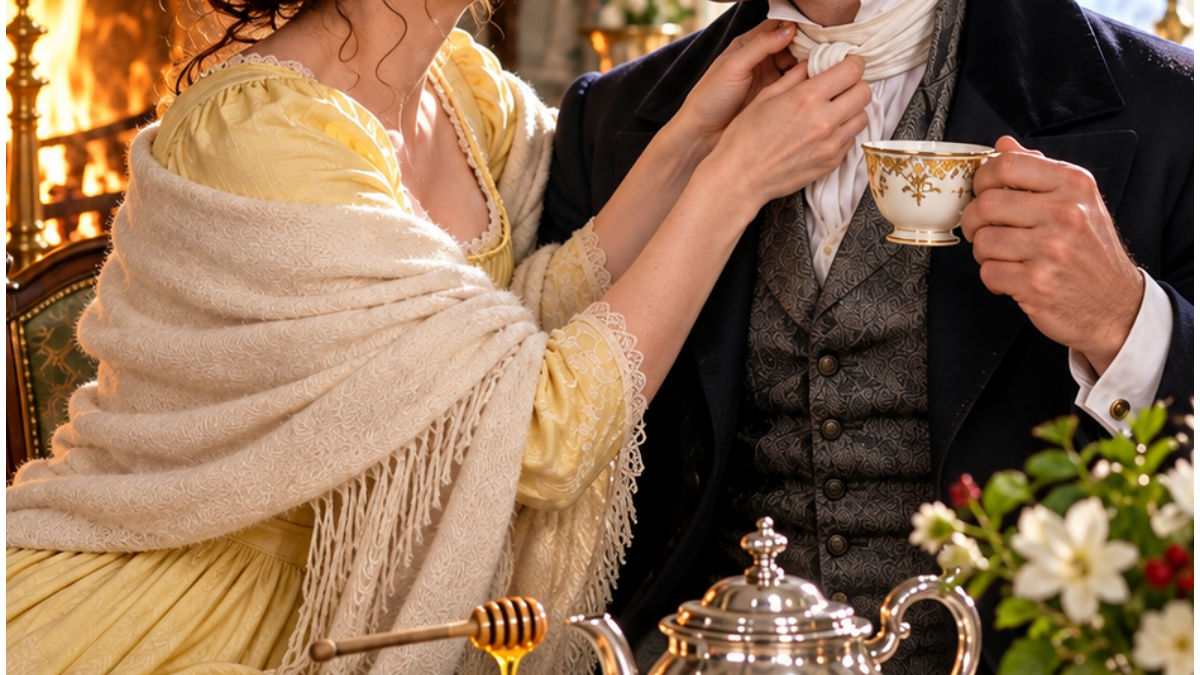
For three years the Duke of Hartzell and his wife had been perfectly polite strangers, and her trunk was packed to leave him.
Then a winter fever took every one of those years from her.
She woke, reached for his hand, and asked her husband why he looked so frightened when he loved her.
He had never once said that he loved her.
He could not bring himself to say that he didn’t.
The candles were down to stubs when she said it, and a gray light was creeping in at the edge of the curtains.
Reald stood up from the hard chair by the wall where he had sat all night, and his wife frowned at the chair as though it had insulted him.
“Not there,” said Marielle.
Her voice was a thread.
“Sit on the bed. I can’t see you properly across all that carpet.”
He sat. The mattress dipped under his weight, and her hand, hot and thin, found his wrist and stayed on it.
“Have you slept?” she asked.
“He had not. Not since the fever took her.” He said nothing.
And she smiled at him.
A slow, crooked, sleepy smile he did not recognize, and came to him that he had never seen her smile on waking.
He had never been in the room when she woke.
You always did that, you know.
She said, “Pretended you weren’t tired. You did it at the ball. You stood by the pillar all evening with your jaw set as if your boots pinched.”
“The ball?” She meant their betroal ball.
Her thumb moved on his wrist while she spoke of it, and he sat rigid under that small touch and understood what she was doing.
Describing a man she had met for a single evening and filled in afterwards with a kindness of her own invention.
She was looking at him as if he were that man.
Dr. Fenby put his head around the door.
He looked at the Duke over his spectacles and very slightly shook his head.
Outside in the passage, he said it in words.
Do not contradict her, your grace.
Whatever she believes, let her believe it.
A fright now could undo everything.
And what does she believe? That is for you to judge, said Fenby.
You are her husband. Rhynold went down to breakfast alone.
On the turn of the back stair, he met Blesop coming up with a jug of hot water, and the maid stopped a step above him, so that for once their eyes were level.
Your grace, she said very low.
The trunk in the dressing room.
What am I to do with it?
He watched the jug in her hands and the steam curling off it, and he thought of the brass cornered trunk standing strapped and labeled by the window upstairs.
“Put it where she will not see it,” said the Duke.
He did not eat. He sat at the top of the long breakfast table with a cup of black tea going cold in front of him and looked down the whole polished length of it to the chair where his wife had sat every morning of their marriage with her back very straight and her eyes on her plate.
They had spoken on a good morning about the weather.
On a bad morning they had not spoken at all.
She had said, “Yes, your grace, and as you wish, your grace,” in a voice so smooth and so pleasant that he had never been able to find the woman underneath it.
He had stopped trying. He had told himself that was courtesy, and she had written to her sister in Bath.
He knew that much because Blesop had come to him a fortnight ago, pink to the ears, to ask whether the traveling carriage might be made ready for the week after 12th night.
He had said, “Whatever the duchess wishes,” then he had gone into his study and shut the door and stood at the window for an hour without seeing anything at all.
Fenby found him in the library at noon.
The physician was a gray, careful man, past 60, who had attended the family since Reald was a boy with the measles, and he did not waste his words.
The fever, he said, had taken a piece of her.
He had seen it twice before.
The mind closed a door on a stretch of time, and the patient walked about quite happily in the rooms on the near side of it.
The far side might open next week, or a little at a time over a year, or never.
She believes she was married in love, your grace, Fenby said, polishing his spectacles on his sleeve.
She told me so while I took her pulse.
She said you were shy and that I was not to tease you about it.
Reald stood very still. She is weak, said the old man gently.
She needs quiet and broth and a reason to get out of bed.
Give her those. And when she’s strong, I suppose you’d better have something to tell her.
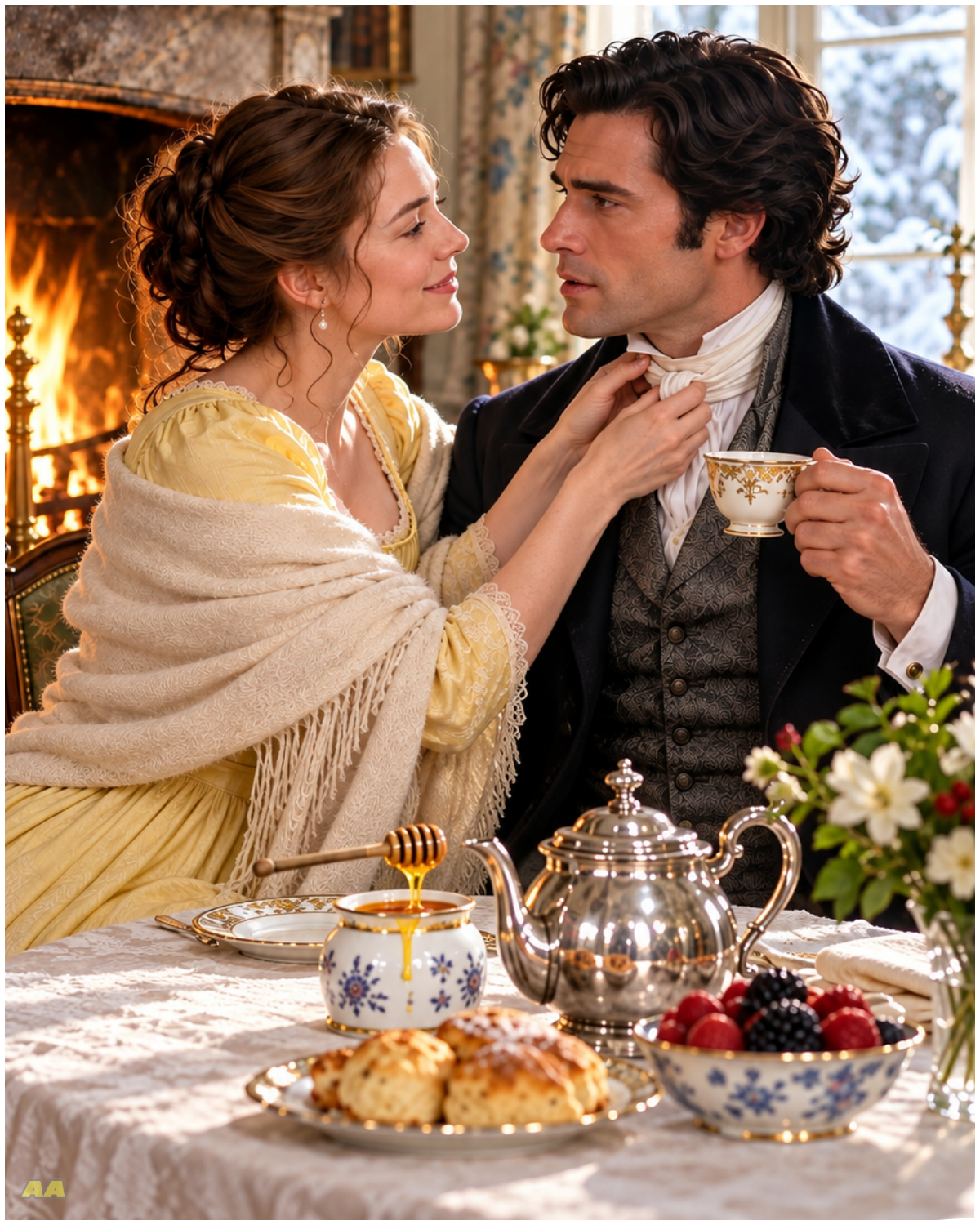
She came downstairs on a white morning 10 days later, leaning on Blesop’s arm in a pale yellow morning gown that hung a little loose on her now, and a cream wool shaw pinned at the breaSt. Snow had fallen in the night.
The whole park beyond the tall windows was blank and soft and blue in the shadows, and the breakfast room was full of that clean, cold, reflected light.
Reald was standing at the sideboard with a piece of toast in his hand.
He turned round and she stopped in the doorway and looked at the long table, and then at him, and then she laughed.
Good heavens,” said Mariel. “Do we really sit at either end of that?
We should have to shout for the salt.” She had the footman bring the little round table from the window to the hearth with two chairs set close together because she wanted to be warm and she wanted to see his face.
The footman looked at the Duke.
The Duke, who had never in his life been asked to sit close to anybody at breakfast, found that he had nodded.
So they sat by the fire, with the flames roaring on her left, and the snow light behind him, and a white cloth, and a silver teapot, and a plate of scon still warm from the kitchen.
She poured. He watched her hands.
She had always poured at the other end of the long table and sent his cup up by the footman, and he had never once watched her do it.
Her wrists were thinner than he remembered.
She lifted the lid of the blue and white honey pot, dipped the wooden dipper, and let a long gold thread of honey fall into his cup.
“There,” she said, stirring it, and pushed the cup and saucer across to him.
Just as you like it. He had never taken honey in his life.
He had taken his tea, black and scolding since boyhood, because his father had, and because sugar was for children.
He looked at the cup. He looked at her face, which was waiting, pleased with itself, a little pale at the lips from the fever, and pink at the cheekbones from the fire.
He picked up the cup and drank.
It was sweet and hot and faintly of clover, and it was not unpleasant, and it was the strangest thing that had happened to him in 36 years.
“Better,” she said, satisfied. Then she tilted her head.
“Why do you eat standing up?
You were eating toast at the sideboard like a man waiting for a coach.” He had not known that she had noticed.
He had not known that anybody had noticed.
He opened his mouth to give the answer he gave everyone which was no answer and heard himself say instead, “So that I can leave quickly, leave for where.” He could not think of anywhere at all.
Mariel looked at him across the scon with her chin in her hand.
Then she leaned across the table, took hold of his crevat with both hands, and began to loosen the knot.
“Hold still,” she said. “You look as if it is strangling you.
It’s only breakfast, Reald. There is nobody here but me.” He held still.
The teacup was halfway to his lips, the honey steaming gently under his chin, and her knuckles brushed the underside of his jaw as she worked the stiff linen free.
He did not move. He did not breathe.
He gazed at her face, a hand’s breath from his own, smiling and absorbed and utterly unafraid of him, as if he might break.
“There,” she said softly, and sat back.
“Now you look like a person.” He sat for a long while afterwards in his study, with the door shut and his crevat still hanging open the throat.
His valet would have wept to see it.
He did not retie it. Every time he lifted a hand to do so, he remembered her fingers there and put the hand down again.
His mother found him like that at 11.
The Daaja Duchess Odora was 62 and walked over from the Daer house every day, snow or no snow, in boots a gamekeeper would have been proud of.
She came in without knocking, pulled off her gloves finger by finger, and considered his throat.
“Well,” she said, “I see she’s been at you.” She put honey in my tea.
“You hate honey. I drank it.
Odora sat down across the hearth and held her hands to the fire.
She was the only person in the world, he thought, who had known from the first week what his marriage was.
She had watched it from the daer house windows and said nothing because she had once been married to his father, and she knew what it cost a woman to be told how she ought to feel.
You haven’t told her,” said his mother.
“Fenbei says I must not.” “Fi is a physician.
He’s quite right about her lungs.” “What do you say, Reald?” He got up and went to the window.
The snow had stopped. Down on the terrace, very small, a figure in a cream shawl was walking slowly up and down the swept flag stones on Blesop’s arm, and he watched her stop and turn her face up to the pale sun and laugh at something the maid had said.
“I say she is happy,” the Duke said.
“I have never once seen her happy.” not in this house, even though it is built on something that isn’t true.
He did not answer. Odora came and stood beside him, and together they watched the Duchess of Hartzel walk in the snowlight.
Then be the man she thinks you are, his mother said at last quite briskly.
Every morning as well as you can manage it.
And when she is strong enough, tell her yourself before anything else tells her firSt. Not a servant, not a letter, not some old dance tune.
You, and if she leaves the moment I do, then she leaves having been loved properly for a little while, said Odora, which is more than either of you has had so far.
The long gallery ran the whole length of the east front, and on the gray afternoons, it was the only place in the house where a convolescent could walk far enough to tire herself without going out into the cold.
Mariel took the Duke’s arm at the south end, where the windows looked down over the frozen lake, and they walked.
She was stronger every day. She could feel it in her legs.
She could feel him too shortening his stride to hers without being asked.
And she smiled to herself because a man who would do that without being asked was surely a man worth marrying.
Under a great dark portrait of a gentleman in a full wig, she stopped.
“His grandfather,” he told her. She studied the scowl for a moment and said the old gentleman looked as though somebody had just told him the price of candles.
The Duke made a sound. It was very short and he stifled it at once, but she heard it and turned round with delight.
You laughed. I did not. You did.
You laughed at your grandfather. You laughed at the ball, too.
I said the orchestra sounded like a flock of geese being taught French, and your aunt looked at us as though we had both caught fire.
He remembered. He had not let himself think of it since the wedding, and now it came back so sharply that it stopped him in the middle of the gallery.
The heat of the ballroom, the terrible violins, and a young woman in white with a frank brown gaze, who had said the silliest thing he had ever heard, and made him laugh aloud in front of half the county.
He had gone home that night and lain awake.
He had been so frightened by it that the next time they met, he was as cold as a stone, and she had taken the hint, as well bred young women do, and never said anything silly to him again.
“I remember,” he said. “I did not mind at all.” They walked on to the north end where a window seat looked out over the snow and she sat down on it a little breathless and patted the cushion beside her.
He sat. Their knees were almost touching.
He could feel the warmth of her through the wool of her shawl.
“Tell me something true,” she said.
“You speak as if every word costs you a guinea.” He watched the snow for a while.
Then he told her about his father who had said that a duke of Hartzel never shows what he feels because the moment he does somebody will use it.
He had been a small boy when he first heard it.
He had believed it. He had been careful ever since and nobody had ever used anything against him because he had never given anybody the chance.
She was quiet. Then she put her hand over his on the cushion between them very lightly.
The way one steadies a cup that has been filled too full.
“Then show me,” said Marielle. “Nobody at all is watching.” “Show me, and I promise I will not use it.” He turned his hand over under hers and held it, and that was all he could manage.
But she seemed to think it was a great deal.
She leaned her head against his shoulder and they sat like that until the light went blue and a footman came to light the candles and went away again very quickly without being told.
After that there was honey every morning.
She never asked whether he wanted it.
She simply poured and dipped and slid the cup across the cloth to him and he drank it.
He began, without quite admitting it, to look forward to the taste.
It was Blesop who made Mariel wonder.
The maid was a sensible, freckled woman of 44 who had come with her from her mother’s house, and she had always been the calmst person in any room.
But now she was not calm.
She dressed Mariel’s hair with fingers that were not quite steady.
She said, “Your grace,” as if the words were hot.
And every time Marielle went near the tall press in the dressing room, Bless found a reason to stand in front of it.
“Why is everybody in this house so careful with me?” Mariel asked one morning, watching her in the glass.
“The footmen look at me as if I might go off like a firework.
And when I laugh at dinner, the whole table goes quiet as if they have never heard me laugh before.
Was I happy here, Bless before the fever?
The pins stopped. You were very well thought of, your grace, said Bless at laSt. Everybody said so.
Mariel looked at her in the glass for a long moment.
Then she looked down and turned her wedding ring round on her finger and said nothing more.
But she noticed when Blesop bent to fetch a ribbon from the drawer, a small brass key on a loop of green thread in her apron pocket that had not been there before.
It was exactly the size to fit the press.
That was not an answer. She knew very well that it was not an answer.
The music room at Hartzell had not been used in years.
It was a small, cold, pretty room at the back of the house with a piano forte under a Holland cover.
And on the afternoon of the first Thor, Mariel had a fire lit in it and pulled the cover off herself.
When the Duke came to the door to see what the noise was, she warned him that she played like a hen crossing a keyboard and told him to sit down and turn the pages.
He sat beside her on the narrow bench.
There was not really room for two, and his shoulder pressed against hers, and she did play very badly indeed.
A little sonata she had learned as a girl with her tongue caught between her teeth and a wrong note in every bar.
He turned the pages. He did not hear the music.
He heard her breathing and the fire and the drip of the Thor outside.
And every time she missed a note, she laughed under her breath and went on.
And every time she laughed, something in his chest turned over like a key in a stiff lock.
At the end, she folded her hands and looked at them.
“May I tell you something strange,” she said.
“I think I was afraid of you once.
I can’t remember when or why, but sometimes when you come into a room very quietly, I feel it for a moment here.” She touched her breastbone.
And then it goes, “I’m not afraid of you at all.
You’re the gentlest man I know.
Was there a quarrel? You can tell me.
I would rather know.” He looked at her in the firelight with the dust of the old room in the air around her like gold, and her gray eyes waiting for him.
And he knew that this was the moment.
Fenby had said, “Wait until she was strong.” She was strong.
She was playing the pianoforte and teasing him about his grandfather and walking the gallery twice before tea.
He had no excuse left. He opened his mouth and she leaned forward and very softly, as if it were the most natural thing in the world, kissed him on the cheek.
He did not move. He wanted to turn his head.
He wanted it so badly that his hands shook on his knees.
But she did not know who she was kissing or what he had done or how many silent breakfasts lay behind that kiss.
And he would not take one thing from her that she would not have given him with her eyes open.
He took her hand instead and held it to his mouth and kissed her fingers once and let them go.
Tomorrow, he said. His voice was not steady.
There is something I must tell you, Muriel, at breakfaSt. Will you let me?
Is it dreadful? It is true, said the Duke.
I’m afraid that is worse. She smiled at him, puzzled and trusting, and went up to bed.
He did not sleep. He sat up in his study with a candle and wrote out what he would say and burned it and wrote it again and burned that too.
Before dawn he went up the dark stair and stood outside her door with his hand flat against the panels, listening to nothing.
And then he went down again.
He was too late by an hour.
It was the cold that did it.
The thor had turned in the night to a hard frost, and Mariel woke early, shivering with the fire gone out, and did not want to ring.
Her good gray shawl was nowhere to be found.
She looked in the chest and on the chair and under the bed.
And then half asleep and quite cross, she went to the tall press and found that Blesop had forgotten for once to take the brass key out of the lock.
There was no shawl in it.
There was a trunk. It was her own trunk.
She knew it the way one knows one’s own handwriting.
Brown leather, brass corners, her initials under a coronet on the lid.
It was strapped and buckled with a label tied to the handle.
And tucked beneath the strap, folded twice, was a sheet of her own writing paper, addressed in her own hand to her sister in bath.
She sat down on the floor in her night gown and read it by the gray light from the window.
She did not need to read much.
There was one line near the top in her careful, pleasant finishing school hand, and it was enough.
I cannot stay any longer in a house where I am only ever polite.
The door in her mind did not open all at once.
It opened in pieces, a crack at a time, and through each crack came something cold.
The long table, his voice level and pleasant and a mile away, saying, “As you wish, madam.” Dinner, after dinner, in silence.
A night in her first autumn, when she had waited up for him in a new blue gown, and heard his step go past her door, without a pause, the day she had stopped hoping, which she could not date, because there had been no particular day.
It had simply grown quieter and quieter until there was nothing left to hear and the ball.
She still had the ball, but she understood now that the ball was all she had ever had.
Blessup found her there an hour later, with the paper on her knee and her face quite dry, and began to cry herself, and Mariel got up and patted her shoulder and told her to hush.
It was not her fault, and to help her dress, she came down to breakfast in a dark gray gown with her hair up very smooth.
The little table was still by the fire.
The Duke stood up when she came in.
He had not slept. She could see that there were shadows under his eyes, like thumb prints, and he had tied his creat very badly, as if he had forgotten how.
She sank into a deep, perfect curtsy.
Good morning, your grace. He went white.
She watched it happen and told herself she felt nothing and sat down and poured.
She poured his tea black the way she had poured it every morning of their marriage and sent it across to him without a word.
She did not touch the honey.
You remember, he said. Some of it enough, I think.
Her voice was light and steady.
It was the old voice. She could hear it in her own ears, and it frightened her how easily it came back.
I found my trunk. Your grace.
Bless kept it very well hidden.
I shan make a scene. I only want to understand.
Why did you let me believe it?
He did not look away. She would remember that afterwards that he did not once look away from her.
Because Fenby told me not to distress you, said the Duke.
That was the first reason, and it was a true one, and because I was a coward.
Every day I meant to tell you, and every day you put honey in my tea, and I could not bear to be the man who made you stop.
There is a third reason. I can see it in your face.
Yes, not today. You are owed better than something said across a teapot to keep you from going.
She nodded slowly, as though that were an answer she had expected, and told him that she would go to Bath after 12th night, as she had meant to.
The carriage was ordered. They need not change it.
No, said the Duke. We need not change it.
She curts it again perfectly and went out.
He sat alone at the table she had moved so that she could see his face and drank his black tea.
And for the first time in his life it tasted of nothing whatever.
12th night came and the varrows came with it as they always came in a string of carriages through the snow.
His uncle and aunt from Shroptshire, the cousins from town, a great aunt in a sedan chair who had outlived her husbands and all her patients.
There were candles in every sconce and holly on every picture frame, and the great dining table was laid end to end with silver.
Mariel sat at the foot of it, where she had always sat.
She had dressed in dark red because it was expected, and she had her pearls on, and her perfect duchess smile, and she answered every cousin pleasantly, and ate almost nothing.
Far away at the head of the table, between his mother and his uncle, sat the Duke.
She did not look at him.
When she did by accident over the soup, she found he was already looking at her, and she dropped her eyes to her plate, as she had done for 3 years, and hated that she knew exactly how to do it.
It was the uncle who began it.
He had drunk a good deal of clarret, and he leaned back over the pudding and asked in a voice that carried to the foot of the table, when the family might expect some news from Hartzell, since a duke wanted an heir and not a cold house, and a wife who went visiting.
There was a small, delighted silence.
Every cousin looked at Mariel. She felt her face grow hot and set her fork down very carefully and opened her mouth to say something pleasant and empty.
The Duke stood up. He did not do it quickly.
He put his napkin on the table and pushed back his chair and stood at the head of his own table in the candle light, and the torque died all the way down it the way a wind drops.
My house has been cold, said the Duke.
That is true. It has been cold for 3 years, and the coldness was mine.
Not my wife’s. She came here frank and kind, and I met her with silence, because I was afraid of what she made me feel, and I kept on meeting her with it, until she learned to be silent back.
Every one of you who has thought her proud or dull or unwilling has been thinking of the wrong person.
You were thinking of me. Nobody moved.
At the foot of the table, Mariel sat with her hands clasped and could not breathe.
The daager sat perfectly still beside her son with the faintest ghost of a smile at the corner of her mouth.
My wife goes to Bath next week, Reald said.
She goes with her full settlement and my blessing and my name to open any door in England.
If any person here ever speaks of her going as a failure of hers, that person will not dine at Hartzell again.
I beg your pardon for the interruption.
Please finish your pudding.” He sat down.
The silence went on for a very long time.
Then the great aunt in the corner, who had not spoken all evening, put up her lawnette, peered the length of the table at the Duke, and announced in a voice like a creaking door, that it was about time somebody in this family said something interesting at dinner.
Somebody laughed, then somebody else. The torque crept back like water into sand.
His uncle drank off his glass and said nothing more at all.
Mariel did not remember the rest of the dinner.
She remembered that the daager came to find her afterwards in the small drawing room where she had gone to sit alone in the half dark and sat down beside her without a word and took her hand.
He has never done that in his life,” said Udora quietly.
“Not for anybody. His father would have died sooner.
I shan tell you what to do, my dear.
Nobody has told you what to do in this house for long enough.
I will only say this. You are not the only one who was afraid.” The carriage came round early on the morning she was to leave.
It stood on the gravel below the breakfast room windows with the horses stamping and blowing in the cold, and the snow was falling again lightly in big slow flakes that melted on the glossy black roof.
Her trunk was strapped on behind.
Blesop was already inside with the rugs.
Marielle came down in her traveling cloak and bonnet, pulling on her gloves, meaning to go straight out through the hall.
But the door of the breakfast room stood open, and the fire was lit, and he was there.
He was sitting by the hearth alone with a teapot in front of him and one cup.
And as she stood in the doorway, not meaning to watch, she saw the Duke of Hartzell take up the wooden dipper clumsily, like a man who has never done it before, and let the honey run from it into his own tea.
He looked up and saw her.
He did not stand. He did not bow.
He only put the dipper down and met her eyes, and his face was entirely undefended, the way it had never once been in all their mornings.
“I have never taken honey in my life,” he said.
“Not until you gave it me.
I have taken it every morning since, and I will take it every morning after you have gone, because it is the only thing in this house that tastes of you.” She did not move from the doorway.
You asked me for the third reason, said Reald.
Here it is. I was not pretending, Mariel.
Not for one day of it.
Not at the gallery window, not in the music room, not at this table.
Every word I let you believe was true.
It was only that I had never said it.
I loved you at the ball when you made me laugh about the geese and it frightened me so much that I was cruel to you with silence for 3 years.
I have no excuse for that.
And I will never ask you to forgive it.
But I love you. I would rather you went to Bath knowing it than stayed here one more morning not knowing.
The fire cracked outside. A horse shook its harness and the bells on it rang very faintly through the glass.
If you go, he said, I will write to you every week and badly.
And if you will let me, I will come to Bath in the spring and call on you like a stranger and sit in your sister’s drawing room and court you properly from the beginning, the way I should have done.
Mariel stood for a long time and simply gazed at him at the honeypot and the cup and his hands which were not steady and the crevat which he had tied very badly again.
Then she pulled off her gloves, finger by finger, the way his mother did, and laid them on the chair by the door, and untied her bonnet, and came across the room, and sat down opposite him, so close to the fire that she could feel it on her cheek.
“Then I choose you,” said Marielle, “wake!”
He did not seem to understand her at first.
So she reached across as she had done on the first white morning and took his face in both her hands very gently and looked at him with her eyes quite open and kissed him on the mouth.
This time he turned his head.
This time he did not hold still at all.
When Blesop came in from the carriage some while later to ask whether her grace was ready, she found the Duke and Duchess of Hartzell sitting side by side on the same side of the little table, which was not at all how it had been laid, with their hands tangled together on the cloth, and the tea gone cold between them.
The Duchess looked up. Her eyes were red and her whole face was shining.
She told Blestop to send the horses back round and to bring the trunk in and to unpack it.
The maid burst into tears for the second time that week and went away to do it.
The spring came late that year and warm.
By the time the lilac was out on the terrace, the long table stood against the wall under a dust sheet, and the footman had quite given up expecting to carry cups the length of the room.
On an ordinary gray morning the winter after, the Duke came down to breakfast and sat and did not stand and did not reach for his toaSt. He waited.
His wife came in with her hair only half up in the old cream shawl, yawning, and kissed the top of his head on her way past and sat down close beside him and poured.
She lifted the lid of the blue and white pot.
She let the gold thread fall into his cup and stirred it and pushed it across the cloth into his hands.
Just as you like it, she said.
Just as I like it, said the Duke and drank.
Being loved in error is a sweet thing, and it will not laSt. Being chosen again by someone who has remembered everything is the thing that lasts.
That is how a house turns into a home.








