“The Duke Worked the Fields in Silence” — Until She Asked Why a Lord’s Son Knew How to Plow
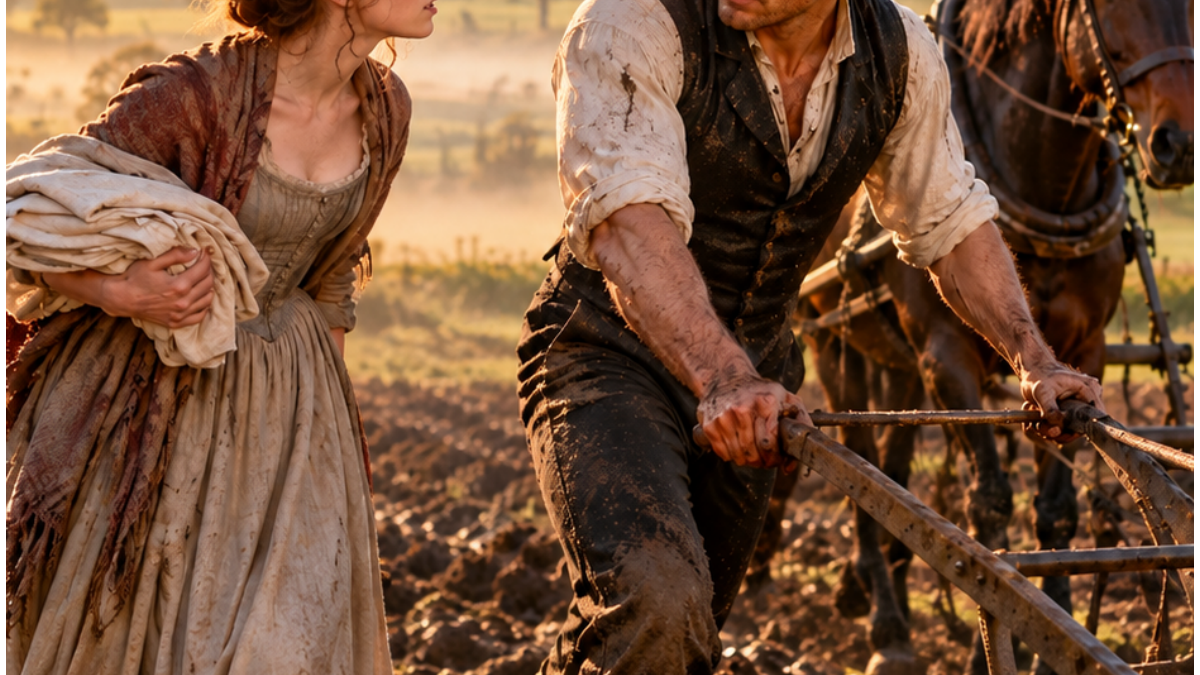
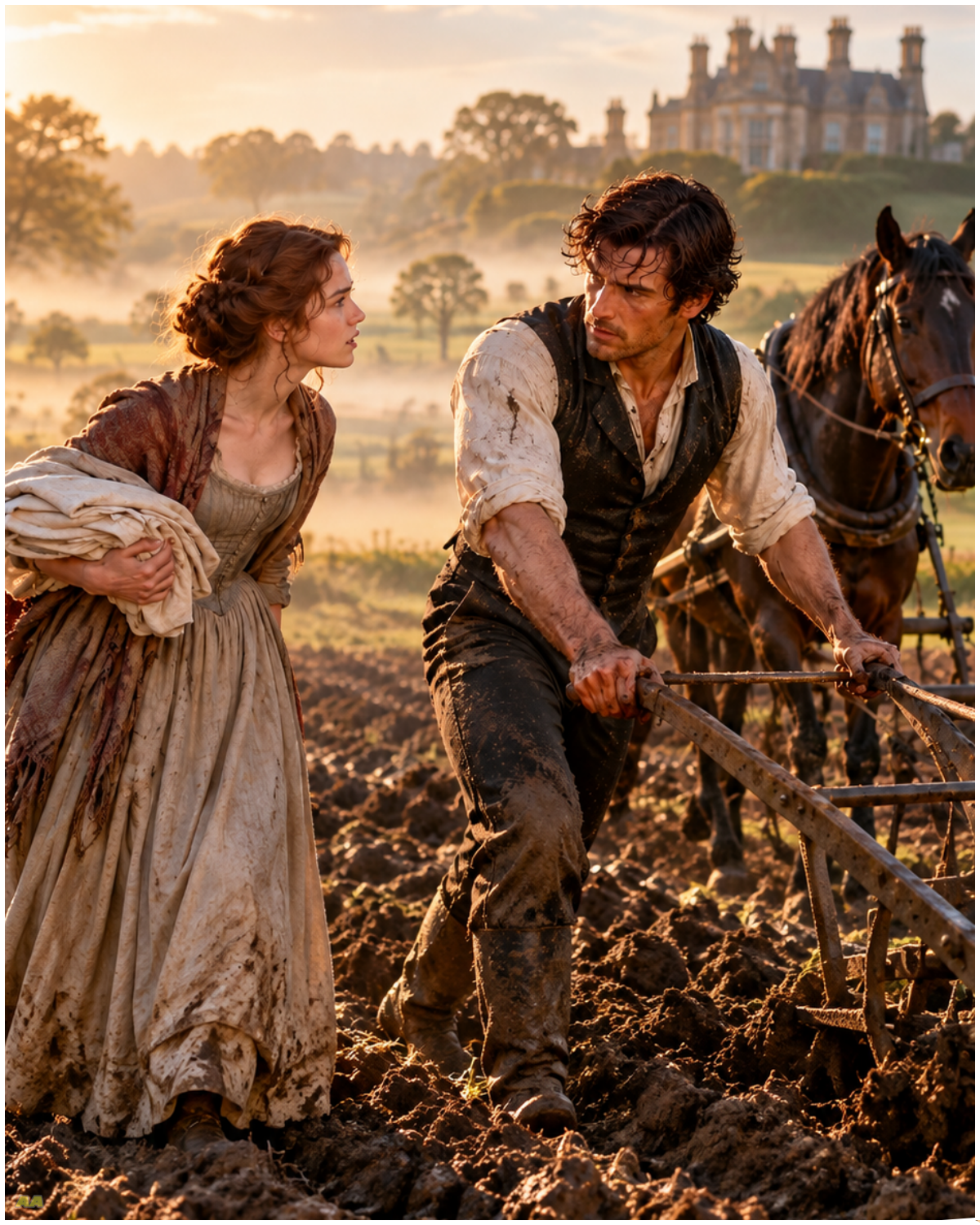
The first time Claraara Witmore saw the man working in the fields, she thought he was a laborer.
It was barely dawn at Ravenshire, and a pale mist still rested over the estate grounds.
The air held the particular hush of early spring, cold enough to numb her fingers through her shawl, and touched with the mineral smell of turned earth.
Claraara had been sent outside to deliver fresh linens to one of the workers’ cottages, when she noticed the figure several rows away.
He was alone.
His coat was too fine for a farm hand, but it was covered with duSt. His boots were muddy.
His sleeves were rolled to his elbows, and he was guiding a heavy plow through the earth as though he had done it all his life.
The only sounds were the creek of the harness and the wet, steady thud of turned soil, and beneath them, very faint, the first birds testing the light.
Claraara stopped walking. There was something strangely familiar about the way he moved.
Not graceful, not delicate, confident.
The horse pulled forward and the man leaned into the plow.
Claraara watched for another moment before curiosity overcame caution.
That is not work I would expect a gentleman to know.
The man stopped. He turned toward her.
He was younger than she had expected, perhaps somewhere near 30, with dark hair, broad shoulders, and an expression that seemed permanently guarded.
Perhaps I am not a gentleman.
Claraara looked at his coat, taking her time about it, the way one might examine a claim before deciding whether to believe it.
That coat suggests otherwise. He glanced down at himself, almost surprised, as though he had forgotten what he was wearing.
It is an old coat.
It is still expensive.
A faint smile appeared there and then carefully put away again.
You inspect everyone’s clothing, only suspicious strangers.
His smile disappeared, though something behind his eyes did not entirely follow it.
Then I must be making a poor first impression.
You are working in a duke’s fields before breakfaSt. That is hardly a crime.
I did not say it was.
She tilted her head slightly, watching him.
But you sound as though you are considering reporting me.
Claraara almost smiled.
I wouldn’t know who to report you to.
The man looked toward the distant manner and something in his shoulders eased just slightly at her answer.
Perhaps that is fortunate.
There was something about the answer that caught her attention.
Do you work here?
He considered the question longer than it seemed to need.
Sometimes that sounds like the answer of a man avoiding a simpler one.
He straightened, resting one forearm along the plow handle as though the question deserved a moment’s real consideration.
When there is work to be done, that isn’t an answer.
No, he agreed, and did not seem in any hurry to give her one.
Then what is your name?
He hesitated, and the hesitation itself told her something, though she could not have said what.
Nathaniel. Only Nathaniel. She waited, certain there was more to it than that.
He held her gaze a moment before he answered as if weighing how much of himself to hand a stranger in a field.
For now, Clara frowned. That is a strange way to introduce yourself.
So is questioning a stranger while he is trying to work, he said.
And there was no real complaint in it, only the same weary amusement.
I was only curious. And now, now I am more curious.
She said it lightly, but she meant it.
And he seemed to hear that she meant it.
He laughed quietly. It was the first time she saw the guarded expression disappear from his face.
For one brief moment, he looked almost ordinary.
Claraara looked toward the plow.
You really know what you are doing.
I should hope so. There was no boast in it, only a kind of quiet certainty.
Why? She was not entirely sure herself why the question mattered so much to her.
He looked at the earth rather than at her, as though the answer were easier to give to soil than to a stranger’s face.
Because I learned a long time ago that there are things a man understands better when his hands are dirty.
Claraara studied him. There was something unusual about him.
He spoke like a gentleman.
He carried himself like one.
Yet there was none of the arrogance she had come to expect from wealthy men who visited Ravenhshire.
Instead, there was a strange quietness about him, as though he had deliberately stepped away from the world he belonged to.
“Do you always work alone?” she asked.
“Usually, why?”
He was quiet a moment before he answered as though weighing how much of the truth a stranger in a field was owed.
“Because people ask fewer questions when they think you are nobody.”
The answer surprised her.
Before she could respond, he returned his attention to the field.
Claraara should have continued toward the cottages.
Instead, she remained where she was.
Then, perhaps I should stop asking questions.
Perhaps. She turned away. After taking several steps, she looked back.
Nathaniel was already working again.
She watched him for another second before continuing toward the cottages.
She did not know his surname.
She did not know why he was hiding, and she certainly did not know why a man who clearly belonged among gentlemen seemed more comfortable behind a plow than inside the great house.
By breakfast, Claraara had nearly forgotten the encounter.
Nearly. The kitchen corridor was warm with the smell of wood smoke and baking bread, and for a few minutes the morning felt ordinary again.
Then Mrs. Bellamy entered the servants’s corridor in a hurry.
Miss Whitmore. Claraara looked up.
Yes, his grace has returned.
Claraara frowned, the name meaning nothing to her yet.
His grace, the Duke, Mrs. Bellamy said it the way one might explain the sun rises in the east, as though the confusion itself were faintly ridiculous.
She stopped. “Which Duke?” Mrs. Bellamy looked at her as though the question were absurd.
“Our Duke, of course.” Claraara’s fingers tightened around the linen she was holding.
The Duke of Ravenshaw? Yes.
Claraara said nothing. Mrs. Bellamy continued on her way, but Claraara remained frozen in the corridor, the smell of bread suddenly cloying, the warmth of the kitchen no comfort at all, the muddy boots, the expensive coat, the dark hair, the quiet voice, the strange smile.
She remembered the man in the fields, Nathaniel.
She suddenly understood why he had refused to give her his full name.
The man she had questioned that morning was not a farm laborer.
He was Nathaniel Blackwood, the Duke of Ravenshire, and she had just spent half an hour asking him why a duke knew how to plow.
Claraara Witmore did not see Nathaniel Blackwood again that morning.
She was relieved. At least that was what she told herself.
The knowledge that the stranger from the fields was the Duke of Ravenshshire had changed everything.
His muddy boots no longer seemed amusing.
His quiet answers no longer seemed harmless.
Every word she remembered now carried a different weight.
A duke had spoken to her as though she were simply a woman standing in a field, and she had spoken to him as though he were nobody at all.
By lunchon, Claraara had heard enough about his grace to understand that she had been fortunate.
Nathaniel Blackwood was not known for being approachable.
He had inherited Ravenshshire 3 years earlier after his father’s death, along with its sprawling estate, several tenant farms, and a reputation for being distant.
He rarely attended London society.
He avoided elaborate entertainments. He did not seem interested in finding a wife, and according to Mrs. Bellamy, he had little patience for people who treated his title as an invitation to flatter him.
“Then why does he work in the fields?” Claraara asked.
Mrs. Bellamy looked at her sharply.
“You have been asking about his grace quite a lot today.” Claraara immediately returned her attention to the folded linens.
I was only curious. Curiosity is a dangerous habit around powerful people.
Claraara smiled faintly. I have survived worse.
Mrs. Bellamy’s expression softened. She knew exactly what Claraara meant.
Claraara had not come to Ravenshire because she had dreamed of serving in a duke’s household.
She had come because she had needed somewhere to go.
Her father, Thomas Witmore, had once been a respected estate steward.
He had been trusted with accounts, rents, and correspondence.
Then when Claraara was 16, he had been accused of stealing money from the estate where he worked.
The accusation had spread quickly.
There had been whispers in the village.
People who had once greeted Thomas warmly began crossing the street to avoid him.
His employer dismissed him. Their small home was sold to settle the debts.
Thomas insisted until the day he died that he had never taken a penny, but he had been unable to prove it.
Claraara remembered sitting beside his bed during his final winter.
The room had smelled of tallow candles and the sharp medicine the apothecary scent, and the cold pressed in at the window, no matter how high the fire was built.
He had been thin then, his face hollow from illness and shame.
Your father was not a thief, he had told her.
I know. Then remember that when others tell you otherwise, I will.
He had closed his eyes for a moment.
One day, Claraara, the truth will come out.
It never had, at least not yet.
After his death, Claraara had been left with little more than his name and a handful of belongings.
Her aunt had taken her in for a short time, but there was little room and even less money, so Claraara had accepted work wherever it was offered.
Eventually, Mrs. Bellamy had helped secure her position at Ravenhshire.
It was not the life she had once imagined.
She slept in a narrow room beneath the servants’s quarters.
She owned three decent dresses and one pair of shoes suitable for church.
Her days were spent carrying linens, helping in the household, delivering messages, and assisting wherever she was needed.
Yet she had never considered herself helpless.
She had learned early that dignity was sometimes the only thing a person could keep when everything else had been taken away.
That was why she had never forgiven the people who had called her father a thief.
And perhaps that was why Nathaniel’s strange habit disturbed her.
A man who possessed everything seemed to understand something about having nothing.
That afternoon Claraara found herself walking past the eastern window again.
Beyond the glass, the fields stretched beneath the pale afternoon sun, the light flat and silvery, the way it fell only in early spring.
She searched the rose without meaning to.
Nathaniel was not there. She felt foolish for being disappointed.
Then she remembered the words he had spoken.
People ask fewer questions when they think you are nobody.
Claraara understood that feeling. She knew what it was like to become invisible.
She had spent years being overlooked because she was the daughter of a disgraced man.
Perhaps that was why she had noticed him, not because he was a duke.
Because for a short time that morning he had seemed like someone who did not belong to the world around him either.
The thought unsettled her. She turned away from the window.
She would not make the mistake of becoming curious about a man like Nathaniel Blackwood.
A duke could afford secrets.
A servant could not. And Claraara had already learned what happened when a powerful family decided that someone else’s reputation was expendable.
She had no intention of allowing herself to become another victim of such a world.
What Claraara did not know was that Nathaniel had noticed her too, and by evening he had already asked Mrs. Bellamy one question about her.
How long has Miss Witmore been at Ravenshire?
Mrs. Bellamy had looked at him carefully before answering.
Nearly 2 years, your grace?
Nathaniel had nodded. And her family, Mrs. Bellamy hesitated.
Her father was Thomas Witmore.
Nathaniel’s expression changed only slightly, but enough for Mrs. Bellamy to notice.
Why do you ask? Nathaniel looked toward the darkened fields outside.
Because I knew that name, he said nothing more, and for the first time since Claraara had arrived at Ravenshshire, the past she had spent years trying to leave behind had begun moving quietly toward her.
Claraara had expected Nathaniel Blackwood to behave differently after she learned who he was.
She was wrong. The following morning, she saw him at breakfaSt. Not in the fields, not covered in mud, not disguised as a laborer.
He stood at the head of the long dining table in a black coat, speaking quietly with the estate steward, while several gentlemen waited for his attention.
Morning light came slanting through the tall windows, catching the silver on the sideboard and the steam rising off the tea earern.
This was the man the servants called his grace, the Duke of Ravenshshire.
Claraara lowered her eyes and continued arranging the breakfast service.
She told herself not to look at him.
She looked anyway. Nathaniel noticed.
Their eyes met across the room.
For the briefest moment, something almost amused passed through his expression.
Claraara immediately looked away. She heard his footsteps approaching.
Miss Whitmore, she turned. Your grace.
The formal title felt strange after their conversation in the field.
His expression suggested that he noticed.
You seem disappointed. Disappointed that I am not carrying a plow.
There was the faintest thread of humor in it, carefully controlled, as though he were not yet certain he was allowed to tease her here in this room, in this coat.
Claraara nearly smiled. “I was not looking for the plow.” He tilted his head slightly, as though weighing whether to believe her.
“No, no,” she said, holding his gaze without flinching.
“Then what were you looking for?” she hesitated.
“The man I met yesterday.” Nathaniel studied her for a moment before he answered.
Something careful moving behind his eyes.
You already found him. Clara looked at him carefully.
No. Yesterday I thought I was speaking to a stranger.
And today? Today I am speaking to the Duke of Ravenshshire.
His expression became more serious.
Would you prefer the stranger?
The question caught her off guard.
I do not know you well enough to prefer either.
That is probably wise. He turned away, but Claraara noticed something in his voice.
Disappointment. It was gone almost immediately.
Before she could think about it, Mrs. Bellamy called her from across the room.
Claraara returned to work. Yet Nathaniel’s question remained with her.
Would you prefer the stranger?
She did not know why the question mattered, nor did she understand why she wished she had answered differently.
Later that morning, Claraara was carrying a stack of books toward the library when she heard voices inside.
“One belonged to Nathaniel. The other was the estate steward,” Mr.
Hargreaves. “The east fields need new drainage before the spring planting,” Nathaniel said.
“It will be expensive, your grace.
Then we will find the money.
There are other expenses, Hargreav said in the tone of a man who had made the same argument before and expected to lose it again, then postpone them.
Claraara paused outside the door.
She had no intention of listening.
Then Nathaniel said something that made her stop.
The tenants cannot lose another season because we are protecting the appearance of the estate.
Claraara looked through the partially open door.
Nathaniel stood beside the desk, studying a collection of estate accounts, the pages catching the gray light from the window.
He did not look like the man she had met in the field.
But somehow he looked more like him than ever.
He was not concerned with appearances.
He was concerned with the people who depended on the land.
Mr. Hargreaves lowered his voice.
Your father would have handled matters differently.
Nathaniel’s expression hardened. My father is dead.
Of course, your grace and his decisions are no longer mine.
Claraara moved away before they noticed her.
She carried the books to the library and placed them on the table.
A few moments later, Nathaniel entered.
You heard us. It was not a question.
Claraara turned. I was bringing these books.
I know. There was no accusation in his voice, only awareness.
I did not mean to overhear.
I believe you. He walked toward the shelves, the old leather bindings releasing a faint smell of dust and tallow as his hand passed along them.
Claraara watched him. “Why do you work in the fields?” he stopped.
She expected him to avoid the question again.
Instead, he answered. “Because I spent most of my childhood being told what a duke should be.” “And you disliked it?” “I disliked being told.” That surprised a laugh out of her.
Nathaniel looked at her genuinely startled as though laughter were not a sound this room heard often.
What? Nothing. You laughed. I did, she admitted.
Because you sound like a stubborn child when you say things like that.
His eyebrows lifted. Few people speak to me that way.
Perhaps more should. A small smile touched his mouth.
I suspect you are right.
Silence settled between them. It was not uncomfortable.
That was what troubled Claraara.
She had expected speaking to a duke to feel frightening.
Instead, she felt strangely at ease.
Nathaniel moved closer to the table.
Your father worked with estate accounts, did he not?
The ease disappeared. Claraara’s expression changed.
Who told you that? I asked Mrs. Bellamy.
Why would you ask her such a thing?
Nathaniel hesitated, and the hesitation was answer enough before he spoke at all.
Because I knew his name.
You said that yesterday and you still have not told me how.
He looked at her and something closed behind his eyes.
The same guarded look she had first seen in the field.
I cannot answer that yet.
Clara stiffened. Then perhaps you should not have asked about him.
You are right. He said it quietly without argument which somehow made it worse.
She gathered the books. Good.
She turned to leave. Miss Whitmore.
She stopped. I am not trying to cause you harm.
She looked back at him.
I have learned that people do not need to intend harm before they cause it.
Nathaniel said nothing. The words had struck somewhere deeper than she expected.
Claraara left the library. Nathaniel remained behind, and for a long moment he did not move at all.
He had told her the truth that he could not answer yet, but not the whole of it.
He could have said more.
He could have told her that the name Thomas Witmore had followed him for 13 years, sitting at the edge of every ledger he opened, every account he balanced, like a debt he had never been brave enough to settle.
He said none of it.
It was easier to let her think he was only being careful.
That evening, Nathaniel returned to the fields.
The light was failing. The sky gone the color of a bruise along the horizon, and the air smelled of wet grass and the smoke of a tenants’s chimney somewhere beyond the hedro.
He found the same stretch of earth where Claraara had first seen him.
He stood there for a long time before taking hold of the plow, but this time his thoughts were not on the soil.
They were on Claraara Witmore, and on a summer 13 years gone, when he had been 17, and had said nothing, while a good man’s name was taken from him, he had expected her to be timid.
She was not. He had expected her to flatter him.
She did not. He had expected her to be impressed by his title.
Instead, she had looked past it.
That was precisely what made her dangerous to him.
Because Nathaniel had spent years keeping people at a safe distance.
And somehow, after only two conversations, Clara had already begun to see the man he had worked so hard to hide, and to remind him of the boy he had once failed to be.
Over the next two weeks, Claraara found herself seeing Nathaniel more often than she intended.
Sometimes it was in the library, where he reviewed estate accounts late into the afternoon, the smell of ink and old paper thick in the closed room.
Sometimes it was in the stable yard, where he insisted on checking the condition of the horses himself, the air sharp with hay and leather, and the sweet heavy smell of the animals.
And sometimes, when the morning mist still covered the fields, she saw him working the land.
At first they spoke only when necessary.
Then their conversations began lasting longer.
It started with small things.
A disagreement about the condition of the eastern road, a comment about the weather, a question about whether the tenants had received their winter supplies.
Nathaniel never treated Claraara as though she were invisible.
That alone made her uncomfortable.
She was accustomed to servants becoming part of the background of a great house.
Nathaniel seemed determined to notice her.
One afternoon, Claraara was carrying a basket of apples toward the kitchen when she found him beside the orchard wall.
The air smelled of bruised windfall fruit and the last of the autumn leaves rotting sweetly underfoot.
He was holding a fallen branch.
That tree will not survive another winter if nobody repairs it, he said.
Claraara looked at the branch.
You sound like you are discussing a person.
Some trees are more stubborn than people.
That sounds like something a man says when he has lost an argument.
Nathaniel glanced at her. Have you been waiting all afternoon to say that?
Perhaps. He smiled. Claraara tried not to smile back.
She failed. That was becoming a problem.
Their conversations were becoming easy.
Too easy. She began discovering small things about him.
Nathaniel preferred simple meals when he could have elaborate ones.
He disliked crowded drawing rooMs. He knew the names of many of the estate workers.
He could repair a fence, saddle a horse, and read an account book with equal patience.
But there was one subject he always avoided.
Her father. Whenever Claraara mentioned Thomas Whitmore, Nathaniel became quieter, not cold, not distant, simply careful.
One afternoon, she finally asked him directly, “You knew my father?” Nathaniel was standing beside the stable, tightening a leather strap.
His hands stillilled on the buckle, though he did not turn around at firSt. I knew of him.
That is not the same thing.
He set the strap down slowly, as though giving himself a moment before he had to face her.
No, I knew him personally, though only briefly.
How briefly? Long enough to remember him?
He finally turned. Something in his face had gone careful, the way it did whenever this subject came near.
She stepped closer, close enough that she had to tilt her chin to hold his gaze.
Then why have you never told me because I was not certain what you had been told?” He said it quietly and did not look away from her while he said it, though it plainly cost him something to keep looking.
I was told my father was a thief.
Nathaniel’s jaw tightened, a small motion, as though the word itself had struck him somewhere.
And do you believe that?
No. The answer came without hesitation.
He looked away out toward the dark line of the stable roof against the sky and was quiet long enough that she thought he might not answer at all.
Why are you so certain?
Because my father looked me in the eye until the day he died and told me he was innocent.
Nathaniel was silent. Claraara watched his face, the muscle working once at the side of his jaw.
You believe him? It was not a question.
Nathaniel looked back at her.
I believe your father was a good man.
The words struck her harder than she expected.
For years, she had carried her father’s shame quietly.
Hearing someone else defend him made her throat tighten.
How do you know that?
You barely knew him. Nathaniel took a slow breath, and for a moment his hand closed hard around the leather strap he had set down, as though he needed something to hold on to while he spoke.
Because I once saw something that would have been easy to look away from and did not look away from it quickly enough to matter.
Claraara frowned. What does that mean?
He shook his head. I cannot tell you yet.
Clara’s expression hardened. Again, I am sorry.
You keep telling me you know something, but you refuse to tell me what it is.
Do you understand how cruel that is?
Nathaniel’s face changed. A flinch he did not try to hide.
Yes, I understand it exactly.
Then why continue? Because I need to be certain before I give you an answer that cannot be taken back.
Claraara stared at him. She wanted to be angry.
Instead, she found herself wondering what he was afraid of.
Before she could ask, Nathaniel reached into his coat.
He removed a small object wrapped in cloth.
I found this locked in a box of confiscated effects filed among the old estate papers from the year your father was dismissed.
He held it out. Clara hesitated before taking it.
She opened the cloth. Inside was a simple silver pocket watch, cool and heavier than it looked.
Her breath caught. She knew it immediately.
My father’s. Nathaniel nodded. Confiscated.
You mean it was taken from him.
When the accusation was made, his person and his rooms were searched along with the accounts.
Anything of value was held as evidence until the matter was settled.
It never was settled, so nothing was ever returned.
Claraara turned the watch over in her hand.
Her father’s initials were engraved on the back.
TWW. The metal had gone dull with years of sitting untouched in the dark.
He wore this everyday until they took it from him apparently and never gave it back even after he had lost everything else.
I know. She looked up sharply.
You saw him wearing it before.
Nathaniel’s eyes met hers steady this time.
Yes. I was a boy who noticed little, but I noticed that watch because your father checked it constantly, the way a careful man does.
The answer changed something between them.
For the first time, Claraara realized Nathaniel’s connection to her father was not merely something he had read in an old account.
He had actually known him.
She closed her fingers around the watch, the metal already warming against her palm, and it simply sat in a box for 13 years, while I believed I had nothing left of his but his name.
I do not think anyone meant cruelty by it.
I think a locked box is simply where unresolved things go in a house that prefers not to look at them.
I found it because I was searching for something else entirely.
What were you searching for?
Nathaniel hesitated, his eyes on the watch rather than on her.
Proof of what? He looked at her at laSt. That your father was telling the truth.
Claraara could not speak. The wind moved softly through the orchard, carrying the last dry leaves across the grass between them.
Nathaniel stepped closer. I cannot promise you that I will find what you hope to find.
I am not asking for a promise.
She said it simply without heat, as though the distinction mattered a great deal to her.
He studied her face for a moment.
Then what are you asking for?
The truth, she said, and nothing more.
As though the word needed no company to make her meaning plain.
His expression softened. Then that is what I will try to give you.
For several seconds, neither moved.
Claraara could feel the warmth of him despite the cool afternoon air.
She should have stepped away.
She did not. Nathaniel looked at her as though he had forgotten what he meant to say.
Then the sound of footsteps approached from the house.
They separated. Mrs. Bellamy appeared at the end of the path.
Your grace. There you are.
I have been looking everywhere.
Nathaniel straightened. What is it?
The solicitor has arrived. His expression changed.
Which solicitor? Mr. Wexford. Claraara saw the change immediately.
Nathaniel’s face became guarded. He glanced at the pocket watch still resting in Claraara’s hand.
Then toward the house. Tell him I will see him in the study.
Mrs. Bellamy nodded and hurried away.
Claraara looked at Nathaniel. Who is Mr.
Wexford? Nathaniel’s eyes remained on the house.
The man who handled the estate accounts when your father was accused.
Claraara’s fingers tightened around the watch, and suddenly the past no longer felt buried.
It was standing inside Ravenur’s walls.
Mr. Wexford remained at Ravenshshire for nearly an hour.
Claraara did not see him leave, but she heard his voice from the corridor outside the study.
It was smooth and measured, the voice of a man accustomed to being trusted.
She disliked him immediately. She could not fully explain why.
Perhaps it was because Nathaniel had become so guarded the moment his name was mentioned.
Perhaps it was because the pocket watch in her hand had made the past feel suddenly close.
Or perhaps it was because she had begun to understand that Nathaniel’s silence was not indifference.
He was searching for something.
And whatever he was searching for had something to do with her father.
That evening, Claraara returned the pocket watch to Nathaniel.
She found him alone in the library, standing beside the window, a single lamp throwing his shadow long across the floor.
I think you should keep it, he said.
It belonged to my father.
Then it belongs with you.
She held it out again.
You found it. I found it because I was looking for answers.
And now, now I think you should have it.
Clara closed her fingers around the watch.
Thank you. Nathaniel turned toward her.
For what? For believing my father.
He was quiet for a moment.
I never understood why people were so willing to believe the worst of him.
Because it was easier, perhaps.
Claraara looked at him. Was your father one of them?
Nathaniel’s expression tightened. My father believed the accusation.
And you? I was 17 when it happened.
I knew my father trusted the accounts because he trusted the man who prepared them.
Wexford. Nathaniel nodded. Yes. Then why do you believe my father was innocent now?
Nathaniel hesitated as though even now the words cost him something.
Because I found something. A letter?
She waited, hardly breathing. From your father?
Yes. What did it say?
Nathaniel looked toward the window before answering.
The glass gone black now with the fallen knight.
Your father wrote that he had discovered money missing from the estate accounts.
Clara stared at him. My father discovered the theft.
Nathaniel nodded. And after that he was accused of taking the money himself.
The room seemed to grow silent.
Clara could barely breathe. Who was responsible?
I cannot prove it yet.
He said it evenly, but his hand had gone still against the desk, as though the name was something he did not want to set loose in the room before he was certain of it.
“But you suspect someone.” He looked at her for a long moment before he answered.
“Wexford!” The name landed heavily between them.
Claraara had spent years believing her father had died, carrying a shame that did not belong to him.
Now, for the first time, she had something stronger than memory.
She had a reason to believe him.
Her eyes filled with tears.
Nathaniel stepped closer. Claraara. She looked at him.
I believed him. I know.
His voice had gone rough.
I should have been able to prove it.
You were 16, he said, as though the fact itself were an argument that needed no further defending.
I should have done something.
He tightened his hold on her hand.
You were a child. The gentleness in his voice broke something inside her.
She turned away. Nathaniel did not touch her immediately.
He waited. That small restraint meant more than she expected.
When he finally reached for her hand, he did so slowly enough that she could have pulled away.
She did not. His fingers closed around hers.
For several seconds, neither spoke.
Then Claraara whispered, “Why are you doing this for me?” Nathaniel looked at their joined hands.
“Because your father deserved better.
And because of that, he lifted his eyes to hers.
No. The answer was so quiet that she almost missed it.
Then why? Nathaniel took a breath.
Because I care what happens to you.
Clara’s heart tightened. She looked at him.
He was close enough now that she could see the small scar near his jaw and smell the woods still clinging to his coat from the evening fire.
For once there was no title between them, no duke, no servant, no distance.
Only two people standing in a quiet library with a truth neither had expected to share.
I care what happens to you too, Claraara whispered.
Nathaniel’s expression softened. He lifted his hand toward her face, then stopped.
Claraara [snorts] understood the question without him asking it.
She closed the distance herself.
Their kiss was gentle and brief, almost uncertain.
But when they separated, neither pretended it had meant nothing.
Nathaniel rested his forehead lightly against hers.
“I should not have done that.” “Do you regret it?” “No.” “Then perhaps you should stop saying things you do not mean.” A quiet laugh escaped him.
“I am beginning to think you enjoy making things difficult for me.
I think you make things difficult for yourself.” He smiled.
Then his expression changed. Claraara noticed.
What is it? There is something else you need to know.
The warmth between them faded.
What? Nathaniel stepped back. The letter gives us a reason to question what happened to your father.
But it does not prove Wexford framed him.
Claraara’s expression fell. Then what do we have?
Your father’s word, the missing money.
And the fact that Wexford controlled the accounts.
That is not enough. No, he admitted and did not try to soften it.
Can you prove it? Nathaniel met her eyes.
I intend to. Before Clara could answer, footsteps sounded outside the library.
Nathaniel turned. Mr. Wexford appeared in the doorway.
His gaze moved from Nathaniel to Claraara, then to their hands, which had only just separated.
His expression changed only slightly, but Claraara saw it.
So did Nathaniel. Your grace, Wexford said smoothly.
Nathaniel’s expression hardened. Mr. Wexford, I did not realize you were occupied.
You were not invited into this room.
Wexford smiled. I came to discuss the old accounts.
Nathaniel stepped toward him. So did I.
For the first time, Wexford looked uneasy, and Claraara realized that the truth about her father was no longer buried in the paSt. Someone was afraid it might be uncovered.
If you’re enjoying Claraara and Nathaniel’s story so far, take a moment to like this video and subscribe to the unremembered.
The truth about Claraara’s father is finally beginning to surface, but what happens next may change everything between them.
Stay with the story because the hardest choice is still ahead.
Mr. Wexford did not enter the library immediately.
He remained in the doorway.
His polite expression fixed in place while Nathaniel watched him without speaking.
At last, Wexford stepped inside.
“I apologize if I have interrupted something.” “You have,” Nathaniel said.
Wexford glanced toward Claraara. “Perhaps Miss Whitmore would prefer to leave.” Clara lifted her chin.
“If his grace has no objection, I would rather stay.” Nathaniel looked at her.
He seemed almost surprised. “She will stay.” Wexford’s smile tightened.
Very well. He placed a leather case on the desk, the buckle striking the wood with a small, deliberate click.
I came to review the estate accounts before tomorrow’s meeting.
Nathaniel did not look at the case.
You have managed these accounts for years.
Indeed, and yet there are discrepancies.
Wexford’s expression remained calm. Old accounts are rarely perfect.
These are not simple errors.
Clara watched them carefully. Nathaniel reached for the ledger, the pages heavy and faintly musty with age.
Several payments were made without proper authorization.
Wexford shrugged. Your father’s instructions were not always recorded formally.
Nathaniel’s eyes hardened. My father was not careless.
I did not say he was, but you implied it.
Wexford said nothing. Claraara looked at Nathaniel.
She could see the restraint in his face, a muscle working at his jaw, his hand gone very still against the ledger’s spine.
He was angry, but he was controlling it.
Wexford eventually closed the ledger.
I believe you are allowing old accusations to influence your judgment.
Nathaniel’s voice became quiet. I believe you are hoping I will.
Wexford looked at him for several seconds.
Then he turned toward Claraara.
Miss Whitmore, I would advise you not to involve yourself in matters that concern people far above your position.
Claraara’s expression hardened. My father’s reputation concerns me.
Wexford’s eyes narrowed. Your father was accused of stealing.
My father was accused, Claraara replied.
That is not the same as being guilty.
Silence filled the room. Nathaniel looked at her.
Something in his expression softened.
Wexford gathered his papers, his movement suddenly brisk.
I see that his grace has already influenced your opinion.
No, Claraara said. My father did.
Wexford’s face went still. Then he left.
Claraara waited until the door closed.
Did you see that? Nathaniel nodded.
He was afraid of you or of what you might discover.
I no longer think there is a difference.
Nathaniel looked down at the ledger, running his thumb along its cracked spine.
That is what concerns me.
Claraara stepped closer. What do you think he is hiding?
I don’t know yet. There were missing payments in the older pages, entries that do not match anything Hargreaves has on file.
Could those payments have been the money my father was accused of taking?
Possibly. Then why was he blamed if the money was already unaccounted for before he ever raised the alarm?
Nathaniel looked at her for a long moment before he answered, as though weighing how plainly he meant to say it.
Because someone needed to explain where the money had gone, “And your father was convenient.” Claraara felt a chill move through her, sharper than the evening air coming through the halfopen window.
Nathaniel did not need to say anything further.
They both understood it now.
That evening, Claraara could not sleep.
She kept thinking about Wexford’s face when she defended her father.
She also kept thinking about Nathaniel.
He had defended her without hesitation.
He had listened when she spoke.
He had allowed her to remain in the library even when Wexford clearly wanted her gone.
And earlier that evening, he had kissed her.
She touched her lips without realizing it.
The memory made her smile.
Then the smile faded. Nathaniel was still hiding something.
She knew it. The next morning, she found him near the eastern fields.
The old barn smelled of hay and dust, and the faint sweetness of rotting apples stored in the loft above.
He was standing beside it, holding a folded paper, turning it over in his fingers without opening it, as though he had been standing there some time before she arrived.
“You came looking for me,” he said.
“I did.” “Why?” because you promised me the truth and I intend to hold you to it.” Nathaniel looked down at the paper in his hands rather than at her.
I found another account from Wexford.
Claraara stepped closer, close enough to see the paper trembling faintly with the small movement of his fingers.
“May I see it?” he opened it without another word.
She examined the page. There were several entries marked against the estate’s funds.
One amount had been crossed out and replaced with another, the ink of the correction darker than the rest, as though written at a different sitting.
Who changed this and when?
Nathaniel pointed to the date rather than answering at once.
3 days before your father was dismissed.
Claraara stared at the page, the small hairs rising on her arms, though the barn was not cold.
Then this is proof. It is a clue.
A clue can still be explained away.
In a courtroom or anywhere else, I need something that cannot.
Why are you always so cautious?
He met her eyes, and there was no softness left in his face, only a kind of tired honesty.
Because I have watched one careless accusation destroy a good man already.
I will not risk making the same mistake twice, even against someone I already believe is guilty.
Claraara stepped closer. Then let me help you find it.
His eyes lifted to hers.
No. Why? Because if Wexford realizes you are helping me, he may use your father’s name against you again.
I have lived with that accusation for years.
Let me choose for once whether I am willing to risk it again.
Nathaniel was silent. She could see the conflict move across his face, his jaw working once before he finally nodded.
Very well. Claraara smiled. Thank you.
Nathaniel looked at her for a long moment.
You make it very difficult to protect you.
I never asked you to protect me.
I know. Then what are you trying to do?
His expression softened. Keep you safe.
She stared at him. And if I do not want to be kept safe.
A faint smile appeared, though it did not quite reach his eyes.
Then I suppose I will have to learn how to stand beside you instead.
The words settled between them.
Claraara reached for his hand.
This time he did not hesitate.
Their fingers intertwined. For a moment the past seemed less frightening.
Then Claraara noticed something on the folded paper.
A name. She pulled her hand away.
Nathaniel, look. He looked down to where she pointed at the bottom of the account.
Wexford’s signature was clearly written beneath the payment, but beside it was an authorization bearing Nathaniel’s father’s name.
Nathaniel went very still, staring at the two signatures as though they might rearrange themselves if he looked long enough.
I have never seen this before.
What does it mean? I don’t know.
Could your father have known about the payment?
About the missing money? Nathaniel’s expression tightened, and for the first time, Claraara saw real uncertainty in his eyes, not the careful reserve he usually wore.
I don’t know that either.
Nathaniel had spent years believing his father had simply accepted the accusation against hers.
Now he had discovered something he could not explain.
He folded the paper carefully.
We need to find out why my father authorized this.
Clara nodded. Together they walked back toward the house, the mist still clinging low over the grass at their feet.
Neither noticed the figure standing at the far end of the corridor.
Mr. Wexford watched them through the window.
His face was unreadable. But when he saw the paper in Nathaniel’s hand, his expression changed.
He knew they were getting close.
He did not go to Nathaniel that night.
He went to Clara. A note found her before supper, pushed beneath the door of her small room, written in Wexford’s careful, unhurried hand.
A moment of your time, Miss Witmore, in the walled garden before the house wakes.
I believe we may be of use to one another.
She told herself she would not go.
She told herself this twice more before she found herself standing in the cold garden an hour before dawn, her shawl pulled tight against a chill that had nothing to do with the weather.
Wexford was waiting beside the sundial, his breath showing pale in the gray light.
I will not waste your time, Miss Witmore, since I suspect you have little patience left for me.
Then don’t. Your father’s name can be cleared quietly.
I will write it myself in my own hand, signed and witnessed, and you may keep it for as long as you live.
Proof for yourself and for anyone who ever doubts you again that Thomas Whitmore was an honest man.
He paused, watching her carefully, along with a sum, settled privately, enough that you would never again need to depend on a household that is not your own.
Claraara’s breath caught despite herself.
It was almost precisely the thing she had wanted for 2 years.
And in exchange, you persuade his grace that the old accounts are not worth reopening.
That whatever was lost is best left lost for the sake of the estate, the tenants, and if I may say so, for your own sake as well.
A quiet vindication is still a vindication, Miss Witmore.
A public one is a scandal with your father’s name written across the top of it and yours beneath it for as long as either of you is remembered.
For a long moment Clara said nothing at all.
She thought of her father’s watch and the note folded inside it.
She thought of every doorway that had closed to her in the village after the accusation and of how simple it would be to have the truth back without ever having to stand in a room and be looked at while she claimed it.
A private letter, a private piece.
No one whispering behind gloved hands at her wedding, if there was ever to be one.
No one deciding forever that she was only the maid who had gotten lucky.
You are offering me the truth as a secret, she said slowly.
So that it costs you nothing.
I am offering you the truth in whatever form you are permitted to keep it.
There is only one form of truth I want, Mr.
Wexford. My father did not whisper his innocence in private for 13 years.
He died still saying it aloud to anyone who would listen, even when no one believed him.
Her voice was steadier than she felt.
I will not trade the last thing he ever gave me for the comfort of never being looked at again.
Something in Wexford’s face flickered.
Disappointment or perhaps something closer to respect.
Then I am sorry for you, Miss Witmore.
Truly, I doubt that. She left him standing beside the sundial and walked back to the house before the kitchen fires were lit and told no one where she had been.
The following morning, Ravenshshire felt different.
Claraara noticed it before anyone said a word.
The servants were quieter than usual.
Mr. Hargreaves avoided the library, and when Claraara asked where Nathaniel was, Mrs. Bellamy hesitated before answering.
His grace is in the study with Mr.
Wexford. Mrs. As Bellamy lowered her voice, “Yes,” Claraara’s stomach tightened.
She had barely slept, and not only because of the authorization bearing Nathaniel’s father’s name, she had a secret of her own now, small and cold, sitting beside the one she had carried for years, and she had not yet decided what to do with it.
She knew Nathaniel would want answers about the accounts.
She also knew Wexford would not surrender them easily.
Claraara waited. An hour passed, marked by the slow tick of the hall clock.
Then another. Finally, the study door opened.
Wexford stepped into the corridor.
His expression was calm. Nathaniel followed him, but Nathaniel did not look at Claraara.
Wexford stopped when he saw her.
Miss Witmore. Claraara ignored him.
Nathaniel. The Duke looked at her.
We need to speak. Not here.
She glanced once at Wexford, still lingering at the far end of the corridor, and did not trouble to lower her voice for his benefit.
Then where? Come with me.
His voice was colder than usual.
Claraara followed him into the library.
The moment the door closed, she turned.
What happened? Nathaniel placed the account on the desk.
I asked Wexford about the authorization and he says my father approved the payment himself.
Claraara stared at him. Do you believe him?
I don’t know. The answer hurt more than she expected.
You don’t know. I have spent years believing my father made mistakes.
I never thought he would knowingly allow money to disappear.
I didn’t say he did, but you are thinking it.
It was not quite an accusation, but it came close enough to one.
No, the word left her too quickly to be entirely convincing, and she suspected he heard that as clearly as she did.
Claraara, I am thinking about my father.
Nathaniel’s expression changed. I know.
My father was accused because money disappeared.
Yes. And now we have a document bearing your father’s authorization.
I know. Then how can you tell me to trust you when you don’t even know what your own family did?
The words hung between them.
Nathaniel looked away, and for a moment Clara thought he would give her the same answer he always gave.
Instead, he sat down heavily at the desk as though something in him had finally given way.
“I was there,” he said quietly.
“The week your father left.” Claraara went very still.
“What do you mean you were there?
I was 17. I heard my father and Wexford arguing in this room.” “I did not understand all of it.” I understood enough to know it was about missing money and about a steward who had asked too many questions.
He looked at his hands.
I told myself I had imagined the worst of it.
I told myself it was not my place to ask.
I was afraid of my father and more afraid of being wrong.
So I said nothing to anyone.
3 days later your father was gone.
Clara stared at him. You knew even then.
I suspected. I did not know.
There is a difference. And I have spent 13 years telling myself that difference excused my silence.
His voice was low. It did not.
A grown man’s life came apart on the other side of a door I was standing behind, and I let it happen because speaking would have been difficult for me.
Claraara’s eyes filled. Why are you telling me this now?
Because you asked me to trust myself with the truth, and I have been asking you to trust me with only half of it.
He looked up at her.
I did not spend 13 years learning these accounts because I loved arithmetic, Claraara.
I learned them because I could not undo the silence of a 17-year-old boy, and I thought that if I understood every figure on this estate well enough, it might finally mean something.
Claraara had expected an argument.
She had not expected this.
For a moment, she only looked at him, and beneath the ache of hearing it was something sharper, unwelcome.
Shame, sitting exactly where sympathy should have been.
He had just handed her the truth at real cost to himself, unasked.
She was still carrying hers folded and unspoken, telling herself it did not matter, because she had refused Wexford, as though the refusal alone erased the silence that came after it.
“I should have known this would happen,” she whispered.
“What?” “That there would be more you had not told me.” She heard too late.
How that sounded coming from her of all people this morning.
And I am no better.
I have something to tell you as well.
And I have spent a day telling myself it did not matter because nothing came of it.
Nathaniel went very still. What is it?
Wexford came to me last night, not to you.
He offered to clear my father’s name quietly in writing with money enough that I would never have to depend on anyone again if I would persuade you to let the old accounts reSt. Nathaniel’s expression did not change all at once.
It changed the way ice changes.
A crack finding its way slowly across something that had looked solid a moment before.
You met with him alone and said nothing to me.
I refused him. That is not what I asked.
The words landed harder than she expected.
I know. You let me stand in that study for an hour, not knowing you already understood exactly what he was capable of.
I was ashamed, Claraara said.
Not of refusing him, of how close I came to considering it before I did, her voice caught.
You have just told me what it cost you to stay silent once.
I am telling you now what it very nearly cost me to stay silent about this.
I did not want you to look at me and wonder whether some part of me had been tempted by a life where none of this was ever spoken of at all.
Nathaniel was quiet for a long moment.
When he finally spoke, his voice had lost its edge, though not its weight.
Were you tempted? For the length of one breath, long enough to frighten me.
She met his eyes and did not look away from what she was admitting.
Then I thought of my father, and I was not tempted again.
He studied her and something in his shoulders eased, though not entirely.
I do not know whether to be angry that you did not tell me sooner or grateful that you are telling me now.
You may be both. I have been both since last night.
Then we are for once exactly even.
It was not quite forgiveness yet in his voice, but it was not far from it either.
I have just told you the worst of it, he said, and this time the words carried a different weight than they had a moment before.
Have you? Yes. Then tell me what is true about the payment.
He had no answer for that yet and said so.
Give me time. I have given this family enough of my life.
She turned toward the door.
Claraara. She stopped. I will find the truth, whatever it costs.
She looked back. And if the truth proves your father was involved, Nathaniel went silent.
Then what? She asked. Then I will accept it, and I will not hide it the way I hid my own part in it.
Even if it destroys your family.
Yes. She searched his face.
For a moment, she believed him.
Then the door opened. Mr.
Hargreaves stood outside. Your grace.
Nathaniel turned. What is it?
The tenants from East Mir are waiting.
Nathaniel frowned. Why? They have been told the estate may be sold.
Claraara looked at him. What?
Nathaniel’s face hardened. Who told them that?
Hargreaves said Mr. Wexford mentioned it.
Nathaniel immediately left the library.
Claraara followed. They found several tenants gathered in the entrance hall, their coats still damp from the walk up from the village.
Their faces were anxious. One elderly farmer stepped forward.
Your grace, we were told the estate is in debt.
Nathaniel looked toward Wexford, who had appeared behind them.
Is that true? Wexford folded his hands.
The estate has obligations. You told them Ravenshshire might be sold.
I warned them that difficult decisions may become necessary.
Nathaniel’s voice sharpened. You had no authority to frighten my tenants.
I was protecting them from disappointment.
Claraara watched Nathaniel. For the first time, she saw him completely lose his patience.
Leave. Wexford’s expression hardened. Your grace.
I said, “Leave.” Wexford walked away.
Nathaniel turned toward the tenants.
Ravenshshire is not being sold.
Relief moved through the group.
I will settle the estate’s obligations myself.
The tenants thanked him and slowly dispersed, though the old farmer glanced once uneasily toward the door Wexford had gone through.
Claraara remained where she was.
Nathaniel approached her. You see why I cannot simply dismiss Wexford.
Because of the accounts, because I need to know what he has done before I accuse him.
Claraara looked at him. And what about your father and you at 17?
I don’t know yet what my father did.
I know exactly what I did.
I said nothing. He met her eyes.
I do not intend to make that mistake twice.
She nodded slowly, but she did not reach for his hand, and Nathaniel did not offer it.
Something had shifted, and neither of them yet knew how to stand on the new ground.
That evening, Claraara sat alone in her small room beneath the servants’s quarters, with her trunk open on the floor.
A single candle guttered on the wash stand, throwing her shadow long and unsteady against the sloped ceiling.
She had not decided to leave.
Not exactly. She had only begun, almost without noticing, to fold her three dresses and set them inside.
She told herself she needed distance to think clearly.
It was easier than admitting the truth, which was that she was afraid.
Afraid that she had allowed herself to hope and that hope had been resting this whole time on a family that might have known and said nothing while her father was destroyed.
She thought of Nathaniel at 17 standing behind a door, choosing silence because it was easier than fear.
She wanted badly to believe that the man he had become was not the boy who had stayed quiet.
But wanting to believe something and being certain of it were not the same.
And Clara had learned that lesson at 16.
In a village that had once smiled at her father and then crossed the street to avoid him.
Mrs. Bellamy found her there near midnight.
The candle burned low, the room smelling faintly of tallow smoke.
You are packing. Mrs. Bellamy said it plainly without the shock the sight of it seemed to deserve.
I am thinking about it at this hour, Mrs. Bellamy said, glancing at the guttering candle, as though the hour itself were a more suspicious detail.
It seemed easier than doing it in daylight, where someone might ask me to explain myself.
Mrs. Bellamy sat on the edge of the narrow bed, which she had never once done in 2 years.
Does his grace know? No.
Perhaps you should speak with him before you decide anything.
I have spoken with him.
That is rather the trouble.
Claraara folded her second dress more carefully than it required.
He told me tonight that he heard his father arguing with Wexford the week my father was dismissed.
He said nothing then. He was 17 and afraid and he let it happen.
Mrs. Bellamy was quiet for a moment.
That is a hard thing to confess.
It is harder than staying silent about it forever, I should think.
Claraara looked up. You are taking his side.
I am not taking anyone’s side.
I am only saying that a man who tells you the worst thing he has ever done without being forced to is not usually the same man who would do it again.
Mrs. Bellamy’s voice softened. Your father trusted very few people at the end, Miss Whitmore.
I do not think he would want you to close a door simply because it once had bad news behind it.
You did not know my father.
No, but I have known you for 2 years, and I have watched you decide every single day that dignity mattered more than comfort.
Running in the middle of the night before you have even heard whether the boy in that story grew into the man in this house does not sound like dignity to me.
It sounds like fear. Claraara said nothing for a long while, then quietly.
I am so tired of being afraid.
I know, Mrs. Bellamy rose.
Sleep on it. The male coach does not leave until 9.
There is no shame in deciding in the morning instead of tonight.
She left the candle burning and went out.
Claraara sat with her half-packed trunk for a long time before she finally slept.
She woke resolved or told herself she was.
By 9:00, her trunk was closed and strapped, and the estate’s cart had been sent to carry her the short distance to the village, where the mail coach would take her onward to her aunts.
She did not send word to Nathaniel.
She told herself this was mercy, sparing them both a scene.
It was, in truth, the same fear that had put her at the coaching in in the first place.
While she waited for the coach beneath the inn’s narrow awning, rain threatening in a sky gone the color of wet slate, she opened the small drawstring bag that held what little she had brought, and found her father’s pocket watch resting at the bottom of it.
She had carried it without quite meaning to.
She turned it over once in her palm, the way she had as a girl, and then opened the case simply to feel the small click of the clasp, a habit worn smooth by years of grief.
This time, something inside had come loose.
A tiny piece of paper had worked its way free from beneath the inner cover, where it must have been tucked for years without her ever knowing.
Her hands trembled as she drew it out.
There were only a few words in her father’s unmistakable hand.
Trust the man who works the fields.
Claraara stared at the message until the coach bell sounded twice down the lane, calling the last passengers aboard.
She did not move. Her father’s words should have comforted her.
Instead, they left her breathless because there was only one man who worked those fields now, and she had just packed her trunk to leave him behind without a word.
The coach pulled away without her.
Claraara stood alone outside the inn, reading the message again.
Trust the man who works the fields.
Her father’s handwriting was unmistakable.
She had seen it countless times as a child.
For years, she had believed the last words her father left her words of reassurance.
Now she wondered if he had known something else, something about Nathaniel.
She had the estate cart carry her back before she allowed herself to think further, her trunk still strapped behind her, unopened.
The ride felt longer than the one that had carried her away that morning, though it covered the same ground in the same hour.
She found Nathaniel in the old barn.
He was alone, standing beside the plow, dust turning gold where the afternoon light slanted through the high, broken window.
For a moment, Claraara simply watched him.
This was where she had first met him.
Not as a duke, not as the heir to Ravenshshire.
Just a man working the earth with his own hands, still trying, she now understood, to make up for a silence he had carried since he was 17.
Nathaniel noticed her. Claraara. Then he saw the trunk still on the cart behind her, and his face changed.
You were leaving. I was.
And now? She held out the paper instead of answering.
I found something. Read it.
He took the paper and read the words.
His face went pale, the color leaving it so quickly that Claraara took a half step toward him before she caught herself.
Where did you find this?
Inside my father’s watch. I nearly took it with me and never opened it again.
Nathaniel read it a second time, his thumb tracing the fold in the paper as though the motion might change what it said.
Your father wrote this. You are certain.
Yes. He looked toward the fields, the plow standing forgotten behind him.
I don’t understand it. Neither do I.
Did he ever mention you?
Ever speak your name in all those years?
No. Did he know I worked the fields even as a boy when it would have meant nothing to anyone?
I don’t know. He died before you inherited before any of this.
Nathaniel looked troubled. His eyes moving over the barn as though searching it for an answer that had been sitting there all along.
Then suddenly he seemed to remember something and went very still.
When I was 17, your father came to Ravenshire, not to the house here, to the fields where my own father would not think to look for me.
Claraara stared at him. You told me you knew him.
You never told me this.
I did not understand it myself until this moment.
He took a breath. He knew I was unhappy with the way things were being handled in the house.
I do not know how he knew.
Perhaps he saw it in me the way you saw it in me that first morning.
Claraara listened very still, her hand tightening around the folded paper.
He told me not to trust everything I heard inside those walls.
Nathaniel’s voice was unsteady. He said that if I ever became master of Ravenshshire, I should learn the estate myself, the fields, the tenants, the accounts, everything a man in a fine coat is never made to learn.
Claraara’s eyes widened. He was already trying to protect you.
Even then, even after what was done to him, Nathaniel went very still as though something had only just reached him.
It was the same week.
What was the argument I overheard?
The one I told you about in the library.
He pressed the heel of his hand briefly against his eyes.
I have spent 13 years remembering the door I stood behind, and I had never once let myself remember what came before it.
Your father came out to these fields to tell a boy he barely knew how to be worth trusting.
One day while his own name was already being taken apart inside that house.
And days later, when I had the chance to say one true word in his defense, I said nothing at all.
Claraara’s breath caught. You never told me that part.
I did not let myself know it until just now, standing in the same place he stood.
His voice was rough. He gave me the only decent thing he had left to give, and I repaid it with 13 years of silence.
I remembered his words for years without understanding why they mattered so much to me.
I thought I had simply admired a steward who spoke plainly to a frightened boy.
I did not know he had left you the other half of the same instruction.
Claraara looked down at the note.
He wanted me to trust you before either of us had any reason to.
I think so, but why you?
He barely knew you. Nathaniel was silent for a long moment, his eyes on the workbench rather than on her.
Then he walked toward it and opened a drawer, removing a small leatherbound notebook, its cover soft and cracked at the spine from handling.
I found this after my father died.
I have read it a 100 times and understood less of it each time.
Claraara took it. The leather was warm from his pocket.
Inside were several notes written by Nathaniel’s father.
Most concerned the estate, but one page had been marked.
The corner turned down so many times it had gone soft as cloth.
Nathaniel pointed to it. This was written shortly after your father was dismissed.
Claraara read the entry. It was brief.
Wexford insists Witmore took the money.
I cannot prove otherwise. I fear I trusted the wrong man.
Claraara’s eyes filled with tears.
He knew. He suspected and did nothing.
I don’t know why. Nathaniel’s voice broke slightly.
Perhaps he was afraid. Perhaps he was ashamed.
Perhaps he believed Wexford had stronger evidence than his own doubt.
I used to think my father was simply careless with people.
Now I wonder whether he spent his last years as quietly haunted by this as I have been.
Claraara closed the notebook. But my father was telling the truth.
Yes, for the first time, Nathaniel said it without hesitation.
Claraara looked at him and you believed him.
All these years, I wanted to.
Why didn’t you tell me everything the very first day you learned my name?
Because I was afraid of exactly this moment, of watching you decide that my family and then I myself belonged with Wexford in your mind rather than beside you.
Claraara shook her head slowly.
I very nearly left this morning because of that fear.
Not because of anything you did, because I could not tell yet which man you were.
And now, now I think you are the man who told me the truth before I forced it out of you.
That is not nothing. She held up the note.
And my father, it seems, decided the same thing 13 years before I did.
A faint, painful smile touched Nathaniel’s face.
I wish he had known what that would mean.
Claraara reached for his hand.
This time Nathaniel held it carefully as though it might still be taken back.
I am still angry with you, she said.
I know. I am not ready to forget that you once said nothing any more than I am ready to forget that Wexford said something cruel.
I don’t expect you to forget it, but I believe you.
Nathaniel looked at her. Thank you.
Claraara squeezed his hand. Now we need to prove what happened.
All of it. Not only for my father, for the boy who stood behind that door, too afraid to speak.
Nathaniel nodded. There is one thing we have not checked.
The original account before it was copied and altered for the papers Wexford showed me.
Where is it? Kept with the oldest ledgers in the estate office.
Wexford does not know I still hold the key to that cabinet.
My father never gave it to him.
Claraara’s expression hardened. Then we get it tonight.
Nathaniel looked at her. Together, together.
For the first time since she had arrived at Ravenshshire, Claraara felt certain of something.
Her father had not left her a warning.
He had left her a direction, and it had led her through a night nearly spent walking away, straight back to the man she had never expected to love.
Nathaniel and Claraara did not wait until morning.
They went directly to the estate office, their single candle throwing wild shadows up the walls of shelved ledgers as they went.
The original account was kept in a locked cabinet alongside the older financial records.
Nathaniel unlocked the cabinet and began searching through the ledgers, the old hinges groaning in the quiet.
Claraara stood beside him, holding the small notebook that had belonged to Nathaniel’s father.
“There,” she said. Nathaniel pulled out a thick ledger.
He opened it carefully. The pages were old and yellowed, and they made a dry, papery whisper as he turned them, but the writing remained clear.
Claraara leaned closer. This is it.
Nathaniel followed the entries with his finger.
There is the payment. Claraara looked at the amount.
It matches the figure in the other account.
Nathaniel turned several pages, then he stopped.
“What?” He pointed to a second entry.
The same amount had been recorded as returned to the estate.
Clara stared at it. If the money was returned, why was my father accused of stealing it?
Nathaniel’s face hardened because someone changed the records after the fact to make it look as though it never came back at all.
He searched the next page.
There was a faint mark where another entry had been removed.
Claraara touched the page, the paper rough and slightly raised where a knife had once scraped a line away.
Can we prove that? Perhaps, Nathaniel said, and closed the ledger, though his hand stayed flat on its cover, as though he were not finished with it yet.
There is a running account further back of payments made to a tailor and a gaming house in London drawn against Wexford’s own salary and then twice against unexplained estate funds in the same season.
The money vanished. I noticed it weeks ago and did not understand what I was looking at.
I understand it now. Claraara’s eyes narrowed.
He was in debt badly, I should think.
Enough to need my father’s trust more than he needed his own honesty.
While Nathaniel searched the lower shelf for anything else the cabinet held, Claraara reached toward the back of the drawer where the ledger had been kept, and her fingers found something else.
A thin bundle of personal correspondence tied with a faded ribbon and pushed far behind the estate’s own papers, as though someone had wanted it near enough to retrieve and far enough not to be found.
She drew it out slowly.
“Nathaniel,” he looked up. She untied the ribbon and unfolded the topmost letter.
It was written in a hand she did not recognize, though the ink and the paper looked no older than a season or two, faded, but not yellowed the way the true old accounts were.
It was addressed to a Mr.
Josiah Adalie of London, and it had never been sent.
It still bore the fold marks of a letter meant for an envelope that had never held it.
You need not press me further on the sum.
I have arranged to borrow what is owed against the Ravenhshire accounts, and I will see it replaced before anyone thinks to look.
A man in my position is trusted precisely because no one imagines he would need to be watched.” Claraara read it twice before she could make herself speak.
Her hand had gone very still around the page, and for a moment she did not hand it to him at all.
She understood, holding it, exactly what it would do.
It was not a clue that could be argued away in a drawing room.
It was a confession in Wexford’s own hand, addressed to a real man in London, dated the same season her father lost everything.
Once Nathaniel read it, there would be no more careful waiting, no more quiet searching in locked cabinets by candle light.
There would be a scandal with her father’s name at its center again, told this time to everyone forever, except that now it would end differently.
She would no longer be the steward’s daughter.
People pied or doubted. She would be the maid who had caught a thief and married a duke.
A story repeated at every dinner table in the county.
Her father’s death turned into a piece of gossip dressed up as triumph.
She had spent 2 years learning how to be invisible enough that no one asked about Thomas Witmore’s daughter.
This letter would make certain no one ever stopped asking again.
She thought unbidden of a cold morning beside a sundial and a voice offering her exactly this kind of quiet in exchange for exactly this kind of silence.
She had refused that offer once already and had been ashamed even of how briefly she had considered it.
It was she understood now far easier to refuse a stranger’s bargain than one’s own fear.
This was only her fear again.
Back a second time, wearing no one’s coat but her own.
Claraara. Nathaniel’s voice was gentle.
What is it? She looked down at the page instead of at him.
If I give you this, it will not stay a quiet thing between the three of us.
It will become a story people tell about my father, about me.
Her voice caught. I have spent so long being nobody in particular, Nathaniel.
I do not know how to be the woman this letter will make me in every drawing room from here to London.
You do not have to give it to me.
Yes, I do. She said it before she had entirely decided it and then found saying it that she meant it.
My father spent 13 years as a story people got to finish without him.
I will not let him be a story with no ending simply because I was afraid of what my own ending might look like.
She held the letter out, her hand steadier now than her voice had been.
Read it. Nathaniel took it from her carefully, as though he understood exactly what it had cost her to let go of it.
And read it once, then again.
This is it, he said quietly.
This is what we needed.
Yes, Claraara said. There is no explaining that away.
Where are you going? She asked, though she already knew, and was already reaching for the ledger to carry it herself.
To Wexford, Claraara followed him, the notebook and the bundle of letters gathered against her cheSt. They found Wexford in the study.
He was standing beside the fireplace, calmly reading a letter of his own, the fire light moving orange across his face.
When Nathaniel entered, his expression barely changed.
Your grace. Nathaniel placed the ledger on the desk and then deliberately the letter to Adie beside it.
We found the original account and this Wexford’s eyes moved to the second page.
For the first time, his composure did not merely falter.
It broke. The color left his face entirely, and his hand, Claraara saw, closed hard on the back of the chair beside him, as though the room had tilted under his feet.
Where did you? He stopped himself, but it was already too late.
The question itself was an admission, and he seemed to know it.
You told me my father authorized the payment, Nathaniel said.
He did. Wexford’s voice had lost its usual smoothness.
But the original ledger shows the money was returned before you altered the copy to hide that fact.
And this letter shows you had already spent what you owed Adalie on debts of your own and meant to cover the gap with money that was never yours to borrow.
Wexford said nothing for a long moment.
When he finally spoke, something in him seemed to give way all at once, the way a wall gives way, not in an instant, but through a hundred small cracks finally meeting.
I did not set out to ruin anyone.
His voice had gone quiet, almost young.
I want you to understand that whatever else you believe of me, I was 3 and 20 when I first borrowed against an account I meant to repay within the season, a debt of my father’s, not even my own, that I inherited along with his name, and thought I could clear quietly before anyone noticed I carried it.
Then it was a second debt and a third.
And each time I told myself the same thing, that I was not a thief, only a managing a difficulty no one needed to know about.
By the time your father trusted me with Raven Shur’s accounts, your grace, I had told myself that story so many times.
I very nearly believed it.
Claraara stepped forward and when my father found the discrepancy, Wexford looked at her and for the first time there was no calculation left in his face, only something tired and old.
He came to me first, Miss Witmore, quietly.
He gave me a chance to explain it myself, manto man, before he took it further.
I have told myself for 13 years that I meant to confess that very week, but I only needed a little more time to put the money back before anyone was harmed by it.
That was a lie I told myself so often it wore smooth like a coin handled too many years.
Your father paid for my 13 years of telling myself I would make it right tomorrow and tomorrow and tomorrow until there were no more tomorrows left in which to do it.
Nathaniel’s jaw was tight. That does not excuse what you did to him.
No, Wexford said, “It does not.
I am not offering it as an excuse.
You asked in your way why a man does such a thing for 13 years.
That is the only honest answer I have left to give you.” I was afraid of being seen as I was, and it was easier to let an honest man be seen that way instead.
Silence filled the room. Claraara found to her own surprise that she felt something close to pity move through her anger and then felt ashamed of the pity and then let both sit together because it seemed the truest thing to feel.
Nathaniel picked up the ledger.
You will give the estate solicitor every account you have, including whatever remains of what you took, and this letter besides.
There is no version of tonight in which you keep any of it.
I will not survive what comes after that.
You will survive it better than the man whose name you buried survived what you did to him.
He is 13 years in his grave.
Wexford, you still have the chance to answer for this standing up.
Wexford’s shoulders fell. He did not argue further.
He looked for a moment, not like a villain court, but like an old man finally set down a weight he had carried so long he had forgotten how to stand without it.
Claraara stepped forward once more.
And my father was accused three days later because he found the discrepancy before you could hide it properly.
Yes, Wexford said simply. No smooth denial followed it this time.
Yes, that is exactly what happened.
Nathaniel moved closer. You knew Thomas Whitmore was innocent.
All these years I knew it better than anyone living.
Wexford’s voice had gone hollow.
I let a good man carry my shame because I could not bear to carry it myself.
Wexford looked toward Clara. You believe this man?
Clara answered without hesitation. I believe my father and I believe the man who finally told me the truth.
Even the part of it that cost him something to say.
You have just told me the truth too in your own way for the first time since I have known your name.
It changes nothing about what you did.
But I am glad, for your sake as much as mine, that you finally said it aloud.” Wexford looked at her a moment longer, something unreadable moving behind his eyes, and then looked away, as though her forgiveness, however small and however little he had earned, it was harder to bear than her anger would have been.
Nathaniel set the ledger down at laSt. “It is done, then.” “No,” Claraara said, he frowned.
“Not yet,” she stepped closer.
You chose the truth. I had to.
You chose it even though it could hurt your family.
Yes. And the estate, she said, each cost aloud deliberately, as though naming them were the only way to be sure he had truly weighed them.
Yes. And your own good name, which you had never once put at risk before tonight.
Nathaniel looked at her. I would rather lose a title than lose myself a second time.
Claraara’s eyes filled with tears.
That is the man my father wanted me to truSt. Nathaniel reached for her hand.
Claraara, there is something else I need to say.
She waited. I spent years believing that being a duke meant carrying every burden alone because the one time I did not carry a burden alone at 17.
I chose silence instead of speaking and it ruined a man’s life.
I thought if I kept people at a distance, I could never fail them that way again.
Claraara listened. Then you arrived.
A small smile touched her lips.
You were already here. He smiled.
You know what I mean?
I do. Nathaniel’s expression became serious.
I love you. Claraara’s breath caught.
He continued before fear could make him stop.
I love you enough to tell you the truth, even when it makes me afraid, the way I could not once when I was 17.
I love you enough to let you choose what you want, even if that choice is not me.
Claraara looked at him for several seconds.
Then she took his hand.
I am still angry with you.
I know. I may be angry with you for some time yet.
I understand. But I do not want to leave.
I nearly did this morning.
And I have never been more grateful for a small piece of paper in my life.
Nor, I think, for the courage it took to hand you the second one tonight.
Nathaniel’s eyes softened. Are you certain?
Claraara nodded. I spent years believing I had to carry my father’s shame alone.
She stepped closer. Then I met a man who worked the fields in silence.
Nathaniel smiled. And now, now I know why.
Because he was trying to become the kind of man my father believed he could be long before either of us knew it.
Nathaniel covered her hand with his.
And the kind of man you can love.
Clara smiled through her tears.
That too. He kissed her.
This time there was no uncertainty, no question, no fear that the moment meant something only to one of them.
When they parted, Clara looked toward the old ledger.
The truth still has to be made public.
Nathaniel nodded. It will be all of it, including my father’s part and mine and Wexford.
He will answer for what he did and for what he spent.
And your father, Nathaniel looked down.
I cannot change what he failed to do or what I failed to do.
No, but I can choose what I do now.
Claraara squeezed his hand. Then we choose together.
Nathaniel looked at her together.
Outside the window, the first light of morning touched the fields, pale and gray, and then slowly gold.
The same fields where Claraara had once seen him working alone, but he was no longer alone.
By the following week, the truth about Thomas Whitmore was no longer a secret.
Nathaniel presented the original account to the estate solicitor, along with his father’s notebook, the records Wexford had tried to conceal, and the letter to Mr.
Adelie, and a written account in his own hand of what he had overheard at 17, and said nothing about.
He insisted that last part be included, though the solicitor told him plainly, it was not required.
It is required of me, Nathaniel said.
Whatever the law requires of anyone else, there was no dramatic trial, no grand spectacle, only the quiet, painful process of correcting a wrong that had been allowed to stand for years.
Wexford was dismissed from his position and required to answer for the debts he had covered with the estate’s money.
Enough of it was recovered from his own accounts to settle what remained of the missing son, though not all of it.
A portion had already been spent beyond any hope of recovery, on debts long since called in by men who would never see a shilling returned.
The Eastfield’s drainage, delayed once already, so the estate could afford to fight for the truth instead of simply forgetting it, was delayed a second season, while the accounts were set right, and the Tuttle family at Eastmere lost the better part of a harvest to standing water that a finished ditch would have carried away.
Nathaniel paid what he could toward their loss.
It did not return the season to them, and old Tuttle, though civil enough at market, never quite spoke to the Duke again the way he once had.
Some costs, Nathaniel was learning, could be settled only in part.
The estate survived, all the same.
The tenants remained at Ravenshshire, and most importantly, Thomas Whitmore’s name was cleared publicly and without qualification.
Claraara stood in the library when Nathaniel gave her the solicitor’s letter.
She read it twice. Then she lowered the page.
My father is innocent. Nathaniel nodded.
He always was. Now the world knows it, too.
She pressed the letter against her cheSt. For years, she had imagined what it would feel like to hear those words.
She had expected relief. Instead, she felt grief.
Not because the truth had failed her, but because her father was not alive to hear it.
Nathaniel understood without her explaining.
He stepped closer. You should have had this years ago.
Claraara wiped the tears from her cheek.
I know. I am sorry, not only for what Wexford did.
For the years I spent afraid to say what I had heard.
She looked at him. You did not create the wrong.
No, but you helped undo it once you finally chose to.
And so did I in the end once I stopped being afraid of what finishing it would cost me.
Nathaniel took her hand. Your father helped me become the man I am twice over.
Once when he spoke to a frightened boy in a field, and once when he trusted that boy enough years later to leave you a note in a watch.
He could not have known I would ever see.
Claraara smiled faintly by telling you to work the fields, among other things.
She laughed softly. For the first time, the memory of her father’s disgrace no longer felt like a weight around her heart.
It was still part of her past, but it no longer defined her.
A few days later, Claraara returned to the eastern fields.
Nathaniel was there, just as he had been when she first met him.
He stood beside the plow, his sleeves rolled up and his boots covered in earth, the low afternoon light gilding the furrows behind him.
She stopped at the edge of the field.
Nathaniel looked up. You are watching me again.
I was wondering whether a duke is supposed to work this hard.
I believe I have already established that I dislike being told what a duke is supposed to do.
Claraara smiled. Then I suppose I shall have to accept you as you are.
Nathaniel walked toward her. And how am I?
She pretended to consider the question, walking a slow half circle around him as though inspecting livestock at market, which drew a laugh out of him before she had said a single word.
Stubborn, fair, he allowed, not troubling to argue it.
Secretive, though somewhat less than you once were.
I am improving, he said, with the particular dignity of a man who knows he is being teased and has decided to bear it well.
Occasionally impossible. She said this one more gently as though it were the least of his crimes rather than the worSt. He smiled.
Anything else? Claraara looked at him for a moment.
Honest now, even when it costs you.
His expression softened. That one matters moSt. It does.
He reached for her hand.
They walked slowly along the edge of the field.
For a while, neither spoke.
Then Nathaniel said, “There is something I want to ask you.” Claraara looked at him.
“I thought you might.” He stopped.
“I know what your life has been like.
I know what my title means and what people will say about a duke who married a maid rather than a lady.
Some will call you a fortune hunter the way they once called your father a thief.
And I cannot promise you that will not wound you.” Claraara listened quietly and did not look away from what he was saying.
I cannot promise that being my wife will always be easy.
She smiled. I never asked for easy.
I have had easy explanations handed to me before about what my father was and what I must be because of him.
I would rather have something true and difficult than something false and comfortable.
Nathaniel’s eyes remained on hers.
I want you to marry me.
Claraara’s heart tightened, not because she was surprised, but because the question carried everything they had survived, the shame, the distruSt. The years of uncertainty, the fields, the pocket watch, the letter, the first kiss, the truth, finally spoken instead of buried.
She looked down at their joined hands.
“Do you remember what you asked me the first morning?” Nathaniel smiled.
“Whether you preferred the stranger or the Duke?” Yes, she let the words sit a moment before she went on.
And I think after everything, I prefer the man who works the fields and tells the truth, even when silence would be easier.
He laughed quietly, though his eyes had gone bright.
That is fortunate, since he has been hoping you would say exactly that for a very long time.” She lifted her eyes to his.
Then, yes. Nathaniel went very still.
Yes, I will marry you.
He drew her into his arMs. This kiss was different from the firSt. There was no uncertainty in it, no fear, only the quiet certainty of two people who had chosen one another, after having every reason to walk away.
News of the engagement reached London before the ink on the solicitor’s letter had properly dried, and with it came Nathaniel’s aunt, Lady Augusta Blackwood, who arrived at Ravenshshire on a gray afternoon in a carriage that seemed determined to announce her before she ever stepped down from it.
She brought with her a guest, Miss Eleanor Faircliffe, a young woman whose family had spent the better part of 10 years assuming with quiet confidence that she would one day be the Duchess of Ravenshire.
Clara felt the weight of the visit before a single word had been spoken.
Lady Augusta’s gaze traveled over her the way one might inspect a purchase brought home by a careless servant, the plain gray dress Claraara had chosen that morning, her hands still faintly reened from years of work no lady’s hands ought to show.
So Lady Augusta said when they were seated for tea in the drawing room, the good china laid out and the fire built up higher than the mild afternoon required.
You are the young person my nephew has decided to marry.
I am my lady Whitmore.
I do not know the name.
She said it as though its very unfamiliarity were an offense.
And your father was, remind me a steward, my lady.
He worked estate accounts, as it happens, much as Mr.
Wexford once did. Claraara kept her voice even, though her hands had gone still and careful around her teacup.
Something flickered across Miss Faircliffe’s face.
Not quite a smile. How resourceful of you to have risen so far from a steward’s cottage.
I confess I cannot imagine how one learns to pour tea correctly for a room like this one, having never been taught.
One learns the same way anyone learns anything, Miss Faircliffe.
By being willing to be corrected, and by not assuming the lesson beneath her.
A small, cold silence followed.
Lady Augusta set down her cup with a click that seemed louder than it should have been.
I did not travel from London to discuss pouring tea.
I came because my nephew is about to make the family a laughingstock, and I intend to speak plainly since apparently no one else in this house will.
Nathaniel, you cannot seriously intend to place a maid at the head of this family’s table.
I intend to place the woman I love at the head of my table, Nathaniel said.
Her former position in this house has no bearing on that.
It has a great deal of bearing on how this family is received in every drawing room from here to London, and you know it perfectly well.
Lady Augusta turned back to Claraara, and her voice sharpened further, the pretense of civility dropping away entirely.
You will forgive me for saying so, Miss Witmore.
But a woman does not simply stop being what she was born by marrying above herself.
You will always be the maid who caught herself a duke.
Every person who curtsies to you will be laughing behind your back while they do it.
I have seen it happen to women with far better claims than yours, and it did not end well for any of them.
The room went very quiet.
Claraara felt the old familiar heat rise in her face.
The same shame she had carried since she was 16.
Standing in a village that had decided who her father was before he ever had the chance to speak for himself.
For one terrible moment, she was certain she would simply sit there and let the silence answer for her, the way she had let so many silences answer for her before.
Then she set her own cup down carefully and looked directly at Lady Augusta.
You are not entirely wrong, my lady.
I expect some people will always see me as the maid who called herself a duke, whatever else I do or become.
I have spent a great deal of my life being seen as something other than what I actually am, a thief’s daughter when my father was never a thief at all, a servant when I was in fact a steward’s daughter doing work I was never raised to do.
I have found in both cases that the opinion of a room rarely has much to do with the truth of a person, and I have stopped being willing to let it decide who I am allowed to become.” Nathaniel rose from his chair.
He crossed the room and stood beside Claraara, close enough that there could be no mistaking where he meant to stand, and rested his hand over hers on the arm of the seti.
Aunt Augusta, I have known Claraara Witmore for some months now, in the fields, in this house, and in a study at midnight over ledgers that very nearly cost her father his good name a second time.
I have never once seen her flinch from a truth, because it was difficult to hear, including several she owed me, and delivered without mercy.
I cannot say the same of every woman in this room.
His voice did not rise, but it left no room for argument.
If you cannot speak to her with the respect she has earned a dozen times over since you arrived this afternoon, then I must ask you not to speak to her at all.
Lady Augusta’s face went white, then read.
You would choose a maid over your own family.
I would choose honesty over comfort, which is a lesson I learned rather late and at a terrible cost to someone who deserved better from me.
I do not intend to unlearn it now for you or for anyone.
Lady Augusta rose, gathering her gloves with hands that were not entirely steady.
Then I see there is nothing further to discuss.
Her gaze passed over Claraara once more, flat and final, the way one looks at a decision already made and filed away.
I wish you every happiness, Miss Witmore.
She did not say whatever she may think of how you came to it.
She did not need to.
It was in the set of her mouth as she turned for the door, and it did not soften on the way out.
She left within the hour, taking Miss Faircliffe with her.
She did not stay for dinner.
She did not, in the end, stay for the wedding either, though that would not become clear until the invitation went unanswered some weeks later.
When the carriage had gone, Claraara stood at the window a long while, watching the empty drive.
I am sorry, Nathaniel said quietly, coming to stand beside her.
That was not the welcome you deserved.
I expected it in one form or another.
I did not expect you to stand where you stood.
She looked at him. Thank you for not asking me to be smaller so that the room could be more comfortable.
I spent 13 years making myself smaller so that other people’s comfort would not have to answer to my conscience.
I find I have very little patience left for it.
He took her hand. She will not be the last person to say something like that to you.
I cannot promise you she will be.
I know. Claraara’s voice was steady, though it had cost her something to keep it that way through the whole of the afternoon, but I would rather stand here and be looked at plainly than go back to being invisible simply because it was easier for everyone else.
Months later, when Claraara stood beside Nathaniel at Ravenshar as his wife, she still sometimes walked down to the fields.
The servants eventually stopped staring.
The tenants stopped whispering. Word of what a duke’s wife had once been, a maid, and the daughter of a disgraced steward, had traveled through every drawing room in the county, exactly as she had feared it would.
The afternoon Lady Augusta had come to tea.
Some doors had closed to her because of it.
Lady Augusta’s chair at the wedding breakfast had stood empty, a small, precise absence that Nathaniel had not tried to explain away, and that Claraara had decided quietly not to let spoil the day.
Claraara found she did not much miss the rooms behind such doors.
Nathaniel never stopped working the land when he wanted to escape the expectations of his title.
One morning, warm with the first real heat of the year, the hedge rose loud with bird song, Claraara found him standing beside the same old plow.
“You know,” she said, “I never did understand why a duke would choose to work in the fields.” Nathaniel looked at her.
Perhaps because the fields never cared that I was a duke.
They never once asked me to be anyone other than the man holding the plow.
Claraara smiled. And I suppose that is why I found you there, exactly as you were.
He took her hand. No.
She looked at him. Why then?
Because that was the only place I could be myself before I learned how to be myself anywhere else.
Before you taught me that a true thing said aloud costs less in the end than a true thing kept hidden.
Clara rested her head against his shoulder.
And now, Nathaniel looked across the fields, green and moving gently in the warm wind.
Now I can be myself anywhere.
He kissed her forehead. Because you are there, and because I no longer have anything left to hide from you.
The wind moved softly through the crops.
The field stretched toward the horizon, and the man Claraara had first known as a silent laborer was no longer hiding behind a title or behind an old and unspoken shame.
He had chosen truth over pride, twice over, once for her father and once for himself.
She had chosen trust over fear, and then, when it mattered most, had chosen it again, at a cost only she had fully understood at the time, and together they had turned an old injustice into the beginning of a life neither had expected.
Claraara had once believed her father’s disgrace would be the story that followed her forever.
Instead, it became the path that led her to the man she loved.
The juke who worked the fields in silence had finally been seen for who he truly was.
Not merely as a lord, not merely as a juke, but as the man who had loved her enough at last to stop hiding and to let her choose him freely.
And she had.








