The Duke Was Forced to Marry the “Ugliest” Sister — But He Lifted Her Veil Before the Entire Court
The royal decree was absolute.
Arthur Pendleton, Duke of Westford, was to marry a Somerset.
That the ton expected him to claim the radiant Cecilia.
Instead, Arthur was handed the pariah.
Henrietta, the phantom sister who hid behind thick black crepe, whispered to be so hideously disfigured that even her father averted his eyes.
Society waited for the Duke to bolt, but Arthur didn’t run.
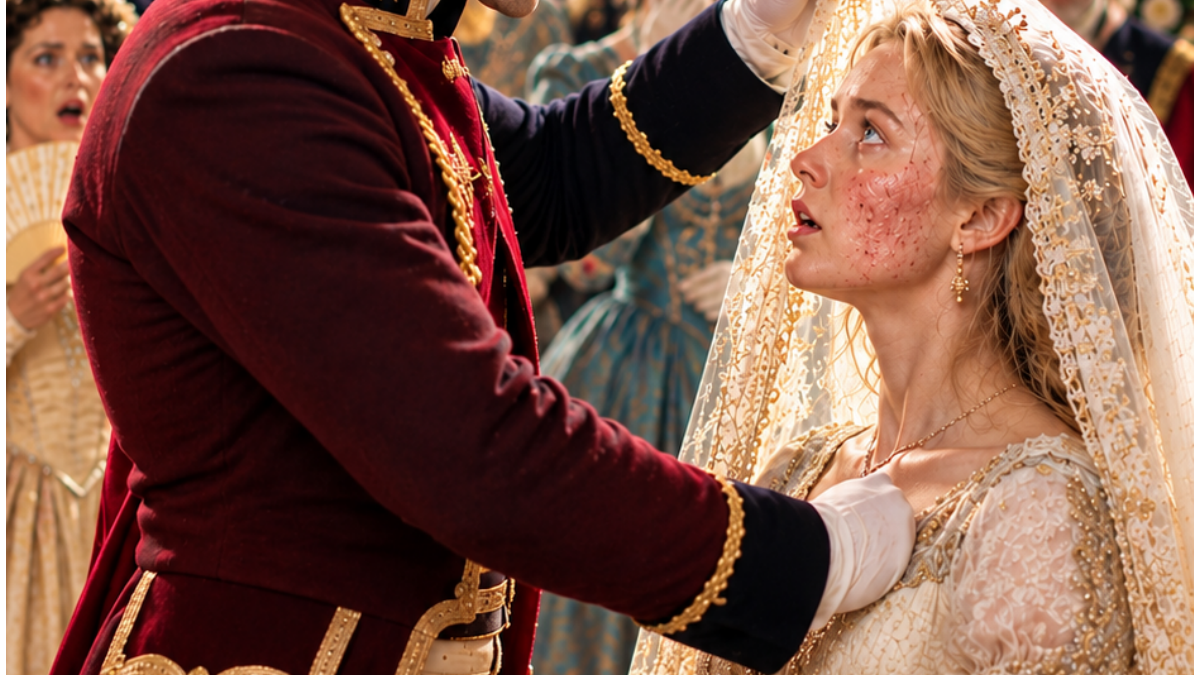
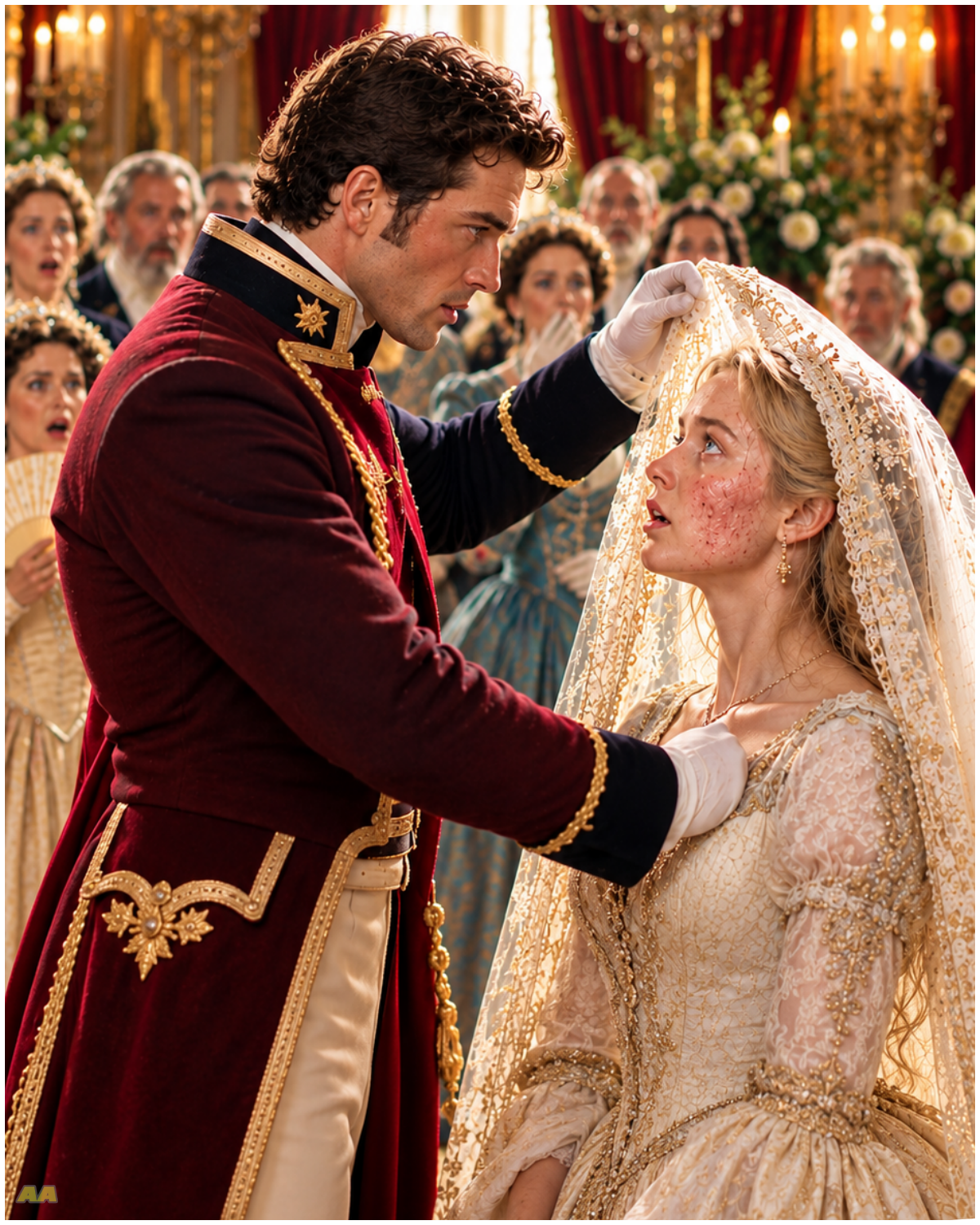
He married her, and then before the entire sneering court, he reached for her veil.
Arthur stood by the window of Lord Reginald Somerset’s study.
The glass was grimy, blurring the London rain into streaks of dull gray.
He preferred it that way.
The less clearly he saw the world, the less it disappointed him.
Behind him, the scratch of a quill pen echoed in the stifling room.
It smelled of stale tobacco, spilled port, and the sharp metallic tang of desperate men.
Arthur did not turn around.
He kept his hands clasped behind his back, his posture rigid beneath the dark wool of his tailored coat.
His boots, still bearing the faint dusting of mud from his ride in from the country, were planted firmly on the threadbear Persian rug.
The entailment is quite clear, your grace, a nasal voice whed.
This belonged to Mr. Penhaligan, Somerset solicitor.
The original land grant from King George II stipulates that the Westford estate in the event of a lapsed direct male heir in the tertiary line reverts to the deed holder.
Which through a series of unfortunate gambling debts incurred by your late uncle is now Lord Somerset.
Arthur finally turned. His face was a study in exhaustion.
He was 32, but the brutal campaigns in the peninsula and the subsequent rot of London society had carved deep, cynical lines around his mouth.
He looked at Somerset.
The older man was sweating, mopping his flushed forehead with a monogrammed linen handkerchief.
Somerset had the deed.
Arthur had the title. The crown, in its infinite bureaucratic malice, had decreed that the only way to merge the two and prevent the complete dissolution of the Westford duke was a marriage between the families.
I am aware of the legalities, Penhaligan, Arthur said.
His voice was low, devoid of warmth.
I am here to sign the contract.
Let us not pretend this is anything other than a transaction.
I need my land. You need a duke in the family to legitimize your newly acquired wealth.
Produce your daughter. Somerset coughed into his handkerchief.
He refused to meet Arthur’s eye, focusing instead on the brass inkwell on his desk.
Yes. Well, about the bride, Westford.
Arthur’s jaw tightened. Do not tell me the dowy has changed, Somerset.
We agreed on £20,000 to repair the East Wing.
The money remains, Somerset said quickly.
It is the specific daughter.
Arthur stepped closer to his desk.
The sheer physical presence of him, tall, broadshouldered, carrying the quiet, dangerous stillness of a man who had killed at close quarters, made the solicitor shrink back into his leather chair.
Explain.
You assumed you would marry Cecilia, Somerset blurted out.
She is your eldest unmarried daughter.
It is the logical assumption.
Cecilia is betrothed. Somerset lied.
Arthur knew it was a lie.
He could see the nervous tick under Somerset’s left eye.
An informal understanding with the Marquis of Queensbury.
I cannot break it. It would ruin her.
Arthur let out a short, harsh breath that might have been a laugh in another man.
Ruin her. But marrying a duke with a crumbling estate and a reputation for utter ruthlessness, that was perfectly acceptable until Queensbury made an offer.
Somerset swallowed hard. I have another daughter, your grace.
Arthur stopped. He searched his memory of the endless, suffocating ballrooms he had been forced to attend over the past 3 months.
He remembered Cecilia Somerset, blonde, vapid, flawless in that entirely forgettable way English roses tended to be.
He did not remember another.
Henrietta, Somerset muttered, the name leaving his lips as if it tasted bitter.
She is 24, past her first bloom, certainly.
But she is of good breeding.
Ding. She is quiet. She will not trouble you.
Why have I never seen her?
Arthur demanded. Silence stretched in the room.
The rain beat harder against the glass.
Penhaligan busied himself with shuffling the parchment documents.
Henrietta does not frequent society, Somerset said carefully.
She prefers the country. She suffered a a carriage accident when she was 14.
It was a terrible blaze.
Her mother perished. Arthur understood immediately.
He had seen the aftermath of fires.
He had pulled men from burning artillery wagons.
She is scarred severely, Somerset admitted, his voice dropping to a whisper as if acknowledging the defect was a crime.
She wears a veil always.
She is unfit for the usual marriage, Mart.
The ton is cruel, Westford.
They would tear her to pieces.
But you, you intend to retire to your estate in Yorkshire once this business is concluded, do you not?
I do. Then she is perfect for you.
Somerset pushed a desperate edge creeping into his tone.
She requires no entertaining, no balls, no London townhouse.
She will manage your servants, keep out of your way, and provide you with the heirs you need.
You sign the paper, take her to Yorkshire, and the deed is yours.
Cecilia stays in London. Arthur stared at the sweating man.
It was a vile piece of bartering.
Somerset was throwing his damaged daughter to a man he considered a brute solely to keep his pretty daughter for a better social match while still clutching the prestige of a ducal connection.
It was repulsive. It was utterly entirely normal for their world.
Arthur didn’t care about a wife’s face.
He cared about the Westford tenant farmers who would starve if Somerset foreclosed on the land.
He cared about the 300 years of his family’s blood soaked into that Yorkshire soil.
If the price of his home was sharing it with a recluse who hid behind a veil, it was the cheapest bargain he had ever struck.
Draw up the new names, Penhaligan, Arthur said, turning back to the window.
Your grace, the solicitor squeaked.
Cross out, Cecilia. Write in, Henrietta.
Let us be done with this.
Somerset exhaled a massive sigh of relief.
You are a pragmatic man, Westford.
I appreciate that. I will have her brought down.
You should at least be introduced.
Don’t bother, Arthur said, buttoning his coat.
Keep her out of my sight until the chapel.
Have her at St. George’s on Tuesday at 10:00 in the morning.
If she is late, I will burn this contract and let the crown seize the lot.
He walked out of the study without looking back.
The heavy oak door slamming shut behind him, leaving a hollow echo in its wake.
Henrietta Somerset stood in the shadows of the upper landing, the heavy oak banister cold beneath her gloved hand.
She had heard the door slam.
She had heard the heavy measured footsteps of the Duke of Westford echoing across the marble foyer below, fading as the footman hurried to open the front doors to the rainy street.
She did not need to be in the room to know her fate had been sealed.
The servant’s gossip traveled faster than the London poSt. Henrietta turned and walked back down the long, dimly lit corridor toward her bed chamber.
She walked with a slight limp, another souvenir from the overturned carriage in Surrey 10 years ago.
Her right leg achd when the weather turned damp, a dull, pulsing reminder of crushed bone that had never set properly.
But it was the other reminder that defined her life.
She entered her room and closed the door.
It was a Spartan space compared to her sister’s lavish quarters.
No guilt-edged mirrors, no bright silks.
Henrietta walked to the small vanity table and sat down.
There was only one mirror in the room, and it was currently draped in a thick linen cloth.
She reached out and pulled the cloth away.
The left side of her face was ordinary, pale skin, a sharp jawline, an eye the color of dark wet earth.
She looked like her mother.
Then she turned her head slightly.
The right side of her face was a ruin.
The fire had taken her cheek, the edge of her jaw, and part of her neck.
The skin there was tight, shiny, and riged with thick white and purple scar tissue.
It pulled the corner of her mouth into a perpetual slight grimace.
It lacked eyelashes, leaving her right eye staring out from a bed of puckered flesh.
She was not a monster.
She was just a woman who had survived something monstrous.
But to the polite society of London, the difference was entirely negligible.
The door handle rattled and Cecilia burst in without knocking.
She was flushed, her golden curls bouncing, an excited manic gleam in her blue eyes.
“He signed it,” Cecilia gasped, pressing a hand to her cheSt. Father just told me Westford signed the contract.
Oh, Hetti, you are to be a duchess.
Henrietta picked up the linen cloth and draped it methodically back over the mirror.
And you are to be spared marriage to the bear of Yorkshire.
Congratulations, Cecilia. Cecilia had the grace to look momentarily guilty, her smile faltering.
But only momentarily. It is not like that.
Father said the Duke is perfectly content with the arrangement and it is a brilliant match for you.
You will have a massive estate.
Servants, you will be her grace.
I will be a prisoner in a larger cage, Henrietta corrected, her voice flat.
She felt no anger toward her sister.
Anger required energy, and Henrietta had exhausted her reserves of it years ago.
Cecilia was exactly what the world had made her.
Beautiful, shallow, and terribly afraid of anything unpleasant.
“Do not be entirely grim,” Cecilia coaxed, coming to stand behind Henrietta, careful not to look at the side of her sister’s face.
“West is said to be very rich, rough, yes, but he will provide for you, and you will not have to endure the season.” When is the wedding?
Tuesday. Henrietta closed her eyes.
4 days. Her father was taking no chances that Westford might sober up and realize what he had tied himself to.
I will need to pack.
Henrietta said, “Send my maid up.
What will you wear to the church?” Cecilia asked, leaning against the bedpoSt. You cannot wear white.
Father says it should be a quiet affair.
Just the family. I will wear gray, Henrietta said.
She stood up and walked to her wardrobe.
And my veil, Cecilia fell silent.
The veil was a point of contention in the household.
It was a heavy, suffocating construction of black crepe and silk that draped from a widebrimmed bonnet, obscuring Henrietta’s face entirely.
It was what she wore when she was forced to walk in the gardens or travel between houses.
It was a shroud. To your own wedding, Cecilia asked softly.
He did not ask to see me before he signed, Henrietta replied, pulling a heavy wool traveling dress from the hanger.
He purchased a title to land, and I am merely the ink on the contract.
There is no need for him to look at me.
Tuesday morning dawned bitterly cold.
St. George’s Chapel was mostly empty, the vast stone vault echoing with the hollow sound of rain lashing against the stained glass.
Henrietta stood in the vestibule, freezing despite her heavy gray police, the black veil clung to her face, smelling faintly of dust and old camour.
It narrowed her vision to a dark cross-hatched reality.
Her father stood beside her, checking his pocket watch every few seconds.
He smelled of brandy. Courage liquid.
He will come, Somerset muttered more to himself than to her, and he did.
Through the mesh of her veil, Henrietta watched the Duke of Westford step out of the shadows near the altar.
He was taller than she had imagined, dressed in severe black, lacking the usual frills and vibrant waste coats of the tons gentleman.
He looked like a raven that had somehow found its way inside the church.
He did not look nervous.
He looked fiercely, aggressively bored.
“Time to go,” her father whispered, gripping her arm tight enough to bruise.
Henrietta walked down the aisle, her bad leg dragged slightly on the stone floor, the scuffing sound loud in the silence.
Westford did not step for forward to meet her.
He waited at the altar, his hands clasped behind his back, his jaw set in stone.
When she finally stood beside him, she turned her head slightly to look up at him through the dark fabric.
He didn’t look back. He kept his eyes fixed firmly on the prieSt. The ceremony was a blur of Latin and rapid English.
Henrietta’s voice was a dry croak when she gave her vows.
Arthur’s voice was a low, resonant rumble that shook the air between them.
He did not hesitate. He did not tremble.
He simply spoke the words like a soldier reciting a casualty liSt. “I now pronounce you man and wife,” the priest said, looking incredibly relieved.
It was over. Usually, this was the moment for a kiss, a lifting of the veil.
Arthur did neither. He turned sharply on his heel, offering her his elbow without so much as a glance in her direction.
The carriage is waiting, he said.
His first words to her.
Henrietta rested her gloved hand lightly on his dark sleeve.
The muscle beneath the wool felt like iron.
She bowed her head, the heavy black veil swaying against her chest, and let her new husband lead her out of the church and into the storm.
The journey north to Yorkshire was a gruelling, bone rattling endurance trial that lasted 4 days.
The carriage was a heavy, unyielding beast of dark wood and iron built for surviving muddy ruts rather than providing comfort.
Inside the air was thick with the smell of damp wool, oiled leather, and the bitter dust that clung to Henrietta’s veil.
They did not speak. Arthur sat on the opposite bench, his long legs stretched out, taking up most of the floor space.
He spent the first two days staring out the window at the relentless gray downpour, his expression locked in a permanent, brooding scowl.
He did not read. He did not sleep.
He simply watched the bleak English countryside roll past with the hyper vigilant intensity of a soldier expecting an ambush.
Henrietta sat perfectly still, her hands folded in her lap.
The cold seeped through the floorboards, biting into the crushed bones of her bad leg until it throbbed with a sickening rhythmic agony.
She refused to shift. She refused to rub the limb.
She had learned long ago that displaying pain only invited pity or irritation, and she suspected her new husband possessed an abundance of the latter, and none of the former.
On the third day, a violent jolt pitched the carriage sideways.
Henrietta was thrown forward. Her hands flew out to brace herself against the opposite seat, landing squarely on Arthur’s knee.
He didn’t flinch. He didn’t offer a hand to help her back upright.
He simply looked down at her gloved hands resting on his trousers and then slowly shifted his gaze up to the black void of her veil.
“The axle is slipping,” Arthur stated, his voice raspy from disuse.
Henrietta pulled her hands back instantly, heat flaring in her neck beneath the crepe fabric.
I beg your pardon, your grace.
The mud. Do not apologize for the roads, madam.
You did not build them.
He leaned forward, bracing his forearms on his knees, bringing his face closer to hers.
And you do not need to call me your grace inside this carriage.
Arthur will suffice. We are tied together now for better or worse.
Mostly worse, I suspect. It was the most he had spoken to her since the altar.
Henrietta gripped the edge of her seat, steadying herself as the carriage writed its balance.
Very well, Arthur. I am Henrietta.
I am aware. He leaned back, crossing his arms over his broad cheSt. Your father was eager to sell you.
He told me you were quiet, unobtrusive.
He told me you hide because the world cannot stomach looking at you.
The bluntness of it was a physical blow.
Society couched its disgust in whispers and averted eyes.
Arthur delivered it like a musket shot.
“My father is a pragmatic man,” Henrietta said, her voice shaking only slightly.
He speaks the truth. Does he?
Arthur’s dark eyes narrowed. I find men like Lord Somerset rarely speak the truth unless it profits them.
You flinch when the carriage hits a rut.
Your right leg. It pains you.
Henrietta froze. She had thought her stillness was absolute.
It is an old injury.
It require no attention. I did not ask if it required attention.
I stated a fact. Arthur reached down, grabbed a heavy wool lap robe from the floor, and tossed it across the carriage.
It landed squarely in her lap.
Wrap it. If you freeze to death before we reach Westford, the crown will tie me up in probate for another 6 months.
He turned back to the window.
The conversation was over. Henrietta stared at the heavy dark gray blanket.
It was coarse and smelled of horses and rain.
Slowly she unfolded it and draped it over her legs, tucking the edges around her aching calf.
The warmth was immediate and deeply comforting.
She looked at her husband’s sharp profile against the dirty glass.
He was a brute, just as her sister had claimed, but he was an observant brute.
They reached the Westford estate at twilight on the fourth day.
Henrietta peered through the mesh of her veil as the carriage lurched up the long winding drive.
Their estate was massive, a sprawling beast of dark stone and ivy, but it was dying.
The roof line sougged. Entire wings were dark.
Their windows shuttered like closed eyes.
The gardens were overgrown, choked with creeping weeds and rotting leaves.
It looked exactly like the man sitting across from her, imposing, battered, and utterly devoid of softness.
The carriage ground to a halt before a massive oak door.
A single footman hurried out into the drizzle, hauling the door open and lowering the steps.
Arthur stepped out firSt. He did not wait for Henrietta.
He stroed up the stone steps, stripping off his wet riding gloves.
A severe-looking woman in a black bombazine dress stood in the open doorway, holding a flickering candalabra.
“Mrs. Reed,” Arthur barked, his voice echoing in the cavernous, damp foyer.
“Have the fires lit in the master suite, and prepare the adjoining chambers for my wife.” Henrietta navigated the carriage steps carefully, favoring her bad leg.
She stood in the driving rain for a moment, looking up at the towering facade of her new home.
There was no welcoming committee, no grand introduction, just the cold wind howling off the moors, and the reality of her isolation pressing down on her.
She pulled her police tighter around her shoulders and limped up the stairs, disappearing into the dark mouth of the manor.
The morning light in Yorkshire was different from London.
It was thinner, sharper, cutting through the grimy windows of the breakfast room with a pale, unforgiving clarity.
Henrietta sat at the end of a long mahogany table that could comfortably seat 30.
She was entirely alone. She had compromised on her veil.
The suffocating black crepe was gone, packed away in the depths of her trunk.
In its place she wore a lighter shroud of charcoal silk mesh.
It draped from a simple tortoise shell comb in her hair, obscuring the ruined right side of her face while allowing her left eye a clearer view of the world.
It was easier to breathe, easier to move, but it still served its primary purpose, keeping the world at bay.
Mrs. Reed, the housekeeper, marched into the room bearing a silver tray.
The woman’s face was carved from the same hard stone as the manor.
She set a plate of toast and a pot of black tea down in front of Henrietta.
“The Duke has been in the field since dawn, your grace,” Mrs. Reed said, her tone perfectly flat, giving away nothing of her thoughts regarding the veiled woman sitting in her mistress’s chair.
“He does not usually take breakfast indoors.” “Thank you, Mrs. Reed, Henrietta said, “Before you go, I would like to see the household ledgers.” Mrs. Reed paused, her hands clasping over her apron.
“The ledgers, your grace?” The Duke handles all estate business.
“I am sure he handles the tenant farms and the crops,” Henrietta replied evenly, picking up her teacup.
“But I am the Duchess.
The running of this house is my domain.
Bring me the books for the kitchen, the laundry, and the staff wages, and fetch a fire for the library.
I will work there. For a fraction of a second, surprise flickered in the housekeeper’s pale eyes.
Then the stern mask slammed back into place.
As you wish, your grace.
Henrietta spent the next 6 hours in the freezing, cavernous library.
The scale of the neglect at Westford was staggering.
As she cross-referenced the smeared ink of the ledgers, she began compiling a grim inventory of their reality.
The list of immediate failures was long.
The east-wing roof, the slate was entirely compromised.
Three guest chambers were rotting from water damage.
The stables, widespread dry rot in the loadbearing beaMs. A total collapse was imminent before winter.
Staffing. The manor was operating on a skeleton crew of eight, less than a quarter of what a house this size required.
Provisions. The winter stores were pitifully low, and the coal merchants in the village had cut off their line of credit 2 years ago.
Arthur was broke. The £20,000 her father had paid for the title was not a luxury.
It was a desperate lifeline to keep the manor from crumbling into the mud.
Late in the afternoon, the heavy library door swung open.
Arthur walked in. He was covered in mud.
It coated his heavy boots, stained the hem of his dark riding coat, and speckled his jaw.
He smelled of rain, wet horse, and sweat.
He stopped abruptly when he saw her sitting behind the massive oak desk, surrounded by precarious stacks of decaying ledger books.
“What are you doing?” he demanded, striding into the room.
He didn’t look angry, merely baffled.
“I am assessing the damage,” Henrietta said, not looking up from a column of figures regarding candle wax.
“Mrs. Reed has been keeping honest books, but she has been managing a steady decline.
The butcher in the village is owed £40, and we are paying twice the market rate for flour because they know you cannot settle the aras.
Arthur stopped at the edge of the desk, staring down at her.
I did not bring you here to play at being an accountant, Henrietta.
You brought me here for my father’s money, she counted smoothly, finally raising her head to meet his gaze through her silk veil.
I am simply ensuring you do not waste my purchase price.
The £20,000 will clear the village debts and fix the stable beaMs. But if we do not repair the east wing roof before November, the structural rot will cost you double by spring.
Arthur remained silent for a long moment.
He looked at the neatly ordered lists she had written out on fresh parchment.
He looked at the ink staining the fingertips of her right hand.
You understand estate management, he said slowly, as if translating a foreign language.
I managed my father’s country estate in Surrey for the past 8 years, Henrietta said flatly.
A woman with no prospects and no social calendar has an abundance of free time.
I learned to run a house.
I am very good at it.” Arthur leans over the desk, planting his large mudcaked hands flat on the polished wood.
My uncle drank this estate into the ground.
I inherited a graveyard. The servants don’t respect me because I am a soldier, not a gentleman.
And the tenants think I am a brute.
Are you? She asked. A brute?
Arthur’s mouth twitched, a cynical half smile that didn’t reach his dark eyes.
Yes. Usually, when it is required.
Good, Henrietta said, closing the main ledger with a definitive snap.
Because the coal merchant in the village is charging an extortionate interest rate.
You will need to ride down there tomorrow and be brutal about renegotiating the terMs. I will draft the new contract tonight.
Arthur stared at her. The silence in the library stretched, filled only by the crackle of the newly lit fire in the hearth.
Slowly, the tension in his broad shoulders eased.
He picked up one of her lists, his dirty thumb smudging the edge of the parchment, and read over her precise, elegant handwriting.
“Draft the contract,” Arthur said quietly, turning to leave the room.
He paused at the door, glancing back over his shoulder.
“And Henrietta?” She looked up.
“Tell Mrs. Reed to double your coal allowance for this room.
You are shivering. He closed the door behind him, leaving Henrietta alone in the quiet warmth, her inkstained fingers resting on the heavy leather cover of the ledger.
Autumn struck Yorkshire with the subtlety of a siege.
The wind tore across the moors, stripping the trees bare and lashing the heavy stone walls of Westford Manor with freezing rain.
Inside, however, a strange rhythmic order had begun to take hold.
Henrietta’s ledgers were no longer filled with red ink and despair.
They were a testament to ruthless efficiency.
The coal merchant had been cowed into submission after a single terrifying visit from the Duke.
The east-wing roof now sported fresh slate, holding firm against the November gales.
The butcher was paid. The staff wages were regular, and Mrs. Reed no longer looked at Henrietta with veiled suspicion, but with a stiff, professional reverence.
Arthur and Henrietta rarely saw each other in the daylight.
He was a creature of the land, riding out before dawn to oversee the drainage of the lower pastures, or the repair of the tenant cottages.
She was the architect of the house, managing the fragile economy of their survival.
From behind the massive oak desk in the library, their true marriage existed in the hours between supper and midnight.
They would sit in the library, a roaring fire keeping the damp cold at bay.
Henrietta would review the day’s receipts, the charcoal silk of her veil pinned back slightly to allow her to read the fine print.
Arthur would sit in the worn leather armchair opposite her desk, nursing a glass of cheap brandy, a map of the estate spread across his knees.
They spoke in the clipped, pragmatic language of partners.
They discussed crop yields, timber prices, and the cost of winter wheat.
It was utterly unromantic. It was the most secure Henrietta had felt in 10 years.
On a Tuesday in late November, the routine broke.
A frantic pounding echoed through the manora halls just past 10:00.
Henrietta looked up from a stack of linen inventories as Arthur stroed into the library, his coat already halfon.
Flash flood down at the Miller farm,” Arthur said tursly, grabbing his heavy riding crop from the table.
The river broke the south bank.
Two of their draft horses are trapped in the lower barn and the water is rising.
Take those stable hands, Henrietta said, standing up immediately.
I will have Mrs. Reed boil water and prepare the kitchens for casualties.
Do they have children? Three.
Miller’s wife is bringing them up the hill to the manor now.
Arthur paused in the doorway.
He looked at her, his eyes entirely devoid of the cynical boredom that usually masked his features.
In the dim light, he looked like the soldier he had once been, focused, dangerous, and alive.
“Have dry blankets ready,” he ordered.
Then he was gone. Henrietta did not sit back down.
The phantom ache in her crushed leg flared in warning, a barometer for the dropping pressure of the storm, but she ignored it.
She moved through the house with a rapid, uneven gate, issuing sharp commands that sent the skeletal staff sprinting to the kitchens and the linen closets.
By the time Miller’s wife arrived, sobbing and carrying her youngest child, the manor’s great hall was warm.
Henrietta knelt on the stone floor, her silk veil brushing against the wet wool of the terrified children’s coats as she wrapped them in thick blankets.
She poured hot broth, her steady hands, a stark contrast to the trembling hands of the mother.
Arthur did not return for 3 hours.
When the heavy front doors finally swung open, he was practically carried in by two stable hands.
He was soaked to the bone, his boots leaving thick smears of black mud on the marble.
A deep gash wept blood across his forehead, washing away the dirt in a stark crimson line.
“The horses?” Henrietta asked, stepping forward, a sharp knot pulling tight in her cheSt. “Saved?” Arthur grunted, waving off the hands who were trying to support him.
He stumbled slightly, catching himself against the wall.
The barn beam came down, clipped my head.
It’s nothing. It is bleeding profusely, Henrietta stated.
She turned to Mrs. Reed.
Bring the medical box to the library and hot water.
10 minutes later, Arthur was sitting in his leather chair by the fire, his coat discarded.
Henrietta stood beside him. The air smelled of wet wool, iron, and the sharp scent of the alcohol she had poured into a basin.
She soaked a clean cloth in the warm water.
“Lean your head back,” Arthur complied, his jaw tight.
He closed his eyes as she gently pressed the cloth to his forehead, cleaning away the blood and grit.
“Her touch was incredibly light, practiced from years of tending her own agonizing recoveries.” “You managed the family,” Arthur said, his voice a low rumble in the quiet room.
They are asleep in the guest chambers, she replied, focused on the laceration.
It was deep, but it would not require stitching.
Mrs. Miller has stopped crying.
Arthur opened his eyes. He was looking directly at her, studying the faint outline of her jaw visible beneath the mesh.
“You do not panic.” Panic is a luxury for those who believe someone else will save them,” Henrietta said quietly, reaching for a dry bandage.
“I learned early that no one is coming.” Arthur reached up, his large, calloused hand wrapped gently around her wrist, stopping her movement.
His fingers were freezing. “I am here,” he said.
The words were not a romantic vow.
They were a statement of fact, solid and unyielding as the stone walls around them.
Henrietta froze. His grip was loose enough that she could pull away, but she didn’t.
She looked down at him, her heart beating a frantic rhythm against her ribs.
Slowly, deliberately, Arthur shifted his grip from her wriSt. His fingers brushed against the edge of the charcoal silk framing her face.
“Henrieta,” he murmured. “No.” The word slipped out, raw and terrified.
She stepped back instantly, snatching her hand away.
The illusion of safety shattered.
“The cut is clean. Apply pressure.
I will leave you to reSt.” She turned and fled the room, her uneven footsteps echoing down the long empty corridor.
Arthur watched her go, the damp cloth still clutched in his hand, the silence of the library suddenly feeling entirely too loud, the letter arrived two weeks before Christmas.
It bore the heavy wax seal of the Duke of Cumberland, the king’s brother, and it landed on Henrietta’s desk like an unexloded mortar shell.
She stared at the crest, her stomach dropping.
She knew exactly what it was.
The Westford entailment, the legal friction that had forced their marriage required a final formal ratification by a representative of the crown to fully transfer the deed from the Somerset line to Arthur.
Arthur walked into the library, shaking the snow from his heavy coat.
He took one look at her rigid posture and the heavy parchment on the desk.
He walked over, picked it up, and broke the seal.
As he read, the harsh lines around his mouth deepened.
“Cumberland,” Arthur spat, tossing the letter back onto the desk.
“He is holding a winter court at his estate in York.
He requires our presence next Friday to sign the final decrees in front of the regional peers.” Henrietta felt the blood drain from her face.
A court in York. A glorified spectacle.
Arthur corrected. Cumberland despises me.
We clashed over supply lines in Portugal.
He wants to make a show of forcing me to bend the knee for a piece of paper surrounded by every gossiping lord and lady north of London.
Henrietta folded her hands tightly in her lap to hide their trembling.
You must go then. You cannot risk the deed.
Arthur looked at her. The summon says the Duke and Duchess of Westford.
We must both go. No, Henrietta said, her voice rising in panic.
She stood up, her chair scraping harshly against the floor.
I cannot. I will not.
You You do not understand what they are like, Arthur.
They will stare. They will whisper.
They will make a mockery of you for bringing a monster into their assembly.
Arthur closed the distance between them in two long strides.
You are not a monster.
You are my wife. I am a transaction, she cried, the suppressed bitterness of the past month finally breaking through.
I am £20,000 and a signature.
You have your money. You have your repaired roof and your saved horses.
Do not ask me to walk into a room of 300 people so they can laugh at the bear of Yorkshire and his veiled gargoyle.
Arthur didn’t yell. He didn’t flinch.
He stood perfectly still, letting her rage wash over him.
“Are you finished?” he asked quietly.
Henrietta swallowed hard, her chest heaving.
She looked away, staring at the fire.
Tell them I am ill.
Tell them I am mad.
Society will readily believe it.
But go without me. If I go without you, Cumberland will stall the signing.
He will claim the marriage is unconsumated or a sham or whatever legal fiction he can invent to humiliate me.
Arthur said, his voice flat and reasonable.
But that is not why you are coming.
She looked back at him, bewildered.
Then why? Because you rebuilt this house, Arthur said, pointing a finger at the ledgers.
Because you dragged this estate back from the brink of ruin while I dug in the mud.
This land is yours as much as it is mine, Henrietta.
I will not let you hide in the shadows while I take the deed.
We walk in together. We sign the paper and we leave.
They will tear us apart, she whispered.
Let them try, Arthur said.
A dangerous, feral smile touching the corners of his mouth.
I have killed men for less than a whisper.
A few sneering aristocrats will not break my line.
The journey to York was entirely different from their journey north.
The carriage was lined with fresh, warm furs.
The axle was repaired, and the silence between them was thick with nervous anticipation rather than cold indifference.
Henrietta had retreated to her heaviest armor.
The charcoal silk was gone.
In its place was the suffocating, impenetrable black crepe veil she had worn on her wedding day.
It felt like a burial shroud.
She wore a severe gown of dark plum velvet high at the neck, devoid of lace or ornamentation.
She looked like mourning incarnate.
Arthur sat across from her, dressed in the formal regimentals he had not worn since the war, that the dark red coat and gold braiding stood in stark contrast to his usual austere black.
He looked terrifyingly regal. The Duke of Cumberland’s estate in York was ablaze with light.
Hundreds of carriages lined the sweeping driveway.
As Arthur handed Henrietta down from their coach, the sheer volume of noise, music, laughter, the clinking of crystal hit her like a physical blow.
Her bad leg throbbed violently in the freezing air.
“Hold my arm,” Arthur ordered, stepping close.
She gripped his forearm, her gloved fingers digging into the heavy wool of his uniform sleeve, eyes forward, he muttered, leading her up the grand stone steps toward the open double doors.
You look at no one but me or Cumberland.
They are ghosts, Henrietta. They cannot touch you.
They stepped into the massive gilded ballroom.
The effect was instantaneous. It was as if someone had thrown a heavy blanket over the crowd.
The music continued, but the laughter died.
Hundreds of heads turned toward the entrance.
Henrietta felt the weight of their staires piercing through her veil.
She heard the harsh, sudden whispers.
She saw the fans rise to hide sneering mouths.
She felt her chest tighten, the air suddenly too thin to breathe.
She was exactly where she had always feared to be, trapped in the light, the object of universal unvarnished disguSt. Arthur did not slow his pace.
He walked with measured predatory grace, guiding her straight down the center of the ballroom, parting the sea of glittering aristocrats like a warship cutting through ice.
The final battle for Westford had begun.
The chandeliers overhead were monstrosities of cut glass and burning wax, radiating a blistering heat that trapped the heavy perfumes of the ton into a suffocating cloud.
Henrietta focused entirely on the gold braiding of Arthur’s uniform sleeve.
If she looked left or right, she would see the eyes.
The whispers hissed through the stifling air like a nest of disturbed vipers.
They did not bother to lower their voices.
Society understood only the language of power, and an unloved duke with a disfigured, veiled bride possessed none in this room.
“Good God, is she draped in mourning?” a sharp female voice noted over the scrape of a cello.
“They say she is missing an eye or a nose.
The Somerset girl, you know, the broken one,” a man replied, his tone laced with grotesque fascination.
Henrietta stumbled, her bad leg caught on the edge of a thick Persian rug, the sudden spike of pain shooting straight up her spine.
She pitched forward slightly. Before she could fall, Arthur’s hand shot out, catching her rigidly by the waiSt. He did not ask if she was well.
He merely hauled her upright, his grip and iron band against her ribs, and kept walking.
At the far end of the ballroom, sitting upon a raised dis flanked by enormous marble pillars, was the Duke of Cumberland.
He was a bloated man with a ruddy complexion and the arrogant slump of someone who had never been told no in his entire life.
He watched their approach with a cruel, satisfied smirk, a glass of wine resting on his protruding stomach.
A small mahogany table sat at the base of the deis holding the thick parchment deed to Westford and a silver inkwell.
The regional peers, the lords and ladies who controlled the social and political capital of the north crowded around the edges, forming a tight, suffocating ring of velvet and jewels.
Arthur halted before the dis.
He released Henrietta’s waist, stepping half a pace in front of her.
He did not bow. Cumberland, Arthur said.
His voice was not loud, but it cut through the residual murmurss of the room like a cavalry saber.
Cumberland took a slow, deliberate sip of his wine.
Westford, you are late. We were beginning to think the journey from your quaint little ruins was too much for you.
The roads are poor. The horses are tired.
Let us dispense with the theater, Arthur replied, gesturing to the table.
I am here for my signature.
The crown has verified the marriage.
The entailment is fulfilled. Cumberland smiled.
It was an ugly, predatory expression.
He leaned forward, resting his heavy forearms on his knees.
The crown has verified a piece of paper, Arthur.
But I am the king’s proxy here, and I am charged with ensuring that the transfer of such significant lands is completely beyond reproach.
The documents are in order.
The documents state you married Henrietta Somerset, Cumberland said, his eyes drifting lazily over Arthur’s shoulder to where Henrietta stood, entirely swallowed by her black crepe.
Yet you bring a shadow into my hall, a woman with no face.
How am I to know you did not simply pull a scullery maid from the gutters and drape her in silk to steal a dukedom?
The silence in the ballroom became absolute.
The cruelty was laid bare, raw and undisguised.
Henrietta stopped breathing. The air beneath her veil turned to hot ash.
She felt the eyes of 300 people drilling into the fabric, peeling it away with their collective imagination.
This was the nightmare. This was the moment she had hidden from for 10 years.
Her identity is sworn by the archbishop who married us,” Arthur said, his voice dropping an octave, taking on a dangerous lethal calm.
“Are you calling the church a liar, Cumberland?
I am merely adhering to the law, Cumberland counted, waving a dismissive hand.
The law requires visual identification of the signitories.
It is a standard formality.
Have your wife lift her veil, Westford.
If it is indeed the Somerset girl beneath that shroud, I will sign the deed.
If she refuses, he shrugged, then the marriage is suspect, and the lands revert to the crown by mourning.
A soft, collective gasp rippled through the onlookers.
A trap, a perfectly executed, publicly humiliating trap.
Henrietta’s hands shook violently. The room tilted.
She could not do it.
She would rather freeze on the moors.
She would rather let Westford rot.
She took a panicked step backward, her dragging foot catching loudly on the polished wood.
Arthur turned to her. He blocked her view of Cumberland, stepping directly into her line of sight.
He reached out and caught her trembling hands in his own.
His dark eyes searched the black mesh of her veil, finding the terrified shining gleam of her left eye.
“Arthur, no?” she whispered, the sound entirely lost beneath the thick fabric.
“Please let the land go.
We can leave. Please, if we leave now, they will hunt you forever,” Arthur said, his voice so low only she could hear it.
“They will whisper about you until you are nothing but a ghost in your own home.
They feed on shame, Henrietta.
I’m shameful,” she choked out.
“You are the strongest person I have ever known.” He corrected fiercely.
“You saved my house. You saved my people.
You saved me from going mad in the dark.
Do not let this bloated pig tell you what you are worth.
I cannot let them see.” Arthur tightened his grip on her hands.
“Then let me.” The ballroom held its collective breath.
The tension was a physical weight pressing down on the polished floorboards.
Cumberland leaned further forward on his velvet chair, a look of greedy anticipation lighting up his dull eyes.
He expected Westford to rage.
He expected the bride to flee in tears.
Instead, Arthur released Henrietta’s hands.
He stepped closer to her, invading the space society dictated should be kept strictly empty.
He raised his hands clad in spotless white gloves and reached for the heavy silver pins securing the black crepe to her bonnet.
Henrietta squeezed her eyes shut.
A single scalding tear broke free, tracking down the unscarred side of her cheek.
She forced her chin up, bracing herself for the inevitable wave of revulsion, the shrieks, the disgusted turning of heads.
Arthur’s fingers were steady. He pulled the first pin, then the second.
He gathered the thick, heavy fabric in his fists.
He did not yank it.
He lifted it slowly, reverently, like a priest uncovering a sacred relic.
The black veil pulled clear of her face, catching slightly on her tortoise shell comb before Arthur smoothed it back and draped the shroud entirely over her shoulders.
The harsh, blinding light of a thousand candles hit her skin.
Henrietta opened her eyes. The silence that followed was not a gasp of horror.
It was a stunned vibrating shock.
The right side of her face was completely exposed.
The deep puckered ridges of white and purple scar tissue twisted from her jawline to her temple.
The missing eyelashes, the tight, shiny skin, it was all there, undeniable and brutally visible.
Someone in the front row, Lady Harrington, by the look of her violently green silk, raised a fan to cover her mouth.
Lord Danver stared, utterly dumbfounded.
Arthur did not look at the crowd.
He looked only at Henrietta.
He let his gloved hand rest against her face, his thumb brushed exactly over the worst of the scarring on her cheek.
He touched the ruin of her skin with the same gentle familiarity a man might use to wipe away a stray curl of hair.
“Look at them,” Arthur commanded quietly.
Henrietta forced herself to turn her head away from him and face the room.
They were staring. Yes, but the anticipated jers did not come.
The sheer audacious confidence of the Duke’s touch, his absolute unbothered acceptance of her face, had shortcircuited their practiced cruelty.
Society thrived on finding the weak spot and pressing it.
But Arthur was treating her scars not as a weakness, but as a badge of honor.
He had fundamentally altered the rules of engagement.
Arthur turned his head slowly, sweeping his dark, hard gaze over the assembled peers.
The men who met his eyes quickly looked down, the women snapped their fans shut.
“My wife,” Arthur said, his voice carrying effortlessly to the back of the massive hall.
“Her grace, the Duchess of Westford.
Does anyone require a closer inspection?
No one moved. No one breathed.
Arthur turned back to the deis.
Cumberland’s mouth was slightly open.
His cruel joke had misfired entirely.
The humiliation he had meant to inflict upon Arthur had backfired, painting the king’s proxy as a petty bully while elevating the brute of Yorkshire into an untouchable figure of absolute authority.
The pen, Cumberland, Arthur demanded, pointing a single gloved finger at the inkwell.
Cumberland blinked, snapping his mouth shut.
His ruddy face flushed a deeper, angrier shade of red, but the wind had been entirely knocked from his sails.
He snatched up a quill, dipped it aggressively into the ink, and scrolled his massive looping signature across the bottom of the Westford deed.
He shoved the parchment across the small table.
Arthur stepped forward and rolled the heavy parchment into a tight cylinder.
He did not thank the Duke.
He did not bow. He turned back to Henrietta and offered his elbow.
She did not pull her veil back up.
She left it draped around her shoulders, a discarded skin.
She placed her trembling hand into the crook of his arm, feeling the solid living warmth of him beneath the heavy uniform.
They walked back down the center aisle.
The sea of aristocrats parted faster this time.
They stepped back, clearing a wide path.
There were no whispers now.
Henrietta kept her chin perfectly level, her bad leg still dragged, the rhythmic scrape echoing off the marble pillars, but it no longer felt like a sound of defeat.
It sounded like a metronome ticking away the final seconds of her imprisonment.
They reached the massive double doors, stepped out into the freezing Yorkshire night, and left the glittering, suffocating world behind them.
The carriage ride back was pitch black, the lamps outside struggled against the rising sleep.
Henrietta sat shivering beneath the thick furs, the adrenaline finally leaving her body in violent shaking waves.
She was entirely exposed. Her face felt cold, the scars tight against the icy air.
Arthur sat beside her on the bench this time, not across from her.
He reached under the furs and found her hand, his warm, bare fingers intertwining with hers.
“You did not put the veil back on,” he noted, his thumb rubbing slow circles against her knuckles.
“I couldn’t,” she whispered into the dark.
“It felt heavy.” “Good.” Arthur shifted closer.
He reached up, his hand finding her face in the gloom.
He didn’t avoid the scars.
He traced the hard ridge of tissue along her jawline.
It is just skin, Henrietta.
It is just the shell that carried you through the fire.
I do not care about the shell.
I care about the woman who survived.
He leaned in, the scent of rain and leather surrounding her, and pressed his mouth to her scarred cheek.
It was a simple grounding touch, devoid of pity, anchoring her to the reality that she was finally truly seen.
The carriage crunched against the gravel of Westford Manor’s Circular Drive long past midnight.
The storm had broken hours ago, leaving a biting crystalclear cold in its wake.
When the footman pulled the carriage door open, the sharp Yorkshire air hit Henrietta’s exposed face.
She braced herself. The instinct to shrink away, to pull up the phantom barrier of her black crepe veil clawed at her nerves.
It was a 10-year habit, a physical reflex born of survival.
But she forced her hands to remain in her lap.
She kept her chin parallel to the icy ground.
Arthur stepped out firSt. He turned and offered his hand.
She took it, letting him support her weight as she navigated the treacherous frozen steps.
Her bad leg was screaming, a deep bone grinding ache radiating from her crushed calf, exacerbated by the freezing temperature and the sheer, terrifying tension of the night.
She leaned heavily against him as her boot hit the gravel.
He didn’t complain. He didn’t offer empty platitudes.
He merely wrapped his arm firmly around her waist, taking the brunt of her weight as they walked up the stone steps and through the heavy oak doors.
The foyer was dimly lit, smelling of beeswax and wood smoke.
Mrs. Reed stood by the grand staircase, a solitary sentinel wrapped in a thick wool shawl against the draft.
The housekeeper stepped forward to take their heavy outer coats.
Mrs. Reed paused. Her pale, severe eyes fell immediately on Henrietta’s face.
For 10 years, servants had gasped, dropped trays, or abruptly looked at the floor when catching a glimpse of the scarring.
Mrs. Reed did none of these things.
She looked at the ruin of Henrietta’s cheek, then moved her gaze up to meet Henrietta’s dark, unblinking eye.
I kept the fire stoked in the library.
Your grace,” Mrs. Reed said, her voice perfectly even, devoid of any manufactured shock.
“And there is a hot brick waiting for your bed chamber.” “Thank you, Mrs. Reed,” Henrietta said.
Her voice sounded strange to her own ears.
It was clearer, sharper, unmuffled by layers of silk and crepe.
Arthur dismissed the housekeeper with a short knot and steered Henrietta toward the library.
It was the heart of the house.
It was the room where they had forged their strange pragmatic alliance over ledgers and coal disputes.
Tonight, it felt entirely different.
It felt like a fortress.
Arthur guided her to the leather armchair nearest the hearth.
He didn’t sit down. He walked straight to the massive oak desk, pulled the rolled parchment of the Westford deed from his coat pocket, and tossed it onto the wood.
It landed with a dull, heavy thud.
“It is done,” Arthur said.
He unbuttoned the high, stiff collar of his red uniform, discarding the restrictive regimentals with the exhaustion of a man who had fought a brutal campaign, and finally laid down his arMs. He shrugged out of the coat and tossed it over the back of his chair.
Henrietta watched him from the armchair.
She felt the raw tight skin of her face pulling as she’d swallowed.
“Cumberland will talk. They all will.
Tomorrow half of England will be writing letters about the monster you paraded through York.
Let them write,” Arthur said, crossing the room to stand before the fire.
He picked up the heavy iron poker and drove it into the glowing coals, sending a sudden shower of orange sparks up the dark chimney.
I do not live in London.
I do not care about their letters.
I care about this estate.
I care about my land.
He set the poker down and turned to face her, his dark eyes locking onto hers.
And I care about my wife.
He walked over and crouched beside her chair.
The sheer physical scale of him, a man capable of breaking a wild horse or commanding a battlefield, kneeling on the worn rug, was a jarring sight.
He rested his heavy forearms on the armrests of her chair, boxing her in.
She felt absolutely no desire to escape.
“You are in pain,” he stated, observing her rigid posture.
My leg,” she admitted. The need to lie, to pretend she was an invulnerable machine, had evaporated the moment he pulled the pins from her bonnet.
“The cold makes it worse,” Arthur nodded.
He reached down, lifted the heavy hem of her plum velvet skirt just enough to expose her booted foot, and gently lifted her bad leg, resting it across his solid thigh.
He began to massage the stiff, aching muscles of her calf.
His thumbs pressed deeply into the cramped tissue, working with a brutal, effective grace.
The heat from his large hands bled through her stockings.
The relief was agonizingly sweet.
Henrietta slumped back in the chair, closing her eyes.
You should not be doing this.
You are a duke. I’m a man taking care of what is his,” Arthur replied softly.
They sat in silence for a long time.
The only sounds were the violent crackle of the burning logs and the steady rhythmic pressure of Arthur’s hands, working the pain out of her limb.
When Henrietta finally opened her eyes, he was watching her.
He was studying the right side of her face in the warm, flickering fire light.
There was no pity in his gaze.
There was no morbid curiosity.
There was only a quiet, fierce possessiveness.
Henrietta slowly raised her own hand, her fingertips brushed against the tight ridges of her cheek.
There was no fabric between her skin and the air.
“I am not going to wear the veil anymore,” Henrietta said.
The words slipped out before she had fully formed the thought, cementing themselves into reality the moment they hit the air.
Arthur stopped rubbing her leg.
He didn’t smile. He rarely did.
But the hard, cynical lines around his eyes softened completely.
“No, you are not.” He stood up, carefully, lifting her leg and placing her foot back on the floor.
He leaned down, bracing his hands on the arms of her chair again, and brought his face level with hers.
He kissed her. It was not a tentive, frightened brush of lips.
It was a solid, deliberate connection.
He tasted of freezing rain and the sharp tang of brandy.
He kissed her scarred cheek, the twisted corner of her mouth, and finally her lips.
Henrietta kissed him back. She reached up, her hands entirely steady, her fingers tangling in the dark, damp hair at the nape of his neck.
For the first time since the fire, she did not feel broken.
She felt entirely whole. She was the Duchess of Westford.
She was the architect of this manor, the equal partner of the bear of Yorkshire.
And she was finally done hiding in the dark.
Arthur didn’t just restore a crumbling estate.
He rebuilt the woman society tried to bury alive.
By refusing to let Henrietta hide, he proved that true power doesn’t lie in perfection.
But in the fierce, unyielding acceptance of our scars.








