The Duke Saved Her from a Disastrous Courtship – Never Knowing She Was Secretly in Love with Him
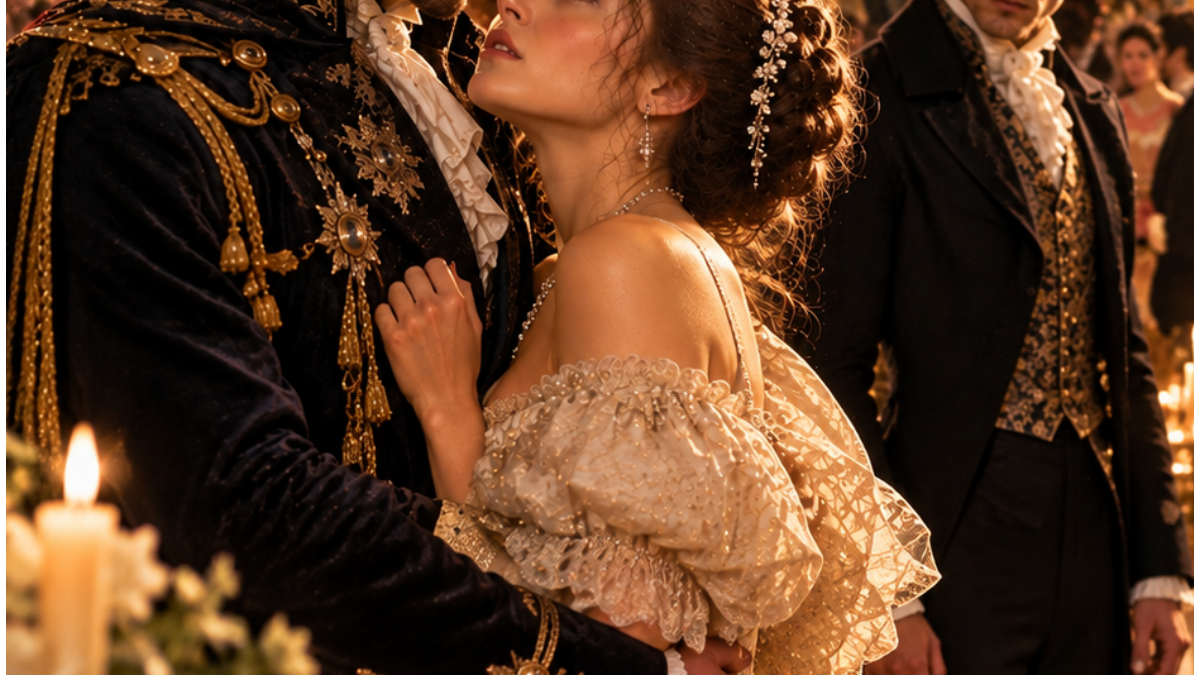
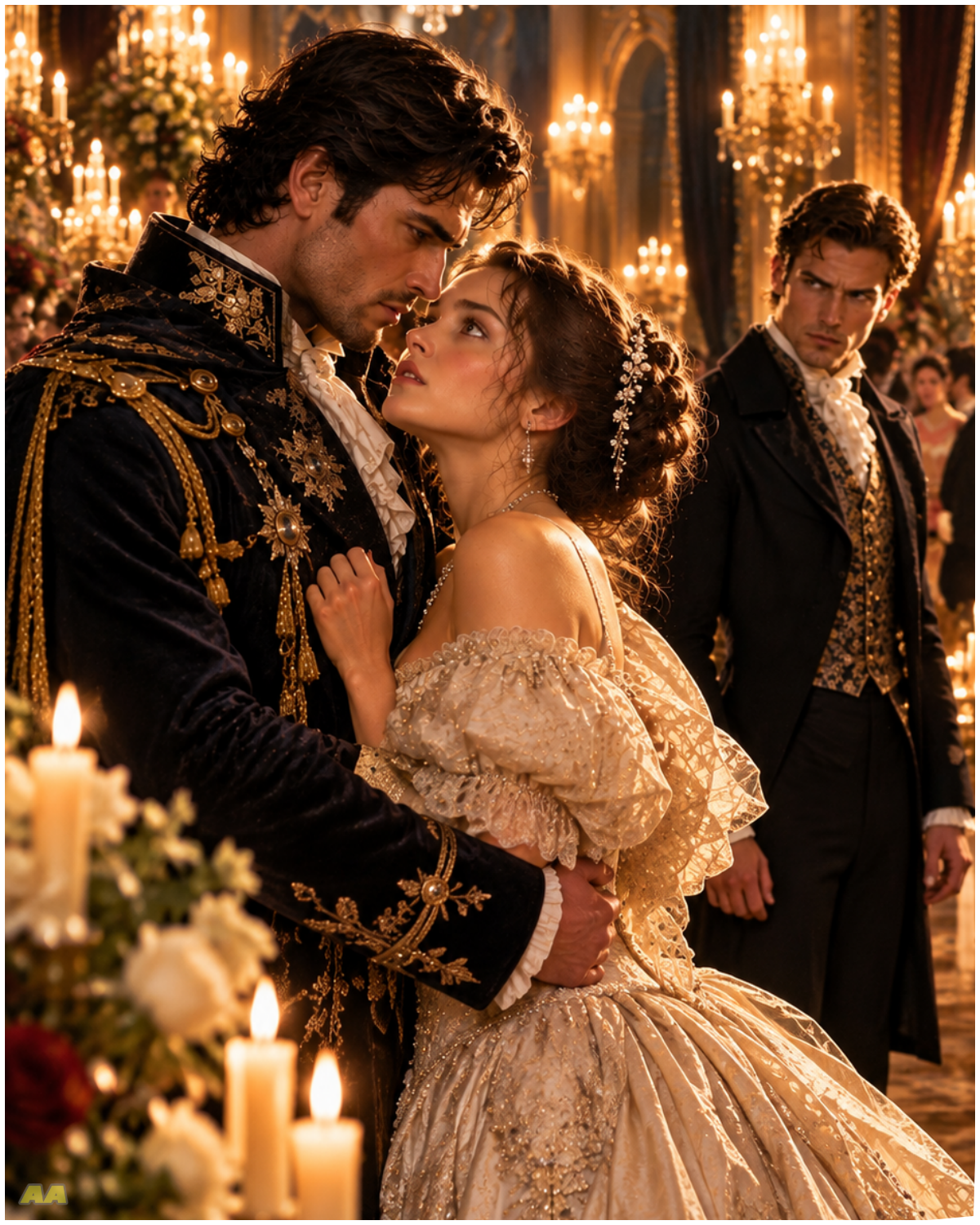
The Ashford ball glittered with all the excessive splendor that London society demanded.
In the spring of 1847, the orchestra played a lively waltz that had couples spinning in perfect synchronization.
Lady Theodora Caendish stood near the terrace doors, her pale blue silk gown catching the candlelight as she pretended to admire the garden beyond the glass.
She was not admiring the garden.
She was watching him.
Hugh Sinclair, the Duke of Blackmir, stood across the ballroom like a dark pillar of masculine indifference, his black evening coat fitting his broad shoulders with tailored precision.
His expression held that particular brand of aristocratic boredom that made every debutant in London flutter their fans and sighed dramatically.
At 32, he possessed the kind of severe handsomeness that intimidated most women, sharp jaw, piercing gray eyes, and an air of complete disinterest in the matrimonial games played around him.
Theodora had been in love with him since she was 17.
Four years of harboring this impossible secret.
Four years of attending every ball where he might appear.
Four years of memorizing the way he held his champagne glass.
The slight furrow between his brows when something displeased him.
The rare, devastatingly rare curve of his mouth when something amused him.
Theodora, darling, there you are.
She turned to find her mother, the Martianess of Carrington, sweeping toward her with Lord Lucienne Whitlock in tow.
Lucien smiled, his practiced charming smile, the one that made every mama in London believe he was the perfect match for their daughters.
“Lord Witlock was just saying how lovely you look this evening,” her mother continued, her eyes gleaming with matchmaking triumph.
“Weren’t you, my lord? Exquisite as always,” Lucienne said smoothly, taking Theodora’s gloved hand and pressing a kiss just above her knuckles.
The fairest bloom in all of London.
Theodora managed a polite smile, though something about his touch always made her want to withdraw her hand too quickly.
She’d been courting Lucien for 3 months now, or rather their families had been courting the idea of their union.
The son of an earl, heir to a considerable fortune, impeccable lineage.
“On paper, he was everything a young lady should want.”
“On paper.”
“I do hope you’ll save me the supper dance,” Lucien said, his blue eyes twinkling with practiced charm.
Of course, Theodora replied, because that was what was expected of her.
Her mother beamed, Lucien bowed, and Theodora’s gaze drifted, as it always did, back across the ballroom to where the Duke of Blackmir stood, now in conversation with Lord Peon.
Even from this distance, she could see the sharp intelligence in his eyes, the way he listened with complete attention when someone spoke to him, unlike the other gentlemen who simply waited for their turn to talk.
Theodora. Her mother’s voice held a note of concern.
Are you quite well? You seem distracted.
Forgive me, mama. Just a touch of the heat.
Perhaps some fresh air. The terrace is lovely this evening.
Yes, I think I shall.
Theodora slipped through the doors onto the stone terrace, grateful for the cool April air against her flushed cheeks.
She walked to the ballastrade, resting her gloved hands on the cool stone, and breathed deeply.
The garden below was illuminated by lanterns.
Their soft glow creating romantic shadows among the carefully manicured hedges.
This was her life, she thought, with a mixture of resignation and melancholy.
Marry Lucienne, become a respectable wife, manage a household, produce heirs, and watch Hu Sinclair from afar at social functions for the rest of her days, never speaking to him beyond polite pleasantries, never knowing if he even remembered her name.
Lady Theodora. She jumped, spinning around to find the very object of her thoughts standing in the terrace doorway.
The Duke of Blackmir stepped forward, his expression serious, his gray eyes fixed on her with an intensity that made her heart hammer against her ribs.
Your grace, she managed, dropping into a curtsy despite her trembling knees.
I didn’t hear you approach.
Forgive the intrusion. He glanced back toward the ballroom, then moved closer, his voice lowering.
I need to speak with you privately.
It’s rather urgent. Urgent? The Duke of Blackmir needed to speak with her urgently.
Theodora’s mind raced through a dozen impossible scenarios, each more fantastical than the laSt. Of course, she said, trying to keep her voice steady.
What is it? Hugh hesitated, which was unusual for him.
He was known for his directness, his unwillingness to engage in the subtle verbal dancing that characterized most aristocratic conversation.
He studied her face for a moment, as if weighing his words carefully.
“This is rather delicate,” he began, and I debated whether it was my place to speak at all, but I find I cannot in good conscience remain silent.
Theodora’s breath caught.
“Your grace, you’re frightening me. That is not my intention.”
He took another step closer and she caught the faint scent of sandalwood and something uniquely him.
It concerns Lord Whitlock. Whatever she’d been expecting, it wasn’t that.
Lucien. Yes. Hugh’s jaw tightened.
I understand you’ve been courting for some months now.
Our families have been discussing the possibility of an arrangement.
Yes. Then you should know something about the man you’re considering marrying.
Hughes gray eyes held hers with unwavering directness.
Lord Whitlock possesses a reputation that I suspect has been carefully concealed from you and your family.
Theodora’s heart began to pound, though not from her usual proximity to the Duke.
What sort of reputation? The kind that involves frequent visits to certain establishments in the less respectable parts of London, gaming hells primarily, though there are also other venues.” He paused, clearly uncomfortable with the delicacy required for such a conversation.
He is known among gentlemen, though not spoken of in polite society, as a rake of the First Order, a gambler, a womanizer who has left more than one young woman in unfortunate circumstances.
The words struck her like physical blows.
I I don’t understand. How can this be?
His family, his reputation are carefully maintained facads, Hugh interrupted, his voice gentler now.
His father pays his debts.
His mother ensures the right stories reach the right ears.
But I have it on excellent authority from men I trust that Lord Whitlock is not the gentleman he appears to be.
Theodora’s mind whirled three months of courtship of polite conversations and proper chaperoned walks in Hyde Park.
Had she been so blind?
Or had she simply been too preoccupied with her impossible feelings for the man standing before her to pay proper attention to the one actually courting her?
Why are you telling me this?
The question escaped before she could stop it, raw and confused.
Hugh looked slightly takenback by her directness.
Because you deserve to know the truth before making such a significant decision.
But why do you care?
The words tumbled out, emboldened by shock and the intimacy of the darkened terrace.
Forgive me, your grace, but we barely know each other.
We’ve never had more than the briefest of conversations.
Why would you concern yourself with my marital prospects?
For the first time since she’d known him, Hugh Sinclair looked genuinely uncertain.
A faint crease appeared between his dark brows, and he seemed to be searching for the right words.
“Because I know you to be a woman of excellent character,” he said finally.
“Your family is respectable. Your father is a man I admire greatly, and you yourself have always conducted yourself with grace and intelligence.
You deserve better than to be trapped in a marriage with a man who will bring you nothing but heartache and scandal.
It was a perfectly reasonable answer, a perfectly kind answer, and it broke Theodora’s heart just a little bit more.
I see, she said quietly.
That’s very considerate of you.
I realize this is shocking news, Hugh continued, clearly missing the deeper current of her disappointment.
But I urge you to pay closer attention to Lord Whitlock’s movements, where he goes, whom he associates with.
You’ll find I’m not mistaken.” Theodora nodded, her throat tight with a complicated tangle of gratitude, humiliation, and the persistent foolish hope that refused to die.
“Thank you for the warning, your grace.” Hugh studied her face, and for a moment she thought she saw something flicker in those gray eyes.
Concern perhaps, or curiosity, but then it was gone, replaced by his usual composed expression.
I should return to the ballroom before your absence is noted, he said, stepping back.
But please, Lady Theodora, take my words seriously.
You deserve happiness, not a lifetime of regret.
He bowed, turned, and disappeared back into the glittering ballroom, leaving Theodora alone on the terrace with her shattered illusions and her racing heart.
The Duke of Blackmir had saved her from a disastrous marriage, and he had absolutely no idea that she’d been in love with him all along.
The following morning, Theodora sat in her father’s study, the morning sun streaming through the tall windows as she recounted the previous evening’s conversation.
The Marquis of Carrington listened intently, his weathered face growing increasingly grave as his daughter spoke.
Blackmir said this, he asked when she’d finished.
You’re certain? Yes, Papa. He was quite specific.
The Marquis leaned back in his leather chair, steepling his fingers.
Hugh Sinclair is many things, reserved, particular, sometimes unbearably serious, but he is not a gossip, and he is not a liar.
If he took the trouble to warn you personally, then I believe we must take his concerns seriously.
What should we do? Leave that to me, my dear.
Her father’s expression softened. I’ll make some discreet inquiries.
If what Blackmir says is true, then this courtship ends immediately.
I’ll not have my daughter married to a scoundrel, regardless of his family’s status.
Relief flooded through Theodora. Thank you, Papa.
You should thank Blackmir, the Marquis said thoughtfully.
It took courage to approach you with such delicate information.
Many men would have stayed silent rather than risk the awkwardness.
Yes, Theodora said quietly. He was very kind.
Her father’s sharp eyes studied her face.
Theodora, is there something else you wish to tell me?
No, papa. Nothing at all.
But there was, of course, there was the secret she’d carried for 4 years, the impossible love that made her heart ache every time she saw Hugh Sinclair across a crowded room.
There was the devastating knowledge that he’d helped her out of nothing more than gentlemanly concern that she was just another responsibility to him, another young lady to be protected from the predations of unsuitable men.
That evening, as Theodore dressed for the Worthington Suare, her lady’s maid, Betty, chatted excitedly about the latest society gossip.
They say the Duke of Blackmir actually attended three social events this week, my lady.
Can you imagine? Everyone’s in quite a flutter about it.
Lady Peton told Cook that he’s never been so social before.
Some think he might finally be looking for a wife.
Theodora’s handstilled on her necklace.
Does anyone know why he’s attending more events?
Oh, the usual speculation, my lady.
Some say he’s under pressure from his family to produce an heir.
Others think he’s finally ready to settle down.
But you know how society talks.
Half of its nonsense. Betty secured the final pin in Theodora’s dark hair.
There, you look absolutely lovely, my lady.
That green silk brings out your eyes beautifully.
Theodora studied her reflection. At 21, she knew she was considered attractive enough.
Dark hair, hazel eyes, a pleasant figure, but standing next to the ethereal beauties who typically caught the attention of dukes, she felt decidedly ordinary.
The Worthington Suare was a smaller affair than the Ashford Ball, which meant the rooms felt more intimate, conversations more personal.
Theodora had barely arrived when Lord Whitlock appeared at her side, all charming smiles and practiced compliments.
Lady Theodora, how delightful to see you again so soon.
She studied him with new eyes, remembering the Duke’s warning.
Lucienne was handsome, certainly, golden hair, bright blue eyes, the kind of classical features that made matrons sigh.
But now that she was paying attention, she noticed things she’d missed before, the slight redness in his eyes, as if he’d been up too late.
The way his gaze flickered around the room, even as he spoke to her, as if constantly assessing, calculating, the overpowering cologne that seemed designed to mask something less pleasant.
“Lord Whitlock,” she replied coolly, “I trust you’ve been well.” “Exceedingly well, now that I’m in your presence,” he moved closer, too close for propriety.
“I was hoping we might continue our courtship with a drive-thru Hyde Park tomorrow afternoon.
I’m afraid I have a prior engagement.” A flash of irritation crossed his features before he smoothed it away with another smile.
The day after, then I’ll have to check my calendar and send word to your mother.
His jaw tightened almost imperceptibly.
Have I done something to offend you, my lady?
Before Theodora could formulate a diplomatic response, a deep voice spoke from behind her.
Good evening, Lord Whitlock. Lady Theodora.
She turned to find the Duke of Blackmir standing there imposing in his evening attire, his gray eyes fixed on Lucian with an expression that could only be described as coolly assessing.
“Your grace,” Lucienne said, his smile becoming strained.
“What a pleasant surprise.” “Is it?” Hugh’s tone suggested he found nothing particularly pleasant about the encounter.
He turned to Theodora. “Lady Theodora, your father asked me to convey that he wishes to speak with you regarding a family matter.
He’s in the card room.
It was a lie, an obvious, transparent lie, and yet Theodora seized upon it gratefully.
“Oh, yes, of course. Please excuse me, Lord Whitlock.” She curtsied quickly and allowed Hugh to guide her away, his hand hovering just behind her elbow, without quite touching her.
They walked in silence until they reached a quiet corner near the library, away from the main press of guests.
Only then did Hugh stop and turn to face her, his expression concerned.
“Forgive the deception,” he said quietly.
“But you looked as though you needed rescuing.” “I did,” Theodora admitted, her heart doing that familiar, foolish flutter at his proximity.
“Thank you again. Has your father made inquiries about Whitlock?” “Yes, he’s looking into the matter discreetly.” “Good,” Hugh paused, then added.
“I hope I haven’t caused difficulties between your family and the Whitlocks.
That wasn’t my intention. You’ve caused no difficulties whatsoever, Theodora assured him.
If anything, you may have saved me from a terrible mistake.
I’m grateful, truly. Hugh studied her face with an intensity that made her breath catch.
You’re handling this with remarkable composure.
Many young ladies would be devastated by such a revelation.
Perhaps I’m not like many young ladies, Theodora said, then immediately regretted the boldness of the statement.
But Hugh’s expression softened almost imperceptibly.
“No,” he said quietly. “I don’t believe you are.” For a moment, one crystalline perfect moment, they simply looked at each other.
The sounds of the suare faded into the background, the chatter and laughter becoming nothing more than distant noise.
Theodora felt as though she could drown in those gray eyes, in the subtle intelligence and unexpected kindness she saw there.
Then Hugh cleared his throat and stepped back.
The moment shattering like dropped crystal.
“I should return to the card room before my absence is noted,” he said, his formal mask sliding back into place.
“Good evening, Lady Theodora.” “Good evening, your grace.” She watched him walk away, her heart a confusion of gratitude, longing, and the persistent ache of loving someone who would never see her as anything more than a responsibility to be managed.
3 days later, the Marquis of Carrington summoned his daughter to his study with grave news.
His inquiries had confirmed everything the Duke of Blackmir had warned about.
Lord Lucien Whitlock was indeed a gambler, a rake, and a man of decidedly questionable character.
More troubling still, the Marquis had discovered debts, staggering debts that Lucian’s father had been paying off quietly for years.
The courtship ends today, the Marcus declared firmly.
I’ll speak with Lord Whitlock’s father myself.
There will be no scandal, but there will be no marriage either.
Theodora felt relief wash over her.
“Thank you, papa. Thank the Duke of Blackmir,” her father said.
“I owe him a considerable debt for this.
Not many men would have the courage or the decency to intervene in such a delicate matter.” That evening, Theodora penned a letter to the Duke, a brief, proper note thanking him for his assistance, and informing him that her father’s inquiries had confirmed his warnings.
She chose her words carefully, keeping her tone appropriately formal and grateful, betraying nothing of the emotions that churned beneath her composed exterior.
The reply came the next morning, delivered with the Duke’s seal.
Lady Theodora, I am relieved to hear that your father acted swiftly on the information provided.
You deserve a marriage built on respect and genuine affection, not deception and financial desperation.
Should you ever require assistance in the future, please do not hesitate to call upon me.
Yours respectfully, Blackmir Theodora read the letter three times, analyzing every word, searching for any hint of personal feeling beyond polite concern.
She found none. It was exactly the kind of letter one would expect from a responsible gentleman performing his duty to protect a young lady of good family.
She folded it carefully and placed it in her writing desk next to the other precious few items she’d collected over the years.
A dance card from a ball where he’d been present.
A program from a charity event where he’d given a brief speech.
A pressed flower from the Peton garden party where she’d watched him from afar.
Pathetic really. This collection of meaningless objects, but they were all she had.
The scandal, when it finally broke three weeks later, exceeded even the most dramatic expectations of London society.
Lord Lucenne Whitlock had been caught in a compromising position with the married daughter of a prominent banker.
The husband, upon discovering them, had challenged Lucienne to a duel, an archaic practice that was technically illegal, but still occasionally employed by outraged gentlemen.
The matter was hushed up before any shots could be fired, but not before half of London had heard the delicious details.
Lord Whitlock’s family retreated to their country estate in disgrace.
Lucenne himself was reportedly being sent to their holdings in Scotland, far from the temptations of London and the vengeance of cuckolded husbands.
Theodora heard the news from her mother, who’d heard it from Lady Peton, who’d heard it from Lady Worthington, who’d heard it directly from the banker’s mortified wife.
The chain of gossip that was London society’s lifeblood.
Can you imagine? The Martianist said, fanning herself dramatically.
If we hadn’t ended the courtship when we did, you might have been engaged to him when this scandal erupted.
Thank heavens for your father’s good sense.
Thank heavens for the Duke of Blackmir’s warning.
Theodora corrected gently. Her mother paused.
Yes, that was rather extraordinary, wasn’t it?
I wonder what prompted him to take such an intereSt. Simple decency, I imagine.
Perhaps. Her mother’s eyes took on that speculative gleam that Theodora had learned to dread.
The Duke has been remarkably more social this season, attending balls, suarees, even the theater.
Lady Peton says his mother has been pressing him about marriage.
Has she? Theodora tried to sound disinterested while her heart performed uncomfortable acrobatics.
Indeed, he’s 32 now with a duche to manage and no air.
It’s his duty, really. The Martianess studied her daughter thoughtfully.
He’s always been particular about society events, but lately, well, one does notice patterns.
What patterns? Never mind, dear.
Just mother’s intuition. She patted Theodora’s hand.
Now we must prepare for Lady Ashworth’s garden party tomorrow.
It’s meant to be the social event of the season, and I won’t have you moping about that dreadful witlock business.
You’re well rid of him, and there are plenty of other suitable gentlemen in London.
But Theodora had no interest in other suitable gentlemen.
Her heart, foolish and stubborn, had made its choice four years ago.
Lady Ashworth’s garden party was indeed spectacular.
The Ashworth estate boasted magnificent grounds with manicured lawns, a beautiful rose garden, and a small lake where guests could take boats out for romantic excursions.
Tables laden with refreshments dotted the landscape, and a string quartet played softly near the main terrace.
Theodora wore a white muslin dress with delicate green embroidery, a parasol protecting her fair skin from the bright June sunshine.
She’d been at the party for perhaps an hour, making polite conversation with various acquaintances when she noticed him.
The Duke of Blackmir stood near the Rose Garden, conversing with Lord Peton and the Marquis of Carrington, her own father.
All three men looked serious, engaged in what appeared to be a weighty discussion, as if sensing her gaze, Hugh glanced up, their eyes met across the lawn.
He said something to the other gentleman, then began walking in her direction with that purposeful stride that made her pulse quicken.
“Lady Theodora,” he said, bowing as he approached.
“You look well, as do you, your grace.
It was the truth. He was devastatingly handsome in his day attire, the sunlight catching the dark waves of his hair and emphasizing the strong lines of his jaw.
I trust you’ve heard about Lord Whitlock’s recent difficulties.
All of London has heard.
Indeed. A slight curve touched his lips.
Not quite a smile, but close.
I confess I’m not surprised.
Men like Whitlock eventually reveal their true nature.
Thanks to you, my family avoided being entangled in his disgrace.
I’m glad I could be of service.
He paused, then added, “Your father tells me you’ve been delued with new suitors since news spread that your courtship with Whitlock ended.” Theodora couldn’t help but laugh at the delicate phrasing.
That’s a generous way of describing the social vultures who’ve suddenly discovered my existence.
This time Hugh did smile, a genuine surprised smile that transformed his entire face and made Theodora’s heart stop.
Social vultures. That’s rather apt.
My mother prefers to call them opportunities, but I find your description more honeSt. I imagine it must be exhausting fending them off somewhat, though my father has become quite skilled at identifying unsuitable prospects.
He’s developed a rather comprehensive vetting system.
Hugh’s expression grew thoughtful. Has he?
Oh, yes. Family history, financial standing, personal habits, associates.
I believe he’s compiled dossier on half the eligible gentlemen in London.
Your father is a thorough man.
He says he learned the importance of thoroughess from recent experience.
Theodora met Hugh’s eyes directly.
He credits you with teaching him that lesson.
A faint color touched Hugh’s cheekbones.
An actual blush barely visible, but definitely there.
Theodora filed this remarkable observation away to treasure later.
I merely provided information, Hugh said, clearly uncomfortable with the praise.
Your father took the appropriate action.
They stood in comfortable silence for a moment, watching the other guests mill about the garden.
Lady Harriet Bowmont walked past with her sister, both young ladies giggling behind their fans as they noticed the Duke.
An elderly matron actually stopped mid-con conversation to stare, her expression one of barely concealed admiration.
“You’re quite the sensation,” Theodora observed, amused.
Hugh followed her gaze and sighed.
“I’m beginning to regret accepting my mother’s advice about being more social.
You don’t enjoy the attention.
I find it tiresome. Most people want to talk about nothing of consequence, the weather, fashion, gossip.
Very few are interested in genuine conversation.
What would you prefer to discuss?
Hugh looked at her with surprise, as if no one had ever asked him that question before.
Books, mostly, philosophy, politics, though that’s considered inappropriate in mixed company, architecture, agricultural improvements, the state of education in England.
He paused. I realize that makes me sound terribly dull.
On the contrary, Theodora said softly.
It makes you sound interesting.
Their eyes met again, and this time the look held longer.
Something flickered in Hugh’s expression.
Confusion perhaps, or curiosity. Before either of them could speak, however, Lady Peton appeared with her daughter Charlotte in tow.
Your grace, Lady Theodora, how delightful to find you both here.
Charlotte was just saying she hoped to see you, Duke.
Charlotte Peton blushed prettily, her blonde curls bouncing as she curtsied.
Your grace, would you perhaps like to join us for a boat ride on the lake.
Mama thought it would be lovely.
Hugh’s jaw tightened almost imperceptibly.
Thank you, Lady Charlotte, but I’m afraid I’m engaged at present.
Engaged? Lady Peton looked around, clearly seeing no evidence of this engagement.
Yes, I was just about to escort Lady Theodora through the rose garden.
She expressed particular interest in Lady Ashworth’s collection.
Theodora blinked in surprise, but recovered quickly.
Yes, the roses here are magnificent.
Lady Peton’s expression suggested she didn’t quite believe them, but social propriety prevented her from challenging a Duke’s statement.
Of course, perhaps later then.
Perhaps, Hugh said non-committally. When they’d walked away, Theodora glanced up at Hugh with barely suppressed amusement.
I expressed particular interest in the roses.
You might have, Hugh replied, his own lips twitching.
In theory, “That’s a very creative interpretation of our conversation.
I prefer to think of it as strategic improvisation.” They entered the rose garden, a secluded area bounded by tall hedges and filled with blooms in every color imaginable.
The sweet fragrance hung heavy in the warm air, and the sound of the party faded to a pleasant murmur.
Thank you for the rescue, Theodora said, though I notice you’re doing a lot of rescuing where I’m concerned.
You seem to require it frequently.
Perhaps you’re simply nearby at opportune moments.
Perhaps. They walked slowly along the gravel path, Theodora’s parasol casting dappled shadows on her dress.
She was acutely aware of Hugh’s presence beside her, the way his height made her feel protected rather than diminished.
The clean scent of his soap and shaving soap.
May I ask you something?” she ventured.
“Of course. Why have you been attending more social events this season?
Everyone’s noticed. There’s considerable speculation.” Hugh was quiet for so long that Theodora thought he might not answer.
Then he said, “My mother believes it’s time I consider marriage.” “She’s not wrong.
I do have responsibilities to my title and estate, but the prospect of navigating the marriage market is, he trailed off, daunting, dishonest, he corrected.
So much of courtship is performance and pretense.
Very little of it involves genuine understanding between two people.
Yet you must marry eventually.
Yes, he looked at her, his gray eyes serious.
Which is why I find myself attending garden parties and balls, hoping to find someone who might.
He stopped again as if unsure how to finish the sentence.
Might what? Theodora asked softly.
Might see past the title.
Might want genuine conversation. Might?
He shook his head. Forgive me.
I’m being philosophical when I should be making pleasant small talk about the roses.
I prefer philosophy to small talk.
Hugh studied her face with that intense focus that made her feel seen in a way she’d never experienced before.
Do you? Yes. I’ve always found small talk rather pointless.
All those words saying nothing of substance.
That’s a remarkably honest admission.
You inspire honesty, your grace.
The words hung between them, more revealing than Theodora had intended.
Hugh’s expression shifted, something warming in his eyes that made her breath catch.
Hugh, he said quietly. I beg your pardon.
My name is Hugh. I would like it very much if you would use it when we’re alone at leaSt. Theodora’s heart hammered so hard she was certain he could hear it.
That’s rather informal, your grace.
Yes, it is. His mouth curved in that rare, transformative smile.
Will you? I Yes, Hugh.
[snorts] The name felt intimate on her tongue, precious and dangerous.
Then you must call me Theodora.
Theodora, he repeated, and the sound of her name in his deep voice made her shiver despite the warm June air.
They continued walking, but something had changed between them.
The air felt charged with possibility, with a tentative connection that both thrilled and terrified her.
Theodora hardly dared to breathe, afraid that any sudden movement might shatter whatever fragile thing was forming.
“I should tell you,” Hugh said after a moment, that your father and I have been discussing a matter of mutual intereSt. “Oh, he mentioned you have a passion for reading.
Apparently, your collection rivals his own.
I do love books, Theodora admitted.
Sometimes I think I prefer them to people.
What sort of books? Philosophy primarily, history, poetry, though I know that’s considered more appropriate for young ladies.
I’ve been attempting to read Adam Smith’s work on economics, but I confess some of it is rather dense.
Hugh stopped walking, turning to face her fully.
You’re reading The Wealth of Nations?
Trying to at leaSt. Is that very shocking?
It’s he paused, seeming to search for words.
It’s remarkable. Most young ladies of my acquaintance limit their reading to fashion plates and romantic novels.
I read those, too, Theodora said, slightly defensive.
But I also like to understand the world beyond drawing rooms and dance floors.
Have you read Burke or Woolstone Craft?
Both, though I had to borrow them from my father’s library secretly.
My mother thinks such reading is unbecoming for a young lady.
Hugh’s expression was one of undisguised admiration.
Your mother is wrong. The simple declaration delivered with such absolute conviction made Theodora’s eyes sting with unexpected emotion.
No one had ever validated her intellectual interest before.
No one had ever suggested that her desire to read and learn and think was anything other than a peculiar eccentricity to be tolerated at beSt. “Thank you,” she said quietly.
“That’s Thank you.” They stood there in the rose garden, surrounded by blooms and afternoon sunlight, looking at each other with a new understanding.
Theodora saw the exact moment when Hugh’s expression shifted from admiration to something deeper, something that made her breath catch and her skin flush.
Theodora, I there you are.
They both turned to find the Marquis of Carrington approaching with Lady Ashworth, effectively shattering the moment.
Theodora wanted to scream with frustration.
“Papa,” she said, forcing a smile.
“Lady Ashworth.” “My dear, you must come see the peacocks,” Lady Ashworth gushed.
“They’ve just been fed, and they’re displaying their feathers.
It’s quite spectacular.” “Yes, of course,” Theodora said, trying not to sound as disappointed as she felt.
Hugh bowed. “Marquis, Lady Ashworth.” His eyes met Theodora’s for one brief moment full of unspoken words and interrupted possibilities.
Theodora, thank you for the pleasant conversation.
The pleasure was mine, your grace.
As she walked away with her father and Lady Ashworth, Theodora glanced back once.
Hugh stood in the rose garden, watching her leave, his expression thoughtful and intense.
Something had changed between them.
Something significant, and Theodora’s foolish, impossible hope flared to life once more.
The following week brought an unexpected invitation that sent London society into a frenzy of speculation.
The Duke of Blackmir was hosting a dinner party.
This was significant because Hugh Sinclair never hosted dinner parties.
He attended them occasionally out of social obligation, but he never opened his own home, the magnificent Black Mir House in Mayfair, to guests beyond his closest family and friends.
The Marquis of Carrington received his invitation on a Tuesday morning, and promptly announced that the entire family would attend.
“This is quite an honor,” he told his wife and daughter over breakfaSt. “Blackmir doesn’t entertain lightly.
If he’s extending an invitation, it means something.
Perhaps he’s finally serious about finding a wife, the Martianess speculated.
I heard from Lady Peton that his mother has been quite insistent.
Theodora said nothing, her heart performing complicated gymnastics at the thought of seeing Hugh, of seeing him in his own home, in an intimate setting with only a dozen or so carefully selected guests.
When the evening of the dinner party arrived, Theodora dressed with particular care.
She chose a deep blue silk gown that complimented her complexion and allowed Betty to arrange her dark hair in an elegant style with small pearls woven through the curls.
“You look beautiful, my lady,” Betty said with satisfaction.
“The Duke won’t be able to take his eyes off you.” “Betty,” Theodora laughed despite her nerves.
“Don’t be absurd. I’m not being absurd, my lady.
Everyone in service has noticed how the Duke looks at you, Mrs. Henderson.
That’s his housekeeper, told our cook that his grace has been asking about you.
Theodora’s heart leaped. Asking what?
Oh, just general things, your interests, your character.
But Mrs. Henderson says she’s never seen his grace take such an interest in a young lady before.
Betty leaned in conspiratorally. She thinks he’s smitten.
That’s ridiculous gossip, Theodora said, but her pulse raced.
The Duke and I are barely acquainted.
If you say so, my lady.
Betty’s tone suggested she believed otherwise.
Blackmir House was even more impressive than Theodora had imagined.
The townhouse occupied a prime location in Mayfair.
Its elegant Georgian facade lit by torches that cast dancing shadows on the stone.
A footman in impeccable livery helped them from the carriage, and they were ushered into an entrance hall that took Theodora’s breath away.
Marble floors gleamed beneath crystal chandeliers.
A grand staircase swept upward to the floors above.
Portraits of Hughes ancestors lined the walls.
Generations of Sinclair’s looking down with aristocratic dignity.
The butler, an elderly man with impeccable posture, announced them.
The Marques and Martianness of Carrington and Lady Theodora Caendish.
Hugh appeared at the top of the staircase, descending with controlled grace.
He wore evening attire of deep charcoal gray that emphasized his broad shoulders and made his eyes seem even more striking.
When his gaze found Theodora, something flared in his expression.
Recognition, pleasure, and something else she couldn’t quite name.
“Lord Carrington, Lady Carrington, Lady Theodora.” “Welcome,” he bowed, then extended his hand to her mother.
“Thank you for accepting my invitation.” “The honor is ours, your grace,” the Martianess replied.
Hugh’s eyes returned to Theodora.
“You look lovely this evening.
Thank you, your grace. Your home is magnificent.
I hope you’ll allow me to show you the library later.
I believe you might find it interesting.
Before Theodora could respond, other guests began arriving.
She recognized Lord and Lady Peton, the Earl of Westbrook, with his wife and daughter, and several other prominent members of society.
Notably absent were the young unmarried ladies, who typically pursued Hugh at social events.
This gathering was clearly designed for serious conversation, not matrimonial maneuvering.
Dinner was served in a magnificent dining room with walls covered in rich burgundy silk and lit by candles in silver candelabra.
Theodora found herself seated between Lord Westbrook and to her delight and terror Hugh himself at the head of the table.
I hope you don’t mind the seating arrangement, Hugh said quietly as the first course was served.
I confess I specifically requested your company.
Theodora’s pulse quickened. I’m honored your grace.
Hugh? He corrected, his voice low enough that only she could hear.
“Remember, Hugh,” she repeated, the intimacy of his name on her lips making her flush.
The dinner conversation flowed around topics of genuine substance, politics, the recent railway expansion, debates in Parliament about working conditions in factories.
To Theodora’s surprise and pleasure, Hugh actively solicited her opinions, treating her contributions with the same respect he showed the gentleman present.
Lady Theodora, you mentioned you’d been reading Smith’s work, Hugh said during a lull in conversation.
What do you make of his theories on the division of labor?
All eyes turned to her.
Several of the gentlemen looked surprised that the Duke would ask a young lady about economic theory.
Theodora saw her mother’s expression of mild alarm, but Hugh’s eyes held only genuine interest, encouraging her to speak.
“I find his observations compelling,” Theodora said carefully.
The idea that specialized labor increases efficiency makes logical sense, though I wonder about the human cost, whether workers become mere cogs in a machine, losing the satisfaction of creating something complete.
An excellent point, Lord Westbrook interjected.
The factories in Manchester are certainly efficient, but the conditions for workers are deplorable.
The conversation shifted to labor reform with Theodora contributing several more observations that were met with respect rather than patronizing amusement.
She felt Hugh’s approval like a physical warmth beside her.
After dinner, the ladies retired to the drawing room while the gentlemen enjoyed their port and cigars.
Theodora endured 20 minutes of fashion discussion before Hugh appeared in the doorway.
Forgive the interruption, ladies, but Lady Theodora had expressed interest in seeing my library.
Would anyone else care to join us for a brief tour?
The other ladies declined, preferring the warmth of the drawing room.
Only Theodora’s mother looked slightly concerned, but the Marquis caught her eye and shook his head slightly.
Whatever was happening, he approved.
Theodora followed Hugh through the magnificent house, her heart pounding.
They climbed the stairs to the second floor, walked down a long corridor lined with more family portraits, and finally stopped before a set of double doors.
“This is my favorite room in the house,” Hugh said, opening the doors.
“Very few people have seen it.” Theodora stepped inside and gasped.
The library was breathtaking. Floor toseeiling bookshelves lined every wall, filled with thousands of volumes bound in leather of various colors.
A massive fireplace dominated one wall with comfortable chairs arranged before it.
Tall windows overlooked the garden behind the house, and a rolling ladder provided access to the higher shelves.
This is magnificent, Theodora breathed, turning in a slow circle.
Absolutely magnificent. Hugh watched her reaction with undisguised pleasure.
I thought you might appreciate it.
Appreciate it. I could live in this room and never be bored.
She walked to the nearest shelf, running her fingers reverently along the spines.
Philosophy, history, science, poetry. You have everything.
Not quite everything, Hugh said, moving to stand beside her.
But I’m always adding to the collection.
There’s a bookshop near Piccadilli that sends me cataloges of new acquisitions.
Hatchards? Yes, you know it.
I’ve been begging my father to take me there for months, but he keeps saying it’s too far from our house.
Theodora pulled out a volume, a first edition of Edmund Burke’s Reflections on the Revolution in France.
“Oh, this is wonderful. I’ve only read this in my father’s much more worn copy.
You may borrow it if you like.” She looked up at him in surprise.
“Truly?” “Of course. What good are books if they’re not read?” Hugh’s expression grew more serious.
“Thodora, there’s something I wanted to discuss with you away from the other guests.” Her breath caught.
“What is it?” Hugh seemed to gather his thoughts, his usual confidence giving way to something more uncertain.
I realize we’ve only known each other a short time.
Truly known each other. I mean, our previous encounters were brief, superficial, but these past few weeks I found myself thinking about you rather frequently.
Theodora’s heart was beating so hard she felt dizzy.
Have you? Yes. Our conversation in the Rose Garden at Lady Ashworth’s party, it affected me more than I expected.
He turned to face her fully, his gray eyes intense in the lamplight.
You’re not like other young ladies I’ve met.
You’re intelligent, genuine, unafraid to express your real thoughts.
You read philosophy and economics.
You value substance over appearance.
And you? He paused as if the next words were difficult.
You make me want to be more social, more engaged with the world simply because I might encounter you.
Theodora felt tears prickling her eyes.
This moment, this impossible, wonderful moment, was everything she’d dreamed of for 4 years.
“Huw,” she said softly, “I must tell you something.
What is it? I’ve been in love with you since I was 17 years old.” The words fell into the space between them like stones into still water, creating ripples that couldn’t be called back.
Hugh stared at her, his expression one of complete shock.
“You, what? I’ve loved you for 4 years, Theodora continued, the truth pouring out now that she’d started.
Every ball, every party, every social event I attended, hoping you might be there.
I’ve watched you from across ballrooMs. I’ve treasured every brief conversation we’ve had.
When you warned me about Lord Whitlock, I was grateful, of course, but part of me hoped.
I hoped it might mean something more, that you might see me as more than just someone to be protected.
Hugh’s face had gone pale.
Theodora, I had no idea.
How could you? I never said anything.
I never gave any indication beyond what any other young lady might show.
She laughed shakily. I’ve become quite skilled at hiding my feelings.
4 years, Hugh said slowly, as if testing the words.
You’ve loved me for 4 years.
Yes, and I’ve been completely oblivious.
You had no reason to notice me.
I was just another young lady in society, unremarkable in every way.
That’s not true, Hugh said sharply.
You’re anything but unremarkable. He ran a hand through his hair, clearly trying to process this revelation.
Theodora, if I’d known, you would have what?
Married me out of pity.
I don’t want your charity, Hugh.
I never did. Theodora’s voice grew stronger despite the tears threatening to fall.
I told you this because I couldn’t bear for you to think I was just responding to your recent attention.
I need you to know that my feelings are real, that they’ve existed long before you decided to rescue me from Lord Whitlock.
Hugh stepped closer, his expression intense.
You think I’m pursuing you out of some misguided sense of duty, aren’t you?
No. The word was forceful, definitive.
Theodora, when I warned you about Whitlock, it was because the thought of you married to that scoundrel made me physically ill.
I told myself it was simple concern for your welfare, but the truth was more complicated.
What do you mean? I mean that I’ve noticed you for longer than these past few weeks.
At the Peton ball last autumn, you wore a green gown and spent most of the evening in conversation with Lady Westbrook about her work with orphanages.
You laughed at something, she said, and the sound, it stayed with me for days.
Theodora’s breath caught. You remember that?
I remember everything about you,” Hugh said quietly.
“The way you tilt your head when you’re thinking.
The small crease that appears between your brows when you’re concentrating.
The way you bite your lower lip when you’re nervous, exactly as you’re doing right now.” Theodora immediately stopped biting her lip, her cheeks flushing.
Hugh continued, “When I learned about your courtship with Whitlock, I was furious, not just at him, but at myself for waiting so long, for being too cautious and reserved.
I told myself I was protecting you, but really I was giving myself an excuse to speak with you, to be near you.
But you said I deserved better,” Theodora protested.
“You said I was an excellent woman from a wonderful family.” “Because you are.
But that’s not why I helped you.
I helped you because the thought of you belonging to anyone else was unbearable.
They stood facing each other in the library.
The truth finally laid bare between them.
Theodora felt as though she couldn’t quite catch her breath, as though the world had tilted slightly on its axis.
Four years, Hugh said again, shaking his head.
I’ve wasted 4 years. You didn’t know.
I should have known. I should have paid attention.
He moved closer. Close enough that she could see the darker flexcks in his gray eyes.
Theodora, I know this is sudden.
I know we’re in my library alone, which is highly improper.
But I need to know, is there any possibility that you might still harbor those feelings?
Or have my months of obliviousness destroyed whatever affection you once felt?” Theodora let out a surprised laugh that was half sobb.
You think I could stop loving you just because you didn’t notice?
Hugh, I’ve tried. I’ve tried so very hard, but my heart is remarkably stubborn.
His expression transformed. Relief, joy, and something fierce and possessive.
Thank God for stubborn hearts.
What are we going to do?
Theodora asked. Society will expect a proper courtship.
My parents will have expectations, and your mother.
My mother, Hugh interrupted, will be delighted.
She’s been not so subtly suggesting I pay more attention to you for months.
Apparently, she has better observation skills than I do.
She knew. She suspected. Mothers have an uncanny ability to perceive such things.
Hugh reached out, hesitating for just a moment before taking her hand.
His touch sent warmth radiating through her entire body.
Theodora, I want to court you properly.
I want to give you all the romance and attention you deserve, but I need to know.
Is that what you want, or would you prefer I speak to your father immediately?
Theodora’s eyes widened. You want to marry me more than I’ve wanted anything in my life?
His thumb traced circles on the back of her hand.
But I’ll do this at whatever pace you prefer.
She thought about it for a moment.
Four years of secret love, of watching from afar, of impossible hopes.
And now, suddenly, miraculously, those hopes were becoming reality.
I think, she said slowly, that I would like both.
A courtship, yes, but a brief one.
I’ve already waited 4 years, Hugh.
I don’t wish to wait much longer.
His smile was brilliant, transforming his usually serious face into something breathtakingly handsome.
Then we’re in agreement. I’ll speak to your father tomorrow.
He’ll say yes, Theodora assured him.
He admires you greatly. And I believe he suspected my feelings for some time.
Has everyone been aware of this except me?
Apparently so. Hugh laughed, a genuine delighted sound that Theodora had never heard from him before.
“I’m supposed to be observant.” “How did I miss this?
You were looking at society, not at me,” Theodora said.
“There’s a difference.” “Well, I’m looking at you now,” Hugh said softly.
“And I intend to keep looking for the rest of my life.” He raised her hand to his lips, pressing a kiss to her knuckles that sent shivers through her entire body.
They stood there in the lamplight, surrounded by books and possibility.
Two people who’d been circling each other for years, finally finding their way together.
“We should return to the others,” Theodora said reluctantly.
“Before our absence is noted, “Let them notice,” Hugh said, but he released her hand.
“Though you’re right. There will be time for this later.
All the time in the world.” As they walked back toward the drawing room, Theodora felt as though she were floating.
Four years of secret love, of impossible dreams, had somehow transformed into reality.
The Duke of Blackmir, her hu wanted to marry her.
The evening concluded with Hugh making a point of sitting beside Theodora in the drawing room, engaging her in conversation that made it abundantly clear to everyone present where his interests lay.
Lady Peton’s eyes nearly popped out of her head.
The Martianess of Carrington looked simultaneously shocked and delighted, and the Marquis of Carrington simply smiled, as if he’d known all along.
When the Caendish family departed, Hugh personally helped Theodora into her cloak, his hand lingering on her shoulder for just a moment longer than necessary.
“Until tomorrow,” he said quietly.
“Until tomorrow,” she echoed. In the carriage, her mother immediately launched into excited speculation.
“Did you see how he looked at you?” “Everyone noticed.
Lady Peton will be beside herself.” and that invitation to see his library.
Theodora, dear, I believe the Duke has serious intentions.
I believe you’re right, Mama, Theodora said, unable to stop smiling.
Her father caught her eye and winked.
The old schemer had definitely known.
That night Theodora lay in her bed, staring at the ceiling, her heart too full for sleep.
Everything had changed. Her impossible love wasn’t impossible anymore.
Hugh Sinclair, the Duke of Blackmir, loved her back, and tomorrow he would ask her father for her hand in marriage.
Hugh arrived at the Carrington townhouse at precisely 11:00 the following morning, dressed impeccably and carrying himself with the confidence of a man on a mission.
The butler showed him immediately to the Marquis’s study, where Lord Carrington waited with barely concealed amusement.
“Your grace,” the Marquis said, gesturing to a chair.
I confess I’ve been expecting this visit.
Hugh sat, though he looked slightly uncomfortable with the informal reception, Lord Carrington, I’ve come to request permission to marry your daughter.
I assumed as much. The Marquis poured two glasses of brandy, handing one to Hugh.
The question is why now?
You’ve known Theodora for years.
I’ve been a fool for years, Hugh corrected.
But I’m hoping to remedy that now, if you’ll allow it.
The Marquis studied him thoughtfully.
My daughter has been in love with you since she was 17 years old.
Did you know that? I learned that last evening, much to my shame.
And your feelings for her?
When did those develop? Hugh considered the question carefully.
If I’m honest, I think I’ve been drawn to her for quite some time, but I convinced myself it was merely recognition of her excellent character.
I didn’t allow myself to see it as anything more until the situation with Lord Whitlock forced me to examine my motivations.
When you realized the thought of her marrying someone else was unbearable.
Precisely. The Marquis nodded satisfied.
You’re a good man, Blackmir.
Reserved certainly, and not given to displays of emotion.
But you’re honorable, intelligent, and you clearly care for my daughter.
You have my blessing with one condition.
Name it. Make her happy.
Theodora is a remarkable young woman, brilliant, compassionate, and deserving of a marriage built on genuine affection, not merely duty or convenience.
Can you provide that? I can, Hugh said without hesitation.
I will. She deserves nothing less.
Then we have an understanding.
The Marquis raised his glass.
Welcome to the family, son.
They shook hands, and Hugh felt a weight lift from his shoulders.
One obstacle cleared. Now for the most important part.
Is Theodora at home? In the garden, I believe.
She’s been pacing since breakfaSt. The Marquis smiled.
Go ease her anxiety. Hugh found Theodora exactly where her father had indicated.
In the small garden behind the townhouse, walking among the rose bushes with her hands clasped tightly together.
She wore a simple morning dress of pale yellow that made her look like sunlight made manifeSt. She turned at the sound of his footsteps, her expression a mixture of hope and terror.
Hugh, your father said yes, he announced without preamble.
The tension drained from her body so quickly she nearly collapsed.
Hugh crossed the distance between them in three strides, catching her hands in his.
Are you all right? I’m She laughed shakily.
I’m wonderful. Did he really say yes without hesitation, though he did extract a promise that I would make you happy.
That seems reasonable. I intend to spend the rest of my life keeping that promise.
Hugh squeezed her hands gently.
Theodora, I know we discussed a brief courtship, but I find I’m impatient.
Would you object to a wedding in 6 weeks?
Her eyes widened. 6 weeks?
That’s hardly any time at all.
I’ve already wasted 4 years.
I don’t wish to waste another moment.
He pulled her closer. Propriety be damned.
They were in her family’s garden, after all.
Say yes. Yes, she breathed.
Yes, of course. Yes. Hugh had never considered himself a romantic man.
He’d always viewed marriage as a practical arrangement, a duty to be fulfilled.
But standing in that garden with Theodora looking up at him with love shining in her hazel eyes, he understood for the first time what poets wrote about.
What made sensible men do foolish things?
What transformed the mundane into the miraculous?
“I love you,” he said, the words feeling both strange and perfectly natural.
“I should have told you that last night, but I was too stunned by your revelation to think clearly.” I love you too, Theodora replied, tears glistening on her lashes.
I’ve loved you for so long, Hugh.
Sometimes I thought I might die from it.
No more suffering, he promised.
No more watching from afar.
We’re together now, and I intend to keep you very close for the rest of our lives.
He wanted to kiss her.
The desire was nearly overwhelming, but they were still in public view of the house, and he’d already pushed propriety quite far enough.
Instead, he brought her hands to his lips and kissed each one tenderly.
“6 weeks,” he said. “And then you’ll be my duchess.” “Your Duchess,” she repeated [clears throat] as if testing the words.
“That will take some getting used to.
You’ll be magnificent. You already are.
The six weeks that followed passed in a whirlwind of activity.” The announcement of their engagement sent London society into parexisms of excitement and speculation.
The Duke of Blackmir, the most elusive bachelor in England, was finally marrying.
And not to one of the obvious choices, not to Lady Charlotte Peton with her impeccable lineage, not to Lady Victoria Ashworth with her substantial dowy, but to Lady Theodora Caendish, the quiet, bookish daughter of the Marquis of Carrington.
The gossips had a field day.
I heard she trapped him with her intellect, Lady Peton said at a tea party, not quite quietly enough.
Men do appreciate a good conversation.
I heard he’s been in love with her for years, counted Lady Worthington.
Apparently, he was simply too proud to admit it.
The truth, as is often the case, was more complicated and more beautiful than any of the rumors.
Hugh and Theodora spent every allowable moment together, chaperoned by Theodora’s mother, or an army of servants, learning each other in the way that engaged couples do.
Hugh discovered that Theodora had a sharp wit that manifested in unexpected moments, making him laugh when he least expected it, that she was fiercely loyal to those she loved, that she had a habit of reading in unusual places.
He’d once found her perched in a tree in her family’s garden, completely absorbed in a book of Greek philosophy.
Theodora learned that Hugh’s reserve masked a surprisingly tender heart, that he had been supporting three orphanages anonymously for years, that he played the piano beautifully, but only when he thought no one was listening, that he had nightmares sometimes about failing in his responsibilities, and that beneath all his aristocratic composure, he was simply a man who wanted to be worthy of the position he’d been born into.
They visited Hatchard’s bookshop together, scandalizing several patrons by engaging in an animated debate about Rouso’s social contract right there in the philosophy section.
Hugh bought her a first edition of Mary Wilstoncraft’s a vindication of the rights of woman, and Theodora bought him a collection of romantic poetry, which made him blush.
“I’m not very good at poetry,” he admitted.
“You don’t need to be good at it,” Theodora said, her eyes dancing with mirth.
You just need to appreciate it and occasionally recite some to your wife.
That sounds dangerously romantic. You’re marrying me, Hugh.
You’d better get comfortable with romance.
He pulled her into a quiet corner of the shop.
They’d managed to briefly lose their chaperone in the history section and said seriously, “I’m comfortable with anything that involves you.” The wedding preparations proceeded with military precision overseen by the Martianess of Carrington and the Daaja Duchess of Blackmir who had taken to each other immediately.
The ceremony would be held at St. George’s Hanover Square followed by a wedding breakfast at Carrington House.
It’s going to be the social event of the season, the Martianess declared.
Everyone will attend. Everyone already is attending, Theodora replied, looking at the guest list with mild alarm.
Mama, there are 300 people on this liSt. It’s a ducal wedding, dear.
We can’t have a small affair.
Hugh, when consulted, simply shrugged.
Invite the entire city if it pleases you.
I only care about the part where Theodora becomes my wife.
The night before the wedding, Theodora’s father requested a private word with her in his study.
She found him standing by the window, looking out at the London streets with a pensive expression.
Papa, he turned, smiling. Come in, my dear.
Close the door. Theodora did so, settling into the familiar chair across from his desk.
This room had been the site of so many important conversations throughout her life.
The day he’d explained why she needed a governness, the morning after her mother had told her about the realities of marriage.
The evening he’d confirmed Hugh’s suspicions about Lord Whitlock.
I wanted to tell you something before tomorrow, the Marquis said.
Something I perhaps should have said years ago.
What is it? I knew you loved him.
Black Mia, I’ve known for years.
Theodora felt her cheeks flush.
Was I so obvious to a father who pays attention?
Yes. He smiled gently. You thought you were being subtle, but I noticed.
The way you always knew exactly where he was in any room.
The way you lit up when someone mentioned his name.
The way you made excuses to attend events you normally found tedious simply because he might be there.
Why didn’t you say anything?
Because you needed to come to it on your own.
Both of you did. The Marquis moved to sit on the edge of his desk.
I could have arranged an introduction years ago.
I could have invited him to dinner, created opportunities for you to interact, but that wouldn’t have been genuine.
You both needed to find each other naturally, even if that took 4 years.
Even then, the best things are worth waiting for.
He reached out and took her hand.
Theodora, you’re entering into a marriage that most people never achieve.
You’re marrying a man you genuinely love, who genuinely loves you in return, who respects your mind as much as your beauty, who will be your partner in the truest sense.” Tears pricricked Theodora’s eyes.
“I’m very fortunate. You’re very wise and brave.
It takes courage to love someone from afar for so long, never knowing if that love will be returned.” The Marquis squeezed her hand.
“I’m proud of you, my dear.
Your mother and I both are.
Thank you, Papa. Now, tomorrow you become a duchess.
That’s a significant responsibility. But I have complete faith that you’ll handle it with the same grace and intelligence you bring to everything else.
He smiled. And if Blackmir ever gives you trouble, you tell him that your father knows where he lives.
Theodora laughed through her tears.
I don’t think that will be necessary.
Nevertheless, the option remains. The wedding day dawned clear and bright.
One of those perfect June mornings that seemed designed for important occasions.
Theodora woke early, too excited and nervous to sleep, and watched the sun rise over London from her bedroom window.
This was the last morning she would wake up as Lady Theodora Caendish.
By afternoon, she would be Theodora Sinclair, Duchess of Blackmir.
The morning passed in a blur of activity.
Betty helped her bathe and dress, carefully arranging the wedding gown that had taken three seamstresses 6 weeks to complete.
It was made of ivory silk with delicate lace sleeves, and a train that stretched 6 ft behind her.
Pearls had been sewn into the bodice in intricate patterns.
A veil of Brussels lace worn by Hugh’s mother at her own wedding would complete the ensemble.
“You look like an angel, my lady,” Betty said, tears in her eyes.
“His grace is a lucky man.” I think I’m the lucky one, Theodora replied.
Her mother came to help her dress, her own eyes suspiciously moiSt. My baby girl getting married.
Where has the time gone?
I’m still your daughter, Mama.
I know, but you’ll be someone’s wife now, someone’s duchess.
The Martianess adjusted the veil carefully.
Are you frightened? No, Theodora said, and realized it was true.
I’m not frightened at all.
I’m excited. I’m ready. Then let’s not keep the Duke waiting.
The church was packed with London’s elite, all dressed in their finest, all eager to witness this unlikely union.
Flowers decorated every available surface, their sweet fragrance filling the air.
The organ played softly as guests settled into their pews.
In the vest, Hugh stood with Lord Peton, who was serving as his groomsman.
He’d been calm all morning, but now, with minutes until the ceremony, nerves were beginning to set in.
What if I forget my vows?
He asked. Peanutton laughed. You won’t forget your vows.
And if you do, the vicar will prompt you.
What if Theodora changes her mind?
She’s not going to change her mind.
That girl has been in love with you for years.
Exactly. Years. And I was oblivious for all of them.
What if she realizes she could do better?
Peton gripped his shoulder. Blackmir listened to me.
That young woman loves you truly, deeply, completely.
She’s not going to change her mind now.
Stop this nonsense and go marry her before I have to knock some sense into you.
Hugh took a deep breath, straightened his crevat, and nodded.
Right, let’s do this. They entered the church, taking their positions at the altar.
Hugh stood facing the congregation, his hands clasped behind his back to hide their slight tremor.
He recognized faces in the crowd, friends, family, business associates.
His mother sat in the front pew, beaming at him with maternal pride.
The organs notes changed, shifting to the wedding march.
Everyone stood turning toward the back of the church, and then he saw her.
Theodora appeared in the doorway on her father’s arm, and Hugh forgot how to breathe.
She was radiant, ethereal, absolutely breathtaking.
The ivory gown made her skin glow, and through the delicate lace veil he could see her smile, that beautiful, genuine smile that had captivated him without his even realizing it.
She walked down the aisle with measured steps, her eyes never leaving his.
The Marquis of Carrington delivered his daughter with obvious pride, placing her hand in Hughes with a firm squeeze to both their hands.
“Take care of her,” he whispered.
“I will,” Hugh promised. The vicar began the ceremony, his voice sonorous and formal.
Hugh barely heard the words.
He was too focused on Theodora, on the way her hands trembled slightly in his, on the love shining in her eyes.
Do you, Hugh, Charles Sinclair, Duke of Blackmir, take this woman to be your lawfully wedded wife?
I do. The words came out strong and clear, leaving no room for doubt.
And do you, Theodora Elizabeth Caendish, take this man to be your lawfully wedded husband?
I do, Theodora said, her voice soft but certain.
They exchanged rings, simple gold bands that Hugh had chosen himself, having them engraved with their initials and the date.
When the vicar pronounced them man and wife, Hugh lifted the veil with careful hands and looked into the face of his duchess.
“Hello, wife,” he said softly.
“Hello, husband,” she replied, tears streaming down her cheeks.
He kissed her then in front of 300 witnesses in front of God and society and everyone who’d ever doubted that the reserved Duke of Blackmir could love with passion.
It was a kiss that spoke of four years of waiting, of obstacles overcome, of love finally acknowledged.
The congregation erupted in applause.
The wedding breakfast at Carrington House was a magnificent affair.
The ballroom had been transformed into a garden paradise with flowers and ribbons decorating every surface.
A string orchestra played softly while servants circulated with champagne and delicacies.
Q and Theodora stood together receiving congratulations, his hand possessive on the small of her back, her smile radiant and genuine.
Everyone wanted to offer their best wishes to be part of this moment.
I knew it all along, Lady Peton declared, conveniently forgetting her previous skepticism.
Anyone could see you two were meant for each other.
Congratulations, Blackmir,” Lord Westbrook said, shaking Hugh’s hand firmly.
“You’ve married an exceptional woman.” “I know,” Hugh replied, pulling Theodora closer.
“I’m the most fortunate man in England.” When they finally had a moment alone, or as alone as one could be at a wedding breakfast with 300 guests, Hugh leaned down and whispered in Theodora’s ear, “How much longer must we stay?” She laughed.
“We can’t leave our own wedding breakfast, Hugh.
Watch me. At least wait until we’ve cut the cake.
Fine. But after that, I’m taking you to Blackmir House, and we’re not emerging for at least a week.
A whole week? Possibly longer?
Theodora blushed, but her eyes sparkled with anticipation.
I suppose I can live with that.
They cut the cake, an enormous creation of five tears decorated with sugar flowers.
They danced the first waltz together, moving in perfect synchronization while the guests watched and whispered.
They endured countless toasts, most of them delivered with varying degrees of sincerity and wit.
Finally, as the afternoon sun began to slant through the windows, Hugh declared they’d fulfilled their social obligations, and it was time to leave.
There were protests, of course, but he was a duke, and this was his wedding day, so his word prevailed.
The ducal carriage waited outside, decorated with flowers and white ribbons.
Servants loaded Theodora’s trunks. She would officially take up residence at Blackmir House now.
As they prepared to depart, her family gathered for final goodbyes.
Her mother hugged her tightly, whispering, “Be happy, my darling.” Her father kissed her forehead.
“Remember if he gives you any trouble.
You know where he lives,” Theodora finished laughing.
“I know, papa.” Hugh helped her into the carriage, then climbed in beside her.
As they pulled away from Carrington House, she leaned against his shoulder.
Suddenly exhausted but blissfully content.
“We did it,” she said.
“We did.” Hugh wrapped his arm around her, holding her close.
“Are you happy?” “I’m more than happy.
I’m” She searched for the right word.
“I’m complete. For the first time in 4 years, I feel complete.
Only 4 years. I think I’ve been incomplete my entire life, just waiting to find you.” Theodora tilted her head to look up at him.
That’s remarkably poetic for a man who claimed he wasn’t good at poetry.
Love makes poets of us all, apparently.
They rode in comfortable silence for a while, watching London pass by the windows.
Finally, Theodora said, “Thank you for what?
For saving me from Lord Whitlock, for noticing me, for loving me back.” Hugh tightened his hold on her.
“Thodora, I should be thanking you.
You loved me when I was too blind to see it.
You waited for me even when there was no guarantee I would ever notice.
You gave me the greatest gift anyone has ever given me.
Your heart freely and completely.
It was always yours, she said simply.
From the moment I first saw you at the Peton ball when I was 17 and foolish and had no idea what love really meant.
It was always yours, Hugh.
He kissed her then properly this time without 300 witnesses or social propriety to constrain them.
When they finally broke apart, both breathless, Hugh rested his forehead against hers.
“I will spend the rest of my life earning that gift,” he promised.
“Every day for as long as we live.” “You already have,” Theodora said, “just by being you.
Just by finally seeing me.” 2 years later, the library at Blackmir House had undergone some changes.
The austere masculine space had been softened with touches of Theodora’s influence, fresh flowers in crystal vases, comfortable cushions on the chairs, a cozy daybed near the fireplace where she often curled up to read.
But the most significant addition wasn’t furniture or decoration.
It was the cradle positioned near Hugh’s favorite chair, where their six-month-old son, Charles Edmund Sinclair, slept peacefully, his tiny fist curled against his chubby cheek.
Hugh sat in his chair, a book open on his lap, but completely ignored as he watched his son sleep.
Theodora entered quietly, smiling at the familiar scene.
She’d found Hugh like this nearly every evening since Charles was born, pretending to read while actually gazing at their baby with an expression of bewildered adoration.
He hasn’t moved in an hour, Hugh reported.
Do you think that’s normal?
Perfectly normal. Babies sleep, Hugh.
It’s what they do. But what if he’s fine?
Theodora settled into Hugh’s lap, wrapping her arms around his neck.
You need to stop worrying so much.
I’m his father. Worrying is my primary responsibility.
I thought protecting the duche was your primary responsibility.
That’s secondary now. Charles is primary.
Your primary. Everything else is just details.
Theodora kissed him softly. I love you, you anxious, overprotective man.
I love you, too. Hugh pulled her closer, resting his chin on top of her head.
Do you ever regret it?
Regret what? The four years you spent loving me from afar.
All that time you could have been with someone else, someone less oblivious.
Theodora leaned back to look at him seriously.
Hugh, I could have lived a thousand lives and loved a thousand men, and none of them would have been you.
Those four years weren’t wasted.
They were just the beginning of our story.
A very long beginning. The best stories have long beginnings.
It makes the ending sweeter.
This isn’t an ending, Hugh said, pulling her back against his cheSt. It’s a beginning.
Our life together, our son, all the years we have ahead of us.
You’re right. Theodora settled comfortably against him.
Both of them watching the baby sleep.
It’s just the beginning. Charles stirred, making a small sound, and immediately both parents leaned forward in concern.
But he simply yawned, stretched his tiny arms, and settled back into sleep.
He has your nose, Theodora observed.
He has your stubbornness. He refused to go to sleep for an hour this afternoon.
That’s determination, not stubbornness. It’s definitely stubbornness.
He gets it from his mother, who loved me for 4 years, despite having no evidence that I would ever reciprocate.
Theodora laughed softly. Determination, stubbornness.
Should we agree to disagree?
We should, Hugh said, kissing her temple.
But you’re still wrong. They sat together in peaceful silence, watching their sons sleep, surrounded by books and love and the life they’d built together.
Outside London continued its noisy business.
But here, in the library of Blackmir House, two people who’d found each other, despite time and circumstance, and their own obliviousness, held each other close.
The Duke of Blackmir had saved Lady Theodora from a disastrous courtship, unaware she was secretly in love with him.
But in the end, she’d saved him, too.
From a life without love, without connection, without the joy that came from being truly seen and valued by another person, they’d saved each other.
And that they both agreed was the best kind of happy ending.
The end. Thank you for staying with us until the very end of this story.
We are truly grateful for your presence and your time.
If this story moved you, we warmly invite you to support our channel by subscribing, liking the video, leaving a comment, and sharing it with others who might enjoy stories of love, redemption, and unexpected turns.
Your support from the bottom of our hearts helps us stay inspired to continue bringing you more heartfelt tales, each one crafted to stir your emotions and remind you that love always finds a way.
At the end of this video, another story from our channel will appear.
Click and let yourself be drawn into another unforgettable journey.
Thank you once again for being here.
The Legends of Love team.








