The Duke Ordered Her to Return His Ring — It Had Been on His Desk Since Yesterday
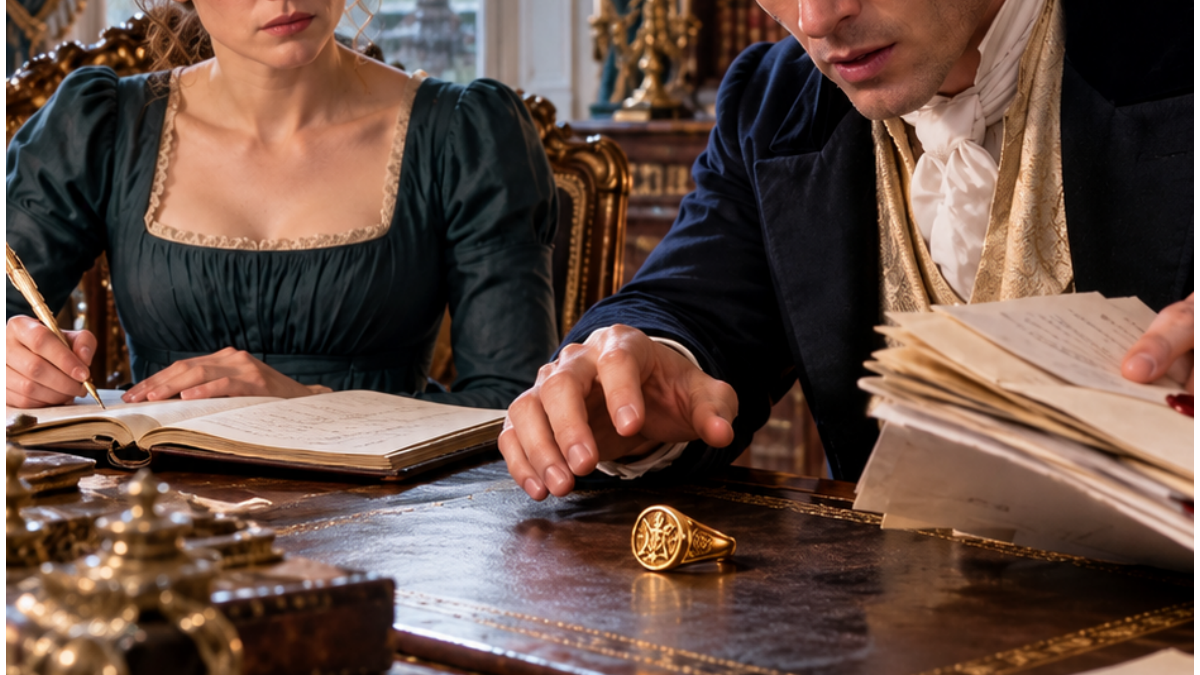

Return the ring, Tabitha. Gideon Sinclair, the Duke of Dunmir, stood in the doorway of the library, his voice carrying the freezing weight of the North Sea.
He did not shout. He never shouted.
He simply spoke with the absolute uncompromising authority of a man who expected the world to bend to his precise measurements.
Tabitha did not flinch. She did not gasp, nor did she drop her gaze to the cold flagstones beneath her feet.
She sat at the heavy oak table, her posture perfectly straight, her hands steady as she held a bonehandled pen over a mended ledger.
She did not cry. She had learned long ago that tears changed nothing.
It is on your desk, your grace, she said softly, her voice barely louder than the rain lashing against the tall glass windows of Silverbeck.
Exactly where I left it yesterday at 3:00.
Gideon did not move. The silence in the room stretched, thick and suffocating, smelling of old paper, beeswax, and the faint, sharp scent of rosemary that always seemed to cling to her skirts.
He had accused her of presumption.
He had assumed she had taken his heavy gold signate, the seal of his power, the symbol of his trust, to use for her own ends, just as others had done before her.
It was the natural conclusion for a man who had been bled dry by betrayal.
But Tabitha was not like the others.
She never had been. She dipped her pen into the inkwell, the small clinking sound echoing in the vast shadowed room.
“You asked me to seal the correspondence to the magistrate in Salt Cliff,” she continued, her tone entirely devoid of reproach.
“I did so. I then placed the ring in the center of your leather blotting pad.”
If it has moved, it was not by my hand.
One second. 2 3 Gideon’s jaw tightened.
He turned on his heel, his dark coat sweeping behind him, and walked back down the long corridor toward his private study.
Tabitha did not watch him go.
She simply returned to her numbers, her mind a fortress of quiet discipline.
This was her life now.
It was not a fairy tale, nor was it a tragedy.
It was a transaction, one she had entered into with her eyes entirely open.
As the wind howled over the moors, rattling the ancient frames of the estate, Tabitha allowed her mind to drift back to the place she had escaped, the place where she had learned the dangerous art of becoming invisible.
Bramblehurst Park had never been a home to her.
It had been a cage gilded for its masters and iron for its servants, and Tabitha had existed in the purgatory between the two.
Left orphaned at the age of 10, she had been taken in by her aunt, Leonora Lockheart, a woman whose charity was as cold and calculating as a banker’s ledger.
Leonora had not seen a grieving child.
She had seen unpaid labor.
For 14 years, Tabitha had been the ghost of Bramblehurst.
While her cousin Rosman Vickers was paraded through drawing rooms in silks and imported lace, Tabitha was relegated to the back rooms, the kitchens, the linen closets, and the estate office.
She was the one who balanced the household accounts, her sharp, precise memory catching every discrepancy, every missing shilling, every inflated bill from the butcher in Dunmere.
She was the one who mended the fine tapestries, her needlework so flawless it was passed off as Rosamman’s own.
She was the one who managed the servants, dispensing orders with a quiet dignity that earned their fierce, unspoken loyalty.
But she was never thanked.
She was never seen. She was simply expected to endure.
Her oppression was not marked by physical violence, but by a thousand daily diminishments.
It was the way Leonora would snatch a completed ledger from her hands without a word of acknowledgement.
It was the way Roseund would deliberately drop a muddy writing crop on a freshly laundered gown, knowing Tabitha would be the one forced to clean it.
It was the constant suffocating reminder that she was a burden, a charity case, a creature of no value beyond her utility.
She thought of the cold.
She thought of the silence.
And she thought of the sheer exhausting weight of keeping an entire estate running while being treated as though she were less than a shadow.
But Tabitha had a weapon.
She had her mind. She cataloged everything.
She remembered every date, every sum, every whispered conversation in the hallways.
She knew that Leonora was siphoning funds from the estate’s primary accounts to pay for Roseman’s extravagant London seasons.
She knew that the estate was teetering on the edge of ruin, held together only by Tabitha’s desperate, creative accounting.
She had kept the secret because she had nowhere else to go until Gideon Sinclair arrived.
The Duke of Dunmier had come to Bramblehurst Park not for pleasure but for business.
He was a man carved from granite, a widowerower whose young wife had died under circumstances that the ton whispered about, but never dared mention to his face.
He was known to be ruthless, emotionally sealed, a man who prized evidence over charm and plain speech over flattery.
He had come to purchase a prime stretch of timberland that bordered his own neglected estate, Silverbeck.
Leonora had seen his arrival as a divine opportunity, a duke, wealthy beyond measure, grieving and entirely unguarded, or so she thought.
She had immediately pushed Rosamund into his path, dressing her daughter in the finest muslins, orchestrating accidental meetings in the gardens, and forcing Tabitha to bake his favorite pastries while forbidding her to leave the kitchens.
But Gideon Sinclair was not a man who could be snared by a painted smile and a rehearsed laugh.
He saw through the performance instantly.
What he did not see at first was the woman keeping the performance alive.
Their inciting encounter had been an accident.
It was past midnight, and the great house of Bramblehurst was silent.
Tabitha had crept into the library to finish the quarterly accounts, relying on the light of a single sputtering candle.
She was dressed in her usual worn gray wool, a shawl wrapped tightly around her shoulders against the persistent draft.
She had just discovered a massive shortfall in the tenant rents.
A shortfall Leonora had explicitly created to purchase a matched set of grays for Roseman’s carriage.
Tabitha was erasing a figure trying to balance the impossible when a voice broke the stillness.
You are altering the books.
Tabitha froze. She turned slowly to see the Duke standing in the shadows, his tall frame leaning against the door jam.
He wore a dark dressing gown over his shirt, his crevat untied, his face a mask of weary cynicism.
He stepped into the light, his pale eyes fixing on her with the intensity of a predator.
“I know forgery when I see it,” he said, his voice low and devoid of warmth.
Who are you protecting? Tabitha did not panic.
She did not beg for his silence.
She set her pen down and met his gaze squarely.
I am not protecting anyone.
Your grace, she said softly.
I am surviving. There is a difference.
He stepped closer, his eyes dropping to the ledger.
He was a man who understood numbers.
He scanned the columns, his sharp mind instantly grasping the intricate web of transfers and adjustments she had made.
He saw the missing funds.
He saw the desperate attempts to cover the gaps.
And he saw the flawless, beautiful handwriting that held the entire crumbling edifice together.
“Your aunt is stealing from her own estate,” he stated plainly.
“Yes, and you are hiding it for her.
I am keeping the tenants from being evicted when the creditors arrive.
Tabitha corrected him, her voice entirely steady.
My aunt’s vanity will ruin this house.
I am merely delaying the collapse.
Gideon looked at her then truly looked at her.
He saw the dark circles under her eyes, the raw, inkstained tips of her fingers, the frayed edges of her collar.
He saw a woman who had been reduced to invisible labor, yet who carried herself with the quiet dignity of a queen in exile.
It was not pity that stirred within him.
It was something harder and more respectful.
It was recognition. “What is your name?” he asked.
“Tabitha Penrose.” “You are the cousin.” I am the ledger keeper, the seamstress, and the ghost of Bramblehurst, she replied.
Now, if you will excuse me, your grace, I have three more pages to balance before dawn.
She picked up her pen and resumed writing.
Gideon did not leave. He stood there in the silence, watching the steady, rhythmic movement of her hand.
He had spent the last 3 years surrounded by sycopants, liars, and beautiful women who wanted to drain his vaults.
Here, in the freezing dark, was a woman who wanted nothing from him at all.
That night had changed everything.
Over the next week, Gideon had watched her.
He saw the way the servants deferred to her, the way she managed a chaotic household with a single calm directive.
He saw Rosund spill tea on a priceless rug and watched Tabitha clean it while Leonora scolded her for being clumsy.
He saw it all, and his brilliant, calculating mind began to form a plan.
His own estate, Silverbeck, was a disaster.
Since the death of his wife, he had let it fall into ruin.
His servants were corrupt. His accounts were a shambles.
And his home was a tomb.
He needed a manager. He needed a partner.
He needed someone who could not be bought, who would not lie to him, and who understood the value of quiet competence.
He found her in the gardens harvesting herbs with a woven basket over her arm.
He approached her without preamble.
I require a wife,” he said.
Tabitha stopped, a sprig of time held suspended in her hand.
She looked at him, her expression unreadable.
“I believe my cousin is currently in the morning room, your grace.
She has been practicing her surprised expression all week.” “I do not want your cousin,” Gideon said, his voice flat.
“I want you.” Tabitha lowered the herbs into the basket.
She did not blush. She did not flutter her eyelashes.
I am asking. Answer plainly, he said.
Why? Because you are intelligent.
You do not panic. You do not weep over spilled tea, and you possess a meticulous understanding of estate management.
He stepped closer, towering over her.
Yet she did not step back.
My home, Silverbeck, is dead.
I need someone to bring it back to life.
I offer you my name, my protection, and a household of your own.
You will never have to hide in the library at midnight again.
In return, you will manage my estate.
You will organize my life, and you will not betray me.
It was a transactional proposal, explicit terms, unspoken feelings.
Tabitha looked into his pale, guarded eyes.
She saw the grief there, the deep, unhealed wounds of a man who had trusted the wrong people.
She thought of Leonora. She thought of the endless years of being nothing.
“And what of affection, your grace?” she asked quietly.
I have none left to give, he replied honestly.
But I can promise you respect.
I can promise you peace.
Yes, Tabitha said plainly. Together, Gideon added, a solemn vow.
The sudden marriage had sent shock waves through BramblehurSt. Leonora had screamed.
Roseand had thrown a vase against the wall, her face twisted in ugly, unmasked jealousy.
They had accused Tabitha of witchcraft, of seduction, of unspeakable treachery.
But Gideon had stood before them, an immovable wall of dark authority, and informed them that if they ever spoke to his fiance in such a tone again, he would personally ensure their creditors were informed of the estate’s true financial state.
Tabitha had left Bramblehurst with nothing but a small trunk of plain dresses and a dented silver cup that had belonged to her mother.
She had ridden in Gideon’s carriage to Silverbeck, watching the landscape shift from rolling green hills to the stark, dramatic cliffs of the coaSt. The journey had been silent, but it was not a hostile silence.
It was the silence of two people who had struck a bargain and were now waiting to see if the terms would hold.
Silverbeck was magnificent, but it was freezing.
The great stone walls seemed to absorb the heat.
The fires were never lit in the unused rooms, and the servants moved like frightened mice.
The housekeeper, a gruff, broad-shouldered woman named Bess, had greeted Tabitha with deep suspicion.
Bess had seen the previous duchess.
She had seen the chaos, the cruelty, and the ultimate tragedy.
She did not trust this quiet, plain woman who had suddenly arrived to take the reigns.
But Tabitha did not demand respect.
She earned it. On her first day, she did not order the house to be redecorated.
She did not demand new gowns.
She simply walked into the kitchens, tied an apron over her gray wool dress, and began to inventory the pantry.
She found the rotting vegetables, the missing flour, the stolen wine.
She did not shout at the staff.
She simply reorganized the system, establishing clear rules, fair wages, and a schedule that allowed the servants to actually reSt. By the end of the first week, the fires in the main hall were lit.
By the end of the second week, the smell of fresh bread and roasted meats filled the corridors.
By the end of the month, Bess was leaving a small, perfectly brewed cup of chamomile tea on Tabitha’s desk every afternoon.
A silent, concrete gesture of absolute loyalty.
Gideon watched the quiet transformation from his study.
He saw the dust vanish.
He saw the ledgers balance.
He felt the warmth returning to his home, seeping into the stones like blood returning to a frozen limb.
He found himself leaving his study door open just to hear the soft rustle of her skirts as she passed.
He found himself seeking her out in the evenings, bringing his ledgers to the library so they could work in shared, comfortable silence.
The numbness that had encased his heart for 3 years was beginning to crack, which brought them to the ring.
Tabitha sat in the library listening to the rain.
She heard Gideon’s footsteps returning.
They were faster this time.
He appeared in the doorway, his large hand gripping the heavy gold signet.
His face was pale, his eyes wide with a sudden, horrifying realization of his own cruelty.
He had found it exactly where she had said it would be, on the center of his blotting pad.
He had placed a stack of unread letters over it yesterday, and had simply forgotten.
In his panic, in his ingrained expectation of betrayal, he had lashed out at the one person who had never lied to him.
Gideon stepped into the room.
He walked to the heavy oak table and stood before her.
Tabitha looked up, her expression calm, her hands still resting on the ledger.
“I was wrong,” Gideon said.
His voice was he did not offer excuses.
He did not blame the letters.
He stated his failure plainly.
I accused you unjustly. I am deeply, profoundly sorry.
Tabitha looked at the ring in his hand, then up to his face.
“You expected me to be like her,” she said softly.
It was the first time she had referenced his late wife.
Gideon closed his eyes, a muscle feathering in his jaw.
Yes, I am not her, Gideon.
It was the first time she had used his Christian name.
The sound of it on her lips was like a physical blow to his cheSt. It was an event.
“No,” he whispered, opening his eyes to look at her.
“You are not. You are.
You are the only true thing in this house.” He reached out and gently placed the heavy gold ring on the table, pushing it toward her.
“Keep it,” he said. Tabitha frowned slightly.
“It is your seal, your grace.
It belongs on your hand.
It belongs to the person who holds this estate together,” he replied, his voice gaining strength.
“It belongs to my partner.
Use it as you see fit.
I trust you, Tabitha. I trust you entirely.
He did not wait for her to answer.
He turned and left the room, his stride long and purposeful.
Tabitha sat in the silence, staring at the gold ring gleaming in the candle light.
She slowly reached out and touched the cool metal.
A strange tight feeling blossomed in her cheSt. It was not gratitude.
It was the terrifying, exhilarating sensation of being truly seen.
We’ll take a very short break.
If you don’t want to miss new stories, please subscribe to the channel.
The peace of Silverbeck, however, was a fragile thing, and there were those who could not abide its existence.
A week after the incident with the ring, a carriage bearing the crest of Bramblehurst Park arrived at the front steps.
Tabitha was in the conservatory inspecting a revived crop of medicinal herbs when Bess appeared in the doorway, her face set in a grim, thunderous scowl.
“Your grace,” Bess said, her voice tight.
“You have callers, the Lady Leonora and Miss Rosund.” Tabitha’s hands stilled over a pot of lavender.
She carefully wiped the soil from her fingers with a mended cloth, her face betraying nothing.
Show them to the blue drawing room, Bess.
Offer them tea. I will join them shortly.
I’d rather offer them arsenic, your grace, Bess muttered darkly.
Tabitha allowed a tiny, almost imperceptible smile to touch her lips.
Tea will suffice, Bess. She found her aunt and cousin sitting on the edge of the velvet sofas, looking around the beautifully restored room with expressions of poorly concealed outrage.
They had expected to find Tabitha miserable, overwhelmed, or entirely cast aside by a cold, cruel husband.
Instead, they found a house humming with life, wealth, and impeccable order.
Roseund was dressed in a traveling gown of vibrant emerald silk, a feathered hat perched aggressively on her blonde curls.
Leonora wore dark purple, her sharp eyes cataloging the expensive artwork, the silver tea service and the heavy silk curtains.
When Tabitha entered wearing a simple but beautifully cut gown of deep navy wool, neither woman stood.
Well, Leonora said, her voice dripping with honeyed malice.
It seems you have managed to make yourself comfortable, Tabitha.
I must say, I am surprised the Duke allows you to handle the good silver.
Did you tell him how many plates you dropped at Bramblehurst?
I dropped no plates at Bramblehurst, Aunt, Tabitha said calmly, taking a seat opposite them.
She did not pour the tea.
She let it sit there, forcing them to either ask or go without.
“How may I help you?” “We have come to check on you, of course,” Rosamund chimed in, her smile sharp enough to cut glass.
“We were so worried. Everyone in the town knows the Duke’s history.
We feared you might have met a similarly tragic end, locked away in this dreary fortress.” Silverbeck is not dreary, Rosamund, and my health is excellent.
For now, Leonora murmured. She leaned forward, her eyes narrowing.
Do not think you have won, Tabitha.
You are a glorified servant who managed to trick a grieving man into a marriage of convenience.
But he will tire of you.
He will realize you are nothing but a plain uninteresting spinster and he will cast you out.
And when he does, do not come crawling back to me.” Tabitha looked at her aunt.
She felt no fear. She only felt a profound, exhausting pity.
“I have no intention of returning to Bramblehurst,” Aunt Leonora.
Now, if you have only come to deliver insults, I must ask you to leave.
I have an estate to run.” Leonora’s face flushed an ugly modeled red.
She stood up abruptly. “We are staying for the week.
The roads are too muddy to return today, and as your family, we demand hospitality.” Tabitha knew she could throw them out.
She had the power. But she also knew that refusing them would give Leonora a weapon to use in society.
The cruel, ungrateful niece turning her family out into the storm.
“Bess will show you to the guest wing,” Tabitha said smoothly.
“Dinner is at 8. We do not tolerate lateness.” As she walked away, she heard Rosamund whisper, “She acts like a queen.
We must remind her what she truly is.” Over the next four days, the escalating opposition began.
It was not a physical assault.
It was a campaign of psychological warfare.
Leonora and Rosund moved through Silverbeck like a poison, attempting to undermine Tabitha at every turn.
They whispered to the servants, suggesting Tabitha was stealing from the household funds.
They rearranged the floral displays, loudly complaining about Tabitha’s lack of taste.
At dinner, they dominated the conversation, bringing up old, fabricated stories of Tabitha’s incompetence and supposed madness.
Gideon watched it all in silence.
To the outside observer, he appeared detached, ignoring the barbs directed at his wife.
But Tabitha knew him now.
She saw the tightening of his jaw, the deadly stillness in his eyes, the way his knuckles turned white as he gripped his wine glass.
He was gathering evidence. He was letting them reveal their true natures.
But Rosemond was not satisfied with mere insults.
She wanted destruction. She wanted Tabitha humiliated and cast out.
And so she laid a trap.
It happened on the fifth day of their visit.
Gideon was hosting a small informal assembly for the local gentry, a way to reintroduce Silverbeck to society.
Among the guests was Judge Gregory Dracott, a sharp tonged elderly magistrate from Saltcliffe, who had known Gideon’s father, and possessed a mind as unforgiving as a steel trap.
The music was playing, the wine was flowing, and Tabitha was moving through the room, ensuring every guest was comfortable.
She wore a gown of midnight blue silk, her only ornament, the heavy gold sign ring she wore on a chain around her neck.
She looked radiant, possessing a quiet dignity that drew the eyes of the room.
Rosund, furious at being ignored, decided it was time to strike.
Suddenly, a piercing scream echoed from the grand staircase.
The music stopped. The guests turned in alarm.
Rosund was standing on the landing, her face pale, tears streaming down her cheeks.
She was clutching her throat.
“It is gone,” she wailed, her voice carrying over the silent crowd.
“My necklace, the diamond teardrop my mother gave me for my debut.
It has been stolen.” The room erupted into murmurss.
Gideon stepped forward, his presence immediately commanding silence.
“Calm yourself, Miss Vickers,” he said coldly.
“Nothing is stolen in this house.” “Where did you leave it?” “I left it on my dressing table,” Rosman sobbed, descending the stairs.
“I went to retrieve it for the assembly, and it was gone.
Someone has taken it.” Leonora rushed forward, wrapping an arm around her daughter.
“This is an outrage, your grace.
We demand a search of the servants quarters immediately.
“My servants do not steal,” Tabitha said, stepping to Gideon’s side.
Her voice was calm, but it carried clearly across the room.
“Then who did?” Leonora snapped, rounding on her.
“You have always been jealous of Rosamund, Tabitha.
You always coveted her things at BramblehurSt.” Judge Dracott stepped out of the crowd, his bushy eyebrows drawn together.
These are serious accusations, madam.
One does not accuse a duchess of theft in her own home without proof.
Then search her rooms, Rosamund cried, pointing a trembling finger at Tabitha.
If she is innocent, she has nothing to fear.
Search her chambers. The room went dead silent.
It was a monstrous breach of etiquette, a direct insult to the Duke and his wife.
Gideon’s eyes were black with fury.
He opened his mouth to order them thrown out of the house, but Tabitha placed a gentle hand on his arm.
She looked at Rosamund, then at Leonora.
She saw the frantic, desperate gleam in their eyes.
She knew exactly what they had done.
“Very well,” Tabitha said plainly.
“Search my rooMs.” Tabitha. No, Gideon said quietly, turning to her.
You do not have to submit to this.
I have nothing to hide, Gideon, she replied, holding his gaze.
Let them look. Judge Dracott, sensing the gravity of the moment, volunteered to lead the search to ensure impartiality.
He, along with Gideon, Leonora, and a weeping Rosamund, ascended the stairs to Tabitha’s private chambers.
The guests below waited in breathless suspense.
In Tabitha’s room, the search was brief.
Judge Dracott opened the wardrobe, checked the drawers, and finally moved to the small writing desk by the window.
He opened the top drawer.
Inside, resting beneath a stack of mended ribbons, was a glittering diamond teardrop necklace.
Leonora gasped in triumph. There you see.
I told you she was a thief.
She has always been a thief.
Gideon stared at the necklace.
The crisis had arrived. The shadow of doubt, the ghost of his past betrayal, flickered in his mind for a fraction of a second.
His first wife had lied to him.
She had stolen from him.
Was history repeating itself? Was this quiet, competent woman just another illusion?
He turned to look at Tabitha.
She stood in the doorway, her posture perfectly straight, her face an unreadable mask.
She did not cry. She did not beg for him to believe her.
She simply waited, respecting him enough to let him make his own choice.
Gideon looked at the necklace.
Then he looked at the drawer.
He looked at the mended ribbons and the ghost of his past vanished, shattered by the overwhelming, undeniable truth of the woman standing before him.
“This is a forgery,” Gideon said.
His voice was not loud, but it silenced the room instantly.
Leonora blinked. “I beg your pardon.
This situation. It is a forgery,” Gideon repeated, stepping away from the desk.
He turned to Judge Dracott.
“Tell me, judge, what do you notice about this desk?” Dracott frowned, adjusting his spectacles.
He looked at the drawer.
“It is a writing desk, your grace.
It contains ink, pens, paper, and these ribbons.
Look closer at the ribbons,” Gideon commanded.
Dracott lifted one. “It is slightly damp, your grace.
It smells of lavender water.” “Exactly,” Gideon said, his eyes locking onto Rosamund, who was suddenly looking very pale.
“My wife does not use lavender water.
She despises the scent. She uses rosemary.
The entire house smells of it.
Furthermore, my wife is meticulously organized.
She would never place a heavy diamond necklace directly on top of freshly ironed silk ribbons.
It would crush them. He walked slowly toward Rosamund, his tall frame radiating a quiet, lethal menace.
You planted this, Miss Vickers.
You came into my wife’s chambers, placed your own necklace in her desk, and then staged a hysterical performance in my drawing room to humiliate her.
“No,” Rosman stammered, backing away.
“You are lying. You are protecting her.” “I do not lie,” Gideon said flatly.
“And I do not need to protect my wife.
She is entirely capable of protecting herself.” Tabitha stepped into the room.
She walked past her aunt and cousin, went to her wardrobe, and pulled out a heavy leatherbound ledger.
It was the same ledger she had been working on the night Gideon had found her in the library at BramblehurSt. She carried it to the desk and opened it, flipping past pages of meticulous numbers until she reached a folded sheet of parchment tucked into the back.
She handed it to Judge Dracott.
“What is this, your grace?” the judge asked, unfolding the paper.
“It is a sworn copy of the Bramblehurst estate accounts for the past 3 years,” Tabitha said, her voice echoing in the quiet room.
“I kept it because I knew that one day my aunt would attempt to destroy me to protect herself.” “Read the highlighted figures,” Judge Dracott.
The judge adjusted his spectacles and began to read.
His eyes widened. He looked up at Leonora, his expression hardening into utter disguSt. These are records of systematic embezzlement.
Thousands of pounds siphoned from tenant rents, widow funds, and estate maintenance, funneled directly into personal accounts in London.
She forged those, Leonora shrieked, her composed facade shattering completely.
She is a liar. The handwriting is yours, Lady Leonora, the judge said coldly, examining the signatures.
And the bank drafts are cross referenced with dates that match the London season.
This is devastating evidence. If presented to the crown, you would face ruin, perhaps even new gate.
Leonora stumbled backward, clutching her cheSt. Rosamund began to cry in earnest, the ugly, jagged sobs of a spoiled child realizing the game was over.
They had tried to break Tabitha with a cheap parlor trick, and Tabitha had answered by dismantling their entire lives with a single piece of paper.
“I am the ledger keeper,” Tabitha said softly, looking at her aunt.
“I remember every sum. I remember every lie.
You thought me invisible, Aunt Leonora.
You thought because I did not speak, I did not see.
You were wrong. She turned to Gideon.
I believe our guests are ready to leave your grace.
Gideon’s eyes were blazing with a fierce, unmistakable pride.
He looked at the two women cowering before him.
Bess, he called out. The gruff housekeeper appeared instantly in the doorway, a look of vicious satisfaction on her face.
Pack their trunks, Gideon ordered.
Have the carriage brought round.
They are leaving immediately. If they ever set foot on my lands again, I will have them arrested for trespass and forward this ledger to the authorities.
But it is raining, Rosman wailed.
Then you will get wet, Gideon replied.
He offered his arm to Tabitha.
“Come, my dear. We have guests waiting.” The public reckoning was complete.
As they descended the stairs, the whispers of the guests ceased.
Judge Dracott followed them down, loudly, declaring that a misunderstanding had been resolved, and that the Lady Leonora had been taken ill and was departing immediately.
The music resumed. The crisis had passed, leaving behind a profound, unshakable clarity.
Later that night, when the guests had departed and the house was quiet, Tabitha stood in the library.
The fire was burning low, casting long, dancing shadows across the rows of books.
She was holding the dented silver cup that had belonged to her mother, tracing the worn rim with her thumb.
It was over. She was safe.
She had won her vindication not through magic, not through rescue, but through her own precise, enduring competence.
She heard the door open.
Gideon walked in. He had removed his coat and creat, his white shirt open at the collar.
He looked exhausted, but the rigid tension that had defined him for years was gone.
He looked at her, standing by the fire, and he knew that he was entirely, irrevocably undone.
He walked slowly across the room, stopping mere inches from her.
He did not touch her.
He simply looked down at her, his pale eyes dark with emotion.
You kept that ledger for years, he said quietly.
Yes, you could have destroyed them at any time.
I did not want to destroy them, Gideon.
I only wanted to be free of them.
He reached out and gently took the silver cup from her hands, setting it on the table.
Then he took her hands in his.
His grip was warm, strong, and incredibly gentle.
When they accused you, he said, his voice dropping to a rough whisper.
When they pulled that necklace from your drawer, I felt a moment of fear.
Not because I thought you were guilty, but because I realized that if I lost you, I would have nothing left.
Tabitha looked up into his eyes.
She saw the truth there, stripped of all pretense, all armor.
I am not going anywhere, Gideon,” she said softly.
Gideon slowly sank to his knees on the cold flagstones.
It was not a gesture of subservience.
It was a gesture of absolute deliberate devotion.
He held her hands against his chest right over his heart.
“I asked you to marry me because I needed a manager,” he said, his voice thick with emotion.
I asked you because you were competent and because you did not weep.
I offered you a transaction.
I was a fool. He looked up at her, his eyes shining in the fire light.
I do not want a manager, Tabitha.
I want my wife. I want the woman who brought my home back to life.
I want the woman who stood in the dark and refused to break.
I love you plainly, entirely.
I love you. Tabitha felt a tear slip down her cheek.
She did not wipe it away.
She had learned long ago that tears changed nothing.
But these tears were different.
These tears were the melting of the ice, the breaking of the long, lonely winter.
She squeezed his hands, her heart overflowing with a quiet, triumphant joy.
“Yes,” she whispered, her voice trembling slightly.
“Plainly.” Gideon stood up, wrapping his arms around her and pulling her flush against his cheSt. He kissed her, then not a tentative brush of lips, but a deep, anchoring kiss that sealed the promise between them.
It was a kiss of recognition.
Of choice of two people who had walked through the fire and found each other in the ashes.
Time moved forward as it always does, but it moved differently at Silverback now.
3 years later, the estate was unrecognizable.
The gardens were in full glorious bloom, the air thick with the scent of rosemary, lavender, and climbing roses.
The great stone halls echoed not with silence but with the sounds of life, the clatter of plates, the laughter of servants, and the quick pattering footsteps of a small boy with dark hair and pale observant eyes.
Tabitha sat in the conservatory, the morning sun streaming through the glass, warming her face.
She was no longer the invisible ghost in gray wool.
She wore a dress of soft golden muslin, her hair pinned up loosely, a few strands escaping to frame her face.
On her lap rested a new ledger, its pages crisp and white, filled with numbers that spoke of prosperity, growth, and security.
Beside her, on a small iron table, sat the dented silver cup.
It was no longer empty.
It was filled with freshly cut thyme and rosemary, a humble object transformed into a vessel of life.
And resting against her collarbone, warm against her skin, hung the heavy gold signate ring.
She did not need to wear it to prove her power.
She wore it because it was a piece of him, a constant reminder of the trust they had built together.
The door to the conservatory opened and Gideon stepped in.
He had been riding. His boots were dusty and his face was flushed with the wind.
He looked at her, his expression softening instantly, the hard lines of his face relaxing into a warm, open smile.
He walked over to her, leaning down to press a kiss to the top of her head.
“The new timber shipments have arrived from Dunmir,” he murmured, his hand resting lightly on her shoulder.
The foreman wishes to speak with you regarding the storage.
I will see him after lunchon, Tabitha replied, closing the ledger.
She reached up and covered his hand with hers, their fingers interlacing naturally.
Did you check the fencing near the south pasture?
I did. It holds. He stepped around the chair and crouched down beside her, bringing his face level with hers.
He looked at the silver cup, then at the ring around her neck, and finally into her eyes.
The profound quiet love he felt for her was a physical presence in the room as real and vital as the sunlight.
“Are you happy, Tabitha?” he asked.
A question he asked often, not out of insecurity, but out of a deep, abiding desire to hear the answer.
Tabitha smiled, a true radiant smile that reached her eyes.
She thought of the cold flagstones of BramblehurSt. She thought of the silence, the oppression, the invisible labor.
And then she looked at the man before her, the man who had seen her worth when she was nothing but a shadow, the man who had given her a home, a family, and his heart.
Yes, she said softly, leaning forward to rest her forehead against his plainly together.
That is how counties turn on their own, quietly by degrees.
The wicked are forgotten, their names fading into the dust of their own bitter making, while the true, the steady, and the competent endure, building empires out of mended ledgers and quiet courage.
Silverbeck stood strong against the winds of the North Sea, a beacon of warmth and light, held together by a love that required no poetry, only truth.








