The Duke Invited the Maid to Dinner as a Joke — She Came in a Duchess’s Gown
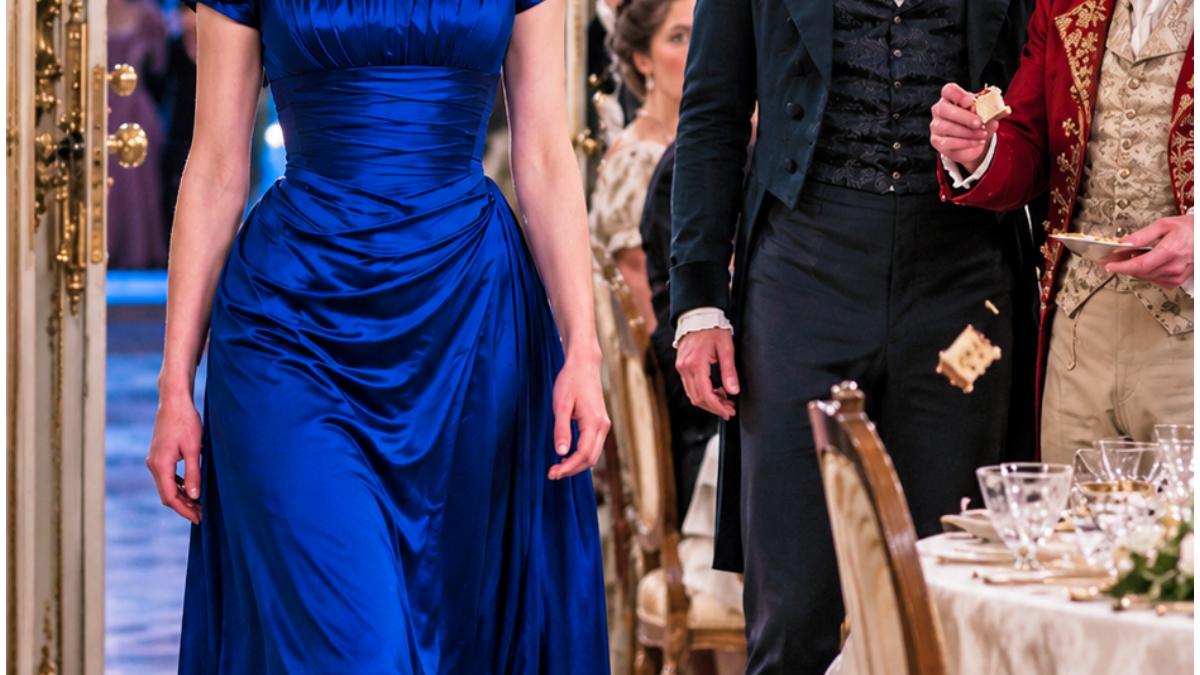
The joke was simple. Invite the dirtiest, lowest chambermaid to the grandest dinner of the season.
Watch her humiliate herself and have a good laugh over brandy.
Gideon Hail, the Duke of Westford, made the wager out of sheer, suffocating boredom.
But when the dining room doors swung open, the laughter died in their throats.
She didn’t come in rags.
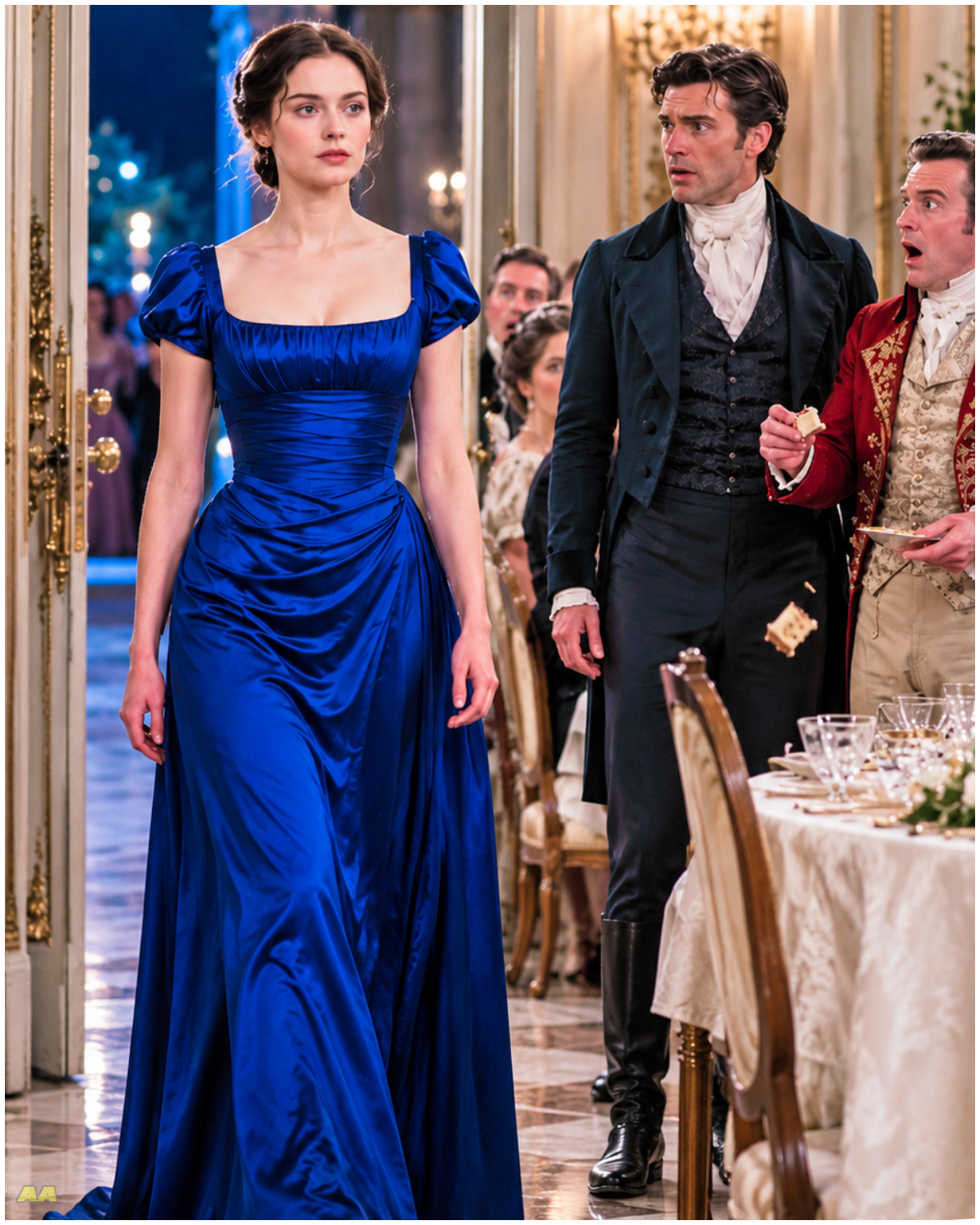
She came in a ruined dynasty’s silk, wearing it like armor.
And suddenly the Duke wasn’t laughing at all.
Rain lashed against the tall mullion windows of Oak Haven.
It had been raining for 3 days.
Inside the drawing room, the air was thick with the smell of stale port, damp wool, and the suffocating boredom of men who had never been forced to do a day of actual work in their lives.
Gideon Hail, the Duke of Westford, stared at the cards in his hand, and felt absolutely nothing.
He was 30 years old, possessed a fortune that could buy a small European nation, and he was dying of sheer apathy.
“I tell you, the entire season is a wash,” Lord Croft drawled, slouching in a wing back chair.
Croft was a man whose wealth barely concealed his profound lack of character.
He possessed a cruelty that only the truly insulated could afford.
The women are dull. The horses are slow.
Even the scandal is tedious.
Gideon tossed his cards onto the green bays table.
You lose, Croft. Croft scowlled, pushing a stack of banknotes toward Gideon.
He looked around the room, desperate for a distraction.
His eyes caught movement in the hallway just beyond the open double doors.
A maid was kneeling on the cold marble floor.
She was cleaning the massive iron grate of the hallway fireplace.
It was filthy, backbreaking work.
Even from a distance, Gideon could see the gray smear of soot across her pale cheek.
Her dress was a coarse, homespun gray, practically entirely devoid of shape and hemmed with damp dirt.
She scrubbed at the iron with a stiff bristled brush the harsh sound carrying into the silent velvetlined drawing room.
Look at that miserable creature.
Croft sneered, sitting up slightly.
A vicious little spark lit in his eyes.
I wager she doesn’t even know what a dining fork looks like.
Probably eats with her hands.
Thomas Lindley, sitting to Gideon’s left, laughed.
It was a thin, papery sound.
I wager she’d faint if a gentleman so much as spoke to her.
Gideon looked at the girl.
She paused her scrubbing, lifting a hand to push a stray lock of dark hair out of her eyes.
Her knuckles were red and raw.
There was a rigid mechanical efficiency to her movements.
She wasn’t a person to these men.
She was part of the furniture, a fixture of the estate, like the grandfather clock or the hunting hounds.
I have an idea, Croft said, his voice dropping to a conspiratorial whisper.
£50 says you can’t get her to sit at the table with us tonight, Gideon.
Gideon slowly turned his head.
To dinner? Yes, the grand dinner.
Lady Hastings has brought out the good silver and the French chef.
Invite the soot girl.
Tell her it’s a special reward from the master of the house.
She’ll show up in her pathetic little rags, thinking she’s been elevated, and we’ll have a bit of sport.
Gideon stared at Croft. It was a vile idea.
It was base, cruel, and utterly devoid of honor.
A gentleman should protect those beneath him, not drag them out for mockery.
But the boredom was a physical weight on Gideon’s chest, and a darker, more cynical part of him wondered what it would take to break the suffocating monotony of his existence.
He was surrounded by sycopants.
Everyone wanted something from him.
“What would this girl want?”
“£50 is an insult,” Croft, Gideon said softly.
He stood up smoothing the front of his waist coat.
500 and she sits at my right hand.
Croft’s eyes widened. Done. Gideon walked out of the drawing room.
The heavy silence of the house seemed to press down on him as he crossed the threshold into the hallway.
The maid didn’t look up until his polished Hessian boots stepped into her line of sight.
She stopped scrubbing. Gideon looked down at her.
Up close, she was younger than he had thought, perhaps three and 20, but there was an ancient, exhausted quality to her face.
Her eyes were a flat, startling gray, like a winter sky over the moors.
They didn’t widen in terror.
They didn’t flutter in awe.
She looked at his boots, then slowly tracked her gaze up his long legs, past his tailored coat to his face.
She looked at him the way a carpenter looks at a rotten piece of wood.
“Stand up,” Gideon said. His voice was smooth, carrying the effortless command of a duke.
The girl did not scramble.
She set the brush down on the stone hearth, wiped her raw hands on her canvas apron, and rose.
She was tall for a maid, and she stood entirely straight.
“Your grace,” she said. Her voice was slightly steady.
“No tremor, no stammer.”
“What is your name?”
“Nora.”
“Well, Nora,” Gideon said, plastering on a charming, devastating smile that had ruined half the debutants in London.
“I am here on behalf of our host. We feel the servants have been working terribly hard during this dreary weather.”
As a token of our appreciation, I am formally inviting you to join us for dinner tonight in the grand dining room.
At 8:00, Norah stared at him.
She didn’t blink. The silence stretched between them, heavy and suffocating.
She looked past his shoulder into the drawing room where Croft and Lley were failing to hide their smirks.
She understood. In an instant, she read the entire geometry of the situation.
Gideon felt a sudden, sharp twist of guilt in his gut.
He expected her to blush, to cry, to stammer a refusal, and run away.
He wanted her to refuse so he could pay Croft the £500 and go back to his hollow life.
Instead, Norah brought her flat, gray gaze back to his face.
Dinner, she said. It wasn’t a question.
Yes, in the grand dining room.
Indeed. Gideon’s smile faltered slightly.
Norah wiped her hands on her apron one last time.
I require no charity from gentlemen bored by the rain.
But if it is an order from a duke, I suppose I have no choice in the matter.
It is an invitation, Gideon corrected, feeling inexplicably defensive.
A master’s invitation is a servant’s command, she replied, her voice stripped of any deference.
8:00. She didn’t curtsy. She simply turned her back on him, picked up her bucket of ash, and walked down the servant’s corridor, leaving Gideon standing in the hallway, feeling oddly as though he were the one who had just been dismissed.
The attic was freezing. Norah set her bucket down and leaned her forehead against the rough wooden door of the small room she shared with two other maids.
They were still downstairs polishing the silver Nora was supposed to eat with tonight.
She let out a long, ragged breath.
Her hands were shaking, not from fear, but from a deep seismic anger.
She knew exactly what men like the Duke of Westford were.
She had spent her entire life cleaning up their messes, scrubbing their mud from the carpets, and carrying out the chamber pots filled with their expensive sour wine.
Her father had been a master torn, a proud man who constructed miracles out of wool and silk.
He had gone bankrupt because gentlemen of Westford’s class believed that paying a tradesman was beneath their dignity.
The debts piled up. The debtor’s prison followed.
The fever took him 3 months later.
Norah had learned the hard way that the aristocracy was nothing but cheap thread holding together an expensive facade.
She walked over to her narrow cot.
Beneath it was a battered wooden trunk, the only thing she had salvaged from her old life.
She pulled it out. The iron hinges screamed slightly in the cold air.
They wanted a joke. They wanted the soot stained maid to shuffle into their glittering room, terrified and small, a mouse dropped into a pit of bored, lazy vipers.
They wanted to laugh at her coarse gray wool and her cracked hands.
No, [clears throat] Norah whispered to the empty room.
She opened the trunk. Inside, wrapped in layers of cheap muslin, lay a ghoSt. It had belonged to the previous Duchess of Oak Haven, a woman who had died in scandal and debt 20 years ago.
The current host had ordered the attic cleared out, throwing the old woman’s belongings onto a bonfire.
Norah had saved this one dress.
It had been ruined, a massive tear down the bodice, a dark stain on the skirt, and deemed unsalvageable.
But Norah was a master tor’s daughter.
She knew the math of fabric.
She knew the geometry of silk.
For 3 years, in the dead of night, using candles she had stolen from the drawing room stubs, Nora had worked.
She had unstitched every seam.
[clears throat] She had strategically cut and redraraped the ruined skirt to hide the stain within deep architectural folds.
She had restructured the bodice using scraps of velvet to cover the tears, creating something entirely new.
She pulled it out now.
The heavy silk spilled over her rough red hands.
It was midnight blue. Not the bright gaudy colors of the current London season, but a deep abyssal blue that absorbed the light.
The bodice was severe, squarene necked, and tailored so flawlessly it looked like it had been poured from liquid shadow.
The sleeves were tight, ending in simple, razor sharp points over the wrists.
It was a dress for mourning or for war.
Norah dragged the small tin wash basin to the center of the room.
She broke the thin layer of ice on the water pitcher and poured it into the basin.
The water was agonizingly cold.
She stripped off her coarse gray uniform.
Shivering violently, she took the block of harsh lie soap and a stiff brush.
She didn’t just wash, she scoured.
She scrubbed the soot from her neck, the ash from her collarbones, the dirt from under her fingernails.
Her skin turned angry and red, stung by the cold and the harsh soap, but she did not stop until she was clean.
Drying herself with a thin towel, she felt a strange, terrifying calm settle over her.
She stepped into the silk.
Without a maid to help her, lacing a gown was usually impossible.
But Norah had engineered this dress for herself.
She had sewn a hidden corset into the lining, fastening at the front beneath a structured stomacher that snapped flawlessly into place.
She pulled the laces tight.
The dress gripped her ribs, forcing her spine straight.
It didn’t feel like clothing.
It felt like armor. She sat at the cracked mirror on the wash stand.
Her hair was clean, but she had no pomade, no pearls, no curling irons.
So she pulled it back.
She brushed it severely, scraping it away from her face and twisted it into a tight, complicated knot at the base of her skull, pinning it securely.
The starkness of the style left her neck and shoulders completely bare.
Without jewelry, the expanse of pale skin against the midnight blue silk looked intentional, bold, almost violent in its simplicity.
She looked at her reflection.
She didn’t look pretty. Pretty was for debutants.
She looked cold. She looked like a blade that had just been drawn.
Norah glanced at the small clock on the mantelpiece.
10 minutes to wait. She stood up.
The heavy silk whispered against the wooden floorboards.
She walked to the door, opened it, and began the long descent from the attic into the belly of the beaSt. The dining room was a theater of light, a massive crystal chandelier hung over a mahogany table that could seat 30, though tonight it was set for only 14.
Silver glinted sharply in the candle light.
The air smelled of roasted pheasant, heavy clarret, and beeswax.
Gideon stood by his chair at the head of the table, a glass of wine in his hand.
The liquid was sour on his tongue.
“She won’t come,” Croft said, tearing a piece of bread with his teeth.
“She’s likely hiding under her bed, weeping.” “She’ll come,” Lindley chuckled.
“These people are greedy. She thinks she’s going to get a slice of roast beef to take back to her miserable family.
Gideon tightened his grip on his glass.
He felt sick. The wine wasn’t helping.
He had spent the last hour trying to justify the wager to himself, relying on his usual cynicism, but the memory of the maid’s flat dead eyes haunted him.
She hadn’t looked like a victim.
She had looked bored, just like him.
And when she arrives, Croft continued, raising his voice for the benefit of the other guests.
We must treat her with the utmost respect.
Call her my lady. Ask her opinion on the opera.
Watch her squirm. A smattering of cruel laughter rippled around the table.
Gideon opened his mouth to tell them the bet was off, to throw the £500 at Croft and order the footman to bar the door, but it was too late.
The heavy mahogany doors at the end of the room clicked open.
The head footman, a stoic man named Roberts, stepped into the doorway.
Roberts looked distinctly pale. He held the door, his mouth opening and closing for a fraction of a second before he found his voice.
He didn’t know how to announce her.
He couldn’t say lady, and he couldn’t just say the maid.
Miss Norah Hayes, Roberts announced, his voice echoing slightly in the sudden quiet of the room.
The guests turned in their chairs.
The smirks were already plastered on their faces, ready for the punchline.
Norah stepped over the threshold.
The silence that followed was absolute.
It wasn’t just a pause in conversation.
It was a physical force that pressed against the crystal and smothered the fire in the hearth.
She didn’t scurry. She didn’t keep her head down.
She walked with a slow, measured cadence, the heavy midnight blue silk sweeping the carpet with a sound like shifting sand.
Gideon forgot to breathe. It wasn’t merely that she was beautiful, though stripped of the dirt and the gray wool.
Her striking angular face and pale skin were arresting.
It was the absolute crushing dignity of her presence.
The dress was a masterpiece.
It fit her with a brutal precision, the severe cut making the fussy ruffled gowns of the aristocratic women at the table look like cheap, childish costumes.
But it was her eyes that pinned the room to the wall.
She swept her gaze over the table.
She didn’t look intimidated. She looked at the silver, the crystal, and the gaping lords as if they were slightly dusty ornaments she might need to wipe down later.
Croft’s mouth was hanging open.
A piece of bread dropped from his hand onto the tablecloth.
Norah stopped a few feet from the table.
She looked directly at Gideon.
You are late,” she said.
Her voice was quiet, but in the dead silence of the room, it carried perfectly.
Gideon blinked, his mind struggling to process the shift in reality.
“I beg your pardon.” “I was told 8:00,” Norah said, her tone as dry as bone.
“It is 3 minutes paSt. I assume a duke’s dining room operates with the same precision as his servants’s quarters.
Or is punctuality only required of those who work for a living?
Someone gasped. Lady Hastings at the far end of the table.
Gideon felt a sudden frantic spark of something he hadn’t felt in years.
Shock, thrill, respect. He set his wine glass down, stepped around his chair, and walked toward her.
He felt entirely out of his depth.
A man who had set a trap for a rabbit and found a wolf staring back at him.
“You are entirely correct, Miss Hayes,” Gideon said, bowing deeply.
“Not a mocking bow. A real one.” “The fault is mine,” he offered his arm.
Norah [clears throat] looked at his arm as if it were a vaguely interesting piece of masonry.
Slowly she reached out and placed her hand upon his velvet sleeve.
Her grip was firm. He could feel the calluses on her fingers through the fabric, a stark reminder of who she was, wrapped in the disguise of a queen.
Gideon led her to the chair at his right hand, the seat that had been meant for the punchline of a joke.
He pulled it out for her.
As she sat, Croft finally recovered a fraction of his venom.
He leaned forward, his face flushed.
I see you raided the costume trunk in the attic, girl.
Croft sneered, though his voice lacked its usual arrogant base.
Playing dress up won’t change what you are.
Tell me, did you steal that fabric or beg for it?
The table held its breath.
Norah slowly turned her head to look at Croft.
She didn’t flush. She didn’t shrink.
She let the silence stretch for three agonizing seconds, letting Croft stew in his own petty outburSt. “I made it, Lord Croft,” Norah said evenly.
“From scraps deemed ruined and worthless.” She let her eyes drift deliberately over Croft’s shoulders, where his coat was visibly bunching.
A skilled tailor knows how to salvage a disaster, though looking at the way your coat pulls across the back, causing you to slouch like an unstrung puppet.
I assume your tor gave up long ago.
Lindley let out an involuntary choked sound that was half laugh, half cough.
Croft turned a violent shade of purple.
He opened his mouth, but no words came out.
Norah turned her attention back to the table, dismissing the furious lord completely.
She looked at the empty plate in front of her, then looked at Gideon.
“Now,” she said, her voice dropping to a low register meant only for him.
“You bought my time for the evening, your grace.
What exactly did you plan to do with it?” Gideon looked into her cold gray eyes, and for the first time in his adult life, the Duke of Westford had absolutely no idea what to say.
The first course was a clear turtle soup, a dozen footmen moving in synchronized silence, placed the porcelain bowls before the guests.
The steam rose, carrying the scent of cherry and rich broth.
Norah stared at the array of silver flanking her plate.
There were four forks, three knives, and three spoons.
A minefield of etiquette designed specifically to humiliate outsiders.
Gideon watched her. He took a sip of his wine, waiting to see if she would hesitate.
He had seen provincial squires sweat through their collars at this table, terrified of picking up the oyster fork for the fish course.
Norah did not sweat. She didn’t even look at the silverware.
She simply waited. She watched Lady Hastings at the far end of the table pick up the wide round bold spoon on the outermost right.
Only then did Norah reach for her own.
Her movements were fluid and precise.
She did not slurp. She did not scrape the porcelain.
She ate with the mechanical efficiency of someone consuming fuel, completely unaffected by the luxury of it.
Tell me, Miss Hayes,” Lady Hastings called out, her voice dripping with artificial sweetness.
She was a woman whose entire personality was constructed from gossip and pearl powder.
“Where did a girl of your station learn such remarkable table manners?
Surely they do not serve turtle soup in the scullery.” The table went quiet again.
The clinking of silver stopped.
“Norah finished swallowing. She patted her lips with the corner of her linen napkin.” “They do not, my lady,” Norah replied.
“We mostly eat the bread you deem too stale, and the cuts of meat the hounds refuse.” “As for my manners, I learned them by watching.” “Watching!” Lady Hastings blinked, a fake smile frozen on her lips.
Yes, Norah said, her gray eyes locking onto the older woman.
I have stood against the walls of dining rooms much like this one for 5 years.
I have watched lords and ladies eat, drink, argue, and weep.
I have watched a Marquis spill gravy down his front because he was too drunk to find his mouth.
I have watched a countess steal a silver salt cellar and slip it into her reticule.
When one is invisible, my lady, one learns a great deal about how the visible world operates.
Lady Hastings face drained of color, her hand [clears throat] instinctively flew to a beaded reticule resting on her lap.
Gideon choked on his wine.
He quickly raised his napkin to his mouth, trying to disguise the sharp, barking laugh that escaped his throat as a cough.
Thomas Lindley stared at his plate, suddenly terrified of making a sound.
Croft, however, possessed neither shame nor self-awareness.
He leaned forward, aggressively cutting his feeasant.
The knife screeched violently against the china.
“You have a very sharp tongue for a servant,” Croft snarled.
“You speak of thievery and drunkenness.
Do you despise your betters so openly?” I do not despise my bets, Norah said.
She looked at Croft’s knife, still digging into the plate.
I simply have yet to meet them.
A pin could have dropped and shattered the crystal.
Gideon felt a rush of adrenaline hit his bloodstream.
It was intoxicating. He had spent 10 years sitting at tables exactly like this, dying of boredom, listening to the same hollow boasts and the same vicious gossip.
And here was this woman dragged from the ashes, dismantling a table of aristocrats with nothing but cold, unvarnished truth.
He leaned toward her. “You are not a maid by birth,” he said quietly under the cover of the tense silence.
Norah looked at him. [clears throat] The proximity was jarring.
Gideon smelled of sandalwood and expensive port.
She smelled of lie soap and rain.
“Does it matter?” she asked, her voice dropping to match his.
“Birth is just an accident of geography and blood.
It guarantees nothing.” “Look around you.” “Who was your father?” Gideon pressed.
A man who believed in the honor of gentlemen,” Norah said flatly.
“It killed him.” She turned away, effectively ending the conversation.
The rest of the dinner proceeded in a state of suspended terror for the guests.
No one dared speak directly to Norah again.
Terrified of being publicly fileed, they spoke in hushed tones about the weather, the war, the price of grain.
The grand dinner, intended to be a rockous comedy at a poor girl’s expense, had turned into a funeral.
When the dessert plates were cleared, Lady Hastings stood.
It was the signal. The ladies were to retire to the drawing room for tea, leaving the men to their port and cigars.
Norah stood up. The midnight blue silk settled around her perfectly.
Lady Hastings looked at her, her eyes darting nervously.
Will you Will you be joining us in the drawing room?
Miss Hayes. It was the ultimate concession, an invitation into the inner sanctum.
No, my lady, Norah said.
I have the morning fires to lay at 5:00.
I will take my leave.
She didn’t, Curtsy. She didn’t offer a polite farewell.
She turned and walked toward the heavy mahogany doors.
Gideon stood up so fast his chair scraped violently against the hardwood floor.
“Wait,” he said. Norah paused, her hand hovering over the brass door knob.
She looked back over her shoulder.
The candle light caught the sharp angle of her jaw.
“The evening is not concluded,” Miss Hayes, Gideon said.
His voice carried the unquestionable authority of the Duke.
I would speak with you in the library.
Croft snorted into his glass of port.
Careful, Gideon. Check your pockets before she leaves.
Gideon didn’t even look at him.
Roberts, he snapped to the head footman.
Have Lord Croft’s carriage brought round.
He’s leaving. Croft slammed his glass down.
It’s pouring rain. It’s past 10:00.
Then you will have a long wet ride back to London, Gideon said, his eyes never leaving Norah.
Get out of my sight, Croft.
The room was paralyzed. Gideon stroed past the table, past the shocked faces of his peers, and opened the door for the maid in the duchess’s gown.
“After you,” he said. “The library was a sanctuary of old paper, leather bindings, and shadows.
A fire burned low in the massive hearth, casting long, flickering light across the shelves.
Rain hammered relentlessly against the tall windows, a chaotic counterpoint to the heavy silence inside the room.
Gideon closed the double doors, shutting out the faint murmurss of the stunned dining room.
Norah stood in the center of the Persian rug.
She didn’t wander. She didn’t touch the globes or trail her fingers over the leather chairs.
She stood with her hands clasped in front of her, still as a statue.
Gideon walked over to a crystal decanter on a side table and poured two glasses of brandy.
He turned and offered one to her.
I don’t drink, she said.
Take it anyway, Gideon replied softly.
Your hands are freezing. Norah hesitated, then stepped forward and took the glass.
She didn’t drink, but she wrapped her long, raw fingers around the crystal, letting the ambient warmth of the room heat the amber liquid.
Gideon took a long sip of his own brandy.
The fire burned down his throat, cutting through the haze of the evening’s wine.
He looked at her. [clears throat] In the dim light of the library, the severe lines of her blue dress made her look like a painting from a forgotten century.
You owe me an explanation, Gideon said.
I owe you nothing, your grace, Norah replied instantly.
I attended your dinner. I ate your soup.
I provided the entertainment you requested.
The contract is fulfilled. Entertainment?
Gideon let out a bitter laugh.
You terrified them. You humiliated Croft.
You made Lady Hastings look like a pickpocket.
They humiliated themselves. I merely provided the mirror.
Gideon paced toward the fireplace, staring into the flames.
The cynical, bored armor he had worn for a decade felt suddenly too tight, suffocating him.
“I apologize,” Gideon said. The words tasted strange in his mouth.
He couldn’t remember the last time he had apologized to anyone.
“The wager, it was a vile thing.
I was bored. It is no excuse, but it is the truth.
Norah watched him. Her expression was unreadable.
£500, she said quietly. Gideon flinched.
He spun around. You heard.
The acoustics in the servants corridors are excellent.
We hear everything. We hear your mistresses weeping when you discard them.
We hear your gambling debts.
We hear your crude bets made over cards.
Norah took a slow breath.
Her knuckles turned white around the crystal glass.
£500. Miss Hayes, do you know what that amount of money means to a person who actually has to bleed for it?
Norah’s voice didn’t rise in volume, but the intensity in it was absolute.
It was a localized hurricane.
My father was Henry Hayes.
He was a master tor on Bond Street.
Gideon searched his memory. The name meant nothing to him.
He made coats for men like you.
Norah continued, her eyes locking onto his.
He bought the finest silks from France, the best wool from Scotland.
He paid his workers a fair wage.
And when the lords of London came to collect their coats, they waved him away.
Put it on my account, they said.
I will pay you after the racing season.
I will pay you after the harveSt. She took a step toward him.
The heavy silk rustled like dry leaves.
They never paid. A gentleman’s honor, it seems, applies only to his gambling debts with other gentlemen.
Tradesmen are just the dirt beneath your boots.
When the suppliers demanded their money, my father had nothing.
The debts totaled £480, £20 less than your casual little wager tonight.
Gideon stared at her, feeling a cold weight settle in his stomach.
He was thrown into New Gate, Norah said, her voice finally cracking just a fraction.
A hairline fracture in her armor.
Have you ever smelled a debtor’s prison, your grace?
It smells like rotting meat and despair.
He died of jail fever in 3 months.
I was left with nothing but his shares and a ruined reputation.
So I took a job scrubbing soot out of the fireplaces of the men who killed him.
Silence fell over the library, heavy and absolute.
The rain lashed the glass.
Gideon looked at his hands.
They were smooth, clean. He had never built anything.
He had never saved anyone.
He had inherited the earth, and spent his life complaining that it wasn’t entertaining enough.
He walked over to his massive oak desk.
He pulled open a drawer, took out a leather-bound checkbook, and picked up a silver fountain pen.
He quickly scrolled a sum across the paper, signed his name with a violent flourish, and tore the slip from the book.
He walked back to Norah and held it out.
“£500,” Gideon said. His voice was ragged.
“Take it. You won it.
You won the night.” Norah looked at the slip of paper fluttering in his hand.
She didn’t move her arMs. “You think this is a transaction?” she asked.
I think it is justice.
It is charity. Norah snapped.
It is guilt money. You want to hand me this paper so you can sleep soundly tonight knowing you have settled the ledger.
You want to wipe away the soot with gold.
Then what do you want?
Gideon demanded his frustration spiking.
You hate me. You hate my class.
I am offering you the means to escape us forever.
Take the money, Nora. No.
She set the untouched glass of brandy down on a side table.
“I will not be bought by you, and I will not be absolved by you,” Norah said.
She reached behind her waiSt. There was a sharp click, a rustle of fabric, and she began to unlace the hidden corset of the gown.
Gideon turned his back immediately, his face burning.
“What are you doing? Taking off the costume,” Norah said.
Her voice was muffled by the heavy silk as she pulled the bodice down.
The clock has struck midnight, your grace.
The joke is over. The carriage has turned back into a pumpkin, and the duchess is just a maid again.
He heard the heavy rustle of the silk dropping to the floor.
He heard the rough scratching sound of coarse wool being pulled over skin.
“You can leave the check on the desk,” Norah said.
“I will use it to lay the fire in the morning.
Paper burns very well. Gideon heard her footsteps move across the rug.
He heard the heavy library door open and then click shut.
When he finally turned around, she was gone.
The room was empty. But lying in the center of the Persian rug, pulled like spilled midnight ink, was the ruined, perfect blue silk dress.
The morning was brutal. The rain had finally stopped, replaced by a biting frostedged wind that stripped the last dead leaves from the oak trees.
The sky was the color of bruised iron.
Inside Oak Haven, the hangover was collective.
The guests emerged from their chambers late, pale, and irritable.
They drank black tea in silence.
Croft had indeed been forced into a damp carriage the night before, and his absence hung over the breakfast room like a ghoSt. Gideon had not slept.
He had spent the night in the library, staring at the blue dress on the floor.
He hadn’t touched it. It felt like a crime scene.
It felt like a shed skin.
At 6:00 in the morning, he walked out of the library and into the main hallway.
The air was freezing. He heard the sound before he saw her.
Sh. Gideon stopped at the top of the grand staircase.
Below him, in the massive entrance hall, a figure knelt before the hearth.
It was Nora. She was back in her shapeless coarse gray wool.
A canvas apron was tied around her waiSt. Her hair, which had been so severely and elegantly styled the night before, was hastily shoved under a white linen cap.
She was scrubbing the ash from the stones.
Her hands were raw, submerged in a bucket of cold, gray water.
She looked exactly as she had yesterday afternoon.
The illusion was entirely gone, and yet Gideon couldn’t see the maid anymore.
He looked at the gray wool and his mind superimposed the midnight silk.
He looked at the bowed head and saw the razor sharp jawline and the terrifying commanding gray eyes that had silenced a room of aristocrats.
He walked slowly down the stairs.
His boots echoed on the marble.
Norah didn’t stop scrubbing. She didn’t look up.
I require the hearth clear by seven.
Your grace,” she said, her voicearo from the cold air.
“If you intend to stand there, you are in my way.” Gideon stopped a few feet from her.
He looked at her cracked red knuckles.
The guilt he had felt last night had crystallized into something harder, something permanent.
“I left the check on the desk,” Gideon said.
Then I suggest you tell the footman to throw it out,” Norah replied, dipping her brush into the filthy water.
“I have no use for it.” “Why?” Gideon asked.
He genuinely didn’t understand. “Why choose this?
Why choose the freezing water and the dirt when you could walk out of here today and never scrub another stone?” Norah paused.
She rested her hands on the rim of the bucket.
She took a slow breath, staring at the soot on the iron grate.
Because it wouldn’t be mine, she said quietly.
If I take your guilt money, I am still surviving on the whims of a duke.
I am still a dependent.
I am just a beggar who got lucky.
My father built his shop with his own hands, stitch by stitch.
If I build a life, I will build it myself.
I will not owe my existence to a man’s bad conscience.
She resumed scrubbing. Gideon stood there for a long time.
The house slowly began to wake up around them.
He heard the distant clattering of pans in the kitchens, the heavy footsteps of footmen in the upper halls.
He realized with absolute clarity that he was looking at the strongest person he had ever met.
She had been stripped of her wealth, her family, and her dignity, and she had forged the remaining scraps into iron.
She didn’t need saving. But he needed her.
He needed the fire she possessed.
He needed the brutal honesty that cut through the sycopantic rot of his life.
He had been dying of apathy, and in one night she had shocked his heart back into rhythm.
“What if it wasn’t guilt?” Gideon asked.
Norah ignored him. “What if it was capital?” he pressed.
He took a step closer, uncaring that the dirty water from her bucket was splashing onto the polished leather of his boots.
“Your father was a master.
You clearly possess his skill.
The restructuring of that gown.
It was architectural genius. You understand fabric and you understand the psychology of the people who wear it.
Norah stopped again. She looked at his boots, then slowly tilted her head up to look at his face.
The flat dead stare was gone.
In its place was a sharp guarded curiosity.
I am proposing a business arrangement, Miss Hayes, Gideon said.
His voice was entirely professional, stripped of the aristocratic draw, stripped of the pity.
I have several empty storefronts on a property I own in Mayfair.
I will front the capital for the lease, the bolts of fabric, and the wages for three seamstresses.
You will run the shop.
Norah narrowed her eyes. You know nothing about running a tor’s shop.
No, but you do. Gideon held her gaze.
I will be a silent partner.
I will take 30% of the net profits until the initial investment is repaid.
After that, we renegotiate. You will owe me nothing but a return on my investment.
Norah stood up. She wiped her hands on her apron.
She looked at him, searching his face for the trick, for the punchline.
Why? She asked. Why would you risk capital on a scullery maid?
Because you are not a scullery maid, Gideon said softly.
You are Norah Hayes. And I have a very strong suspicion that within 2 years every lady who sat at that table last night will be begging for an appointment at your shop, terrified that if they don’t wear your designs, they will be invisible.
A small genuine spark lit in the depths of Norah’s gray eyes.
It wasn’t a smile, not quite, but it was the closest thing he had seen to one.
It was the look of a predator being offered the keys to the chicken coupe.
50% of the profits until the investment is repaid, nor accounted.
And I choose the location.
I will not be relegated to a back alley.
Gideon felt a genuine smile break across his face.
It felt strange. It felt like waking up.
“Agreed,” he said. He offered his hand.
Norah looked at his clean, uncaloused hand.
She reached out with her raw soot stained fingers and gripped it firmly.
“I will need to pack,” she said, pulling her hand back.
“I have a trunk in the attic.” “Leave it,” Gideon said.
Except for the blue dress.
Bring that. I left the dress in your library, your grace.
Then I will have it brought to the carriage, Gideon said.
He turned and signaled to Roberts, who was lingering nervously at the edge of the hallway.
Roberts, have my personal carriage brought round.
Miss Hayes is leaving for London.
Roberts gaped. Leaving your grace, the the maid?
No, Roberts, Gideon corrected, his voice echoing loudly in the grand hall.
My new business partner. As Norah untied the rough canvas apron and let it drop to the floor, splashing into the bucket of dirty water, she looked back at the cold, dead stones of the hearth.
She would never scrub them again.
She walked past the Duke, her spine straight, heading for the front doors.
The game was over. The work was about to begin.
Two years later, Mayfair smelled of rain and hot iron.
The sign above the door on Bond Street did not boast a royal crest or a flamboyant painted carriage.
It was a single slab of black slate with one word carved into it in stark gold lettering, haze.
Inside the shop was not a chaotic riot of feathers and chattering debutants.
It felt like a bank or a church.
The walls were painted a severe calming gray.
There were no mannequins displaying gaudy gowns in the windows.
If a woman wanted to know what Hayes sold, she had to earn the right to walk through the door.
Norah stood by the cutting table in the back room, a piece of white Taylor’s chalk in her hand.
She was drafting a pattern directly onto a bolt of heavy forest green velvet.
She wore a simple charcoal daydress, her hair pinned up with the same brutal efficiency she had used as a maid.
But the fabric of her dress was flawless, and the shears resting on the table beside her were forged steel, custombalanced for her hand.
The bell above the shop door chimed.
Norah didn’t look up. She drew a sharp, precise curve along the velvet.
Miss Hayes, a tentative voice called from the front room.
Norah wiped the chalk dust from her fingers and walked out through the heavy velvet curtain that separated the workroom from the storefront.
Standing in the center of the gray room was Lady Hastings.
She looked older, though it had only been 2 years since the dinner at Oak Haven.
The frantic, exhausting pace of the London season had worn the edges off her manufactured chair.
She clutched a beaded reticule tightly in both hands, staring at Nora with a mixture of desperate hunger and lingering fear.
Fashion in London had shifted violently over the last 18 months.
The fussy, overmbellished gowns with excessive ruffles and lace had vanished.
Suddenly, the most powerful women in the city were wearing severely tailored architectural gowns that commanded respect rather than invited coddling.
A rumor had circulated that the Duke of Westford’s mysterious new business partner was dictating the trend.
“If you weren’t dressed by Hayes, you were irrelevant.” “Lady Hastings,” Norah said.
Her voice was perfectly neutral.
“To what do I owe the pleasure?” Lady Hastings swallowed hard.
She looked at the stark walls, terrified by the lack of fabric swatches to hide behind.
I I have a ball at Devincure House next month.
I was hoping to secure an appointment.
Norah stood completely still. She let the silence stretch.
It was a weapon she had honed in the sculleries and perfected in the drawing rooMs. She let Lady Hastings feel the agonizing weight of her own insignificance.
I am booked through the season, my lady,” Norah said simply.
Lady Hastings’s face crumpled slightly.
“Please, Miss Hayes, I will pay double your standard rate.
The Duchess of Richmond wore one of your creations last week, and well, my current modist simply cannot replicate the structure.” “Of course she cannot,” Norah replied.
“She is a dress maker.
I am a tor. There is a difference between hanging fabric on a body and building a structure for it.
Norah stepped forward. She didn’t offer a smile.
She walked slowly around Lady Hastings, assessing her the way a general assesses a battlefield.
You slouch when you are nervous.
Norah observed coldly. Your current corsets are cut too low, which forces your shoulders forward to compensate for the weight of the silk.
It makes you look defensive, frightened.
Lady Hastings flushed, but she didn’t argue.
She stood perfectly rigid, enduring the critique because she knew it was true.
I have a cancellation next Tuesday at 3:00, Norah said, walking back toward the velvet curtain.
I will dress you in a clar silk cut high on the collarbone.
The bon will be rigid.
If you slouch, the stays will bruise your ribs.
You will stand straight or you will suffer for it.
Do you understand? Lady Hastings nodded frantically.
Yes, yes, completely. Tuesday at 3.
Do not be late. Norah disappeared through the curtain.
When she returned to the cutting table, she found Gideon sitting in the leather armchair in the corner of the workroom.
He had a habit of letting himself in through the back alley door.
He was entirely out of place among the bolts of muslin and the scattered pins, dressed in a flawless charcoal frock coat, one of the few men’s pieces Norah had dained to make.
He was watching her. A quiet, dangerous amusement in his dark eyes.
You are going to bruise a peer of the realm, Gideon noted, resting his chin on his steepled fingers.
I’m going to fix her posture, Norah corrected, picking up her shears.
The heavy steel sliced cleanly through the green velvet.
Pain is a very effective teacher.
You terrify them. They terrify themselves.
They have spent their entire lives hiding behind inherited wealth and unearned titles.
When you strip that away and force them to stand on their own geometry, they realize they have no spine.
I am simply giving them one woven from whale bone and steel.
Gideon let out a low laugh.
The sound sent a strange, involuntary shiver down Norah’s arMs. She hated how comfortable he looked in her shop.
Over the last 2 years, he had been true to his word.
He was a silent partner.
He handled the bank, the ledgers, and the lease, shielding her from the aristocratic landlords who would never have rented a Mayfair property to a workingclass woman.
But he was always here, lingering in the shadows of the workroom, watching her draft patterns, drinking her cheap tea instead of his imported port.
He had stopped attending the grand dinners and the horse races.
The crushing boredom that had once defined him seemed to have burned away, replaced by a sharp, focused intensity that he directed entirely at her.
“Why are you here, Gideon?” Norah [clears throat] asked, not looking up from the velvet.
It had taken a year for her to drop the your grace, and even now the familiarity felt like a loaded gun.
“It’s the end of the month,” Gideon said.
He reached into his coat pocket and pulled out a heavy leatherbound ledger.
He set it on the edge of her cutting table.
Norah stopped cutting. She stared at the book.
She knew what was in it.
She set the shears down, wiped her hands on a scrap of muslin, and walked over to the ledger.
She opened it. The columns were meticulously tallied in Gideon’s sharp handwriting.
At the bottom of the final page, the balance was written in red ink.
Zero. The shop was dead quiet.
Outside, the carriage wheels on Bond Street rattled over the cobblestones, a distant rhythm that seemed to belong to another world.
Norah stared at the zero.
Two years ago, he had fronted £500 to secure the lease, the materials, and the wages for her staff.
She had given him 50% of the net profits every month.
She had worked 14-hour days, ruined her eyesight by candle light, and bled into the seams of the dresses that now defined London society.
She had done it. The debt is paid, Gideon said quietly.
He didn’t sound triumphant. He sounded hollow.
Norah ran a calloused finger over the red ink.
A massive crushing weight lifted off her chest, but it was immediately replaced by a sudden, terrifying vacuum.
For two years, this debt had been the tether between them.
It was a business arrangement.
It was safe. It was defined.
The shop is entirely yours, Gideon continued, standing up from the armchair.
He stepped closer to the table, his tall frame casting a long shadow over the scattered patterns.
The lease is in your name.
The bank accounts have been transferred.
From tomorrow, you keep every penny.
I have no legal claim to this business.
Norah closed the ledger. The heavy thud echoed in the room.
You [clears throat] held your end of the bargain, she said, keeping her voice strictly professional.
She refused to look at him.
If she looked at him, she would see the way his dark eyes tracked her every movement.
She would see the man who had pulled her out of the ashes not as a charity case but as an equal “I did,” Gideon said.
He stopped on the opposite side of the cutting table.
“So did you.” Norah moved to a wooden lock box on the shelf behind her.
She took out a key from a chain around her neck, unlocked the box, and withdrew a thick envelope.
She walked back to the table and slid it across the smooth wood toward him.
The final 50%, Norah said.
For this month’s profits. Gideon looked at the envelope.
He didn’t touch it. Take it, she ordered.
And if I don’t, then the ledger is unbalanced, and I still owe you.
I will not owe you, Gideon.
Gideon finally reached out, his long fingers resting on the heavy paper, but he didn’t pull it toward himself.
He simply held it there, pinning it to the table.
“What happens now, Norah?” he asked.
“The question wasn’t about the shop.” “Norah looked up.
The physical distance between them was just the width of a cutting table, but it felt like a canyon.” “Now,” Norah said, her voice tightening.
I hire an accountant. I hire a cler.
I continue to dress the women who drove my father into the grave.
And I drain their bank accounts doing it.
I survive. You’re already surviving, Gideon [clears throat] counted, his voice dropping into a low, desperate register.
You conquered them. You won.
The game is over. So what happens now?
You go back to your life, Norah said sharply.
The defensive walls slamming into place.
She hated the vulnerability in his voice.
It felt like a trap.
Aristocrats didn’t do vulnerability. They did boredom and cruelty.
You go back to Oak Haven.
You sit in your drawing room, drink your port, and find another wager to keep yourself entertained.
I am no longer your project.
Gideon flinched. The words hit him like a physical blow.
He let go of the envelope.
He gripped the edge of the cutting table, his knuckles turning white.
“Do you really think that’s what this was?” he demanded.
The carefully cultivated calm he usually wore shattered.
“A project? A distraction? What else could it be?” Norah fired back, her own anger flaring to match his.
“You are the Duke of Westford.
You own half of Yorkshire.
I am a tor’s daughter who used to clean your fireplaces.
Do not romanticize this, Gideon.
We made a transaction. The transaction is complete.
Damn the transaction. Gideon slammed his hand flat against the table.
The tor’s chalk jumped. Norah froze.
Gideon breathed heavily, staring at her with a raw, unprotected intensity.
The cynical aristocrat was entirely gone.
In his place was a man who looked like he was bleeding out on a beautifully tailored rug.
“I haven’t thought about a wager in 2 years,” Gideon said, his voice dropping to a harsh whisper.
“I haven’t sat in that drawing room.
I haven’t drank that port.
Because every room I walk into that doesn’t have you in it feels like a tomb, nor as breath hitched in her throat.” She gripped her measuring tape, her anchor to the physical world, wrapping the yellow ribbon tightly around her knuckles.
“Gideon, you think I stayed because of the money?” He let out a bitter, self-deprecating laugh.
I stayed because this back room, smelling of hot iron and chalk dust, is the only place in the world where I actually feel alive.
Because I watched you build an empire out of spite and silk, and it was the most magnificent thing I have ever seen.” He looked down at the ledger, then back up at her.
“I didn’t want the debt paid,” he confessed, the truth finally breaking loose.
“Because I knew the moment you didn’t need my capital, you wouldn’t need me.
And you are perfectly, ruthlessly capable of walking away and never looking back.
Norah stared at him. Her heart was hammering against her ribs, a violent, erratic rhythm.
She had spent her entire life building armor, the coarse gray wool, the midnight blue silk, the severe charcoal daydresses.
She had weaponized her detachment.
She had sworn never to let a man of his class hold any power over her.
But looking at Gideon now, she realized the terrifying truth.
He didn’t hold power over her because of his title or his money.
He held it because he was the only person who had ever truly seen her.
He hadn’t tried to save the maid.
He had handed a sword to the tor.
You’re right, Norah said quietly.
The anger drained out of her, leaving only the terrifying, unvarnished truth.
I don’t need your capital anymore.
Gideon’s jaw tightened. He nodded once, a sharp, defeated motion.
He reached for the envelope.
I understand. Leave it, Norah commanded.
Gideon froze, his fingers brushing the paper.
Norah unwrapped the measuring tape from her knuckles.
She walked around the edge of the cutting table, stepping into his space.
The proximity was electric. She could smell the sandalwood and the cold rain on his coat.
I don’t need your capital, Norah repeated, looking up into his dark, wide eyes.
Which means anything that happens between us from this moment forward is not a transaction.
It is a choice. Gideon didn’t move.
He barely breathed. A choice, he repeated, the word sounding foreign on his tongue.
Yes. Norah stepped closer. She was completely out of her depth, operating without a pattern, without a guide.
But she trusted her hands.
She raised the yellow measuring tape.
“Take off your coat,” she said softly.
Gideon stared at her, uncomprehending for a second.
Then, slowly, as if moving underwater, he unbuttoned the charcoal frock coat.
He slipped it off his shoulders and draped it over the cutting table.
He stood before her in his white linen shirt and dark waste coat.
Without the heavy wool of the coat, he looked leaner, more human.
Norah stepped into his personal space.
She looped the tape measure around the back of his neck, pulling it down over his cheSt. “Your Taylor in St. James is a fool.
Norah murmured, her voice steady, though her hands trembled a fraction of an inch.
He cuts your shoulders too wide.
He builds padding where you don’t need it, trying to make you look like a statue.
You aren’t a statue. Gideon looked down at her.
Her hands were moving over his cheSt. professional assessing, but the heat radiating from her fingertips burned through the linen of his shirt.
“What am I?” he asked quietly.
“You’re a man who has spent his life trying to take up space he didn’t actually want,” she said.
She slid the tape measure across his cheSt. “42 in,” she noted automatically.
She moved around to his back.
The physical intimacy of tailoring was something she had always kept sterile, a clinical assessment of geometry and flesh.
But as she pressed the tape measure across the broad expanse of his shoulders, tracing the line of his spine, the clinical distance shattered.
Gideon stood perfectly still, letting her map him.
“I have nothing to offer you, Norah,” he said to the empty room, his voice rough.
“Not really. You have your own money.
You have your own power.
My title is just a ghost from a dying era.
The people in my world are vapid and cruel.
You’ve seen that. I have.
Norah agreed. She moved the tape down to his waiSt. 32.
She stepped back around to the front.
She didn’t write the numbers down.
She didn’t need to. They were burned into her mind.
She looked up at his face.
The aristocratic mask was completely gone, leaving a man who was terrified he wasn’t enough.
“I don’t want a duke,” Norah said fiercely.
The walls she had built around her heart for years finally quietly crumbled.
“I don’t want a mana house filled with bored sycophants.
I don’t want to attend the season.
I don’t want your title.
Then what do you want?” Norah dropped the measuring tape.
It fell to the floor with a soft hiss.
She reached up and placed her raw, calloused hands.
The hands that had scrubbed his floors and built her empire flat against his chest, right over his heart.
She could feel it beating, a frantic, heavy rhythm against her palMs. “I want the man who handed me a check in the library and let me burn it,” Norah said, her gray eyes burning with absolute clarity.
I want the man who sat in the corner of my shop for 2 years and never once asked me to make myself smaller.
I want a partner. Gideon closed his eyes for a fraction of a second.
A sharp shuddering breath escaped his lips.
When he opened them, the fear was gone.
He brought his own hands up, wrapping his long, smooth fingers over her rough ones.
He didn’t pull her hands away.
He pressed them harder against his cheSt. You have him, Gideon swore.
It wasn’t a vow made in a church.
It was a vow made in the dust and the silk.
I am yours entirely. He didn’t ask for permission.
He didn’t hesitate. Gideon leaned down and kissed her.
It wasn’t a gentle, polite kiss of the aristocracy.
It was desperate. It was the collision of two people who had survived a war and finally found safe harbor.
Norah kissed him back with the same fierce, unyielding intensity that she applied to everything in her life.
She gripped the lapels of his waist coat, pulling him down, anchoring him to her reality.
For the first time in her life, she wasn’t fighting.
She wasn’t building armor. She was simply letting someone in.
When [clears throat] they finally broke apart, the silence in the shop wasn’t heavy anymore.
It was peaceful. Gideon rested his forehead against hers, his eyes closed, breathing in the scent of chalk and rain.
“So he murmured, a faint, [clears throat] genuine smile touching his lips.
Does this mean I get a discount on the coat?” Norah let out a sudden, bright laugh.
It was a sound he had never heard before, clear and entirely unguarded.
“Absolutely not,” she said, stepping back and picking up the yellow tape measure from the floor.
“I charge a premium for difficult clients.
Put your arms up your grace.
We aren’t finished with the sleeves.” Gideon laughed, a rich, full sound that echoed off the gray walls.
He raised his arms, surrendering entirely to the tor who had taken the measure of his soul and found it worth keeping.
And that’s how the maid not only stole the show, but built an empire and won the Duke on her own terms.








