The Duke Feigned Sleep After Their Fight – Then Heard Why His Duchess Wanted to Leave Forever Now

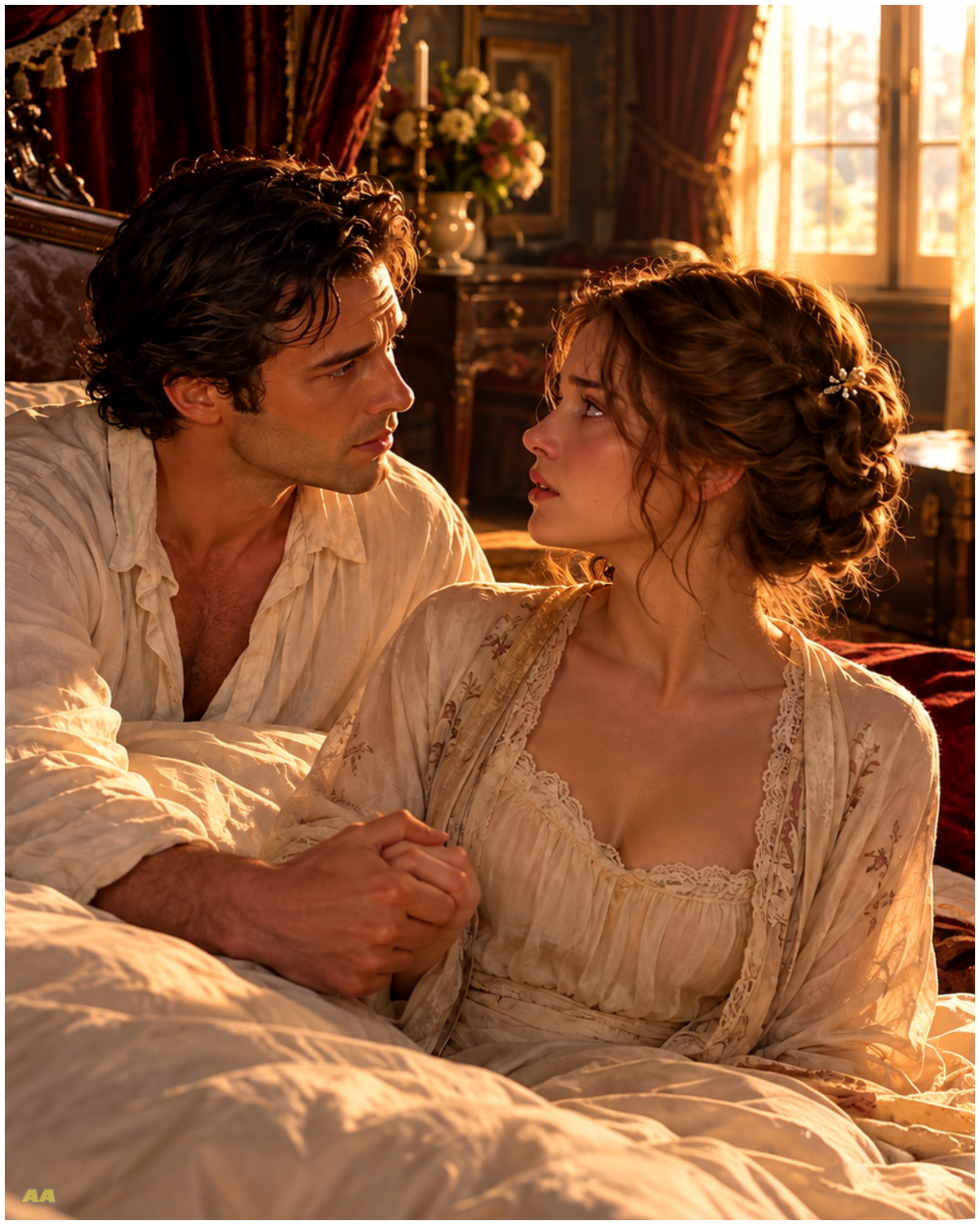
The candles in the great house had been put out one by one until only a single lamp burned in the bedchamber at the end of the west corridor.
Outside, the wind moved through the bare autumn trees, and inside, the Duke of Ashworth lay very still under the heavy blankets, his eyes closed, his breathing slow and even.
He was not asleep. He was only pretending, and he had been pretending for almost an hour.
The fight had happened just after supper.
It had started small, the way most quarrels do, with a comment about a letter left unanswered and a dinner attended alone.
But it had grown quickly into something larger, something that had been building for a long time.
Words had been said that could not easily be taken back.
He had called her distant. She had called him cold.
Then she had left the room, and he had come upstairs alone, angry and tired, and told himself that he would sort it all out in the morning when both of their tempers had cooled.
Now, lying in the dark, he heard the door open softly.
He recognized the sound of her step, light and careful, as though she did not wish to wake him.
He almost opened his eyes then.
He almost said her name. But something in the quality of her silence stopped him, some instinct that told him this was not simply a wife returning to bed after an argument.
There was a different sound to her movements, something more deliberate.
He heard the soft creak of the wardrobe door.
He heard fabric being lifted and folded.
He heard the quiet, careful placing of things into what he guessed was a small trunk, one she must have kept hidden or perhaps sent for from another room while he sat brooding by the fire downstairs.
His heart began to beat faster, though he kept his face calm and his breathing steady, the way a man does when he does not yet understand what is happening but senses that it matters greatly.
Eleanor moved around the room in the dim light of a single candle she had brought with her.
She did not look toward the bed.
She seemed entirely certain that her husband was asleep and there was something almost tender in how carefully she avoided disturbing him even now, even as she prepared to leave him.
She spoke very quietly, more to herself than to anyone else, the way people sometimes do when they believe they are alone with their thoughts.
Her voice was low and steady, though it trembled at the edges.
“I did not want it to come to this,” she said.
“I truly did not. I thought in the beginning that I could be patient. I thought that kindness given freely would eventually be returned. I was foolish to think so, perhaps. But I did think it.”
She paused, folding a shawl with hands that moved slower than they needed to, as though the task itself were a kind of comfort.
“I heard you,” she continued, “three weeks ago speaking with Mr. Whitfield in the study. I did not mean to listen.
I was passing by and the door was not fully closed and I heard my own name, so I stopped, the way anyone would stop, and I heard you say that our marriage was a necessary arrangement, nothing more than that, a necessary arrangement made to secure the estate and satisfy your father’s wishes before he died.
You said it so plainly, as though you were discussing the weather or the accounts or some small matter of business that required no particular feeling at all.” She stopped folding and stood very still for a moment, the candle flame trembling slightly in her hand.
“I have turned those words over in my mind every day since,” she said.
“I have told myself that perhaps I misunderstood, that perhaps there was more to the conversation that I did not hear. But the words themselves were plain enough, a necessary arrangement. That is what I am to you. That is what our marriage is.”
The Duke, lying motionless beneath the blankets, felt something cold settle in his cheSt. He remembered that conversation.
He remembered it exactly because he remembered how carefully he had chosen those words and how much he had regretted them the moment they left his mouth.
He had been discussing the estate’s finances with his steward, a man who had known him since childhood and who had a way of asking questions that felt too close to the heart.
Whitfield had asked, in his blunt manner, whether the Duke’s marriage had brought him any comfort or whether it remained, as many such marriages did, simply a matter of duty.
The Duke had answered the way he always answered questions that touched on feeling.
He had made it sound smaller than it was.
He had called it a necessary arrangement because the true answer, the real answer, was too large and too frightening to say aloud to another person.
The true answer was that he had come to love his wife more than he had ever expected to, more than he knew how to express, and that this love frightened him because it made him vulnerable in a way he had spent his whole life trying to avoid.
His own parents’ marriage had been full of grand and declarations and greater cruelties, and he had promised himself, long ago, that he would never say more than he meant, would never open himself to the kind of disappointment he had watched his mother endure.
So, he had hidden his feelings behind careful, guarded words, even when those words cost him the very thing he was trying to protect.
He had not known that Eleanor had heard him.
He had not known that his careful guardedness had been so plainly wounding.
She continued speaking, her voice growing quieter still.
“There is something else you should know,” she said.
“Though I do not suppose it will change anything now.
I am with child. I have known for perhaps 6 weeks and I have not told you because I could not find the courage and because each day I told myself I would wait until things felt easier between us.
But things have not grown easier.
They have grown worse and I find that I cannot imagine raising a child in a house where love is spoken of as an arrangement, where warmth is rationed like a resource too costly to spend.
She set the shawl into the trunk and closed the lid gently, so it would not make a sound.
“I will go to my sister’s house before the sun rises,” she said.
“I will write to you once I am settled, so that you know I am safe, and so that we might discuss, in time, and as calmly as two reasonable people can manage, what is to be done about the child and about the marriage itself.
I do not wish for scandal.
I do not wish to embarrass you or myself or the family name.
I only wish to be somewhere I am not merely tolerated.” She blew out the candle then, and in the sudden darkness, the Duke heard her cross the room and lie down beside him, carefully, on the very edge of the bed, as far from him as the mattress would allow.
He understood that this would be the last night she meant to spend beside him, and the knowledge of it struck him with a force he had not expected.
He had thought, foolishly, that he had time.
He had thought that whatever distance had grown between them could be closed slowly, gradually, without the discomfort of open conversation.
He saw now how wrong he had been.
He lay awake for what felt like a very long time, listening to her breathing slow beside him, though he suspected she was no more asleep than he was.
His mind moved quickly through everything she had said, every word landing with its own particular weight.
A necessary arrangement, a child, leaving before dawn.
Each thought seemed to press harder against his chest than the one before it.
He thought of his father, a distant and formal man who had never once told his son that he loved him, who had believed that affection shown too openly was a kind of weakness.
He thought of how carefully he had built his own life to avoid becoming that man, and how, in his effort to avoid one kind of failure, he had walked directly into another.
He had wanted to protect his heart, and in doing so, he had nearly lost the person who held it.
The night moved slowly toward morning.
He watched through the gap in the curtains as the black sky softened first to deep blue and then to the pale gray that comes just before the sun rises.
He knew he did not have much time left.
Once the light came fully, she would rise and dress and be gone before the household stirred.
He made his decision quietly in the stillness of that fading dark.
He would not let her leave believing what she believed.
He would not let his own fear cost them both the life they might still build together.
As the first true light touched the window, he stirred as though only now waking and reached across the small distance between them to find her hand.
She startled slightly at his touch and he felt her go very still as though bracing herself for another quarrel, another cold word.
“Eleanor,” he said, his voice rough with the night and with everything he had been holding inside it.
“I heard you. I have been awake since you came into the room.
I heard everything you said.” She pulled her hand back sharply sitting up, her face pale in the gray morning light caught between anger and something that looked almost like fear.
“Then you let me believe.” “I know,” he said quickly sitting up as well turning to face her fully for the first time in what felt like months.
“I know what I let you believe and I am ashamed of it, but I needed to hear what you truly thought, what you truly felt because I have never once managed to ask you directly and I do not think you would have told me otherwise.” “What I told Whitfield,” he continued before she could speak was not the truth or rather it was the smallest safest version of the truth, the version I could say aloud without breaking apart in front of him.
The real truth is that I love you, Eleanor.
I have loved you for a long time, longer than I have known how to admit even to myself.
I called our marriage an arrangement because saying anything else, saying what I actually felt, seemed too dangerous.
My father taught me, without ever meaning to, that love spoken aloud is love that can be used against you.
I did not want to be like him.
I did not want to hand anyone that kind of power over me, not even you, especially not you.
Because what I feel for you is larger than anything I have felt for another person, and that terrified me more than I can properly explain.
Eleanor sat very still, watching him, her eyes bright with unshed tears.
“You let me pack a trunk,” she said softly.
“You let me believe I was leaving a house with no love in it.” “I know,” he said again, and this time his own voice broke slightly.
“I am sorry for that, more sorry than I know how to say.
But I could not let you walk out that door still believing it.
Please, stay. Not because of the child, though the thought of our child fills me with more joy than I expected, and more fear, too, if I am honeSt. Stay because I am asking you to, plainly, without hiding behind careful words this time.
Stay because I love you, and because I want the chance to say it every day until you believe it fully, until it no longer needs proving.” For a long moment, Eleanor said nothing.
The room grew brighter around them as the sun climbed higher, filling the space with soft gold light.
Finally, she spoke, her voice steadier now, though still quiet.
“I do not want grand words,” she said.
“I do not want speeches given only when I am halfway out the door. I want honesty, plainly given, on ordinary days, not only in moments of crisis. Can you give me that?”.
“I can try,” he said.
“I will try every day, for as long as you allow me to.” She looked at him for a long moment, searching his face for something, and whatever she found there seemed to ease some of the tightness in her shoulders.
She did not smile, not yet, but something in her expression softened.
“Then I will stay,” she said, “for now, and we will see, day by day, whether your trying is enough.”
He nodded, understanding that this was not forgiveness fully given, but something more valuable, a chance offered carefully, the way one offers something fragile and easily broken.
He took her hand again, and this time she did not pull away.
Outside the window, the sun had fully risen, spreading pale morning light across the room, across the small trunk still sitting closed by the door, forgotten now, its purpose no longer needed.
Neither of them moved to open it.
It would remain there through the morning, a quiet reminder of how close they had come to losing each other, and of how much still lay ahead of them to build, carefully, honestly, one ordinary day at a time.








