The Duke Brought His Mistress to the Wedding — So His Bride Tossed Her Veil and Walked Away
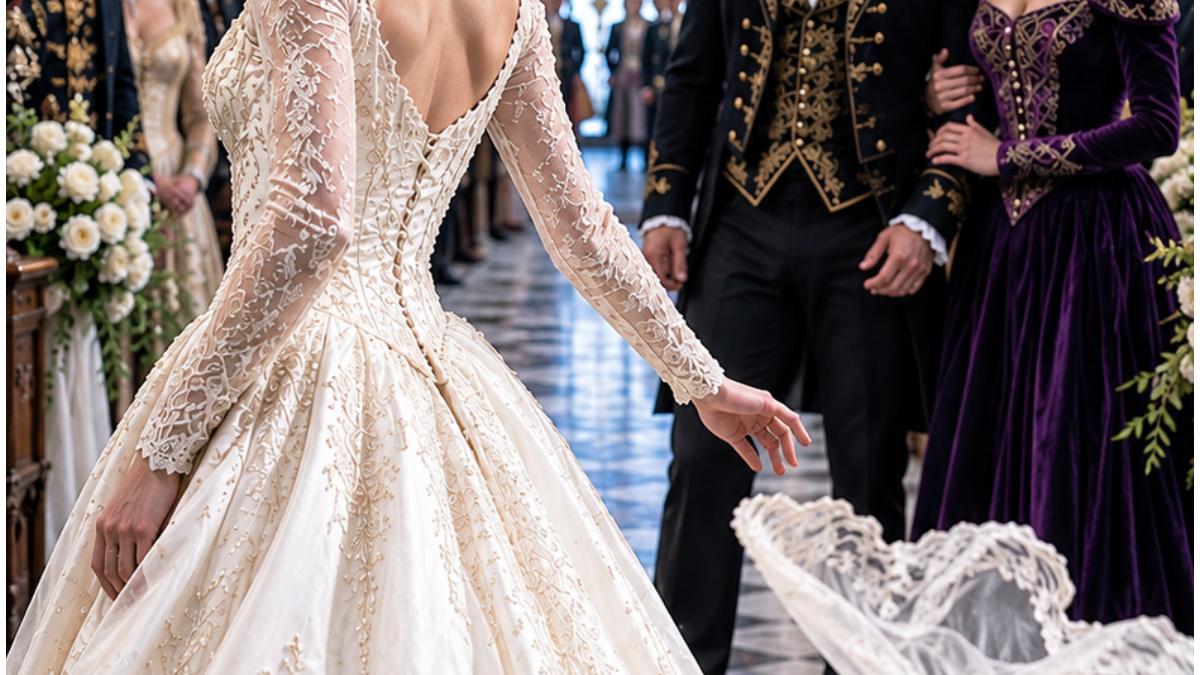
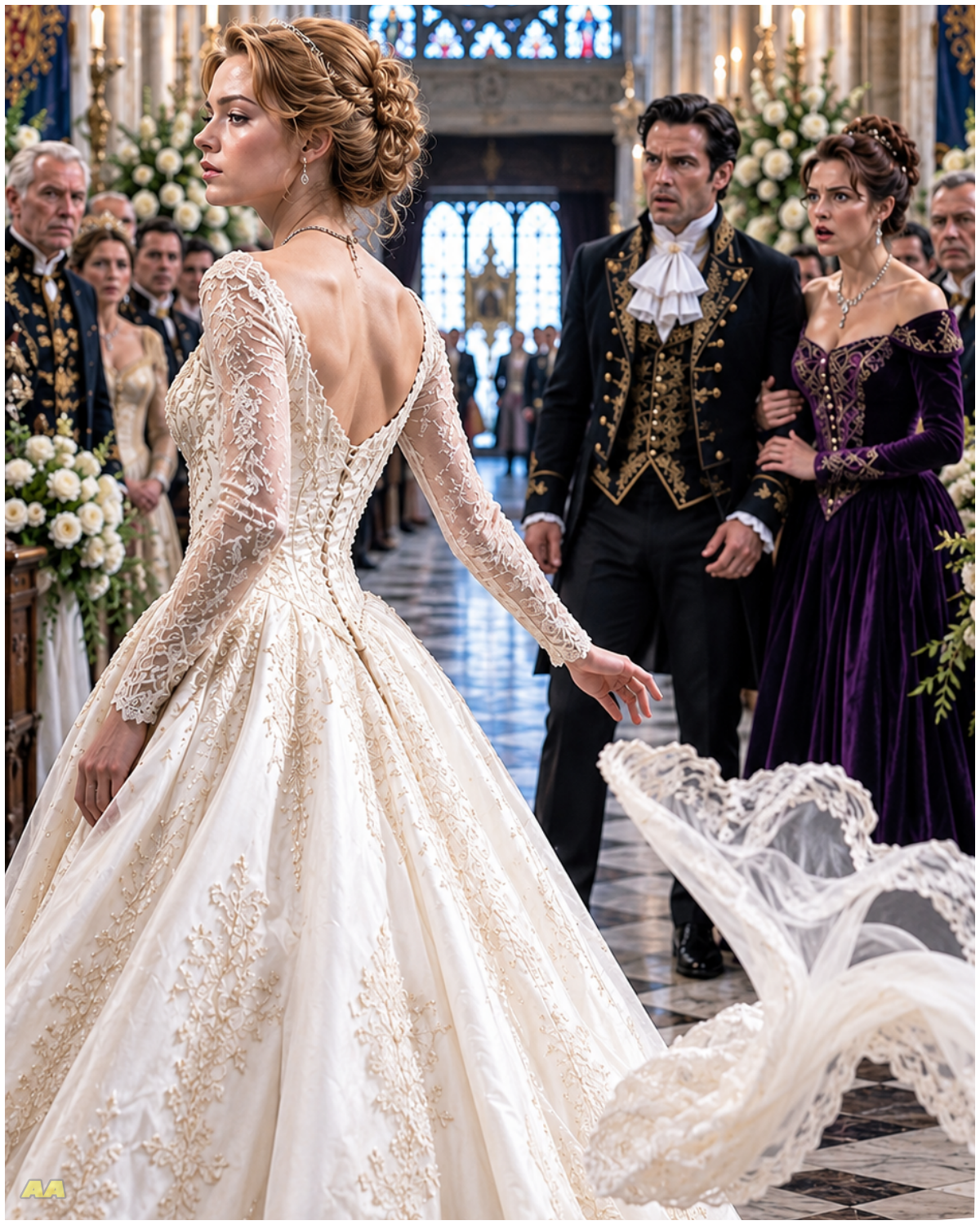
Silk rustled against the cold marble of St. George’s Cathedral, a sound swallowed by the suffocating silence of 300 guests holding their collective breath.
A wedding day is supposed to be the absolute pinnacle of a woman’s life, a grand ascension into respectable society.
But when the Duke of Westford walked down the aisle with his notorious mistress clinging to his arm, he didn’t just break an unspoken vow.
He insulted a dynasty. He expected tears.
He expected compliance. Instead, his bride dropped her veil and walked away.
Beatatric Whitmore did not believe in fairy tales.
She believed in contracts, land deeds, and the quiet, brutal arithmetic of aristocratic survival.
She stood at the altar of St. George’s wrapped in 40 of ivory silk and duchess lace, acutely aware that she was nothing more than a highly decorated commodity.
Her father, Lord Thomas Whitmore, had negotiated this merger for 6 months.
Beatatrice brought a flawless bloodline and a desperate need for capital.
Angelo Jimenez, the Duke of Westford, brought an ancient title, limitless wealth, and a reputation that required immediate laundering.
It was a clean trade. Beatatrice had accepted her fate with the cold pragmatism of a soldier being handed a rifle.
She did not love Angelo. She barely tolerated his scent of stale brandy and unearned arrogance, but she was prepared to be his duchess.
The cathedral smelled overwhelmingly of white liies and melting beeswax.
The air was thick, suffocating beneath the vaulted ceilings.
Angela was 20 minutes late. The murmurss in the pews had shifted from polite whispers to a low, buzzing hum of genuine scandal.
Beatatrice stared straight ahead at the gilded crucifix above the altar.
Her spine was rigid. The corset dug sharply into her lower ribs.
A physical manifestation of the trap closing around her.
Beside her, the archbishop shifted his weight, clearing his throat for the fourth time.
Then the heavy oak doors at the back of the nave groaned open.
The murmurss died instantly, a silence so profound it felt violent rushed into the vacuum.
Beatatrice turned slowly, the heavy silk of her train dragging against the stone.
She expected to see Angelo, perhaps ruffled, perhaps hung over, striding down the aisle with a careless apology on his lips.
She saw him, but he was not alone.
Angelo Jimenez walked down the center aisle of St. George’s Cathedral with a woman on his arm, not his mother, not her sister.
It was Genevie Luron. Everyone in London knew Genevieve.
She was an actress of mediocre talent, but possessing a sharp feline beauty and a ruthless intellect.
She was Angelo’s mistress.
For 3 years, she had lived in a townhouse he purchased for her in Mayfair, draped in his diamonds, driving his carriages.
Society tolerated her existence because it was kept neatly in the shadows.
Men had mistresses. It was an ugly, boring fact of the world.
But bringing her to the wedding, parading her down the aisle in a gown of deep, bruised plum velvet that blatantly mocked the sea of pastel guests.
That was not an indiscretion. That was a declaration.
Angelo’s face was utterly relaxed. He wore a faint, bored smile, his chin tilted up.
He was sending a message, broadcasting it to the 300 aristocrats in the pews, to Beatatric’s apoplelectic father, and to Beatatrice herself.
I own this room. I own you.
I will do exactly as I please, and you will all swallow it.” Genevieve clung to his arm, her gaze fixed on Beatrice.
There was a challenge in the other woman’s eyes, a desperate, triumphant hunger.
Beatatrice felt a strange detached calm wash over her.
Her father, sitting in the front pew, was purple in the face, half rising from his seat, restrained only by his brother’s hand on his shoulder.
The guests were statues, terrified to miss a single second of the spectacle.
Angelo stopped at the base of the altar steps.
He released Genevieve’s arm with a pat.
She stepped back, taking a prominent place in the front row, entirely unbothered by the venomous glares of the Witmore family.
Angelo climbed the three steps to stand beside Beatatrice.
He smelled of cigars and expensive cologne.
My apologies for the delay, Archbishop.
Angelo said, his voice carrying easily through the silent church.
Traffic on the Strand was abominable.
He turned to Beatatrice. He offered his arm.
He expected her to take it.
He expected her to bow her head, swallow the bile of humiliation, and say her vows.
He knew the Witors were broke.
He knew Beatatrice had no options.
He was counting on the ironclad cage of societal expectation to force her compliance.
Beatatrice looked at his extended arm.
The gold threading on his sleeve caught the candle light.
Angelo, Beatatrice said. Her voice was quiet, but in the echoing silence of the cathedral, it snapped like a dry twig.
Yes, my dear, he replied, a patronizing edge to his tone.
Are you unwell? Angelo’s brow furrowed slightly.
I am perfectly well. Shall we proceed?
You brought your to our wedding, Beatatrice stated.
She didn’t whisper. She spoke with the clear, crisp enunciation of a woman ordering tea.
A collective gasp echoed from the pews.
Several older women clutched their pearls.
Angelo’s face flushed, the smug veneer cracking for a fraction of a second.
Keep your voice down, he hissed, leaning in.
Do not make a scene, Beatatrice.
You know the arrangement. I know the arrangement, Beatatrice replied.
Her voice remaining perfectly level. The arrangement was my dignity in exchange for your capital.
You have just breached the contract.
You are being hysterical. Say the vows.
His eyes hardened, turning flat and cruel.
Beatatrice looked past him. She looked at Genevieve, who was watching with a tight, nervous smile.
She looked at her father, whose eyes pleaded with her to just get through it.
He was begging her to accept the humiliation so he could keep his country estate.
A profound exhausted cynicism settled into Beatatric’s bones.
This was the rest of her life.
Decades of this man pushing boundaries, testing her breaking point, publicly degrading her to stroke his own fragile ego.
No. Beatatrice reached up. She unpinned the heavy Brussels lace veil from her hair.
The ivory comb snagged on her intricate updo, pulling a few strands loose.
She didn’t care. She let the veil fall.
It pulled on the marble floor between them, a fragile, discarded barrier.
I find I am no longer interested in your capital, your grace, Beatatrice said.
She turned on her heel. Beatatrice.
Angelo barked, his voice cracking with sudden genuine shock.
If you walk down those steps, it is over.
That, Beatatrice said without looking back.
Is the general idea. She walked down the aisle.
The heavy silk train whispered loudly against the stone.
The guests parted perfectly, shrinking back into the pews as if she were made of fire.
She didn’t look at Genevieve. She didn’t look at her father.
She walked out of the heavy oak doors into the blinding gray light of the London afternoon and breathed in the exhaust of the city.
It tasted like freedom. The carriage ride back to the Witmore Townhouse in Mayfair was entirely devoid of the dignified silence Beatatrice craved.
Her father sat opposite her, vibrating with a rage so intense it bordered on a medical emergency.
He slam slammed his silver tipped cane against the carriage floorboard.
You have destroyed us. Lord Witmore spat, flexcks of spit hitting the velvet upholstery.
A little embarrassment. That is all it was.
A minor embarrassment. You could have weathered, but no, you have made a mockery of this family.
Beatrice stared out the window. The streets of London rolled by, gray and indifferent.
She felt surprisingly light. He brought his mistress to the altar, father.
He humiliated us. He is a duke.
Her father roared. Dukes do as they please.
You think your mother enjoyed my my indiscretions?
She had the good grace to look the other way.
Now what do we have? Debts, Beatatrice.
Ruinous, insurmountable debts. Sell the Yorkshire estate, she said flatly.
It’s been in the family for 300 years.
Then go to DA’s prison with your pride intact.
Beatatrice snapped, finally turning to face him.
Her eyes were hard, devoid of the daughterly deference she had faked for 22 years.
I will not tie myself to a man who treats me like a dog to be kicked for his amusement.
I was a bride father, not a martyr.
The moment the carriage pulled up to their residence, Beatatrice stepped out before the footman could fully lower the steps.
She marched through the front doors, ignoring the wide-eyed stares of the domestic staff, who had clearly already heard the news.
Gossip in London traveled faster than disease.
She walked into her bedroom and rang violently for her maid.
“Get this off me,” Beatatrice ordered.
The maid, a young girl named Claraara with trembling hands, began unlacing the gown.
The silk fell away like shedding skin.
When the suffocating corset was finally unhooked, Beatatrice took a deep, agonizing breath.
Her ribs achd. She stepped it out of the krenolin and walked over to the mahogany side table in nothing but her shmese.
She did not weep. She didn’t feel the urge to throw herself on the bed and sobb into the pillows.
She felt a cold, jagged anger and a deep, gnoring anxiety about tomorrow, but no regret.
She poured two fingers of her father’s worst scotch into a glass and drank it neat.
It burned a path down her throat, grounding her in her own body.
By nightfall, the house was under siege.
Notes arrived in droves, some from faux sympathetic society matrons fishing for details, others from angry creditors who had caught wind that the Witmore Jimenez merger had collapsed.
Her father locked himself in his study.
Beatatrice sat in the drawing room by the fire, reading the letters and burning them one by one.
At midnight, a heavy knock echoed through the quiet house.
Claraara brought a silver tray holding a single heavy envelope sealed with the Westford crest in red wax.
Beatatrice broke the seal. The handwriting was sharp, aggressive.
Beatatrice, your theatrics this afternoon were profoundly tedious.
I am willing to overlook this bout of feminine hysteria.
I will return to the cathedral with you on Tuesday.
We will have a private ceremony.
No guests. You have made your point.
Now cease this foolishness before your father loses his shirt.
Westford. Beatatrice read the note twice.
He actually believed he was being magnanimous.
He believed she would come crawling back because the alternative, ruin, was unthinkable to a woman of her station.
He didn’t understand that she would rather be ruined on her own terms than survive on his.
She didn’t write a response. She simply folded the letter, walked to the fireplace, and dropped it into the dying embers.
She watched the red wax melt and the paper curl into black ash.
Then she went to her desk and pulled out a leatherbound ledger.
It was a record of her mother’s personal assets.
Lord Witmore had squandered most of the dowy, but there was one property he could not touch.
It was entailed directly to Beatatrice.
Oak Haven. It [clears throat] was a crumbling manora house in the desolate windswept moors of North Yorkshire.
The roof supposedly leaked. The grounds were feral.
It produced no income and had been abandoned for a decade, but it was hers.
It was bricks and mortar and land that no man could dictate.
She rang the bell. Claraara appeared in the doorway, looking exhausted, “Pack a trunk, Claraara,” Beatatrice said quietly.
“Nothing silk, only wool, cotton, and riding habits.
We leave for Yorkshire at first light.
The journey north took four gruelling days.
The carriage rattled over ruted dirt roads.
The sky bruised purple and gray with impending rain.
Beatatric’s bones achd, and the meager provisions they had packed were stale by the third afternoon, but the further she got from London, the easier it became to breathe.
They arrived at Oak Haven in the fading twilight of a torrential downpour.
The mana house loomed out of the mist like a forgotten gravestone.
It was built of dark, rough huneed stone, half swallowed by aggressive ivy.
Several windows on the second floor were boarded up, and the heavy oak front door looked as though it hadn’t been opened since the turn of the century.
“Miss Beatatrice,” Claraara whispered, peering out the carriage window, her voice trembling.
“It looks haunted.” “Good,” Beatrice said, pulling her heavy wool cloak tighter around her shoulders.
Ghosts are infinitely better company than dukes.
She stepped out into the mud.
The rain was freezing, slicing through her clothes instantly.
The driver, an old man loyal to her late mother, managed to force the rusted lock on the front door.
Inside it was a tomb. The air was thick with dust and the smell of rot.
Sheet covered furniture sat in the gloom like slumbering beasts.
The cold was damp and penetrating, settling deep into the joints.
It was terrible. It was perfect.
For the next two weeks, Beatatrice did not act like the daughter of a Vic Count.
She rolled up her sleeves. With only Claraara and a sullen local caretaker named Griggs, they began forcing life back into Oak Haven.
They scrubbed decades of grime from the wooden floors.
They tore the rotting drapes from the windows to let the pale Yorkshire light bleed into the rooMs. Beatatrice learned how to build a fire that didn’t immediately smoke them out of the parlor.
Her hands, previously soft and manicured, became blistered and rough.
She ruined her remaining good dresses.
She ate simple stews of root vegetables and tough mutton, and it tasted better than any multicourse banquet she had ever attended in Mayfair.
She was exhausted, aching, and completely isolated.
She had never felt more powerful.
The solitude was absolute, save for the howling wind off the moors.
She spent her evenings in the library, swaythed in blankets, reading her mother’s old books by candle light.
She pushed the memory of Angelo, of Genevieve’s triumphant face, of her father’s red-faced fury into a small locked box in the back of her mind.
But society and men who are denied what they want rarely let a woman disappear quietly.
It was a Tuesday afternoon. Beatatrice was in the muddy courtyard wrestling with a stubborn rose bush that had overgrown the stone path, her hands protected by thick leather gloves.
The sound of hoof beatats broke the heavy silence of the moors.
Beatatrice straightened up, wiping a smear of dirt from her forehead.
A solitary rider was approaching up the winding dirt drive.
As he drew closer, she noted the immaculate cut of his riding coat, the polished leather of his boots.
He did not belong here. He pulled his horse to a halt a few yards from her and dismounted.
He was a younger man, perhaps 30, with sharp, intelligent eyes and a practiced professional smile.
Lady Beatatrice,” he said, bowing slightly.
“I am no longer answering to titles from London,” Beatatrice said, her voice flat, keeping her pruning shears firmly in her right hand.
“Who are you?” “My name is Mr.
Charles Sterling. Apologies, Mr. Charles Hail.” The man corrected himself smoothly.
“I am the chief solicitor for the Duke of Westford.” Beatatrice stared at him.
The sheer audacity of it. Angelo hadn’t even bothered to come himself.
He had sent a cler to retrieve his runaway property.
“Mr. Hail,” Beatatrice said slowly. “You have ridden a very long way for nothing.
His grace is prepared to be extraordinarily generous, Lady Beatatrice,” Hail said, stepping closer, his boots sinking slightly into the mud.
He looked at the crumbling facade of Oak Haven with barely concealed disguSt. He understands that you felt slighted.
He is willing to offer an increased settlement to your father.
Furthermore, the companion who caused the disruption at the ceremony has been sent to the country.
She is no longer in London.
Beatatrice laughed. It was a sharp barking sound that startled Hail’s horse.
He sent his mistress to the country.
Beatatrice asked, shaking her head. He thinks this is about jealousy.
He thinks I care who warms his bed.
Lady Beatatrice, please look around you.
Hail gestured to the desolate moors and the damp stone of the manor.
You cannot live like this. You are a gentle woman.
Come back to London. Say the vows.
Your debts will be cleared, your position restored.
The scandal will fade in a month.
My position,” Beatatrice echoed softly. She looked down at her mudcaked boots, then back up at the solicitor.
“Tell the Duke that my position here is standing on my own land.
My position in London was kneeling on his hail” frowned, losing some of his polished veneer.
“Lady Beatatrice, your father is facing ruin.
If you refuse this, his grace will ensure that the Witmore name is effectively bankrupted by the end of the quarter.
It is not a threat. It is a financial certainty.
The threat hung in the damp air.
Beatatrice felt a cold knot tighten in her stomach.
She hated her father, but she did not wish to see him destroyed.
Angelo knew this. He was tightening the financial gara.
You tell Angelo, Beatatrice said, her voice dropping to a low, dangerous register.
That if he moves against my family’s remaining assets, I will not quietly return to London.
I will travel to Parliament. I will stand in the public gallery, and I will read the ledgers of his illegal gambling debts that I found in his study during our courtship.
I will burn his political standing to the ground.
Hail’s eyes widened. You have no such ledgers.
Call my bluff, Mr. Hail,” Beatatrice said, raising her chin.
“I dare you.” She didn’t have the ledgers, but she had spent enough time around Angelo to know he was terrified of scandal that affected his standing with the crown.
Hail stared at her for a long moment, realizing that the woman standing in the mud was not the terrified debutant he had expected to find.
“I will relay your message,” Hail said stiffly.
He mounted his horse. “Good day, madam.” Beatatrice watched him ride away until he was a tiny speck on the gray horizon.
Her hands were shaking inside the thick leather gloves.
The war wasn’t over. It had just begun.
Rain battered the leaded glass windows of the library for three consecutive days, sealing Oak Haven in a cocoon of gray isolation.
Beatrice sat wrapped in a damp wool shawl, her mother’s genuine accounting book resting heavily on her knees.
The numbers were not merely bleak.
They were catastrophic. Oak Haven possessed 3,000 acres of rugged moand, but land without capital to work.
It was just dirt. She dragged a silver fountain pen across the coarse paper, tallying the remainder of her pocket money.
£94 shillings. It was enough to buy flour, root vegetables, and perhaps coal for another month.
It was not enough to hire shepherds for the spring lamming season, nor could it repair the collapsed eastern roof that was currently leaking rainwater into the drawing room.
Angelo’s silence from London was deafening.
She had successfully bluffed his solicitor, but Beatrice knew the Duke of Westford was not a man to simply accept defeat.
He was likely regrouping, calculating a quieter, more devastating method of retaliation.
She needed an income. “Griggs,” Bertrris called out, her voice cutting through the damp chill of the hallway, the sullen caretaker appeared a moment later, wiping grease from his hands onto a coarse rag.
He looked at her with the perpetual simmering resentment of a man who did not like taking orders from a disgraced 22year-old woman.
“What do we actually own out there?” Beatatrice asked, gesturing toward the fog choked window.
“Aside from mud and heather,” Grigg scratched his jaw, his eyes narrowing.
“Sheep mostly. A few hundred head of swelles wandering the high crags.
Feral things haven’t been properly sheared or counted in 5 years.
Then we shear them. Beatric stated, closing the ledger with a sharp snap.
Wool cells. The mills in Bradford are always buying.
Griggs let out a harsh scraping laugh.
And who is going to catch them, Lady Beatatric?
You, Claraara? It takes a dozen men and good dogs to bring that flock down from the crags.
Men expect wages, hard coin, not promises from a crumbling house.
Beatatrice stood up. She walked over to the modest oak desk and unlocked the bottom drawer.
She pulled out a velvet box, flipping the lid open to reveal a diamond and sapphire choker.
It was a gift from her father on her 18th birthday, purchased on credit he couldn’t afford.
It felt heavy and cold in her palm.
Take the carriage into York tomorrow morning, Beatatrice ordered, holding the necklace out to him.
Find a jeweler who doesn’t ask questions.
Sell this. Do not accept less than £80.
Use the first 10 to hire the men and dogs we need.
Bring the rest back to me.
Grigg stared at the jewels, then up at her face.
For the first time since she arrived, the resentment in his eyes flickered, replaced by a cautious, calculating respect.
He took the necklace. I will leave at dawn, he grunted.
By the end of the week, the quiet courtyard of Oak Haven was transformed into a chaotic, bleeting nightmare.
12 local men, rough hune and smelling of damp wool and pipe tobacco, drove the feral swale sheep down from the moors.
The noise was deafening. The smell was sharp, an intense mixture of wet lenoline, mud, and manure.
Beatatrice did not hide in the house.
She stood in the center of the courtyard, wearing her oldest riding habit, her boots buried in the muck.
She held a clipboard, counting the fleces as the men threw them onto the weighing scales.
It was exhausting, filthy work. A stray sheep bolted, knocking into her and sending her sprawling into the mud.
The men paused, holding their breath, waiting for the aristocratic lady to burst into tears and flee to her parlor.
Beerus sat in the mud for 3 seconds, wiped a smear of manure from her cheek, and calmly stood back up.
That was fleece number 112, she said loudly, picking up her clipboard.
Keep moving. A low murmur of approval rippled through the men.
She had passed a test she hadn’t known she was taking.
That evening, as Claraara painstakingly brushed the dried mud from Beatatric’s hair, a rider arrived.
It wasn’t Angelo’s solicitor. It was a post boy bearing a letter with a French stamp.
Beatatrice recognized her father’s erratic, panicked handwriting.
She tore it open. Beatatrice, Westford has called in the markers.
He bought up every promisory note I had in the city.
I am ruined. The Yorkshire estate is gone.
The Mayfair house is seized. I have secured passage to Calala on a freighter.
I have nothing left but the clothes on my back.
I hope your pride keeps you warm because you have doomed us both.
Thomas Beatatrice stared at the letter until the words blurred.
The financial gar had finally snapped tight.
Angelo hadn’t touched O’haven because legally he couldn’t.
But he had annihilated her father to prove a point.
He wanted her to feel the weight of her disobedience.
He wanted the guilt to crush her into submission.
She walked to the fireplace and tossed the letter into the flames.
She watched it curl and blacken.
I will not break, she whispered to the empty room.
I will shear every sheep in Yorkshire before I ever ask that man for a penny.
The wool from the Oak Haven flock yielded 42 of profit after paying the men.
It was a pathetic sum compared to the thousands of pounds her father used to drop at the card tables in a single night.
But to Beatatrice it felt like an empire.
It was real. She had earned it.
However, her small victory was immediately overshadowed by the harsh realities of rural commerce.
She had the wool, but she needed a buyer, and the local agents offered insultingly low prices, assuming the desperate lady of the manor would take whatever she was handed.
She refused them all. Instead, she sent a letter directly to the largest textile mill in the region, demanding a meeting with the owner.
3 days later a heavy unadorned black carriage pulled up Oak Haven’s Drive.
The man who stepped out was not a gentleman by London standards.
Henry Tolbert wore a suit of dark, durable worsted wool, utterly lacking the tailored elegance of Mayfair.
He had broad shoulders, a square jaw, and hands that looked as though they had actually operated the looms he now owned.
He was a man of industry, new money, and ruthless efficiency.
Griggs showed him into the drawing room where Beatatrice had managed to light a respectable fire.
“Lady Beatatrice,” Henry said, his voice a deep, grally baritone.
He did not bow. He offered a curt nod.
“I received your letter. You mentioned 50 bales of raw swail.” “I did, Mr.
Talbert,” Bertrris said, remaining seated in the wingback chair.
She gestured to the seat across from her.
“Please,” Henry sat down. He looked around the room, taking in the faded wallpaper, the lack of ornaments, and the cold, damp air.
His eyes missed nothing. “I will be blunt, madam,” Henry said, leaning forward and resting his large hands on his knees.
“I I usually deal with agents.
I don’t typically make personal calls to decaying estates, but rumor in the village says the runaway bride of the Duke of Westford is currently winging through sheep manure in my county.
I confess my curiosity got the better of me.
I am glad my personal misfortunes provide you with entertainment, Mr.
Talbbert. Beatatrice replied, her tone matching his bluntness.
But you are here because you need wool and I have 50 bales of exceptional quality.
Swell is coarse. It’s only good for carpets and heavy overcoats.
Henry countered dismissively. I can buy it from a dozen other farms for6 p a pound.
You can buy dirty, poorly sorted fleece for6 p a pound.
Beatatrice corrected him smoothly. My fleces have been hand sorted, cleaned of the worst debris, and graded.
I oversaw it myself. They will save your carding machines hours of labor.
I want 8 p a pound.
Henry raised an eyebrow, genuinely surprised.
He studied her face, searching for the delicate, helpless aristocrat he had expected to find.
He saw only sharp, calculating resilience.
7 p. Henry said 7 and a half.
Beatatrice counted. And you provide the carts to transport it from my barns to your mill.
A slow genuine smile spread across Henry’s face.
It completely changed his demeanor, softening the hard lines of his jaw.
You negotiate like a dock worker, Lady Beatatrice.
I will take that as a compliment, Mr.
Talbert. It was intended as one, he said, standing up.
7 and a half it is.
I will send my wagons tomorrow morning.
He walked toward the door, but paused, turning back to look at her.
The amusement had faded from his eyes, replaced by a quiet, intense scrutiny.
You should know, Henry said softly, that Westford has reached even up here.
He has investments in the railways and the shipping lines.
If he finds out you are doing business with me, he will try to squeeze my supply chains.
Beatric’s stomach tightened, but she kept her face perfectly impassive.
Are you afraid of him, Mr.
Talbot? I am a businessman. I am afraid of unprofitable ventures.
Henry replied, Westford is old money.
He fights with lawyers and social pressure.
I fight with iron and steam.
Let him try to squeeze. He offered another curt nod and left the room.
Beatatrice listened to his carriage roll away.
For the first time since she had dropped her veil at the altar, she felt a genuine spark of hope.
She had an ally, not a friend perhaps, but a mutual combatant in the brutal arena of survival.
Down in London, the season was in full swing, but Angelo Jimenez was not enjoying it.
He sat in the smoking room of his private club in St. James, a glass of expensive brandy ignored on the table beside him.
Genevieve sat across from him, draped in a gown of shimmering emerald silk.
She looked beautiful, triumphant, and entirely out of place among the dark wood and leather chairs.
You are brooding again, Angelo, Genevieve purred, reaching out to trace the rim of his glass.
It is tedious. The girl is gone.
Her father is exiled. You won.
Let us enjoy the evening. Angelo looked at her.
For 3 years, she had been a thrilling rebellion, a sharp contrast to the dull, beautiful women of his class.
But bringing her to the cathedral had broken the spell.
By making her public, he had forced the world to look at her, and in doing so, he was forced to really look at her himself.
She wasn’t a rebellion anymore. She was just a woman who had cost him his public dignity.
I did not win, Genevieve,” Angelo said softly, his voice dripping with venom.
“Winning implies the opponent has surrendered.
She hasn’t surrendered. She is sitting in a ruined pile of rocks in Yorkshire, making a fool of me by simply refusing to die.” “Who cares what she does in Yorkshire?” Genevieve sighed, leaning back.
“I care.” Angelo snapped, his eyes flashing with sudden violent anger.
She humiliated me in front of the archbishop, in front of the entire house of lords.
She made me look small. He stood up, abandoning the brandy.
He walked to the window, looking out at the gas-lit streets of London.
Beatatrice thought she had escaped him by running to the dirt and the mud.
She thought her little ruined estate was a fortress.
She was wrong. I am going to burn Oak Haven to the ground.
Angela whispered to the glass, a cold, empty smile forming on his lips.
And I am going to make her strike the match.
Autumn ripped through the Yorkshire Valley, stripping the ancient oaks bear, and turning the thick mud of Oak Haven’s courtyard into rigid frozen ruts.
Beatrice sat by the meager hearth in the drawing room, her fingers stiff and aching as she gripped her fountain pen.
The ledger balanced on her lap painted a fragile, teetering picture of survival.
Henry Talbert’s mill had paid promptly for the first shipment.
The money had allowed her to buy winter provisions, a mountain of coal, and enough raw timber to finally patch the leaking eastern roof.
She had caught her breath. She had begun to sleep through the night without waking in a cold sweat.
Then the second shipment of sorted wool sat in the barn for 10 days.
Telbbert’s black wagons never arrived. Beatrice did not send a letter.
Letters were easily ignored. She instructed Griggs to saddle the estate’s only riding horse, a massive badteeered geling named Brutus.
She rode the 10 mi to Tolbert’s Mill through a biting sleetfilled wind.
The mill was a cathedral of industry, a sprawling brick monstrosity belching thick black smoke into the slate gray sky.
The noise was a physical entity.
It vibrated through the soles of her boots as she dismounted, a deafening rhythmic clatter of hundreds of mechanized looms devouring raw cotton and wool.
She pushed through the heavy wooden doors, ignoring the shocked stairs of the floor workers.
She found Henry Tolbert in his glasswalled office, suspended above the factory floor.
He was leaning over a massive table strewn with shipping manifests, his shirt sleeves rolled up past his elbows, revealing forearms thick with muscle and dark grease.
He looked up as she walked in, his jaw tightened.
Lady Beatatrice, Henry said, his deep voice barely audible over the den of the machinery below.
He didn’t look pleased to see her.
He looked exhausted. My wool has been sitting in the damp for over a week, Mr.
Telbbert. Beatatrice said, bypassing any polite preamble.
She stripped off her leather riding gloves, slapping them against her thigh.
You gave me your word. You gave me a price.
If you have found a cheaper supplier, you owe me the courtesy of a direct refusal.” Henry let out a harsh, humilous laugh.
He walked over to a small wash basin in the corner and began scrubbing the grease from his hands with a stiff brush.
I haven’t found a cheaper supplier, Henry said.
“I have found any supplier. Look out the window.” Beatatrice walked to the glass pane overlooking the railard behind the mill.
Three dozen of Talbbert’s freight cars sat idle on the tracks, their wooden sides weathering in the sleet.
The yard was eerily silent compared to the chaotic roar of the factory floor.
The Northern Line Railway raised their freight tariffs yesterday, Henry explained, drying his hands on a coarse towel.
A general increase across the board, they claimed.
But curiously, the tariffs for textile goods, specifically raw wool and finished cloth, were raised by 400%.
It costs me more to ship my goods to the coast than the goods are actually worth.
Beatrice felt a cold, dread pool in her stomach.
Angelo, his grace, the Duke of Westford, recently acquired a controlling interest in the Northern Line’s debt.
Henry confirmed, tossing the towel onto a chair.
He leaned against his desk, crossing his arMs. “He is choking my supply lines.
He knows I cannot afford the new tariffs, and he knows I cannot survive without shipping my product.
I have enough raw material to keep the looms running for perhaps another fortnight.” After that, I shut down.
300 local families lose their wages.
He looked at her, his dark eyes entirely devoid of accusation, which somehow made the guilt worse.
He was simply stating facts. He is doing this to break me.
Beatatrice whispered, the realization settling heavily over her.
He He doesn’t care about your mill.
He just wants to cut off my only source of income.
He is burning down your livelihood just to smoke me out of Oak Haven.
Yes, Henry said plainly. He is.
I I will release you from our contract.
Beatrice said, her voice shaking slightly.
She She hated the tremor. She hated that Angelo still had the power to make her feel small.
If you publicly sever ties with Oak Haven, perhaps he will lift the tariffs.
Henry pushed off the desk and walked slowly toward her.
He stopped an arms length away, towering over her.
He smelled of machine oil, strong tea, and hard work.
“Do you honestly believe?” Henry said, his voice dropping to a low, intense rumble.
“That a man who alters national railway tariffs to spite a woman will simply walk away if I apologize.
He is a predator, Lady Beatatrice.
If I show him my throat, he will rip it out.
I do not back down from aristocrats playing with ledgers.
I built this mill from nothing.
But your rail lines are blocked.
How will you move the goods?
I don’t know yet, Henry admitted, running a hand through his dark hair.
I am looking into overland carting, but it is slow and agonizingly expensive.
The roads to the eastern ports are abysmal in the winter.
Bertrris closed her eyes, forcing her panic down into the tight, locked box in her mind.
She thought of her mother’s chaotic, messy accounting books.
She thought of the maps of Oak Haven she had studied by candle light.
Not all the roads, Bertrris said slowly, opening her eyes.
What about the water? The Canal system?
Henry scoffed. It’s been defunct for 20 years.
The locks are rusted shut and half of it is silted over.
The river connects to the Humber estuary.
Beatatrice countered, her mind racing. There is a deep water canal spur that cuts directly through the western edge of Oak Haven property.
It bypasses the northern line entirely.
My grandfather built it to move timber, but he kept the transit rights private.
It belongs to the estate. It belongs to me.
Henry stared at her. The exhaustion in his eyes vanished, replaced by a sudden sharp intensity.
Are the locks functional? He asked, stepping closer.
Griggs thinks so. He says the stone is sound, just overgrown.
Beatatrice looked up at him, her heart hammering a frantic rhythm against her ribs.
You have men. I have the transit rights.
We clear the canal. We load your goods onto flatbottomed barges and float them right under Angelo’s useless railway bridges.
A slow, dangerous smile spread across Henry’s face.
It was not a polite smile.
It was the smile of a bare knuckle boxer who had just found an opening.
“Lady Beatatrice,” Henry murmured. “You are a profoundly dangerous woman.” Only two men who try to starve me, she replied.
Clearing the Oak Haven Canal was brutal, bones snapping labor.
Henry brought 50 of his strongest mill workers.
Beatatrice provided the axes, the heavy ropes, and the land.
For 3 weeks, they waged war against the encroaching earth.
They hacked through decades of dense, frozen willow scrub, and hauled massive rotting logs out of the dark water.
Beatatrice was there every day. She did not swing an axe, but she organized the camps, boiled gallons of bitter tea over open fires, and kept the ledges of the men’s wages.
She watched Henry work waist deep in the freezing muddy water, his shoulders straining as he threw his entire weight against a rusted iron lock mechanism.
When it finally gave way with a deafening groan, sending a rush of dark water surging forward, the men cheered.
Beatatrice found herself smiling, a genuine, unforced smile.
It felt entirely foreign on her face.
The first barges, heavily laden with Tolbert’s finished textiles, floated quietly down the canal 2 days before Christmas.
They slipped past the frozen landscape, completely invisible to the railway magnates in London.
The victory was sweet, intoxicating, and inevitably brief.
It was a bleak Tuesday morning in January.
The sky was the color of a bruised plum.
Beatatrice was in the library going over the newly drafted transit contracts with Henry.
The fire was roaring, and for the first time since she had arrived, the room felt warm.
The heavy thud of the brass knocker echoing through the manor shattered the piece.
Griggs’s heavy footsteps shuffled down the hall.
The front door groaned open. A cold draft swept into the library, making the candle flames dance frantically.
“You cannot go in there.” Griggs’s voice barked thick with outrage.
Remove your hand from my coat, you filthy animal, or I will have my men break your jaw.” A smooth, cultured, and devastatingly familiar voice replied.
Beatatric’s blood turned to ice water.
The pen slipped from her fingers, leaving a dark blot of ink on the contract.
“Angelo!” He didn’t wait to be announced.
The library doors were pushed open violently.
Angelo Jimenez, Duke of Westford, stood in the doorway.
He looked entirely out of place, wearing a bespoke sable lined overcoat and polished leather boots that had clearly never touched genuine mud until today.
Behind him stood two massive men with the rough, battered faces of hired muscle.
Angelo’s gaze swept the room. It bypassed the faded wallpaper, the worn rugs, and landed squarely on Beatatrice.
Then his eyes slid to Henry Tolbert, who was slowly rising from his chair, his massive frame unfolding like a waking bear.
“Angelo,” Beatatrice said, her voice was terrifyingly steady.
She did not stand. She remained seated behind her desk, anchoring herself to the heavy wood.
“Beatric,” Angela replied, stepping into the room.
He took off his kid leather gloves, finger by finger.
I must say, the sheer squalor of this place exceeds even my most dire imaginations, and I see you have taken up entertaining the local tradesmen.
How quaint.” Henry said nothing. He simply stepped slightly to the side, placing himself closer to Beatric’s desk.
His silence was heavier and far more menacing than Angelo’s polished insults.
“What are you doing here?” Beatatrice asked.
I came to collect my property,” Angelo said simply.
He walked over to the fireplace, holding his hands out to the warmth as if he owned the hearth.
“Your little canal trick was clever, Beatrice, very spirited, but it ends today.” “I have purchased the debt on Mr.
Talbbert’s factory machinery from the Bank of England.
The transit bypass is irrelevant if the looms are repossessed.” He turned to look at Henry, a patronizing smirk on his face.
You are out of your depth, Mr.
Telbot. Go back to your soot and leave the affairs of the nobility to your betters.
Henry’s jaw worked, the muscles ticking rapidly.
He took a step forward, but Beatatrice shot her arm out, pressing her hand against Henry’s rigid forearm.
The physical contact stopped him. Oak Haven is entailed to me, Beatatrice said, focusing entirely on Angelo.
You have no legal right to be in this house.
Get out. Ah, the entailment. Angelo sighed, looking genuinely bored.
He reached into his overcoat and pulled out a thick folded legal document.
He tossed it onto Beatatric’s desk.
It landed with a heavy ominous thud.
Your father, in his desperation before fleeing to France, signed a rather interesting affidavit,” Angelo explained, his voice silky.
“He swore under oath that you were not of sound mind when you fled London.
He claimed you suffered a violent, hysterical break from reality.
Given your current living conditions, it is not a difficult claim to substantiate.” Beatatrice stared at the document.
Her lungs refused to expand. Her own father.
He had sold her sanity for a few final scraps of Angelo’s money.
As your former betrothed and appear of the realm, Angelo continued, relishing every syllable.
The courts have granted me temporary conservatorship over your estate until a medical board can evaluate you.
In an asylum in London. He walked back to the desk, leaning over it, bringing his face inches from hers.
He smelled of the same expensive cologne and stale cigar smoke that had haunted the cathedral.
“I told you, Beatatrice,” Angela whispered, his eyes flat and dead.
“You do not walk away from me.
You are coming back to London.
You are going to wear the white dress.
You are going to say the vows and you are going to smile or I will have these men drag you out of here in a straight jacket and I will tear this house down brick by miserable brick.
The silence in the library was absolute.
The fire crackled loudly, a violent snapping sound.
Beatatrice looked at the affidavit. She looked at the hired thugs by the door.
She looked at Angelo’s smug, triumphant face.
He had boxed her in completely.
He had used the law, her family, and his limitless wealth to build an inescapable cage.
She felt the old familiar panic rising, the suffocating weight of societal expectation preparing to crush her, but then she felt the rough, calloused warmth of Henry’s arm beneath her hand.
She remembered the freezing mud of the canal, the smell of damp wool, and the bitter, exhausting taste of real freedom.
Beatatrice picked up the affidavit. She didn’t read it.
She didn’t tear it up. She stood up.
Angelo, she said softly, her voice barely a whisper.
You have made a catastrophic miscalculation.
Fire light caught the edge of the heavy parchment as Beatatrice held it up.
It was a masterpiece of legal fiction, a weapon forged in the exclusive gentleman’s clubs of London, designed specifically to strip a woman of her autonomy.
Angelo watched her, his lips curved in a terrible victorious arc.
He was waiting for the tears.
He was waiting for her to shatter.
To finally realize that her defiance was nothing more than a temporary entertaining delay of the inevitable.
Beatatrice did not shatter. She lowered the document and placed it gently on the oak desk.
Temporary conservatorship. Beatrice repeated, tasting the words.
Granted on the grounds of hysteria and familial abandonment.
It is a very thorough piece of paper, Angelo.
I imagine it cost you a fortune in bribes.
Efficiency is expensive. Angelo replied smoothly, buttoning his sable coat.
Now Claraara can pack a small trunk for you.
We are leaving within the hour.
The carriage is heated. Henry moved.
He did not lunge, nor did he raise his voice.
He simply took two heavy steps forward, placing himself entirely between Beatatric’s desk and Angelo’s hired thugs.
The floorboards groaned beneath his boots.
“You are trespassing,” Henry stated. His voice was a low, industrial rumble, devoid of any aristocratic inflection.
“It was the voice of a man who commanded hundreds of workers in deafening factories.” Angelo sneered, looking Henry up and down as if inspecting a piece of defective machinery.
“I I hold the legal rights to this estate and its inhabitant, Mr.
Talbert, I suggest you return to your bankrupt mill before I have you arrested for interfering with a pier.
You hold a piece of paper signed by a coward who fled to France,” Beatatrice said.
She stood up, walking around the desk to stand beside Henry.
She did not shrink behind him.
She stood shoulder-to-shoulder with the industrialiSt. “And that paper is entirely worthless under the eyes of the crown.” Angelo smirk faltered for a fraction of a second.
Do not bore me with amateur legal theories, Beatatrice.
A father’s sworn affidavit, a father’s rights, Beatrice interrupted, her voice ringing clear and hard off the stone walls are utterly superseded by the legal rights of a husband.
The silence that followed was suffocating.
The crackle of the hearthfire suddenly sounded like artillery fire.
Angelo stared at her, his pale blue eyes narrowing into tight, confused slits.
The two hired men shifted uncomfortably, sensing a sudden change in the atmospheric pressure of the room.
“You are bluffing,” Angelo whispered, the cultured veneer cracking to reveal genuine ugly panic.
Henry reached into the breast pocket of his heavy worsted coat.
He withdrew a folded document, far simpler than Angelo’s elaborate court order, but possessing infinitely more power.
He unfolded it and laid it flat on the desk.
“Special license,” Henry said, his tone conversational.
“Signed by the bishop of York 3 days ago, witnessed by Griggs and my foreman.
We were married in the village chapel at dawn on Thursday.” Angelo lunged forward, snatching the paper from the desk.
His eyes darted frantically over the ink, searching for a forgery, a loophole, a mistake.
There was none. It was ironclad.
By the rigid, inescapable laws of England, the very laws Angelo had tried to weaponize, Beatatrice no longer belonged to her father, and therefore could not be signed over to a conservator.
She belonged to Henry Tolbert. You married a mechanic.
Angelo breathed, stepping back. The parchment trembling in his hand.
He looked at Beatatric as if she had just grown a second head.
You threw away a dukedom to marry a man with grease under his fingernails.
You are insane. I am pragmatic.
Bertrus corrected him coldly. I married a man who builds things instead of burning them down.
I married a man who respects my mind.
And most importantly, Angelo, I married a man you cannot break.
I have already broken him,” Angelo shouted, the carefully maintained facade of the bored aristocrat dissolving entirely.
His face flushed a mottled ugly purple.
“I hold the bank notes on his factory.
I will foreclose tomorrow. I will leave you both starving in the mud.” Henry let out a short, sharp laugh.
He leaned against the desk, crossing his massive arMs. “You bought my debts from the Bank of England.” Henry nodded.
A very aggressive move, but you failed to understand how northern mills operate.
Your grace, we don’t rely solely on London banks.
When we opened the canal bypass, I secured advanced payments from my buyers in Amsterdam and Calala.
Gold bullion, Angelo, not paper credit.
I paid off the principal on those factory loans yesterday morning.
Your banknotes are void. You spent a fortune buying empty paper.
Angelo stood frozen. The arithmetic was crashing down on him.
He had overextended his own credit to buy the railway tariffs and the factory debts, assuming it would be a brief, terrifying siege that would end with Beatatric’s surrender.
He had waged a war of attrition against a woman who had already learned to survive on nothing.
“Griggs!” Henry barked, turning his head toward the hallway.
The heavy dragging footsteps returned, followed by the sound of 20 more.
The library doors swung fully open.
Griggs stood there holding a rusted iron crowbar.
Behind him stood two dozen of Tolbert’s mill workers, men who had spent the last month hauling timber out of freezing water.
They were massive, filthy, and entirely unimpressed by sable coats.
Show his grace to his carriage, Henry ordered.
If he or his men resist, throw them in the canal.
Angelo looked at the wall of men.
He looked at his two hired thugs who had immediately lowered their hands, calculating that whatever Angelo was paying them, it wasn’t enough to survive this room.
Angelo turned back to Beatatrice. There was no rage left in his eyes, only a hollow, terrifying emptiness.
He had loSt. He had been publicly humiliated at the altar.
And now he had been outmaneuvered in the mud.
You will rot here, Angelo spat, his voice trembling.
I will thrive here. Beatatrice promised softly.
Never return to my land. Angelo turned on his heel and walked out.
The sea of mill workers parted just enough to let him pass, their silent, hostile stairs burning into his back.
The heavy oak doors slammed shut behind him, shaking the dust from the rafters.
Winter finally broke its grip on the Yorkshire moors.
The aggressive biting frost melted into a soft, persistent rain, turning the harsh crags a vibrant, shocking green.
The Oak Haven Canal flowed heavy and dark, carrying barges of wool and finished textiles efficiently toward the eastern ports, entirely bypassing the crippled Northern Line Railway.
Down in Mayfair, the season had ended in a spectacular quiet implosion.
Angelo Jimenez sat in his shadowed drawing room, the curtains drawn tight against the spring sunlight.
The house was painfully quiet. His reckless financial maneuvering to destroy Henry Tolbert had triggered a panic among his own creditors.
The Duke of Westford was not bankrupt.
Dukes rarely were, but he was mortgaged to the hilt, forced to lease his country estates and sell his grandfather’s art collection just to keep the London townhouse open.
He poured another glass of brandy, his hands shaking slightly.
The door opened. Geneviev Lauron stood in the threshold.
She was not wearing the bruised plum velvet she had worn to the cathedral.
She wore a traveling suit of sharp tailored navy wool, her hair pinned up severely beneath a practical hat.
Angelo barely looked at her. Tell the servants I am not receiving callers.
The servants have mostly quit, Angelo.
You haven’t paid them in 2 months, Genevieve said.
She’d walked into the room, setting a heavy leather reticule on the side table.
Angelo looked up, finally noticing her attire.
“Where is she going?” “Paris,” she replied simply.
She reached into her pocket and pulled out a velvet box, tossing it onto the table beside his glass.
It landed with a heavy thud.
“It was the diamond necklace he had given her for their first anniversary.
I am returning this. It should cover the butcher’s bill.
Angelo stared at the box, a fresh wave of humiliation washing over him.
“You are leaving me now when I am consolidating my assets.
I am leaving you because you are a fool,” Genevieve said, a voice devoid of any pity or affection.
“It was cold clinical truth. For 3 years, I let you dress me up and parade me around because it served me.
But you didn’t bring me to that cathedral because you loved me, Angelo.
You brought me because you wanted to break Beatric Whitmore before you even married her.
You wanted to prove you owned her.
She pulled on her leather gloves, smoothing the fabric over her knuckles, and she broke you instead.
Genevieve continued. She didn’t shed a tear.
She just walked away. And you have spent the last 6 months destroying your own life just trying to make her look back.
You are obsessed with a woman who doesn’t even think about you.
Angelo opened his mouth to shout, to order her out, but the words died in his throat.
The sheer accuracy of her cruelty paralyzed him.
Goodbye, Angelo. Genevieve said. She turned and walked out of the townhouse, leaving the door wide open.
The sounds of London drifted in.
Carriages, hawkers, life moving forward. Angelo sat alone in the dark, clutching his glass, finally understanding the true cost of his pride.
300 mi north, Beatatrice stood on the crest of a high mand.
The wind whipped her heavy woolen skirt around her boots.
Below her the valley stretched out like a green canvas.
She could see the dark ribbon of the canal, the smoke rising from the distant chimneys of Henry’s Mill, and the sprawling patched slate roof of Oak Haven.
It was not a fairy tale.
The manor still drafted terribly in the eastern wing.
The sheep still smelled awful. She spent hours every evening buried in ledgers, fighting the brutal arithmetic of running a rural estate and a textile shipping operation.
But it was hers. Every brick, every fleece, every drop of water in the canal.
Footfalls sounded behind her, heavy and steady on the damp earth.
Beatatrice didn’t turn. She recognized the rhythm.
Henry stepped up beside her. He smelled of machine oil, strong tea, and the crisp spring air.
He didn’t say anything at firSt. He just stood with her, looking out over the empire.
They were slowly, painfully clawing out of the dirt.
The Bradford buyers agreed to 8 p a pound for the spring shearing.
Henry rumbled, slipping his hands into his coat pockets.
“Your grading system worked. They are requesting an exclusive contract for the next 3 years,” Beatatrice smiled, a genuine, warm expression that crinkled the corners of her eyes.
“Tell them I want eight and a half, and they cover the offloading fees at the docks.” Henry chuckled, a deep, resonant sound that warmed the cold wind.
He turned to look at her.
The marriage had started as a tactical strike, a cold piece of paper designed to block a duke.
There had been no romance, no grand declarations of love.
They had shared a cramped office, fought over shipping schedules, and collapsed into separate beds out of sheer exhaustion.
But somewhere between clearing the rusted canal locks and balancing the winter ledgers, a profound, unshakable respect had taken root.
There were two people who had looked at a rigged game and decided to flip the board.
Henry reached out, his large, rough hand gently brushing a stray lock of hair from Beatatric’s cheek.
His touch was incredibly tender, a sharp contrast to the brutal world they operated in.
You negotiate like a dock worker.
Mrs. Talbbert, Henry murmured. Beatatrice leaned into his touch, the cold wind entirely forgotten.
She looked up at him, her eyes bright and fierce.
“I am a survivor,” Mr. Telbot, Beatatrice replied, and survivors always get their price.
She turned back to look at the valley.
She had walked away from the altar with nothing but the silk on her back and the cold anger in her cheSt. She had traded a gilded cage for a crumbling stone house, and in doing so, she had found the only thing that truly mattered.
She had found her own ground to stand on.








