The Duke Brought His Mistress to the Royal Ball… Then His Ex-Wife Arrived With Three Children No One Expected
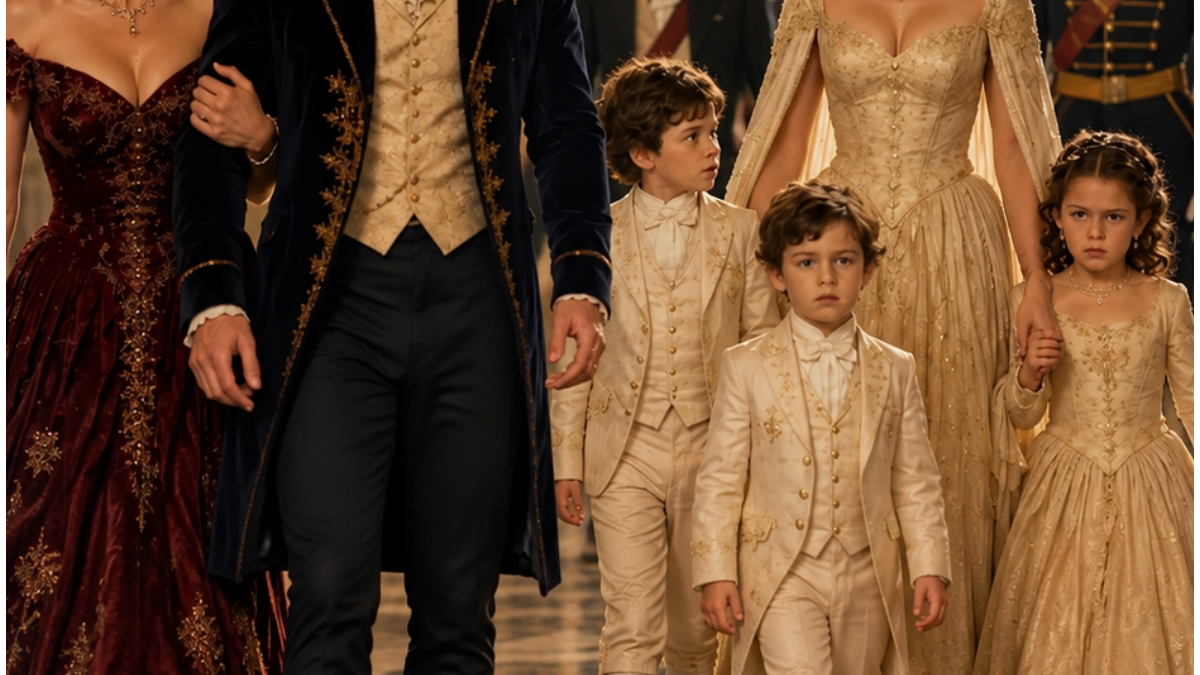
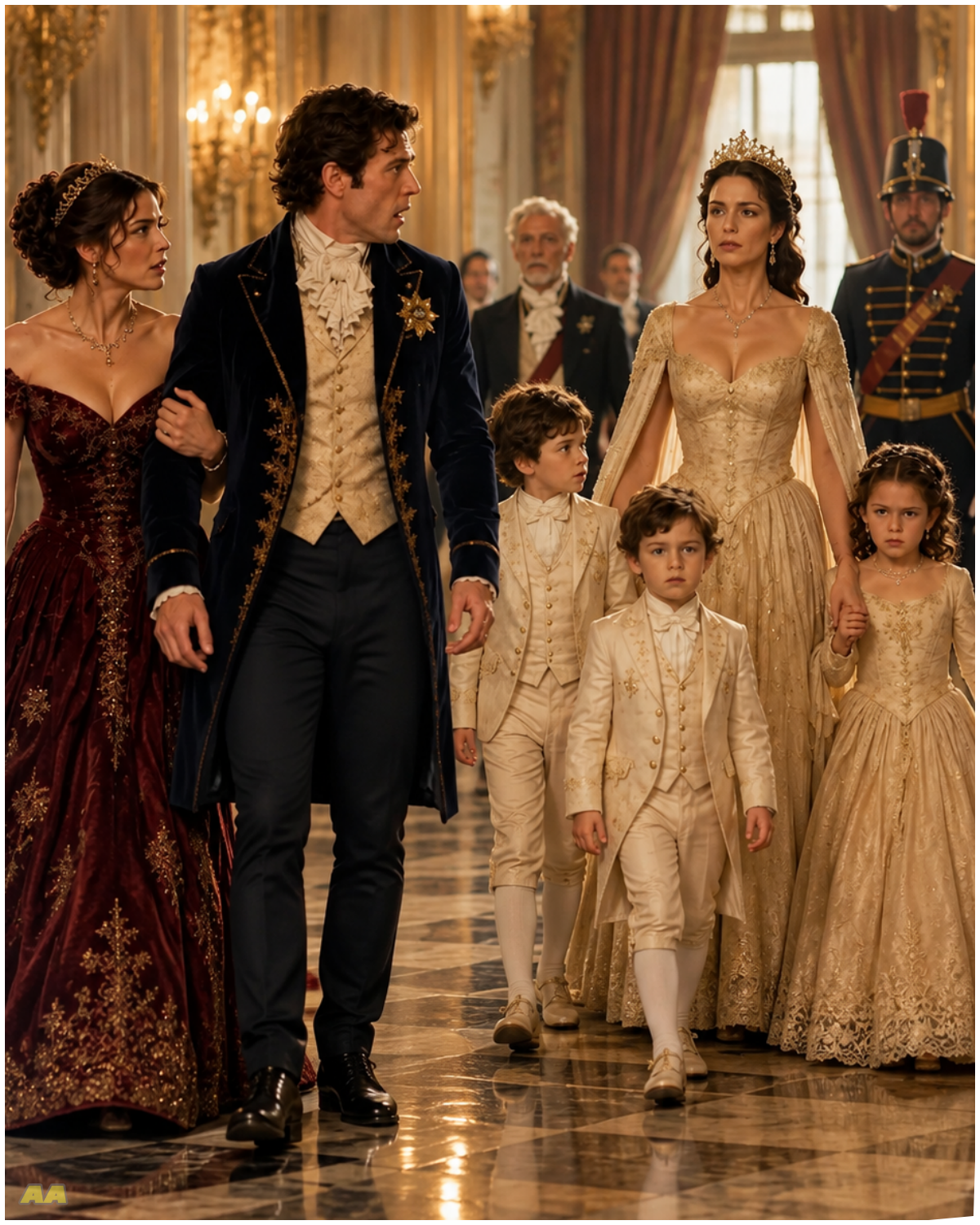
The clasp on her cloak would not close.
Margaret tried it once, then again, her gloved fingers slipping over the silver fox that had been her mother’s and her mother’s mother’s before that.
And she had perhaps 4 minutes before the carriage at the bottom of the steps would be turned away by the master of horse who did not, as a rule, indulge latecomers and certainly did not indulge women who had been struck from the guest list 11 months ago by a single ink stroke and a single signature she see when she closed her eyes.
Behind her, in the narrow upstairs room of the rented house on Coppergate Lane, three small voices were doing what three small voices do when they have been told very seriously to be silent.
They were not silent.
They were conferring.
They were debating in the particular grave whisper of children who have rehearsed importance which of them would walk first into the hall and which of them would walk last and which of them, the smallest by a quarter of an inch, would carry the velvet box.
The velvet box was the size of a loaf of bread.
It was heavier than it looked.
It did not, at this hour, contain bread.
The clasp gave. She breathed out.
She did not let herself look in the glass above the hearth because she knew what she would see there and she did not have the time tonight to argue with her own face.
There would be a great deal of looking later.
Let it wait. Downstairs the boy from the stable knocked twice on the door, the agreed signal, and called up that the horses were restless and the driver was beginning to make the sort of small coughs that drivers make when they wish to be paid for waiting.
Margaret called back that she was coming.
She turned. She knelt. She looked for a moment at the three of them lined along the bed like a small council of state, three pairs of dark eyes above three identical white collars.
And she felt, against her will, the old throb under her ribs that she had been so careful for so many months to refuse.
She put her gloved hand to the cheek of the eldest, who was eldest by 7 minutes, and had never let the other two forget it.
And she said, quietly, “You remember what we agreed. We do not run. We do not speak unless spoken to first. We do not let go of one another’s hands until I say. And when I say, you walk straight to me, not to him, to me.”
The eldest, whose name was Aldous, nodded once, like a man receiving an order he had received before.
The middle, whose name was Cassian, mouthed the instructions back as if to be sure they had been pronounced correctly.
The smallest, whose name was Wren, and who had been quietest in the womb and had remained so, simply lifted the velvet box and held it against his chest with both hands.
And his small jaw, set in the way she had begun to recognize, was not stubbornness, exactly, but something steadier and older, and harder for a mother to look at without flinching.
She had not meant to come tonight.
She had told herself, for 10 of those 11 months, that she would not come.
She had refused the letters at firSt. She had refused the discreet visits from people who had once called themselves her friends and now called themselves witnesses.
She had refused even to read the printed accounts when they began to appear, the brief paragraphs in the court papers that referred to her, when they referred to her at all, as the former Duchess of Halverston, that small gray adjective doing the dignified work of a knife.
She had refused. And then, the letter had come from the dowager, written in a hand Margaret had not seen in a year, the looping confident hand of a woman who never asked twice.
The letter was three sentences long.
Margaret had read it standing at the kitchen table, in the unlit kitchen, with the boys asleep in the room above her, and the rain coming sideways against the window.
And she had read it twice, and then she had folded it into quarters, and slid it under the salt cellar.
And she had sat down on the kitchen chair and put her face into her hands and laughed.
Once, a short dry laugh that surprised her.
Because she had not laughed in some time.
The letter said, in essence, “Come. Come on the night of the ball. Bring the boys. Bring everything. I have waited.”
The carriage was very cold.
Wren leaned against her hip, and she put her arm around him without looking down, because looking down would undo her, and she had not survived the last 11 months by being undone in carriages.
Kassian sat opposite, swinging his small boots in the small space, until Aldous, without turning his head, laid a hand on his brother’s knee, and the swinging stopped.
They had become, in the months in the rented house, a small organism with three heads and one careful pulse.
And they had learned, without being taught, when to fall in with one another, and when to be still.
She would never quite forgive their father for that lesson.
She would never quite forgive herself, either, for being the one who let it be taught.
The streets through the carriage window were the streets she had once driven through as a matter of course, and they had not changed at all.
And that was the part that struck her now.
The sheer indifference of the lamps along the avenue, the unbothered ordinariness of the shop fronts at the corner of Mercer’s Row, the way the railings outside the bishop’s house still bent inward at the third post from the gate where a thousand years ago she had snagged the hem of a green silk skirt and laughed about it for the rest of an evening.
She had been a different woman in that skirt.
She had been, in fact, a girl.
Tonight, she was something else.
The carriage slowed. The driver said, “Quietly, my lady, the gates.”
She had asked him not to call her that.
He had not listened. There were a great many things, she had come to understand, that men did not listen about, and the use of an old title by a kindly stranger was not, in the present scheme, the worst of them.
She lifted the curtain. The palace was lit the way it was always lit on these nights.
Every window a soft yellow square.
Every torch along the carriage drive set at a precise distance from the next.
The whole long facade made gentle by the particular trick of light on pale stone after rain.
She had stood at the top of those steps as a bride.
She had stood at the top of those steps when the boys were three days from being born, vast and slow and laughed at kindly by the queen herself, who had taken her elbow and walked her very deliberately in front of every woman in the room who had whispered behind a fan that no woman so small could carry three.
The queen had said that night softly into Margaret’s ear, “Let them count, my dear. Let them all count. We have done harder things than this.”
Margaret had remembered that sentence many times in the months since.
She had repeated it to herself at the kitchen table in the dark.
She repeated it now. The carriage stopped.
The boy at the door of the carriage was new and young and did not know her face.
He opened the door and offered his hand and saw the three small faces inside and faltered the way young men faltered when something did not match the list they had been handed.
He recovered. He was well trained.
He said, “My lady.” and offered his hand again.
And Margaret took it and stepped down and the boys stepped down behind her in their agreed order.
Aldous first, Cassian second, Wren last and last because of the box.
The gravel under her shoes was the same gravel.
The smell of the wet boxwood was the same smell.
At the top of the steps, behind the great open doors, she could hear the music already begun.
The soft underlayer of strings that always preceded the announcing of guests.
The murmuring of a hundred conversations layered over one another like a tide.
Somewhere in that tide was the man she had been married to for nine years.
Somewhere in that tide, she knew because she had been told and because she had finally allowed herself to be told, was the woman he had brought tonight on his arm.
She did not let herself picture either of them.
She had work to do and picturing was a luxury for after.
She took Wren’s free hand.
She nodded to Aldous. They climbed.
At the door at the steward had been warned, she saw it in the set of his shoulders before she saw it in his face.
He was a man she had known for years, a man who had once shown her in confidence a small drawer in his desk where he kept dried lavender from his late wife’s garden because the smell, he had said, kept him honest in a building where honesty was a difficult flower.
He looked at her now and his eyes did the small thing eyes do when they are choosing in a single second between an old loyalty and a new instruction.
He chose. He bowed. He said, very quietly, “Your Grace.” She inclined her head.
She did not correct him.
The Grace was not hers any longer in law, but the steward was not tonight a man of law.
He was a man of lavender.
She would not embarrass him.
He glanced at the boys and at the velvet box in Wren’s small, careful arms and something passed across his face that she could not read and did not have time to read and he turned to the great inner doors and he placed his hand on the brass handle and he paused.
He paused longer than he had ever paused for any gueSt. He said, again very quietly, “The dowager asked me to wait for your nod, Your Grace.” Margaret stood at the top of the wide stone landing with her three sons gathered at her hip and the music of an entire court beyond the door and she thought, briefly, of the kitchen table in the rented house and of the salt cellar and of the laugh she had laughed alone in the dark.
She nodded. The doors opened.
The room beyond did not, at first, notice.
That was always the way of these rooMs. They were too large and too full and too lit to notice anything in a single instant.
And the announcement of a guest was a slow chemical reaction that began at the door and traveled, by gossip and by glance, in concentric rings outward toward the far wall, where the throne was set on its dais under the long banner of the kingdom, embroidered with the bird whose meaning no living person could quite agree upon.
She had stood under that banner.
She knew its threads. She knew that the third feather from the left had been resown after a candle had fallen in the year of the long winter, and that the resowing had been done by a woman named Hetty, who had since gone blind and now sat in a back room of the south wing with her hands in her lap and her memory intact.
And who, when Margaret had visited last spring, had said, “My lady, I knew you by the sound of your steps even now.” Margaret stepped over the threshold.
The steward did not, this time, announce her.
The dowager had asked him not to.
The boys came with her in their three-headed quiet, and the first ring of the chemical reaction began in the cluster of guests nearest the door.
An old marquis and his much younger wife, and envoy with a sash of an unfamiliar color, and the marquis saw her first, and his glass stopped halfway to his mouth, and the envoy, who did not know her, saw only that the marquis had stopped and turned to see why, and so on, outward in the slow, widening way these things go.
Margaret did not look at any of them.
She walked. She had decided in the carriage that she would walk the long way, not the short way, around the edge of the floor, past the windows, under the high gallery where the musicians sat, past the long table of the lesser guests, the route that would take her in full view of every part of the room before it brought her to the foot of the dais.
She had decided this because she wanted to be seen, fully and without ambiguity, by every person in the room before she was seen by him.
She did not yet know where he stood.
She did not look. The first eyes she met were the eyes of an old friend, a woman named Lisette who had been one of the friends who had stopped writing in the third month, and who now stood by a column with a glass in her hand and a small look on her face that Margaret had seen before, on other faces, in other rooms, the look of a person caught in the act of pretending not to have been caught.
Lisette did not speak. Margaret did not speak.
They passed one another at four paces.
That, Margaret thought, was a kind of conversation in itself.
She walked on. The boys walked with her in their precise small order.
Aldous had set his chin in the way his grandfather had used to set his chin, which was a thing Margaret had not taught him and had not realized until tonight he had learned.
Cassian was looking with the bright open curiosity of a child who had been kept too long in a small house at the chandeliers and at the gilded ceiling and at the great clock above the dais whose pendulum moved with the slow patience of an animal that had nowhere in particular to be.
Ren walked with the velvet box pressed against him and his eyes on the floor, counting, she suspected, the dark squares between the light squares because Ren counted when he was nervous, and he was nervous now, although a stranger would not have seen it.
The murmur in the room thickened.
She felt it before she heard it, the way one feels weather.
Heads were turning. Fans had paused at the level of throats.
A woman near the punch table whispered audibly, “But those are and another woman, sharper, said, “Hush.” Margaret did not turn.
She did not need to turn.
She knew the geography of the room and she knew where the dais was and she knew, by the slight thickening of the murmur at her left shoulder, where he must be standing, and she knew, by the further small ripple within that thickening, that he had turned and seen her and that the woman on his arm had turned and seen her, too.
She did not look. She walked.
At the foot of the gallery, an old man stepped forward.
A man she did not know well, but had liked, a retired admiral with a stiff knee and a habit of telling longer stories than his audience required.
And he bowed to her and his bow was deep and it was the deep bow of a man who had decided which side of the room he stood on tonight.
She inclined her head to him.
She kept walking. Behind her, in the path she had already crossed, she could feel the room beginning to do the thing rooms do when a story is unfolding inside them faster than the room can keep up with it.
Glasses were lowered. Conversations were abandoned mid-sentence.
A small servant girl with a tray of cordials stood still in the center of the floor for two full seconds, simply forgetting to move, and then remembered, and moved.
Margaret reached the long windows.
The night beyond them was wet and dark and indifferent, and she caught in the black glass the reflection of herself walking, and of the three small boys walking beside her, and she did not, after all, flinch at her own face.
She looked, she thought, like a woman who had decided something.
That would have to be enough.
At the far end of the room, on the steps of the dais, a figure rose.
The dowager. Margaret did not let her step quicken.
She did not let her step slow.
The dowager did not descend.
She simply stood at the top of the steps in her plain dark blue and her plain pearl pin, and she watched Margaret walk the long way around her own old life, and Margaret understood, without being told, that this was the part of the plan in which she was meant to be alone, and that the dowager would meet her only when she had been seen by every eye in the room, and that the seeing was the point.
So she walked. So she let them see.
She had not always been a woman who could walk a room like that.
She had been, when she first came to the court, a creature of small, anxious courtesies, a young woman who said please too often and thank you too late, who had been raised in a quiet northern house by a quiet northern father and a sharp, clear-headed mother, and had been sent south at 17 with three trunks, two pieces of advice, and a horse she had been told, gently but firmly, she could not bring.
The first piece of advice had been from her father, and it had been, “Do not let them see you flinch.” The second had been from her mother, and it had been, “When you cannot help flinching, flinch on purpose, so that they think you meant it.” Margaret had used the second more often than the firSt. She had used it on her wedding day, when the long aisle had seemed to lengthen with every step, and she had used it on the day she was first presented to the queen, and she had used it again and again on the small private occasions when her husband, who was a man of many strengths and one cold central absence, had looked at her with the polite distant face that meant he had remembered in the middle of a conversation about her that he had somewhere else to be.
She had used it on the day, 11 months ago, when the lawyer had read aloud the document that ended their marriage in 12 clauses and a signature.
She had flinched on purpose then, deeply and visibly, so that the lawyer, who had pitied her, would not pity her any longer.
It had worked. He had stopped pitying her by the third clause.
By the eighth, he had begun, almost against his will, to admire her.
By the 12th, he had asked, very quietly, whether she wished him to write to anyone on her behalf.
And she had said, “No, thank you.” And she had walked out of his office into the bright cold street, and she had stood on the curb for a long minute, and she had thought, with a clarity that surprised her, “So, now we begin.” The boys had been small then.
They were still small now, but they had been smaller.
She had taken them north for a time, to her father’s house where her father was dying slowly in the way the men of her family always died with great dignity and great inconvenience to everyone around them and she had sat by his bed in the afternoons and listened to him not complain and she had walked the boys on the moor in the mornings and she had begun slowly to understand what she had been given and what she had been taken from.
She had been given three sons who by every law of the land by every old custom of the kingdom by every line of the long agreement that had been signed between her family and his were the heirs of the Duchy and in a more complicated and more dangerous sense that her father had explained to her one evening with a slow patience of a man who knew his time were the heirs also of something rather larger than the Duchy.
She had been taken from a marriage she had been taken from a position a household a name.
She had not despite the document and its 12 clauses and its single signature been taken from any of the things that actually mattered.
Her father had told her this in the failing light of his bedroom in the north with the curtains half drawn and a cup of weak tea cooling on the table beside him and he had said Margaret listen to me.
The man who signed that paper does not understand what he signed.
He thought he was setting you aside.
He has in fact sharpened you.
He has in fact handed you the entire room.
Use it slowly. Do not use it in anger.
Wait for an evening when the whole court is gathered and the king is present and the queen is watching and walk in with your sons and let the room remember what it has been pretending to forget.
She had laughed at him a little at the time.
She had said, “Father, I am not a chess piece.” He had smiled with the small, tired smile of a dying man, and he had said, “No, my dear, you are not.
You are the player.” Three days later, he was dead.
She had buried him in the small churchyard at the foot of the moor in the rain with the boys standing in a row at the edge of the grave, and she had come back down south with the dowager’s letter already, although she did not know it yet, on its way to her kitchen table.
The dowager. The dowager had been her enemy firSt. That was the thing it was important to remember walking now under the long banner with the bird whose meaning no one agreed upon.
The dowager had not wanted the marriage.
The dowager had said so plainly in a room with five other people present in the spring before the wedding when Margaret had been brought to be examined like a horse and had been examined, in fact, in much the same spirit.
The dowager had said, “She is too small to bear sons.” The dowager had said, “She has the wrong sort of laugh.” The dowager had said, “She will not last a winter at court.” Margaret had borne three sons in a single afternoon, had laughed exactly as she pleased for nine years, and had lasted, by her count, nine winters and a fraction.
She and the dowager had become, over time, something that was not friendship and was not love, but was, perhaps, a kind of grudging mutual recognition between two women who had each underestimated the other and had each, in private, corrected the error.
When the document was signed, the dowager had written Margaret one short note in the same looping confident hand, and the note had said only, “I am sorry.
I was wrong about him.
Use me when you need me.” Margaret had not used her.
Margaret had gone north, had buried her father, had come south, had taken the rented house on Coppergate Lane, had paid the rent in advance for a year out of a small private fund her mother had set aside for her decades ago, and that the document had failed to find, and she had not used the dowager until the letter, until come on the night of the ball, bring the boys, bring everything.
I have waited. She reached the center of the long room.
She paused deliberately for a count of three.
The murmur in the room reached its highest pitch, and then, very strangely, dropped, because rooms, when they understand that something is about to be done, fall quiet on their own.
She heard, for the first time, the small particular sound she had been listening for, without knowing she was listening for it, a small intake of breath, sharp and short, from somewhere to her left, at the level of the dais, where she knew, without looking, he was standing.
She did not turn. She walked.
The boys walked with her.
The dowager waited. He had brought his mistress.
That was the phrase that had been used in the letter from a friend she had been refusing to read, the letter she had finally read three nights ago at the kitchen table, the letter she had folded into quarters and put, with a small grim symmetry, under the salt cellar beside the dowager’s.
He had brought his mistress to the ball.
The friend who had written it had used the word with an audible wince, as if writing it had cost her something, which it had.
The word was an old word.
It carried, in this court, in this season, a particular weight, because the ball was not an ordinary ball, although it was always called only the ball, with a soft definite article that meant there could be only one.
It was the ball at which the king, every year on the same night, was understood, by long custom, to acknowledge the standing of the great houses of the kingdom.
To nod or not to nod to certain people, to speak or not to speak to certain others, to permit or not to permit certain small physical gestures, a hand on a sleeve, a kiss to a glove, that were read the next morning in every drawing room from the river to the sea, as if they had been written down in law.
To bring a mistress to the ball was therefore not a private indiscretion.
It was a public sentence.
It was a thing said aloud in front of the king.
It said, “This woman is now to be acknowledged.” It said, “The former woman is now to be forgotten.” He had said it.
He had said it tonight in front of the king, in front of the queen, in front of the dowager, who had once told him, in his own nursery, that he must never lie to a woman of his own house.
He had said it with his arm.
The arm was on the woman now, as Margaret crossed the center of the floor, and Margaret, having promised herself she would not look, found that her promise had been a kind of polite fiction, and that she would, in fact, look, and that she would look once and not again.
She looked. She did not turn her head.
She used the trick her mother had taught her at 12, which was to slide the gaze sideways under the lashes while keeping the face forward.
A small theatrical thievery of a glance, and she saw him in the half second she allowed herself, standing at the foot of the dais on the left in his dark blue with the gold at the collar.
His hair shorter than she remembered.
His jaw, the same jaw.
The small old scar at the line of the cheek where he had fallen from a horse at 22, and had been embarrassed about for a year, and proud of for the rest of his life.
She saw the woman on his arm.
The woman was not what she had expected.
The woman was older than she had expected, was plainer than she had expected, was in fact a woman she had once spoken to at a garden party four years ago about the cultivation of late autumn roses, and had liked.
That was the part Margaret had not been prepared for.
She had been prepared for someone she could despise on sight.
She had been prepared for a beauty so unkind, it would simplify the evening.
She had not been prepared for a woman who, in another life, in a different room, on a different afternoon, had laughed with her about the difficulty of getting a particular yellow rose to take in heavy clay.
The woman saw Margaret. The woman did not flinch.
The woman, to her credit, lifted her chin a small degree and looked back.
And there was, in the look, something Margaret read very quickly and filed away to consider later, which was that the woman on his arm had not, perhaps, known about the children.
Not all three of them.
Not in the row in which they now walked.
There There a particular small failure of the face that occurs in a person who has been told one version of a story and is now seeing another, and Margaret saw it.
She filed it. She walked on.
She did not look again.
She had used her glance.
The boys, who had been told nothing of who they would see, had not been told because there was no version of telling them that would have done anything but harm.
Aldous, who watched his mother’s face the way smaller animals watch the weather, had felt the small unallowed glance happen at his side, and his small jaw had set further, and his hand had tightened on hers a fraction.
Cassian had not noticed. Cassian was still looking at the ceiling.
Ren had stopped counting the squares and was, she realized with a soft inward pang, counting now the steps to the dais, which was a thing she had not asked him to do, but which he was doing because Ren, when frightened, made small private games of arithmetic, and the games kept him steady.
He was at 142 when she reached the foot of the steps.
He whispered the number very softly, almost only to himself, but she heard it because she had become, over the year in the rented house, a woman who could hear her smallest son’s smallest sounds across any room.
She squeezed his hand. He did not look up.
He was at 143 now, counting the steps he had not yet climbed.
The dowager stood at the top.
The dowager had not moved.
The dowager was, Margaret saw now, holding something in her left hand, a thin dark folder of the kind used by clerks of the court to carry documents that were not yet, technically, in the public record.
The dowager’s right hand empty, palm down at her side, in the practiced rest of a woman who had been waiting a long time for an opportunity and had decided not to fidget through it.
Behind the dowager, on the dais itself, the king sat in the high carved chair.
And the queen sat in the chair beside him.
And between them, on a smaller chair that had been placed there only in the last hour, sat a thin old man in a plain gray coat whom Margaret did not at first recognize, and then recognized with a small jolt as the chief herald of the kingdom, a man who appeared in public perhaps three times a year and never at balls.
And whose presence here, in that chair, with that posture, meant that something was about to be entered, formally and in the hearing of the court, into the long unrolling record of the realm.
Margaret understood, in that instant, the full shape of what the dowager had arranged.
She understood why the letter had said bring everything.
She understood why Wren had been told, that afternoon in the rented house, to carry the velvet box with both hands and not to set it down for any reason, even if he was tired, even if his arms hurt, even if a kind stranger offered to take it from him.
She understood that she had not, after all, walked into a ball.
She had walked into a hearing.
The chamberlain at the foot of the steps stepped forward and bowed to her.
And his bow was not the polite bow given to a gueSt. It was the older bow, the bow given to a person whose name was about to be read aloud in a particular way.
And he said, in a voice pitched to carry to every corner of the hushed room, “Her grace, the Duchess of Halverston, with the three young lords, her sons.
Somewhere to Margaret’s left, very softly, like a glass set down too hard on stone, a man said no.
She did not turn her head toward the sound.
She had heard it. She did not need to confirm it.
She placed her foot on the first step.
The boys placed their feet on the first step behind her in their precise small order.
The chamberlain stepped aside. The dowager did not move, but her eyes met Margaret’s and there was in those eyes a thing Margaret had not seen in them in 9 years, which was something very close to apology.
Not for tonight. For everything before tonight.
Margaret inclined her head, the smallest possible inclination, and the dowager inclined hers back, and the two of them had the entire conversation that had been owed between them for 9 years in the space of a single shared breath, and then it was done, and they were back inside the public moment, and Margaret was climbing the steps with her sons.
At the top of the steps she paused.
She turned for the first time to face the room.
The room was entirely silent.
The musicians in the gallery above had stopped playing, not because anyone had signaled them, but because musicians, like rooms, know when to stop.
The king sat very still.
The queen beside him was leaning forward slightly with her hands folded in her lap and her face composed in the particular expression Margaret had seen on it years ago in the matter of the small carrying.
The expression that meant let them count.
The queen did not look at the Duke.
The Queen looked steadily at Margaret and at the three boys lined up behind her and her eyes did the smallest possible thing at the corner, the smallest possible warming and Margaret felt, in spite of herself, a thing she had not let herself feel in a year, which was the feeling of being recognized by a person who had bothered to remember her.
The Dowager stepped forward then, only one pace, only as much as was needed, and she lifted her voice and her voice was the voice Margaret had heard once before on the spring afternoon when the Dowager had said, “She is too small to bear sons.” And it was the same voice and it was a different voice because the Dowager was using it now in the opposite direction.
The Dowager said, “Your Majesties, with your leave, there is a matter to be set straight before the dancing.” The King inclined his head.
He did not speak. He rarely spoke at the ball.
His inclinations did the work of paragraphs.
The Dowager turned, only a quarter turn, toward the figure at the foot of the dais on the left, the figure in the dark blue with the gold at the collar, and she did not look at the woman on his arm because the Dowager, even in this, was a woman of precise economies and the woman on his arm was not, in this moment, the subject.
The Dowager said, “My son.” The word fell into the silent room with the weight of an old word being used for the first time in a long time in its full sense.
He did not answer at once.
He had perhaps the longest second of his life to choose what to say and Margaret, who had been married to him for nine years and had watched him choose what to say in many long seconds, knew before he opened his mouth what he would attempt.
He would attempt charm. It was, in difficult rooms, his one reliable instrument, and he had used it on her in the early years in such a way that she had not even noticed it was an instrument.
She noticed now. He said, “Mother, this is, with respect, neither the place nor the The dowager did not let him finish.
The dowager said, “It is the place.
It is the hour. It is, in fact, the only place and the only hour for what is now to be said, because what is now to be said concerns the standing of this house before the crown and the standing of these three children before the law, and you have, by your choice of escort tonight, made the saying of it necessary in this room rather than in a smaller one.
I would have preferred the smaller room.
You have denied me that preference.
So, here the room did not move.
The room had perhaps 200 people in it, and not one of them moved.
Margaret stood at the top of the steps with her three sons behind her and felt, against the small of her back, the soft consistent presence of Wren’s velvet box, and she understood, without being told, that the box would be opened in a moment and that what was in the box would be entered by the Chief Harold in the gray coat into the long unrolling record of the realm.
And that the entering would be heard in its full weight by the man in the dark blue with the gold at the collar, and by the woman on his arm, and by the king, and by the queen, and by every person in the room who had, in the last 11 months, refused to write to Margaret or had crossed a street to avoid her, or had whispered behind a fan that no woman so small could carry three.
She let her shoulders drop a fraction.
She had not realized she was holding them.
She turned to Ren. She knelt briefly in front of him in full view of the room because she did not in this moment care any longer how a duchess was meant to comport herself on a dais, and she put her gloved hands over his small hands on the velvet box, and she said very softly only to him, “You can give it to me now, my love.
You did beautifully.” He looked at her then for the first time since they had entered the hall, and his eyes were the eyes of his grandfather, the quiet northern man who had died in a half-drawn room with weak tea cooling on the table, and he said in a whisper only she could hear, “I counted them, Mama, all the steps.
I did not lose count once.” She said, “I know you did not.” She took the box.
She rose. She turned with the box in her hands to the dowager.
The dowager nodded. The dowager said to the chief herald in the gray coat, “Sir, if you would.” The chief herald rose from his small placed chair.
He came forward slowly with the slow careful gait of a man whose knees had carried him through a great many ceremonies, and he stood beside Margaret, and he bowed, and Margaret opened the box.
Inside the box, on a folded square of pale linen, lay three things.
The first was a small heavy seal of a kind not used in the present generation, a seal that had belonged to her father and to her father’s father, and which carried on its face a device that was not the device of any Duchy in the kingdom because it was older than any Duchy in the kingdom and was in fact the original device of a small northern line that had by a marriage 400 years ago that had been forgotten by everyone except the heralds and the dowager the right in the failure of a certain other line to be considered.
The second was a folded paper sealed twice in two different waxes which Margaret had carried out of her father’s bedroom on the night he died and had not opened because she had not needed to.
Because she knew what was in it.
Because her father had told her in the failing light with the curtains half drawn.
The third was a small lock of dark hair tied with a thin gray ribbon which Margaret had cut from each of her sons on the morning of their first birthday and had braided together into one strand and which had no legal weight whatsoever and which she had placed in the box anyway because the box was not only a legal object.
And because Ren when she had shown him what was inside the night before had looked at the small braided strand and had said that is us and she had said, “Yes, my love.
That is you.” The chief herald in the gray coat looked at the seal.
He looked at the folded paper.
He did not with any discourtesy look at the lock of hair which was not after all his business.
He took the folded paper.
He broke the two seals with the careful small movements of a man who had broken a great many seals in a long life and he read silently what was written inside and his face did not change because the faces of chief heralds do not change but his shoulders, which had been very slightly stooped, straightened by a small precise degree, and he turned with the paper in his hand to the king.
He bowed. He said, “Your Majesty, the document is in order.” The king, who had not yet spoken, spoke now.
His voice was quiet. It had always been quiet.
He said, “Read it.” The chief herald read it.
He read it slowly in the flat unornamented voice in which such things are read, the voice that does not embellish and does not soften and does not, on any account, hurry.
He read the date of the marriage 400 years ago and the names of the two persons joined by it and the witnesses to it and the small clause at the end of it that had, at the time, been considered a courtesy and had become, over four centuries and the unpredictable failures of certain other lines, something rather more than a courtesy.
He read the line of descent.
He read the names in the line of descent, each in its turn, generation by generation, and the room listened and the room understood, slowly, that the line of descent was Margaret’s line and that the names he was reading were the names of her grandmothers and her great-grandmothers and the women before them and that the line did not stop at her and that the line did not stop at her sons and that there was, in the small clause at the end, a particular ordering of inheritance that, in the failure of a certain other line, the failure of which had been quietly recorded by the heralds three months ago and had not yet been announced because there had been no occasion at which to announce it, placed three small boys standing on a dais in a hushed ballroom in the direct line of succession to a thing rather larger than the Duchy of Halverston.
The Chief Herald finished reading.
He folded the paper. He returned it to Margaret with a small bow, and Margaret took it and laid it back on the folded linen in the box and closed the lid.
The room did not move.
The room could not, at that moment, move.
Somewhere at the back, near the great doors, a glass slipped from a hand and shattered on the marble, and the sound was the only sound.
And then, even that sound was over, and the silence resumed.
The duke in the dark blue with the gold at the collar was very pale.
The woman on his arm was no longer on his arm.
She had stepped back, one small, careful step.
The step of a person who has realized she is standing too close to the edge of something, and her hand had come to her throat, and Margaret felt, in spite of everything, a small, unwilling pity for her because the woman had not, after all, known.
The dowager turned to the king.
The dowager said, “Your Majesty, the children of the former Duchess of Halverston, who is no former at all in the matter now read, are presented to Your Majesty tonight in their proper standing.
I ask only that the record reflect what the herald has read, and that the children be acknowledged by Your Majesty’s hand.” The king sat for a moment.
He looked not at the dowager, and not at the duke, and not at the woman who had stepped back, but at the three small boys on the dais in their identical white collars with their dark eyes.
He looked at Aldous first, who met his look without He looked at Cassian second, who having finally remembered that he was not in a cathedral, dropped his gaze from the chandeliers and met the king’s look with the bright open curiosity of a child who was not yet old enough to be afraid of kings.
He looked at Wren laSt. Wren did not, at first, lift his eyes.
Margaret, beside him, did not prompt him.
She had decided in the carriage that she would not prompt him in anything tonight.
He was, she had decided, old enough to be his own small man on his own small evening.
Wren stood with his hands now empty at his sides, having given up the box, and he looked at the floor for the count of perhaps three of his careful seconds, and then, with the same small steadiness that had set his jaw in the upstairs room on Coppergate Lane, he lifted his eyes and looked at the king.
The king smiled. It was a very small smile.
It was the smile of a man who had been a king for a long time and had seen a great many things presented in a great many ways, and who had, despite that long seeing, been moved by what he saw now.
He rose. The whole room, which had been still, became, at the rising of the king, the kind of still that has direction in it.
He came forward two steps to the front of the dais.
He lifted his right hand.
He did not, contrary to the expectation of every person in the room, place his hand first on the head of the eldeSt. He placed his hand, very gently, on the head of Wren, who was the smallest and who had that night carried the box.
He said, in In quiet voice that did not need to be loud because the room was already entirely his, “My lord.” He said it once, and then he moved his hand to Cassian’s head, and he said, “My lord.” And then he moved his hand to Aldous, and he said, “My lord.” Then he turned to Margaret.
He did not take her hand.
He inclined his head. He said, “Your grace.” And then, because he was a king and had the right to add what he chose, he added, “We have missed you in this house.” Margaret could not for a moment speak.
She had prepared for many things on the long walk around the edge of the floor, and she had not prepared for kindness.
She inclined her head. She did not trust her voice.
The king understood. He turned finally to the man in the dark blue with the gold at the collar.
He looked at him for a long second.
He did not speak. He did not need to.
The look did its own work.
Then the king turned and walked back to his chair and sat.
And the queen beside him smiled at Margaret a small smile that was the smile of an old promise being kept, and the dowager stepped back.
And the chief herald in the gray coat returned to his small placed chair, and the room, which had been holding its breath for a count of beats no one would later be able to agree upon, breathed out.
The musicians in the gallery, who had not been told what to do, did the thing musicians do, which was to begin, very softly, the opening passage of an old air that had been played at this court since before any person now in the room had been born.
An air that did not belong to any particular event, and could be played at any of them without giving offense.
And the playing of it was its own small announcement that the formal part of the evening was, by the music’s quiet authority, ended, and the dancing part might, in due course, begin.
Margaret turned. She took her sons, one by one, by the hand.
She did not, even now, look at the man in the dark blue.
She had used her glance.
She walked down the steps of the dais in the opposite direction from the one in which she had come up, and a small lane opened in the room for her to pass, and the lane was made by the same people who had, 11 months ago, struck her from a guest list and crossed streets to avoid her, and she walked through them, and she did not look at any of them.
At the foot of the steps, the dowager met her briefly, and the dowager, who was a woman of precise economies, said only, “Well done.” Margaret said, “Thank you.” The dowager said, “I will come to Coppergate Lane in the morning.” Margaret said, “Please do.” The dowager said, “Also, on the matter of the woman.” And Margaret said, quickly, “Leave her be.” She did not know.
The dowager looked at her for a long moment, and then nodded, and the matter of the woman was, by that nod, decided.
She did not, after all, dance.
There would be other balls and other dances, and tonight was not, she had understood, from the moment she stepped onto the dais, an evening for dancing.
She walked instead, with her three sons, the long way back around the edge of the floor, past the long windows where the rain had begun again against the black glass, past the long table of the lesser guests, where the old admiral with the stiff knee was standing, and bowed to her again, more deeply this time.
And where Lisette, the friend who had stopped writing in the third month, took a step forward as if to speak, and then, seeing Margaret’s face, took a step back.
And Margaret felt no triumph at the stepping back, only a small clean tiredness, the tiredness of a thing finally set down.
She walked. She walked under the high gallery where the musicians played the old air softly above her.
And she walked past the cluster of guests nearest the door, where the marquis and his much younger wife and the foreign envoy with the sash of an unfamiliar color stood now arranged in a different small geometry, the marquis bowing very low.
The younger wife trying not to stare at the children.
The envoy, who had still not entirely understood what had happened, smiling the polite international smile of a man who has decided to be on the side of whichever person seems most certain.
She walked to the door.
The steward who had kept dried lavender in his desk drawer was at the door.
He opened it for her.
He did not speak. He did not need to.
His eyes did the small thing eyes do when an old loyalty has been vindicated, and Margaret, who had not allowed herself to weep all evening, found that she would have to do her weeping later, in private, because the steward’s small look had nearly finished her on the threshold, and she would not allow it to finish her in public.
She stepped through. The boys stepped through behind her.
On the landing at the top of the wide stone steps, the night was cold, and the rain had quieted to a thin steady whisper.
And the boy from the carriage, who was new and young and had not known her face when she arrived, was standing at attention beside the open door of the carriage, and his attention was different now, because someone had told him in the half hour since she had gone in who she was and who the boys were.
And his face, lit by the carriage lamp, was the face of a young man who would tell this story for the rest of his life and would, with each telling, gild it a little more.
And that, Margaret thought, was permitted.
She helped the boys in.
Ren went first now. He climbed in by himself.
He did not look back.
He had carried the box.
He had counted the steps.
He had earned, by every small measure he understood, a seat by the window.
Cassian climbed in after him and immediately began to talk in the low, fast murmur of a child who had been holding talk in for 2 hours and could no longer hold it.
About the ceiling, about the chandeliers, about the clock above the dais whose pendulum moved with the slow patience of an animal that had nowhere in particular to be.
Aldous climbed in last and sat opposite his brothers and did not, at first, speak.
And then, in the small voice he had inherited from his mother, said, “Mama, was that very bad of us?” Margaret, who had one foot in the carriage, paused.
She looked at him. She said, “No, my love.
That was not bad. That was the opposite of bad.” He said, “Will Papa be angry?” She said, “Perhaps.” He said, “Will it matter?” She said, “No.” She climbed in.
She closed the door. The carriage moved.
The wet streets through the carriage window were the same streets she had driven through on the way to the palace and they were not the same streets because she was not the same woman who had driven through them.
And she allowed herself, finally, the small luxury of looking at her own reflection in the black glass beside Wren’s small dark head.
And she did not, in that reflection, see a former duchess or a duchess restored, or a woman who had walked a long room and survived it.
She saw, simply, a mother in a wet cloak with three small sons asleep almost against her side.
And she thought, “That will do.” The carriage turned the corner onto Coppergate Lane.
The lamp at the end of the lane was lit.
The boy from the stable was waiting at the door of the rented house with a lantern in his hand because the dowager, who arranged what she arranged, had sent word that he should wait.
And Margaret stepped down from the carriage and gathered her sons and walked them up the small stone steps of the small rented house.
And the boy from the stable held the lantern high so that none of them stumbled.
And the door opened, and the warm small hallway of the house received them, and the door closed behind them, and the night, which had been an enormous public night, became, in the closing of that door, a small private night of three small boys to be undressed and put to bed.
And that, Margaret thought, was the right shape for it to take.
Upstairs, in the narrow room, she undressed Wren first because Wren was already half asleep against her shoulder.
She undressed Cassian second, who was still talking, more slowly now, about the clock.
She undressed Aldous last because Aldous, who watched her face the way smaller animals watch the weather, would not let himself sleep until she had set the room in order.
She set the room in order.
She blew out the candle.
She sat for a moment in the dark on the edge of the narrow bed and listened to the three small breathings settle into the one quiet pulse that had become in the months in this house the most familiar music in her life.
Then she rose. She went downstairs.
She sat at the kitchen table.
She did not this time laugh.
She put her face in her hands and she allowed for the count of perhaps a minute the weeping she had not allowed in public.
And then she lifted her face and wiped it with the back of her glove and she sat for a long quiet moment looking at the salt seller under which two letters were still folded into quarters and she thought simply, “So, now we begin the reSt.” Outside the window the rain had stopped.
Somewhere in the city in a room she did not need to picture a man in dark blue was sitting alone perhaps with a glass he had not yet drunk and a woman who had once spoken about late autumn roses was riding home in a different carriage with her hand still at her throat.
And in the great hall of the palace the musicians in the high gallery were playing now the old air more loudly because the dancing had begun and the dancing would go on until very late and the story of what had happened on the dais would already be moving like weather from room to room faster than any of those present could write it.
None of it at this hour was her concern.
Her concern was upstairs in three small breathings in a narrow room.
As to the rest of it time would do its slow honest work.
The dowager came to Coppergate Lane in the morning as promised with a small basket of pears from her own glasshouse and a great many quiet sentences.
And she stayed 2 hours, and when she left, she had arranged, in the manner of dowagers, almost everything.
The chief herald in the gray coat entered the document, in due course, into the long unrolling record of the realm, where it sits now, and where it will sit, regardless of any future arrangement of any future house.
The man in the dark blue with the gold at the collar wrote a letter 3 weeks later asking to see the children, and Margaret, after a week of consideration, said yes, and the seeing was awkward and brief, and grew, over a year, less awkward, and the children, for their part, decided in their three-headed quiet what their father would be permitted to be in their lives, and what he would not, and that decision was theirs, and was respected.
The woman who had once spoken about late autumn roses left the city for the country, and was not, after that, much spoken of in the court, and was reported by a kind cousin who saw her at a market in the spring to be well, and to be growing, in heavy clay, a yellow rose that had finally taken.
Lisette wrote a letter of apology that was four pages long, and that Margaret read once and answered briefly and kindly.
And the friendship resumed in a smaller, more honest shape than it had had before.
The old admiral with the stiff knee told the story of that night for the rest of his life, in approximately 17 versions, each more flattering to himself than the last, and Margaret, when she heard them, did not correct him.
The steward who had kept dried lavender in his desk drawer was, the following spring, quietly given a small additional pension by the queen, in recognition of an old loyalty that had not, when called upon, faltered.
And the three small boys grew.
As small boys do, into larger boys, and then into young men.
And the youngest of them, Wren, who had carried the box, kept for the rest of his life the habit of counting steps in unfamiliar rooms, and was, by general agreement of everyone who met him, the steadiest of the three.








