The Duchess Caught the Duke’s Mistress in a Wedding Gown – She Ripped the Fabric Off the Dress

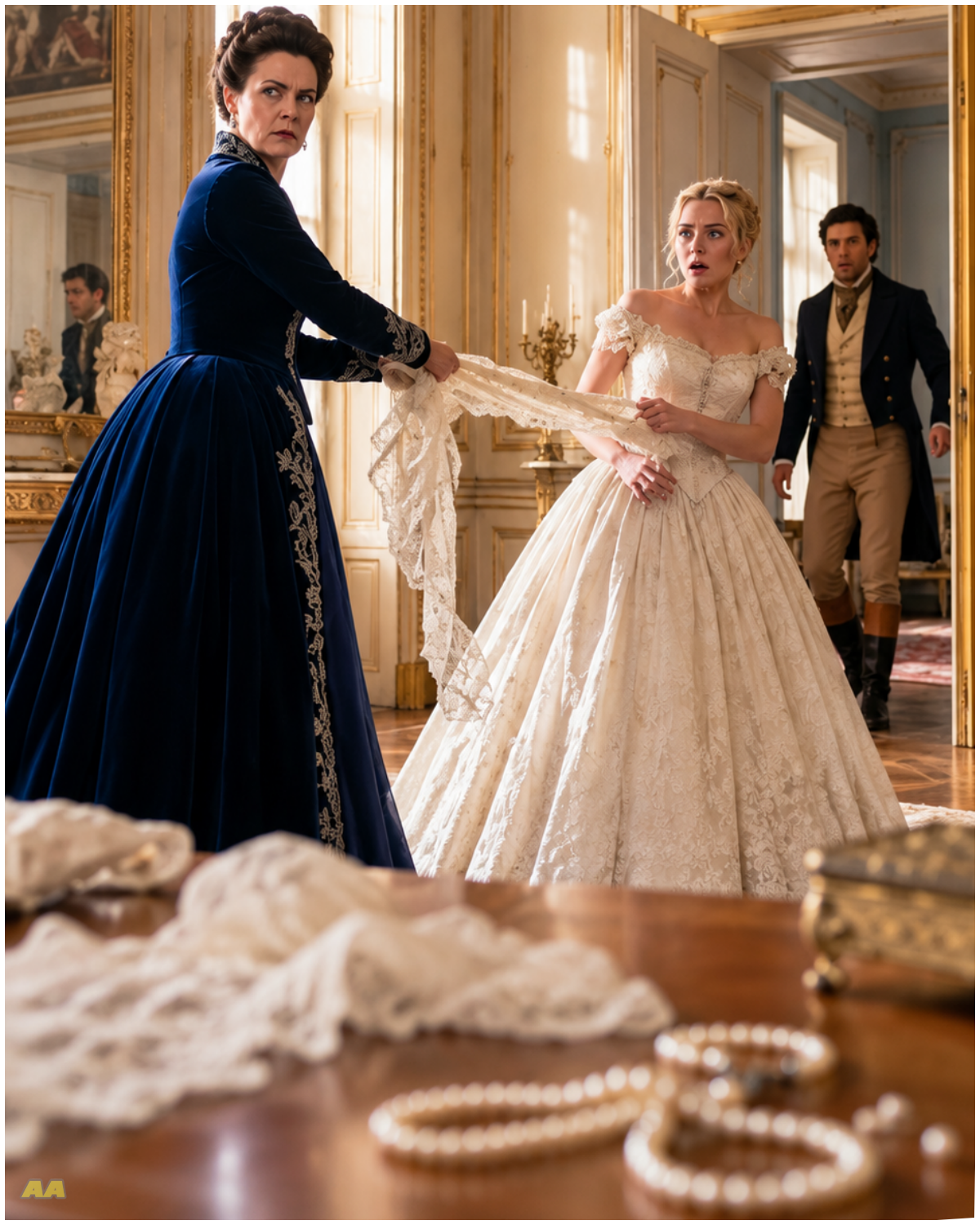
Aloan Ashworth had scrubbed floors for other people’s happiness before she ever wore silk, and some nights standing in the hush of Ashkcom Hall long after the candles were trimmed low, she still expected someone to notice the mistake and send her back to the scullery where she began.
But this, what she saw through the halfopen door of Madame Verier’s fitting room on a gray Tuesday in early autumn, this was not a mistake anyone could send her back from.
This was a wound.
There stood her husband, Perival Ashworth, the Duke of Rensley, with his hand resting lightly at the waist of a woman not his wife, while that woman turned slowly at top a dress maker’s platform, arms lifted, chin high, draped in yards of ivory silk that could only be a bridal gown.
She crossed the little shop in four strides, seized two fistfuls of the unfinished gown, and tore it clean away from the dress form in a single furious motion, the fabric shrieking as pins scattered across the floorboards like hailstones.
But that moment, the ripping, the gasp, the Duke’s face draining the color of ash, that is not where this story begins.
To understand why a duchess would destroy a wedding gown in a stranger’s shop, you must go back three years to a girl who owned nothing but a name nobody wanted and a spine nobody had managed to break.
Eloan Ashworth had not always been a duchess, and she had not always been an Ashworth.
She had been born ilo in vain.
The daughter of a shipping cler who drowned in debt two winters after he drowned in the harbor itself, leaving behind a wife who did not survive the grief and a daughter of 12 who was passed like an unwanted parcel between relations who wanted her labor more than her company.
By the time she was 19, she had learned to make herself small in rooms full of people who resented feeding her, to mend her one good dress so many times that the thread outnumbered the cloth, and to keep her opinions locked so tightly behind her teeth that she sometimes forgot she had any.
She worked as a companion to old lady Peton, a half-blind widow with a sharp tongue and a sharper eye for character, reading to her in the evenings and managing her correspondence, her medicines, her moods.
It was a position beneath what her father’s modest name might once have suggested, and everyone who met her made certain she knew it.
The other companions in the great houses nearby wore borrowed condescension like a uniform, and Eloan wore her poverty like a penance, quiet, unresented, waiting for nothing in particular, because she had learned that wanting things only made their absence sharper.
It was in Lady Peton’s garden, on an ordinary afternoon thick with the smell of cut grass, that she first met the man who called himself Perry.
He wore a plain coat, mud on his boots, and an expression of a man doing his best to look like he belonged.
Nowhere important.
He told her he was a land agent’s clerk come to survey the boundary hedge for a client, and she believed him entirely, because why would she not?
They spoke for perhaps 20 minutes that first day about nothing of consequence, the weather, a stray dog that had adopted the kitchen garden, the impossibility of keeping ink from smearing in damp weather.
And yet Elan walked back into the house feeling as though she had been handed something warm to hold.
He returned the following week and the week after that, always with some flimsy pretext about the hedge, the drainage, the old boundary stone that supposedly needed reserveying every fortnight for reasons that made less and less sense.
She was not a fool.
She suspected fairly quickly that Perry was not entirely what he claimed, but she said nothing because his company was the first thing in years that had asked nothing of her except her honest self, and she was not willing to trade that for the satisfaction of catching him in a lie.
What Loan did not know, what the audience watching this story already senses, the way one senses a storm before the sky has darkened, was that Perry was in fact Percal Ashworth, fifth Duke of Rensley, a man so thoroughly exhausted by the marriage market that he had taken to riding out under a false name, simply to remember what it felt like to be looked at as a person rather than a title.
He had buried a father who ruled through fear, survived a broken engagement to a woman who had wanted his coronet, and nothing else about him, and inherited an estate riddled with debts his father had hidden behind good tailoring and better manners.
Every woman who had ever smiled at him in a ballroom had done the arithmetic of his fortune before she had learned the color of his eyes.
Elo vain, mending her own gloves in a borrowed garden, had never once asked what he was worth.
The rising trust between them built the way trust always builds when neither party is performing for the other in small honesties.
He noticed she flinched when Lady Peton’s nephew, a red-faced young man named Osrich Veinharding, no relation, though he traded on the coincidence of the surname to imply one, spoke to her as though she were furniture.
Perry began arriving precisely when Ozri was known to visit, a coincidence Eloan chose not to examine too closely.
She noticed that his hands, for a land agent’s clerk, were unmarked by real labor, and that his boots, however deliberately scuffed, were cobbled by someone with considerable skill.
She said nothing of that either.
Instead, she asked him, one afternoon, when the rain had trapped them both beneath the garden’s old oak, why a clark troubled himself so much over one modest hedge.
He had looked at her for a long moment, and then he had said quietly that some men found it easier to survey a hedge than to survey their own lives, and that he was not ready yet to explain which sort of man he was.
She had accepted that answer the way she accepted most things, without demanding more than she was given, because demanding had never once worked in her favor.
The moment everything changed, arrived on a night that should have been unremarkable.
Lady Peton’s small household was thrown into chaos when the old woman fell ill with a fever that the local physician pronounced dangerous, possibly mortal, and Osrich Vain Harding, who stood to inherit the house should his aunt die intestate as he believed she had, showed his character fully for the first time, refusing to send for a better doctor from town because of the expense, and suggesting to the housekeeper within Eloan’s hearing that arrangements ought to be made for after.
Aloan did not wait for permission.
She took the last of her own meager savings, walked four miles in the dark to the posting in, and paid a rider to fetch the finest physician within 20 mi, a man whose fee she could not possibly cover, and did not in that moment care.
When Perry arrived the next morning and found her sitting up with the old woman gray-faced with exhaustion, having spent money she did not have on a person who had never once raised her wages.
Something in his face changed in a way.
He asked her why she had done it.
She told him that Lady Peton never once made her feel like a burden, and that seemed to alone sufficient reason for anything.
It was 3 days after that, with Lady Peetton recovering and color returning to her cheeks, that Perry arrived at the garden gate, not in his mudstained coat, but in a coach bearing a crest Ilan recognized from the county assembly rooms the ducal arms of Rensley.
She stood very still. She did not gasp or weep or reach for the nearest chair the way novels insisted a woman ought to when confronted with deception on this scale.
She simply looked at him and said with a steadiness that surprised them both that she suppose the hedge had been surveyed thoroughly enough by now.
He had the grace to look ashamed, and then haltingly he explained everything, the false name, the exhaustion with being courted for his title, the fear that had kept him from telling her sooner because he had somewhere in the last weeks begun to dread the moment she would look at him the way every other woman in his life eventually did.
He drew from his coat a small object, a signate ring bearing the Rensley crest, and pressed it into her palm, not as a proposal, but as proof, as though he needed her to hold the evidence of who he was in her own two hands.
She did not answer him that day.
She asked for time because a girl who has learned never to want things does not surrender that caution easily, even to a juke, and he, to his credit, and unlike every man in her life before him, gave her the time without complaint.
She said yes. Three weeks later, in the same garden, under the same oak, and Persal Ashworth married Eloin vain in a ceremony so quiet it scandalized half the county, who had expected a Duke’s wedding to be an event.
Not a private vow exchanged before a handful of witnesses, because the bride wanted no spectacle built on a foundation she still could not quite believe was real.
The county gossip denied their grand wedding, found other ways to express their disapproval.
They called her a fortune hunter behind gloved hands, though anyone who had watched the courtship knew she had not hunted anything, had in fact resisted the fortune longer than sense required.
They called her unsuitable common. Companion elevated far past her station, and Iloan absorbed every whisper the way she had always absorbed cruelty, without visible reaction, storing it somewhere she did not examine too closely.
Perl, for his part, adored her with the specific fierceness of a man who has finally found the one person who wanted him and not his coronet.
And for two years, within the walls of Ashkam Hall, Elo and Ashworth allowed herself cautiously to believe she had finally been given something no one could take back.
Which is precisely why the sight of him in Madame Verier’s fitting room, his hand at another woman’s waist, while ivory silk was pinned around her body, did not merely wound.
It confirmed the oldest, quietest fear she had carried since childhood, that good things were loans, not gifts, and that the bill always eventually came due.
The woman on the dress forms platform was named Cassia Thorne, and she had entered Iloan’s life eight months earlier with the particular smoothness of someone who had rehearsed her own arrival.
She came to Ashkum Hall as a distant cousin of the Duke’s late mother, a widow of modest but respectable means, seeking nothing more, she claimed, than a season near family while she settled her late husband’s affairs.
Persal, who prized loyalty to blood above almost every other virtue, welcomed her without hesitation, and Eloan, still knew enough to her role to distrust her own instincts more than she trusted the evidence in front of her, welcomed her, too, though something in Cassier’s manner, a particular way of assessing a room’s furnishings before assessing its people, made the back of Aloan’s neck prickle from the very first afternoon.
Cassia was beautiful in the practiced way of a woman who understood exactly which angle of her chin, photographed best in candle light, charming in company, subtly cutting in private, and endlessly, exhaustingly present, appearing in doorways and gardens and drawing rooms with a regularity that could not entirely be coincidence.
It was Cassia who first mentioned lightly over tea that she had noticed the estate’s steward, a soft-spoken man named Mr.
Gideon Hail seemed troubled of late, pouring over ledgers late into the night, with a particular anxiety of a man carrying a secret too heavy for one set of shoulders.
It was Casia who suggested more than once that perhaps Eloin’s origins made her unsuited to the finer management of a great house, offered always with a smile so warm that the cruelty beneath it could be denied if challenged.
And it was Cassia who 3 weeks before the scene in Madame Verier’s shop had begun a campaign of small deniable insinuations aimed at convincing Perl that his wife’s affections had cooled, that she seemed distracted, distant, perhaps even involved in correspondence she did not share with him.
A slow poisoning of trust administered in teaspoons.
Never a dose large enough to be noticed as poison at all.
Eloan did not yet know the shape of the scheme unfolding around her, only that the ground beneath her marriage had begun, in small and deniable ways to shift.
And on that gray Tuesday, when she had gone to Madame Verier’s shop on an ordinary errand of her own to collect a repaired shawl, and had instead found her husband’s hand resting at Cassia Thorne’s waist, while a wedding gown was measured to her body, every quiet fear Alan had carried since she was 12 years old, rose up at once, and she did the only thing that felt like it belonged to her in that moment.
She tore the gown from the form and she did not apologize for it.
Not then and not for a long while after.
The shop fell into a silence so complete that could hear Madame Vier’s assistant drop a pin cushion somewhere behind the counter.
Perival’s face had gone the color of old paper, and for a moment he did not speak at all, only stared at the torn silk pooling on the floorboards, as though it was something he could not quite make sense of.
Cassia recovered first, pressing her hand to her collarbone, with the wounded delicacy of a woman entirely unused to being contradicted, and murmured that she supposed the duchess had misunderstood something perfectly innocent.
It was that word misunderstood, spoken in a tone so carefully pitying that it made Eloan’s hands shake, which finally loosened her husband’s tongue.
He said her name, just her name, Eloin, in a voice she had not heard him use since the night in Lady Peton’s garden, when he had confessed to being a juke instead of a cler, a voice stripped of its usual composure.
But before he could say anything further, before he could offer whatever explanation he had clearly not prepared for a moment like this, Madame Verier herself stepped forward, ringing her hands over the ruined bodice, already calculating the cost of the silk, in a tone that suggested she considered this the true tragedy of the afternoon.
Loen did not wait to hear the sum.
She turned and walked out of the shop without another word, leaving her husband standing amid scattered pins and torn silk with an expression that had she looked back to see it might have told her this was not at all the story she believed she had walked into.
She did not go home. She could not in that moment imagine sitting across a dinner table from Perl and pretending the last hour had not happened.
So instead she walked, skirts gathering mud at the hem, until she found herself at the small stone church on the edge of the Ashkam estate.
The one Lady Peetton had been buried behind two winters ago after the fever the good doctor had in the end not been able to cure.
Eloan sat on the cold step and allowed herself for the first time in years to cry without restraint.
Not delicately, not the composed weeping of a duchess who must always mind her appearance, but the racking, undignified grief of a girl who had let herself believe.
She thought of every warning the county gossips had murmured, every prediction that a companion elevated too far above her station would eventually be discarded once a man of Perl’s rank remembered what he was owed by the world.
She thought bitterly that perhaps they had been right all along, and that she had simply been too grateful to notice the shape of her own undoing.
She did not return to Ashkcom Hall until well after dark, and when she did, she found Perl waiting in the hall himself, rather than send a servant to fetch her, pacing before the cold hearth, with the restless energy of a man who has spent hours composing and discarding a 100 different speeches.
He came toward her the moment she entered, and she stepped back before he could reach her.
A small motion that seemed to cost him more than a physical blow would have.
He asked her to let him explain.
She asked him, in a voice she barely recognized as her own, whether there was anything to explain that would undo what her own two eyes had shown her.
He opened his mouth and then closed it again.
And in that hesitation, brief but unmistakable, Iloen felt something inside her go very quiet and very cold, because a man with nothing to hide does not hesitate before the truth.
What Illoan could not have known standing in that hall with her heart cracking open for the second time in her life was that Perl’s hesitation had nothing to do with guilt over Cassia Thorne and everything to do with a promise he had made 3 days earlier to Gideon Hail his steward.
A promise sealed in whispered urgency in the estate office with the door locked and the curtains drawn.
A promise that he would say nothing to anyone, not even his wife, until the trap was fully sprung.
For weeks, Gideon had been unraveling a slow and careful theft from the Rensley accounts.
Funds bled away in increments small enough to escape casual notice, routed through a network of false invoices and shell purchases that led, when traced far enough, back to a single name that appeared again and again, disguised under aliases and married names and the names of supposed charitable trusts.
Cia Thorne, whose late husband had left her not respectable means at all, but considerable debts, and whose arrival at Ashkam Hall 8 months prior, had been not a family visit, but the opening move of a long and patient fraud aimed at either marrying into the Rensley fortune outright, or bleeding it dry from within before anyone noticed the wound.
The wedding gown, Perl would have explained if his wife had given him 30 more seconds before the church bells of her own fury had already begun tolling in her chest, was not for a wedding to him at all.
It was baked. Gideon had discovered buried in Cassia’s forged correspondence evidence that she intended to stage a fraudulent marriage to a fabricated cousin of the dukes, a non-existent relation she planned to invent whole cloth using forged parish records in order to claim a share of the estate.
And the gown she had commissioned was meant to be worn at that invented ceremony, evidence of her intentions solid enough to bring before a magistrate.
Perl had gone to the dress makers that morning, not as a bridegroom admiring his bride, but as a witness, invited by Madame Vier’s own nervous confession that something about Mrs. Thorne’s commission felt deeply irregular, gathering the final thread of proof he needed before he could bring the whole scheme crashing down.
He had placed his hand at Cashier’s waist, not out of tenderness, but because he had been examining at exactly the wrong moment for his marriage, and exactly the right moment for his case against her, a hidden pocket sewn into the gown’s lining, where Gideon had warned him she liked to conceal documents.
He had been one heartbeat from finding proof there in the silk when his wife’s hands had torn the entire garment away.
None of this Illoan knew standing in that cold hall.
All she knew was that her husband had hesitated when asked for the truth, and hesitation to a woman raised on disappointment had always been indistinguishable from confession.
She told him that night that she would be removing to the Daer cottage at the far edge of the estate until she understood her own mind and though he pleaded with her to stay to let him explain properly once certain matters were settled.
She heard in the phrase once certain matters were settled only further evidence of a man managing her rather than loving her.
And she left before dawn the next morning with a single trunk.
And Martyr, her old lady’s maid, the one servant in the entire household, whose loyalty had never once wavered.
Not when the county gossips mocked her mistress’s origins, and not now, when the mistress’s own certainty seemed to be crumbling.
The days that followed were the loneliest Iloen had known since Lady Peton’s death.
What of the scene at Madame Verier had inevitably traveled the length of the county within a week, embellished with each retelling until the story that reached the assembly rooms bore only passing resemblance to what had actually happened.
The version that circulated at dinner tables held that the duchess, common and always unsuited to her rank, had made a vulgar and jealous spectacle of herself in a public shop over nothing more than her husband’s perfectly ordinary attentiveness to a respectable relation, and that the marriage, so scandalously quiet from its first day, was finally revealing itself as the mismatch everyone had always known it to be.
Ori Veain Harding, who had never forgiven Iloen for the loan that saved his aunt’s life and delayed his inheritance by two more years, took particular relish in spreading the tale wherever he was received, adding embellishments about her ingratitude and her unfitness for society.
Quacia Thorne, for her part, played the wounded party with theatrical precision, appearing at the few gatherings she could not avoid, dressed in somber, dignified colors, accepting condolences for the duchess’s outburst, with a martyed patience that won her considerable sympathy among the county’s more credulous hostesses.
She let it be known, always indirectly, always through a sigh rather than a direct accusation, that she feared for the Duke, married to a woman whose origins had perhaps left her unequipped for the demands of great position, prone to fits of temper unbecoming a lady of rank.
Each retelling drove the knife deeper, and each week that Elo spent alone in the Daer cottage, tending a small garden that reminded her uncomfortably of Lady Peetton’s made the whispers seem a little more like a verdict.
She had already half believed about herself.
Perl did not stay away, though Eloan refused at first to see him.
He wrote to her nearly every day letters Martr delivered and which Eloan read alone by candlelight, never answering but never quite able to burn them either.
The letters did not plead for forgiveness in the way she expected.
Instead, they were strange, careful things full of references she could not yet understand.
Mentions of Gideon Hail working through the night, of a magistrate’s name she did not recognize, of patience being asked of her that he knew he had no right to ask, of a truth he swore he would lay before her the moment it was safe to do so.
She did not know what to make of them, and in her roarest moments she suspected they were simply a clever man’s attempt to manage her doubt the way he seemed to manage everything else, with careful words rather than honest ones.
It was Martr who finally pressed her to reconsider, entirely refusing him.
The old maid, who had watched Eloan since her first frightened week at Ashkcom Hall, pointed out, with the bluntness only decades of loyal service could earn her, that the duke she had watched for 2 years was not a man who lied easily that his letters read like the words of someone protecting something, and that all people understood better than most what it cost a person to be judged entirely by the worSt. first five minutes anyone had ever witnessed of them.
Eloan did not answer, but that night, for the first time in 10 days, she did not simply read Perl’s letter and set it aside.
She wrote back four words only.
What is the truth? And three nights later, a carriage arrived at the Daer Cottage well past dark, and Gideon Hail himself stepped down from it, hat in hand, looking like a man who had not slept properly in a month, carrying beneath his arm a leather portfolio thick with documents.
He asked to speak with her alone, and Martr, after a long assessing look at the steward’s exhausted, earnest face, left them to it with the firebanked low.
Gideon began haltingly by apologizing, not for anything he had done, but for the position his silence had placed her in, a position he said he had argued against from the very first week, urging the Duke to simply tell his wife everything, and trust her judgment rather than protect her from a danger they had not yet fully proven.
He told her then everything he had told Perival 3 weeks prior in that locked estate office, the false invoices, the vanishing sums, the forged correspondence, the fabricated cousin, the wedding gown, hidden pocket in the lining, that Percal had been one moment from finding when the entire garment had been torn from the dress form by the very woman he had been trying, clumsily and belatedly, to protect.
Eloan sat very still through the whole of it, the way she had sat still through the death of her parents and the cruelty of relations and every hardship life had handed her before she learned that stillness was often the only dignity available to her.
When Gideon finished laying the portfolio of forged documents on the small table between them, she asked only one question.
She asked why. If all of this were true, Perl had not simply told her from the beginning, before the scene in the shop, before the 10 days of silence, before the county had been given a story to feast on at her expense.
Gideon’s answer was quiet, and she would later admit entirely fair, that Cassia Thorne was clever enough and desperate enough to notice if her mark’s wife suddenly began treating her with suspicion instead of warmth, and that one careless glance from Iloin might have been enough to send Cassia fleeing the county with the funds she had already stolen, and the proof of her forgeries burned in whatever fire was neareSt. Perival, Gideon said, had gambled that a wounded silence, however unfair to Eloan, was safer for the case than a warning that might collapse the entire trap before the magistrate could act.
It was not, Gideon admitted, a gamble he had agreed with.
It was not, he suspected, a gamble Perl was proud of either, but it was the gamble that had been made.
Now it had cost the Duke the one thing Gideon suspected he valued more than the entire Rensley fortune combined.
Ilawan sat with that information long after Gideon had gone, turning it over the way she had once turned over Perry’s two clean hands and two well-made boots in Lady Peton’s garden, recognizing in it the same shape, not deception born of contempt, a man so afraid of losing what he had barely dared to hope for, that he had made a choice which nearly cost him precisely that.
She understood the impulse better than she wished to.
Had she not spent years hiding her own fears behind silence, afraid that voicing them would make them real.
The difference, she thought, staring into the low fire, was that her silences had only ever cost herself something.
His had cost them both. She did not send word to Perl that night, nor the next.
Instead, she asked Gideon, when he returned 2 days later to check on certain figures he had left with her, whether the case against Cassia Thorne was close enough to conclusion that a duchess, who had been publicly humiliated, might, with proper evidence in hand, be the one to finish it herself, rather than remain the wronged wife whispered about in every drawing room in the county, while her husband quietly cleaned up a mess she had never been permitted to understand.
Gideon studied her for a long moment, then allowed cautiously that the final piece, direct testimony connecting Casia’s Forge Parish records to the clerk who had been bribed to produce them, was still missing, and that the clerk in question, a nervous, underpaid young man named Mr.
Alfrick Boon, had thus far been too frightened of Cassia’s threats to speak against her to any one official.
It was Eloen, not Percal and not Gideon, who solved that particular problem, because Eloen understood something about frightened, underpaid young men that neither a duke nor a steward, both comfortable in their authority since birth, could easily grasp.
She understood what it was to be poor and afraid and certain that no one of consequence would ever believe your word over the word of someone richer and better dressed.
She traveled with only martyr for company to the small parish office where Alfrick Boon kept his ledgers and she did not threaten him and she did not offer him money both of which she suspected Cassia had already tried in opposite directions.
Instead, she told him plainly and without embellishment what it had been like to be 19, and friendless and certain that speaking a hard truth would only get her thrown out into a world with no safety net beneath her.
And she told him that the difference between that fear and the courage to act on it was, in her experience, nothing more than one person choosing to stand beside you.
When you finally did,” she told him she would stand beside him.
She did not know that afternoon whether it would work.
It worked. 3 days later, Alfred Boon appeared at the Daer Cottage with a small terrified resolve in his face and a confession written in his own hand, describing in careful detail the sums Cassia Thorne had paid him to falsify parish records, establishing a fictitious cousin’s birth, and naming the two other clarks in neighboring parishes she had similarly bribed to construct the illusion of an entire fabricated family line.
With that confession added to Gideon’s portfolio of forged invoices and vanished sums, the case against Cassia Thorne was no longer a quiet suspicion contained to a locked estate office.
It was, as Gideon put it, when Eloin showed him the document, enough to hang the whole scheme in front of a magistrate and half the county at once, provided it was presented properly, and provided the presentation happened somewhere, Cassia Thorne could not simply deny it away with a wounded sigh and a welltimed tear.
Loen knew exactly where that somewhere should be.
The Michaelmas assembly held every year in the great hall of Ashkam itself was a fixture of county society that even the Duke’s most estranged wife could not decline without inviting a fresh wave of gossip.
And it was conveniently the one event Cassia Thorne would be certain to attend.
Poor oi oi in something calculated to reinforce her role as the wronged dignified relation enduring a jealous duchess’s temper with saintly patience.
It was the perfect stage for exactly the kind of public reckoning had spent her whole life avoiding and had in the space of 3 weeks learned she was finally ready to conduct.
She returned to Ashkam Hall four days before the assembly, not as a wife, slipping quietly back into her husband’s good graces, but as a woman with a plan she intended to execute, regardless of whether he approved of every detail.
Perival, when he saw her carriage in the drive, came out into the cold without his coat and the look on his face, hope and fear and exhaustion tangled together, nearly undid the composure she had spent the whole journey assembling.
She told him, before he could apologize again, that she had not come back for apologies.
She had come back to finish what he and Gideon had started properly this time with her included rather than protected from it.
He opened his mouth to argue some instinct toward shielding her rising even now, and she stopped him with a single look that reminded him more forcefully than any words could have of the woman who had once walked four miles in the dark to save a dying woman’s life.
He closed his mouth, and for the first time since the scene in Madame Vier’s shop, he simply listened to her.
The four days before the assembly passed in careful, quiet preparation.
Gideon compiled every document into an order that would tell the story plainly, without requiring a magistrate’s trained eye to follow the threads.
Alfred Boon was given a place to stay under discrete protection, well away from any chance that Casia’s remaining allies might silence him before he could speak.
Martr, who had spent 20 years learning which servants in every great house for three counties could be trusted and which could not, quietly gathered corroborating whispers from Cassia’s own ladies maid, a frightened girl named Susan, who had noticed months ago.
Ledgers and letters she had not been meant to see, and had said nothing out of fear for her position, until Martr assured her that silence this time would cost her a great deal more than speaking would.
And Perl, for his part, did the one thing Iloan asked of him directly, he wrote, quietly to the county magistrate, a stern and incorruptible man named Justice Prior, inviting him to attend the Michael Assembly as a personal favor, without specifying why, and trusting that once he arrived, he would understand exactly why his presence had been requested.
The night of the assembly arrived cold and clear.
The great hall of ash come blazing with candlelight.
The county’s finest families arriving in carriages that crunched over frost hardened gravel.
Every one of them Aloan knew already primed by weeks of gossip to watch her and her husband with a particular hungry curiosity.
She dressed that evening in deep blue silk.
Nothing so bright as to seem a provocation, nothing so somber as to seem a surrender, and she wore, pinned discreetly at her collar, the small signate ring Perl had once pressed into her palm in Lady Peton’s garden, reset by the Ashkcom jeweler, that she wanted some visible proof upon her own body of the truth she had chosen to believe, rather than the lie the county had been so eager to construct around her.
Cassia Thorne arrived precisely fashionably late, dressed in unreieved gray, playing to perfection the role of a dignified woman enduring undeserved scandal with quiet suffering, and the murmur that moved through the hall at her entrance carried.
Ilwan could hear clearly more sympathy for Cassia.
Casio made her way through the crowd with practice grace, accepting condolences, dropping small martyed size at exactly the right intervals, and when she finally drew near enough to Eloin to be unable to avoid an exchange, she offered a smile of such perfectly calibrated pity.
Who knew the truth now in exhaustive documented detail, felt the old instinct to shrink rise up in her cheSt. She did not shrink.
He smiled back and said pleasantly that she hoped Mrs. Bar Thorne had recovered fully from the unfortunate incident of Madame Verier’s and that she understood a wedding gown once torn was terribly difficult to salvage, particularly one with such an unusual construction in the lining.
She watched with grim satisfaction the flicker of genuine alarm that crossed Cassia’s composed face before it smoothed itself away again.
The moment came just after the second dance when Perl by prior arrangement requested the hall’s attention on a matter of some importance to the estate and to several families present.
And just as prior seated near the fire with a glass of port he had barely touched all evening set the glass down and rose along with everyone else.
Perl did not speak long. He did not speak alone.
He gave the floor first to Gideon Hail, who laid out in the plain and methodical language of a man who had spent weeks documenting exactly this moment the pattern of forged invoices and vanished funds that traced back transaction by transaction to Cassia Thorne.
He gave the floor next to Alfred Boon, whose hands shook visibly, but whose voice did not waver as he described the sums he had been paid to falsify parish records, inventing a cousin who had never existed, a cousin whose fabricated birth had been the foundation of an entire scheme to claim a share of the Rensley inheritance.
And he gave the floor last to his own wife because he understood finally and completely that the reckoning belonged to her as much as to anyone in that [clears throat] room.
Eloan stepped forward into the candle light, and the hall that had spent weeks whispering about her temper and her unsuitability fell into a silence so absolute she could hear the fire crackling in the great hearth behind her.
She did not raise her voice.
She did not need to.
She told them plainly what she had seen in Madame Verier’s shop, and what she had believed it meant, and how wrong that belief had been, not because her eyes had deceived her, but because she, like every person in that hall, had been trained by a lifetime of watching women like Cassia Thorne to assume the worst of a woman like herself, before assuming the worst of a woman dressed in fashionable gray, and armed with a welltimed sigh.
She told them that the gown Casia had commissioned had never been meant for a wedding at all, but for a courtroom evidence of a fraud so patient and so complete that it had nearly succeeded in convincing an entire county, and very nearly a duchess herself, to distrust the one man who had never once in three years given her real cause to doubt him.
Cassia Thorne did not go quietly.
She laughed first a bright, brittle sound, and called the entire accusation the jealous fantasy of a commonborn woman who had never belonged in this hall, and clearly could not bear to share her husband’s attention with anyone.
But Justice Prior, who had listened to the whole account with the careful stillness of a man weighing evidence rather than gossip, stepped forward before she could gather further momentum, and asked in the flat, unimpressed tone of a man who had convicted better liars than her, thinly disguised on three separate parish documents that Mr. Boon had just sworn under oath to have forged at her instruction.
The silence that followed was different from the first.
It was the silence of a room watching a performance collapse in real time.
Casia’s composure did not crack all at once.
It fractured in stages, the smile faltering, the color rising and then draining from her face, until finally, cornered by documents and testimony, and the unblinking presence of a magistrate who was already visibly composing the warrant in his mind, she turned and fled the hall, gray silk streaming behind her, made it only as far as the front steps of Ashkam before two of Justice Prior’s men, stationed there at his quiet earlier instruction, took her firmly by the arms.
The aftermath moved with the swift, orderly satisfaction that only genuine justice provides.
Cassia Thorne was tried within the month of fraud and forgery, her scheme laid out in exhaustive documented detail before a court that had no patience left for wounded size, and she was sentenced to transportation, her name struck from every guest list in the county, before the ink on the judgment had even dried.
Orig Vain Harding, who had spread the ugliest version of the shop scandal with such relish, found himself the subject of considerably less sympathy once the truth emerged, and spent the following season quietly explaining to anyone who would listen that he had, of course, never truly believed the worst of the duchess.
A claim nobody in the county troubled themselves to credit.
Alfred Boon, whose courage had provided the final thread that unraveled the whole scheme, was given a respectable position in the Rensley estate office by Gideon Hail himself, who told him plainly that a man who could find courage once could be trusted to find it again when it mattered.
Perl found Iloan alone in the garden the night after the trial concluded, standing beneath a bare autumn tree, not unlike the oak, where he had first confessed to being a juke instead of a clerk.
And he did not make excuses this time, only told her simply that he had let his fear of losing her make a choice that had very nearly cost him exactly that, and that he understood, if it took her a long while yet, to trust the shape of his silences again.
She told him that she understood fear better than almost anyone, and that the difference between them going forward needed to be that neither of them face it alone again, not out of some romantic notion of partnership, but because she had learned the hard way twice now.
That love without full honesty was simply a more elegant version of the same abandonment she had spent her whole childhood learning to expect.
He agreed and meant it. And in the years that followed, whatever difficulties arose at Ashkam Hall, and difficulties did arise, as they do in any marriage worth having, they arose in the daylight, spoken plainly between two people who had each in their own way learned what it cost to let silent standin for trust.
Eloan Ashworth, once a companion with nothing but a mended dress and a lot heart, became known throughout the county, not for the scandal of a torn wedding gown, but for the quiet, steady justice she had helped bring into a courtroom, and she never again mistook a hesitation for the whole of the truth, because she had learned in the hardest possible way that the whole of the truth is very often more complicated and more worth waiting for than the Bory that first meets the








