The Duchess Arrived Dressed as a Servant to Meet Her Son’s Bride… What They Said Cost Them!!!
The carriage wheels ground to a halt in the mud.
But Daaja Duchess Catherine didn’t reach for her velvet cloak.
She reached for a coarse wool shawl.
She was about to meet the woman her son planned to marry.
Society called Miss Beatatrice Lynfield a saint.
Catherine knew better than to trust society.
She stepped out into the rain not as a duchess but as a scullery maid.
What she heard in that drawing room would destroy a dynasty.
Part one.
The wool scratched at Catherine’s collarbone.
A dull, persistent itch that felt more honest than the silk she usually wore.
It smelled of lie soap, stale smoke, and the faint, sour tang of old sweat.
Perfect. She stood before the fulllength mirror in the dim light of a rented in room, assessing the stranger in the glass.
Gone was the daagger Duchess of Oak Haven.
Gone were the pearls that had cost a small estate, the posture drilled into her by a governness with a riding crop, the cold authority that parted crowded ballrooms like Moses at the Red Sea.
In her place stood an aging woman with graying hair, tucked haphazardly beneath a stained linen cap.
Her hands, usually soft, were rubbed raw with chalk and ash to mimic years of scrubbing grates.
Arthur had called her paranoid.
Her son, 23 years old, the new Duke of Oak Haven, and hopelessly, fatally naive.
He had returned from a month in Bath with a ring missing from the family vault and a name on his lips like a prayer.
“Beatric Lynfield.”
“She is an angel, mother,” Arthur had said just 3 days ago, pacing the library of their London townhouse.
His eyes had held that terrifying glassy shine of a young man who believed love was a shield against the world’s ugliness.
She reads to the blind.
She refused Lord Calicott because she said he was too cruel to his horses.
She’s everything good. Catherine had stirred her tea, the silver spoon clinking softly against the porcelain.
A woman who wants to be a duchess will read to the devil himself if it secures the title.
Arthur, he had slammed his hands on the mahogany desk.
You see the worst in everyone.
I see the truth in everyone.
A title blinds them. It makes them perform.
Catherine knew this intimately. She had married Arthur’s father at 18.
To the ton, the late Duke of Oak Haven had been a statesman, a gentleman, a pillar of the realm.
Behind the heavy oak doors of their bed chamber, he had been a monster who bruised her ribs and belittled her mind.
Society didn’t care about a woman’s bruises so long as they were covered by expensive silk.
Catherine had survived him. She had raised Arthur to be different, kind, empathetic, soft, but that softness made him a target.
She would not let another monster into her house, not without seeing its teeth firSt. The plan was simple, born of desperation and a lifetime of mistruSt. The Lynfield estate, a modest manner in Hampshire, was currently drowning in the logistics of preparing for an engagement ball.
They had sent to the nearby village for extra hands.
Catherine had intercepted the requeSt. She pulled the coarse shawl tight around her shoulders, stepped out of the inn, and began the two-mile walk in the freezing autumn drizzle.
The mud was a shock.
It didn’t just coat her boots.
It sucked at them heavy and greedy.
By the time she’d reached the rot iron gates of Lynfield Manor, her calves burned, and her lower back achd with a deep, grinding throb.
She didn’t announce herself at the front door with its polished brass knocker and sweeping stone steps.
She bypassed the manicured hedges and slipped down the gravel path that led to the underbelly of the house.
The servant’s entrance was propped open, venting out the suffocating heat of the kitchens.
The air tasted of roasting mutton, burnt sugar, and panic.
Catherine stepped across the threshold.
“You there?” A woman with a face the color of boiled beef pointed a wooden spoon at her.
The cook. Are you the girl from the village?
You’re late. I apologize, Mom.
Catherine said, dipping her chin, letting her voice drop into the flat, exhausted cadence she had heard from her own scullery maids for decades.
The roads are thick with mud.
“I don’t care about the mud. I care about the tarts,” the cook snapped, turning back to a massive iron stove.
“Tie on an apron.”
The mistress and her precious daughter are ringing the bell every 5 minutes.
Nothing is good enough. They want the silver polished again.
They want the tea hotter.
They want the world handed to them on a platter before the Duke arrives tomorrow.
Catherine found a stiff, stained apron on a peg and tied it around her waiSt. She kept her eyes down.
The kitchen was a war zone.
Maids darted past her, carrying steaming basins and heavy trays.
There was a hierarchy here, as rigid and unforgiving as the house of lords.
The butler shouted at the footmen.
The cook shouted at the maids, and all of them lived in terror of the floor above.
You, a young maid, no older than 16, shoved a silver tray into Catherine’s hands.
The girl’s eyes were red- rimmed, her breathing shallow.
There was a fresh, angry red mark across her left cheek.
It looked entirely like a hand print.
Take this up to the drawing room.
If you spill a drop of that tea, she’ll have your wages for a month.
Catherine looked at the girl’s cheek.
Who did that to you?
The girl swallowed hard, glancing nervously at the ceiling.
Miss Beatrice, I pulled her corset too tight.
Just take the tray. Don’t look her in the eye.
Catherine’s grip on the silver handles tightened.
The metal was cold. She reads to the blind.
She is everything good. I’ll take it, Catherine murmured.
She turned toward the narrow, poorly lit servants stairs.
The steps were steep and smelled of beeswax and old wood.
With every step she took, the oppressive heat of the kitchen faded, replaced by the cool floral scent of lavender and expensive perfume.
The transition from the working world to the world of the idle rich was always a stark line.
Catherine had spent her entire life on the upper side of that line.
She reached the landing. A heavy oak door separated the servants’s hall from the main house.
Catherine balanced the tray on her hip, took a slow, grounding breath, and pushed the door open.
It was time to meet the angel.
Part two.
The drawing room was a suffocating display of new money, trying desperately to look old.
Guilt-framed mirrors crowded the wallpaper, reflecting heavy velvet drapes and too much porcelain.
It lacked the effortless elegance of Oak Haven, but it screamed of ambition.
Catherine kept her gaze fixed firmly on the patented carpet, shuffling forward with the heavy silver tray.
I simply don’t see why we must accommodate his ridiculous aunt at the head table.
Mother, she smells of mothballs and moral superiority.
The voice was high, crystalline, and sharp enough to cut glass.
Catherine paused near a side table, carefully lowering the tray.
She allowed herself a brief peripheral glance.
Beatric Lynfield was undeniably beautiful.
She possessed that rare, flawless English complexion, pale as milk, with a natural flush of rose on her cheeks.
Her hair was spun gold, pinned up in an intricate style that must have taken her maid hours to achieve.
She sat on a Sha’s lounge, draped in a gown of pale blue muslin that cost more than a tenant farmer made in a decade.
Across from her sat Mrs. Agatha Lynfield.
The mother was a hardened version of the daughter.
The beauty had faded, replaced by a tight, calculating sharpness around the eyes and mouth.
“You will smile at the aunt,” Beatatrice, Agatha said, not looking up from her embroidery.
“You will smile at the aunt.
You will compliment the cousins, and you will fawn over the Duke’s insufferable mother.
Once the ring is on your finger and the vows are said, you can banish them all to the countryside for the rest of their miserable lives.
But until the bishop says, “Amen.
You are a saint.” Beatatrice let out a long theatrical sigh.
She picked up a silver hand mirror, checking her reflection.
Arthur is so dreadfully boring.
Mother, do you know he spent an entire hour in Bath talking to me about crop rotation?
Crop rotation? I thought I would die of sheer tedium.
He is a duke, Beatatrice.
Agatha snapped the thread with her teeth.
His bank accounts are not boring.
His estates are not boring.
The fact that he looks at you like a lost puppy is not boring.
It is your greatest asset.
A smart man is dangerous.
A besoughted fool is a gold mine.
Catherine stood perfectly still by the tea table.
Her heart was beating a slow, violent rhythm against her ribs.
She carefully lifted the porcelain teapot, pouring the amber liquid into the delicate cups.
Her hands did not shake.
The discipline that had kept her alive in her own marriage kept her anchored now.
A besotted fool, I suppose,” Beatatrice drawled, dropping the hand mirror onto the velvet cushions.
“But he’s so thoroughly sincere, it’s exhausting to match it.
Yesterday he sent me a poem,” he wrote.
“A poem, mother?” I gave it to the scullery Mary made to use as kindling.
Agatha chuckled. A dry rasping sound.
Practical. Just ensure you memorize a line or two in case he asks.
Catherine finished pouring the tea.
She arranged the small cakes on the tiered plate.
By the rules of the house, she was supposed to serve them curtsy and disappear into the walls.
She picked up a teacup and saucer, walking toward the Sha’s lounge.
She kept her head down.
She extended her hands, offering the cup to Beatrice.
Beatatrice didn’t even look at her.
She reached out blindly, her eyes still on her mother.
Her fingers brushed the edge of the saucer, but instead of grasping it, she gestured sharply with her hand to emphasize a point.
The back of Beatric’s hand smacked the porcelain.
The cup tipped. Hot tea splashed over the saucer.
A few drops landing on the pristine pale blue muslin of Beatric’s gown.
The silence in the room was absolute heavy and terrifying.
Beatatrice slowly lowered her hand.
She looked at the small brown stain on her dress.
Then, for the first time, she looked at Catherine.
There was no angelic sweetness in her eyes.
There was only a cold reptilian fury.
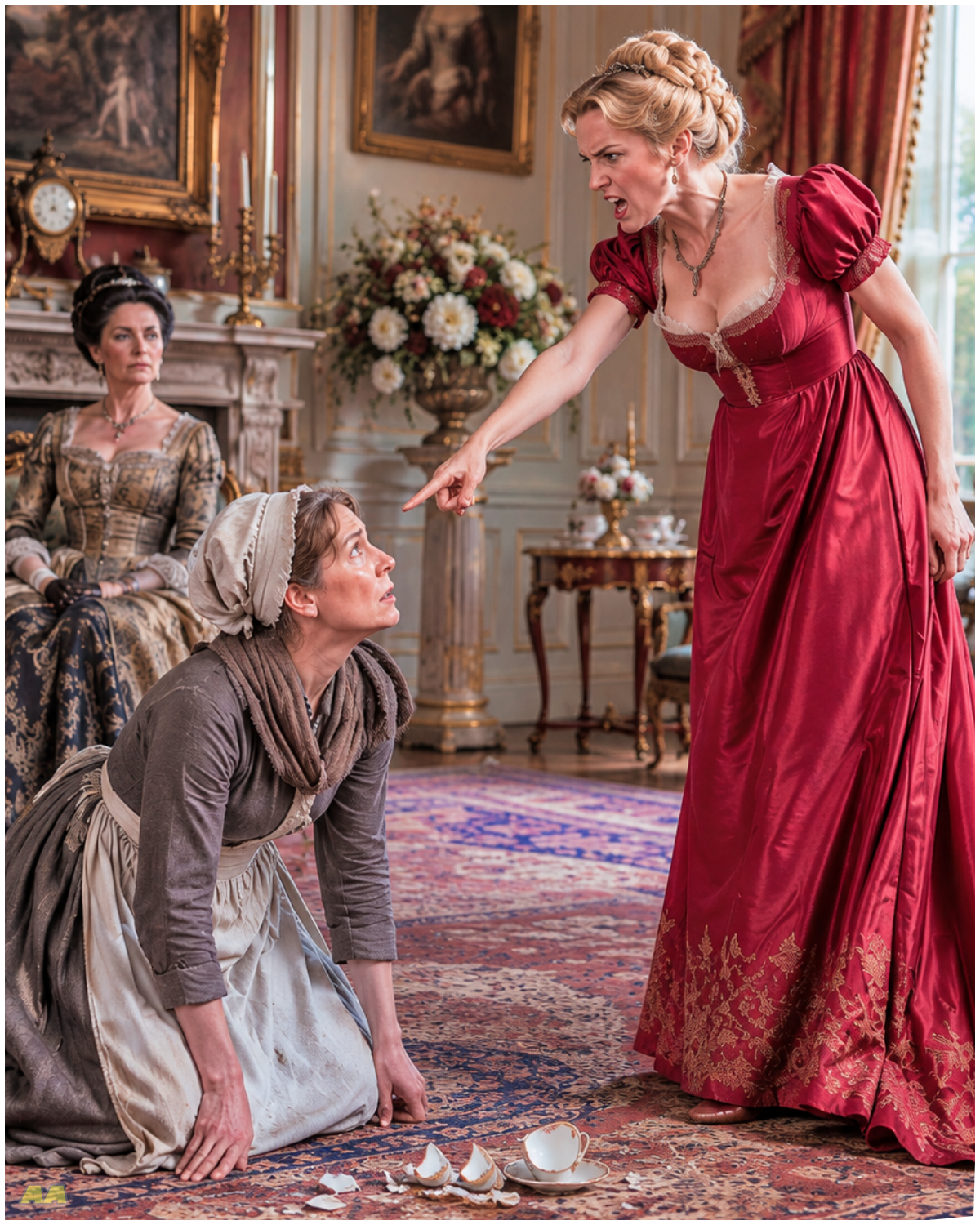
“You stupid, clumsy cow!” Beatatrice hissed.
The crystalline voice dropped an octave, turning guttural and ugly.
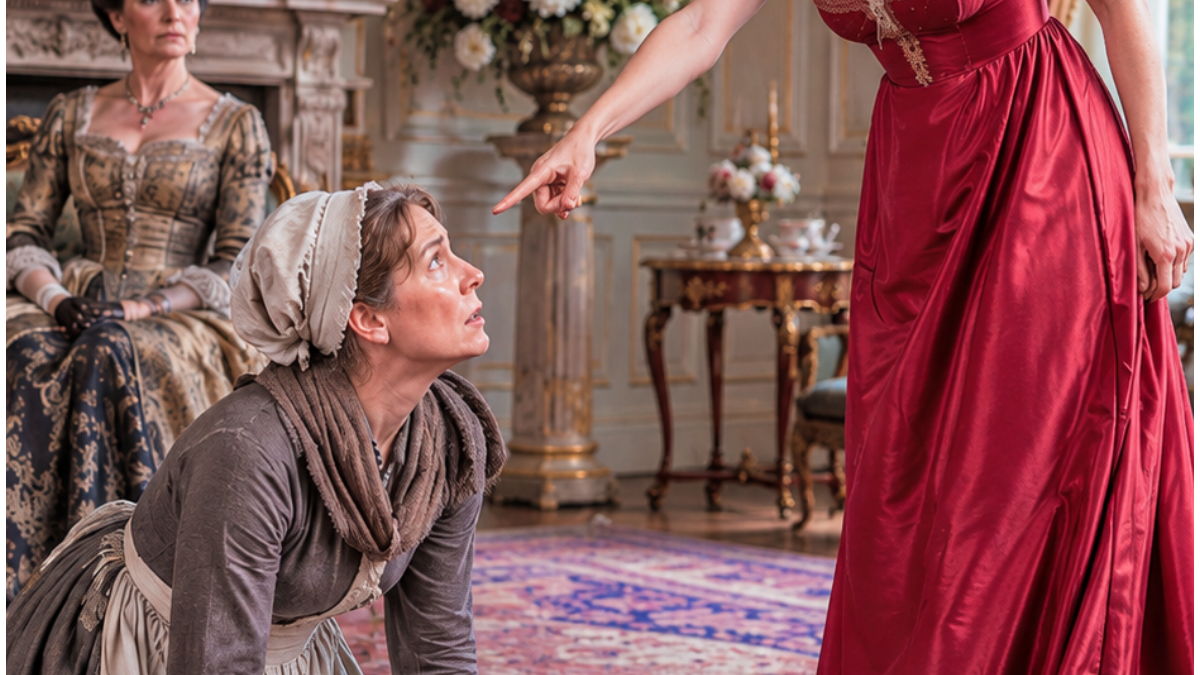
Catherine immediately fell to her knees, pulling a rag from her apron pocket, playing the part she had written for herself.
I am so sorry, miss.
Forgive me, I tripped. Get your filthy hands away from me, Beatatrice kicked out.
That the toe of her silk slipper caught Catherine hard in the shoulder, shoving the older woman backward onto the carpet.
Catherine hit the floor. The physical shock of the blow was nothing compared to the ice flooding her veins.
She stayed down, her head bowed, her breath shallow.
She didn’t cry out. She just watched.
Beatrice A stood up, her face flushed with rage.
She looked down at Catherine as if she were a roach that had crawled out of the floorboards.
“Do you know what this dress cost?” Beatatrice demanded, stepping closer.
“It costs more than your miserable, worthless life.” “Mother, ring the bell.
Have this idiot thrown out into the mud where she belongs, and tell the housekeeper to dock her wages to pay for the cleaning.” Agatha reached for the bell pull.
Looking mildly annoyed by the disruption.
Really, Beatrice, control your temper.
The Duke arrives tomorrow. You cannot have a flushed face and stress lines.
Just let the housekeeper handle the trash.
She ruined it. Beatrice shouted, pointing a trembling finger at Catherine.
Look at her. She’s pathetic.
It makes me sick that creatures like this are even allowed to breathe the same air as us.
Catherine slowly gathered herself. She placed her hands flat against the expensive rug and pushed herself up to a kneeling position.
She didn’t stand all the way up.
“Not yet. I will fetch some water, Miss” Catherine whispered, her voice rough, hiding the lethal calm settling over her mind.
“To lift the stain. You will get out of my sight,” Beatatrice spat.
If I ever see your ugly peasant face in this house again, I will have the groomsman whip you off the property.
Get out.” Catherine stood up.
She kept her posture hunched, her eyes cast downward.
She picked up the dropped saucer and the broken teacup.
She turned her back on the future Duchess of Oak Haven and walked toward the door.
And tell the cook,” Beatatrice called out behind her, her voice dripping with disgust, that if the dinner tomorrow is as bland as Arthur’s personality, I’ll have her fired the moment I have the Oak Haven ring on my finger.
Catherine closed the heavy oak door behind her.
She stood alone in the dark hallway.
Slowly, deliberately, she straightened her spine.
The hunched shoulders rolled back.
The submissive tilt of her chin vanished, replaced by the rigid, terrifying posture of a woman who commanded counties.
She looked at the broken porcelain in her rough, ash stained hands.
Arthur wanted to marry an angel.
Catherine was going to give him a demon, and she was going to expose it in front of the entire county.
Part three.
The kitchen was still a battlefield of grease and panic when Catherine descended the servant’s stairs.
No one looked at her.
In the suffocating ecosystem of a manor’s lower floors, a dismissed maid was a ghoSt. To acknowledge her was to invite the same wrath.
She untied the stained apron, letting it drop to the stone floor.
She didn’t bother hanging it on the peg.
Wait. A small voice cut through the hiss of boiling pots.
It was the young maid, the one with the bruised cheek.
She stood by the pantry door, ringing a damp cloth between her hands.
She darted a terrified glance toward the cook, who was currently screaming at a butcher’s boy, then scured over to Catherine.
“You’re leaving,” the girl whispered.
“It wasn’t a question.” “Did she hit you?” Catherine looked at the girl.
Her name was likely something common, easily forgotten by the people upstairs.
She saw the fresh red handprint, the exhaustion sinking into the girl’s young bones.
Catherine remembered being 18, trapped in a grand house, waiting for the heavy footfalls of an angry aristocrat.
“She kicked me,” Catherine said.
Her voice was no longer the flat, differential tone of a scullery maid.
It carried the crisp, commanding edge of a duchess.
The girl blinked, startled by the sudden change in cadence.
You shouldn’t walk back in the dark.
It’s a long way to the village.
The groomsman might let you sleep in the hoft if you don’t let him catch you.
Catherine reached down, lifting the hem of her coarse woolen skirt.
From the lining of her thick leather boot, she extracted a heavy gold sovereign.
She held it out. The girl stared at the coin as if it were a live coal.
A sovereign was three months wages.
Take it, Catherine ordered, her tone brooking no argument.
Pack your things tonight. Walk away from this house and do not look back.
There is a posting in on the London road.
Buy a ticket on the morning coach.
A woman who hits you because her corset is too tight will eventually break your jaw because her tea is cold.
Understand? The girl’s trembling fingers took the coin.
She looked up at Catherine, utter bewilderment, waring with desperate gratitude.
Who are you? A woman who learned too late when to leave.
Catherine turned and walked out into the freezing rain.
The two-mile trek back to her rented rooms at the inn was agonizing.
The mud had thickened, gripping her boots with every step.
Her shoulder throbbed where Beatric’s silk slipper had connected with the bone.
The physical pain was sharp, undeniable, and utterly grounding.
It cleared her mind. Arthur’s father had been careful.
The late Duke had never left a mark where society could see it.
He had bruised her ribs, pulled her hair beneath the intricate pins, squeezed her wrists until the tendons screamed.
He had been a monster who understood the rules of the game.
Beatric Lynfield was worse. She was a monster who thought she owned the board.
She was sloppy, arrogant, and drunk on the proximity of power.
By the time Catherine reached the inn, she was soaked to the bone.
Her trusted lady’s maid, Claraara, let out a sharp gasp when she opened the door.
Your grace, you are freezing.
Claraara immediately began stripping away the soden wool, her hands quick and efficient.
Catherine stood silently as the heavy wet garments fell away.
She stepped into a brass tub of steaming water Claraara had kept waiting.
The heat bit into her frozen skin.
She grabbed a cake of expensive mil soap and began to scrub the ash and chalk from her hands.
She scrubbed until her skin was raw and red, washing away the scent of the Lynfield kitchens.
“Did you find what you were looking for, your grace?” Claraara asked quietly, pouring a picture of warm water over Catherine’s hair.
“I found exactly what I expected,” Claraara, and it is worse than Arthur could possibly imagine.
Catherine stepped out of the tub.
She allowed Claraara to wrap her in a thick cotton robe.
She walked to the small writing desk in the corner of the room, pulling a sheet of vellum toward her.
She dipped a quill in the inkwell.
Send Thomas with this letter to London immediately, Catherine said, her pen scratching furiously across the paper.
I want my solicitor to pull every promisory note, every debt, every mortgage tied to the Lynfield name.
I want to know exactly how desperate they are for Oak Haven money.
If they owe the butchers, I want to know if they owe the tailor.
I want to know. Yes, your grace.
Catherine folded the letter, sealing it with a plain wax wafer.
She stared out the dark rain streaked window.
Arthur was arriving tomorrow afternoon.
He had ridden ahead of his carriage, eager to see his angelic bride.
If Catherine simply told him what she had seen, he would deny it.
He would call her suspicious.
Agatha Lynfield would twist the narrative, claiming the servants were liars.
Beatatrice would weep perfectly calibrated tears, and Arthur would fall to his knees to comfort her.
No, you do not tell a blind man that the room is on fire.
You let him feel the heat.
Beatrice wanted to play a game of masks.
Catherine was going to let her put the mask on, parade it in front of the entire county, and then rip it off her face in front of an audience she couldn’t buy.
Bully or bribe. She touched her bruised shoulder.
A cold, flat smile touched her lips.
“Lay out the emeralds for tomorrow night,” Claraara, Catherine murmured.
“We are going to a ball.”
Part four.
The Lynfield estate looked entirely different from the front.
Lanterns hung from the ancient oaks lining the gravel driveway, casting long, elegant shadows across the manicured lawns.
A line of lacquered carriages crawled toward the sweeping stone steps, depositing the county’s elite into the warm, golden glow of the manor’s open doors.
Music. A string quartet playing something aggressively cheerful spilled out into the crisp autumn’s air.
Inside the Oak Haven carriage, Arthur adjusted his white silk crevat for the fourth time.
He looked radiant. His dark hair was perfectly styled, his evening coat tailored to emphasize his broad shoulders.
He looked like a young king stepping into his prime.
“Are you well, mother?” Arthur asked.
Noticing her unnatural stillness. “You’ve been painfully quiet since I arrived at the inn.” Catherine sat in the opposite seat, enveloped in the darkness of the carriage.
She wore a gown of midnight blue velvet, severely cut with a high collar that framed the heavy, suffocating weight of the Oak Haven emeralds.
“The necklace alone was worth more than the entire Lynfield estate.” I am merely observing, Arthur, she said, her voice perfectly level.
You will love her. I promise you.
Arthur leaned forward, earnest and desperate for her approval.
She was so nervous about meeting you.
She knows your reputation. She knows you expect perfection.
I do not expect perfection, Arthur.
I expect honesty. We shall see if she can provide it.
The carriage lurched to a halt.
A footman opened the door, lowering the folding steps.
Arthur stepped out first, offering his hand to his mother.
Catherine took it. She stepped onto the gravel, not sparing a glance for the mud that had nearly swallowed her boots yesterday.
She ascended the stone steps with the terrifying glacial grace of a predator entering a new territory.
The footmen at the doors bowed so deeply they nearly snapped in half.
The entry hall was a sea of silk feathers and forced laughter.
The moment the major domo struck his staff against the marble floor, the chatter died.
His grace, the Duke of Oakhaven and the Daaja Duchess of Oak Haven.
The crowd parted. It was an involuntary reaction, a physical yielding to the sheer gravity of their titles.
At the far end of the hall, standing at the base of the grand staircase, were the Lynfields.
Agatha Lynfield wore an emerald green gown that tried too hard to look regal.
Beside her stood Beatatrice. She was breathtaking.
There was no denying it.
She wore a gown of pure white silk, entirely devoid of the stain Catherine had caused yesterday.
Her golden hair was threaded with tiny pearls.
She looked soft, ethereal, and utterly harmless.
Arthur’s breath hitched. He dropped his mother’s arm and crossed the floor, his eyes locked on Beatatrice.
Beatatrice offered him a smile so sweet it made Catherine’s teeth ache.
She dipped into a flawless curtsy as Arthur took her hand, pressing a kiss to her knuckles.
You look like a vision,” Arthur murmured loud enough for the quiet room to hear.
“You are too kind, your grace,” Beatatrice replied, her high crystalline voice vibrating with modesty.
“I was terrified you might be delayed.” Agatha stepped forward, practically vibrating with triumph.
“Your grace! We are so honored.” And she turned her gaze to Catherine.
The predatory sharpness in the older woman’s eyes faltered for a fraction of a second as she took in the oak haven emeralds.
Your grace. Welcome to our humble home.
Catherine closed the distance. The crowd watched with baited breath.
The formidable daagger meeting the angelic bride.
Catherine stopped 2 feet from Beatatrice.
She did not smile. She let her gaze travel slowly, deliberately over the white silk gown.
“Miss Lynfield,” Catherine said, her voice carried easily over the silent hall.
Beatrice looked up, her polite smile remained frozen in place.
She looked at Catherine’s face, the sharp cheekbones, the cold gray eyes, the graying hair pinned tightly beneath a diamond tiara.
There was not a flicker of recognition.
Why would there be? A duchess in velvet was a person.
A scullery made in wool was a piece of furniture.
Beatrice had never truly looked at the woman on the floor yesterday.
Your grace, Beatrice said, curtsying again deeper this time.
It is an absolute honor.
Arthur has told me so much of your wisdom and your strength.
Has he? Catherine’s tone was dry.
She took a step closer, her voice dropping to a volume only the four of them could hear.
I must say, I am relieved to see you in white.
Pale blue is such a difficult color to manage, especially when one is prone to spilling tea.
Agatha blinked, confused. Beatric’s smile wavered.
A tiny fracture in the porcelain.
I forgive me your grace.
Nothing to forgive. Catherine turned to Arthur, her expression softening into a maternal mask.
She is lovely, Arthur. Exactly as you described, a true picture of grace.
Arthur beamed, relief washing over his face.
I knew you would see it.
Oh, I see everything,” Catherine murmured.
She turned back to Beatrice, locking eyes with the younger woman.
The coldness in Catherine’s stare finally seemed to register.
A flicker of unease crossed Beatric’s perfect features.
“Tell me, Miss Lynfield, do you have an interest in agriculture?” Arthur mentioned you two spent hours in Bath discussing crop rotation.
Beatatrice forced a small, breathless laugh.
She gripped Arthur’s arm tighter.
Arthur is so passionate about his estates.
I find anything he cares about fascinating.
Fascinating, Catherine repeated, tasting the word.
She let the silence stretch for one agonizing second too long.
How very sincere of you.
I hope you find the evening’s dinner equally fascinating.
I pray it isn’t entirely devoid of flavor.
It would be such a shame to fire the cook on your engagement night.
Beatatrice stiffened. The color drained from her face, leaving her pale as a corpse.
Her eyes widened, darting frantically over Catherine’s face, searching the lines, the shape of the jaw, the gray eyes.
The realization hit her like a physical blow.
Catherine didn’t flinch. She just smiled.
A thin, bloodless curve of her lips.
Shall we go in? Catherine asked, stepping past them toward the ballroom.
I am eager to hear the music.
Part five.
The ballroom was a masterpiece of illusion.
Hundreds of beeswax candles cast a forgiving golden light over the peeling guilt paint of the ceiling.
The air was thick with the scent of crushed roses and desperation.
Beatrice moved through the opening movements of the quadril like a windup toy on the verge of breaking.
Her smile was rigid. Her eyes, usually so adept at projecting wide, innocent adoration, kept darting toward the edge of the room.
Catherine sat in a highbacked velvet chair by the tall windows, sipping a glass of iced champagne.
She did not mingle. She did not need to.
The aristocracy came to her, orbiting her chair like planets around a terrifying silent sun.
She offered polite nods, brief pleasantries, and nothing more.
Her gaze remained fixed on the dancing couple.
Every time Beatatrice turned in the dance, she met Catherine’s eyes.
And every time, Catherine offered a slow, deliberate tilt of her glass.
I know what you are.
The message did not require words.
It was written in the flat, gray depths of the dowaggers stare.
Arthur, entirely oblivious to the silent war being waged across the polished floor, beamed at his partner.
He leaned in as the dance brought them together, whispering something in Beatatric’s ear.
Under normal circumstances, Beatatrice would have giggled, touched his arm, and murmured a sweet nothing in return.
Instead, she flinched. Arthur’s smile faltered.
He stepped back as the music dictated, his brow furrowing.
He was not a stupid young man.
He was simply a sheltered one.
He noticed the tremor in her hands.
He noticed the way her skin, normally a flawless porcelain, had taken on a sickly, clammy sheen.
When the music finally swelled to a close, Arthur did not lead her to the refreshment tables.
He led her directly toward his mother.
Beatric’s steps grew heavier with every yard they crossed.
She looked like a prisoner walking to the gallows, her white silk skirts dragging like lead weights.
Mother,” Arthur said, his voice laced with concern as they reached Catherine’s chair.
“Betrice is feeling a bit faint.
The heat in here is overwhelming.” Catherine set her champagne flute on a passing footman’s tray.
She looked up, her expression a mask of maternal worry.
“Is that so? My dear Miss Lynfield, you do look terribly pale.
Perhaps you need a glass of water or some tea.
Beatrice shuddered. The word tea hit her like a physical blow.
I am quite well, your grace.
Truly, just a moment to catch my breath.
Nonsense, Catherine said smoothly. She stood up, the Oak Haven emeralds catching the candle light, a heavy, glittering reminder of the power she wielded.
A sudden shock to the system can be so disorienting.
One moment you are sitting comfortably on a shea’s lounge and the next everything is utterly ruined.
Wouldn’t you agree? Beatrice opened her mouth but no sound came out.
Her throat worked convulsively. She looked at Arthur desperate for a lifeline.
But Arthur was watching his mother entirely confused by the exchange.
Ruined. Arthur echoed. But mother, what are you talking about?
Oh, I was merely speaking in metaphors, Arthur, Catherine said, her tone light and conversational.
Life is so unpredictable. A clumsy mistake can leave a permanent stain, on a dress, on a reputation.
She stepped closer to Beatatrice.
The scent of lavender and expensive perfume clung to the girl, masking the sour smell of raw panic underneath.
But you are a resilient creature, aren’t you, Miss Lynfield?
You know how to discard things that are no longer useful to you, whether it is poetry or people.
The silence that stretched between the three of them was absolute.
The noise of the ballroom, the laughter, the scraping of violins, the clatter of crystal seemed to fade into a dull roar.
Arthur looked back and forth between the two women.
The innocent glassy shine in his eyes was beginning to fracture.
He could feel the hostility radiating from his mother, a cold, crushing weight that he had never seen directed at him, but had heard rumors of from the men his mother destroyed in Parliament.
“Mother,” Arthur said, his voice dropping, taking on a warning edge.
“What is this?” “This is an engagement ball, Arthur,” Catherine replied, not breaking eye contact with Beatrice.
“We are getting to know one another.
Miss Lynfield and I have so much to discuss.
Her charity work, her deep abiding love for agriculture, her temper.
Beatric’s breath hitched. She took a step back, her heel catching on the hem of her pristine white gown.
Arthur, please. I need to find my mother.
I feel terribly ill. She didn’t wait for his permission.
She turned and fled. It was not a graceful exit.
She shoved past a dowager in purple silk, nearly knocking a tray of tartlets from a servant’s hands and disappeared into the crowded hall.
Arthur stared after her, stunned.
He turned to Catherine, his jaw tight.
“What did you say to her?
You promised me you would give her a chance.” I gave her a chance, Arthur, Catherine said softly, the mocking edge leaving her voice, replaced by a profound, weary sadness.
I gave her a chance to be exactly who you told me she was.
She failed. Before Arthur could demand an explanation, a discreet cough interrupted them.
Catherine turned. Thomas, her headman from London, stood at the edge of the al cove.
He was not in livery, but dressed in plain dark traveling clothes.
He held a thick sealed leather pouch in his gloved hands.
He had ridden hard, his boots were splattered with mud, and his face was etched with exhaustion.
“Your grace,” Thomas murmured, bowing low.
“The documents from your solicitor.” “As you requested,” Catherine took the pouch.
The leather was cold. It felt heavy.
It felt like an executioner’s axe.
Thank you, Thomas. You have done well.
Get some food in the kitchens and reSt. She turned back to her son.
Arthur was staring at the leather pouch, the pieces slowly beginning to click together in his mind.
He recognized the seal of his mother’s London solicitor.
“You investigated her,” Arthur whispered, the betrayal raw and bleeding in his voice.
You couldn’t just let me be happy.
You had to look for dirt.
I didn’t look for dirt, Arthur, Catherine said, her voice dropping to a harsh private whisper.
I looked for the truth.
And it is about time you did the same.
Find Mrs. Lynfield. Bring her to the library.
Tell her the Daager Duchess wishes to discuss the marriage settlements.
Part six.
The Lynfield Library was a dark, suffocating room that smelled heavily of damp paper and cheap brandy.
It lacked the quiet dignity of the library at Oak Haven.
The shelves were half empty, the leatherbound volumes bought by the yard merely for display rather than read.
Catherine stood by the unlit hearth, her fingers resting lightly on the cold marble mantelpiece.
The leather pouch sat on the center desk.
Open. Its contents spilled across the green bays.
The heavy mahogany door clicked open.
Agatha Lynfield entered first, her chin held high, her emerald gown rustling loudly in the quiet room.
She looked entirely self assured, the picture of a proud mother ready to negotiate a king’s ransom for her daughter.
Beatrice Fris followed closely behind her, looking significantly less confident.
The girl’s eyes were red- rimmed, and she refused to look in Catherine’s direction.
Arthur closed the door behind them.
He stood by the threshold, his posture rigid, his face pale.
Your grace, Agatha began, her voice dripping with artificial warmth.
Arthur said you wish to discuss the settlements.
I must admit it is a bit unusual to do so in the middle of a ball, but we are of course entirely at your disposal.
I have drawn up a preliminary list of requirements for Beatatric’s pin money [clears throat] and sit down, Mrs. Lynfield.
Catherine did not raise her voice.
She did not need to.
The command cracked through the room like a whip.
Agatha’s smile faltered. The false warmth vanished, replaced by a sharp, defensive weariness.
She walked slowly to one of the leather wing back chairs and sat.
Beatrice remained standing behind her mother, her fingers gripping the back of the chair so tightly her knuckles were white.
Catherine picked up a piece of heavy parchment from the desk.
You have exquisite timing, Mrs. Lynfield.
Engaging your daughter to a duke just 3 weeks before the final note on your estate is called due by the bank of England.
Agatha stiffened. A flush of ugly dark red crept up her neck.
I do not know what you are talking about.
The Lynfield estate is entirely secure.
Do not insult my intelligence, Catherine said, her voice dropping to a lethal purr.
She began dropping papers onto the desk one by one.
The heavy thud of the parchment sounded like nails being hammered into a coffin.
You owe £3,000 to the bank.
You owe £400 to a silk merchant in Cheapside.
You owe £200 to your own butcher.
Your stable hands haven’t been paid in 4 months.
You are drowning, Mrs. Lynfield.
And you saw my son as a life raft.
Arthur stepped forward, his eyes wide.
Is this true? You told me your father’s investments in the indies were thriving.
Beatrice. Beatrice flinched, looking desperately at her mother.
Agatha recovered quickly. She lifted her chin, her eyes narrowing into cold, hard slits.
The gentile mask shattered, revealing the desperate, ruthless woman beneath.
So, we have debts. What of it?
Half the ton has debts.
The Duke of Oak Haven has an income of 40,000 a year.
Our debts are a drop in the ocean to him, and in exchange, he gets a flawless, beautiful bride of impeccable breeding.
It is a fair trade.
This is how our world works.
Your grace, you know this.
I do know this. Catherine agreed smoothly.
I know that titles are bought and sold.
I know that beauty is a commodity.
If you had come to my son honestly, a desperate woman securing her family’s future, I might have respected you for it.” Catherine walked slowly around the desk.
She stopped in front of Beatrice.
The young woman shrank back, pressing herself against the bookshelves.
Up close, stripped of her angelic pretense, Beatrice looked small and terrified.
But you were not honest, Catherine said.
You built a fantasy. You told my son you read to the blind.
You told him you loved poetry.
You played the part of a saint to trap a boy who was too kind to see the snare.
You called him a besotted fool, didn’t you?
Arthur stopped dead. The breath rushed out of his lungs in a sharp, jagged exhale.
What did you say? Beatrice shook her head frantically.
No, Arthur. No, I never said that.
She is lying. She hates me.
She’s hated me since you brought my name up.
She is trying to poison you against me.
Am I? Catherine tilted her head.
She reached into the pocket of her velvet skirt.
She withdrew a small, jagged piece of porcelain.
It was the handle of a broken teacup painted with a delicate gold rim.
She held it up to the candle light.
Beatrice stared at the broken porcelain.
The last shred of color drained from her face.
Her breathing turned shallow, ragged.
“You recognize this, don’t you, Miss Lynfield?” Catherine asked softly.
“It broke yesterday afternoon in the drawing room upstairs, right after you smacked a tray out of a clumsy scullery maid’s hands, right before you kicked her in the shoulder.” Agatha shot up from her chair.
“What is this nonsense? Are you mad?
Beatrice has never sett in the kitchens, let alone spoken to a scullery maid.
She didn’t go to the kitchens, Mrs. Lynfield, Catherine said, her gray eyes locked on Beatatrice.
The maid came to her, a woman with an ash stained face, wearing a coarse wool shawl and a dirty apron, a woman who spilled tea on a very expensive pale blue muslin gown.
Arthur looked at his mother, his brow furrowed in deep confusion.
“Mother, what are you saying?” “You arrived at the inn yesterday evening.” “I arrived in the village at noon,” Arthur Catherine corrected gently.
She slowly reached up and touched her left shoulder, exactly where Beatatric’s slipper had struck her.
“I wanted to see the angel you fell in love with.
Without her halo on. The silence in the library was horrifying.
It was the heavy, suffocating silence of a room where all the oxygen has just been burned away.
Agatha looked from Catherine to Beatatrice, horror dawning in her eyes.
Beatatrice, she hissed. What did you do?
Beatatric’s mouth opened and closed like a dying fish.
She looked at Catherine, really looked at her.
She saw the shape of the jaw, the severe pull of the hair, the cold, unforgiving gray eyes.
The memory overlaid itself in her mind.
The older woman kneeling on the carpet, gathering broken porcelain, her head bowed in submission.
You, Beatatrice choked out, stumbling backward until her spine hit the mahogany shelves.
It was you. You were the maid.
I was, Catherine said. She did not sound triumphant.
She sounded weary. And you were a monster.
Get your filthy hands away from me.
I believe you said it makes me sick that creatures like this are allowed to breathe the same air as us.
Tell me, Beatrice, do you still feel that way now that the creature is holding the deed to your home?
Part seven.
Arthur stared at the beautiful girl pressed against the mahogany bookshelves.
The golden light of the library’s single candalabra caught the pearls woven into her hair.
She looked exactly as she had an hour ago in the grand hall, ethereal, flawless, the very picture of innocence.
But the image was dead.
The silence in the room was the sound of a carefully constructed world caving in.
You kicked her, Arthur said.
The words tasted like ash in his mouth.
He didn’t yell. His voice was hollow, stripped of the vibrant boyish warmth that usually defined it.
Beatatrice lunged forward, her hands reaching out to grab his lapels.
Arthur, please, you must understand.
I was terrified. The engagement was tomorrow.
The house was in chaos.
The servants were entirely incompetent.
It was a moment of sheer madness.
I didn’t know who she was.
Arthur looked down at her hands gripping his coat.
He did not pull away, but he did not hold her.
He’d simply observed her fingers, noting the frantic, white- knuckled desperation.
“That is the point, Beatatrice,” Arthur said softly.
“You didn’t know who she was.
You thought she was just a maid.
You thought she was someone you could hurt without consequence.
He gently reached up and detached her hands from his coat, letting them drop between them.
The physical rejection hit Beatrice harder than a slap.
She let out a sharp, ragged sob, stepping back.
Agatha Lynfield was not a woman who surrendered easily.
She stepped between her daughter and the young Duke.
Her face a mask of aggressive, desperate pragmatism.
“Your grace! Listen to reason!” Agatha pleaded, directing her intensity entirely at Arthur.
She dismissed Catherine as a lost cause and focused on the boy she thought she could control.
“Beatric is young. The pressure of marrying into a ducal family is immense.
Young women have nerves. They snap.
It is an ugly thing, yes, but it is a private thing.
Tomorrow you will exchange rings.
You will take her away from this stressful house.
She will be a devoted, beautiful wife.
Do not let one clumsy mistake ruin a brilliant match.
Arthur looked past Agatha, his eyes locking onto Beatatric’s tear streaked face.
“Is it true what my mother said?” Arthur asked.
The innocence in his eyes was gone, replaced by a cold, devastating clarity.
“Did you give my poem to the scullery maid to use as kindling?” Beatatrice flinched.
She looked at the floor.
She couldn’t meet his gaze and the crop rotation.
Arthur continued, a bitter, self-deprecating smile twisting his lips.
“You found it dreadfully boring.
You called me a besotted fool.
I was angry, Beatatrice cried out, a sudden venomous flash of her true temper breaking through the panic.
You are a duke, Arthur, and you act like a gentleman farmer.
You spent an hour talking about dirt and sheep while I was trying to secure my future.
I had to smile. I had to pretend to care.
Do you have any idea how exhausting it is to constantly perform for a man who lives in a fairy tale?
The words hung in the air, vibrating with ugly, undeniable truth.
Catherine stood silently by the desk.
She did not intervene. She did not gloat.
She watched her son take the blow.
It was agonizing to witness.
She wanted to step in, to shield him, to tear the Lynfield women apart for breaking his heart.
But she knew she couldn’t.
Arthur had to walk through the fire himself if he was ever going to learn how to survive the burns.
Arthur closed his eyes for a long moment.
When he opened them, the boy who had eagerly ridden ahead of his carriage that afternoon was dead.
The man who remained stood taller, his shoulders set with the heavy, unyielding posture of the Duke of Oak Haven.
“You did not have to perform, Miss Lynfield,” Arthur said, his voice terrifyingly calm.
“If you wanted my wealth, you only had to ask for it.
I would have gladly shared it with a friend.
But you wanted the title and you wanted the power and you were willing to lie to my face every single day to get them.
He turned away from her and looked at Agatha.
My mother does not speak for me in this.
Mrs. Lynfield, Arthur said, his tone authoritative, dismissing the older woman’s earlier assumption that he was merely a porn.
I speak for myself. There will be no engagement.
There will be no wedding.
The house of O’haven will not be allied with your family.
Agatha’s face crumbled. The arrogant, calculating matriarch vanished, leaving behind a terrified woman staring down the barrel of total ruin.
You cannot do this. The invitations are out.
The bands have been read.
You will ruin her. You will ruin us both.
You ruined yourselves, Arthur replied simply.
He turned his back on them and walked toward his mother.
Catherine met his gaze. There was profound grief in his eyes, but there was also a new hardened resilience.
He had survived the shock.
He was standing upright. “Are we finished here, mother?” Arthur asked quietly.
Catherine looked at the heavy leather pouch on the desk, spilling its catastrophic secrets across the green bays.
She looked at Beatatrice, who had sunk to the floor, weeping violently into her hands, her white silk dress pooling around her like a surrendered flag.
She looked at Agatha, who was staring at the wall, her chest heaving with silent, terrified hyperventilation.
“Not quite,” Catherine said. Her voice was not cruel, but it was absolute.
She reached out and rested her hand flat against the scattered promisory notes and unpaid bills.
It was time to close the trap.
Part eight.
This paper, Catherine said, her voice cutting through the sound of Beatric’s weeping, represents £3,600 of debt.
This morning, while my son was riding here with a ring in his pocket, my solicitor in London was very busy.
Agatha slowly turned her head, her eyes locked onto the documents.
“What have you done?”
“I bought them,” Catherine stated flatly.
“I bought the mortgage to this house. I bought the debts from your silk merchant, your butcher, and your carriage maker. As of noon today, Mrs. Lynfield, you do not owe the Bank of England. You owe me.”
Agatha gripped the edge of the leather wing back chair to keep her knees from giving out.
“Why? If you wanted to destroy the marriage, you had the proof. Why the debt? Because I know exactly how women like you operate,” Catherine replied, walking slowly around the desk.
“If we simply broke the engagement and walked away, you would spend the next 6 months dragging my son’s name through the mud.
You would claim he compromised her.
You would claim he was mowed.
You would spin a thousand vicious lies to the ton to salvage her reputation and trap another wealthy fool.
I will not allow that.
Catherine stopped a few feet from Agatha.
The physical distance between them was minimal, but the shift in power was absolute.
“You have one week to pack your belongings,” Catherine ordered, her voice cold and precise.
You will inform your guests tonight that the engagement has been broken by mutual consent due to a sudden grave illness on your daughter’s part.
Tomorrow you will depart for a quiet obscure property far from London.
The Scottish borders perhaps or Cornwall.
If you do this quietly, if I never hear the name Lynfield spoken in polite society again, I will hold these debts indefinitely and allow you to live out your days in obscurity.” Agatha swallowed hard, her throat clicking audibly in the quiet room.
And if we refuse, if you refuse, Catherine leaned in, her gray eyes devoid of any human warmth.
I will call the debts due on Monday.
The magistrates will seize this house.
They will seize your daughter’s expensive gowns, and they will throw you both into the fleet debtor’s prison where you can scrub your own floors.
Do we understand one another?
Agatha looked at the iron willed duchess, then down at her weeping daughter on the rug.
The fight left her entirely.
She gave a single jerky nod.
Good. Catherine turned away. She did not look at Beatrice again.
The girl was already a ghoSt. She walked over to Arthur and slipped her arm through his.
Let us go home, Arthur.
They did not sneak out the back door.
They did not rush. Catherine and Arthur walked out out of the library and back through the grand hall.
The music was still playing.
The aristocracy was still drinking Lynfield champagne and gossiping by the potted palMs. As the Duke and the Daaja Duchess moved toward the front doors, the crowd parted for them once again, entirely unaware that the foundation of the house they were standing in had just been pulverized.
The cold night air hit them the moment they crossed the threshold.
It smelled of rain and wet earth.
Thomas was waiting by the carriage.
He pulled the door open, his expression carefully blank.
Arthur helped his mother up the folding steps, then climbed in after her.
The heavy door shut, sealing them in the dark, leatherscented interior.
The carriage jolted forward, the wheels grinding against the gravel.
For a long time, the only sound was the rhythm of the horse’s hooves and the rain drumming against the roof.
Arthur sat staring out the window into the pitch black countryside.
He looked exhausted. The adrenaline of the confrontation fading, leaving behind a profound, aching hollowess.
“I am sorry, Arthur,” Catherine said quietly into the dark.
Arthur didn’t turn his head.
“For what? For being right?
For how you had to find out?
I know it was cruel to let you walk into that room believing in a lie.
I know it broke your heart.” Arthur finally turned to look at her.
The shadows in the carriage hid his expression, but his voice was thick with unshed tears.
“You told me a title makes people perform.
I didn’t want to believe you.
I wanted to believe that goodness was simple, that she was simple.” He dragged a hand across his face, a raw, frustrated gesture.
“How did you know, mother?
How did you know to look past the charity work and the sweet smiles?
Why were you so certain she was a monster?
Catherine closed her eyes. The steady rocking of the carriage felt like a pendulum, dragging her back to a past she had spent two decades trying to bury.
“Because I married an angel once, Arthur,” she said softly.
Arthur went still. He had never heard her speak of his father this way.
To the world, your father was the greatest man in England, Catherine continued, her voice remarkably steady, though her hands were clenched tightly in her velvet lap.
He funded orphanages. He spoke brilliantly in Parliament.
He kissed my hand in public and called me his greatest treasure.
She opened her eyes, staring at the dark velvet upholstery of the opposite seat.
And in private, if a servant overcooked his meat, he would break their nose.
If I spoke out of turn, he would drag me by my hair and lock me in a windowless room for three days.
He was a monster, Arthur.
But he wore a beautiful mask.
Arthur stared at her, the breath trapped in his throat.
He had been a boy when the old Duke died.
He had only known the public face.
He looked at his mother, the formidable, terrifying Dowager Duchess of Oak Haven.
And for the first time, he saw the survivor beneath the armor.
“I swore on the day he died,” Catherine whispered, leaning forward slightly.
“That he would never bring a monster into our home.
I swore I would burn down the entire county before I let another cruel, two-faced tyrant sit at my table and hurt the people I love.
I am not sorry for exposing her, Arthur.
I am only sorry that the truth had to hurt you.” Arthur reached across the dark space between them.
He took his mother’s hand.
Her skin was still slightly raw from scrubbing the ash and lie soap away.
He held it tightly, offering a silent, profound understanding.
It hurts, Arthur admitted quietly, his voice finally breaking.
But I will survive it.
Catherine squeezed his hand back.
The carriage rolled on through the darkness, carrying them away from the ruins of a lie and toward the honest, hard one sanctuary of home.
Part nine.
The carriage passed through the iron gates of Oak Haven just as the first gray light of dawn crept over the horizon.
There was no mud here.
The gravel was rad flat, crunching steadily beneath the heavy wheels.
The sprawling limestone facade of the manor stood like a fortress against the morning miSt. It was a house built on centuries of quiet, unyielding authority.
When the carriage halted, the front doors opened immediately.
The staff was waiting. There was no shouting, no panic, no red-faced cook wielding a wooden spoon.
There was only the hushed, efficient hum of a deeply loyal household.
Thomas helped Catherine down, offering a steady hand while Arthur followed.
Catherine paused in the grand foyer.
She took a deep breath, letting the scent of lemon oil and old wood settle into her lungs.
It smelled like safety. 6 weeks passed.
The London papers briefly fluttered with confused speculation.
A society column noted the abrupt cancellation of the season’s most anticipated wedding, citing a sudden tragic decline in Miss Lynfield’s constitution.
Another paper reported that the Lynfield family had leased out their Hampshire estate and retreated to a damp, isolated cottage on the jagged edge of the Cornish coaSt. The town gossiped for a fortnight.
Then, as always, they found a new scandal, and Beatatrice Lynfield was entirely forgotten.
Arthur did not speak her name again.
He changed. The transformation was not loud or dramatic, but it was absolute.
The boy who had written overly earnest poetry in the library was gone.
In his place stood a young man who finally understood the weight of the ducal ring on his finger.
He stopped reading romanticized essays on agriculture and started riding out to the tenant farms at first light.
He came back with mud on his boots, his hands calloused from holding the rains, smelling of frost and horse sweat.
He sat in his study with his steward for hours, ruthlessly auditing the estate ledgers.
When a local magistrate tried to dismiss a poacher with an excessive, brutal sentence, Arthur rode to the courthouse and personally intervened, stripping the magistrate of his local authority.
He was fair. He was kind, but the naive softness had hardened into a formidable protective steel.
One bitter November afternoon, Catherine found him in the long portrait gallery.
The gallery stretched the entire length of the West Wing, lined with generations of Oakhaven Dukes and Duchesses.
Arthur was standing perfectly still in front of a massive gilded frame.
It was the portrait of his late father.
The artist had captured the old duke sitting in a leather chair, a hunting dog at his feet, projecting an aura of benevolent patriarchal wisdom.
Catherine stopped a few paces behind her son.
She did not speak. She simply followed his gaze to the oil painted eyes of the monster she had survived.
“He looked so incredibly decent,” Arthur said softly.
The anger in his voice was long gone, replaced by a cold clinical observation.
“The artist painted a lie, and society hung it on the wall and called it a masterpiece.” “People see what they’re told to see, Arthur,” Catherine replied.
“The frame distracts them from the canvas.” Arthur reached up and touched the heavy gold frame.
“Not anymore,” he turned his head.
Thomas was standing at the far end of the gallery, polishing a silver sconce.
“Thomas,” Arthur called out. His voice echoed down the long hall, firm and resonant.
The footman set down his cloth and walked briskly over, bowing.
“Your grace, take this portrait down,” Arthur ordered.
He didn’t hesitate. He didn’t look back at the painting.
“Have it moved to the attic.
Face the canvas to the wall.
I want a landscape hung here instead.
Something with the sea, something real.
Thomas did not blink. Right away, your grace.
Arthur offered his arm to his mother.
Catherine took it, feeling the solid, grounding strength in his muscles.
They walked out of the gallery together, leaving the painted ghost behind them in the duSt. They retreated to the warmth of Catherine’s private parlor.
The fire was roaring in the hearth, crackling as the dry oak log split.
Arthur sat in the armchair opposite her, stretching his long legs out toward the heat.
A soft knock sounded at the door.
“Enter,” Catherine said. The heavy door opened.
A young maid stepped into the room carrying a heavy silver tea tray.
She wore a crisp, immaculate black dress and a pristine white apron.
Her hair was tucked neatly beneath a clean linen cap.
Her face was pale, but the flesh of her cheek was flawless.
The angry red handprint was entirely gone, replaced by a quiet, steady dignity.
It was Annie, the girl from the Lynfield kitchen.
Catherine had sent Thomas to the posting in the morning after the ball.
He had found the shivering girl clutching her sovereign, waiting for the coach, and brought her directly to Oak Haven.
Annie walked toward the low table between the two armchairs.
Her hands did not shake.
She did not cast terrified darting glances at the ceiling.
She set the heavy silver tray down with a soft, confident clink.
“Thank you, Annie,” Arthur said, looking up at her.
He met her eyes directly, offering a warm, respectful nod.
He knew exactly who she was.
He knew exactly what she had survived.
Annie offered a small, genuine smile.
“Will there be anything else, your grace?” “No, that is all.
You may go rest,” Catherine said gently.
Annie curtsied and quietly left the room, closing the door behind her.
Arthur leaned forward, picking up the silver teapot.
He poured the amber liquid into the delicate porcelain cups.
He handed one to his mother, his movements steady and careful.
He did not spill a drop.
Catherine took the warm cup, letting the heat seep into her palMs. She looked at her son.
She saw his grounded posture, the sharp intelligence in his eyes, the hard one wisdom settling over his features, the crushing lifelong terror that he would be destroyed by a world he refused to see clearly finally dissolved.
The heavy armor she had worn for 23 years suddenly felt unnecessary.
Catherine leaned back in her chair.
She took a slow sip of her tea.
It was perfect. What a brilliant, satisfying end to the Lynfield deception.
The Daaja Duchess proved that true power doesn’t need to shout.
It just needs to know exactly when to strike.
The mask shattered, and Arthur finally stepped into his role, not just as a duke, but as a true protector of his people.
Do you think Arthur will ever trust another woman after Beatatric’s brutal betrayal?
Let us know your thoughts in the comments below.
If you loved this story of vengeance, unmasking, and high society justice, smash that like button, share it with your friends, and subscribe to the channel.
Turn on notifications so you never miss our next Regency drama.








