The Doctor Told the Healer, ‘Stay Away From Her’ – By Midnight, He Was Asking for Her Help.
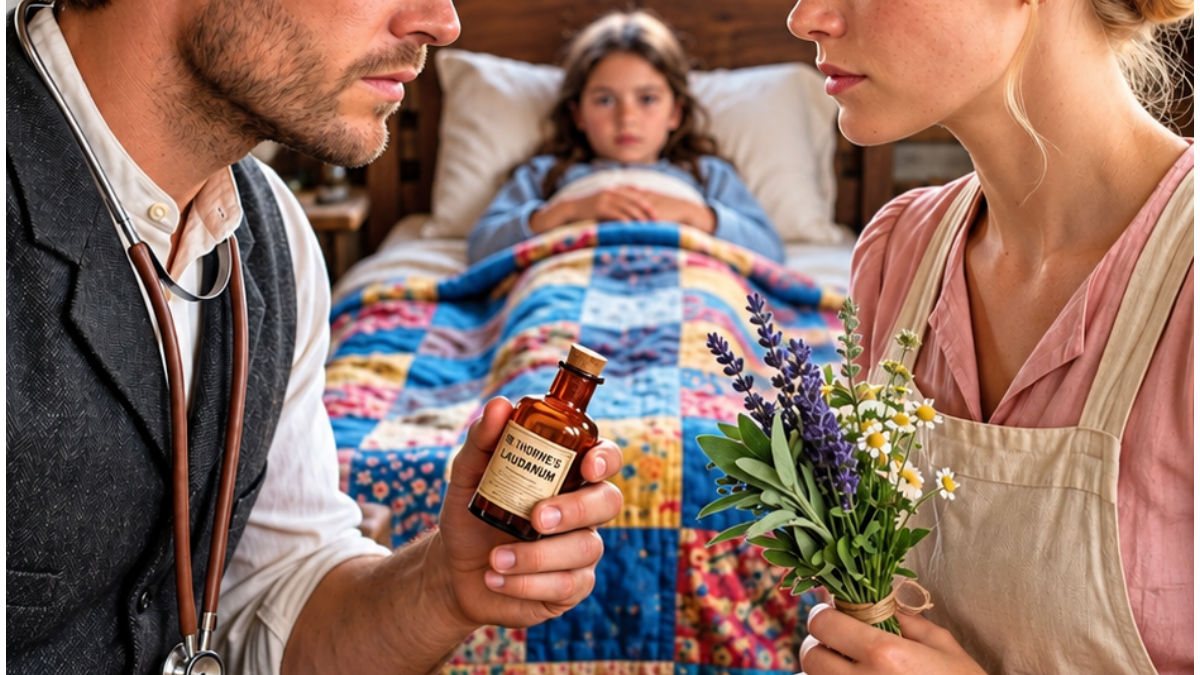
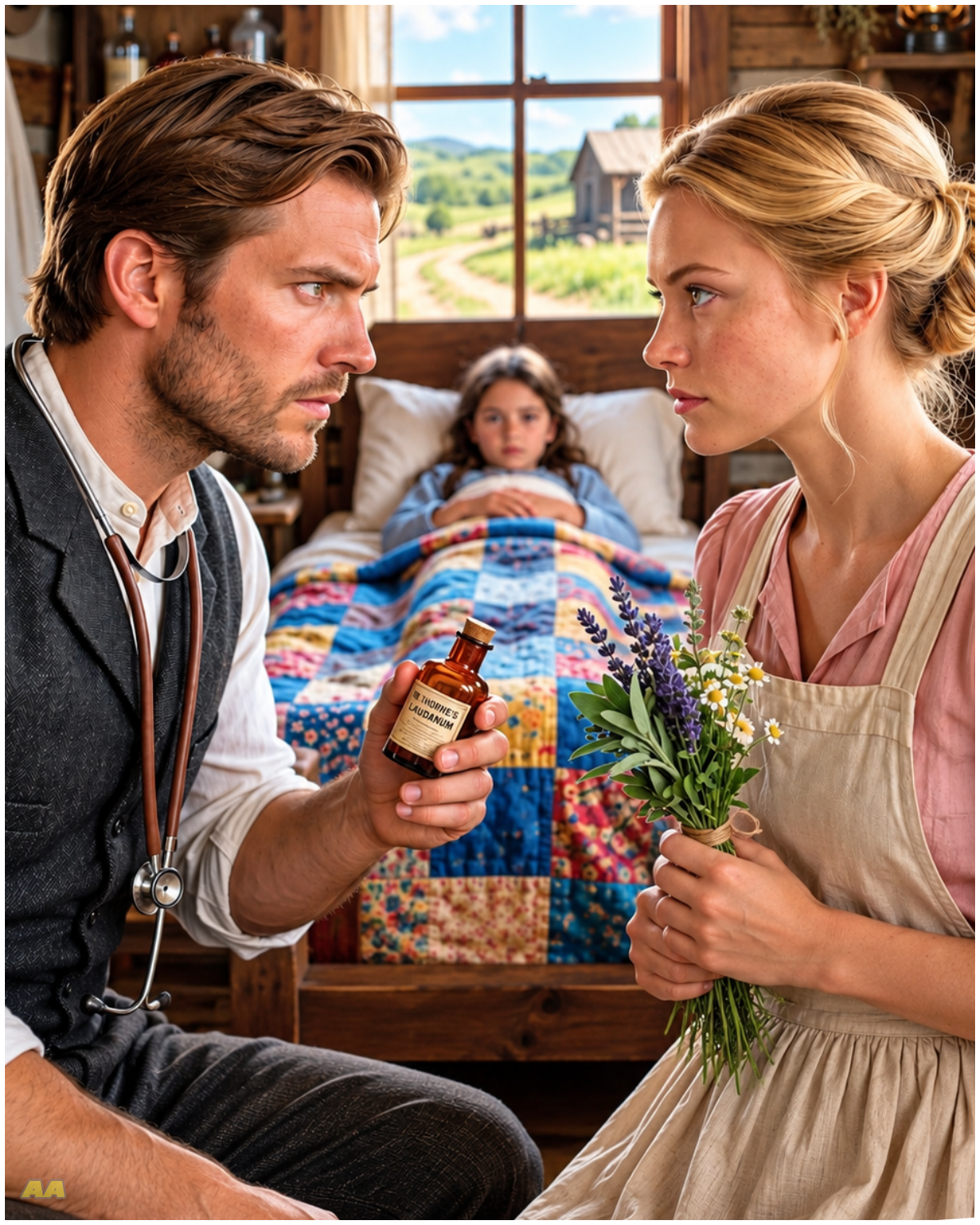
Washington Territory, 1887. Faith Hart was 7 years old when the fever took hold, and by the second evening, her father had sent for every kind of help the county could offer.
Dr. Theodore Cross had already examined her twice that day, certain enough of his own diagnosis that he barely looked up when a second visitor arrived at the gate.
Rose Quinn had walked four miles carrying a satchel of dried herbs called not by the family but by her own worry.
Word of the girl’s illness having reached her through a neighbor before noon.
Theodore met her on the porch before she’d taken three steps toward the house.
“Stay away from her,” he said plainly enough that the words carried through the open window into the sick room itself.
This child needs medicine, not superstition.
Rose didn’t move. That rash on her collarbone, she said.
Has it started spreading downward yet or only across?
Theodore went very still. He hadn’t mentioned the rash to anyone.
By midnight, he would have to decide whether he trusted his own diagnosis or the woman he’d just sent away.
Theodore had trained in Philadelphia, studied under respected physicians, and carried West with him a fierce, careful pride in medicine learned from books and lecture halls and years of supervised practice.
He’d lost a patient once early in his career, a young mother whose fever he’d treated exactly as his training instructed, and who had died anyway, despite every correct step taken in the correct order.
The town had never once blamed him.
He’d blamed himself considerably more thoroughly than they ever managed, and the loss had hardened into a conviction that the only defense against such losses was rigorous method, nothing left to chance or folk remedy.
He kept a small ledger still, noting every patients dosage and outcome with obsessive care, as though sufficient documentation might somehow guarantee against another loss he couldn’t fully explain.
He’d heard of Rose Quinn since arriving in the territory, and had dismissed her without ever once meeting her properly, as exactly the kind of dangerous amateur his training had warned him against.
The fever began on a Tuesday in June, mild enough at first that Faith’s mother assumed it would pass with rest.
By Wednesday afternoon, it hadn’t, and Franklin Hart, the wealthiest farmer in the county, sent his fastest rider for Theodore.
The doctor arrived within the hour, examined the girl carefully, and diagnosed a common seasonal fever.
He prescribed rest, fluids, and a tincture meant to break the fever’s grip within a day or two.
By Wednesday evening, the fever hadn’t broken.
A faint rash had begun spreading across Faith’s collarbone, something Theodore noted in his ledger without quite being able to place within his training.
He returned to check on her that same evening, uneasy in a way he didn’t yet have proper words for.
It was through the sick room window, waiting on the porch to be led inside, that Rose first saw the rash properly.
Faint, but visible even from a distance, spreading in a pattern she recognized from years of practical experience.
“That was the question she asked Theodore before he’d finished ordering her away.”
“I’m not offering superstition, Dr. Cross,” she said when he repeated himself.
I’m offering an honest question about something I can see for myself through that window.
You needn’t answer it. I’ll simply keep walking and hope your training accounts for what I just saw.
I’ve seen fevers far more complicated than anything you’re likely to have encountered.
I don’t doubt it, Rose said.
I’ve also seen this particular pattern once before, years back, in a case that didn’t end well for a family who waited too long to consider more than one opinion.
I’ll leave that with you, Dr. Cross.
Whatever you decide to do with it.
She turned and walked back down the road and did not look back to see whether he was still watching her go.
Faith’s condition worsened through the following hours.
Her fever climbed higher, the rash spreading further across her small chest, her breathing growing labored in a way that frightened even Theodore’s careful, practiced composure, he tried every remedy his training offered.
Nothing slowed the fever’s progress. By midnight, watching Faith fight for breath, watching Franklin Hart’s careful composure finally crack into open terror, Theodore thought of the pattern Rose had described, and understood plainly that his pride had already cost precious hours he couldn’t get back.
He saddled his horse and rode the four miles himself.
Rose opened the door before he’d finished knocking, already dressed, as though she’d half expected exactly this.
I need your help, Theodore said, the words costing him more than any diagnosis ever had.
The rash, the fever pattern. I don’t fully understand what I’m looking at.
Neither do I entirely, Rose admitted, already gathering her satchel.
I have a suspicion, not a certainty.
It could be the water. There’s a pattern like this I’ve seen before in families drawing from a shared well gone bad.
I’d want to see where the hearts get their water before I’d claim anything more than that.
Then we’ll look together, Theodore said.
Whatever it is, we’re not solving it standing in your doorway.
They rode back together, and while Theodore sat with Faith through the worst of the night, monitoring her breathing by lamp light and recording every small change in his ledger, Rose walked out at first light to the well the Hart household drew from.
She knelt at the water’s edge for a long while, drawing a sample, examining the ground around it, and finally found what she’d half expected, a dead livestock trough uncomfortably close to the source, its runoff angled ever so slightly toward the well itself.
She couldn’t say with certainty that this was the cause.
She could only say it was wrong and worth correcting, regardless of whether it explained Faith’s illness fully.
It’s not certain, she told Theodore when she returned, exhaustion and quiet urgency both plain in her voice.
But it’s enough to act on.
Boil every drop of water this house uses from now until we understand this properly.
Beyond that, I can offer fluids and a preparation that’s eased fevers like this before, though I’ll not promise you it’s a cure.
It’s the best I have. Then we use what we both have.
Theodore said, “My monitoring, your preparation, and honest water until we know more.” Neither of them pretended that morning to be certain of anything beyond the plan itself.
The days that followed were slow and uncertain, neither doctor nor healer willing to promise Franklin Hart anything beyond their honest best effort.
Faith’s fever held steady through the first day, neither worsening nor breaking.
An agonizing plateau that tested both their nerves.
Theodore monitored her breathing hour by hour.
Rose adjusted her preparation twice, watching closely for any sign it was doing harm rather than good, willing to abandon it the moment it seemed to be.
I don’t know that this is working, she admitted honestly.
The second evening, exhaustion plain on her face.
Neither do I, Theodore said. But she’s no worse.
Some days holding steady is the only honest victory available to us.
Late that same second night, Faith surfaced briefly from the fever’s grip, eyes fluttering open long enough to find both of them still there, still arguing quietly over her small, restless body.
“You’re both still here,” she murmured, barely audible.
“We’re not going anywhere,” Rose told her gently.
“You argue a lot,” Faith said.
The ghost of a smile crossing her flushed face before her eyes closed again.
“We do,” Theodore admitted, though she’d already drifted back under, and neither of them mentioned aloud how much that small half-conscious observation had steadied them both through the rest of that long night.
On the third morning, the fever finally began to break slowly, Faith’s breathing easing by careful degrees rather than all at once.
By the fifth day, Faith was sitting up.
Color returned to her face, the fever fully broken.
“I won’t claim your preparation cured her,” Theodore told Rose plainly, watching the girl eat a full breakfast for the first time in a week.
“Nor will I claim my own monitoring alone managed it.
I have no honest way to separate what helped from what simply ran its natural course.” That’s more honesty than most physicians would offer.
Rose said, “It’s the only kind I trust anymore.” Theodore said, “I owe you an apology regardless.
I dismissed years of your genuine knowledge because it didn’t arrive wrapped in credentials I recognized.” That was pride, not sound judgment, whatever I told myself at the time.
“I’ll accept it,” Rose said. Though I’d rather you simply remembered the lesson than dwell too long on the apologizing itself.
Before we go on, there’s something worth understanding about frontier medicine in this period.
Formally trained doctors were genuinely scarce across rural territories, and many families relied on whoever was actually available, trained physician or experienced local healer simply because distance and cost put a proper doctor out of reach more often than not.
Contaminated wellwater was also a real and common danger.
One that folk knowledge sometimes recognized through pattern and experience well before formal medicine had a clear explanation for it.
None of that means every old remedy worked as claimed.
It means the two traditions often worked side by side out of necessity whether or not either side fully trusted the other.
On this channel, our stories do more than entertain you.
They help us understand the world these people actually lived in.
Now, let’s get back to Theodore and Rose because something considerably more complicated than professional respect has quietly begun.
Weeks later, Theodore called on Rose again, this time over a farm hand with a stubborn cough neither of them considered especially serious.
Willow bark tea twice daily, Rose said, examining the man briefly.
I’d rather he rest properly and avoid dust for a week, Theodore said.
I’m not convinced the tea will help his cough specifically, whatever it might do for the fever he doesn’t currently have.
You’re welcome to prescribe rest, Rose said.
I’ve simply found patients tolerate advice better when it comes with something to actually do.
That’s a fair point, Theodore admitted.
Though I notice you didn’t actually argue that the tea works.
I didn’t, Rose said, and something like a smile crossed her face.
I argued that it helps him feel useful while his body does the actual work.
There’s a difference, and I found both matter.
Theodore found himself considerably more entertained by the exchange than the minor case strictly warranted.
He stayed longer than the visit required, and Rose, without much ceremony, set an extra plate at her own table.
“You take your coffee like a man rationing it,” she observed, watching him nurse a single cup through the whole meal.
“Old habit. Medical school didn’t leave much coin for indulgence.” “I take mine considerably less carefully,” Rose said, pouring herself a second cup without hesitation.
Seemed a fair trade, learning to enjoy small things properly, given how little certainty this work generally offers.
That’s a lesson I could stand to learn, Theodore admitted.
Then finish your coffee before it goes cold arguing philosophy, Rose said, and he laughed, surprised by how easily it came.
Faith herself caught them midargument one afternoon, arriving at Rose’s door with a scraped knee she’d earned falling from her father’s fence, and found Theodore already there, deep and comfortable disagreement with Rose over whether a neighbor’s persistent headaches called for spectacles or simply less reading by poor lamplight.
“You’re here again,” Faith observed, entirely too pleased with herself for a girl bleeding slightly at the knee.
Professional visit. Theodore said, that’s what you said last week.
It was a different professional matter last week.
Faith looked between them with the frank assessing patience of a child who has decided two adults are being considerably slower than the situation requires.
Are you courting my mother’s friend, Dr. Cross?
Rose nearly dropped the bandage she’d been unwinding.
Theodore, to his credit, didn’t flinch, though it cost him visible effort.
I’m considering it, he said. Properly and slowly, so as not to make a mess of it.
That seems a very doctor’s way of answering, Faith said unimpressed, and held out her knee for Rose to finish bandaging, satisfied she’d extracted the honest truth from a grown man twice her age.
Rose, biting back a laugh, cleaned the scrape with considerably more attention to Faith’s chatter than the small wound strictly required, and neither she nor Theodore mentioned the exchange again that day, though both of them thought of it more than once in the weeks that followed.
It was some weeks later in the merkantile that Theodore properly understood something about Rose he hadn’t before.
A woman he recognized as a former patient of Roses, treated successfully for a bad winter cough, passed her on the street without so much as a nod, her eyes sliding past Rose as though she weren’t there at all.
Rose didn’t react, continuing her own errand without pause, though Theodore, watching, understood plainly what he was seeing.
She was trusted quietly, called on in private need, and just as quietly unagnowledged the moment that need had passed.
He mentioned it to her afterward, careful not to embarrass her further by making too much of it.
“You noticed that,” Rose said, neither surprised nor especially pleased.
“Most don’t, or pretend not to.
It’s simply how it’s always been.
Useful enough to call on, not quite respectable enough to greet properly in daylight.
That’s not simply how it’s always been, Theodore said.
That’s how people have chosen to treat you, which is a different matter entirely.
He began after that, making a point of greeting her plainly whenever their paths crossed in town, whatever curious looks it drew from neighbors unaccustomed to seeing the doctor treat the healer as an equal.
The next time the same woman from the merkantile passed them both on the street, Theodore stopped mid-sentence, tipped his hat toward Rose with deliberate ceremony, and said loud enough to carry, “Miss Quinn saw something in Faith’s illness that I had missed.
She helped me care for that child when I was too proud to ask.” This county owes her more than polite silence.
The woman flushed, murmured something apologetic, and did from that day forward nod to Rose properly whenever their paths crossed.
“You needn’t make a show of it,” Rose told him afterward, though without much real objection in her voice.
“Isn’t a show,” Theodore said. “Simply overdue correction on my part and the town’s both.” One evening, walking her home after a longer visit than either had quite planned for, he finally told her about the young mother he’d lost, the weight he’d carried silently for years.
“Her name had been Sarah Puit,” he said, and she’d trusted him entirely, never once questioning a single instruction he’d given her through the whole course of her illness.
He’d followed every step his training prescribed in the correct order, and she had died regardless, on a morning so ordinary he could still recall the particular slant of light through her window when it happened.
He’d told her husband it had simply been beyond anyone’s power to prevent, and had spent every year since privately unconvinced of his own reassurance.
“I’ve spent years believing that pride was thorowness,” he admitted.
I understand now it was closer to fear dressed up as certainty.
Grief does that. Rose said, “I lost my grandmother much the same way.
Watched illness take her despite every remedy I knew.
Took me years to understand that losing someone doesn’t mean the knowledge failed.
Sometimes illness is simply larger than any single tradition can answer alone.” They walked the rest of the way to her door in a silence that felt, for the first time since they’d known each other, entirely comfortable rather than merely professional.
He asked her that autumn on the same porch where he’d once told her plainly to stay away.
“I’m not offering you rescue from anything,” Theodore said.
“You’ve built something valuable on your own, and I respect it too much to pretend otherwise.
I’m asking whether you’d have me as a husband and let me spend the rest of my career standing beside you in daylight, not simply calling on you when convenient.” Rose was quiet a moment, weighing it with the same careful honesty she brought to every diagnosis.
“I’ve spent a long while being useful to people who’d rather not be seen needing me,” she said finally.
“I’d like to try being needed openly instead, for once.
Yes, Theodore. They married that winter.
Faith Hart herself present among the small gathering, fully recovered and delighted to witness the wedding of the two people who’d fought so hard for her that terrible week.
Married life settled into a rhythm neither had quite expected.
Theodore learned slowly to properly identify the herbs drying across their kitchen, though he never matched Rose’s instinct for which remedy suited which complaint.
Rose took to reading his medical journals some evenings, arguing points with him late into the night with obvious enjoyment.
“You’re memorizing symptoms like a physician now,” he told her once.
Someone in this house ought to keep up with you properly, Rose said.
Before you grow prideful again from lack of competition, their first proper case as husband and wife came that same spring.
A fever considerably milder than Faiths had been, though the family calling for help lived close enough to town that both a doctor and a healer arrived within the hour of each other.
This time by shared agreement rather than accident.
Water first, Theodore said before Rose had even finished dismounting.
Already thought of it, she said.
I’ll check the well. You check the child.
They worked the case in under an hour, moving around each other with an ease that drew a curious, approving look from the family’s own grandmother, who’d clearly expected some manner of professional squabble, and seemed almost disappointed not to witness one.
You two argue considerably less than the whole county predicted,” the old woman observed, watching them pack their respective bags.
“We save our arguing for matters that actually deserve it,” Rose said.
And Theodore, loading his own horse, didn’t bother disagreeing.
Two years into their marriage, in the early spring of 1890, on an ordinary evening with herbs drying on every surface of the kitchen, Rose told him plainly that he’d soon need to learn a great many things beyond herbs and journals both.
It took him a moment to understand.
When he did, he set down the mortar and pestle he’d been holding with considerably less care than the instrument deserved.
You’re certain? Reasonably, Rose said, smiling despite herself.
Though I’d welcome a second medical opinion if the physician in the house has one to offer.
He examined her with careful, genuine tenderness, and confirmed what she already knew.
“I believe congratulations are in order,” Theodore said, “for both of us.” Faith, nine now, and insisting to anyone who’d listened that she’d soon be 10, visited often that spring, delighted at the thought of what she’d already decided would be her own honorary younger sibling.
“I remember being sick in that bed,” she told Rose once, helping fold small blankets for the coming child.
“I don’t remember much else about that week, just that you and Dr. Cross never once stopped arguing about what to try next.
We were rather good at that, Rose admitted.
You’re still good at it, Faith said entirely without malice.
And Rose laughed until she had to set the blankets down.
I’ve been thinking, Faith said considerably more serious now, smoothing a small quilt across her knees.
“When the baby comes, I’d like to teach her what you taught me about the herbs.
I mean, not the doctoring part, just the garden part.
You’d make a fine teacher, Rose said.
Though I suspect she’ll have two mothers teaching her that particular lesson, whether either of us properly plans it that way.
Faith considered this with obvious satisfaction, and said nothing further, though she returned the following week with a small, carefully labeled jar of dried chamomile she’d gathered and prepared herself, insisting it be the first thing placed on the nursery shelf.
The baby came on a clear night in early autumn.
Theodore, despite every medical text he’d studied and every birth he’d calmly guided as a physician, found his own composure entirely abandoning him the moment it was his own wife laboring behind a closed door.
He paced the hallway for 3 hours until the midwife finally opened the door and called him in with a look that suggested she’d seen calmer fathers.
He held his daughter with hands that had studied countless patients over the years and found them for the first time in his career not quite steady at all.
She’s got your stubborn chin, Rose observed, exhausted and radiant both.
And your capacity for proving me wrong at every turn, I expect, Theodore said.
Seems only fitting she’d inherit that firSt. They named her June for the month years before when a rash on a sick child’s collarbone had first taught a doctor to trust a healer’s honest question.
June grew up between dried herbs and medical journals.
Toddling from her mother’s garden to her father’s examination room with the easy confidence of a child who understood both kinds of knowledge mattered equally in her household.
By four, she’d taken to helping in the garden, pulling up more weeds than herbs.
Though her careful, serious attention delighted her mother regardless.
“This one’s for fevers,” she informed a patient’s worried mother once, holding up a sprig she hadn’t yet properly identified.
“And that one’s definitely a weed.” “She’s not entirely wrong on either count,” Rose told the startled woman, laughing.
By six, she’d taken to listening carefully whenever her father examined a patient, asking careful questions afterward that reminded Theodore more than once of Rose’s own methodical curiosity.
“Will she grow up a doctor, do you think?” Rose asked one evening, watching June arrange dried herbs into some private, meaningful order only she understood.
“Or a healer,” Theodore said. Or knowing our daughter, likely both traditions combined into something better than either of us managed alone.
Faith, 16 now and nearly grown herself, still came by most Sundays, and had taken it upon herself to teach June exactly what she’d once promised.
Not the doctoring, but the garden.
The two of them kneeling together in the dirt while June solemnly repeated whatever plant name Faith offered her.
That’s chamomile, Faith said, guiding June’s small hand to the right leaves.
Same jar I brought your mother before you were even born.
I know, June said with the particular authority of a six-year-old certain she’d always known everything worth knowing.
You tell me every time. Because it’s worth telling every time,” Faith said, entirely unbothered, and let the girl arrange the cutings however she pleased, exactly as Rose had once let her.
Dr. Theodore Cross spent years believing that proper medicine meant trusting only what his training had taught him, until a healer’s honest question gave a frightened child the best chance his pride alone had nearly cost him.
Rose Quinn had grown accustomed to being useful in private and unagnowledged in daylight until a proud doctor finally learned to stand beside her in town and discovered in the standing considerably more than simply a colleague worth respecting.
Some of the best medicine isn’t found in a single tradition at all.
It’s found in the honesty to admit what you don’t know and the humility to ask for help from exactly the person you once told to stay away.








