The Cowboy Needed His Mare to Cross – The Woman He Hired Knew the Secret Behind Her Fear
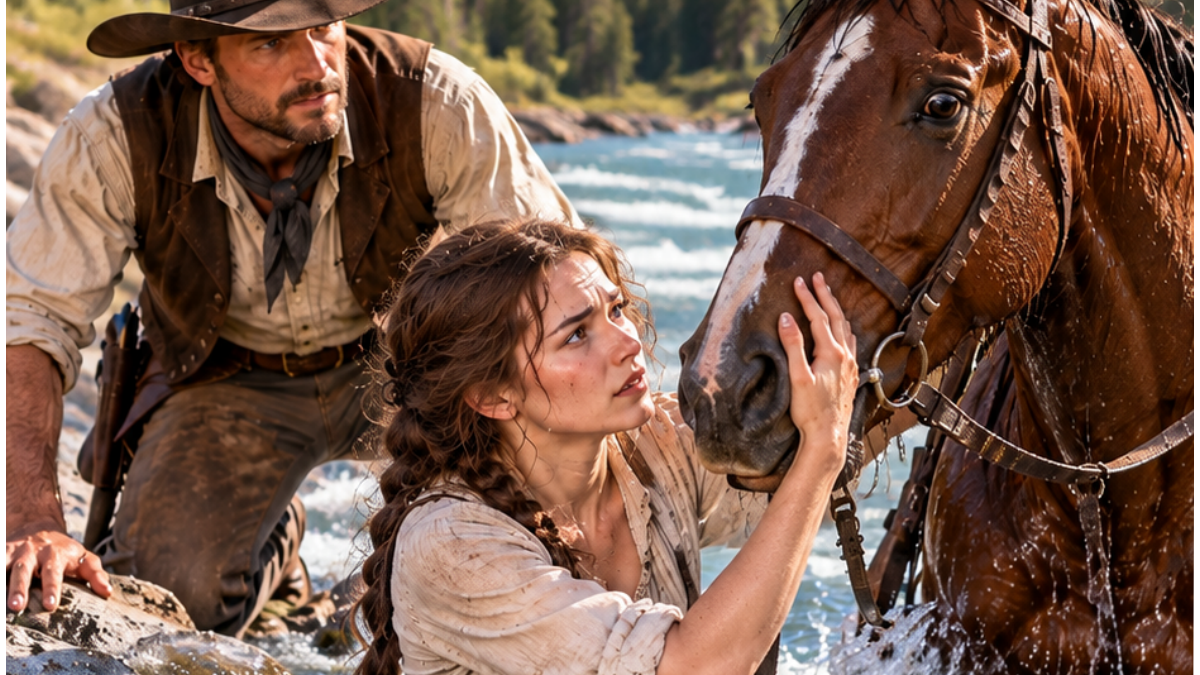
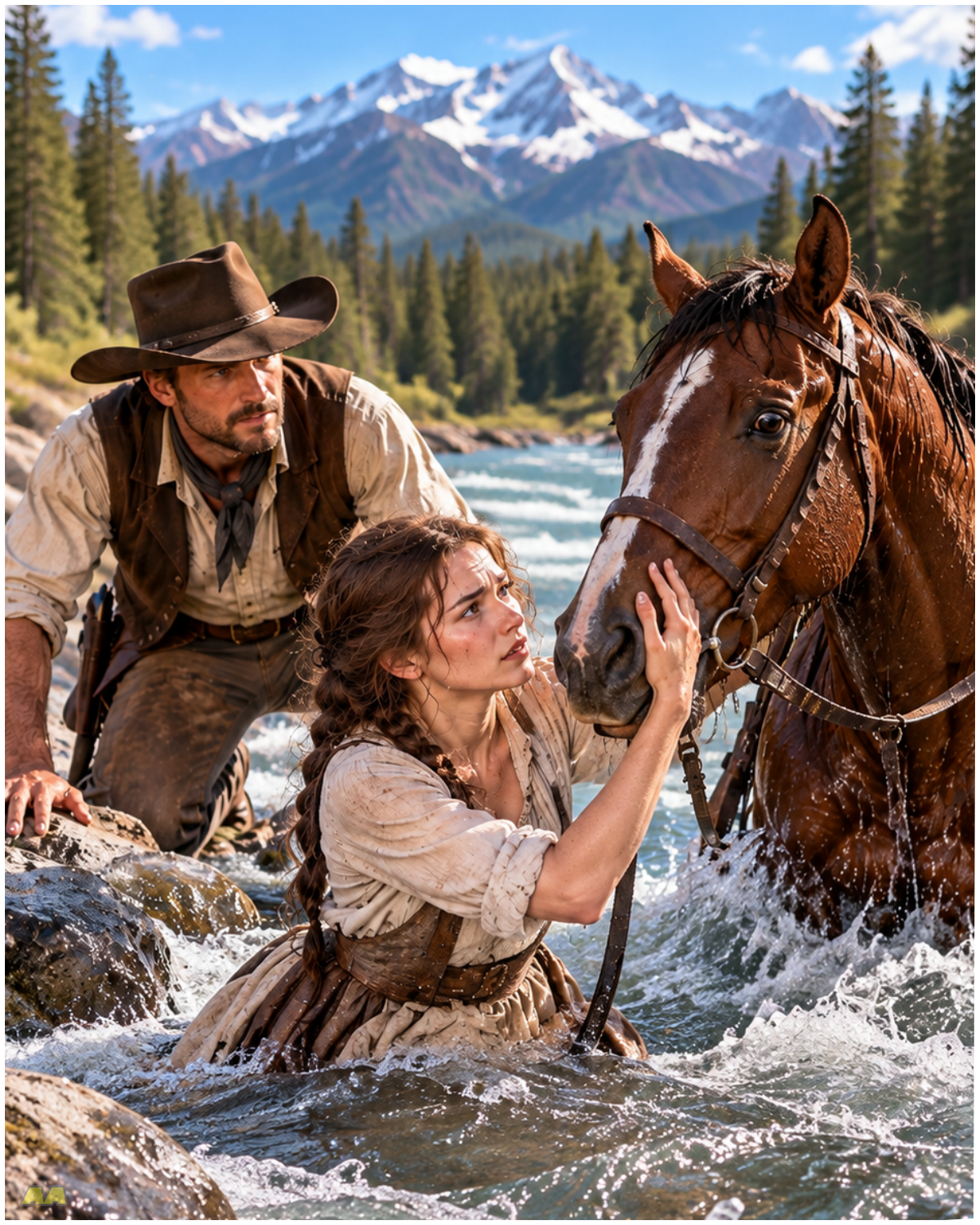
The rope was already in Everett’s hands when the stranger stepped between him and the horse.
Rainbird stood trembling at the river’s edge, water dripping from her legs, nostrils wide and white- rimmed.
She had made it six steps, six steps before the current touched her belly, and something ancient and terrible fired behind her eyes.
She had reared, twisted, and taken 42 horses back to shore, with her like a tide pulling out.
Everett had watched 43 winters of breeding work turn away from a river crossing, and he had done the only thing a man in his position knew to do.
He reached for the stronger rope.
Don’t tighten that. The woman’s voice was flat, not loud, not asking.
Everett looked at her. He had hired her 48 hours ago because his crew was short and her references were solid, and he hadn’t had time to think much past that.
Lydia Boon, 31 years old, showed up with a lame geling and asked for seasonal work until the animal recovered.
She knew horses. That much had been obvious within the first hour.
What was not obvious was why she was standing between him and a problem that wasn’t hers to solve.
“Step aside,” he said.
“If you put pressure on her in that water,” Lydia said, she’ll fight until something breaks.
“Could be the rope, could be her leg, could be both.”
Snow covered the ridge to the northeast.
Not a dusting, a real covering, sitting up there like a clock face that had stopped moving.
They had 5 days, maybe less.
I’ve got 43 horses that need to be across this river before that weather comes down, Everett said.
That mayor leads the herd.
She goes, they all go.
She doesn’t go. I know what happens if she doesn’t go.
He stared at her. Then get out of my way.
Lydia didn’t move. Instead, she looked at Rainbird at the place where the mayor’s chest met her left foreg.
And something crossed her face that Everett couldn’t name.
Not pity. Something older than pity.
You see that scar? She said quietly.
He hadn’t mentioned the scar.
He hadn’t mentioned it because he’d bought Rainbird 3 years ago from a freight outfit in Lewon, and the man selling her said she’d caught a rope in a water crossing and left it at that, and Everett had left it at that, too, because the mayor was otherwise perfect for his needs.
How do you know about that scar?
Lydia’s jaw tightened. She kept her eyes on Rainbird because she said, “This isn’t the first river where I’ve watched her nearly die.”
The summer had gone wrong quietly.
That was the worst kind of wrong Everett had found over the years.
The dramatic failures, a fence line down, a horse with collic, a hand who quit in the middle of a gather those announced themselves.
You knew what you were dealing with, but the summer of 1,884 had simply dried up.
The grass had come in short and stayed short.
The creek that usually ran strong through July had gone thin by June, and Everett had watched his 43 horses eat through the available range 2 weeks faster than any year he could remember, and he had done the math in his head every night before sleep, and the math kept arriving at the same answer.
He needed winter pasture across the Salmon River.
He had arranged it. Tom Greer, who ran sheep on the southacing slopes east of the river, had land that his animals didn’t touch until late spring.
They had agreed on a price, and Everett had felt for about a week that the problem was solved.
The crossing was difficult, but not unknown.
He had done it before with smaller numbers in better conditions.
Then Rainbird refused. The first attempt had been a scouting run, just Everett, his foreman Cal, and three of the steadier gelings trying to feel out the ford.
Rainbird had gone in willingly enough at firSt. She was not a nervous horse.
She had earned the Ramuda’s trust over four years, not through aggression, but through steadiness.
She was simply the animal that knew where to go, and the others had learned to read her.
She entered the salmon to her knees.
Then the current shifted against her legs.
Everett had seen horses hesitate at water before.
He had seen horses refuse and need convincing.
What Rainbird did was different.
She didn’t slow down. She didn’t plant her feet.
Something switched over inside her like a lamp going dark, and she came out of the water so fast that Cal’s horse spooked sideways off the bank.
“She’ll go in again,” Cal had said.
“Give her another try.”
Everett had given her three more tries over two days.
Same result every time. She made it kneede and the current hit her and she came out.
And every time she came out, the younger horses read it and pulled back.
And the older ones watched her and decided if Rainbird didn’t like it, they probably didn’t either.
He had ridden home that second evening and sat on the porch and stared at the mountains until Owen came out and set a cup of coffee on the rail beside him.
Owen Hail was 61 years old and had been running this ranch alongside Everett since Everett’s father died.
He was not Everett’s father.
He was something closer to what Everett’s father should have been practical without being cold.
Honest without enjoying honesty as a weapon.
How bad? Owen said. She won’t cross.
Owen was quiet for a moment.
What do you want to do?
I don’t know yet. You could sell 20 of the younger ones now.
Get ahead of it. The prices are low.
They’ll be lower after the snow comes and everyone else is selling for the same reason.
Everett picked up the coffee and didn’t drink it.
I’m not selling the FO.
Two of them are out of the bloodline I’ve been building toward for 6 years.
Then we need Rainbird to cross, Owen said simply and went back inside.
That was 4 days before Lydia Boon arrived.
She came up the road from Chalice on a gray geling that was carrying his right front leg wrong.
Not dramatically wrong, he was still moving, still willing, but Everett was close enough to see the compensation in the shoulder, and he stepped off the porch to meet her before she even reached the gate.
“Your horse is lame,” he said.
She looked down at the geling, and her expression said she already knew.
He caught himself on loose shale two days back.
“I’ve been walking him as much as riding.
You heading somewhere specific? Wherever there’s work?
She looked at the ranchyard, the horse pens, the barn, the stacked hay.
I heard at the store in Chalice that you’re moving a ramuda before winter.
Who told you that? Feed storeman said you were short-handed.
That was true enough. He’d lost a hand to a broken arm in August, and another one had gone home to his family in Oregon.
When word came that his mother was dying, he had Cal and he had Owen, and he had one other man who was useful but slow, and moving 43 horses across a difficult river with that crew was manageable in theory and miserable in practice.
You have experience with large horse moves, some she swung down from the saddle without ceremony, and stood beside the geling with a hand on his neck.
I’ve worked ferry crossings, mountain drives, two ramuda moves in Oregon territory.
I’m good with problem horses.
What kind of problems? She looked at him steadily, the kind that have reasons.
He hired her that afternoon, not because she was impressive, though she was, but because he was running short on time, and she was there, and her references, when he asked for them, were verifiable.
He put her in the spare room that the hand with the broken arm had vacated, and told her she’d start in the morning.
The first thing Lydia did the next day, before breakfast was cleared, was walk the horse pens alone.
Everett watched her from the barn.
He wasn’t spying he had work to do in there, and the pen was directly in his sighteline.
He just didn’t announce himself.
She moved along the rails without hurrying, letting the horses come to her or not, not reaching, not making sounds, just present.
The younger horses, the 2-year-olds who were suspicious of everyone, drifted toward the far end.
The older gelings watched her with professional disintereSt. A few came to the rail out of curiosity.
Rainbird stood at the center of the pen.
She wasn’t doing anything. She was the way she usually was alert without being tense, watching the yard with the mild authority of an animal that has never had to prove it.
When Lydia came to the rail near her, she didn’t move away.
She also didn’t come forward.
Then Lydia whistled three notes descending low, high, low, like a question asked gently.
Rainbird’s head lifted so fast it startled the horse next to her.
She walked directly to Lydia.
Walked, not drifted, deliberate, like answering a name she had not heard in a long time.
And then Lydia stopped whistling.
She put her hands in her pockets and looked away from the mayor as if she hadn’t done anything at all.
Rainbird came all the way to the rail and stood there, breathing against Lydia’s shoulder, and Lydia let it happen without turning toward her, and the whole thing lasted maybe 15 seconds before Lydia walked away toward the barn.
Everett stepped back from the doorway and picked up a bridal that didn’t need mending and started working on it anyway.
When Lydia came into the barn, she said, “What do you want me to start on?” And he told her about the fencing on the east pasture, and she nodded and went to get tools, and nothing was said about the mayor.
But Everett kept thinking about those three notes for the rest of the day.
“You can’t push the timeline any further,” Cal said.
They were standing at the corral gate after the evening feed.
Cal with his hat pushed back and his arms on the top rail, watching Rainbird move through the other horses like water finding its level.
Cal Foster was 24 and had been with the ranch 2 years, and he was good help, quick with his hands, decent with a rope, willing to work in weather that discouraged better men.
He was also the kind of young man who believed most problems had solutions that just needed enough force applied in the right direction.
I know the timeline, Everett said.
Then we need to run her through.
Get ropes on her flanks.
Give her nowhere to turn.
Run her through with the herd moving behind her.
She’ll panic halfway across. And then she’ll be halfway across and there’s nothing to do but finish.
And if she goes under, horses swim.
Not always. Everett watched the mayor.
And not always in current that cold.
Ev, we got maybe 4 days before weather hits that ridge hard enough to close the trail.
We can’t afford to be delicate about one horse.
She’s not one horse, Everett said.
She’s the reason the other 42 move as a unit.
You lose her truSt. You lose the cohesion you need to run that crossing at all.
Cal was quiet for a moment, working his jaw.
The new woman. You think she can do something?
Everett didn’t answer right away.
He thought about three descending notes and a mayor who had crossed a pen like she was answering a door.
I don’t know yet, he said.
Lydia’s method, as Everett came to understand it over the first week, was not gentle in the way people used that word when they didn’t really mean it.
It wasn’t soft. It wasn’t coddling.
It was specific. She identified what Rainbird was afraid of, which was not water.
And then she built toward it from the edges of the fear rather than from the center.
The first day she worked Rainbird around wet ground, just wet, the pasture corner, where runoff gathered after rain.
She walked her through it until the squelching underfoot stopped making the mayor’s ears flick.
That took about 2 hours.
The second day she set up a shallow irrigation pan barely 4 in deep and led other horses through it until Rainbird grew bored of watching and followed on her own terMs. The third day she dragged a long rope through a shallow puddle while Rainbird watched.
Then let the rope drag past the mayor’s legs.
Let it get wet and heavy and slow around her ankles.
Most horses hated that sensation.
Rainbird had history with ropes and water.
She danced sideways twice and blew hard through her nose and then stood still and let it happen.
“You’re not working on water,” Everett said, watching from the fence on the fourth afternoon.
“I’m working on trapped,” Lydia said without looking at him.
“The water’s secondary. Those aren’t the same problem.
They were the same for her.” She adjusted her grip on the lead.
Something got around her legs and water once and pulled.
Now her brain connects moving water and restraint as one signal.
You have to separate them.
That takes time we don’t have.
It takes less time than a mass casualty crossing would.
He didn’t have an answer for that.
So he stayed quiet and watched.
What he saw over that afternoon and the three that followed was not a horse being trained so much as a horse being given back something that had been taken from her.
Rainbird didn’t become unafraid. She became slowly a horse who was afraid and kept going anyway because the thing she was afraid of kept proving that it would not kill her.
Everett understood that at a clinical level.
What he didn’t understand was why watching it made something behind his own sternum feel strangely uncomfortable.
It was Owen who said it firSt. She’s not just working on the horse.
He told Everett one evening coming in from the barn.
I know she’s working on you too.
Showing you something, Owen. I’m not saying she knows she’s doing it.
The old man poured himself coffee and stood at the stove with it.
I’m saying some people solve problems in a way that’s a kind of argument.
Every method is a philosophy.
You watch someone work long enough, you find out what they believe.
Everett picked up his hat.
What do you think she believes?
Owen considered that things that were hurt once don’t need to be hurt again to move forward.
Everett put on his hat and went outside.
He stood in the dark for a while listening to horses breathe in the pasture.
Then he walked to the edge of the pen where Rainbird was standing and held out his hand and she came to him and breathed against his palm and he thought about a blizzard that had happened 19 years ago and 17 horses dead in a mountain pasture because a man had believed the weather would turn.
He thought about how he had been 19 years old and had gone up there with his father in the aftermath and the snow was still coming down and the shapes in it were not shapes you forgot.
He thought about how ever since then a deadline had not been simply a deadline.
It had been a wall with consequences on the other side.
Rainbird walked through a shallow creek on a Tuesday, not led through, walked through.
Lydia had spent that morning moving other horses across it repeatedly until it was just a fact about the landscape.
And then she had simply not blocked Rainbird.
When the mayor decided to follow a geling named Wicker over the crossing, Rainbird hesitated on the bank for 11 seconds.
Everett counted, though he told himself he wasn’t.
Then she stepped down into the water and walked across with her high and her hires for and came out the other side and shook herself and went back to grazing.
Lydia looked at Everett. Everett was already looking at her.
He felt something move in his chest that was not triumph exactly.
It was more like the feeling of a door opening in a house you had been trying to leave for a long time.
That’s a creek, he said.
The salmon’s different. It is, Lydia agreed.
But, but this is how it starts.
She coiled the lead in her hands.
You can’t get to the hard part firSt. That’s not how fear works.
How does it work? She looked at the creek for a moment.
It works like this. You go close enough to feel it, and then you go back and nothing bad happens.
Then you go a little closer.
Then you go back and eventually the place that was terrifying is just a place.
What if you run out of time before you get there?
She was quiet. What if the weather doesn’t wait for the process?
He pushed. Then you make a different choice, she said.
But you know the cost of it.
They stood in the same space without moving for a moment that was 1 second longer than it needed to be.
And both of them noticed, and neither of them said anything about it.
Cal came riding across the pasture from the east fence, and the moment ended before it finished becoming anything.
But Everett thought about it again that night, which told him something he wasn’t ready to name.
It was 11 days after Lydia’s arrival that he heard the whistle again.
He had come around the corner of the barn in the early morning before anyone else was stirring and heard it.
Three notes, low, high, low, coming from the far end of the horse pen.
He stopped where he was.
Lydia stood at the rail in the gray morning light with her back to him.
And Rainbird stood on the other side of the fence with her nose almost touching Lydia’s hair.
Lydia was not doing anything dramatic.
She was not training. She was just standing there with her forehead almost resting against the mayor’s forehead through the rail, and she was talking too quietly for Everett to hear.
It was the most unguarded he had seen her.
It lasted maybe 30 seconds before Rainbird pulled back and moved away into the herd, and Lydia straightened and turned around and found Everett standing 20 ft away.
Her expression shifted into something controlled so fast he almost missed the one beneath it.
She’s going to be ready, Lydia said.
I know, Everett said. Where did you learn that whistle?
The controlled expression held perfectly.
Old way of calling horses.
Works on some of them.
She came to that whistle first time you used it.
Day you arrived. She responded to the sound.
She came like she recognized it specifically.
He kept his voice even like she’d heard it before.
Lydia looked at him for a moment.
Then she looked at the herd.
“She’s a smart animal,” she said.
“Some horses just pick things up quickly.
She walked past him toward the barn and he let her go because he had 43 horses and a deadline and no proof of anything except a feeling he couldn’t articulate, which was that Lydia Boon had not arrived at his ranch entirely by accident.
He didn’t push it. He would push it later when he was ready, and by then he would wish he had done it sooner.
The night Owen said what Owen said, Everett had been sitting with Lydia at the small table outside the bunk house.
The kind of sitting that starts because someone needs a cup of coffee and ends because neither person has gotten up yet, even though the coffee has been gone for an hour.
She had been telling him about a crossing she’d done in Oregon 40 horses through a river that was running wrong from upstream rain.
And he had been listening the way he listened, the way he listened when someone was telling him the truth about something hard, not waiting to talk, actually hearing it.
You weren’t scared? He asked.
I was scared the whole time.
But you went. You go scared or you don’t go.
She turned her cup in her hands.
Standing on the bank talking yourself out of fear doesn’t work.
You just go and the fear comes with you and eventually the other bank is under your feet and you’re still alive.
He was quiet for a moment.
That philosophy applies to more than horses.
Most things do. He told her about the blizzard then, not because he had planned to, because the conversation had arrived in a place where it was the honest thing, and he had too much experience with horses to believe dishonesty was ever actually easier than the truth.
She listened without filling the silences.
When he finished, she said, “How old were you?” 19.
That’s young to carry something like that.
People carry worse. That’s not a competition.
He looked at her. She was not looking at him with pity.
She was looking at him the way someone looks at a horse that is still carrying a load.
It was put under too young with recognition rather than judgment.
You check the ridges every morning, she said.
Old habit. No, she said it’s not a habit.
A habit is automatic. You do it like you’re paying a debt.
He didn’t argue. Outside the horses moved in the dark pasture.
Rainbird’s pale shape was visible near the water trough, standing the way she stood like she was in charge of the night itself.
She’s going to cross, Lydia said, looking out at the mayor.
I believe that. Because of your method?
Because she’s not a coward.
She never was. A pause.
She just needs someone to stop confusing panic with refusal.
Everett thought about that distinction for a long time after Lydia went inside.
He thought about all the times in his life.
He had confused those two things in himself.
Panic and refusal. They felt the same from the inside.
Maybe the difference only became visible from the outside when someone was watching carefully enough to see what was really underneath.
The snow on the ridge caught moonlight and glowed faintly white against the dark sky.
4 days maybe. He went to bed and did not sleep well.
And in the morning, Rainbird walked through the irrigation ditch on her own initiative.
And Lydia watched it happen from 50 ft away without interfering, and Everett stood at the barn door with his coffee, getting cold in his hand, and thought, “We’re not out of time yet.” But they were getting there, and something else was getting there, too.
Between him and Lydia Boon, something that moved the way Rainbird moved, not fast, not performing, just arriving steadily at a place he hadn’t expected to find himself standing.
He didn’t know yet what it was going to cost him.
He didn’t know yet what she was carrying.
He didn’t know yet that the river they were preparing Rainbird for was a river Lydia had already been to once before.
But Rainbird knew. And somewhere in the mayor’s careful, watchful eyes was a knowledge that would eventually become the most important truth Everett had ever been asked to hear.
Rainbird crossed the irrigation ditch three times that morning before anyone asked her to do it a fourth.
That was the thing Everett kept coming back to.
The mayor hadn’t been directed across the third time or the second.
She had simply stood at the edge after the first crossing and looked at the water and then walked back through it on her own, like she was testing something, like she was asking a question and waiting to see if the answer changed.
It didn’t. The ditch was still shallow.
The footing was still solid.
Nothing grabbed at her legs.
She crossed a third time and went back to grazing.
Lydia hadn’t moved from her spot near the fence poSt. She didn’t praise the horse.
She didn’t make a production of it.
She just stood there and let Rainbird process what she had discovered, which was that a thing she had feared had allowed her to leave it twice and had not punished her for doing so.
You’re not going to say anything to her?
Cal asked. He had come up beside Everett at the fence without being invited.
She already said what needed saying, Everett told him.
Cal chewed on that for a moment.
We’re still 2 weeks from the river at this pace.
We’re 10 days from the river, which is worse.
Everett watched Rainbird drop her head into the grass.
Give it until end of week.
And if she still won’t end of week, Cal Cal pushed off the fence and went back to the other horses, and Everett stayed where he was, watching Lydia walk slowly back toward the barn without looking at the mayor again.
That was the part he kept studying without meaning to.
The way Lydia worked was full of deliberate absences, things she chose not to do.
Pressures she chose not to apply.
Most horsemanship he had learned was about what you added.
This was about what you withheld.
He was starting to understand it mattered.
He wasn’t ready to admit how much.
The second week settled into a rhythm that was deceptive in its ordinariness.
Mornings on fence work, afternoons on water training, evenings on whatever needed doing before the temperature dropped.
Lydia fit into the crew without friction.
She did her share of the grunt work without complaint, didn’t talk more than necessary, and had the particular quality that good hands had, which was the ability to see what needed doing before being told.
But the rhythm was not the same as calm.
Everett felt the difference every morning when he checked the ridges.
The snow up there was patient.
It wasn’t going anywhere. It was just waiting on weather that would bring it down, and the weather would come when it came, regardless of what he needed it to do.
The water work progressed in stages that Lydia set, and Everett watched, and Owen occasionally commented on from the porch in the evenings.
She moved from the irrigation ditch to a broader, low section of Elk Creek, which ran through the eastern pasture.
The creek was maybe 12 ft across at its widest and calf deep at the center.
She spent two full days there with Rainbird before attempting anything.
The first day she simply worked other horses through it, repeatedly back and forth, back and forth until the crossing was routine background noise, and the splashing didn’t register as a threat.
The second day she let Rainbird stand at the bank for as long as the mayor wanted, which turned out to be most of the morning, and then led her along the bank in both directions for a while, and then stopped asking anything and went to do other work.
Rainbird stood at the edge of that creek for 40 minutes after Lydia walked away.
Then she stepped into her knees, stood there, stepped back out, went back to grazing.
Everett had been watching from a distance that was far enough to not be interference and close enough to see the clearly.
He didn’t write it down, but he committed it to memory the way he committed feed weights and breeding records.
The mayor had entered water voluntarily, without pressure, without a lead rope on her.
She had entered and retreated on her own schedule, and the world had not ended, and she had not panicked.
That evening, he told Owen.
Owen said, “How long until the river?” “8 days, maybe 9 if the weather holds.” “And she’s ready.” Everett turned his coffee cup.
“She’s making progress.” “That’s not what I asked.” “No,” he admitted.
“I don’t know if she’s ready.” Owen was quiet for a moment.
The woman knows something about that horse she hasn’t told you.
I know. You going to push on it?
Not yet. Owen made a sound that was not quite agreement and not quite disagreement.
Sometimes not yet becomes too late.
Everett knew that. He had a specific and permanent memory of what too late looked like, and it looked like 17 horses in a mountain pasture in the snow.
But he also knew that pushing Lydia before she was ready would get him nothing useful.
And the one thing watching her with Rainbird had taught him was that pressure at the wrong moment could turn hesitation into a closed door.
He was patient with horses because he’d had to learn patience the hard way.
He told himself he was being equally patient with Lydia.
He didn’t examine whether that was true.
The creek crossing happened on a Wednesday.
Lydia brought Rainbird to the bank on a loose lead and walked her own horse through first and stood on the far side and waited.
Rainbird planted her feet. She stood there with her ears up and her weight back and all 42 other horses somewhere behind her in the pasture and nobody pushing, nobody roping, nobody making the decision for her.
Wicker, the old steady geling, who had been across that creek 15 times in the past week, walked up beside her and crossed without ceremony and stood next to Lydia’s horse on the far bank.
Rainbird watched him. She shifted her weight forward.
She put one foot in the water, then another.
Her head came up high as the current touched her legs.
Not fast current, not deep water, nothing like the salmon, but moving, definitely moving, and cold enough to make her blow out hard through her nose.
She stood there with two feet in the creek and two feet on the bank.
Nobody breathed. Then she stepped forward and crossed.
She came out the other side, shaking and blowing, and Lydia didn’t go to her immediately.
She let the mayor settle herself.
Let Rainbird pace two steps and stop and put her head down and figure out that she was standing on solid ground with water behind her and nothing had trapped her and nothing had pulled at her legs and she was completely entirely fine.
Then Lydia walked over and put a hand on her neck once briefly and that was all.
Everett realized his hands were tight on the fence rail and loosened them.
Cal said beside him, “Huh?” “Yeah,” Everett said, “That’s not nothing.” “No.” He watched Lydia lead Rainbird back across the creek in the other direction.
Casual like it was already old news.
It’s not nothing. They didn’t say anything for a while after that.
There was something in watching it that didn’t need commentary.
The way certain sunsets didn’t need someone standing next to you pointing out the colors.
The trouble with progress Everett had found was that it created its own kind of pressure.
Before the creek crossing, the problem was clear.
Rainbird won’t enter water. After it, the problem became something more complicated.
She would enter water. She would cross water.
But the Salmon River was not Elk Creek.
And everyone who had been watching understood that.
And now the question was not will she move forward, but will what she’s learned hold in conditions that are nothing like these.
That question kept Everett awake two nights running.
On the third night, Lydia found him at the barn at midnight.
He hadn’t heard her come out.
He was doing nothing useful, just standing in the dark with a lantern, checking tack that didn’t need checking.
She appeared in the doorway with her coat pulled around her and her hair loose, which he hadn’t seen before.
She looked younger without the hat.
Or maybe just different, more like a person who was tired rather than a person managing being tired.
“You couldn’t sleep either,” she said.
“No, she came in and sat on a hay bale and pulled her knees up and looked at the tack on the wall without really looking at it.
He sat on the opposite bale and the lantern sat between them on the dirt floor and the horses breathed softly in their stalls.
“Tell me about the salmon,” she said.
“You’ve seen it. I mean, what it’s like in fall, the specific ford,” he told her.
The ford was maybe 80 ft across at the crossing point, which was the narrowest place for 2 mi in either direction.
In autumn, the water was lower than spring, but still running strong from mountain drainage.
The current angled southwest at the crossing, which meant animals entering on the east bank would be pushed slightly downstream as they crossed, which was manageable for horses that were moving well, but disorienting for horses that hesitated.
The bottom was gravel and scattered rock, solid enough, but there were three places where the bottom dropped suddenly, and a horse that wasn’t moving with purpose could find itself chest deep before it expected.
Lydia listened to all of it.
Floating debris,” she said. “Sometimes.
If there’s been windup river, you can get branches.
Sometimes larger stuff.” She nodded slowly.
“What are you thinking?” he asked.
“I’m thinking about the difference between Elk Creek and a river,” she said.
“Not the size, the sound, the pressure on the legs.” “The way the footing feels different when water is actually moving around you versus just flowing paSt.” “A pause.
Rainbird crossed a creek. That’s real.
But she’s going to hit the salmon and her body is going to remember something that her brain has been working very hard to reason around.
So what do we do?
We keep going. We work her in bigger water before we try the river.
She turned the lantern over with her foot, a small nervous movement he hadn’t seen from her before.
There’s a deeper section of Elk Creek about a mile north.
I want to try there before we attempt the ford.
That’s two more days. I know.
We’ve got six days of good weather left.
Maybe seven if we’re lucky.
I know Everett. The way she said his name stopped something in him briefly.
She had called him Hail since she arrived, or nothing at all.
It was the first time she had used the other one, and she heard it the same moment he did, and neither of them made anything of it.
Both of them looking somewhere other than at each other for a moment.
Two days, he said. Two days, she agreed.
He looked at her then, and she was already looking at him, and the lantern light was doing something particular to the plains of her face, and he was aware, with a clarity that was slightly inconvenient, that he had not thought about a woman, this specifically since before the last hard winter, which was longer ago than he cared to calculate.
He stood up and picked up the lantern.
“Get some sleep,” he said.
“We’ve got work tomorrow.” “You, too,” she said.
He walked back to the house and did not sleep for another hour.
And when he finally did, he dreamed about horses crossing water, and the images were not frightening, which surprised him when he thought about it in the morning.
The next day, Lydia worked Rainbird in the northern section of the creek, where the water ran kneedeep on a horse, and the current was noticeable, not dramatic, but real.
She spent the morning on approach work, bringing the mayor to the bank, letting her feel the current from the edge, walking away, coming back.
The afternoon she led her in on a very long, loose line, 30 ft of slack, so that Rainbird had to understand that the line connecting her to Lydia was not a restraint, but a thread, something that would break before it would trap her.
Rainbird went into her belly on the second afternoon.
She didn’t like it. Her movement became choppy, and her head stayed too high, and she was clearly calculating her exit the entire time.
But she went in and she stood and she was persuaded by the evidence of her own legs that the bottom was not going to disappear and the rope was not going to tighten and nobody was going to hold her underwater.
She came out on her own terMs. Lydia called it a good day.
Cal watching from horseback said it was the slowest progress he’d seen on a horse problem in his entire career.
“Your entire career is 4 years,” Lydia said without looking at him.
Cal started to answer and Owen, who had written out to watch, said Cal in a very quiet voice and Cal stopped.
That was the moment Everett thought later when the crew had made its decision about Lydia.
Not when she arrived, not when Rainbird first crossed the ditch, but that particular afternoon when she answered Cal without heat and Owen backed her without ceremony.
After that, the bunk house felt different, less like a trial and more like something that had been decided.
The attraction between Everett and Lydia was not something that announced itself.
It was more like the light changing in late afternoon when you don’t notice the shift itself, but you look up and realize the world is a different color than it was an hour ago.
It came through in small specific things.
The way he started saving her the better coffee when he made a second pot in the mornings.
The way she began timing her work around his so that they ended up covering the same ground in the same hours without either of them mentioning it.
Conversations that started about horses and ended somewhere else entirely, neither of them navigating toward it on purpose.
She told him about a horse she’d helped at a ferry crossing once years ago, an animal that had been in bad water and never quite recovered its confidence.
She talked about it in the way she talked about most things with precision without decoration.
The fact arranged carefully carefully so that the meaning was in the structure rather than the sentiment.
He told her about the breeding program he’d been building for 6 years.
The bloodline he was chasing that was half quarter horse.
Half something wild he’d found in a mustang band that had the particular quality of calm under pressure he’d never managed to breed reliably into a working line.
Rainbirds part of that? He asked.
“She’s the closest I’ve come.” Lydia looked at the mayor across the pasture.
Something moved in her face.
Something that was not quite pain and not quite the absence of it.
“She’s worth it,” she said.
“Whatever this is costing you.” He looked at her.
“What is it costing you?” She held his gaze for just a moment longer than necessary.
Then she looked away. “Ask me again when we’re across the river,” she said.
He should have pushed then.
He knew it afterward. But she had the same quality as certain horses, the ones that would close up entirely if you came at them wrong.
And he had learned by now to read when the door was open and when it was only almost open, which was its own kind of closed.
The kiss happened the evening after the second creek crossing.
It was not planned and was not dramatic and was not the kind of thing that would make sense to describe to someone who hadn’t been there.
They were standing at the pasture fence in the last light of the day, watching Rainbird move through the other horses.
Both of them tired in the bone deep way that good work produces and Everett had turned to say something about the day’s progress and found her already turned toward him and the distance between them was wrong for the situation too small and neither of them corrected it.
The kiss lasted a moment.
She pulled back first, not in a way that suggested regret, in a way that suggested she was taking inventory of what had just happened and wasn’t sure yet what the balance was.
He let her have the space.
That’s not She started. It’s fine, he said.
I didn’t say it wasn’t.
She turned back toward the horses.
I just need a minute.
He waited. After a while, she said, “I don’t do well with things I can’t leave.” Nobody said anything about leaving.
Nobody had to. She was still looking at the horses.
That’s the thing about starting something.
It changes what leaving would mean.
He thought about that.
What does leaving mean to you?
She was quiet long enough that he thought she wasn’t going to answer.
It means Daniel, she finally said, and then stopped.
He waited for more. It didn’t come.
Not that night. But he had the name.
He had the weight in her voice when she said it.
And he was experienced enough with things that ran deep in people to understand that he had been told something important without being told the whole of it, and that the part he’d been given was a kind of trust he should not spend carelessly.
I’m not going anywhere, he said, and I’m not asking you to either.
She looked at him then, a long measuring look, the kind she gave a horse when she was deciding whether it was ready for something.
Then she nodded once and went inside.
He stood at the fence for a long time after, with Rainbird watching him from across the pasture, and the night coming down cold and clear, and the snow on the ridge catching what was left of the light.
3 days later, they made the first attempt at the Salmon River.
Everett had kept the crew small himself, Lydia, Cal, and Owen on horseback to manage any animals that broke from the group.
He told himself they were ready.
The creek work had gone well.
Rainbird had been in moving water twice and come through it.
The rest of the herd was steady.
The weather was holding. He told himself all of that and believed most of it.
What he hadn’t fully accounted for was the sound.
Elk Creek whispered. The salmon spoke at a register below speech.
A sound that came through the ground before it came through the air.
A deep, constant pressure of water that moved faster than a horse could comfortably reason about.
He saw Rainbird register it from 50 yards back.
The mayor’s head came up.
Her ears went forward. Her stride shortened.
Lydia saw it, too. She didn’t say anything.
They came to the bank, and the herd crowded behind Rainbird as it always did when she stopped.
42 animals pressing softly toward the one who was supposed to know where they were going.
Everett watched the mayor stand at the ver the river’s edge and look at the water and he watched the water and he watched the way the current pushed against the bank grass and he watched Lydia who was watching all of it without Rainbird took a step in then another then another until the water reached her knees and the current pressed against her legs and the bottom shifted slightly under her hooves not dangerously just the normal shifting of gravel and current and something in the mar’s body changed tightened became a different animal entirely.
She came out of the river so fast that the horses behind her scattered backward, and Cal’s geling nearly sat down trying to stop itself.
Rainbird reached the bank and kept going.
20 ft back, 30, and the herd turned and moved with her, and in 30 seconds the crossing attempt was simply gone.
Everett sat on his horse and looked at the river.
The rope was already in his hands before he understood he’d reached for it.
“Don’t tighten that,” Lydia’s voice.
And now he was back at the beginning of the story, standing at the river with a rope in his hands and 42 horses behind a mare that would not cross in the weather on the ridge that was not waiting.
And Lydia Boon standing between him and the problem and telling him she had already watched this horse nearly die once before.
He looked at her and she looked at him and the river moved between them and the horses and everything that happened next.
And he said, “For the second time, low and careful, how do you know that scar?” This time Lydia didn’t turn away.
This time the answer was already working its way up through her through two years of weight she had been carrying alone.
And he could see it happening in her face the way you could see weather moving across open country from a high ridge stills distant still approaching but coming now for certain.
We need to get the horses back to pasture, she said.
Yes, he agreed. And then I’ll tell you.
He held her gaze for one more moment, long enough to understand that whatever she was about to tell him was the thing that had been underneath everything since the day she arrived.
The thing Rainbird had known from that first three note whistle, the thing Owen had sensed and Cal had missed, and Everett had felt at the edges of without knowing its shape.
“All right,” he said. They turned the horses back toward the ranch, and the river went on running behind them, and the snow on the ridge had come down another 500 ft in the past 2 days, and the window that remained was small enough now that Everett could see the edges of it from where he was standing.
But for the first time since Lydia had arrived, the deadline was not the only thing he was thinking about.
They put the horses back in the pasture, and nobody said much during the ride home.
Cal rode ahead, which was his way of registering disagreement without having to voice it.
Owen fell back, which was his way of giving space to whatever needed space.
Everett and Lydia rode side by side in the particular silence of two people who have agreed to a conversation and are both preparing for it in different ways.
The horses settled. The son dropped behind the western ridge.
Everett unsettled his horse and did it slowly, not stalling exactly, but not hurrying either.
And when he came out of the barn, Lydia was sitting on the top rail of the near fence with her back to the pasture and her hands in her lap and the look on her face of someone who has decided to do something difficult and is holding that decision carefully so it doesn’t slip away before they can act on it.
He leaned against the fence post and waited.
She looked at the ground for a moment.
Then she looked at him.
Two years ago, I was working my family’s ferry crossing, she said.
On the Clear Water about 40 mi east of Lewon.
My father ran it for 15 years.
I grew up working it with him.
After he got sick, I ran it with my brother Daniel.
She said the name the same way she’d said it before carefully, like handling something that could still cut.
A freight outfit came through in May.
Spring runoff, which is the worst time to cross.
But they were behind on a delivery.
And the foreman decided the water level was manageable.
Her jaw moved. It wasn’t.
The ferry was loaded heavy.
Wagon cargo, six horses. We should have cut the load and made two trips.
I told the foreman that he didn’t listen.
He paid me what I asked for the crossing and told me I was being overly cautious.
She paused. Maybe I was.
I don’t know anymore. I’ve gone back and forth on that so many times it’s lost its shape.
Everett didn’t fill the silence.
Halfway across the cable went the main support line.
It had been showing where, and I had written to my supplier for a replacement, but it had hadn’t come yet.
And I had made a judgment call that it would hold another two weeks.
She stopped, started again. It didn’t hold.
The ferry went over partially.
One side dropped, the wagon slid.
The horses came off the ferry into the current still in their traces.
The whole side of the ferry was underwater, and the rigging was tangled around the wheel axle, and the horses were fighting it and going under.
She put both hands flat on her thighs.
I went in with a knife.
There were six horses. Four were in a cluster I could reach.
The other two were further downstream where the current had taken the wagon tongue.
Rainbird was one of the four.
She was the worst tangled.
The traces had wrapped when the wagon rolled, and she was being held partially underwater by the rigging.
She was fighting so hard she’d already cut herself on the hardware.
Lydia’s voice was level, but the level was a thing she was working to maintain.
I cut her loose. It took longer than it should have because she was panicking and I kept having to pull back or she’d have kicked me under.
And Daniel, she was quiet for long enough that Everett counted his own heartbeats.
He followed me into the water.
I didn’t ask him to.
He saw me Zo and he went.
She looked at the fence post to the left of Everett’s shoulder.
While I was working on Rainbird, he swam downstream toward the other two horses, the ones that were caught on the wagon tongue.
Her voice changed quality slightly.
The current there was worse.
The wagon had hung on a boulder and there was a hydraulic behind it.
The kind circulates water that that goes down and comes back around instead of moving through.
He got into it trying to reach the horse.
Everett said nothing. Rainbird went free and I turned around and Daniel was gone.
She said it flat. Matter of fact, the way people say things they have said to themselves so many times, the words have worn smooth.
They found him 3 mi downstream 2 days later.
The horses moved in the pasture behind her.
One of them blew softly.
Somewhere a long way off, a bird called once and stopped.
“I’m sorry,” Everett said, “It was insufficient, and he knew it, and said it anyway, because it was true.
I left the ferry after that.
There wasn’t a reason to stay.
My father died 4 months later.
She finally looked directly at him.
I’ve been moving since. Working horses where I can find work, not staying anywhere long because staying feels like like I’m building something that can be taken.
She said it simply without self-pity the way someone describes a weather pattern they have learned to read.
I know how that sounds.
It sounds like something that happened to you, Everett said.
Not a character flaw, something moved in her face.
Not gratitude exactly. More like surprise, the kind that comes when someone says the thing you were not expecting them to say.
I recognized Rainbird the first morning, she said.
The scar, the way she moved, the position of the star on her forehead.
I knew her the moment I saw her in your pen.
The thing Everett had been holding carefully in the back of his mind since that first morning.
Since the three note whistle, and the mayor crossing the pen, like she was answering a name, settled into its final shape.
Did you come here because of her?
No, she met his eyes.
I came because your ranch was hiring, and my horse was lame, and I needed work.
That was true. A beat.
But when I saw her, I couldn’t leave because of what happened at the ferry.
Because I cut her loose and she survived.
And Daniel went after another horse and he didn’t.
She said it without looking away.
I’ve spent 2 years thinking about whether that means something.
Whether I owe her something, whether finishing what I started with her, finishing what I started with her, actually getting her through the water, actually fixing what broke in her, whether that changes anything about what happened.
Does it? She shook her head.
I don’t know. That’s the honest answer.
Everett pushed off the fence post and walked a few steps and turned back.
He was not angry. Exactly.
But something in him had tightened up in a way that wasn’t entirely comfortable.
You’ve been working my horse for 2 weeks knowing all of that, he said, knowing her, knowing the history.
And you let me think you were working from the outside.
I was working from the outside.
My history with her is 2 years old.
She had to learn to trust me again the same as any horse would.
That’s not what I mean, and you know it.
She was quiet. I mean, you had information about this mayor that was directly relevant to what we were trying to do, he said.
The specific trauma, the ferry, the ropes, the hydraulic.
You knew all of it, and you let me operate like I didn’t need to.
You didn’t need to, she said.
And there was a new edge in her voice now.
Not defensive, but firm. What happened to her 2 years ago is what happened.
Knowing the details doesn’t change what she needs now.
She needs what she always needed.
Water she can enter and leave on her own terms until her body stops expecting the worSt. It changes how much I trust the person helping her.
That landed. He watched it land.
She got down from the fence, not storming off, just standing on the ground, which felt more stable for what she needed to say.
I didn’t lie to you.
You omitted something significant. I was going to tell you when when I was ready.
Her voice was level but tight.
When I had the words for it that weren’t going to, she stopped, pressed her lips together.
I haven’t talked about Daniel to anyone since it happened.
Not once. I’ve been carrying that alone for 2 years, and I needed to.
She stopped again. You needed to be sure I wouldn’t use it, Everett said.
She looked at him. You needed to know I was someone you could trust with it before you handed it over.
He said it not as an accusation, but as a thing he was figuring out while he said it.
That’s not manipulation. That’s just that’s just being careful with something that matters.
She was watching him with an expression he couldn’t quite read.
That doesn’t mean it didn’t catch me wrong.
He said it did. I’m telling you that honestly.
I know. And it means I’ve been operating without the full picture for 2 weeks while the window was closing.
The picture I had wouldn’t have moved the timeline.
She said you couldn’t have crossed her faster knowing the fairy story.
If anything, you’d have pushed harder and she’d have refused worse.
He thought about that. He thought about it for long enough that the silence became something other than tension.
She was right. He knew she was right.
And it irritated him that she was right in the specific way it irritates a person when the truth lands somewhere inconvenient.
We still don’t have enough time, he said.
I know, 4 days, maybe five.
He turned and looked at the ridge.
The snow had come down further while they were standing there talking.
It did that sometimes moved in the time it took you to look away and look back and she regressed at the river today.
The creek was one thing.
The salmon is a different animal entirely.
And we saw that. We saw that.
Lydia agreed. And I’m telling you, forcing her is not the answer.
What is the answer? She looked at the pasture where Rainbird was standing in the last light, still and quiet, unaware that she was the center of a conversation that would decide what happened to 42 other animals.
We take her to the river without the herd.
No objective, no crossing planned.
We go and we let her look at it and we go home and we do it again the next day.
She needs to know it exists without needing to go through it.
That’s two days of the four we have left.
Yes. And if it doesn’t work, she looked at him directly.
Then you make the call about the herd and I’ll respect it.
But you’ll know that we did everything that could be done.
Cal appeared at the barn door.
He had been inside long enough that Everett suspected he had heard most of it or enough of it to have formed an opinion which Cal always had.
Or Cal said, “We separate her, run the herd through without her.
It’ll be rough for a day or two, but horses aren’t as fragile as we’re treating them.
She’s the lead animal.” Lydia said, “You take her out of that crossing and run the others through without her.
You’re going to have 42 horses that got through on terror and adrenaline.
They’ll be difficult to manage in the new pasture.
Potentially dangerous to each other.
Better difficult than frozen. Cal.
Ever’s voice was quiet and final.
Cal looked at him. I’ll let you know when I need your opinion.
Cal’s jaw tightened. He went back inside.
Owen had come out of the house at some point and was standing near the porch with his coffee.
Not close enough to be part of it, but not far enough to pretend he wasn’t listening.
Two days, Everett said to Lydia.
She nodded. If she doesn’t show progress on the third day, I’m making a different call.
Understood. They went to dinner separately.
The meal was quiet in the particular way of a crew that has too much to think about and not enough to say, and Everett ate without tasting, and went to bed and lay awake, listening to weather that hadn’t arrived yet, but was coming, had been coming, was always coming.
The first river session the next morning was the hardest thing Everett had been asked to do in years.
Not because it was dangerous, because it required him to stand at the edge of a problem with a deadline and do nothing.
Lydia brought Rainbird down the bank alone.
Just the two of them on a very long, loose lead.
The rest of the crew stayed back at the tree line.
Everett stood at a distance that felt wrong, too far to help, close enough to see everything.
Rainbird reached the bank and stopped.
The river was loud in a way the creek had never been.
It talked. It argued with itself around the rocks and came out the other side of the argument, still moving, still insisting.
Rainbird stood at the edge of it, and her whole body was an argument in itself, weight back, ears moving constantly, reading everything.
Lydia stood beside her and did nothing.
A minute passed. Two, five.
Everett counted his own breathing.
Rainbird put one foot in the water.
The current curled around it, and she pulled it back and stood on the bank again.
Lydia didn’t move, didn’t praise, didn’t pressure, just stood there with the lead rope hanging loose enough that it made a small curve down toward the ground between them.
The mayor put the foot back in, left it there for 10 seconds, pulled it back, put it back.
The river kept running, and the morning got later, and Everett’s hands were in fists inside his pockets, and he was only barely holding on to the understanding that this was the right thing.
This waiting, this deliberate absence of intervention.
After 40 minutes, Rainbird had both front feet in the water to her fetlocks.
She did not go further.
She stood there with the river moving around her hooves and her head high and everything in her screaming that she was afraid and she was doing it anyway and nobody was making her and nobody was going to trap her and the river was just the river.
Then she backed out and walked back toward the trees on her own and Lydia came with her.
Everett met them at the tree line.
He didn’t say anything. Lydia said, “Tomorrow we go further.” He nodded.
That was the first day.
The second day, the snow came down another 200 ft on the ridge, and Owen came to find Ever after breakfast with the expression of a man who has been patient and is running out of the resource.
“I’ve been thinking,” Owen said.
“I know. The Greer pasture deal is only good through the month.
After that, he’s committed his ground to a logging outfit that needs the access road clear.” “I know, Owen.
If we don’t get the horses across in the next 3 days, we might not get them across at all this season.
The old man turned his coffee cup in his hands.
I love those horses, E, but I need to know you’re thinking clearly about this.
I’m thinking about it. Are you thinking about the horses, or are you thinking about her?
Everett looked at him. Owen looked back, not apologetically.
He had earned the right to ask direct questions.
She’s a good woman. The work she’s done with that mayor is real.
I’m not disputing any of that.
I’m asking you whether the deadline is still the deadline or whether it’s become something you’re managing around.
The approach she’s using is the right one, Everett said.
I believe that independent of anything else.
Then believe it quickly, Owendon said, and went back to the house.
The second river session was different.
Rainbird remembered the day before.
The bank, the sound, the current around her feet.
It was not new information.
And there is a particular quality in an animal that has survived something frightening and returned to face it again.
A quality that is not bravery exactly, but is something adjacent to it.
A willingness to discover whether yesterday’s truth is still true today.
She went into her knees within the first 15 minutes.
The current pushed at her legs, and she braced against it.
And it kept pushing, and she kept standing.
And Lydia was beside her in the water up to her own boots, not holding the rope tight, just present, a fact in the landscape rather than a handler.
And Rainbird stood knee deep in the Salmon River, and breathed through it.
Then she went to her belly, not gracefully.
Her movement was choppy and anxious, and twice she started to scramble back.
And each time she stopped herself, which was the part Everett could not entirely account for that she stopped herself, not because she was prevented, because something inside the animal was being slowly renegotiated in real time.
She stood belly in the Salmon River for 30 seconds.
Then she backed out on her own terMs. Lydia came out of the water behind her, soaked to the thigh, and Everett came forward without thinking, and took his own coat off and put it around her shoulders before he decided to do it.
And she looked at him with an expression that was startled and then wasn’t, and she let the coat stay.
Tomorrow, she said, “Tomorrow,” he agreed.
What happened the following morning was not what any of them planned.
The night brought wind from the northwest, and by the time Everett was up before dawn, the temperature had dropped hard, and there was a fine dusting of snow on the yard that hadn’t been there when he went to bed.
Not a storm. Not yet.
But the conversation the weather had been having with the ridge had changed in register.
The way a conversation between two people changes when one of them finally says the thing they’d been building toward.
He stood on the porch and looked at it and made his decision.
He went to the bunk house and knocked.
And when Lydia opened the door, she already had her boots on, which told him she had been looking at the same sky.
“We go today,” he said.
She looked at the snow on the yard.
“She’s not fully ready. She’s more ready than she was, and we’re out of time.” Something moved in her face that was not agreement and not refusal.
It was something in between the expression of a person deciding whether to keep arguing a point they know they’ve loSt. “Okay,” she said, “Finally.
We do it the right way.
She goes firSt. I’ll be downstream of her, not upstream.
You stay on a her left shoulder, not behind her.
No ropes on her flanks.
Nothing that feels like chasing.
And the moment she commits to the crossing, we let the herd come.
Not before. And if she turns, if she turns, she turns.
And we go home and you make the call about the herd.
He held her gaze. All right, Everett.
She said it in a way that made him pause.
Whatever happens at that river, the decision to go today is yours.
If it goes wrong, that’s not on you for pushing.
It’s just what happened. You understand that?
He looked at her for a moment.
Is that what you needed someone to tell you about Daniel?
She went very still. He hadn’t planned to say it.
It came out of the same place that honest things come from, which was not always a place with good timing.
That’s not She started. It’s not the same, he said.
I know it’s not the same.
I just He rubbed the back of his neck.
I’m not trying to fix it.
I just want you to know I understand why you need to finish this.
She looked at him for a long moment in the cold dawn light with his coat over her arm from the night before and snow dusting the yard around both of them.
“Let’s go get the herd,” she said.
They gathered the horses in the early morning, all 43 moving as a loose unit the way they always did, Rainbird naturally drifting toward the front.
Cal was tight jawed and professional, and Everett appreciated both.
Owen rode without comment, which was its own kind of statement.
At the river, the herd spread along the bank, and the sound hit them, and Rainbird’s head came up, and Everett watched the mayor’s body, carefully the way you watch a sky that could go either way.
Lydia moved her horse downstream and dismounted, leaving her horse tied to a willow branch, and waited into her knees, and stood there in the current facing the bank.
And she put two fingers in her mouth, and gave the three note whistle, low, high, low.
Rainbird’s ears pricricked forward, every horse on the bank went still.
The mayor walked to the water’s edge.
She paused there with the current touching the tips of her hooves, and Everett was on her left shoulder, exactly as Lydia had said, close enough to feel the heat coming off the animal, and he kept the rope between them with enough slack that it curved down to the ground, and back up again, present, but empty of pressure, a thread rather than a restraint.
Rainbird looked at the river.
She looked at Lydia standing in it.
She stepped in one step, two, the water climbed her legs, and the current pushed, and she braced and kept going, and the gravel bottom held firm under her hooves, and Everett moved with her, and kept the rope slack, and felt his own pulse in his ears and said nothing, absolutely nothing.
She reached her belly. The current was stronger at this depth.
It pressed against her side, and she lurched slightly, and Everett’s hand tightened on the rope automatically, and then forced itself open again.
She kept going, 6 ft from the first bank, 10 15.
The herd on the bank had begun to move.
The pressure of 42 animals watching their lead mayor go into the river created its own momentum.
The way a crowd starts moving when the front of it finds a way through, and Cal was there managing the approach, keeping them from rushing, keeping the energy from becoming something uncontrollable.
Rainbird was 20 ft into the crossing.
Then the log came. It came from upstream, fast and quiet, the way floating timber moved in current, barely visible until it was close, and it struck Rainbird on the right flank with a sound that was not loud, but was the exact wrong sound wet wood against horse flesh.
The sudden unexpected impact. The mayor exploded.
She reared and twisted, and the rope went electric in Everett’s hands.
4,300 years of flight instinct firing all at once.
And behind her, the herd on the bank surged, and Cal shouted something, and Owen was already moving to cut off the animals trying to bolt sideways.
Rainbird scrambled backward, hooves churning in the current, and the rope in Everett’s hands was a living thing, pulling toward shore with everything the mayor had.
He could hold her. The rope was strong, and she was panicking.
And panicking animals could be held if you braced right, if you had good footing, if you were willing to fight it.
He had his heels dug in in the strength to do it.
And across the churning water, Lydia was watching him, and she said one thing, not loudly, in a voice that was absolutely steady.
Give it back. The rope sang with tension in his hands.
Everything in his body said, “Hold.” Everything he had learned from 19 and a blizzard and 17 dead horses said, “Don’t let go.
Don’t let the thing you can still control slip through your hands.
Because the cost of losing control was something he had measured in a mountain pasture, and he had never stopped measuring it.
Give it back. He opened his hands.
The rope went slack. Rainbird hit the bank at a scramble and went 20 ft past the water’s edge and stood there blowing, chest heaving, wildeyed, everything in her broadcasting catastrophe.
Behind her. Half the herd had retreated up the bank, and the other half was milling in confusion, and Cal was swearing somewhere in the middle of all of it.
For one long, terrible moment, it looked like everything was gone.
The crossing, the season, the 40 horses that needed the other bank.
Then Lydia gave the whistle from the river three notes.
Low, high, low. Rainbird’s head turned.
She was still trembling, still blowing, still standing on the bank with her body pointed away from the water.
And every signal she was sending saying, “No, not that.
Never again.” But she heard the whistle, and she turned toward it.
She stood there for a moment that felt much longer than it was, looking at the river, at Lydia standing in it, at Everett standing in the shallows, where the slack rope trailed in the current.
Nobody moved toward her. Nobody tightened anything.
Everett stood in the river with his hands empty, and the rope floating, and the water cold around his boots, and he waited.
And he did not use the one thing he still had, which was her name or the lead or any of the tools that had felt like certainty for the past four weeks, because all of those things were a form of need.
And Lydia had been trying to tell him since the beginning that need was not the same as truSt. Rainbird walked back to the river slowly, not rushing.
One step and then another, each one a decision rather than a momentum.
And when the water touched her legs again, she flinched.
But she kept walking and Everett picked up the rope and kept it soft between them and she went past the place where the log had hit her and she went past belly deep and she went past the halfway point and the herd on the bank read her and started following and Lydia was giving soft sounds from downstream not the whistle anymore just her voice just present just there.
Rainbird came out on the other side of the Salmon River.
She stood on the far bank and shook herself once, hard water flying from her coat, and then she dropped her head and blew out long and slow and stood still.
The herd came behind her, 42 horses crossing a river, because the one who led them had decided it was possible.
Everett came out last, soaking to the waist, and stood on the far bank and counted.
42 behind Rainbird, he was 43.
He counted again to be sure.
Then he looked upstream for Lydia.
She was not at the spot where she had been standing.
She was 30 ft downstream, face down in the shallows.
Everett was back in the water before the thought fully formed.
The current at the bank’s edge was not deep, barely knee height, but she was not moving, and the water was cold enough to stop a person’s breathing if they went under wrong, and he covered the distance in a scramble.
That was more controlled falling than running.
He got his hands under her and turned her and she came up coughing, which was the best sound he had heard in his life up to that point.
She was conscious. Her eyes were open and tracking.
She had a cut above her left eyebrow that was bleeding freely into the river water, and her coat was soaked through entirely, and she was shaking hard enough that he could feel it through his own hands.
“Her horse,” she said before anything else.
“She’s across,” he said. “They’re all across.” Lydia turned her head and looked at the far bank where Rainbird stood dripping, and something in her face shifted into a relief so complete it looked almost like pain.
“Can you stand?” she nodded, and he got her upright, and she stood in the shallows with his arm across her back, and the river moving past both of them, and she looked back at the bank they had come from, now 20 ft of fast water away, and did not say anything for a moment.
“What happened?” he asked. Lost my footing when the herd came through.
Got turned around in the current and hit the bank edge.
She touched the cut above her eye without looking at her fingers.
I’ve had worse. That’s a high bar.
She almost smiled. Get me out of this water.
He got her out. Owen was already there with a dry blanket from the packor which told Everett the old man had been watching for exactly this possibility.
Cal had the herd moving up the bank and into the first flat ground of the gre pasture, counting as they went with the automatic focus of a man who had learned that practical tasks were the best thing to give your hands when your nerves were running too high.
Lydia sat on a rock at the bank edge and let Owen wrap the blanket around her, and she held it closed with both fists and stared at the river.
Everett crouched in front of her.
“That cut needs cleaning,” he said.
I know, and you need to warm up before you lose more than feeling in your hands.
She looked down at her hands.
Her fingers were pale and slow.
I need to count the horses.
Cal’s counting. I need to count them myself.
He held her gaze for a moment.
Then he stood and stepped aside.
She got up and walked the length of the gathered herd on unsteady legs, counting under her breath, the blanket trailing behind her in the grass.
Everett walked beside her without touching her unless she needed it, which she needed twice.
Once when her boot caught a tusk, and once when she stopped suddenly and put a hand against Rainbird’s shoulder.
The mayor turned her head and looked at Lydia.
She put her nose against the side of Lydia’s face briefly.
Then she went back to grazing.
Lydia stood there with one hand on the mayor’s shoulder and her eyes closed for 10 seconds.
Then she counted the rest of the horses.
43. One’s limping, Cal said, coming up beside them.
He nodded toward a young bay geling near the back of the group who was moving with a shortened stride on his left rear.
Caught a rock coming out of the water.
He’ll walk it off or he won’t.
Not bad enough to be urgent.
I want to look at him, Lydia said.
After you’re dry and warm, Everett said.
She started to argue. He looked at her and she looked at him and the look lasted long enough for her to understand that this was not a point he was going to concede.
So, she stopped arguing. They made camp in the first flat ground past the river in a stand of cottonwoods that broke the wind from the northweSt. It was early afternoon, but the snow had started coming down from the ridge in thin curtains, and everyone agreed, without much discussion, that moving the herd further that day made no sense.
The Greer pasture main ground was another hour’s ride, and in deteriorating weather, with 43 horses still reading the previous hour’s adrenaline, it it was not a reasonable calculation.
Owen built a fire with the focused efficiency of a man who had built fires in bad weather for 40 years.
Cal worked the horses into a natural draw that gave them shelter on three sides.
Everett helped Lydia out of her wet coat and hung it near the fire and brought dry clothes from the pack that were too big for her, and she put them on anyway behind her horse, and came back to the fire looking like someone who had been dressed by a person twice her size, which would have been funny in other circumstances, and was still almost funny in these.
She sat close to the fire, and let Everick clean the cut above her eye, with water from his canteen, and a cloth from his pack.
She held still for it better than most people did.
He had done enough field wound cleaning to know that the ones who held still were usually either very practiced or very focused on something else.
And with Lydia, he suspected it was both.
You’ll have a scar, he said.
Add it to the collection.
He pressed the cloth against it and held.
You scared me in that water.
I scared myself. She paused.
Thank you for coming back.
You would have come up.
Maybe. She looked at the fire.
But I’m glad you didn’t wait to find out.
He finished cleaning the cut and held the cloth in place while she looked at the fire, and the snow came down around them, and the horses settled into the draw, and Cal and Owen moved around the camp perimeter in the easy, competent way of men who knew their work.
After a while, she said, “You let go of the rope.” “Yes, I didn’t know if you would.” He thought about that.
I didn’t know either until I did it.
What made you? He was quiet for a moment.
He had been turning that question over since the moment his hands had opened, trying to locate the exact thing that had moved in him.
You, he said, 3 weeks of watching you tell that horse that she was allowed to choose.
It gets into you whether you want it to or not.
She turned her head and looked at him.
The fire light was doing what firelight did to faces, making everything more visible or possibly just less hidden.
That was the hardest thing I’ve done in a long time, he said.
Harder than any physical work.
Letting go when everything in me said hold.
I know, she said quietly.
I know exactly what that costs.
He believed her. They sat like that for a while, not filling the silence with anything, which was its own kind of statement.
The snow thinned and then thickened and then thinned again.
Owen put more wood on the fire.
Cal came back from a perimeter check and poured himself coffee and sat on the other side of the fire and didn’t speak, reading the situation correctly for once.
The young BA’s leg turned out to be a bruised fetlock.
Not cracked, not swollen badly, just the kind of deep bone bruise that a horse earned by hitting a river rock wrong, and would resolve itself over a week with rest and no pushing.
Lydia examined it in the fire light on her knees in the wet grass, running her hands down the leg methodically, and pronounced her verdict without drama, and the horse stood for it calmly, as though he understood this purse was not going to hurt him.
He’ll need easy handling for the first few days, she said, standing.
No hard driving. Let him set the pace.
The Greer pasture is flat ground, Everett said.
Once we’re there, he can reSt. She nodded and wiped her hands on the oversized trousers and looked across the draw at the rest of the horses, all 43 of them, in various stages of settling, some grazing, some standing in companionable clusters.
Rainbird near the center of the group in her usual position of quiet authority.
They made it, Lydia said.
It was simple and complete, and Everett didn’t add anything to it.
They reached the Greer pasture the following morning.
The snow had stopped uh overnight and left an inch on the ground that the horses walked through without complaint, their breath clouding in the cold air, hooves leaving dark tracks in the white.
The pasture opened up past a low ridge, and it was good ground.
Thick dried grass showing through the snow, a creek running along the southern fence that wouldn’t freeze until deep winter.
Shelter from the north in the form of a long rocky outcropping that Tom Greer had wisely built his winter arrangement around.
43 horses spread out across it and began eating.
Everett sat on his horse and watched them.
There was a particular quality to that moment that he had no adequate word for not pride, not satisfaction, something quieter than both, the feeling of a long-held tension releasing from the body all at once.
He had built this herd across seven years of specific choices and they were alive and they were here in the winter that had been a threat on the horizon for 2 months was now a fact they would navigate rather than a crisis they would survive.
Owen rode up beside him.
They sat together for a moment.
Good ground, Owen said. Good ground.
Rainbird looked settled. Everett watched the mayor.
She was grazing near the center of the herd, relaxed, unremarkable.
The same mayor he had bought 3 years ago from a freight outfit in Lewon.
Except that she was not the same mayor at all, and he understood that now in a way he hadn’t when he bought her.
“You’re going to need to talk to Lydia,” Owen said.
“I know.” before she starts thinking too long about leaving.
Everett turned to look at the old man.
She said something. She didn’t have to.
Owen kept his eyes on the pasture.
She’s the kind of person who makes plans in her head, and by the time she’s told you about them, they’ve already been made.
You’ve seen how she works.
A pause. She finished what she came here to do.
Whether she came for the horse or the job or something else entirely, she finished it.
That’s the kind of moment people leave from.
Everett looked back at the herd.
Lydia was on the far side of the pasture, riding a slow perimeter, still checking, still working even now, which was so completely her that he felt something shift in his chest in a way that was no longer deniable.
I’m not going to hold on to her, he said.
I know you’re not, Owen said.
That’s not what I’m saying.
The old man looked at him.
I’m saying there’s a difference between holding on and speaking plainly.
One is a rope. The other is just a man saying what’s true.
He rode off toward the creek to check the water situation and left Everett with that thought.
The first week in the Greer pasture was work without drama, which was its own kind of relief.
The herd needed monitoring in the new ground, watching for fence line issues, making sure the water source was adequate, checking that the dominant animals were not pushing the younger ones off prime grazing.
The bay’s fetlock was improving.
Rainbird settled into the new pasture with an ease that was almost indifferent, as though she had simply added it to the inventory of places where she belonged.
Lydia worked alongside the rest of the crew without signaling any particular intention one way or another.
She was present and useful and clear about the work, and in the evening she sat at the campfire and talked about ordinary things, the condition of the grass, the creek flow, the behavior of the young horses, and didn’t say anything about leaving.
But Everett noticed the way she sometimes sat at the edge of the fire light and looked east toward the direction of the clear water toward 40 mi of territory between here and a ferry crossing that was no longer operating.
He recognized that look. He’d worn a version of it himself for 19 years, looking at ridges.
On the fourth night, he sat down beside her at the fire after Owen and Cal had gone to their bed rolls, and he said what he had been turning over since Owen had talked to him at the pasture fence.
I want you to stay, he said.
She looked at him. Not for the winter, not through the season.
I mean, past that. He kept his voice even.
I want to build out the young horse program I’ve been thinking about for 2 years, and I want you to run it.
You’re the best horse person I’ve worked with.
That’s a professional statement, and I mean it seriously, and I’ll pay you what it’s worth.
She was quiet, watching the fire.
And beyond that, he said, I think you know what I mean beyond that, so I’m not going to perform not saying it.
I want to see where this goes.
Whatever this is. She was still quiet.
That’s what I want, he said.
I’m telling you plainly, and I’m not going to make it more complicated than it is.
He paused. But I also need you to know that if you leave, I understand why.
And I’ll still think you’re the best thing that happened to this ranch in the 3 years I’ve been running it the way I’m running it.
That won’t change based on what you decide.
She looked at him for a long moment.
You practice that, she said.
Some of it. The last part about leaving.
You practiced that specifically. Yes.
Why? He thought about it.
Because I needed to know I could say it and mean it.
Not just as a strategy to make you stay.
Actually mean it. He turned his coffee cup.
I’ve held things too tight before.
Animals, plans, deadlines. I know what it looks like when something is held too tight, and I didn’t want to do that to you.
She turned back to the fire and looked at it for a long time without speaking.
And he let her look.
I need to go back to the clear water, she finally said.
He waited, not permanently, not to stay.
I She pressed her lips together.
Daniel is buried there. I haven’t been back since the funeral.
I’ve been moving around for 2 years, and I’ve been telling myself I was fine with that, and I wasn’t fine with it.
I just didn’t know what going back would mean.
She looked at her hands.
I think I know now.
I think I need to go stand at that river and not hate myself for standing there.
Okay, he said. That’s it.
Just Okay. It’s not my grief,” he said it gently, “and it’s not my decision.
You don’t need me to approve it.” She looked at him in a way that made him understand the approval had not been what she was asking for, and that what she had actually been asking for was simply someone to hear it, and that he had done that correctly, and that this apparently surprised her somewhat.
“I’ll be back before spring,” she said.
He looked at her. “I’m not making a promise because I don’t know if promises are something I can.” She stopped, “Started again.
I’m telling you my intention.
I intend to come back.
Then I’ll be here,” he said.
The following morning, she saddled her own horse, the Greygeling, who had recovered fully from the shale injury sound and rested and packed her gear and came to say goodbye to the crew with the practical directness of a person who did not believe in making departures into ceremonies.
Cal shook her hand and said, “Good work and meant it,” which for Cal was the equivalent of a speech.
Owen hugged her briefly, which surprised her enough that she held still for it with an expression of someone receiving something they hadn’t expected and didn’t quite know what to do with.
She went to Rainbird laSt. The mayor was near the east fence grazing.
She raised her head when Lydia approached and stood with her ears forward in that particular way at attentive without being anxious, reading the situation before deciding what it meant.
Lydia put both hands on the mayor’s face and held it the way she had not done before in front of anyone, and she said something too quietly for Everett to hear from where he stood.
Rainbird held still. Then Lydia stepped back and walked to her horse and mounted and turned east and rode out of the pasture without looking back.
Everett watched her go until she was past the ridge and out of sight.
Owen came to stand beside him.
“She’ll be back,” Owen said.
“I know.” He turned back toward the herd.
“Let’s check the south fence.” Cal said there was a post that needed resetting.
The weeks that followed were not empty, but they had a different quality to them.
The work was the same.
Horses to manage, fence to maintain, water to monitor as the cold deepened.
Owen ran the camp with his customary steadiness.
Cal improved slightly as a person, which Everett attributed partly to Lydia’s departure, because people sometimes became better versions of themselves when they could no longer measure themselves against someone superior.
Rainbird adjusted to the gre pasture as though she had wintered there for years.
The young horses settled around her.
The bay geling’s fetlock healed clean.
In the mornings, when the frost lay thick on the grass, Everett would ride a slow perimeter and find Rainbird at the center of the herd, doing what she had always done, being the stable thing that other animals moved around.
He did not put a lead rope on her, unless there was a specific reason.
He found that most mornings there wasn’t one.
One evening in mid- November, Owen sat across from Everett at the campfire and said, “Out of nothing, your father made one bad call.” Everett looked at him.
“One bad call in 15 years of running horses in hard country.” Owen said he read the weather wrong once, and it cost him 17 animals, and it cost you something that never entirely healed.
The old man poured himself coffee.
You’ve been paying that debt ever since.
Treating every deadline like a final exam, every weather system like that specific blizzard.
He paused. This season you moved 43 horses across a difficult river in deteriorating conditions and you lost none of them.
One bruised fetlock. Everett, I know that woman showed you something.
Owen said about the difference between managing risk and being afraid of it.
Those aren’t the same posture and you’ve been confusing them for a while.
Everett looked at the fire.
You’re not wrong. I rarely am.
Owen said it without humor, which was what made it funny.
The ranch is solid. It’s more solid than it’s been in 3 years.
You have good young stock, and you have a breeding program that is genuinely worth something, and you have the sense to let good help run it properly.
He looked at his coffee.
Stop managing the future like it’s the paSt. Everett turned his cup.
Outside Scythe camp, the horses moved in the dark pasture, their breath rising in small clouds in the cold air.
Somewhere in the middle of the herd, Rainbird stood with her head up, watching the treeine, reading the night the way she read everything carefully, with her whole attention, missing nothing.
She was still afraid of fast water.
She would probably always be somewhat afraid of fast water.
The training had not removed the fear.
It had given her something to set against it when the fear arrived.
That was different. That was something.
Everett thought about Lydia riding east toward the clear water.
He thought about her standing at a river that had taken her brother and choosing to stand there rather than keep moving away from it.
He thought about what it cost a person to go back to the places where the worst things happened, not to fix them, not to undo them, just to stand there and not be destroyed by the standing.
He wrote her a letter in late November, not long.
He was not a man who found letters easy, and he had learned from watching Lydia work, that more was not always better when you were communicating with something that needed space.
He said the ranch was doing well.
He said the herd was settled and Rainbird was healthy, and the bays fetlock had healed clean.
He said he had fixed the south fence post and found two more that needed attention.
He said this offer stood professional and personal whenever she was ready to hear it again.
He sent it to the post office in Chalice with a note asking them to hold it for Lydia Boon, who would come through eventually.
He didn’t know if she would get it.
He didn’t know exactly where she was or exactly when she would pass through chalice on her way back from wherever she had gone.
He sent it anyway >> because a man who had spent most of his adult life >> making decisions based on what he could control needed to practice the other kind occasionally, which was acting from what was true and then letting it be.
December came down hard, and the passes closed, and the gre pasture became its own world, separated from the rest of the territory by weather and distance.
The horses grew their winter coats, and the work slowed to the deliberate pace that deep winter imposed.
Owen read in the evenings.
Cal learned to play cards tolerably well.
Everett checked the horses in the mornings, and the sky in the afternoons, and the fire in the evenings, and did not spend more time than was useful thinking about what he could not change.
He thought about it some, but not more than was useful.
He had learned over the course of one autumn in the Idaho territory that there was a particular kind of strength that looked like weakness from the outside.
The strength of an open hand, the strength of a slack rope, the strength of standing at a river’s edge and letting something choose its own way across.
He was still still learning it.
But Rainbird walked to the water trough every morning without flinching and drank her fill and walked away again.
And that was not nothing.
That was the beginning of something.
Even if Everett couldn’t yet see where it ended, the letter reached her in January.
She had not gone directly to the clear water.
She had ridden east from the Greer pasture with the intention of going straight to the river, straight to Daniel’s grave, straight to the thing she had been avoiding for 2 years.
And somewhere past the second day of riding, she had stopped at a small ranch outside Mai and asked if they needed a hand for the winter, and they had said yes, and she had stayed.
She told herself it was practical.
Her horse needed reSt. The passes were uncertain.
The weather between Mai and the Clear Water in November was not weather you rode into without reason.
All of that was true.
None of it was the reason.
The reason was that standing at the Clear Water was something she had promised herself she was ready to do.
And arriving at the moment of actually doing it.
She had discovered she was not as ready as she had believed.
And that discovery had required sitting with for a while, which she had not expected, because Lydia Boon did not generally require much sitting with things.
She was a person who moved, who worked, who covered ground.
But grief, she was learning, did not particularly care what kind of person you were.
The Mai Ranch family was a man named Hess and his wife and their two grown sons.
And they were practical people who did not ask many questions and needed reliable help with their winter horses.
And she provided it and they fed her well and she slept better than she had in months and somewhere in the ordinary rhythm of that winter.
Work she began to understand something she had been unable to understand while she was moving.
She had not caused Daniel’s death.
She had not saved him either.
Those two things existed at the same time, and she had spent two years confusing them, collapsing them into each other, turning the fact that she could not save him into the assumption that she must therefore have caused the conditions that took him, as if proximity to a tragedy made you responsible for its architecture.
As if going into the water first had pulled Daniel in after her.
Rather than Daniel making the choice that Daniel made because he was 23 years old and could not stand still while his sister was in danger.
She had gone after Rainbird because Rainbird was the most critically trapped animal she could see.
And she had training and a knife and an assessment of the situation that said this horse would die in the next 60 seconds if nobody acted.
That was not recklessness. That was not selfishness.
That was the decision a person made when they had skills and the moment required them.
Daniel had made his own decision.
She had known this in the abstract for 2 years.
She had known it the way you know something intellectually while simultaneously not believing it in the part of yourself that actually runs the day-to-day operation of living.
The difference between knowing and believing turned out to be, in her case, a winter in Mai, and a lot of cold mornings in a horse barn, and the particular silence that happened when you were too busy and too tired to keep arguing with yourself.
The letter from Everett arrived in late January, forwarded from the chalice post office to the Mai post office by a postal worker who apparently knew everyone in the territory.
She read it once standing at the Hess kitchen table and then folded it and put it in her coat pocket and went back to work.
She read it again that night in the bunk room.
It was exactly what he had said it would be.
Not long, not performing. He said the horses were doing well.
He said Rainbird was healthy.
He said the bay’s fetlock had healed clean.
He said the offer stood.
That last sentence was short enough that she read it three times to make sure she had understood it correctly, and she had, and she sat with it for a while.
The offer stood. Not the question of whether she would take it, not the argument for why she should.
Not the catalog of things he would provide, or the reassurances about what he would and wouldn’t ask of her, just the offer stands, as if the thing he was extending was a fact of the landscape rather than a demand dressed in patient clothing.
She wrote back in February.
Her letter was not long either.
She said she was in Mai, that she would leave when the passes were passable, that she had some things to do on the way back.
She said the Hess horses were in good condition, and that she had found a quarter horse bloodline in their string that he might find interesting for his breeding program.
She said she intended to be back before the horses needed moving from winter to spring pasture.
She said she was looking forward to negotiating her wages.
She sent it from the Mai post office on a Tuesday morning and walked back to the barn and got on with the day.
And for the first time in 2 years, the future felt like a place she might actually arrive at rather than a direction she was walking in to put distance between herself and the paSt. She left Mai in the first week of March.
The passes were open, barely patchy ice and soft shoulders, and the kind of riding that required paying attention to the ground rather than the horizon.
She took it carefully, and the gray geling was fresh from his winter rest, and moved well, and they made decent time toward the clear water.
She reached the site of the old ferry crossing on a Thursday afternoon.
The ferry itself was gone.
Someone had removed the hardware from both banks, or it had come down in a spring flood, or some combination.
What remained was two worn patches of bank on either side of the river, where generations of wagons and animals had approached the crossing, and the faint ghost of the approach road on the east side, still visible under two years of grass.
The clear water was running high with snow melt, loud and greenish gray and purposeful, not violent, just insistent, the way rivers were in early spring, moving the season along, whether the land was ready or not.
She sat on her horse at the east bank for a long time.
She thought about Daniel, not the day of the accident specifically she had thought about that day so many times it had become a kind of worn groove in her mind.
The same images in the same sequence, but Daniel in general.
The way he laughed too loud at his own jokes.
The way he had never met an animal he didn’t immediately try to make friends with, which had gotten him bitten more than once and had never changed his behavior at all.
The way he had followed her into the water, not because he lacked judgment, but because he had made a judgment that his sister in a dangerous river was a situation that required him, and he was right that it did, just not in the way either of them anticipated.
He had been 23 years old.
He would have been 25 now.
She got down from her horse and walked to the bank and stood there with the river moving in front of her, and she did not try to feel any particular thing.
She had spent enough time around horses to understand that forcing a specific emotional response was as useless as forcing a specific physical one.
You could not haul grief to a particular place in yourself and demand it behave a certain way.
You could only show up and let it be what it was.
It was very large and it was very old, and she was still standing when it finished moving through her.
Daniel’s grave was in a small cemetery at the edge of the nearest town, 3 mi from the crossing.
She rode there in the late afternoon and found it without difficulty she had been there once for the burial and the ground had been frozen and the sky had been white and she had not cried at the graveside because she had not been able to cry yet at that point which was its own kind of wrong.
She stayed for an hour.
She talked to him for some of it out loud quietly because it felt dishonest not to.
She told him about Rainbird.
She told him about the Salmon River in Everett and the rope going slack at the critical moment and the mayor crossing on her own terMs. She told him she thought he would have liked Everett, which was a high bar because Daniel had not easily liked men who were larger than their surroundings.
And Everett was exactly that kind of man, except that he was also the kind of man who could open his hands when everything in him said hold.
She told him she was going back.
She rode out of that cemetery in the early evening with the feeling of having set something down that she had been carrying in the wrong way for a long time.
Not set it down as in dropped it, abandoned it, stopped caring.
Set it down the way you set a tool down when you finished the work it was needed for carefully in a place where you know where it is, available to pick up again if the moment calls for it.
She slept well that night for the first time since she could remember.
The ride back to the Greer pasture took 6 days.
She did not hurry and she did not drag it out.
She covered ground at the pace the ground required and the weather permitted and the gray geling preferred which was his own understated way of reminding her that horses com was a relevant variable in all planning decisions which was a thing she knew perfectly well and still appreciated being reminded of.
She came into the Greer pasture on a Wednesday morning in mid-March with the sun just clearing the eastern ridge and the frosta still heavy on the grass and the horses spread out across the ground in the particular loose arrangement that content animals took in good pasture not clustered anxiously not scattered carelessly just distributed across the available space in a way that said we are fine and we know it.
She saw Everett before he saw her.
He was on horseback at the far end of the pasture, riding the morning perimeter the way she had learned he always rode the morning perimeter, and his horse moved at the steady, unhurried pace of a man who was checking, because checking was the right thing to do, rather than because he expected to find anything wrong.
He sat in the saddle the way that people who had ridden for 40 years sat not dramatically, not performing competence, just occupying the horse with the casual certainty of someone who had been doing this.
So long the two of them had merged into a single functional thing.
She waited at the gate.
He saw her when he turned the corner of the far fence, and he pulled up briefly a single half-second pause, the kind of pause that the body makes.
Before the mind has finished processing what the eyes had seen, and then he rode toward her at the same steady pace, not rushing, which he had expected and which she was glad of, he stopped his horse 10 ft from the gate and looked at her.
She looked at him. You’re back, he said.
I said I would be.
You did. He swung down from the saddle and came to the gate and opened it from his side.
Come in. She rode through and he closed it behind her.
And they stood in the pasture with the horses moving around them at their early morning business.
And the frost melting off the grass in the strengthening sun and the particular quality of silence between two people who have a great deal to say and are deciding in what order to say it.
“How was the clear water?” he asked.
“Hard,” she said. “And then not as hard as I expected.” She looked at the pasture.
I talked to Daniel, his grave.
“How was that?” “Also hard.” And then she paused.
And then I felt like I’d done something I owed him.
Not the crossing, not Rainbird.
Just going back and saying what I needed to say.
She looked at Everett. I don’t know if that makes sense.
It makes sense, he said, in the way of someone who had their own version of the same account.
She got down from her horse and stood beside him, and they both looked out at the pasture for a moment, which was a comfortable thing to do when you were figuring out what came next.
“Rainbird looks good,” she said.
She was near the center of the herd, grazing with the mild authority that had never left her, regardless of what the previous autumn had put her through.
She had come through the winter well.
Her coat was thick and her weight was right, and she moved with the same ground covering confidence she’d always had.
She’s been good all winter, Everett said.
No probleMs. Cal tried to lead her through the creek to the south pasture last month for a rotation, and she went without any trouble.
He paused. Didn’t even hesitate.
She’ll always be cautious with fast water, Lydia said.
That’s not something that fully goes away.
I know. He was quiet for a moment.
I think I’ve learned to respect caution more than I used to.
She looked at him. He was looking at the horses with the expression he had when he was saying something simple that was not actually simple, and she had learned over the course of one autumn to recognize that expression and take it seriously.
About the offer, she said, still standing.
I want to run the young horse program, she said.
Full authority over training methods.
No overruling me midsession because the timeline is getting tight.
Agreed. Wages to be negotiated.
And I want the percentage of future horse sales we discussed.
Also agreed. She looked at him steadily and the other part also still standing.
She was quiet for a moment, not hesitating exactly.
More like a person who has made a decision and is taking a moment to confirm that the decision is theirs and not someone else’s that she has agreed to carry.
There was a difference and she knew the difference and she needed to be on the right side of it.
I’m not good at staying, she said.
I need you to know that’s still true.
I can intend to stay and mean it and still find the walls closing in sometimes.
I know. And when that happens, I need to be able to say so without it meaning the end of everything.
That’s not an unreasonable thing to ask.
He said a lot of people would find it unreasonable.
Then it’s good you came back to this particular ranch.
He said it evenly without performing ease, which was exactly the right register.
I’ve been learning all winter about the difference between holding something tight and holding it well.
I haven’t finished learning it, but I’ve made some progress.” She looked at him for a long moment with the horses moving around them and the spring morning opening up around the pasture and the frost fully gone from the grass now.
And she thought about a rope going slack in a river.
And she thought about a mayor choosing to turn back toward the crossing when nobody was preventing her from going the other way.
And she thought about Daniel at 23 years old going into a river because that was the person he was and had always been.
And she thought about how staying somewhere was not the same as being trapped there if the door was a door and not a wall.
Okay, she said. Everett nodded.
They unsaddled her horse and turned him out into the pasture.
And he went immediately to a patch of south-facing grass and put his head down, done with traveling, comfortable with arriving, which Lydia watched with a feeling she didn’t have a clean word for.
Owen came out of the camp shelter and saw her and said, “Good morning.” with the tone of someone who had been expecting this development and and was satisfied to see it arrive, but not surprised.
And that was all he said about it.
Cal said, “You’re back.” And then I’ll show you the fence sections we added on the south side, and that was also all he said, which from Cal was a form of welcome.
The days that followed moved in the rhythm of springwork, which was a different rhythm from autumn’s urgency.
The ground was softening. The horses were ready to move toward their summer range.
The breeding season was approaching, which meant assessments and decisions, and the particular careful thinking that went into a bloodline being built toward something specific rather than just maintained.
Lydia threw herself into the young horse work with the focus of a person who had found the right shape for her skills and and was not inclined to waste the fit.
Three two-year-olds that had spent the winter as essentially range horses became over six weeks animals that could be handled saddled and moved without drama.
She was not faSt. She was systematic in the way that she had always been building from the edge of the fear inward rather than from the center outward.
And the results were not dramatic, but they were consistent, which was worth more in the long run.
Everett watched her work when he could without making it a thing.
He noticed things. The way she still went quiet when something touched close to Daniel.
The way she sometimes looked east in the mornings, not with the restlessness she’d had before, but with something that was more like acknowledgement I came from there.
I know where it is.
I’m here now. The way she and Rainbird had developed a relationship that was different from what it had been in the autumn, less weighted, less freighted with what had happened at the clear water.
More simply a woman and a horse respect affect each other and moved around each other with the ease of long familiarity.
The wages negotiation took an entire evening and some of the following morning, and Lydia emerged from it with terms that were fair and somewhat better than what Everett had initially planned, which he found more satisfying than annoying, because a person who could negotiate her own worth clearly was a person who understood her own worth clearly, and that was someone worth having around.
The discussion about the percentage structure for horse sales went two rounds.
The first round ended without resolution because they disagreed about the calculation basis.
The second round ended with a compromise that neither of them had arrived with, which was the sign of a negotiation that had gone correctly.
Owen watched both rounds from a distance and did not comment, which was the most telling endorsement he could have offered.
When they finally moved the herd from the Greer pasture toward summer range in late April, the weather was clear and the river was lower and everything was different from the previous autumn in ways both practical and otherwise.
43 horses, same animals, give or take a leg that had healed and a winter that had seasoned the younger ones into something more reliable.
Rainbird at the center of it because she was always at the center because that was simply the kind of animal she was.
Everett had not planned anything particular about the river crossing.
He had thought about it more than he would admit.
And what he had decided was that he would not plan anything particular because planning assumed he knew what Rainbird needed.
And the lesson of the previous autumn was precisely that he didn’t always know what Rainbird needed.
And the lesson of the previous winter was that not knowing was something you could work with if you were honest about it.
They came to the salmon in the midm morning.
The water was lower, slower than October, calmer.
The sound was different, less argument, more conversation.
The ford looked like exactly what it was, a manageable crossing for healthy horses moving with purpose.
Rainbird came to the bank with the herd and stopped.
Everett started to move toward her.
Lydia said, “Let’s see.” He stopped.
The mayor stood at the bank and looked at the river.
Her ears were forward. Her weight was not back.
She was not in the defensive posture she’d had every time she’d approached this water in the autumn.
She was reading it, assessing it the way she assessed most things with the particular intelligence that had made her a lead mayor in the first place.
The current touched the bank grass.
Rainbird stepped down into it.
Everett’s hands were at his sides, and the rope between him and the mayor had a foot of slack in it, and he did not pick up any of that slack.
She went into her knees and the current pressed against her legs and she walked, not hesitating, not stopping to calculate, just walking the way she walked through most of the world when the world was not asking her to relive the worst day of her life.
She crossed. She came out on the west bank and shook once and put her head down, and the herd came behind her.
42 horses reading the mayor the way they always read her.
And the river made the sound it made, and the morning sun hit the water, and nobody tightened anything, and nothing was loSt. Everett crossed laSt. Lydia crossed just before him, the gray geling steady under her, the current pushing at his sides, and neither of them carrying much.
And when she reached the west bank, she turned her horse and watched Everett come across, and he watched her watching him, and the river moved between them for the last few seconds before his horse came out on the bank.
He stopped beside her. Rainbird was already 30 ft ahead of them, moving toward the summer with the herd behind her, her lead rope trailing loose from Everett’s saddle horn, where he had unclipped it to let her find her own way to the bank.
Nobody had asked her to go firSt. She had simply looked at the river and decided it was something she could cross, and she had crossed it, and the 40 who trusted her had followed, cuz they had always followed her followed.
“Oh, her, and she had never once given them a reason to stop.” There it is, Lydia said.
There it is, Everett agreed.
She looked at him. He looked at her.
The way he looked at her was direct and warm, and without the complicated thing that had been underneath it in the autumn, the need that could tip into control, the deadline that could tip into demand.
It was just a man looking at a woman he had chosen and been chosen by, which was quieter than the other thing and more complete.
“You doing all right?” he asked.
“Yes,” she said. And then, because it was true, and because he deserved the whole truth rather than the careful version, more than all right, he reached over and took her hand briefly, the way people do when they are not making a statement, but simply acknowledging a fact, and then released it.
They rode after the herd.
The summer range opened up past the lower canyon, broad and green, and more grass than 43 horses could eat in 3 months, which was exactly as intended.
The horses spread out across it in the easy way of animals that had arrived somewhere they recognized as good, which was a thing you could see in the way they moved slower, more deliberate, the difference between traveling and being somewhere.
Rainbird stopped near the center of the first good flat ground and stood for a moment with her head up reading the range.
Then she dropped her head and began to graze, which was the only verdict that mattered.
Everett sat on his horse and looked at the range and the horses in the sky above the canyon rim.
And he thought about his father’s 17 animals in a mountain pasture, and he thought about the weight of that specific grief that had been running, his relationship with time and risk for 19 years, and he thought about a rope that he had opened his hands around in a cold river while everything in him argued against it.
And he thought about the mayor 20 ft ahead of him with no lead rope attached, choosing every moment to stay within the herd she had always led.
Trust was not proven when something had no way out.
He believed that now in a way he had not believed it before.
Had understood it, yes, had known it as a concept, but there was a long distance between knowing something and letting it actually change how you held the things that mattered to you.
Lydia had not needed to come back.
She had two job offers, and a skill that would carry her anywhere in the territory, and a gray geling that was sound and well-rested, and nothing holding her to this specific ranch except the thing she had chosen to hold.
That was not a small thing.
That was the whole thing when you examined it honestly.
She came up beside him, and they sat looking at the summer range while the crew got the horses settled and the camp gear organized.
I want to talk about the 2-year-olds, she said.
The Bay Philly is showing the bloodline characteristic you’re chasing.
The calm under pressure thing.
She held steady through the river without anyone managing her.
I noticed that she’s worth more than you’ll be able to ask for her this season.
She needs another year of development before you sell.
I agree. And the rone cult is more complicated than he looks.
He’s not difficult. He’s just She paused.
He thinks too much. He’ll need someone patient with horses that think too much.
I know a person like that,” Everett said.
She looked at him with an expression that was almost a smile.
“The Ron’s yours,” he said.
“If you want him,” she looked at the colt, who was currently standing near a water source, making a careful study of whether it met his standards.
“He’ll drive me crazy.” “Yes, I’ll take him.” They sat in the morning sun for a while longer without talking, which was the kind of silence that two people earned over the course of a hard autumn, and an honest winter and a spring that had resolved into something neither of them had arrived at expecting.
Owen rode past them on his way to check the east fence, and said nothing, but made a small nod that encompassed both of them, which was as close to ceremony as Owen had ever gotten, and was sufficient.
Cal was unsaddling his horse and singing something tunelessly to himself, which meant he was in a good mood, which happened more often now than it used to.
Rainbird grazed in the center of the summer range with no rope on her and no one making decisions on her behalf.
And she was fine, and she had always been fine at her core, a mare of unusual intelligence and unusual courage who had needed someone to understand that panic was not the same as refusal, and fear was not the same as failure.
And the bravest thing a living creature could do was go back to the thing that hurt them and discover it would not kill them a second time.
Lydia understood that Everett was learning it.
The river had taken things from both of them and given things back in the particular way that hard experiences gave things back not cleanly, not in repment of what was lost, but in the form of a different understanding that you could not have acquired any other way.
And that was worth something, even when you would have preferred the simpler version of your own life.
The summer range ran long and green to the south.
The horses moved across it in the easy way, and the rope hung slack from the saddle horn, unnecessary, present, a reminder of what had been learned rather than what still needed controlling.
The summer passed the way good summers did without announcing itself.
That was the thing about a season that went right.
You didn’t notice it the way you noticed the ones that went wrong.
You just looked up one day in late August and the horses were fat and the grass was still holding and nobody had broken anything expensive or permanent and you realized that what you had been living inside for 3 months was the thing people meant when they said things were fine.
Everett was not accustomed to fine.
He had spent enough years in the other condition that fine felt slightly suspicious, like a horse that was too calm before a crossing.
He kept checking the ridges.
He kept running the numbers.
He kept waking up at 4 in the morning with the vague certainty that something had been forgotten.
Lydia told him one morning in July that he was going to have to find a different way to spend his 4A m energy because she was tired of him getting up to check the horses and coming back smelling like the barn.
He laughed. It surprised him the quality of it, how straightforward it was, coming up from a place in him that had not been accessed in a very long time.
She looked at him when he laughed with the particular expression she had when she was filing something away.
What? He said nothing, she said.
I just don’t think I’ve heard you do that before.
Laugh like that. She turned back to her coffee like nothing’s about to go wrong.
He thought about that for a while.
She was right. He decided he had laughed before at Cal’s bad card playing, at Owen’s dry observations, at the job absurdity of trying to manage animals that outweighed him considerably and had their own opinions about everything.
But there was a quality to most of his humor that was the humor of a man staying ahead of something, quick and finished, a door opened and closed.
This had been different. He filed that away in his own way.
The ran cult that Lydia had claimed as a project became over the course of the summer the most interesting horse on the range.
He was not difficult in any conventional sense.
He didn’t kick. He didn’t bite.
He didn’t do the dramatic things that difficult horses did.
He simply processed every new experience with a thorowness that bordered on inconvenient.
He needed to understand things before he agreed to do them, which meant that rushing him produced nothing except a horse standing very still while humans failed to communicate effectively.
Lydia worked with him in the mornings before the heat built and Everett watched when he had time.
And he what watched was a process that had no dramatic moments and no obvious turning points, but that accumulated into something real over weeks of consistent patient work.
The cult began to move through new situations with something that looked like considered trust, not blind willingness, not forced compliance, but a genuine assessment that arrived at yes because his experience had given him reasons to say yes.
He’s going to be worth more than the Bay Philly.
Everett said one afternoon in AuguSt. I know, Lydia said.
He’s not for sale. She looked at him.
That’s your horse, he said.
As long as you want him.
She was quiet for a moment in the way she was quiet when something had reached further into her than she had been prepared for.
That’s a significant thing to give someone.
She said, “I’m aware. I might leave someday,” she said.
“And he’d come with me.
I know that, too.” She looked at the ran, who was standing near the fence with one ear forward and one back, performing his customary assessment of the universe.
“You’re not afraid of that?” Everett thought about it honestly, which was the only way he knew how to think about things that mattered.
I’m aware of it, he said.
That’s different from afraid. She turned toward him.
When did that change? He thought about a river in October and a rope in his hands and a voice that said, “Give it back.” About the time I opened my hands at the wrong moment, and the right thing happened anyway.
She held his gaze for a moment.
Then she looked back at the ran with the expression she had when she had filed something away permanently.
They did not talk about the future in large terMs. Neither of them were people who trusted large terMs. What they did instead was build the small terms carefully, the morning routines and the work distribution and the management decisions and the slowly accumulating evidence that two people could occupy the same space without one of them becoming less themselves.
Lydia remained specifically herself. She argued about training methods with a precision that occasionally drove Cal to distraction.
She wrote out alone sometimes and came back without explaining where she’d been.
Which Everett did not ask about because he understood without being told that a person who had spent 2 years moving needed to be allowed the movement even when the moving was a short circle that always came back.
She kept her own accounting of the horse sales separately from the ranch accounts, not because she didn’t trust Everett, but because trusting trusting someone and maintaining your own clear view of the numbers were not mutually exclusive, and she knew the difference.
She also had opinions about coffee that were specific and non-negotiable, and she reorganized the barn tac room twice, and she had a habit of talking to horses in a low continuous murmur, while she worked at Everett found he had started listening.
For in the mornings the way you listened for particular birds, he remained specifically himself.
He still checked the ridges.
He had not broken the habit and was not sure he wanted to.
The ridges were worth checking and the checking had purpose.
He just worked on the distinction between checking because it’s it was sensible in checking because he was bracing for catastrophe.
He still had opinions about herd management that were sometimes in conflict with Lydia’s, and those conflicts were aired and argued and resolved in the direct way of two people who respected each other’s competence enough to disagree without drama.
Owen watched all of this with the quiet satisfaction of a man who had lived long enough to know that two people building something real looked nothing like two people performing it.
In September, a month before the herd needed to move back across the salmon, Everett rode out one morning and found Lydia at the summer range fence, looking eaSt. He came up beside her and looked east, too, at the long open country that eventually became the canyon country that eventually became the territory she had come from.
“Do you need to go?” he asked.
She shook her head slowly.
“No, I was just,” she paused.
“I was thinking about Daniel.
It’s coming up on 3 years.
Do you want to go to his grave?” She considered it maybe in the spring after the crossing.
She turned to look at the range.
I think I want it to be a different kind of trip than the last one.
Not something I’m doing because I owe it.
Something I’m doing because I want to tell him how the year went.
Everett looked at the horses.
He’d have had opinions about the ran cult.
She surprised him then. She laughed quick and real.
The kind of laugh that has grief and affection and time all mixed together in it.
He absolutely would have. He would have argued the cult was smarter than both of us and he would not have been entirely wrong.
They stood at the fence for a while with the horses spread out behind them and the September morning light flat and gold across the range.
Ask me something, she said.
He looked at her. What?
Something you’ve been not asking.
She kept her eyes on the horses.
I can tell when you’re not asking something.
You get a particular look.
He thought about what he had been not asking since approximately January when her letter had arrived from Machi with I intend to come back written in her direct undecorated handwriting.
Will you marry me? He said.
She turned and looked at him.
Not because I need you to, he said.
Not because the ranch needs you to because I’d like to spend the rest of my life in a house where someone reorganizes the tack room without asking and argues training methods at dinner and talks to the horses so they know someone’s listening.
He paused. And because I love you, which I’ve known for a while, and should probably have said before asking the other thing, she held his gaze for a long moment.
The range stretched out around them.
The horses moved in the autumn light.
Somewhere in the middle of them, Rainbird stood with her head up, reading the morning the way she read everything completely, patiently, missing nothing.
“Yes,” Lydia said. “It was simple.
It was complete. It was entirely her own answer and not a performance of one.
And he knew the difference and was glad of it.
He did not sweep her off her horse or make a speech.
He reached over and took her hand and held it and she held back and they stayed like that for a moment with the whole working world of the ranch continuing its business around them, ordinary and ongoing and sufficient.
Then Owen appeared at the far end of the range on horseback, coming back from his morning perimeter check, and he saw them and pulled up briefly in the same way.
Everett had pulled up when he’d first seen Lydia at the Greer pasture gate.
That half-second pause before the mine catches up with the eyes, and then he rode over at his steady pace.
He stopped his horse beside them and looked at their joined hands and then at their faces.
About time, he said. We’ve been busy, Everett said.
You’ve been afraid, Owen said pleasantly.
Both of you. And you got past it.
Which is the same as brave.
Near enough. He turned his horse.
I’ll make better coffee. He rode back toward camp.
Cal found out at lunch and said, “Well, huh.” and then spent the rest of the afternoon being slightly more cooperative than usual, which was his way of expressing goodwill.
The autumn crossing came in October, almost exactly a year from the first failed attempt.
The herd moved toward the salmon in the same loose formation.
It always moved Rainbird at the centerfront, younger horses around her, the whole group reading each other with the unconscious coordination of animals that had spent a season together and knew each other’s rhythMs. The river was recognizable.
Same ford, same gravel bottom.
Same current angling southwest, lower water than the previous year, which helped.
Floating timber was a possibility, as it was always a possibility, and Everett had looked up river before they arrived, and had not seen anything concerning, which was not a guarantee, but was what the information available to him said.
He did not make a speech to the crew.
There was nothing to explain that the river would not explain better.
Rainbird came to the bank.
She stood there for perhaps 15 seconds.
Not the long careful assessment of the previous year, not the trembling, held breath pause of an animal managing fear at its limit.
Just a brief reading, a glance at the water, a confirmation that this was what it was.
Then she walked in. She crossed steadily, with the current pressing against her, and the gravel shifting slightly underfoot and the river doing what rivers did, which was to move regardless of who needed what from them.
She moved with it rather than against it, not fighting the angle, letting the downstream drift carry carry her forward toward the best exit point on the west bank, which was something only a horse that had crossed before could know.
She came out clean. The herd came behind her.
Everett crossed with the lead horses, keeping pace rope loose.
Lydia was downstream and slightly to the west, her gray geling moving with the matter-of-fact competence of a horse that had done this and knew what it was.
The ran cult, still technically Lydia’s project, still thinking about everything crossed mid-heard, with his ears moving constantly, assessing the current, with the thoroughess that was his nature, and came out the other side intact, and apparently satisfied with his assessment.
The Bay Philly crossed without any special attention from anyone, which was exactly what she deserved.
43 horses. 43. Everett came out on the west bank and counted, which was something he would always do, which was fine, which was just the way he was built.
And the count came back correct, and he let himself feel the specific quality of that moment.
The crossing done, the season turning, the ranch another year, further into something that was working.
Lydia rode up beside him.
She was wet to the knee and her hair had come loose on one side and she was looking at the horses settling onto the west bank with the expression she had when she was satisfied with something but not making a performance of the satisfaction.
43 he said 43 she confirmed Rainbird was already 20 ft ahead leading the herd toward the Hail Ranch range with the same unheeded purpose she had always had.
The lead rope was unclipped and trailing from the saddle horn.
Nobody had attached it for the crossing.
It had not been needed.
It occurred to Everett, watching her walk ahead of them into the autumn afternoon, that the mayor had never actually needed to be led.
What she had needed was to believe the river would not trap her.
Once she had that once two years of terror had been replaced by two crossings that proved the water could be navigated >> and left on the other side.
She had simply become what she had always been underneath the fear, >> an animal that knew where she was going and went there.
He thought that was probably true of most things.
Lydia reached over and unclipped the rope from his saddle horn and coiled it neatly and handed it back to him without comment.
He hung it on his saddle and they rode after the herd.
The hail ranch came into view past the lower canyon, the barn and the main house, and the near pasture where the ground was familiar, and the fences were solid, and the winter hay was stacked in the long shed Owen had reinforced in September.
It looked like what it was, a working ranch, not large, not wealthy in any dramatic sense, but sound and getting sounder.
Owen rode ahead to open the gate.
Cal pushed the rear of the herd toward the near pasture with the practiced efficiency he had developed over the past year into something genuinely reliable.
The horses moved through the gate and the loose, easy flow of animals arriving somewhere they recognized.
Rainbird walked through laSt. She paused in the gate opening just for a moment, long enough to look back at the canyon they had come through, at the trail behind the herd, at the distance already covered.
Then she walked into the home pasture and the gate closed behind her.
Everett sat on his horse for a moment at the gate.
He thought about his father, not the blizzard specifically, just his father, the man who had run horses in this country for 20 years and had made one bad calculation in the last of them, and who had lived with that calculation for the remaining years of his life in the particular way that capable people lived with their failures, which was not gracefully.
He thought about what it would mean to his father to know that the ranch had survived, that the bloodline he had started was still running, that the land was holding.
He thought his father would have had opinions about Lydia.
He thought those opinions would have been the complicated mixture of admiration and difficulty that independent people provoked in other independent people, and that over time the admiration would have won with because his father had known good horsemanship when he saw it, regardless of the source.
He rode into the home pasture and dismounted at the barn.
Lydia was already there, unsaddling with the efficient movements of someone who had done it 10,000 times.
The gray gel stood with the patience of a horse who had earned the right to be done for the day and knew it.
Home, she said. It was the first time she had said it about this place.
Home, he agreed. She handed him the Gray’s lead and went to check on the Rome Colt, who had come through the crossing with his characteristic thoroughess and was now standing near the water trough, making his customary assessment of whether it met his standards, which it apparently did because he drank from it.
Owen came into the barn and began organizing the evening feed with the calm efficiency of a man who had been doing this for 30 years, and was not tired of it, which was its own kind of grace.
Cal was somewhere in the pasture, finishing the count for the third time because Cal counted three times, and that was also fine.
That was just two. Cal was outside.
Rainbird moved through the home pasture with no lead rope on her, going where she chose to go, stopping where she chose to stop.
The other horses moved around her and with her in the way that horses moved around the stable center of a herd, not following blindly, not being pushed, just naturally orienting toward the thing that had always known where to go.
The last of the afternoon light came through the barn door and lay across the straw and the familiar tools and the good smell of hay and horses and worked leather.
And Everett Hail stood inside it and understood in the quiet way that understanding finally arrived after a long time of working toward it that this was the thing he had been trying to protect all along.
Not the ranch, not the herd.
This this specific quality of a day ending with everyone accounted for, and something built that had not existed before, made not from the absence of difficulty, but from the willingness to move through it with open hands.
He heard Lydia laugh at something the Rone cult had done outside.








