The Bride Was Told She Didn’t Belong in the Palace – Then the Royal Knights Arrived
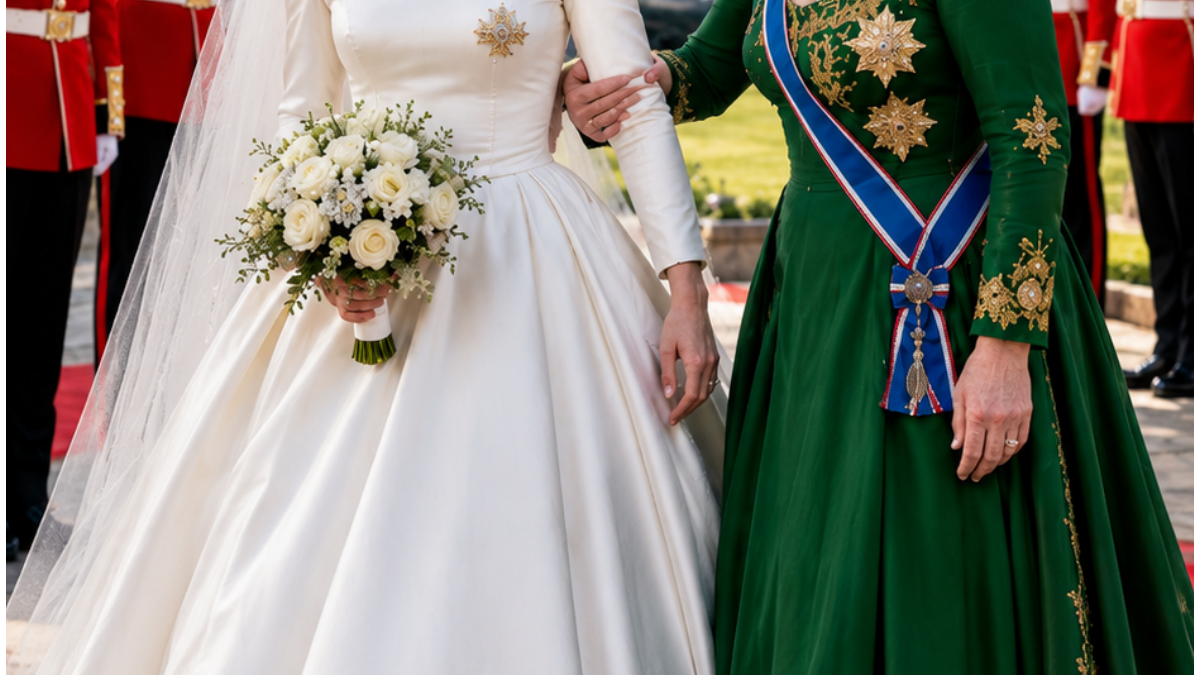
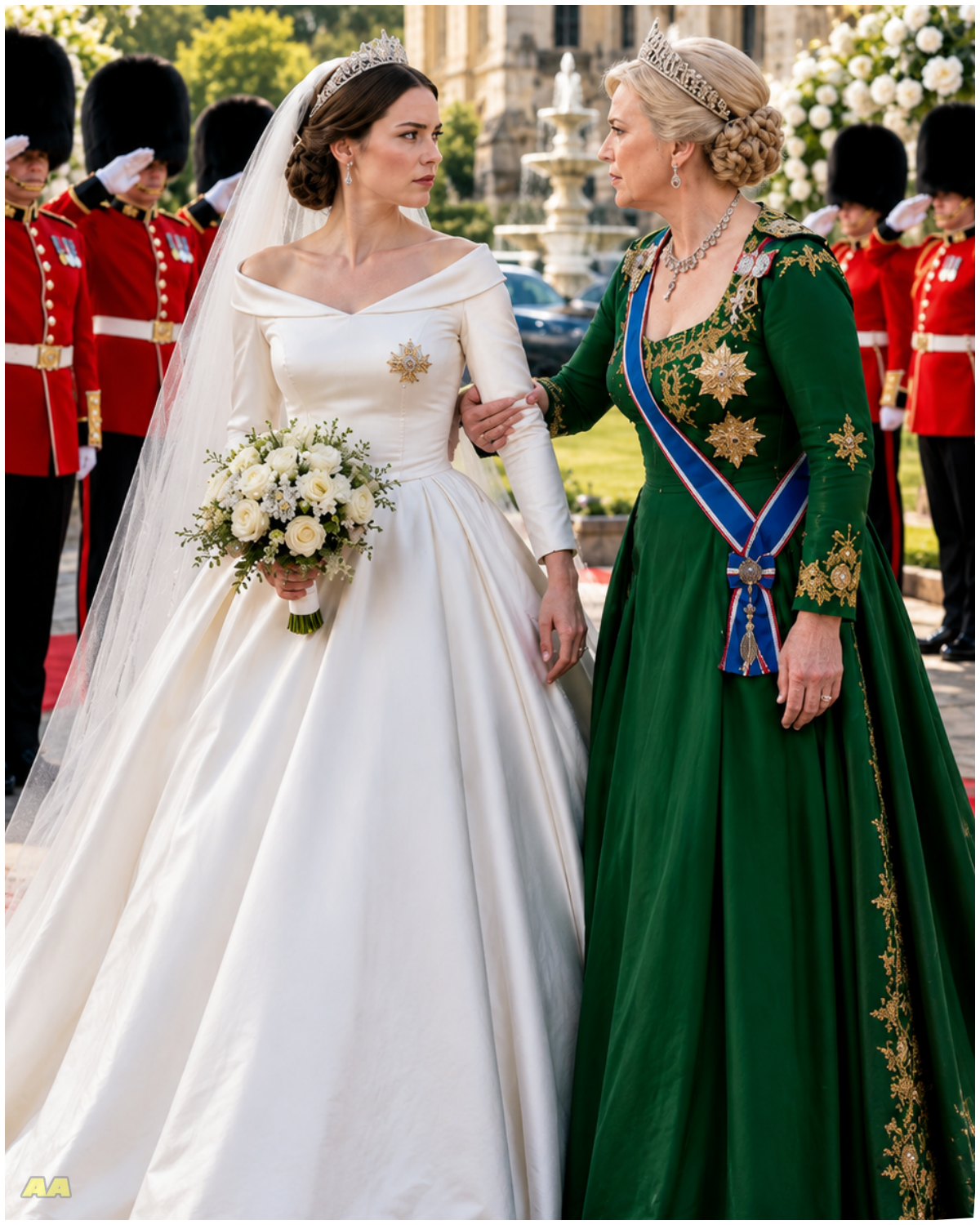
She stood in the grand vestibule of the Sans Ceir Palace, trembling in her silk gown as the queen leaned in and whispered, “You are nothing but a commoner, a stain on this family, and you will never belong here.”
But as the great mahogany doors swung open for the royal procession, something unprecedented happened.
The entire royal guard veterans, who bowed to no one but the king, drew their ceremonial swords and saluted the bride in perfect unison.
This is the unbelievable true story of Clara Montgomery.
The grand halls of the Sans Ceir Palace smelled of aged beeswax, centuries-old oil paintings, and the overwhelming, suffocating scent of white lilies.
For Clara Montgomery, a 28-year-old trauma surgeon from South Boston, it felt less like a fairytale castle and more like a beautifully gilded cage.
She sat at the edge of an antique chaise lounge, her fingers nervously tracing the edge of her teacup, feeling the weight of a dozen judgmental eyes pressing into her back.
Clara had never asked to fall in love with a prince.
In fact, for the first year of their relationship, she didn’t even know he was one.
They had met 3 years prior in a dusty, unforgiving field hospital on the outskirts of an active conflict zone in the Middle EaSt. Clara was attached to a joint national medical task force, spending her days pulling shrapnel out of soldiers and civilians alike.
He was introduced to her simply as Captain Leo Harrington, a liaison officer for a classified European coalition force.
He was charming, quietly intense, and possessed a grim sense of humor that kept Clara grounded when the trauma of the surgical tent became too much to bear.
Their bond was forged in blood and adrenaline.
There was no royal protocol when you were diving for cover during a mortar barrage.
There were no curtsies or titles when Clara was desperately trying to stop the bleeding of one of Leo’s men while he held the IV bag, his hands covered in dust and grime.
They fell in love in the spaces between chaos sharing stale coffee at 3:00 a.m.
Talking about their childhoods and dreaming of a quiet life.
It wasn’t until Leo’s deployment ended and he arranged a trip for them to visit his family estate in Europe that the truth was finally revealed.
Captain Leo Harrington was actually His Royal Highness Prince Leopold, the second in line to the throne of one of Europe’s oldest and wealthiest sovereign states.
The transition from a military camp to the royal court was jarring, but nothing could have prepared Clara for the sheer hostility of Leopold’s family, particularly his mother, Queen Consort Matilda.
From the moment Clara stepped out of the black Range Rover onto the cobblestones of the palace courtyard, the campaign against her began.
Queen Matilda was a woman carved from ice and old money.
She viewed the monarchy not as a duty, but as a divine right, and she had spent the last decade carefully curating a list of aristocratic women suitable for her sons.
Clara, an American, a commoner, and a woman who worked with her hands was an insult to the Queen’s meticulously laid plans.
“You must understand, Miss Montgomery,” the Queen had said during their very first private tea in the morning room, her tone dripping with polite venom.
“Leopold is going through a phase. He has always had a pension for strays. You are a fascinating novelty to him, a reminder of his time playing soldier. But novelty fades. And when it does, you will find that our world is incredibly unforgiving to those who do not have the breeding to survive it.”
Clara had held her ground, her jaw set.
“With all due respect, Your Majesty, Leopold and I didn’t play soldier. We survived together. My love for him isn’t a phase.”
The Queen had merely taken a slow sip of her Earl Grey tea.
“We shall see.”
Despite the Queen’s icy reception, Leopold proposed six months later.
He did it without the grand fanfare of the palace, choosing instead to propose on a quiet, rainy afternoon in their private London flat, slipping a modest vintage diamond ring onto Clara’s finger.
He had forsaken the royal family’s traditional sapphire, knowing Clara hated ostentatious displays of wealth.
When the engagement was announced to the public, the palace communications office went into overdrive.
But behind closed doors, a silent war was declared.
The royal family realized they could not legally stop Leopold from marrying Clara without causing a massive public scandal.
So, they chose a different tactic. They would make the wedding process so unimaginably miserable that Clara would break under the pressure and leave on her own accord.
They grossly underestimated the resilience of a woman who had spent years operating under mortar fire.
The months leading up to the wedding were a master class in psychological warfare.
Queen Matilda, aided by her closest advisers and a cabal of aristocratic sycophants, began systematically isolating Clara.
It started with the press. Stories began leaking to tabloids like the Daily Telegraph and the Royal Standard, painting Clara as a manipulative gold digger.
Anonymous palace insiders claimed she was unrefined, loud, and constantly breaching protocol.
Paparazzi miraculously knew Clara’s exact location, swarming her when she left the gym in her sweatpants or when she was running errands, juxtaposing her casual American attire against the polished designer looks of Leopold’s ex-girlfriends.
Then came the wedding planning. As a royal bride, Clara was legally required to allow the Lord Chamberlain’s office to handle the logistics.
Every decision she made was quietly vetoed and overturned.
She asked for a small intimate dinner for the rehearsal.
They booked the grand ballroom at the Waldorf Astoria and invited 300 foreign dignitaries whom Clara had never met.
The most cutting insult came wrapped in high fashion.
Clara had secretly traveled to New York to work with a designer at Carolina Herrera to create a timeless, elegant, but understated wedding gown.
It was a dress that felt like her.
A week before the final fitting, Queen Matilda summoned Clara to the royal tailor’s suite.
Waiting there was Lady Beatrice, the daughter of a duke, and the woman the queen had originally intended for Leopold.
“Clara, dear,” the queen announced smoothly, gesturing to a massive, heavily embroidered, antiquated monstrosity of a gown hanging in the center of the room.
“The royal council has decided that your American dress is simply not suitable for a cathedral wedding.
It lacks gravitas. We have had the royal seamstresses alter my grandmother’s gown for you.
Lady Beatrice was kind enough to model it for the alterations as you share a somewhat similar, albeit less tailored, frame.” It was a blatant power move, forcing Clara to wear a dress modeled by the woman the family wished Leopold was marrying.
Clara stared at the heavy oppressive fabric, feeling a lump form in her throat.
She looked at Lady Beatrice, who wore a smug, pitying smile.
Clara wanted to scream. She wanted to pack her bags, take a flight back to Logan International Airport, and never look back.
But then she remembered Leopold. She remembered the way he had held her the night before, exhausted from arguing with his father, the king, on her behalf.
Leopold was fighting a war on two fronts, trying to defend his bride while maintaining his duty to his country.
Clara refused to be the reason he lost his family.
“It’s a beautiful piece of history,” Clara said evenly, refusing to let her voice shake.
“I would be honored to wear it.” The queen’s eyes narrowed slightly.
She had expected a tantrum, a breakdown, a dramatic refusal that she could report back to Leopold as proof of Clara’s unsuitability.
Clara’s quiet grace infuriated her further. The final straw, however, came 2 days before the wedding when the official seating chart and guest list were finalized.
Clara had only asked for two things for her wedding: that her parents be treated with respect and that 10 of her closest friends from her medical unit be invited.
These were the men and women who had bled with her, who had saved Leopold’s life when his convoy was ambushed, the people who were more family to her than anyone else.
When the thick parchment guest list was handed to Clara by the royal secretary, she scanned it eagerly.
Her heart plummeted. Her parents were seated in a secluded alcove behind a marble pillar, barely visible to the altar.
And her unit, the names of Captain Reynolds, Doctor Ares Mercer, and the rest of her squad were nowhere to be found.
She marched directly into the queen’s private study, bypassing the shocked royal guards at the door.
“Where are they?” Clara demanded, slapping the parchment onto the queen’s mahogany desk.
“My unit. I submitted their names 6 months ago.” Queen Matilda didn’t even flinch.
She placed her fountain pen down and looked at Clara with cold, dead eyes.
The cathedral is at capacity, Clara. We had to make room for the Prime Minister of Spain and the Belgian royal delegation.
There simply wasn’t space for a handful of enlisted soldiers.
It would completely throw off the aesthetic of the highborn seating arrangement.
They aren’t just soldiers, Clara’s voice shook with suppressed rage.
They are the reason your son is alive to stand at the altar this Saturday.
And they were given medals for their service, were they not?
The queen replied, her voice dropping to a harsh whisper.
They did their jobs. That does not entitle them to a front row seat at a royal wedding.
You are entering a new world now, Clara.
A world of kings, queens, and lords.
You must leave the dirt of your past behind you.
You are marrying into the highest echelon of society.
Act like it or leave. The choice is yours.
Clara stared at the woman who was about to become her mother-in-law.
The malice in the queen’s eyes was absolute.
She wasn’t just trying to control the wedding.
She was trying to erase who Clara was.
Clara didn’t shout. She didn’t cry. A strange, eerie calm washed over her.
I understand perfectly, Your Majesty, Clara whispered.
She turned on her heel and walked out of the study.
She didn’t tell Leopold about the guest liSt. She didn’t want to start a war that would ruin his wedding day.
But as she walked back to her quarters, a silent, ironclad resolve settled into her bones.
If the queen wanted a display of rank, Clara was going to give her one.
The morning of the wedding arrived with a violent thunderstorm that rattled the stained glass windows of the Saint-Sulpice Cathedral.
Though the skies miraculously cleared just as the sun rose, leaving a crisp, blindingly bright morning in its wake.
Inside the bridal suite of the palace, the atmosphere was suffocating.
Clara stood in the center of the room, encased in the heavy antique royal gown.
It [clears throat] was restrictive, the boning digging into her ribs, the high lace collar scratching at her neck.
It felt like a suit of armor designed by an enemy.
Her mother, Sarah, stood by the window nervously wringing her hands.
“Oh, you look beautiful, sweetie.” She lied softly, though her eyes betrayed her worry.
She had seen the way the palace staff looked at them, like they were the hired help who had wandered into the wrong wing of the estate.
A sharp knock at the door silenced the room.
Without waiting for a response, Queen Matilda swept in, flanked by two ladies-in-waiting.
She looked immaculate in an emerald green structured suit.
Her expression set in a mask of polite disdain.
She waved a hand and the ladies-in-waiting ushered Clara’s mother and the makeup artists out into the hall, closing the heavy oak doors behind them.
Clara and the queen were entirely alone.
“I have come to inspect the bride.” the queen announced, circling Clara like a predator inspecting its prey.
She reached out, roughly adjusting a piece of lace on Clara’s shoulder.
“It is a heavy dress. Many women have buckled under its weight.” “Ah, I am stronger than I look.” Clara replied, staring straight ahead into the gilded mirror.
The queen stepped close, her reflection hovering over Clara’s shoulder in the glass.
The polite veneer finally vanished, leaving only raw, unadulterated contempt.
“Let us drop the pleasantries, Miss Montgomery.” the queen whispered, her voice like grinding glass.
“You have played your hand well. You convinced my son that he is in love with you, but do not mistake his infatuation for your victory.
You do not belong here. You are nothing but a commoner, a stain on this family, and you will never belong in this palace.” Clara’s breath hitched, but she forced herself to remain perfectly still.
“You have no pedigree. You have no rank.” The queen continued, stepping back and looking at Clara with absolute disguSt. “When you walk through those doors today, every lord, every duke, every royal knight will be looking at you and thinking the exact same thing.
You are an impostor. Enjoy your day in the sun, Clara, because tomorrow the reality of what you have done will crush you.
This marriage will not last a year.” With that final venomous strike, the queen turned and exited the room, the doors clicking shut with a terrible finality.
Clara stood in the silence for a long time, her chest tightened, panic rising in her throat.
The queen’s words echoed in her mind.
“You have no rank. You are an impostor.” For a terrifying second, Clara almost believed her.
She looked at herself in the mirror, draped in someone else’s history, wearing someone else’s dress, surrounded by a world that actively despised her.
Then Clara closed her eyes, took a deep breath, and remembered the dust of the field hospital.
She remembered the blood on her hands, the deafening roar of the medevac choppers, and the faces of the soldiers she had pulled back from the brink of death.
She remembered the day she threw herself over Captain Leopold Harrington to shield him from the blast of a secondary IED.
She wasn’t an impostor. She was a survivor.
Clara walked over to her small travel bag in the corner of the room.
She unzipped a hidden compartment and pulled out a small worn mahogany box.
She had kept it hidden since the day she arrived at the palace.
Even Leopold rarely spoke of it, respecting the heavy emotional toll it represented.
She opened the box. Resting on a bed of faded blue velvet was a heavy solid gold starburst suspended from a crimson ribbon.
It was the Grand Cross of the Order of the Lion.
In this sovereign state, there were hundreds of lords, dukes, and earls.
They inherited their titles through bloodlines and wealth, but the Order of the Lion was different.
It was the absolute highest military honor the kingdom could bestow, awarded only for acts of unfathomable bravery and self-sacrifice in active combat.
It superseded all aristocratic titles. It outranked dukes.
It outranked royal advisors. In the long, bloody history of the kingdom, it had only been awarded to a civilian once, 3 years ago, to a trauma surgeon who refused to abandon a collapsed medical tent, holding the line and saving the lives of 12 elite soldiers, including the heir to the throne, while under heavy enemy fire.
The queen wanted a display of rank.
Clara took the heavy gold medal and with steady hands pinned it directly onto the front of the antique royal gown, just above her heart.
The bright gold and crimson ribbon stood out like a defiant flare against the suffocating white lace.
She picked up her bouquet of white orchids, holding it perfectly so that it concealed the medal from view.
She would not reveal her hand until the exact right moment.
A knock sounded at the door. It was the Lord Chamberlain.
Miss Montgomery, it is time. Clara took one last look in the mirror.
She was no longer shaking. Her eyes were hard focused and utterly fearless.
She was stepping onto a battlefield, and this time she was bringing her own armor.
“I’m ready,” Clara said. She was escorted out of the suite and led down the sprawling, echoing corridors of the Sancere Palace toward the vestibule of the Grand Cathedral.
The air was thick with the smell of incense and anticipation.
As they approached the final set of mahogany doors, the Lord Chamberlain stepped aside, standing in absolute silence lining both sides of the massive vestibule were 50 members of the Royal King’s Guard.
These were not ceremonial palace guards. These were the elite battle-hardened veterans who served as the King’s personal protectors.
They wore midnight blue uniforms, silver breastplates, and ceremonial broadswords resting at their hips.
By royal tradition, they bowed to no one except the King, the Queen, and the Crown Prince.
To everyone else, including foreign dignitaries and lower royalty, they remained completely motionless, staring straight ahead like statues of stone.
Standing near the doors, waiting to make her own grand entrance was Queen Matilda.
She looked at Clara as she approached her lips curling into a triumphant, mocking smile, ready to watch the commoner walk through the gauntlet of stone-faced, uncaring knights.
Clara stopped at the start of the vestibule.
She looked at the Queen, then slowly and deliberately, Clara lowered her bouquet letting it rest at her side.
The crimson ribbon and the heavy gold starburst of the Grand Cross of the Order of the Lion caught the light of the chandeliers blazing against her white dress.
The commander of the Royal Guard, a towering man with a scarred face, was the first to see it.
His eyes flicked from Clara’s face down to the medal on her cheSt. A shockwave of recognition passed through the seasoned He knew exactly what that medal was, and he knew exactly who she had saved to earn it.
The commander took a sharp, booming step forward, his boots echoing like a gunshot in the silent hall.
The towering commander of the Royal Guard, a man named Thomas Reed, who bore the jagged scars of a deployment in the Balkans, stared at the gold starburst resting above Clara’s heart.
For a man who had spent three decades mastering the art of absolute stone-faced neutrality, the sudden widening of his eyes was as loud as a scream.
He knew exactly what the Grand Cross of the Order of the Lion meant.
Every soldier in the kingdom knew the stories of the dusty, blood-soaked medical tent 3 years ago.
They knew that when the evacuation choppers were driven back by relentless anti-aircraft fire, a lone American surgeon had refused the order to abandon the wounded.
They knew she had dragged their dying men away from the burning perimeter, performing life-saving triage with a flashlight in her teeth while mortar shells detonated so close the concussions shattered her eardruMs. Commander Reed didn’t see a commoner standing before him.
He saw the savior of his brothers-in-arMs. He saw a living legend.
Protocol for the Royal Guard was absolute.
They remained perfectly still, acknowledging no one but the king, the queen, and the Crown Prince.
But there was one ancient, deeply buried caveat in the military bylaws of the kingdom written in the 18th century and untouched since the Order of the Lion eclipses all mortal station.
In the presence of the cross, the sword must be offered in reverence.
Commander Reed took a sharp, booming step forward, his polished boot striking the marble floor like a gunshot.
The sound echoed violently through the silent vestibule, startling the surrounding aristocrats.
Queen Matilda snapped her head toward the commander, her polite facade cracking into sheer panic.
“Commander Reed, what are you doing? Stand your ground.” She hissed, her voice a venomous whisper meant only for him.
Reed did not even look at the queen.
His eyes remained locked on Clara. With a smooth, practiced motion, Commander Reed drew his heavy ceremonial broadsword from its silver scabbard.
The ringing hiss of steel being drawn sent a collective gasp rippling through the gathered courtiers.
He brought the hilt of the blade to the center of his face, the flat of the metal gleaming against his nose, and then snapped it downward, the tip resting inches from the floor.
“Guard! Present arms! Kai form [clears throat] to tay kai ree!” bellowed his voice tearing through the suffocating stillness of the palace vestibule.
The reaction was instantaneous. 50 hardened veterans of the royal guard men who had stood entirely motionless for 2 hours moved as one single terrifying entity.
The synchronized deafening sheen of 50 broadswords being drawn from their scabbards echoed off the vaulted stone ceilings like a crack of thunder.
In perfect unison, the 50 guardsmen brought their swords to their faces and snapped them downward in a flawless bone-rattling salute.
They were not saluting the bride. They were not saluting a future princess.
They were saluting the metal on her chest and the blood she had spilled for their country.
Queen Matilda stumbled backward, her hand flying to her throat as if she had been physically struck.
The blood drained from her face leaving her perfectly applied rouge looking garish against her pale skin.
“No!” she gasped, her composure entirely shattered.
“No, stop this. Lower your weapons, I command you.” Commander Reed stood immovable.
“Military protocol supersedes royal presence, your majesty.” he replied, his voice cold and flat, never taking his eyes off Clara.
“The guard honors the lion.” Clara stood at the entrance to the gauntlet of steel.
Her heart hammered wildly against her ribs, but her face remained a mask of absolute calm.
She glanced to her right, meeting the horrified, panicked gaze of Queen Matilda.
Clara didn’t smirk. She didn’t gloat. She simply offered the Queen a slow, measured nod, an acknowledgement that the rules of engagement had just changed permanently.
With the heavy antique gown suddenly feeling like a suit of armor, Clara stepped forward.
She walked down the center of the vestibule, flanked by the lowered swords of the kingdom’s fiercest warriors.
The courtiers, lords and ladies-in-waiting who had sneered at her for 6 months, now shrank back against the walls, their eyes fixed in horror and awe at the blazing crimson ribbon on her cheSt. She wasn’t an impostor trying to sneak into their world.
She was a conqueror walking through their front door.
The massive, heavily carved mahogany doors of the Saint-Sacre Cathedral swung open, groaning under their own immense weight.
Inside the massive cathedral was packed with 800 of the most powerful people in Europe.
Prime Ministers, foreign dignitaries, dukes, and billionaires turned in their pews as the thunderous opening chords of the grand pipe organ began to play.
Clara paused at the threshold. The sunlight streaming through the massive stained glass windows illuminated the incense smoke hanging in the air, creating a hazy golden path down the center aisle.
At the end of the long red carpet stood Prince Leopold.
He looked regal in his midnight blue military dress uniform adorned with his own medals and sashes.
Standing beside him was his father, King Philip, a stern, imposing man who [clears throat] had remained largely silent during Clara’s ordeal, letting his wife handle the domestic warfare.
As Clara began her slow, deliberate march down the aisle, the whispering began.
It started like the hiss of a snake near the back pews and rapidly swelled into a buzzing wave of shock that washed over the entire congregation.
They saw the Queen’s grandmother’s dress, the garment meant to humiliate her, meant to swallow her small frame.
But then the golden light caught the starburst on her cheSt. A British diplomat in the third row actually dropped his program.
A prominent duchess gasped so loudly it was audible over the organ.
Whispers of uh the lion, she has the lion, rippled through the crowd like wildfire.
These people understood power. They understood hierarchy.
And they instantly realized that the American commoner was wearing a commendation that legally required their own husbands and fathers to bow to her.
At the altar, Leopold’s breath caught in his throat.
He had not seen her all morning.
When he spotted the crimson ribbon against the white lace, his eyes immediately welled with tears.
He knew how much Clara hated the medal.
To her it wasn’t a symbol of glory.
It was a heavy, agonizing reminder of the friends she had lost and the blood that had soaked into the desert sand.
Oh, she kept it locked away because it brought back nightmares of the screaming and the mortar fire.
For her to wear it today proudly and openly meant she was going to war for him.
She was shielding him from his own family’s venom just as she had shielded him from the blast in that medical tent.
As Clara approached the steps of the altar, King Philip did something that made the remaining air leave the room.
The king, who traditionally remained seated until the bride reached the altar, stood up.
He did not smile, but as Clara drew near, the king of the sovereign state offered a sharp, distinct nod of his head, a soldier’s greeting to a superior warrior.
It was a subtle gesture, but in the highly choreographed world of royal protocol, it was the equivalent of a nuclear detonation.
Clara stepped up beside Leopold, handing her bouquet to her stunned maid of honor.
Leopold reached out and took both of her hands.
His voice shook as he whispered, “You wore it.” “I told you.” Clara whispered back.
Her eyes fiercely locked onto his. “I don’t leave my people behind, and you are my people.” The Archbishop of the kingdom, an elderly man draped [clears throat] in gold embroidered vestments, cleared his throat nervously.
He had been thoroughly briefed by the queen’s staff to rush the ceremony to minimize the grandeur of the event.
But looking at the cold, unyielding gold of the Grand Cross, and the sudden, terrifying respect radiating from the king, the Archbishop decided to abandon the queen’s script.
He delivered the full, ancient, hour-long high royal blessing.
Throughout the ceremony, Clara could feel the burning glare of Queen Matilda, who had taken her seat in the royal box to the left of the altar.
The queen looked like she had swallowed glass.
Her grandmaster’s plan to dress Clara in an ugly, oversized gown and let the aristocracy laugh her out of the palace had backfired so spectacularly that the social foundations of the family were currently crumbling around her.
When it came time for the vows, Clara’s voice rang out clear and unwavering, echoing off the stone pillars of the cathedral.
She promised to love, honor, and protect Leopold.
And when she said the word protect, she let her eyes drift up to the royal box, meeting Queen Matilda’s furious gaze.
“I pronounce you husband and wife.” The Archbishop declared, his voice trembling slightly.
“What God has joined together, let no palace, no power, and no man put asunder.” Leopold leaned in and kissed her, the crowd erupting into applause that felt distinctly more frantic and nervous than joyous.
As they broke the kiss and turned to face the congregation, Clara stood tall.
The heavy gown no longer felt like a cage, it felt like a cape.
They walked back down the aisle together hand in hand.
As they passed the pews, the very same lords and ladies who had spent 6 months leaking vicious rumors to the press, now bowed their heads deeply in reverence.
They weren’t bowing to the prince’s new wife, they were bowing to the gold starburst that commanded their submission.
If the wedding ceremony was a battlefield, the grand reception in the Sancere Palace’s crystal hall was supposed to be Queen Matilda’s final execution.
The crystal hall was a breathtaking masterpiece of architecture featuring vaulted ceilings painted with Renaissance frescoes, walls lined with mirrors, and a dozen massive crystal chandeliers that cast a warm, twinkling light over the 100 round dining tables.
The tables were draped in heavy silk adorned with towering centerpieces of white orchids and gold leafed cutlery.
Protocol dictated that the bride and groom enter last after the guests had been seated according to their strict social rankings.
This was where the queen had laid her final trap.
Clara and Leopold waited in a holding room adjacent to the main hall while the 800 guests filed in.
Leopold squeezed Clara’s hand. “You survived the ceremony,” he said with a tired, relieved smile.
“The worst is over.” Clara didn’t smile back.
She knew about the seating chart. She hadn’t told him, not wanting to ruin the moment at the altar, but now the bill was coming due.
Leo, there’s something you need to know about the reception.
She started, but the heavy doors swung open and the Lord Chamberlain appeared looking completely frazzled.
Your royal highnesses, they are ready for your entrance, he announced bowing deeply.
The trumpets sounded, a bright, triumphant fanfare that signaled the arrival of the newly married couple.
The massive double doors were pulled open and Clara and Leopold stepped out onto the landing overlooking the sprawling reception floor.
The guests stood and applauded as they descended the grand staircase.
Clara’s eyes instantly scanned the massive room.
At the very front, elevated on a velvet-draped dais, was the high table.
Seated there were King Philip, Queen Matilda, the prime minister, and Lady Beatrice, a final petty insult from the Queen to seat the preferred bride at the head table.
Clara’s gaze swept past the Dukes in the front, past the wealthy foreign dignitaries in the middle, straight to the very back of the hall.
There, hidden behind a massive obstructing pillar near the swinging doors of the kitchen, was a small, unadorned table.
Seated there, looking incredibly uncomfortable in their rented formal wear, were her parents, Richard and Sarah Montgomery.
And that wasn’t all. Sitting with them were the only three members of her medical unit who had managed to scrape together the funds to fly to Europe, Captain Reynolds, Dr. Mercer, and Sergeant Miller.
The Queen hadn’t just denied them an invitation.
When they had shown up anyway, using their personal savings, the palace staff had shoved them into the darkest corner of the room, treating them like unwanted pests.
A cold, dangerous fury ignited in Clara’s cheSt. The metal on her dress suddenly felt very heavy.
Leopold began to lead her toward the raised dais and the high table.
Clara stopped dead in her tracks, her hand tightening around his.
“Clara,” Leopold whispered, confused. “What is it?” “Look,” she said quietly, nodding toward the back of the room.
Leopold followed her gaze. When he saw Richard and Sarah hidden behind the pillar, and then saw the bruised, weathered faces of the soldiers who had pulled him out of a burning wreckage 3 years ago, the color drained from his face.
His jaw clenched so hard a muscle ticked visibly in his cheek.
He looked up at the high table, locking eyes with his mother.
Queen Matilda offered a small, thoroughly wicked smile, raising her champagne glass an inch in a mock toaSt. “I’m going to kill her,” Leopold whispered, his voice trembling with a rage Clara had never heard from him before.
He started to take a step toward the dais, his hands balled into fists.
“Oh, no,” Clara said sharply, pulling him back.
“You don’t make a scene. You don’t give her the satisfaction of a tantrum.
We do this my way.” Without waiting for his response, Clara turned her back on the high table.
She tightened her grip on Leopold’s hand and began walking in the opposite direction.
The applause in the room began to falter as the 800 guests realized the bride and groom were going the wrong way.
They bypassed the front row of dukes.
They walked past the foreign dignitaries. They walked straight down the center aisle, heading toward the swinging doors of the kitchen.
Up on the dais, Queen Matilda’s smug smile vanished.
She leaned forward, her knuckles turning white as she gripped the edge of the table.
King Philip frowned in confusion. Clara and Leopold reached the tiny, cramped table hidden behind the pillar.
Richard and Sarah scrambled to stand up, looking terrified that they had done something wrong.
The three soldiers immediately snapped to attention, saluting Leopold.
“Mom, Dad.” Clara said, her voice carrying loudly in the sudden deafening silence of the hall.
“I believe there’s been a mistake with the seating.
This table seems a bit crowded.” “Clara, honey, it’s fine, really.” Her father, Richard, stammered, pulling at his collar.
“We’re just happy to be here.” Leopold stepped forward, placing a hand on Richard’s shoulder.
“It is absolutely not fine, sir.” The prince turned around, surveying the hundreds of guests staring at them.
He spotted a massive, lavishly decorated table in the center of the room, occupied by minor cousins of the queen.
“You.” Leopold barked, pointing at the aristocratic cousins.
“Vacate that table immediately.” The cousins looked mortified, but they hastily grabbed their belongings and scattered.
Leopold gestured for Clara’s parents and the soldiers to move to the newly emptied center table.
But Clara wasn’t finished. The queen had tried to erase her people.
Clara was going to make them the center of the kingdom.
As they moved to the center table, a booming voice echoed from the front of the room.
“Well, I’ll be damned if I’m sitting up here while the real heroes are sitting down there.” Everyone turned.
Standing up from a prominent table near the dais was General Wyatt Hayes, the supreme commander of the Allied Coalition Forces.
He was a man who commanded hundreds of thousands of troops across the globe, and he held more geopolitical power than half the aristocrats in the room combined.
General Hayes picked up his champagne glass and his plate.
He marched down from his premium seat, his chest covered in his own ribbons, and walked straight to Clara’s new table.
He stopped in front of Dr. Mercer and Captain Reynolds.
“Room for an artillery man.” General Hayes asked gruffly.
Captain Reynolds, looking completely stunned, nodded quickly.
“Yes, sir, General.” General Hayes sat down.
But he didn’t stop there. He turned to Clara, looking at the heavy gold starburst resting on her cheSt. The General’s eyes softened, a look of profound grief and respect washing over his hardened features.
“Doctor Montgomery.” General Hayes said, his voice carrying perfectly in the silent hall.
“You never let anyone thank you. You disappeared before the commendation ceremony.
But my son, Lieutenant David Hayes, was in that tent with Prince Leopold.
You kept your hands inside his chest cavity for 2 hours while the roof was literally burning down around you.” A collective gasp swept through the room.
Even King Philip, up on the dais, looked utterly stunned.
He hadn’t known the specifics of the incident.
The military reports had been heavily redacted for security purposes.
General Hayes raised his glass high in the air, turning to face the hundreds of stunned aristocrats.
“I don’t give a damn about bloodlines.
I don’t give a damn about titles.
The woman wearing that white dress has more nobility in her little finger than this entire palace combined.” The General turned to Clara, tears shining in his eyes.
“To Clara, the lion of the desert.” Instantly, every military officer, every foreign dignitary with an ounce of sense, and surprisingly, King Philip himself, stood up from their tables.
The scrape of hundreds of chairs being pushed back filled the room.
“To Clara.” They echoed, raising their glasses.
At the high table, Queen Matilda sat frozen.
She was entirely alone in her seat.
The power dynamic of the room had physically shifted.
The center of the reception was no longer the elevated dais.
The center of the room was a trauma surgeon from South Boston surrounded by her parents, three battered soldiers, and the supreme commander of the military.
Clara looked up at the high table.
She met Queen Matilda’s eyes one final time.
The queen looked small, brittle, and utterly defeated.
Her meticulously planned campaign of sabotage had not just failed, it had publicly crowned Clara as the untouchable matriarch of the new era.
Clara raised her own glass toward the queen, a silent, definitive victory.
She took a sip of champagne, turned to her husband, and for the first time in 6 months, Clara finally smiled.
The war was over, and the commoner had won.
The crystal chandeliers of the grand reception hall had long been dimmed, and the last of the aristocratic guests had been whisked away in their chauffeured vehicles.
But the true climax of the wedding night did not occur on the dance floor or in the bridal suite.
It happened at exactly 1:15 a.m. In the king’s private study, a cavernous oak-paneled room that smelled of expensive cigar smoke and centuries of sovereign rule.
Clara and Leopold had barely reached their private quarters when a sharp knock sounded at their door.
It was the king’s personal equerry, Lord Harrison Croft.
He delivered a simple, non-negotiable message. “The king requires your presence immediately.” Still wearing her wedding gown, though she had finally removed the suffocating lace collar and draped a simple silk shawl over her shoulders, Clara walked hand in hand with her new husband down the silent, shadowed corridors.
The heavy gold medal of the Order of the Lion still rested over her heart.
Boy, she was exhausted, her bones aching from the emotional and physical toll of the day, but her mind was fiercely alert.
The battle in the banquet hall was won, but the war for her survival in this family was far from over.
When the heavy oak doors of the study swung open, Clara saw Queen Matilda sitting rigid in a high-backed leather chair by the fireplace.
The queen had changed into a dark velvet evening gown.
Her face was pale, her lips pressed into a thin, bloodless line.
She looked less like a reigning monarch and more [clears throat] like a cornered viper.
King Philip stood by the massive floor-to-ceiling windows staring out at the floodlit palace gardens.
He did not turn around when Clara and Leopold entered.
“Close the doors, Croft,” the king commanded.
The heavy wooden doors clicked shut, plunging the room into a heavy, suffocating silence.
For a long moment, no one spoke.
Then, Queen Matilda stood up. She could no longer contain her fury.
“Philip, I demand you annul this farce immediately.
You saw what happened tonight. This This commoner intentionally humiliated the crown.
She dragged the lowest dregs of the military into our inner circle.
She insulted my family. She insulted the high lords, and she mocked the very institution of our monarchy in front of the entire world.” Leopold stepped forward, his voice a low, dangerous rumble.
“The only person who humiliated the crown tonight was you, Mother.
You seated the parents of the bride in a corner next to the kitchens.
You deliberately tried to erase the people who saved my life.
Clara didn’t break the dignity of this family, she salvaged whatever was left of it.” “She made a mockery of us,” Matilda shrieked, dropping her polished veneer entirely.
“She paraded that medal around like a weapon.” “Enough,” King Philip said softly.
He didn’t yell, but the absolute chilling authority in his voice instantly silenced the room.
He finally turned away from the window and walked slowly toward his massive mahogany desk.
He looked at his wife, then at his son, and finally his gaze settled on Clara.
For the first time since Clara had arrived at the palace 6 months ago, the king truly looked at her.
He looked at the exhaustion in her eyes, the proud unyielding set of her jaw, and the crimson blazing against her white dress.
Matilda, the king began his voice dangerously calm.
Do you know what General Hayes said to me as he left the palace tonight?
The queen swallowed hard, her eyes darting nervously.
I do not concern myself with the drunken ramblings of an American general.
He told me, the king continued ignoring her, that if the monarchy cannot find a way to respect the woman who pulled my son’s shattered body and out of a burning command tent, then he will personally ensure that the allied coalition withdraws all military support from our borders.
He informed me that the only reason this family still has an heir is because Clara Montgomery refused to retreat when ordered.
He also informed me that you tried to ban his officers from the cathedral.
Matilda’s face drained of the last of its color.
Philip, I was preserving the aesthetic. You were playing a petty jealous game of high society while dealing with a woman who operates in life and death, King Philip interrupted, his voice finally rising in volume, cracking like a whip in the silent room.
You thought you could break her. You thought you could dress her in your grandmother’s hideous gown, put her in a corner and watch her cry.
Instead, she triggered a military protocol that hasn’t been invoked in 200 years and had my own royal guard draw swords against you.
The king walked over to his desk and picked up a heavy rolled parchment sealed with red wax.
I have remained silent for the past 6 months, Clara, the king said turning to her.
Not because I agreed with my wife’s abhorrent behavior, but because I needed to know if you had the spine to survive this family.
The crown is a heavy brutal thing.
If you had crumbled under Matilda’s childish bullying, you never would have survived the international press, the political assassinations, and the weight of ruling.
I needed to see your steel. He walked toward Clara and held out the parchment.
This is a royal decree drafted by my own hand 3 days ago, the king explained.
It dictates that upon your marriage to my son, you are not merely absorbing his title.
By virtue of the order of the lion and your service to the crown, I am elevating you to the rank of Duchess of the Western Provinces in your own right.
You answer to no one in this family but me, and as of this moment, you possess equal political authority to the Queen Consort.
Matilda gasped, staggering back as if she had been physically struck.
Philip, no, you cannot give a commoner sovereign power.
The parliament will revolt. The parliament will do exactly as they are told, especially when they see tomorrow’s headlines.
The king snapped. He turned back to his wife, his eyes devoid of any warmth.
Your campaign of sabotage is over, Matilda.
You will pack your belongings. Tomorrow morning you are relocating to the summer palace in the northern mountains.
You are officially on an indefinite leave of absence for health reasons.
If you attempt to contact the press or if you ever try to undermine my daughter-in-law again, I will strip you of your royal stipend entirely.
You are exiling me. Matilda whispered, tears of rage and humiliation welling in her eyes.
After 30 years of marriage, you are exiling me for her?
I am protecting the future of this monarchy from your arrogance, Philip replied coldly.
Leave us. Shattered, defeated, and entirely stripped of her power, the once terrifying Queen Matilda turned and fled the room, her footsteps echoing down the long empty corridor.
King Philip looked back at Clara. He offered a small, weary smile, the first genuine smile she had ever seen from him.
Welcome to the family, Clara. I apologize for the trial by fire, but I suspect you are quite used to the heat.
Clara took the heavy parchment. She looked at Leopold, who was staring at his father in stunned reverent silence.
Then, she looked back at the king.
“I don’t need a title to protect my husband, Your Majesty.” Clara said softly but firmly.
“But I will use this to protect the people your wife tried to erase.” King Philip nodded deeply.
“I expect nothing less, Your Grace.” The morning after the royal wedding, the international press descended upon the kingdom like a pack of starving wolves.
Queen Matilda had spent 6 months laying the groundwork for a massive media assassination, whispering poison to editors at the Global Herald and the London Times.
The tabloids had pre-written their Sunday editions, ready to publish scathing reviews of the tacky American bride and her inevitable breaches of protocol.
But at 6:00 a.m., before the official palace communications team could even pour their first cups of coffee, an unprecedented leak occurred.
[clears throat] E- Someone widely suspected to be Commander Thomas Reed, though it was never proven, released a high-definition video taken from the cathedral’s security cameras.
The footage showed the exact moment Clara walked through the palace vestibule.
It showed the 50 elite King’s Guards drawing their broadswords in perfect unison, bowing their heads and saluting the solitary stoic bride.
It clearly highlighted the blazing gold and crimson metal pinned to her cheSt. Accompanying the video was a leaked military dossier officially declassified overnight by General Hayes.
It detailed in agonizing heroic specifics exactly what Dr. Clara Montgomery had done in that blood-soaked tent in the Middle EaSt. It outlined the mortar fire, the severe burns she suffered to her own hands, and the 12 lives she saved including the Crown Prince.
By 8:00 a.m., the narrative didn’t just shift, it violently inverted.
The front page of the International Post ran a massive full-page photograph of Clara standing at the altar with the metal gleaming on her dress.
The headline read in bold black ink, “The Lion Queen: How a Combat Surgeon Conquered the Crown.” The internet exploded.
Social media platforms were flooded with the video of the royal guard’s salute.
For months, the public had been fed a narrative that Clara was a fame-hungry gold digger.
Discovering that she was actually a decorated war hero who had remained completely silent about her own unimaginable bravery sent the public into a frenzy of adoration.
The aristocracy, realizing the wind had completely shifted, immediately scrambled to save face.
The very same dukes and duchesses who had sneered at Clara’s parents at the reception began releasing public statements praising the refreshing courage and nobility of the new duchess.
It was a sickening display of hypocrisy, but Clara ignored them all.
She had no interest in playing their high society games.
On Monday morning, just 2 days after the wedding, Clara and Leopold were scheduled to depart for a lavish month-long honeymoon in the Seychelles, a trip arranged entirely by the palace’s PR office to keep the newlyweds out of sight.
Instead, Clara woke up at 5:00 a.m., pulled on a pair of dark denim jeans, a simple white blouse, and a navy blazer.
She tied her hair back in a messy ponytail.
Leopold woke up to find her lacing up a pair of scuffed leather boots.
He smiled, propping himself up on his elbows.
“Let me guess,” he said sleepily. “We aren’t going to the beach.” “Cancel the flights,” Clara said, tossing him his jacket.
“We have work to do.” By 9:00 a.m., the royal motorcade bypassed the airport entirely and pulled up outside the gates of St. Jude’s Memorial, the largest and most underfunded veterans hospital in the capital city.
The hospital staff, expecting nothing, were thrown into absolute chaos when the newly minted duchess and Prince Leopold walked through the sliding glass doors without a single camera crew or press liaison in tow.
Clara didn’t offer a polite waving photo op.
She rolled up her sleeves. She walked straight into the intensive care wards.
She sat by the beds of amputees, speaking to them in the blunt, honest language of a fellow soldier.
She reviewed medical charts with stunned, exhausted nurses.
Leopold walked beside her quietly, holding the hands of men who had served under his command.
It was a civilian patient, a young nurse who had secretly snapped a photo on her phone, who broke the story to the world.
The image showed the new royal bride, the woman who had worn the kingdom’s highest honor just 48 hours prior, sitting on the edge of a hospital bed, laughing and holding the hand of a severely scarred veteran.
The public reaction was deafening. The citizens the kingdom were used to royals who cut ribbons from a safe distance and waved from balconies.
They had never seen a royal who smelled of antiseptic, who understood the grim realities of trauma, and who actively fought in the trenches alongside them.
Within a week, Clara Montgomery wasn’t just accepted by the people, she was wildly, fiercely beloved.
The public began calling her the lioness.
Letters of support poured into the palace by the tens of thousands.
Military barracks across the country hung up the newspaper clippings of her walking through the gauntlet of swords.
When Queen Matilda, freezing in her forced exile at the summer palace, saw the news coverage on her television, she finally understood the magnitude of her defeat.
Clara hadn’t just survived the royal family, she had rendered the old guard completely obsolete.
A year passed since the thunderstorm broke over the Saint-Cyr Cathedral, and the kingdom was unrecognizable.
The grand halls of the palace no longer smelled only of beeswax and old oil paintings.
They were alive with real, palpable purpose.
Clara and Leopold had officially launched the Montgomery-Hayes Foundation, a massive global initiative funded by the royal treasury to provide state-of-the-art medical and psychological care to veterans and civilian casualties of war.
Clara had refused to give up her medical license.
In a move that nearly gave the Lord Chamberlain a heart attack, she mandated that she would spend two days a week performing trauma surgeries at the capital’s central hospital.
“I am a surgeon first and a duchess second,” Clara had told the frantic royal council.
“If you try to lock me in a tower with a tiara, I will simply climb out the window.
My hands were trained to save lives, not wave at parades.” King Philip, true to his word, backed her entirely.
The king found himself quietly amused by his daughter-in-law’s absolute refusal to bend to tradition.
Under Clara’s influence, the monarchy began to shed its archaic, untouchable image.
Leopold, once burdened by the stifling expectations of his lineage, thrived.
Standing shoulder to shoulder with his wife, he became a fiercely progressive advocate for international peacekeeping, utilizing his political power to broker ceasefires in the very regions where he and Clara had once dodged mortar fire.
On the evening of their first anniversary, the palace hosted a gala.
But this was not the suffocating, aristocratic nightmare of their wedding reception.
The crystal hall had been transformed. The guest list was not dictated by bloodlines or ancient wealth.
Walking through the glittering doors were doctors, nurses, military veterans, charity workers, and international diplomats.
Clara’s parents, Richard and Sarah, were seated squarely at the center of the high table, laughing heartily with King Philip over a glass of vintage wine.
Captain Reynolds, Dr. Mercer, and Sergeant Miller, the soldiers Queen Matilda had tried to hide behind a pillar, were now the guests of honor, wearing sharp, tailored tuxedos, mingling with global ambassadors.
Clara stood on the balcony overlooking the hall, feeling the cool night air on her face.
She wore a sleek, modern, midnight blue evening gown, a quiet nod to the color of the royal guard.
She didn’t wear the Order of the Lion tonight.
She didn’t need to. The respect she commanded in this room was woven into the very fabric of the kingdom now.
She felt strong arms wrap around her waist from behind.
Leopold rested his chin on her shoulder, looking out over the crowded, joyous banquet hall.
“You did it.” Leopold whispered, pressing a kiss to her temple.
“You actually changed the world. You took the oldest, most stubborn institution in Europe, and you forced it to have a heart.” Clara leaned back into him, her hands resting over his.
“We did it.” she corrected softly. “I just brought a little bit of South Boston grit to the palace.” Leopold chuckled, his chest rumbling against her back.
“A little bit, Clara. Commander Reed still salutes you before he salutes me.
I think my father is actually a bit jealous.” Clara smiled, looking down at the heavy gold wedding band on her finger.
She thought back to that agonizing morning exactly a year ago, standing in the bridal suite, suffocating in an antique dress, listening to Queen Matilda tell her she was an impostor who would never belong.
She had been terrified then. But she realized now that the queen had been half right.
Clara didn’t belong in the old version of the palace.
She didn’t belong in a world of whispers, prejudice, and petty cruelty.
So, instead of shrinking to fit into their cage, she had simply shattered the bars and built a new world entirely.
Just then, the grand double doors of the balcony opened and Commander Thomas Reed stepped out, looking striking in his formal dress uniform.
The scars on his face softened into a look of absolute unwavering loyalty.
He didn’t draw his sword tonight, but he snapped to rigid attention, bringing his hand sharply to his brow in a perfect, crisp military salute.
“Your Graces,” Commander Reed rumbled respectfully.
“The Prime Minister and General Hayes are asking for you inside. It seems they want to discuss the new hospital wing.”
Clara turned around.
She didn’t offer a delicate royal nod.
She stood tall, squared her shoulders, and returned the soldier’s salute with flawless precision.
“Thank you, Commander.” Clara said, her voice ringing with the quiet, ironclad confidence of a woman who had walked through the fire and emerged as a queen.
“Let’s go change the world.”
Clara took Leopold’s hand, and together they walked back into the light of the palace.
She wasn’t just the bride who survived the gauntlet anymore.
She was the lioness of the kingdom, the savior of the crown, and the absolute master of her own destiny.
And that is how Clara Montgomery proved that true nobility isn’t born in a palace, it’s forged in the fire of courage.
She didn’t just marry a prince, she commanded the respect of an entire kingdom without ever raising her voice.
Her story proves that when the world tries to tell you that you don’t belong, you don’t shrink to fit their expectations.
No, you stand tall, wear your armor, and force the world to respect exactly who you are.








