“That Can’t Be Her…” The Lonely Mountain Man Fell in Love the Moment His Bride Arrived
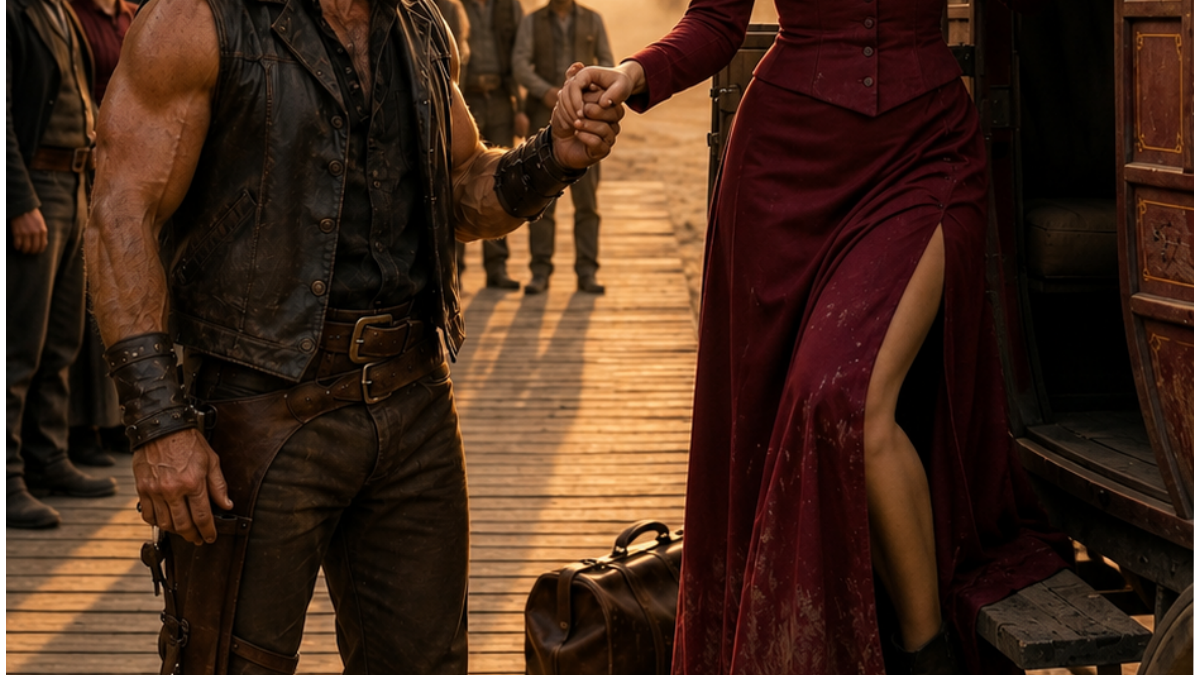
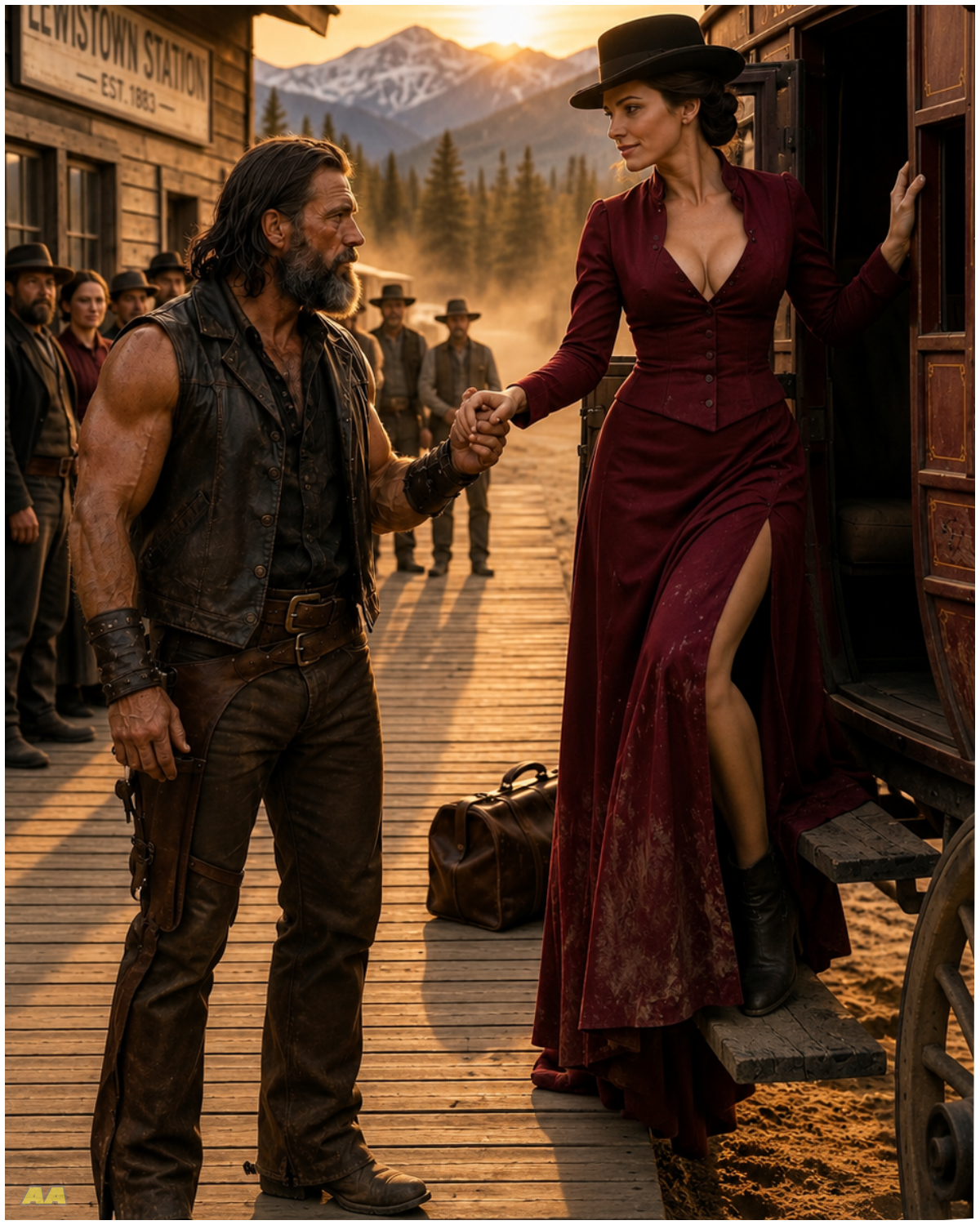
That can’t be her. Owen Renick said it out loud on the platform at six mile in front of 11 people and he could not take it back and every single one of them heard it.
He had not meant to say anything at all.
He had spent the 20 minutes before the coach came doing what he had been doing for 2 weeks, which was talking himself into being reasonable.
This was a practical arrangement.
He had written a practical letter.
A practical woman had answered it.
He was going to shake her hand and put her trunk in the wagon and drive her out to the place.
And neither of them was going to make it into anything.
He had it worked out.
He had it worked out down to the sentences.
Then the coach door opened a second time and a woman came down the step with her own case in her hand and every word of it walked out of his head and did not come back.
The 11 people on that platform were not there by accident.
Sixmile had 240 souls and one telegraph office and word moved through it the way water moves downhill.
Amity Peele was there because she kept the boarding house and had a room made up.
Renshaw was there because Renshaw went wherever there was something to see and had done for 30 years.
The Vance boys sat on a feed barrel, pretending to be bored in the way that only works on people who have never been 16.
Two women had found reasons to be standing in view of the platform from a store window.
They were there because everybody in Sixmile remembered the last time Owen Renick had stood on that platform waiting for a coach.
He had been standing in the same place with the same set to his jaw and the same hat pulled down.
And a woman named Elizabeth had come down that same step, and 11 people had watched him take her trunk and put it in a wagon and drive her out to the Renick place.
That was two winters ago.
Elizabeth Renick had been in the ground since the 4th of March the following spring.
So the town came out, not to be cruel, Sixmill was not a cruel place.
They came out the way people come out for a thing they cannot look away from.
And they arranged themselves along that platform with their faces set to neutral.
And they watched Owen Renick stand there with his arms crossed and his hat down and wait for the second one.
The coach came in trailing September duSt. Two passengers got down firSt. A drummer in a checked coat with a sample case.
A young woman with a baby on her hip who was coming home from her sisters in Deer Lodge.
The baby cried. The mother made a sound at it.
The platform sorted itself out around the ordinary business of arrival.
Owen was watching the driver hand down a trunk he was fairly certain was going to be awkward on a wagon when the platform went quiet.
Not silent, that other kind of quiet where a set of people all turn their attention to one point at the same moment without any of them deciding to.
He looked up. She was standing on the coach step with one hand on the frame, and she was not doing any of the things he had prepared for.
She was not timid. She was not making the small apologetic arrangements of a woman arriving somewhere she is not sure she is wanted.
She was not smiling at anybody.
She was reading the platform, reading the whole of it, the buildings behind it, the road running north out of town, the 11 faces, and taking inventory the way a person takes inventory of a place they are deciding whether they can live in.
Not am I welcome here.
Can I stay here?
Her traveling dress was the deep red of a good wine, and it was covered in two days of stage road duSt. And it was, he understood immediately, too fine for a cattle outfit at the head of a Montana valley.
Dark hair pinned up under a plain hat with nothing on it.
She was 34 or thereabouts, and she was carrying her own case.
Nobody had handed it to her, and she had not waited.
Owen Renick had built a wall two winters high, and he had built it carefully, and he had inspected it.
And a woman he had never seen came down a coach step in a red dress and walked straight through it like it had not been there at all.
That can’t be her, he said.
Renshaw, standing two feet to his left, heard it very clearly.
Renshaw bit down on a grin and turned away, which was the most diplomatic thing Renshaw had done in a decade.
And the woman’s eyes came across the platform and found him.
The letter had taken him 3 weeks to write.
Not because words on paper were hard.
Owen Renick had kept his own books for 14 years, written contracts, signed deeds, dealt in writing with cattle buyers out of three territories.
Words on paper were easy.
Words on paper did not look back at you.
The trouble was that every time he sat down at the kitchen table with the lamp low and the pen in his hand, he would put down a sentence and then sit there staring at it like it had accused him of something.
I am a stockman in six Montana territory.
He crossed that out. Too plain.
I run 400 acres of cattle and timber at the head of the Wolfhead Valley.
He crossed that out too, too much like a bill of sale.
I am a man of 36 years who buried a wife he never got to know.
And I am looking for somebody who understands that some people already spent everything they had and came back with nothing.
He burned that one in the stove and sat there a while afterward.
What he finally sent was eight sentences.
His acreage, his stock count, his income the previous year.
That the winters up that valley were serious and the nearest town was 6 mi by road and considerably longer in mud.
That he wanted somebody capable who was not going to arrive expecting a comfortable life because Six Mile did not offer one, and neither did he.
And then at the bottom, one more line which he told himself was purely a matter of logistics.
Do not send a photograph.
I do not want to make this emotional.
He mailed it on a Tuesday.
By Thursday, he had talked himself into writing back in and taking it off the mail coach.
It had been Doss Tiller who talked him into writing it at all.
Doss was 61 and had been Owen’s nearest neighbor for 11 years and had been married to the same woman for 33 and never let anybody forget it.
He had come by one evening.
The previous May and found Owen sitting on the porch step with his boots off and his eyes somewhere else entirely and Doss had sat down beside him without waiting to be asked.
You are going to work yourself into the ground out here.
Doss said. Owen did not answer.
Not from the cattle. From the quiet.
I have got the quiet handled.
You have got the quiet arranged.
Doss said that is a different thing.
He looked out at the pasture.
A man is not built to carry a place this size by himself.
I am not talking about hired hands.
I am talking about somebody at the table.
Somebody across a room. I had that.
You had it for 11 weeks.
The silence between them went on long enough to be its own kind of conversation.
The wind came down the valley through the grass.
One of the horses in the corral shifted and blew out a long breath.
13 weeks, Owen said. Doss looked at him sideways.
That is not 11. No, Owen said.
It is not. It was 7 months before he wrote the letter.
But he wrote it. Her name, she told him on the platform, was Theocoin lately of Abene, Kansas.
She said it. The way a person states a fact they have no intention of apologizing for.
Standing there with her case at her feet and the whole town pretending very hard to be occupied.
Owen got his speech back in pieces.
Owen Renick. I know. He did not know how she knew since he had not sent a photograph either and had in fact specifically told the agency not to.
But she said it as though she had known for some while which made him feel looked at in a way he was not accustomed to.
The wagon is on Second Street, he said.
If there is more than the one case, there is a trunk in the boot.
I will get it. I can manage the case.
I did not say you could not.
She looked at him a moment.
Something in her face was reading something in his, and he did not know what it found.
But she did not look away firSt. Mr.
Renick, she said, “I imagine you have spent the last 20 minutes on this platform talking yourself into being reasonable about me.” His jaw said, “I do not know what you mean.
I think you do.” She picked up her case.
I have done the same thing for two days on that coach.
Talked myself into being practical, into expecting nothing, into treating this like exactly what it is.
She paused. Only I could not work out what it is.
So I stopped trying. I am here.
You are here. We are both reasonable people.
The rest we can work out as we go.
It was, he would think later, the most unsettling thing anybody had said to him in his life because it was entirely reasonable and because she had said it in front of Renshaw.
The arrangement he had made with the agency was a trial week.
The coin would take a room at AMD Peele’s boarding house in town.
Owen would ride in each day.
She could decide whether the valley was something she could bear, and he could decide whether she was something he could manage.
And at the end of seven days, either of them could walk away without owing the other an explanation.
That was the whole of it, and it had seemed to him writing it like the only sensible way to do a thing this uncensible.
The coin lasted 4 hours in that boarding house.
At half 6 that evening, she came down the stairs with her case in her hand and asked AMD Peele for directions to the Renick Place.
AMD told her it was 6 mi north up the Wolfhead Road.
Thea asked whether there was a horse she could hire or a wagon going out that way.
You got off a two-day coach at 4:00 this afternoon, AMD said.
I know when I got off it.
Mister Renick said one week in town.
Mister Renick said a trial period.
Thea said he did not say I had to spend it in a rented room 6 milesi from the thing I am supposed to be deciding about.
She picked up her case.
Is there a wagon or is there not?
There was. Doss Tiller’s nephew was hauling a load of fence wire out past the Renick gate that evening and AMD Peele told Theoso with the expression of a woman who has stopped trying to stand in front of weather.
The nephew whose name was Corbin and who was 19 said nothing at all for five full seconds when a woman in a red traveling dress walked up to his wagon, introduced herself, and asked for a ride north.
Then he said, “Yes, ma’am.” and moved a coil of wire to make room on the bench.
They were two miles out of town before he found his voice.
“Mister Renick know you are coming.” “He will,” said Thea Coin.
Corbin looked at the road ahead for a while.
“Yes, ma’am,” he said again, and this time it had a different quality in it, like he was saying it to himself.
Owen was in the barn when he heard the wagon.
He had a feed order coming, so he was already walking out with a rag in his hands when he came into the yard and saw the two of them on the bench and stopped where he was.
Corbin gave him a small apologetic lift of the hand.
Thea got down off that wagon before it had entirely stopped, the same way she had come down off the coach step, trusting her own feet.
She took her case out of the bed, and then she stood in the yard and looked at the house and the barn and the corrals and the timber going up the slope behind them, and she read all of it with the same deliberate attention she had given the platform at 6 Mile.
Owen found his voice. The arrangement was a week in town.
I know what the arrangement was.
Then why? Because I wanted to see it.
She turned and looked at him.
I am not going to decide about spending the rest of my life somewhere I have not stood.
Are you? He opened his mouth.
He closed it. Corbin had become extremely interested in unloading fence wire by himself.
You could have waited until Mr.
Renick. She said it plainly.
I am not here to keep to a schedule that makes this easier to back out of.
I am here to find out whether it is real, whether you are, whether this is a place a person can work and be useful in.
A pause. I cannot do that from a boarding house.
Silence. Behind him, Corbin dropped a coil of wire and then immediately bent to pick it up.
Owen turned toward the house.
It wants work, he said.
I assumed. The kitchen is sound.
The back room is not.
All right. There is a room at the end of the hall.
It is small. I do not need large.
He walked to the house.
She walked beside him, not behind him.
He noticed that the house was exactly what he had told her.
It was functional, bare, built by a man who had stopped caring some while back whether he was comfortable.
A good iron stove and a worktop and shelves that wanted organizing.
A main room with a stone hearth and a worn saddle and a shelf half full of stock manuals and one Bible.
The floor was clean because Owen was disciplined about cleanliness the way he was disciplined about everything as a defense against disorder rather than out of any interest in comfort.
Thea walked through it slowly.
She did not remark on the bare windows.
Every window in that house had a frame and a sill and glass and nothing else.
And she looked at each of them and said nothing at all.
She went to the kitchen first and opened the cold larder and looked at what was in it.
Then she closed it and opened the firebox on the stove and checked the flu.
Who has been cooking? I have what?
Mostly. She looked at the larder again and then at him.
Mostly what things that do not take long.
She did not answer that because she did not have to.
He had salt pork and beans and coffee and a sack of cornmeal and there was nothing else in there that a person would call food.
Do you keep a garden?
I have got the ground for one.
I will want seed. I will write out a liSt. She said I will want the way a person says it who has already worked out that she is staying.
Not we could, not you might think about.
He noticed it and did not know whether to correct it.
And by the time he had decided he could not correct something that was probably just practical planning, she had gone down the hall to the end and was looking into the small room.
This is fine. It is the smallest one in the house.
I said, “It is fine.” She set her case inside the door and came back out.
And on her way back up the hall, she stopped.
There was another door. It was closed.
Everything else in that house stood open because Owen kept it that way so that air moved and so that the place did not go stale and there was exactly one closed door in it.
Thea looked at the door and did not touch it.
“That one is shut,” she said.
“It is all right,” she said and kept walking.
He stood in the hallway for a moment after she had gone through to the kitchen looking at that door and understood that she had put a question down without asking it and had left it lying there where he could pick it up when he wanted to which was he would come to learn the way the coin handled every single thing that was not hers to open.
She cooked that night. He had not asked her to.
He came in from the corral at dark and she was at the stove with her sleeves pushed up and her jacket on the hook by the door and there were potatoes browning correctly in the cast iron and something with dried herbs in it that she had found on a shelf he had forgotten he owned.
You did not have to.
I know you were going to have salt pork.
He sat down at the table.
They did not say much over that meal and it was not uncomfortable exactly.
It was more like two people calibrating, taking the measure of the distance between them and deciding without discussing it whether the distance was workable.
She washed up after he dried because standing there watching her seemed rude.
She said good night and went down the hall to the small room and he stood in his own kitchen for a long time afterward, not sure what to do with the fact that the house felt different, not better.
Different, like a window had been opened somewhere.
He was up at 4 the next morning, the way he was every morning, and the fire was already lit, and the coffee was already made, and Theocoin was not in the house.
There was a piece of paper on the table, gone to walk the south pasture, back before breakfaSt. Owen stood in his kitchen holding that paper, and felt a thing he had not felt in a very long while, which was outrun.
He found her at the south fence in the half hour before sunrise in that light that is not night and not day and exists purely as the passage between them.
She was crouched beside a red heer with one hand flat on the animals flank and her head tilted slightly, the way a person listens to a thing they are trying to read.
She heard him coming and did not startle.
There are three of them, she said without looking up.
This one and two black baldies in the southeast corner.
All three have got it.
Owen swung down. Got what?
Respiratory. Early she stood and wiped her hands down her skirt and he noticed she had come out in a plain gray work dress and not the red one, which meant she had planned this the night before.
Nasal discharge on all three.
This one is coughing on exertion and her breathing is short at rest, which is the one I would be worried about.
The other two are behind her by a few days.
He went and looked at the heer himself.
Then he walked out and looked at the two in the corner.
She was right about every bit of it.
He had been running cattle for 14 years.
He came back across the pasture in the first gold of the morning and stood in front of a woman who had been on his ground for one night.
“How do you know that?” “My father was a doctor,” Thea said.
“A traveling one, rural Kansas.
When there was nobody to see, he doctorred stock because a man who will not treat a farmer’s mule does not get called back for the farmer’s wife.” She looked out at the herd.
I went with him from the time I was nine until I was 22.
You learn what sickness looks like.
It does not matter enormously what species it is in.
What happened when you were 22?
He died. She said it the way she said everything.
And I was on my own, she said.
I married at 25, 3 years.
He took a fever in the fourth winter and went in 9 days.
She turned and looked at him with that steady reading quality.
Is that the sort of thing you needed to know before you decided?
Owen stood in his own south pasture with three sick cattle and the sun coming up and understood that he had spent two weeks so occupied with managing his own history that it had not occurred to him she had one.
“I am sorry about your husband,” he said.
“It came out rougher than he meant it.
And I am sorry about your wife.” He felt the clench go through him.
Two winters of practice at not letting it show.
Doss Tillery told me on the road out, she said.
I asked. I would rather know a thing than step on it.
What did he tell you?
That her name was Elizabeth?
That she came off the same coach I came off?
That she was here 13 weeks?
A pause. And that you have not said her name out loud in front of him since the funeral.
Owen looked at the horizon.
13 weeks, he said. That is what I said.
Doss says 11. I know, said Thea Coin.
That is why I said 13.
They stood in the south pasture in the flat gold morning light.
And she did not say anything else and she did not push and she did not offer him comfort he had not asked for.
She simply turned back to the heer and told him what she would need and where in the territory he could get it.
It was somehow considerably more comforting than comfort would have been.
By the end of that first week she had done four things.
She had gone through the cold larder and the dry storage and written out an inventory in a clear hand, including three tins at the back that were bulged at the top and wanted throwing out before somebody was poisoned, and a note that cold air was getting into the larder through the north wall and spoiling things faster than it should.
She had walked every fence line on 400 acres, which took her three days, and come back with 11 posts that had heaved in the frost and wanted resetting before they went over.
She had treated the three cattle, and they had come around, and the red heer was back with the herd inside of 9 days.
And she had turned over a garden plot behind the house, marked out with stakes and string, in ground that had not been broken since the summer before Elizabeth came.
Doss Tillery came by at noon on the Friday, which was what Doss did when there was a thing he wanted to discuss and did not want to seem to be making a trip for.
He found Owen resetting the worst of the corral posts and held it steady for him without being asked, which was the tillerary version of a greeting.
Heard she showed up 2 days early.
She showed up 4 hours early.
She has been out here since.
Corbin says she talked him half out of his wits on the way.
Doss shifted his grip. So what do you make of her?
Owen drove the post twice.
She is competent. That is not what I asked.
She diagnosed three head before I was out of bed.
She has walked my whole fence.
She told me Tuesday that I have been keeping this place instead of running it.
He tamped the soil down and she was right, which is the part I care for leaSt. Doss bit down on a grin.
She sounds terrible, he said.
Do not. I am only saying.
Doss Owen picked up the tools.
She has been here 9 days.
I know exactly how long she has been here, said Doss Tillery.
So do you. Down to the day.
That is my whole point.
It was the second week of October when she asked him about the letter.
They were at the kitchen table after supper.
She had taken to reading in the evenings a book held in one hand with her left thumb running along the bottom edge of the page the way people do when they are properly inside something.
He had taken to staying at the table longer after the plates were cleared for reasons he was not prepared to look at directly.
She put the book down.
I want to ask you about something you wrote.
All right. You told the agency not to send a photograph.
Owen turned his cup a quarter turn on the table.
That was a practical instruction, was it?
I did not want this getting sentimental before it started.
A man looks at a likeness and he builds something in his head that is not there.
And then a real person gets off a coach and cannot possibly match it.
And that is not fair to her and it is not useful to me.
He had that answer ready.
He had been carrying it for 2 months.
It was practical. The coin looked at him across the lamp.
Mister Renick, she said, “Only a man who is entirely emotional writes that sentence.
He did not move. A man who does not care about a thing does not have to tell somebody not to make it emotional.” She said, “He does not have to say it because it does not arise.
He just writes his acorage and his stock count and signs his name and puts it in the poSt. She kept her eyes on his.
You had to say it, which means it was already the danger.
You were not protecting me from a photograph.
You were protecting yourself from what you would do with one.
The lamp burned between them.
Out past the window, one of the horses moved in the corral.
That is a considerable amount to take out of one line.
Owen said it is one line at the bottom of eight practical sentences.
That is exactly why it carries.
A man tells you what he is afraid of in the part he thinks does not count.
He looked at his hands on the table.
Why did you answer it?
He said truly, you could have answered a letter out of Denver or Sacramento.
Easier country, better money. Why a stock outfit at the head of a Montana valley from a man who told the agency not to send a picture?
Because of that line, Thea said, he waited.
Every other letter in that office was a man describing what he wanted.
His acres, his church, the sort of woman he had in mind.
Hair color in two of them.
Her mouth did something that was not quite a smile.
Yours was a man describing what he would not survive.
He just did not know he was doing it.
She turned her own cup once.
I read it standing up in that office and I thought, “There is a man who is going to ache himself into the ground out there if nobody goes and refuses to let him.” “That is either a reasonable judgment,” Owen said after a while, or it is a considerable gamble.
“Most things worth anything are both.” She picked her book back up.
He sat at that table for a long time after she had said good night, with the lamp burning down and the Montana dark enormous outside, and somewhere under two winters of arranged solitude and disciplined self-sufficiency, something shifted.
Small, careful, he did not name it.
He was not ready to name it, but he did not put it out either.
The town made up its mind about her in stages.
The first stage was that Sixmile did not know what to do with her at all, which lasted about two weeks.
She came in with Owen on a Saturday and went through Hendrick’s dry goods with a liSt. And she asked the sort of questions that made a shopkeeper straighten up.
And when Hendrickk tried to sell her a barrel of flour that had been in the back since spring, she opened it, looked at it, smelled it, and told him plainly and without heat that she would take the newer barrel or she would take none.
Hendrick sold her the newer barrel.
He also, Renshaw reported afterward, looked more cheerful about it than a man in that position had any business looking.
The second stage was that Six Mile started asking her things.
It began with AMD Peele who had a girl at the boarding house with an ear that had been running for a month and who mentioned it in the way people mention a thing they are not asking about.
Thea looked at the ear.
She said what it was and what to do about it and what to watch for.
And she said it in the plain unhurried voice of somebody who was not enjoying being asked and was simply answering.
The ear was better in 4 days.
After that, it was a hand that would not heal on one of the Vance boys, then a woman out the east road whose milk had failed, then a horse, then a great many things.
The third stage was Dosha Quill.
Doshaquill was 73 and had been the medicine in the Wolfhead Valley for 31 years.
She had set bones and pulled teeth and brought better than 200 children into the world out of a canvas bag and 30 years of knowing what worked in weather that would have kept any doctor in Helena by his own stove.
Doshiaquill had buried Lisbizabeth Renick.
She had sat up three nights with her at the end.
And in the last week of October, Dosia Quill began telling people in Sixmile that the woman out at the Renick place was not a doctor, had never been a doctor, and had no business being let anywhere near anybody’s child.
The door came open on the 1st of November, and it was not anybody’s fault.
There had been rain for 3 days and the northeast corner of the house had begun taking water where the roof met the wall and Thea had been tracking the damp along the inside of the hall with a candle and the closed door was the last door on that wall.
Owen came up the hall and found it standing open.
She was inside with the candle up, one hand flat against the plaster below the window, feeling for how far the water had gone.
She heard him stop. She turned.
She looked at his face and understood in about half a second and the candle went still in her hand.
I am sorry, she said quietly.
I should have asked firSt. He stood in the doorway.
He had not been in that room since the week after the funeral when he had come in and stood in the middle of it and understood that the thing which had briefly lived in this house was not coming back.
And he had shut the door and had not opened it since.
“It is all right,” he said.
He had two winters of practice at steady.
“It is not,” Thea said.
“I did not ask. I should have asked.” He looked past her.
There was almost nothing in that room.
A bed frame with no tick on it, a chair, the window with the water stain spreading down the plaster under it, and a trunk.
It stood against the far wall with its straps still buckled and the buckles gone dull and a finger of dust across the lid and it had not been moved from that spot in two years and one summer.
“That was hers,” Owen said.
Thea did not say anything.
She simply held the candle and was still, and he found that the stillness made it possible to keep going where sympathy would have stopped him.
“She came off that coach on the 11th of December,” he said.
We were married on the 14th by a preacher out of Deer Lodge who was passing through and did it in AMD Peele’s front room because there was no church in Sixmile then and there is not one now.
He looked at the trunk.
She got sick in her second week.
Thea’s face changed. Not much.
Something behind it went very still in a different way.
Sick how? She said throat.
The word sat there. There was a sickness in this valley that winter.
Owen said it came through the schoolhouse in Sixmile in November and it went through the town and it came up this road.
It took nine people. Seven of them were children.
Dtheria Thea said that is what the doctor called it when he finally got here.
He was 4 days out of Helena and the road closed behind him and he got here on the 2nd of March.
Owen’s voice did not move at all.
She died on the fourth.
He was in this house.
He was standing right there.
There was nothing he could do by then.
And he told me so.
And he was not lying.
And I have thought about that for 2 years.
The candle burned. I sat in that chair, Owen said.
And I listened to a woman I had known for 13 weeks fight for every breath for two days.
And I could not do one single thing about it.
Not one thing. I could put a cloth on her head.
That was the whole of what I had.
Thea said nothing at all.
She never unpacked that trunk.
He said she got here on the 11th and she took sick on the 21st and after that there was no reason to.
It came off the coach and it went in this room and it has been there since.
He shook his head slowly.
I could not open it and I could not put it out.
So I shut the door.
Owen, it was the first time she had used his name.
You do not have to, she said.
There is one more piece of it and then I am done.
He looked at the bare window with the water stain running down under it.
The day she got here, I walked her through this house the same way I walked you through it.
And she went through the whole of it without a word.
Every room. And at the end of it, she stopped in the main room and looked at the windows and said one thing to me.
He stopped. She said, “These windows want curtains.” The rain moved across the roof.
That is the only thing she ever asked me for.
Owen Renick said, “In 13 weeks.” and I said I would see about it in the spring.
Thea stood in that room with the candle in her hand and looked at him for a long moment.
I will fix the wall, she said.
That is all. I will fix the wall and I will close the door behind me and it can be whatever you decide to make it.
And if that is nothing, then it is nothing.
He looked at the room one more time.
He let himself look at it, which was different from standing in a hallway with the door open.
The wall should be fixed, he said.
All right. It does not need to be anything else.
No, she agreed. It does not.
She stepped past him into the hall and pulled the door gently closed and they went back to the kitchen and he poured them both coffee and they sat down.
She did not say one more word about that room.
He was grateful in a way that sat down too deep for language and stayed there.
Now, before this story goes any further, the narrator would put a question to you who are listening in the warm dark of your own evening.
You have surely met somebody who told you plainly and upfront exactly how little they wanted from you.
And you have surely wondered listening to them whether what you were actually hearing was a man describing what he had already loSt. Stay with this story to the end and tell us in the comments below where you are listening from tonight.
Because on the 9th of November, it came back.
It started in the Sixmile Schoolhouse the way it had 2 years before and the way that particular sickness has started in a thousand small places since people began putting their children in one room together.
A boy named Curtis Vance came home on a Monday with a sore throat and by Thursday he could not swallow.
By the following Monday there were six children in that town who could not swallow.
The schoolhouse was shut and Hendrick had put a paper in the window of the dry goods that said no gathering by order of nobody in particular.
The nearest doctor was in Helena.
4 days in good weather.
The weather in the Wolfhead Valley on the 9th of November was not good and was getting worse.
The Coin heard it from Corbin Tillery, who came up the road at a hard trot to bring word that Doss had sent, and she listened to the whole of it standing in the yard with her arms folded and her face going somewhere Owen had not seen it go before.
“How many?” she said. Six that they know of.
Maybe eight. How old is the oldest?
Curtis Vance is 11. The youngest is the Renshaw girl.
She is four. Any of them gone yet?
Corbin swallowed. Not yet. The coin turned around and looked at Owen Renick.
And what was in her face was not fear.
I need to go into six miles, she said.
Owen did not move for a second.
Owen, I heard you. I have seen it 40 times.
I rode with a man who treated it for 13 years and I stood in the room for most of them.
I know what it does and I know the difference between the ones you can bring through and the ones you cannot.
And more than that, I know how to keep it from going through a whole town, which is the part nobody in Six Miley is thinking about right now.
Her voice had gone entirely level and entirely relentless.
There is no doctor. There is not going to be a doctor.
There is me. I know what it does too, Owen said.
She stopped. She had not thought about that.
He watched her not have thought about it and then watched her arrive at it and something in her face changed.
“Yes,” she said quietly. “You do?
You are asking me to hitch a wagon and drive you into a town where six children have got the thing that killed my wife.” “Yes,” Thea said.
“I am.” He stood in his own yard and looked at her.
Then he went and got the wagon.
Sixmile did not want her.
That was the part nobody afterward liked to remember, but it was true and it was the first thing that happened.
She came into that town on a Tuesday afternoon with a bag in her hand.
And she went to the Vance house first because Curtis was the worst and the sickest and Ivy Vance met her at the door and would not open it past a foot.
Dosha Quill has been here.
I know she has. Dosha says to keep the throat swabbed and give him the sulfur and keep him warm and let it run.
That is not wrong, Thea said.
That is most of what there is to do.
I would like to look at him.
You are not a doctor.
No, then what are you?
And Theocoin stood on that step in the cold with the door open a foot and said, “I am the only person within 4 days of this house who has seen 60 cases of this and can tell you which one your son is.” Ivy Vance closed the door.
Thea went to three more houses that afternoon.
Two of them did not open at all.
The third was the Renshaw place and Renshaw himself came to the door.
The same Renshaw who had stood 2 feet from Owen on that platform in September and bitten down on a grin.
And he looked at her for a moment and then he said, “My girl is 4 years old and she has been fighting for air since about 11:00 last night and I do not care what you are.” He stepped back from the door.
“Come in,” he said. She was in that house 11 hours the wrench girl lived.
That was the whole of it.
And it did not take any miracle.
The coin went into that house and got the child propped upright instead of flat because flat was killing her and got a kettle going and a sheet tented over the bed so the steam stayed where the child was breathing and swabbed the throat every hour through the night and got water into her a spoon at a time because a child that cannot swallow will go dry in a day and dry kills faster than the membrane does.
None of it was clever.
All of it was relentless.
And at 4 in the morning, the girl coughed something loose and drew a breath that went all the way down.
And Renshaw, who had buried a wife and a son already, sat down on the floor of his own house and put his hands over his face.
Word moved through Sixmile before it was fully light.
The Vance house opened at 7.
Ivy Vance did not apologize and Thea did not ask her to.
She went up the stairs to Curtis and she was there until dark.
By the 11th of November she had been in nine houses.
By the 13th there were 14 sick and Doss Tillery and Owen Renick were driving a wagon between houses from before light until after dark carrying kettles, firewood and clean cloth.
And Thea Coin had not slept more than three hours at a stretch since the Tuesday.
And on the 14th, the weather came.
It came out of the northwest off the divide the way it does in that country.
And it put 18 in down in a night and then it kept going.
And by the morning of the 15th, the Wolfhead Road was shut and the Helena Road was shut and the Deer Lodge road was shut and the valley was sealed.
There was not going to be a doctor.
Thea stood at the window of the Vance house on that morning and looked at the white going sideways past the glass and did the arithmetic out loud to nobody.
14 sick in nine houses spread across two miles of town.
Nine stoves being fed by nine exhausted families who were also nursing.
Nine sets of bedding, nine sets of cloth, every one of them cross-contaminating.
Every well person in Sixmile walking between infected houses carrying it on their hands and their coats.
They were not treating an outbreak.
They were feeding one. She went and found Owen at the wagon.
They have to come out of the town.
She said, “Come out to where?” “Somewhere with one stove big enough and rooms enough and far enough out that whatever is left in that town stops moving through it.” She looked at him.
There is one house in this valley that answers all three.
Owen Renick stood in the snow in the main street of Six Smiley and understood what she was asking him for.
She was asking him to open his house to the sickness that had killed Liispath.
In the rooms where it had killed her, to carry it in himself in his own wagon and put it down in front of his own stove.
How many? He said. All of them.
He looked down the street.
Nine houses with nine stove pipes going and a wind coming out of the northwest that was not finished.
“Get them ready,” he said.
“I will start with the worSt.” They moved 14 children and four adults out to the Renick place over two days in the worst weather of that winter, and Doss Tillery brought his wagon, and Corbin brought a sledge, and Renshaw brought his own team.
And by the evening of the 17th of November, there was a sick house at the head of the Wolfhead Valley with 18 people in it.
Thea took the main room for the worst of them because it was nearest the stove.
She put the ones who were mending in the back bedrooMs. She put the well family members in the barn loft with stoves and a rule she did not bend once, which was that nobody crossed from the barn to the house or the house to the barn without washing to the elbow in water she had boiled and putting on a different coat.
Doseaquil arrived on the 18th.
She came up that road in the snow in a buggy she had no business driving at 73 years of age.
And she got down in the yard and walked into that house without knocking.
And the two women looked at each other across a room with 14 sick children in it.
You have got them stacked up like cordwood.
Dosia said, “I have got them where I can reach all of them from one stove in the same room.
They have all got the same thing.
There is nothing in that room to give each other.
Thea did not raise her voice.
Mrs. Quill, I know what you are.
I have been asking about you since the second week I got here.
You have brought 200 children into this valley and half the grown people in Sixmile are alive because you knew what to do at 3:00 in the morning in weather like this.
I am not here to take that.
Then what are you here for?
To not lose 14 of them, Thea said.
And I cannot do it alone.
And there is nobody else.
Dosia Quill stood in that doorway a long moment with the snow melting off her shoulders.
Then she took her coat off and hung it on the hook by the door.
Where do you want me?
She said. They ran out of cloth on the 21St. Nobody had thought about it, which was the thing about a sick house.
Everybody counted medicine and food and firewood, and nobody counted linen until it was gone.
14 throats swabbed every hour meant a clean cloth every hour, 14 times around the clock.
Steam tents wanted sheets. Beds wanted changing twice a day, and everything that came off a bed went into the fire.
Because Theocoin had one rule she would not bend, and it was that nothing which had touched a sick throat got washed and used again in that house.
Sixmile had sent out everything it had.
Doss Tiller’s wife had stripped her own beds.
Amity Peele had sent every sheet in the boarding house.
It was the 21st of November, and there were four clean cloths left in the kitchen, and Dosha Quill was cutting up her own pedicote on the table.
Thea came and found Owen in the barn.
He was splitting wood, which was what he had been doing for 4 days, because he could not treat anybody and he could not sit still, and there was a house full of people that needed heat.
“I have to ask you for something,” she said.
“He set the mall down.” “There is a trunk in that room,” Thea said.
Owen Renick stood in his own barn and did not say anything.
“It came off a coach and it went in that room and it has been shut for 2 years and one summer,” she said.
And I would not ask you.
I want you to know that I would not ask you for that if there was one other thing in this valley left to ask for.
Her voice did not shake, but it was not steady in the way she was usually steady.
There is a boy in your main room who is 11 years old and there are four clean cloths in your kitchen and Dosia Quill is cutting up her own underclo.
He did not answer. Owen, what do you think is in it?
He said, “I do not know.
Neither do I.” He looked at the barn wall.
“That is the whole trouble with it.
I have had two years to imagine, and I never once got past the straps.” He picked the mall back up and set it against the wall and wiped his hands down his coat.
And he walked out of that barn and across the yard through the snow and into his own house, and down the hall past 14 sick children.
And he opened the door he had shut on the 4th of March two years before.
Thea came behind him and stopped in the doorway.
He knelt down in front of that trunk and put both hands on the straps.
It took him some while.
Then he unbuckled them and lifted the lid and looked at what a woman he had known for 13 weeks had packed to bring to a house she had never seen.
Linen. That was the first thing, and there was a great deal of it.
Sheets. Four pairs, good ones, the kind a woman buys once and keeps.
Pillow slips. A tablecloth with white work along the edge.
Towing a whole bolt of it unopened.
Two night dresses. A good wool shaw.
A stack of squares of soft cotton hemmed that Owen looked at for a moment before he understood they were for a baby.
Under that, a bag of garden seed and 12 paper twists with the names written on them in a small clear hand, a wooden box of buttons, a book of sermons, and a book that was not sermons, and down the whole of one side folded flat, bolts of plain unbleached cotton, yards and yards of it, the kind a woman brings west, because she does not know yet what she will need, and she knows she will need cloth.
Owen Renick knelt in front of that open trunk in a cold room with the snow going past the window and understood that Elizabeth had packed to build a life.
Every single thing in there was for making a house into a house.
She had put it all in a trunk in December and got on a coach and come 900 miles and had 13 weeks and never opened it.
He put his hand flat on the folded cotton.
“Take it,” he said. Owen, take all of it.
His voice came out wrong, and he did not fix it.
She brought it out here to make a house with, and she never got to.
Let her make one now.
The coin knelt down beside him on the floor of that room and put her hand over his on the cloth, and neither of them said anything for a moment.
Then she picked up the first bolt and carried it down the hall.
They used every bit of it.
The sheets went into steam tents over four beds.
The towing went into swabs by the hund.
The night dresses went on two children who had nothing dry.
The unbleached cotton got cut into squares on the kitchen table by Dosha Quill and Amity Peele and Ivy Vance working in shifts and boiled in the wash boiler and used and burned and cut again.
The shawl went around the shoulders of the Renshaw girl who was mending and cold.
The baby squares went to a woman out the east road who came in on the 23rd with a 9-month-old, and Thea used them and did not tell that woman what they were, and the child lived.
By the 26th of November, the trunk was empty except for one thing at the bottom, and Theocoin found it when she went in for the last of the cotton and stopped with her hand on it, and did not take it out.
She closed the lid and left it there and did not mention it to anybody.
The worst night was the 2nd of December.
They had lost nobody. That was the thing that everybody in the Wolfhead Valley would say about that winter afterward, and it was true right up until 11:00 that night, and Theocoin had begun in the previous 48 hours to allow herself to believe they might get all the way through.
Then Curtis Vance stopped being able to breathe.
He was 11 and he had been the worst of them from the first day and he had been holding.
And at about 10:00 in the evening his color went and by 11 he was sitting bolt upright on the settle fighting for air with his whole body and getting almost none of it and every person in that house knew what they were looking at.
The membrane had closed his throat.
Doshaquil got to him firSt. She had him up and had her fingers in his mouth and had a hooked swab down and was working and she got a piece of it and it did not matter because there was more behind it and it had gone too far down.
She came off him and looked at Thea across that room.
It is in his windpipe.
Dosha said Ivy Vance made a sound.
The coin stood absolutely still for 3 seconds.
Then she said, “Get his mother out of this room.
Do not you dare. Mrs. Vance Thea did not raise her voice one degree.
In about four minutes, I am going to do something to your son that you are not going to be able to watch and then stay in the same room with me afterward, and I am going to need to not be thinking about you while I do it.
Ivy Vance stood there with her whole face coming apart.
Is he going to die?
He is dying now. Thea said, “That is what this is.
What I am asking you for is the room.
Doss Tillery took Ivy Vance out.
Thea turned to the table.
Dosia, boil the small knife and the two silver tubes out of my father’s roll and the fine silk and bring the lamp close.
Amity water on Owen. Owen Renick had not moved from the wall by the door in about an hour.
Owen, he looked at her.
I need you to hold him, she said.
And Owen Renick stood in the main room of his own house, which had a boy suffocating in it, 7 ft from the chair he had sat in for two days two winters before, and heard a woman ask him to put his hands on the thing he had spent 2 years not being able to touch.
Tell me what you are going to do, he said.
I am going to open his windpipe below the blockage and put a tube in it so he can breathe through his neck until the membrane comes loose.
My father did it nine times.
I stood at his elbow for seven of them and I did the last two myself with him telling me where to cut.
Her voice was flat and fast and entirely clear.
It takes about 90 seconds.
If he moves, I go through something I cannot put back.
Nobody in this house is strong enough to hold an 11year-old boy who is suffocating except you.
What happens if you do not do it?
He is gone inside a quarter of an hour.
And if it goes wrong, then he is gone in about a minute instead, Thea Coin said.
And everybody in Sixmile will say a woman off a stage coach cut a boy’s throat in Owen Renick’s front room.
The stove ticked. Then do not let it go wrong, Owen said, and crossed that floor.
He got behind the boy on the settle and got one arm across his chest and the other flat and steady under his jaw.
And he put his own head down beside Curtis Vance’s ear and said, “You have got hold of me.
I have got hold of you.
Do not move.” In a voice that came out of somewhere he had not been in two years, and the boy who could not answer and could not breathe still in his arMs. Doshaquil brought the lamp close and held it.
The coin wiped her hands and took the small knife off the cloth and put two fingers on the boy’s throat and found what she was looking for and did not hesitate at all.
It took her 110 seconds.
Owen carried the sound of it the rest of his life.
Not the cutting, the other sound, the one that came about 80 seconds in when the tube went home and the hole of that boy’s chest hauled in a breath through his neck for the first time in half an hour.
A long, wet, dragging whoop of air that was the ugliest and most beautiful noise Owen Renick ever heard.
Curtis Vance’s hand came up off the settle and closed on Owen’s forearm and held on.
Doia Quill said very quietly, “Well, Thea got the silk tied and the tube seated and sat back on her heels on the floor, and her hands started shaking about 4 seconds after they were no longer needed, which Owen noticed, and Doshia noticed, and neither of them ever mentioned to her.
“Somebody get his mother,” Thea said.
Ivy Vance came in and saw her son breathing through a silver tube in his throat with a stranger’s hand still bloody beside him and she did not scream and she did not faint.
She crossed that room and got down on the floor and put her forehead against her son’s knee and stayed there.
They kept that tube in Curtis Vance for 9 days.
Nobody in the Wolfhead Valley died that winter.
Not one. 18 sick in one house at the head of a road that was shut for five weeks and every single one of them walked out of it.
Doshaquil told it in sixmile for the rest of her life and she told it the same way every time and the way she told it was this that she had been the medicine in that valley for 31 years and she had never in her life seen anything done as well as that and that the woman who did it had asked her permission first and had used her name in front of the room and had not needed to do either of those things.
The road opened on the 9th of January.
They went home in pieces over 4 days.
The Vance is last because Curtis was slowest, and by the 14th the Renick house had 18 fewer people in it, and was quieter than it had been since November, and felt, to both of them enormous.
They burned the bedding in the yard.
They boiled everything that could be boiled, and they scrubbed the floors down to the grain, and they opened every window in that house in January, and let a wind through it that would have killed a lesser building.
Sixmeal did not know how to say what it wanted to say, so it said it in the way small towns say things.
Hendrick’s dry goods stopped charging for anything Thea Coin ordered, and when she went in and objected, he told her the ledger had gone missing.
Renshaw brought a hind quarter of elk up that road on a sledge in February and left it in the barn without knocking.
Ivy Vance sent a letter that was four lines long and had plainly been rewritten a dozen times and had a piece of Curtis’s handwriting at the bottom of it.
Somewhere in the middle of February, the town stopped calling her the Renick woman and started calling her Mrs. Coin, which was not accurate and which nobody corrected because it was on its way to being accurate and everybody knew it.
Owen said it on the 4th of March.
He had not planned the date.
He understood afterward that some part of him had, but he had not sat down and worked it out.
And when he realized what day it was, he was already on the porch and it was already too late to go back in.
She came out with two cups and sat down beside him, not two steps below.
Beside you have been out here an hour, she said.
I have. It is 9°.
It is. The coin handed him a cup and waited, which was one of the several hundred things about her he had stopped being able to imagine the house without.
I wrote a letter, Owen said, asking for the least thing I could think of to ask for.
I asked for practical. I asked for capable.
I put a line at the bottom telling a stranger not to make it emotional.
And I told myself for two months that the line was about logistics.
He turned the cup around.
You read that line in an office in Kansas and you knew exactly what it was.
You knew it before you got on the coach.
You knew it before you knew my name.
She did not say anything.
You came out here anyway.
He said to a man who was not going to be able to give you one thing you deserved for a considerable while.
And you got off that coach.
And I said what I said in front of the whole town.
And you did not flinch.
And you have not flinched since.
And you went into a house with a boy dying in it and you put your hands on him.
He looked out at the dark.
I have been trying for 2 weeks to work out how to say the next part in a way that does not sound smaller than it is, he said.
I have not managed it.
So I am going to say it plain because you taught me that plain carries further.
The cocoin looked at him.
I love you, Owen. And Renick said, “I did not want to.
I built a considerable amount of structure specifically to prevent it.
It did not hold for 10 seconds on that platform, and I have been pretending otherwise since September.” He turned and faced her.
I am asking you to marry me, not the arrangement.
Not the practical thing I wrote off for you.
The Montana night was enormous and quiet around them.
Say the date out loud, Thea said.
He was quiet a moment.
The 4th of March. I know what today is.
I have known all day.
She put her hand over his on the step.
I wanted to be sure you did because if you had asked me today without knowing, I would have said yes, and then spent 30 years wondering.
I know what today is.
Then yes, said Thea Coin.
Yes, Owen. They were married in April in Amity Peele’s front room because there was still no church in Sixmile and there is not one now by a preacher out of Deer Lodge who was passing through.
Doss Tillery stood up with them.
Dosha Quill sat in the front with her hands folded.
Half the town came and the other half sent word that they would have come if the road had been better, which in that country in April was true.
Thea wore the red dress.
Owen had said nothing about it and she had not asked.
And when he saw her come down the stairs in it, he understood that she had worn it on purpose and that the purpose was not sentimental.
It was the dress she had chosen this life in.
She intended to be wearing it when she said so out loud.
Renshaw told the story of the platform at that wedding and told it badly and enjoyed himself enormously.
She got her credentials four years later.
It took longer than it should have because the paths open to women in medicine in that territory in those years were narrow and crooked.
Doshaquil taught her every single thing she knew before she died in the winter of 89, which took 11 months, and which both of them treated as a formal course of instruction, and the territory licensed Thea in 91.
And she was the only trained medical practitioner between Sixmile and the Divide for the next 26 years.
She delivered somewhere upward of 600 children in that valley.
One of the first of them was her own.
And in the spring of the year they were married on an afternoon in May when the road was finally clear and the house was finally quiet.
The coin Renick went into the room at the end of the hall which was no longer shut and opened a trunk that had one thing left in the bottom of it.
Curtains.
Two pairs unbleached cotton cut and hemmed and pressed with the corners squared off by somebody who had done it carefully and had plainly done it on a coach because the stitching wandered in the places where the road had been rough.
A woman had sewn them 900 m from a house she had never seen for windows she had been told about in a letter.
Thea hung them that afternoon.
All of them. Every window in the house.
And when Owen Renick came in at dark and stood in his own doorway and saw what had been done to his house, he did not say anything for a long time.
And then he said the only thing there was to say, which was her name, not Theas.
And Thea Renick stood in that kitchen and let him say it and did not mind at all because she had understood from the first line of one badly written letter exactly who she had come out here to marry.
And she had never once wanted him to be a man who could forget.








