“Tell Them I’m Your Wife” the Poor Runaway Begged a Rich Cowboy – He Never Expected Her to Come Back

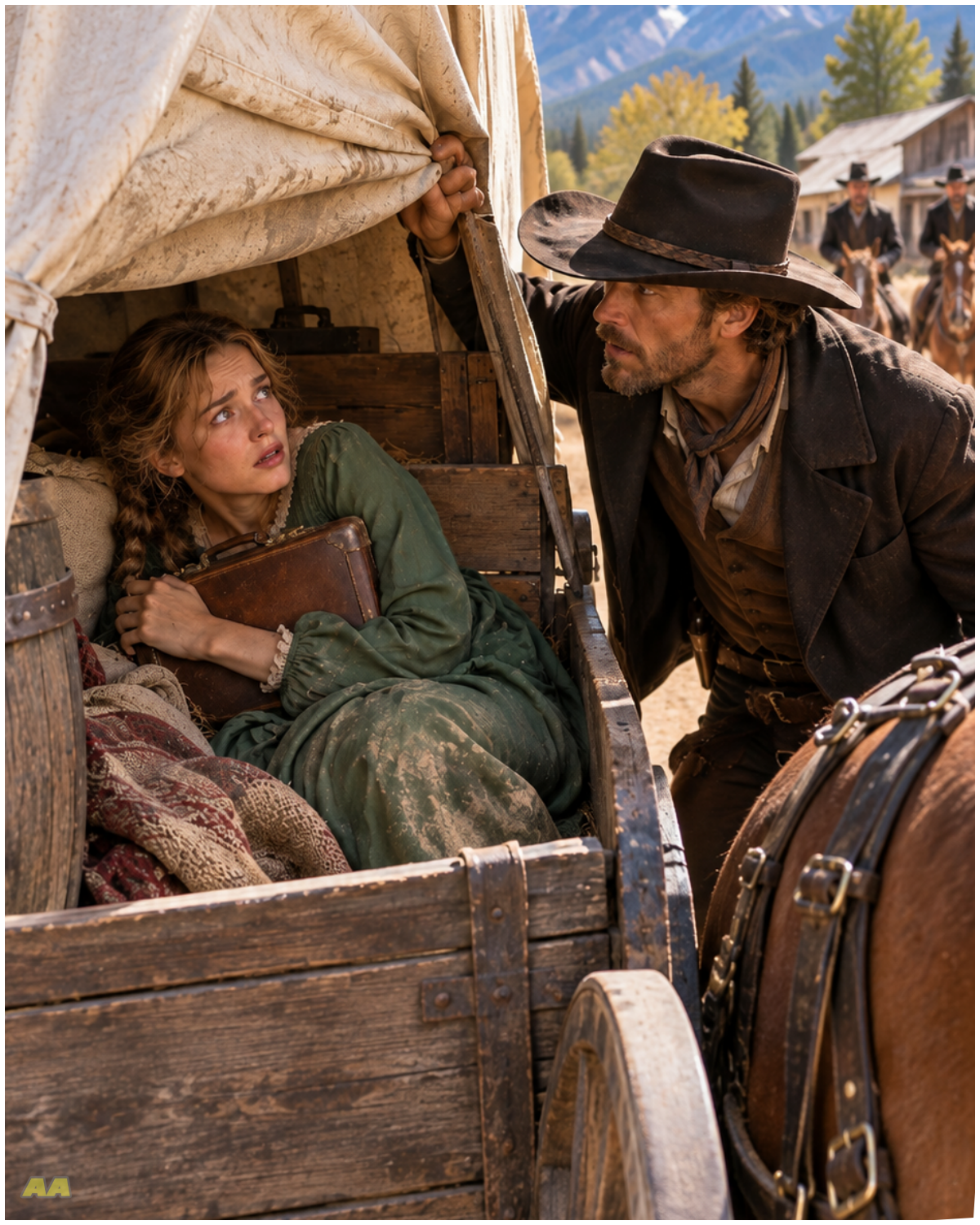
Malcolm Bain pressed his thumb onto the page and slid the ledger across the table without looking up.
$46.11, he said.
Outstanding.
As of this morning, Eloan Price stared at the number.
She had arrived at this labor house at 16 years old with nothing but a fever-killed father’s name and $11 of original debt her mother had apparently signed over in desperation.
7 years she had worked, seven years of mending, laundering, hauling, planting, and being told each month that somehow, somehow the balance had not moved, had in fact grown.
And now Malcolm Vain was smiling at her the way a man smiles when he already knows the outcome of a conversation.
“You want to leave,” he said.
“So pay.” Elo looked at his hands.
Clean, soft, never moved a bail in his life.
“I can’t pay it,” she said.
“Then I suppose you’re not leaving.”
The morning Elo and Price signed the marriage contract, it was raining so hard that the ink pulled in the corners of the page before the clerk could blot it dry.
She didn’t take that as a sign of anything.
She had stopped reading weather as metaphor years ago.
Weather was weather.
You either got wet or you didn’t.
The clerk, a thin young man with inkstained fingers, who had the practiced blankness of someone who spent his days processing other people’s desperate decisions, placed the document in front of her without comment.
The registry office smelled of damp wool and old paper.
There was a single window facing the street, and through it Elean could see two women walking quickly beneath a shared umbrella.
Their skirts muddied at the hem, their laughter carrying even through the glass.
She looked down at the contract.
Marriage contract territory of Montana, October 1,888.
Bride Ellen Price, age 23, formerly of the Harwick Labor Beneficent House, Billings County.
Groom Graham Vale, age 37, Vale Ranch, Deer Creek Township, Lincoln Valley.
She read it twice.
Then she picked up the pen.
The clerk cleared his throat.
You understand this is legally binding upon signing.
There is no trial period.
I understand.
You’ve read the party description provided by the groom’s representative.
She had widowerower, ranch owner, financially secure, no children living, reputation described as reserved.
The representative, a pleasant, unremarkable man named Hol who worked for the registry, had described Graham Vale as a man of substantial property who wished for a capable wife to manage a large household.
When Elellwin had asked whether the man had any particular expectations, Hol had chosen his words with too much care.
“He’s a quiet man,” Hol had said, lost his wife some years back.
“He’s not he doesn’t seek a society marriage. He wants someone practical.”
Eloin had thought practical, as though she were a tool being ordered from a catalog.
She had thought that, and then she had thought about Malcolm Bain’s ledger, and about the room she shared with three other women whose debt balances had also been growing without explanation.
And she had signed the preliminary agreement before Hol finished his sentence.
Now she signed the final contract.
Her hand didn’t shake.
She’d made decisions in worse rooms under worse conditions.
At least this one had a window.
The clerk blotted the ink and separated the copies.
He stamped both with the registry seal.
He said in the same tone he used for everything.
Congratulations, Mrs. Veil.
Your husband’s man will collect you from the main gate at 6 tomorrow morning.
Mrs. Veil, Ellen walked back through the rain.
She did not have an umbrella.
She had $11 hidden in the hem of her dress, sewn in at night over 3 months using thread she’d unraveled from a worn pillowcase and a small canvas bag containing everything she owned that could fit inside it.
She did not tell anyone she was leaving.
The wagon that collected her the next morning was better than she expected.
Two good horses, a driver named Aldis, who was old enough that he’d apparently given up caring whether his passengers wanted conversation.
He handed her a folded blanket without comment.
When she climbed up, nodded at the road ahead, and they moved.
The journey took 2 days.
Elo watched Montana open up around her and tried to prepare herself for whatever came next.
She had made a mental inventory of what she knew about Graan Vale, almost nothing.
What she knew about wealthy ranchers, that they tended to be men who had always had things, and therefore assumed things would continue arriving on schedule.
What she knew about marrying one? Nothing at all.
She had never met a man who was actually wealthy.
Not like this.
The Harwick labor house had been run by people who considered themselves prosperous, and Malcolm Bain wore his status in his posture and his clean shaved chin.
But the actual men with actual money were a different category entirely theoretical, like a country she’d heard described, but never visited.
On the afternoon of the second day, Alda said without preamble, “You can see the property in about 20 minutes.” Elo looked.
She saw it before she understood what she was seeing.
The land first rolling pasture in the late autumn gold that went further than she could comfortably take in.
Then fences, good fences, properly maintained, running in straight lines with post spacing that spoke of careful labor or the money to hire careful labor.
Then cattle, more cattle than she’d seen in one place in her life, dark shapes moving in slow groups across the far pasture.
Then a barn that was, as she would later tell herself, the size of a building that ought to contain other buildings.
And then the house.
It was not a grand house in the way grand houses looked in books.
No columns, no sweeping stair.
It was a frontier house built by someone with enough money to build something permanent.
Two full stories, a wide porch along the front and one side, good glass in the windows, a proper chimney, a kitchen garden that had been put to bed for winter with the kind of careful mulching that meant someone understood the work.
Elsa sat very still on the wagon bench.
She had been poor for so long that wealth, when she finally saw it, registered almost like a language she didn’t quite speak.
She could read the individual words large house, many cattle, good fences, but the full meaning of them pressed against something in her chest she didn’t have a clean name for.
Aldis pulled the wagon to a stop near the porch steps.
There was a man standing at the top of the steps.
He was tall.
That was the first thing.
Then broad through the shoulders in the way of men who worked with their bodies regardless of whether they had to.
His hands at his sides.
His face, she was trying to read his face from a distance, which was always a mistake still and watchful.
He had dark hair gone gray at the temples.
He was wearing working clothes, clean but working clothes.
He did not come down the steps.
She climbed down from the wagon without waiting to be helped.
Aldis handed down her bag.
She walked up the steps.
Graham Vale watched her come with an expression that was not unfriendly and not welcoming and not anything she had a precise word for.
It was the face of a man who had made a decision and was now standing inside the consequences of it without being sure what the consequences would require of him.
Mrs. Vale, he said his voice was low even.
She could not tell yet if it was a naturally quiet voice or a deliberately quiet one.
Mr. Veil, he looked at her bag.
One bag.
Is there more in the wagon?
There’s a trunk.
He went down the steps past her without another word and lifted the trunk from the wagon bed with the ease of someone accustomed to heavier work than a small traveling trunk.
He carried it up the steps and through the front door.
Eloin followed.
The inside of the house hit her in the way the outside had, but worse because the outside she’d been able to keep at a distance.
Here there were rugs, actual rugs on the floors, not worn mats.
A prop her staircase with a banister.
A parlor she could see through an open open door with two armchairs and a fireplace that had been recently cleaned.
The hallway was wide enough that two people could pass without touching.
Graham set her trunk at the foot of the stairs.
He turned to face her.
I’ll show you the rooms, he said.
He led her upstairs.
The landing opened onto a hallway with four doors.
He opened the second door on the right.
Elo looked inside.
It was the largest bedroom she had ever stood in the doorway of.
A bed, a real bed, not a cot, not a three-woman sharing arrangement with a quilt on it that had been washed recently enough that she could smell the soap from the door, a wash stand with a mirror, a wardrobe, two windows, a small writing desk.
She waited for him to say, “Our room.”
He said, “This is yours.”
She turned to look at him.
“The master bedroom,” he added, which was apparently his definition of sufficient explanation.
Elo said carefully.
And where will you sleep?
Above the stable.
I’ve slept there for several years.
It suits me.
She could think of nothing to say to that.
The appropriate responses were all either too direct or too grateful, and she wasn’t capable of the grateful ones yet, and the direct ones felt like prying into something he’d very clearly indicated was not up for discussion.
“All right,” she said. He nodded, turned.
“Suppers at 6:00. Mrs. Callaway comes in 3 days a week for the heavier cooking. The rest is however you prefer to manage it. I can manage a kitchen. I assumed you could.”
He paused at the top of the stairs without quite turning back.
I have no particular.
There are no rules about the house.
I need to explain.
You can use any room.
I’m generally in the fields or the barn during the day.
Mr. Veil, he stopped.
Why did you choose the registry?
A man with this property.
You could have had your choice of women in the county.
The pause lasted just long enough that she knew it was a real question, and he was deciding whether to answer it honestly.
The minister in town could tell you plenty about my reputation, he said finally.
“Most of what he’d tell you would be accurate. I needed someone who could manage a household and who didn’t require me to be something I’m currently not capable of being.”
He went downstairs.
Elo stood at the top of the stairs and listened to his boots on the floor below, and then the sound of a door and then nothing.
She was alone in the largest room she had ever occupied, and she was the most unsettled she had been, since she’d first understood that Malcolm Bain’s ledger was never going to reach zero.
She did not sleep well the first night.
This was not the bed’s fault.
The bed was better than anything she’d slept in since her parents’ house, and the room was warm and quiet in a way that the labor house never was.
The labor house was always populated with the sounds of women who hadn’t had enough and didn’t expect to get it.
The sounds of coughing, the sounds of effort that wasn’t going anywhere.
What kept her awake was thinking.
She had learned a long time ago that gratitude was a trap.
Not the feeling.
The feeling was fine.
Probably it was the way gratitude could be used to reshape what you were willing to tolerate.
Vain had been excellent at this.
He’d provided meals and heat and medical care when required, and he had made absolutely certain that every one of those provisions was entered into her account.
By the time Eloin understood what was happening, her debt had grown to more than twice its original size.
She lay in Graham Vale’s enormous bed and told herself, “Don’t be stupid about this.”
He had given her a room.
He had carried her trunk.
Neither of those things created an obligation she couldn’t survive.
The marriage contract gave him no rights over her person.
She had read that section with the exhaustion of someone who understood that certain clauses existed because people had needed them to exiSt.
What she could not figure out was what he wanted.
Men who wanted nothing made her more nervous than men who wanted something obvious.
At least obvious wants could be tracked.
She got up before dawn and found the kitchen.
The kitchen was the most organized room in the house, which told her something about the person who’d arranged it.
Not Graham Eloin would learn later that a former housekeeper had organized the stores before leaving the previous spring and that Graham had been eating supper at Tobias Reed’s neighboring ranch more often than not.
Coming home to a house that stayed largely untouched, she found flour, salt pork, dried beans, preserved tomatoes, coffee.
She found a cast iron stove that needed a thorough cleaning but functioned.
She made coffee and cornbread and was moving systematically through the kitchen stores when she heard boots on the porch.
Graham entered, stopped, and looked at the table.
I didn’t ask you to do this, he said.
No, she agreed.
She poured him a cup of coffee and set it down without asking whether he wanted it.
He sat slowly like a man who wasn’t sure whether sitting was allowed.
He drank the coffee.
She served the cornbread.
He ate half of it in silence.
She ate her portion standing at the counter because she hadn’t yet decided whether she was allowed to sit at his table.
It occurred to her halfway through her second piece that she was the legal owner of an equal claim on that table and she sat down.
Graham looked at her.
She looked back.
He looked away first and poured more coffee.
There’s a household account ledger in the top drawer of the parlor desk.
Mrs.
Callaway will explain the current arrangement when she comes.
I’ll introduce you to Harlon, the ranch foreman, today.
All right, you don’t have to Eloin.
He stopped.
It was the first time he’d used her name.
She wasn’t sure he’d done it intentionally.
You don’t have to earn anything here, he said.
He was looking at the table when he said it.
I understand that it may take time to believe that.
She thought about the cornbread.
It may, she said.
Harland turned out to be a weathered man in his 50s who assessed her once with the frank efficiency of some son accustomed to evaluating new elements introduced to an existing operation and then apparently decided she was acceptable and moved on.
The ranch was larger than she’d understood from the outside.
Harlon walked her through it because Graham had asked him to, and Haron was the kind of man who did what he was asked without ornament.
200 head of cattle on the home range, 40 horses, six full-time ranch hands, plus seasonal labor at peak times.
The barn she’d seen from the road was for horses and equipment, there was a second, larger structure further back for winter hay storage.
Eloen walked and listened and did not say much.
What she noticed, in the way she had learned to notice things from 7 years of institutional living, was what was missing.
The house had every material thing.
Good food stores, well-maintained tools, enough firewood stacked against the north wall to outlast any winter the territory could produce.
What was missing was sound, not the natural quiet of a working ranch.
She could hear horses and cattle and the ranch hands calling to each other in the far distance.
She meant the sound of a house being lived in.
The house was silent the way rooms were silent when no one expected to come home to them.
She asked Harlon, who had known Graham for over a decade, what Graham was like before.
Haron was quiet for a moment.
Before what?
He said.
Then before Marjorie and the baby.
He was different before that.
How? Talk more, Harlon said simply.
Not easy.
Exactly.
But present.
A man who was somewhere.
He paused.
The way it went, he rode out for the doctor in the worst storm of that year.
Took him 4 hours each way.
He came back and they were already gone.
Elo said nothing.
He built that stable room himself.
Harlland said took him 3 weeks.
I thought he was going to live out there and let the whole house fall empty.
He looked at her sideways.
He didn’t put an advertisement in the registry for a wife until this past summer.
6 years that evening she found the room.
She had not gone looking for it.
She had been walking the upper hallway, identifying which doors opened onto which rooms, the practical habit of someone who had spent years in institutional buildings, and learned quickly that understanding a floor plan was useful when she turned the wrong handle and it didn’t move.
Locked.
She wouldn’t have thought much about it except that the door wasn’t like the others on the floor.
The others were plain.
This one had a small wreath of dried flowers fixed to it.
Dry now, colorless, the kind of dried flowers that had been there for years.
She looked at it for a long moment.
Then she heard a sound from downstairs the front door and she went down.
Graham was standing in the hallway with his hat in his hand.
He looked up at her on the stairs.
Good evening, she said.
Evening.
He looked at her for a moment with an expression she couldn’t read.
Did you find everything you needed today?
I did.
The house is well stocked.
Good.
He moved toward the kitchen and then stopped.
Mrs.
Veil Eloin,” she said.
If you got to use her name arbitrarily, so did she.
He looked at her for a moment with an expression she still couldn’t quite read, not quite surprise, not quite anything she had a reliable name for.
Elo, he said, “I want you to know whatever you heard today in town, or we’ll hear about the circumstances of this marriage.
” “I chose the registry deliberately.
I wanted someone capable.
I wanted someone who didn’t.
I wanted the arrangement to be clear.
” He stopped.
“Try it again.
I’m not good company.
I’m not I don’t have a great deal to offer outside this property.
You don’t need to apologize for what you are.
She said, I didn’t sign that contract expecting something different.
What did you expect? She thought about it honestly.
Somewhere I couldn’t be reclaimed, she said.
Something moved in his face.
Not pity, she would have walked back out the door for pity.
Something more like recognition.
I’ll make sure of that, he said.
And then he went into the kitchen and she heard him pouring water.
And neither of them said anything else that night.
She lay in the big bed and thought about the locked room with the dried flower wreath and about what Harlon had said about the storm and about the way Graham Vale moved through his own house like a man visiting a place he wasn’t certain he had the right to be.
She had spent 7 years inside a system that turned survival into obligation.
She was trying very carefully not to do the same thing to this.
The problem was that kindness, even honest kindness, could grow into a structure if you weren’t paying attention.
And she had watched that structure form around other women at the labor house.
Women who were grateful for small things and stayed for years passed when they should have left because leaving meant admitting the small things hadn’t been enough.
She was not going to be stupid about this.
But as she lay there in the dark with the sound of Montana wind moving outside and nothing asking anything of her, she thought about the dried wreath on the locked door and what it must have cost a man to leave it there.
And she thought, “He’s afraid of this room, too.
Whatever was inside it, whatever was unfinished, whatever was locked, he was as afraid of it as she was of her own debts.
” That was not comfort.
Exactly.
But it was the first thing about Graham Vale that made her feel that she was living beside a human being rather than a decision she’d made.
In a moment of desperation, she turned onto her side.
She closed her eyes.
Outside Veil Ranch stretched out in the dark.
Thousands of acres of land she hadn’t earned, horses she hadn’t broken, cattle she hadn’t raised.
Wealth so complete it was almost an abstraction.
And in a room above the stable at the far edge of the property, a man who owned all of it chose to sleep in the cold rather than come inside.
Eloan Price, who had been poor every day of her adult life, and had learned to read danger in even the smallest kindness, lay still and tried to decide whether she had made the best decision of her life or simply the least terrible one.
She was asleep before she reached a conclusion, which was, she would later decide, probably for the beSt.
The first week taught her several things.
Graham Vale ate fast and left the table faster.
He took his coffee standing at the kitchen window looking out at the yard, which Eleanto was not not rudeness, it was habit.
The habit of a man who had been eating alone long enough that sitting down felt like an event that required justification.
She didn’t comment on it.
She ate her own meals at whatever pace suited her, and started noticing what the house needed.
It needed a great deal, not in the way of poor houses.
Nothing was broken or insufficient.
The larder was full enough to see them through winter twice over.
The furniture was solid and well-made, but the whole house had developed the particular neglect of a place where someone lived without quite inhabiting it.
Curtains that had last been washed in another season.
Kitchen stores organized by someone who’d left, restacked in a hurry by someone who hadn’t cared.
A vegetable garden at the east side of the house that had grown over itself for a full season and was waiting beneath the dead growth to be recovered.
Elo started with the kitchen because the kitchen was where she was most mornings and because reorganizing it required no permission and no conversation.
She found the household account ledger in the parlor desk where Graham had told her it was.
She read it carefully.
The numbers were accurate but unthoughtful misses.
Callaway had reported costs without comparison which meant they’d been paying top price for several staples they could have sourced cheaper if anyone had been paying attention.
Elo noted it.
She didn’t say anything yet.
She just noted it.
On the third day, she started on the vegetable garden.
She worked through the morning, pulling dead growth and turning the soil along the edge rose while the air was still cold enough to see her breath.
She was so absorbed in it that she didn’t hear footsteps until Graham’s shadow fell across the row she was working.
She looked up.
He was standing at the edge of the garden wi with an expression.
She was starting to recognize the particular expression of a man who had walked somewhere without fully deciding to and had now arrived and wasn’t sure what to do about it.
You don’t have to do that, he said.
I know.
I can hire minus.
I’m sure you can, she said.
I don’t need you to hire someone to do something I’m doing myself.
He stood there for another moment.
He was holding his hat.
She’d noticed he often held his hat when he was standing still, as though having it in his hands gave him somewhere to put attention that didn’t require looking at things directly.
Elo, he stopped.
I brought you here to manage the household.
Not to work like like what? The pause was too long.
He knew what the rest of that sentence sounded like, and he apparently wasn’t willing to finish it.
Like, I have to earn this.
She finished for him quietly without heat.
I know that’s what you were going to say, and I understand you mean it well.
She sat back on her heels and looked at him properly, but I don’t know how to live inside a house without earning my place in it.
I’ve been doing this since I was 16.
You can tell me to stop every morning for the next year, and I will still be outside at dawn with dirt on my hands because this is the only thing I know how to truSt.
” He looked at her for a long moment.
Then he put his hat back on and walked back toward the barn without speaking.
She thought she might have said too much.
Then she turned back to the garden and kept working because what else was she going to do?
He didn’t tell her to stop again.
What he did instead was stranger.
He started showing up.
Not intrusively.
He wasn’t that kind of man.
But over the following week, she would be working in the kitchen and she’d hear his boots on the porch and he’d come through, pour a second cup of coffee, and stand at the window the way he always did, except that once or twice he didn’t go immediately.
He stood and after a while he would say something about the weather coming in from the west about a horse that had been favoring its left front leg about a cattle buyer arriving Thursday from Billings.
Eloin answered when he spoke and didn’t push for more.
Then Mrs.
Callaway arrived.
She was a broad-shouldered woman in her late 40s with the confident efficiency of someone who had managed other people’s houses long enough that she no longer needed to think twice about anything.
She walked through the kitchen, noted the reorganization, opened three cabinets, and then looked at Eloin with an expression that was not quite approval, but was not dismissal either.
“You moved the preserves,” she said.
They were in front of the flower.
“Now the flower’s accessible without moving half the shelf every morning.
” Mrs.
Callaway looked at the new arrangement for another moment.
“Fine,” she said.
It was Eloin would come to understand about as enthusiastic as Mrs.
Callaway got about anything she hadn’t done herself.
She took it.
They worked together through the morning without friction.
Mrs.
Callaway was Eloin noticed deeply interested in what Elo had changed and resolutely uninterested in asking about it directly.
She opened a cabinet, observed the new arrangement, closed it, and moved on.
A kind of inventory taking.
After lunch, while Elean was going through the household ledger again, Mrs.
Callaway appeared in the doorway.
“How are you finding it?” she said.
Finding what? All of it.
A pause.
Him.
Elo set down her pencil.
I don’t think I know him well enough yet to have an opinion.
That’s an opinion.
Mrs.
Callaway said he was a different man before.
I worked for Marjgery Vale for 3 years.
She ran this house properly.
Flowers in every room.
That kitchen garden was hers.
She paused.
He doesn’t go near it.
I assumed he’d let it go entirely.
Elo looked out the window at the garden she had been working.
I didn’t know that.
She said he wouldn’t have told you, Mrs.
Callaway said.
She picked up her coat from the hook.
He doesn’t tell people things on purpose.
He just doesn’t say them in hopes they figure it out.
Or don’t.
She buttoned her coat.
You moved his preserves and took apart his dead wife’s garden.
I’d say that’s a fairly confident entrance.
She left before Eloin could determine whether it was a criticism.
Thursday came and the cattle buyer arrived from Billings.
His name was Prescott, and he had the kind of well-fed confidence that men who spend money on behalf of other men carry as a professional credential.
He arrived with a younger assistant and a ledger of his own, and Graham walked him around the livestock pens for 2 hours before they came inside to settle numbers.
Elodom brought coffee.
She would have left except that Prescott was sitting at the kitchen table and she had a household account question she needed to ask Graham before he signed anything.
So she waited near the kitchen door and listened to them negotiate.
The numbers were she had to consciously keep her expression from changing.
Prescott opened with a purchase offer for 30 head at $12 each.
Graham said 14.
Prescott said 13.
Graham said 14 without any particular urgency the way a man states the temperature of a room.
Prescott wrote 14 in his ledger.
$360 in less time than it took her to bake cornbread.
The assistant caught her expression she hadn’t hidden it as well as she’d thought, and gave her the particular look of a man who has watched wealthy people conduct business long enough to find other people’s reactions to it mildly amusing.
She looked back at him steadily until he found something else to look at.
After Prescott left, Graham turned to find her still standing in the doorway.
“You had a question,” he said.
The household account, we’re paying 15 cents per pound for dried beans from Callaway’s supplier.
Gerber’s general store in town sells the same grade from a local supplier at 11 over a full year.
That’s a significant difference.
Graham looked at her for a moment.
Change it, he said.
I’ll need you to authorize the account transfer.
I’ll authorize it today.
He went back to his desk.
She went back to her ledger and entered the change.
She found two more similar discrepancies that afternoon and noted them both.
The same evening, she put the notes on the parlor desk where the authorization papers were kept.
In the morning, they’d both been signed.
She picked them up and looked at his signature, plain, fast, the signature of a man who’d been signing documents his whole life and had never needed to make it impressive.
She thought about $360.
She thought about $11.
She filed the authorization papers and went back to the kitchen and started breakfaSt.
Sunday came and Graham drove the wagon to the Sunday service at the settlement church without asking whether she was coming and without suggesting she wasn’t.
He simply had the wagon ready and was sitting on the bench when she came out and she climbed up.
The church held about 60 people, more than she’d expected for a settlement this size.
She sat beside Graham in the pew he apparently always sat in third row on the left, which felt like the pew of a man who was present out of obligation rather than proximity, and was aware from the first 30 seconds of the particular quality of attention that arrives when a room full of people knows something about you that you’re still discovering for yourself.
She was the workhouse bride.
She could hear it before anyone said it.
In the quality of the glances, in the slight extra pause before people introduced themselves, in the carefully phrased warmth of the minister’s wife, whose warmth was just a degree too careful to be entirely natural.
She kept her back straight and her expression pleasant, and she noted faces.
Two women in particular, they were seated three rows back, and they had the specific body language of women who are speaking to each other through their postures.
Small, lean, slight turn, the kind of conversation that doesn’t require open mouths.
They looked at Eloin and then at each other and back at Elo, and one of them said something behind her gloved hand.
Elo had read lips just long enough in the labor house to know when people were forming the word money.
The service ended.
People filtered outside.
She was standing near the wagon when she heard it, clearly not the two women from before.
A different voice.
A man speaking to another man without sufficient care about who was nearby.
Workhouse girl of all things.
No family, no land, nothing to her name.
You’d think with everything he’s sitting on, he could have done better.
She turned.
Graham was 3 ft to her left.
He had heard it.
She could tell from the stillness that had come over him the specific stillness of a man who was deciding.
The men who’d been speaking noticed Graham and had the grace at least to look uncomfortable.
Graham looked at Eloin.
Then he looked back at the men.
“Mrs.
Veil,” he said loudly enough that it carried.
“We’re going home through the front gate.
” “She didn’t understand immediately.
” “There’s a back path through the cemetery,” he said more quietly.
“It’s faster.
I’ve been using it most Sundays,” he paused.
“We’re not using it today,” he offered her his arm.
“She took it.
” They walked through the middle of the yard, past the two women, past the men who’d been talking, past everyone who was watching.
Graham walked at his own pace, unhurried, undisguised, and nodded to the people who spoke to him as though nothing in particular was happening.
They can look.
She’d understood what he meant.
He wasn’t performing defiance for anyone watching.
He was simply refusing to make himself smaller in front of people who’d have preferred he’d be ashamed of her.
It was the first thing he’d done that surprised her in a way that didn’t feel like a trap.
She filed it carefully.
Tobias Reed came by the following Wednesday with a horse he wanted Graham to look at a red rone mare that was refusing to settle in her new stall and stayed for supper because Eloin had made enough and because Tobias Reed was apparently the kind of man who treated other people’s houses with the comfortable authority of long friendship.
He was 59 broad through the chest with a face that had been lived in long enough that it had stopped trying to conceal what he thought about things.
He watched Eloin move around the kitchen with open unconcealed assessment for about 4 minutes and then apparently decided she was acceptable because after that he talked to her directly instead of around her.
He’d been bothering you about working too hard?
Tobias asked her.
She sat down the serving bowl once.
Don’t let it stick.
Half the women in this county would have that garden cleared and producing by spring.
He looked at Graham.
She cleared half the beds already.
I noticed.
Graham said Marjgery’s beds, Tobias said without particular emphasis.
Just stating a fact.
Something shifted at the table.
Elo kept her expression even and served the rest of the meal and sat down.
Graham ate and said very little after supper.
When Graham had gone back to the stable on some pretext involving the mayor, a pretext that Tobias watched him leave on with the ease of a man who had seen this kind of departure.
Many times Tobias poured himself the last of the coffee and sat back.
He’s not a bad man, Tobias said.
I didn’t think he was.
He’s a man who did one thing wrong and decided to keep paying for it indefinitely.
He wrapped his hands around the cup.
Marjorie was 29 when she died.
The baby never drew a breath.
He rode for the doctor through a storm that took down three barn roofs in this valley.
Took him near 4 hours each direction.
He came back and they were already gone.
Elo said nothing.
The midwife said there was nothing he could have done differently.
Doctor said the same.
Half a dozen people told him for years after that it wasn’t his fault.
Tobias looked out the window at the dark.
He stopped listening after the second year.
Decided their version of events was people being kind.
He set down the he built that room above the stable himself.
3 weeks.
I watched him do it.
I thought I thought he was going to wall himself off from everything and let the whole property run on inertia until it ran out.
But he didn’t.
Elo said.
No, he didn’t.
He just went smaller, got quieter, stopped coming to things.
He paused.
He put the advertisement in the registry this past July.
First real decision he’d made about his own life in about 5 years.
I don’t know what convinced him.
He looked at her.
I’d like to think it was something and not just exhaustion.
She thought about that.
He told me he wanted someone capable, she said.
And someone who didn’t require things he couldn’t currently provide.
Tobias made a sound that was almost a laugh.
That’s how he’d say it.
Yes.
He stood and collected his coat.
For what it’s worth, what he can currently provide is substantial, just not the kind that shows up on a cattle ledger.
He said good night and let himself out.
She sat at the kitchen table for a while after he left.
The house was quiet in its usual way, not the quiet of emptiness.
She was starting to realize, but the quiet of one person living very deliberately inside a space that had been built for more, like the echo of something that used to be louder.
She thought about what Tobias had said about the storm about 4 hours through bad weather and arriving home to find the outcome already decided regardless.
She thought about the locked room upstairs with the dried flower wreath.
She had not tried the handle again.
It wasn’t her room to open, but she thought about it differently now.
She assumed it was locked because Graham couldn’t bear to look at it.
She was starting to think it was locked because he believed he didn’t deserve to.
There was a difference.
She was not going to fix that.
It was not hers to fix.
And she was not in the business of deciding what other people’s grief required of them.
She had learned that particular lesson from 7 years of watching vain decide what every woman in the labor house required their emotional states, their needs, their progress, and she had no interest in reproducing that structure in the direction of warmth.
But she understood him better now, and understanding someone was not the same as trusting them.
But it was a start.
The following week, she began assisting with the formal household accounts.
Graham’s bookkeeper, a young man named Finn, who came in twice a month and had the perpetually mild anxiety of someone who suspected he was missing something, but couldn’t locate what had left the October accounts on the parlor desk with a note indicating he’d returned to reconcile them at month’s end.
Elo looked at them out of professional curiosity and found three unrecorded household expenses from the week previous.
She noted them in.
When Fen arrived at months end and found the accounts already reconciled, he looked at Eloin the way a man looks at an unexpected problem.
I did the household half, she told him.
The ranch operating accounts are yours.
That’s yes, but I usually I know what you usually do.
I’m not undercutting you.
I’m saving us both a half day of work.
She looked at him steadily.
Are the numbers correct?
He checked them with the careful suspicion of a man who needed to be certain he was finding a problem.
And then apparently didn’t find one.
“Yes,” he said slowly.
“Good.
Come back in November.
I’ll have the same half ready.
” He left looking uncertain, but not disagreeable, which was she had found about the best outcome you could expect from men whose routines you’d adjusted.
That evening, Graham came in from the fields later than usual.
He looked at the account ledger on the parlor desk she’d left it open to the reconciled page, not as a demonstration, just because she hadn’t closed it, and he stood in the doorway looking at it for a moment.
Fen seemed confused.
He said he’ll adjuSt.
Three missing expenses.
Feed repair and two kitchen deliveries that weren’t logged.
Fen was only given the invoices, not the receipts.
I matched both.
Graham was quiet for a long moment.
Then how much have we been losing to unrecorded expenses?
Estimating from October.
Probably $30 to $40 a year.
Maybe more in busier months.
He said nothing else.
He went upstairs.
In the morning, there was a second household account ledger on the parlor desk.
New with a note in his handwriting, “Your half.
” She stood there looking at it for a moment.
It was not sentiment.
It was a man who understood the value of practical competence, recognizing where it lived.
She was aware it was exactly the kind of thing Vain would have done.
Look how I’m rewarding you.
Look how I value your contribution.
Look how your account grows.
And she was also aware that Graan Vale had not in the 3 weeks she’d known him indicated any interest in using her gratitude as leverage.
She picked up the ledger.
She went to the parlor desk.
She set it next to his.
She did not say thank you and he did not wait for it.
3 weeks after the church incident, two women from the settlement wrote out to call on her.
Their names were Francis Doyle and Nell Ackers, and they arrived with the formal purposefulness of women who had decided something in advance and were now executing it.
Francis was the wife of a grain merchant.
Nell was older, the mother of one of the ranch hands, with the settled confidence of someone whose opinion had been relevant in this community for long enough that she’d stopped making it available for debate.
They sat in the parlor.
Elo served coffee and the cornbread she’d been making that morning and did not adjust her behavior in any direction to account for what she suspected they’d come to determine.
Francis asked about the house about how she was settling in.
She was pleasant, which Elelloan recognized as a mode of inquiry.
Nell was more direct.
You worked at the Harwick House, Nell said.
I did.
7 years.
That’s a long time.
It is.
Nell looked at her over the coffee cup.
There are women in this settlement who think Graham married beneath his position.
I expect you’ve gathered that.
I’ve gathered that.
And they’re probably right by the measure they’re using.
Elo held the woman’s gaze evenly.
I came here with one bag, $11 sewn into a hymn, and a work history that won’t impress anyone who cares about family names.
By that measure, Granville could have done considerably better.
Nell was quiet for a moment.
By what measure couldn’t he have?
She said it was the kind of question that could be a trap or could be a genuine inquiry and Elo had learned to treat them the same way regardless with a straight answer.
By the measure of someone who needs the specific things I have, she said, which Graham does.
Whether that counts for anything in this community is your calculation to make.
Francis glanced at Nell.
Nell sat down her coffee cup.
Well, Nell said, “You’re not what I expected.
What did you expect?” Either shy or grasping.
A pause.
You’re neither.
I’ve had limited opportunity to be either.
Eloan said.
Shy doesn’t survive 7 years in the labor house, and there was nothing to grasp.
Nell almost smiled.
It was a contained expression, the kind of smile that had been practiced into over years of not wanting to encourage things prematurely, but it was there.
They finished coffee and left without saying anything definitive, which Elo had learned to read as a better outcome than most available alternatives.
That evening she found Graham in the stable yard checking the red ran mare that Tbahas had brought by the horse that had apparently settled without incident into the routine of the property as horses generally did when given time and minimal fuss.
She told him about the visit.
He listened with his attention on the horse, which she understood by now was simply how he processed information in real time, not dismissal, just the particular focus of a man who listened better when his hands were doing something.
Nell Aers has more influence in this valley than anyone without a ranch title, he said finally.
If she decides you’re acceptable, most of the rest follow.
She didn’t decide anything.
She came out here.
That’s deciding something.
He moved around to check the horse’s left for leg.
The first year after Marjgery, nobody came to call.
Tbisus and two others.
Everyone else was waiting to see which way the thing was going to fall.
And which way did it fall? He didn’t answer immediately.
He ran his hand down the horse’s leg, checking the joint she’d apparently been favoring.
It fell quiet, he said.
Just quiet, and they eventually stopped waiting for something to observe.
Elo leaned on the fence rail and looked at the horse.
The women who were whispering at church, she said, “After you said we were going through the front gate.
I know who they are.
Do they matter?” Not particularly.
He straightened and looked at her.
Does it bother you?
She thought about the labor house.
About sharing a room with women who’d made themselves small enough that no one would bother adding to their accounts, about learning to move through spaces without drawing notice because drawing notice always cost something.
I’ve been surviving people’s opinions since was 16.
She said, “What bothers me is when opinions turn into decisions someone else makes about my life without asking.
” He looked at her for a moment.
I’ll keep that in mind.
I know you will.
She meant it as a straightforward statement of what she’d observed about him.
He appeared to receive it that that way he turned back to the horse without the particular stiffening she’d noticed when he was uncertain about the emotional register of something.
They stood in the yard for a while, both of them looking at the ran mare moving around her paddic.
The evening was going blue and cold at the edges, and somewhere in the far pasture, a cattle dog was working a small group of strays back toward the fence line.
It was, Eloan thought, the longest period of time she and Graham had occupied the same space, with either of them feeling the need to account for it.
That was not nothing.
She had lived most of her life among people who charged for everything, time, space, proximity, the simple fact of her continued presence in a room.
She had come to expect that the comfortable moments were the ones you paid for later.
Graham Vale stood beside her in his own yard, watching his own horse, and made no indication that he was keeping a record of any of it.
She didn’t trust it yet.
She was still waiting for the ledger.
But she noticed it.
She noticed it the way she noticed the garden coming back along the east wall, the soil already responding to the work she’d put in, the small evidence of something recovering.
Inside the house, through the window above the kitchen, she could see the two account ledgers on the parlor desks side by side where she’d left them.
His half, her half, no hidden charges, not yet.
November arrived cold and fast, the way Montana November’s did not gradually, not with the courtesy of warning, but all at once, as though the territory had simply decided it was done with autumn, and was moving on without consultation.
Elo had been at Veil Ranch for 5 weeks.
She had stopped lying awake, waiting for the ledger to appear.
This was not the same thing as trusting the situation.
She understood that.
But there was a difference between the vigilance she’d maintained in the labor house, the specific electric alertness of someone who had learned that relaxation was often followed immediately by a new charge on her account, and the quieter watching she was doing now.
She was still watching.
She was just watching differently.
More like a person assessing an unfamiliar road than a person waiting for a blow.
Part of what had changed her was the animals.
She had noticed at first with the rone mare, Tobias had brought over the one that had been nervous in her new stall, shying from the gate, keeping herself pressed against the far wall until Graham came in and sat down on the ground against the opposite wall and simply waited.
Didn’t approach, didn’t coax, just sat there with his back against the wood and his legs extended and his hat on the ground beside him, and waited until the horse got curious enough to come to him on her own terMs.
It had taken 45 minutes.
Eloen had watched through the gap in the stable door, not planning to stay, but staying.
The horse came to him, eventually took one step, then stopped, then three more, then stopped again.
Graham didn’t move.
When her nose finally found his shoulder, he brought one hand up very slowly and rested it against her jaw and said something too quiet to hear from where Eloin stood, and the horse’s head came down.
She filed it away the same way she had filed the ledger beside hers on the parlor desk and the front gate at the settlement church.
She was building a picture piece by piece, and she understood that pictures built this way were more reliable than ones presented whole.
What she had so far.
A man who was harder on himself than on anything else he was responsible for.
The wagon repair happened on a Tuesday.
She had been coming back from checking the far side of the kitchen garden when she found him under the wagon in the sideyard working at something with a wrench and an expression of focused irritation that looked different from his usual.
This quiet this was operational frustration specific to a problem that wasn’t cooperating.
And it was the most ordinary expression she’d seen on him in 5 weeks.
She looked at the wheel he’d pulled off.
She crouched down.
Left rear axle pin, she said.
A pause from beneath the wagon.
Rear left.
Yes.
I can hold the axle housing while you set it.
It’s easier with two.
Another pause.
Longer this time.
You’ve done this before, he said.
It was not quite a question.
At the labor house, the wagon was everybody’s problem or nobody’s problem.
Same difference.
She heard him shift his position.
She moved to the wheel housing, got her hands under the axle collar, the way she’d done a dozen times in the labor housey yard when the maintenance men were short, and Vain had decided the women could learn to be useful.
Ready, she said.
They worked without much conversation, which was fine.
She held the housing steady while he set the pin, and she handed him the correct tools when he asked for them, and when the wheel went back on, she tested it herself, rotating it through a full cycle to check the play.
Even, she said.
Graham came out from under the wagon and stood.
He looked at the wheel and then at her.
You didn’t need to stay, he said.
I know, but you did.
Two people is faster than one.
He wiped his hands on a cloth and said nothing else.
But for the first time since she’d arrived, the silence between them had a different quality to it, less like a distance being maintained, and more like two people who had just done something together and were comfortable with what it had been.
That was new.
She noticed it carefully and tried not to want too much from it too faSt.
The cattle work happened the following week during a bitterly cold afternoon when three of the ranch hands were occupied with a fence problem in the north pasture and a group of heers needed to be moved from the eastern range to the winter feeding area closer to the barn.
Graham was doing it himself which seemed unnecessary and she said so.
I have three hands at the fence he said.
I can ride.
He looked at her.
Can you? I grew up in the Billings Valley before my parents died.
We had two horses.
She paused.
I haven’t ridden in seven years, but I haven’t forgotten.
There was a brief internal calculation visible in his expression.
Not doubt exactly, she was starting to be able to read him well enough to distinguish between his versions of quiet, but the automatic male recalibration that happened when a woman stated a practical capability he hadn’t accounted for.
The gray, he said, Biscuit.
She’s patient.
The gray was patient.
She also had a slight tendency to want to cut left on her own interpretation, which Eleanor twice in the first 10 minutes until they came to an understanding.
The work took 2 hours in the cold.
She remembered how to position herself, how to read the herd’s direction, when to press and when to hold back, and let them find their own momentum toward the gate.
Graham worked the opposite side, and they communicated almost entirely through positioning a raised arm, a direction of movement.
The practiced non-verbal language of people doing physical work together.
At one point, a young hepher broke from the group and ran directly at Elo’s horse.
Biscuit planted and Elo stayed with her, cut the heaper back before she cleared the group, and turned her back without drama.
When she looked up, Graham was watching her so from the other side of the herd.
He said nothing, but the qu the quality of the watching was different from the assessment she’d seen in the first weeks, more like recognition.
They drove the last animals through the gate, and she dismounted and stood in the cold evening air with the breath coming off the horses in clouds and something in her chest that felt against her better judgment like satisfaction.
Graham latched the gate and turned around.
7 years, he said.
Seven years.
You ride like someone who rode last week.
She looked at him.
He said things like this rarely enough that she’d learned to receive them as they were not flattery, not performance, just accurate assessment delivered plainly.
“Thank you,” she said.
He nodded once and led his horse toward the stable.
She followed with the gray and thought piece by piece.
That evening, Graham sat at the kitchen table for supper without leaving early.
She noticed immediately he’d been doing it more often over the past few weeks, staying past cost defeat, asking the occasional question about the household accounts or the garden or something he’d apparently been holding on to during the day.
But this evening, he pulled the chair out across from her, the chair that had been empty every meal since she’d arrived, and sat there.
It was such a small thing that she almost looked away from it.
She didn’t look away from it.
They ate and talked about the heers, about the fence problem in the north pasture, about a letter from the cattle buyers association that had arrived that week regarding spring grazing contracts.
Elo had questions about the spring contracts because she’d been reading the ranch account structure and didn’t understand the fee arrangement for the shared grazing lands.
And Graham explained it with the automatic patience of someone who had learned these systems so long ago, he’d stopped realizing they needed explaining.
She had more questions than he’d expected.
She could tell that from the slight shift in how he was answering less the brief summaries he’d been giving her in the first weeks and more the fuller explanations of someone who had recalibrated their understanding of who they were talking to.
You could have managed a ranch, he said.
It wasn’t quite a compliment.
It was an observation the kind people made when they just updated a position.
I managed what I was given to manage.
She looked at him.
You were given manage more.
That’s not exactly.
I know it’s not exactly, but it’s close enough to matter.
He looked at her and then at the table and then back at her with the expression she’d started to think of as his thinking face not cold, not absent, but internally occupied, working through something.
My aunt is coming on Friday, he said.
This was the first she’d heard of an aunt.
Beatatrice.
She’d seen the name on old correspondents in the household files.
Beatatrice Vale, Lincoln Valley.
She manages.
She helped manage portions of the ranch after Marjorie died.
While I was, he stopped.
She’ll have opinions about the household accounts.
I expect she will.
He looked at her steadily.
She can be difficult.
I can manage difficult.
I know.
He said there was something in it, not just acknowledgement of a capability, but something less defined, something that had more to do with 5 weeks of watching and rebuilding than with wagon repairs or cattle work.
She felt it arrive and consciously decided not to examine it too directly yet.
“More coffee,” she said.
“No,” he said.
“Thank you.
” He cleared his own plate without being asked, which was new, and said good night and went upstairs, and she sat at the kitchen table in the quiet house for a long time before going up herself.
He brought her to the cemetery on the Thursday.
He hadn’t planned it, or if he had, he hadn’t communicated any plan.
He’d come in from the morning work earlier than usual and found her in the kitchen and said without preamble, “There’s something I want to show you.
” Then stood there as though surprised he’d said it.
She put down the pot she was holding and said, “All right.
” They walked north from the main yard, past the winter pasture in the grain stores, and through a gate she hadn’t used before, and then up a slight rise to a flat area behind a stand of bare-limmed trees that in summer would have provided shade.
There were two stones, simple ones, not elaborate.
A rancher’s markers cut and placed by someone who valued permanence over ceremony.
The larger one read, “Marjgery Annevil Veil, beloved wife.
” A birth year and a death year 1,861 to 861 to 1,882.
And then beside it, a smaller stone veil infant daughter.
December 1 882.
She stood and looked at them, grabbed three feet to her left with his hands in his coat pockets, and did not look at the stones for a long moment.
When he did, it was with the expression of a man looking at something that he has looked at so many times that the looking itself has become part of the weight.
She said nothing.
She had learned that with Graham, silence did not mean nothing was happening.
It often meant more was happening than words could get ahead of.
He spoke eventually.
“The storm came in the second week of December,” he said.
His voice was even, not controlled, even the way facts stated plainly were even when the person stating them had already said everything else about them to themselves privately a thousand times.
She’d been having trouble for 2 days.
The midwife was with her, but she said the baby wasn’t turning right and she needed the doctor from town.
He paused 12 mi in a storm that took three roof sections off the aer’s barn that same night.
Elo waited.
I rode fast, as fast as the horse would go in that weather.
I’ve gone over at every decision on that road for 6 years.
Every turn I took or didn’t take.
Whether I should have gone north around the valley ridge instead of straight through, whether a different horse, he stopped.
It took me 4 hours.
The wind moved through the bare branches above them.
He rode back with me, Graham said.
The doctor he wasn’t.
He wasn’t slow about it.
We were both riding as fast as we could.
He looked at the smaller stone.
By the time we got back, the midwife had done everything that could be done.
Marjorie had already he stopped again differently this time.
The baby never breathed.
She looked at him.
The extraordinary thing was not that he was telling her this.
She had known the broad outline for weeks from Tobias, from Harlon, from Mrs.
Callaway and the quality of the silences inside the house itself.
What was extraordinary was the expression on his face as he said it.
Not grief exactly.
Grief had a quality of freshness to it that time eventually wore down.
What Graan Vale wore was older.
It was guilt in the late stages.
Guilt that had been converted by long repetition into a kind of permanent tax on everything.
Something he paid every morning without expecting a balanced change.
She said, “You rode 12 mi in a December storm and came back in 4 hours.
” It wasn’t fast enough.
The midwife said, “I know what she said.
” Not harsh, just tired in the specific way of someone who has heard a correct argument many times and rejected it many times and is tired of both.
I know what all of them said.
Tobias, the doctor, my aunt.
He looked at the stone.
I know the argument.
I just don’t believe it.
She thought about Vain’s ledger.
She thought about the number that never moved.
The balance that grew year after year regardless of the work she put in because the system required a balance to continue justifying the system.
Grief is not a debt, she said.
He turned to look at her.
She kept her eyes on the two stones.
I know what it looks like when someone has decided they owe something that doesn’t have a fixed amount.
When the payment keeps getting made and the account never closes, she paused.
I’ve lived inside that structure.
I know what it feels like from the inside.
It feels like the only honest response to something that happened.
Like the least you can do.
She looked at him.
But it’s not honeSt.
It’s just a way to stay inside the worst moment without having to find out what comes after.
His jaw was tight.
He was not.
She could see dismissing it.
What if there isn’t anything after?
He said, “There is,” she said.
“There always is.
You just get to decide whether you’re inside it or outside it.
” He was quiet for a long time.
Then he reached out and took her hand, not reaching for her, more like a man who had arrived somewhere without quite charting the route, and found that arriving involved this.
She didn’t pull away.
She let it sit the way she let silences sit, attended to, but not forced into something it wasn’t yet.
They stood there for a while, the two of them, in front of those two stones.
When they walked back to the house, neither of them said said anything about it.
She thought that was right.
Beatatric Vale arrived the following afternoon in a wagon driven by her own man with two trunks and the particular authority of a woman who had earned her opinions about a property through actual work inside it.
She was 63 with gray hair pinned back precisely and blue eyes that had the quality of s excellent light.
They didn’t miss things.
She looked at the house as she came through the door and Eloin watched her look at it.
The small inventory of a woman who had helped hold this place together through the worst period of its life.
Mrs.
Veil, she said, not unkindly, but measuring.
Miss Veil, Eloan said, please come in.
I’ve made coffee.
Beatric’s mouth did something that was not quite a smile, more an acknowledgement that the correct thing had been done, filed accordingly.
She toured the house, not intrusively, she moved through the rooms with the confidence of someone who’d been in them before and was updating her assessment, not inspecting someone else’s territory.
She looked at the reorganized kitchen stores without comment.
She paused at the door to the parlor and looked at the two ledgers on the desk.
Two,” she said.
“Graham authorized a household account for me.
I’ve been managing the household half-monthly.
” Beatatrice looked at the ledgers for another moment.
His idea, mine originally.
He agreed to it.
H she came into the kitchen and sat at the table and drank the coffee Eloen had poured and asked three direct questions about current household expenditure, feed costs through winter, and the state of the vegetable garden.
Elo answered all three with numbers.
Beatatrice said nothing beyond the initial question which was Eloin was beginning to understand how Beatatric Vale received information that met her standards.
They managed the first afternoon without difficulty.
It was after supper while Graham was meeting with Haron in the barn about a problem with the winter grain supply that Beatatrice said something.
Elo was clearing the table.
Beatatrice was still seated, her coffee in front of her, looking out the darkened window with the expression of someone who had decided something during supper and was now working out how to say it.
He put in the advertisement specifically, Beatrice said.
Elo set the plates down, the registry advertisement.
He didn’t simply register as available.
Beatatric’s eyes came away from the window.
He specified bride from a labor registry or institutional placement.
No family connections, no social relations in the territory.
Preferably without resources or prior property.
The kitchen went very quiet.
Elo was still standing at the table.
He told me he wanted someone practical, she said carefully.
He wanted someone who would make fewer demands on him, Beatatrice said.
Not cruy, with the bluntness of a woman who had watched her nephew destroy himself slowly for six years and had made her own decisions about the kindness of directness.
He told me directly.
He wanted someone who would manage the house competently and who would not who would not expect things he couldn’t give.
A pause.
He specified a woman without connections because a woman without connections would have fewer expectations.
His word.
Something cold moved through Eloin’s chest and without resources, she said.
Yes.
The word fell into a perfectly still room.
She thought about everything she’d filed.
The front gate at the church, the ledger beside hers, the cemetery in the afternoon light and his hand over hers.
Every piece she’d been building into a picture.
She thought about what happened when the picture turned out to be something other than what she’d believed it was.
So, “Thank you for telling me,” she said, her voice was level.
She picked up the plates and took them to the basin and began washing them because having something to do with her hands was the difference between holding herself together and not.
Beatatrice was quiet behind her.
Then I don’t tell you this to I know why you told me.
Eloan said she did know Beatatrice had watched Graham for 6 years.
She was not trying to damage what was growing.
She was trying to make sure it grew on ground that was real and not on a story Elo was building from incomplete information.
That didn’t make the information easier.
It made it, if anything, harder.
Because if Beatatrice had come in cruel or triumphant, it would have been easier to dismiss.
What Beatrice had done was tell her the truth plainly and with no evident satisfaction in it, which meant it was simply true.
She finished the dishes.
Good night, she said.
She went upstairs.
She sat on the edge of the bed and thought about it clearly, which was the only thing she knew how to do with something this size.
He had requested a woman with no power, because a woman with no power was safer.
Not maliciously.
She was almost entirely certain it had not been malicious.
Graham Vale was not a man who manufactured exploitation as a business practice that was vain.
Graham’s version was quieter and more p and in some ways worse precisely it came from genuine intention.
He had wanted a practical arrangement.
He had wanted someone who would manage his house without requiring the emotional risk of being present in his own life.
And when he had been constructing that arrangement, he had looked at the available options and chosen the one most likely to need less, the one with fewer exits available.
She had been chosen partly because poverty made her convenient.
She kept the thought still and looked at it.
The garden she’d been working all these weeks had been his dead wife garden.
The account she’d reorganized had been growing slack because no one alive in this house had cared enough to attend to them.
The cemetery visit had been.
She stood and forced herself to ask honestly had that been her or had it been the accumulated pressure of having someone present enough to finally say the thing he’d been carrying.
Would he have taken any competent woman there eventually?
She didn’t know.
That was the honest answer.
She didn’t know.
And that was the thing she couldn’t tolerate.
Not the next explanation itself, but the way it reframed everything she’d thought she had understood.
She had built a picture, and now several of the pieces were different things than she’d believed.
In the morning, she found him at the kitchen table with his coffee.
He knew immediately.
She could see it from the doorway the slight shift in his posture when she came in, the careful stillness that told her Beatatrice had spoken to him after she’d gone to bed, and he was waiting to find out what that meant.
She poured herself coffee and sat across from him.
“Tell me what the advertisement actually said,” she said.
He sat down his cup.
Beatatrice, tell me.
Then at her, his voice was even.
I specified a bride from a labor registry or placement house.
Without family in the territory, without prior property.
Why? I wanted I wanted a practical arrangement that didn’t ask for more than I could currently give.
He said it without looking away, which she noticed.
A woman with family connections would have expectations about society, about what marriage looked like.
A woman with her own resources would have leverage, she said.
His jaw tightened.
Yes, you wanted someone with less leverage.
I He stopped, started again.
I wanted a quiet household, someone capable, someone who wouldn’t.
I couldn’t do it again.
I couldn’t be inside another marriage that expected me to be present when I couldn’t figure out how to be present anywhere.
He put both hands flat on the table.
I wasn’t thinking about what it would mean from your side of it.
I was thinking about what I could survive.
She looked at him for a long moment.
So, you chose me partly because I was poor enough that I’d have fewer expectations.
He didn’t say no.
And because I had no family to protect me, if the arrangement was unkind, it was not.
I know it wasn’t unkind.
That’s not the point.
She kept her voice level because anger that came out too fast lost its precision, and she needed this to be precise.
The point is that the absence of unkindness is not the same as choosing someone for honest reasons.
You chose me partly because my poverty made me safer.
And you didn’t tell me that.
He was quiet.
You asked me what I expected, she said.
I told you somewhere I couldn’t be reclaimed.
Do you remember that? Yes.
Did you think about what it meant?
That the thing I was looking for was somewhere I couldn’t be owned.
And then you brought me to a house where the reason you chose me was that owning me would be easier.
The word landed in the kitchen like a stone into still water.
I did not own you.
His voice had changed tighter now.
Something actual moving through it.
No, she said, “But you chose me because the balance of power would be comfortable.
” “That is not the same thing as choosing me.
Do you understand the difference?” He looked at her.
She could see him trying to find the place where she was wrong and not finding it, and the particular expression that produced on a man who was accustomed to being right about practical things, and had just walked into an argument that lived in a different category than practical.
I know I can’t fix this by offering to No, she said you cannot fix this by offering to pay for it.
She stood up and took her cup to the basin.
I’m not angry in the way you’re preparing for.
I’m not going to shout and I don’t need you to apologize in some particular form.
She kept her back to him.
But I need you to understand that I came here from a place where men decided things about my value based on what I could produce and what I was worth to their system.
And you chose me from that exact place for reasons that overlap with how Vain thought about me even though your intentions were entirely different.
She paused.
That matters to me.
It matters considerably, she heard him stand.
I know, he said.
His voice was rough, not with defensiveness with something that was harder to hear because it was genuine.
I know the argument is correct.
I can hear it being correct.
A pause.
I don’t stopped.
Try it again.
Eloan, I don’t know how to tell you that the decision was wrong without it sounding like I’m trying to remove its consequences.
She turned around.
He was standing at the table with his hands at his sides and the expression of a man who has run out of the kind of language that usually served him.
He was not trying to charm his way through this, which she had half expected, because wealthy men generally had access to charm as a substitute for honesty.
He was standing in the kitchen looking at her like a man standing in a problem.
He’d made and refusing to make it look like something else.
She believed that much.
She also believed she needed time and that believing something about a man and forgiving a thing he’d done were not the same step.
She had lived inside the consequences of collapsing that distinction before.
I need some time, she said.
All right, I’m not She looked at him.
I haven’t decided anything about leaving.
He nodded.
Something in him didn’t quite hold still at that not relief exactly, but the absence of the worst version of what he’d been preparing for.
I know you can’t ask me to stay, she said, for the same reason you can’t pay the debt.
The only version of this that means anything is if I stay on my own.
I know that, she left the kitchen.
She went upstairs and sat in the room he’d given her, and looked out the window at Veil Ranch, the enormous barn, the well-maintained fences, the winter pasture going gray under the November sky, and thought about $11 and $46, and what the difference between those numbers had cost her, and what the difference between someone choosing you and choosing your circumstances ought to cost a cost a who had learned to read those numbers carefully.
She thought about the cemetery and his hand and the first thing in 5 weeks that had felt like one real person touching another real person.
She thought about the dried wreath on the locked door and Harland saying he built that room himself and the mayor coming across the stable floor because Graham had sat still long enough for her to decide it was safe.
She was not going to make the decision today.
She was not going to make it from the worst version of what she’d just learned.
And she was not going to make it from the best version either.
She was going to sit with it until she understood what it actually was.
And then she was going to decide.
Outside the kitchen door opened and she heard his boots on the porch steps and then the sound of him walking toward the stable, not away from everything, just toward the work.
She watched him go.
She thought there is a difference between a man who chooses you for the wrong reason and a man who when the wrong reason is named plainly does not tell you it wasn’t a wrong reason.
She didn’t know yet if that difference was enough.
But it was real.
And the following morning before she had decided anything, a wagon came through the front gate of Veil Ranch that she had not been expecting.
Carrying a man she had hoped never to see again in her life.
Malcolm Bain stepped down from the wagon with a leather satchel under his arm and his cleanest coat on and looked at the main house of Veil Ranch, the way a man looks at a number he has been meaning to collect.
She was still upstairs when she heard the wagon.
The window gave her a clear line to the front gate, and she recognized vain before he was halfway through it, not his face at that distance.
But the way he carried himself, the particular posture of a man who had spent decades in rooms where he held all the paper, and everyone else held none, straight back, unhurried, the leather satchel under his arm the way it always was, as though it were part of his anatomy.
Her first instinct was the old one.
Make yourself small.
Make yourself inconvenient to notice.
Give him nothing to catch hold of.
She stood at the window and let the instinct pass through her and then she went downstairs.
Beatatrice was already in the hallway.
She’d seen the wagon from the parlor window and her expression had the particular quality of a woman who had decided something without sufficient information and was recalibrating in real time.
Do you know that man? Beatric said.
Yes.
Elo went to the front door.
Vain was in the yard.
Graham had come from the direction of the stable and was standing 20 ft from the wagon, looking at the visitor with the evaluative stillness he used for things he hadn’t been told to expect.
Harlon had materialized at the corner of the barn with no particular reason to be there except that he was Haron.
Vain stepped forward and extended his hand.
Mr.
Vale Malcolm Vain, administrator of the Harwick Labor beneficent house, Billings County, I apologize for arriving without advanced communication.
My correspondence to your address went unanswered, which I suspect reflects the distance involved rather than any one of cooperation on your part.
Graham shook the hand because refusing it would have been a statement before he understood the situation.
Mr.
Vain, I’m here on a matter of some financial delicacy.
Vhain’s eyes moved to the porch and found Elo standing there, and his expression did not change in any visible way that Eloin could name.
He was too practiced for that.
Mrs.
Vale, you look well.
Montana appears to agree with you.
She came down the porch steps into the yard.
“Mr.
Vain,” she said.
Her voice was level.
She had had seven years of practice making her voice level in front of this man.
“I wonder if we might all speak inside,” Vain said pleasantly.
“I’ve ridden since early this morning, and this is something best addressed at a table.
” “They sat in the parlor.
Vain settled himself in the armchair across from the seti with the ease of a man accustomed to entering other people’s rooms and arranging them to his purpose.
He opened the satchel and produced the ledger a different one from the one she’d sat across from at the labor house or perhaps the same one rebound.
She couldn’t be certain and placed it on the table in front of him with the precise care of someone handling an instrument they expected to do work.
Graham sat in the chair beside Eloan.
Beatatrice stood in the doorway.
She had apparently decided that leaving was not an option.
The Harwick labor beneficent house Vain began operates under a statutory indenture arrangement which many of our women enter through family placement during periods of financial hardship.
In Mrs.
Veil’s case previously, Miss Elean Price, the original indenture was signed at the time of her entry in 9,880 upon the death of her parents by the parish administrator acting in protective custody.
Graham said, “Go on.
” Vain opened the ledger to a marked page.
He turned it to face them.
At the time of Mrs.
Veale’s departure from the house this past September, her account showed an outstanding balance of $46.
11, representing the original indenture principle plus acred maintenance costs over 8 years of residency.
Graham looked at the number.
Vain watched him look at it with the composed patience of a man who had performed this particular scene many times and knew which beat came next.
Her residency generated wages, Graham said.
Creded to her account monthly, yes.
The net balance reflects what remains after all labor credits are applied.
Graham looked at Eloin.
She was looking at the ledger, not at the number at the page itself, the structure of it, the columns.
8 years of entries in Vain’s careful handwriting.
She had never seen a full page of her account before.
Vain had always shown her only the current total, the single number at the bottom that never moved.
What was the original indenture amount? She said $11.
40 40 representing the initial placement bond in first months.
$11, she said, not $1.
40.
$11 flat.
I remember the document.
Vain’s expression did not change.
There were placement fees attached to there were no placement fees.
The placement was made by the parish acting in custody.
Parish placements under the county statute don’t carry placement fees because the parish has no commercial standing in the arrangement.
She looked at him.
I know because a woman named Agnes, who’d been at the house for 12 years when I arrived, told me the statute.
She’d read it in the county records herself.
A brief pause.
The statute has provisions for Mr.
Vain, Graham said.
The rooms went still.
Graham was looking at Vain with an expression that was not his usual quiet.
Not cold, not aggressive, but an expression that had weight behind it.
The expression of a man who had assessed a situation and arrived at a clear conclusion and was not planning to negotiate himself away from it.
I can settle this today, Graham said.
The amount you’ve named write a bank draft you ride back to Billings.
The matters closed.
He paused.
What would it take?
Vain led a small professional smile onto his face.
Simply a settlement of the outstanding balance, Mr.
Veil.
Nothing more complicated than >> No, Eloan said.
>> Both men looked at her.
She was still looking at the ledger page, the columns.
8 years of credited labor at a rate she’d been told each month was the fair standard.
Netting against costs she’d been told each month were the fair standard.
Arriving perpetually at a balance that somehow always managed to remain just large enough to be meaningful and just small enough to seem repayable in theory.
No, she said again.
You won’t pay it.
Graham turned to her.
[snorts] Elo, I know what you’re going to say.
She looked at him directly.
I know it seems obvious.
$46 means almost nothing to you and it ends this today and Vain rides back to Billings and we go back to our lives.
She kept her voice even.
And if that was all this was, I would let you write the draft and say thank you.
But that’s not all is.
She looked at Vain.
How many women have you collected from, mister Vain?
Since I left, women who married and whose husbands paid the balance rather than make a difficulty.
Vain said nothing.
I can count four from my own time at the house, she said.
Women who married out and were visited within a year with an outstanding balance their husbands didn’t want to argue about.
Some were visited more than once.
She looked at the ledger.
The balance never closes because it can’t.
It’s designed not to.
Each new charge gets written in before the previous one is credited.
The gap is maintained.
She turned to Graham.
If you pay this, Vain goes back to the house with $46 and the knowledge that when a woman from his books marries a man with money, the money is available.
Every woman currently in that house with a balance, every woman who marries out will receive this same visit.
Vain’s composed expression had not moved.
It was one of the things she had always found most unsettling about him.
His face was a working surface, not a window.
Mrs.
Veil, he said carefully.
I understand this may feel.
I’m not finished, she said.
He stopped.
The original bond, she said.
The document I signed at 16 when the parish placed me.
I want to see it.
The original documentation is archived at the house and not I know where it’s archived.
She looked at him.
Is the amount on the original bond $11?
A very brief pause.
The kind of pause that a less attentive person would have missed.
As I mentioned, there were additional placement.
Yes or no, Mr.
Vain.
Is the amount on the original bond $11?
Vain closed the ledger.
He took his time about it.
He placed both hands on the cover and looked at Eloin with the expression of a man rec-calibrating.
“I’ll give you 7 days to arrange the settlement,” he said to Graham.
“After which I’ll need to pursue the matter through the county authority.
” He stood, picked up the satchel, nodded to the room, and left.
The front door closed.
The parlor was very quiet.
Beatatrice, still in the doorway, was looking at the table where the ledger had been.
Her expression had undergone a significant change during the preceding 10 minutes, though she hadn’t said a word.
Graham was looking at Eloan.
She could feel the quality of what he wanted to say, the shape of it, pressing against the silence, the version where he said, “7 days is time enough to find the records, but it’s also time enough for me to write that draft today and save you the difficulty.
” She could hear it before it came.
Don’t, she said.
I wasn’t.
You were about to tell me that fighting this is the harder way and you can make the harder way unnecessary.
He was quiet.
And you’re right that it’s harder, she said.
But you keep thinking that money makes danger smaller.
For most things it does.
For the person who has it, that stopped him.
She could see it land not as a blow, more like a correction to something he’d been calculating wrong.
He sat with it.
She stood up.
I need to think.
She went to the kitchen.
She put water on for coffee because she needed to do something with her hands, and because the labor house had taught her that thinking clearly required having something physical to anchor to.
She heard Beatatrice say something to Graham in the parlor, quiet, and heard his short reply, and then heard Beatatric’s footsteps going toward the back of the house.
She thought about the original bond.
She had signed us at 16.
Her parents had been dead 3 weeks.
The parish man, she’d never known his name.
He was just a man with a case of documents and a kindly manner that meant efficiency had walked her through the house intake and told her the bond cost of her placement and initial $11 to be repaid through labored at the house’s standard rate $11.
She had known from the second year that the balance wasn’t moving.
Agnes had confirmed why in year three.
By year five, Eloin had been doing what she always did with a problem she couldn’t solve directly, watching, filing, waiting, keeping her own informal record of what the balance actually should have been if the credits had been applied honestly.
By year 7, according to her own private arithmetic, she had repaid the $11 three times over with intereSt.
The current balance in Bain’s ledger was $46.
11.
She set the coffee down.
Graham found her in the kitchen.
He came in quietly.
He always moved quietly.
It was simply how he was built and stood near the table rather than sitting, which was how he stood when he had something to say that he wasn’t certain of.
Tell me what you need, he said.
It was a different thing to say than what she’d expected.
She looked at him.
The original bond is at the Harwick House.
Or at the county records office in Billings, if the parish copies were filed there, she wrapped her hands around the coffee cup.
If the bond shows $11, Vain’s current ledger is fraudulent on its face.
$46 doesn’t add up even at the highest allowable maintenance rate over 8 years of labor credit.
All right, I need to travel to Billings.
A pause.
I’ll come with you, he said.
She looked at him.
No, his jaw set.
Elo, I know what you want to do, she said.
You want to come to Billings and stand behind me so that anyone we need to talk to understands that I have a wealthy husband and will therefore be taken seriously?
She looked at him directly.
I understand why that seems reasonable and understand it might even work.
But if your money is what opens those doors, then what I find behind them is something you bought for me, not something I found for myself.
Do you understand what that means? He looked at her for a long moment.
It means the next time Vain shows up or someone else, the same logic applies.
And you never get to be the person who actually actually solved it.
Yes, he exhaled.
Not sharply, more the exhale of a man who has understood something he genuinely didn’t want to understand.
I don’t like it, he said.
I know.
I want you stopped.
Every instinct I have says that putting you on a road to Billings alone to argue with a county records clerk while Vain has a 7-day window is the wrong thing to let happen.
It’s not your decision to let happen, she said, not harshly.
That’s the part you keep coming back to.
You keep finding me in the sentence as the object.
I’m asking you to find me as the subject.
The kitchen was very quiet.
Graham looked at the table, then at her.
He had an expression she hadn’t seen before.
Not the thinking face, not the cemetery expression, not the specific stillness of a man deciding.
This was something more stripped down.
A man who had run out of the protective layer of competence and was standing in something that required a different kind of courage than any he usually practiced.
“I can give you whatever you need for the road,” he said finally.
“Money for lodging and expenses, all this to drive, not to accompany he’ll bring the wagon and wait.
I won’t send anyone with you who has instructions to help.
Just someone who can bring you home.
” She looked at him.
“And I stay here,” he said.
“I don’t write to anyone in Billings.
I don’t speak to the county authority.
I don’t arrange anything.
A pause.
That’s what you need.
Yes.
He nodded once.
He stood there for another moment with his hands at his sides, not moving, not looking away.
I’m not good at this, he said.
I know.
I mean, he looked at the window.
I spent 6 years making all the decisions alone because the only person I had to be wrong in front of was myself.
I don’t when you’re in this, I want to put myself between you and the thing that could hurt you.
I can’t turn that off like a lamp.
She looked at him and thought about the mayor across the stable floor and the long patience of a man who understood that protection and control were not the same thing but kept having to relearn the difference.
I’m not asking you to turn it off, she said.
I’m asking you to hold it still until I come back.
He looked at her for a long time.
All right, he said.
That evening Tobias arrived.
He had not been sent for he arrived the way he often arrived on some pretext of ranch business that fooled no one.
And over supper he listened to a brief accounting of the situation from Graham with the composure of a man who had suspected something of this nature was coming and had decided not to say so until it arrived.
Vain Tobias said he turned the name over like something he was checking the weight of.
I’ve heard the name.
Not well.
He’s been at the house for over 15 years.
Elo said and the balance $11,880.
$46 now.
Labor credited at a rate I can’t verify because I never had access to the full ledger.
She looked at the table, but I’ve been doing my own arithmetic for 6 years.
At the standard labor house rate for the territory, my labor should have cleared the original bond by 1,884.
Four years clear, Tobias looked at Graham.
Graham was eating and not saying much, which was how he processed situations that required him to do less than he wanted to.
The bonds in Billings, Tobias said.
County records are still at the house.
One or the other.
Henry Lel is still at the house.
Tobias said looked at Eloen.
You know him?
She thought.
Young clerk.
Brown hair.
Nervous.
He’s been there six 7 years.
He’s watched Vain work those ledgers for most of it.
Tobias put down his fork.
I know his older brother.
They’re not close, but I know him.
EMTT Lel over in the Cresten Valley.
He paused.
Henry’s been wanting out of that job for at least 2 years.
EMTTs told me so.
Wanting out isn’t the same as willing to testify, Ellen said.
No, but wanting out means he’s not invested in Vain’s success.
Tobias looked at her.
If you go in there as Graanvale’s wife, ledgers or no ledger, Vain has the maneuvering room to make it complicated.
He knows county procedure better than any clerk you’re going to find.
He picked up his fork again.
If you go in there with Henry Lel already on your side, you have a witness who’s seen what Vain does to those records.
I’d need to talk to Henry firSt.
The house is the south side of Billings.
Lel in the rooming house on Cutter Street, separate from the house Vain lets the clerks live off site.
EMTT told me.
Tobias glanced at Graham.
She could speak to Lel before she goes anywhere near the records office.
Graham said, assuming Lel will talk.
Assuming Tobias agreed.
Elo looked at Tobias.
You knew Vain was going to come.
I knew men like Vain come.
He said, “When a labor house girl marries a rancher with Veils Holdings, eventually someone comes to see if the holding is accessible.
He said it plainly without apology for the bluntness.
I didn’t know the specific amount or the specific window.
I knew the logic of it.
” She nodded.
“I’ll leave the day after tomorrow,” she said.
“Aldis and the wagon.
I’ll find Loel then the records.
” Tobias nodded.
Graham set down his fork.
“Seven days is tight.
Six if I move on the second day,” she said.
Three there, one full day in Billings, two back.
It’s enough.
He didn’t say anything else about it.
She had expected another version of the earlier argument.
She had it ready, the full construction, but he sat at the table with the particular stillness she had come to recognize as the stillness of a man actively choosing not to do the thing he wanted to do, and he ate the rest of his supper in silence.
That was its own kind of answer.
The morning before she left, she found Beatatrice in the kitchen.
They had not spoken directly since the conversation about the advertisement.
Beatatrice had maintained a careful neutrality over the intervening days that was neither coldness nor warmth, more like a woman who had discharged a specific responsibility and was now waiting to see what the recipient did with it.
Elo poured coffee.
Beatatrice said, “You’re not staying.
I’m going to Billings for 4 days.
” She looked at her.
“I’m coming back.
” Beatatrice was quiet for a moment.
I told you about the advertisement because I didn’t want you building a picture that wasn’t accurate.
I know that.
Not because I wanted you to leave.
I know that, too.
Beatatrice turned her coffee cup in her hands.
He told me last night that you’d made him understand the difference between protecting someone and making decisions for them.
He used different words, but that’s what he meant.
She paused.
He hasn’t said anything that complicated to me in 6 years.
Elo said nothing.
He’s wrong about the choice he made, Beatatrice said.
But the man who made that choice in July isn’t the same man who ate supper in that dining room last night.
She looked at Eloin directly.
I want you to know I can see the difference.
Elo looked at the window.
I can see it too, she said.
I’m not leaving because I’ve given up on the difference.
I’m leaving because I need to finish this myself and then I’ll know what I’m deciding from.
Beatatrice nodded once.
It was the most complete approval Elo had seen from her in the full weeks of her visit.
It was she was beginning to understand how Beatatric Vale operated not with praise, but with the particular quality of attention she gave when she had decided something was genuinely worth her attention.
Graham walked her to the wagon.
Aldis was already up on the bench, wrapped against the November cold, looking at the middle distance with the patience of a man who had driven this wagon through worse conditions than this, and was prepared to do it again.
Graham handed up her bag.
She was already on the bench when he put his hand on the wagon side and looked up at her.
3 days, he said, four at moSt.
A pause.
Elo.
He looked at her with the stripped down expression she’d seen the night before in the kitchen.
I almost stopped.
Started again.
There’s a small heirloom in the parlor desk, a pocket watch that belonged to Marjgery’s father.
I thought about selling it before you said no.
He said it plainly.
I thought if I couldn’t pay the money directly, paying it through something that cost me something would make it cleaner.
Like the sacrifice would make the decision better.
She looked at him.
Tobias talked me out of it.
He said he said it was just another version of solving it without asking you firSt.
He was right.
I know.
His hand was still on the wagon side.
I want you to know that I saw it as soon as he said it.
Not because he convinced me, because I already knew and was trying not to.
He looked down for a moment, then back up.
I keep trying to love people by making decisions alone.
I’m trying to stop.
She sat with that.
I’ll be back before the deadline, she said.
He stepped back from the wagon.
She didn’t say anything else, and neither did he, which was right.
There was nothing else that needed, saying that actions over the next 4 days wouldn’t say better.
Aldis clicked the horses forward.
She looked back once as they went through the gate.
Graham was standing in the yard, not moving, not calling after her, just standing there the way the mayor had stood at the stable wall, waiting to see what something decided on in its own terMs.
She faced forward.
The road to Billings opened ahead of her in the gray November morning.
40some miles of frozen ruts, an uncertain outcome, and Eloan Price, who had arrived at Veil Ranch 6 weeks ago with one bag and $11.
Sewn into a hem and a marriage contract signed beside a stranger’s name, sat on the bench of her husband’s wagon, and felt something that was neither.
Comfort nor resolve, but some honest combination of the two.
She was not going back to the labor house.
She was going through it.
There was a difference.
She had learned to live inside that difference a long time ago, and it had never let her down yet, and she was counting on it now.
The horses moved into the grey road and Veil Ranch fell behind her and ahead of her was Billings and a clerk named Henry Lel who had been watching a fraud accumulate for 7 years and hadn’t yet found a reason compelling enough to say so.
She was about to give him one.
Billings in November was gray and loud with the particular noise of a territorial town that had been growing faster than its roads could accommodate supply wagons, cattle buyers rigs, horses tied three deep outside the assay office.
Men moving with the purposeful urgency of people who had money to make before winter closed the major routes.
Elo had been here twice before, both times with a labor house work party escorted with a list of approved stops and a time she was required to be back at the wagon.
She had never walked these streets on her own.
She did now.
Aldis had the horses at the livery on the north end of Cutter Street, and he had looked at her when she climbed down with her bag and said, “Rooming house is the yellow one, end of the block.
I’ll be here.
Nothing more than that.
Which was she had come to understand simply how Aldis communicated.
He delivered people to places and waited for them to come back and did not involve himself in the middle part.
She found the rooming house and asked the woman at the desk for Henry Lel.
Third floor, the woman said without looking up.
He’s in.
She knocked.
The door opened onto a young man who was, she guessed, 28 years old.
Though he looked younger, the look of someone who had spent years making himself as unremarkable as possible, the specific invisibility of a person who worked in a room with Malcolm Vain, and had learned that being noticed was not advantageous.
He recognized her immediately.
His face did several things in quick succession surprise, then calculation, then something that was partly fear and partly the expression of a man who had been waiting for something without knowing exactly what shape it would arrive in.
Miss Price, he said, Mrs.
Vale, she said, can I come in?
Henry Lowel’s room was small and very tidy in the way of someone who had organized the space available to them with meticulous care because meticulous care was the only kind of control accessible to him.
He had a writing desk with neat stacks of tipper, a single window facing the street, and a chair he offered her without hesitation while he sat on the edge of the bed.
She told him plainly.
Vain had come to Veil Ranch with a ledger showing $46 outstanding.
Vain had a 7-day window before he was going to return with county authority.
She needed the original intake bond.
Henry listened.
He held his hands folded in his lap with the tight, deliberate composure of a person trolling the expression of something large.
He’s going to reclaim you, Henry said.
Not a question.
He’s going to try.
Henry looked at his desk.
I know what the current balance says.
I He stopped.
I copy the current ledger for the monthly records.
I know what your balance has been.
What I need to know, she said, is what the original bond says.
He was quiet for a moment, long enough that she thought he was going to tell her he couldn’t help her, and she was already constructing the next version of the argument, the one that didn’t require him.
Then he said, $11.
The room was very still.
The original bond, the intake document you signed in 1988, $11 flat.
He looked at her.
I know because the parish copies are in the county records archive and I filed the labor house copies myself when I started.
The original ledger entry matches $11.
No placement fees because it was a parish custody placement.
He paused.
His current document for you shows 4611.
I’ve seen the current document.
The difference isn’t explained by the standard maintenance rate.
No, he said it quietly.
It isn’t.
She looked at him.
You’ve known.
I’ve known for 4 years that the balances he carries for former residents don’t match what I would get if I ran the arithmetic myself.
He unfolded his hands and pressed them flat against his thighs.
I know what he does.
After a woman leaves, especially if she marries, he amends the running balance before the final ledger page gets closed.
Adds a category he calls deferred care costs.
It’s vague enough that no one questions it without the original bond to compare againSt.
How many women?
He looked at the window.
In the four years I’ve been close enough to see it clearly, eight that I can name.
Probably more before that.
He paused.
He doesn’t do it to everyone.
He does it to women who marry men with any kind of property.
He assesses whether the balance is worth the collection effort and then he amends.
Eight women, eight balances, eight husbands who had paid rather than make a difficulty.
She thought about Beatatric’s advice about Mel Aers and community influence.
She thought about the women she’d left behind at the labor house.
She thought about what it would mean to take $46 from Graham and ride home and close the door on this.
I need the original bond, she said.
Certified copy, county stamp, and I need you to be willing to say what you just told me.
Henry went very quiet.
She watched him.
She did not rush it.
She had learned a long time ago that some decisions had to move at their own speed, and pushing them only drove them sideways.
“He’ll know it was me,” Henry said.
“Yes, I’ll lose the position.
” “Yes,” he was quiet.
She could see him calculating not cowardice, which would have been easier to argue against, but the honest arithmetic of a man in a small room with limited resources, weighing what he had against what he’d be spending.
“I know it’s a large thing to ask,” she said, “I’m asking it anyway, not only for my situation.
” She kept her voice level.
There are women in that house right now whose balances are growing the same way mine did.
Some of them will marry out.
Some of them will sit across from Vain the way I sat across from him and be told they owe a number that has no honest relationship to anything they actually owe.
She looked at him directly.
You’re the only person who has seen enough of it to make it stop.
He sat with that for a long time.
EMTT told me to get out of that job 2 years ago, he said finally.
She said nothing.
He’s been right.
He stood up.
The county records archive opens at 8:00 in the morning.
I can bring you there.
I know the clerk.
I’ve filed enough documents there that he knows my face.
He picked up his coat from the hook behind the door.
The bond will be in the 1,880 parish placements box.
If the county stamp is still clean, I can get you a certified copy today.
She stood.
Thank you, she said.
He shook his head slightly.
Don’t thank me yet.
Thank me when it holds up in front of a deputy.
The bond was there.
The 1,880 parish placements box was exactly where Henry said it would be, in the third row of the archive room in a building that smelled of old paper and lamp oil, and the particular dryness of documents that had not been consulted in years.
The clerk, a middle-aged man with inkstained fingers who looked at Henry with the recognition of professional familiarity, pulled the box without question.
Henry found the document in 11 minutes.
Intake bond Eloan Anne Price, age 16, entered into the care of the Haric Labor beneficent house under parish custody placement.
Original debt $11.
11.
Labor credit to be applied at standard territory rate until balance cleared.
$11.
She stood in the archive room and held the document and read it four times.
Her own name in the handwriting of a parish man she had never known.
Her age at the time, the amount, $11.
The number she had always known and had never been able to prove.
Certified copy, she said.
The clerk stamped it inside 10 minutes.
She folded it and put it inside her coat close to her chest and thought about the $11 she still had soon into her dress hem.
She was back on the road by midm morning.
Henry had agreed to follow in two days when he’d had time to organize the documents.
He’d been quietly keeping his own informal record of the balance discrepancies he’d observed, the dates of the amendments, the names of the women.
He would come to Lincoln Valley.
He would bring what he had.
She had given him Tobias Reed’s name as someone who could receive him safely and had written it on a piece of paper and pressed it into his hand and told him, “If anything changes, if Vain discovers what you’ve taken, go to that name firSt.
” Henry had looked at the paper and folded it into his pocket with the care of a man holding something he expected to need.
She had not been able to promise him it would be easy.
She had not tried.
Easy was not the available offer.
Aldis had the wagon ready.
The road back to Lincoln Valley was the same 40some miles of frozen ruts she’d come out on, but it moved differently on the return faster, or she perceived it as faster.
The particular pull of moving towards something instead of away from it.
She did not let herself go over the evidence compulsively the way she wanted to.
She had the bond.
She had a witness.
She had the outline of eight other cases.
She went through it once cleanly, checked it for gaps, found two she’d need to address, and then set it aside and watched the land move paSt.
She thought about Graham watching the road.
She was almost certain he’d been watching the road.
He was not the type to admit it, and she was not going to ask him to admit it, but the image was clear enough in her mind that it was less imagination than simple probability.
She arrived late on the third afternoon one day inside the window.
Graham was in the yard when the wagon came through the gate, which meant he’d either been working near the gate specifically or he’d heard the wheels from a distance and come out.
She suspected the second.
He walked to the wagon as it stopped.
He didn’t say anything immediately.
He looked at face the way a person looks when they’re searching for information and they haven’t decided yet which question to ask firSt.
“I found it,” she said.
Something went out of him that she hadn’t quite realized had been their attention she’d attributed to his ordinary stillness, but was now in its absence clearly something else.
Relief, plain and physical.
She climbed down and he took her bag and they went inside.
At the kitchen table, she laid out the certified copy of the bond and he read it.
$11.
She watched him read the number.
He set the document down very carefully, the way people set down things they understand to be significant.
He looked at it for a moment.
Then he looked at her.
Henry Lel, she said.
He’s seen vain amend at least eight balances over four years.
Women who married out and whose husbands had property.
He’s coming in 2 days.
He has his own documentation.
Graham looked at the bond again.
Eight women at minimum.
He was quiet.
Then what do you need from me?
It was the right question.
She noticed that it was the right question and what it had cost him and what it had cost him to land on it.
She could see the shape of all the wrong questionists had set aside to get there to be, she said.
And whatever standing the veil name carries in this county, when a deputy needs to decide whether to look at a set of documents or send us home, you’ll have both.
She nodded.
He said, there’s something I need to tell you.
She waited.
The day after you left, he said, he was looking at the table.
I drafted a letter to the county records office in Billings asking them not to locate the Harwick intake bonds from 1,880 and hold any found for examination.
I addressed it and sealed it and had it ready to send with the morning post rider.
She felt the shape of what was coming.
Then I sat with it for an hour, he said.
I knew what it would mean.
It might have gotten to Billings before you did.
It would have flagged the record to the clerk before you arrived.
It might have helped.
He paused.
It also would have been me solving it from behind your back because I couldn’t stand the 48 hours of doing nothing.
She said nothing.
I burned it, he said before the postwriter came.
She looked at him.
I want you to know I burned it.
He said not because I’m asking for credit because I want to be honest about what I almost did.
She sat with that.
The version of him who had drafted the letter and sealed it was not not difficult to imagine.
It was in fact the most predictable version of him.
The version that had been operating his whole life was solving things from a position of resources because resources were available and doing nothing was intolerable.
The version who burned it was something else.
You burned it, she said.
Yes.
Before or after Tobias talked you out of anything?
A pause before he didn’t know about the letter.
She looked at him for a long moment.
I don’t need you to be the man who never makes the wrong instinctive choice.
She said, “I’m not that person, and I’m not going to find that person anywhere.
” She folded her hands on the table.
“I need you to be the man who can hear no before the choice becomes action.
” “There’s a difference.
That difference is the one that matters.
” He was quiet.
“I’m learning,” he said.
It was the plainest thing she had heard him say in 6 weeks.
No performance, no management of register, just two words that were true.
She picked up the bond and held it in both hands.
“Then we have work to do,” she said.
The next two days moved faSt.
Tobias rode out the same evening and by the following morning had spoken to three neighboring families who had either daughters or connections to the labor house.
Two families recognized Vain’s method immediately.
One had paid a balance 2 years previous without examining it, a fact the wife mentioned with the compressed fury of a woman who had suspected something was wrong and had been overruled by a husband who wanted the matter closed.
Henry Lel arrived on schedule, thin from the road, and carrying a leather case of documents he placed on the parlor table with the relief of a man who had been holding something heavy for too long, and was finally setting it down somewhere solid.
Rebecca Moore came out from the settlement on the second day.
Elo had not expected her.
Tobias had sent word, which she hadn’t known about, and Rebecca had come on her own initiative with a school teacher’s meticulous instinct for documentation.
She sat with Henry for 3 hours going through his records, matching names against other women in the settlement she knew or knew of.
She found two more cases inside the first hour.
He’s systematic, Rebecca said.
She was reading through the amendment dates.
He doesn’t do it immediately.
He waits 6 to 12 months after a woman leaves.
Long enough that if the husband raises it, the woman has already settled somewhere new and has reason to want it gone quietly.
He timed mine to the 6-month mark, Elo said.
Yes, Rebecca looked up, which means he planned it before you left.
She had known that somewhere under the surface, knowing it plainly was different.
Beatatrice came to find Eloen that evening.
She had been largely quiet through the preceding days present, watching, not directing.
She came into the kitchen where Eloen was going through the organized documentation with Henry and Rebecca and said, “There are three women in this valley I can speak to directly, widows of ranchers.
Their opinions carry weight with the county authority separately from Graham’s name.
She paused.
I won’t tell them what to say.
I’ll tell them what the situation is and let them make the decision.
Elo looked at her.
That’s all I’m offering.
Beatric says access to ears that will be heard, not a verdict.
That’s exactly what I need.
Elo said.
Beatatrice nodded once and went to put her coat on.
That night after Henry and Rebecca had gone to their accommodations and Beatatrice had retired, Eloat at the kitchen table with organized evidence spread in front of her the bond.
Henry’s amendment records, the matched cases, Rebecca’s notes, and looked at it all as a whole.
$11 and 8 years of work and $46, which was not a number arrived at by any honest arithmetic, which was a number generated by a system that existed to perpetuate itself.
She thought about Agnes, who had been at the house for 12 years when Elellwin arrived and was still there when she left, and whose original bond had been $17.
She thought about what the bond would have shown for Agnes.
What 12 years of arithmetic would have produced if anyone had been allowed to run it honestly.
Graham came in late.
He looked at the table and the organized documents and then at her.
Can you do this? He said.
She looked at what they had assembled.
Yes, she said.
He poured two cups of coffee and set one in front of her without being asked, and sat down across the table in the chair opposite, the chair that had been empty for so many meals, the chair he had slowly learned to sit in again.
“Vain comes the day after tomorrow,” he said.
“I know.
” He looked at the bond lying at the top of the stack.
“Her name and perish handwriting.
” “$11.
He’s going to walk through that gate expecting frightened compliance,” Graham said.
“I know what he’s expecting.
” She wrapped both hands around the coffee.
He’s done this enough times that he has a settled idea of how it goes.
Woman who came from nothing.
Worried about her situation.
Husband who wants to make the problem disappear.
She looked up.
He doesn’t know about Henry.
He doesn’t know about the other cases.
He doesn’t know that Rebecca’s been matching names.
Graham was quiet.
He’s going to walk through that gate, she said, and find that none of his assumptions were right.
He looked at her across the table.
Really looked at her with the quality of attention she’d first seen at the cemetery, the attention of a man who had stopped managing the view and was just looking at what was there.
“You’re not afraid,” he said.
She thought about it honestly.
“I’m afraid of what happens to the women still in that house if this doesn’t work, not of vain.
I’ve been afraid of vain for 8 years,” she said.
“Fear of vain is the most familiar feeling I have.
I know exactly what it weighs.
” She met his eyes.
“I know what I’m doing with it.
” He looked at her for a long moment.
Then he set down his cup and placed his hand on the table, palm up between the stacked documents, not reaching, just placed there an offer.
She put her hand over his.
They sat like that for a while in the kitchen of the house that had been silent for 6 years.
The documents spread between them, the fire going low, and nothing needing to be said that the quiet didn’t already hold.
Outside Veil Ranch sat under the November stars.
The barn, the fences, the winter pasture, the cemetery rise beyond the north gate, where two stones stood in the frozen ground.
Tomorrow would require everything she had.
For now this was enough.
A table, two cups of coffee, a hand open on the wood, and the first honest silence she had sat inside in 8 years that belonged to no one but her.
Part six.
The most marriage that became a choice.
The morning vain returned.
The sky was the particular gray of a Montana November that had stopped pretending it might clear.
Elo was in the yard before the wagon came through the gate.
Not waiting, she had been checking the kitchen gardens winter covering the mundane task of a woman who had things to do regardless of what the day required.
But she was outside and she was facing the gate.
And when Bhain’s wagon appeared, she did not move toward it, and she did not step back.
He came with a county deputy this time, a young man in an official coat who rode alongside the wagon with the professional neutrality of someone who had been hired to enforce a legal process and had not yet been told whether the process was legitimate.
Vain stepped down.
He saw the people before he saw the documents.
Tobias Reed was standing at the left of the yard, Harland beside him.
The three women Beatatrice had spoken to two older widows whose ranches bordered the valley and a younger woman whose husband had paid a labor house balance three years prior and who had written out that morning with a quietness that meant she had been deci deciding something for a long time and had finished deciding stood together near the porch.
Henry Lel was at the parlor window and came out when the wagon appeared.
Rebecca Moore had a leather case under her arm.
Graham stood to Eloin’s right, not in front of her, beside her.
Vain looked at all of this.
His expression went through several calculations in quick succession and arrived at a version of itself that was still closed, still professional, but had lost the ease it had worn on his first visit.
He put the ease back consciously, which was worse than if it had stayed.
Mrs. Veil, he said, I’m glad to find you home.
I hoped we might conclude this matter simply.
We will, Elo said.
Come look at this.
She walked to the porch table where Rebecca had laid the documents and she did not look back to see if Vain was following because she already knew he was.
The bond was on top intake bond Elan Price age 16.
Original debt $11 g county stamp certified copy her own name in 17-year-old ink.
Vain looked at it for a long moment.
This document represents the original amount, he said carefully.
Subsequent costs at the standard territory maintenance rate.
Elo said, “Applied against labor credits at the rate you listed in your own ledger for the relevant years, the $11 bond was cleared by the spring of 1,884. I’ve done the arithmetic three times.” She said her own calculation beside the bond.
“Mr. Vain, by your own numbers, I have owed you nothing for 4 years.” The deputy had come closer.
He was looking at the documents.
Henry stepped forward.
“My name is Henry Lel,” he said.
His voice was steadier than Eloin had expected, the voice of a man who had made a decision far enough back that the fear had finished, and what remained was simply the carrying through.
I have been a clerk at the Har Labor beneficent house for 7 years.
I can identify this bond as genuine.
I can also identify the current ledger entry for Mrs.
Veil as containing an amendment that was not present in the record I personally filed at the county archive in 1,880.
He opened his case.
I have documentation of seven additional cases with the same pattern.
Women who left the house, married into property, and whose balances were subsequently amended under a category called deferred care costs that does not appear in any original intake document or county approved fee schedule.
The deputy looked at Henry, then at Vain.
Bhain’s composed expression was still there.
It was a remarkable thing to watch a man keeping a face in place through will alone when everything underneath it had shifted.
These are serious allegations.
He said, “Yes, Henry said they are.” Rebecca opened her own case.
I can provide matching documentation for two additional cases within this valley alone with names of women willing to make statements.
The younger woman near the porch, the one whose husband had paid 3 years ago, said, “My balance was $19 when I left. My husband paid 31. I have the original bond.” She held it up.
Vain turned to the deputy.
This is clearly a coordinated Mr. Vain.
The deputy’s voice was not unkind, but it had the quality of a man who had seen enough to know which direction the weight was falling.
I’m going to need to look at all of this.
You have no authority to I have authority to not enforce a debt claim that’s being disputed with documentary evidence, the deputy said.
He looked at Eloin.
Mrs. Vale, the claim against you is stayed pending investigation.
You understand what that means? It means he can’t take me back today, she said.
That’s correct.
Vain looked at the table of documents, at Henry, at the women in the yard.
Something went out of his professional composure then, not dramatically, not with any theatrical collapse, more like a structure settling when the load it had been carrying was removed slowly and without recovery.
The face didn’t change, but something behind it did.
He looked at Eloan.
You’ve caused considerable difficulty, he said.
I’ve uncovered a fraud, she said.
The difficulty was already there.
He picked up his satchel.
The deputy was already writing in his notebook, talking quietly to Henry, taking the documents Eloan handed him one by one with the methodical care of a man beginning a formal process.
Graham stood beside her and said nothing, and she felt him not saying anything, as a kind of presence more substantial than words would have been.
Vain walked back to his wagon.
He climbed up.
He looked at Veil Ranch, the big barn, the fences, the house, with the expression of a man recalculating what he had miscounted.
He drove out through the gate.
Alowan watched him go.
The yard was quiet for a moment.
Then Tobias made a sound that was not quite a laugh, something too dry for a laugh, and said, “Well, and that was enough.”
The investigation moved with the reliable slowness of county process, which meant it took the better part of four months.
Henry Lel provided his full documentation to the county examiner.
The examiner found six additional cases beyond the 10 already identified.
The parish records confirmed that placement bonds had never legally carried deferred care costs, a provision Vain had apparently invented and never been challenged on because no one had ever held his current ledger beside the original bond.
Simultaneously, Malcolm Vain was removed from his position in January.
He was not sent to prison county process in 1,888.
Montana was not efficient enough for that outcome.
And the women whose balances had been paid could not recover what their husbands had given without litigation that would have cost more than it returned.
But his authority over the labor house ended.
The fraudulent balances were voided.
And a new administrator was appointed who arrived with a mandate from the county to run a public accounting of every current resident’s balance against their original bond.
Elo testified at the formal hearing in February.
She traveled to the county seat with Graham, who sat in the public gallery and did not speak and did not attempt to speak.
She gave her testimony to the examiner clearly and without ornamentation.
Here is the bond.
Here is the arithmetic.
Here is the discrepancy.
And answered every question put to her and did not look at the gallery for reassurance.
She did not need to.
Agnes was still at the labor house when the new administrator reviewed the balances.
Her original bond had been $17.
The new calculation showed she had been owed free departure for over 6 years.
She left in March with a small settlement from county funds and went to live with a sister in the Cresten Valley who had apparently been willing to take her in for years and had not known she was still held.
Elo received a short letter from the new administrator, noting that Agnes had asked for her name to be conveyed.
She sat at the parlor desk and read it twice, and then she folded it and put it in the household file for its day.
Spring came to Veil Ranch, and the kitchen garden came back in the way of things given time and attention.
Elo had been at the ranch 8 months, long enough that the house had stopped feeling like a place she was visiting on temporary terMs.
long enough that she’d stopped waking in the night with the half-awake calculation of the old habit.
How much do I owe? What does today add?
What What does tomorrow require that had run under her sleep for 8 years and had only recently gone quiet?
She had not made any formal decision about staying.
She had made all the informal ones.
Graham came in from the fields one evening in April and found her at the kitchen table with the ranch accounts open the full operating accounts now not just the household half because she had asked to understand the full picture in March and he had handed her the ledgers without discussion.
He poured coffee and sat across from her and she finished the column she was working and looked up.
He said I want to tell you something.
She waited.
I love you.
He said he said it plainly the way he said everything no performance no managed delivery just a fact he had been holding and was now handing across the table because keeping it seemed dishoneSt.
She looked at him.
I know that doesn’t change the original decision.
He said about the advertisement about how I chose you.
I’m not.
He stopped.
I’m not saying it to close an account.
I know you’re not.
She said I wanted to say it because it’s true and I kept waiting for the right moment and I think there isn’t a right moment.
There’s just now or not.
She looked at him across the table.
The man who had slept above the stable for 6 years because he believed his grief was a debt he owed.
The man who had sat on the stable floor and waited for a frightened horse to come to him on her own terMs.
The man who had burned a letter.
The contract, she said.
Yes.
It doesn’t feel like enough to you anymore.
No, he said it doesn’t.
She looked at the open accounts between them.
The ranch figures, the household ledger, both halves of a record that no longer had anything hidden inside it.
If I left, she said, “Could you accept it?”
He looked at her for a long moment.
“No,” he said.
Then, after a pause long enough that she understood it was real, but I would.
She sat with that.
She thought about what it had cost him to say it not the first word which was easy for a man who had made a decision but the second one which required him to place her will above his own in the one circumstance where his instinct was to hold on with both hands.
That was the answer she had needed.
Not the love which she had known was there for months in the grammar of his silences and the burned letter and the way he sat in the chair opposite her and read ranch figures aloud because she had asked him to.
But this, the willingness to accept that her yes only meant something if her no was also real.
She reached across the table and set her hand over his.
I’m not leaving, she said.
He looked at her hand, then at her face.
Because of the house, he said, not asking testing the sentence, the way he tested things he wasn’t certain of.
No, she said, because you don’t have anywhere obvious to go.
I have Henry’s brother’s address, she said.
EMTT Lel in the Cresten Valley.
He said I could write if I needed anything.
I have Rebecca Moore’s offer to board with her while I figured things out.
I have Nell Aers who told me 3 weeks ago that if I ever needed standing in this community, I had it.
She looked at him steadily.
I have options, Graham.
I didn’t when I came here.
I do now.
She paused.
I’m staying because I’m choosing this.
That’s the only version that means anything and it’s the true one.
Something settled in him that she felt across the table.
Not relief exactly, some past relief, something that comes after relief has finished, and what remains is simply the fact of a thing being true.
He turned his hand under hers.
They sat like that for a while.
Outside Veil Ranch stretched in the in the April light, the cattle moving in the far pasture, the horses in the paddic, the kitchen garden coming back along the east wall, in the small determined way of things recovering from long winters.
The fences ran straight to the horizon.
The barn stood solid and enormous against the pale sky.
It was still his inheritance, the land, the cattle, the accumulated wealth of a family that had been building this for 50 years.
That fact had not changed and would not change, and Eloin had stopped expecting it to.
Equal money was not the available offer, and had never been, and she had known that from the parlor desk on the first day.
What she had built was something different.
Equal authority over the life they shared inside of it.
Her half of the accounts, her testimony at the hearing, her decision made on her own terms from her own position to stay.
That was what made the house home, not the rugs or the well stocked larder or the bedroom that had been too large for her and had slowly become the right size.
The fact that the decision had been hers.
They finished the evening account side by side.
He read the figures.
She checked them.
She closed the ledger.
No hidden charges, she said.
He looked at her with the expression she had learned to read, as his version of warmth contained, but real.
The expression of a man who had stopped treating his own feelings as a problem to be managed.
“Not between us,” he said.
She left her hand where it was.
Outside the window, spring moved across the Montana Valley in the unhurried way of seasons.
In the unhurried way of seasons that don’t require permission, the grass coming in along the fence lines, the light lasting a few minutes longer each evening, the whole enormous country going on the way it always had.
Indifferent and beautiful and utterly unmoved by what any two people at any kitchen table decided to do with their one shared life.
They had decided to do this.
That was enough.
It turned out that was more than








