“Take the Dower House,” They Sneered – Unaware Clara and Her Little Girl Held the Duchess’s Final Will
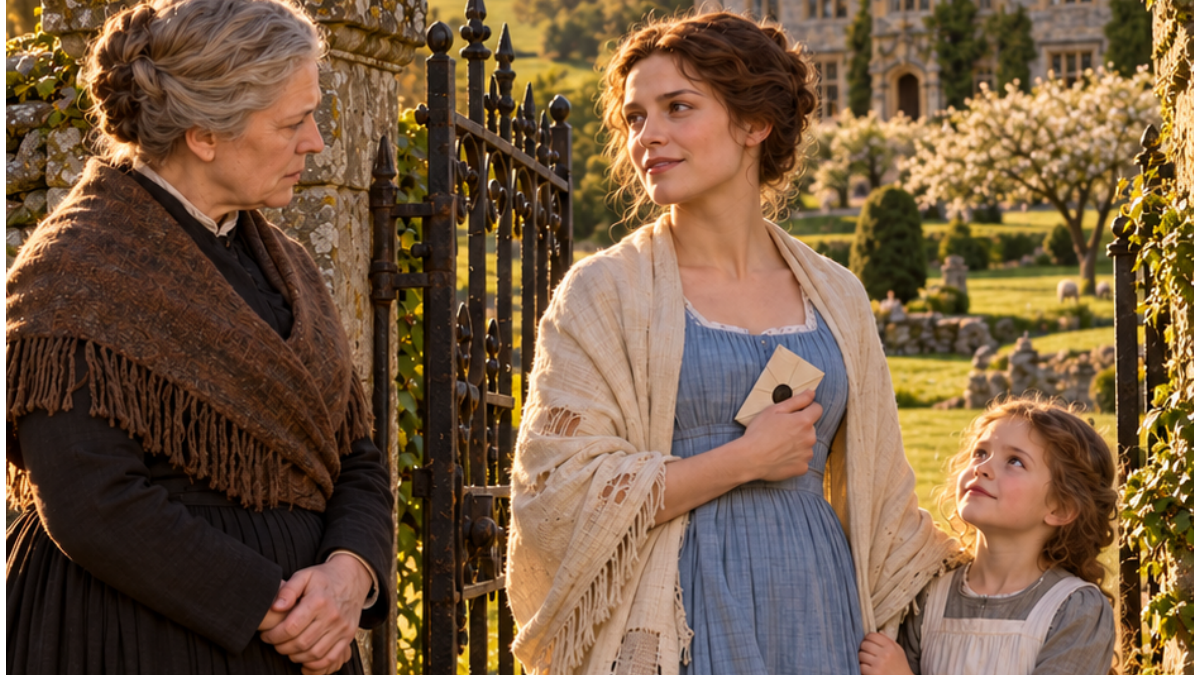
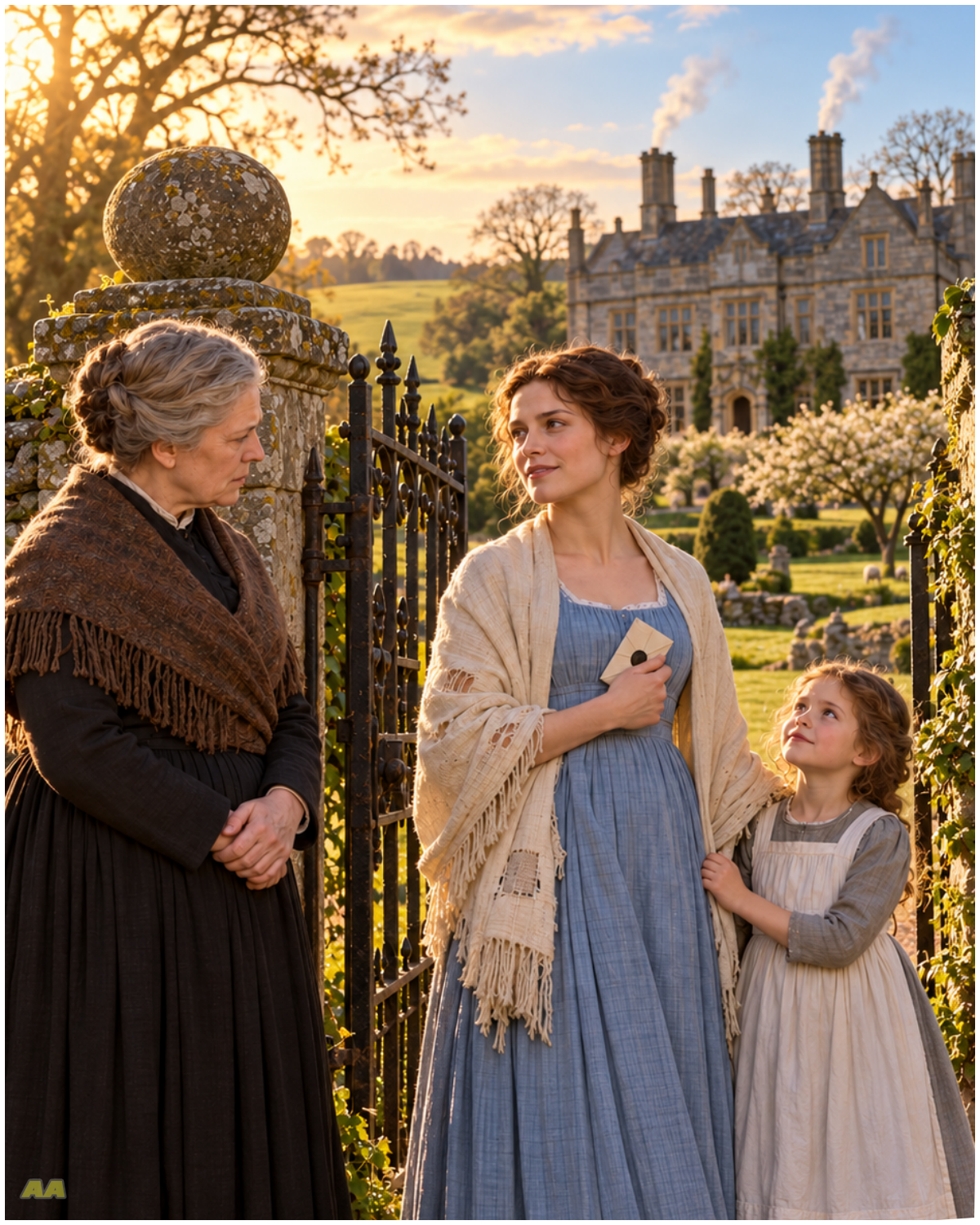
On the morning the will was to be read, Claraara Tmaine rose before the house was light, dressed herself by the gray square of the window, and then knelt on the cold boards to button her little daughter into the dove gray wool frock that had been let down twice at the hem, and would not bear a third letting.
“Is it today?” Tamson asked, lifting her chin so that her mother could reach the top button.
It is today. Will they be kind?
Claraara considered the question properly because Tamson was 6 years old and had been promised at the age of five that her mother would never answer her with a thing that was only meant to stop her asking.
“Some of them will be polite,” she said at last.
That is not quite the same as kind, but it will do for one morning.
Tamson thought about this while her mother tied the strings of her white pinn.
Mrs. Ibbertson says the nephew has a voice like butter on a hot knife.
Mrs. Ibbertson ought not to say such things where small persons can hear them.
She said it to the cat.
Then the cat ought not to repeat it, said Claraara, and her daughter laughed, and for a moment the room was only a room again, and not the last week of something.
When the child was ready, Claraara went to the walnut writing box that stood on the chest of drawers beneath the glass.
It had been her father’s, and it had come with her from Malbor to Portsmouth, from Portsmouth to the lodging in South Sea, where she had learned she was a widow.
And from there, 3 years ago this spring, to Lark Hollow, she unlocked it with the small key she wore on a ribbon inside her collar, lifted out the tray of pens and wafers, and took from the well beneath a packet about the size of a folded letter.
It was sealed in three places with black wax, and each seal carried the same impression, a heron standing in reads, which was the private seal of Augusta, Daaja, Duchess of Herodena.
Across the face of it, in a hand that had grown large and slanting in its last year, the old lady had written only four words, for Mrs. Tmaine’s keeping.
Claraara did not open it.
She had never opened it.
She knew what it was because she had been told what it was, and she knew who had witnessed it because she had entered the fees and the post shares in the household book in her own hand.
What it said. She did not know, and she had not tried to guess, because guessing at the contents of a sealed paper was a thing her father had taught her never to do.
A guess, he used to say, grows teeth in the night.
She put the packet into the inner pocket of her reticule, drew the strings close, and went down.
Lark Hollow was not a large house, but it was an old and honest one, built of the gray stone that the district gave up so readily, with three tall chimneys at the roof and mullion windows that let in the light in narrow golden bars.
The kitchen was the warmest room in it.
Mrs. Ibbitson was already at the range in her black stuffed gown with her brown fringed shawl crossed over her bosom and knotted behind which was how she had worn it everyday for as long as anyone in the parish could remember.
She was a woman of 62, gay-haired and square, and she had kept the Duchess’s house for 26 years, without once, she liked to say, being thanked for it to her face.
You’ll eat, she said, and it was not a question.
I shall try.
You’ll eat and the child will eat and then you’ll walk up there with your back as straight as the old lady’s walking stick and not give them the satisfaction.
Mrs. Ibbitson set down two bowls of porridge with a force that made the spoons jump.
I heard in the village that the nephews hired a postches from devices for the week and brought his sister and his sister’s maid.
Seven trunks, Hannador counted.
Seven.
You don’t bring seven trunks to a funeral, you mean to leave.
Claraara ate what she could. Tamson ate all of hers and some of her mothers and swung her boots under the table and asked whether the Duke would be there.
“I expect he will,” said Claraara.
“It is his house.”
He knelt down once to answer me.
Tamson told Mrs. Ibbitson, who had heard this before, and would hear it again.
In the orchard, when I asked him why the apples are called peares, he knelt right down on the grass in his good riches.
“His grace has knees like other men,” said Mrs. Ibbitson.
That’s all the proofs. But she looked at Claraara over the child’s head when she said it, and Claraara looked at her bowl.
They set out a little after 9.
The March morning was cold and very bright.
The sky a clean washed blue above the elms, and the frost was only just going off the lawn in long, pale fingers, where the shadow of the wall still lay.
Mrs. Ibbitson walked with them as far as the gate, as she had said she would, with her shawl pulled tight and her mouth pulled tighter.
The gate of Lark Hollow was a rot iron thing, older than the house, and handsomemer, hung between two stone pillars, furred with gray and yellow lyken, and topped with round stone finials like a pair of sober puddings.
Beyond it, the lane ran along under the park wall of Harodine for half a mile before it reached the lodge and the long avenue that led up to the great house.
From the gate, one could look back across the lawn at Lark Hollow itself, gray and square and quiet, with smoke going straight up from all three chimneys into the still air.
Claraara put her hand on the cold iron of the gate and stopped.
“You needn’t go,” said Mrs. Zibbitson abruptly.
“You could send word your poorly. Nobody would think the worse. Everybody would think the worse, and they would be right, too. They mean to have the house off you before lady die.”
I know it.
The whole parish knows it. And that nephew means to do it with a smile on his face and his gloves on.
I know. And you’ll sit there and let them.
Claraara looked down at her daughter who was holding a fold of her mother’s faded blue skirt in one mittened hand and looking back at the house with the particular gravity of a child who has been told that something important is happening and is determined to notice all of it.
Then she looked at Mrs. Ibbertson.
I shall sit there, she said, and I shall listen.
Her grace asked me to do exactly that and nothing more until the proper time.
I gave her my word. Mrs. Ibbitson made a sound in her throat that was very nearly a word and very nearly not.
Then she reached out and straightened the ribbon of Tamson’s straw bonnet, which did not need straightening and stepped back.
“Mind your manners up there,” she told the child.
“And if the nephew speaks to you, you look at his boots and say, Yes, sir, and no, sir, and nothing besides.” “Why his boots?” “Because they’re the only honest thing about him,” said Mrs. Zibbitson and turned and went back up the path to the house with her shawl fringe swinging.
Claraara pushed the gate open. It groaned on its hinges as it always did.
A long rising note that Tamson had once said sounded like a cow that had remembered something sad.
And they went through it together into the lane.
It was a long walk, and Claraara was glad of it.
She had learned in the Navy towns that a woman who must face a room should walk to it if she possibly can because the body settles what the mind cannot and by the time one arrives the heart has been going at a walking pace for half an hour and has forgotten how to gallop.
Her husband had told her that Lieutenant Edmund Tremaine of his majesty’s sloop Clover had told her a great many useful things in the four years of their marriage, most of them in letters, since he had been at home for only 19 months of the four years altogether, and the last of his letters had come from Port Royal in Jamaica.
And after it there had come, instead of a letter, a small parcel from the admiraly containing his watch, his prayer book, and a lock of her own hair that she had given him on the key at Portsmouth.
Tamson had been too. She did not remember him, though she said she did, and Claraara let her say it, because a child should be allowed to own her father in whatever way she can.
The lane was deep and quiet, and the rooks were loud in the elms above the park wall.
At the lodge, the keeper’s wife came out to the door with her arms folded, looked at Claraara, and then at the child, and said good morning in a voice that meant she had already heard everything there was to hear.
Claraara returned the greeting exactly. The avenue beyond the lodge was of limes planted by the duchess’s husband in the year of his marriage, and it ran straight as a ruled line for 3/4 of a mile, with the great house at the end of it growing slowly larger and paler and more full of windows as they walked until it seemed to Claraara to be looking at them with everyone.
Haroden was not an old house.
The old house had burned in the reign of Queen Anne, and what stood now was all pale bath stone and long straight lines with a portico of six columns and a great flight of steps and a roof crowded with urns.
It was the kind of house that is built to be seen from a distance by people who will never be asked inside it.
Claraara had been inside it perhaps a dozen times in 3 years, always on some errand for the Duchess, and always by the side door.
This morning a footman in black gloves stood at the top of the great steps, and when he saw who was coming up the avenue, he hesitated visibly and looked behind him into the hall as if for instruction.
Then he came down two steps and stopped.
Mrs. Tmaine, he said, “You’re to go round by the side.
I think, Mom, I was asked by Mr.
Grace’s letter to attend the reading of her Grace’s will in the drawing room at 10:00,” said Claraara.
“I have the letter here if you would like to see it.” The footman went red.
He was a young man, a Harodan boy whom Claraara had once helped with the spelling of a letter to his mother.
And he knew perfectly well that she knew who he was.
No, Mom, he said miserably. That is, I’m sure it’s right, Mom.
Only Mr. Stannard, said the companion might go round by the side.
Then Mr. Stannard may say so to me himself, said Claraara.
And I will go wherever the master of the house directs.
Is his grace within? In the drawing room, mom.
Then that is where I am expected.
She did not raise her voice.
She had never in her life found that raising her voice made a thing more true.
She simply went on up the steps with Tamson’s hand in hers, and the young footman, after one more wretched look over his shoulder, went ahead of them into the hall and across the checkered marble, and opened for them the double doors of the drawing room.
The room was very long and very bright, hung with pale green silk, and gilded at every edge, and it was full of people in black.
There were perhaps two dozen of them.
Chairs had been set out in rows facing a table at the far end, where a thin gay-haired man in black sat with papers before him, and a pair of spectacles folded in his hand, and a fire burned at either end of the room, and still it was not warm.
At the tall windows on the south side, with his back half turned to the company and his hands clasped behind him stood a tall man in plain black, who did not look round when the doors opened.
Everyone else did. Claraara felt the attention of the room arrive on her like weather.
She had been looked at before by people who had made up their minds.
In the Portsouth lodging house and at the Admiral T pay office and in the long corridors of the Navy board.
And she had learned that the only defense against it was to be entirely unhurriedly occupied with something else.
She drew off her gloves. She bent and untied Tamson’s bonnet strings.
She looked for two empty chairs and found them in the last row near the door and led her daughter to them.
She had nearly reached them when a voice from the second row said clearly and pleasantly and at exactly the pitch meant to carry to the back of the room, “Good heavens, must we have the companion and the child?” It was a warm voice, deep and easy, and a little amused, the voice of a man who has never in his life been refused a second helping.
Claraara knew it, and did not turn.
She was asked, Everard, said someone else, a woman lower.
Grace asked her, “There are the servants legacies, I suppose.” Then she might have waited in the housekeeper’s room with the other servants, said the warm voice, and been told what she was left along with the cook.
But there perhaps she thinks she was a friend of the family.
And then lightly, as if it were a kindness, “Sit down, Mrs. Tmaine.
Do sit down. We shan keep you long.” Several people laughed, not loudly.
It was the kind of laughter that is intended to be heard and also to be deniable, a sort of rustle, like wind going over a field of barley.
Claraara sat down. She lifted Tamson onto the chair beside her and arranged the child’s skirt and folded her own hands on the reticule in her lap over the place where the packet lay and looked at the man at the table with the spectacles and waited.
Tamson leaned against her arm. “Was that the butter one?” she whispered.
“Hush,” said Claraara. “Yes.” The thin man at the table was Mr.
Josiah Grace of Lincoln’s Inn, who had been solicitor to the family of Herodan for 30 years, and to the Duchess’s own affairs for nearly as long, and who had the look of a man who has read a great many wills aloud, and has long since stopped expecting any of them to surprise him.
He unfolded his spectacles, put them on, took them off again to polish them, and put them on once more.
Then he cleared his throat and the room settled.
We are met, he said, on the melancholy occasion of the late Daaja Duchess’s death, to make known the dispositions of her own separate property, which is to say the house and lands called Lark Hollow in this parish, together with her funds in the public stocks, and her personal effects, all of which were hers absolutely, and none of which forms any part of the settled estate.
Of Harodan. His grace is not interested under this instrument, nor is any part of the entail.
I say so at the outset, at his grace’s own request, so that there may be no misunderstanding.
At the window, the tall man in black inclined his head very slightly without turning round.
The will I am about to read, Mr.
Grace went on was drawn by my own office and executed by the Duchess at Haroldan on the 4th of June in the year 182.
It has been in my strong room since that date.
I have no knowledge of any later instrument.
He glanced once around the room over his spectacles as a matter of form and then down at the paper.
This is the last will and testament of me.
Augusta Mary Lizel, Duchess of Harroden, widow.
It was not a long will, and Claraara, who had heard a great many wills, read aloud in her father’s front office at Malbor, sitting on a high stool in the corner with her pen and her copy book, while the widows wept, and the nephews fidgeted, could [snorts] have told anyone in the room what shape it would have before it was half done.
There were small legacies to servants, £20 to Mrs. Zibbitson, 10 to the coachmen, five to each of the maids then living.
There were rings for mourning to certain old friends, most of whom Claraara knew to be long dead themselves.
There were £10 for mourning to whatever lady might be the duchess’s companion at the time of her death, if any, which produced a small ripple of amusement in the second row, and a glance or two over shoulders toward the back of the room.
And then there was the heart of the thing, which was that the house and lands of Lark Hollow and all the Duchess’s funds in the 3% consolidated annuities, amounting at present, Mr.
Grace added in a drier side to something above £9,000 and the residue of everything else she had were left to her beloved nephew Everard Stannard, the son of her late sister.
Absolutely. Mr. Grace read the attistation clause, took off his spectacles, and laid the paper down.
There was a silence of the particular kind that follows good news for somebody.
Then a general russle and a murmur.
And in the second row a lady in a great deal of very new black silk turned to the gentleman beside her and put her gloved hand on his sleeve.
Well, Everard, she said, poor dear aunt.
Poor dear aunt, Mr. Everard Stannard agreed.
He was a man of perhaps 45, well-made and well-fed, with a smooth pink face and very smooth fair hair brushed forward at the temples in the fashion of 10 years before.
And he wore a black coat of such excellent cut that it seemed less a coat of mourning than a sort of compliment he was paying to himself.
His gloves were lavender. He had not taken them off.
She always did say, “I was the only one of us with any sense of what a house was for.” “And what is a house for?” Everard, someone asked, and there was a small laugh.
“Selling mostly,” he said, “and the laugh grew.
The lady in the new silk was his sister, Mrs. Leticia Crane, a widow herself of a Bristol sugar merchant and a woman who had been handsome and had decided to go on being handsome by sheer force of will.
She leaned across him now and looked down the room, not troubling to lower her voice.
But Everard, what is to become of the companion?
She has been living there with that child as though she owned the place these three years.
Poor aunt could hardly see her hand before her face at the end.
One heard such things. Mrs. Tmaine ordering the dinners and keeping the keys and sitting in the duchess’s own chair of an evening.
The whole county has been talking of it.
Everard Stannard turned round in his chair then deliberately and looked the length of the room at Claraara.
He had pale blue eyes, rather prominent, and he let them rest on her faded gown and her darned shawl and her bare mended gloves in her lap and on Tamson and then on Claraara’s face again with a slow and comfortable pleasure.
“Oh, let her take the Der house,” he said.
He said it quite loudly in the easy warm voice as a man throws a crust to a duck.
Take it, Mrs. Tmaine, by all means.
Take the dow house. Carry it off in your reticule, a slate at a time.
You have had the run of it for 3 years.
You may as well have the roof.
And the child, he added, smiling at Tamson, can manage the chimney pots.
The room laughed. It was not the rustling half laughter of before.
This was a real laugh, released and grateful, the laugh of people who have been sitting too long in a cold room in black clothes and are glad to be given permission.
Mrs. Crane laughed with her handkerchief to her mouth.
A young man with a yellow waste coat under his black coat laughed so much that he had to be nudged.
Even one or two of the upper servants standing by the wall looked at the floor with their mouths pressed tight.
Claraara said nothing. She felt Tamson’s hand creep into hers and grip it, and she held it, and she kept her eyes on Mr.
Grace’s table, where the old will lay with its red tape trailing, and she was aware, as one is aware, of a draft, that the tall man at the window had at last turned round, and was looking not at Everard Stannard, but at her, Grace, said Everard, when the laughter had worn down.
You will write to Mrs. Tmaine formally, I suppose.
Lady Day will do. I have a man coming from Bath on Thursday to value the timber, and I shall want the house empty when he is done with the orchard.
The furniture can go to the rooms it devises.
You’ll see to it. He turned back to the front, adjusting one lavender cuff.
Well, that’s all very satisfactory. Is there Sherry, Gideon, or must we go on being melancholy until noon?
Mr. Grace did not answer him at once.
He had gathered up the old will and was squaring its edges against the table with small, precise taps, and his face was quite without expression.
There is one further formality, he said, which I am obliged to observe, and which I observe at every reading, as a matter of course, so that it cannot afterwards be said I failed to ask it.
Does any person here present know of any later will, codisil, or other testimentary paper executed by the deceased?
He did not look at anyone in particular when he asked it.
He looked at the ceiling, as men of his profession do when they are asking a question that has never yet in 30 years received any answer but silence.
Claraara stood up. She did it without haste.
She set Tamson’s hand down on the child’s own lap and patted it once, and she rose, and she stood in the last row by the door with her reticule in her two hands.
And she said in a voice that was quite clear and quite level and not at all loud, “I do, sir.” The silence that followed was of a very different kind from the firSt. Mr.
Grace lowered his eyes from the ceiling.
He looked at her over his spectacles for what felt like a long time.
“You do, madam,” he said. “Yes, sir.” Claraara opened the reticule, drew out the packet, and held it up so that the black seals could be seen.
Her grace put this into my hands on the 14th of November last in the library at Lark Hollow, and told me it was her will.
She told me it had been drawn by Mr.
Ambrose Finch, attorney of Salsbury, and witnessed by three persons whose names she gave me.
She desired me to keep it among my own things, not to open it, and to produce it at the reading of any will of hers before her family, and to put it into the hands of whatever attorney was present, to be opened and read aloud before them all.
I have not opened it. The seals are as she left them.” Everard Stannard had turned half round in his chair again.
His smile had not gone away exactly.
It had simply stopped moving like a clock that has not yet been noticed to have stopped.
“My dear Mrs. Tmaine,” he said, “what a very affecting little piece of theater.” “It is not theater, sir,” said Claraara.
“It is a paper. I was asked to bring it, and I have brought it.” “And who, pray, were these three famous witnesses?
The Reverend Mr. Oaks, the vicor of this parish, Dr. Hugh Pardu, who attended her grace, and Mr.
Robert Tuller, who is clocked to Mr.
Finch. There was a movement in the fourth row, and a stout elderly clergyman with a round, much worried face, half rose from his chair, looked around him as if he wished very much to be somewhere else, and then, as if, remembering that he was a clergyman and a witness, straightened his back.
“That is quite true,” said the Reverend Nathaniel Oaks.
“I did witness a will of the duchesses in October.
I had supposed I had supposed Mr.
Grace knew of it. Mr. Grace did not, said Mr.
Grace very dryly indeed. He held out his hand.
Claraara came up the room with the packet, and the room turned its head to watch her come, row after row as she passed.
Tamson slipped down from her chair and came after her and took hold of a fold of her mother’s skirt.
And Claraara let her because a child who has been laughed at should be allowed to walk beside her mother up the middle of the room if she wishes to.
At the table, Claraara put the packet into Mr.
Grace’s hand. He turned it over.
He looked at the seals one after another through his spectacles and then without them.
“Your grace,” he said without turning his head.
“I should be obliged if you would look at these seals as head of the family and tell me whether they are your grandmothers, and Mr.
Oaks, if you would come up.” The tall man came from the window.
He was younger than Claraara had once thought him.
The first time she had seen him in the orchard at Lark Hollow, when he had seemed to her merely a very large, dark shape, in a riding coat, standing among the apple trees.
He was perhaps 32, grave-faced and rather pale, with dark hair that would not lie as his ve intended, and a way of looking at a thing for a long moment before he said anything about it at all.
This was Gideon Lizel, fourth Duke of Harodan, who owned everything in that room and a good deal of the county around it, except the one small gray house now in question, and who had not said one word since Claraara came in.
He looked at the seals now for a long moment.
“They are hers,” he said. “The heron, she used it for nothing but her own letters.” He did not look at Claraara.
He went back to the window and stood there with his hands behind him as before.
The Reverend Mr. Oaks, peering through his own spectacles at the direction on the packet, [snorts] said that was her hand certainly, poor soul.
It was quite unmistakable at the end, and went back to his chair and sat down heavily.
Mr. Grace took a pen knife from his waist coat pocket and broke the seals one after another.
The sound of each one cracking was small and distinct in the silence.
He unfolded the outer sheet which bore a few lines in the same slanting hand and read them to himself and his eyebrows rose very slightly.
There is a direction on the cover, he said, in her Grace’s hand.
I will read it to be opened before my family by whatever lawyer is present and read aloud every word and in particular the fifth clause which I desire my nephew to hear with his gloves off.
Nobody laughed this time. Mr. Grace unfolded the inner paper, which was a single sheet of stout folded fool’s cap, engrossed in a clear, round law writer’s hand, quite unlike the Duchess’s own, with her signature at the foot of it in the large slanting letters, and three other signatures below.
He looked at the date. He looked at the attistation.
Then he began to read aloud in exactly the same dry level voice in which he had read the firSt. This is the last will and testament of me.
Augusta Mary Lysil, Daaja Duchess of Harodine, widow made this 9inth day of October in the year of our Lord 1815.
I hereby revoke all former wills, codisils, and testamentary dispositions whatsoever by me at any time here to form made, and declare this only to be my last will.
I appoint Ambrose Finch of the city of Salsbury, gentlemen, and the Reverend Nathaniel Oaks, vicar of Haroden, to be the executives hereof.
He turned the sheet a little toward the light.
I give and devise my message or dwelling house called Lark Hollow with the gardens, orchard, outbuildings, and the home farm there to belonging, containing 94 acres or thereabouts, all which I purchased with my own money in the year 189, and which are mine absolutely, unto Claraara Tmaine, widow of the late tenant Edmund Tremaine of His Majesty’s his navy now my companion to hold unto her for and during the term of her natural life and from and after her decease unto her daughter Tamzen Tmaine her heirs and assigns forever somebody in the second row drew a sharp breath it may have been Mrs. crane.
Claraara did not look to see.
I give unto the said Claraara Tmaine the sum of £600 to be paid to her within 3 months of my decease that she may not be obliged to sell anything she would rather keep.
I give unto Ha Ibbertson, my housekeeper, £100 and my gray silk gown that she has always coveted.
I give the sum of £2,000 in the said consolidated annuities unto the vicar and church wardens of this parish for the time being upon trust to found and keep a school at Haroden for the daughters of the laboring people of the parish that they may learn to read and to cast accounts and to keep their own books which I have lately learned is a thing worth a great deal.
Mr. Grace paused and cleared his throat.
Fifthly, I give unto my nephew Everard Stannard the gold repeating watch that was my late husband’s and the sum of £50, being as much as I judge he may reasonably lose at cards within the year without distress to himself.
He has been told in writing why I have altered my dispositions and I have his answer.
All the rest and residue of my estate I give to the said school.
He read the attistation clause which said that the will had been signed, sealed, published, and declared by the testrics as and for her last will and testament in the presence of the three witnesses who in her presence at her request and in the presence of each other had subscribed their names.
And then he read the three names.
And then he laid the sheet down on the table beside the first will and took off his spectacles and folded them.
For a moment nobody moved at all.
Then somewhere toward the side of the room, an old lady in a great black lace cap, whom Claraara knew only as some cousin of the late Dukes who lived at Bath and came to Haroldan every Christmas to disapprove of it, said in a thin, carrying voice to nobody in particular.
“Well, Everard, it seems she has taken the Der house.” Everard Stannard stood up.
He was not a man who moved quickly, and he did not move quickly now.
He stood and drew off his lavender gloves, one finger at a time, as though he had been asked to, and had decided to be amused by it, and put them into his pocket.
His face was a little pinker than before.
“Gryce,” he said pleasantly. That is a very pretty document, and I don’t doubt it was very prettily got up.
A woman of 83, half blind, shut up in that house all the last winter with nobody but a penniless naval widow who had the keys, the letters, the ink, the physician’s ear, and the vicar to tea.
I have no doubt at all it was signed.
I have every doubt about how.
He turned and looked down the room at Claraara, and the pleasant voice did not change by a hair.
I shall enter a caveat against it tomorrow.
It will never be proved. You may keep your seat by the door until Lady Day, Mrs. Tmaine, and not a day after.
And then you and your little girl may take the Daer House wherever you like, so long as it is off my land.” Claraara turned from the table to face him.
She stood very straight as Mrs. Ibbitson had told her to, with her daughter’s small hand wound in her skirt.
I did not know what it contained.
Sir, she said, I knew only that it was her grace’s will, and whose hands had witnessed it, and where it had lain since she gave it to me.
I have said so before everyone in this room.
Beyond that, I think it is not for me to say anything but for the court.” And she made the room a small curtsy and took her daughter’s hand and walked back down the middle of it to the door and out.
She did not let herself walk quickly until they were past the lodge.
Then, in the deep quiet of the lane under the park wall, with the rooks going over and nobody to see, she found that her knees had begun to shake, and she stopped and put one hand flat against the cold stone of the wall and stood there for a little while, breathing with her eyes shut.
Tamson stood beside her and held her skirt and waited.
She was a child who knew how to wait.
She had learned it in the South Sea lodging in the months when her mother used to sit at the window in the afternoons with a letter in her lap that she did not read.
“Are you poorly?” Tamson asked at laSt. “No, my love, only tired.” “Was it a good paper or a bad paper?” Claraara opened her eyes.
She looked down at her daughter, at the small, serious face under the straw bonnet, and she found that she did not entirely know how to answer.
“It was a good paper,” she said slowly.
“A very good one. Her grace was kinder to us than I had any notion of.
But there are people who will say it is not a true paper, and there will have to be a court to decide, and that will take a long while.
Will we have to go away?
Not yet. Perhaps not at all.
We shall see. Tamson considered this.
The butter one laughed at me, she said.
Yes. Why? Because he was frightened, said Claraara, and he did not know it yet.
It was not perhaps the whole truth, but it was the part of it that a child of six could carry home without spilling.
And Tamson seemed satisfied with it.
She took her mother’s hand and they walked on.
They had nearly reached the gate of Lark Hollow when Claraara heard a horse behind them on the lane coming at a walk, and she drew Tamson to the side against the wall to let it pass.
It did not pass. It stopped a few yards off, and a man got down, and she saw that it was the Duke of Harolden, bareheaded in the same plain black he had worn at the window, leading his big gray hunter by the bridal.
Mrs. Tmaine, he said, “Forgive me.
I did not mean to come up behind you like a highway man.” “Your grace.” He stood for a moment with the res in his hand, looking at her in that way he had as if he were reading something written a little too small.
Then he said, “I came to say two things and then I shall go away again.
May I say them?” Of course.
The first is that I knew nothing of that paper.
I want you to know that.
My grandmother told me nothing. And I should not like you to think that I stood at that window knowing what was coming and let you sit through the other while my cousin said what he said.
I did not think so, sir.
The second said the Duke, and here he hesitated, is that my cousin Everard will do exactly what he says.
He will enter a caveat and he will fight it and he will spend a good deal of money that is not his own doing it because he has spent every penny of his own long since and was counting on hers.
My lawyers in London are good.
If you should wish “No,” said Claraara.
She said it gently, but she said it at once, and he stopped.
“Thank you,” she went on. You are very kind, and I do not say it to be proud.
But her grace was your grandmother, sir, and Mr.
Stannard is your cousin. And if your lawyers stood up in court for the Duchess’s companion against the Duchess’s nephew, there is not a soul in Wiltshire who would not say that you had your own reasons.
And they would say what those reasons were and they would say it about me.
Her grace went to a great deal of trouble so that nobody could say that this paper was anybody’s doing but her own.
I will not spoil it for her now.
The Duke looked at her for a long moment.
Then he nodded slowly once as a man nods who has been shown a sum and found it correct.
Then I will not ask again, he said.
But if there is ever anything I can properly do, and I will leave you to be the judge of what is proper, since you seem to be a better one than I am, you have only to send.
Thank you, your grace. It seemed that was all.
He gathered the res. Then Tamson, who had been standing all this while at her mother’s side, and gazing up at the gray horse with the frank and ardent interest she gave to all very large animals, said in a clear voice.
Why didn’t you laugh? Claraara drew a breath to hush her.
The Duke put up one hand, not to Claraara, but as a man does, who would like to answer a question himself.
He crouched down on his heels on the lane in his black britches as he had crouched in the orchard among the pearmines so that his face was on a level with the childs.
Because it was not funny, he said seriously.
People laugh sometimes because they think they are expected to.
It is a very bad reason to do anything.
Tamson weighed this. The lady with the handkerchief laughed.
Yes, she did. Is she frightened as well?
The Duke looked up at Claraara, a quick look, puzzled, and then back at the child.
I should think, he said gravely, that she is very likely more frightened than anyone.
What is your horse called in the orchard game?
The one you told me about at Mikkelmus.
Captain Pelio, said Tamson at once.
After the admiral, papa served under him.
So he did, said the Duke.
Well, this one is called Solomon, he says, and he is very old and very wise and not frightened of anything but pigs.
You may give him your hand to smell if your mother allows it.
Claraara allowed it. Tamson held out her small mittened hand flat as she had been taught, and the great gray horse lowered its head and breathed on it.
And the child stood absolutely still with her whole face alike.
And the Duke of Herodine stayed crouched on his heels in the lane, and watched her do it, as if there were nothing else in the county requiring his attention.
Then he stood up and bowed and mounted and rode back the way he had come and did not look round.
Mrs. Ibbitson had been watching from the kitchen window, of course, and she met them at the door with a face like a closed book.
Well, she said, Claraara told her.
She told it plainly in order, as her father had taught her to report a thing.
First what was read, then what was said, then what was done.
When she came to the £100 and the gray silk gown, Mrs. Ibbertson sat down suddenly on the kitchen settle, which Claraara had never seen her do in the daytime in 3 years, and put her apron over her face, and stayed like that for some time.
And when she took it down again, her eyes were red, and her mouth was working.
The gray silk, she said. The old devil.
The old blessed wicked devil. She knew I wanted it.
I never said. Not once in 26 years did I say.
She knew a great many things nobody said,” said Claraara.
And that was true, and it was the thing Claraara thought about that evening after Tamson was in bed and Mrs. Zibbitson had gone up when she sat alone in the little library at Lark Hollow with one candle and the fire burning down and did not read.
She had come to Lark Hollow 3 years ago this April in answer to an advertisement in the Salsbury paper that she had very nearly not answered at all.
A lady of rank, it had said, advanced in years, required a gentle woman as companion, of cheerful disposition, good principles, and a clear reading voice, one who could write a good hand and keep household accounts with exactness.
No objection to a widow. Claraara had read it three times at the window in South.
She had been a widow then for 10 months.
There was no other way to count it, though she had tried.
And she had spent the halfpay pension and the admiral’s gratuitity and most of the proceeds of her father’s books, and she had a daughter of three who needed boots.
She had written in her best hand, which was very good indeed.
She had said she was the daughter of the late Mr.
Walter Penrose, attorney of Malbor and the widow of Lieutenant Edmund Tmaine of the Navy, and that she had a child.
She had not expected to hear anything.
A week later, a letter had come in a large, slanting, rather furious hand, which said only, “Come on Tuesday, bring the child.
I dislike being told about children.
I prefer to look at them.
The Duchess had been 80 then, small and upright and fierce, with eyes that were already going milky at the edges, and a mind behind them that was not going anywhere at all.
She had received Claraara in this very room, sitting in the highbacked chair by the window with a stick across her knees.
And she had not asked a single one of the questions Claraara had prepared answers to.
She had not asked about Claraara’s principles or her disposition or her late husband’s family.
She had handed her instead a sheet of paper with a column of figures on it.
Add that, she had said upside down.
I want to see if you can do it the way my first steward could.
Reading it across the table, Claraara had added it upside down.
[snorts] It had come to £416,9 shillings and 5 p.
And she had said so. And then she had said, “But the seventh line has been carried wrong, Mom.
the shillings. Someone has put down a seven for a one.
It ought to be £416, three shillings and five p.
The duchess had looked at her for a long time with those milky sharp eyes.
Yes, she had said it ought.
That is my nephew’s account of what he spent at Harrigate on my behalf and he has been making that particular mistake for 20 years always in his own favor.
Can you read law hand? Yes, ma’am.
Who taught you? My father. Ma’am, I used to copy for him conveyances mostly leases now and then a will.
And do you know what an attestation clause is for?
Claraara had been so surprised that she had answered exactly as she would have answered her father.
It is as so that the witnesses may swear afterwards if it is ever questioned that they saw the testator sign and that they signed in her presence and in each others.
And for lands, ma’am, there must be three of them, and they must be credible, which means they must take nothing under the will themselves.
H, said the Duchess, and then abruptly, looking past Claraara at Tamson, who had been sitting on a foottool by the door all this while, with her hands in her lap, perfectly silent, 3 years old, and grave as a judge.
And what does that one do?
She waits, Mom, Claraara had said.
Very well. It is her particular talent.
H said the Duchess again.
It is a rare one. Most people never learn it at all.
Come here, child. Tamson had got down off the foottool and gone across the room and stood in front of the highbacked chair and looked up at the old lady with her hands still folded.
And the duchess had leaned forward and looked back at her from about a foot away, peering as she peered at everything that year.
“You will do,” she had said at last to Tamson, not to Claraara.
Both of you. I pay £40 a year and your keep and the child’s.
And I dislike being read to by people who mumble, and I shall be very disagreeable when my eyes are bad, which is most of the time.
You may begin on Monday. That had been all.
There had never afterwards been any more said about it.
Claraara had simply come on the Monday with Tamzin and the walnut writing box and two trunks and had stayed.
She had read aloud every day for 3 years the newspapers and the reviews and Mr.
Scott’s poems which the duchess liked and Lord Byron’s which she said were disgraceful and made Claraara read twice.
She had written the duchess’s letters from dictation and kept a fair copy of everyone in the letter book.
She had kept the household accounts and the farm accounts and the book of the poSt. And every Saturday she had taken the ledger into the library and read it aloud, line by line, while the duchess sat with a great round reading glass in her hand and followed the figures down the page an inch from her nose and at the bottom of each week in her large slanting hand wrote her initials and sometimes a correction and once memorably the single word nonsense.
The Duchess had been, as she promised, very disagreeable when her eyes were bad.
She had also, without ever once saying so, taught Tamin her letters and the names of the stars, and how to play PK for buttons, and how to sit through a long sermon without fidgeting by counting the organ pipes.
And she had had the little room over the porch fitted up for the child with a bed and a press and a set of shelves.
And when Claraara had tried to thank her, she had said, “Don’t be tiresome.” and changed the subject to the price of oats.
Claraara sat in the library now in the dark and looked at the highbacked chair by the window, which was empty.
Take the dower house, he had said.
Carry it off in your reticule, a slate at a time.
She thought of the duchess sitting there in October in the low gold light of the afternoon with her reading glass in her lap, saying as if it were nothing.
I want you to take the child to Malbor tomorrow and stay the whole day.
Hire the gig from door. Go and see your father’s grave and buy the child a book.
I don’t want either of you in this house before dark.
And Claraara, who had been 3 years in the habit of doing exactly as she was asked without asking why, had done exactly that.
She had not known why. She had not asked.
She knew now. It had been a fine day that 9th of October, one of those clear, still autumn days that seemed to have been left over from September by mistake.
She had hired the gig from door at the farm, as she was told, and entered the hire in the book before she went, four shillings for the day, and the horses bait because she entered everything.
She had driven Tamzin the nine miles to Malbor through lanes full of blackberries and falling leaves.
They had gone to St. Mary’s Churchyard and stood a while by the plain stone that said Walter Penrose, attorney at law, and Tamin had laid on it a bunch of Miklmus daisies she had picked from the hedge and asked whether Grandpapa had liked daisies.
And Claraara had said she thought he had preferred ceiling wax, and Tamson had laughed.
Then they had gone to the book sellers in the high street, and Tamson had spent a very long time choosing between a Robinson Crusoe with the pictures colored by hand and a small fat Asop with woodcuts, and had chosen the esop because the fox on the cover had a kind face, and Claraara had paid three shillings and six pence for it out of the duchess’s purse, as instructed, and entered that too.
They had come home at dusk, and on the lane under the park wall, a mile short of L Hollow, a hired postchase had come toward them from the direction of the house, going fast, with its lamps just lit.
Claraara had drawn the gig in to let it by.
In the moment of passing, she had seen through the glass a stout, elderly gentleman in a brown coat, with his foot propped up on the opposite seat in a great swaddling of flannel, and beside him a thin young man holding a green bag upright on his knees as though it were a baby.
She had known the stout gentleman by sight.
It was Mr. Finch, the attorney from Salsbury who had the gout.
She had not thought very much about it at the time.
Mr. Finch had come once or twice before about the farm leases.
It was not until the next morning when the duchess sent for her to the library before breakfast and said without preamble, “Enter in the book if you please.” To Mr.
Finch his attendance on me yesterday.
Three guineies to his post shares from Salsbury and back 1 8 shillings to his clark half a crown.
That Claraara had understood that Mr.
Finch had been sent for and had come and had been in the house all the day that she was away from it.
She had entered it. She had said nothing.
The duchess had watched her do it with the reading glass in her lap.
And when Claraara looked up from the ledger, the old lady was looking at her with an expression Claraara could not read.
“You don’t ask,” the duchess had said.
“No, Mom. Why not?” “Because if you wished me to know, Mom, you would tell me.
And if you did not wish me to know, then asking would only oblige you to refuse me, which is disagreeable for both of us.
The Duchess had made a small sound that might have been a laugh.
Your father taught you that. My father taught me that a clark who wants to know what is in a paper before he is told is a cler who will one day be asked in court what he knew and when he knew it.
H the duchess had said and then after a moment read me the week.
So Claraara had read her the week line by line as she did every Saturday and the duchess had followed it down the page with the glass an inch from her nose.
At the butcher’s bill she had stopped.
4 pence, she said. He has charged me four pint for the sweat twice on the Tuesday and again on the Thursday, and I had sweat only once because I had the pudding only once, and I remember it because it was heavy.
Claraara had looked. It was quite true.
The butcher’s boy had written it twice, and Claraara, entering from his bill, had copied it faithfully, which was her duty, and had meant to query it on Monday, which she said.
Don’t query it. The duchess had said, “Take it off.
I’ll not pay for sweat. I haven’t eaten.
Not at 83, and not with my own money.” and she had taken the pen from Claraara’s hand, and with the glass pressed nearly to the page, she had struck through the second forpants in a long, wavering line, and written beside it in her large, furious slant, once only, ah, and then she had initialed the foot of the week, as she always did, and handed the pen back and said, “There, let them say I didn’t know what I was out.
Claraara remembered that now sitting in the dark library.
Let them say I didn’t know what I was about.
At the time she had supposed it was about the butcher.
On the 20th of October, the Duchess had written a letter herself.
This was so unusual that Mrs. Ibittson came to the library door twice in the course of the afternoon on some pretext to look at it.
The Duchess had not written a letter with her own hand for more than a year.
She dictated everything to Claraara and signed it and sometimes added a line at the bottom in the large slant when she wished to be particularly rude.
But that afternoon she had sent Claraara out of the room with Tamson to walk in the orchard.
And when they came back at 4:00, the old lady was still sitting at the writing table in the window with the great glass propped on a book and the pen in her hand, and three spoiled sheets crumpled on the floor beside her, and a fourth sheet folded and sealed with the heron before her on the blott.
Enter it in the post book, she said.
To Everard Stannard, Esquire, Half Moon Street, London, by tomorrow’s mail from Devisers, and pick up those sheets and burn them.
I don’t want them read by the housemate.
Claraara entered it. The post book at L Hollow was a narrow green volume with columns for the date, the direction, the means, the postage, and a last column headed answer, which the Duchess’s first companion had ruled in 30 years before, and which nobody had ever troubled to fill in until Claraara came.
Claraara filled it in. It was her way.
Every letter that went out of the house was entered there.
And when an answer came, the date of it was written in the last column against the letter it answered.
And the answer itself, once the duchess had done with it, was folded, marked on the back in Claraara’s small hand, with the date of receipt and the name of the writer, and tied with red tape into the bundle for that quarter, which was kept in the second drawer of the library bureau, labeled letters answered.
She had burned the spoiled sheets without looking at them.
The duchess had watched her do it.
The answer from Half Moon Street had come on the 8th of November.
Claraara remembered that too very clearly.
A thick letter heavily sealed, franked through by some members frank, which Everard Stannard always contrived to obtain so that he need never pay his own postage.
She had carried it into the library on the salva, and the duchess had taken it without a word and broken the seal and unfolded it, and it had been four close written sheets, and she had read all four of them slowly with the glass for the better part of an hour, while Claraara sat by the fire with her mending, and did not look up.
At the end of the hour, the duchess had laughed once, a short dry sound like a stick breaking.
Then she had folded the letter up again and held it out and said, “File it, my dear, with the letters answered.
Don’t read it. It will spoil your supper, and he is not worth a supper.” Claraara had not read it.
She had written on the back of the outer sheet as she always did received the 8th of November 1815 from Mr.
E. Stannard, and she had entered the date in the answer column of the post book against the Duchess’s letter of the 20th of October, and she had tied the letter into the bundle with the red tape and put it in the second drawer of the bureau.
She had done it without a second thought.
She had filed perhaps 300 letters for the Duchess in 3 years.
She had never read a single one.
She had been told not to.
It was 6 days after that, on the 14th of November, that the Duchess gave her the packet.
It had been a gray, wet afternoon, and the old lady had been poorly for some days with the cough that came every winter, and every winter stayed a little longer, and Dr. Pardu had been twice.
She had been sitting by the fire with a shawl over her knees and Tamson on the foottool at her feet reading aloud from the esop very slowly with her finger under each word.
And when the child reached the end of the fable of the ant and the grasshopper, the duchess had said, “That will do, child.
The moral is detestable. Go and ask Mrs. Ibbitson for a biscuit.” and Tamson had gone.
Then the Duchess had reached down beside her chair, where she kept her own small writing case that nobody else was permitted to touch and taken out the packet sealed in three places with the heron and held it out.
This is my will, she said.
Finch drew it. Oaks and Paru and Finch’s young man witnessed it.
All three in the room together.
And all three saw me sign, and I saw them.
I made Oaks read the attistation aloud before he put his name to it, which annoyed him, and I made Finch explain every clause of it to me twice, which annoyed him more.
I was in my perfect senses.
I was a good deal more in my senses than Finch, who had had two glasses of my madiraa for his gout.
You were not in the house.
I took care of that. I have been a widow 40 years, and I know very well what is said about women who are kind to old ladies.
Claraara had sat quite still with the packet in her hands.
You will keep it among your own things, the Duchess went on.
Not in the bureau, not with my papers, in that writing box of your father’s that you think I don’t know you lock.
When I am dead, there will be a reading.
Grace will come down from London with my old will, which he has been keeping in his strong room like a hen on a china egg these 14 years, and he will read it before them all, and my nephew will enjoy it very much.
You will be there. You will sit through it.
Whatever is said and a great deal will be said.
You will say nothing and you will not weep and you will not argue and you will not look at anybody as though you expected them to help you.
Can you do that? Yes, ma’am.
And when Grace asks whether anybody knows of a later will, he will ask.
He always asks. It’s the only thing he does that isn’t a waste of my money.
You will stand up and say that you do and give him that and make him read it aloud every word before them all.
Yes, ma’am. You don’t ask what’s in it.
No, ma’am. The Duchess had looked at her for a long time with the milky sharp old eyes.
No, she said at last, “You don’t.
That is why it’s you.” And then, as though she were a little ashamed of having said so much, she had waved her hand and said, “Now go away and fetch the child back and tell her to bring the book, and we will find a fable with a respectable moral, if there is one in the whole volume, which I doubt.” The winter had been long and very cold.
The Duchess had kept her room a great deal after Christmas, and Claraara had read to her there, and Tamson had read to her, too, from the Esop and then from the Bible, which the Duchess said was at least better written.
And the old lady had taught the child to find the pole star from the bedroom window on clear nights, and to know Orion by his belt.
The Duke had come down from London for a week at the new year and sat with his grandmother every afternoon, and once passing the open door, Claraara had heard the old lady say to him quite sharply, “Don’t be such a slow coach, Gideon,” “It is a very bad habit in a man of your size.” And the Duke’s low voice answering, and then astonishingly the Duchess laughing.
She had died on the 2nd of March in the small hours in her chair by the window of her bedroom where she had insisted on being put so that she could see the stars.
Mrs. Ibbitson found her there at 6:00 with a shawl over her knees and the reading glass in her lap and her face turned toward the gray window.
Quite peaceful. The funeral had been at the parish church a week later.
The Duke had walked behind the coffin bareheaded in the sleet and half the parish had come and Everard Stannard had arrived from London the evening before in a post shales from devises with his sister and his sister’s maid and seven trunks.
Mr. Finch came out from Ssbury 2 days after the reading in the same hired postches with the same thin young clark and the same foot in flannel.
And he was carried into the library at Lark Hollow by his clark and the post boy between them and sat down in the duchess’s own highbacked chair where he sat breathing hard and looking about him with small shrewd watery eyes.
Well, Mrs. Tmaine, he said. Well, well, I hear you stood up.
I was asked to, sir. So, you were?
So, you were? I told her it was a mad way to go about it.
I said, “Your grace, lodge it with me, and I’ll bring it to the reading myself.” And she said, “Finch.
If you bring it, they’ll say you drew it for a fee and came to collect.
And if the companion brings it, they’ll say she had it all along and didn’t know what was in it.
And the second is true. And the first is a lie.
So the companion shall bring it.
That was her way of arguing.
You couldn’t answer it. I never could.
He wiped his eyes with a large silk handkerchief, not entirely on account of his foot.
Now then, I’m executive and so is Oaks.
God help him. And we must get the thing proved.
And Stannard’s Proctor entered a caveat at Doctor’s Commons yesterday morning.
I had it by express. He hasn’t wasted his time.
No, sir. I did not suppose he would.
You know what that means? It means the will cannot be proved in common form, sir, but must be proved in solemn form by witnesses sworn in open court, said Claraara.
And since her grace held stock in the funds, which are reckoned to lie in London, it must be the prerogative court of Canterbury and not the bishop’s court at Salsbury.
And until it is proved, the executives hold everything, and Mr.
Stannard holds nothing at all, whatever he may have told Mr.
Grace about Lady Day. Mr. Finch stared at her.
Then he turned his head slowly and stared at his thin clark, who was standing by the door with the green bag, and the cler, who was young Mr.
Robert Toller and had witnessed the will went rather pink and looked at the carpet.
Toller said Mr. Finch. You’ve been 3 years in my office and you couldn’t have told me that without looking it up.
No, sir, said Mr. Toller humbly.
Walter Penrose’s girl, said Mr. Finch to the ceiling.
Of course I knew Penrose, best conveyancer in the county, and never made a penny because he wouldn’t take work he thought was crooked.
Well, Mrs. Tmaine, since you know so much, what do you want of me?
Only what is proper, sir. I have drawn up a schedule of all her Grace’s papers in this house so that the executives may take them into their custody.
I should like you to check it against the papers themselves and sign it and take the originals away with you and leave me a copy with your receipt.
And I should like a letter from the executives authorizing me to keep the house and the household books for you until the will is proved so that no one can say I remain here on my own account.
She laid the schedule on the table in front of him.
It ran to nine close-ritten pages.
She had sat up two nights over it at the writing table in the library window with the candle and then with the gray morning light and Tamson at her elbow on the second morning, kneeling up on a chair with her slate, copying the numbers of the items in chalk because she wished to help.
Every paper in the house was there.
The leases and the counterparts of the leases.
The farm book, the household ledgers year by year, the letter book, the post book, the receipts in their files, the bank book, the stock receipts, the duchess’s private writing case with its contents listed separately, and the bundles of letters answered quarter by quarter, each one described by the number of letters in it, and the names of the writers, and the dates of receipt.
Mr. Finch put on his spectacles and read the first page.
Then he read the second. Then he turned to the sixth and ran his finger down it and stopped and read one line twice and looked up at her over the spectacles.
Letters answered. Melmus quarter 1815. He read aloud 19 letters.
The 14th from Mr. E. Stannard Half Moon Street received the 8th of November four sheets unread by me.
Yes, sir. Unread by you. Her grace desired me not to read it, sir.
So I did not. Mr. Finch took off his spectacles and put them on again.
Do you know what’s in it?
No, sir. Nor do I, said Mr.
Finch. But I know she wrote to him.
She told me she was going to.
She said, “I shall tell him myself, Finch, in my own hand, so that he can never say he did not know, and I shall keep his answer, and then I’m damned if she didn’t.” He looked down at the schedule again, and then at Claraara, and a slow and rather terrible delight began to come into his round red face.
“Toller, take these papers.” every one of them in the order she’s got them.
Nine pages. And don’t you dare untie a single bundle till we’re in Salsbury with the door locked.
That was the first thing. The second thing was a letter to Mr.
Amos Henry Proctor of Doctor’s Commons London, which Claraara wrote that same evening at the writing table in the library.
She had not seen Mr. Henry for 8 years.
He had been at school with her father at the grammar school in Malbor and had come down every summer when she was a girl to fish the Kennet and argue about the statute of frauds.
And he had given her on her 12th birthday a pen knife with a mother of pearl handle because he said a girl who could engross a lease in round hand ought to have her own tools.
He was the only proctor at Doctor’s Commons she knew.
He was also the only man in London whom she trusted to take her case without first asking himself what the Duke of Harodan would think of it.
She told him everything in order, what was read, what was said, what was done.
She told him she had £52 and some shillings of her own saved out of her wages in 3 years and that she would send him 40 of it by return as a retainer and that she would owe him the reSt. She did not tell him she was frightened.
She had never found that telling people she was frightened made a thing more true.
Mr. The Henry’s answer came in 4 days.
It was one line long and it said, “Keep your £40.
Send me the schedule and do not let that man into the house without a witness.” Amos Henry.
So when Everard Stannard called at Lark Hollow on a raw bright afternoon at the end of March, Claraara received him in the parlor with Mrs. Ibittson sitting in the corner with her knitting and the door open and Tamson on the window seat with the esop.
He brought his sister. Mrs. Crane came in first in a police of black velvet with a great deal of fur, and looked around the little parlor at the worn chints and the faded carpet and the good old walnut furniture as though she were pricing it for an auction, which Claraara supposed she very likely was.
Everard came after, drawing off the lavender gloves, all warmth and ease.
Mrs. Tmaine, how very snug you are.
And Mrs. Ibson, too. How nice.
We shan keep you from your needles.
He sat down without being asked in the best chair and smiled at Claraara.
I’ll be plain with you since I think you prefer it.
You are a sensible woman. You know very well that caveats cost money and suits in the prerogative court cost a great deal of money and when they are lost as this one will be lost the costs are very often given against the losing party.
You have I believe something under £60 in the world.
Claraara said nothing. She wondered briefly and without any particular heat how he knew.
I don’t wish to see you ruined, Everard went on.
Nor the little girl. I am not a monster.
I am prepared to offer you 300 guineies, paid on the day you sign a renunciation of any interest under that paper and quit this house.
300 guineies, Mrs. Tmaine, for a lieutenant’s widow.
That is a very handsome sum.
It would set you up in a little school somewhere or a lodging in Bath.
You might teach the pianoforte. You are very kind, sir, said Claraara.
But I have no power to renounce anything.
I am a legoty, not an executive.
The will is her graces, and the executives must prove it or fail to prove it as the court decides.
If I signed your paper, it would change nothing except that I should have taken 300 guineies from a man who hoped it would look as though I had been paid to go away.
There was a small silence. In the corner, Mrs. Ibbitson’s needles clicked once and stopped.
Everard Stannard went on smiling, but his prominent blue eyes had gone very still.
You have been well taught, he said.
Yes, sir, I have. There is one other small matter.
He said it lightly, turning one glove over in his fingers.
My aunt and I corresponded now and then, and some of my letters were of a private family nature.
I should not like them read by strangers.
I suppose they are among her papers.
As her nearest relation, I should be glad to have them back.
Every paper her grace left in this house, sir, is in the custody of the executives, said Claraara, with a schedule of them in my hand, which Mr.
Finch has signed. If you wish for anything, you must apply to him.
Ah. Everard looked at her for a moment longer.
Then he stood up and smiled and bowed.
Then I shall come, let him.
They went out into the little hall.
Mrs. Ibbitson did not get up to show them out, and Claraara did not ask her to, but went herself.
And so she was standing in the hall by the parlor door.
With Tamson come down off the window seat and holding her hand, when Mrs. Crane, drawing on her furlined gloves by the front door, said to her brother, clearly not troubling to lower her voice by a single note, “Did you ever see such heirs, “A lieutenant’s widow, with a child in tow, sitting in poor aunt’s parlor, as if she’d been born to it.
She’ll take the 300 by midsummer you’ll see Everard when her proctor’s bill comes in.
Women like that always do. Very likely, Letty, said Everard, and laughed, and they went out to the carriage.
Claraara closed the door behind them.
She stood with her hand on the latch for a moment.
Then she looked down at her daughter.
“What is a child in tow?” asked Tamson.
“It is a boat,” said Claraara.
That is pulled along behind a larger boat on a rope because it cannot go by itself.
Tamson thought about this with great seriousness.
But I can go by myself.
Yes, said Claraara. You can. So can I.
That is what the lady does not know yet.
And she went back into the parlor where Mrs. Ibbitson was already knitting again very fast with her mouth shut tight.
And she sat down at the writing table and took a fresh sheet and wrote to Mr.
Henry an exact account of everything that had been said and by whom and at what hour and who had been present to hear it.
The man from Bath came on the second Thursday in April, exactly as Everard Stannard had promised in the drawing room with two laborers, a surveyor’s chain, and a small brassbound notebook, and he got as far as the iron gate.
Claraara was waiting for him there.
She had seen the cart coming along the lane from the parlor window, and she had put on her bonnet and her shawl, and walked down the path without hurrying, and she was standing inside the gate, with one hand resting on the top bar of it when he drew up.
He was a Mr. Collie, a timber merchant, a big weatherbeaten civil man who clearly did not relish the errand, and he took off his hat to her at once.
Mrs. Tmaine, is it? I’m sorry to trouble you, ma’am.
I’m engaged by Mr. Stannard to value the timber on the property, the elms along the lane, and the old walnuts, and the orchard wood, if it’s worth the felling.
He said you’d been told. I was told a good many things in Haroden drawing room, Mr.
Collie, said Claraara. But I am afraid Mr.
Stannard has sent you on a wasted journey.
The property is not his. It is in the hands of the executives of the late Duchess, Mr.
Finch of Salsbury, and the Reverend Mr.
Oaks until the will is proved in the prerogative court and I keep the house for them under their written authority.
Here it is, if you would care to read it.” She held it out through the bars of the gate.
Mr. Collie took it and read it slowly, moving his lips a little, and then read it again.
He looked up at the elms along the lane, which were very fine, and at the old walnuts on the lawn, which were finer.
And then he looked at Claraara with something between disappointment and respect.
He didn’t say anything about executives, he said.
No, said Claraara. I don’t suppose he did.
Mr. Collie folded the letter carefully and handed it back.
Well, ma’am, I’m not in the business of cutting down trees that nobody can sell me, and I don’t much fancy being sued by a Salsbury attorney for trespass.
You’ll tell Mr. Finch I came and went civil.
I shall enter it in the book, Mr.
Collie, with the hour, and that you behaved very properly.” He looked at her oddly at that and then laughed a big surprised laugh and put his hat back on and turned his cart in the lane with some difficulty and drove away toward Deis.
Claraara went back up the path and entered it in the book.
The letter to the farm came the following week.
Thomas Door, who rented the home farm of Lark Hollow, and had rented it from the Duchess for 19 years, and from her husband’s steward before that, brought it up to the kitchen door himself on a Saturday morning, with his hat in one hand, and the letter in the other, and a face like a wet Sunday.
It was from an agent in devises, a Mr.
Py writing on behalf of Everard Stannard, Esquire, and it required Mr.
Door to pay the halfyear’s rent due at Lady Day being £4710 shillings to the said Mr.
Py at his office in the marketplace, and to no other person on pain of legal proceedings.
I don’t know what to do, Mrs. Tummaine, said Door.
I have the money. I’ve had it put by since the use went to Wayhill, but I’ve never had a letter like this in my life.
And my wife says if I pay the wrong man, I’ll have to pay twice.
And we can’t do it twice.
Not this year. Your wife is quite right, said Claraara.
Come in, Mr. Door, and sit down.
She sat him down at the kitchen table, and Mrs. Zibbitson put a mug of cider in front of him without being asked and Claraara explained.
She explained it very simply because Thomas Door was a good farmer and a slow reader and she had learned long ago in her father’s office that the whole art of explaining the law to a man who was frightened of it was to use no word he would not use himself.
The rent was owed to the late Duchess’s estate.
The estate, until the court had spoken, belonged to the executives.
The executives were Mr. Finch and the vicar.
Mr. Py was nobody in the matter at all.
If Mr. Door paid the rent to Mr.
Finch and had Mr. Finch’s receipt, then no court in England could ask him to pay it again to anyone, whichever way the case went.
And if you like, she said, I will write to Mr.
Finch today, and he will send you a proper receipt form, and you may carry the money to him in Salsbury yourself on market day, so that you need not trust it to anybody.
Thomas Door looked at her for a long time over his cider.
The old lady always said, “You had a head on you,” he said at laSt. She said so to my wife at the harvest supper.
She said that young woman could keep the books of the bank of England and find them for ppint short.
He drank his cider. What will I say to this py?
Nothing at all, said Claraara. That is always the best thing to say to a Mr.
Py. It was harder to know what to say to the county, for the talk had begun, and it did not stop.
Clara did not go into society.
She never had. But the parish was small, and the market town was not large, and a lady in a black velvet police with a great deal of fur can say a good many things in a fortnight at the devisor’s assembly rooms, and over the card tables of her acquaintance.
By the end of April, it was generally understood in that part of Wiltshire that the late Duchess of Haroden had been quite blind at the end and very likely wandering, and that her companion, a designing person of no family, had had the whole management of her letters, her keys, and her physician, and had got her to put her name to something while the Duchess’s own relations were kept.
At a distance. It was also said that the companion’s husband had not been a left tenant at all, but a purser, and that there had been some unpleasantness about his accounts.
None of this was said to Claraara.
All of it came back to her by way of kind women at the church door who thought she ought to know.
She thanked them. She said nothing else.
She went on keeping the house and the books and teaching Tamson her sums at the kitchen table in the evenings.
And she did not go to devises on market days.
And she held her head up in the parish church on Sundays in her faded blue gown in the lark hollow pew.
And she found that it was possible to be spoken of in that way for a very long time and still sleep if one was tired enough.
At the beginning of May, a thick packet came from Mr.
Henry. It contained a fair copy of the allegation Everard Stannard’s Proctor had given into the court, which was the formal statement of his case against the will.
Claraara read it at the writing table in the library window twice slowly with a pencil as her father had taught her to read a pleading marking each head of it in the margin.
There were three heads. The first was that the deceased, at the date of the pretended will, was of great age, nearly blind, and in a weak and failing state of body and mind, and not of sound, and disposing mind, memory, and understanding.
The second was that the pretended will was obtained by the undue influence and contrivance of Claraara Tmaine widow who had the entire management of the deceased’s household correspondence and affairs and who by that means had kept the deceased relations from her and her mind from them.
The third was that the deceased had never at any time signified to her nephew Everard Stannard, the party in the cause, any intention of altering the will of 182, but on the contrary had always assured him that he would be her heir, and that he first learned of the existence of the pretended will at the reading on the 14th of March, to his very great surprise.
Is there was also a note in Mr.
Henry’s own crabbed hand pinned to the last page their proctor tells ours it said that the third attesting witness Dr. Pardu has given up his practice and left the county and cannot be found and that without him they will argue we cannot prove due execution by the witnesses the statute requires.
We shall see. As to the third head Finch has been through the bundle.
He sends his compliments and says he never in his life so much enjoyed a sheet of fool’s cap.
I will not tell you what is in it, since I understand you have made up your mind not to know until the court does, which I think very proper and very like your father.
But I will say this, I should like to see Mr.
Stannard swear to that third head.
I should like it very much.” Claraara folded the letter and sat for a long time looking out of the window at the orchard.
The Duke had come to the orchard in April, the week after Mr.
Collie. He had sent a note first, very formally, addressed to Mrs. Tmaine as keeper of Lark Hollow for the executives, asking whether he might be permitted to bring over some grafts from the walled garden at Harolden, since his grandmother had asked him at the new year to see to the old trees at Lark Hollow, several of which were failing, and he did not like to leave a promise to her undone, merely because she was not there to hold him to it.
Claraara had written back that the executives could have no objection to the orchard being improved at no cost to the estate, and that she was sure the duchess would have wished it.
He had come on a soft gray morning with one old gardener and a basket of cut scions wrapped in wet moss.
And he had worked there all that day in his shirt sleeves with a grafting knife, cutting and binding and sealing with clay while the gardener held the ladder and grumbled.
Tamson had watched from the orchard wall.
After an hour, she had come down off the wall.
After two, she was holding the ball of bast for him.
By noon, she was sitting cross-legged in the wet grass at the foot of an old pearm, asking questions.
Claraara, at the parlor window with her mending, had watched them and had not gone out.
“Does it hurt the tree?” She had heard Tamson ask the Duke made a long slanting cut in the bark of an old branch.
The Duke had put down the knife and knelt in the grass so that the child could see.
A little perhaps, he had said at firSt. But look, this little one, he held up the scion, a short gray twig with three buds on it, comes from a tree in my grandfather’s garden that is very old and very good and has no more room to grow.
And this big tree here is strong with deep roots, but its own fruit has grown small and sour.
So we put the little one into the big one, just here where the cut is, and bind it up, and by next spring they will have grown together, so that you cannot tell where one ends.
And in 3 or 4 years, this branch will bear apples that are the little tre’s own kind, but fed by the big tree’s roots.
Tamson had considered this for some time, frowning at the cut.
So the little one gets a home, she said.
And the big one gets better apples.
Exactly. So, the Duke had said very gravely.
You have understood it better than my gardener, who has been doing it for 40 years, and still thinks it is witchcraft.
He had not come to the house that day, except to the kitchen door at the dusk to thank Mrs. Ibittson for the bread and cheese she had sent out, and to ask Claraara, standing in the passage, whether she would allow him to come again in a fortnight, to see whether the grafts had taken.
He had not said one word about the suit, or his cousin, or the talk in devices.
He had asked her instead whether she thought the lower meadow would drain better with the ditch cut on the harrowan side or on her own, and had listened to her answer with great attention, and gone away.
He had come again in a fortnight, and again a fortnight after that.
The grafts had taken, nearly all of them.
He never stayed to dine. He never once in all that spring offered her help of any kind.
Claraara had noticed that. She found that she noticed it a good deal.
That was the summer the sun did not come.
People spoke of it for 50 years afterwards in that part of England and in every other.
The year 1816 when it rained from May until September, and there was frost on the lawns at midsummer, and the hay lay black in the fields because it could never be got dry, and the wheat stood green in August and never turned.
At Lark Hollow, the rain came in at the old leaded windows on the west side and ran down the inside of the glass in the library, and Mrs. Ibbitson put basins under the worst of the slates in the attic, and said it was a judgment, though she would not say on whom.
Thomas Do came up to the kitchen door every week or so, with his hat dripping, and his face longer each time.
The hay was loSt. The barley was drowning.
He did not see how he could make the Miklmus rent.
Not the whole of it. Not if he was to keep the use through the winter.
Claraara asked him to wait and went to the copy of his lease, which he had kept among the household papers under Mr.
Finch’s authority, and read it through again at the library table, while the rain ran down the window beside her.
She had copied that lease herself 3 years before from the Duchess’s counterpart, and she remembered that there was something in it.
There was in the ninth clause among a great deal about hedging and ditching and the carrying of dung.
The old Duke’s steward had written that in any season of extraordinary calamity by flood, drought, or blight, the landlord might, in his discretion, abate such part of the rent as should seem juSt. She wrote to Mr.
Finch that afternoon setting out the claws and the state of the farm and the figures from Door’s own book which she had helped him cast up at the kitchen table and proposing on the executive’s behalf an abatement of one quarter of the Mikkelmus rent.
Mr. Finch wrote back by return that the executives agreed and that the Reverend Mr.
Oaks wished it to be known that he had said at the time the old Duke’s steward was a fool and was glad to be proved wrong at laSt. Door, when she told him, stood in the kitchen doorway with the rain running off his hat, and said nothing for so long that Mrs. Ibbertson asked him if he was ill.
“No,” he said. No, only I’ve been farming 30 years, and nobody ever read me my own lease before.
It was in the same week, and very nearly by the same means, that Claraara found Dr. Parardu.
Mr. Henry had written again in June to say that the other side were still pressing the point about the third witness.
The doctor had given up his practice at Lady Day and sold his house in Devis and gone away.
Nobody seemed to know where, and it was being put about by Mr.
Stannard’s people that he had gone because he did not wish to be asked questions.
Two attesting witnesses would very likely serve for the funds, Mr.
Henry wrote. But the statute of frauds wanted three for a devise of land.
And though the court might take the attestation clause, and the other two on trust, he would a great deal rather put all three in the box and have done.
Claraara read the letter twice and then sat with it in her lap and shut her eyes and made herself go back through the post book in her head page by page as it had been in the last winter of the duchess’s life.
She had kept that book for 3 years.
She had written in it perhaps a thousand times.
She did not have it now.
It was in Mr. Finch’s strong room in Salsbury with everything else.
But she found, as she had half hoped she would, that she could see it, the narrow green volume with its ruled columns, the ink a little faded at the top of each page, where she had dipped the pen fresh.
January, the letter to the coal merchant.
The letter to the bishop’s wife about the charity blankets.
February, a letter received from a Mrs. Levvenia Hurst thanking her grace for her kindness in standing godmother by proxy to her infant son.
and against it in the answer column the date of the duchess’s reply which had gone out with a silver christening mug from the Salsbury goldsmith value £410 entered in the ledger and the direction to which it had gone Mrs. Hurst the vicorage Kirkby lonsdale in the county of West Miland Mrs. Levvenia Hurst had been before her marriage, Miss Levvenia Pardu.
Claraara opened her eyes. She got up and went to the writing table and wrote two letters.
One was to Mr. Finch, asking him to look at the post book for February, and the bundle of letters answered for the Lady Day quarter, and to tell her whether she had remembered the direction rightly.
The other was to the Reverend Mr.
Hurst at the vicorage, Kirk Bonsdale, asking with great respect whether his wife’s father, Dr. Hugh Parardu, might be staying with him, and if so, whether he would be so good as to give him the enclosed.
Mr. Finch wrote back that she had remembered it to the letter, and that he was beginning to be frightened of her.
The answer from West Miland took 19 days because the roads were rivers and the mail was late all over the north.
It came in a shaking old hand that Claraara knew from a hundred prescriptions.
Dr. Parardu wrote that he was indeed at his daughters where he had come to live out his days among his grandchildren and away from other people’s coughs.
That he had heard nothing whatever of any dispute since nobody had troubled to write to him that he remembered the 9th of October perfectly well and the Duchess’s madiraa and Finch’s foot and that if Mrs. Tmaine would tell him where and when he was wanted, he would come, though it should cost him the rest of his rheumatism.
He added a postcript. You may tell whoever says I ran away, he wrote that I have been a physician 44 years and never yet ran from anything except a Wiltshire farmer’s wife with a list of symptoMs. Mr.
Henry wrote that the cause was set down for hearing on the 18th of July in the prerogative court at Doctor’s Commons and that Claraara was to come up to town a few days before and bring the child and Mrs. Ibittson if she liked and lodge with his sister in Great Night Rider Street which was 2 minutes walk from the court and had a good dry kitchen which he understood was more than could be said for anywhere in Wiltshire that summer.
So they went up to London by the devises coach in the second week of July in the rain.
Tamson had never been further from Lark Hollow than Malbra, and she sat at the coach window the whole of the first day, with her nose on the glass, and her mother’s hand in hers, and asked the name of every town.
Mrs. Ibittson, who had not left Wiltshire in 30 years, and did not see why she should begin now, sat bolt upright opposite them in her brown fringed shawl, with her reticule clutched on her knees, and told everybody who got in that she was going to London on a matter of law, in a voice that discouraged further inquiry.
They lay at Reading that night and came into London on the second afternoon through miles of wet brick and smoke and noise until the coach turned at last into a narrow street near the river under the shadow of the great dome of St. Paul’s and Tamson looking up at it through the rain said in a small odded voice.
Is that where the court is?
No, my love, said Claraara, that is only a church.
The court is a good deal smaller.
Is it as important? Claraara thought about this.
To us, she said, “For one day, yes.
Miss Henry was a small, brisk, gray woman, very like her brother, who kissed Claraara on both cheeks, and Tamson on the top of the head, gave Mrs. Zibbitson the best chair by the kitchen fire and had a hot supper on the table within the hour.
Mr. Henry came in afterwards from the commons in his black gown, stooped and gray and dry as a pressed flower with a bundle of papers under his arm and shook Claraara’s hand for a long time without saying anything and then said, “You have your father’s chin.
God help the other side. After supper, when Tamson had been put to bed in the little room at the top of the house, and Mrs. Ibbitson had gone up to sit with her, he took Claraara into his study, and showed her the order of the next day’s proceedings, and the list of witnesses, and the questions he meant to put to each.
And she went through them all with him carefully as she would have gone through them with her father and twice made him change a word.
At the end he looked at her across the lamp.
There is one more paper, he said.
Finch sent it up under seal.
It is the letter. Mr. Stannard’s answer.
I have it here. I will show it to you tonight if you wish to see it.
It would do no harm now.
Claraara looked at the sealed packet on his desk for a long moment.
No thank you, she said. Her grace told me not to read it.
She did not say until when.
I think I had better hear it read tomorrow with everyone else in the court, the way she meant it to be heard.
Then no one can ever say I knew beforehand what it said and shaped anything I say to fit it.
Mr. Henry sat back in his chair and looked at her for a while.
Your father would have said exactly that, he said.
In exactly that tone of voice.
It used to drive me to distraction.
He put the packet away in a drawer and locked it.
Go to bed, my dear. The court sits at 10:00 and you should know since he asked me to tell you and nobody else that the Duke of Haroden will be in the gallery as a member of the public.
He was very particular about the words.
As a member of the public, said Claraara.
His exact phrase. She found, climbing the narrow stair to bed, that she was smiling in the dark, and could not have said why.
The prerogative court sat in the hall of the college of advocates, in a quiet paved yard behind St. Paul’s.
It was not a large room, and it was not a grand one, whatever Tamson had hoped.
It was a long paneled hall, rather dim, with tall windows down one side that let in the gray light of the rain.
And at the far end, a raised bench curved like a horseshoe, where the judge sat alone in a scarlet robe and a full gray wig.
Below him, on either side, the advocates sat in their scarlet too, like a row of robins on a wall, and below them, again, at a long table covered in green cloth, the proctors in black with their papers.
At the back, behind a wooden rail, there were benches for the public, and on the morning of the 18th of July, they were fuller than they had been for some time.
Claraara sat at the green table beside Mr.
Henry in her faded blue gown, which was the best she had, with her hands folded.
She did not look round. She knew who was behind the rail without looking.
Mrs. Crane in black silk and the young man in the yellow waist coat, and three or four other faces from the drawing room at Haroden come up to town to see the end of the matter.
And on the end of the front bench with Mrs. Ibbitson on one side of her in the brown fringed shawl, her little daughter in the dove gray frock with her feet not reaching the floor, and somewhere near the back, alone in plain black, a tall man who had asked to be considered a member of the public.
Everard Stannard sat at the other end of the green table beside his own proctor in a blue coat now and the lavender gloves, and he smiled at Claraara once pleasantly when she came in, as a man smiles at an acquaintance across a card table before he takes all her money.
His advocate was a Dr. Qualls, a tall, silver-haired man with a fine voice and a habit of holding his robe by the edges as though he were about to fly off in it.
He opened the case against the will, and he opened it well.
He spoke for most of an hour.
He painted the court a picture of a very old woman, nearly blind, shut up through a long winter in a small house in the country, with no company, but a paid companion.
He described the companion. He did not raise his voice to do it, and he did not need to.
A person of no family and no fortune, a lieutenant’s widow with a child in tow, who had come into the house with two trunks and a writing box, and who within 3 years had in her hands the keys, the accounts, the correspondence, the physician, and the ink.
And at the end of it, said Dr. walls, spreading his scarlet wings.
We find this person standing up in the late Duchess’s drawing room with a sealed paper which she tells us she never opened and which leaves her, she tells us to her very great surprise.
A house, a farm of 94 acres and 600.
My lord, I do not say she forged it.
I do not need to say it.
I say only that the court has seen a great many surprised legotees in its time, and I’ve yet to meet one whose surprise was so very well arranged.
There was a ripple of laughter from behind the rail.
Claraara heard Mrs. Crane’s laugh in it, high and pleased.
She kept her eyes on the green cloth in front of her, and her hands folded and said nothing.
And beside her, Mr. Henry made a small note in pencil and underlined it twice.
Then the witnesses were called. The Reverend Mr.
Oaks was sworn first and stood in the little box below the bench with his round face red and anxious and told the court what had happened on the 9th of October.
He told it slowly and badly, going back to correct himself, but it was all there.
The Duchess had sent for him.
The letter that asked him to come had been in her own hand what there was of it, a single line at the foot of a note that the housekeeper had written for her.
Come on the 9th at noon, Oaks, and don’t bring your wife.
Mr. Finch and his cler and Dr. Parardu had been in the library with her when he arrived.
Mrs. Tmaine had not. He had understood she was gone to Malbor for the day with the child.
The Duchess had said so, and had said she had sent her.
The will had been read over to the Duchess by Mr.
Finch, clause by clause, and she had asked questions about several of the clauses, sharp ones.
She had then held it up to her eye with her great reading glass and gone over it herself, a line at a time, and had found a mistake in the engrossing.
“A mistake,” said the judge. It was the first time he had spoken.
He had a dry, light, courteous voice.
“Yes, my lord, the cler had written the name of the house wrong.
Lark Hallow with an A for Lark Hollow.
She saw it at once. She was very sharp with young Toller about it.
She took the pen and struck out the A and wrote in the O above it herself and put her initials in the margin before she signed.
You will see it, my lord.
It is on the will. The judge sent for the will.
It was handed up to him.
He looked at it for some time through a glass of his own.
So it is, he said. Go on, Mr.
Oaks. Dr. Qualls cross-examined him and asked him whether he had not dined at Lark Hollow a great many times that year, and whether Mrs. Tmaine did not generally sit at the table, and whether he had not said once in the Vestri that she was the best reader in the parish.
And Mr. Oaks said yes, and yes, and yes, he had said so.
It was quite true. She read the lessons at the Christmas service when he had the Quincy, and he did not see what that had to do with anything.
A few people laughed behind the rail, but not at Claraara.
Mr. Tollah was sworn next, very pink, and confirmed everything, and was asked by Dr. calls whether the duchess had not seemed very feeble, and said, after some thought, that she had seemed feeble in the same way a hornet seems feeble, sir, if you take my meaning, and was told to confine himself to the question.
Then Dr. Parardu was called, and there was a small stir when he came in, because he had been spoken of so freely as having run away.
He had come down from West Miland by the mail, three days and two nights in the rain.
And he walked into the box on a stick, a bent, white-haired, very clean old man, with a face like a walnut and a voice like a rusty gate.
He was sworn. He told the court that he had attended the late Duchess of Herodan for 22 years, and that on the 9th of October she was as clear in her mind as he had ever known her, and a good deal clearer than he was, since she had beaten him that evening at PK for two shillings, and made him pay on the spot.
He said that she had signed the will in his presence and in the presence of the other two, all three of them standing round the table at once, that he had then signed it himself in her presence, and that nobody else whatever had been in the room.
Was the companion in the house?
Asked Dr. She was not. I asked where she was, as it happens, because I had brought her a receipt for the child’s chillaines.
Her grace said she had sent her off to Malbor on purpose, and she said the old man paused and looked for a moment at Claraara at the green table and then at Everard Stannard.
She said, “And I give you her words, sir.
Because you asked, she said, I have sent her out of the house so that my nephew cannot say she was in it.
Behind the rail, somebody drew a breath.
Dr. CS did not ask him anything more, and then Mr.
Henry Rose stooped and gray in his black gown, and told the court that he wished to call Mrs. Claraara Tmaine who kept the household books of the deceased for the executives to prove certain entries in those books.
Claraara stood up. She went to the box.
She was sworn and she stood with her hands on the ledge and looked at the judge and waited to be asked.
Mr. Henry handed up the household ledger for 1815 and the post book and asked her to identify them and she did.
He asked her to turn to the week ending the 14th of October and read the court the entries for the 9th.
And she did that too in the same clear level reading voice in which she had read the duchess the week every Saturday for 3 years the 9th of October paid Thomas door hire of gig and horse for the day to Malbra and Hor’s bait four shillings paid Mr.
Tanner book seller of Malbra for a copy of Asop’s Fables for Miss Tmaine by Her Grace’s order three shillings and six pence the 10th of October paid Mr.
Finch his attendance on her grace yesterday, three guineies, paid his post shares from Salsbury and back, £18 shillings, paid his clark half a crown.
She turned the page, and at the foot of the week, the butcher’s account with the sweat charged twice, fourpint on the Tuesday, and fourpint on the Thursday.
The second forprint is struck through, and there is written beside it in her grace’s own hand once only, and her initials, and her initials again at the foot of the week, as on every week of that year.
The judge sent for the ledger, and looked at it for a long time.
She checked her own butcher’s bill, he said.
In the week she made her will, and found fourpants.
Yes, my lord, said Claraara. She generally did.
This time the laughter behind the rail was warm, and it was not Mrs. Cranes.
Dr. Calls rose to cross-examine. He did it gently, which Claraara had been warned was when he was most dangerous.
He asked her whether she had not had the whole management of the duchess’s correspondence.
She said that she had written what she was bidden to write and entered what came in.
He asked whether it was not true that she had in that way kept the duchess from her relations.
She said that every letter the duchess had received from any relation in 3 years was entered in the post book with the date it came and the date it was answered and that the court might count them.
Then perhaps you will count them for us madam said Dr. Calls with a little bow since you are so exact.
How many times did my client write to his aunt?
Claraara did not need to look at the book.
She looked at it anyway because it was proper and turned the pages slowly and ran her finger down the columns and the court waited.
Seven times, sir, in 3 years, she said on the dates entered.
Six of those letters were answered by her grace in my hand from her dictation, and the copies are in the letter book.
Each of the six asked her grace for money.
She sent it four times. There was a murmur behind the rail.
Dr. Qu’s face did not change.
And the seventh? It was the judge who asked it, leaning a little forward on the bench.
The seventh I did not read, my lord, said Claraara.
Her grace desired me not to.
It came on the 8th of November in answer to a letter her grace wrote to Mr.
Stannard herself in her own hand on the 20th of October which is entered here on this page with the date it went by the devises mail.
I marked the 7th with the date of receipt and filed it with the letters answered for that quarter and I listed it in the schedule I gave the executives.
It is in their custody. I have never seen what is in it.
Everard Stannard had stopped smiling. He had half risen from his seat at the end of the green table, and his proctor had a hand on his arm.
“My lord,” said Dr. Qualss quickly, “I must object.
A private family letter is the party’s own letter, said the judge, written in answer to the deceaseds on the very matter in issue, and pleaded to by the party himself in his third article, where he swears that the deceased never at any time signified to him any intention of altering her will.
If he wrote it, it goes to the heart of his case.
Mr. Henry, have you the letter?
Mr. Henry had. He handed up a folded packet under the executor’s seal.
The judge broke it and looked at the outer sheet where Claraara’s small, neat hand written the date of receipt, and then unfolded the four close-ritten sheets inside, and read the first of them to himself.
His eyebrows went up very slowly.
Then he handed the hole to the registar who sat below him and said, “Read it aloud.
All of it.” The registar read it aloud.
Claraara stood in the box and heard it for the first time with everyone else exactly as the duchess had meant her to.
It began, my dear aunt. It said that the writer had that morning received her Grace’s very extraordinary letter of the 20th, informing him that she had made a new will, and that Lark Hollow and the farm were to go to her companion and the companion’s child, and the funds to a school for laborers’s daughters, and that he was to have his uncle’s watch.
It said that he could not believe she was in earneSt. It said that she had always promised him.
It said that he was in very great difficulties and named the sum which made someone behind the rail gasp.
And then on the third sheet the tone changed.
I tell you plainly, the registar read in his flat, careful, dreadful voice, that if you persist in this, I shall say you were not in your right mind, and that the woman got it out of you when you were half blind, and I shall have half the county to swear to it, and Lety the other half.
I shall enter a caveat the day you are buried.
I shall say, I never heard a word of this from you, and nobody will ever know I did, for I shall burn this letter of yours as soon as I have answered it.
And I advise you to burn mine.
We shall see then whether a lieutenant’s widow with a child in tow can stand the cost of a suit in the prerogative court.
I am my dear aunt, your affectionate nephew, Everard Stannard.
The registar stopped reading. For a long moment, nobody in the hall made any sound at all.
The judge looked down the length of the green table at Everard Stannard, who was sitting quite still now, with his proctor’s hand fallen away from his arm, and his smooth pink face gone the color of tallow.
“Mr. Stannard,” said the judge courteously.
Is that your hand? Everard Stannard did not answer.
He looked at the letter in the registar’s hand.
[snorts] He looked along the table at Claraara in the box, and she looked back at him steadily, without anything in her face at all, as she had looked at him across the drawing room at Haroden.
Then he looked away. Dr. calls rose and said in a low voice that with the court’s leave he would wish to take his client’s instructions and the judge said that he did not think that would be necessary.
He gave judgment that same afternoon briefly from the bench.
He said that the court was entirely satisfied that the paper of the 9th of October 1815 had been duly executed by the deceased and attested by three credible witnesses in her presence and in each others.
That the deceased was at that date of sound and disposing mind, memory, and understanding, as the court had reason to think few of its suitors were, that there was not the smallest evidence of any undue influence on the part of Mrs. Tmaine, who had been on the evidence of every witness 9 miles away buying a book of fables, and that as to the third article of the allegation, the court would say only that it was contradicted by the party’s own hand, and that the court would not trouble itself to characterize it further.
He pronounced for the will. He condemned Everard Stannard in the whole of the costs.
He directed that probate issue to the executives.
Then he rose and the advocates rose in a scarlet flutter and the court was over.
Claraara came down out of the box.
Mr. Henry was on his feet at the green table with his hand held out to her, and his dry old face was working in a way she had never seen it work.
She took his hand. She said something to him.
She never afterwards remembered what. And then she turned and looked for the front bench behind the rail, and her little daughter had already slipped from Mrs. Ibbitson’s side, and was standing at the rail with both hands on it, looking up at her mother across the length of the court, with her whole face a light.
As she had looked up at the great gray horse in the lane, Claraara went to her.
She did not hurry.
Behind the child at the back of the hall, a tall man in plain black was standing in the shadow by the door with his hat in his hand.
He did not come forward. When Claraara looked up and found him there, he bowed to her once, very low, as a member of the public might bow to a lady he had never been introduced to, and went quietly out.
Everard Stannard left London within the week, and England within the month.
The costs of the suit came to a little over £400, and there were other bills behind them, a great many, which had been waiting patiently for the Duchess’s 9,000.
And in the second week of August, it was learned in Wiltshire that he had gone to live in Brussels, where a gentleman with a good coat and a warm voice could still make a figure at cards, and where the baiffs of Half Moon Street could not follow.
He did not take the gold repeating watch.
It was found afterwards among the effects he had left behind at his lodging, still in the case in which Mr.
Finch had sent it to him.
Mrs. Crane called at Lark Hollow in September.
She came alone in a planer bonnet than before and sat on the edge of the best chair in the parlor for exactly a quarter of an hour, which was the time the rules of civility required, and said that she had been very much deceived in her brother, which Claraara believed, and that she had always thought Mrs. Tmaine, a person of great good sense, which Claraara did not.
Claraara gave her tea. At the end of the quarter of an hour, Mrs. Crane rose, and at the door she stopped and looked at Tamson, who was sitting on the window seat with a slate doing sums, and said abruptly in a quite different voice.
She is very like you. Then she went away and did not come again.
And Claraara found that she did not wish her any harm at all.
Probate was granted in AuguSt. The £600 was paid in September, and Claraara put 500 of it into the funds in her daughter’s name, and paid Mr.
Henry his fee with the rest over his protests, and a bill besides from Miss Henry’s butcher, which Miss Henry had not meant her to see.
The school for the girls of the parish opened at Miklmas in the old tithe barn at Harodan with 19 pupils, a mistress from Ssbury, and a set of account books ruled by Claraara herself at the vicar’s earnest request, since he said he could not add a column of figures rightway up, let alone upside down.
Thomas Door paid his Mikkelmas rent less the quarter to Mrs. Tmaine of Lark Hollow in her own parlor and she wrote him a receipt in her own name for the first time and he folded it up very carefully and put it inside his hat and the grafts in the orchard which had been bound up in April in a cold gray drizzle had all of them taken everyone.
And by October the new wood on them was as long as a man’s hand.
The Duke came to look at them on a clear, still afternoon in the middle of the month.
He had not been to Lark Hollow since the spring.
He had written once in August a short note of three lines to say that he was glad and that his grandmother would have been gladder and that he would not call until he could be certain nobody could suppose he called for any reason connected with a court.
Claraara had kept the note. She had not quite known why.
She walked down to the orchard with him because it would have been absurd not to.
Tamson ran ahead through the long grass to show him the pear mane, and he admired it at length, and knelt to look at the joint in the bark where the little scion had grown into the big branch, and showed her that the seam was nearly gone already.
Then the child ran off to the wall to look for the last of the blackberries, and they were alone under the old trees in the low gold light.
And for a while neither of them said anything at all.
I have waited, said the Duke at last, for a good many months to ask you something, Mrs. Tmaine.
I waited until the court had spoken and until the will was proved and the money paid and my cousin gone and your house your own beyond anybody’s questioning.
I waited so that you could never think and nobody in this county could ever say that I had asked you while you had need of anything I had.
You have no need of anything I have.
That is why I can ask you now.
He stopped and looked at the grafted branch and then at her.
Will you marry me? Claraara stood very still under the pear mane with the gold light on her face.
You did not once offer to help me, she said.
All that spring, not once after the first time.
No, you told me not to.
Nobody has ever done what I told them before, said Claraara.
Unless they were paid for it.
The Duke smiled, which he did not often do.
My grandmother told me at the new year that if I ever tried to be useful to you, you would never forgive me, and that the only way to be of any use to a woman like you was to stand well back and let her be right.
She said I was a slow coach.
I thought she meant about the orchard.
Claraara looked away from him down the long slope of the orchard to the wall where her daughter was standing on tiptoe in the grass reaching for a bramble.
I have a house, she said slowly, that is my own for my life and hers after me.
I have a school whose books I have promised to keep through its first year.
I have a child who has been laughed at in a drawing room and has not forgotten it.
I will not bring her into Haroden until she is ready to walk into it with her head up of her own accord and nobody there left who laughed.
Then I will wait, said the Duke, until she is.
It may be a long time.
I have been grafting apple trees since I was 14, said the Duke of Herodan.
I am a very patient man.
In the end, it was Tamson who decided, and she decided at Christmas.
The Duke had come to Lark Hollow on Christmas Eve with a sack of chestnuts and a very small gray pony on a leading rain, which he said belonged to nobody in particular, and was eating its head off at Haroden, and wanted exercise.
Tamin had named it Captain Pelu on the spot.
She had spent the whole of the short bright afternoon leading it round and round the lawn inside the iron gate with the Duke walking on the other side of its head.
And at dusk when he stooped to say goodbye to her at the kitchen door.
She had looked up at him for a long considering moment in the lamplight.
If mama marries you, she said, can Captain Pelu live here?
He can live wherever you like, said the Duke.
And can I still come home here whenever I want to by myself?
This is your house, said the Duke gravely.
My grandmother said so in writing before a judge.
Nobody can ever say otherwise. You may come to it whenever you please and bring whoever you please and send away anybody you do not like.
Tamson considered this. Then she turned to her mother standing in the kitchen doorway with the light behind her.
I think we had better, she said.
He is very patient and the pony would be sad.
The bands were read in the parish church of Haradan on the first three Sundays after Easter by the Reverend Mr.
Oaks in a voice that shook a little on the names.
Nobody knew any cause or just impediment.
A good many people turned round in their pews on the first Sunday to look at the Lark Hollow Pew where Mrs. Tmaine sat in her faded blue gown as she had sat every Sunday for four years with her little daughter beside her.
And on the second Sunday fewer turned, and on the third Sunday nobody turned at all, because by then it was only what everybody in the parish had known was going to happen since the grafts took.
They were married on a bright April morning in 1817 with the prim roses thick along the churchyard wall and the rooks building in the elMs. It was a very quiet wedding as she had asked.
Mr. Henry came down from London on the devisor’s coach to give her away in a new black coat that his sister had made him buy and wept openly in the vestri afterwards and said it was the duSt. Mr.
Finch was carried into the front pew in a chair by toller and a footman with his foot in flannel and said the responses louder than the bridegroom.
Mrs. Ibittson sat behind him in the duchess’s gray silk gown which had been let out at the seams and fitted her very ill and which she would not have changed for a coronation.
Thomas Door and his wife sat at the back in their best and the 19 girls of the new school stood in two rows along the path from the lich gate to the porch in clean pores.
Each holding a bunch of prim roses and every one of them could read.
Tamson walked up the aisle beside her mother, holding her hand with her head up.
Nobody had asked her to.
She had simply taken her mother’s hand at the church door in a new dove gray wool frock with a white pinn and a blue sash and walked.
And Claraara had let her because a child who has once been laughed at in a drawing room should be allowed if she wishes to walk up the middle of a church with everyone watching and nobody laughing at all.
At the altar rail the child let go and went and stood by Mrs. Ibittson and watched the whole of the service with the grave unblinking attention of a person who has been told that something important is happening and is determined to notice all of it.
Afterwards, in the April sunlight, at the church door, with the school girls throwing prim roses and the bells going overhead, the Duke of Haroden knelt down on the flag stones of the porch in his wedding coat, so that his face was on a level with the child’s.
“Where shall we go now?” he asked her.
“You must decide. It is your parish as much as mine.”
Tamson thought about it seriously.
Home, she said, for the breakfast.
Mrs. Ibbitson made a cake with the pear mains.
Then will you show us the way, said the Duke.
So she did.
She walked ahead of them down the lane under the park wall with the whole wedding party straggling behind in the spring sunshine past the lodge where the keeper’s wife stood at her door and curtsied and onto the iron gate between the two lickened pillars with their stone finials.
And she pushed it open herself with both hands and it groaned on its hinges, its long rising note like a cow remembering something sad.
And they all went through it into the garden of Lark Hollow.
Years later, when Claraara was the Duchess of Haroden, and had been so for a long time, people who did not know the story used sometimes to ask why she kept the books of that great estate herself, every column of them, in her own small, neat hand, instead of leaving them to a steward like any other duchess in England.
She would only smile and say that she had been taught to and that it was a very bad habit to give up.
Lark Hollow was never sold and never let.
It stood at the end of the lane under the park wall with smoke going up from its three tall chimneys kept aired and furnished and ready because it was Tamson’s and had been given to her before a judge by an old woman who had taught her the pole star.
The school in the tithe barn outgrew the barn and was given a building of its own.
And in the library at Lark Hollow, in the second drawer of the bureau, labeled in a small neat hand, there lay to the end of Claraara’s life, a narrow green post book, a household ledger with a four penny correction in the margin, and a single folded cover sealed with a heron standing in reads, on which was written in a large and furious slant for Mrs. Tmaine’s keeping.
They had told her once in a cold, bright drawing room full of people in black to take the Daer house.
She had taken it and she had kept it every








