Shy Waitress Greeted Mafia Boss’s Deaf Mom — Her Sign Language Left Everyone Shocked
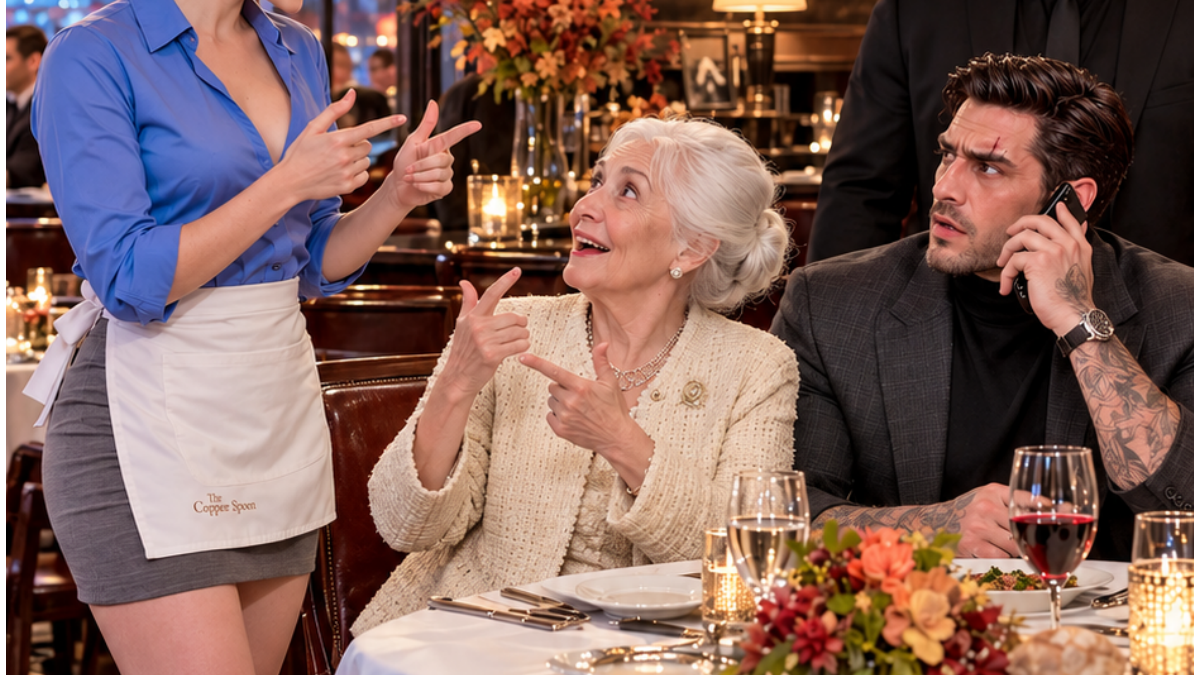
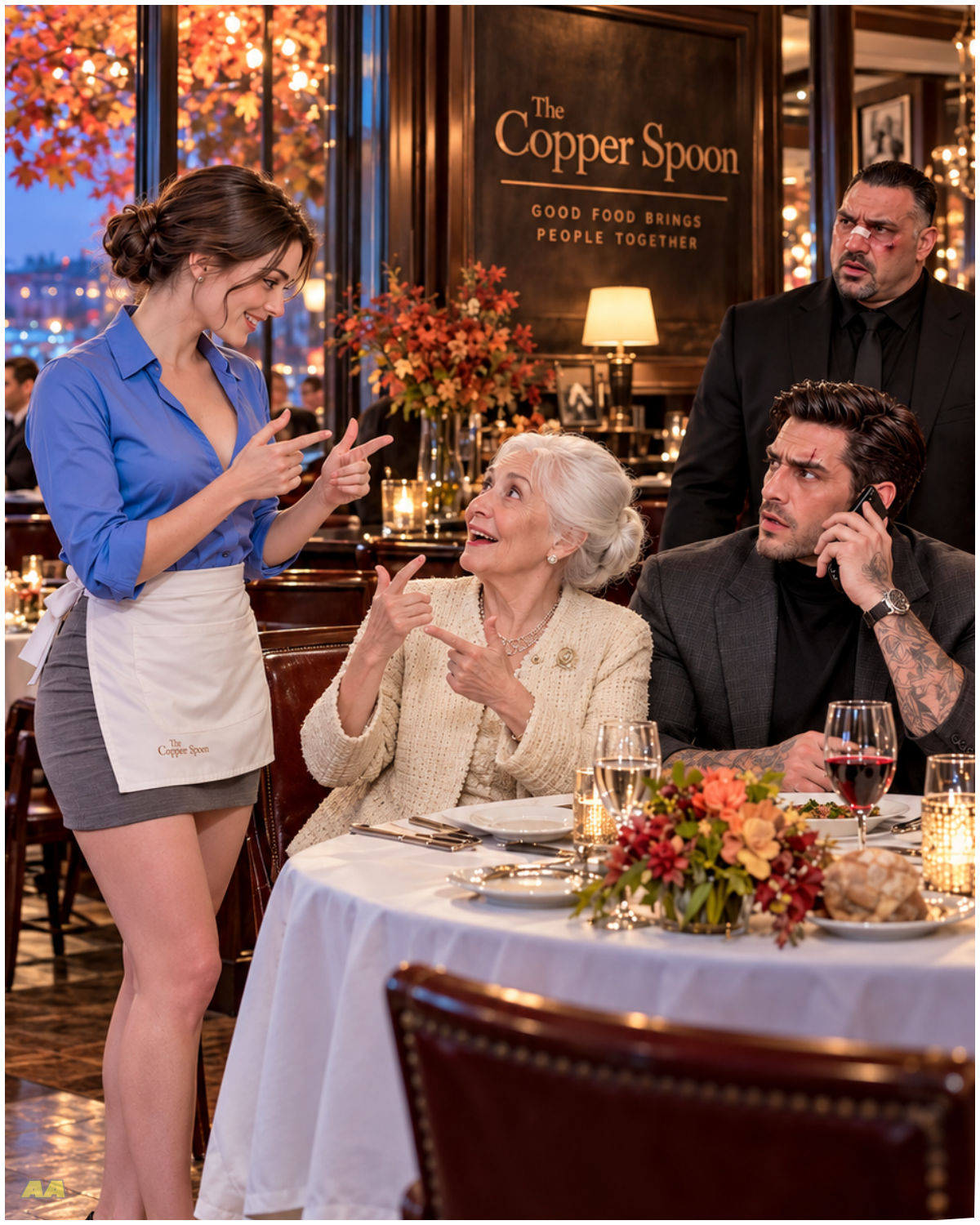
In a city where eye contact with the wrong man was a death sentence, Norah kept her head down.
She was a nobody, serving expensive scotch to men with blood on their hands until the night Victor Gallow, the city’s most ruthless boss, walked in with the one person he protected above all else, his mother.
What happened next wasn’t an act of defiance.
It was a simple silent movement of Norah’s hands, and it stopped the deadliest men in the room cold.
Tuesdays at the Copper Spoon were usually quiet affairs, the kind of shifts where the faint hum of the industrial refrigerator in the back could be heard all the way in the main dining room.
Norah preferred it that way, that the fewer the people, the lower the volume.
She was wiping down booth 4, digging a thumbnail under a stubborn spot of dried wax on the mahogany table when the atmosphere in the restaurant shifted.
It wasn’t a sound.
It was an absence of one.
The low murmur of the three occupied tables died simultaneously.
The clinking of silverware against porcelain ceased.
Norah looked up. Through the frosted glass of the front doors, the distorted shapes of three black SUVs idled on the curb.
The valet wasn’t moving to open their doors.
He was backed against the brick wall of the alley, hands shoved deep into his pockets.
Paul, the floor manager, stood by the host stand.
The color had completely drained from his face, leaving his complexion the shade of old oatmeal.
He grabbed a stack of menus, his knuckles turning white.
The heavy glass door swung open.
Four men entered first.
They didn’t look like mobsters from a movie.
There were no fedoras or pinstriped suits.
They wore dark tailored clothes that hung just loosely enough to conceal the hardware on their belts.
They fanned out with practiced efficiency.
One stayed by the door.
Two took the perimeter.
The largest one, a man with a broken nose and colorflower ears, stood near the center of the room.
Then Victor Gallow walked in.
Norah had seen him on the local news, usually walking out of a courthouse completely unbothered, his lawyers swarming around him like angry bees.
In person, he was worse.
He didn’t swagger.
He didn’t have to. He moved with the terrifying loose limbmed grace of a man who knew precisely how much violence he was capable of.
He wore a charcoal overcoat unbuttoned over a black turtleneck.
His eyes, dark and flat, scanned the room.
When his gaze swept past Nora, the hair on her arm stood up.
It was like being assessed by a landslide, impersonal, inevitable, and entirely destructive.
But it was the woman on his arm that broke the spell.
She was tiny, barely coming up to Victor’s chest.
Wrapped in a heavy cream colored wool coat, despite the mild autumn weather, she leaned heavily on a silver tipped cane.
Her hair was a shock of bright pure white pinned back in elegant twists.
As she looked around the dimly lit restaurant, a small, polite smile touched her lips.
She didn’t look like she belonged to him.
She looked like a retired school teacher who had wandered into a war zone.
Victor leaned down, his entire demeanor softening as he touched her elbow, guiding her toward the back of the room.
The secluded corner booth, the one Paul always kept reserved just in case.
Paul practically jogged over to Norora, his breathing shallow.
He shoved two leatherbound menus into her apron.
Table nine. Paul hissed, his voice cracking.
Norah stared at the menus.
I’m in section one, Paul.
Table 9 is your section.
I can’t do it, Nora.
I poured water on his brother’s lap 3 years ago, and I swear to God, the guy still looks at my kneecaps every time he comes in.
Please just take their order.
Keep your eyes on the floor, and don’t talk.
Unless spoken to.
“I’m not exactly good with high stress tables,” Norah whispered back, her heart beginning to thud, a frantic rhythm against her ribs.
“You’re fine. You’re invisible. That’s your whole thing,” Paul pleaded, already backing away toward the kitchen doors.
“Just get them drinks. Don’t make sudden movements.”
Norah stood alone with the menus, invisible.
He was right. It was her survival mechanism.
Keep the head down, do the job, collect the cash, go home to the empty apartment.
She took a slow, deep breath, tasting the faint smell of roasted garlic and bleach in the air.
She walked over to the drink station, grabbed a pitch of iced water, and arranged two heavy crystal glasses on a tray.
Her hands were shaking slightly. She gripped the tray harder, forcing the tremor into the plastic.
As she approached table 9, the sheer physical presence of the men surrounding it became oppressive.
The bodyguard, with the broken nose, “Carmine,” she heard Victor call him once on the news, stepped slightly into her path.
He did didn’t say a word.
He just looked at her, then at the tray, then gave a millimeter of a nod, stepping back.
Norah kept her eyes focused on the polished wood of the table.
She could hear Victor speaking in a low, grally, baritone.
They told them they have until Friday.
After that, it’s not a negotiation.
It’s an eviction. You understand me?
Yeah, boss. Carmine grunted from his post a few feet away.
Norah stepped up to the table.
She placed a coaster down, then a glass.
The ice clinkedked sharply. To her own ears, it sounded like a gunshot.
She placed the menus down, sliding one toward Victor and one toward the older woman.
“Good evening,” Norah said, her voice barely above a whisper.
“Can I start you with something from the bar?” Victor didn’t even look up from his phone.
“Scotch Mallen 18. Neat hot water with lemon for my mother.” “Right away,” Norah said.
She turned to leave, but a sharp, frustrated exhalation from the older woman stopped her.
Norah glanced back. Rose Aallo was tapping a manicured finger against the open menu.
She looked up at her son, tapping the paper again.
Victor was already dialing a number on his phone, his jaw tight with irritation, aimed at whoever was on the other end of the line.
Rosa turned her attention to Carmine.
She pointed at a dish on the menu, then raised her hands, forming a few quick, sharp shapes with her fingers.
Carmine shifted his weight awkwardly. He scratched the back of his thick neck.
Uh, I don’t know, Mrs. Gallow.
The boss usually orders the steak for you.
I think it’s good. Rose’s shoulders slumped.
The light in her eyes dimmed, replaced by a quiet, profound isolation.
She looked back down at the menu, her hands dropping to her lap.
She was surrounded by the most powerful men in the city, and she was completely alone.
Norah froze. The tray in her hands felt suddenly very heavy.
Norah knew she should walk away.
Paul’s frantic advice echoed in her head.
Keep your eyes on the floor.
Don’t make sudden movements. She needed this job.
She needed the tips to keep the lights on in her cramped studio apartment.
Getting involved with a mafia boss’s family dynamic was the opposite of staying invisible.
But looking at Rosa Gallow’s defeated posture, a bitter familiar ache flared in Norah’s cheSt. It was the same look her younger brother used to get when people talked over him, around him, but never to him.
The look of being a ghost in a room full of living people.
Norah didn’t walk away. She stepped back up to the table.
Carmine stiffened instantly, his hand twitching toward the opening of his jacket.
Victor paused his phone call, his dark eyes snapping up to lock onto Nora.
The indifference in his gaze vanished, replaced by a cold, sudden scrutiny.
He didn’t speak, but the threat radiating from him was palpable.
Norah ignored him. Her heart was hammering a frantic rhythm against her ribs, but her hands were steady as she placed the tray under her left arm.
She looked directly at Rosa. Norah raised her free right hand, extending her index finger and tapped her chin twice, then brought her hand down flat into her left palm.
Excuse me. Across the table, Victor’s phone slipped an inch from his ear.
Carmine went entirely still. The air in the corner booth turned to ice.
Rosa blinked, her head snapping up.
Her dark eyes, so similar to her sons, but lined with decades of a different kind of weariness, widened in pure shock.
Norah smiled gently, fighting the tremor in her knees.
She used both hands now, forming the signs clearly and patiently, retrieving the vocabulary she hadn’t used in 3 years.
I saw you looking at the menu.
Norah signed. The branzino is very good, but the sea boss is fresher today.
For a second, the universe seemed to pause.
The silence at the table was profound, heavy, with sudden unpredictable tension.
Then a brilliant, blinding smile broke across Rose’s face.
It erased 10 years from her features.
She sat up straighter, her hands flying up with practiced fluid speed.
“You sign,” Rosa replied, her expressions animated, her fingers moving like hummingbirds.
“Beautifully.” “Where did you learn?” “My brother,” Norah signed back, keeping her movements smaller.
“Respectful. He was deaf. We learned together.
It is a blessing to meet you,” Rosa signed, pressing a hand to her cheSt. She pointed at the menu with renewed energy.
“The sea bus, then with extra asparagus, of course.” Norah nodded, signing the confirmation.
I will bring it right away.
Norah finally broke eye contact with the older woman and turned to head for the kitchen.
As she pivoted, she crashed headlong into the reality of what she had just done.
Victor Gallow was staring at her.
He hadn’t moved. His phone was resting on the table now.
His posture was perfectly relaxed, but the intensity in his eyes was staggering.
He wasn’t looking at her the way men usually looked at waitresses.
He was looking at her like she was a locked safe, and he had just found the first number of the combination.
What’s your name? Victor’s voice was quiet.
It didn’t carry past the table, but it commanded absolute obedience.
Norah swallowed hard. Her throat felt like sandpaper.
Nora. Nora. He repeated. He tasted the syllables, rolling them around in his mouth.
You didn’t learn that in a weekend seminar, Nora.
No, sir. Who told you she was deaf?
No one, sir. I just saw her trying to ask a question.
Norah kept her hands clasped tightly in front of her apron so he wouldn’t see them shake.
Victor glanced at his mother. Rosa was watching them, still smiling, her posture completely relaxed for the first time since she walked into the building.
She reached out and patted Victor’s hand, signing something quick and sharp to him.
Victor didn’t sign back, but he nodded slowly, his eyes never leaving Norah’s face.
She says, “You have a kind face.” Victor translated, his tone betraying absolutely nothing.
And that I should double your tip.
“That’s that’s not necessary,” Norah stammered, taking a step backward.
“I’ll get your drinks.” She practically fled to the kitchen.
As the heavy swinging doors closed behind her, she leaned her back against the cool metal of the prep station, letting out a breath she felt like she’d been holding for an hour.
Paul appeared beside her, holding a ramkin of butter like a weapon.
What happened? I saw Carmine go for his piece.
What did you do to them?
Nothing. Norah breathed out, rubbing her temples.
I just took their order. She closed her eyes, trying to calm her racing pulse.
She had survived the interaction. She just had to bring their food, keep her distance, and let them leave.
She would go back to being invisible.
But as she carried the steaming plates of sea bass and perfectly seared steak back out to the dining room 20 minutes later, she felt a heavy physical weight pressing against her.
She looked up across the dim room.
Past the flickering candles and the hulking shadows of the bodyguards, Victor Gallow was watching her.
The cold indifference was gone. In its place was something much more dangerous.
IntereSt. The invisible girl had just turned on a spotlight, and the most dangerous man in the city was standing right in the beam.
The rest of the shift felt like walking on a tightroppe suspended over a live volcano.
Norah moved through her section on autopilot, pouring coffee, clearing plates, and nodding at complaints about overcooked asparagus from table 4, but the back of her neck prickled constantly.
Every time she emerged from the kitchen, the pull of the corner booth was magnetic.
She fought the urge to look.
She lost repeatedly. Victor Gallow wasn’t glaring at her.
He wasn’t overtly watching her either.
He was simply aware of her.
When she moved to the cash register, his head tilted a fraction of an inch in her direction.
When she dropped a fork and bent to retrieve it, the low rumble of his conversation stopped for 3 seconds.
It was a terrifying kind of tracking.
At 10:30, they finally stood to leave.
Carmine helped Rosa into her heavy wool coat.
Rosa caught Norah’s eye across the dining room, raised her hand, and signed a quick, graceful, “Thank you.” Norah signed back, “Have a good night.” Keeping her movements tight and close to her chest, Victor dropped a few crisp bills on the table, buttoned his overcoat, and walked toward the exit.
He didn’t look back. The vacuum created by his departure was immediate.
The restaurant seemed to physically exhale.
Paul, the manager, emerged from the back office, wiping sweat from his forehead with a bar towel.
“They’re gone,” Paul said, his voice shaking.
“Holy hell, we survived.” Norah walked over to table 9 with a bus tub.
The plates were practically licked clean.
Beside Victor’s empty scotch glass lay a stack of $100 bills.
Not one, not two, five of them.
$500 on a bill that barely cracked 80.
She stared at Benjamin Franklin’s stoic face.
It wasn’t a tip. It was a tether.
It was a statement that she had crossed an invisible line from staff to person of intereSt. She shoved the money into her apron pocket.
It felt like it was burning a hole through the cheap polyester.
For the next 3 days, paranoia became Norah’s constant companion.
Every black SUV that rolled past her bus stop made her heart skip a beat.
Every heavy footstep in the hallway of her apartment building made her reach for the deadbolt.
She slept poorly, waking up at 3 a.m.
To the sound of imaginary gravel crunching under tires.
By Friday, the tension had began to curdle into exhaustion.
She was working a double shift, her feet throbbing inside her worn out sneakers.
It was raining, a cold, relentless drizzle that washed the city streets in a greasy sheen.
At 4 p.m., the diner was dead.
Norah was leaning over the counter, refilling the salt shakers, when the bell above the door chimed.
She didn’t look up immediately. Take a seat anywhere.
I’ll be right with you. Heavy footsteps approached the counter.
They didn’t stop at a booth.
They stopped directly in front of her.
Norah looked up. The salt shaker slipped from her fingers, clattering loudly against the formica counter.
It was Carmine. The broken-nosed bodyguard looked entirely out of place amidst the vinyl boos and neon pie signs.
He wore a dark raincoat, water dripping from the broad shoulders.
He looked uncomfortable, shifting his massive weight from one foot to the other.
Uh, hey, Carmine grunted. His voice sounded like rocks grinding together in a cement mixer.
Norah backed up a step, her hand instinctively reaching toward the heavy ceramic coffee mugs behind her.
We’re closed for a private event in 20 minutes.
It was a lie. Carmine sighed, rubbing a massive hand over his jaw.
Look, lady, I ain’t here to break nothing.
The boss sent me. Victor Gallow sent you.
Norah’s voice betrayed her, trembling on the syllables.
Mr. Gallow. Yeah. Carmine reached into the inner pocket of his raincoat.
Norah flinched. Carmine froze, his hand half inside his coat.
He rolled his eyes toward the ceiling in silent prayer, then pulled out a small, thick, creamcoled envelope.
He slid it across the counter, carefully avoiding the spilled salt.
“For you,” Carmine said. “From Mrs. Gallow, the boss’s mother.” Norah stared at the envelope.
Her name Nora was written in elegant looping cursive.
“What is it?” “I just deliver things,” Carmine said, stepping back from the counter.
“The boss said to tell you the car will be out front at noon tomorrow.
Don’t make me wait in the rain, Nora.
The leather seats get weird when they’re damp.
He turned and walked out, the bell chiming merrily behind a man capable of breaking a femur with his bare hands.
Norah stood frozen for a long time.
She reached out and touched the envelope.
It was heavy, expensive paper. She tore it open.
Inside was a simple note card.
My son is throwing a terrible party for his associates.
I would be honored if you would attend as my guest so I have someone intelligent to talk to.
Rosa, it wasn’t a requeSt. You didn’t say no to a mafia’s mother when the dawn himself sent his top enforcer to deliver the invitation.
Saturday at noon was overcast, the sky a bruised purple.
Norah stood on the curb outside her dilapidated apartment building.
She wore her only nice dress, a simple black sheath she usually saved for funerals, and a trench coat she’d bought at a thrift store.
She felt exposed. She felt utterly terrified.
Exactly at 12 p.m., a sleek black town car pulled up to the curb.
The tinted window rolled down halfway.
Carmine was in the driver’s seat.
He jerked his head toward the back.
Norah opened the heavy door and slid into the immaculate leather interior.
It smelled like expensive cologne and ozone.
The divider between the front and back was raised.
She was alone. The drive took 40 minutes, leading them out of the congested city center and into the sprawling gated estates of the northern suburbs.
They pulled through massive row iron gates, crunching over a perfectly manicured gravel driveway.
The Gallow House was less a home and more a fortress disguised as a mansion.
High stone walls, security cameras tucked discreetly into the ancient oak trees.
Carmine opened the door for her through the front.
Take a right at the stairs, the sun room.
Norah clutched her small purse like a shield.
She walked up the stone steps.
The heavy oak door was already open, held by a stoic man in a dark suit who didn’t even look at her.
She followed Carmine’s directions, moving over polished marble floors.
The house was silent, but it hummed with a strange, watchful energy.
She turned right at a sweeping mahogany staircase and saw double glass doors leading into a bright, airy sunroom.
Rosa Gallo was sitting in a wicker chair surrounded by violently blooming orchids.
She wore a deep burgundy dress, her white hair perfectly quafted.
When she saw Nora, her face lit up.
She raised her hands. You came.
She signed rapidly. Norah forced a smile, stepping into the room.
I was invited. It is nice to see you, Mrs. Gallow.
Rosa. Please. The older woman signed, patting the empty chair beside her.
Sit. My son’s people are arriving soon.
They talk loud, but they say nothing.
I wanted a friend. Norah sat down.
The wicker chair creaked. For the next 20 minutes, the tension in Norah’s chest slowly began to uncoil.
Rosa was funny. She was sharp, observant, and completely unfiltered in her opinions of her son’s business associates.
They fell into an easy rhythm, the silence of their conversation creating a comfortable bubble within the massive cold house.
Then the temperature in the room dropped.
Norah didn’t hear him enter, but Rose’s eyes flicked past Norah’s shoulder and her hands dropped to her lap.
Norah turned her head. Victor stood in the doorway.
He wore a dark navy suit that fit him with predatory perfection, a stark white shirt open at the collar.
Without the overcoat, the sheer physical power of the man was undeniable.
He held two crystal glasses of amber liquid.
I see you found her, Victor said.
His voice was smooth, dark honey poured over crushed glass.
He walked forward, handing one glass to his mother.
He didn’t offer one to Nora.
Instead, he pulled up a chair directly opposite her, leaning forward, resting his forearms on his knees.
The scent of sandalwood and something sharper, something metallic, drifted off him.
“I wasn’t sure you’d get in the car,” Victor said, looking directly into Norah’s eyes.
I didn’t think I had a choice, Norah replied, keeping her voice steady, though her hands were clamped together in her lap.
Victor’s mouth curved into a faint, dangerous smile.
There’s always a choice, Nora. You chose to speak to her on Tuesday.
You chose to step out of line.
Rosa tapped Victor’s knee sharply. She signed something angry and faSt. Victor didn’t look at his mother.
He kept his eyes locked on Nora.
“She says, “I’m scaring you.” “Am I scaring you?” “Yes,” Norah said truthfully.
Victor’s smile faded. The intensity in his dark eyes deepened, shifting from intimidation into something raw and entirely unexpected.
It looked dangerously close to gratitude.
My mother lost her hearing 5 years ago from an illness,” Victor said quietly.
The gravel in his voice smoothed out.
“Most of the people in my world, they don’t have the patience to learn a new language.
They just stopped talking to her.
They pretend she’s a piece of furniture.
She sits in rooms full of people who owe me their lives, and she is completely alone.” He leaned in closer.
Norah could see the faint shadow of a scar bisecting his left eyebrow.
“Then you walk up,” Victor murmured.
“A waitress making minimum wage, and you gave her a voice in my territory.
You made the men at my table look like fools.
I just wanted to help her order fish,” Norah whispered.
“You did more than that.” Victor leaned back, his broad shoulders settling against the chair.
The vulnerability vanished, replaced instantly by the cold, calculating mob boss.
“She wants you around.” “So, you’re going to be around?” “I have a job,” Norah said.
A spark of defensive anger finally cutting through her fear.
“I have a life.” “You had a job?” Victor corrected smoothly.
“I bought the diner this morning.
You’re unemployed, but as of right now, you work for me.
You are my mother’s companion. You will be paid five times what you made pouring burnt coffee, and you will be under my protection.” Norah stared at him.
The reality of the golden cage snapping shut around her.
She looked at Rosa, who was watching them with a gentle, hopeful expression, entirely unaware of the absolute tyranny her son was exercising.
Victor stood up, adjusting his cuffs.
The party starts in 10 minutes.
Stay by her side. Don’t speak to my men.
If anyone bothers you, you tell me.
He looked down at her, his dark eyes unreadable.
Welcome to the family, Nora. The sunroom doors remained open to the sprawling terrace, but the air inside quickly turned stifling.
By 2:00 in the afternoon, the Gallow estate was crawling with men.
They moved in packs, clutching heavy crystal tumblers filled with amber liquor.
The noise was a physical weight, a chaotic blend of booming laughter, aggressive backs slapping, and the low, constant thrum of negotiations happening in the corners.
Norah sat rigidly beside Rosa on the wicker sofa, feeling like a field mouse trapped in a terrarium full of bored snakes.
No one looked at them directly.
It was a fascinating, terrifying dynamic.
The men gave the sunroom a wide birth, treating the invisible line across the threshold like a trip wire.
They would glance over, lower their voices, and quickly look away.
Rosa was the queen mother, respected, but entirely isolated.
Norah kept her hands busy. She and Rosa talked about everything and nothing.
Rosa explained the lineage of her orchids, her fingers moving with precise, delicate grace.
Norah listened, offering small smiles and signing back questions she barely cared about, desperate to keep the older woman engaged.
It was easier to focus on the shape of Rose’s hands than the holsters bulging beneath the tailored jackets outside.
Then the invisible boundary was breached.
A man detached himself from a loud group by the terrace fountain.
He was younger than the rest, maybe late 20s, with sllicked back dark hair and a suit that was a shade too shiny.
He swayed slightly as he walked, the ice clinking loudly in his glass.
Carmine, standing near the doorway, shifted his weight to intercept, but the younger man waved him off with a sloppy, arrogant flick of his wriSt. Back off, calm.
I’m just paying my respects. The man slurred.
Carmine’s jaw tightened, but he stepped aside.
The man crossed the threshold. The smell of him arrived firSt. Cheap cologne trying and failing to mask the sour of too much gin.
He stopped in front of their sofa, looming over them.
He didn’t look at Rosa, his bloodshot eyes locked immediately onto Nora.
Well, he said, a slow, greasy smile spreading across his face.
Victor didn’t say he was bringing in new talent for the house.
I’m Dominic. Norah didn’t move. She kept her hands folded in her lap.
Next to her, she felt Rosa stiffen.
Dominic leaned down, bracing her hand on the armrest of Norah’s chair.
He was close enough that she could see the erratic pulse beating in his neck.
You’re a quiet one, aren’t you?
What’s your name, sweetheart? Rosa reached out and firmly slapped Dominic’s hand off the chair.
Dominic blinked, momentarily startled. He looked down at the older woman as if he had just noticed she was sitting there.
Rosa glared at him, her dark eyes flashing with a familiar, terrifying authority that mirrored her sons.
She raised her hands, forming a sharp, aggressive gesture.
Leave. Dominic laughed. It was a harsh, ugly sound.
Right. Sorry, Mrs. G. I forgot you do the whole handwaving thing.
He turned his attention back to Nora, entirely dismissing the matriarch.
Come on, let’s go get a drink.
The old lady doesn’t need a babysitter right now.
He reached for Norah’s wriSt. Norah didn’t think.
Instinct, honed from years of navigating aggressive drunks in dive bars, took over.
She grabbed the crystal pitcher of ice water resting on the small table between the chairs.
She didn’t throw the water. She drove the the heavy leaded base of the pitcher hard into the center of Dominic’s cheSt. It wasn’t a lethal blow, but it was completely unexpected.
Dominic gasped, stumbling backward. His heel caught the edge of a woven rug, and he went down hard, his glass shattering against the marble floor.
Gin and ice sprayed across the tiles.
The immediate silence that fell over the terrace was deafening.
The booming laughter died. The clinking glasses stopped.
30 heavily armed men turned their heads in unison to look into the sunroom.
Dominic scrambled to his feet, his face flushing a violent shade of purple.
Humiliation burned in his eyes. He wiped a splash of water from his lapel, his hand dropping toward the inside of his jacket.
You stupid little Dominic. The voice wasn’t loud.
It didn’t need to be. It cut through the thick tension in the room like a scalpel.
Victor stood at the opposite end of the sunroom.
He had a cigar in one hand, unlit.
He slowly walked forward. The crowd of men on the terrace parted for him instantly.
A sea of dark suits melting out of his way.
Dominic froze. The the anger in his face evaporated, replaced by a sudden stark terror.
He pulled his hand away from his jacket as if the fabric were on fire.
Boss, I was just I was paying my respects to your mother.
Victor stopped 2 feet away from Dominic.
He looked at the shattered glass on the floor, then at an aura, who was still clutching the water pitcher.
Her knuckles white. Finally, he looked at his mother.
Rosa raised her hands. Her signs were sharp, furious, and precise.
He ignored me. He touched her.
He is a pig in a silk suit.
Victor’s expression didn’t change, but the air around him seemed to drop 10°.
He slowly looked back at Dominic.
“My mother says you’re a pig, Dom.” Victor’s voice was a soft, dangerous rasp.
Victor, I swear I just asked the girl for a drink.
I didn’t know she was Victor moved with a sudden horrifying violence.
He didn’t punch Dominic. He simply reached out, grabbed the younger man by the lapels of his shiny suit and drove him backward into the heavy stone column framing the sunroom doors.
The sickening crack of skull against stone echoed across the terrace.
Dominic’s knees buckled. Victor held him up effortlessly by the fabric of his jacket.
“You don’t you don’t speak to my mother unless spoken to,” Victor said, his voice entirely devoid of emotion.
“You don’t look at her companion.
You don’t breathe the air in her section of my house.
Do you understand?” “Yes,” Dominic choked out, blood beginning to trickle from a cut on the back of his head.
Yes, boss. Victor released him. Dominic hit the floor like a sack of wet cement.
Victor looked up at the silent crowd of men watching from the terrace.
Take him out front. Throw him in his car.
Tell his carpo he’s out of the city by midnight or he’s under it by dawn.
Two men immediately stepped forward, grabbing Dominic by the arms and dragging him away.
The rest of the crowd awkwardly resumed their conversations, forcing a chaotic murmur back into the air.
Victor pulled a pristine white handkerchief from his pocket and wiped his hands.
He turned to face Nora. She was shaking.
The adrenaline was draining out of her, leaving her cold and nauseous.
She had grown up in a rough neighborhood, but she had never seen violence dispensed with such cold corporate efficiency.
Victor stepped closer. He reached out and gently pried the heavy crystal pitcher from her rigid fingers, setting it back on the table.
“Are you hurt?” he asked. “No,” Norah whispered.
“Good.” Victor looked at his mother.
Rose assaigned something small and dismissive, returning to her orchids as if a man hadn’t just been concussed 3 ft away.
Victor looked back at Nora, his dark eyes tracing the pale lines of her face.
You handle yourself well, but next time let Carmine do the heavy lifting.
He turned and walked back into the crowd.
Norah sat back down on the wicker sofa, the reality of her new life settling heavily over her shoulders.
She wasn’t just a waitress anymore.
She was property of the Gallow family.
By Wednesday, Norah had stopped trying to find a way out.
The Gallow Estate operated on a strict, unbreakable rhythm.
Breakfast at 8, a walk through the sprawling gardens at 10:00, lunch at 1.
The compound was an isolated ecosystem, complete with its own chef, cleaning staff, and a rotating army of silent men in dark suits who patrolled the perimeter.
Norah had been given a suite in the east wing down the hall from Rosa.
The room was twice the size of her entire apartment, decorated in soft grays and muted blues.
Her worn out clothes had vanished on the first day, replaced by a closet full of expensive understated dresses, cashmere sweaters, and soft leather shoes in her exact size.
She was living in luxury, but the heavy oak door of her bedroom locked from the outside at midnight.
Carmine called it a security protocol.
Norah knew it was a cage.
Despite the imprisonment, the days were surprisingly peaceful.
Rosa was demanding but deeply affectionate.
The older woman had been starved for real conversation, and she devoured Norah’s time.
They sat in the climate controlled greenhouse for hours, signing about history, bot, and the books Rosa read relentlessly.
Norah learned that Rosa had lost her hearing after a severe fever five years ago.
She learned that Rosa’s husband, the former Dawn, had been murdered in his bed 30 years prior, leaving a young victor to claw his way to the top of a brutal empire.
Rosa never explicitly talked about the blood on her son’s hands, but the shadows in her eyes spoke volumes.
She loved Victor fiercely, but she was trapped by the monster she had raised him to be.
It was late on Thursday night when the illusion of domestic peace shattered.
Norah couldn’t sleep. The mattress was too soft, the sheets too smooth.
She missed the distant siren whales and the rumble of the garbage trucks from her old street.
She slipped out of bed, pulled a thick wool cardigan over her silk pajamas, and padded quietly down the dark hallway.
The security lock on her door hadn’t engaged yet.
It was only 11:30. She made her way down the grand staircase towards the massive industrial kitchen, hoping to find a glass of warm milk.
The kitchen was dark, lit only by the faint blue glow of the massive Subzero refrigerators.
Norah walked over to the island and froze.
Victor was sitting on a stool in the shadows.
He didn’t have a jacket on.
His tie was gone, and his white dress shirt was unbuttoned halfway down his cheSt. He was resting his elbows on the marble counter holding a glass of scotch.
He looked exhausted. The predatory grace was gone, replaced by a bone deep weariness.
As Norah’s eyes adjusted to the dark, her breath caught in her throat.
There was blood on his shirt, a bright, unmistakable smear of crimson across the stark white cotton of his left cuff.
Norah backed up, her heel scraping loudly against the tile floor.
Victor’s head snapped up, his hand instantly moved toward his waistband, but he stopped when he saw her.
He let out a long, slow breath, running a hand through his dark hair.
“You’re supposed to be in your room, Nora,” he said.
His voice was hollow, stripped of its usual commanding resonance.
I couldn’t sleep, she said, her eyes locked on his cuff.
Victor followed her gaze. He looked down at the blood.
He didn’t try to hide it.
He just calmly rolled the sleeve up past his elbow, exposing thick forearms corded with muscle and faded scars.
“Get your milk,” he said, taking a slow sip of his scotch.
I’m not going to bite. Norah hesitated, then moved quickly to the fridge.
She poured a glass of milk, her hands shaking slightly.
The silence in the kitchen was heavy, pressing against her eard druMs. She turned to leave, desperate to get back to the safety of her room.
“Sit,” Victor commanded softly. “It wasn’t a requeSt.” Norah pulled out a stool on the opposite side of the massive island and sat down.
She kept the glass of milk between her hands like a barricade.
Victor stared at his scotch. “You think I’m a monster?
I think you’re a man who hurts people.” Norah replied, surprising herself with her own bluntness.
The late hour had stripped away some of her filter.
Victor let out a dry, humorous chuckle.
I hurt the people who try to hurt mine.
It’s a simple equation. You grew up in the South End, right?
Off Fourth Street. Norah stiffened. You looked into my background.
Of course I did. I don’t let strangers sleep 50 ft from my mother without knowing everything about them.
Victor looked up, his dark eyes locking onto hers.
Your father was a drunk. He hit you.
He hit your deaf brother. The police came three times in four years and did absolutely nothing.
Norah felt the blood drain from her face.
The memories she had buried deep in the dirt of her mind were suddenly dug up and thrown onto the marble counter.
“My father is dead,” Norah whispered fiercely.
“I know,” Victor said gently. “A car crash 5 years ago.
The world is a better place without him.
The law didn’t protect you, Norah.
The rules didn’t protect you. The rules are designed to keep the weak exactly where they are.
He leaned forward, the smell of scotch and copper drifting across the island.
I don’t follow their rules. I made my own.
And in my world, the people I care about are untouchable.
My mother is untouchable. And now you are untouchable.
I didn’t ask for this,” Norah said, her voice shaking with a mix of fear and old, unhealed grief.
“I didn’t ask to be pulled into your war.” “You asked for it the second you looked at my mother and treated her like a human being,” Victor said flatly.
“Good deeds rarely go unpunished, but they also rarely go unrewarded.” He finished his scotch and stood up.
He looked massive in the dim light, a monolith of violence and control.
He walked around the island, stopping right next to her chair.
Norah held her breath. Victor reached out.
His hand hovered over her head for a fraction of a second before he gently, almost hesitantly, tucked a stray lock of hair behind her ear.
His fingers were warm, rough with calluses.
The contrast between the gentleness of his touch and the blood drying on his sleeve was paralyzing.
Go to sleep, Nora, he murmured.
The doors lock at midnight. He walked out of the kitchen, his footsteps silent on the marble floor.
Norah sat alone in the dark, her heart hammering against her ribs, terrifyingly aware that the lock on her door was no longer keeping the danger out.
It was keeping her locked inside with it.
November arrived with a brutal, biting chill that stripped the oak trees bare.
The gallow estate settled into a grim, gray routine.
Norah learned the subtle barometers of the house.
She knew that when Carmine double-cheed the window latches in the morning, a shipment was moving through the docks.
She knew that when Victor didn’t come down for breakfast, a negotiation had gone bad, and Victor was missing breakfast more often.
Since the night in the kitchen, a strange, undeniable gravity had formed between them.
He no longer ignored her presence.
When he was home, he found reasons to be in the same room.
He would stand in the doorway of the conservatory while she signed with Rosa, watching her hands with a heavy, unreadable intensity.
He started taking dinner with them, dismissing his lieutenants to sit at the long mahogany table, eating in a profound, heavy silence that made Norah’s skin prickle.
She was no longer just the waitress.
She was a fixture. And in Victor’s world, fixtures eventually became targets.
It happened on a Tuesday, the anniversary of her first shift at the corner booth.
It was raining again, a freezing downpour that turned the gravel driveway into a muddy swamp.
Nora and Rosa were in the sun room.
The orchids had been moved to the heated greenhouse, replaced by heavy, dark winter ferns.
Rosa was showing Norah a worn leather photo album pointing to faded polaroids of a younger Victor on a bicycle.
His face scraped, his eyes already hard.
He never liked to play. Rose assaigned, tracing the edge of the photograph.
He only liked to win. It worried his father.
Norah nodded, leaning closer to the album.
Some people are just born fighting.
Rosa looked up, her expression turning somber.
She began to sign a reply, but her hands froze midair.
Norah didn’t hear it at firSt. The rain lashings against the glass panes masked the initial sounds, but she felt it.
A heavy rhythmic vibration deep in the floorboards.
Then Carmine burst through the double doors.
He wasn’t walking. He was sprinting, his massive frame moving with terrifying speed.
He had a suppressed pistol in his right hand.
“Get down!” Carmine roared. The command didn’t register in Norah’s brain, but her body reacted to the sheer violence in his voice.
She lunged forward, grabbing Rosa by the shoulders and dragging the older woman out of her wicker chair.
They hit the marble floor hard.
A split second later, the sun room exploded.
It wasn’t a bomb. It was sustained concentrated gunfire.
Automatic weapons tearing through the heavy reinforced glass from the treeine.
The noise was absolute, a deafening mechanical roar that vibrated in Norah’s teeth.
Shards of glass rained down like jagged hail, shredding the ferns, chewing through the wicker furniture, ripping into the plaster walls.
Norah covered Rosa with her own body.
She pressed her face against the cold, dustcovered floor, squeezing her eyes shut.
She couldn’t breathe. The air was instantly thick with the bitter metallic stench of cordite and pulverized stone.
Rosa was trembling violently beneath her, letting out small, sharp gasps that were completely drowned out by the gunfire.
Carmine was returning fire, using a thick stone column for cover.
His gun made sharp, controlled pops that sounded insignificant against the barrage from outside.
They bypassed the outer gate. Carmine yelled into a radio clipped to his lapel, his voice roar.
Heavy artillery, east lawn. We are pinned in the sunroom.
The barrage paused. A heavy ringing silence dropped over the room, interrupted only by the sound of falling glass and the relentless rain.
Norah opened her eyes. The sunroom was decimated.
Cold wind howled through the shattered frames.
Move. A voice snarled behind her.
Victor was there. He wore a black tactical vest over a dress shirt holding an assault rifle.
His face was a mask of pure concentrated murder.
The civilized veneer was completely gone, replaced by the apex predator of the city’s underworld.
He didn’t wait for Norah to stand.
He grabbed her by the back of her sweater, hauling her up, then reached down and scooped his mother into his other arm as if she weighed nothing.
“Keep your head down,” Victor ordered, shoving Nora toward the hallway.
They ran. Carmine covered their retreat, firing blindly into the rain.
The house was alive with chaos.
Men in dark suits were flooding the corridors, shouting orders, racking shotguns.
The polished, quiet sanctuary had transformed into a war zone in less than 60 seconds.
Victor pushed them down the main corridor, moving towards the kitchen.
As they passed the study, the front door of the mansion splintered inward.
A man in a wet schema mask stepped through the ruined wood, raising a weapon.
Victor didn’t break stride. He didn’t even blink.
He raised his rifle with one hand and fired three rounds into the man’s cheSt. The intruder crumpled backward into the rain.
Victor stepped over the body, his hand tight on the back of Norah’s neck, forcing her to keep moving.
They reached the kitchen. Victor kicked open a door disguised as a pantry shelf.
Behind it was a heavy steel door with a keypad.
His blood sllicked fingers punched in a code.
The door hissed open, revealing a concrete stairwell plunging into darkness.
Go. Victor barked, shoving Nora and Rosa inside.
Norah stumbled down the steps, holding tightly to Rosa’s hand.
The older woman was hyperventilating, her eyes wide with terror.
They reached the bottom of the stairs, stepping into a stark, brightly lit concrete bunker.
It smelled of stale air and emergency rations.
Footsteps clattered down the stairs behind them.
It was Victor. He pulled the heavy steel door shut.
The lock engaged with a loud final clank.
The deafening roar of the gunfight above was instantly muted, reduced to faint rhythmic thuds.
Victor turned to face them. He was breathing heavily, his eyes wild, his chest heaving under the tactical veSt. He looked at his mother.
Then he looked at Nora. He had saved them.
But as Norah stared at the blood splattered across his cheek, she realized the terrifying truth.
This wasn’t an anomaly. This was his life.
And by dragging her into it, he had made it hers.
The safe room was freezing. It was a sterile 12×12 concrete cube beneath the wine celler.
No cell service, no internet, just a bank of monitors showing static from the destroyed security cameras, a cot, and a metal first aid cabinet on the wall.
Rosa was sitting on the edge of the cot.
She wasn’t crying. Her shock had settled into a rigid, hollow stare.
Norah sat beside her, gently rubbing the older woman’s hands, trying to coax some warmth back into her icy skin.
“You are safe,” Norah signed, her fingers trembling so badly the words were barely legible.
“We are under the house. The doors are steel.” Rosa didn’t sign back.
She just leaned her head against Norah’s shoulder and closed her eyes.
Victor was pacing. He stalked the perimeter of the small room like a caged panther, checking his watch, checking his ammunition, staring at the static on the monitors.
He had stripped off the tactical vest, leaving him in a ruined dustcovered dress shirt.
Every time his back was turned, Norah saw the dark, wet stain spreading across his right shoulder blade.
You’re bleeding,” Norah said. Her voice sounded thin and raspy in the cold acoustic space.
Victor stopped pacing. He glanced over his shoulder, twisting his neck to look at his back.
He grunted, a dismissive sound of irritation.
“It’s glass, a ricochet. It’s fine.
It’s not fine. It’s soaking your shirt.” Victor turned fully to face her.
The adrenaline was beginning to crash, leaving behind a stark, brutal exhaustion.
I don’t have time to bleed, Nora.
My men are fighting upstairs. Your men are handling it.
You are locked in here with us.
Norah stood up. The fear from the gunfight was receding, replaced by a sudden, sharp clarity.
She walked over to the metal cabinet on the wall, pulled it open, and retrieved a roll of gores, a bottle of antiseptic, and a pair of trauma shears.
She walked back to him. She didn’t ask for permission.
She grabbed the collar of his ruined shirt and used the shears to cut down the back, pulling the fabric away from his skin.
Victor went perfectly still. He didn’t pull away.
The wound was ugly. A jagged piece of shrapnel or glass had torn a deep 4-in gash across his shoulder blade.
It was sluggishly leaking dark blood down his back, mixing with sweat and plaster duSt. Sit on the chair,” Norah ordered, pointing to a metal folding chair near the monitors.
Victor obeyed. He sat down, leaning his elbows on his knees, his broad, scarred back exposed to her.
Norah soaked a square of gores in antiseptic.
“This is going to burn.” She pressed the gores into the cut.
Victor’s muscles instantly corded like steel cables.
He sucked a sharp breath through his teeth, his knuckles turning white as he gripped his own knees, but he didn’t make a sound.
Norah worked in silence, cleaning the debris from the wound.
Her hands were covered in his blood.
A month ago, she would have fainted.
Now it felt like just another Tuesday in the Gallow estate.
The absurdity of it made a bitter laugh catch in her throat.
“Who was it?” Norah asked softly, applying pressure to stop the bleeding.
Dominic’s uncle, Victor said, his voice a low, grally rasp.
The Lupatazi crew, they didn’t like how I handled their nephew at the party.
They decided to send a message.
They tried to kill your mother to send a message about a concussion.
Victor turned his head slightly, looking at her out of the corner of his eye.
They didn’t come for my mother, Norah.
Norah’s hand stopped moving. The cold air in the room suddenly felt suffocating.
They came for you, Victor continued, his tone entirely devoid of emotion.
Dominic told them about the girl in the sun room.
The one who humiliated him, the one I embarrassed him over.
In this life, if you want to hurt a boss, you don’t shoot at him.
You burn his house down. You take his favorite things.
Norah stared at the raw, bleeding muscle under her hands.
I’m not your favorite thing. I’m your mother’s companion.
Victor stood up abruptly. The chair screeched against the concrete.
He turned to face her, ignoring the open wound on his back.
He stepped into her space, backing her up against the metal cabinet.
He looked down at her, his dark eyes stripped of all their usual defenses.
There was no cold calculation left, just a raw, terrifying hunger.
Don’t lie to yourself, Victor murmured, lifting a hand.
His thumb smeared with dirt and gunpowder brushed roughly against her jawline.
And don’t lie to me. You know exactly what you are.
I’m a waitress, Norah breathed, her chest rising and falling rapidly.
You were a waitress. Now you’re the only reason I give a damn about walking out of this basement.
He didn’t ask. He simply leaned down and kissed her.
It wasn’t a gentle kiss. It was desperate, bruising, and heavy with the scent of violence and survival.
It was a man claiming the one thing he refused to lose.
Norah knew she should push him away.
He was a monster. He was the reason men with guns were currently tearing down the house above them.
But as his hand slid to the back of her neck, pulling her flush against his chest, the cynical, exhausted part of her gave up.
She was tired of running. She was tired of being invisible.
She grabbed the lapels of his ruined shirt and kissed him back.
It was a fatalistic surrender. The world above them was burning.
But in the cold, silent concrete beneath the earth, Norah had finally stopped fighting her cage.
She had given the key to the warden.
The steel door reverberated with three sharp metallic clangs.
The sound ripped them apart. Victor stepped back, his chest rising and falling heavily.
The freezing air of the bunker rushed into the space between them, biting at Norah’s flushed skin.
She looked down at her hands.
They were smeared with his blood, drying into a tacky rustcoled film across her knuckles.
She didn’t try to wipe it off.
Boss. Carmine’s voice crackled through the intercom, bolted to the concrete wall.
It sounded distorted, breathless. It’s clear.
We pushed them back to the treeine.
Then the siren started. They bailed.
House is secure. Victor reached up and pressed the intercom button.
Casualties two of ours. Carmine replied, the heavy grief in his voice barely contained.
Tommy and the new kid, and we got four of theirs bleeding out on the terrace.
Victor closed his eyes for a fraction of a second.
When he opened them, the man who had just kissed Norah with such desperate raw need was gone.
The boss had returned. His face was a mask of carved granite devoid of any human softness.
“Open it,” Victor commanded. The heavy lock disengaged with a loud hiss.
The steel door swung outward. The smell hit Nora before she saw the destruction.
It was a thick, gagging mixture of pulverized drywall, burning plastic, and the undeniable sweet copper stench of fresh blood.
They walked up the concrete stairs.
Victor led, his gun drawn. Norah followed closely, her hand gripping roses.
The older woman moved stiffly, her eyes fixed firmly on her son’s broad back, refusing to look at the shadows.
The kitchen was unrecognizable. The massive Subzero refrigerator, once a glowing blue monolith, was riddled with bullet holes, leaking Freon and milk across the shattered marble floor.
The heavy oak cabinets were splintered into jagged teeth.
Near the island where Victor and Norah had spoken just days before, a man in a dark suit lay motionless on his back.
His eyes were open, staring blankly at the ceiling.
Norah recognized him. Tommy, the guard who always held the front door for her.
She stopped. A cold, heavy nausea rolled through her stomach.
She forced herself to breathe through her mouth.
This was the coSt. This was the reality of the golden cage she had just agreed to stay inside.
Carmine was waiting in the main hallway.
His face was covered in a layer of gray dust, a fresh, ugly gash bleeding freely down his temple.
The surviving guards were moving with frantic, grim efficiency, dragging bodies out of sight, checking window locks, racking shotguns in the grim silence.
When Carmine saw Nora, his posture shifted.
The subtle disrespect, the lingering assumption that she was just a temporary play thing was completely gone.
He looked at the blood on her hands, then at the blood on Victor’s ruined shirt.
He gave her a slow, deliberate nod.
“Status!” Victor snapped, walking past Carmine toward the ruined front doors.
“Police are setting up a perimeter at the main gate,” Carmine said, keeping pace.
I have our guys stalling them, but they’ll want to come up here.
We need to move you and your mother now.
Victor stopped in the foyer. The grand crystal chandelier had been shot down.
It lay in a million shattered pieces across the expensive Persian rug.
Get the armored SUV, Victor said, his voice terrifyingly calm.
Take my mother and Nora to the penthouse downtown.
The one under the shell company.
Take six men. You don’t stop for red lights.
You don’t roll down the windows.
What about you? Norah asked. Victor turned to face her.
The ruined grandeur of his home framed his bruised, blooded face.
The Lupatazi crew just broke a 50-year truce.
If I go to a safe house, I look weak.
I look like I’m hiding. I’m going to the South End.
I’m going to find Dominic’s uncle.
And I’m going to burn his empire to the ground before the sun comes up.
Rosa let out a sharp, ragged breath.
She stepped forward and grabbed her son’s arm.
Her hands flew up, moving with frantic, desperate speed.
“You are hurt. Let your men do it. Please, Victor. I cannot bury another man I love.”
Victor reached out and gently caught his mother’s hands, stilling them.
He kissed her forehead.
“I’ll be home for dinner tomorrow, Ma.”
He looked over his mother’s shoulder, his dark eyes locking onto Nora.
He didn’t offer a gentle goodbye.
He didn’t offer a promise of safety.
He simply gave her a hard, possessive look that stripped away the last remnants of her old life.
“Keep her safe, Carmine,” Victor ordered, turning his back on them.
“If anyone gets within 10 ft of them, I’ll take your eyes.”
Understood, boss.
10 minutes later, Norah was sitting in the back of a heavily armored SUV, the city blurring past the bulletproof glass.
The rain was still falling, washing the grime from the dark streets.
Beside her, Rosa sat perfectly still.
The older woman reached out and placed her cold hand over Norah’s.
Norah looked down. She turned her hand over, intertwining her fingers with roses.
She raised her free hand and signed, “Slow and deliberate. He will come back.”
Rosa looked at her, her dark eyes filled with a heavy ancient sorrow.
She nodded slowly. He always comes back, but he always brings the ghosts with him.
“Are you ready for the ghosts, Nora?” Norah turned her head to look out the window.
The reflection staring back at her didn’t look like the invisible waitress from the copper spoon.
The girl who kept her head down and her voice quiet was dead, buried under the rubble of the gallow estate.
She had traded her quiet, lonely life for a world of violence, loyalty, and blood.
She had made her choice. Yes, Norah signed back, never taking her eyes off the approaching city skyline.
I’m ready. Norah traded her quiet anonymity for a life surrounded by wealth, danger, and a man who would burn the city to the ground to keep her safe.
But in the mafia, every choice has a price, and surviving Victor’s world might demand she become just as ruthless as he is.
Did Nora make the right choice?
Or did she just trade one cage for a much deadlier one?








