“She’ll Return Once Her Anger Fades,” The Mafia Boss Assumed — Her Empty Room Proved Him Wrong
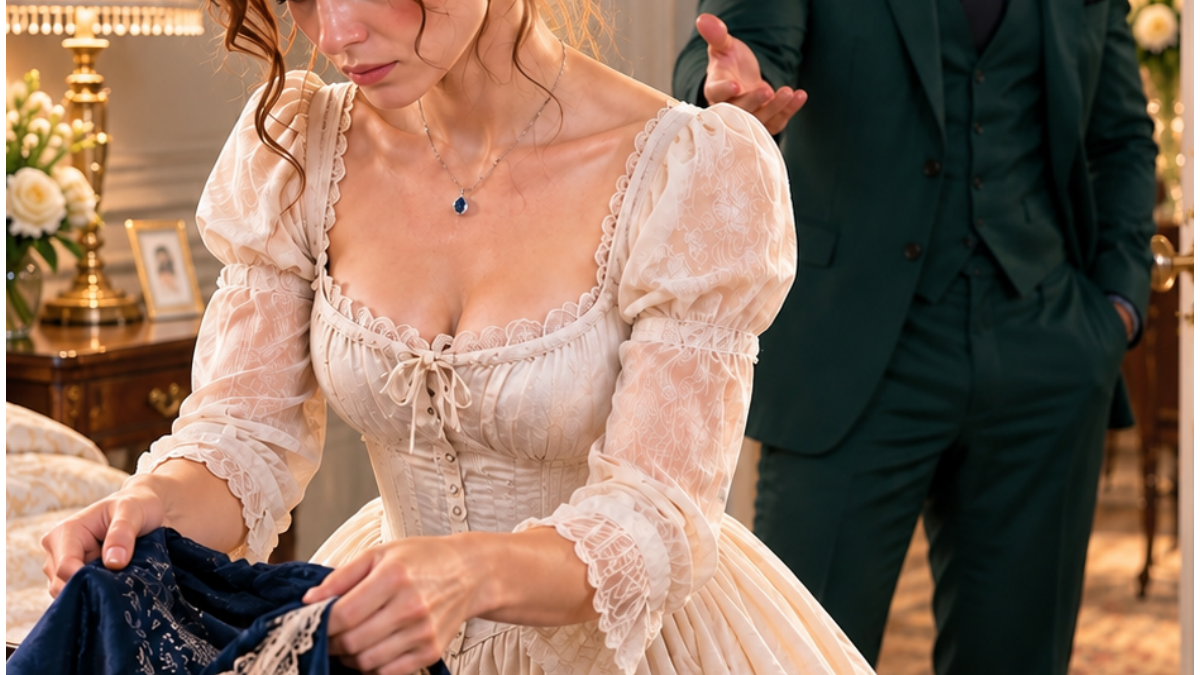
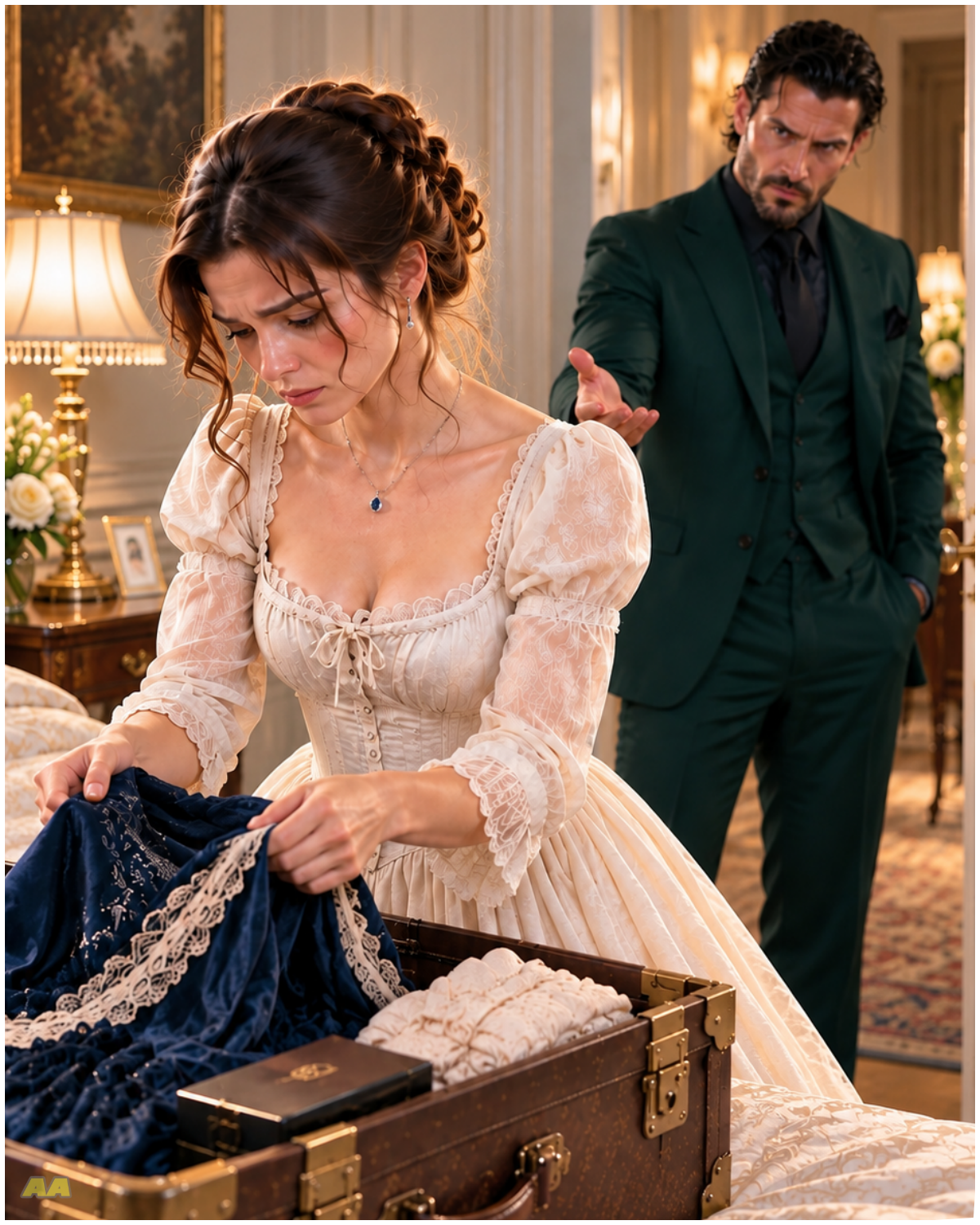
The suitcase was already half full when Victoriao Moretti understood that his wife was actually leaving.
He heard it before he saw it.
The soft, patient sound of fabric being folded, not thrown, not stuffed into a bag by a woman in a rage.
Folded corner to corner the way a person handles something she intends to keep.
He stopped in the bedroom doorway.
Elena knelt beside an old brown trunk with brass corners, its lid propped against the edge of the bed.
Morning light came through the tall windows and caught the lace at her sleeves, the loose curls slipping from her braided hair, the wet shine on her cheeks.
She still wore the cream dress from the night before, as if she had never gone to sleep.
In her hands was a dark blue gown trimmed in lace, and she laid it into the case as gently as she might have laid a sleeping child into a crib.
Victoriao had walked into rooms full of armed men with a steadier pulse.
Elena.
He lifted his hand toward her, palm open.
The gesture of a man who had never reached for anything he didn’t expect to stop when he wanted it to.
Enough.
She did not look up.
She reached for the next garment.
He waited for the tears to turn into shouting, and for the shouting to become a list of everything he had done wrong.
He knew how these nights went.
Last night his voice had carried through the whole east wing, and hers had grown quieter and quieter until it stopped altogether.
He had mistaken that silence for surrender.
Then he had gone to sleep in the study, certain that mourning would restore the order of things.
Now he looked at what she was packing, and something small and cold moved in his chest.
Not the diamonds, not the pearls asleep in their velvet cases on the dresser, or the emeralds he had commissioned for their fifth anniversary.
Elena was taking a small wooden box of letters, a photograph of her mother, a few books with cracked spines.
Nothing in that suitcase had been bought by him.
Everything in it had belonged to her before she ever learned his name.
“We had an argument,” he said.
“We’ve survived worse than an argument.”
Nothing.
He tried a gentler voice, one he used rarely and never in front of anyone.
You’ll come back once your anger fades.
Elena’s hands went still.
For the first time, she turned and looked at him, and it was not what he had prepared for.
Her eyes were red, her lashes wet, but her expression was calm.
Terribly, completely calm.
I’m not angry anymore, Vtorio.
A breath.
That’s why I’m leaving.
Victoria Moreti did not lose his composure.
It was the thing the city feared most about him.
He had ended a war between two families over a single dinner.
He had bought a port authority before its owner finished his coffee.
He had sat across from men who wanted him dead and asked politely about their daughters weddings.
Fear was something he produced, never something he felt.
He listened, he priced, he decided, and the room rearranged itself around his decision.
That was the whole method.
It had never failed him.
So he did what the method demanded.
He crossed the floor and took hold of the suitcase.
Elena did not fight him.
She simply drew it back toward her.
Gently, the way you take a fragile thing from a child who doesn’t yet understand what it is.
Please don’t make this harder than it already is.
Nobody had ever told Victoriao no softly.
People said it in terror or in fury or with a gun in their hand.
Elena said it like a woman closing a book she had finished reading.
Every instinct he owned told him to end this quickly.
Call for the driver, lock the door, put a man at the foot of the stairs.
He had solved every problem of his adult life by removing the other person’s ability to say no.
But there was no one to remove.
There was only his wife kneeling in the morning light, asking him kindly to let her go.
He felt it then.
The first hairline crack in a wall he had never known was there.
She fastened the brass clasps one by one, each click small and final.
She rose, smooth the lace at her wrist, and lifted the case.
It was lighter than it should have been, packed by a woman who knew exactly how little she needed.
She walked past him so closely he caught her perfume, jasmine, and something warmer beneath it.
He waited for her to turn at the end of the corridor.
She didn’t.
He waited for her to turn at the landing.
She didn’t.
At the top of the stairs, he stopped waiting.
Far below, a door opened and closed.
Then the house was silent.
She’ll return once her anger fades, he said to the empty corridor.
At the far end of the hall, a young maid carrying folded linen stopped walking.
She couldn’t have been more than 20.
Her knuckles were white against the cloth.
She lowered her eyes and did not come toward him.
In 8 years, no one in the Moretti mansion had ever avoided walking past him.
They knew.
He understood it the way he understood a room a moment before a shot was fired.
The maid knew.
Perhaps the whole household knew.
He thought of the way the kitchen girls had begun to hush when he entered, and how he had taken it for respect.
Everyone in this house had been part of a conversation from which he alone had been excluded.
He turned back into the bedroom.
At first, everything looked ordinary.
The bed with its ivory coverlet, the white roses on the nightstand, the lamp Elena liked, still burning in the daylight.
On the dressing table lay a single sheet of paper folded once.
He opened it blank.
He turned it over blank on both sides.
He could not have said why.
He slid it into his breast pocket.
Then he saw the wardrobe.
One door hung open.
Inside a row of bare hangers, spaced evenly, perfectly still, as though someone had taken the time to straighten them.
The shells were wiped clean.
On the floor, where a dozen pairs of shoes should have stood, there was only a pale rectangle of untouched wood.
The air smelled faintly of cedar and of her, and already less of her than it should.
He stood there a long moment, and the truth arrived in pieces.
A woman who packed in anger left drawers hanging open and sleeves trailing from the lid.
This wardrobe had been emptied slowly weeks ago in careful stages by someone patient.
The suitcase by the window hadn’t been the beginning of anything.
It was the last of it.
The question came without permission, and it was worse than any he had ever faced across a negotiating table.
How long had she been planning this?
This was not an argument.
It had never been an argument.
Vtorio did not shout.
He had never needed to.
He pulled the bell cord in the upper hall three times, and within five minutes the entire household stood in the marble foyer below him, cooks with flower on their sleeves, maids with their caps a skew, gardeners and muddy boots.
He came down the staircase slowly, the blank sheet of paper still folded in his breast pocket.
Nobody met his eyes.
My wife left this house a few minutes ago, he said.
One of you will tell me where she went.
Silence.
Somewhere in the kitchen wing, a pot lid rattled and was hastily stilled.
Then Rosa Bellini stepped forward.
She was 56, gray at the temples, and had run the household for 11 years with a ring of keys at her waist, and not one wasted word.
She did not lower her gaze, and that was the first thing he noticed.
“I don’t know where, sir,” Mrs. Moretti didn’t say.
Then tell me what you do know.
She said her goodbyes last night after you had gone to the study.
Rosa chose each word like a woman crossing ice.
To every one of us quietly, she thanked us.
She asked us to look after each other.
A car waited at the service gate from before Sunriser.
It wasn’t one of ours.
Every one of them.
Elena had walked through his house in the dark, saying goodbye to the people who worked for him while he slept in a leather chair, believing the quarrel was over.
She’s gone somewhere close, Victoria said.
It was not a question, and he made sure it didn’t sound like one.
A hotel, that friend of hers, across the river.
She wanted a night away to frighten me, and it has worked.
Dismissed.
They scattered like startled birds.
Only Mateo Reichi remained by the door, his dark coat still buttoned as though he had never gone to bed.
Mateo was 34 and had stood at Victoriao’s shoulder through two wars and a funeral.
She’ll be back by tonight, Victoria said.
Matteo said nothing.
It was a small silence.
A lesser man would have missed it.
But Vtorio had built an empire on hearing what people declined to say.
And this one crawled under his skin like an insult.
“When I speak to you, I expect an answer. You didn’t ask me a question,” Mateo said evenly.
Vtorio’s jaw tightened.
He turned away and climbed the stairs two at a time, something he had not done since he was a boy.
Back in the bedroom, he shut the door and searched it the way he would search a rival’s office, drawer by drawer, without sentiment.
The walnut jewelry box that had been her mother’s, worn smooth at the corners, gone.
The crystal bottle of Jasmine perfume she ordered from a shop whose name he had never bothered to learn.
Gone, leaving a clean circle on the glass tray, on the shelf by the window.
Her books had left gaps like missing teeth.
The photograph drawer was empty.
So was the one where she kept her papers, the ones he had once offered to lock in his safe, and she had politely refused.
And on the nightstand, where a small silver frame had held a picture of her mother laughing.
There was only a square of unfaded wood.
He straightened.
He had expected fury.
What came instead was a slow, sick disorientation, like reaching for a stare that wasn’t there.
Because everything else was still here.
The emerald set lay in its case on the dresser.
Beside it, the pearls in the open top drawer, the diamond necklace he had flown a man to Antwerp to select.
Enough stones to buy a small street.
If Elena had wanted to punish him, she would have taken them.
If she had only wanted to survive, she would have taken them.
Instead, she had left them behind like receipts for a debt she had stopped owing.
Everything she had taken was worth almost nothing to anyone but her.
She hadn’t been stealing his fortune.
She’d been collecting herself piece by piece from every corner of his house.
A soft knock.
Rosa stood in the doorway, hands pressed flat against her apron as though holding something in place.
Sir, before Matteo’s men tear the city apart, there is something you should hear.
Then say it.
Mrs. Moretti asked me about apartments last spring.
Small ones, cheap ones.
She wanted to know how much a person needs each month to live alone.
Rose’s voice wavered, then steadied.
I told myself she was asking for a friend.
I wanted to believe that.
She drew a thick cream envelope from her apron.
3 weeks ago, she put this in my hands.
I said I couldn’t take it.
She said, “You’ll need it before I do.” Rosa swallowed.
My mother has been ill since winter, sir.
The treatment costs more than I earn in a year.
She was the only one I told.
11 years Rosa had poured his coffee.
He had not known her mother was ill.
11 years, he said, and I never knew.
No, sir, Rosa said without cruelty.
You didn’t.
The room tilted.
He heard himself asked the only question that mattered.
How long has she been planning this?
Rosa’s fingers tightened around the envelope.
She looked at the floor, then at him, like a woman choosing between two kindnesses.
6 months.
6 months.
The calendar rearranged itself behind his eyes.
Every late night he had come home to find her already asleep or pretending to be.
Every dinner she had sat across from him, turning her wine glass by its stem, saying almost nothing.
And one night in particular, candle light, a phone still warm against his ear.
Elena’s voice light as a dropped ribbon.
If I ever wanted something different, would you let me go?
He had laughed.
He remembered it now with a clarity that made his hands curl.
He had laughed, crossed to her chair, kissed her forehead, and said, “You have everything you could ever want.” She had smiled.
He had taken it for agreement.
It had been the look of someone deciding not to ask twice.
She had asked him about freedom, and he had answered with an inventory.
He left Rosa standing there and found Mateo at the foot of the stairs.
“Find her,” he said.
Every driver, every hotel, every road out of the city.
Matteo drew out his phone.
His thumb was already moving when Victoriao added quietly, “Bring her back.” The thumb stopped.
It was barely a hesitation, but Victoria heard it, and his voice dropped into the register that had once made a district attorney rewrite his testimony.
“Did you hear me?” Mateo lifted his eyes.
He looked less like a soldier than a man asked to carry a message he knew would never be welcome.
Yes, boss.
It was the correct answer.
It did not sound like a promise.
In his breast pocket, the blank sheet of paper pressed against his heart.
Elena had spent 6 months preparing for this morning.
Vario had known for less than an hour.
Vtorio just realized his wife planned her escape for six months without him noticing a single sign.
If you want to see how deep this unravels and whether a man like him can survive losing control, subscribe now and turn on notifications so you never miss the next chapter.
Vtorio sat alone in the bedroom for a long time after Rosa left.
The blank sheet of paper still folded against his chest like a wound that hadn’t started bleeding yet.
He tried to remember the last 6 months the way he remembered a negotiation moment by moment, detail by detail, and found to his horror that most of it was missing.
He had been in the room.
He had not been paying attention.
He closed his eyes and a memory rose up uninvited.
3 months ago.
The dining room candle light.
A bottle of bo he’d been saving.
The Genevese shipment clears customs Thursday, he’d said, cutting into his food without looking up.
After that, the North Route is ours outright.
Elena had nodded, turning her wine blast slowly by its stem.
A habit he’d found charming once back when he still noticed things about her.
Enzo’s mother is in the hospital again, she’d said.
The boy who runs receipts for you.
He hasn’t slept in days.
Victoria had waved a hand, already thinking about the shipment.
I’ll have someone handle it.
I already did, Elena had said quietly and reached for the bread.
He hadn’t asked what she meant.
He hadn’t asked how.
He had simply filed it away as one of her small kindnesses, the sort of thing wives did, and moved on to desert.
Now, sitting in the wreckage of her closet, the sentence came back to him with its true weight.
I already did, not I will, not someone should.
She had already acted quietly, competently, without waiting for his permission or his money, and he had been too busy discussing customs routes to hear what she was telling him about herself.
How many times had she said something like that?
How many small sentences had he let pass through him like water?
Mateo found him there an hour later, standing motionless in the ruined wardrobe.
I have something, Mateo said.
And there was a note in his voice Vtorio didn’t like.
Not fear exactly, but the careful tone of a man delivering news he already knew would land badly.
Tell me.
She met with a banker on Tuesday, not one of yours.
An independent small branch other side of the river.
She’s been moving money there for months.
Her own money boss.
The allowance you give her untouched for years sitting in an account you never looked at.
Matteo paused.
She also saw a property agent twice and picked up copies of her documents from the notary birth certificate, the papers from before the marriage.
Bought a car service under a different name, her maiden name.
Borio’s face didn’t move, but something behind it did.
She used none of my accounts.
None.
Nothing that could be traced back through us.
She was careful, boss.
Very careful.
Mateo hesitated, then added, “She bought groceries yesterday. Basic things: towels, sheets, a kettle, a kettle, a kettle.”
Vtorio almost laughed, and the sound that came out instead frightened him a little because it wasn’t a laugh at all.
Where is she? Mateo told him.
An address across the city in a neighborhood of narrow streets and small shops where Vtorio had never once done business.
Never needed to, never bothered to learn the names of the men who ran things there because there was nothing there worth running.
A modest building, third floor, two bedrooms, a small kitchen, a balcony barely wide enough for a chair.
That can’t be right, Ritio said.
She could have anything.
A house on the coast, a suite at the grande.
She has taste.
She always had taste.
He shook his head as if refusing the information might undo it.
Why would she choose that? Mateo was quiet for a moment.
Then he said simply, “Maybe because it’s hers.”
The words landed somewhere Victoriao hadn’t expected to be hit, and his answer came out sharper than he meant it to.
Everything in that house was hers.
She wanted for nothing.
“That’s not what I meant, boss.”
Mateo didn’t flinch from him, which was rare enough that Vtorio noticed it, even through his anger.
I meant nobody gave it to her.
Vtorio told him to get out.
Mateo went, but the sentence stayed in the room after he’d gone, circling, refusing to be dismissed the way everything else could be dismissed with a word and a wave of his hand.
Across the river in a small apartment with mismatched furniture and a crack in the ceiling, plaster shaped like a river delta, Elena Moretti sat down her suitcase for the last time.
The apartment was smaller than her bedroom at the mansion.
Smaller, in fact, than her old dressing room alone.
The paint on the far wall had been touched up unevenly by whoever lived there before, leaving a faint rectangle of a different white.
The couch sagged a little on one side.
There was a kettle on the stove that wasn’t hers left by the last tenant, and she found she didn’t mind.
She walked to the window and pulled back the thin curtains, and gray afternoon light spilled across a floor that had never been swept by anyone but its owner.
For a long moment, she simply stood there breathing.
No one was arranging a room for her arrival.
No one would ask what she planned to wear tonight, or which men she should smile at and which she should avoid, or whether her silence at dinner had offended someone whose feelings mattered more than hers.
There was no schedule waiting behind her, no version of herself she had to become.
The moment she stepped through a door, she sat down on the sagging couch in the small apartment with the crooked paint, and she cried.
It wasn’t grief.
She checked for it the way you check a wound to see how deep it runs and found only relief there and underneath.
The relief something roar, the simple bottomless exhaustion of a woman who had spent 8 years holding her breath and had only just now remembered how to let it go.
She cried the way people cry after carrying something too heavy for too long the moment it’s finally set down.
Outside her narrow balcony, the city went on without knowing her name.
Back at the mansion, Vtorio sat at Elena’s writing desk and went through what remained of her papers.
The ones she hadn’t taken the discarded drafts and receipts too small to matter to her, too small for her to think he’d ever see them.
Tucked beneath a stack of old correspondents, he found a single bank statement printed and folded, the account number circled once in her careful hand.
The balance was modest by his standards.
To anyone else, it would have looked unremarkable.
To Vtorio it looked like a verdict.
He did the arithmetic without wanting to rent on a small apartment groceries the quiet ordinary cost of one woman’s life and understood with a cold clarity that had never once failed him at a negotiating table and had never once heard him like this that the number in front of him would last her years.
She hadn’t run from him in a panic.
She hadn’t fled in fear, hoping he wouldn’t follow, hoping to be caught and forgiven.
She had built herself an exit brick by brick for 6 months in full view of a man who prided himself on missing nothing.
She planned for a life without me.
He whispered to the empty room and for the first time since he was a boy standing over his father’s grave.
Victoria Moretti felt something close cold and entirely unfamiliar settle into his cheSt.
Fear.
When Victoria pushed open the bedroom door again, he expected the same wreckage he’d left behind.
The bare hangers, the pale rectangle on the closet floor, the ghost shape of everything Elena had taken.
What he found instead stopped him in the doorway a second time.
Two maids were stripping the bed, folding the ivory coverlet into careful thirds.
The wardrobe doors stood open on nothing at all.
Not even the bare hangers now.
Someone had cleared those, too.
The dressing table had been wiped down to bare wood.
Its surface catching the light with nothing to interrupt it.
Even the white roses that had sat on the nightstand that morning, still burning with the lamp beside them, were gone, vase and all.
“Who ordered this?” Victoriao said.
His voice came out quieter than he meanted to.
One of the maids froze midfold.
“Signalini, sir.”
She said the room should be.
She stopped herself, searching for a word that wouldn’t sound like what it was.
Put in order.
Erased, Victoria thought.
That was the word she wouldn’t say.
He waved them out without another word and stood alone in a room that no longer had a single trace of the woman who had slept in it for 8 years.
And something about the thoroughess of it frightened him more than the suitcase had that morning.
A woman running from a fight left mess behind her.
A woman who was finished left nothing.
He was turning to leave when he saw it.
On the windowsill, face down was a single silver frame.
He crossed the room and picked it up.
And even before he turned it over, he knew what it was.
He could feel the shape of the memory through the metal.
Their wedding photograph.
Elena in white laughing at something just out of frame.
Her veil caught mid-motion by a wind that no longer existed anywhere except in that instant to film.
Boria beside her, younger, unlined, his hand at the small of her back with the easy confidence of a man who had never once imagined losing anything he decided to keep.
She hadn’t taken it with her.
She hadn’t thrown it away either.
She had simply turned it face down.
The way you set aside a book you no longer intend to finish.
He remembered standing at that altar with a certainty so complete it had never once needed examining.
She will never leave me.
Not because he’d asked her to promise it, because it had never occurred to him that leaving was a door she could open.
He had built walls around her so carefully, filled every room with so much comfort that he’d mistaken the absence of complaint for the absence of want.
He set the photograph down, face up this time, and opened the drawer of the nightstand out of habit more than hope.
Inside were four envelopes, each sealed, each labeled in Elena’s careful hand.
The first held cash, more than a young household worker would see in half a year, addressed to a kitchen girl whose name Victoriao had to think twice to recall.
The second was a letter of recommendation, WMAN specific, praising a gardener’s work in a way that suggested Elena had actually watched him work.
The third contained instructions, a pediatrician’s name, an address, a schedule of appointments for a larress’s daughter who’d been sick in spring.
A fact Victoria was hearing for the first time in his own house.
The fourth envelope stopped him completely.
Inside was a single sheet of paper with a lawyer’s name and number and beneath it in Elena’s handwriting a short precise sentence.
If Victoriao attempts to interfere with any arrangement I have made for these people, contact this office immediately.
Everything has been done through legal documented channels.
She had anticipated him, not guested.
Pirissicipated the way he anticipated a rival’s next move, methodically in writing, with a lawyer’s name attached in case her instincts about him proved correct.
She had built a wall of her own, and he was standing on the wrong side of it.
He was still holding the envelope when Rosa appeared in the doorway, a stack of linens in her arms that she didn’t seem to know what to do with anymore.
“You should know something, sir,” she said.
And there was a steadiness in her voice he hadn’t heard from her before, not once in 11 years, since it seems no one else intends to say it.
Say it then.
Rosa set the linens down on the bare mattress as if she needed her hands free.
You kept protecting Elena from the world, sir.
The gates, the drivers, the men at the door.
You built walls around her so nothing could touch her.
She met his eyes and did not look away.
You never noticed she needed protecting from the life you gave her.
For a moment, Victoriao felt the old anger rise in him.
Quick and familiar, the reflex of a man not used to being told anything he hadn’t asked to hear.
His jaw tightened.
He opened his mouth to say something that would have ended the conversation.
And very possibly Rose’s 11 years of service along with it, but the words wouldn’t come because some smaller, colder part of him was already turning her sentence over and finding that it fit.
He didn’t dismiss Rosa.
He didn’t say anything at all.
She gathered the linen’s back into her arms after a moment and left him standing there.
And it was only once her footsteps had faded down the hall that a memory surfaced he had not thought of in years.
A year ago, perhaps more.
This same bedroom, a different night.
I’d like an account of my own, Elena had said, not looking up from the book in her lap.
Something separate.
Something that’s only mine to manage.
Vtorio had laughed not unkindly.
The way you laugh at a child asking for something already given a hundred times over.
Why do you need that? Everything I have is yours.
Elena had looked at him then, and there had been something in her face he hadn’t understood at the time.
Not hurt exactly, but a kind of tired clarity.
The look of a woman filing away one more piece of evidence.
That’s exactly the problem, she’d said.
He hadn’t asked her to explain.
He’ taken it for one of her moods and gone back to his papers, certain that whatever she meant, it would pass, because everything about their life together had always eventually passed back into its proper order, his order.
He understood it now, standing in a room with nothing left in it but a stripped bed and a photograph he’d set right side up.
Everything he’d given her had been his to give, and therefore, in some fundamental way his to take back.
She had never had anything of her own to stand on.
Not a room, not a bank account, not a single decision that didn’t run, in the end through him.
He had called it love.
She had called it correctly a problem.
He crushed to the bed and sat down on his own side out of old habit, and his eyes fell on the other side, smooth bare stripped down to the mattress ticking.
Nothing left to even suggest a woman had ever slept there.
The mansion had 41 rooms.
He had commissioned each one himself, filled them with marble and silk and things that cost more than most men earned in a lifetime.
And he had always thought of it as magnificent.
Sitting there looking at the empty half of his bed, Victoria Moretti understood for the first time that a house could be enormous and still be nothing at all.
Vtorio is finally seeing the truth about the marriage he thought was perfect, and it’s breaking him in ways his enemies never could.
The real transformation is just beginning.
Subscribe now so you’re here for every twist as this powerful man learns what he lost and whether he can win it back.
It took Matteo 11 hours to find her.
Boro was in his study when the message came through.
A single line, an address, nothing more.
The way he trained his men to report anything that mattered.
He read it twice, then stood so fast the chair scraped back against the floor and nearly toppled.
He was halfway to the door, already reaching for his coat.
His mind assembling the shape of the next hour, the way it assembled everything, who to bring which entrance, how many men would be enough to make the point without making a scene the neighbors would remember.
It was, he realized later, the easiest plan he had made in years.
He had solved harder problems before breakfaSt.
His hand was on the door when her voice stopped him, not in the room, in his memory, clear as if she’d spoken it that second.
Please don’t make this harder than it already is.
He stood there with his palm flat against the wood.
And for the first time all day, the method failed him.
Not because he didn’t know what to do, but because he understood with a clarity that felt almost physical exactly what doing it would mean.
He knew how to find her.
He had already found her.
He knew how to make a building superintendent forget he’d ever seen a woman with dark hair carry a suitcase up three flights of stairs.
He knew how to have four men in the stairwell before she finished her coffee, and how to have her home by dinner, quiet, contained, a story the household would never repeat.
He had built an empire on exactly this kind of certainty.
And that was precisely the problem, because if he did any of it, if he sent one man, one car, one knock on one door, he would be proving in the clearest possible terms that she had been right to run.
He stood in the doorway a long time, his coat still in his hand.
When he finally turned around, Matteo was waiting in the hall phone still lit with the address on the screen, watching him with the careful patience of a man who had learned to read his boss’s silences the way other men read contracts.
Find out where she is, Victoriao said.
Nothing more.
Mateo’s brow moved just slightly.
You don’t want us to bring her back.
Victoria looked at him for a long moment.
Somewhere behind his ribs, a version of himself he barely recognized was screaming.
That this was madness.
That a man like him did not simply let things walk away.
That the whole city was built on the understanding that Victoriao Moretti’s word was the last word spoken in any room he entered.
No, he said it was one syllable.
It was, he thought, one of the hardest things he had ever said aloud.
Across the river, Elena’s days had begun to take on a shape of their own.
Small and unglamorous and entirely hers.
She had found within the first week a group of women who worked the morning shift at a bakery two streets over flour under their nails tired eyes.
The particular exhaustion of women who worked 12 hours to feed households that never quite thanked them for it.
She began sitting with them on her breaks, listening.
One needed help understanding a lease she’d been handed.
Another had a daughter who wanted to go to university and no idea how the applications worked.
Elena, who had spent eight years being decided for, found she still remembered how to decide things and that she was good at it better than she’d ever been permitted to discover.
She bought flowers from the cart at the corner, cheap ones, slightly wilted by afternoon, and put them in a jar because she didn’t own a vase.
She burned the first three dinners she tried to cook and laughed about it alone in her kitchen, which surprised her more than the burning did.
She made decisions all day long.
What to eat, when to sleep, which women to help first, and nobody asked her to explain any of them.
But the nights were harder.
She would sit by the narrow balcony after the city had gone quiet and feel the specific aching shape of missing him.
Not the house, not the diamonds gathering dust in a case he probably still refused to move, but him, the man he’d been in the rare, unguarded hours before the empire had finished swallowing him whole.
She loved him.
She understood, sitting there, that leaving him and stopping loving him had turned out to be two entirely different things, and that nobody had warned her how much harder the second one would be.
It was Gabriel Santoro who helped her open the account.
He was a quiet, unremarkable man in his 40s who ran a small consultancy for women starting businesses with nothing behind them but nerve and Elena had been referred to him by one of the bakery women.
They met twice over coffee papers spread across a cafe table.
Gabriel walking her patiently through the language of ledgers and licenses that Victoriao had never once thought to teach her because Vtorio had never imagined she would need it.
The photographs reached Vtorio 2 days later.
Grainy taken from across the street.
Elena leaning over a table toward a man he didn’t recognize.
Both of them smiling at something on a page between them.
The rage arrived before the thought did.
He was halfway through demanding the man’s name and address when Mateo standing across the desk said carefully, “Boss, he’s not. It’s not what you’re thinking. Then what is it?” Gabriel Santoro.
He helps women set up independent accounts, small businesses.
Legitimate boss.
She’s opening something in her own name.
A consultancy of her own from what our contact says.
Nothing to do with you.
Nothing to do with any man.
Ptorio stared at the photograph a long time after Matteo left the room.
He had been so certain so instantly that another man was the explanation because a man was a thing he understood, a rival he could measure and remove.
It had not occurred to him, not once, that Elena might not be looking for someone to replace him at all.
She was looking for someone to help her become a person who didn’t need replacing anyone.
She wasn’t building a new marriage in secret.
She was building herself brick by brick the same slow and patient way she’d built her exit.
And somehow that was harder to sit with than jealousy would have been because jealousy he knew how to fight.
And this he didn’t.
The message arrived that evening.
A single line on a screen he had been checking every hour without admitting it to himself.
I’m safe.
Please stop looking for me.
He read it until the words stopped looking like words at all.
He typed three replies and deleted each one before it left the draft.
Come home and then I’m sorry and then nothing, just her name, which felt somehow the most honest and the most useless of the three.
He set the phone down on the desk and sat with it a long time in the lamp’s yellow light.
Then he opened Mateo’s file, the address, the surveillance notes, the photographs, everything 11 hours of searching had bought him.
And one by one he deleted it all.
He went through her things the way a man goes through the ruins of a houseire, looking for something that might have survived.
Most of what remained was ordinary old letters from her mother, a hairbrush, a stack of theater programs from evenings he barely remembered attending.
He was nearly finished when his hand found the false bottom of her writing desk, a small mechanism he hadn’t known existed in 8 years of living beside it.
Inside was a locked drawer.
He broke it open with a letter opener because there was no key, and he no longer had the patience to search for one.
Inside were pages, not one letter, several different inks, different handwriting speeds, as though written across months rather than days.
He sat down on the floor of the ruined room, still in his shirt sleeves, and began to read.
The first was dated over a year ago.
Her handwriting was looser then, almost eager.
Vtorio, I keep starting this and not knowing how to finish it, so I’ll just say the thing plainly.
I miss you.
Not the man who comes home and falls asleep before I finish a sentence.
The man who used to sit with me on the balcony and ask what I was reading.
I know the business takes everything from you.
I only want a little of what’s left.
It was unfinished.
No signature.
He set it aside and picked up the next.
I have stopped waiting for you to notice I’m lonely because I don’t think you’d know what to do with the information if I told you.
I’m not writing this to send it.
I’m writing it because I need to say it to someone, even if that someone is only this page.
The third was shorter, sharper.
The ink pressed hard enough to nearly tear the paper.
You bought me a bracelet today because I mentioned once in passing that I liked the shape of it in a window.
You didn’t ask why I was quiet at dinner.
You solved a problem I never had.
Instead of asking about the one I did, I don’t want you to buy my silence.
I want you to earn my company.
The fourth made something in his chest fold inward.
I don’t think anyone in this house sees me anymore.
Not you.
Not the girls who dress me for events.
I don’t choose to attend.
Not the men who nodd at me like a piece of furniture that happens to be married to their boss.
I used to think I minded being unseen because it was lonely.
Now I think I mind because I’m starting to forget what I look like when someone actually looks.
The fifth letter was dated only three months before she left.
And it was the one that made him put the pages down on his knee and press the heel of his hand against his eyes.
I am becoming someone I don’t recognize.
A woman who smiles at dinners she despises.
Who thinks men she doesn’t truSt.
Who has learned to disappear so completely inside a room that she sometimes forgets to reappear when she’s alone.
I don’t know when I stopped being Elena and started being only Mrs. Moretti.
I would like to find her again before there’s nothing left to find.
The last letter had no date.
The handwriting was steady, deliberate, as though she’d already decided this one, unlike the others, might actually be read one day.
Victoriao, I have tried to say this to your face a dozen times, and each time you’ve answered a question I didn’t ask.
I’m not writing to explain myself anymore.
I’m writing because I think there’s one sentence you need whether or not you ever see the rest of this.
I don’t think you know the difference between keeping me safe and keeping me trapped.
It ended there.
No closing, no signature, just the sentence sitting alone on the page like something she’d sat down and then walked away from before it could finish breaking her.
Victoria sat on the floor of the empty room for a long time.
The pages spread around him like something exumed.
He understood finally that it had never been the argument.
The argument had only been the last stone on a wall he’d been building for 8 years without ever noticing he held the trow.
Every I’ll handle it.
Every You don’t need to worry about that.
Every trust me, said instead of tell me.
He had spent a marriage deciding for her and calling it devotion.
And somewhere in all that deciding he had never once asked what she wanted decided.
He had believed completely that he was loving her.
She had experienced it as a cage with excellent furniture.
Enzo found him there an hour later still on the floor.
The letters gathered now into a single stack on his knee.
Boss, you should eat something.
Enzo hovered in the doorway the way men did when they didn’t know which version of Vtorio they were about to meet.
Give her a few weeks.
Women come home.
They always do.
Vtorio looked up at him and something in his face made Enzo stop leaning against the frame and stand up straight instead.
“She’s not coming back because we’re waiting for her,” Victoriao said.
Enzo blinked.
“Boss, if she comes back,” Victoria said, and the words cost him something to say.
“Something he didn’t have a name for yet. It will be because she chooses to.” Enzo said nothing.
It was perhaps the first time in 11 years that Victoriao Moretti had said a sentence about his wife that wasn’t a plan.
That evening, Elena’s phone lit up on the small table by the sagging couch.
She almost didn’t look.
She had trained herself over the last week not to hope every time it buzzed.
But something made her turn it over.
I understand that you’re safe.
I won’t come looking for you.
When you’re ready, I’d like to hear what I refused to hear before.
No demand, no apology stuffed with reasons that would have made it about him instead of her.
No mention of the house, the money, the life he could restore with a single phone call.
She read it once, then again, then a third time, sitting very still in the lamp light with the narrow balcony door open behind her, and the city breathing quietly beyond it.
She did not answer, but she did not delete it either.
She set the phone face up on the table where she could see it.
The way you leave a door unlocked without deciding yet whether you want anyone to walk through it.
For the first time since the morning, she had folded a dark blue gown into a trunk and walked past him without turning around.
Alena let herself imagine what it might be like to stand in a room with Victoriao Moretti again, not as his wife, arranging her face for whatever the evening required of her, not as an asset in a portfolio of things he had acquired and intended to keep, just as herself.
The woman who had once packed a suitcase in the quiet, unhurried way of someone who knew exactly what she was worth, and had finally, 6 months, and one small apartment later, begun to believe it.
Four months had passed since the morning.
The suitcase closed with three small clicks, and the mansion Victoria Moretti had built to be unshakable had, in quiet ways, been entirely remade.
He no longer touched Elena’s accounts, not because a lawyer had forced the arrangement, but because he had signed the papers himself, unprompted, and told no one to make note of the date.
He had stopped asking the staff to report where she went, who she saw, what she said at dinners.
He wasn’t present for.
He had in fact told Rosa plainly that whatever loyalty the household felt, it no longer needed to run through him.
Rosa now managed the estate’s affairs with a set of keys that opened doors.
Even Vitario no longer asked about when men beneath him disagreed with the decision he had begun, however awkwardly, to ask them what they thought before he told them what he’d already decided.
He did not know if any of it mattered.
He had made the changes without any promise that they would be witnessed.
Let alone rewarded.
And some nights that uncertainty sat heavier on him than any rival ever had.
Then on an ordinary Tuesday afternoon, Elena came home not because he had asked, not because Mateo had found her, or because 6 months had worn her down into surrender.
She came because she had left behind a small wooden music box that had belonged to her grandmother, tucked at the back of a shelf, too high for the wardrobe surge to have found it, and she wanted it back.
She let herself in through the service gate the way she had left and walked the familiar corridors with an expression Vtorio would later struggle to describe.
Not nostalgia exactly and not discomfort, but the careful attentiveness of someone revisiting a place they used to live and finding it both exactly the same and entirely unfamiliar.
He was in the study when Rosa told him he didn’t call anyone.
He didn’t send for Matteo.
He walked to the top of the staircase himself and there she was in the marble foyer where he had once gathered the whole household to demand an answer nobody would give him.
He didn’t rush toward her.
He didn’t reach for her hand the way he had reached for the suitcase that morning, certain that his grip alone could keep something from happening.
“Hello, Elena,” he said.
“Hello, Victoria,” she answered.
The silence between them held everything neither of them had said in four months, and for a long moment neither moved to fill it.
They ended up in the same bedroom, though neither had suggested it.
It was simply where the conversation carried them, the way rivers find their old channels.
“I thought if I gave you everything,” Victoriao said, “you could never have a reason to leave.”
Elena stood by the window, her arms loosely folded, watching him with the same terrible calm she’d had the morning she left.
“You gave me everything,” she said, “except a choice.”
He absorbed that without flinching, without the old reflex to explain himself, to point to the pressures of the business, the expectations of his father’s world, the assumption that a wife in his position simply understood the terMs.
None of that came.
He had spent four months learning not to reach for it.
I loved you like something I was afraid to lose, he said instead, and his voice, usually so measured, came out rougher than he intended.
I should have loved you like someone who was free to leave.
Elena’s eyes shown, but she didn’t look away, and she didn’t cross the room to him either.
“Will you come back?” he asked finally.
It was the only question he had left.
And he asked it the way a man asks a question whose answer he has genuinely decided to accept whichever way it falls.
She didn’t answer right away.
Instead, she studied him for a long moment and asked, “If I say no, what will you do?” There it was, the test he hadn’t known he would be given, arriving without warning, the way the real ones always did.
“I’ll respect it,” he said.
He watched something in her shoulders ease some tension she’d been carrying since she walked through the gate and understood that this answer, not the confession, not the apology, not even the letting go of her money and her privacy was the one that mattered moSt.
She didn’t move back that day.
She agreed instead to see him.
Dinners outside the mansion walls and restaurants where no one at the door reported her comingings and going long evenings where he asked questions and for the first time in years actually waited for the answers instead of finishing her sentences with his assumptions.
There were no gods trailing precepts behind her.
No decisions made and presented to her as gifts.
It was slow.
It was more than once awkward in a way 8 years of marriage should have made impossible and somehow hadn’t.
But it was real in a way.
Their life together had stopped being real long before she ever packed a single dress.
It was several weeks later that she finally walked back into their old bedroom.
Not to take something this time, but because he had asked gently if she wanted to see what he’d changed.
The room was different.
The monument to their marriage.
The matching everything, the portraits, the excess that had always felt less like love and more like inventory, had been stripped back to something simpler, fewer things, more space to breathe in.
On the dresser sat the wedding photograph, and this time it was face up.
The two of them younger, laughing, caught in a moment neither of them could have known would need defending years later.
Beside it, lay a single folded sheet of paper.
Elena crossed the room slowly and picked it up, unfolding it, though she already knew what she’d find, blank on both sides, exactly as it had been the morning she left it on her dressing table without a word.
“You kept this?” she asked.
Victoria nodded from the doorway.
“It reminded me that I hadn’t been listening,” he said.
“A blank page. I filled in whatever I wanted it to say for months, and none of it was ever what you actually meant.”
Elena looked down at the paper a long moment, then folded it once more, gently, and set it back down beside the photograph.
She didn’t promise forever.
She didn’t tell him everything was forgiven because it wasn’t, not entirely, and they both understood that some things took longer than an apology to heal.
“If I stay, Vtori,” she said, “it will be because I choose to.”
“That’s the only way I want you to stay,” he answered.
Months earlier in this same room, Vitaria had watched Elena walk out with a suitcase and told himself with total confidence that her anger would fade and she would return.
He had been wrong about the shape of it, though not entirely wrong about the outcome.
Her anger had faded, not in days, but slowly, in a small apartment across the river, over quiet mornings with cheap flowers in a jar, and evenings spent helping women who had no one else to help them.
Somewhere in all that ordinary, unglamorous living, she had found the person she’d stopped being able to locate inside the marriage.
And when she finally stood in this room again, she was not the woman he had once assumed would always come back to him, because she had nowhere else to go and no other version of herself to return to.
She was the woman who now knew with absolute certainty that she could leave and had chosen this time on her own terms and for her own reasons to stay.
The empty room had proved Victoriao wrong.
The woman standing in it again was there not because she belonged to him, but because she had finally chosen him.
Elena’s journey from a packed suitcase to choosing to stay proves that real love was never about control.








