She Was Mistakenly Invited to the Duke’s Ball — By Midnight, He Asked Her Not to Leave
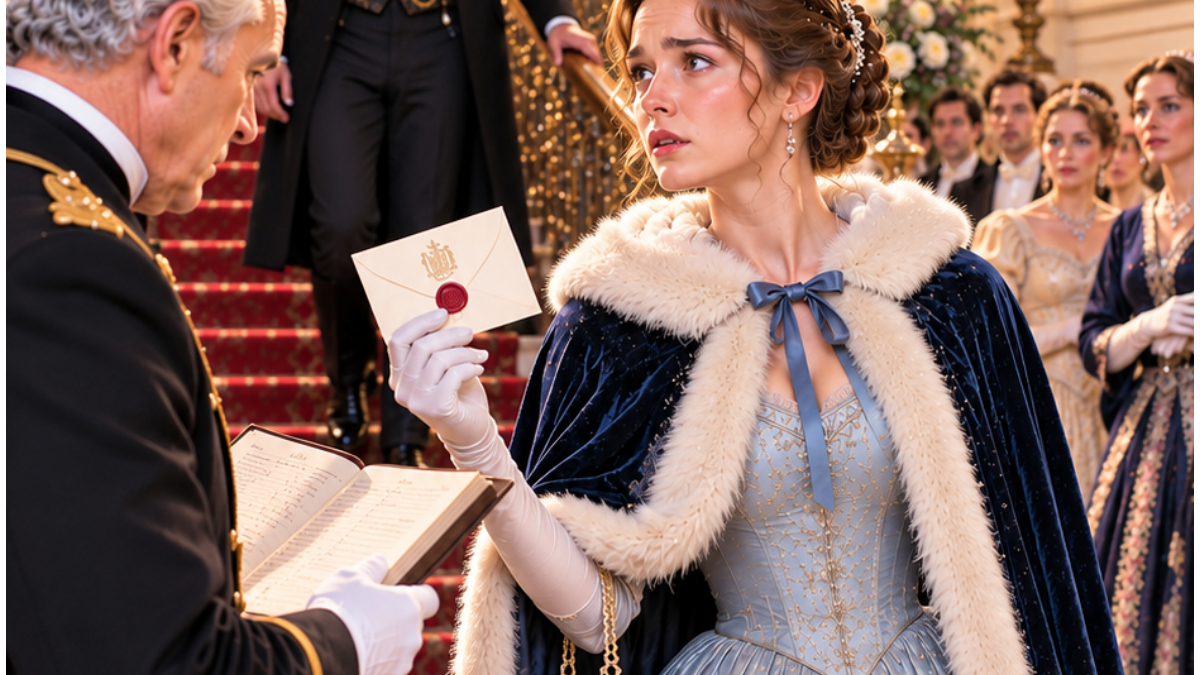
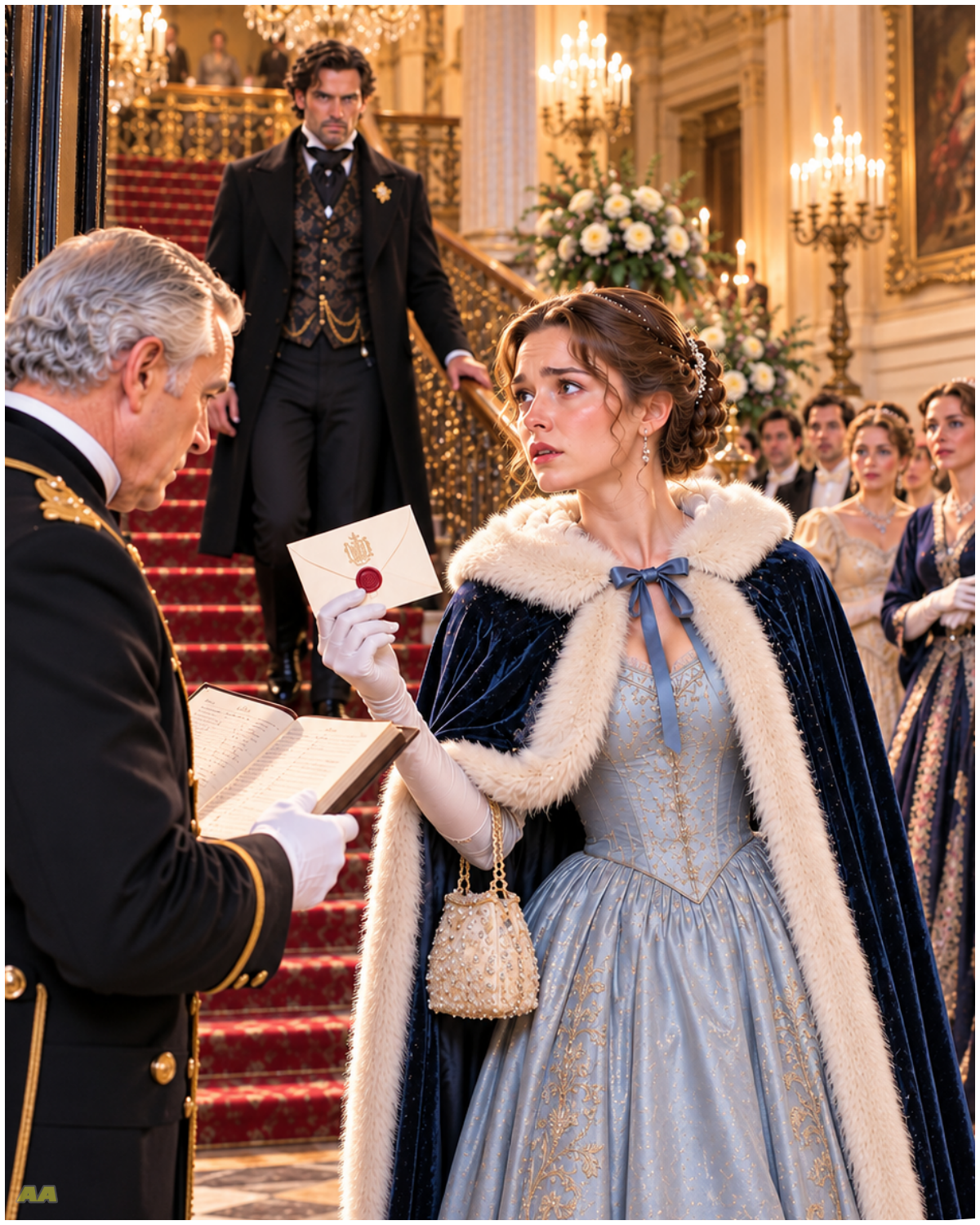
Your name is not on the list.
The words were spoken quietly, yet to Grace Whitmore they seemed louder than the orchestra beyond the gilded doors.
She stood beneath the towering entrance of Black Ridge House, with one gloved hand wrapped around an ivory invitation bearing the Duke’s private seal.
Behind those doors, nearly 300 guests moved beneath crystal chandeliers, their laughter mingling with violins and the soft rhythm of a winter walts.
Grace had traveled 12 miles through the cold to reach this place.
Now a silver-haired steward studied the guest register for the third time.
There must be some mistake, Miss.
Grace felt the warmth leave her face.
The invitation was delivered to me yesterday.
She offered it without trembling, though she had spent nearly a week’s wages on the carriage that brought her here.
The steward examined the seal.
His expression changed. It was genuine.
That seemed to trouble him more.
Grace became suddenly conscious of everything she had tried not to notice.
The carefully repaired seam of her mother’s dark blue gown, the tiny stitch across her left glove, the elegant women arriving behind her wrapped in velvet and winter fur.
She did not belong among them.
She had known that before leaving home.
Still, the invitation had named her plainly.
Miss Grace Whitmore, Black Ridge Winter Ball, December 19th, 8:00.
For one foolish evening, she had allowed herself to believe that perhaps the world had opened a door instead of closing one.
I understand, she said, lifting her chin.
I won’t cause embarrassment. Please return the card and I’ll leave.
She reached for it. Wait.
The voice came from above.
Conversations nearest the entrance softened.
Grace looked toward the great staircase.
A man stood halfway down beneath the amber light of a hundred candles, one hand resting against the dark walnut railing.
Nathaniel Hawthorne, Duke of Blackidge, needed no introduction.
Even Grace, who lived far beyond the glittering circles of high society, knew his face from newspaper engravings and the whispers attached to his name.
He was taller than she had expected, dressed entirely in black, except for the white at his collar.
There was nothing theatrical about him.
That made his presence more commanding.
His dark eyes moved from the steward to the invitation, then settled on Grace.
For one uncomfortable second, she had the strange impression that he was trying to remember her.
He could not. They had never met.
“Your grace,” the steward said carefully.
“The young lady possesses an authentic invitation, but her name does not appear anywhere in the register.”
Nathaniel descended another step.
Her name, Grace Whitmore. Something almost imperceptible passed across the Duke’s face.
Not recognition, something quieter, more troubling.
Grace wished desperately that she were already inside her hired carriage, moving through the cold streets toward the small room where nothing glittered and no one questioned whether she belonged.
“I apologize.” Your grace, she said.
I believe the invitation reached me by mistake.
Nathaniel’s gaze dropped to the ivory card in the steward’s hand.
The Black Ridge seal gleamed red beneath the candle light.
Then he looked at Grace again.
Around them, several guests had stopped pretending not to listen.
Grace extended her hand for the invitation.
I’ll leave. The Duke remained silent long enough for humiliation to begin burning beneath her composure.
Then his expression changed, though only slightly.
“No,” he said.
Grace’s hand stopped.
Nathaniel Hawthorne descended the final steps, turned toward the steward, and spoke with the calm certainty of a man accustomed to being obeyed.
Let her in. Lady Victoria Langford had spent enough winters in noble houses to recognize danger before anyone else was willing to name it.
It rarely arrived loudly. Sometimes it entered wearing an old blue gown and repaired gloves.
From across the ballroom she watched Nathaniel remain beside Grace Whitmore when custom gave him every excuse to move away.
That alone was unusual. Nathaniel was never rude to his guests, but courtesy was something he distributed with careful economy.
He spoke when required. He listened when necessary.
He smiled so rarely that society had learned to treat the smallest change in his expression as an event.
Tonight, Grace had already caused two.
“You are being observed,” Nathaniel said.
Grace kept her attention on the winter landscape before them.
I noticed. Does it trouble you?
Would it change anything if it did?
Nathaniel studied her profile. Most women he met inside rooms like this understood precisely what his title could offer them.
They approached him with practiced laughter.
Family names, carefully arranged introductions, and conversations designed long before he heard the first word.
Grace had done none of those things.
In fact, she appeared to be calculating the safest distance between herself and everyone important.
You could have left when the steward questioned you, he said.
I intended to, yet you came 12 miles to attend.
Grace turned toward him. How did you know how far I traveled?
Nathaniel paused. He had noticed the address written beneath her name on the invitation.
The fact that he remembered it irritated him more than it should have.
I read the card. Then you know as much about me as I know about you.
I doubt that. You would be surprised how little newspapers tell us about people.
Before Nathaniel could answer, an elderly gentleman approached and bowed.
Duty reclaimed the Duke at once.
Grace used the interruption to step away.
She moved toward the edge of the ballroom, relieved by the return of anonymity, but Nathaniel’s attention followed her longer than courtesy required.
6 years had passed since he had willingly remained beside an unfamiliar woman without searching for a reason to escape the conversation.
6 years since music had sounded like anything except obligation.
The first waltz began beneath the chandeliers.
Couples swept across the polished floor in graceful circles while Nathaniel stood among people who believed they knew him.
He had not danced at his own winter ball since the year his wife died.
At first, society had called it grief, later devotion, eventually coldness.
Nathaniel had never corrected any of them.
Some silences were easier to carry than explanations.
Grace knew none of this.
She had found refuge near a tall window overlooking the snow-covered gardens when a young woman beside her dropped a lace handkerchief.
Grace bent, retrieved it, and returned it before a servant could cross the room.
The young woman thanked her absently and disappeared into the dance.
Grace smiled anyway. Nathaniel saw that, too.
She was kind when nobody important was watching.
Something about that unsettled him.
Then Lady Victoria appeared beside Grace, luminous in silver, silk, and diamonds.
“Miss Whitmore, is it?” she asked pleasantly.
Grace inclined her head. “Yes.” Victoria’s smile remained flawless.
How curious! I thought I knew every family invited tonight.
The words were gentle enough to escape accusation, but several nearby conversations immediately quieted.
Grace understood. This was not a question.
It was a door being politely shown to her.
Before she could answer, Nathaniel began walking across the ballroom.
Lady Victoria noticed the Duke approaching before Grace did.
The change was almost invisible, no more than the slightest tightening around her carefully composed smile.
But Grace had spent years observing wealthy households from the edges of their rooMs. She knew when courtesy became armor.
Perhaps, Grace said quietly. There has been an error.
Victoria tilted her head. Errors are usually corrected before they reach the ballroom.
Then tonight has been unusually generous with them.
A gentleman nearby concealed a smile behind his glass.
Victoria’s eyes cooled. Grace regretted the answer immediately, not because it was cruel, but because attention was the last thing she wanted.
She had come expecting music, candlelight, and perhaps one evening she could remember when winter returned to its ordinary gray.
She had not expected to become entertainment.
Lady Victoria. Nathaniel’s voice ended the exchange without rising above the orchestra.
Victoria turned with effortless grace.
Your grace. I was merely becoming acquainted with your gueSt. Nathaniel looked at Grace.
So I see. The second waltz was beginning.
Musicians lifted their bows and the first notes moved through the ballroom like warm air beneath a closed door.
Nathaniel had intended to say something polite, something final, and then returned to his duties.
Instead, his gaze fell upon Grace’s hands.
One glove bore a nearly invisible line of stitching along the thumb.
She noticed him noticing it and quietly folded her hands together.
There was no shame in the gesture, only privacy.
Something in him shifted. For six years, Nathaniel had watched this floor fill and empty without once stepping onto it.
He remembered the questions after the first winter, then the whispers after the second.
By the third, everyone had accepted that the Duke of Blackidge no longer danced.
Society was remarkably skilled at turning sorrow into tradition.
Lady Victoria followed his gaze toward the dancers.
Lord Pembbrook has promised me this waltz.
It was an invitation for Nathaniel to excuse himself.
He did not. Instead, he looked at Grace.
Miss Whitmore. She met his eyes.
Your grace. Nathaniel extended his hand.
The nearest conversation stopped. Grace stared at it.
Across the room, one violin continued its delicate melody while 300 people seemed to forget how to breathe.
“Dance with me,” he said.
Grace’s first instinct was refusal.
Not because she did not wish to dance, but because she understood exactly what accepting would mean.
I think I have attracted enough attention tonight.
That was not what I asked.
No, her voice softened. But it is what will happen.
For the first time, Nathaniel understood that she was not afraid of embarrassing herself.
She was trying not to embarrass him.
Then let them look. Grace glanced at Victoria.
The woman’s face remained composed, yet the silence around her had become colder than the windows.
Grace returned her attention to Nathaniel’s waiting hand.
You may regret this tomorrow.
Tomorrow has disappointed me before.
Something in the answer silenced her.
Grace placed her gloved hand in his.
A murmur traveled across the ballroom.
Nathaniel led her onto the polished floor as the chandeliers burned above them and snow pressed white against the tall windows.
The orchestra continued. Grace counted the first measures beneath her breath.
Nathaniel heard her. Nervous, terrified.
You hide it well. So do you.
His eyes sharpened, but the music carried them forward.
Grace moved carefully at firSt. then with unexpected confidence.
Her father had taught her years ago in the narrow parlor of their old home, moving chairs aside and counting steps while rain struck the windows.
The memory steadied her. Nathaniel said nothing for several turns.
He had expected awkwardness. Instead, he found stillness.
Grace did not cling to his attention or search the room to see who was watching.
She simply danced. And for the first time in six winters, Nathaniel did, too.
When they passed beneath the central chandelier, he looked down at the woman who should never have been there and asked the question that had been troubling him since the entrance.
Miss Whitmore, who invited you?
Grace looked almost surprised. You did.
Nathaniel’s steps slowed by half a beat.
No, he said. I did not.
For one suspended moment, Grace heard nothing but the music.
The violins continued their measured walts.
Couples turned beneath the chandeliers, and hundreds of candles burned as though the world had not shifted beneath her feet.
“You did not,” she asked.
Nathaniel’s hand remained steady as he guided her through the next turn.
I have never seen your name before tonight.
Grace searched his face for amusement and found none.
Then someone in your household sent it.
Perhaps it bears your seal, which means it came from Black Ridge.
It does not mean I sent it.
Her steps faltered. Nathaniel adjusted without drawing attention to the mistake, and from a distance they continued to appear perfectly composed.
Only Grace knew how suddenly cold the ballroom had become.
Then I should leave. Why?
Because I have entered your home under an invitation you never intended me to receive.
You entered with an authentic invitation.
That distinction may satisfy a lawyer.
It will not satisfy this room.
Nathaniel glanced beyond her shoulder.
She was right. People were watching.
Lady Victoria, most of all, you are remarkably concerned with the opinions of people you do not know.
No, your grace. I am concerned with what their opinions can cause someone who does not possess your name.
The answer struck him with unexpected force.
The music carried them another circle before Nathaniel spoke.
What exactly arrived at your home?
An envelope. Only an invitation.
Grace hesitated. He felt it immediately.
Miss Whitmore. There was something else.
Nathaniel’s expression changed. What? The walts ended before she could answer.
Applause rose around them. Grace withdrew her hand, but Nathaniel did not move away.
A note, she said quietly.
Inside the envelope. Where is it?
Grace glanced toward the small embroidered evening bag hanging from her wriSt. Nathaniel followed her gaze.
May I see it? She should have refused.
Whatever mystery had brought her here belonged to his household, not to her.
Yet the invitation had crossed 12 miles to reach her door, bearing her full name and an address few people in this room would ever have known.
Grace opened the bag and removed a folded piece of cream paper.
“It was smaller than the invitation and carried no seal.
I thought it explained why I had been invited,” she said.
Nathaniel took it. The handwriting was unfamiliar.
The sentence was not. His eyes stopped on the first line.
Grace watched the color leave his expression.
“What does it mean?” she asked.
Nathaniel read the words again.
“Your father once saved a Hawthorne.
It is time the debt was remembered.” The ballroom seemed to recede from him.
Henry Witmore. A narrow school room on a winter morning.
A patient voice refusing to flatter.
A grieving young heir. A sentence Nathaniel had carried for nearly 20 years.
Grief does not excuse cruelty.
He looked at Grace. Until that moment, her surname had been merely familiar, like a melody remembered without its source.
Now the memory returned whole.
Your father, Nathaniel said. What was his first name?
Grace frowned. Henry. Nathaniel folded the note slowly.
Henry Witmore? Yes. Her unease deepened.
You knew him? Nathaniel did not answer at once.
Across the ballroom, Lady Victoria was speaking to Thomas Reed, the Duke secretary, who had just entered carrying the guest register.
Thomas looked from the book to Grace, then toward Nathaniel.
Alarm crossed his face. He approached quickly but discreetly.
Your grace. I believe I have discovered how Miss Whitmore received the invitation.
Nathaniel’s gaze remained on Grace.
Not here. Thomas stopped. Grace understood before either man spoke again.
The invitation had indeed been a mistake.
But the note was not.
Nathaniel returned the folded paper to her hand.
Come with me. Grace closed her fingers around it.
Where he looked toward the dark corridor beyond the ballroom, toward a part of Black Ridge House that had remained closed to guests for 6 years.
There is something you need to see.
Grace followed Nathaniel beyond the ballroom while the walts resumed behind them, its bright melody fading with every step into the quieter corridors of Black Ridge House.
Thomas Reed remained several paces behind, carrying the guest register beneath one arm.
Grace could feel questions gathering around her, but Nathaniel offered no explanation.
He led her past portraits darkened by age, past all windows silvered with frost, until they reached a narrow hall where only every second wall lamp had been lit.
At its end stood a pair of walnut doors.
Nathaniel stopped. For the first time since leaving the ballroom, uncertainty touched his face.
This room has been closed for 6 years, he said.
Grace looked at him. Then perhaps I should not enter it.
Perhaps neither should I. He drew a small brass key from his pocket.
The lock resisted before turning with a quiet click.
When Nathaniel opened the doors, cold air carrying the scent of old paper and cedar drifted into the hall.
The library beyond was enormous, yet strangely intimate, with shelves rising nearly 20 ft toward a painted ceiling.
White sheets covered several chairs.
A marble fireplace stood empty.
Moonlight stretched across the floor through three tall windows overlooking the frozen gardens.
Nathaniel entered first and lit two lamps from a candle left near the door.
Their amber glow reached only partway into the room.
Grace remained near the threshold.
“Why was it closed?” she asked.
Nathaniel looked toward the fireplace.
“My wife preferred this room.” Grace immediately understood the silence that followed.
She did not offer sympathy polished into meaningless words.
She simply said, “I see.” Nathaniel glanced at her, almost surprised by the absence of questions.
Then he crossed to a writing desk beneath the eastern shelves, and opened a lower drawer.
Inside lay bundles of letters tied with faded ribbon.
He searched until he found one marked with a name Grace recognized before he even turned around.
Henry Witmore. Her breath caught.
That is my father’s handwriting.
Nathaniel placed the letter carefully on the desk.
He taught me when I was 17.
Grace stared at him. Her father had spoken of many pupils, but never of a Hawthorne.
You were his student for nearly 2 years.
Nathaniel looked at the letter rather than at her.
I was not an easy one.
There was something restrained in his voice, the faintest shadow of the young man he had once been.
My mother had died the previous winter.
Everyone around me decided grief excused whatever mood I brought into a room.
Your father disagreed. Grace could almost hear Henry’s patient voice.
That sounds like him. Nathaniel’s mouth shifted with the memory.
One morning I dismissed a servant for dropping a tray.
Your father waited until we were alone and told me that grief did not excuse cruelty.
Grace looked down. He used to say that kindness meant very little when it cost nothing.
Nathaniel met her eyes. He said that too.
The room became quieter. For the first time that night, Grace no longer felt like a stranger standing in a house where she had entered by mistake.
Her father had walked these halls.
His words had remained here long after his footsteps disappeared.
Thomas appeared at the doorway.
Your grace. Nathaniel turned. You found the error?
Yes. Thomas opened the register.
The invitation was intended for Lady Grace Whitmore Hall.
Her family recently changed residences and the copying clerk confused the delivery entries.
Grace absorbed the explanation without surprise.
Of course, a clerical mistake.
Nothing more. Then that settles it, she said.
Thomas hesitated. Not entirely. Nathaniel’s expression hardened.
Explain. Thomas looked at the folded note still in Grace’s hand.
The invitation was sent accidentally, but that note was not prepared by my office.
Grace tightened her fingers around the paper.
“Then who put it there?” Thomas lowered his voice.
“That is precisely what I cannot explain.” Thomas’s uncertainty lingered in the cold library like a draft no closed window could keep out.
Grace unfolded the note again and studied the handwriting beneath the amber lamp.
The letters were deliberate, written by someone who had known exactly which memory would reach Nathaniel.
How many people handled the invitation?
Nathaniel asked. Thomas considered the question.
The copying clerk prepared it.
I checked the guest liSt. The envelopes were sealed in the west office before being sent downstairs for delivery.
And the note? I never saw it.
Nathaniel turned toward Grace. Did the envelope appear disturbed when you received it?
No. The seal was intact.
That answer made Thomas frown.
Someone inside Black Ridge House had placed the message there before the envelope was sealed.
Grace looked at her father’s name on the old letter resting upon the desk.
Only an hour earlier. She had believed herself, the accidental recipient of an evening among strangers.
Now her dead father’s words were lying in a locked room belonging to a man she had met less than an hour ago.
“Who knew my father taught you?” she asked.
Nathaniel’s gaze moved toward the shadowed shelves.
“Very few people still living in this house.” Before Thomas could answer, footsteps approached from the corridor.
An elderly woman appeared at the doorway wearing a plain black dress and a ring of household keys at her waiSt. Margaret Bell had served Black Ridge for more than 30 years.
She looked first at Nathaniel, then at Grace, and something in her expression softened with unmistakable recognition.
Grace noticed it. So did Nathaniel.
Mrs. Bell, he said. Do you know Miss Whitmore?
Margaret’s hands became still. I know the name.
Grace stepped closer. Did you know my father?
The older woman looked at the letter on the desk.
Everyone who mattered in this house once did.
Nathaniel’s eyes narrowed slightly. That is not an answer.
Margaret met his gaze without fear.
No, your grace. It is not.
From far beyond the closed library, the orchestra began another dance.
The sound barely reached them, softened by stone walls and distance, Margaret looked toward Grace again.
Your father was a good man, miss, better than many who entered this house wearing finer coats.
Grace felt an ache rise behind her composure.
Then why did he never tell me about Blackidge?
Because he never believed kindness should become a claim upon another person’s gratitude.
Nathaniel looked down at Henry’s letter.
The sentence sounded painfully familiar.
Grace held up the mysterious note.
Did you write this? Margaret did not answer.
Not yet. Instead, her eyes settled on the invitation.
You should return to the ballroom.
Grace almost laughed, though nothing was amusing.
I should return home. If you leave now, they will decide why you left for you.
Margaret’s words were quiet. By morning, the story will belong to everyone except you.
Grace understood immediately. Somewhere beyond those doors, whispers were already spreading.
The unknown woman in the old blue gown.
The incorrect invitation. The Duke’s first dance in six years.
Nathaniel stepped toward her. You do not owe that room an explanation.
No, Grace said. But neither will I hide from it.
Nathaniel studied her. You would go back.
Grace carefully folded the note and placed it inside her evening bag.
Lady Victoria wanted to know what family invited me.
Now I know the answer.
None did. That will not make them kinder.
I did not come here expecting kindness.
She turned toward the doors.
Nathaniel reached for his coat where he had left it over a chair.
Then I am coming with you.
Grace stopped. Why? He looked at her with the same restrained intensity that had unsettled her beneath the chandeliers.
Because this happened in my house.
Grace shook her head. If you walk beside me, they will believe I need your protection.
And if I do not, she lifted her chin.
They may discover I can stand without it.
For several seconds, Nathaniel said nothing.
Then he stepped aside. Grace walked from the library alone.
The music grew louder with every footstep.
When she reached the ballroom, conversations began fading one by one.
Lady Victoria turned. 300 eyes followed.
Grace entered anyway, and several paces behind her without touching her, shielding her, or speaking a word on her behalf.
The Duke of Blackidge followed.
The ballroom did not fall silent all at once.
Silence moved through it in waves.
The conversation near the doors stopped first, then another beside the orchestra, until even those who had not noticed Grace’s return began turning to discover what everyone else was watching.
Grace felt every glance. She kept walking.
Her mother’s blue gown suddenly seemed louder than silk, louder than diamonds, louder than the music that struggled on for several uncertain measures before the conductor finally lowered his baton.
Lady Victoria stood beside the marble fireplace with several guests gathered around her.
She had expected Grace to disappear quietly into the night.
Instead, the young woman crossed the polished floor without apology while Nathaniel followed several paces behind.
Not beside her, behind her.
Victoria understood the distinction, and somehow it troubled her more.
Grace stopped near the center of the room.
She had no speech prepared, no powerful family name to summon, no fortune capable of making an insult expensive.
She possessed only the truth.
A gentleman near Victoria spoke firSt. Miss Whitmore, I understand there has been some confusion concerning your invitation.
His tone was pleasant enough to make the cruelty respectable.
Grace turned toward him. There has a few whispers stirred.
Then you were not actually invited.
Grace could have looked toward Nathaniel.
She did not. The invitation was intended for another woman.
The admission traveled through the room more quickly than Scandal ever needed assistance to travel.
Lady Victoria stepped forward. How unfortunate.
Grace met her eyes. Yes, surely you must be terribly embarrassed.
There it was, not an accusation, something more elegant, an invitation to lower her head.
Grace considered the question before answering.
I was embarrassed when I learned the truth.
Victoria waited. And now, now I know I made an honest mistake.
Grace’s voice remained calm. I find honest mistakes easier to carry than deliberate unkindness.
No one moved. Nathaniel stood near the edge of the floor, watching her with an expression Grace could not read.
He had spent years believing power, announced itself through titles, estates, signatures, and rooms that became quiet when he entered them.
Grace Whitmore possessed none of those things.
Yet 300 people were silent for her.
Lady Victoria’s smile thinned. Society is not always forgiving.
Then society must be very tired.
It appears to spend a great deal of time searching for people to punish.
Somewhere near the windows, an older woman concealed a smile.
Grace continued before anyone could answer.
I did not enter this house knowing the invitation was mistaken.
Had I known, I would not have come.
But I will not pretend dishonesty simply because the truth is less entertaining.
She turned toward the orchestra.
Please forgive the interruption. Then Grace walked away from the center of the ballroom.
That was all. No tears, no plea for acceptance, no attempt to make Nathaniel defend her.
The musicians slowly resumed. Conversations returned, quieter now.
Nathaniel remained where he was.
Something had changed in the way he saw her.
Curiosity had brought him across the room earlier.
Memory had taken him to the library.
But neither explained what held him still now.
Grace had been offered his protection and refused it, not from pride, but because she would not borrow another person’s power to preserve her dignity.
Nathaniel had known people who possessed everything and stood for nothing.
Grace possessed almost nothing and had stood alone before an entire ballroom.
Lady Victoria approached him after several moments.
“You seem impressed.” Nathaniel watched Grace stop beside an elderly guest who had been left without a chair.
Grace quietly moved one closer for her before stepping away.
I am. Victoria’s gaze sharpened.
She does not belong here.
Nathaniel finally looked at her.
Perhaps that says more about here than it does about her.
Before Victoria could respond, Margaret Bell appeared at the ballroom entrance.
Her face was pale but composed.
She caught Nathaniel’s attention and gave the smallest nod toward the corridor.
He understood. She was ready to answer the question she had avoided in the library.
Nathaniel looked once more toward Grace.
The invitation had been an accident.
The note had not, and somewhere inside Blackidge House was the person who had arranged for the two to arrive together.
Margaret Bell waited until Nathaniel had crossed the corridor before speaking.
I wondered how long it would take you to ask me again.
The ballroom doors remained open behind him, allowing a thin ribbon of music into the darker hall.
Nathaniel stopped beneath a wall lamp.
You wrote the note. Margaret did not deny it.
Yes. And placed it inside the envelope.
Yes. Nathaniel’s expression hardened, though his voice remained controlled.
You interfered with private correspondence carrying my seal.
I did. Why? Margaret looked past him toward the ballroom where Grace stood near the tall windows, apparently studying the snow outside rather than the guests still studying her because Henry Witmore once asked something of me.
Nathaniel said nothing. Margaret continued, “Years ago, when his health began to fail, he told me he had a daughter.
He worried about what would become of her if he could no longer provide for her.
He did not ask for money.
He would never have done that.” He asked only that Black Ridge remember her, if she ever truly needed help.
Nathaniel glanced toward Grace. “And you decided tonight was that moment?” No.
I learned three weeks ago that she had lost two pupils when their family moved to Boston.
Her rent had increased. She was taking copying work late into the night.
Nathaniel’s eyes returned sharply to Margaret.
How did you know? I kept my promise to her father.
Quietly, Margaret folded her hands.
When the invitation for Lady Grace Whitmore Hall was prepared, I saw the delivery error before the envelopes were sealed.
You could have corrected it.
Yes. But you did not.
No. Nathaniel’s jaw tightened. You allowed her to travel 12 m believing she had been invited to a house where nobody expected her.
Margaret met his displeasure without retreating.
I allowed a door to remain open.
That was not your decision to make.
Perhaps not. Her gaze softened.
But if I had corrected the address, would you ever have remembered Henry Witmore had a daughter?
Nathaniel had no answer. That silence was answer enough.
Inside the ballroom, Grace felt the weight of the evening settling upon her.
The excitement that had carried her through the first hour was gone.
She looked at the clock above the marble fireplace.
It was nearly 11. She should have been thinking about the hired carriage, the cold ride home, and the work waiting on her desk tomorrow morning.
Instead, she found herself thinking about a 17-year-old Nathaniel Hawthorne sitting across from her father in a forgotten school room.
“You survived,” Lady Victoria said beside her.
Grace turned. Victoria held a glass of champagne she had barely touched.
Was I expected not to?
Most women would have fled.
I considered it. Victoria studied her with an expression less cruel than before.
You should still consider it.
Grace’s face remained calm. Is that advice?
Yes. The answer surprised her.
Victoria looked across the room toward the corridor where Nathaniel had disappeared.
You believe tonight is about an invitation.
It is not. Then what is it about?
A man who has spent 6 years convincing everyone, including himself, that he needs nothing.
Victoria lowered her voice. His family expects him to marry again.
His estate expects an heir.
Society expects a duchess. There are obligations surrounding Nathaniel Hawthorne that do not disappear because he danced once with a woman in blue.
Grace absorbed the words without flinching.
And you are the woman they expect him to marry.
Victoria’s silence confirmed it. Grace looked toward the empty corridor.
Does he love you? For the first time that evening, Victoria’s composure showed a fracture.
Then she gave a small, almost sorrowful smile.
Men like him are not required to.
Nathaniel had returned in time to hear those words.
He stopped just beyond the doorway.
Grace did not see him.
Victoria did. And in that instant, Nathaniel understood that the mistake which had brought Grace into his house was no longer the most dangerous thing about the evening.
The dangerous thing was that for the first time in 6 years, he cared whether someone stayed.
Nathaniel remained at the edge of the ballroom for several seconds after Victoria’s words reached him.
Men like him are not required to love.
Once he might have accepted the sentence is practical.
Tonight it sounded like a judgment on every year he had spent allowing duty to speak where his heart had gone silent.
Victoria excused herself from grace with perfect composure and approached him.
You heard me enough. Then you know I was not being cruel.
Nathaniel looked toward Grace. I know you were being truthful.
Victoria’s expression softened with something almost like resignation.
Your family has discussed our marriage for years.
My family discusses many things without consulting me and you have never objected.
Silence is not consent. Victoria studied him carefully.
Then perhaps you should stop being silent.
She moved away before he could answer.
Grace still stood near the windows where frost gathered along the glass in delicate white branches.
Nathaniel crossed the room toward her.
She heard him approach but did not turn immediately.
Lady Victoria believes I should leave, she said.
Lady Victoria has many opinions.
Some of them appear sensible.
That does not make them mine.
Grace finally faced him. Mrs. Bell wrote the note.
Did she not? Nathaniel paused.
How did you know? She looked at me as though she had been waiting for me.
There was no accusation in Grace’s voice, only tired understanding.
Nathaniel told her everything Margaret had confessed.
Henry’s requeSt. Margaret’s promise. The delivery error she had deliberately left uncorrected.
Grace listened without interruption. When he finished, she lowered her gaze to the repaired seam of her glove.
So, I was brought here because someone believed I needed help.
Your father wanted Blackidge to remember you.
My father wanted me protected if I had nowhere else to turn.
That is not the same thing, Grace.
It was the first time Nathaniel had spoken her name without formality.
She noticed. So did he.
I can arrange something, he continued.
There are families connected to my estate who require tutors.
If you prefer copying work, my solicitor employs several clerks.
Or I could provide an allowance that would allow you time to decide what you want.
Grace’s expression changed. The warmth that had begun to exist between them disappeared behind quiet dignity.
An allowance. Nathaniel immediately understood his mistake.
I meant no insult. I know somehow that made the answer worse.
You are trying to repay my father.
I am trying to make certain his daughter is secure with money with whatever assistance you choose.
Grace looked around the ballroom.
This is why I should leave.
Because I offered help. Because for 1 hour I forgot why I was here.
Nathaniel said nothing. Grace continued softly.
My father did not teach you kindness so that one day you would purchase the comfort of knowing his daughter was comfortable.
The words landed without cruelty.
That gave them greater weight.
If he helped you, he did it because he believed it was right.
Nathaniel’s gaze dropped. And if I accept payment for that kindness, then I turn what he gave freely into a debt.
You are not a debt.
Then do not treat me like one.
The clock above the fireplace chimed the quarter hour.
11:15. Grace looked toward the entrance hall.
Her carriage had been instructed to return before midnight.
Suddenly, the remaining 45 minutes felt very short.
I am grateful for what happened tonight, she said.
Even the humiliation, especially that a faint sadness touched her smile.
It reminded me that a room full of important people cannot decide who I am unless I permit them.
Nathaniel wanted to answer, but every response sounded too much like authority, and authority was precisely what she had refused.
Grace inclined her head. I should collect my cloak.
Then she walked toward the entrance.
Nathaniel watched her go. He had estates, servants, influence, and a name capable of opening almost any door in the country.
Yet none of it gave him the right to close the one Grace was preparing to walk through.
Grace reached the entrance hall at 11:23.
She knew the exact time because the tall walnut clock beside the staircase seemed determined to measure every remaining minute for her.
A servant disappeared toward the cloak room, leaving grace beneath the pale glow of two wall lamps.
Beyond the windows, snow had begun falling again, soft and steady across the dark drive.
Her hired carriage would return before midnight.
Until then, there was nowhere to go except back into the ballroom.
And suddenly, even the cold steps outside seemed preferable.
You are leaving early. Lady Victoria’s voice came from behind her.
Grace turned. Victoria stood alone now, without the circle of admirers that usually surrounded her.
In the quieter light, she seemed less like the perfect woman society had designed for Nathaniel and more like someone tired of performing perfection.
I think I have stayed long enough, Grace said.
Victoria glanced toward the ballroom.
He will follow you. Then he should not.
You say that as though men always do what they should.
Grace almost smiled. I have had little reason to believe otherwise.
Victoria came closer, stopping several feet away.
I owe you an apology.
Grace had not expected those words.
For what? For deciding what you were before I knew who you were.
Grace studied her. You were not entirely wrong.
I did not belong on the guest liSt. That is not what I meant.
Victoria looked down briefly at her untouched glass.
I have spent years being told that I belong beside Nathaniel.
Our families approve. Our estates connect.
Our names look respectable beside one another in announcements.
And is that what you want?
Victoria’s answer took too long.
I wanted to be chosen.
The honesty stripped away something between them.
Grace understood that wound better than she wished to admit.
That is not the same as wanting him.
No. Victoria looked toward the ballroom doors, and perhaps I knew the difference before tonight.
I simply preferred not to name it.
Footsteps sounded along the corridor.
Nathaniel appeared, but stopped when he saw them speaking.
Victoria noticed him and gave Grace a small nod.
Your cloak has not arrived yet.
You still have time to change your mind about leaving, about believing you caused any of this.
Then Victoria walked past Nathaniel without stopping.
He watched her disappear into the ballroom before approaching Grace.
Margaret told me everything,” he said.
“So you know she kept her promise to my father.
I know she believed she was keeping it.” Grace looked through the glass doors at the snow.
She was. Nathaniel stood beside her, leaving enough distance that she could not mistake his presence for restraint.
I also know my offer offended you.
Your offer did not offend me.
What it made me feel did.
And what was that? Grace took a moment before answering.
Small. Nathaniel’s face changed. That was never my intention.
I know. That is why I am not angry.
The servant returned carrying Grace’s dark wool cloak.
Nathaniel took it before Grace could, then hesitated as though realizing even that gesture might be interpreted as another form of assistance she had not requested.
Grace saw the uncertainty, and for the first time since their conversation, her expression softened.
You may hand it to me your grace.
I promise not to consider it charity.
A quiet trace of amusement passed through his eyes.
He gave her the cloak.
Grace fastened it herself. What will you do tomorrow?
He asked. Work. And the day after that probably more work, Grace.
She looked at him. Do not make my life into a problem you need to solve.
Nathaniel absorbed the words. Then tell me what I am permitted to do.
Grace glanced toward the clock.
11:37. Nothing. The answer should have relieved him.
Instead, it frightened him. Grace turned toward the doors, and Nathaniel finally understood that helping someone stay was not the same as giving them a reason to.
Grace’s carriage had not yet arrived.
Beyond the glass doors, the circular drive lay beneath fresh snow, pale under the lanterns, while bare branches moved gently against the winter sky.
She stood with her cloak fastened and her evening bag held between both hands, listening to the distant orchestra as though the music belonged to another house entirely.
Nathaniel remained beside the staircase.
He had been told to do nothing.
For a man whose entire life had been built around the ability to act, command, arrange, and repair, the instruction felt almost impossible.
Yet, he obeyed it. For several minutes, neither spoke.
The walnut clock marked 11:42.
Then 11:45. Guests began drifting toward the supper room and the entrance hall grew quieter.
Grace looked toward Nathaniel. You do not have to wait with me.
I know. Your guests will notice.
They have noticed everything else tonight.
Grace lowered her eyes, hiding the beginning of a smile.
You sound disappointed in them.
I am more disappointed in myself.
That made her look up.
Nathaniel stood beneath the lamp with none of the distance he had worn when she first saw him on the staircase.
“When you told me not to make your life into a problem,” he said, “I realized that is precisely what I was doing.” Grace said nothing.
I heard your father’s name.
Remembered what I owed him and immediately tried to turn gratitude into arrangements.
Employment, money, security. His voice became quieter.
I never asked what you wanted.
The clock ticked behind them.
Grace looked through the doors.
Most people with power believe helping means deciding.
Your father would have said something similar.
He probably would have said it less politely.
Nathaniel almost smiled. He usually did.
For one brief moment, Henry Witmore seemed present between them, not as a debt or memory, but as a bridge neither had expected to cross.
Grace’s expression softened. “What I want is simple.
I want enough work to pay my own way.
I want to wake in the morning without owing my existence to anyone’s pity.
And someday, perhaps, I would like a room with a window that receives sunlight before noon.” Nathaniel listened.
He did not offer her a room.
He did not offer employment.
He simply listened. That restraint mattered more than Grace expected.
The clock reached 11:50. Outside, carriage wheels finally sounded over the snow.
Grace drew a slow breath.
That will be mine. Something tightened in Nathaniel’s cheSt. He had known the carriage would come.
He had watched the minutes approaching it.
Still, the sound felt unexpectedly final.
A servant opened the outer door and cold air swept into the hall.
Grace stepped forward, then stopped.
She reached into her evening bag and removed the ivory invitation.
This belongs to your house.
Nathaniel looked at the card.
Keep it. It was never mine.
Your name is written on it.
By mistake, Nathaniel took the invitation only because she continued holding it toward him.
Their gloved hands did not touch.
Grace inclined her head. “Thank you for the dance, Grace.” She paused.
He nearly said the words gathering inside him, but stopped.
He did not yet know whether he wanted her to remain because of Henry, because of loneliness, or because something about her had awakened a part of him he had carefully kept silent for 6 years.
She deserved better than uncertainty dressed as affection.
So he let his hand fall.
Grace turned toward the open doors.
11:54 Snowlight touched the edge of her blue gown beneath the dark cloak.
Nathaniel watched her descend the first step, then the second.
Behind him, the great clock continued its patient movement toward midnight, and for the first time in years, Nathaniel Hawthorne wished time would stop.
Grace had reached the third stone step when Nathaniel moved.
He did not call for a servant.
He did not consider what the ballroom might think.
He simply followed her into the winter night.
Snow settled upon his black coat as he crossed beneath the lanterns.
Grace heard his footsteps and turned before reaching the carriage.
Your grace. Nathaniel stopped several feet away.
For once the distance between them did not belong to rank.
It belonged to choice. He held the ivory invitation in one hand.
You forgot this. Grace looked at it.
I returned it. I know.
Then I did not forget it.
A faint breath of amusement escaped him, disappearing white into the cold.
You sound remarkably like your father.
You have mentioned that several times tonight.
I mean it more fondly each time.
Grace’s expression softened. But she did not reach for the card.
It was meant for someone else originally.
That does not change because the evening became complicated.
No. Nathaniel looked down at the invitation, then back at her.
But perhaps I have spent too much of my life believing that only things arranged correctly are allowed to matter.
Snow gathered along Grace’s dark cloak.
Behind them, through the tall windows, hundreds of candles burned against the glass.
The ballroom seemed impossibly far away now.
Mrs. Belle made a choice that was not hers to make.
Nathaniel continued. The clerk made an error.
You arrived at a house where nobody expected you.
Grace waited. And yet, he said, “You reminded me of a man I should never have forgotten.
You walked into a room determined to judge you and refused to let it define you.
You made me dance when I had forgotten that music could be anything except memory.
I did not make you.
No. His voice grew quieter.
That is precisely the point.
The clock inside Blackidge began striking midnight.
One deep note crossed the snowy grounds.
Grace looked toward the house.
A second followed. Then a third.
Nathaniel extended the invitation, not as an order, but as an offering.
Keep it. Grace slowly accepted the card.
Why? Because it may have been sent to you by mistake.
Another chime sounded. But you being here was not.
Grace searched his face. There was no authority in his expression now.
No duke accustomed to obedience.
Only a man standing in the snow, uncertain whether he had discovered something precious too late.
The final chime faded. The carriage driver shifted on his seat.
Grace turned toward the carriage.
Nathaniel’s courage nearly failed him.
Six years of silence had taught him how to endure absence.
It had never taught him how to ask someone to remain.
Grace. She stopped. His next words were almost lost beneath the winter wind.
Do not leave. Grace turned fully toward him.
Neither move. Are you asking me to stay at the ball?
She asked. No. Nathaniel took one careful step closer.
I am asking you not to disappear from my life when this night ends.
Grace looked down at the invitation between her gloved hands.
You barely know me. Then allow me to change that.
Without allowances. Without allowances, without deciding what my life should become, without deciding anything for you.
A small smile touched her face.
You may find that difficult.
I already do. She laughed softly, and the sound reached somewhere inside him that grief had kept closed for years.
Three months later, Nathaniel climbed the narrow stairs to Grace’s rented rooms, carrying no gifts, no contracts, and no promises he had made without asking her.
He came because she had invited him for tea.
By spring, he knew the children she taught by name.
By summer, Grace no longer wondered whether his affection had grown from gratitude.
He had proved the answer in the only way she trusted, patiently.
The invitation remained inside her desk.
Its mistaken address faded slightly at the fold.
Grace never corrected it. Some invitations are written by mistake.
Others perhaps are written by fate.








