She Was Hired to Plan a Billionaire’s Wedding – Then He Asked Her to Be His Bride…
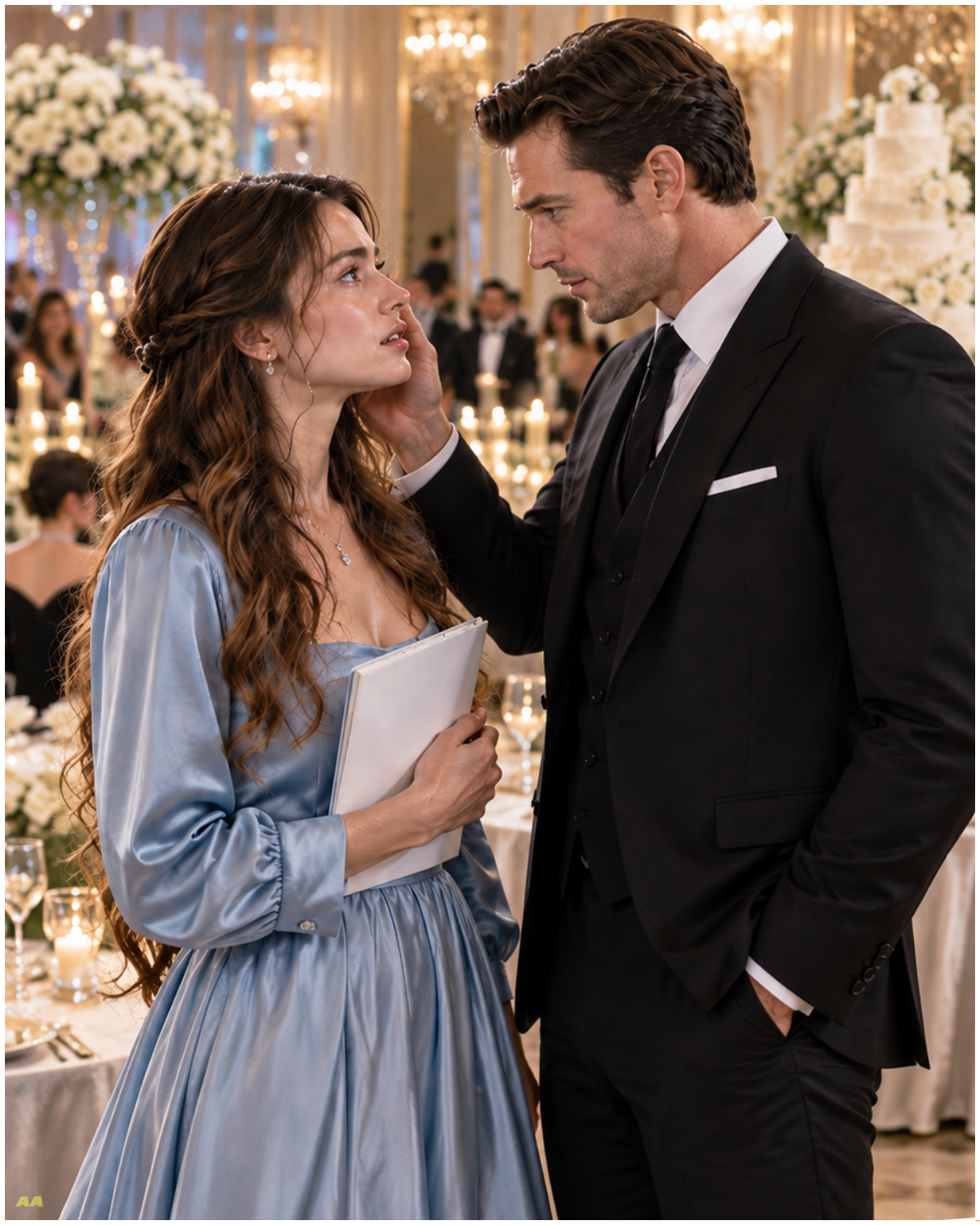
He was standing at the altar of the most expensive wedding of the decade, surrounded by 500 guests, 12,000 roses, and a woman he did not love.
The cameras were rolling, the champagne was chilled, the world was watching, and Grayson Hail, billionaire, widowerower, father, was about to make the biggest mistake of his life with a smile on his face because that was what men like him were supposed to do.
What nobody in that gilded ballroom knew was that 3 weeks earlier, a woman named Emma Parker had walked through his front door with a clipboard, a broken heel, and absolutely no intention of turning his world upside down.
She did.
The morning everything started to fall apart began, like most disasters, with something small.
It was a Tuesday.
Grayson Hail sat at the long mahogany table in the executive dining room on the 43rd floor of Hail Capital’s flagship tower in Manhattan, pretending to review a merger proposal while his assistant read him a list of wedding related emergencies that had accumulated since Sunday.
The ice sculptor is threatening to walk unless he receives the second half of his payment by end of business today, said Marcus Webb, 26 years old, relentlessly efficient and visibly uncomfortable delivering news he knew would irritate his employer.
The florist says the peies Victoria requested aren’t available in the volume needed, so she wants to substitute garden roses.
But Victoria’s mother called the florist directly and told her that if she substitutes anything, she’ll have her blacklisted from every event on the eastern seabboard.
And Marcus paused, the way people paused before delivering the worst thing on the liSt. Julian Marsh quit this morning.
Grayson looked up from the proposal he hadn’t actually been reading.
Julian Marsh, he repeated. Your wedding planner.
I know who Julian Marsh is.
He cited creative differences.
His exact words, per the email, were that he could no longer in good conscience facilitate an event where the primary clients had Marcus glanced at his phone screen.
Quote diametrically opposed visions for the emotional atmosphere of the occasion.
Grayson was quiet for a moment.
Outside the floor to ceiling windows, Manhattan spread itself beneath a flat gray November sky, all glass and steel and purpose.
He quit, Grayson said 3 weeks before the wedding.
22 days technically. Cancel my 10:00.
It’s the Donovan acquisition call.
Resched it.
Marcus typed something without asking further questions.
That was one of the things Grayson valued about him.
The man understood when to stop talking.
Grayson stood, buttoned his jacket with the automatic precision of a man who had performed that gesture 10,000 times, and walked to the window.
Below, the city moved in its usual aggressive rhythm.
Taxis and pedestrians and delivery bikes all competing for the same square footage with the cheerful hostility New York specialized in.
22 days. He thought about Victoria, her precise voice on the phone that morning, the way she’d said good morning like it was a business greeting rather than an endearment.
He thought about the seating chart they’d argued over for 40 minutes last week.
Not because either of them cared deeply about who sat next to whom, but because arguing about the seating chart was easier than talking about anything real.
He pressed two fingers to the bridge of his nose and closed his eyes.
Find me a new planner, he said.
I’ve already started, said Marcus.
Chian. What the financial press called Grayson Hail’s remarkable personal renaissance was from the inside something considerably less romantic.
He was 32 years old.
He had built Hail Capital from a $40 million inheritance into a $3.7 billion empire through a combination of genuine talent, the ability to function on 4 hours of sleep and a specific kind of ruthlessness that he preferred to think of as clarity.
He had a daughter named Lily who was 6 years old and who, of the many things currently in his life, was the only one that felt entirely real.
His wife Clare had died four years ago.
Ovarian cancer diagnosed at stage 4, gone 11 months after the diagnosis in a way that was simultaneously devastating and by the end merciful.
Grayson had been 28.
He had sat by her hospital bed during her last night with his hand wrapped around hers, telling her things he wished he’d said earlier, and then he had walked out of that hospital room and spent the next four years building walls so efficiently that he sometimes forgot they were there.
He did not talk about Clare in interviews.
He did not post about her on the rare occasions his PR team pressured him into social media.
When business journalists referred to him as the widowed billionaire, he answered whatever followed the phrase and ignored the phrase itself.
He had learned how to be fine.
It was a different skill than actually being fine, but it served the same external purpose.
Victoria Langford had entered his life 18 months ago at a charity dinner for pediatric research.
The one annual event Grayson attended, not because his PR team told him to, but because it had been Clare’s favorite cause.
Victoria was 30 years old, the daughter of William Langford of Langford Financial, educated at Oxford, elegantly composed, and genuinely intelligent.
Their relationship had progressed the way a well-managed business partnership progresses, logically, efficiently, with clear milestones and mutual benefit.
He respected her.
He admired her in the same way he admired a well- constructed building, appreciating the craftsmanship without feeling anything when he stood in front of it.
His engagement to Victoria had been announced 7 months ago.
The press had received it with the enthusiasm reserved for celebrity mergers.
Two financial dynasties united, Manhattan’s most powerful couple.
The headlines practically wrote their own theme music.
Grayson had read them on his phone in the back of a town car and felt approximately nothing.
Marcus came back an hour later with a folder.
Emma Parker, he said, setting it on the desk.
She runs a boutique event planning company out of Brooklyn.
Parker and company events. She’s been operating for 5 years, primarily high-end private events, not at the level of Julian’s clientele, but her reviews are exceptional.
Two clients I spoke with described her as he checked his notes.
One said, “The most organized human being I’ve ever encountered.”
And another said, “She saved my wedding and possibly my marriage.”
She’s available immediately.
Grayson flipped open the folder.
There was a professional photograph.
A woman with dark hair pulled back, intelligent brown eyes, wearing a blazer that was slightly too large for her shoulders in a way that suggested she’d bought it when she was trying to look more established than she felt.
She was not looking at the camera the way people look at cameras when they want to appear impressive.
She was looking at it like she was thinking about something else entirely.
He read her bio. Colombia graduate communications and business management.
5 years building her company without outside investment.
The list of events she’d coordinated showed genuine range.
A fundraising gala for a Brooklyn arts nonprofit.
A corporate retreat for a tech startup.
Three high-end private weddings with budgets in the six-figure range.
Not Julian Marsh’s world. But Julian Marsh had quit, so Julian Marsh’s world was no longer relevant.
Set up a meeting, Grayson said.
This afternoon, if she’s available, Emma Parker was available.
She found out about the meeting approximately 40 minutes before it happened because that was when Marcus Webb called her cell phone and said in the polite but faintly commanding tone of someone who was used to the world rearranging itself around his employer’s schedule that Grayson Hail would like to meet with her at 4:00.
She was in the middle of a tasting at a catering company in Midtown trying a sixth variation of a fig and bree crustini for a client’s rehearsal dinner.
She set the Christini down, stepped away from the table, and told Marcus that 4:00 would be fine.
Then she walked to the bathroom, looked at herself in the mirror for approximately 3 seconds, and said quietly, but with feeling, “Okay, okay.” Grayson Hail, she knew who he was.
Obviously, everyone knew who he was.
His face had been on the cover of Forbes twice in the past 3 years.
His engagement to Victoria Langford had generated the kind of press coverage normally reserved for royal families.
Emma had read the articles the way she read most things about the ultra wealthy with a combination of professional interest and personal detachment the way a marine biologist might read about deep sea creatures.
She had also six months earlier been hired briefly by a colleague to assist with preliminary vendor coordination for what was at the time being build as the Hail Langford wedding.
That engagement had lasted 2 weeks before Julian Marsha’s team had taken over completely and Emma had been paid a consultation fee and thanked for her time.
She remembered thinking the budget was obscene and the flower selection was impractical and leaving it at that.
Now Julian Marsh had apparently quit and Marcus Webb was calling her 40 minutes before a meeting.
She went back to the Christini table, made her selections with the decisiveness of someone who had learned years ago that hesitation was expensive, and took a cab to Hail Capital’s Tower.
Tip: The 43rd floor smelled like money, not metaphorically.
There was something about the temperature-cont controlled air and the specific quality of the carpet and the way the lighting fell that communicated without words that an enormous amount of wealth had been spent on making the space feel like wealth was not something anyone here needed to think about.
Emma had been in rooms like this before, not often, but enough to know that the correct response was not to be impressed by them.
She adjusted the strap of her bag, the good one, the leather tote she’d bought secondhand and had resold twice, and followed the receptionist to a conference room with a view that made her stomach briefly forget its usual concerns.
She was looking at the skyline when Grayson Hail walked in.
She had seen photographs. The photographs had not done him justice in either direction.
He was not as polished as the magazine covers suggested, and not as formidable as the financial profiles implied.
He was tall with dark hair that looked like it had been cut by someone expensive and then immediately ignored and he had the kind of eyes that registered information before his face decided how to respond to it.
He also looked exhausted in a way that had nothing to do with sleep.
“M Parker,” he said, and shook her hand with the grip of someone who had shaken a thousand hands and still hadn’t decided whether the ritual meant anything.
“Mr. Hail.” She sat across from him, opened her portfolio, and set her phone to the side.
22 days, he blinked. That’s what we’re working with, she said.
I looked at your original timeline on the way over.
Julian’s team sent me their coordination files 3 years ago when I was briefly consulting on preliminary vendor work, and I still have them.
The structure is solid. What isn’t solid is the execution timeline now that it’s been left 2 and 1/2 weeks before the event.
He was looking at her with an expression she couldn’t immediately categorize.
“You have Julian’s files,” he said, “from the initial consultation phase, not the full planning documents, but enough to understand the vendor relationships and the event architecture.” She turned the portfolio toward him, showing a preliminary assessment she’d put together during the cab ride, handwritten on three pages of her notepad because she hadn’t had time to type it.
I can make this work.
I want to be transparent with you about what that means.
It means some elements will be adjusted, some vendors will need to be renegotiated, and I’ll need your direct access to decision-making authority rather than going through multiple layers of approval.
Every hour matters at this point.
Grayson Hail was quiet for a moment.
She could feel him evaluating her.
My assistant mentioned you primarily work private events, he said.
Not at this scale. That’s accurate.
This wedding is going to have 500 guests, a live orchestra, and enough press interest that there will be photographers stationed outside the venue for 3 days beforehand.
I understand that. So, tell me why I shouldn’t wait until tomorrow and find someone with more experience at this level.” Emma looked at him steadily.
Because waiting until tomorrow cost you a day you don’t have.
And finding someone with this level experience on 22 days notice means finding someone desperate enough to take an impossible job.
Which means finding someone whose judgment is already compromised.
I’m not desperate. I’m hungry.
Which is different. And I’ve spent the last 40 minutes reviewing the situation.
So I’m the only person in this city who’s currently thinking about your wedding.
Something shifted in his expression.
Not quite a smile. Something quieter than that.
The ice sculptor, he said, pay him today, full amount.
You’ll lose the negotiating leverage, but you’ll gain the goodwill, and goodwill from vendors in the final 3 weeks is worth more than the money.
Julian’s team was holding back the second payment as leverage.
Julian’s team is not working this wedding anymore.
He looked at her for another moment.
Then he said, “When can you start?” “I already have,” Emma said.
The Hail residence was in the West Village, a townhouse on a treeline street that had probably cost somewhere in the 8 to10 million range and had been renovated by someone with excellent taste and no interest in showing off.
The exterior was clean brick and iron railings.
The interior, the first time Emma visited to go through the wedding files, was warm in a way she hadn’t expected.
There were children’s drawings framed in the hallway, not the self-conscious kind of decoration where wealthy parents display their child’s artwork to signal that they are in touch with what matters.
These were hung the way you hang drawings when you actually like them at slightly irregular intervals in frames that matched because someone had thought about it but not obsessed over it.
She noticed them while a housekeeper named Mrs. Alvarez led her to the study and then she noticed them again on her way out and she filed them somewhere in the back of her mind under a category she didn’t examine too closely.
The work was immediate and unrelenting.
She spent her first two days on the phone with the venue coordinator who was professional but barely concealing panic with the florist whom she managed to persuade that garden roses were not a defeat but a deliberate choice that would photograph better.
With the catering team who had 17 unresolved questions about the timeline of the dinner service.
She worked from a folding table in the corner of the hail study while Marcus came and went with documents and coffees he placed at her elbow without being asked.
On the third day at approximately 7 in the evening, Grayson appeared in the doorway of the study and said, “Have you eaten anything today?” Emma looked up from her laptop.
I had a protein bar at noon.
That’s not eating. I have a call with the entertainment coordinator in 20 minutes.
He looked at her for a moment with that same unclassifiable expression.
There’s food in the kitchen.
Mrs. Alvarez left pasta. Eat something and then make your call.
She wanted to tell him that she didn’t need managing, but she also, now that she thought about it, genuinely needed pasta.
Fine, she said. She was standing at the kitchen counter with a bowl of pasta when she heard the sound of small feet on the stairs.
And then a six-year-old appeared in the kitchen doorway wearing pajamas printed with cartoon foxes and squinting against the lights.
“You’re new,” said the child.
“I am,” Emma said. “I’m Emma.
I’m helping your dad with a project.” “What kind of project?” “A party.
A really big one. The little girl processed this.
She had her father’s dark eyes and her own particular gravity.
The kind of seriousness that six-year-olds sometimes have when they’ve learned early that the world doesn’t always stay reliable.
“Is it a good party?” she asked.
Emma considered the question honestly.
“It’s going to be a beautiful party,” she said, because that much at least she could guarantee.
“Are you supposed to be in bed?” “Probably.” But the girl didn’t move.
“I’m Lily.” “I know. I’ve seen your drawings in the hallway.” Something changed in Lily’s expression.
A small careful opening. Those are old ones.
I have better ones now.
I’d like to see them sometime.
Lily studied her with the focused attention of a child who has learned to evaluate adults carefully.
Then she said, “Okay.” And disappeared back up the stairs.
Emma stood in the kitchen for a moment with her pasta cooling, and she felt something she didn’t know how to name.
She learned over the following days the architecture of Grayson Hail’s life, the way you learn it when you’re working inside someone’s space.
Not through what they tell you, but through what they’ve built around themselves.
There were always two coffee cups in the sink in the morning, one adult-sized, one small with a cartoon rabbit on it.
There was a reading chair in the corner of the living room that had clearly been used hard and long, surrounded by stacks of books that included both financial texts and children’s picture books with no distinction between them.
There was a photograph on the bookshelf.
A woman with lighter hair than Lily’s, laughing at something outside the frame that sat beside a photograph of Lily at maybe age two.
Both pictures equally present, neither hidden, neither given more prominence than the other.
Emma did not look at the photograph of Clare Hail for long, but she noticed it every time she passed.
On day six, Victoria Langford arrived for a planning meeting.
Emma had spoken with her twice by phone, efficient, specific conversations in which Victoria communicated her preferences clearly and acknowledged Emma’s adjustments without complaint.
In person, Victoria was everything the press described.
Tall, blonde, immaculately put together in the way that suggests the effort has been so consistent for so long, it no longer feels like effort.
She was not unkind. She was gracious, actually, in a precise and careful way.
She shook Emma’s hand and said, “I understand you’ve already stabilized the floor situation.
That was quick work.” “Thank you,” Emma said.
I have a few items I’d like to go through with you both.
Grayson won’t be here, Victoria said.
She set her bag on the chair with a gesture that was not quite dismissive, but was certainly owned.
He has a board call until 5.
I’ll convey his preferences. Emma had learned in 6 days, something she didn’t think anyone in this household’s orbit spoke about directly.
The wedding was not a shared project between Grayson and Victoria.
It was two parallel projects, Victoria’s vision and Grayson’s checkbook.
Running adjacent to each other without quite connecting.
“Of course,” Emma said and opened her portfolio.
Later that evening, after Victoria had left and Lily was in bed and the townhouse had settled into its quiet, Grayson came into the study where Emma was updating the vendor timeline, he poured himself a glass of water from the picture on the sideboard.
She had noticed he drank a lot of water, that he chose water over the liquor cabinet with a consistency that suggested it was deliberate, and sat in the chair across from her desk.
“How did it go?” he asked.
“Well,” Emma said. “Victoria has clear preferences.
That makes my job easier.” She paused, then added, “Because honesty was usually more efficient than discretion.” She mentioned you weren’t going to be here.
I had a board call.
You had a board call on the same afternoon as a planning meeting for your wedding.
He looked at her. Is that an observation or a criticism?
It’s a question, Emma said.
You don’t have to answer it.
He was quiet for a moment.
The board call was scheduled firSt. Okay.
He turned the glass in his hands, looking at the water.
Victoria doesn’t need me in those meetings.
She knows what she wants.
That’s probably true, Emma said.
And then because she was tired and because the pasta from 3 days ago was apparently making her brave.
Is that a quality you’re looking for in a partnership?
Someone who doesn’t need you in the room.
The silence that followed was the kind that has weight.
I think Grayson said finally that you’re probably better at your job than I initially calculated.
I’m aware, Emma said and turned back to her laptop.
But she could feel him still looking at the water glass and the room had changed somehow.
And she told herself it was just the particular quality of late evening light and not anything worth examining further.
By the end of the first week, Emma had developed a system.
She arrived at the townhouse each morning at 8, having already reviewed the day’s vendor communications on her phone during the subway ride from Brooklyn.
She worked through the day with the focused efficiencies she’d spent 5 years cultivating.
The kind of concentration that had gotten her through the year.
Her company almost failed when her biggest client pulled out two months before their event, and she’d had to scramble to rebuild her booking list from scratch.
She took her calls in the study, walked the venue twice a week, and ate lunch at whatever point in the day she could manage it.
She spoke to Victoria by phone every other day, and saw Grayson every evening when he returned from the office.
The evening conversations were the part she had not planned for.
They started practically. She would brief him on the day’s developments.
He would make decisions about the few items that required his specific authorization.
But somewhere around the third or fourth evening, the briefings began to extend past their practical purpose, and Emma found herself still sitting in the study at 9:10, talking about things that had nothing to do with ice sculptures or seating charts.
He asked about her company one evening, not the professional courtesy version of asking, “So, how long have you been doing this?” but the specific genuinely curious version that meant he’d actually been thinking about it.
“You built it yourself,” he said.
“No outside capital?” “No.” She kept her eyes on her laptop for a moment, then looked up.
I had $12,000 in savings when I started.
I maxed out one credit card in the first year.
I didn’t pay myself a real salary for two years.
Why not bring in investors?
Because investors come with opinions.
When it’s your company, it’s your company.
That matters to me. He nodded slowly.
I understand that, he said, and the way he said it suggested he actually did, not from experience of scarcity, but from the experience of having built something with his own hands and wanting to keep it that way.
Your father left you the capital base, Emma said.
It wasn’t a challenge, just a statement.
40 million. He said it without embarrassment, which she respected, which sounds like a lot.
It is a lot, but 40 million in private equity investment is not the same as 40 million in your pocket.
I lost 30% of it in my first year on a deal that fell apart in ways I should have predicted.
What did you learn? That I was arrogant.
He said it simply. I thought the money meant I was smarter than I was.
I wasn’t. I was just younger.
Emma looked at him for a moment.
In her experience, people with inherited wealth did one of three things with it.
They pretended they hadn’t inherited it.
They leaned into it as a personality trait, or they quietly forgot that most people would never have 40 million to lose and learn from.
Grayson didn’t fit neatly into any of those patterns.
How old were you? She asked.
23, he paused. Clare thought I should slow down, take more time to evaluate the opportunity.
He said her name the way you say a name that’s become part of your daily furniture.
Not with weight exactly, but with a particular kind of care.
She was right. Emma didn’t say anything.
She had learned by this point that Grayson only mentioned Clare when he wasn’t thinking about the fact that he was mentioning her and that these were the moments when he was most himself.
Did she have a good eye for business?
Emma asked. Something that was not quite a smile moved across his face.
She had a good eye for everything.
She was a structural engineer.
She looked at everything, deals, situations, people, and figured out where the weightbearing points were.
He paused. She would have had a list of 17 questions for you by the end of our first meeting.
What kind of questions? The kind that make you realize the answer you plan to give isn’t actually what you think.
Emma nodded. She looked back at her laptop, but she wasn’t really reading what was on the screen.
She sounds like someone worth knowing.
She was, Grayson said, and the room held that for a while.
Eat. Lily found her way back to the kitchen on Emma’s eighth evening at the townhouse.
This time, she brought a folder.
“You said you wanted to see my new ones,” she said, setting the folder on the table with the careful seriousness of someone presenting important documents.
Emma pushed her laptop aside and opened the folder.
Inside were maybe 20 drawings, animals mostly, a few buildings, one elaborate scene that appeared to depict some kind of underwater kingdom with a submarine and a family of seahorses.
“Tell me about this one,” Emma said, pointing to the submarine.
Lily climbed into the chair across from her.
“Not the one Emma was sitting in, the one beside it, close but independent.” “That’s the family,” she said.
The big seahorse is the dad.
The little one is me.
And that’s the friendly shark who keeps them safe.
Who’s the friendly shark? Lily considered.
I haven’t decided yet. Emma looked at the drawing.
The little seahorse in the drawing had very large eyes and was positioned directly behind the big seahorse, close enough to be sheltered.
It’s really good, she said, and meant it.
My teacher says I have good spatial awareness, Lily said with the matter-of-act tone of someone reporting a diagnostic result.
Your teacher is right. Lily examined Emma with that focused child’s attention again.
Are you going to come to the wedding?
Emma looked up. I’ll be there.
I’m the one making sure everything goes right on the day.
But after that, Lily said, “After the wedding, will you still come here?” Emma felt something move through her that she didn’t want to inspect too carefully.
My job is to coordinate the wedding, she said.
After the wedding, I’ll be working on other things.
Oh. Lily looked at the folder of drawings for a moment.
Okay. She didn’t say it with disappointment.
Exactly. She said it with the practiced acceptance of a child who has learned that adults don’t always stay, that circumstances change, that you take what you get and adjuSt. That understanding should not exist in a six-year-old’s voice, and it absolutely did.
And Emma sat with that fact in silence while Lily gathered her drawings back into the folder with small, careful hands.
“I’m here for now,” Emma said.
“That’s real,” Lily looked at her.
Then she nodded once with that particular gravity and climbed down from the chair.
“Good night, Emma,” she said.
“Good night, Lily.” Emma sat in the kitchen for a long time after, listening to the sound of small feet on the stairs, and told herself very firmly that she was tired and that tired people felt things more than they should, and that none of this was anything to think too hard about.
2 weeks before the wedding, the seating chart crisis arrived.
It came in the form of a 12-minute voice message from Victoria’s mother, Diane Langford, delivered to Emma’s phone at 7:30 in the morning in the tone of a woman who has spent her entire life operating under the assumption that her displeasure should be taken seriously by everyone within a half mile radius.
The substance of the message was that a family friend named Charles Whitmore had been seated at table 11, which was apparently an insult of such magnitude that it threatened to undo 70 years of social relationship between the Langfords and the Whitmore family.
Emma listened to all 12 minutes of it while drinking coffee in the kitchen, made three notes, and then called Marcus.
“Who does the seating chart?” she asked.
Currently, it’s divided between Victoria’s coordinator and Grayson’s assistant, meaning me, and they haven’t spoken directly in approximately 3 weeks.
I need everyone with authority over that chart on a call at noon.
Grayson has a call he can move, Emma said.
Please. By noon, she had everyone on the line.
By 12:40, the seating chart had been restructured around a logic that had nothing to do with social politics and everything to do with the actual flow of the event, who needed to be near the dance floor, who had mobility considerations, which tables were photographed most frequently during dinners at this venue, who genuinely couldn’t sit next to each other without professional consequences.
Charles Whitmore ended up at table 7, which was better than table 11 by any reasonable metric.
And Diane Langford sent a two-line email saying the arrangement was acceptable.
Grayson found her afterward standing in the hallway of the townhouse with her phone pressed to her chest and her eyes closed.
“You okay?” he asked. “I’m deciding whether a 12-minute voice message from a mother of the bride constitutes a hostile work environment.
A sound came out of him that was unmistakably a laugh.
Not the polished public version, a real one surprised out of him.” Emma opened her eyes.
She had not heard him laugh before.
The sound rearranged something in the architecture of her understanding of him.
“Diane Langford,” he said, composing himself.
“Is she always?” “Yes.” “How does Victoria manage her?” Something passed across his face.
“She’s been managing her for 30 years,” he said.
“She’s had practice.” Emma looked at him.
“That’s not an answer.” “No,” he said.
“It’s not.” He was standing close enough that she could see the specific exhaustion in his eyes.
Not the surface tiredness of someone who works long hours, but the deeper kind, the kind that lives in a person’s bones and has been there long enough that they’ve stopped noticing it.
Grayson, she said, don’t. He said, not unkindly, just steadily, like a person who knows exactly where a conversation is going and has made a decision about whether to walk down that road.
We have work to do.
We do, Emma agreed. They both stood there for another moment, then they went back to work.
10 days before the wedding, Emma made a mistake.
It was a small one in the overall scale of things.
She had confirmed with the string quartet that their setup time at the venue was between 2:00 and 3:00 in the afternoon on the wedding day when she had actually intended to say 1 to two.
It was the kind of error that comes from managing 17 moving pieces simultaneously while operating on inadequate sleep, and it would have been entirely fixable if she had caught it before the venue coordinator had communicated it to the catering team, and a conflict had developed with the appetizer service timeline.
She caught it at 11 at night, reviewing the day’s communications before closing her laptop.
She sat for a moment and felt something cold and heavy settle in her stomach.
5 years of her own business.
Every mistake was paid for in real currency.
A client who didn’t rebook.
A vendor who didn’t want to work with you again.
A reputation built on reliability that could crack if you weren’t careful.
She had been so careful for so long that the coldness in her stomach was familiar and immediate and completely unwelcome.
She called the venue coordinator at 11:15, apologized directly, explained the situation, and worked through the adjustment for 45 minutes until the conflict was resolved.
Then she sat in the study in the quiet townhouse and stared at her laptop with the aftermath of the adrenaline still moving through her.
You’re still here. She looked up.
Grayson was in the doorway in the clothes he’d had on at dinner, which meant he’d been working in his home office and hadn’t been to bed either.
I had a scheduling conflict I had to fix, she said.
He came in, which was unusual.
Usually, he stood in the doorway when he came to check on her at this hour.
He sat in the chair across from her and looked at her face, which she was pretty sure was doing a poor job of concealing the specific quality of the evening she’d had.
“What happened?” he asked. She told him.
Precisely, clearly, without either minimizing it or building it up, just what happened and how she’d fixed it.
When she finished, he was quiet for a moment.
“It’s fixed,” he said. “Yes, then it’s done.” I know it doesn’t.
She stopped. I don’t like making mistakes.
Nobody does. No, I mean, she looked at the laptop.
When I started my company, I was terrified every day for the first 2 years that I’d make a mistake that would cost me everything I’d built because there was no margin, no safety net.
If I lost a client because of an error, that was real money I couldn’t recover.
It made me, she paused, choosing the word.
Vigilant, maybe too vigilant. I don’t know anymore.
Grayson was looking at her in the way he had that way of listening that felt like he was actually receiving what was being said rather than waiting for his turn to speak.
I made a mistake in 2017, he said that cost my fund approximately $38 million.
Emma looked at him. A single decision, one analysis I believed in despite evidence that should have given me pause.
He said it without drama.
It took me eight months to recoup the losses.
My major investors stayed, but two of them had conversations with me that I would classify as the most uncomfortable of my professional life.
A pause. I still think about it, not obsessively, but it’s there.
What do you do with it?
I try to figure out what I actually learned rather than just feeling bad about it.
He looked at his hands.
Feeling bad about it doesn’t teach you anything.
Understanding it might. Emma looked at him for a long moment.
Did anyone ever tell you that you’re not what people expect?
What do people expect? I don’t know.
More uh she tried to find the word.
More finished, I think. Like the version of you in the magazine profiles.
Someone who has made all his decisions already.
Something in his expression shifted.
Careful and genuine at once.
“Nobody’s finished,” he said. “No,” Emma agreed.
“They’re not.” The quiet in the room was different from other quiets she’d sat in with him.
She became aware of it.
At the same time, she became aware that it had been going on for a moment longer than was purely professional, and that neither of them had moved to end it.
She looked at her laptop.
“I should Yeah,” he said.
He stood. He was halfway to the door when he stopped and she could see him from the back.
The particular set of his shoulders, the posture of a man carrying something he doesn’t put down.
Emma, he said, “Yeah, you’re good at this,” he said.
Not just the planning, all of it.
He left before she could answer.
She sat in the study for a long time with the laptop open and the document unread, and she told herself with absolute firmness that there were exactly 10 days until this wedding, that she had a list of 47 things that needed her attention before she could sleep, and that whatever was happening in this room in the quiet hours of the night was not something she could afford to think about.
She believed herself mostly. 8 days before the wedding, Lily got sick.
It was nothing serious like a fever that the pediatrician diagnosed as a standard viral infection, the kind that sweeps through first grade classrooms with the efficient malice of something that knows exactly where to find a concentrated population of unimmunized bodies.
She ran 101.3 for 2 days, slept a lot, and wanted to watch animated films about ocean animals on repeat.
Mrs. Alvarez had a family commitment.
The backup babysitter had a conflict.
Marcus was in three meetings and physically at the office.
Victoria, when Grayson mentioned the situation in passing, said she hoped Lily felt better soon in the tone of a person who is expressing appropriate concern for a child who is not really in her orbit.
Emma found out when she arrived at the townhouse at 8:00 in the morning, and found Grayson in the kitchen with Lily on the couch in the adjacent sitting room, a thermometer on the coffee table, his laptop open, and the particular expression of a parent who has calculated the dimensions of their problem and doesn’t love the math.
She had 101.2 this morning, he said, down from yesterday.
The doctor says she’s not contagious past 48 hours in, and she should be fine by the weekend, but she can’t go to school today.
And I have,” he stopped.
“I have three calls. I cannot move.” “I’ll be here,” Emma said.
He looked at her. “That’s not your job.” “No,” Emma agreed.
“But you can’t be in two places, and I can run my calls from here as easily as from the study, so I’ll be here.” He started to say something, and she could see him assembling an objection based on professional boundaries or not wanting to impose or some other reasonable adult consideration.
And she said, “Gayson, it’s fine.
Go take your calls. He looked at her for a moment with an expression she couldn’t entirely read.
Then he said, “Thank you.” in a voice that was quieter than his usual voice and went upstairs.
Lily was awake, propped up on three pillows, watching a film about a blue tangfish with the focused attention of a child who has seen it before and is watching for specific moments.
“Hey,” Emma said, sitting on the edge of the couch.
“I’m sick,” Lily said. “I know.
How do you feel? Tired, she considered.
And my throat hurts. And this is my favorite movie.
Which part is your favorite?
The part where she remembers, Lily said simply.
Emma looked at the screen.
Watched the animated fish find her way back to the family she’d lost her memory of.
That’s a good part, she said.
She stayed on the couch for most of the morning working on her laptop while Lily dozed and woke and asked questions about things that had nothing to do with what Emma was working on.
Why are clouds different shapes?
What’s the biggest number? Do fish dream?
And Emma answered them as honestly as she could while maintaining her vendor communications with her other hand.
At some point around 11, Lily curled toward her on the couch and went to sleep with her head resting against Emma’s arm.
Emma sat very still. She looked at the small sleeping face, the fox pajam shoulder, the loose dark hair.
She looked at the thermometer on the coffee table in the stack of picture books and the drawing Lily had apparently been working on before she got sick.
A new seahorse family, this time with three seahorses.
She told herself she was being ridiculous.
She was a wedding planner.
She was here for 22 days, now 14, to coordinate an event for a man she worked for.
She had no part in this family’s story past the wedding day.
She looked at the drawing.
Three seahorses. Grayson came down at noon to find them like that.
Lily asleep against Emma’s arm.
Emma’s laptop still open on her knees.
Her face doing the thing it did when she was trying very hard not to feel something.
He stood in the doorway for a moment.
He looked at his daughter sleeping at the way Emma was careful not to move.
And Emma looked up and found him watching.
And she saw on his face something that frightened her a little because of how clear it was and how much it asked without asking anything and how completely she understood it.
Neither of them said anything.
The film kept playing. The fish kept looking for home.
The fever broke on Thursday.
Emma knew because Lily came into the study at 7:15 in the morning with color back in her cheeks and a drawing she’d finished the night before.
And she set it on the edge of Emma’s table without preamble or ceremony.
The way children deliver things they’ve decided matter.
It was the seahorse family again.
Three seahorses, the big one, the small one, and a new one that was roughly the same size as the small one, but had longer hair indicated by several enthusiastic brown lines radiating from the top of the figure.
Emma looked at the drawing for a moment.
Then she looked at Lily.
“Is that one me?” she asked.
Lily shrugged with the practice nonchalants of a six-year-old who has committed to a feeling but isn’t ready to be held accountable for it.
Maybe, she said, and left.
Emma sat with the drawing in front of her and her coffee going cold and told herself again with slightly less conviction than the last several times that she was here for nine more days, and that was the complete and total extent of her involvement with this household and everything in it.
She took a photograph of the drawing before she started work.
She didn’t examine why. Grayson came through at 8:30 on his way out, already in his coat, already carrying the particular forward momentum of a man who has structured his mornings to leave no space for hesitation.
He paused when he saw the drawing on her table.
Lily’s work, he said, delivered at 7:15.
I’ve been informed it may or may not represent me.
He looked at the drawing, and something happened in his face.
That quiet rearrangement that Emma had learned to recognize as him feeling something he hadn’t planned to feel.
He picked it up carefully, turned it over, set it back down.
How’s she doing? No fever.
She ate breakfaSt. She asked me if fish can get colds, which I could not answer with any confidence.
The almost smile again. She’s been asking that for a week.
She’s worried about her fish at school.
She has a fish at school.
Class pet, a beta fish named Gerald.
He paused. She named him.
The class voted. Emma looked at him.
Gerald. Gerald. He picked up his bag.
She argued that he looked like a Gerald.
No one could disagree once she said it.
He left, and Emma sat in the study with the drawing and the image of a six-year-old successfully lobbying a first grade classroom for the name Gerald.
And she understood with a clarity she found deeply inconvenient that she was in a significant amount of trouble.
The trouble was not that she had feelings for Grayson Hail.
She was aware of the feelings, had been aware of them the way you’re aware of a sound in another room, present, but not yet requiring action.
The trouble was that she also had feelings for his life, for the drawings in the hallway and the coffee cup with the cartoon rabbit and the beta fish named Gerald.
And the way this household existed as a thing held together by the deliberate and ongoing effort of one person who refused to let it fall apart, even when he was exhausted, even when he was going through the motions of a future that didn’t fit him.
That was the trouble. She hadn’t just gotten close to a man.
She’d gotten close to a family.
And families were not things you could walk away from in 9 days and file neatly in the completed projects folder.
She told herself she’d been through worse complications and opened her email.
There were 23 new messages, 14 of which required responses before noon.
She was grateful for every one of them.
The crisis of the week arrived the following morning in the form of a phone call from the entertainment director at the venue, a man named Paul Reeves, who had the weary professionalism of someone who has seen every possible wedding disaster and has stopped being shocked by any of them.
The orchestra’s first chair violinist broke his wrist at rehearsal yesterday.
He said, “Non-negotiable absence. They’re looking for a replacement, but I want you to know before Victoria’s team does because the last time her team found out about a problem before you did, I spent 40 minutes on the phone with someone named Diane.
Emma closed her eyes briefly.
How long do they have to find a replacement?
7 days. Have they started looking?
They say yes. I say probably not urgently enough.
Give me the orchestra manager’s number.
She spent the next two hours managing the violinist situation, which required calling in a favor from a musician contact she’d worked with on a fundraising gala 2 years prior, who knew someone who knew someone else who turned out to be a session musician with orchestral experience who was available and willing and lived with the particular luck that sometimes shows up in the final weeks of an impossible timeline 20 minutes from the venue.
By noon, the chair was filled.
By 1:00, she had confirmed the replacement’s availability for the two remaining rehearsals.
By 1:30, she had sent Paul Reeves a summary email with all the updated contact information.
She sat back in her chair and let herself have 30 seconds of satisfaction, which was about as much as she could afford.
“You look like someone who just won a fight,” said a voice from the doorway.
Lily was standing there in her school clothes.
She’d gone back that morning, declared fit by the pediatrician and by her own assessment.
But it was 4:15, which meant Mrs. Alvarez must have picked her up.
“I kind of did,” Emma said.
“A small one.” “Come in if you want.” Lily came in and climbed into the chair across from Emma’s desk with the ease of a child who has decided a space is comfortable and therefore belongs partly to her.
She pulled a workbook from her backpack and set it on her knee.
“Homework?” Emma asked. “Subtraction?” A pause.
“I don’t like subtraction.” “Why not?
Because things go away in subtraction, Lily said with a directness that landed harder than a six-year-old probably intended.
Emma looked at her for a moment.
That’s a pretty sophisticated way to think about math.
My teacher says it’s about taking things apart to understand them better.
Lily considered this with visible skepticism, but it still feels like things going away.
Sometimes both things are true, Emma said.
Lily looked at her with those dark, serious eyes.
Then she opened the workbook and started writing.
They sat in comfortable silence for the better part of an hour.
Emma working through the remaining vendor communications.
Lily moving through her subtraction problems with the focused determination of someone who doesn’t like a thing but is going to do it anyway.
Emma found herself glancing at the girl’s profile every few minutes.
The way you glance at something you’re not quite allowing yourself to look at directly.
At 5:15, Lily said without looking up from her workbook, “Is the party going to change things?” Emma paused.
“What do you mean?” “After the party?” Lily turned a page.
“When Victoria lives here, is it going to be different?” Emma chose her words carefully, the way you do when you’re answering a child who is asking a real question and deserves a real answer.
“Things will be different,” she said.
“Probably.” “Is that?” She stopped.
“Are you worried about that?” Lily was quiet for a moment, her pencil moving.
“She doesn’t watch movies with me,” she said finally.
“Victoria, she came for dinner once and I asked if she wanted to watch something and she said she had a call.” A pause.
I don’t think she likes movies.
Some people don’t. My dad likes movies.
He falls asleep during them, but he likes them.
Lily’s pencil stopped. He used to watch them with my mom, Mrs. as Alvarez told me.
Emma said nothing. She held very still.
I don’t remember her watching movies, Lily said.
I was too little, but I remember she smelled like the yellow flowers, the ones in the backyard.
She looked up from her workbook with an expression that was too old for her face and too honest for Emma to look at without feeling it somewhere deep.
Do you think she would have liked you?
Emma felt the question land in her chest like something physical.
I don’t know, she said honestly.
I hope so. Lily nodded with this gravity of someone who has received an acceptable answer and went back to her subtraction.
Emma stared at her laptop screen and did not read a single word on it for approximately 4 minutes.
The evening that followed was the first evening in 2 weeks when the work genuinely slowed down enough that Emma ran out of urgent tasks before Grayson ran out of waking hours.
She had updated every document, confirmed every outstanding vendor, resolved every open question she could resolve without his direct input.
At 9:15, she closed her laptop with the strange disorientation of a person who has been moving at high speed and suddenly stopped.
She was washing her coffee cup in the kitchen sink when Grayson came in.
He was in the clothes of the end of a long day, jacket gone, the first button of his shirt undone, the slightly loosened look of a man who had finally stopped performing.
Executive. He opened the refrigerator, stared into it with the focused blankness of someone who isn’t actually seeing what’s in front of them, and closed it again without taking anything.
There’s pasta from yesterday, Emma said.
Left shelf. He opened the refrigerator again.
Found it. Put it in the microwave with the automatic motion of a man who has been feeding himself mechanically for years and doesn’t overthink it.
“How was the day?” he asked, leaning against the counter while the microwave ran.
She told him about the violiniSt. He listened without interrupting, which was something she’d noticed about him.
He listened without filling in her sentences, without nodding preemptively, without doing any of the things people do when they’re waiting for a conversation to be over.
7 days, he said when she finished, and you solved it in 2 hours.
2 hours in a favor I’ve now spent.
I’ll owe you a favor.
You’re already paying me. Those are different things.
The microwave beeped. He got the pasta, got a fork, stood at the counter eating it in the unhurried way of someone who has eaten too many meals standing at counters to have opinions about it anymore.
“Lily, talked to me today,” Emma said.
He looked up. She asked about after the wedding, what things would be like.
Emma turned the coffee cup in her hands, not quite looking at him.
She said Victoria doesn’t watch movies with her.
The silence that followed was the kind that means the person you’re talking to already knew the thing you just said and has been not saying it.
She mentioned that. Grayson said not defensive, just quiet.
She’s perceptive. She’s always been perceptive.
He set the fork down.
Clare was like that. She could read a room better than anyone I’ve ever known.
He paused. Lily got that.
Is that Emma? Stopped, considered decided.
Is that part of why it’s complicated with Victoria?
Because Lily already knows? He looked at her, not with surprise, with the expression of a man who recognizes that the conversation he’s been avoiding has arrived without his permission.
Victoria is a good person, he said.
I know that she’s not.
He stopped. She doesn’t dislike Lily.
She’s just not. He pushed the pasta container slightly to one side.
The gesture of someone clearing space to say something.
She’s not in it. Do you know what I mean?
She’s present, but she’s not engaged.
And Lily notices the difference between people who are in it and people who are just present.
Yes, Emma said. She does.
The kitchen was quiet. The refrigerator hummed.
Somewhere upstairs, the house settled in the way old buildings settle at night with a creek that sounded almost deliberate.
“I know how this looks,” Grayson said.
He wasn’t looking at her anymore.
He was looking at the counter, at the pasta container, at the middle distance where people look when they’re talking about things that are difficult to look at directly.
From the outside, the wedding of the decade, the power couple, two financial dynasties.
I don’t care about that, Emma said.
I know you don’t. That’s He stopped again.
That’s actually part of the problem.
She looked at him. Emma, he said her name the way you say a name when you’re not sure you should be saying it.
When the saying of it acknowledges something you weren’t ready to acknowledge.
I don’t know how to do this without it being I’m 3 weeks from a wedding.
I have a daughter who has already lost one person who was supposed to be permanent.
I have He made a gesture that encompassed something she didn’t have a word for.
All of this and you’re here for nine more days.
Eight. She said it’s after midnight.
His expression did something complicated.
I’m aware of what I am in this situation.
Emma said. She kept her voice even.
I’m the planner you hired.
I’m the person who showed up at the wrong moment and fit in spaces she wasn’t supposed to fit.
I’m not. She set the coffee cup down.
I’m not confused about what’s real.
I don’t think you’re confused about anything.
He said that’s the problem.
You’re the least confused person in this house.
She met his eyes. What are you confused about?
The question sat between them.
He looked at her and she looked at him and neither of them was pretending for maybe the first time that the thing in the room was something other than what it was.
Everything, he said. And then with honesty that she suspected cost him.
I haven’t felt like myself in so long.
I’m not sure I remember what that means.
And then you showed up with a clipboard and a broken heel and you just He shook his head.
You just said what was true.
You keep saying what’s true.
I forgot that was something people did.
Emma didn’t say anything. There wasn’t much to say.
Victoria and I made sense on paper, he said.
And I told myself that was enough.
That after Clare, he stopped.
That after everything, sense was what I had to offer.
That love was something I’d used up.
You haven’t used it up, Emma said quietly.
No, he said. I know that now.
The kitchen was very quiet.
Emma picked up the coffee cup, set it in the drying rack, dried her hands on the dish towel that hung from the oven handle.
These were normal gestures. She made herself make them.
I’m going to go, she said.
It’s late. Yeah. There’s a venue walkthrough at 9 tomorrow.
I’ll need 20 minutes with you beforehand to go over the lighting decision.
I’ll be here. Okay. She gathered her bag from the study, shut her laptop, put on her coat.
He was still in the kitchen when she came back through to the hallway and she paused.
Grayson. Yeah, for what it’s worth, she said, and she chose the words carefully because she was not a person who said things carelessly.
You’re a better father than you know and a better man than whatever version of yourself you’ve decided to settle for.
She paused. That’s just true.
It doesn’t require anything from you.
She left before he could respond.
She walked two blocks to the corner where she could get a car and stood in the November air that had turned genuinely cold in the past few days and looked at the street and breathed.
She did not regret saying it.
She regretted almost nothing she’d said to him, which was unusual for her because Emma Parker had spent most of her adult life monitoring her own words with the vigilance of someone who knew that what you said could not be unsaid and that unsaid things piled up in ways you eventually had to deal with anyway.
She thought about Lily’s drawing.
Three seahorses. She got in the car and went home to Brooklyn.
She did not sleep well.
In the morning, she arrived at the townhouse at 8, reviewed the lighting specifications, and had 20 focused, professional minutes with Grayson in the study before the venue walkthrough.
He was exactly as he always was, precise, attentive, making decisions without wasting words.
Whatever the kitchen had held the night before was present between them in the way that acknowledged things are present.
Neither of them pretending it wasn’t there.
Neither of them making it the center of gravity either.
They were professionals. They had 8 days in a wedding.
They worked. The venue walkthrough took 3 hours and produced 11 action items, a revised entrance timeline, and a renegotiated position for the photographers’s second assistant that resolved a long-standing dispute between the photography team and the venue staff.
Emma handled all of it.
She was in the space she knew how to occupy, moving, thinking, solving, and the work was the kind of thing she was genuinely good at in the way that doesn’t require performance.
And she felt for the duration of those 3 hours like herself in the clearest possible sense.
Afterward, standing in the empty ballroom with the afternoon light falling through the tall windows and turning the parkquet floor gold, she let herself look at the space properly.
It was beautiful. Genuinely, uncomplicatedly beautiful.
The kind of room that had been built for occasions that understood its own purpose and fulfilled it.
In 8 days, it would hold 500 people and 12,000 roses and an orchestra that now had a full compliment and a timeline that she had wrestled into something that would actually work.
She had done that. This was her work in all its ordinary significant reality.
Paul Reeves came to stand beside her.
He had been in the business long enough to recognize the particular silence of a planner reviewing their own creation.
“It’ll be good,” he said.
“Not flattery, just a professional’s assessment.” Yeah, Emma said it will.
She went back to the townhouse and found Marcus waiting with three contract amendments that required her review, and she sat at her folding table and worked through them with the same precision she’d brought to everything else, and she did not let herself think about anything that wasn’t on the page in front of her.
Victoria called it four. I want to go over the ceremony program, Victoria said.
There’s been a change. Of course.
What changed? The reading. A pause.
I’d like to cut it.
The Naruda. Emma had spent two days tracking down a calligrapher for the ceremony program who could do the decorative border Victoria had specified.
It doesn’t feel right anymore, Victoria said, and something in her voice was flatter than usual, quieter than the precise controlled register Emma had come to expect from her.
I’d like something shorter, more straightforward.
I can work with that.
Do you have something in mind?
Not yet. Another pause. Emma.
Yes. The silence lasted long enough that Emma moved the phone slightly from her ear to check that the call was still connected.
It was. Is Grayson? Victoria started and stopped.
Never mind. The reading. I’ll send you something by end of day.
That’s fine. Emma said. The call ended.
Emma sat very still with the phone in her hand and thought about the flatness in Victoria Langford’s voice and the sentence she had started and not finished, and she felt something moved through her that was not quite guilt and not quite dread, but occupied the same uncomfortable neighborhood.
She thought she knows. She didn’t know exactly what Victoria knew, or how much, or whether what there was to know was even a defined enough thing to be known.
But she thought about the months Victoria had been engaged to a man who ate pasta alone in his kitchen and barely participated in planning his own wedding.
And she thought about the perceptiveness that seemed to run in some families.
And she thought that Victoria Langford was quite possibly the sharpest person in this entire situation and the most careful about not saying so.
When Grayson came home that evening, Emma was packing up her bag to leave.
Heading out, he said, “Early.
I have work at my actual office tomorrow morning before I come here.
She put her laptop in her bag.
Victoria’s cutting the naruda reading from the ceremony.
He didn’t react the way she expected.
He just said, “Okay.” And set his own bag down.
She said it didn’t feel right anymore.
He was quiet. Grayson, I heard you.
I think she stopped. She was not his therapiSt. She was not his friend technically.
She was the person he’d hired, who had said too many true things already and was walking a line she needed to stay on for six more days.
Nothing. I’ll adjust the program order and send you both an update tomorrow.
Emma, she looked at him.
I need to talk to her, he said.
Yes, Emma said simply. You do?
I know I do. He sat down in the chair in the entryway, the one by the front door that existed for putting on shoes and not much else.
And he sat in it like a man who has run out of the energy required to stand.
I’ve been telling myself that after the wedding things would he stopped.
But that’s not that’s not how it works.
No, Emma said it’s not.
If I talked to her before, he rubbed one hand over his face.
3 weeks ago, I was living a life that made a specific kind of sense.
And then you showed up and you’ve said true things every day for 2 weeks.
And now I’m sitting in the hallway not knowing how to He shook his head.
Emma stood with her bag on her shoulder.
She looked at him. Really looked at him.
The exhaustion and the decency and the man behind all the construction he’d done around himself.
I can’t tell you what to do, she said.
I wouldn’t if I could.
That’s not that’s yours to figure out.
She paused. But I think you already know.
I think you’ve known for a while.
He looked up at her.
And I think she said carefully that the reason you know is not because of me.
I’m not I don’t want you to put that on me or on whatever is between us or isn’t what you know you knew before I got here.
I just She searched for the right word.
I just made it harder to ignore.
He was quiet for a long moment.
Yeah, he said. That’s right.
She nodded. Good night, Grayson.
Good night, Emma. She walked out into the cold and the dark and the ordinary noise of the west village at 9:00 and she thought about six more days and a drawing of three seahorses and a man sitting in a hallway chair and she walked to the corner and got her car and went home.
She made herself dinner, real food, not protein bars.
She sat at her own kitchen table in her own apartment in Brooklyn with its familiar secondhand furniture and the corkboard on the wall covered in event timelines and the view of the street below where a couple was arguing cheerfully about something she couldn’t hear through the glass.
She thought about what she’d said.
I just made it harder to ignore.
She thought about whether that was something she’d had the right to do.
She thought about Lily’s drawing for a long time.
Then she opened her laptop and started working on the ceremony program adjustment because the program needed to be redone.
And that was something she could do.
And doing things she could do was how Emma Parker had gotten through every hard stretch of the last 30 years.
And she was not about to stop now.
She adjusted the program. She sent the update.
She went to bed. 3 days later, she found out that Grayson had talked to Victoria.
She found out not because he told her ye he didn’t mention it and she didn’t ask but because Victoria called in the morning with her weekly logistics update and at the end of the call after every vendor had been accounted for and every timeline had been confirmed Victoria said you’ve done exceptional work Emma whatever happens I want you to know that whatever happens Emma sat with those two words for the rest of the morning.
She turned them over the way you turn something over when you’re not sure what shape it is yet.
She didn’t know going into that final week exactly what had been said or decided or acknowledged between Grayson and Victoria in whatever conversation had happened without her.
She didn’t know what whatever happens meant or whether it meant anything specific or just the general fragility of every event she’d ever planned.
What she knew was that there were 5 days left, that the florist was handling a minor substitution on the centerpiece greenery that would not be noticeable to anyone except Emma, that the replacement violinist had passed both rehearsals with flying colors.
That Lily had shown her three new drawings of Gerald the betaish, all of which were anatomically inaccurate and entirely correct in spirit.
What she knew was that she was here fully in this strange compressed version of a life that had arrived uninvited and taken up residence in parts of her she’d thought were unavailable for occupancy.
5 days she worked. She did not let herself think too far ahead.
And on the fifth to last evening as she was leaving, Grayson caught her at the door and said quietly, “I told her the truth or the beginning of it.” He paused.
I don’t know what happens now.
Emma looked at him. That was brave.
She said it didn’t feel brave.
It never does. She said, “That’s what makes it brave.” She left and the door closed behind her.
And the city did what cities do.
Kept moving, kept making noise, kept existing with magnificent indifference to the things people felt inside their various illuminated windows.
5 days. She didn’t know, walking home through the November cold, whether that was too much time or not nearly enough.
The last four days before the wedding were the kind that compressed time in a specific way.
Each hour arriving and departing with more weight than the previous one.
The way pressure builds in a system that has no release valve.
Emma worked through them with the focused momentum of someone who knows that stopping to feel anything would cost her things she couldn’t afford to lose.
She did not see Grayson alone again after the night in the hallway.
This was partly circumstance. The final days were dense with vendor arrivals, venue preparation, logistics calls, and the arrival of Victoria’s extended family from Connecticut, which generated a secondary wave of requests and adjustments that kept Emma’s phone ringing from 7:00 in the morning until past 9 at night.
It was also, Emma acknowledged to herself with the honesty she applied to everything, partly deliberate.
Not avoidance exactly, more like the careful management of a situation that was already complicated enough without adding proximity.
She saw him at the morning briefing she held each day at 8, which included Grayson, Marcus, and the venue coordinator on a conference line.
He was present and focused and said exactly what needed to be said.
She matched his register and said the same.
They were professional in the way that two people are professional when they are working very hard to take up only the space the work requires.
Marcus noticed Emma was fairly certain Marcus noticed everything and that he filed it in the part of his mind that was too professionally disciplined to ever mention.
On the morning 2 days before the wedding, Emma arrived at the townhouse at 7:30 to find Lily in the kitchen in her school uniform eating cereal with the methodical seriousness of a child who has a system for her morning and intends to follow it.
You’re early, Lily said. I have a lot to do today.
Me too, Lily turned her spoon.
We’re doing a science project about water.
Where it goes? The water cycle?
It evaporates, Lily said with the gravity of someone reporting a surprising and slightly troubling fact.
It goes up and comes back down again.
It does, Emma said. It always comes back.
Lily considered this. Always. Always.
It just takes different forms sometimes.
Lily seemed to find this satisfactory and went back to her cereal.
Emma poured her coffee from the pot that Mrs. Alvarez had left.
She had started leaving a full pot, a small wordless acknowledgement of Emma’s early arrivals, and stood at the counter reviewing the day’s list on her phone.
Grayson came down at 7:50, registered Emma’s presence with a slight adjustment in his expression that said he’d known she’d be here and had prepared for it, which Emma recognized as the same thing she’d done.
“Morning,” he said. “Morning. The tent pavilion for the outdoor cocktail hour is going up today.
I need you available by phone at 11:00 if there are any authorization questions from the venue.
I’ll be available. Also, the favors need a final count confirmation.
Marcus has the number, but the vendor wants direct approval.
I’ll tell him. And the weather forecast for Saturday changed.
There’s a 30% chance of rain in the afternoon, which is relevant to the outdoor transition timeline.
He looked at her. How relevant?
Manageable. I’ve already spoken with the venue about the alternate indoor setup.
If it rains, we move the cocktail hour to the east gallery.
It adds 6 minutes to the guest transition, but the space is good.
Okay. He poured his own coffee.
You’ve got it handled. I do.
I know you do. He said it simply without weight.
And it landed with weight anyway.
Lily looked between them with the attention of a child who is tracking something adults think they’re concealing.
Emma finished her coffee and went to the study.
The two days moved like that in the grammar of work, in the language of logistics, in the specific safety of things that needed to be done and could be done and had clear, measurable outcomes.
Emma understood during those days why she had built her life the way she had.
Work was real in a way that feelings weren’t always real.
You could hold work in your hands.
You could point to it and say, “I did this.
This exists. This is mine.” Feelings were a different kind of real.
Less portable, less controllable, more likely to take up residence in your chest and stay there making noise at inconvenient hours.
She had both, and she managed both, and she kept moving.
The night before the wedding, Emma did something she hadn’t done since her first year in business.
She went to the venue alone.
She let herself in with the coordinator’s key.
Paul Reeves had given it to her a week ago for final prep access, and she walked through the empty ballroom at 10:30 at night with just the low ambient lighting that the venue kept on overnight.
The tables were set, the linens were pressed.
The 12,000 roses were in the refrigeration rooms, waiting for the morning installation.
The orchestra’s chairs and stands were arranged in the precise configuration she’d approved on the last walkthrough.
She walked the room slowly, end to end, in the way a director walks a set before the actors arrive.
She looked at every table, every centerpiece position, every element of the lighting design.
She looked at the space where the ceremony would be, the floral arch which would be assembled in the morning, its base structure already in place, a skeleton of green wire and wood that would become something extraordinary in 6 hours.
She had made this out of a disaster, out of a lastminute hire and an impossible timeline and 22 days of working with the particular fierce efficiency that had always been her most reliable quality.
She had made this. It was beautiful.
It was real. She stood in the middle of the empty ballroom and let herself feel that for exactly as long as she could afford to.
Then she felt the other thing that the thing she’d been managing for 2 weeks with the careful precision she applied to everything else.
The thing that was Grayson in the kitchen at 11:00.
Grayson in the hallway chair.
Grayson saying I told her the truth.
Lily’s three seahorses. The photograph on the bookshelf.
The drawing she still had a picture of on her phone.
Tomorrow this was done. Tomorrow she would stand in this room and watch it all happen and do her job.
And that would be the end of it.
That was the job she’d taken.
That was the arrangement. She stood in the empty ballroom for another few minutes.
Then she turned off the section of lights she’d turned on, locked the doors behind her, and went home.
She slept 4 hours, which was two more than she’d expected.
The wedding day arrived. Emma was at the venue by 5:30 in the morning, 2 hours before the first florist arrived because she needed those 2 hours to move through every element of the setup timeline in her head and be certain there were no surprises left in it.
She walked the rooMs. She checked the catering staging area.
She confirmed with security that the press perimeter was established and functioning.
She stood at the main entrance and looked at the approach, the way the light fell, the placement of the receiving area, the path guests would take from arrival to ceremony.
By 7:30, the venue was alive.
Florists arrived with trolleys of roses moving through the space with the practiced efficiency of a team that has been briefed and rebriefed and knows exactly where everything goes.
The catering team began the kitchen setup.
The orchestra’s technician arrived to test the sound levels in the ballroom.
Emma was everywhere at once, which was the only mode she knew on event days.
At 9:00, she got a text from Marcus.
Everything on schedule on our end.
Grayson asks if you need anything.
She typed back, “Tell him to be at the venue by 2.
Everything else is handled.” A minute passed.
Then Marcus replied, “He says, “Okay.” He also says, “Thank you.” Emma put her phone in her pocket and went back to work.
Victoria arrived for hair and makeup at 10:00, accompanied by four bridesmaids and her mother, who swept through the bridal suite with the proprietary energy of a woman who has been planning this day in her head since her daughter was approximately 12.
Emma managed Diane Langford with the focused patience of someone who has developed over 3 weeks a specific understanding of where the woman’s pressure points were and how to redirect her when she started pressing on them.
The greenery on the arch, Diane said, standing in the doorway of the ballroom and squinting at the florist’s work.
It’s different from what I saw in the design.
Slightly darker, Emma said. The original variety wasn’t available in quantity, so I substituted an equivalent.
The effect is essentially identical and photographs better.
Victoria approved this. Approved. Victoria approved the substitution 10 days ago.
Emma met Diane’s eyes with the steady assurance of someone who documents everything.
I can show you the email if that’s helpful.
Diane looked at her for a moment with the expression of a woman recalibrating.
Then she said, “The effect is actually quite lovely with the particular grace of someone who can change positions without appearing to.” “Thank you,” Emma said.
“The florists have done excellent work.” She moved on before Diane could find anything else to squint at.
At 11:15, standing near the catering staging entrance reviewing the appetizer service timing with the head caterer, Emma’s phone rang.
The number was Grayson’s. She stepped away from the caterer.
Is everything okay? Yeah. His voice was the version she’d learned to read as controlled.
I’m at the hotel. Marcus is here.
Lily’s with Mrs. Alvarez. A pause.
I just He stopped. Grayson.
I’m fine, he said. I wanted to.
I don’t know why I called.
She looked at the ballroom from across the staging area.
The roses, the light, the arch that was now fully assembled and extraordinary.
The tables glowing in the warm pre- noon light.
The room is beautiful, she said.
It’s exactly what it should be.
Good. Everything is ready. I know it is.
A pause. Because of you.
Emma said nothing. I just needed to He stopped again.
I’m sorry. You’re in the middle of everything.
I am, she said. But it’s okay.
Another pause. She could hear faintly the ambient sounds of a hotel room, an air conditioning unit, perhaps Marcus’s voice in the background, the particular quiet of a space being occupied by people who aren’t talking.
Emma, Grayson said. Yeah, I’ll see you there.
I’ll be the one with the earpiece and the clipboard, she said.
A sound that not quite a laugh, but adjacent to one.
I’ll find you, he said, and hung up.
She stood with her phone in her hand for a moment.
Then she put it in her pocket and went back to the caterer.
The guest began arriving at 4:00.
Emma was at the entrance at 350, positioned where she could see everything, the valet operation, the guest flow toward the ceremony space, the security perimeter.
Without being in the middle of it.
She wore the dress she always wore for events.
Dark navy, clean lines, professional without being invisible.
She had her earpiece in the left ear, her clipboard in her left hand, her phone in her right jacket pocket.
She watched 500 people arrive in the gold November afternoon light.
She watched them move through the entrance, watched the ushers direct them to their seats, watched the seating chart she’d spent two weeks perfecting execute itself in real time with the satisfaction of a system working the way it was built to work.
She watched Grayson arrive. He came through the main entrance at 4:15 with Marcus and a colleague she didn’t recognize.
He was in a dark suit, not black, a charcoal that sat well on him.
And he looked the way people look on significant days when they’ve decided to hold themselves together.
Deliberate, composed, present in the way that takes effort.
He saw her immediately across the entrance hall.
Through the movement of arriving guests, he found her with the ease of someone who has learned the specific geography of a person’s presence.
He walked toward her. It’s He looked around the entrance hall at the floral installation that framed the doorway at the candle light already lit along the pathway to the ceremony space.
Emma, it’s I know, she said.
He looked at her instead of the room.
Thank you, he said. Not the professional version, the other kind.
Go, she said. Marcus knows where you need to be.
I’ll be here. He held her gaze for a moment, one beat longer than was necessary and not nearly as long as it wanted to be, and then he went.
Emma turned back to her clipboard.
The ceremony began at 5:00 with the precision she had built into it.
The orchestra played the processional arrangement she had coordinated through three separate rehearsals.
The guests were seated with 3 minutes to spare.
The lighting shifted to the warm ceremony setting at exactly the right moment.
The arch 12,000 roses and the work of two weeks stood at the front of the space in the golden light and was by any honest measure extraordinary.
Emma stood at the back of the ceremony space near the sound technician station and watched.
Victoria walked in on her father’s arm.
She was genuinely beautiful, the kind of beautiful that has been cultivated and maintained over years, but is real underneath all of it.
She walked with the posture of a woman who has been taught how to enter rooms and has always been able to do so.
The guests exhaled collectively in the way guests do at this moment.
The release of a breath held since the music changed.
Emma watched Grayson watch Victoria walk toward him.
She watched his face very carefully, the way she watched every element of the event she planned, looking for the thing that would tell her whether the system was working or not.
And what she saw on his face was something that broke her heart a little quietly and without drama because it was not what a groom should look like watching his bride approach.
He looked like a man trying.
He looked like a man doing the right thing with every resource he had, standing at the front of a room full of people who needed him to want to be there and working very hard to be the person they believed him to be.
He did not look happy.
He looked resolved, which was a different thing.
And the difference was visible, at least to Emma, who had spent 3 weeks learning the geometry of his expressions.
She looked away. Her job was the event, not the groom’s internal landscape.
She checked the sound levels on her tablet.
She confirmed with the caterer via earpiece that the cocktail hour transition was ready.
She watched the light on the ceremony space and noted with professional satisfaction that it was exactly right.
The officient spoke. The vows were exchanged, traditional, prepared, spoken with the care that people bring to words when they know they’re being recorded and witnessed.
Victoria’s voice was steady. Grayson’s was steady.
Emma stood at the back of the room and did not allow herself to feel anything she couldn’t afford to feel right now.
Then the rings were exchanged and the ceremony ended and the guests rose in the room filled with sound and Emma put her earpiece to full and began the transition to the cocktail hour with the focused competence that had gotten her here.
The cocktail hour ran. The weather had held.
The 30% rain had moved north and left the venue’s terrace dry and usable, which Emma noted as one of the few gifts the universe had contributed to this particular event without being asked.
The guests moved through the terrace space, drinking champagne, talking in the way people talk at events where being seen matters as much as being present.
Emma circulated without being part of it, checking in with her venue contacts, monitoring the catering timing, making the small adjustments that events always require in the gap between plan and execution.
She fixed a lighting queue that had drifted from specification.
She managed a minor disagreement between the catering captain and the events floor manager about the timing of the second appetizer pass.
She intercepted Diane Langford twice.
Once before she could approach the orchestra with a request during their break and once before she could redirect a server who was in Dian’s estimation distributing the champagne in the wrong pattern.
She was doing her job.
She was excellent at her job.
She kept moving. The ballroom opened for dinner at 7:00.
The guests were directed to their tables.
The seating chart she’d restructured, which worked, which guided 500 people to their correct seats in under 11 minutes, which was by any standard a logistical achievement.
The orchestra began the dinner set.
The first course arrived on time.
The room was full and warm and genuinely beautiful, and Emma stood near the ballroom entrance with her clipboard and watched it working and felt something that was underneath all the other things real professional pride.
She had built this out of chaos and an impossible deadline.
She had built something that was functioning exactly as designed.
She was watching the second course service when she felt the change in the room.
It was not a visible thing at first, more like a drop in air pressure.
The particular shift that happens when something is about to occur that the room hasn’t been told about yet.
She noticed it at 7:45 when the dinner service was in full execution and the orchestra was between pieces and the room had reached that relaxed midpoint hum that usually preceded the first dance.
Grayson had stood up from the head table.
Emma saw him from across the room, saw him stand, saw Marcus register it from his position near the entrance, saw the slight fractional concern that crossed Marcus’s face before he controlled it.
She began moving toward the center of the room.
Not quickly, not in a way that would draw attention, but moving.
Grayson picked up the microphone from the table.
Emma stopped walking. The orchestra had paused.
The audio technician, perhaps responding to some signal Emma hadn’t seen, had left the microphone active.
Grayson stood at the head table with the microphone in his hand, and 500 people gradually realizing that something was happening.
The room quieted in stages.
The way a wave moves, the silence spreading from the head table outward until it reached the edges of the ballroom and 500 people were looking at the man who was supposed to be the groom and trying to understand what his expression meant.
Emma could not see Victoria’s face from where she was standing.
She could see Victoria’s shoulders, the line of her back, the way she was very still.
Grayson looked at the room.
He looked at it the way a man looks at something when he has made a decision he cannot unmake and has accepted that fact completely.
I need to say something, he said.
His voice through the sound system was clear and steady and Emma recognized the particular quality of it.
This was not the boardroom voice, not the press conference voice.
This was the voice from the kitchen at 11:00.
The voice from the hallway chair, the voice that said, “I told her the truth.
I’ve spent the last He paused.
Not a rhetorical pause, the pause of a man locating the honest thing in real time.
The last 7 months building toward this night, and everyone in this room has been generous enough to come and celebrate it, and I’m aware that what I’m about to say is going to be difficult for a lot of people.
The silence was the kind that has physical weight.
I’m not able to do this, Grayson said.
Not because of anything Victoria has done wrong.
There is nothing she’s done wrong.
She’s Victoria is. He looked toward her and his voice held something that was not love in the romantic sense, but was real and genuine and specific.
She’s one of the most capable and honest people I’ve known.
And she deserves someone who is standing up here tonight certain.
Not someone who has been trying to manufacture certainty for months.
Nobody in the ballroom moved.
Emma stood 12 ft from the edge of the head table and did not breathe.
I’ve been living a version of my life that made sense to everyone who was looking at it from the outside, Grayson said, including me for a while.
And I kept thinking I kept telling myself that the feeling would come that I just needed more time.
He shook his head. It’s not fair to Victoria and it’s not fair to any of you and it’s not it’s not who I want to be.
He set the microphones on the table and then Victoria stood up.
Emma watched Victoria Langford rise from her chair at the head table with the composed precision of a woman who has been prepared for this moment longer than anyone in the room realized.
She picked up the microphone that Grayson had set down.
She was beautiful and controlled, and the expression on her face was not the one that Emma had anticipated.
It was not devastation. It was not fury.
It was something more complicated than either.
The expression of a person who has been carrying a heavy thing for a very long time and has finally put it down.
“I’ve known,” Victoria said. The room, which had thought it had already reached maximum silence, found more.
“Not everything,” she said, “but enough.” She looked at Grayson, and the look was direct and clear and without theater.
I think we’ve both known for a while that this was, she paused, finding words with the same careful process Emma had watched Grayson use.
This was a sensible arrangement between two people who respect each other and have been very careful not to say the thing that would mean actually changing our lives.
A pause. I should have said it earlier.
I didn’t. That’s on me, too.
She set the microphone down.
The room held the particular stunned silence of 500 people who have witnessed something they didn’t have a category for.
Not a scandal. Exactly. Not a disaster.
Something stranger and more honest than either.
A wedding stopping itself. Two people telling the truth in the same moment in front of everyone.
Emma looked at the room.
She looked at the roses and the candle light and the orchestra that had set down their boughs.
She looked at the table she had planned and the space she had built and the event that had arrived at a moment she could not have planned for and wouldn’t have known how to plan for.
She thought about what Victoria had said in that last phone call.
Whatever happens, she had known.
The silence broke gradually in pieces.
Guests turning to each other, the low murmur of people processing, the tentative sound of a room that is not sure whether to respond with discomfort or with something else.
There was no screaming, no dramatic exit.
Grayson walked around the head table and he and Victoria had a brief, quiet conversation that lasted maybe 90 seconds, close enough that it was private despite the audience.
And when it was over, Victoria’s mother surged forward and Grayson stepped back and the room reorganized itself around the new shape of the evening.
Marcus appeared at Emma’s elbow.
“Tell me what to do,” he said.
He was 26 and professionally unflapable and right now his face was the face of a young man who was in territory.
His training had not covered.
Nothing dramatic, Emma said. She kept her voice level.
The dinner service continues. The orchestra plays the dinner set as planned.
We let the room find its own rhythm.
This is still an event with 500 people who have traveled here and are sitting in front of a first course.
She looked at him. Keep it moving quietly.
No announcements. No acknowledgements. Just let the evening continue in the most dignified way it can.
Marcus nodded once with the decisiveness of someone who needed a clear instruction and received one.
He moved. Emma stood in the middle of the ballroom and looked at the room she had built.
The orchestra began to play again.
The catering team continued the service with professional steadiness because they were experienced people who had seen disruptions and knew that the answer to disruption was always to keep moving.
The guests settled in the gradual way guests settle into the altered evening.
Small conversations, the particular sound of a room that is absorbed something unexpected and is choosing collectively to continue.
Grayson was at the far end of the room near the terrace doors alone for a moment.
A thing that was brief because Marcus would be there shortly because people would approach because men in his position are rarely alone in rooms full of their own guests.
Emma watched him from across the ballroom.
He was looking at his hands.
She crossed the room, not quickly, through the tables, around the guests, past the orchestra, along the edge of the space where the evening was still technically happening in the form of dinner and quiet conversation.
She moved the way she moved through all events, deliberately, without performance.
She reached him. He looked up when she was close enough that looking up was the natural thing to do.
They were standing near the terrace doors, slightly apart from the nearest guests, in the particular pocket of relative privacy that large rooms sometimes produce at their edges.
“You okay?” she said. He looked at her, and the expression on his face was not the one she’d seen at the head table or in the hallway or in the kitchen.
It was something older and quieter.
The face of a man who has been holding something in his hands very carefully for a very long time and has finally set it down and is standing in the new lightness of that.
Yeah, he said I think I actually am.
She looked at him. Is that is that wrong?
He said to feel okay.
No, Emma said that’s not wrong.
Victoria is a strong person, Emma said.
And you both said true things.
That’s not nothing. He looked at the room at the 500 people who were eating dinner and talking in the altered geography of the evening.
There are going to be consequences, he said.
Yes, there are business consequences, family consequences.
Yes, the press is going to Yes.
Emma said, all of that is going to happen.
None of it is happening right now.
She looked at him. Right now there is a dinner service in progress and a room full of people who need this evening to end with some dignity.
That’s what’s happening right now.
He looked at her with the expression she had learned to recognize as him actually receiving what she was saying rather than filtering it through the layer of what he thought he should feel.
Right? He said go talk to your guests, she said.
Be present. Let the evening be what it can still be.
She paused. And go check on your daughter.
She came with Mrs. Alvarez.
She’s in the east anti room and she’s been asking about you since 7:00.
Something moved across his face.
Something that broke through the composed steadiness and was just a father, just a man who has a six-year-old who was waiting for him.
Yeah. He said, “Yeah, okay.” He took one step, then turned back.
He was looking at her in a way that said everything that wasn’t being said and had been not being said for weeks.
And Emma met it directly because she was not a person who looked away from things.
Emma, go see Lily,” she said.
He went. Emma turned back to the room.
The orchestra had moved to a softer selection, something instrumental and undemanding that gave the room permission to breathe.
The catering team was executing the second course with the calm efficiency of professionals who had decided that the event was continuing and were behaving accordingly.
The guests, for the most part, were doing what people do at social events when something unexpected has happened.
Talking more quietly, paying more attention to each other, the shared experience of the room binding them in a different way than a standard wedding reception would have.
Emma walked the perimeter. She made two small adjustments.
A lighting cue that needed advancing, a catering captain who needed direction about the dessert timing.
She spoke to Paul Reeves, who was managing the venue staff with the weathered professionalism of someone who has genuinely seen everything, and they made the decision together to extend the dinner service by 30 minutes and adjust the conclusion accordingly.
She did her job. At 9:15, when the dinner service was complete and the room had settled into the quiet conclusion of an evening that had become something none of them had planned, Emma stood near the main entrance with her clipboard and her earpiece and the specific stillness of a person who has spent everything they had and is standing in the aftermath.
She had built this room.
She had held it together through an evening that should have broken in 17 directions, and had instead found somehow a strange and quiet dignity.
The roses were still extraordinary.
The light was still warm.
The 500 people were still there, moving through the end of the evening with the careful thoughtfulness of people who had witnessed something real.
She was exhausted in a way that went deeper than the physical in the place where you feel things when you’ve used up the buffer that keeps feeling at a professional distance.
Marcus came to stand beside her.
Mr. Hail is in the anti- room with Lily, he said.
He asked me to tell you.
He paused with the slight hesitation of a man reporting something he was not sure fell within his job description.
He asked me to tell you that she’s okay and that he’s okay and a pause.
He said you’d understand. Emma looked at the room for a moment, at the roses and the light and the evening she had built out of 22 days and a broken timeline and a billionaire’s kitchen and a six-year-old’s drawings and the particular kind of work that takes everything you have and gives you something real in return.
I do, she said. She put her clipboard under her arm and began the quiet work of ending the evening correctly.
The morning after the wedding, the internet woke up before Grayson did.
By 6:00 a.m., three separate accounts had posted cell phone footage of the ballroom moment.
Shaky, poorly lit, but clear enough to hear his voice through the sound system.
By 7, the footage had been picked up by two entertainment news sites and a financial gossip column that normally covered hostile takeovers and earnings calls.
By 8, Hail Halt’s wedding was trending on two platforms, and Marcus had 37 missed calls on his work phone and was sitting in his apartment in Midtown, making a list of which ones required responses before noon.
Grayson found out the way he found out most things that happened outside his direct sphere of control, Marcus told him concisely and without editorializing at 8:15 when Grayson called from the West Village townhouse to check on the day’s situation.
How bad? Grayson said, manageable, Marcus said in the tone that meant significant but not catastrophic.
The coverage is a mix.
The financial press is treating it as a business story.
Questions about the Langford relationship, what it means for any cross institutional arrangements.
The entertainment side is running with the romance angle.
Social media is a pause.
Various various. Some people are calling it honeSt. Some people are calling it a humiliation.
Some people are debating whether Victoria looked relieved, which Marcus stopped.
I’ll let you watch that discourse on your own time.
I won’t be watching it.
Correct decision. Grayson was standing in the kitchen.
He had been standing in the kitchen for 20 minutes, holding coffee that had gone cold, looking at the morning light on the floor, in the way a person looks at things when they are trying to locate themselves in the landscape of a day that is unlike any previous day.
William Langford called. Marcus said last night after midnight, he didn’t leave a message.
I’ll call him. Your PR team wants a statement.
I’ll talk to them. Your mother called.
A pause. I’ll call her.
And but this is the last one.
Your fund’s COO sent an email at 6 this morning.
The subject line is damage assessment.
I’ve forwarded it to you.
Grayson set the cold coffee down.
Forward me everything that requires a direct response.
Handle the reSt. Already started, Marcus.
Yeah, you’re good at this.
A brief silence. You pay me to be, Marcus said.
But thank you. Grayson hung up and stood in the kitchen a little longer.
Lily was still asleep. Mrs. Alvarez had brought her home from the venue at 9 the previous night, and Grayson had sat on the edge of her bed for a while after, watching her sleep with the particular intensity of a parent who needs to confirm the realness of something anchoring.
She had woken up briefly and looked at him and said with the direct simplicity of a child processing complex events through a child’s framework.
You didn’t get married. No, he’d said, “Is that okay?” “Yeah,” he’d said.
“It’s okay.” She had looked at him for a moment with those serious eyes, evaluating the answer for honesty, and then she’d said, “Okay.” And gone back to sleep.
He had sat there for a long time.
He called William Langford at 9.
The call lasted 4 minutes.
William Langford was 63 years old and had built his financial institution through 30 years of cultivated relationships and precise management of reputation.
And he was in those four minutes as controlled and deliberate as a man could be while communicating that he was furious.
My daughter, William said, handled herself with more grace than the situation required.
She did, Grayson said. Victoria was she was extraordinary.
Whatever I’ve cost her, she didn’t deserve it delivered the way it was delivered.
No, she didn’t. I know that doesn’t fix anything.
No, it doesn’t. A pause.
I respect that you said it directly.
I don’t respect much else about last night, but I respect that.
Another pause. We’ll let our respective teams handle the business implications.
I don’t anticipate any actions that benefit either of us from making this worse.
Agreed. The call ended with the particular civility of two men who have decided to manage their mutual damage with efficiency rather than emotion.
And Grayson sat with his phone in his hand and felt the weight of the 38-year-old mistakes he’d made landing in the account they’d been running toward for months.
He had expected to feel worse.
He felt bad, genuinely bad, the specific guilt of a person who has hurt someone through his own cowardice and delay, who had let things run too long before being honeSt. He sat with that guilt and did not try to argue himself out of it because it was accurate and deserved.
But underneath it, quiet and sturdy like a loadbearing wall, was the other thing, the thing that had been there since he’d set down the microphone and said what was true, a kind of stillness he hadn’t felt in.
He couldn’t remember exactly how long.
He called his PR team.
He called his mother who was in Connecticut and who spoke to him for 40 minutes in the specific tone of a woman who is managing her own complicated feelings with great effort and is not entirely succeeding.
He returned three board member calls with the measured transparency that he’d built his professional reputation on.
He did not explain more than was necessary.
He did not apologize for the fact of the decision, only for the timing and the method.
At noon, he made himself eat something.
At one, Lily woke up and came downstairs and asked if they could go to the park, and he said yes because the park was real and the morning’s phone calls were real.
And sometimes the only answer is to put both of those things in the same day and let them coexiSt. They went to the park.
Lily ran. Grayson sat on a bench in the cold November air and watched her, and he thought about Emma.
He had not called her.
He did not know exactly what calling her would mean or what the right moment for it was.
He understood, had understood since the kitchen at 11:00, since the hallway, since every evening conversation that had stretched past its professional purpose, that whatever existed between them was real.
He also understood that whatever was real between them needed space to become itself without being rushed, without being defined before it was ready to be defined, without being made into something compensatory or reflexive.
He was not. He had decided somewhere in the early hours of the previous night going to reach for Emma Parker as a solution to the life he’d just undone.
That would be the wrong thing for both of them.
But he was going to reach for her that he was certain of.
He watched Lily on the climbing structure, all focused, determination, and small achievement.
And he let himself sit in the cold and the honesty and the particular feeling of a day that was hard in ways he’d chosen and right in ways he couldn’t fully explain.
Emma spent the morning after the wedding in her Brooklyn apartment with her phone turned face down on the kitchen table.
She had turned it face down at 7:15 after checking her messages and finding three texts from colleagues who had seen the news.
Two emails from clients who wanted to discuss potential bookings and one voicemail from a reporter at a financial news outlet who had apparently found her name in the vendor documentation and wanted a comment on the Hail Langford wedding.
She had deleted the voicemail, responded to the client emails with professional brevity, and put the phone face down.
She needed approximately 1 hour of not being reachable.
She sat at her kitchen table with actual coffee ground and brewed in the ceramic pot she’d bought at a Brooklyn market 3 years ago.
One of the few things she’d spent money on that wasn’t strictly necessary and had never regretted.
And she let herself sit in the morning.
She thought about this ballroom.
She thought about Grayson’s voice through the sound system, steady and direct and saying the true thing in front of everyone.
She thought about Victoria standing up and saying, “I’ve known.” And the room going so quiet you could have heard the roses breathing.
She thought about what it must have taken.
What it costs to stand in front of 500 people and say, “I can’t.” Even when it’s right, especially when it’s right.
She had done her job.
She had built the room and managed the evening and held it together through an event that could have fallen into chaos and instead had ended somehow with a strange and unexpected dignity.
She was proud of the work in the honest way she was proud of work that was hard and real.
She was also sitting at her kitchen table at 8 in the morning fighting the feeling that she had spent 3 weeks building something she wasn’t allowed to stay in.
She was not a person who indulged self-pity.
She had learned young that self-pity was expensive and paid for itself in lost time and she didn’t have time to lose.
But she also wasn’t a person who lied to herself about what she felt because selfdeception was expensive in a different way and paid itself out in the long run.
She felt it. She let herself feel it for the duration of the coffee.
Then she picked up her phone, turned it face up, and began her actual day.
Parker and company events had two pending client consultations she’d been managing around the Hail Langford timeline.
She responded to both emails, proposed meeting dates, and drafted preliminary outlines for each.
She reviewed her accounts. The final invoice for the Hail event was the largest single payment her company had ever received, and it would cover 5 months of operating costs and allow her to hire the part-time assistant she’d been making arguments for and against for 2 years.
She did the math carefully in the precise way she did all financial planning.
And then she made the decision about the assistant and opened a job posting template.
She worked for 4 hours straight.
At 2:00 in the afternoon, her phone rang with a number she recognized.
She picked it up. Victoria.
Emma. Victoria’s voice was its usual composed register, perhaps slightly quieter.
I hope I’m not interrupting.
You’re not. Are you okay?
A pause, brief, but genuinely considered.
I’m better than I expected to be, Victoria said, which is, “I’m still working out how to feel about that.” A breath.
I wanted to call you because I didn’t have the chance last night.
And I wanted to say what you managed in that room after everything happened was remarkable.
The evening could have been a disaster.
It wasn’t. That was you.
Emma sat with that for a moment.
I’m glad it held together.
More than held together. A pause.
The florist called me this morning.
Incidentally, she wants to work with you again.
I gave her your direct number.
Thank you. Don’t thank me.
You earned it. A longer pause.
I’ve been thinking. I told Grayson something months ago that I want to tell you.
I told him that I thought our relationship made sense, that it was logical, and I believed that.
I think I decided that logical was what I had room for.
She paused. I think I was wrong about that, about the room I had.
Emma said nothing. I’m not unhappy, Emma.
I want you to know that I’m I’m figuring out what I actually want, which is harder than knowing what makes sense, but it’s also more interesting.
A brief sound that was almost humor.
I’m going to take a month in London.
Clear some space. That sounds right.
It does. A pause. Take care of yourself.
And she stopped. Just take care of yourself.
The call ended. Emma sat in her apartment with the afternoon light coming through the window and the sounds of the street below.
A delivery truck. Someone’s music from the floor above.
The ordinary alive sound of a building full of people living their days.
And she thought about what Victoria had said, figuring out what I actually want, the difficulty and the interest of it.
She understood that the week that followed was the kind of week that exists in the space after a significant event.
Quieter on the surface, louder underneath.
Emma returned to the normal rhythm of her business with the focused attention of someone who has been away and is reassessing what they’ve come back to.
She met with the two pending clients, both of whom hired her.
She hired the assistant, a 24-year-old named Priya, who had a background in hospitality management and a quality Emma recognized immediately as the willingness to do the unglamorous work without requiring acknowledgement for it.
She did not hear from Grayson.
She did not expect to hear from him exactly.
She understood had understood since the kitchen and the hallway and the room between them that kept finding new ways to say true things that whatever was between them needed time to exist in the open air before it became anything.
She understood that he was managing consequences she could only partially imagine that his life had just reorganized itself significantly and that the correct thing was to let that process happen.
She understood all of this.
She also found herself at various points during the week looking at her phone with the particular awareness of the space on it where a message wasn’t.
On Thursday, 6 days after the wedding, her phone rang at 7:40 in the evening.
She was at her desk reviewing a vendor contract for the first of the new client events in the particular late evening work mode she’d operated in for most of her adult life.
The number was Grayson’s. She picked it up.
Hey. Hey. A pause. Is this is this okay to call?
Yes. I wasn’t sure of the um I wasn’t sure what the right time was.
This is fine. She said, “How are you?” Honest answer.
Please. Complicated. He said, “The business fallout is I’ve had harder weeks professionally, but not many.
Two major clients had conversations with me that were not comfortable.
The press has been He stopped.
The press is the press.
I’ve stopped reading it. Good call.
My mother is speaking to me again, which took 4 days.
A pause. Lily made me a card.
Emma leans slightly forward. What kind of card?
Construction paper. It says, “I’m proud of you, Dad.” With what appears to be a drawing of a man standing on top of a mountain.
A brief pause. She said the mountain was hard to climb, but you could see farther from the top.
Emma sat with that image.
Six-year-old Lily at the kitchen table.
Small hands and construction paper and that particular focused gravity making a card for her father.
That’s She stopped. She’s something else, your kid.
Yeah, he said. She is.
A pause. How are you?
Good. Busy. I hired an assistant.
You needed one. I’ve needed one for 2 years.
Sometimes it takes external events to move a decision forward.
A sound from him. The real version of a laugh.
The unguarded one she’d first heard in the hallway.
Something in her chest moved.
I want to see you, he said.
She was quiet for a moment.
Not I’m not trying to.
He stopped. I’m not moving faSt. I understand that this needs to be.
I understand the situation. I just want to have a conversation in person without a clipboard or a vendor timeline.
I’m aware of what a conversation without a clipboard looks like.
Emma said, “I do own furniture.” “I know.” “Okay,” she said.
“Yes.” “When?” “Saturday. There’s a farmers market in the neighborhood.
Not the one near me.
Somewhere more neutral. Brooklyn, if you want the home advantage.” Emma looked at her apartment at the corkboard and the secondhand table and the view of the street below where ordinary life was doing ordinary things.
There’s one on Court Street, she said.
10:00 10:00, he said. Okay.
A pause. Grayson, she said.
Yeah. I’m glad you called.
Me, too, he said quietly.
Me, too. Saturday was cold and clear, the kind of November morning that is honest about what it is without apology.
Emma walked to the Court Street Market in jeans and a coat that was practical rather than impressive with coffee from the corner place in one hand and the particular groundedness of someone who was about to do something real and has decided to do it without performance.
She saw him before he saw her.
He was standing near the entrance of the market in clothes that were she noticed immediately not the clothes of a man who was performing normaly.
Jeans, a dark coat, no visible signaling of what he was worth or who he was.
He looked like a person waiting for someone in the most ordinary and human sense of that.
She walked up and he turned.
Hey. She said, “Hey.” A pause.
You have coffee? I got you one.
She held out the second cup she was carrying.
I guessed if you hate oat milk, you’re on your own.
He took it, looked at it.
I don’t hate oat milk.
Good. They stood for a moment in the way of two people who have said significant things to each other and are now standing in the daylight version of that which is different from the kitchen at night version and requires some adjustment.
Your assistant, he said, how’s that going?
It’s been 4 days. She reorganized my filing system and I’m still finding things in new places, which is deeply unsettling.
But good. But good. Emma agreed.
Probably. They walked into the market.
It was busy with the Saturday crowd.
People with strollers, couples making selections from vegetable stands, the particular democratic energy of a farmers market, where the common element is everyone choosing to be outside in the cold in pursuit of good produce.
They walked through it without urgency.
Emma stopped at a bread vendor she knew, a woman named Ros, who’d been at this market for years and whose sourdough was worth the price, and bought a loaf.
And Grayson bought one, too.
And they walked further in.
“How’s Lily?” Emma asked. “Asking about you,” he said.
Emma looked at him. “Specifically,” he said.
“She asked if you were coming to see Gerald the fish.” “Gerald has fans.
Gerald has one fan, but she’s committed.” He looked at the vegetable stand they were passing.
She made another drawing. Three seahorses, but now there’s a fish.
Gerald joined the family. Apparently, Gerald is the friendly shark.
She reconsidered the species. Emma laughed.
It came out of her before she had decided to let it, genuine and unguarded, and she saw Grayson watching her laugh with the expression she had come to know.
The one that meant he wasn’t trying to look the way he looked.
That what was on his face was simply what was there.
I’ve been thinking, he said when the laugh had settled, about what you said in the kitchen the last night.
I said several things in the kitchen that last night.
The one about being better than the version of yourself you’ve decided to settle for.
You looked at the market around them at the Saturday people in the November light.
I’ve thought about that a lot this week during calls where people were disappointed in me or telling me I’d made a mistake or during all of it.
A pause. It kept coming back to that.
Emma waited. I’ve been settling.
He said, “Not just for Victoria, for everything, the whole architecture.
I built a life that looked right from the outside, and I stopped checking whether it felt right from the inside.” He turned the coffee cup in his hands.
Clare used to call it executive mode.
When I was doing things because they made strategic sense instead of because I actually wanted them.
He paused. I think I’ve been in executive mode for 4 years.
That’s a long time, Emma said.
Yeah. He looked at her.
You’re not in executive mode.
I can’t afford it. She said, “When your margin is smaller, you have to actually know what you want.” Maybe that’s why.
He stopped, started again. Maybe that’s why it was different talking to you.
You never treated me like I was, like the frame around me was the real thing.
The frame is not the real thing, Emma said.
The frame is just what people see firSt. What did you see first?
She considered this honestly. A man who looked trapped, she said.
At our first meeting, you looked like someone who had decided to stop arguing with their own life.
He was quiet. That’s not a criticism, she said.
People do that. You get tired and the walls you built to protect yourself start to feel like the room you live in, and after a while, you forget their walls.
And then someone shows up and says what’s true.
He said. And then someone shows up and says what’s true.
Emma agreed. They had reached the end of the market’s main row and turned the way you turn in markets to come back through on the other side.
The crowd moved around them with the easy indifference of Saturday morning.
Everyone in their own orbit.
I want to do this right.
Grayson said. It was a direct statement delivered with the particular quality Emma had always noticed in him.
The boardroom clarity applied to something personal which should have felt inongruous and instead felt like exactly what it was.
A man who doesn’t have a template for this using the tools he has.
I don’t know exactly what right looks like in terms of timing or what’s appropriate or I don’t know all of it but I know I don’t want to rush it and I know I don’t want to use you as the explanation for why I did what I did.
That’s not that’s not who you are in this.
Emma looked at him steadily.
“I know that,” she said.
“I’ve never thought of myself that way.” “Good.” He looked relieved in a way that was almost visible.
Good. But Grayson. Yeah. Don’t do the other thing either.
He looked at her. Don’t take so long being careful about it that nothing happens, she said.
“I’m not a complicated situation to be managed.
I’m a person and I have She stopped then said it simply.
I have real feelings about this, about you, about Lily.
I’m not confused about them, and I’m not hiding from them, so I’d like it if you didn’t either.
He looked at her for a moment.
The market moved around them.
Somewhere nearby, someone was offering samples of something that smelled like apple cider.
“I’m not hiding from them,” he said.
“I promise you I’m not.” “Okay,” she said.
I’m just, he turned the coffee cup.
Figuring out how to be in a life that I’m choosing instead of maintaining.
It’s different. It uses different muscles.
I know, Emma said. I’ve been doing it my whole life.
A pause. It gets easier.
The muscles get stronger. He smiled at that.
A real one, the kind that reached his eyes and stayed there.
She had seen that smile four, maybe five times in 3 weeks.
And each time it caught her slightly off guard.
“Okay,” he said. They walked the rest of the market without urgency, buying things neither of them strictly needed.
A jar of honey, a bunch of late season herbs, a small paper bag of roasted almonds, and talking the way people talk when they are getting to know each other outside of the specific conditions that introduce them, which is to say tenatively, honestly, with the occasional silence that signals comfort rather than discomfort.
She learned things she hadn’t known.
That he played chess badly and kept trying to improve.
That he’d wanted to study architecture before his father redirected him toward finance.
That he was currently reading a book Lily had made him promise to finish because she wanted someone to discuss it with.
And that the book was about a family of raccoons navigating a very complicated summer.
He learned things. That she’d grown up in Eastern Pennsylvania, the middle child of a school teacher and a mechanic.
That she had failed spectacularly at learning to drive stick shift twice before succeeding on the third attempt.
That the real reason she’d gone into event planning was that her grandmother, who had died when Emma was 22, had thrown parties for their neighborhood every summer.
Not elegant ones, just cookouts with folding chairs and too much food.
And that something in the way those gatherings had made people feel had stayed with Emma as the thing she wanted to replicate in her own way.
“That’s why you’re good at it,” Grayson said.
You’re not just executing a plan.
You’re making people feel something.
That’s the job, Emma said.
The logistics are just the structure.
The feeling is the actual thing, he looked at her.
The frame is not the real thing, he said.
She recognized her own words.
Ex. Exactly. At noon, they stopped at a bench near the edge of the market.
The crowds had thinned slightly, the peak of the Saturday morning rush, passing into the midday quiet.
I want to take Lily to the botanical garden next weekend, Grayson said.
She’s been asking about the winter lights installation.
I was wondering. He stopped, looked at the coffee cup, which was long empty.
I was wondering if you’d want to come.
Emma was quiet for a moment.
Not as I’m not trying to make it something it isn’t yet, he said.
Just three people at a botanical garden in the daylight with my six-year-old and whatever opinion she has about Gerald’s representation in the plant kingdom.
Emma looked at him at the careful honesty of it.
The way he’d offered it without making it a pressure.
The way he’d named what it wasn’t while leaving room for what it might be.
“Yes,” she said. “I’d like that.” “Yeah, yes,” he nodded.
Something in his posture settled like a thing he’d been holding slightly tense had been allowed to release.
They sat on the bench in the November cold for a few more minutes, talking about nothing significant.
The market vendor who had been aggressively promoting a winter squash variety.
They’d both declined, whether the roasted almonds were better than they had expected, which they were.
The ordinary language of two people occupying the same space without agenda.
When they stood to leave, they walked back through the last edge of the market toward the street, and at the point where their directions diverged, she was going left toward her apartment.
He had a car waiting to take him back to the west village, he stopped.
He looked at her in the daylight, which was different from the kitchen light and the ballroom light and the hallway light.
In daylight, people look like what they are.
And Emma stood in it and let herself be looked at.
Thank you, he said, for He stopped, started again.
For all of it, not just the wedding, for saying what was true, even when it was inconvenient.
I usually can’t help it, she said.
I know. He paused. That was actually the first thing I noticed about you in the conference room.
You said what was true before I’d even decided whether I trusted you.
“Did it bother you?” “Terrified me,” he said simply.
“I wasn’t used to it.” Emma looked at him for a moment.
“You’ll get used to it,” she said.
He smiled. “The real one, the one that reached.” “Good,” he said.
She went left. He went to his car.
She walked the six blocks to her apartment in the cold November air with the bread under her arm and the almonds in her coat pocket.
And she thought about a botanical garden and winter lights and a six-year-old with serious eyes who had decided on some sovereign child’s authority that Emma Parker belonged in the drawing.
She thought about the months that would come, the difficulties, because there would be difficulties.
A man whose life had just been upended in public.
A child who had already learned how loss worked.
Her own business, her own apartment, the life she’d built from $12,000 and one maxed out credit card, and the refusal to be anything other than what she actually was.
None of it was simple.
None of it would be.
And she was not a person who needed simple.
She was a person who needed real.
She unlocked her apartment door and set the bread on the counter and took her coat off and stood in her own kitchen for a moment in the ordinary quiet of a Saturday noon.
Then she opened her laptop and started working on the proposal for the new client because the work was real and the proposal needed to be done.
And somewhere in the distance there was a botanical garden next weekend with winter lights and a bed of fish named Gerald who featured prominently in at least one child’s artistic mythology.
And that was enough to hold.
That was more than enough.
The botanical garden was Lily’s idea of paradise.
She walked through the winter lights installation with her neck craned back and her mouth slightly open.
The way children look at things when they’ve decided to receive them completely without the adult reflex of managing your own reaction.
The lights were strung through the bare branches of the trees in the garden’s main corridor sir.
White and gold in a deep amber that made everything look like the inside of something warm.
And Lily walked through them like she was walking through a different world that had been installed specifically for her consideration.
Emma walked beside her. Grayson walked on Lily’s other side, and the three of them moved through the garden at the pace Lily set, which was slow and deliberate and included frequent stops to examine specific installations that warranted closer attention.
“That one looks like Gerald,” Lily said, pointing to a cluster of blue lights shaped into a loose sphere among the branches.
Gerald is a fish, Grayson said.
That’s a light installation. It’s the same blue, Lily said with the certainty of someone who has made a decision and will not be argued out of it.
Emma looked at the lights.
She’s not wrong, she said.
Grayson looked at the lights.
He looked at Emma. You’re both committed to this Gerald narrative.
Gerald is very important, Emma said seriously.
Lily took Emma’s hand without preamble or explanation in the way small children take the hands of people they’ve decided belong to them and kept walking.
Emma felt it. The small weight of that hand, the matterof fact completeness of the gesture, and she did not let herself make it into more than it was and could not stop it from being exactly what it was, which was significant in a way she’d stopped trying to argue with.
Grayson saw it. He didn’t say anything.
He walked on Lily’s other side and looked at the lights and had an expression that Emma, from her peripheral vision, could not see fully, but could feel.
They bought hot chocolate from a cart near the main greenhouse, three cups, one with extra marshmallows, because Lily had conducted a brief but effective negotiation, and sat on a bench while Lily explained at length her current theory about what fish dreamed about.
“Water,” Grayson said. “They dream about water.” They’re already in water, Lily said with the patience of a child correcting an adult who should know better.
You don’t dream about where you already are.
Emma looked at Grayson over Lily’s head.
He looked back. The look lasted a beat longer than necessary and said something neither of them said out loud, which was that they were both, for the first time in a long time, exactly where they already were.
That afternoon at this botanical garden was in December, 3 weeks after the farmers market, 4 weeks after the wedding.
In those 3 weeks, something had been quietly building between them in the specific way that things build when neither person is rushing them, but both people know the direction.
They had seen each other twice more before the garden.
Once for dinner at a small restaurant in Brooklyn where Grayson had been almost comically out of his depth with the menu, which was aggressively seasonal, and described everything in terms of its relationship to the surrounding landscape, and once for a walk along the waterfront near Emma’s neighborhood that had lasted 2 hours longer than either of them planned, and had included a long conversation about architecture, the version Grayson had wanted to study, the way structures bear weight, the difference between a building that looks strong and one that actually is the ones that actually are.
Emma had said, “You can feel it when you’re inside them.
The walls don’t perform holding things up.
They just do it.” “You’re talking about people now,” Grayson had said.
“I’m talking about both,” Emma had said.
He had looked at her in the waterfront dark with the wind off the water and the city light reflected in the harbor.
And she had looked back, and there was a moment that existed in the space between what had been said and what was going to be said eventually.
And then they had kept walking because the walking was real and the direction was clear and neither of them needed to name it before it was ready.
But that was the shape of those weeks.
Real and clear and building.
The complications were also real.
The press did not go away.
The coverage of the wedding had a longer half-life than Emma had anticipated.
Not the entertainment gossip which cycled through its news in days, but the financial press which was interested in the Langford implications and the social commentary which had discovered an angle about authenticity and billionaires and public honesty that apparently had legs.
There was a think piece in a major magazine that Emma read by accident on a Thursday evening and immediately closed because it used the word refreshing 17 times and made the whole thing sound like a planned media moment which was both insulting and completely missed the point.
Grayson had two board members who remained difficult through December.
One resolved itself through a long meeting in which Grayson apparently sat across a table from the man for 90 minutes and simply refused to apologize for the decision while acknowledging every legitimate business concern in specific detail which was the kind of patience Emma recognized as costing something real.
The other resolved itself more gradually through the ordinary accumulation of Grayson being exactly who he was at his job, which was extremely good at it.
His relationship with William Langford stabilized into the kind of professional distance that two people maintain when they’ve decided that the shared interest of not making things worse outweighs whatever personal feeling remains.
It was not warm. It was functional.
Grayson accepted that distinction without trying to improve it, which Emma thought was the right call.
Victoria sent a postcard from London in the first week of December.
It was a view of the tempames and on the back it said in Victoria’s precise handwriting, “The city is helping.
I’m eating well. Don’t worry.” She had addressed it to Emma’s apartment, which meant she’d looked up the address, which meant she’d intended to send it, which meant something that Emma held quietly and did not analyze too much.
And through all of it, the press and the board members, and the careful navigation of a situation that had no established template, there was the building thing.
The thing that was Grayson at her kitchen table on a Tuesday evening when he’d come by after a meeting in her neighborhood.
The thing that was Emma at the West Village townhouse on a Saturday afternoon when Lily had demanded her presence for an art project that required apparently an audience.
The thing that was the three of them at the botanical garden and later at a diner in Brooklyn where Lily had eaten an impractical quantity of pancakes and pronounced the experience the best Saturday she’d had since maybe forever.
Emma had driven home from the diner.
She’d borrowed Priya’s car, a small concession to the fact that her evening might run later than subway hours, and she’d sat in the car for a few minutes before starting the engine in the dark December street, and she’d thought about what was happening with the honesty she applied to everything.
She was falling in love with him.
She was already a significant way down that road, past the point where the word falling was a metaphor, and into the place where it was just the true description of a thing in progress.
And she was not afraid of it exactly, but she was cleareyed about it the way she was cleareyed about things that mattered.
She knew the complications. A man still working through the public aftermath of a broken engagement.
A child who had already had too much loss and was attaching to Emma with the focused determination of a six-year-old who had decided on a thing.
Her own business, her own life, the $12,000 and the maxed out credit card, and every year of building she’d done to get to a place where she stood on ground that was entirely her own.
She was not going to lose any of that.
She had decided whatever happened with Grayson, whatever this was or became, she was going to stay herself in it.
That had always been her term.
She sat in the dark car for another minute.
Then she started the engine and drove home through the December streets and went to bed and slept well, which was how she knew she’d made the right decision.
The new year came in without ceremony for Emma.
She spent it at a client event she’d coordinated, a New Year’s Eve party for a tech company in lower Manhattan, and at midnight, she was standing near the venue’s back entrance, reviewing the midnight service timeline with the catering captain.
While somewhere inside, 500 people counted down.
She heard the number and the sound of it and thought with the particular honesty of midnight, “This was a year.
This was a year I will not forget.” Grayson spent New Year’s Eve with Lily, who had been allowed to stay up until 10:00 because 10 was almost midnight in a 6-year-old’s negotiated cosmology.
He texted Emma at 12:04.
“Happy New Year,” Lily says to tell Gerald happy new year, too.
She’s asleep on the couch.
Emma texted back, “Happy New Year.” Teller Gerald says, “Thanks.” Then after a moment, she added, “I’m glad this year happened.” His reply came after a minute.
“Me, too, even the hard parts.” She put her phone in her pocket and went back to the catering captain and finished the event.
January was colder than December and quieter.
Parker and company events was in the slower season that all event companies experience after the holiday rush, which Emma used, as she always did for the planning work that couldn’t happen when execution was constant.
She developed proposals, refined her vendor relationships, onboarded Priya fully into the business’s systeMs. She worked in the particular focused way that she worked when the external pressure was lower, deeper, more considered, less reactive.
She saw Grayson on weekends mostly.
Occasionally on an evening when schedules aligned.
The rhythm of it was its own thing, not defined by rules or explicit agreements, but by the genuine shape of two adult lives finding the places where they fit together without forcing the fit.
There was an evening in mid January when it snowed.
The real kind. Not the dusting that New York usually got, but actual sustained snow that built up on the window sills and softened the city’s noise and made everything look temporarily simpler.
Emma was at the townhouse working on a proposal she’d brought with her and Grayson was across the study at his own desk dealing with the end of his day’s communications and Lily was asleep upstairs and the snow was falling outside the window and neither of them was talking.
It was a comfortable silence, the kind that develops between people who have gotten past the stage where silence needs to be filled.
Emma was working and he was working and they were in the same room doing it and the snow was falling and at some point Emma looked up from her laptop and found him looking at her.
Not the careful version, the unguarded one.
She looked back. “Hey,” she said.
“Hey,” he said. “You’re not working.
I finished.” He leaned back in his chair.
“You’re still working. I’m almost done.
Take your time.” She looked at him for a moment.
The snow on the window, the light in the room, the particular quiet of a house where a child is asleep upstairs and two adults are sitting in the same space without needing it to be anything other than what it is.
Grayson, she said, “Yeah, I’m happy.” She said, “Right now in this room, I’m just I want to say that I’m happy.” He looked at her and what moved across his face was something she didn’t have a word for in any language she knew.
Something that was gratitude and recognition and the particular relief of a person who has been found in a place they’d almost stopped believing anyone would look.
Me too, he said. I keep waiting for it to feel complicated.
It is complicated, she said.
And I’m still happy. He smiled.
The real one. Yeah, he said.
Me, too. The months that followed were not a series of perfect moments.
They were a series of real ones, which is what months actually are when you’re paying attention.
There was a Saturday in February when Lily had a meltdown about something small, a toy that broke or a plan that changed.
The trigger was minor, but the feeling underneath it wasn’t, and she cried in the specific way children cry when they’re not really crying about the thing they’re crying about.
Emma happened to be there and she sat on the floor of the hallway with Lily while Grayson stood nearby looking like a man who wanted to fix a thing he couldn’t fix.
And Emma didn’t try to fix it either.
She just sat there and said, “I know.” A few times and let the feeling be what it was until it was done.
Afterward, Lily had crawled into her lap without asking, and Emma had held her, and Grayson had looked at the two of them on the hallway floor from the doorway of the kitchen with an expression that she didn’t see because her eyes were closed, but that she felt there was a Tuesday in March when Emma had a bad day.
A vendor who’d made a significant error that cascaded into 3 hours of damage control.
A client who’d called with concerns that were partly legitimate and partly just the anxiety that some clients carry.
And then a billing dispute with a venue that took another hour to resolve.
She arrived at her apartment at 8:30 exhausted in the specific way of days that take everything and give you back only the knowledge that you survived them.
Grayson called at 9. Bad day, she said before he could say anything.
Tell me. She told him all of it in the honest and precise way she’d told him things from the beginning.
Not performing the bad day, not minimizing it, just saying what happened and what it coSt. He listened the way he always listened, receiving it without filling it.
And when she was done, he said, “The billing dispute, the clause you mentioned, I’ve dealt with variations of that.
Do you want to talk through the argument?” “Yes,” she said.
They talked through the argument.
He knew contract law well enough to be useful and was clear about the limits of what he knew.
By the end of the call, she had a better approach and her shoulders were lower, and the day felt like a thing that had happened rather than a thing still happening.
Thank you, she said. You’ve done the same for me, he said more times than you know.
There was a morning in April when Lily, unprompted and at breakfast, announced that she wanted to show Emma her school.
Emma cleared her afternoon and went, and she sat in a very small chair in Lily’s first grade classroom and met Gerald the beta fish in person.
He was, she confirmed to Lily with complete sincerity, exactly how she’d imagined him.
And she met Lily’s teacher and saw Lily’s cubby and the drawing Lily had done that was currently on display on the classroom’s art wall.
It was the Seahorse family, all three of them, plus Gerald the sharkfish in a version that had clearly benefited from months of practice.
The detail was better, the proportions more considered, the whole thing rendered with a six-year-old serious artistry.
Emma stood in front of it for a moment.
I told my teacher about you, Lily said beside her.
What did you say? I said you were the person who helped my dad be brave.
Lily looked at the drawing with the critical assessment of an artist reviewing her own work.
She said that was a nice thing to say about someone.
Emma crouched down to Lily’s level.
It’s a very nice thing to say, she said.
Thank you. Lily shrugged the practice nonchalants, the currency of six-year-olds everywhere.
It’s just true, she said.
Emma stayed in that position for a moment, eye level with a child who had her father’s eyes in her own particular gravity, and she thought about all the ways that truth arrives.
Sometimes in a ballroom with 500 witnesses, and sometimes in a first grade classroom in front of a drawing of seahorses.
Yeah, Emma said it is.
The lakehouse was Grayson’s. He’d bought it three years ago in a decision he’d described to Emma without embarrassment as an impulse purchase he’d never regretted.
A property 2 hours north of the city on a lake that was small enough to see across and large enough to matter.
With a house that was not grand, but was solid and had a porch that faced the water, and a dock that needed minor repairs every spring, and a kitchen that was functional in the honest way of a house that has been used rather than designed.
He had taken Lily there in summers since buying it.
He had not taken anyone else.
He told Emma about it in late May on an evening when they were sitting on her building’s rooftop.
Her building had a rooftop that technically required a key and was technically for residents only.
But the super had a policy of not noticing Emma because Emma always remembered his name and asked after his daughter, watching the city go dark below them.
I want to take you there, he said.
This summer, you and Lily a weekend if you want.
Emma looked at the city at the lights coming on in windows, all those lives inside their lit rooMs. Yes, she said.
It’s not. He stopped. It’s not a big deal practically.
It’s a 2-hour drive and the house has a temperamental dishwasher and the neighbors across the lake play music on Saturday evenings.
That is, it’s loud. You want me to know what I’m agreeing to?
I want you to know what you’re agreeing to.
Emma looked at him. I know what I’m agreeing to, she said.
I’ve known for a while.
He was quiet for a moment.
Yeah, he said. I think I have, too.
The weekend at the lakehouse was in July, warm and humid, and the kind of July that the Northeast does when it’s trying to prove a point.
Heavy air and green that’s almost too vivid.
They drove up on a Friday afternoon.
Lily in the back seat narrating the landscape with the dedicated observation of someone who has appointed herself the trip’s official document.
Emma in the passenger seat with the window down and her arm resting on the door.
Grayson driving with the easy focus of a man who knows this road.
The house was exactly what he’d described.
Not grand, a shingled exterior with a porch that faced the water and needed a coat of paint and rocking chairs that were old enough to have opinions about weight distribution.
The kitchen had a dishwasher that made its mechanical skepticism audible.
The bedroom windows looked out over the lake and let in the sound of the water at night, which Emma found on the first night that she could sleep to without difficulty.
Lily adapted to the lakehouse the way she adapted to most things she’d already decided to like immediately and completely.
She was in the water by Saturday morning with the inflatable ring Grayson had brought and a collection of plans for the weekend that included fishing, though she had already determined she would release anything she caught and building something on the shoreline and convincing someone to let her row the small aluminum boat tied to the dock.
The rowing negotiation happened Saturday afternoon.
Emma was on the dock reading, a real book, a physical one, the kind she rarely had time for during the working year, when Lily appeared beside her with the fishing rod she’d been carrying around without using.
“If I promise to stay close to the dock,” Lily said.
“Can we go in the boat?” Emma looked at the boat.
“Let me find your dad.” “He’s on the porch,” he said to ask you.
Emma looked at the porch.
Grayson was in one of the rocking chairs with a book of his own.
And even from the dock, she could see the particular quality of his stillness.
Not the executive stillness of a man waiting for the next thing, but the actual stillness of a person who has gotten somewhere and knows it.
Okay, Emma said, put on a life jacket firSt. They took the boat out.
Emma rowing, Lily in the bow, with the fishing rod she was holding, more for ceremony than function.
The afternoon light falling flat and gold across the water.
They stayed close to the dock the way Emma had promised, making slow circles while Lily explained her theory about what fish thought about docks, which was that fish considered docks the equivalent of very large floating trees and were therefore comfortable near them.
“Did you develop this theory from Gerald?” Emma asked.
“Gerald informed the theory,” Lily said seriously.
“But the lake fish probably have different specifics.” Naturally, Lily trailed her hand in the water.
She looked at Emma with the directness she’d had from the beginning, that particular child’s gift for looking at things straight.
“Are you going to stay?” she said.
Emma kept rowing. The orars made their small sound in the water.
“What do you mean?” “I mean.” Lily considered how to say it.
“Some people visit a lot and then they stop visiting.
Mrs. Alvarez’s niece used to come every week and then she moved and now she comes sometimes.
A pause. Are you a come sometimes person or a stays person?
Emma stopped rowing. The boat drifted slightly.
She looked at this child 6 and 1/2 years old now with her father’s eyes and her own impossible perceptiveness and a drawing on a classroom wall that had three seahorses and a shark who was also a fish.
I’m a stays person, Emma said.
That’s what I want to be.
Lily looked at her for a long moment with the evaluating seriousness of a child who has learned the difference between what adults say and what they mean.
Okay, she said then toward the dock.
I think there are fish there.
Emma rode toward the dock.
That evening after dinner, Grayson had cooked, which Emma had discovered he could do adequately when he applied himself and inadequately when he didn’t.
And tonight he’d applied himself.
And after Lily was asleep in the room with the bunk beds that she’d chosen with the strategic precision of a child who had planned ahead, Emma and Grayson sat on the porch in the rocking chairs with the lake going dark below and the neighbors across the water proving as promised that their summer music was a commitment rather than an occasional event.
The music was big band, unexpected and somehow appropriate.
“You cooked well tonight,” Emma said.
“I was motivated,” he said.
“You were watching. I was reading.
You were watching and reading.
She didn’t deny it. She had been watching him in the kitchen with the particular attention she sometimes paid him when he didn’t know she was paying it.
The attention of someone who is still learning the shape of a person and finds the learning worthwhile.
The lake made its sounds.
The music floated across the water.
Lily asked me if I was a stays person, Emma said.
Grayson was quiet for a moment.
What did you say that I was?
He looked at the water.
Good, he said. And then after a moment, I’ve been trying to figure out how to He stopped.
I’ve been trying to figure out the right moment, which is a thing I’ve been overthinking for approximately 2 months.
Emma looked at him. I’m not doing a thing, he said quickly.
I don’t have a I’m just talking.
I don’t have a ring or a plan.
I just have. He stopped again, turned the mug in his hands, looked at the lake with the expression of a man finding the true words in real time.
I love you. I’ve known it for a while and I’ve been careful about when to say it because I didn’t want it to be.
I didn’t want it to be the wrong moment or the wrong context or to feel like it was connected to everything that happened before.
But I’m sitting on this porch and Lily is asleep in there and you’re in the rocking chair next to me and the neighbors are playing in the mood across the lake and there’s no version of this that isn’t the right moment.
Emma had stopped rocking. She looked at him at the side of his face in the dark.
The familiar geometry of it.
The man she had seen trapped and careful and exhausted and honest and present and laughing.
The man who had stood at an altar and told the truth because telling the truth was the only thing he knew how to do when it finally mattered enough.
I love you too, she said.
I’ve known it longer than I wanted to, which was inconvenient.
He looked at her then fullon.
When he said, “The night Lily fell asleep on my arm,” Emma said, “On the couch.” When you came down and found us.
The way you looked. She paused.
I knew right then and I spent the next two weeks telling myself all the reasons it didn’t matter.
Did the reasons work? Not even a little.
The music across the lake shifted to something slower.
The lake was dark and the porch was warm and Emma sat in the rocking chair next to the man she loved and felt the particular completion of a thing that has taken exactly as long as it needed to take and no longer.
He reached across and took her hand, which was a simple gesture and also the first time, and she let him, and neither of them said anything for a while, which was correct.
The question came 8 months later, not from a plan, or not from a conventional one.
Grayson had never been a man who performed things for the sake of performance, and Emma had never been a woman who needed a performance.
And the understanding between them was built on exactly that alignment.
It was a Sunday in late March.
Lily was at a birthday party, a classmates conducted with the elaborate seriousness of seven-year-old social occasions, and Grayson and Emma were at the lakehouse alone for the first time.
They had driven up Saturday, walked the shoreline in the early spring cold, eaten dinner at the kitchen table by the window that looked out at the water, and talked the way they talked when there was no agenda.
Around corners, through memories, into the places where people go when they trust each other enough to go there.
Sunday morning, Emma was standing at the porch railing with coffee, looking at the lake.
The water was still, and the light was the particular quality of early spring, thin and honest, without Summer’s enthusiasm.
She heard the door open behind her, and then Grayson was beside her at the railing.
She didn’t look at him immediately.
She was looking at the water.
“There’s something I want to ask you,” he said.
She looked at him then.
He was not performing this.
He was not down on a knee or holding something.
He was standing beside her at a porch railing at a lakehouse on a Sunday morning with coffee he’d set on the railing post, looking at her in the way he looked at her when he was exactly where he was.
I don’t have a ring here, he said.
We can do that part.
However you want, however makes sense, but I wanted to I didn’t want to wait for the right staging.
I just want to ask you now.
Emma turned to face him.
Emma Parker, he said. Will you marry me?
Not the event. Not the He stopped and the corner of his mouth moved.
Not the wedding of the decade.
Just this. Me and you and Lily and Gerald the fish and the porch and the rocking chairs that are trying to kill us.
The real thing. Emma looked at him.
She thought about the conference room where they’d met, his files, her clipboard, the broken heels she hadn’t mentioned, and the building she hadn’t let herself be impressed by.
She thought about the study and the kitchen and the couch where Lily had fallen asleep on her arm.
She thought about the ballroom and the microphone and the silence of 500 people watching someone tell the truth.
She thought about what she’d built in her life, the company, the $12,000, the credit card.
Every year of choosing herself in her own ground and her own terMs. She was not giving any of that up.
She was adding to it.
That was the difference. That was what she’d needed to be sure of and was sure of now.
Yes, she said. He exhaled the specific exhale of someone who had been holding something for a long time.
Then he laughed. The real one.
And she laughed too because it was funny in the best way.
The way that joy is sometimes funny.
The way that things you’ve wanted and worked for and almost stopped believing in are funny when they actually arrive.
And they stood on the porch of the lakehouse laughing at nothing and everything.
And the water was still and the spring light was thin and honest and it was real.
They told Lily that evening when they picked her up from the birthday party.
She was carrying a goodie bag and had cake icing on her sleeve and the look of a child who has been at a party long enough to be ready to be done with it.
Grayson crouched down to her level in the parking lot while Emma stood slightly behind him.
“Hey,” he said. “We have something to tell you.” Lily looked at him.
Then she looked at Emma.
The serious eyes, the focused attention.
Emma said yes, Grayson said, “To being part of our family, if that’s okay with you.” Lily was quiet for a moment.
Not long, a few seconds.
The seconds of a child checking the feeling against the fact and finding them in agreement.
I knew she would, Lily said with the matter-of-act certainty of someone who had been operating on this assumption for some time.
I drew it already. You drew what?
Emma said the new family.
She held up the goodie bag.
Can we get dinner? I’m hungry.
They got dinner. A diner.
Their diner. The Brooklyn one with the pancakes.
And Lily ate an amount of food that defied reasonable expectation and told them about the birthday party with the comprehensive detail of a seven-year-old journaliSt. And Grayson and Emma sat across from her in the booth and ate their own food and looked at each other occasionally over the table in the way of people who are in the same room as their own future and find it good.
The wedding was in October, not a ballroom, a property upstate that belonged to a colleague of Grayson’s who had offered it with the genuine warmth of someone who understood what the occasion was.
40 people, people who knew them, who had been present in the actual texture of their lives.
Emma did not plan it herself.
She hired a planner, a woman named Dana, who was efficient and kind, and who sent Emma exactly three emails requiring input and handled everything else herself, which Emma had specified as the requirement, and Dana had delivered.
The ceremony was outside by a pond that was turning the particular gold of October, under trees that had gone orange and red in the specific annual miracle that never stops being one.
It was cold enough for coats.
Emma wore a dress that was ivory and simple and that she had bought herself alone on a Tuesday afternoon in September in a shop in Brooklyn where the woman who sold it to her had said without excessive ceremony, “This is the one.
I can tell by how you’re standing.” She had stood in the mirror and looked at herself and thought, “Yes, Lily was the flower girl.” She performed this role with an intensity of purpose that scattered petals with more enthusiasm than precision and produced a path that was generous in interpretation.
She wore a dress with foxes on it.
She had negotiated this outcome from the beginning of the process, and Emma had told the seamstress, and the seamstress had found a fabric with small embroidered foxes on the hem, which Lily had assessed and approved with the gravity of an executive signing off on a final design.
There was no orchestra. There was a string quartet.
Four musicians Emma knew from years of event work.
People who played because they loved it and it showed.
They played things that were beautiful and real.
And when the music started and Emma began walking through the scattered pedals and the October light, she walked without anyone giving her away because she had gotten here herself and she knew it and it was correct.
Grayson watched her walk toward him.
She had watched him watch Victoria walk toward him 11 months ago in a different kind of light and she had seen the face of a man trying.
This was not that face.
This was the face of a man who was exactly where he wanted to be, looking at exactly who he meant to be looking at with the particular uncomplicated certainty of someone who has found the real thing and recognized it.
She reached him. “Hey,” she said quietly, because that was how they’d always started.
“Hey,” he said, and his voice was the kitchen version, the real one.
The vows were their own words said to each other in front of 40 people who knew what they meant.
Emma’s were direct and specific.
The way she was direct and specific, promising not the version of herself she might become, but the version she was imperfect and cleareyed and unwilling to settle, and his because she’d chosen to be, not because it made sense on paper.
Grayson’s were he had told her he wasn’t good at this kind of language.
She had told him to say the true thing, and that would be enough.
He had said the true thing, which was that she had walked into his house with a clipboard and said what was true when he had forgotten what true sounded like, and that she had shown his daughter that people could stay, and that he was choosing this with every part of himself that was still capable of choice, and that was everything.
It was enough. It was more than enough.
Lily danced at the reception with the focused joy of a child who has decided this is her best day and is delivering on that decision comprehensively.
She danced with her father.
She danced with Emma. She danced with several adults who had not planned on dancing and found themselves recruited without quite knowing how it had happened.
At some point in the evening, Emma stood at the edge of the dance floor and watched Grayson dancing with Lily.
Slow, the way you dance with a 7-year-old, her feet on his feet, her head against his chest, his hand on her back.
The music was something gentle, and the October dark was outside the windows, and the lights inside were warm.
She thought about the conference room 11 months and a lifetime ago.
The man who had looked trapped, the woman who had shown up with a clipboard and a broken heel and said what was true.
She thought about all the ways things could have gone differently.
If Julian Marsh hadn’t quit, if Marcus had found a different planner, if she’d been less honest or he’d been less ready to hear it or Lily hadn’t walked into the kitchen that first night with her drawings.
She thought about the fact that she didn’t believe in neat causality, that she didn’t think the universe had arranged these things purposefully, that she had no interest in calling this fate or destiny or any of the words that take the credit away from the people who actually did the work.
She and Grayson had done the work.
They had said the true things when it was inconvenient.
They had waited when waiting was right and moved when moving was right and built something out of honesty and patience and the willingness to be seen clearly.
That was what it was.
Not a perfect story, a real one.
She crossed the dance floor and Grayson looked up and saw her coming.
And he made room, the natural, easy way of someone who has been waiting for you without making a performance of it.
And she came into the space beside him.
And Lily looked up with those serious eyes and smiled.
The open version, the one she gave when she wasn’t managing her reactions.
“Are we all dancing?” Lily said.
“We’re all dancing,” Emma said.
And they were the three of them and the October night outside the windows and 40 people who knew what it meant and the music that was playing because someone had chosen it and the life that was real because people had chosen it imperfectly and honestly and without apology.
That was the thing about real.
It doesn’t arrive polished. It arrives the way Emma had arrived that first day with a broken heel and a clipboard and no idea what she was walking into.
It arrives when you’re not ready and asks you to be honest when honesty is the hardest thing.
And it stays when you choose it.
And you have to choose it more than once.
And that’s the whole of it.
That’s the whole of it.
And it’s enough.








