She Walked In on Her Mafia Boss Husband and His Mistress — What She Did Destroyed His Empire
Some betrayals don’t demand tears.
They demand precision. When Lena Marelli walked into her bedroom that Friday night and found her mafia husband tangled with another woman, she didn’t scream.
She didn’t shatter. She pulled out her phone, took one clear photograph, and made a promise so calm it felt like a death sentence.
By Monday, his empire would start bleeding.
Because here’s the truth. Dante Marchelli never bothered to learn.
His brilliant, invisible wife wasn’t just keeping his books.
She was the entire machine.
And the second he forgot that, he signed his own execution order.
Lena Marchelli had always believed that loyalty was a language.
And for 7 years, she’d spoken it fluently.
She spoke it in the way she kept Dante’s schedules synchronized across three phones and two continents.
She spoke it in the immaculate spreadsheets that tracked cash flows through Shell Corporations with names like Meridian Holdings and Apex Consulting Group, entities that existed only on paper in the Cayman’s in Delaware in jurisdictions where questions died before they were born.
She spoke it in the silent hours after midnight when Dante came home smelling of cigars and gunpowder.
And she never asked where he’d been because asking implied doubt.
And doubt was a luxury their marriage couldn’t afford.
But loyalty, Lena had learned, was a language not everyone bothered to learn back.
The realization came on a Friday night in late October when the autumn rain hammered against the windows of their Beacon Hill townhouse with the kind of relentless rhythm that made you believe the world outside had drowned.
Lena’s flight from Chicago had landed 2 hours early, a rare gift from the aviation gods.
And she’d decided not to call ahead.
Dante hated being managed, even by her, and she thought surprising him might be nice, romantic, even.
She still remembered thinking that romantic.
The house was dark when she arrived, except for the soft amber glow bleeding from beneath their bedroom door on the third floor.
Lena set her overnight bag down in the foyer, slipped off her heels, and climbed the stairs in stalking feet, each step silent against the Persian runner Dante’s mother had given them as a wedding gift.
She’d planned what she’d say when she opened the door.
Something light, teasing, about catching him watching old mob movies again, or falling asleep over his endless rotating texts from his coniglier, Marco.
But when her hand touched the brass door knob and pushed, the words died unborn in her throat.
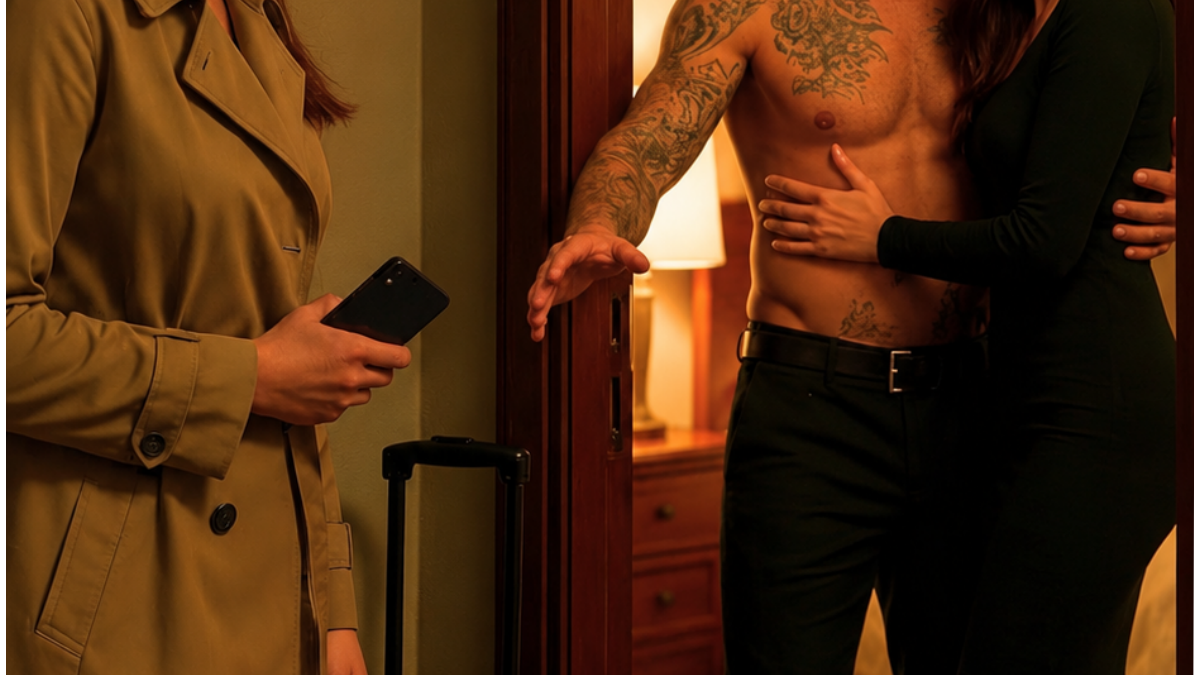
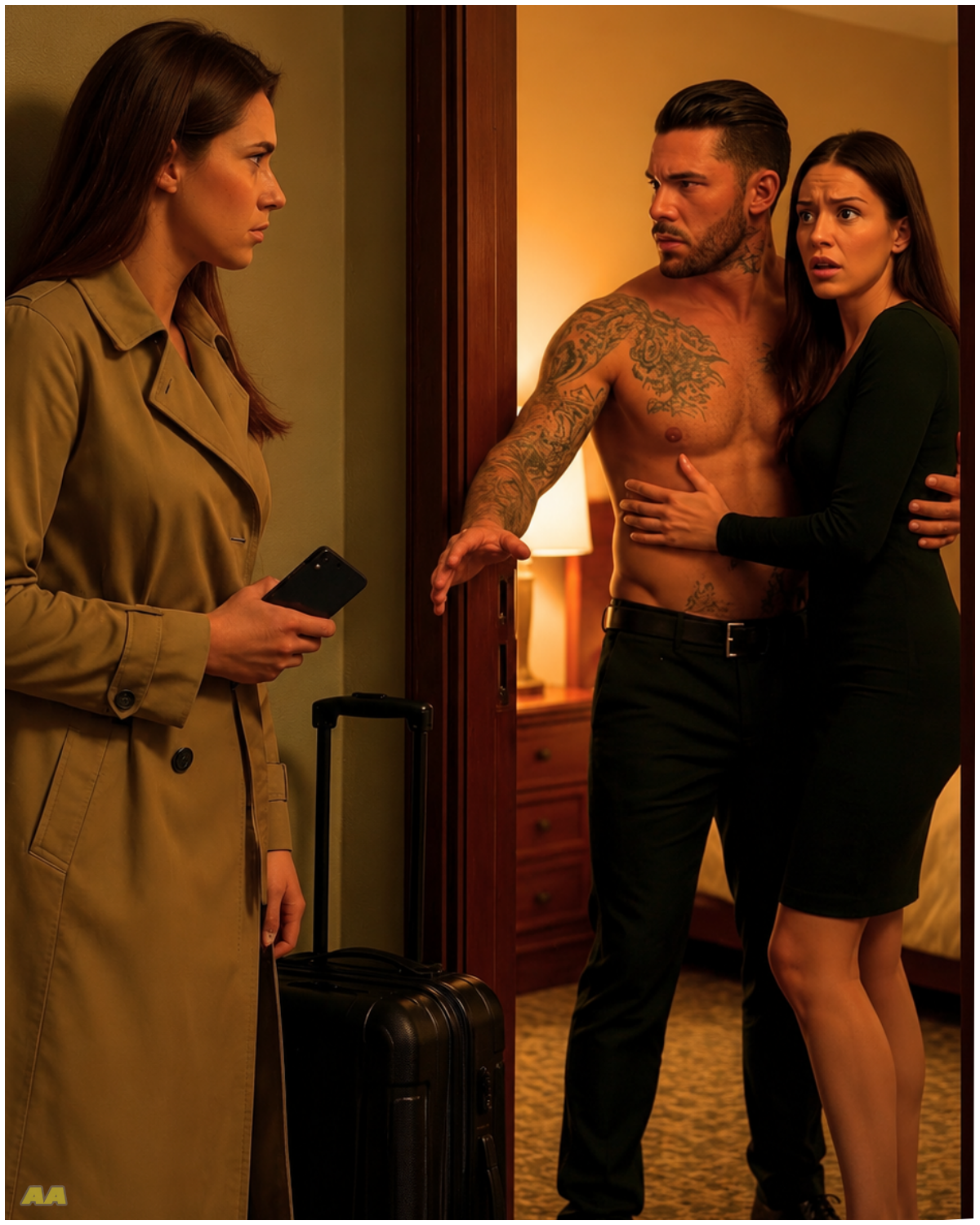
The scene arranged itself before her with the terrible clarity of a photograph.
Dante, shirtless, belt undone, sitting on the edge of their bed.
Their bed, the one they’d picked out together at that overpriced furniture showroom in Cambridge, the one where she’d curled against him during thunderstorms and believed she was safe.
And Viven Cruz. Viven, who Dante had introduced as a family friend at a charity gala three years ago.
Viven, who wore Cartier and Lubbouton like armor and laughed at Dante’s jokes with a practiced musicality that had always made Lena’s teeth ache.
Viven, who was currently straddling Dante’s lap with her dress unzipped to her waist and her perfectly manicured hands tangled in his hair.
For exactly 3 seconds, Lena’s nervous system refused to process what her eyes were reporting.
Then Dante looked up. Their gazes met across the dim room, his dark and wide with the stupid shock of a man who genuinely believed he wouldn’t get caught.
Hers cool and steady as a surgeon’s hand.
Vivien turned, following his stare, and her red lips formed a perfect O of surprise that might have been genuine or might have been performance.
Lena couldn’t tell, didn’t care.
Lena, Dante started, his voice cracking on her name.
Don’t. The word came out even, almost gentle.
Lena pulled her phone from her coat pocket, opened the camera, and took one clean photograph.
No flash, no dramatics, just documentation.
The shutter sound clicked through the silence like a bone breaking.
Viven scrambled off Dante’s lap, tugging at her dress.
This isn’t We weren’t save it, Lena said.
Her voice was still calm.
Surgically calm. The kind of calm that comes when you realize the bleeding has already started and panic won’t stop it.
She looked at Dante, who’d stood up and was now staring at her like she was a stranger.
Maybe she was. Maybe she always had been.
I want you to remember this moment, Lena told him, holding his gaze.
Because by Monday morning, you’re going to understand exactly what you just loSt. She turned and walked out, closing the door behind her with a soft click that felt louder than a gunshot.
Behind her, she heard Dante shout her name, heard his footsteps pound across the bedroom floor, but Lena was already moving down the stairs, past her abandoned overnight bag, out the front door, and into the rain that soaked through her blouse in seconds and felt like baptism.
She didn’t cry. Tears were a language of grief, and grief implied surprise.
This this careful, calculated destruction of her illusions required something colder.
It required precision. Lena climbed into her car, started the engine, and drove.
The hotel she checked into was a mid-range Marriott near the financial district, the kind of anonymous establishment where business travelers came to disappear for a night or a week, and nobody asked questions.
Lena booked the room under Sarah Mitchell, an identity she’d constructed 2 years ago when she’d first started noticing the hairline cracks in Dante’s fidelity.
Late night texts, he deleted unexplained charges on credit cards.
She wasn’t supposed to monitor the particular cologne and perfume cocktail that clung to his collar on Thursday nights.
She’d told herself she was paranoid, that marriage to a man like Dante required a certain flexibility regarding conventional morality, that the women who circled him at parties and charity events were occupational hazards, not threats.
But Lena had also been raised by a forensic accountant mother who taught her that hope was a beautiful thing right up until it made you stupid and stupid got you killed.
So she’d built a contingency just in case.
Now sitting on the hotel bed with her wet clothes clinging to her skin and her phone glowing in the dark, Lena opened the encrypted folder she’d labeled insurance and began to work.
The truth was this. Dante Marchelli believed he ran an empire.
He believed he was the mastermind behind the sprawling criminal enterprise that stretched from Boston to Miami.
From gambling operations in Atlantic City to protection rackets in Providence.
From moneyaundering through a network of car washes and laundromats to strategic partnerships with Colombian suppliers who moved product through cargo ships with falsified manifests.
He believed his authority was absolute, his position unassalable.
He believed these things because Lena had let him believe them.
But belief and reality were not the same country, and Lena had been living in reality while Dante vacationed in Ego.
She opened her laptop and logged into the first of 17 accounts.
Might the Marceli organization, though Dante would have bristled at calling it an organization, preferring euphemisms like family business or our in interests, operated on a fundamental principle that most legitimate corporations would recognize, compartmentalization.
Different crews handled different operations.
Money flowed through different channels.
Information traveled on a need to- know basis.
What made the system work wasn’t Dante’s strategic brilliance or Marco’s street level enforcement.
It was infrastructure. Boring, unglamorous infrastructure that required someone to track payroll for 47 employees across six states.
Someone to reconcile offshore accounts in nine different jurisdictions.
Someone to manage the shell corporations and front businesses and charitable foundations that turned dirty money into clean investments.
That someone was Lena. She’d started 7 years ago, back when Dante was still mid-level in his father’s organization and charming enough to make her believe that marrying into the mob was a romantic adventure rather than a life sentence.
He’d asked for her help with some paperwork, tax documents for a legitimate restaurant chain his family owned.
Lena, who’d graduated Sumakum Laad with a double major in accounting and computer science, had agreed.
The paperwork had multiplied. The restaurant chain had led to import export companies, which had led to real estate holdings, which had led to private investment funds.
Before Lena fully understood what she was building, she’d become the invisible architect of Dante’s entire operation.
The person who knew where every dollar lived, where every vulnerability hid, where every federal regulation bent just enough to avoid breaking.
Dante’s father had died four years ago.
And Dante had ascended to boss with Lena still working in the shadows, still making the impossible logistics of crime look easy.
The men who worked for Dante, musclebound enforcers and coldeyed dealers and nervous accountants who did the street level books, never knew her name.
Dante’s inner circle knew she existed, but assumed she was decorative, a smart wife who handled domestic finances.
Only Marco, Dante’s consilier, had ever looked at Lena with something approaching understanding.
Once at a family wedding, after too much wine, he’d cornered her near the catering table.
“You know what you are?” he’d asked, his words slightly slurred, but his eyes sharp.
“What?” “The foundation. Dante’s the house.
Big, visible, impressive. But you’re the foundation, and foundations don’t get credit until the house falls down.
Lena had smiled politely and changed the subject, but she’d never forgotten it.
Now staring at her laptop screen, she thought about foundations and houses and the physics of controlled demolition.
The first account she accessed was the primary offshore repository, a Cayman Islands bank called Providential Trust that held approximately $8.3 million in liquidity across four sub accounts.
Lena navigated through the security protocols she’d personally designed past the two-factor authentication and biometric verification that required her fingerprint and facial recognition.
She transferred $8.3 million to a different account.
Then she closed Providential Trust’s access entirely.
Changing passwords and security questions to random strings of characters she didn’t bother memorizing.
The second account was a Delaware LLC called Silverpoint Management that owned three properties in Miami and held $2.1 million in operating capital.
Lena dissolved the LLC, triggered the liquidation protocols, and rerouted the funds.
The third account was payroll.
Dante’s operation employed 47 people who expected regular deposits every 2 weeks.
Dealers, drivers, enforcers, fixers, the guy who ran the sports betting website, the woman who managed the strip club books, the lawyer who handled the legitimate facing business disputes.
Lena canceled every scheduled payment.
She also locked the backup accounts in the emergency reserves.
By the time she finished with the financial architecture, it was 3:00 in the morning and Lena’s eyes burned with screen fatigue.
She stood, stretched, ordered room service coffee that arrived with a sympathetic smile from a night shift server who’d clearly seen worse, and moved on to phase 2.
The beauty of Shell corporations was their complexity.
The danger of shell corporations was their fragility.
Dante’s empire rested on a network of 23 business entities that existed primarily to obscure ownership, launder money, and create legal barriers between criminal activity and prosecution.
There was Apex Consulting Group, which build for services never rendered.
There was Meridian Holdings, which owned properties that generated rental income from tenants who didn’t exiSt. There was Northstar Imports, which moved shipping containers full of furniture that weighed suspiciously little for furniture.
Each entity required maintenance, annual filings, registered agents, tax returns that balanced legitimate income against plausible expenses.
Lena had been maintaining them for 7 years, which meant she also knew exactly how to dismantle them.
She started with the registered agents, the anonymous third-party companies that served as the official point of contact for each shell corporation.
Lena had always used the same three firms, rotating them to avoid patterns.
Now, she contacted each firm through their emergency protocols and revoked their authority, replacing them with randomly selected companies in different states who would receive a sudden flood of legal documents and have no idea what to do with them.
Then she moved to the annual filings, deliberately triggering administrative dissolution by missing deadlines and failing to pay franchise taxes.
Some states would take months to process the dissolutions.
Others would move faster, but all of them would create chaos, frozen accounts, revoked business licenses, confused creditors, and most importantly, attention because phase 3 was about attention.
That Lena had never intended to send her husband to prison.
That was the irony that almost made her laugh as she began uploading files to the encrypted server she’d set up 3 months ago when Viven’s name had started appearing too frequently in Dante’s text messages and Lena had accepted that her marriage was ending whether she acknowledged it or not.
She’d loved Dante once. Maybe she still did in the way you love a language you used to speak fluently but no longer practice.
He’d been charming and dangerous and convinced that loving her made him different from his father, better than the brutality he’d inherited.
For a while, Lena had believed that, too.
But love without respect was just another prison, and Lena was done with captivity.
The files she uploaded were comprehensive.
Seven years of meticulous documentation, bank statements showing suspicious transactions, emails discussing shipments and coded language that wouldn’t survive basic scrutiny.
Photographs of meetings between Dante and known criminals.
Recorded conversations where Dante and Marco discussed handling problems in ways that implied violence.
Property records showing shell corporation ownership.
Tax returns that didn’t match actual income.
Lena had kept everything, not because she’d planned to use it, but because information was power, and power was survival.
And somewhere deep in her accounting trained brain, she’d always known that balance sheets eventually balanced.
She packaged the files carefully, organized them with a prosecutor’s dream index, and attached a cover document that explained exactly what each piece of evidence proved and which federal statutes it violated.
Money laundering, racketeering, tax evasion, interstate transportation of stolen goods, wire fraud.
Then she sent it to an encrypted email address connected to a reporter at the Boston Globe who’d been investigating organized crime for a decade and to a federal prosecutor in the Eastern District of Massachusetts who’d made a career out of RICO cases.
She didn’t sign her name, didn’t leave any trace, just a simple message.
If you want to dismantle the Marcelli organization, start here.
The sun was rising when Lena finally closed her laptop.
She slept for 4 hours, a dreamless, exhausted sleep that felt like falling through darkness, and woke to 17 missed calls from Dante and nine from Marco.
Lena deleted them all without listening to the voicemails.
She showered, changed into the spare clothes she’d packed in her overnight bag, now retrieved from the townhouse by a Task Rabbit worker she’d hired through a burner phone, and ordered breakfaSt. The eggs arrived overcooked and the coffee was mediocre, but Lena ate mechanically.
Fuel for a body that needed to keep moving.
Her phone buzzed with a new call.
Dante again. This time she answered, “Lena, thank God.” His voice was ragged, desperate.
“Where are you? We need to talk.
This is what you saw.
It’s It’s not what you think.
It’s exactly what I think,” Lena said calmly.
She was sitting by the hotel window watching the financial district wake up below.
Men and women in expensive suits rushing toward buildings where they’d move money and make deals and convince themselves they were better than people like Dante.
You were [ __ ] Vivien Cruz in our bed.
There’s no other interpretation. Silence.
Then Lena, please. I made a mistake.
I’m sorry. I’ll fix this.
You can’t fix this, Dante, but I appreciate the offer.
What does that mean? His voice shifted, sharpening with the first edge of panic.
Lena, what did you do?
Me? I didn’t do anything.
I just stopped doing everything.
Stop talking in riddles and tell me what the [ __ ] is going on.
Lena smiled, though he couldn’t see it.
Check your accounts. Call your lawyer.
Talk to Marco. You’ll figure it out.
She hung up. Okay. The calls multiplied throughout Saturday.
Dante called 11 times. Marco called six.
Three different crew leaders called.
Their numbers showing up as unknown, but their voices immediately recognizable.
Tony from the gambling operation, Louise from the Miami properties, Kevin, who ran the protection rackets.
Lena didn’t answer any of them.
Instead, she went shopping. There was something magnificently ordinary about walking through Nordstrom on a Saturday afternoon, trying on dresses she didn’t need.
While Dante’s empire began its slow collapse somewhere across the city, Lena bought a navy sheath dress that cost too much, a pair of leather boots, an expensive lipstick in a shade called Resilient Red.
The saleswoman complimented her choices with the kind of studied enthusiasm that suggested commission, and Lena smiled and thanked her and felt nothing.
She had dinner at a sushi restaurant.
She’d always wanted to try, but Dante hated.
He had a thing about raw fish, considered it unmasculine somehow, and ordered the omicazi menu.
The chef prepared 17 courses with the kind of precision Lena recognized from her own work.
Each piece of fish a small perfection, and she ate slowly, tasting everything, aware that this was the first meal in 7 years she’d eaten without calculating its cost against Dante’s operation.
By Sunday morning, the panic in Dante’s voicemails had evolved into rage.
You [ __ ] [ __ ] His voice snarled through her phone speaker while Lena did yoga in her hotel room.
You think you can destroy me?
You think I won’t find you?
I built this empire. Lena pressed delete and moved into downward dog.
Betrayed me after everything I gave you.
Delete warrior pose. Going to regret this, Lena.
I swear to God, you’re going to delete child’s pose.
Marco’s voicemails were more measured but equally desperate.
Lena, I don’t know what’s happening between you and Dante.
But we need to talk.
The accounts are frozen. Payroll didn’t process.
We’ve got suppliers calling in debts and I can’t access the emergency funds.
Please, whatever this is, we can fix it.
Just call me back. She didn’t call him back.
Instead, she opened her laptop and checked the news.
Nothing yet. The federal investigation would take time.
Prosecutors didn’t move on tips alone, even well-documented ones.
They’d need to verify, cross reference, build their case, but the reporter had already started working.
Lena found a brief article on the Globe’s website buried in the local business section.
Federal investigators probed possible money laundering scheme linked to Boston area businesses.
No names, not yet. But the clock was ticking.
Yes. Monday morning arrived with rain again, softer this time, more resignation than violence.
Lena packed her few belongings, checked out of the Marriott, and drove to a different hotel.
This one in Cambridge near MT, chosen because it was the kind of place where brilliant young people came to change the world, and nobody would ever think to look for a mob wife.
She checked in under a different name, Jennifer Hartley this time, and settled into the familiar anonymity of another beige room with another generic landscape painting and another coffee maker that promised mediocrity.
Then she opened her laptop and watched Dante’s empire bleed.
The financial damage was cascading now, each failure triggering the next in a chain reaction Lena had designed with the precision of a watch maker.
Payroll hadn’t processed for the second week in a row, which meant dealers were getting nervous and enforcers were asking questions.
The offshore accounts were inaccessible, which meant Dante couldn’t pay his Colombian suppliers, which meant shipments were being held in limbo, while very dangerous men made very dangerous phone calls.
The Shell corporations were dissolving, which meant properties were being flagged for tax leans and bank accounts were being frozen, and lawyers were suddenly unavailable.
Lena’s phone buzzed with a call from a number she didn’t recognize.
She answered cautiously. Mrs. Marcelli, a woman’s voice, professional and careful.
Who’s asking? My name is Sarah Chen.
I’m a financial analyst with the IRS.
I’m calling regarding some irregularities we’ve identified with several business entities registered under your name.
Those entities were registered without my knowledge or consent, Lena said smoothly.
She’d prepared the script weeks ago, practicing until it sounded natural.
My husband handled all our business affairs.
I’m currently separated from him and in the process of consulting with legal counsel regarding identity theft concerns.
A pause. I see. Could you provide the name of your attorney?
Lena gave her the number of a lawyer she’d retained two months ago, a sharp woman named Rebecca Torres, who specialized in financial crimes, and had asked exactly zero questions when Lena had showed up with a retainer check and a hypothetical situation involving a woman who might need to prove she had no knowledge of her husband’s illegal activities.
Thank you, Mrs. Marcelli. We’ll be in touch.
The call ended. Lena marked it down in her mental ledger.
IRS engaged, narrative established, liability shifted.
By Monday afternoon, Dante was leaving voicemails that sounded like a man unraveling.
Lena, they’re circling the suppliers, the crew.
Everyone’s asking questions I can’t answer.
Marco says we’re down to maybe 2 weeks of operating capital, and I don’t I don’t know how to fix this without you.
Please, I know I [ __ ] up.
I know I hurt you, but this is bigger than us.
You understand? People depend on this operation, families.
If it falls apart. Lena listened to the whole message this time, waited until his voice cracked with something that might have been genuine fear, and then deleted it with the same clinical detachment she’d used to dissolve his shell corporations, people depending on the operation, families.
He was right about that in his own myopic way.
47 employees did depend on Dante’s criminal enterprise for their income.
Their families did depend on it indirectly.
Rent and groceries and children’s birthday presents paid for with money that flowed from violence and exploitation and corruption.
But Lena had stopped believing that perpetuating harm was justified by the people it fed.
She’d stopped believing a lot of things.
She’d stopped believing that loving someone required setting yourself on fire to keep them warm.
She’d stopped believing that loyalty without reciprocity was loyalty at all.
She’d stopped believing that she owed Dante her brilliance, her labor, her silent complicity in his empire.
And most importantly, she’d stopped believing that walking away made her the villain.
Aam Tuesday brought the first news coverage.
The Boston Globe published a longer piece.
Front page of the metro section above the fold.
Federal investigation targets alleged criminal enterprise.
Still no names, but details were emerging.
Suspicious financial transactions. Shell corporations used to launder money, properties purchased with untraceable cash, law enforcement sources suggesting a major development in a long-running organized crime investigation.
Lena read the article twice, checking the by line.
The reporter she’d sent the files to had shared them with the federal prosecutor, who’d apparently moved faster than expected.
By Wednesday, search warrants would be issued.
By Thursday, arrests would begin.
Dante called 17 times on Tuesday.
Lena answered none of them.
Marco called twice, his voicemails increasingly tur.
Lena, I know you’re angry.
I know Dante betrayed you, but this whatever you’re doing, it’s going to get people killed.
The suppliers don’t care about marital probleMs. They care about money.
And when they don’t get their money, they come collecting in ways that don’t leave room for explanations.
Please, if not for Dante, then for the people who are going to get caught in the crossfire.
Call me back. She didn’t call him back because Marco was wrong.
This wasn’t about anger. Anger was hot and impulsive and prone to mistakes.
This was about precision, about dismantling a machine she’d built with such care that even the people running it hadn’t understood how it worked.
And if people got caught in the crossfire, well, they’d made their choices.
They chosen to work for a criminal organization.
They’ chosen to profit from violence.
They chosen to believe that Dante’s empire was permanent, invulnerable.
Lena had simply revealed the truth.
Nothing built on lies could last forever.
Okay. On Wednesday morning, Vivien Cruz called.
Lena almost didn’t answer. The number showed up as private caller, but curiosity won.
Lena. Vivien’s voice was tight, controlled.
We need to talk. I don’t think we do.
Dante is falling apart. The business is collapsing.
Whatever point you’re trying to make, you’ve made it.
But this vendetta Lena laughed.
Actually laughed. The sound sharp and genuine.
Vendetta. Vivien. I don’t have a vendetta.
I have boundaries. And you crossed them.
I didn’t mean for this.
Wasn’t supposed to. Vivien’s composure cracked slightly.
Dante loves you. He made a mistake, but he loves you.
If he loved me, he wouldn’t have [ __ ] you in our bed.
Silence, then. What do you want?
Money? We can arrange. You don’t have money, Lena said gently.
Dante doesn’t have money. That’s the point.
Everything you thought was his.
Everything you thought you’d won, it was mine.
I built it. I maintained it.
And the second he forgot that, it stopped existing.
You’re insane. No, Vivian, I’m just done.
Lena hung up. Whooped. Wednesday afternoon brought the confirmation she’d been waiting for.
The news alert flashed across her phone screen.
Federal agents execute search warrants in organized crime investigation.
Lena opened the article. Photographs showed agents and FBI windbreakers carrying boxes out of properties.
She recognized the Beacon Hill townhouse, dumped Dante’s Club in the North End, the warehouse in River where the gambling operation supposedly ran.
No arrests yet, but the article mentioned ongoing investigations and potential charges including racketeering, money laundering, and tax evasion.
Her phone rang. Dante, this time she answered.
Lena, his voice was destroyed.
They’re taking everything, the computers, the files, records going back years.
They have warrants, federal warrants, and I can’t without the accounts.
I can’t even pay the lawyers.
I know, Lena said softly.
You did this. It wasn’t a question.
You gave them whatever evidence they have.
You gave it to them.
I documented your crimes for 7 years, Dante.
I kept perfect records because that’s what I do.
And when you decided I was disposable, I disposed of you instead.
Lena, please. The word broke.
I’m sorry. I’m so [ __ ] sorry about Vivian, about taking you for granted, about everything.
But you can fix this.
You know how the system works.
You can make the accounts accessible again.
You can No. What? I said no.
Lena stood, walked to the hotel window, looked out at Cambridge, spreading below her like a promise of reinvention.
I’m not fixing this, Dante.
I’m not saving you. I’m not even watching you drown.
I’m just leaving. They’re going to arrest me.
His voice was small now, childlike.
Lena, they’re going to arrest me and I’ll go to prison.
And yes, she said you will because you committed crimes and now there’s evidence and that’s how consequences work.
I love you. You love what I did for you.
There’s a difference. She ended the call, blocked his number, and felt nothing.
Thursday morning, the arrest began.
Dante was taken into custody at 6:47 a.m.
According to the news, federal agents had arrived at the Beacon Hill townhouse with a warrant, found him sleeping in the guest bedroom, and placed him in handcuffs while he was still in his pajamas.
Marco was arrested simultaneously at his apartment in Somerville.
Tony, Louise, Kevin, the entire leadership structure taken down in a coordinated operation that suggested months of planning.
Except it hadn’t been months.
It had been 7 days.
7 days from betrayal to demolition.
7 days from photograph to handcuffs.
7 days to prove that the empire Dante thought he’d built was actually just a woman’s patience wearing thin.
Lena watched the coverage from her hotel room, eating yogurt and granola she’d bought at Whole Foods.
Feeling the strange lightness of a person who’d been carrying something heavy for so long she’d forgotten what her shoulders felt like without the weight.
Her phone rang. Rebecca Torres, her attorney.
Have you seen the news?
I have. The federal prosecutor’s office called.
They want to interview you.
Standard procedure in cases like this.
Spouse of the defendant. Potential witness.
When? Tomorrow. If you’re available.
I’ll be with you obviously.
And Lena. Rebecca’s voice gentled.
You did the right thing.
For what it’s worth. Lena wasn’t sure she believed in right and wrong anymore, but she believed in survival, and she’d survived.
“Thank you,” she said, and meant it.
Take Friday afternoon, Lena sat across from two federal prosecutors in a conference room that smelled like coffee and stress.
They were exactly what she’d expected, sharpeyed, professionally skeptical, wearing suits that cost less than Dante’s, but fit better because they were bought with clean money.
The woman introduced herself as Maria Delgado.
The man is James Park.
Rebecca sat beside Lena, a steady presence.
“Mrs. Marcelli,” Maria began. “We appreciate you coming in voluntarily.” “Of course.
We’d like to ask you some questions about your husband’s business activities.” “I’ll help however I can.” Lena folded her hands on the table, the picture of cooperative innocence.
Though I should mention I had very limited involvement in Dante’s business affairs.
James raised an eyebrow. Limited involvement?
Mrs. Marcelli. We have records showing you as the registered agent for multiple corporations, signatory on several bank accounts.
Registered without my full understanding, Lena said smoothly.
My husband would bring me documents to sign.
He’d explain them as legitimate business, real estate investments, consulting firMs. I trusted him.
I had no idea he was using those entities for moneyaundering.
Maria and James exchanged glances.
When did you become aware of the illegal activity?
Maria asked. Gradually over the past year.
Small things at firSt. Conversations I’d overhear transactions that didn’t make sense.
But I didn’t have proof until recently.
And when you obtained proof, I contacted a legal counsel.
Lena gestured to Rebecca. I was advised to separate myself from my husband’s activities and cooperate with any investigations.
Did you provide information to this investigation?
James leaned forward slightly. Rebecca’s hand touched Lena’s wriSt. A warning.
My client isn’t required to answer that.
I’m not claiming any protections, Lena said calmly.
If information reached the authorities, I’m glad.
My husband’s activities were illegal and harmful, but I’d like to clarify that any cooperation I provided was as a concerned citizen, not as a participant in criminal enterprise.
The interview continued for 90 minutes.
They asked about Shell corporations, about offshore accounts, about specific transactions and meetings and conversations.
Lena answered carefully, threading the needle between helpful and incriminating, between victim and accomplice.
When it ended, Maria walked her to the elevator.
“Off the record,” Maria said quietly.
“What you did?” Dismantling his operation before we could even move.
“It was brilliant.” “I didn’t dismantle anything,” Lena said.
“I just stopped holding it together.” Maria smiled.
“Like I said, brilliant.” The weeks that followed blurred into a strange new rhythm.
Dante’s bail was set at $5 million.
He couldn’t make it. The accessible funds were gone, the properties were seized, and the people who might have helped him were facing their own charges or had disappeared into the kind of silence that meant survival.
He remained in federal custody pending trial.
The media coverage intensified. Marcelli crime family faces RICO charges.
Federal prosecutors announced major organized crime buSt. Boston mob empire collapses amid investigation.
Lena watched from a distance from her Cambridge hotel room that had become a kind of sanctuary.
She didn’t give interviews, didn’t issue statements, became a ghost in her own story, which was exactly what she’d wanted.
Vivien Cruz tried calling twice more before apparently giving up.
Lena heard through the grapevine, Rebecca had connections, and information flowed, that Viven had discovered the hard way that Dante’s gifts hadn’t actually been his to give.
The apartment she’d been living in, owned by a shell corporation now dissolved.
The credit card she’d been using, connected to accounts now frozen.
The jewelry, probably purchased with laundered money, which meant federal seizure.
Lena didn’t feel sorry for her.
Didn’t feel much of anything really, just a distant curiosity about how people convinced themselves they’d won when they’d only ever been pawns.
She started looking at apartments, real ones in her own name, paid for with money she’d quietly moved into personal accounts years ago.
Legitimate salary from legitimate consulting work she’d done on the side.
Investments made carefully. A nest egg built from her own intelligence rather than Dante’s crimes.
She found a one-bedroom in the South End, all exposed brick and hardwood floors and windows that let in clean light.
She signed the lease as Lena Marchelli because she decided not to change her name.
Not because she wanted to keep Dante’s identity, but because erasing herself felt like letting him win.
She was Lena Marchelli, and Lena Marelli had survived.
The apartment became hers on a Tuesday in November when the autumn light slanted through those wide windows and made the hardwood floors glow like honey.
Lena stood in the empty living room with her single suitcase and a potted plant she’d bought at the farmers market.
Something green and resilient that the vendor had promised would survive even neglect, and felt the unfamiliar weight of freedom settle into her bones.
She spent the first week furnishing the space with deliberate choices.
A sofa in charcoal gray because she’d always hated the leather monstrosity Dante had insisted on.
A dining table for two because she was done hosting dinner parties for men who mistook her hospitality for weakness.
Bookshelves that she filled with novels she’d been meaning to read for years, their spines uncracked and promising.
Everything she bought, she bought with her own money, earned through consulting work that had nothing to do with shell corporations or offshore accounts or the careful mathematics of crime.
It felt like learning to breathe in a new atmosphere.
But the past Lena was discovering had a way of refusing to stay buried.
On her ninth day in the new apartment, Rebecca called with news that made Lena’s coffee go cold in her hand.
The prosecutor’s office wants to offer you immunity, Rebecca said without preamble.
Full testimonial immunity in exchange for cooperation.
They need someone who understands the financial architecture of Dante’s operation.
And you’re the only person who has that knowledge.
Lena set her mug down carefully.
What does cooperation mean? Testifying, explaining how the money moved, how the shell corporations worked, connecting the dots between legitimate businesses and criminal activity.
They’re building a RICO case and your testimony would be the spine of it.
And if I refuse, they can’t compel you to testify against your husband.
Spousal privilege. But Lena, Rebecca’s voice gentled.
If you don’t testify, there’s a chance he walks.
Not on everything, but on enough.
His lawyers are already arguing that he was just a figurehead, that other people ran the operation, that the evidence is circumstantial.
Lena laughed sharp and bitter.
A figurehead? That’s almost true.
So, you’ll do it? She thought about Dante in his federal holding cell, probably still believing he could charm or threaten or negotiate his way out.
She thought about Marco and Tony and Louise and all the men who’d treated her like expensive furniture, present, decorative, easily ignored.
She thought about Vivian Cruz, who’d looked at Dante’s empire and seen power worth stealing, never understanding that the power had never been his.
Yes, Lena said. I’ll testify.
Good. The trial starts in 6 weeks.
We’ll need to prepare. After Rebecca hung up, Lena sat in her quiet apartment and felt the future solidify around her like concrete setting.
There would be no ambiguity now, no pretending she’d been an innocent bystander.
She would stand in a courtroom and explain exactly how she’d built the machine that Dante had driven into the ground, and everyone would know that she’d been complicit until the moment she’d chosen not to be.
The thought should have terrified her.
Instead, it felt like relief because the truth Lena had learned was a kind of freedom, too.
The next morning, Marco’s lawyer called.
His name was Richard Castellano and his voice carried the particular smoothness of a man accustomed to negotiating in gray areas.
Mrs. Marelli, I represent Marco Santoro.
He’d like to speak with you.
No. He’s willing to answer questions you might have about the night you left, about what happened after.
He thinks there are things you should know before the trial.
Lena almost hung up, but curiosity, that dangerous, persistent thing, made her pause.
What kind of things? He’d prefer to tell you in person.
There’s a coffee shop in Brooklyn.
Neutral territory. One conversation. After that, you never have to speak to him again.
She knew it was a mistake, even as she agreed.
They met 2 days later at a place called Vintage Coffee, tucked into a quiet street where graduate students hunched over laptops and mothers with strollers ordered oat milk lattes.
Marco was already there when Lena arrived, sitting at a corner table with two cups of coffee in front of him, looking smaller than she remembered.
Prison did that to people, she supposed, stripped away the armor of expensive suits and confidence, and left only the human underneath.
Lena, he stood when she approached, a gesture of respect that felt inacronistic.
Thank you for coming. She sat without accepting the coffee.
You have 15 minutes. Marco nodded, settling back into his chair.
He looked tired, genuinely tired.
Not the performative exhaustion of busy men, but the bone deep weariness of someone who’d watched his world collapse.
I wanted you to know that I understood what you did, why you did it.
I don’t need your understanding.
I know, but I’m giving it anyway.
He wrapped his hands around his cup like he needed the warmth.
Dante was my friend for 20 years.
I watched him build everything and I watched him destroy it.
And the worst part, he still doesn’t understand that you were the reason it worked in the first place.
Then why are we here, Marco?
If you understand what’s left to say, I want to tell you what happened after you left.
The real story, not the version that’s going to come out in court.
He met her eyes and Lena saw something she hadn’t expected.
Honesty. You deserve to know how fast it fell apart.
Against her better judgment, Lena listened.
Marco told her about the Monday morning when payroll didn’t process and the crew started panicking.
About Tony showing up at the club, furious, demanding to know where the money was, about the calls from Miami, from Providence, from the Colombian suppliers who didn’t care about marital problems or frozen accounts.
They cared about the $2 million Dante owed them and the shipment sitting in a cargo container that was costing $20,000 a day in port fees.
“We tried everything,” Marco said, his voice flat with defeat.
Dante called in every favor, contacted everyone he thought could help, but the accounts were locked, the shell corporations were dissolving, and nobody wanted to touch us because we looked radioactive.
By Wednesday, the suppliers were making threats, real ones.
They sent a guy to the club.
Said if we didn’t pay by Friday, they’d start collecting in blood.
Lena felt nothing. What did Dante do?
He tried to reach you.
Called probably a hundred times.
Left voicemails begging, threatening, bargaining.
When that didn’t work, he sent Vivien.
I know. She called. Marco’s mouth twisted.
Did she tell you that Dante promised her access to the safety deposit box?
Said there was enough cash and gold in there to cover the immediate debts, and if she could get in, he’d set her up properly, make her legitimate.
Lena’s laugh was soft and cold.
Let me guess, the box was empty completely.
You’d cleared it months ago, hadn’t you?
16 weeks ago, to be exact.
Lena had known even then that Dante’s fidelity was fracturing.
She’d visited the bank on a Tuesday afternoon, removed $340,000 in cash, gold bars worth another $200,000, and the property deeds Dante thought were secure.
She’d put it all in a new box at a different bank under a different name, and slept easier knowing that her exit strategy had teeth.
Marco shook his head, something like admiration crossing his face.
Viven lost her mind when she realized, started screaming at Dante, saying he’d promised her security, and all he’d given her was liability.
She tried to forge your signature on the bank documents.
Stupid, desperate. The bank flagged it immediately.
Good. The suppliers didn’t wait for Friday.
Thursday night, two guys showed up at Dante’s house, broke his nose, three ribs, told him he had 72 hours to produce $2 million or they’d come back for something more permanent.
Marco’s voice dropped. That’s when the feds raided.
Honestly, the arrest probably saved his life.
Lena processed this information with the clinical detachment she’d perfected over 7 years of marriage to a criminal.
Dante, beaten and desperate, Viven revealed as an amateur thief, the suppliers circling like sharks around blood in the water.
It should have felt like victory.
Instead, it just felt like confirmation.
“Why are you telling me this?” she asked.
Because when you testify, Dante’s lawyers are going to paint you as vindictive, a scorned wife who destroyed an innocent man out of jealousy.
I wanted you to know the truth that you didn’t destroy anything.
You just stopped preventing the inevitable.
I appreciate the distinction, but it won’t change the trial.
No, Marco agreed. But it might change how you feel about what comes next.
Lena stood, preparing to leave, then paused.
Marco, what are you going to do after all this?
He smiled sad and resigned.
I’m cooperating too, pleading out probably get 8 to 10 years if I’m lucky.
Dante thinks I betrayed him, but the truth is I’m just tired.
Tired of pretending we were building something legitimate.
Tired of watching good people get corrupted or killed.
Tired of being afraid. I understand that.
I know you do. That’s why you left.
He stood, extended his hand.
“For what it’s worth, Lena, I hope you build something better.
You’re smart enough to do it.” She shook his hand, felt the dry warmth of his palm against hers, and walked out of vintage coffee into the November afternoon, feeling like she’d just attended a funeral for a life she’d already buried.
The trial preparation consumed the next month.
Rebecca introduced Lena to the prosecution team, Maria Delgado and James Park, plus three junior attorneys who looked at Lena with a mixture of professional interest and personal weariness, like she was a fascinating specimen they weren’t quite sure how to handle.
They met in a conference room that smelled perpetually of coffee and dry erase markers, and they dissected seven years of Lena’s life with surgical precision.
“Walk us through the meridian holding structure,” Maria would say.
And Lena would explain how she’d layered the ownership through three separate LLC’s to obscure the ultimate beneficial owner.
How she’d routed rental income through a management company that existed only on paper.
How she’d balanced the books to show just enough legitimate activity to avoid suspicion.
Why did you use Delaware for Silverpoint Management?
James would ask. And Lena would detail the state’s privacy protections, the lack of beneficial ownership disclosure requirements, the ease of forming and maintaining entities with minimal public record.
Did Dante understand how the financial structure worked?
This from one of the junior attorneys, a sharp-eyed woman named Patricia Chen, who seemed genuinely curious.
“No,” Lena said. Dante understood outcomes.
Money appears, problems disappear, suppliers get paid, crew stays loyal.
He didn’t understand process. That was my job.
And he never asked. Why would he?
It worked. Men like Dante don’t question mechanisms that serve them.
Patricia wrote something down, and Lena wondered if it was a legal note or a personal observation.
They practiced her testimony until Lena could recite Shell Corporation structures in her sleep.
Until the names Apex and Meridian and Northstar became divorced from meaning and turned into pure data.
They prepared her for cross-examination for the defense attorneys who would try to paint her as a criminal mastermind or a bitter ex-wife or both.
They’re going to ask why you stayed if you knew it was illegal, Rebecca warned during one session.
You need a good answer.
Lena thought about this. I stayed because I loved him.
And then I stayed because leaving seemed impossible.
And then I stayed because I didn’t realize I had a choice.
Until I did. That’s good, Maria said.
Use that. The trial began on a gray morning in early December when the city felt like it was holding its breath before winter truly arrived.
Lena wore the navy sheath dress she’d bought the day after leaving Dante, the expensive one that made her feel armored.
She walked into the federal courthouse with Rebecca beside her and a swarm of reporters shouting questions she didn’t answer.
The courtroom was exactly what she’d expected.
Wood paneling and fluorescent lights, the kind of institutional space that turned human drama into bureaucratic process.
Dante sat at the defense table in a suit that didn’t fit him anymore.
Weight loss carving new angles into his face.
He looked at Lena when she entered and she saw the flash of something complicated cross his expression.
Hope maybe or desperation. She looked away.
The prosecution’s opening statement laid out the case with methodical efficiency.
The Marceli criminal organization operating for over a decade engaged in racketeering, money laundering, illegal gambling, drug trafficking, and violent crimes.
Dante Marchelli at the Apex, Marco Santoro as Consilier.
Various crew leaders managing different operations.
Millions of dollars laundered through shell corporations, legitimate businesses used as fronts, a network of corruption stretching from Boston to Miami to international financial centers.
The defense’s opening statement was predictable.
Dante Marchelli, a legitimate businessman, targeted by overzealous prosecutors.
The evidence circumstantial, the witnesses compromised.
The case built on the testimony of criminals seeking reduced sentences and a vindictive ex-wife seeking revenge.
Mrs. Marcelli, the defense attorney said, his voice dripping with theatrical skepticism, will claim she was an unwitting participant, but the evidence will show that she was the architect of this alleged enterprise.
And when her marriage fell apart, she decided to destroy her husband rather than accept the consequences of her own choices.
Lena listened and felt nothing.
Let them spin their narrative.
The truth would speak for itself.
She was called to testify on the third day.
The baiff swore her in, and Lena placed her hand on the Bible and promised to tell the truth, the whole truth, and nothing but the truth.
Aware of the irony that she was about to expose lies while standing in a building designed to manufacture justice from competing fictions.
Maria Delgato approached the witness stand, her expression professionally neutral.
Please state your name for the record.
Lena Marchelli. And what is your relationship to the defendant?
I’m his wife. We’re currently separated and in the process of divorcing.
How long were you married?
7 years. And during those seven years, what was your involvement in your husband’s business activities?
Lena took a breath. This was the moment.
The fulcrum between her old life and whatever came next.
I managed the financial and administrative infrastructure for what I eventually understood to be a criminal organization.
A murmur rippled through the courtroom.
Dante’s lawyer stood. Objection, your honor.
The witness’s characterizing overruled, the judge said.
She’s testifying about her understanding.
Continue, Mrs. Marcelli. Lena continued.
She explained how it had started innocently with restaurant tax returns and legitimate business documentation.
How it had expanded gradually, one shell corporation at a time, one offshore account at a time until she was managing a complex financial architecture designed to obscure criminal proceeds.
She detailed specific transactions, specific entities, specific mechanisms of fraud and deception.
Did you understand these activities were illegal?
Maria asked. Eventually, yes, it became impossible not to understand.
Why didn’t you stop participating?
Lena looked at the jury.
12 ordinary people who would decide Dante’s fate and indirectly her own.
Because I loved my husband.
Because I believed he would change.
Because leaving felt dangerous and staying felt familiar.
Because fear is a powerful motivator and hope is a powerful seditive.
When did you decide to leave?
When I came home early from a business trip and found my husband in bed with another woman.
And what did you do?
I took a photograph and then I began the process of separating myself from his criminal enterprise.
The questioning went on for hours.
Maria walked Lena through every shell corporation, every offshore account, every transaction that had seemed innocuous at the time but revealed itself as fraud under scrutiny.
Lena testified with precision. Her accounting background manifesting in clear explanations of complex financial structures.
She showed the jury how money moved from street level dealing through front businesses into offshore accounts back into legitimate investments.
She explained how properties were purchased, how businesses were acquired, how an empire of crime dressed itself in the costume of respectability.
When Maria finally said, “No further questions,” Lena felt drained, hollowed out, like she’d just performed surgery on herself in public.
Then the defense attorney stood for cross-examination, and Lena understood that the surgery was only beginning.
His name was Gerald Westbrook, and he had the particular cruelty of a man who’d made a career defending the indefensible.
He approached the witness stand with a smile that didn’t reach his eyes.
“Mrs. Marceli, you testified that you eventually understood these activities were illegal.
How long did that take?
It was gradual. Perhaps 2 years into the marriage before I fully comprehended the scope.
2 years. And yet you continued participating for 5 more years after that.
Why? As I explained, fear and hope.
Fear of what exactly? Did your husband threaten you?
Not explicitly, but the threat was implicit in the world we lived in.
Men who crossed my husband faced consequences.
Did you ever witness your husband commit violence?
No. Did he ever threaten violence against you personally?
Not in words, but intimidation doesn’t require explicit threats, Mr.
Westbrook. It requires context. Context?
I see. Westbrook’s smile sharpened.
Mrs. Marceli, you have a degree in accounting from Boston University and a degree in computer science from MIT.
You graduated Sumakum Laad from both prograMs. Is that correct?
Yes. So, you’re an intelligent woman.
I’d like to think so.
Yet, you’re asking this jury to believe that despite your considerable intelligence, despite your advanced education, you somehow didn’t understand you were committing crimes for 5 years.
I understood I was operating in gray areas.
I didn’t fully comprehend the criminal liability until later.
When you say gray areas, you mean areas where you knew the law was being bent, if not broken?
Lena hesitated. This was the trap she’d known was coming.
Yes. So, you knew. You just chose not to care until it became personally inconvenient, until your marriage fell apart.
Objection, Maria said, standing argumentative.
Sustained. Rephrase, Mr. Westbrook. Mrs. Martelli, isn’t it true that you only decided to cooperate with authorities after discovering your husband’s affair?
That this testimony is motivated by personal revenge rather than moral awakening?
Lena met his eyes. My husband’s betrayal was the catalyst, but the crimes were real regardless of my motivation for exposing them.
A catalyst? How convenient. Westbrook picked up a document from the defense table.
Mrs. Marcelli, I’m showing you what’s been marked as defense exhibit 12.
Do you recognize this signature?
Lena looked at the document, a bank authorization form from 3 years ago.
Her signature at the bottom, neat and confident.
Yes, that’s my signature. And this document authorized the transfer of $1.2 $2 million from an offshore account in the Cayman Islands to a Delaware LLC that you controlled.
Correct. Yes, you controlled, not your husband.
I managed the account on his behalf, but your name was on it.
You had signatory authority. You could have transferred that money anywhere to anyone at any time.
True. Technically, yes. So when you testified that you were merely a participant in your husband’s crimes, that was misleading, wasn’t it?
You weren’t just participating. You were controlling.
I was controlling the mechanisms my husband directed me to control.
Directed? Did he hold a gun to your head?
No. Did he threaten your family?
No. Did he force you in any physical way to commit these crimes?
No. But coercion isn’t always physical, Mr.
Westbrook. Ah, yes. The implicit threats, the context.
Westbrook’s voice dripped contempt. Mrs. Marcelli, isn’t the real truth that you were a willing, enthusiastic participant in this criminal enterprise until your husband’s infidelity gave you a reason to destroy him?
No. No. Then explain why if you were so afraid, so coerced, you managed to dismantle the entire financial infrastructure in less than a week.
That doesn’t sound like the behavior of a frightened, powerless wife.
That sounds like the behavior of someone who’d been planning her revenge.
Lena felt the courtroom’s attention sharpen.
Felt the jury watching her with new calculation.
This was the moment Westbrook had been building toward the suggestion that she was the real criminal, that Dante was somehow her victim.
I dismantled the infrastructure because I built it, Lena said, her voice steady.
And when I decided to leave, I made sure I couldn’t be pulled back in.
That’s not revenge, Mr. Westbrook.
That’s survival. Survival that happened to involve providing evidence to federal prosecutors, freezing accounts, dissolving corporations, and leaving your husband vulnerable to criminal charges and physical threats from his business associates.
Quite the survival strategy. I didn’t create his criminal exposure.
I just stopped protecting him from it.
A fine distinction. Westbrook returned to the defense table, picked up another document.
Mrs. Marcelli, I’m showing you defense exhibit 18.
This is a bank statement from an account in your name alone, not connected to any of your husband’s businesses.
Do you recognize it? Lena’s stomach tightened.
She knew where this was going.
Yes. This account currently holds approximately $180,000.
Correct. Approximately yes. Where did that money come from?
Legitimate consulting work I did independently over several years.
I kept detailed records of all income and expenses.
Consulting work for whom? Various small businesses that needed accounting and financial planning services.
I can provide a complete client list if necessary.
Please do. Because Mrs. Marceli, I find it fascinating that a woman who claimed she was afraid to leave her husband, who claims she was coerced into criminal activity, somehow managed to maintain an independent revenue stream and build a secret nest egg, almost as if she were planning her exit long before the alleged affair.
Maria stood. Objection. Council is testifying rather than questioning.
Sustained. Do you have a question, Mr.
Westbrook? Yes, your honor. Mrs. Marceli, when did you open this independent account?
Approximately 4 years ago. 4 years.
So 2 years after you claim you understood the criminal nature of your husband’s activities, you began preparing your exit.
Planning your eventual betrayal. Planning my survival?
Lena corrected. There’s a difference.
Is there? From where I stand, it looks like you spent four years setting up your husband for destruction while pretending to be a loyal wife.
Would you say that’s accurate?
No. I spent four years trying to build a life that didn’t depend on criminal activity.
When my husband betrayed me, I simply chose that life over him.
Westbrook smiled like he’d won something.
No further questions, your honor.
Lena stepped down from the witness stand, feeling like she’d been flayed open, every wound exposed to public examination.
She avoided looking at Dante as she walked back to her seat in the gallery.
Avoided looking at the jury at the reporter scribbling notes at Rebecca’s carefully neutral expression.
The trial continued for two more weeks.
Other witnesses testified. Marco looking diminished in his prison jumpsuit, explaining the operational structure of Dante’s organization.
Tony, who’ taken a plea deal describing the gambling operation and protection rackets.
A forensic accountant who walked the jury through the shell corporations and moneyaundering schemes, referencing Lena’s testimony repeatedly.
And through it all, Dante sat at the defense table, his expression cycling through anger and disbelief and something that might have been grief.
Once during a recess, he caught Lena’s eye across the courtroom and mouthed something that looked like, “Please.” Lena looked away.
The jury deliberated for 3 days.
When they returned, the verdict was read with the flat bureaucratic efficiency that turned human consequences into legal pronouncements.
Guilty on 19 counts, including racketeering, money laundering, and conspiracy to commit violent crimes.
Not guilty on three counts related to specific drug transactions where the evidence had been thinner.
Dante’s face went white. His lawyer immediately began talking about appeals, but Lena could see the reality settling into Dante’s expression.
He was going to prison.
Not for months, for years, possibly decades.
The sentencing hearing was scheduled for 6 weeks later.
Lena walked out of the courthouse into December afternoon that felt like absolution.
Rebecca was beside her, fielding questions from reporters with practice deflection, but Lena barely heard any of it.
She was thinking about the apartment waiting for her in the South End, about the life she was building from Clean Materials, about the future that had finally stopped being theoretical.
She was thinking about freedom.
That night, alone in her apartment, Lena opened a bottle of wine she’d been saving.
Something expensive that Dante would have appreciated, which was exactly why drinking it alone felt like victory.
She poured a glass, sat by the window overlooking the city, and let herself feel the full weight of what she’d done.
She’d destroyed a man who’d loved her in his limited way.
She’d exposed crimes she’d helped commit.
She testified against her husband and sealed his fate.
She’d become exactly the kind of person her younger self would have judged harshly.
A woman who’d compromised her morals, profited from crime, and only found her conscience when it became personally convenient.
And yet, and yet she couldn’t bring herself to regret it, because the alternative had been staying, had been continuing to build and maintain an empire of harm, had been accepting that Dante’s betrayal was just another price of the life she’d chosen.
The alternative had been remaining invisible, useful, disposable.
Lena had chosen to be seen instead.
Had chosen to speak the truth, even knowing it would burn her, too.
Had chosen to survive rather than disappear.
She raised her glass to the city light spreading below like promises.
And she drank to the complicated, messy, imperfect freedom of a woman who’d finally learned that loyalty without reciprocity wasn’t loyalty at all.
It was just captivity wearing a prettier name.
The wine bottle was half empty when Lena’s phone rang, shattering the quiet she’d wrapped around herself like a blanket.
She glanced at the screen, expecting Rebecca, or maybe her mother calling to check in with that careful concern that had become routine since the trial.
Instead, an unknown number glowed in the darkness.
She should have let it go to voicemail, should have protected the fragile piece she’d constructed from the evening and the wine, and the sense that maybe finally she could breathe without choking on the paSt. But Lena had spent seven years answering calls she didn’t want to take.
And muscle memory was a difficult thing to break.
Hello. Silence, then breathing, ragged, wet, desperate.
Lena. She recognized Viven’s voice immediately, even distorted by what sounded like crying or fear or both.
Every instinct screamed at her to hang up, to delete the number, to refuse this particular ghost entry back into her life.
But something in that breathing, something raw and terrified, made her pause.
What do you want, Vivien?
I need help. The words tumbled out fast, borderline incoherent.
I’m at the emergency room at Mass General.
They came for me, Lena.
The suppliers, the ones Dante owed money to.
They found me and they Stop.
Lena’s voice cut through the panic with surgical precision.
Why are you calling me?
Because you’re the only person who might understand, the only person who knows how this world works and got out alive.
I got out because I had the sense to leave before it killed me.
You chose to stay. You chose to try and steal what was mine.
I know. I know. And I’m sorry.
I’m so [ __ ] sorry.
Vivien’s voice cracked. But they broke my wrist, Lena.
They said, “If I don’t give them information about where Dante hid money, money they think exists, they’re going to come back and break more than that.
And I don’t know anything.
I don’t know where any money is because there isn’t any money, is there?
You took it all.” Lena poured herself more wine, taking a long sip while Vivian’s breathing filled the silence.
She thought about mercy and karma and the strange mathematics of pain.
Thought about the photograph she’d taken that Friday night, the clean documentation of betrayal that had started this entire cascade.
Thought about whether she owed anything to a woman who’d climbed into her bed and tried to steal her life.
“Go to the police,” Lena said finally.
“File a report, get a restraining order.” “The police can’t help me with people like this.
You know that. Then I guess you’re learning what it costs to involve yourself with criminals.
Congratulations on the education. Please.
The word dissolved into something close to a sob.
I’m not asking you to save me.
I’m asking for advice. Just tell me what to do and I’ll never contact you again.
Lena closed her eyes. Saw Vivien straddling Dante in their bedroom, red lips and perfect nails and the casual cruelty of taking what wasn’t offered.
Saw the terrified woman in a hospital somewhere across the city.
Wrist probably in a caSt. learning too late that playing at being a mob wife and actually surviving as one were entirely different skills.
Tell them the truth, Lena said.
Tell them there is no hidden money.
That Dante’s operation was built on structure and credit and the illusion of wealth.
And when the structure collapsed, the wealth evaporated.
Tell them to check the federal asset seizure records.
Every property, every account, every asset has been cataloged and frozen.
There’s nothing left to find because there was never as much as everyone believed.
They won’t believe me. That’s not my problem, Vivien.
You wanted Dante’s world. Now you have it.
Enjoy the consequences. Lena hung up before Viven could respond, then blocked the number with the same clinical efficiency she’d used to dissolve Shell corporations.
She finished her wine in the sudden quiet, feeling nothing that resembled guilt.
Viven had made her choices.
Lena had made hers. The universe was simply delivering results.
But sleep, when it finally came, was fractured with dreams of broken wrists and desperate phone calls and the particular violence that came for women who miscalculated their value in men’s games.
The next morning brought coffee and clarity and a message from Rebecca.
Sentencing hearing moved up to next week.
Prosecution wants to capitalize on the momentum.
Can you meet today to discuss your victim impact statement?
Lena stared at the message while her coffee went cold.
Victim impact statement. The legal systems designated space for her to explain how Dante’s crimes had harmed her, to put a human face on the abstract violations of law and order.
She’d known this was coming.
Rebecca had mentioned it during trial prep.
But the reality felt different now, heavier, like something that required more honesty than she was certain she possessed.
She met Rebecca at the same coffee shop where she’d met Marco weeks ago, as if her life had become a series of difficult conversations happening in neutral spaces over mediocre coffee.
Rebecca was already there, laptop open, looking professionally exhausted in the way lawyers always did when trials bled into the rest of their lives.
“You look terrible,” Lena said, sitting down.
“You look surprisingly good for someone who just torpedoed her husband’s life.” ex-husband if the divorce papers go through.
And I didn’t torpedo his life.
I just stopped holding it together.
Rebecca smiled faintly. You should use that line in your statement.
It’s good. She pulled up a document on her laptop.
The prosecution wants something personal, not just financial harm.
The jury’s already heard about that.
They want emotional impact. How the betrayal felt.
How discovering the depth of his criminal activity affected you.
The fear, the manipulation, the loss of truSt. How much truth are they looking for?
As much as you’re willing to give.
But Lena, Rebecca’s voice gentled.
This is your chance to control the narrative, to make sure the record reflects that you were a victim before you became a witness.
Don’t waste it on false modesty or misplaced loyalty.
Lena thought about this. Thought about standing in that courtroom again, speaking into a microphone while Dante listened while the judge prepared to decide how many years of his life would be spent in federal prison.
Thought about what truth she owed and to whom.
I’ll write something, she said finally.
But I need to do it alone.
She spent 3 days on the statement, writing and rewriting, trying to find the language that captured the particular hollowess of loving someone who saw you as infrastructure rather than human.
She wrote about the slow erosion of self that came from subordinating your intelligence to someone else’s ego.
About the fear that lived in her body like a second heartbeat.
Not fear of violence, but fear of irrelevance.
Of becoming so useful that she ceased to be visible.
About the moment she’d walked into her bedroom and seen Viven, and understood with perfect clarity that she’d been treating herself as disposable long before Dante had.
The final version was two pages, single spaced, and reading it made her throat tight with a grief she hadn’t known she was carrying.
The sentencing hearing took place on a Wednesday morning that felt like the universe holding its breath.
The courtroom was less crowded this time.
The reporters had moved on to fresher scandals, and the gallery held mostly federal officials, a few remaining crew members looking diminished without their boss, and Lena sitting with Rebecca in the second row.
Dante was brought in wearing the same ill-fitting suit from the trial, but something in his posture had changed.
The arrogance had burned away, leaving only a kind of exhausted acceptance.
He looked at Lena when he entered, and she looked back, and for a moment they were just two people who’d built a life together, and watched it collapse under the weight of its own contradictions.
Then he looked away, and the moment passed.
The judge, a woman in her 60s named Patricia Morrison, who’d presided over the trial with the kind of non-nonsense competence that suggested she’d seen every variation of human failure and remained unimpressed, called the hearing to order.
The prosecution presented their recommendations firSt. Maria Delgado stood and delivered a summary that reduced 7 years of Lena’s marriage to bullet points in criminal statutes.
The defendant orchestrated a racketeering enterprise that operated for over a decade, generating millions in illegal proceeds and leaving a trail of violence and exploitation.
The presentance report recommends 188 to 235 months under the sentencing guidelines.
The government believes a sentence at the high end of this range is appropriate given the scope and duration of the criminal activity, the lack of genuine remorse, and the ongoing danger the defendant poses to the community.
Dante’s lawyer stood to argue for the low end of the guidelines, citing his client’s lack of prior criminal history, his cooperation during the trial, which was laughable, Lena thought, since Dante had cooperated with nothing, and the alleged coercion for more powerful criminal elements.
It was a performance and not a convincing one.
Then, Judge Morrison looked at Lena.
Mrs. Marcelli, I understand you’ve prepared a victim impact statement.
Would you like to deliver it?
Lena stood, legs steadier than she’d expected.
She walked to the podium, unfolded the two pages she’d carried like a talisman, and began to read.
Your honor, my [clears throat] name is Lena Marcelli, and for 7 years, I was married to the man sitting at the defense table.
For 7 years, I believed I was building a partnership.
Instead, I was building a prison.
Her voice was steady, clear, carrying through the courtroom with the particular authority that came from finally telling a truth.
She’d buried for too long.
Dante Marchelli never hit me, never threatened me with physical violence.
But abuse doesn’t always leave bruises you can photograph.
Sometimes it’s subtler, a slow erosion of self that happens so gradually you don’t notice until you’ve become someone you don’t recognize.
Someone who uses her education and intelligence to facilitate crimes.
Someone who tells herself that love requires sacrifice, not understanding that what she’s sacrificing is her own integrity.
She glanced at Dante. He was staring at the table in front of him, jaw tight.
I helped build the financial infrastructure that allowed my husband’s criminal enterprise to flourish.
I did this because I loved him, because I believed in him, because I thought I was choosing partnership over isolation.
But partnership requires mutual respect, and Dante never respected me.
He valued what I could do for him, the accounts I managed, the problems I solved, the systems I built.
But he never valued who I was.
And the moment I stopped being useful, I became disposable.
Lena’s throat tightened, but she pushed through.
The night I discovered my husband’s affair, I understood something I should have understood years earlier.
I had built the machine that was destroying me.
And if I didn’t dismantle it, I would disappear inside it.
So, I made a choice.
I chose survival over loyalty.
I chose truth over complicity.
And I accept that this choice makes me complicit in my own right.
I participated in crimes. I profited from harm.
And I only found my conscience when it became personally necessary.
She looked directly at Judge Morrison.
Now, but I also want the record to reflect that the harm Dante Marchelli caused extends beyond his criminal enterprise.
He harmed me by treating our marriage as a transaction rather than a relationship.
He harmed me by making me believe my value existed only in my utility.
And he harmed me by teaching me that love without respect is just another word for captivity.
Lena folded the pages carefully.
I don’t know what sentence is appropriate for the crimes he committed.
That’s your decision, your honor.
But I want him to understand that the empire he lost wasn’t destroyed by federal prosecutors or vindictive ex-wives or bad luck.
It was destroyed because it was built on a foundation of lies and disrespect and the assumption that people who loved him would remain useful and silent forever.
And that foundation was never strong enough to support the weight of his ambition.
She returned to her seat, hands trembling slightly now that the words had left her body and become public record.
Rebecca touched her arm gently, a gesture of support that Lena felt like a lifeline.
Judge Morrison made notes on her legal pad, expression unreadable.
Then she addressed Dante directly.
Mr. Marcelli, do you wish to make a statement before sentencing?
Dante stood slowly. His lawyer whispered something that Dante ignored, stepping toward the podium with the remnants of the confidence that had once made him believable as a boss.
When he spoke, his voice was rough with something that might have been genuine emotion.
Your honor, I’ve made mistakes, serious mistakes.
I hurt people, including my wife, and I accept responsibility for that.
He paused, seeming to search for words.
But I want to say something to Lena if I can.
Judge Morrison nodded. Dante turned to look at Lena directly.
I’m sorry. I’m sorry for the affair, for taking you for granted, for not seeing what I had until I lost it.
You were right about everything.
The empire wasn’t mine. It was ours.
And I destroyed it the moment I forgot that.
Lena met his eyes and felt nothing shift inside her.
The apology was real, she thought.
But it was also irrelevant.
Sorry didn’t rebuild truSt. Sorry didn’t undo 7 years of being treated as infrastructure.
Sorry was just a word people said when they finally understood consequences.
Dante turned back to the judge.
I know I’m going to prison.
I know I deserve it, but I want the record to show that Lena Marcelli is not a criminal.
She’s a woman who loved the wrong man and paid for it in ways that don’t show up in sentencing guidelines.
Whatever punishment I received, she doesn’t deserve to carry the weight of my choices.” He sat down, and the courtroom settled into the heavy silence that preceded judgment.
Judge Morrison reviewed her notes, the quiet stretching until it became almost unbearable.
Then she spoke, her voice carrying the weight of institutional authority.
Mr. Martelli, I’ve presided over many criminal trials in my career.
I’ve seen defendants who showed no remorse, defendants who blamed everyone but themselves, and defendants who seemed genuinely surprised that their actions had consequences.
You, interestingly, seemed to fall into multiple categories.
She leaned forward slightly. Your operation was sophisticated, longunning, and caused significant harm.
You profited from violence, from addiction, from the exploitation of vulnerable people.
Your wife’s testimony made clear that you were not, as your defense suggested, a figurehead.
You were the architect of this enterprise, even if you delegated the actual construction to someone more competent.
Dante flinched at that, and Lena felt a grim satisfaction.
The presentance report recommends 188 to 235 months.
I’ve considered the arguments for leniency, your lack of prior record, your family circumstances, the letters of support from community members who apparently never wondered where your money came from.
I’ve also considered the aggravating factors, the scope of your operation, the violence associated with it, and your apparent belief that marital betrayal is somehow relevant to criminal sentencing.
Judge Morrison’s expression hardened. It is the judgment of this court that you be committed to the custody of the Federal Bureau of Prisons for a term of 216 months, 18 years, followed by 5 years of supervised release.
You will also pay restitution in the amount of $4.7 million to be distributed to victims of your criminal enterprise and a fine of $500,000.
The courtroom erupted in murmurss.
Dante’s face went white, then red, then settled into a kind of gray shock.
His lawyer was already talking about appeals, but Lena could see the reality sinking in.
18 years. Dante was 43 years old.
He’d be 61 when he got out, assuming good behavior.
His empire was gone. His wife was gone.
His future had just contracted to a federal prison cell and the endless bureaucracy of incarceration.
Judge Morrison banged her gavl.
This court is adjourned. Lena stood on shaking legs and walked out of the courtroom without looking back.
The days after the sentencing blurred together in a haze of administrative aftermath.
There were meetings with Rebecca to discuss the divorce proceedings, which would move forward now that Dante was officially a convicted felon with no assets to fight over.
There were calls from the federal prosecutor’s office about restitution and whether Lena would be expected to contribute.
Rebecca handled those with the firm assertion that Lena had cooperated fully and her independent assets were exactly that, independent.
There was a brief media storm when the sentencing hit the news with reporters trying to track Lena down for interviews.
She refused them all, let Rebecca issue a simple statement about moving forward with her life, and deleted her social media accounts to avoid the inevitable commentary from strangers who felt entitled to opinions about her choices.
And there was the strange, disorienting work of building a life that didn’t revolve around Dante’s empire or the trial, or the constant vigilance required to dismantle what she’d built.
Lena started taking long walks through Boston, relearning the city as a free woman rather than a criminal’s wife.
She discovered neighborhoods she’d never explored, coffee shops where nobody knew her name, bookstores where she could spend hours among strangers who didn’t care about her history.
She signed up for a pottery class at the community center near her apartment, something tactile and creative and completely divorced from accounting or crime or anything that required her brain to perform calculations.
She was terrible at pottery.
Her first bowl looked like something a kindergartenner might produce, lopsided and thickwalled and vaguely obscene.
But there was something liberating about being bad at something, about trying and failing without consequences beyond a misshapen lump of clay.
The instructor, a patient woman named Ruth, who wore clay stained overalls and had kind eyes, encouraged her.
You’re gripping too tight. The clay needs room to move.
Relax your hands. Lena tried to relax, felt the clay shift and collapse under her touch.
Started over. Tried again, failed again, kept trying.
It felt like learning to breathe.
3 weeks after the sentencing, Marco was released from federal custody on medical compassionate release.
Advanced liver disease apparently accelerated by decades of stress and alcohol and the particular toxicity that came from living adjacent to violence.
Rebecca mentioned it in passing during a phone call about the divorce papers.
He’s in hospice, Rebecca said.
Maybe 6 months. I thought you’d want to know.
Lena sat with this information, testing it for emotional weight.
Marco, who’d understood her better than Dante ever had.
Marco, who told her she was the foundation and watched her walk away.
Marco dying slowly in some sterile facility while Dante rotted in prison and she built lopsided bowls in a community center pottery studio.
“Thank you for telling me,” Lena said.
She thought about visiting him, then decided against it.
Some goodbyes didn’t need to be spoken.
Some chapters closed themselves without ceremony.
But 2 days later, she found herself standing outside the hospice facility in Brooklyn, holding a container of the Italian cookies Marco had always ordered at restaurants, the ones with almonds and powdered sugar that dissolved on your tongue like snow.
She told herself she was just passing by, that bringing cookies was a pointless gesture toward a man who probably couldn’t eat solid food anymore.
But her feet had carried her through the entrance anyway, past the reception desk and up to the third floor where Marco’s room waited at the end of a long antiseptic hallway.
She knocked softly. “Come in.” His voice was thinner than she remembered, hollowed out by illness and regret.
Marco was sitting in a chair by the window, wearing a bathrobe that hung on his diminished frame like a costume.
His skin had taken on the yellow tinge of liver failure, and an IV drip connected to his arm delivered whatever cocktail of medications was keeping death at a polite distance, but his eyes were still sharp, still recognizing her immediately.
“Lena,” something that might have been a smile touched his mouth.
“I was wondering if you’d come.
I brought cookies.” She set the container on the small table beside him.
I don’t know if you can eat them, but but you remembered I liked them.
That’s kind of you. He opened the container, took one, examined it like an artifact from a previous life.
Sit, please. Lena sat in the visitors chair, suddenly unsure why she’d come.
They sat in silence for a moment, the only sound the quiet beep of medical equipment and the muffled sounds of the hospice beyond Marco’s door.
“How long?” she asked finally.
“Weeks, maybe. The doctors talk around it, but I can do math.
He took a small bite of the cookie, chewed carefully, swallowed with visible effort.
Not a bad way to go, all things considered.
Better than a bullet or a federal prison cell.
Better than 18 years in a cage.
Dante called me, you know, from prison.
Wanted to know if I blamed you for cooperating.
Marco’s laugh was dry, painful.
I told him I blamed him for being stupid enough to lose you.
What did he say? That he’d never meant to hurt you?
That the affair was a mistake?
That if he could do it over?
Marco trailed off, shaking his head.
The usual things people say when they finally understand consequences.
Too late and not enough.
Lena looked out the window at the gray afternoon spreading over Brookline.
Did you ever think it would end like this?
The organization, Dante, all of it?
Honestly, no. I thought we’d go on forever, or at least until we got too old to care.
That’s the delusion of this life.
You start believing your own mythology.
Untouchable, invincible, above consequences. He took another labored bite of cookie.
But you knew better. You saw the fragility.
I built the fragility. I just forgot I was the only thing holding it together until I decided to let go.
And now, are you holding yourself together?
The question landed with unexpected weight.
Lena thought about her lopsided pottery bowls, her walks through unfamiliar neighborhoods, the divorce papers waiting for final signatures.
Thought about the night she still woke up from dreams where she was back in the Beacon Hill townhouse, trapped in a life that had felt like quicksand.
The harder she struggled, the deeper she sank.
I’m trying, she said honestly.
Some days are better than others.
That’s all any of us can do.
Marco’s breathing had become more labored.
Lena, I need to tell you something before I run out of time to say it.
Okay, you did the right thing.
Testifying, dismantling the operation, choosing yourself over loyalty to a man who didn’t deserve it.
I know the world will tell you different stories that you’re a traitor, a vindictive ex-wife, a criminal who only cooperated to save herself.
But from someone who spent 30 years in this life and has nothing left to protect.” He met her eyes with surprising intensity.
“You did the right thing, and I’m grateful you showed me it was possible to choose differently before it was too late.” Lena felt her throat tighten.
“You’re cooperating?” I gave the feds everything I know.
Names, operations, connections they hadn’t even thought to investigate.
“Won’t change my sentence. I’m dying anyway.
But maybe it’ll help dismantle what’s left of the organization.
Maybe some kid who would have been recruited next year won’t be because the structure doesn’t exist anymore.
He smiled faintly. It’s not redemption, but it’s something.
They talked for another hour, the conversation drifting through shared memories that felt like artifacts from an archaeological dig.
Dinner parties at the Beacon Hill House.
The time Dante had tried to fire his accountant and Lena had talked him down.
The endless delicate negotiations that had kept the organization functioning.
They didn’t talk about regret or forgiveness or the complicated mathematics of culpability.
They just talked. Two people who’d survived the same war from different positions, comparing scars.
When Lena finally stood to leave, Marco reached for her hand with his IVtethered arm.
Build something good, he said.
You’re smart enough and strong enough and you’ve earned the right to a life that doesn’t require you to compromise who you are.
Promise me you’ll do that.
I promise, Lena said and meant it.
She left the hospice facility as afternoon tilted toward evening, the container of cookies lighter by two and her chest tight with emotions she couldn’t quite name.
She drove home slowly through traffic that felt like meditation.
And when she reached her apartment, she poured herself a glass of water instead of wine and sat by the window watching the city light up against the gathering dark.
Marco died 3 weeks later.
Lena learned about it from a brief obituary in the Globe that mentioned his conviction but not his cooperation, his criminal career, but not his final attempt at something resembling conscience.
She attended the funeral, a small sparse affair in a Catholic church in the north end, attended by maybe 15 people who all looked like they’d rather be anywhere else.
Dante wasn’t there. Obviously, prison didn’t grant furlow for criminals funerals.
But Lena saw Tony and a few others from the old crew.
Their faces harder now, marked by trials and sentences and the dissolution of everything they’d thought was permanent.
They looked at her with expressions ranging from hatred to resignation, and she looked back with the calm of someone who’d already faced the worst judgment she could imagine, and survived it.
She didn’t speak to any of them, just sat in the back pew, listened to a priest deliver generic platitudes about a man he’d clearly never met, and left before the service ended.
That night, she threw herself into pottery with new intensity.
Ruth had taught the class how to center clay on the wheel, the fundamental skill that everything else built from, the ability to find balance in something formless and spinning.
Lena had been terrible at it for weeks, her clay wobbling off center no matter how carefully she positioned her hands.
But that night, something clicked.
She felt the clay find its center, felt the moment when pressure and movement and intention aligned into perfect balance.
She pulled the clay up into a cylinder, then shaped it into a bowl that was actually round, actually symmetrical, actually resembling what she’d intended to create.
Ruth noticed, came over to examine Lena’s work.
Beautiful. You found your center.
Lena looked at the bowl, still imperfect, still marked by her amateur hands, but recognizably functional.
I think maybe I did.
The divorce was finalized 6 weeks after Marco’s funeral on a morning that felt unremarkable in its ordinariness.
Lena signed the papers in Rebecca’s office, initialed where indicated, accepted the judge’s signature that dissolved 7 years of marriage into legal non-existence.
There was no property to divide, no custody to negotiate, no complicated unwinding of shared lives, just a stack of documents that said what she’d known for months.
She and Dante Marchelli were no longer legally bound to each other.
“How do you feel?” Rebecca asked after the paperwork was filed.
“Lena thought about this.” “Lighter, like I’ve been carrying something heavy for so long, I forgot what my shoulders felt like without the weight.” “That’s good.
That’s healthy.” Rebecca smiled. “What’s next for you?
I have a job interview tomorrow.
Small accounting firm, completely legitimate.
They’re looking for someone to handle tax preparation and financial planning for small business clients.
Will you tell them about Rebecca gestured vaguely at the air between them, encompassing the trial and the testimony and the complicated history that had brought them to this office.
The background check will show everything.
I’m not going to lie about my past, but I’m also not going to let it define my future.
Lena stood, extended her hand.
Thank you, Rebecca, for everything.
They shook hands and Lena walked out of the law office feeling like she’d just completed some kind of transformation ritual.
She was no longer Lena Marcelli, mob wife.
She was just Lena Marcelli, woman with a complicated past and an uncertain future, trying to build something clean from dirty materials.
The job interview went better than she’d expected.
The firm’s managing partner, a sharp woman named Catherine Woo, had clearly done her research.
She asked direct questions about Lena’s involvement in Dante’s organization, about her testimony, about whether she could be trusted.
Lena answered honestly. I participated in criminal activity for years before I understood the full scope of what I was enabling.
When I finally recognized it, I cooperated with federal prosecutors and testified against my husband.
I’m not proud of the choices I made, but I’m committed to using my skills legitimately from now on.
Catherine studied her for a long moment.
We’re a small firm. We can’t afford scandals or associations with criminal activity, but we also believe in second chances, and your technical qualifications are excellent.
I’m willing to offer you a probationary position, 6 months to prove you’re serious about legitimate work.” Lena accepted immediately.
She started the following Monday diving into the minutia of small business tax returns and financial planning with the same intensity she’d once brought to laundering millions of dollars.
But this time the work felt clean, honeSt. Every calculation served a purpose that didn’t require her to compromise her integrity or ignore where the money came from.
Her colleagues were polite but cautious at first, clearly uncertain how to navigate having someone with her history in their midSt. But Lena kept her head down, did excellent work, and gradually earned their trust through competence and consistency.
By month three, people were asking her questions.
By month five, she was training junior associates.
By month six, Catherine offered her a permanent position with a small raise.
“You’ve earned it,” Catherine said simply.
“You’re good at this, and you’re reliable.
That’s all that matters here.” Lena accepted, feeling something unfamiliar settle in her cheSt. pride maybe or just the quiet satisfaction of being valued for her actual skills rather than her utility to someone else’s ambitions.
Life developed a rhythm that felt sustainable.
Worked during the week, pottery class on Tuesday evenings, long walks on weekends.
She made friends slowly. Other women in the pottery class, a neighbor who borrowed sugar and stayed for coffee, colleagues who invited her to happy hours she occasionally attended.
None of them knew about Dante or the trial or the empire she’d dismantled.
To them, she was just Lena.
Pleasant and private and vaguely mysterious in the way single women in cities often were.
She liked being just Lena.
Liked the anonymity of it, the freedom to define herself through present actions rather than past compromises.
8 months after the divorce, Lena met someone who made her remember what it felt like to be seen without being utilized.
His name was David Chen and he taught physics at Boston University.
They met at a coffee shop near her apartment.
Literally met, colliding as Lena was leaving and David was entering, resulting in spilled coffee and profuse apologies and the kind of meat cute that would have felt contrived in a movie, but somehow worked in real life.
David insisted on buying her a replacement coffee.
Lena accepted, more charmed by his genuine embarrassment than by the gesture itself.
They ended up talking for an hour.
Conversation flowing easily from coffee to work to the particular challenges of explaining complex concepts to people who didn’t want to understand them.
I spent half my time trying to convince undergrads that physics isn’t a punishment, David said, laughing.
What about you? How do you make accounting interesting?
I don’t try to make it interesting.
I try to make it clear.
Most people are scared of numbers because they think math is about being right or wrong, but it’s really just about understanding relationships.
That’s a nice philosophy, relationships over correctness.
It applies to more than just accounting, Lena said, and meant it.
They exchanged numbers. David texted her the next day with a terrible physics pun that made Lena laugh out loud in her office.
They went to dinner the following week, the casual Italian place that served excellent pasta and cheap wine, and felt worlds away from the expensive restaurants Dante had preferred, where being seen mattered more than the food.
David was different from Dante in every way that mattered.
He asked questions and listened to answers.
He talked about his work with genuine passion rather than performance.
He paid for dinner but didn’t make it a power play.
And when he walked Lina to her car afterward and asked if he could see her again, it felt like a request rather than an assumption.
“I’d like that,” Lena said, and discovered she meant it completely.
They took things slowly, building something deliberate rather than desperate.
David didn’t pry into her paSt. He’d googled her after they met, found the trial coverage, and addressed it directly over their third dinner.
“I know about your ex-husband,” he said simply.
“And I know you testified against him.
If you want to talk about it, I’m happy to listen.
If you don’t, that’s fine, too.
But I wanted you to know that I know, so you don’t have to carry it around like a secret.” Lena had felt something loosen in her cheSt. “Thank you for being direct about it.
For not pretending you don’t know or treating me like I’m fragile.
You don’t seem fragile. You seem like someone who survived something difficult and came out stronger.
I don’t know about stronger, but I came out.
That counts for a lot.
They’d held hands across the table, and Lena had felt the unfamiliar sensation of being known without being judged, of her history acknowledged without becoming her entire identity.
6 months into dating David, Lena received a letter from Dante.
It arrived on a Tuesday, forwarded through Rebecca’s office with a note saying the prison had sent it to her firm since Dante didn’t have Lena’s current address.
The envelope was standard prison issue.
Dante’s handwriting on the front, still confident despite everything.
Lena stared at it for a full minute before opening it, heartbeating faster than she wanted to admit.
The letter inside was three pages, handwritten, surprisingly coherent.
Dear Lena, I don’t know if you’ll read this.
I don’t know if you should, but I’ve been thinking a lot over the past year.
Hard not to think when you have 18 years stretching ahead of you with nothing but time.
And I needed to say some things, even if you never respond.
First, I’m sorry. I know I said that at the sentencing, but I need to say it again more specifically.
I’m sorry for the affair.
I’m sorry for taking you for granted.
I’m sorry for building a life that required you to compromise yourself.
I’m sorry for treating you like infrastructure instead of a partner.
I’m sorry for not seeing what I had until it was gone.
Second, you were right about everything.
The empire wasn’t mine. It was ours and mostly yours.
I was just the face, the performer.
You were the foundation, the architect, the reason any of it worked.
And I destroyed it the moment I forgot that.
Third, I don’t blame you for what you did.
I blamed you for a while.
It’s easier to be angry than to accept responsibility.
But anger doesn’t last when you’re locked in an 8×10 cell with nothing but your own thoughts.
Eventually, you have to face the truth.
You didn’t betray me. You stopped enabling me.
There’s a difference. I’m not writing this to ask for forgiveness.
I don’t deserve that, and I don’t expect it.
I’m writing because I want you to know that I finally understand what I loSt. Not the empire, not the money, not the power.
You. I lost you. And that’s the sentence that actually matters.
I heard you’re doing well.
Marco told me before he died that you were building something clean, something honeSt. I’m glad you deserve that.
You always deserve better than what I gave you.
I hope you’re happy, Lena.
I hope you found someone who sees you.
Really sees you. Not just what you can do, but who you are.
I hope you’ve built a life that doesn’t require you to sacrifice yourself.
I hope you’ve forgiven yourself for whatever role you think you played in my choices because my choices were mine, not yours.
I’ll be in here for a long time.
Long enough to become a different person.
Maybe long enough to understand what it means to lose everything and face what’s left.
I don’t know if I’ll be better when I get out.
But I know I can’t be worse than I was.
Take care of yourself. Dante Lena read the letter twice, then folded it carefully and put it in her desk drawer.
She didn’t respond. Didn’t know how to respond or if responding would serve any purpose beyond reopening wounds that had finally started to scar over.
The letter felt true. Painfully, belatedly true.
But truth without timing was just sentiment.
Dante had finally learned to see her.
But he’d learned it 18 years too late and from a prison cell, and Lena had already learned to see herself without needing his recognition.
She told David about the letter that night, curled up on his couch after dinner while rain hammered against the windows.
“Do you want to respond?” David asked, his arm warm around her shoulders.
“I don’t think so.” “What would I say?
That I appreciate his apology, but it doesn’t change anything.
That I hope he finds peace, but I’ve already found mine.” You could say exactly that.
Or I could just let it be.
Let him have his epiphany in prison.
Let me have my life here.
Not everything needs closure. Sometimes things just end.
David kissed her temple. That sounds healthy and wise.
I’m working on both. They sat in comfortable silence, listening to the rain, and Lena felt grateful for the particular gift of being with someone who didn’t need her to perform strength or vulnerability, who let her just be complicated and uncertain and human.
A year after receiving Dante’s letter, Lena got a phone call that brought her past, roaring back into her carefully constructed present.
It was from a federal agent named Sandra Reeves calling about the Martelli investigation.
Mrs. Marcelli, or I suppose it’s Ms. Marcelli, now we need to speak with you about some recent developments.
Lena’s stomach dropped. What kind of developments?
There’s been activity suggesting the remnants of your ex-husband’s organization are attempting to reconstitute.
We’d like to bring you in to discuss what you know about potential successors, offshore accounts that might have escaped initial seizure, and any contingency plans Dante might have discussed.
When? Tomorrow, if possible, 10:00 a.m.
At the federal building. Lena agreed, then spent the rest of the day in a state of controlled panic.
She thought this chapter was closed.
She’d testified Dante was in prison.
The organization was dismantled. What could possibly be left to resurface?
The meeting the next morning provided unwelcome answers.
Sandra Reeves was a sharp-eyed woman in her 40s who laid out the situation with clinical efficiency.
Despite the convictions and asset seizures, fragments of Dante’s operation had survived, protected by mid-level operators who’d avoided prosecution, hidden accounts that hadn’t appeared in the original investigation, relationships with suppliers and partners that predated Dante and would outlive his imprisonment.
We’re seeing signs of reorganization, Sandra explained, spreading photographs across the conference table.
New faces running old operations, money moving through channels we thought we’d shut down, and intelligence suggests they’re using infrastructure you helped build.
Shell corporations we missed, accounts in jurisdictions where our subpoena power is limited.
Lena studied the photographs, recognized some faces, saw patterns she’d designed being repurposed by people who’d learned from Dante’s mistakes.
What do you need from me?
Information. Your testimony was invaluable for Dante’s prosecution, but you focused on what we could prove in court.
Now, we need to understand the full architecture.
Everything you built, everything you knew, even if it wasn’t evidentially strong enough for the original trial.
You want me to help you finish dismantling what’s left?
Yes. Lena thought about the life she’d built, the careful distance she’d maintained from her past, the fragile peace she’d constructed.
Thought about David and her job and her pottery class and all the ordinary, beautiful things that required her to be just Lena, not Lena, the mob wife, who testified.
Then she thought about the people who’d been harmed by Dante’s organization, about the new victims being created by its resurrection, about the responsibility she carried for having built the machine in the first place.
Okay, she said, “I’ll help, but I have conditions.” She negotiated those conditions carefully.
Her cooperation would be limited to information sharing and testimony if needed, but she wouldn’t go undercover or participate in active investigations.
Her current life, her job, her relationship, her carefully earned anonymity would be protected as much as possible.
And when this was finished, it would be truly finished.
No more call backs, no more investigations, no more asking her to be the institutional memory of crime she’d helped commit.
Sandra agreed to all of it.
The work consumed the next 6 months.
Meetings with federal investigators, combing through old records, identifying patterns and connections she’d built years ago and half forgotten.
It was exhausting, emotionally draining, like performing archaeology on her own compromised paSt. But it was also clarifying.
Every shell corporation she helped them close, every account she helped them seize, felt like one more piece of the machine being dismantled permanently.
David supported her through it with steady patience, never asking for details she couldn’t share, just being present when she came home exhausted and haunted by memories of who she’d been.
“I built so much harm,” she told him one night, voice breaking.
“All those years, I told myself I was just managing finances, just handling logistics.
But logistics of evil is still evil.” “You’re dismantling it now,” David said gently.
That has to count for something, does it?
Or am I just trying to buy back my own conscience with cooperation that should have come 7 years earlier?
I think you’re doing what you can with the understanding you have now.
That’s all any of us can do.
The final arrest came in a coordinated sweep across four states, taking down the reconstituted leadership and seizing assets across multiple jurisdictions.
The news coverage was significant but brief.
Organized crime prosecutions didn’t hold public attention the way they used to, and this was essentially cleaning up the remnants of an empire already fallen.
Lena watched the coverage from her apartment, David beside her, and felt something finally settle.
It was done, truly completely done.
The machine she’d built was dismantled beyond repair, its pieces scattered and seized, and rendered permanently non-functional.
Sandra Reeves called to thank her.
Your cooperation was essential. We couldn’t have done this without you.
I hope I never hear from you again, Lena said, not unkindly.
Understood. Good luck, Miss Martelli.
Thank you. I think I might finally have some.
She’d earned it. The luck, the peace, the future that stretched ahead of her, unmarked by the crimes of her paSt. She’d earned it through cooperation and testimony and the hard, unglamorous work of helping dismantle what she’d built.
It wasn’t redemption. She didn’t believe in redemption.
Didn’t think you could erase harm by later preventing it, but it was something, an accounting that if it didn’t balance the books, at least moved toward equilibrium.
That night, Lena and David went to her pottery studio.
She’d been working on a set of bowls for weeks, practicing the centering and pulling and shaping until her hands knew the movements without thought.
She threw her best bowl yet that evening, perfectly centered, walls even and thin, rim smooth and level.
When she lifted it off the wheel and set it aside to dry, it felt like completion.
“That’s beautiful,” David said, watching from a nearby stool.
“It’s just a bowl. It’s a bowl you made from formless clay into something useful and beautiful.
That’s not nothing.” Lena looked at her hands, clay stained and strong.
Hands that had built empires and dismantled them.
Hands that had signed documents of fraud and documents of testimony.
Hands that were learning to create things that didn’t require her to compromise herself.
“No,” she agreed softly. “It’s not nothing.
The bowl sat on Lena’s kitchen counter for 3 weeks, glazed in a deep blue that reminded her of winter oceans, perfect in its imperfections.
She used it every morning for oatmeal, found strange comfort in the weight of something she’d made with her own hands, something that served a purpose without requiring moral compromise.” David noticed, mentioned it one Saturday morning while they were making breakfast together in her apartment.
You smile every time you use that bowl, he said, cracking eggs into a pan.
It’s subtle, but it’s there.
Do I? You do. Like you’re remembering something good.
Lena ran her finger along the bowl’s rim, feeling the slight asymmetry that marked it as handmade, human hers.
[clears throat] I think I’m just pleased I finally made something that doesn’t fall apart or leak or look like a kindergarten project.
Or maybe you’re pleased you made something at all.
Something that exists because you wanted it to, not because someone needed you to.
The observation landed with unexpected weight.
Lena set the bowl down carefully, turned to look at David standing at her stove in his weekend clothes, worn jeans and a BU physics department t-shirt that had seen better days, and felt a surge of gratitude for this man who saw her clearly and chose to stay anyway.
“I love you,” she said, the words surprising her even as she spoke them.
David turned from the stove, spatula in hand, expression shifting from surprise to something softer.
Yeah. Yeah. I know we haven’t been together that long, and I know my life is complicated, and my past is messy, but I I love you, and I wanted you to know that.
He set the spatula down, crossed to her in three steps, and kissed her with the kind of certainty that felt like an answer to questions she’d been too afraid to ask.
When they broke apart, he was smiling.
I love you, too. Have for a while, actually.
Was just waiting for the right moment to say it.
This is the right moment.
Me having an emotional breakthrough over a cereal bowl.
This is a perfect moment.
Real and messy and completely yours.
They ate breakfast together in the morning light filtering through her windows.
And Lena thought about how different this felt from her marriage to Dante.
How love without power dynamics was quieter, steadier, less dramatic, but infinitely more sustainable.
She’d spent seven years performing the role of devoted wife while slowly disappearing inside it.
With David, she was just herself, complicated and scarred and learning to build a life from honest materials, and that was enough.
Three months later, during a spring that arrived late and ferocious with sudden warmth, Lena received a phone call that threatened to unravel the careful piece she’d constructed.
The number was blocked, which should have been her first warning.
She answered anyway, distracted by a client’s tax return that wasn’t balancing properly, expecting a telemarketer or wrong number.
Lena Marcelli, a woman’s voice unfamiliar and sharp with urgency, speaking.
Who is this? My name is Jennifer Hassan.
I’m a reporter with the Boston Investigative Press.
I’m working on a story about the Marceli Criminal Organization and the role women played in its operation.
I was hoping we could talk.
Lena’s entire body went cold.
I have nothing to say to you.
I understand your reluctance, but no, you don’t understand.
I testified. I cooperated with federal investigators.
I’ve done everything the legal system required.
I don’t owe the media my story.
With respect, Miss Marcelli, your story is already public.
Court transcripts, trial coverage, federal documents.
It’s all a matter of record.
I’m not trying to expose you.
I’m trying to understand the broader pattern of how criminal organizations exploit women’s labor while rendering them invisible.
Lena hesitated, hand tightening on her phone.
What do you mean broader pattern?
You’re not the only one.
We’ve identified at least seven other cases in the past decade where wives, girlfriends, or female associates managed the financial infrastructure of criminal enterprises while the male leadership took credit and visibility.
Some testified like you did.
Others went to prison. A few died.
I want to tell their stories, including yours, in a way that centers their expertise and agency rather than treating them as accessories to male crime.
That’s Lena struggled for words.
That’s actually a worthwhile project, but I still don’t want to participate.
Can I ask why? Off the record.
Because I’ve worked very hard to build a life that isn’t defined by my ex-husband’s crimes or my testimony.
Participating in a story like this, even a thoughtful one, pulls me back into that narrative, and I’m tired of living in the paSt. Jennifer was quiet for a moment.
I understand, but Ms. Marcelli, you have expertise that could help other women recognize the patterns before they become too entrenched.
Your testimony showed incredible technical knowledge about how these operations work.
Imagine if someone else in a similar situation read your story and realized they had the power to leave, to cooperate, to choose differently.
The appeal to usefulness was strategic and effective.
Lena felt it land, felt the old instinct to be helpful and competent rise up like muscle memory.
But she’d learned painfully that being useful wasn’t the same as being valued.
And she didn’t owe the world her expertise just because she possessed it.
I’m sorry, Lena said firmly.
I appreciate what you’re trying to do, but my answer is no.
Please don’t contact me again.
She hung up before Jennifer could respond, then immediately called Rebecca.
A reporter just called asking for an interview about my role in Dante’s organization.
Can they do that? Can I stop it?
Rebecca’s sigh was audible. They can write whatever they want using public records.
You can refuse to participate, which you should, but you can’t prevent them from publishing.
What outlet? Boston Investigative Press.
The angle was actually thoughtful, examining how women’s expertise gets exploited in criminal organizations.
But I don’t want to be part of it.
Then don’t be. I’ll send them a formal letter stating you declined to comment and requesting they respect your privacy to the extent possible.
But Lena, if this story runs, it might bring some attention back to you.
You should prepare for that.
The thought made Lena’s stomach twiSt. She’d worked so hard for anonymity, for the luxury of being unremarkable.
The idea of her face and name appearing in investigative journalism, of colleagues and neighbors and pottery classmates discovering her history felt like a violation.
How do I prepare for something like that?
You remember that you did nothing wrong by testifying.
You remember that your current life is built on legitimate work and honest choices.
And you remember that other people’s curiosity doesn’t obligate you to explain yourself.
Lena thanked Rebecca and hung up, then sat in her office staring at tax returns that suddenly felt irrelevant.
She thought about calling David, then decided against it.
He was teaching a seminar on quantum mechanics and she didn’t want to interrupt with her anxiety about a news story that might never materialize.
Instead, she forced herself to focus on work, to find comfort in the precise calculations and clear rules that made accounting feel safe.
Numbers didn’t judge. They just balanced or didn’t.
And when they didn’t, you could always find the error and correct it.
If only life worked the same way.
The article published 6 weeks later time to coincide with the sentencing of another organized crime case in New York, where a woman’s financial expertise had been central to the operation’s success.
Lena learned about it when Catherine called her into her office with an expression that managed to be both sympathetic and professionally concerned.
“There’s a story in the Boston Investigative Press this morning,” Catherine said without preamble.
“It’s about women in organized crime, and you’re featured prominently.
Several clients have already called asking if we knew about your background when we hired you.” Lena’s heart sank.
What did you tell them?
The truth. That we were fully aware of your history, that you cooperated completely with federal investigators, and that your work here has been exemplary.
But Lena, I need to be honest with you.
This is going to create complications.
Some clients will be uncomfortable.
Some might leave. We’ll support you through it, but you should be prepared for fallout.
Should I resign? Make it easier for the firm?
Absolutely not. You’ve earned your place here, and we’re not throwing you overboard because of a news story about crimes you’ve already answered for legally.
Catherine’s expression softened slightly. But I won’t lie to you.
The next few weeks might be difficult.
Lena went back to her desk and pulled up the article on her computer.
The headline read, “The Invisible Architects: How Women Build Criminal Empires and Pay the Price.” It was exactly what Jennifer Hassan had promised.
Thoughtful, wellressearched, centering women’s expertise and agency while interrogating how criminal organizations exploited and erased female labor.
Lena’s section was substantial, drawing from court transcripts and trial coverage to explain how she’d built the financial infrastructure for Dante’s organization, how she’d eventually testified against him, how her cooperation had been essential to the prosecution.
The article treated her sympathetically, framing her as someone who’d been manipulated into criminality and then courageously chosen to expose it.
But sympathy didn’t prevent identification.
Her full name was there.
Her photograph pulled from trial coverage was there.
The details of her current life were mercifully absent, but anyone who knew her would immediately recognize the story.
Lena closed the browser and stared at her desk, feeling the careful walls she’d built around her new life beginning to crack.
The fallout started slowly, then accelerated.
Two clients requested to transfer their accounts to different associates, citing comfort levels and concerns about judgment.
A colleague who’d been friendly grew distant, conversations becoming stiff and awkward.
Someone left a printed copy of the article on Lena’s desk with a sticky note that just said, “Wow.” David found out when a graduate student mentioned the article asking if Professor Chen’s girlfriend was that Lena Marchelli from the mob story.
He called Lena immediately, voice tight with concern.
Why didn’t you tell me this was coming?
I didn’t know it would actually publish.
The reporter called weeks ago and I refused to participate.
I thought maybe she’d drop it.
Lena, my department is gossiping about you.
Students are asking questions. I don’t care about your paSt. You know I don’t.
But I care that you’re dealing with this alone.
I’m not alone. I have you.
Do you? Because you didn’t tell me about the reporter.
You didn’t tell me you were worried about exposure.
You just handled it yourself.
Like you handled everything yourself.
The criticism stung because it was accurate.
Lena had spent so long being self-sufficient.
So long believing that needing help was weakness.
That she’d forgotten how to actually share burdens rather than just report on them.
You’re right, she said quietly.
I’m sorry. I should have told you.
I don’t want apologies. I want partnership.
I want you to trust me with the hard stuff, not just the good stuff.
I’m trying. I’m still learning how to do that.
I know, but Lena, if we’re going to build something together, you have to let me in all the way in, not just the parts you’ve already processed and packaged and made acceptable.
They talked for another hour, working through the immediate crisis and the deeper patterns it revealed.
David was patient but firm, making clear that he loved her, but wouldn’t tolerate being kept at arms length.
Lena listened and heard herself making the same mistakes she’d made in her marriage, trying to be useful instead of vulnerable, trying to protect instead of share, trying to manage perception instead of invite intimacy.
I don’t want to lose you, she said finally, voice raw.
Then don’t push me away.
Let me help. Let me be your partner in this, not just your boyfriend who gets updates after you’ve already handled everything.
Okay, I’ll try. I promise I’ll try.
The article’s impact rippled through her life in ways both predictable and surprising.
The Pottery Studio became awkward when Ruth asked gently if Lena was the woman from that article about mob wives.
Lena confirmed and waited for judgment that never quite came.
Ruth just nodded and said, “Well, you make beautiful bowls now, and that’s what matters here.” Her neighbors were less kind.
Someone spray-painted snitch on her building’s exterior wall, and while Lena couldn’t prove it was directed at her specifically, the timing felt pointed.
The building manager had it cleaned within hours, but the message lingered.
Most painfully, her mother called from Florida, voice trembling with a complicated mixture of concern and reproach.
Lena, I’m reading about your marriage in a national publication.
Why didn’t you tell me it was this bad?
Why didn’t you ask for help?
Because you taught me to handle my own problems, Mom.
You taught me that asking for help was admitting failure.
I taught you to be independent, not to marry a criminal and then testify against him in federal court.
You also taught me that when you make mistakes, you fix them.
That’s what I did. I fixed it.
The conversation devolved into old patterns.
Her mother’s disappointment dressed up as concern.
Lena’s defenses disguised as explanations.
Both of them talking past each other toward conclusions they’d reached years ago.
They hung up with mutual promises to talk again soon.
Promises they both knew were half-hearted at beSt. But amid the fallout, something unexpected happened.
Women started reaching out. The first email came through the firm’s general contact form forwarded to Lena by Catherine with a note saying your call whether to respond.
The message was from someone who signed herself only as M and wrote, “I read the article about you.
I’m in a similar situation.
My boyfriend handles money for people I don’t want to know about and he’s asked me to help with bookkeeping.
I don’t know what to do.
I don’t know who to truSt.” But reading your story made me think maybe I don’t have to just accept this.
Thank you for being brave enough to leave.
Lena read the email three times, feeling the weight of another woman’s fear and hope pressing against her carefully maintained boundaries.
She thought about ignoring it, about protecting her privacy and her peace.
Then she thought about who she’d been 7 years ago, smart and in love and slowly drowning without recognizing water.
She wrote back, “Trust your instincts.
If something feels wrong, it probably is.
Document everything you can quietly.
Build your own financial independence.
And when you’re ready to leave, leave completely.
Don’t warn him. Don’t negotiate.
Don’t give him time to trap you.
Just go. And then cooperate with authorities if they come asking because your silence protects him at the cost of yourself.
More emails followed. Women in similar situations.
Women who’d already left. Women who were still trapped and searching for permission to choose themselves.
Lena answered when she could, offering practical advice drawn from brutal experience.
She didn’t try to save anyone.
She’d learned that salvation was individual work, but she offered the kind of cleareyed guidance she wished someone had given her.
Catherine noticed the increased email traffic and called Lena into her office again.
You’re doing pro bono consulting for women leaving criminal relationships.
Is that a problem? The opposite.
I think it’s remarkable, but Lena, you should formalize it.
Not through this firm conflict of interest issues, but on your own.
There are legal aid organizations that would kill for someone with your expertise who understands both the financial architecture of crime and the emotional complexity of leaving.
The suggestion planted itself in Lena’s mind like a seed.
She researched legal aid organizations, domestic violence prevention groups, financial literacy nonprofits, found a network of people doing work that mattered, helping people escape situations that were killing them slowly or quickly.
Reached out to a woman named Sarah Martinez, who ran an organization called Freedom Path that helped women leave abusive and criminal relationships.
Sarah and Lena met for coffee, and Lena explained her background with the kind of direct honesty she was learning to offer.
I managed the finances for a criminal organization for seven years before I understood what I was doing and another five after.
I testified against my husband, cooperated with federal investigators, and now I work as a legitimate accountant.
I’m not a lawyer or a social worker, but I understand how money moves in these operations, and I know how to help someone build financial independence quietly.
Sarah listened with the focused attention of someone who’d heard a thousand difficult stories and still believed in happy endings.
Could you teach that? Could you run workshops for women in our program on financial literacy, documentation, asset protection?
I think so. Yes. We can’t pay much.
Nonprofits never can. But we can offer you the chance to turn your expertise into something that helps people instead of hurting them.
Lena felt something shift in her cheSt. Something that felt almost like redemption, except she still didn’t believe in redemption.
But maybe she believed in transformation.
Maybe she believed in using what you knew to build something better than what you’d left behind.
I’m in. She said the workshop started small.
Eight women in a community center conference room.
All of them in various stages of leaving relationships or criminal situations.
All of them looking at Lena with a mixture of hope and skepticism.
She taught them how to open bank accounts their partners couldn’t access, how to document assets and income quietly, how to build credit in their own names, how to recognize when financial control was really a form of abuse.
She told them her story, not as confession, but as case study.
Here’s what I did wrong.
Here’s what I learned. Here’s what I wish I’d known sooner.
The women asked hard questions.
Did you ever think about going back?
How did you survive the trial?
Do you regret testifying? Are you scared he’ll come after you when he gets out?
Lena answered honestly. Yeah. She’d thought about going back in weak moments when loneliness felt heavier than self-respect.
She’d survived the trial by treating it like a job.
Show up, do the work, don’t think about it too much.
She didn’t regret testifying because regret implied she’d had a better option, and she hadn’t.
And yes, sometimes she was scared Dante would seek revenge when he was released in 17 years, but fear couldn’t be allowed to dictate her entire life.
The thing about leaving, Lena told them, is that it’s not one decision.
It’s a thousand small decisions made over and over again.
You decide to leave, and then you decide not to call him, and then you decide not to respond to his letters, and then you decide to testify if they ask you, and then you decide to build a new life, and then you decide to protect that life.
It doesn’t get easier, but you get stronger, and eventually the decisions become automatic.
After the fourth workshop, a woman named Angela approached Lena, hands shaking slightly as she held out a folded piece of paper.
I documented everything you said, account numbers, shell companies, how he moves money through his construction business.
I’m leaving next week, and I want to know I if the police come asking, should I talk to them?
Lena looked at the paper, recognized the careful handwriting of someone who’d paid attention and taken notes, and decided her freedom was worth the risk.
Do you have a lawyer?
Not yet. Get one firSt. A good one who specializes in criminal defense and witness protection if necessary.
Then yes, talk to the police.
But on your terms, with protection, with immunity if possible.
Will they believe me? If your documentation is good, they won’t have a choice.
Evidence speaks for itself. Angela nodded, tucked the paper back into her purse, and left.
Lena watched her go and felt the particular weight of having given advice that could save or destroy someone’s life depending on a thousand variables she couldn’t control.
David noticed the change in her, commented on it one evening while they were cooking dinner together, a routine they developed where he handled proteins and she handled vegetables, and they met somewhere in the middle with something edible and occasionally delicious.
You seem lighter lately, less haunted.
Do I? Yeah, like you’re carrying less weight.
Lena thought about this while chopping bell peppers with more force than strictly necessary.
I think teaching those workshops helps.
It makes the past feel less like wasted years and more like expensive education.
That’s a healthy reframe. My therapist would be proud.
I’m finally using the cognitive behavioral techniques she’s been teaching me for months.
You’re seeing a therapist? David looked surprised.
Since when? Since the article came out and I realized I couldn’t keep processing trauma alone.
I should have told you I started therapy.
I’m still working on the whole sharing difficult things in real time skill.
Well, I’m glad you’re going and I’m glad you told me, even if it’s after the fact.
They ate dinner together, and Lena felt grateful for this man who loved her patiently while she learned to be loved, who called her on her self-sufficiency when it became isolation, who believed she could build something better than what she’d destroyed.
6 months into running the workshops, Lena got a call from Sandra Reeves, the federal agent who’d worked with her on dismantling the remnants of Dante’s organization.
“We’ve got a situation that might require your expertise,” Sandra said without preamble.
There’s a case developing in Providence, similar structure to what Dante ran, but the financial architecture is even more sophisticated.
The wife is showing signs of wanting to cooperate, but she’s terrified.
I was wondering if you’d be willing to talk to her, civilian to civilian, not as an official witness, just as someone who’s been where she is.
Lena’s first instinct was to refuse.
She’d done her part, paid her dues, earned her distance from federal investigations.
But then she thought about the women in her workshops, about Angela with her shaking hands and careful documentation.
About herself 7 years ago walking into a bedroom and taking a photograph that would change everything.
What’s her name? Rebecca Jiao.
She’s 34, MIT educated, been managing her husband’s operation for 6 years.
Smart, scared, starting to understand she’s complicit in something that could destroy her.
That sounds familiar. That’s why I’m calling you.
They met at a coffee shop in Providence.
Neutral territory, public enough to be safe, quiet enough to be private.
Rebecca Jiao was exactly what Lena expected, well-dressed, controlled, radiating the particular tension of someone holding themselves together through sheer force of will.
She looked at Lena with a mixture of hope and suspicion.
Agent Reeves said you might be able to help me understand my options.
I can try, but first tell me what you think your options are.
Rebecca’s laugh was bitter. Stay married to a criminal and keep being complicit in moneyaundering or leave and probably end up prosecuted along with him.
Those seem to be the choices.
There’s a third option. Cooperate.
Document everything you know. Work with investigators.
Testify if necessary. It’s not easy and it’s not clean, but it’s survivable.
And what did it cost you?
Cooperating? Lena considered this question carefully.
My marriage, obviously. My privacy, because testifying made me public, my sense of myself as a good person because I had to face how long I’d participated in harm.
Some friendships, some professional relationships, some peace of mind.
That’s a lot to lose.
It is. But I gained more.
My freedom, my integrity, a life I don’t have to lie about.
The ability to sleep at night knowing I finally chose truth over comfort.
They talked for 2 hours.
Lena walked Rebecca through the practical logistics of cooperating, how to document without being caught, how to build an exit strategy, how to work with prosecutors to minimize her own liability.
But more importantly, she talked about the emotional reality of it.
It’s going to hurt, Lena said bluntly.
Testifying against someone you loved, even if they betrayed you, it hurts.
Watching their life fall apart because of information you provided.
It’s brutal even when it’s necessary.
And living with the knowledge that you were complicit, that you helped build what you’re now destroying, that’s a weight you carry forever.
Then why did you do it?
Because the alternative was worse.
The alternative was staying trapped in a life that was killing who I actually was, piece by piece, until nothing remained but useful expertise in service of someone else’s empire.
Rebecca’s eyes filled with tears.
I’m so tired of being useful.
I know. Me, too. That’s how I knew it was time to leave.
A week later, Sandra called to say Rebecca had agreed to cooperate.
The investigation was proceeding. Documentation was solid.
Prosecutors were optimistic about building a case.
Lena listened and felt something settle.
Not satisfaction exactly, but a sense that her expertise was finally being deployed toward construction rather than destruction.
The workshops grew. Sarah’s organization secured funding to expand the program, and Lena began training other facilitators to teach the financial literacy curriculum she’d developed.
Women who’d been through the program started volunteering, offering peer support and mentorship.
What had started as eight women in a conference room became a network of dozens, then hundreds, all of them learning to recognize financial control and build economic independence.
Lena’s life developed a fullness that felt sustainable.
She worked at the accounting firm 3 days a week, ran workshops two evenings a month, consulted with federal investigators occasionally when cases required her specific expertise.
She made pottery on weekends, had dinner with David most nights, went to therapy every other Tuesday.
She dated her trauma carefully, gave it space, but didn’t let it colonize her entire existence.
Her relationship with David deepened in ways that felt both frightening and necessary.
He met her mother during a tense weekend visit where Lena’s mother spent approximately 6 hours interrogating David about his intentions before deciding he was acceptable.
Though she didn’t understand what he saw in her daughter.
David had laughed about it later, said he saw someone brilliant and complicated and brave enough to destroy her own life when it became a prison.
That’s what you see, Lena had asked, genuinely curious.
That’s what I see. Someone who made mistakes and then had the courage to fix them, even when fixing them cost everything.
Most people would say I’m damaged goods.
Mob wife, federal witness, complicated paSt. Most people are idiots who don’t understand that complexity is interesting and scars are just evidence of survival.
She’d kissed him for that long and grateful and thought about how love without power dynamics felt like breathing after years underwater.
A year into running the workshops, Lena received an invitation that made her stomach twist with complicated emotions.
The invitation came via certified mail, formal and official, from the Bureau of Prisons.
Dante wanted to see her.
The letter included a formal visitation request form and a personal note in Dante’s handwriting.
I understand if you don’t want to come.
I understand if you never want to see me again, but I’ve been working on myself in here and I have things I need to say to you in person if you’ll give me the chance.
No expectations, no manipulation, just honesty finally.
Lena stared at the letter for 3 days, carrying it around like a talisman of unfinished business.
She discussed it with her therapist, who asked what she hoped to gain from seeing Dante and what she feared losing.
“She discussed it with David, who said he’d support whatever decision she made, but wanted her to be honest about her motivations.” “Are you going because you want closure?” David asked gently.
“Or because some part of you still feels obligated to him.” “I don’t know.
Maybe both.” “Then maybe you’re not ready.” But Lena realized she was ready not to reconcile or forgive or offer Dante absolution, but to face him as an equal for the first time in their entire relationship.
To look him in the eye and know that he couldn’t trap her anymore, couldn’t manipulate her, couldn’t reduce her to infrastructure in service of his ego.
She was ready to see him not as the man she’d loved or the criminal she’d exposed, but as another human being carrying the consequences of his choices, just like she carried hers.
She filled out the visitation request form, scheduled a visit for the following month, and tried not to think too hard about what she would say when she finally saw Dante Marchelli again after three years of silence.
The night before the visit, she couldn’t sleep.
Lay awake in David’s arms while he breathed steadily beside her, mind racing through possibilities and conversations and the thousand ways this could go wrong.
David woke around 3:00 a.m.
Felt her tension. Pulled her closer.
Talk to me. I’m scared.
Not of him, but of of discovering I still feel something.
Love or hate or regret or whatever.
I’ve worked so hard to feel neutral about him, to treat him as a closed chapter.
What if seeing him reopens everything?
Then we’ll deal with it together.
But Lena, I don’t think you’d be this scared if you actually felt neutral.
I think you’re scared because you know you still carry complicated feelings and you’re judging yourself for that.
Shouldn’t I be past it by now?
Love doesn’t just evaporate because someone betrayed you.
Neither does grief over what you thought you had.
You’re allowed to feel complicated things about Dante while still choosing not to be with him.
Those aren’t mutually exclusive. Lena turned in his arms, looked at his face in the darkness.
How did you get so wise about emotional complexity?
I teach quantum mechanics. I’m comfortable with things existing in multiple states simultaneously.
She laughed despite herself, kissed him, and felt some of the tension ease.
David was right. She could visit Dante tomorrow, could acknowledge whatever feelings arose, and still choose to leave at the end of the visit.
Feelings weren’t facts. They were just information to be noted and processed and released.
The next morning, Lena drove to FCY Devans, the federal prison where Dante was serving his sentence.
The facility squatted on the horizon like a concrete promise of consequence, all razor wire and blank walls, and the particular architectural brutality that characterized American incarceration.
She went through security, surrendering her phone and keys, emptying her pockets, submitting to searches that felt invasive but necessary, and was eventually directed to the visitation room.
It was exactly what she’d expected from movies and television.
Sterile tables, plastic chairs, vending machines along one wall, guards positioned strategically to monitor without quite listening.
Other inmates sat with their visitors, wives, children, parents, lawyers, conducting the complicated business of maintaining relationships across prison walls.
And then Dante walked in and Lena’s breath caught.
Despite all her preparation, he’d changed, lost weight, gained muscle, acquired the particular weariness that came from living among men who’d built careers on violence.
His face was harder, older, marked by 3 years of incarceration, and the 17 still stretching ahead.
But his eyes were the same, dark, and intense, and currently looking at Lena like she was water, and he’d been dying of thirSt. He sat down across from her, hands visible on the table as regulations required.
And for a long moment, they just looked at each other.
“Thank you for coming,” Dante said finally, voice rougher than she remembered.
“I wasn’t sure you would.” “I wasn’t sure either.
You look good. Healthy, happy, maybe?
I’m working on happy, getting closer.” Another silence waited with three years of unspoken words.
Then Dante leaned forward slightly, keeping his hands on the table, and spoke with an intensity that felt genuine.
I’ve had a lot of time to think in here about what I did, what I lost, what I destroyed.
And I need to say some things to you, Lena.
Things I should have said before the trial, before the affair, before I took you for granted so completely that I forgot you were a person instead of a tool.
Lena stayed silent, waiting. I’m sorry.
Not because I got caught or because I’m in prison or because my life fell apart.
I’m sorry because I hurt you.
Because I treated you like infrastructure when you were the actual foundation.
Because I betrayed you with Viven and destroyed the one relationship that actually mattered.
Because I spent 7 years using your brilliance to build an empire I was too stupid to maintain.
And then I blamed you when you finally chose yourself.
His voice cracked slightly. You were right about everything.
The empire wasn’t mine. It was ours.
And mostly yours. I was just the performance, the face, the ego.
You were the substance. And I’m sorry it took loing everything for me to understand that.
Lena absorbed this, testing it for manipulation or self-pity, finding mostly what felt like genuine remorse.
Thank you for saying that.
I needed to hear it.
There’s more. I need you to know that testifying was the right thing to do.
For months after my conviction, I was angry at you.
Blamed you for cooperating, for exposing me, for destroying what we’d built.
But that was easier than facing the truth that I destroyed it myself.
You just stopped protecting me from the consequences.
Yes. And I need you to know that I don’t expect anything from you.
No forgiveness, no reconciliation, no help with appeals or early release campaigns.
I’m not asking you to save me, Lena.
I’m just asking you to know that I finally understand what I loSt. And it wasn’t the Empire.
It was you. Lena felt tears prick her eyes, blinked them back.
I appreciate that, Dante. I do.
But you need to understand something, too.
I’m not the woman you married.
That woman died the night I found you with Vivien.
The woman sitting across from you now is someone different.
Someone who built herself from the ruins of who I used to be.
And that woman doesn’t belong to you.
Doesn’t owe you anything. Doesn’t exist in relation to you at all.
I know. Do you? Because for seven years I defined myself through you, your wife, your partner, your infrastructure.
And it nearly killed me.
So I need you to really hear this.
I’m not here to absolve you or hate you or carry your guilt along with mine.
I’m here to close this chapter completely, to see you one last time as human beings who share a history and then to walk away knowing I never have to come back.
Dante’s face showed pain, but he nodded.
I understand and I’m grateful you came at all.
They talked for another hour, careful conversation that covered safe territory, his therapy in prison, her work at the accounting firm, the general shapes of their lives without the specific details that might hurt.
Dante asked if she was seeing anyone and Lena said yes, she was.
Dante said he was happy for her and she believed him because by now he had nothing left to gain from lying.
When their time was up and the guard announced visiting hours were ending, Dante stood slowly.
Can I ask you one thing before you go?
Okay. Do you ever regret leaving?
Not testifying, not cooperating, but just leaving.
Walking away from what we had?
Lena stood too, meeting his eyes across the cheap prison table.
No, I regret that it took me so long.
I regret the years I wasted trying to make it work.
But leaving, choosing myself, that’s the one decision I’ve never regretted.
Something in Dante’s expression shifted.
Acceptance maybe, or the beginning of it.
Then I’m glad you left.
I’m glad you chose yourself.
I wish I’d given you reason to stay.
But I’m glad you were strong enough to go.
Goodbye, Dante. Goodbye, Lena. She walked out of the visitation room through security processing out into the afternoon sunlight that felt like a baptism.
She got in her car and drove away from FCY Devans and didn’t look back, not once.
Not even through the rear view mirror.
She drove straight to David’s apartment, walked in without knocking, and fell into his arms with a relief that felt like coming home.
“How did it go?” he asked, holding her tight.
“It went exactly how it needed to go.
I saw him. I heard him.
And I left. And I never have to go back.” “How do you feel?” free,” Lena said, and realized she meant it completely.
That night, wrapped in David’s arms while rain drumed against the windows of his apartment, Lena felt something fundamental shift inside her.
The visit to Dante had accomplished what years of therapy and workshops and carefully constructed distance hadn’t quite managed.
It had severed the last invisible thread connecting her present to her paSt. She’d walked into that prison still carrying the ghost of who she’d been as Dante’s wife, and she’d walked out carrying only herself.
David must have felt the shift, too, because he pulled back slightly to look at her face in the dim light.
You’re different since you got back.
Lighter somehow. I think I finally let go of something I didn’t realize I was still holding.
What was it? Lena thought about this carefully, trying to articulate something she was only beginning to understand.
Hope. Maybe not hope for reconciliation or forgiveness, but hope that Dante would somehow prove he’d always seen me, always valued me, that the betrayal was an aberration rather than the truth.
But seeing him today, hearing him apologize, it confirmed what I already knew.
He only learned to see me after I destroyed his empire.
And that’s too late. So now, now I get to build something that’s entirely mine.
Not in reaction to him, not in service to him, not even in opposition to him, just mine.
Uh, David kissed her forehead.
I’m proud of you. That took courage.
Courage or stubbornness? I’m not always sure which.
With you, I don’t think there’s much difference.
They stayed like that for a long time, listening to the rain and the quiet intimacy of breathing in sink.
And Lena thought about futures and foundations and what it meant to build a life from honest materials.
The months that followed felt like acceleration towards something Lena couldn’t quite name but recognized as necessary.
The workshops expanded again. Sarah secured a major grant that allowed them to hire Lena part-time as the program’s financial literacy director.
The position came with real salary benefits and the opportunity to develop curriculum that would reach women across the state.
Katherine at the accounting firm was supportive, helped Lena transition to consultant status so she could maintain some clients while dedicating more time to freedom path.
The arrangement worked beautifully. Lena kept the intellectual challenge of complex tax work while gaining the emotional satisfaction of teaching women to recognize and escape financial coercion.
One of those women was Rebecca Xiao, who’d cooperated with federal investigators and was now testifying in the trial that would likely send her husband to prison for 20 years.
Rebecca started attending Lena’s workshops, sitting in the back row with the particular tension of someone still processing trauma.
And after the third session, she approached Lena with a question that felt like confession.
Does it ever stop hurting knowing you helped send someone you loved to prison?
Lena considered lying, offering false comfort, then decided Rebecca deserved honesty.
It stops being the loudest thing.
It becomes background noise instead of a constant scream.
But it doesn’t disappear completely.
You just learn to live with it.
How? By building something better.
By using what you learned to help other people.
By accepting that you can’t undo the harm you participated in, but you can prevent future harm.
By forgiving yourself for being human and making mistakes, even terrible ones.
Rebecca’s eyes filled with tears.
I’m so angry at myself, for staying so long, for being so stupid.
You weren’t stupid. You were in love with someone who manipulated that love into complicity.
That’s not stupidity. That’s just the particular tragedy of loving the wrong person at the wrong time in your life.
Is that what you tell yourself every day?
Lena admitted every single day.
Rebecca became one of the program’s most dedicated volunteers.
Her technical expertise in software engineering complnting Lena’s financial knowledge.
Together, they developed digital tools, encrypted budgeting apps, secure document storage systems, anonymous resource databases that helped women plan their exits with the kind of precision that saved lives.
The work was exhausting and meaningful in equal measure.
Lena would come home from a workshop emotionally rung out, having listened to stories of abuse and coercion that echoed her own too closely.
And David would be waiting with dinner and patients and the particular gift of not requiring her to be anything other than tired.
You’re making a difference, like he’d remind her on the nights when the weight of other women’s trauma felt unbearable.
Real measurable difference. Women are leaving dangerous situations because you taught them how.
That matters. I know it matters.
I just wish it didn’t hurt so much to matter.
That’s the price of actually giving a damn.
If it didn’t hurt, you wouldn’t be doing it right.
A year and a half after visiting Dante in prison, Lena received news that threatened to unravel the careful peace she’d built.
Vivian Cruz was dead. The information came via a brief article in the Globe’s Metro section.
Woman found in her apartment in Somerville.
Apparent overdose. No signs of foul play.
The article mentioned Viven’s connection to the Marcelli case almost as an afterthought, noted she’d struggled with substance abuse since her arrest for attempted fraud and the subsequent dissolution of the lifestyle she’d tried to steal.
Lena read the obituary three times, searching for feelings and finding mostly numbness.
She’d hated Viven once, with the particular intensity reserved for women who’d climbed into her bed and tried to claim her life.
But hatred required energy Lena no longer wanted to spend.
Viven had made her choices, had discovered too late that playing at being a mob wife and surviving as one required entirely different skill sets, and had apparently [clears throat] decided that oblivion was preferable to the hard work of rebuilding.
Lena understood the impulse, even if she’d chosen differently.
There had been moments, dark nights in hotel rooms, empty mornings in her new apartment, the crushing weight of testimony and exposure, when disappearing entirely had felt appealing.
But she’d chosen to stay, to rebuild, to transform her expertise from destructive to constructive, Viven had chosen otherwise.
And Lena couldn’t judge that, couldn’t condemn it, could only feel a distant sadness for the waste of a life.
She told David about Viven’s death that evening, voice steady, but hands shaking slightly as she poured wine they both probably needed.
“How do you feel about it?” David asked, always going straight to the emotional core.
“Sad, mostly, not for her specifically.
I didn’t know her well enough to mourn her as a person, but sad for the whole trajectory.
She wanted what she thought I had, not understanding that what I had was a prison dressed up as a palace.
And when she realized the truth, she didn’t have the tools or support to build something else.
You had those tools. I had education and skills and enough arrogance to believe I could survive anything.
Viven had beauty and ambition and the bad luck to target a man whose empire was already collapsing.
Different resources, different outcomes. Do you think you’ll go to the funeral?
Lena shook her head. No, we weren’t friends.
We were just two women who loved the same broken man and paid different prices for it.
She doesn’t need my presence at her funeral, and I don’t need the closure.
But that night, Lena found herself thinking about Viven and all the women who didn’t make it out, who didn’t have the skills or luck or stubborn refusal to disappear that had saved Lena’s life.
She thought about how easily she could have been Viven, overdosed in a cheap apartment, reduced to a footnote in someone else’s criminal case, mourned by no one who actually knew her.
The thought inspired something. The next morning, Lena called Sarah at Freedom Path with a proposal.
We should start a memorial fund for women who don’t make it out.
Women who die in abusive relationships.
Women who overdose after leaving.
Women who get killed by partners who won’t let them go.
We could use the fund to support survivors.
To provide emergency resources, to make sure their deaths mean something beyond statistics.
Sarah was quiet for a moment.
That’s beautiful, Lena, and necessary.
Let’s do it. They launched the Vivian Cruz Memorial Fund 3 months later, naming it after a woman who’d never know her death had inspired something constructive.
The fund raised money through grants and donations, distributed emergency resources to women fleeing dangerous situations, and provided scholarships for survivors seeking education and training.
The irony wasn’t lost on Lena using Viven’s name to help women in situations Viven had deliberately entered.
But irony didn’t diminish the work’s value.
Women received emergency cash, temporary housing, legal assistance, and job training because Vivian Cruz’s death had reminded Lena that survival was partly luck and partly support, and everyone deserved access to both.
Rebecca Xiao became the fund’s first scholarship recipient, using the money to complete her master’s degree in cyber security while working part-time at Freedom Path.
On the day she graduated, she found Lena in the audience and mouthed, “Thank you.” across the crowded auditorium, and Lena felt the particular satisfaction of watching someone else’s transformation succeed.
2 years after the prison visit, David proposed.
It happened on an ordinary Saturday morning in Lena’s apartment.
No elaborate planning or public spectacle, just David making coffee in her kitchen and suddenly turning to her with a small velvet box in his hand and an expression of terrified hope on his face.
“I know we haven’t talked about this explicitly,” he said, words tumbling out fast like he’d rehearsed them but forgotten the script.
“And I know your last marriage ended badly, and you might not want to do this again.
But Lena, I love you.
I love who you are and who you’re becoming and how you transform pain into purpose.
I want to build a life with you, a real one based on partnership and honesty and mutual respect.
So, I’m asking, “Will you marry me?” Lena’s first instinct was panic.
Marriage meant vulnerability, meant trusting someone with legal and emotional power over her life, meant risking everything she’d rebuilt.
Her marriage to Dante had taught her that love could be a trap, that partnership could be exploitation disguised as intimacy.
But then she looked at David, really looked at him, past the panic, and saw someone who’d spent 2 years proving he was different.
Someone who’d never asked her to be useful instead of human, who’d never demanded her expertise in service of his ego, who’d loved her through workshops and trials and articles and prison visits without ever suggesting she owed him anything in return.
Yes, she heard herself say, voice steady despite the tears streaming down her face.
Yes, I’ll marry you. David’s relief was palpable.
He slid the ring onto her finger, a simple band of platinum with a single sapphire that reminded Lena of the blue glaze on her favorite pottery bowl and kissed her with the kind of certainty that felt like foundation instead of cage.
They planned a small wedding, immediate family and close friends only.
In a garden venue that felt worlds away from the elaborate Catholic ceremony Lena had endured with Dante, Rebecca stood as Lena’s maid of honor, a symbolic choice that meant more than traditional friendship.
Two women who’d survived similar prisons, celebrating the freedom to choose differently.
Lena’s mother flew in from Florida, still carrying complicated feelings about her daughter’s history, but trying, genuinely trying to be supportive.
The night before the wedding, she found Lena in the bridal suite reviewing seating charts with unnecessary intensity.
You’re nervous, her mother observed, sitting down without invitation, terrified, actually.
Of what? David seems like a good man.
He is a good man.
That’s what terrifies me. What if I’m too damaged for this?
What if I can’t be a good wife because the last time I tried, I became complicit in crimes?
Her mother was quiet for a long moment.
Then she reached over and took Lena’s hand.
A gesture of physical affection so rare it made Lena’s throat tight.
You’re not that woman anymore.
You haven’t been her for years.
And David isn’t Dante. This marriage will be what you both make it.
Not a repetition of past mistakes.
She squeezed Lena’s hand gently.
I’m proud of you, baby, for leaving, for testifying, for rebuilding.
I should have said that years ago, but I’m saying it now.
I’m proud of you. Lena cried then, really cried.
And her mother held her with the kind of maternal comfort Lena hadn’t experienced since childhood.
They stayed like that until Lena’s tears subsided.
And when they pulled apart, something between them had shifted.
Not fixed entirely, but moving toward repair.
The wedding itself was beautiful in its simplicity.
Lena wore a dress the color of champagne, carried wild flowers from the farmers market, and walked herself down the aisle because she was done being given away by men who thought they owned her.
David waited at the altar, looking nervous and happy and completely certain.
And when they exchanged vows, they’d written themselves.
Lena meant every word. I promised to be your partner, not your employee.
To share my life with you honestly, even the difficult parts.
To build something together based on mutual respect and genuine love.
To never make you guess where you stand with me and to trust you enough to be vulnerable.
I promise to choose you every day and to never make you feel like you’re only as valuable as what you can do for me.
David’s vows echoed similar themes, promises of partnership and honesty and respect.
Promises that felt revolutionary after years of marriage where those basics had been absent.
They kissed to enthusiastic applause and Lena felt something slot into place that had been fractured for years.
This was what marriage should feel like.
Celebration, not performance. Partnership, not subordination.
Love that added to her life instead of consuming it.
The reception was joyful chaos.
David’s physics colleagues arguing about quantum entanglement over dinner.
Freedom path volunteers sharing success stories.
Rebecca giving a toast that made half the room cry about the power of women supporting women.
Lena’s mother actually laughed, genuinely laughed at something David’s father said, and Lena captured a mental photograph of the moment.
Her two families, old and new, occupying the same space without combusting.
Late in the evening, after most guests had left and the venue staff was cleaning up around them, David pulled Lena onto the dance floor for one last song.
They swayed together in the dim light and David whispered against her hair.
Happy? So happy it’s almost frightening.
What’s frightening about it? Happiness feels fragile, like something that can be taken away if I’m not vigilant.
Or, David said gently, “Happiness is what happens when you stop being vigilant and start being present.” “You’ve earned this, Lena.
You’ve earned peace and love and a life that doesn’t require constant defensive maneuvers.
Just let yourself have it.
Lena rested her head against his shoulder and decided to try to be present instead of vigilant, to accept happiness as something she’d earned rather than something she’d eventually lose.
They honeymooned in Portugal, a week of coastal towns and good wine, and the particular luxury of being anonymous together in a place where no one knew about trials or testimony or criminal empires.
Lena ate seafood and read novels and made love to her husband in hotel rooms overlooking the Atlantic.
And for 7 days, she was just Lena.
No history, no expertise, no workshops or testimony or complicated paSt. Just a woman on her honeymoon learning to be happy.
When they returned to Boston, Lena dove back into her work with renewed energy.
The workshops had waiting lists now, and Sarah wanted to expand to other states, develop a national curriculum, train facilitators across the country.
It was ambitious and exciting, and exactly the kind of challenge Lena thrived on.
She also started writing. At David’s encouragement and her therapist’s suggestion, she began documenting her experience, not for publication necessarily, but for processing.
She wrote about the years with Dante, about building the empire and dismantling it, about the trial and testimony and slow reconstruction of self.
She wrote about Viven and Marco and Rebecca and all the people who’d populated her old life.
She wrote about leaving and surviving and learning to build something clean.
The writing was painful and cathartic in equal measure.
Some nights she’d write until 3:00 a.m., purging memories and grief and complicated guilt onto pages that no one else would read.
Other nights she couldn’t write at all.
The weight of remembering too heavy to metabolize into language.
David found her on one of those blocked nights staring at a blank laptop screen in their apartment.
Their apartment now. The one they’d chosen together with space for both their lives.
And gently closed the computer.
Talk to me instead of writing.
About what? About whatever stuck.
Sometimes speaking it loosens it enough to write it later.
So Lena talked about the guilt that still surfaced unexpectedly.
About wondering if she could have left sooner.
About the women in her workshops who reminded her too much of who she’d been.
About the fear that she’d never fully escape her paSt. That it would always define her no matter how much she built in the present.
David listened without trying to fix or minimize.
And when she finished, he asked a question that shifted something fundamental.
What would you tell one of your workshop participants if they said these things to you?
Lena thought about this. I tell them that guilt is appropriate when you’ve caused harm, but it shouldn’t be permanent imprisonment.
That leaving when you can is always better than staying until it destroys you.
That being defined by your worst choices is a failure of imagination.
You’re also defined by your best choices, by your courage to change, by what you build after everything falls apart.
So why don’t those same principles apply to you?
Because I should have known better.
I had education and skills and every advantage.
And you also had love and hope and the very human tendency to believe people when they say they love you.
Stop holding yourself to standards you’d never apply to anyone else.
The conversation stayed with Lena long after it ended.
She began trying to extend to herself the same compassion she offered workshop participants, the same recognition that survival was complicated and messy, and everyone did the best they could with the understanding they had at the time.
It helped slowly imperfectly, but it helped.
3 years into her marriage to David, Lena received a phone call that brought her past roaring back one final time.
It was from the Bureau of Prisons.
Dante had been hospitalized. An altercation with another inmate, serious injuries, uncertain prognosis.
Lena was still listed as his emergency contact.
And they were calling to inform her of his condition and ask if she wanted to be updated on his status.
“I’m not his wife anymore,” Lena said, voice steady despite the adrenaline flooding her system.
“We’ve been divorced for almost 7 years.
I shouldn’t be his emergency contact.
Our records show otherwise, ma’am.
Would you like us to remove you?
Yes, remove me. I’m not responsible for him anymore.
She hung up and sat very still, processing the information.
Dante was hurt, maybe dying, and her first reaction had been bureaucratic correction rather than concern.
The realization should have bothered her.
Shouldn’t she feel something for a man she’d once loved?
But it didn’t. She felt exactly what was appropriate.
Distant acknowledgement of another human suffering coupled with the firm knowledge that his suffering wasn’t hers to carry.
She told David about the call that evening and he asked the question she’d been asking herself.
Do you want to know how he is?
I could call the hospital, find out the prognosis.
No, that part of my life is closed.
He’s not my responsibility, not my concern.
He’s just someone I used to know who made choices that led him to federal prison where he got hurt in an altercation that has nothing to do with me.
You’re sure? I’m sure. David nodded, accepting her decision without judgment, and they moved on to discussing dinner plans and whether they should finally adopt the cat they’d been talking about for months.
But that night, lying awake while David slept, Lena thought about Dante in a prison hospital, about the trajectory that had taken him from arrogant boss to convicted felon to inmate injured badly enough to warrant emergency contact notification.
She thought about whether he’d changed in the 6 years since she’d visited him, whether he’d found peace or just more bitterness, whether he understood yet that the empire he’d lost had never really been his.
She hoped he’d found something resembling peace.
Hoped he’d learned to see his own culpability clearly to take responsibility without deflecting onto her or circumstances or bad luck.
Hoped he’d used his incarceration for growth rather than just time served.
But hoping for his peace didn’t mean she was responsible for it.
Didn’t mean she needed to know the details of his suffering or offer comfort or carry guilt for choices he’d made independently.
She’d given him what he deserved, consequences, truth, and the opportunity to learn from his mistakes.
She didn’t owe him her continued attention or concern or emotional labor.
The realization felt like the final thread being cut.
Whatever residual connection she’d maintained through emergency contact forms and distant curiosity, it was gone now.
Dante Marchelli was truly completely in the paSt. Lena turned toward David, wrapped herself around his sleeping warmth, and let herself drift off feeling lighter than she had in years.
The final resolution came 6 months later in the form of a letter that arrived at Freedom Path’s office, forwarded to Lena through official channels.
It was from Dante, written from a hospital bed, according to the shaky handwriting, and it said only this.
Lena, I heard you declined to be notified of my condition.
I understand and respect that decision.
I’m writing not to ask for anything, but to tell you something I should have said years ago.
You were right about everything about leaving, about testifying, about choosing yourself.
I spent 6 years in here angry at you for destroying what we built.
But the truth is, I destroyed it myself the moment I treated you as disposable.
You didn’t betray me. You just stopped enabling my delusions.
I hope you’ve built something beautiful with your freedom.
You earned it. This is the last time I’ll contact you.
Consider it a final gift, the knowledge that you made the right choice, and I finally understand that.
Be well. Lena read the letter twice, then then filed it away in a folder labeled closed chapters that she kept in her desk drawer.
She didn’t respond, didn’t need to.
Dante had given her permission to move on completely, though she’d already taken that permission herself years ago.
But having his explicit acknowledgement felt like completion.
The man who’d once held so much power in her life had finally belatedly released his claim on her conscience.
She went home that evening and told David about the letter, watched his expression shift through concern to relief to quiet pride.
How do you feel? Free, Lena said.
Completely finally free. That’s good.
That’s really good. They celebrated by ordering takeout and watching terrible reality television.
And Lena marveled at how freedom looked.
Not dramatic or revolutionary, just ordinary and sustainable, and built from a thousand small choices to prioritize herself.
The years that followed were marked by growth rather than crisis.
Freedom Path expanded to 12 states, helped thousands of women recognize and escape financial coercion.
Lena became a sought-after speaker on financial literacy and economic justice, traveling to conferences where she told her story not as confession but as case study and transformation.
She and David bought a house in Cambridge, adopted two cats who demanded attention and gave nothing but judgment in return.
Hosted dinner parties for friends who knew her history and loved her anyway.
She continued pottery classes, getting better but never quite good, finding joy in the imperfection rather than frustration.
Rebecca Xiao became Freedom Path’s executive director, taking Sarah’s place when Sarah retired and bringing her own experience and expertise to leadership.
Under Rebecca’s direction, the organization launched a legal advocacy program, a housing initiative, and a microloan fund.
All tools Lena wished had existed when she was planning her own escape.
Lena’s mother moved back to Boston, finally ready to build a relationship with her daughter based on present reality rather than past disappointment.
They had dinner every other Sunday, conversation still sometimes strained but improving with practice and patience.
And through it all, Lena kept writing.
The memoir she’d started as therapy became a book she actually wanted to publish.
Not for fame or fortune, but because other women deserved to know that leaving was possible, that complicity didn’t have to be permanent, that you could survive testifying against someone you’d loved.
She titled it The Foundation: How I Built a Criminal Empire and then Burned It Down.
The publisher worried the title was too inflammatory, but Lena insisted the Foundation had been both literal, the financial infrastructure she’d constructed, and metaphorical, her role as the invisible support holding up Dante’s visible empire.
Both meanings mattered. The book, published 5 years after Dante’s final letter, met with surprising critical acclaim and strong sales.
Women wrote to Lena by the hundreds sharing their own stories of complicity and escape, thanking her for articulating what they’d felt but couldn’t express.
One letter came from a woman in Seattle who’d recognized the patterns in her own relationship, documented evidence, and left before criminal charges materialized.
Your book gave me permission to save myself before it was too late.
Thank you for being brave enough to tell the truth.
Another came from a lawyer who specialized in financial crimes.
I’ve recommended your book to every client struggling with cooperation agreements.
It helps them understand that testifying isn’t betrayal, it’s survival.
The responses validated Lena’s decision to publish, to make her private transformation public in service of other women’s potential escapes.
She did a book tour, spoke at libraries and universities and community centers, and at every event, someone would ask the same question.
Do you regret testifying against your husband?
And every time Lena gave the same answer, “No, I regret that it was necessary.
I regret the years I participated in his crimes, but testifying, choosing truth over loyalty to someone who’d betrayed me, that’s the one decision I’ve never regretted.” 7 years after Dante’s final letter, Lena received notification that he’d been released early due to good behavior and health complications from the prison assault.
He’d served 11 years of his 18-year sentence, which meant he was 54 years old and entering a world that had moved on without him.
The notification came with a standard warning about restraining orders and safety protocols if she felt threatened.
Lena filed it away and felt nothing.
Dante was someone else’s problem now.
Parole officers and halfway house counselors and whatever family members still acknowledged him.
He wasn’t her responsibility, her concern, her past to manage.
She mentioned the release to David over dinner.
Casual as discussing weather. Dante got out early.
Medical release apparently. David paused midbite.
How do you feel about that?
Neutral. He’s not my husband.
Not my problem. Not even really someone I think about anymore.
He’s just a man I used to know who made terrible choices and faced consequences.
Will you reach out? Check if he’s okay.
No, that chapter is closed.
Has been for years. I hope he builds something decent with whatever life he has left.
But that’s the extent of my intereSt. Fair enough.
They finished dinner and moved on to discussing their upcoming vacation to Greece.
And Lena marveled at how completely she’d separated from the woman who’d once believed her worth was tied to Dante’s approval.
3 months after his release, Dante tried one final time to reach Lena.
The attempt came through a letter sent to Freedom Path, forwarded to Lena by staff who knew to screen her mail carefully.
Inside the envelope was a single page.
Dante’s handwriting noticeably aged. The content surprisingly brief.
Lena, I know I promised not to contact you again, and I apologize for breaking that promise one last time.
I’m writing only to tell you something I learned too late, but hope might matter.
You were the best thing in my life, and I destroyed you through my own arrogance and stupidity.
I’ve spent 11 years in prison learning to see clearly, and what I see is that you built something extraordinary from the ruins I left you with.
I saw your book, read every word, recognized myself in the villain’s role, and accepted that I earned that characterization.
I’m not asking for forgiveness or reconciliation.
I’m just asking you to know that I finally understand what you tried to tell me years ago.
Respect and partnership matter more than empire.
I learned it too late to save us, but maybe not too late to save myself.
I’m working a legitimate job now, living in a halfway house, trying to build something honest for the first time in my life.
I’m doing this because you showed me it was possible to choose differently.
Thank you for that example, even though I made you pay dearly for providing it.
This is truly the last time I’ll contact you.
Consider it closure or don’t.
Either way, I hope you’re happy.
You deserve that and so much more.
Lena read the letter once, felt a distant echo of something that might have been sympathy or grief or just acknowledgement, then did something she’d never done before.
She wrote back. Her response was brief, carefully boundaried, but honeSt. Dante, I appreciate your honesty and your growth.
I hope you build something good with your second chance, but I need you to understand that we will never be in contact again after this exchange.
I’ve built a life I’m proud of with a husband who respects me and work that matters and peace I fought hard to achieve.
That life has no space for you, even as a reformed version of who you were.
I forgive you for the harm you caused, not because you’ve earned it, but because carrying anger was poisoning only me.
But forgiveness doesn’t mean reconciliation.
It means I release you from my emotional landscape completely.
I hope you find peace.
I hope you build something honest, but I hope you do it without ever contacting me again.
Consider this closure, final and permanent.” She mailed the letter, then came home and told David what she’d done.
I responded to Dante, told him I forgive him, but never want to hear from him again.
David looked up from the paper he was grading, expression neutral.
How do you feel about that?
Good. It feels like the final period at the end of a very long sentence.
I forgave him because I needed to, not because he deserved it.
And now I’m done. Completely done.
Completely. David set aside his grading, pulled Lena into his lap, and kissed her with the particular certainty that came from years of choosing each other.
I’m proud of you. That took real courage.
It took therapy and time and a lot of help from you.
But thank you. They sat together while evening light faded through their windows, and Lena felt the weight she’d been carrying for 13 years, seven married to Dante, six recovering from him, finally lift completely.
She was free. Not because Dante had released her.
Not because he’d apologized or acknowledged his wrongs, but because she’d released herself.
Because she’d chosen to build a life based on her own values rather than his empire.
Because she’d transformed her expertise from destructive to constructive.
Her complicity into cooperation. Her silence into testimony.
She was free because she’d earned it through hard, unglamorous work, therapy, and workshops, and honest conversations, and the courage to forgive herself for being human and making mistakes.
And now, sitting in her husband’s arms in their home, surrounded by evidence of their shared life.
Lena could finally see the trajectory clearly.
She’d been the foundation of Dante’s empire, invisible and essential, and ultimately disposable.
But when she’d chosen to stop supporting his weight, she’d discovered she could build her own structure, one based on integrity and partnership and work that helped rather than harmed.
The empire had fallen, but the foundation remained stronger for having learned what it could support and what it should refuse.
That night, Lena and David made dinner together in their kitchen, a routine so ordinary it felt revolutionary.
They chopped vegetables and discussed David’s upcoming research sbatical and whether they should finally take that pottery inensive workshop in Vermont.
They ate at their kitchen table with the cats begging for scraps.
And Lena felt the profound satisfaction of a life built from honest materials.
After dinner, she went to her desk and pulled out the folder labeled closed chapters.
Inside were artifacts from her paSt. The photograph she’d taken that Friday night, Dante’s letters, court documents, the article from Boston Investigative Press.
She looked through them methodically, remembering without drowning, acknowledging without getting trapped.
Then she put them all back in the folder, sealed it with tape, and wrote across the front, “Evidence of survival.
Open only if you forget what you’re capable of.” She filed it away in the back of her closet behind winter coats and boxes of old tax returns and returned to the living room where David was reading and the cats were napping and her real life her chosen life was waiting.
“You okay?” David asked, looking up from his book.
“Yeah, I’m more than okay.
I’m exactly where I’m supposed to be, which is here now with you building something real and honest and completely mine.” David smiled, set aside his book, and patted the couch beside him.
Lena curled up against his warmth, let herself be held without resistance, and felt the particular peace that came from knowing she’d survived the worst, and built something beautiful from the ruins.
Outside their windows, Boston spread in all directions, a city of new beginnings and second chances, of people reinventing themselves daily, of futures that weren’t determined by pasts.
Somewhere in that city, Dante Marchelli was building his own second chance, learning too late the lessons Lena had tried to teach him years ago.
But his journey was no longer hers to witness or support or even care about.
She’d given him consequences and truth and finally forgiveness.
And now she was done.
Completely, permanently, joyfully done. Lena closed her eyes and thought about the woman she’d been 13 years ago.
Young and in love and slowly disappearing inside a life that required her to compromise everything she believed.
Thought about the woman she’d become, scarred and strong and certain of her own worth.
Thought about the distance between those two versions of herself, measured not in miles, but in choices and courage and the quiet revolution of choosing herself.
She’d walked into a bedroom and taken a photograph that would change everything.
She’d dismantled an empire with the same precision she’d used to build it.
She’d testified and cooperated and rebuilt from nothing.
She’d transformed her expertise into something that helped rather than harmed.
She’d learned to accept love that added to her life instead of consuming it.
And now, wrapped in her husband’s arms in their chosen home, Lena Martelli could finally say without qualification or doubt, she was free.
Not because someone had given her permission, but because she’d taken it.
Not because her past had disappeared, but because she’d learned to carry it without being crushed by it.
She was free, and she had earned every moment of that freedom through the hardest work of her life.
The work of saving herself when no one else would.
The work of choosing truth over comfort, the work of building something honest from materials that had once been used for harm.
The foundation had held, was holding still, would hold for whatever came next.
And that Lena thought as sleep pulled her down into dreams unmarked by nightmares was everything she’d ever wanted.
Not empire or power or the performance of love, but this genuine partnership, meaningful work, and the simple revolutionary freedom to be exactly who she was without apology or compromise.
She’d survived. More than survived, she’d transformed.
And in the end, that transformation mattered more than any empire she’d built or destroyed.
The woman who’d once kept a criminal’s books had learned to keep her own counsel instead.
And in that fierce, hard one independence, she’d found something infinitely more valuable than all of Dante’s dirty money combined.
She’d found herself.








