She Sewed Her Sister’s Wedding Gown — The Duke Told Her He Was Marrying Her
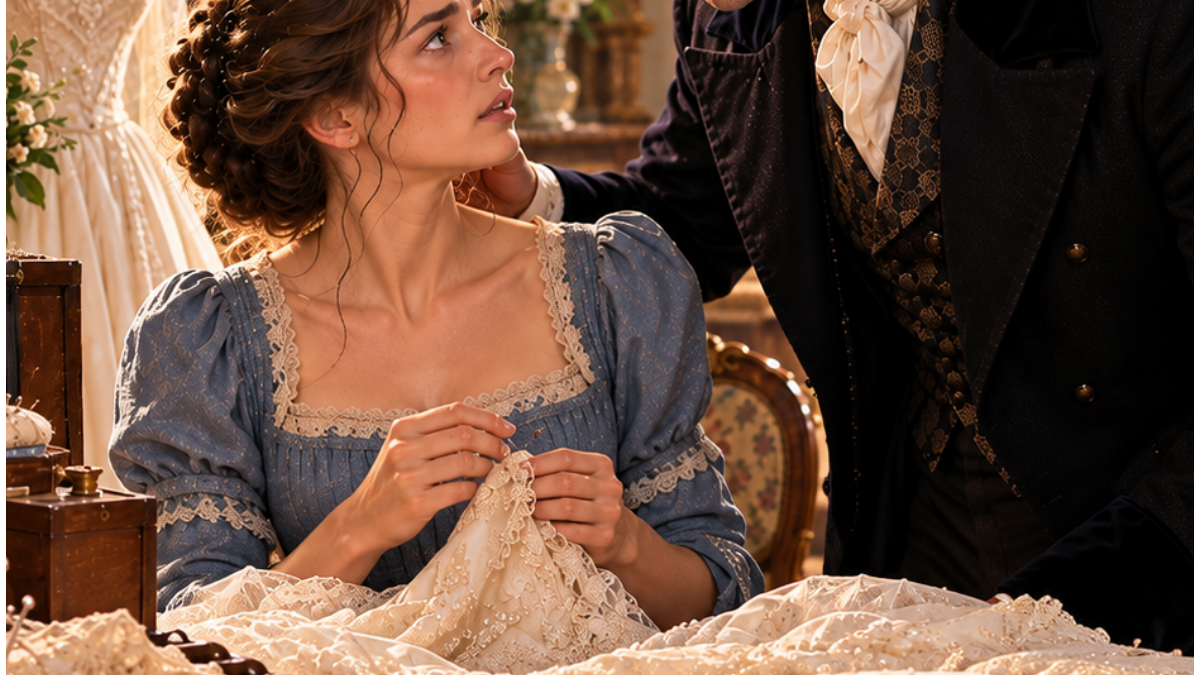
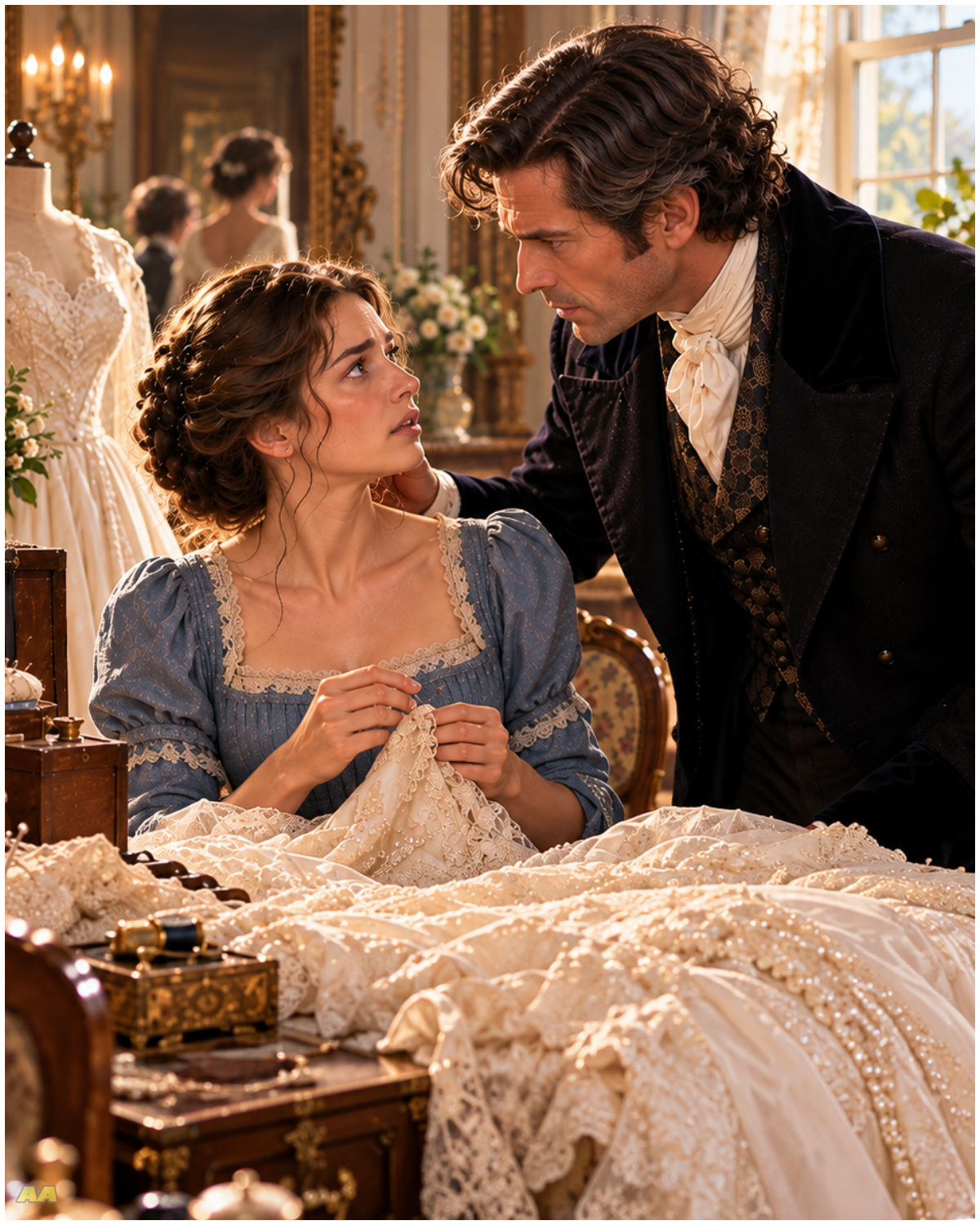
The needle went into the silk on the seventh stitch of the morning, and Jane Ilsley knew before she had drawn it out on the underside that she had put it in wrong.
She did not say so aloud.
There was no one to say so to.
Her sister Lettuce was still asleep upstairs because Lettuce was to be married on the Thursday of the following week, and had been told by everyone in the house, from her mother down to the cook, that a bride ought to sleep.
And Lettuce, who was of an obliging nature, had obliged.
Their mother was at the Fishmongers, their father.
But their father had been six years dead, and the small shop above which they all lived, and behind which Jane worked, and out of which the family was fed and clothed, and week by week, kept just above the line at which a widows household begins to slip, belonged now in the strict letter of the accounts to Jane herself, who was not yet 2 and 20, and who had a needle in her hand at first light, because if she did not have the bodice done by the Wednesday, there would be no bodice.
She drew the needle out.
She looked at the small unhappy pucker she had made on the underside.
She said quite steadily, “No, Jane.”
In the voice her father used to use when she had done a sum wrong at his knee.
And she took up the little pair of embroidery scissors that had been her father’s mother’s.
And she unpicked the stitch, and she smoothed the silk flat under her thumb, and she began again.
The seventh stitch went in clean this time.
She let out a small breath she had not known she was holding.
The bodice was to be pearled all along the front and up the seams of the sleeves in the pattern that had been on a plate in a magazine Lettuce had come home with in the spring and which Jane had studied for one long evening at the parlor table and had at the end of it said to her sister, “Yes, I can do that.”
Not because she was sure that she could, but because Lettuce’s face, when she had laid the magazine down open at the plate, had been the face of a girl who did not entirely believe she was going to get what she was hoping for, and Jane, who had held her sister on her knee, when lettuce was a small pink furious thing, knew out of the nursemaid’s arms, had not in her life been able to sit across a table from that face, and say no.
She had been sewing the pearls on for 11 days.
There were, she had counted, 1742 of them.
She had counted them twice.
Once at the beginning to be sure she had bought enough, and once three nights ago to reassure herself that the tin on the workroom shelf still held enough to finish, and she had been, on the second counting, three pearls short, and had walked half a mile to a shop in a lane behind the cathedral to buy nine more from a French immigr who sold notions out of a room the size of a linen cupboard, because she had preferred to be six pearls over than one under.
She had not told anyone that she had walked to the cathedral for nine pearls.
That was a thing she had noticed about herself lately, that a great many of the small daily arithmetics of the household were carried at present in her own head only, and were not put down on any paper anyone else could read, and that if she were at any moment in the next fortnight to slip on the stairs and break a leg, the household would discover with some astonishment that a great many things it had assumed were happening had been, in fact, happening because Jane had been getting up in the dark to make them happen.
She thought about that sometimes.
She did not on the whole dwell on it.
There was a bodice to finish.
The workroom was above the shop at the back in what had been her father’s cutting room when her father had been a tailor and the shop had been a tailor’s shop.
And after her father’s death, when it had become plain that his widow could not run a tailor’s shop, and that his elder daughter could could, in fact, run a modest and increasingly respectable dress makers.
The cutting room had become Jane’s workroom, and Jane had had a long table brought up and set under the north window, and a smaller table for the sewing machine her mother’s cousin had lent them, and never asked for back, and a shelf of tin boxes labeled in Jane’s clear round hand.
Jet seed pearl cut steel hooks mother of pearl black white on the wall over the smaller table was a piece of card on which her father in the last year of his life had pinned a scrap of paper that said in his handwriting a stitch that has to be looked for twice is a stitch that will fail once Jane had never taken it down she was sitting at the long table now with the bodice of her sister’s wedding gown spread out before her in the north light, and a small saucer of pearls at her elbow, and a pin cushion the size of a plum on her wrist, and the great gray cat from the shop below asleep on a folded piece of unbleached calico at the far end of the table.
Because the great gray cat had determined some years ago, that Jane’s workroom was warmer than anywhere else in the house, and had thereafter ignored all instruction to the contrary.
She had put in perhaps 30 of the morning’s pearls when the shop bell rang downstairs.
It rang twice. She lifted her head.
She looked without meaning to at the little card on the wall.
Two rings in her mother’s private code was the person at the door is somebody you had better come down to see.
One ring was the milk.
Three rings was the coal.
Four rings was a lady from a good house with a length of cloth over her arm and an air of not being kept.
Two rings was not a customer, not a tradesman, not a neighbor, somebody else.
Jane put her needle carefully into the pin cushion.
She stood up. She smoothed her apron.
She went down. Her mother was standing at the foot of the stairs with her hand on the newle post and her face, Jane saw at once, not entirely composed.
There was a gentleman in the shop.
Jane could see him through the open door of the little back parlor where the customers were received.
He had his back to her.
He was very tall. He was in a dark traveling coat that was not new, but that had been made plainly by a man who knew what he was about, and he was holding his hat in his hand.
The hat also was not new, and he was looking with the polite attention of a man who has been asked to wait at the small watercolor of Salsbury Cathedral that Jane’s mother had hung over the shops one good chair.
Some years ago in the hope that it would make the shop look gental and that had not quite done so, but that Jane had grown too fond of to take down.
Jane said her mother in a low voice.
Yes, mama. He has asked for you.
For me? By name, my dear.
He asked for Miss Jane Illsley.
Did he give you his card?
No. Did he give you his name?
He gave me his name, said her mother, and then stopped and put her hand a little more firmly on the new post and said in a voice pitched so low that Jane had to lean toward her to hear it.
He gave me his name, and I do not think you had better keep him waiting, Jane.
It is the Duke of Culverston.
Jane looked at her mother.
Then she looked past her mother’s shoulder at the very tall gentleman in the little back parlor, who was quite steadily and patiently going on looking at the watercolor of Salsbury Cathedral as though he had all the time in the world.
Mama, she said quite reasonably.
That cannot be. He gave that name Jane.
Somebody has played a joke on somebody.
He did not look, my dear, like a man who plays jokes.
Even so, Jane, go in.
She went in. She was aware as she crossed the four paces from the foot of the stairs to the parlor door of several things at once.
That she had a smudge of pearl dust on the second knuckle of her right hand, and had not thought to wash it off.
That her apron was clean, but was still an apron.
That her hair, which she had done in a plain twist at the back of her head that morning without looking at it, would look like the hair of a girl who had not looked at it, and that a person of any calling at all, opening the door of her back parlor to a juke, ought to have taken a moment to put a cap on her head, and that she was not going to, because she was not going to keep him standing while she went and looked out a cap, and because a woman who came down to the Duke of Culverston with her workroom face on, was on the all more respectable than a woman who came down to the Duke of Culverston with a hastily borrowed one.
She went in. He turned from the watercolor.
He was indeed very tall.
He was younger than she had at a glance taken him far from the stairs, perhaps past 30, but not by many years.
And he had the sort of face she associated in her private mental catalog with a certain kind of country curate.
Thin, plain, weathered by outdoor work, with a straight mouth that did not smile easily, and steady dark eyes that made an assessment of a person quickly, and did not, so far as she could see, feel any need to hide the assessment afterwards.
He was not, by any account, a handsome man.
He looked, if anything, tired.
He looked also entirely surprised.
“Miss Ilsley,” he said. “Your grace,” she said.
He looked at her a moment longer.
“You are You are Miss Jane Ilsley.
I am your grace. You are quite sure.” She almost, in spite of the whole strange shape of the morning, laughed at that.
She did not quite, she said, gravely, “I have been your grace for nearly 2 and 20 years.
There has been no one to contradict me.
He looked at her another moment.
Then he did an unexpected thing.
He set his hat down very carefully on the little side table under the watercolor, and he crossed the small parlor in two strides, and he pulled out the good chair, the chair that had been placed under the watercolor in the hope of making the shop look gental.
And he set it in the middle of the parlor floor, and said, “Miss Ilsley, sit down.
Please sit down. I need to sit down and I cannot sit down if you are standing and I do not think either of us is going to get through the next quarter of an hour standing up.
Please sit. She sat. He drew out for himself the planer chair from beside the little writing table where her mother kept the accounts, and he set it opposite her, not too near, the distance, she noticed, of a man who has thought about how a woman in a small parlor ought to feel about the distance of a strange man in a chair.
And he sat down and he put his hands flat on his knees and he looked at her and he said, “Miss Ilsley, Miss Ilsley, I am going to speak to you very plainly.
If I do not speak to you plainly, I do not think either of us will understand what has happened, and I have a strong suspicion, having now seen you, that what has happened is not what I was told had happened.
Do you follow me? Not yet your grace.
No, nor do I entirely.
Let me try. I am, as your mother has evidently told you, the Duke of Culverston.
I do not care for the title.
I did not expect to inherit it.
I inherited it about 18 months ago from a cousin I did not much like, and I have spent the 18 months since, trying to understand a great many affairs I was not trained to.
Are you following me? Yes, your grace.
Good. Now, some 3 weeks ago, I received a letter at my house in the country from a gentleman in the city of Salsbury, who I understand is a friend of your family, a Mr.
Truscot of the firm of Truscot and Kemp, attorneys.
Do you know him? I know Mr.
Truscot. He was my father’s man of business.
He is my mother’s. Yes, just so, the letter said.
I will show it to you if you like in a moment.
I have it in my pocket.
The letter said that a young lady named Miss Ilsley of a most respectable Salsbury family had lately become engaged to be married, and that certain circumstances had lately come to Mr.
Truscott’s attention, which made it his painful duty to inform me as head of my family that the young lady was, in his considered legal opinion, betrothed already.
Betrothed, that is, to me, by the terms of a private contract entered into some years ago, between the girl’s father on his deathbed and my late cousin, the previous juke, and that the young lady was on the point of marrying another gentleman in ignorance of this earlier contract, and that the honorable course, if I intended to honor my house’s word, was to come at once to Salsbury, and, his phrase, make good the promise.
Jane sat quite still. I do not, she said, and then stopped because she did not know which of the several sentences that had risen simultaneously in her chest was the first to be got out of it.
No, he said, I did not either.
I read the letter three times.
I do not ordinarily credit a letter of that kind at the first reading, but it was on a proper letterhead, and it named a firm of good standing, and it was it was, I have to say, extremely well written in the register of a lawyer of the old-fashioned school, and it made reference to a paper deposited, it said, in Mr.
Truscott’s office, and it invited me to come to Salsbury at once, and inspect that paper before I made any decision.
And I thought about it for some days and I sent a man to make inquiries.
And the inquiries said, “Yes, there was a Mr.
Truscott. Yes, there was a firm of Truscott and Kemp.
Yes, the firm had for many years handled the affairs of a Mr.
Ilsley Taylor of this parish.” And I thought, “Well, well, I had better go.” You came to Salsbury.
I came to Salsbury. I arrived last night.
I put up at the George.
I went this morning to Mr.
Truscot’s office to inspect the paper before I did anything else.
And and he said, “There is no Mr.
Truscott.” There is a Mr.
Truscot. That is, there is a Mr.
Truscot sitting behind a desk in Mr.
Truscott’s office. But it is not the Mr.
Truscott who wrote the letter.
The Mr. Truscott behind the desk had never seen the letter in his life.
He read it in front of me twice.
He turned pale. He said, and I quote him, “Your grace, this is a very great impertinence, and I do not know who has done it, but I promise you I shall find out.” He was not lying.
I have been a magistrate long enough to know when a man is lying, and Mr.
Truscott was not. So, the letter, the letter is a forgery.
The paper it refers to does not exiSt. There is no contract.
There is no deathbed promise.
There is, so far as your family’s actual attorney is aware, no engagement between you and any Duke living, and there never was.
And your father, I am very sorry to speak of him.
Your father, so Mr. Truscott says, would have laughed himself sick at the notion.
Those were Mr. Truscott’s words, not mine.
He was extremely upset. She sat with her hands folded in her lap.
She was thinking quite slowly and quite clearly about a number of things.
She was thinking that Lettuce was upstairs asleep.
She was thinking that the bodice was on the workroom table with a needle in the pin cushion beside it.
She was thinking that the great gray cat at this moment was asleep on a piece of unbleached calico.
She was thinking that a stranger of very great rank had come into her mother’s little back parlor and had in the space of about 7 minutes laid out on the small writing table between them the entire absurd shape of a fraud that had been intended quite plainly to result either in a scandal or a marriage or most probably in the extraction of a sum of money from the Duke of Culverston in exchange for the discrete burial of the whole affair.
Your grace, she said at laSt. Yes, I did not write that letter.
No, I did not know it had been written.
No, Miss Ilsley, I am satisfied on both those points.
I was satisfied of them, I think, before I stepped through your shop door.
I was quite certain of them within a minute of your coming into this room.
May I ask how you were certain?
Because he said, “A young woman who was in league with a forger to trap a duke into marriage would not open the door of the parlor with pearl dust on her second knuckle and workroom pins along the inside of her wriSt. And she would not in the first 30 seconds of the interview correct the Duke as to her age.
She would have curtsied further.
She would have brought a cap.
She would have he almost almost smiled and did not.
She would have washed her hands.
She looked at her right hand in her lap.
The pearl dust was indeed still on the second knuckle.
She put her left hand over it.
Your grace, she said. I am very sorry.
Do not be sorry. It was not your doing.
It has cost you a journey.
It has cost me a journey.
That is the smallest of the evils in this business and the one I mind leaSt. Miss Ilsley.
Yes. I would like to ask you a question and I would like you to give me an honest answer.
I will try your grace.
Is there any person you can think of in Salsbury or out of it who might have wished either to embarrass your family or to embarrass mine or to place you in a position from which the only escape was was the marriage the letter proposed.
Any person at all, a rejected suitor, a creditor, a rival in trade, a relation with a grievance, an old servant with a story, anyone.
She sat and thought. She thought quite carefully.
She was a person who was in the habit of thinking carefully.
That was, in a sense, what her trade required of her, and what she had done most mornings of her adult life before she went down to unlock the shop.
She turned the question over.
She looked at it from several sides.
She thought of lettuce’s intended, a mild, slow-moving young man who worked in a bank, and whose family had never, so far as she knew, considered the Illsley’s quite good enough for him, though they had never said so aloud.
She thought of the two apprentices she had let go the year before, because there was not the work for them.
She thought of the milliner two streets over, who had more than once come by the shop on the pretext of borrowing a paper of pins, and had made a slow, careful, mental note of everything hanging in the window.
She thought of the woman from the fish mongers, whose daughter had wanted a place with them, and whom Jane had had to refuse.
She thought of no one.
Then she thought with a small, cold jolt of one person, and she did not at once say the name aloud.
Miss Ilsley, I am thinking your grace.
Take your time. She took her time.
She thought a little longer.
She thought about whether she was being fair, and she thought about whether she was being cowardly.
And she thought about which of those two was likelier in her case to be the mistake she made.
And at last she said quite quietly, “There is one person.
I do not know that it is he.
I would not wish to accuse him without proof.
But there is one person who has cause to wish my sister’s marriage did not take place next week, and who has cause to wish also that our family had some some public embarrassment.
He is not, I think, a clever enough man to have done a thing so elaborate as this letter, but he might perhaps know a clever man.
His name, Mr. Osrich Bream, and Mr.
Osribbream is he is my sister’s late intended.
He proposed to her a year ago last Miklmas.
She refused him. He was not gracious about the refusal.
My mother was obliged to speak to his father in the end.
He has since taken every opportunity to say in company that my sister is a light girl who cast him off for a better prospect.
He is a young man of very small mind and very great vanity.
And I am sorry your grace.
I am aware I am speaking with heat, and he is a man who has on two separate occasions since my sister’s engagement been overheard in a wine room, saying that he would give a great deal to see the Illsley’s wedding ruined.
She stopped. She had not, she realized, ever said any of that aloud to anyone.
She had thought all of it.
She had refrained from thinking a great deal of it, because a woman who runs a small dress makers, does not, on the whole, benefit from carrying a private grudge against a young man whose father may yet in some year to come be a customer.
She had never said it, and now she had said it in her mother’s back parlor to a duke.
She looked in some horror at her folded hands.
Miss Ilsley, your grace. Thank you for what?
For not, he said, pretending you could think of no one.
For not making me press.
That was very useful. That was in fact exceedingly useful.
I know how to proceed.
Your grace. I am going to go now.
I am going to go back to Mr.
Truscott’s office. Mr. Truscott and I are going to make some inquiries in a very quiet way into Mr.
Osrich Bream and any recent visitors he may have had from from certain quarters that specialize in this sort of paper.
I do not think I shall find much.
I think in the end Mr.
Bream will be found to have paid a small sum to a bad man and the bad man will be found to have vanished and I shall have to content myself with satisfying Mr.
Bream personally that he had better not do it again.
But I mean to do that, Miss Ilsley, I want you to know that I mean to do that.
Nobody is going to interfere with your sister’s wedding.
Thank you, your grace, Miss Ilsley.
Yes. May I ask one more thing of you?
Anything? May I ask you not to speak of any of this to your sister?
Not until she is married.
She is to be married on Thursday of next week, you said.
Let her be married. Let her have her wedding.
Do not put this in her head.
I do not want the child looking over her shoulder on her own wedding morning.
Will you keep it from her at least until she is a wife?
Jane looked at him. She saw quite clearly for the first time in the interview that he was under the plain traveling coat and the tired face and the careful courteous distance of his chair.
A person who had in the past 18 months spent a great deal of time thinking about the ways in which the ordinary lives of ordinary people are pressed on by circumstances they did not ask for and had thought about them long enough that he had quite plainly taken a view.
Yes, she said I will keep it from her.
Thank you. He stood up.
He was standing even taller than she had thought when she had come into the room.
And she noticed, standing herself, that he took a small step back before she was quite up, so that she should not feel him too near her when she rose.
And she noticed that he did not offer her his hand, because he was a duke, and she was a dress maker, and he had been long enough in the country to know that the safest kindnesses across a rank were the ones that did not require touch.
He took up his hat from the side table.
At the door of the parlor, he stopped.
“Miss Ilsley, your grace. I did not intend when I came into this shop this morning to say what I am about to say.
Please forgive me if I say it badly.
You were in this room extremely calm and extremely quick and extremely honeSt. And you did not you did not at any point try to make a small advantage for yourself out of a very strange half hour.
I have been in a great many rooms in the last 18 months.
I have not been in many like it.
I only wanted to say so.
He inclined his head. He went out.
She stood in the middle of the little back parlor with the great gray cat, who had at some point come downstairs on cat business, now sitting in the doorway, watching her with an expression of considered feline judgment.
And she looked at the good chair, still in the middle of the parlor floor, and she looked at the smudge of pearl dust on her right knuckle, and she heard through the shop the small silver sound of the bell going as the Duke of Culverston opened the shop door and stepped out into the street, and she thought quite plainly, I do not know what has just happened.
Then she thought, I have to get back to the bodice.
She went back up. Her mother on the stairs put a hand on her arm.
Jane. Mama, are you? I am quite well.
Mama, there has been a great mistake.
I shall explain it to you in an hour.
Do not disturb lettuce. I have to finish the front.
Jane. Mama. In an hour.
She went into the workroom.
She sat down at the long table.
She took the needle out of the pin cushion.
The cat, who had followed her up, arranged herself on the folded calico with the air of a creature who had been kept quite unreasonably from her nap.
Jane looked at the pearls in the little saucer.
She looked then at the small card on the wall over the machine.
A stitch that has to be looked for twice is a stitch that will fail once.
She put the needle in.
The stitch was clean. She let out a small breath she had not known she was holding.
For the second time that morning and she went on.
She did not tell her mother in the end within the hour.
She told her that evening after the shop was shut and lettuce had been sent up early with a headache that lettuce did not have but that her mother had quite correctly invented on Jane’s behalf so as to have the parlor to themselves.
She told her mother everything quite simply sitting on the low fender stool at her mother’s knee with the fire behind her and her mother’s hand on the top of her head in the way her mother had held her when she was 6 years old and had come in with a scraped knee and her mother listened without interrupting.
And when Jane was done, her mother was quiet a long moment and then said only, “Jane, yes, mama, you did well.
I do not feel that I did well.
I feel that I spoke a great deal too much.
I feel that I ought to have been cooler.
You were as cool as one is at 2 and 20, my dear, which is to say cooler than moSt. You did well.
You did particularly well not to send him away without giving him Mr.
Bream’s name. That took thought.
I do not want to be I do not want to be a party to anything.
Mama, I do not want a juke’s business in this house.
I do not want him to come again.
He will not come again, said her mother, and stroked Janes hair once gently.
Do not be foolish. He has satisfied himself of what he needed to satisfy himself of, and he will go home now, and we shall not hear of him again, except perhaps in a note from Mr.
Truscott some weeks from now, to say that the business has been quietly settled.
Come, show me the bodice.” Jane showed her mother the bodice.
Her mother, who was not a sewing woman, but who had watched sewing women all her life, looked at the front of it for a long time in the light of the parlor candles, and then she said, “Quite matterofactly, lettuce will cry.
She will not cry. She is not a girl who cries at gowns.
She will cry at this one, Jane.
It is very fine. It is not finished.
It is very fine.” Jane took the bodice back upstairs and laid it out flat on the long table under a clean cloth and she went to bed and she lay a long while in the dark thinking about the shape of the day.
And she thought about Osrich Bream and about the letter and about her mother’s hand on the top of her head.
And she thought, last of all, and quite involuntarily, about a very tall, plain man in a traveling coat that was not new, standing up out of a chair with the particular careful backward step of a person who has, in the last 18 months spent a great deal of time thinking about other people’s rooMs. Then she thought sensibly, he will not come again, and turned over and slept.
She was wrong about that.
She did not that night know she was wrong, but she was.
And the next time the shop bell went twice, 3 days later, in the middle of the afternoon, with the bodice by then done, and the whole gown laid out for the second fitting, it was the Duke of Culverston again, in the same traveling coat, with the same hat in his hand, saying to her mother in the small back parlor, quite gravely, “Ma’am, I am sorry to trouble you.
It is more difficult than I had thought.
She had in the three days between his first visit and his second put the whole strange half hour in the parlor into a small compartment at the back of her mind and had closed the lid of it.
In the way one closes the lid of a workbox in which a needle has been dropped.
One does not at the moment have time to look for.
And she had gone on with the bodice, and had finished the bodice, and had begun the sleeves, and had on the evening of the second day, laid the whole gown out on the long table under a clean cloth, so that in the morning, when Lettuce came in for her second fitting, the thing would already look like a wedding gown, and not like a bundle of parts.
Lettuce had cried at the fitting.
She had not cried in the tremendous way their mother had predicted.
She had put her arms into the sleeves, and she had stood very still, while Jane, kneeling on the workroom floor with pins between her lips, walked round her once, twice, three times, adjusting nothing, because there was nothing to adjuSt. And Lettuce had looked at herself in the long glass Jane had had brought in from the shop, and her chin had trembled once, and she had said in a small, unsteady voice, “Oh, Jane!” And Jane had taken the pins out of her mouth and put them carefully into the plum-sized pin cushion and had said, “Do not you dare cry on the silk, Letty.
I shall have to sponge it.” And Lettuce had laughed instead of crying and had wiped her eyes on the back of her wrist like a child.
And their mother, standing in the doorway of the workroom with her hand over her mouth, had gone very quietly back downstairs so that nobody should have to watch her cry either.
So the gown was done.
That was, so far as Jane was concerned, the whole of the week’s business.
There was still the veil to be trimmed, and there was still the length of pale ribbon to be made into a sash for the bridesmaid, their little cousin Sophie, who was nine, and had never in her life been asked to be anything of consequence, and was in consequence in a state of continuous suppressed hysteria about the Thursday, and there was still, of course, the ordinary daily work of the shop, which did not stop, because the eldest daughter of the house happened to be finishing her sister’s wedding gown.
There was a black bombazine for Mrs. Orud that had to be back by Friday.
There was a Spencer for the school master’s wife that had to be turned.
There was the interminable business of the police for Miss Corny at the cathedral close which had been in the workroom for 3 weeks because Miss Corny could not from one visit to the next decide what she wanted a police to be.
Jane had all of it in her head.
She had it in her head the way she had the pearl count in her head.
It was, she thought sometimes, why she slept so well.
There was no room in her head at night for anything but sleep, because everything else was already in there being kept in its place.
She did not, therefore, expect to hear the shop bell go twice on the Wednesday afternoon.
She was upstairs at the time, kneeling on the workroom floor with the veil pinned out flat on a piece of clean sheeting, so that she could work at the trim without dragging it.
And she heard the bell, and she heard the pause, and she heard very distinctly the second ring, and she thought in the neat, unsurprised way one thinks a thing one has, in fact, been half expecting without having admitted the expectation to oneself.
Ah. She put the pins into the pin cushion.
She stood up. She washed her hands this time at the little basin by the window and dried them on a linen towel that was, she noticed, with a small private amusement, not perfectly white, and she smoothed her apron, and she did not this time either, put on a cap.
She went down. Her mother was at the foot of the stairs again.
She had the same look, polite, composed, but with a small, unmistakable palar at the corner of the mouth that Jane had learned over the years meant her mother had encountered something she could not immediately reduce to a familiar shape.
Jane? Yes, mama. It is he again.
I heard the bell. He has asked for you again.
He has asked whether I would sit in the parlor with you this time.
He said, he said it very carefully that he did not wish on his account or on yours for it to be a private interview.
He said it was for your comfort.
He said it also, I think, for his own.
Jane looked at her mother.
Come in with me, mama, she said.
Yes. They went in together.
He stood up when they came in.
He had not this time been looking at the watercolor.
He had been standing at the little front window of the parlor with his back to it, and had, so far as Jane could see, been simply waiting in the patient standing way of a man who has done a great deal of waiting in his life and has stopped minding it.
He inclined his head to her mother and then to her, and he said, “Mrs. Ilsley, Miss Ilsley, thank you for allowing me to come in.
Please, Mom.” To her mother, “Please sit.” Her mother sat in the good chair.
Jane took the planer chair beside her.
The Duke drew the chair from beside the writing table and sat again at the same careful distance.
“I am sorry,” he said without preliminary to come again.
“I hoped I should not have to.
It is more difficult than I had thought.” “Your grace,” said Janes mother with a small courteous inclination of the head.
“Ma’am, I shall be plain.
My inquiries of the last 3 days have been have been sufficient to satisfy me that Mr.
Bream did not himself in fact write the letter and were at first sufficient to give me some hope that he might not even have commissioned it.
He has been ill in his bed since the middle of last week.
He has been seen by two physicians.
There is on the face of it no possibility that he has been in a position to conduct any correspondence forged or otherwise in that time.
It seemed 3 days ago that my first suspicion was likely to be wrong.
That was where the matter stood on the evening I called upon Mr.
Truscott a second time. I had, I confess, come away from that meeting inclined to think we were dealing with a stranger to the family altogether, some person from the counties perhaps, who had heard my name and thought a duke a soft mark.
But,” said Jane’s mother, “but this morning,” said the Duke, a boy was taken up at the coaching in at Andover with a letter in his coat pocket, addressed to me at Culverston.
He had been sent up from Salsbury on the morning coach with instructions to deliver it into my hand at my own door.
He had been paid a shilling.
He is 14. He is a decent boy and he was at Andover frightened out of his skin because the letter was the letter mom was a second letter of much the same character as the first but a great deal worse.
It named Miss Ilsley. It named her more particularly.
It said certain things about Miss Ilsley’s private conduct that were not true, and that would, if they were spoken aloud in a certain kind of parlor in this town, do the kind of damage to Miss Ilsley’s name that a young unmarried woman does not in this country recover from.
It said further that Miss Ilsley was in a certain condition.
It named It named a gentleman.
It suggested that the writer of the letter had proof.
It suggested that the writer of the letter would remain silent for a sum.
It named the sum. It offered to place the whole business quietly in Mr.
Truscott’s hands, provided the sum was paid within one week.
There was a silence in the parlor.
Jane’s mother put her hand very quietly over Jane’s hand in her lap.
Your grace, said Jane. Her voice was, to her own surprise, steady.
May I ask the gentleman named in the second letter, Miss Ilsley, please?
The gentleman named said the juke and his voice went for the first time in either of the two interviews quite hard was myself.
Jane sat very still. I see she said the construction of the thing is the construction of the thing is that a young lady of small means has been imposed upon by a nobleman.
That the nobleman has behaved, in a phrase I will not repeat in this parlor, and that the nobleman’s family will pay a certain sum quietly, or the young lady’s condition will be made public, and the nobleman’s name will be attached to it.
There is a small clumsiness in the letter.
It is not, I would say, the work of a person accustomed to blackmail.
There are no proofs offered.
The proofs, it is said, will be produced when the sum is agreed.
That is the pattern, Mom.
That is how these things are done.
The whole thing depends on the man frightening quietly enough that nobody looks too closely at whether there are any proofs at all.
You are not frightened, your grace, said Jane quietly.
I am not frightened for myself, Miss Ilsley.
For me, I am. Yes, I am concerned.
That is the honest word.
I did not wish to say it more heavily than that, but yes.
She was quiet a moment.
Your grace, she said. Why should he write a second letter?
He has already tried a marriage trap.
This is a different trap altogether.
What does he gain? That was the piece I could not myself work out, said the Duke, until this morning.
Now I think I can.
The first letter, the marriage letter, went, I think, at the very outside of what he thought I would swallow.
He must have known when he sent it that there was a good chance I would come to Salsbury and speak to your family’s attorney and discover the paper was fictitious.
He was not, I think, aiming to marry you off to me.
He was aiming in the first letter to fetch me down to Salsbury to establish in the eyes of the town that the Duke of Culverston had been seen going to and coming from a certain small dress makaker shop in this parish quite privately in a traveling coat and having so established to send the second letter which absent my visits here would have seemed a wild fantasy and been thrown in the fire but which with the visits behind it becomes a thing that half a dozen People in the town would say they had at least no independent reason to disbelieve.
He was not, in short, trying to make me marry you, Miss Ilsley.
He was trying to make it necessary that I pay him.
Jane looked at him a long moment.
That is very cleverly worked out, she said.
I have had 18 months practice, Miss Ilsley, at working out what people who do not wish me well are trying to do to me.
I am becoming slowly better at it.
I am, however, not the man I need to be at it yet.
Your grace, said Jane’s mother, very quietly.
What do you propose? That is why I have come, ma’am.
I could, on my own account, do a number of things.
I could return home and let it be known through Mr.
Truscott, that any further letters of this sort will be prosecuted to the extreme of the law.
I could bring a Bow Street man down and have Mr.
Bream watched. I could, if Miss Ilsley wished it, attend her sister’s wedding tomorrow publicly as a family friend, and thereby make it exceedingly difficult for any story about a private compact between us to be believed.
Any of those things I can do.
I am not going to do any of them without the leave of this house.
It is your name, Mom, and it is Miss Ilsley’s name, and it is Miss Lettuce Ilsley’s wedding, and I am not going to move a man of mine into any of it without your leave.
That is what I have come to say.
Jane’s mother sat quite still.
She was a woman who had in her life been given very few decisions to make of any consequence because her husband had made them all until his death and Jane had made them after.
And she looked for a moment at her hands in her lap.
And then she looked at Jane.
And then she looked at the Duke and she said in a voice that was small but that did not in the end tremble your grace.
I do not want you at my daughter’s wedding.
Forgive me. I do not mean it as an insult.
I mean it precisely as you have laid it out.
The town will be at that wedding.
If a duke is at that wedding also, there will be no wedding.
There will only be a duke.
My lettuce will not have her day.
She will have your day.
I cannot I cannot let that happen.
Not to lettuce. No, ma’am.
I would not wish to.
I offered it only because you had the right to know it was on offer.
Thank you. May I make another offer?
Yes, your grace. Let me put a man of mine quietly upon Mr.
Bream. Not in this house, not near this house.
In the wine rooms he frequents, in the coaching in, a person nobody in this parish will know.
He is not to speak.
He is only to watch and to write to me.
If Mr. Bream so much as breathes a word of what is in that second letter to any person in a public place, I shall have him before a magistrate that same afternoon.
I have already spoken to Mr.
Truscott. Mr. Truscott is prepared to act.
He would prefer, Mom, if I am honest with you, to be permitted to act because he is very angry indeed at having his firm’s name used in this business.
And he is a man who does not ordinarily get to be angry in his profession.
Jane’s mother was quiet a moment.
Yes, she said do that.
Thank you, ma’am. And your grace.
Yes. Come to the wedding breakfast, not to the church, to the breakfast in this house.
Come as as a family friend of ours, if anyone should ask, who has been to Mr.
Truscotts on business and has been civil enough to look in.
Sit at my table and eat my mother’s plum cake and be seen to be at ease in my parlor with my daughters and my little niece and my brother-in-law from Alton.
Do that once in front of the 12 people who will be here.
And by Saturday morning, every wine room in this town will have had the story from a different mouth, and there will be no room in any of them for the story your Mr.
Bream is trying to plant.
Will you do that, your grace?
He looked at her. “That is very well thought of, ma’am,” he said quietly.
“I have been thinking of it,” she said, “Since you began to speak.
I am not a clever woman, your grace, but I have been 40 years in a shop, and I know how a town’s talk is built and how it is unbuilt.
Come to the breakfaSt. Come plainly.
Do not send a card.
Do not bring a servant of your own.
Come, please, as you are, in a coat that is not new, and drink my tea.” That is all.
I will come. Thank you, ma’am.
Yes. I want to say one thing and I want to say it in front of your daughter as well as yourself.
I did not when I set out from Culverston anticipate any of this.
I did not anticipate a fraud.
I did not anticipate a second letter.
I did not anticipate that I should have to ask the leave of a household to be seen at a wedding breakfaSt. But I want to say to you plainly that I regard what has been done to your daughter to both your daughters as done to my own name because it has used my name to do it.
It is not on your account only that I am acting though I am acting on your account.
It is on my own also.
I do not want you to feel that I am doing you a favor.
I am not. I am doing what a decent man does when someone has used his coat to cover their knife.
Do you follow me? Yes, your grace.
Good. He stood up. Jane and her mother stood also.
Miss Ilsley, he said. Your grace.
Finish the veil. She looked at him.
You were kneeling on the floor.
He said, I saw the pins in the sleeve of your apron.
Finish the veil. Do not spend this evening thinking about Mr.
Bream. He is not worth the loss of your veil.
Good evening, ma’am. Good evening, Miss Ilsley.
He inclined his head. He went out.
Her mother sat down very suddenly in the good chair.
Jane, yes, mama. I am going to have a very small glass of madiraa.
Do not tell anyone. No, mama.
Jane went upstairs. She washed her hands again.
She noticed that she had done so twice in one afternoon, which was in her workroom life unusual, and she considered the fact and put it aside.
She knelt down again on the workroom floor beside the veil, which was pinned out flat on its clean sheeting, and she picked up her needle, and she finished the trim by the light of two candles, and the last of the afternoon coming through the north window.
She thought once, in the middle of a run of small, even stitches along the border, he saw the pins in my sleeve, and stopped, and looked at her needle, and did not for a long moment put it in.
Then she put it in.
The stitch was clean. She let out a small breath she had not known she was holding for the third time in the space of a week, and she did not this time entirely know why.
The wedding was at St. Thomas’s on the Thursday, at the ordinary hour of such things.
It was in the end exactly the wedding it had been intended to be, no more grand and no less.
Lettuce walked up the aisle on the arm of her mother’s brother, who had come down from Alton for the purpose, and had brought with him a great new hat for his wife that had cost, Jane suspected, quite as much as the police, Miss Corny, was still failing to decide upon.
The young man from the bank stood at the altar in a coat of extraordinary blue and looked throughout the service exactly as though he were about to be sick, which their mother said afterwards was the correct look for a bridegroom, and denoted a proper understanding of the occasion.
The vicar, who was a friend of the family, made the responses at exactly the pace Lettuce had asked him to make them at, without hurrying and without dragging.
And the whole business from door to door took less than an hour.
And lettuce coming back down the aisle on her new husband’s arm with the veil thrown back and her face pink and astonished put her hand out as she passed the pew where Jane was sitting and caught Jane’s hand and squeezed it once hard and did not quite cry.
Jane did not quite cry either.
She had a great deal to do.
She had in her private mental catalog for the day an entire second list of small responsibilities that were not visible to anyone else in the party, and that she alone would notice if they went undone.
[clears throat] and she went home in the second carriage, and while the wedding party was still greeting people in the church porch, she was in the shop parlor, making sure the plum cake had been set out on the good plate, and that the little cousin Sophie’s sash had not been dragged in the mud at the church door, and required a quick sponge, and that the great gray cat had been shut humanely but firmly in the workroom for the duration of the breakfaSt. Because the great gray cat in a room of 12 people eating cake was a variable nobody in the family had the strength to manage.
The Duke came in with the second carriage.
That was, Jane noticed, quite deliberate on his part.
He had not been in the carriage that fetched the family from the church, which would have been an intimacy of a kind that would have got a story going all by itself.
But he had been on the pavement outside the church as the party came out, and had quite simply been introduced to the bride and groom in the porch by Jane’s uncle from Alton, as a gentleman lately of Mr.
Truscott’s acquaintance, who was in Salsbury on a small matter of business, and had walked back with them to the house.
He came in with the second carriage in the sense that he had walked alongside it up the last of the street in his traveling coat with his hat in his hand and had come in through the shop door as though he had been coming in through the shop door once a fortnight for years.
Nobody in the parlor at the breakfast had any idea who he was.
That was Jane’s mother’s doing.
Jane’s mother had not over the tea and the plum cake and the small speeches said a single sentence to any of the guests that would have identified the tall plain gentleman by the sideboard as anything other than a family friend from the country.
She had said twice, “Oh, Mr.
C, come and sit here.
We cannot have you standing about.” She had said once to her sister-in-law from Alton, “This is a Mr.
C of the country, an acquaintance of our Mr.
Truscot. He has been so obliging as to look in.
She had never given him a title.
She had never given him a full name.
She had let him move about her parlor as one lets a tall, careful cousin move about a small, crowded room.
And Jane, watching her from the doorway with a plate of little sugared biscuits in her hand, had understood that her mother, her mother of the fish munger and the coal book and the parish subscription list, was managing at that moment a piece of social work of considerable delicacy, and was managing it, moreover, out of a lifetime of watching other women manage rooMs. The Duke, for his part, did exactly as he had been asked.
He drank a cup of tea.
He ate a piece of plum cake.
He praised the plum cake to Jane’s mother genuinely and at some length because it was Jane knew very good plum cake made by Jane’s mother on the Tuesday to a recipe that had come down from Jane’s father’s mother.
And he sat for the greater part of an hour on the little settle by the parlor fire beside Jane’s uncle from Alton and Jane’s mother’s cousin from the fishmonger’s side of the family and talked quite steadily about the state of the roads in the west country and the price of hay and at one point at Jane’s uncle’s request about a certain vexed question of drainage in a low-lying meadow that Jane’s uncle had recently bought and did not know how to manage and about which the Duke of Culver it turned out, knew a very great deal, and gave to Jane’s uncle over the course of 10 minutes and a second cup of tea, more useful, practical advice than Jane’s uncle had had from any of the men he had paid to give it to him.
Jane’s uncle went home to Alton the next day, quite convinced, and remained convinced for the rest of his life, that Mr.
C was one of the most sensible gentlemen he had ever met, and asked after him regularly at family dinners for years.
Jane spoke to him at the breakfast twice.
The first time was in the doorway of the parlor when she came in with the plate of little sugared biscuits and he stepped back to let her past and she said quietly without looking up at him, “Thank you for coming, your grace.” And he said equally quietly without looking down at her, “Thank you for having me, Miss Ilsley.” And neither of them made any more of it than that.
The second time was on the shopstep when he left.
He left before the party broke up, which was again deliberate.
He left on the pretext of a coach he had to catch, and he left with a small courteous bow to Jane’s mother, and a small courteous bow to Lettuce and to her new husband.
And he had his hat in his hand as he stepped out onto the pavement.
And Jane, who had followed him to the shop door, because the shop door had a stiff latch that only she could work in a hurry, stood a moment with him on the step in the low afternoon light.
Miss Ilsley, your grace. That went very well.
Yes, my mother is a great manager when she has to be.
I saw that. She has never said Jane on a small sudden impulse she did not entirely understand spoken so much in her own parlor in an hour.
She is having at this moment a small glass of madiraa in the pantry to recover from it.
I am not strictly supposed to know.
He almost smiled. He did not quite.
Miss Ilsley. Yes. I am going home tomorrow morning.
Yes. I do not I do not know when I shall be in Salsbury again.
No. May I May I write to your mother from time to time?
Not often. Perhaps a letter each quarter to let her know how the the other matter has been going.
She will worry otherwise. She is that kind of woman.
Jane looked up at him.
He was, she noticed for the first time, standing on a lower step than she was, because the shop step was two steps, and he had already come down one, and he was, in consequence, not quite as much taller than her, as he had been in the parlor, and his face, in the low afternoon light, was tired.
She would like that, your grace, she said.
So should I. Good. Your grace.
Yes. Thank you. For what?
For the plum cake. For the drainage, for sitting on the settle for an hour and being, she hesitated, being a gentleman from the country whom my uncle from Alton is going to talk about at Christmas dinners for the next 15 years.
For all of it, thank you.
He looked at her a long moment on the shopstep.
Miss Ilsley, he said, “I have enjoyed myself today.
I have not I have not enjoyed a day in company for a long time.
I want you to know that.” Good afternoon.
He put his hat on.
He walked away up the street in his coat that was not new.
She stood a moment on the shopstep with her hand still on the stiff latch and watched him go.
And she thought quite plainly, he has enjoyed himself.
And she thought quite plainly after it, so have I.
And she thought, third, with a small startled pang, she did not know what to do with.
He is going away. She went back into the shop.
He did write. The first letter came about 6 weeks after the wedding.
It was directed to Mrs. Illsley plainly in a firm upright hand Jane did not know, but which she assumed correctly to be his, and it was, when her mother opened it in the parlor after tea, and read it aloud, quite short, and quite plain, and entirely as promised.
He wrote that the matter of Mr.
Bream had been resolved to Mr.
Truscott’s satisfaction. He wrote that Mr.
Bream had been visited quietly at his father’s house by a gentleman from London whose card had produced in Mr.
Bream an immediate and comprehensive recollection of certain letters he had some weeks previously paid a man in a public house to write on his behalf.
He wrote that Mr. Bream had gone with his father’s blessing and at his father’s insistence to take up a position in Liverpool with an uncle in the shipping line and was not expected to return to Salsbury.
He wrote that no publicity had attended any part of the affair.
He wrote that he hoped Mrs. Ilsley was well and that Miss Ilsley was well and that Mrs. lettuce, he gave her her new name correctly, was well, and that the shop was well, and that he remained her obedient servant.
Jane’s mother read it through twice.
Then she folded it carefully and put it in the top drawer of the little writing table, and she said in the tone of a woman making a small private domestic decision, “He shall be answered.” You will answer him, “Mama?
You will answer him, Jane.
My hand is not good enough.
Yours is.” He wrote to you.
He wrote to me because it would not have been proper to write to you.
That does not mean you cannot answer for me.
Write him a good honest letter tomorrow.
My dear, thank him. Tell him that we are well.
Tell him about lettuce. Tell him.
Tell him what you would tell any friend of the family who had inquired.
That is all. Jane wrote the letter the next day.
It took her, if she was honest, above an hour, because she was a woman who could put a stitch into silk without looking twice at it, and could not apparently put a sentence to paper for the Duke of Culverston without looking twice at it three times, and starting again once, and at last sitting for some minutes with her pen, not quite touching the paper, and reminding herself sternly that she was writing on her mother’s account, and to a family friend, and that any letter which took above an hour to write, was on the face of it an overelaborate letter.
She wrote it plainly in the end.
She thanked him. She told him that Lettuce and her husband had taken a small house in the next street.
She told him that her uncle from Alton had followed his advice about the meadow and it had come up much drier this spring.
She told him that the shop was well and that they had a new apprentice, a good, quiet girl of 13 from the village Jane’s mother had grown up in.
She told him nothing at all about herself.
She signed the letter at her mother’s dictation for my mother and with our respectful remembrance and her own name below.
He wrote again in the autumn.
He wrote again after the new year.
He wrote again in the spring.
Jane in her mother’s name wrote back each time.
The letters were on both sides short and plain and entirely proper.
He wrote of the roads and the harvest and the small progress of the drainage on a low-lying pasture of his own that he had begun to work on after his conversation with Jane’s uncle.
He wrote once briefly of a visit to the sea.
He wrote once at the end of a letter in a smaller hand as though the sentence had been added after the rest was done.
I hope Miss Ilsley is well.
She wrote back in her own longer letters of the shop and the apprentice and Lettuce’s small progress toward the first child.
She wrote once that Miss Corny had at last decided about the police, and it had been dispatched, and that the entire household had drunk a glass of small beer in the pantry to celebrate the closing of the file.
She wrote once at the end of a letter in a smaller hand as though the sentence had been added after the rest was done.
Miss Ilsley is well. She did not then or afterwards refer to herself in the third person in any other context in her life.
She did not in the whole of that year see him.
She thought about him. She did not, in fairness to herself, think about him with any of the anguish she had read of in the small parcel of novels she had borrowed once from the vicar’s daughter, and had returned with the private opinion that they were greatly overroought.
She thought about him in the manner of a woman who has a small, careful, ongoing correspondence with a person she respects, and who finds when she has finished a hard piece of work in the workroom in the late evening, that the small, careful, ongoing correspondence is one of the things she thinks about with pleasure while she is putting her tools away.
That was all that was in her private accounting of herself quite enough.
She was mistaken about herself as it happened.
She discovered she was mistaken on a morning in the second summer when the shop bell went twice and she was in the workroom and she went to the top of the stairs without waiting for her mother to call up and she looked down and she saw the Duke of Culverston standing in her mother’s back parlor in a traveling coat that was not new with his hat in his hand and she found she could not for a moment come down the stairs at all.
She stood at the top of the stairs with her hand on the rail.
He looked up and he saw her.
He did not smile. He looked, if anything, more tired than she remembered.
He looked steadily up at her and he said quite plainly up the stairwell.
Miss Illsley, forgive me, I have come without warning, “Will you come down?” She came down.
She came down slowly. She was aware as she came down of several things at once, that she had again pearl dust on her second knuckle, that she was again without a cap, that her heart was quite unreasonably going in her chest at a rate that the ordinary business of walking down a flight of stairs did not require, and that her mother, who was standing at the foot of the stairs with her hand on the newle post, had already, in the small, compressed motion of her mouth, understood something Jane had not yet herself entirely admitted.
At the foot of the stairs, Jane stopped.
Your grace, Miss Ilsley, you have not written that you were coming.
No. Is there Is there some new trouble?
No. No, there is no new trouble.
Mr. Bream has not surfaced.
Nobody has surfaced. I have not come on any business of that kind.
Miss Ilsley. He stopped. He looked briefly at her mother, who was quietly and with great dignity backing out of the parlor into the shop.
Her mother closed the parlor door behind her.
There was, in the sudden closing of the door, a small definite click.
Miss Illsley, I have come because I could not this time do what I wish to do in a letter, and I have come without warning, because I did not in honesty trust myself to warn you, and then not lose my nerve on the road.
May I sit? Yes. May you sit?
Yes. They sat. He put his hat down on the little side table under the watercolor in exactly the same place he had put it two summers before.
He looked at her a moment across the small parlor, and then he looked briefly at his own hands on his knees, and then he looked up again, and he said, “I have thought about you every day for 2 years, Miss Ilsley.
I did not at first know I was doing it.
I know now. I have not written of it in the letters because it did not seem to me fair on the strength of two conversations in a parlor and one wedding breakfast to press upon a young woman I scarcely knew.
A settled feeling that had grown up entirely on my side at a distance of 140 mi.
I thought if I waited it would go.
It has not gone. It has if anything become more particular.
I find that I cannot in honor continue writing to your mother once a quarter and pretending to myself or to her or to you that I am doing it out of an interest in the drainage of your uncle’s meadow.
I am not. I have come to ask you whether if I began to write instead to you and to come from time to time to Ssbury and to sit in your mother’s parlor and to be understood to be understood as coming for a particular reason whether that would be a thing you could bear I am not asking you today for any promise I am asking you today only whether I may begin that is all she sat very still your grace please if you are going to say no say it plainly ly.
I would rather have it plainly than gently.
I am not. I am not a young man, and I have been managed too gently in one way or another my whole life.
If it is no, tell me it is no.
She looked at him. She thought in the small, quick, clear way she was in the habit of thinking about a great many things at once, about her mother, who was at this moment standing on the other side of the parlor door, with her hand pressed against her mouth in the shop, about Lettuce, who would shriek about the shop which was hers, and would not go on being hers if she began to belong, however slightly, to the world he lived in, about the workroom above her head, where at this moment The great gray cat was asleep on a folded piece of unbleached calico.
She thought also about a chair pushed back at a careful distance in her mother’s parlor, and the small backward step of a very tall man being careful of a small room, and a piece of plum cake eaten quietly on a settle by her mother’s fire.
“And I have enjoyed myself today,” said on a shopstep in a low afternoon light.
She said, “Your grace, I am not going to say no.
I am not going to say yes either.
I am going to say I am going to say that if you write to me I shall answer and that if you come to Salsbury I shall receive you and that we shall see what happens when I do.
He closed his eyes for a moment.
Then he opened them. Thank you, he said.
Do not thank me. It is not it is not a promise.
No, but it is not a no.
I have been prepared for a fortnight to be told a no.
I was prepared this morning in the coach to be told a no.
It is a great deal not to be told a no.
Your grace, please. Yes. Would you?
He said, and here for the first time she had ever seen him do it, he looked genuinely uncertain.
Would you consent to call me by my name in private in this room?
I have never in my life liked to be called by the title.
It is not a thing I chose.
I would very much like I would very much like to be called by my name in this room by you.
What is your name? Adam.
Adam. Yes, that is that is a very plain name.
It is. It was my father’s.
He was a plain man.
Adam, she said again as though to see whether it would sit on her tongue.
It did. Well, she said, “Adam, if you write to me, I shall answer.” “Yes,” she stood up.
He stood up. He did not this time take a careful backward step.
He stood a moment quite steadily in the small parlor, and he looked at her, and she looked at him, and neither of them for a moment said anything at all.
Then she said quite steadily, “You had better go now, Adam.
My mother is behind that door and she has been standing there quite long enough.
He almost this time laughed.
He did not quite, but the corner of his mouth did the small unauthorized thing it had done in a doorway once long ago in another parlor in another kind of life.
He picked up his hat.
He inclined his head. He opened the parlor door with the particular careful courtesy of a man who does not wish to knock over an eavesdropping mother.
And he found in fact that Jane’s mother had at the last possible instant retreated the six steps to the shop counter and was quite composedly pretending to be writing in the daybook.
He bowed to her. He went out.
The shop bell went. The shop bell went again as the door closed behind him.
The great gray cat unaccountably came down the stairs and sat in the middle of the parlor and looked at Jane with the air of a creature who felt that the whole business of the last half hour had on the whole been about time.
Jane sat down again in the good chair.
Her mother came into the parlor very quietly.
She sat down opposite Jane in the planer chair.
She did not say anything for a long moment.
Then she said, “Jane, yes, mama, you have not said yes.” “No, mama, you have not said no.” “No, mama, that is right.
Mama, that is right, my dear.
Let him write. Let him come.
Let him sit on the settle and eat plum cake.
See what he is when he is not a stranger any longer.
See what you are when he is not a stranger any longer.
There is no hurry. He is not, I think, a hurrying man.
Are you? No, mama. Good.
Get back to the workroom, my dear.
You have Mrs. Ord’s bombazine on the table, and you have not finished the hem.
Jane got up. She went back up the stairs.
She sat down at the long table.
She took her needle out of the pin cushion.
She looked briefly at the small card on the wall over the machine.
She put the needle in.
The stitch was clean. He wrote a letter within a fortnight.
It came this time directed to Miss Ilsley in the same firm upright hand on the same heavy paper.
Her mother took it out of the post bag in the shop and turned it once in her hand considering the direction and then walked upstairs to the workroom without a word and laid the letter down on the corner of the long table beside Jane’s saucer of pins and walked out again without a word and closed the door behind her.
Jane looked at the letter for some little while before she picked it up.
She was at the moment it came in the middle of a difficult scene on Miss Corn’s replacement police.
Miss Corny, having finally taken delivery of the first police, having worn it three times, having declared herself dissatisfied with the cut of a lapel, and having commissioned a second pelise with the lapel altered by a quarter of an inch, and she made herself finished the seam before she took the needle out of the cloth, and put it into the pin cushion, and lifted the letter down off the corner of the table, and broke the seal.
It was not a long letter.
He wrote of the drainage on the low-lying pasture, which had come up wet again with the spring rains, and of a plan he was forming to try a different system of ditches.
He wrote of a stone he had bought at a farm sale, a curious flat stone with a hollow in the middle, which he suspected of being an old grinding stone, but which the man who had sold it to him had insisted was a font.
He wrote in the middle of the letter of a book he had lately begun to read of an evening, an account of a journey through the Orcnes by a gentleman he did not name, and asked quite plainly whether Miss Ilsley cared for travelers accounts, and if so, whether he might, when he had finished this one, send it to her.
He wrote nothing at all of himself in any interior sense.
He wrote nothing at all of the parlor interview.
He wrote at the end in the same firm hand as the reSt. I remain yours very truly, a Culverston.
And then in the smaller hand that Jane had come to recognize as the hand in which a man puts down a thing he has hesitated to put down, one further line under the signature, I think of you.
She read the letter three times.
She sat with it at the corner of the long table for perhaps a quarter of an hour.
She did not in that quarter of an hour.
Though. Then she took a piece of clean paper out of the drawer and she trimmed her pen and she wrote back.
She wrote back plainly. She wrote that Miss Corny had in the end been made to take delivery of a second police and that the family had drunk another glass of small beer to celebrate it.
She wrote that Lettuce’s first child was expected in the autumn, that Lettuce was well, that Lettuce’s husband was walking about the town in a state of quiet terror.
She wrote that she did care for travelers accounts, that she had read when she was 15 an account of a voyage to the South Seas that had ruined her for 6 months for all ordinary conversation.
She wrote that she would be glad to have the book of the Orcnes when he had finished with it.
She wrote at the end in her own smaller hand under her signature, “I think of you also.” She looked at the sentence for a long time before she put the seal on the letter and set it aside for the poSt. Then she went back to the police.
The letters from that spring on came more often, not at first weekly, but often enough that Jane found herself at the beginning of each week keeping a small mental account of what she should tell him when she next wrote in the way she had once kept a small mental account of the household.
She did not at any point write to him about the household in any of the letters.
She wrote to him about the shop and about a customer who had asked for a gown to be made in a shade of yellow that Jane had respectfully refused to make it in, and about a small quarrel between the great gray cat and the new apprentice, and about a book by a Mr.
Kalper her mother had given her at Christmas, which she had liked very much and had not entirely understood.
She did not write about her own feelings for him.
She did not, in fact, write about her own feelings for anything.
That was not her habit in a letter or out of it.
She wrote about the world she saw.
He wrote about the world he saw.
And after a while she could not later have said when it had happened.
The two worlds began on paper to become one world and to be jointly commented upon by two people who had without either of them precisely noticing agreed that this was the way they were going to speak to one another.
He came down to Salsbury in the autumn.
He came in the same traveling coat he put up as before at the George.
He came round in the afternoon at an hour when he had in his letters been quite careful to establish would be convenient.
He sat in the parlor with Jane and her mother, and he ate a small piece of a small cake her mother had baked that morning.
He stayed rather more than an hour, and at the end of it he asked very civily whether he might walk in the close on the following morning with Miss Ilsley if the weather was fine.
And Jane’s mother, who had been managing the tea things, said, without looking up from the tea things, I should think so, your grace.
And Jane did not at the time entirely take in that her mother had without a moment’s hesitation granted her adult daughter permission to walk alone with a juke in a public place and Jane went the next morning and walked in the clothes with him for above an hour and they talked of nothing in particular and when he handed her back at the shop door he took her hand for one small courteous moment and then let it go that was the whole of the courtship in a sense there were of course more visits He came down at Christmas and again in the spring.
He came down for Lettuce’s little girl’s christening, at which he was again introduced as Mr.
Se of the country, a family friend, and at which he stood godfather to Lettuce’s little girl, not it turned out afterwards, under his title, but in his own personal Christian name, because he had refused, in a quiet aside to Jane’s mother in the vestri, to have the child stand godchild to a rank instead of a person.
He came down in the summer following when the new roof was being put on the shop and the whole household was living for a month in the front parlor and the back parlor and the workroom because the upper rooms were temporarily uninhabitable.
And he sat on the second day of that visit on a low stool in the back parlor, peeling apples for Jane’s mother in his shirt sleeves.
Because Jane’s mother had run short of hands, and Jane, coming in from the shop with a bolt of gray muslin on her hip, had stopped in the doorway, and had looked at him, the Duke of Culverston, on a low stool, peeling apples in his shirt sleeves, quite gravely, without any heir of doing anyone a favor, and had thought quite plainly for the first time in the whole 2 years of the thing, “Yes, yes, this one.
Yes, all right.” He proposed to her later that same visit on a walk out toward Old Sarum.
It was a plain proposal, he said, on a path with a low hedge on one side and a stubble field on the other and no other person in sight for a quarter of a mile.
Jane, I have loved you for a very long time.
I would like to marry you if you will have me.
I have not much to offer that you do not already know about.
There is the title which I regret.
There is the house which is large and cold.
There is the land which is troublesome.
There is me which is what there is.
Will you? She said yes Adam.
He said good. That was on both sides the whole speech.
Neither of them was by nature an orator, and both of them had been for two years speaking to one another almost entirely on paper about ditches and cats and cakes, and had discovered along the way that a person one is going to spend one’s life with does not require on the day one agrees to it to be spoken to differently than one has been speaking to them for 2 years.
He did, however, kiss her on the path.
That was not either of them observed in any of the letters, and it was, they agreed afterwards, an entirely satisfactory addition.
She was married to him in the spring following, at the same small parish church where Lettuce had been married, by the same vicar, on a morning of high, thin cloud, and a wind out of the west that set the loose end of Jane’s veil, going sideways, as she went into the porch, and made her three times put up her hand to hold it.
Lettuce was there with her little girl on her hip and her husband from the bank blinking beside her.
Jane’s mother was there in a new peline Jane had made her in secret at the workroom in the last fortnight and had refused to let her mother see until the morning of the wedding.
Jane’s uncle from Alton was there with his wife and the extraordinary hat and his continuing conviction that Mr.
C was one of the most sensible gentlemen he had ever met, and had brought this time no one had entirely worked out why, a very good ham, which he presented to Jane’s mother with a great flourish on the church path, and which was eaten in slices at the breakfast afterwards.
Mr. Truscot was there in a coat of extreme antiquity, having declared that he would not miss the wedding of a young lady in whose service he had done more genuinely satisfying work than in any other of his career.
The great gray cat was not there, having been shut again humanely but firmly in the workroom for the duration.
There was no announcement in any paper.
That was on Jane’s own instruction the way she wanted it.
She was not going to be married as a duchess.
She was going to be married as Jane Ilsley of Ilsley’s shop in the parish of St. Thomas to Adam.
And the fact that Adam happened in other counties and at other tables to be called by another name was not on the morning of her wedding going to be permitted into the church.
Adam had understood this without her having to explain it and had made with Mr.
Truscott’s help all the arrangements he needed to make on his side quietly and elsewhere.
His own people, a lawyer, a steward, an aunt who had written a stiff and cautious but not unkind letter on hearing the news, were not at the wedding.
They would meet her, all of them, in their own good time, at his own house in the country, when she was ready to be met.
She was ready, as it turned out, sooner than she had expected.
She had been ready, in fact, since the low stool and the apples.
They traveled down to the country in his own carriage after the breakfast, his one concession, and Jains, to the shape of his other life.
And they stopped one night on the road at an inn had had swept clean of anyone he might know, and they arrived at Culverston in the last of a spring evening, and Jane, sitting beside him in the carriage, as the trees of the great avenue began to close over their heads, put her hand into his, and said quite steadily, “Well, show it to me, Jane.
It is a large cold house, Adam.
You have told me. I am prepared.
Show it to me. He showed it to her.
It was, as promised, a large, cold house.
It had long stone passages that echoed.
It had a great hall in which Jane’s whole shop from front step to back wall would have fitted twice over with room to walk round it.
It had a housekeeper, a Mrs. trench, who had been at Culverston 40 years, and had received over the last fortnight quiet warning from the master that the new mistress was not a woman of duchess habits, and was to be given not one bit more of ceremony than she asked for, and who received Jane at the door, with a curtsy and one very direct look, and then, having assessed her in that one look, decided that she was going to like the new mistress, and behaved thereafter exactly as she would have behaved to any competent woman who had come into a house she had been left in charge of for too long and would now at last be willing to share it.
That was the first blessing of the great house, that Mrs. Trench and Jane, within a fortnight had come to a comfortable working understanding, in which Mrs. trench managed everything that had been managed at Culverston for 40 years, and Jane began quietly to alter the small things that could be altered by one careful woman without seeming to alter them.
She had a chair moved by two feet in the small morning room, so that the light fell on it in the afternoon.
She put the puter jug she had brought down from the shop, the old putter jug of the pinks, on a sill of a little side window that nobody had, in living memory, particularly looked at, and Mrs. Trench, walking past it on the third day, stopped and looked and said, “Well, ma’am, that is where it should have been all along that window.” That was the second blessing of the great house, Mrs. Trench.
The third was Adam himself, who on the second morning after they had arrived, took Jane by the hand out of the great hall and out of the great front door, and down a path Jane had not yet been shown, and led her round the back of the house to a small brick building with a slate roof and a north window, which had been the estate’s laundry once, and had some years ago been given over to a keeper’s widow, as a workshop for the making of nets, and which the keeper’s widow had a year passed ceased to need.
And Adam opened the door of it and stood back and said, “There is a northlight, Jane.
There is a good table under it.
I do not know what you will want to keep of the trade.
That is entirely for you to decide.
I only wanted you to know that if you did want to keep any of it, if you did want to keep your hand in, there is a room.
That is all.” She stood in the doorway of the small brick room for a long moment.
Then she stepped inside and she went to the window and she put her hand flat on the sill and she looked out at the kitchen garden of Culverston in the spring light and she thought quite plainly he has been thinking about this for a year and she thought quite plainly after it.
He was thinking about it before I said yes.
And she thought third with a small startled pang she had learned over the last two years to recognize I have married the right man.
She turned round. Adam, yes.
Thank you. Do not thank me.
Use it. Do not use it.
Whatever you like, I shall use it.
Good. She used it. She did not, in fact, keep on the shop in Salsbury.
She had known before she was married that she would not.
She sold the goodwill of the shop at a good price to a very capable young woman of 8 and 20, who had trained in a first rate house in London, and had come home to Salsbury to nurse a sick mother, and had, on the mother’s death, been looking quietly for a small good shop she might take on.
And Jane had spent the whole of a long afternoon with her at the back parlor going over the ledgers and the customer book and had walked her around the shop and the workroom and had at the end of it been satisfied.
The shop went on. Jane’s mother continued to live above it with the new mistress paying her a small settled rent and treating her thereafter with the difference due to a founder.
The great gray cat, who had by then reached the age at which any move would have killed her, was left in place with a note pinned to the workroom door, explaining that the cat was a fixture of the premises, and was not to be removed on any account, and the new mistress, who was a sensible woman, obeyed the note.
But Jane kept her hand in.
She kept it in in the small brick room at the back of Culverston.
She had a shelf of tin boxes brought down from Salsbury and set up over the north window.
Jet, seed, pearl, cut steel, hooks, mother of pearl, black, white.
She had a small piece of card pinned above the shelf.
A stitch that has to be looked for twice is a stitch that will fail once.
She had, at suggestion, she had refused at firSt. He had insisted gently, at the third time of asking, a second small table put under the west window for a large tabby kitten Mrs. Trench had produced from somewhere with the heir of a woman who had been waiting for the right moment to introduce a small piece of anarchy into a great house.
And the tabby kitten, whom Jane called Salsbury, and whom Adam, without irritation, addressed as S, took possession of the second small table within an hour of her introduction, and remained upon it for the next 12 years.
Jane took in the small brick room, the work she had always cared most for, and had least often, in Salsbury, been able to afford to do.
She took christening gowns. She took the very fine white work of a bride’s under linen when she took a bride at all, which was seldom and only for particular friends.
She took twice in the first year an altar cloth for a small country church, and later, when she had come to know the sort of women in the district who would take direction from her.
She began quietly to teach on Thursday afternoons in the small brick room, one or two of the younger women in the village to do a piece of fine sewing that would earn them a shilling of their own.
That was in the end the piece of Jane’s Salsbury life that she carried on longest at Culverston and that she was proudest of.
And Adam, who did not enter the small brick room on Thursday afternoons, but who often on a Thursday evening, would stand in its doorway with a glass of small beer in one hand, and a book of husbandry in the other, and would say only, “Jane, come to supper,” and would wait, would say to her in the passage on the way in at least once a season, without any preface, “You are quite a person, Mrs. Culverston.
Do you know that?” and she would say without breaking stride, “I know that, Adam.
Thank you.” They had over the years two sons.
The first came in the second summer of their marriage.
He was a small, dark boy, quiet from the moment he was born, and he was called Thomas for Adam’s father, and he grew up on the great cold houses’s lawns without, so far as Jane could see, ever quite noticing that it was a great cold house.
He climbed the same trees his father had climbed.
He learned at his father’s shoulder the same fields and the same drainage.
He was from the first more his father’s boy than his mother’s.
A slow considering boy who thought about a question for a full minute before he answered it.
And Jane, who had thought at his birth that a mother must be for a boy the first person in the world, and had on his account been braced for a small private grief, when he began, as sons do, to prefer his father, discovered that she did not, in fact, grieve at all.
She had married a man she liked more than she had liked anyone in her life.
She found quite naturally that she liked his son for the same reasons and that she did not in the end need him to be hers alone.
The second was a girl in the spring following.
She was not called Lettuce.
The name had been offered seriously and refused seriously.
Jane, who loved her sister better than any person in the world outside her own household, was not prepared to give her sister the sort of trouble a namesake gives.
But she was called Anne for their mother.
And Anne was from the first the sort of small red furious creature lettuce had been in the nursery.
And Adam, who had been startled on the delivery of Thomas by how gentle a very small child could be, was startled all over again by Anne, and was heard to remark in the passage outside the nursery on the third day, “Well, well, that is more like it.” And Jane, still in bed, laughed until it hurt.
There was later a third child that was not carried through.
A small quiet loss that took Jane for some weeks into a country she had not been ready to enter.
And that took Adam for those same weeks into the doorway of the small brick room where he stood in the evenings with a glass of small beer in his hand and a book of husbandry he did not open and said nothing and did not need to.
Jane came out of the country in her own time.
Adam stayed in the doorway until she did.
That was on his part everything that was needed.
And Jane, who did not think of the loss often, thought of the doorway often, and never entered the small brick room in the evenings, in all the years that followed, without knowing that if she needed him to stand in it, he would.
The children grew. Thomas grew into a serious young man who read a great deal and at his own quiet insistence was allowed to go up to the university where he did well and was in time ordained and took a small country living in a parish two counties away and married a good sensible clergyman’s daughter and had in his own time three children of his own all of whom came to Culverston in the summers and were fed too much of Mrs. trenches plum cake and taken by their grandfather in old age along the same fields he had walked with their father and shown at the small style the small gray stone under the elder tree where generations back some previous Culverston had for reasons no one now remembered scratched a very small heart.
Anne grew into a tall, clever girl who, at 17, announced at supper that she did not intend to marry, and at 23 married anyway a young naval officer she had met at a Southampton dinner, and had liked quite unaccountably on the strength of a single argument about a poem.
And Annes naval officer went to sea, as naval officers do, and came home, as they sometimes do not.
And Anne raised two boys and a girl of her own in a small house on the coast and quarreled with her mother by letter regularly and adored her father by letter shamelessly and was in every particular that mattered the small red furious creature she had been at birth.
Jane’s mother lived a long time.
She lived long enough to see Thomas ordained and Anne married and Lettuce’s little girl grown into a young woman of her own.
And she came down to Culverston every summer for the whole of her later life and sat in the small morning room with the puter jug on the sill and drank her tea and once a year on the last evening of her visit said to Jane in the same tone she had used at the foot of the stairs on the day the juke had first called at the shop.
Jane, you did well. She died in the end at the shop in the room above the parlor with her sister-in-law from the fishmonger’s side of the family at one hand and lettuce at the other and a letter from Jane written the week before open on the coverlet beside her.
Jane came down to Salsbury for the burying and stayed a week and came home and did not speak of it for a long time in the way she did not speak of most things.
Adam in that week stood a great deal in the doorway of the small brick room.
Percy, but there was no Percy in this life.
Percy belonged to another story.
There was, however, in this one a Mr.
Truscot, who died in his own good time in a chair in his own office, and left in his will, to the present Duchess of Culverston, in remembrance of the most satisfying morning’s work of his career, the small ivory pen knife with which he had opened on the morning after her wedding, the packet of papers Adam had sent him for the settlement.
And Jane kept the pen knife on the writing table in the small brick room for the rest of her life, and used it chiefly for the trimming of pens.
They grew old. It is a thing that is easy to say and hard to describe.
His hair went from gray to white.
His face, which had been thin, grew thinner, and the plain weathered look which had put her, in the first interview in her mother’s parlor, in mind of a country curate, deepened over the years, into a face that visitors to Culverston, meeting him for the first time, sometimes mistook for a country curate, still until they were told, and Adam, told that they had made the mistake, was without exception pleased.
Janes hands, which had been the hands of a woman who could put a pearl on silk without looking twice, remained into her old age, quick and small and clever, and she taught in the end the eldest of Thomas’s daughters to sew in the small brick room on a Thursday afternoon.
And the eldest of Thomas’s daughters, who had inherited her grandfather’s slow, considering way of looking at a thing before speaking of it, sewed with her grandmother in that room every summer of her childhood, and remembered all her life the way the north light fell across the long table in the middle of an afternoon.
There was in a late summer one small crisis Jane did not at the time understand as a crisis.
She had gone into Salsbury on business of the shop.
The young woman who had taken it over had over the years become almost as much a friend as Lettuce, and Jane went down to see her once a season, and she had walked on a whim past the little lane behind the cathedral in which the French Emigra had once sold nine pearls to her out of a room the size of a linen cupboard, and the lane was gone.
The shops were still there.
The lane was still there.
But the small hunched building at the far end of the lane where the French immigrate had lived had been pulled down, and a large flat piece of ground was in its place.
And Jane, standing at the mouth of the lane in the late sun, understood without needing to be told that the man who had sold her the nine pearls was dead, and had been dead some years, and had died in some other room, in some other lane, and that she had not, in the whole span of her adult life, learned his name.
She stood there a long time.
She thought quite steadily about the nine pearls, and about the 742 others that had gone with them onto the bodice of Lettuce’s wedding gown, and about her father’s card pinned over the little sewing machine, and about the small, quiet ecology of names and hands and rooms that had made her the woman she had been at 2 and 20, standing in her mother’s parlor with pearl dust on the second knuckle of her right hand, when the shop bell had gone twice, and she thought, without alarm, without any particular emotion at all.
Quite plainly, I am going to die too someday in some room, perhaps in one that no one now living has yet seen the inside of.
And she thought after it without alarm either, but not today and not before Adam.
She turned round and she went back to the shop and she drank a cup of tea with the young woman who had taken it over and she went home.
She did not tell Adam about the lane.
She told him instead one evening some months later in the small brick room that she had been thinking of late about her father and about the nine pearls and about a great many other small quiet accountings of her life.
And Adam, sitting on the edge of the second small table with the tabby in her old age, asleep on his knee, listened without interrupting, and when Jane had done, said only, “You have never told me about the nine pearls.
I have not told anyone about the nine pearls.
Not even my mother knew.” “Tell me.” She told him.
He was quiet a long moment.
Then he said, “That is one of the best stories about you I have ever heard, Jane.
It is not a story.
It is a walk to the cathedral.
It is one of the best stories about you I have ever heard.
Adam. Yes. Do you remember?
She said the day you first came into the shop.
Every hour of it. Do you remember what I was doing when the bell went?
You were not in the shop.
I know that you came down from upstairs.
I was pearing the bodice of lettuce’s gown.
It was the seventh stitch of the morning.
I put it in wrong.
I unpicked it. I put it in again.
It was clean. Then the bell went twice.
He looked at her. The seventh stitch, he said.
The seventh stitch. That is a thing I did not know.
There are a great many things about that morning you do not know.
I have never told anyone.
It did not seem the sort of thing that could be told at the time.
It was such a very small piece of a very large morning.
He put his hand very quietly over hers on the long table.
“Tell me the small pieces,” he said.
“Tell me all the small pieces, Jane.
I would like to know all the small pieces in the time that is left, if you would.” “Yes,” she said.
“Yes, I will.” They sat a long while in the small brick room in the last of the summer light.
And Jane told him in her plain quiet way the small pieces about the seventh stitch and about the smudge of pearl dust and about the great gray cat on the folded calico and about her father’s card on the wall and about her mother’s private code of the bells and about the moment in the parlor when she had looked at his coat and understood without knowing that she had understood that it was not a new coat and Adam listened without interrupting.
And when the light in the small brick room began to go, he stood up still with his hand over hers and said, “Come into supper, Jane.
It is cold.” They went into supper.
He died in his own good time in his own bed, in the room next to hers at Culverston, of a fever he had picked up on a wet day in the fields, and had not in the end put down.
It was not a long dying.
He had been well on the Tuesday and unwell on the Wednesday and worse on the Thursday, and by the Sunday he had, in the calm, considering way he did everything, understood that this would probably be the last of his weeks, and had asked on the Sunday evening for Jane to come in and sit with him properly, and not, as she had been doing, in the hovering nurse’s way of a woman who is trying not to admit what is happening in front of her.
She came in and sat properly.
She took his hand. Jane, yes.
Adam, do not stay in this house after me.
Adam, do not. It is a large, cold house.
Go to Thomas. Go to Anne.
Go back to Salsbury. Do not sit in this house waiting to follow me.
That is not what I have loved you for.
Do you understand me? Yes.
Promise me. I promise you.
Good. He was quiet a little.
Jane. Yes. The seventh stitch.
Yes, Adam. The whole of my life, he said, was the second time the bell went.
Do you understand me? Yes, Adam, I understand you.
Good. He closed his eyes.
He did not in the end speak again in any full sentence.
He opened his eyes once more, some hours later, and looked at her, and almost, almost smiled the slow, private, embarrassed smile of a man peeling apples on a low stool in a small back parlor in a house he did not own.
And then he closed them again, and after a while his hand went slack in hers, and she sat with him until Thomas came in from the corridor, and Thomas put his hand on her shoulder, and she did not weep just then.
That came later. She kept her promise.
She did not stay long at Culverston.
She went first to Anne at the coast for a season, then to Thomas at the parish, then back to Salsbury in the end, to a small house of her own two streets from the shop, which lettuce, lettuce at last, Gray herself, and a grandmother twice over, and quite untamed, had without consulting her, quietly bought and made ready.
Jane sat in the little back parlor of that house in her old age with the puter jug of the pinks on the sill and the ivory pen knife on the writing table, and she sewed only what she wanted to sew, which was chiefly christening gowns for the grandchildren of women she had known when they were girls.
And she went on Thursday afternoons to the shop, and drank a cup of tea with the woman who had taken it over, who was now a woman of 60, and had a daughter of her own in the workroom above.
And they sat in the parlor with the great gray cat’s great great granddaughter.
The workroom cat had been quite deliberately kept up as an institution, and they did not, on the whole, speak much, because they had said over the years most of what needed to be said, and had nothing left but the small, pleasant silences of two working women who have understood each other for a very long time.
On the last evening of her life, she sat downstairs in her own small back parlor with lettuce on one side and Thomas’s eldest daughter on the other.
Anne was not there. Anne was at the coast and would come down later by the coach that was already at that hour on the road out of Southampton and would not in the end reach Ssbury in time and would grieve in her own way in her own house as sailors wives learned to grieve.
There was a small fire in the great.
There was a rug over Jane’s knees.
Thomas’s eldest daughter, the one Jane had taught to sew in the small brick room, and who had, in her own good time, gone on to become quite a person, in her aunt Lettuce’s phrase, held her grandmother’s hand quietly in both of hers.
Lettuce on the other side said, “Jane, yes, Letty.
Are you comfortable, my dear?” “Quite.
Do you want anything at all?” No.
Lettuce was quiet a moment.
Jane. Yes, Letty. Do you remember what he used to say about the seventh stitch?
Jane looked into the fire.
She smiled. She had not heard the phrase in a long time.
It had been in the last years a thing between two people at a north window in a small brick room, and had not in the end been said in front of any of the children more than once or twice, and Lettuce had never known it at all.
Lettuce had known only that Jane had, on the day the Duke of Culverston had first walked into their mother’s shop, been sewing the bodice of Lettuce’s own wedding gown, and had in the last summer she and Lettuce had had a long evening together, told Lettuce the story of the seventh stitch in the small back parlor of the little house in Salsbury over a glass of small beer.
“I remember, Letty,” said Jane quietly.
“Tell me again. It was only that I had put it in wrong, and I unpicked it, and I put it in again, and it was clean, and then the bell went, “That is all.” “That is not all.” “No,” said Jane.
“It is not all, but it is all I can say tonight.” Adam knew the reSt. Lettuce put her cheek down against her sister’s hand.
“I think I should like to close my eyes now, Letty,” Jane said.
“Yes, my dear.” She closed her eyes.
She was thinking at the very last of a north window in a small brick room, and of a plain man in his shirt sleeves sitting on the edge of a second small table with an old tabby cat on his knee, and of his voice, saying quietly, “The whole of my life was the second time the bell went.” And she thought quite plainly, without alarm, in the practiced way of a woman who had all her life done her sums cleanly.
“Yes, yes, so was mine.” Then she thought nothing more.
And so we leave them there.
The tall plain man in a coat that was not new, and the young dress maker with pearl dust on the second knuckle of her right hand, and the small back parlor in the shop, above which a great gray cat once slept on a folded piece of unbleached calico, and the small brick room at the back of a great cold house, where a north window is dark now, and a puter jug stands empty on its sill, and a shop bell somewhere in Salsbury, in the low light of some other afternoon, ringing twice for someone else in some other life.
Pour a dark drink, dim the lamp, sit a little longer with them if you will.
The candles are low and the hour is late.








