She Served Tea to Her Sister’s Suitor – Then He Whispered, “I Came for You.”

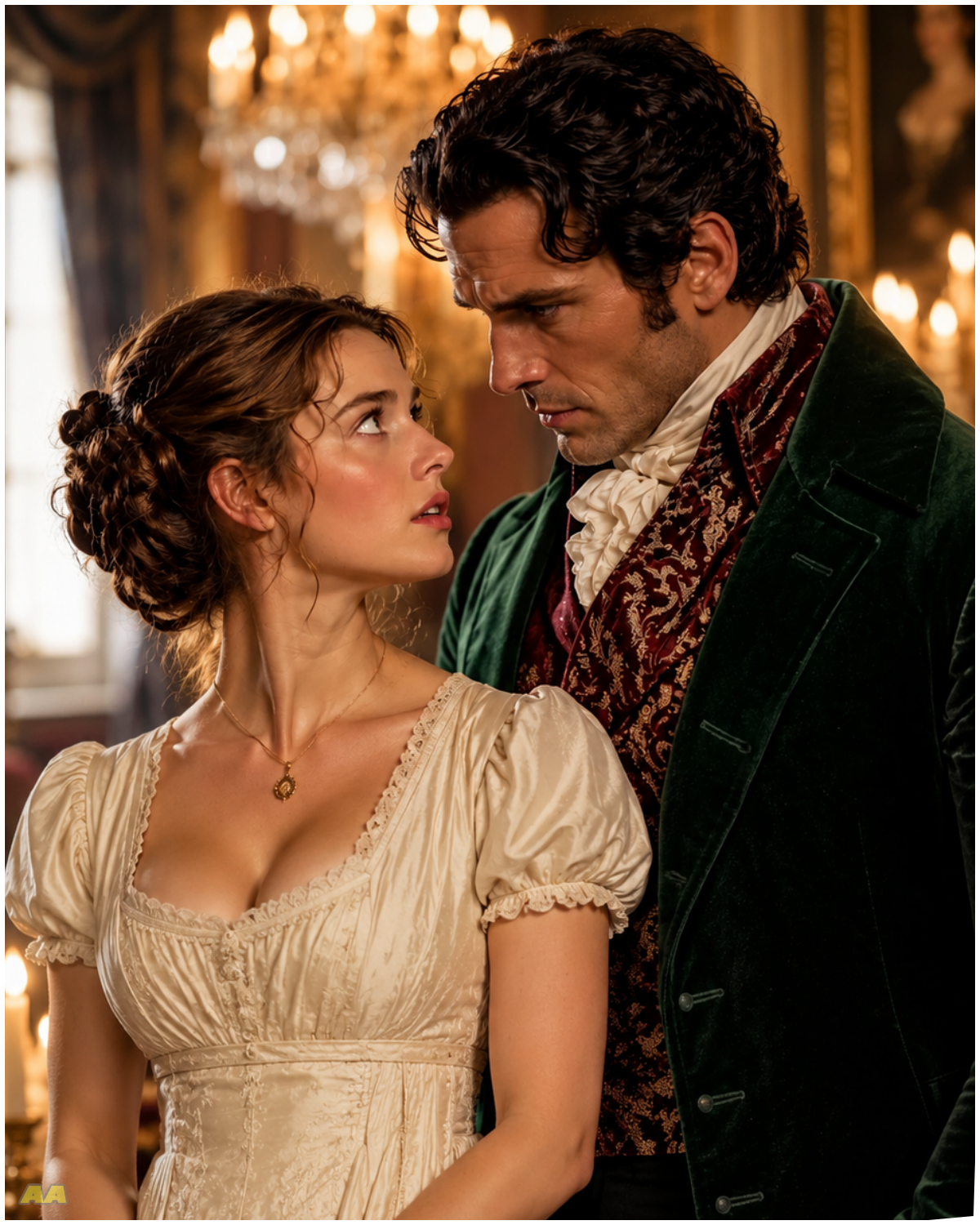
Pull your chair closer to the fire.
Tonight’s story is of a governness who never meant to be noticed, a duke whose reputation made London nervous, and a single April morning at Ravensmere Hall when both of their lives turned in the space of a single sentence.
Miss Eleanor Whitfield caught the falling child before she caught her own breath.
She had been on the gravel sweep no more than half a minute, her traveling boots still wet from the carriage step.
When the small figure in a white muslin pinnhor came hurtling down the great stone stair of Ravensmere Hall as if pursued.
The child’s foot missed the third step from the bottom, her body pitched forward into open air.
Eleanor moved without thought. She dropped her port mantto, lunged across the gravel, and caught the child against her shoulder with the cushioned thump of a struck pillow.
The girl’s pinn was stre with mud at the hem.
Her hair, two long black platts, swung against Eleanor’s chin.
The smell of her was warm honey, rivers, and the faint vegetable tang of someone who had been wading through new spring grass.
“Hello,” Eleanor said when she had her balance again.
“I do hope you were not coming down to greet me at quite that speed.”
The child went absolutely still.
She blinked up at Eleanor with eyes the color of wet slate.
A small pale girl of perhaps seven, every freckle visible across the bridge of her nose.
You’re the new one, the child said.
I am the new one.
They said the new one would be cross.
Then they have been telling tales about me before I even arrived.
How disappointing. The child considered her with the grave intensity only the very young manage.
You smell of coach horses.
That is because I have been sitting 6 hours behind two of them.
I think it is a fair exchange.
Behind them, on the broad sweep of pale gravel, a man’s voice cut clean through the morning air like a blade through still water.
Nvenia, step away from the woman.
Eleanor did not turn at once.
She set the chance small, slippered feet back on the gravel with all the care she would have used for crystal.
Gathered the trailing end of a sash that had come loose at the waist, retied it in a neat bow, and only then straightened half a head taller than the child, and looked toward the speaker.
The Duke of Ravensmere stood three yards away at the foot of the stair.
She had expected, on the strength of a fortnight of London gossip in coaching ins and posting houses, to find herself confronted by something theatrical, some redeyed brigant of a man with a curl of contempt around his mouth and the carriage of a brawler.
The newspapers had used the word dangerous no fewer than four times in the printed line Eleanor had carried in her reticule for two days.
The agency in Bedford Square had used the word twice in a tone of mild apology before handing her the letter of engagement.
Two coaching companions had crossed themselves at the mention of his name, and the eldest had whispered with relish that he had killed three men.
What Eleanor saw, in fact, was a tall, broad-shouldered man of perhaps 30 in plain riding clothes, buckskin breaches the color of clotted cream, a dark green coat slightly dusty at one cuff, top boots that had been polished by someone who took his work seriously.
His hair was the deep tarnished bronze of an old penny, cropped close at the nape and longer above the brow.
His face was clean shaven, sharp in the bones, with gray eyes set under a level brow, and a mouth that, at this particular moment, looked as though it had not smiled in a great many weeks.
He was unmistakably the most physically imposing man she had ever stood within 10 ft of.
He was also, in the broad sunlight of an April morning at a quart 10, not in the least dangerousl looking.
He simply looked tired and irritated, and as if he had a great deal more to do before noon than catch falling nieces.
“Your grace,” Eleanor said, and curtsied.
She made the curtsy neither too deep nor too shallow.
She had been practicing it in the carriage by leaning forward against the seat strap.
It had been some time since she had needed it.
“You are Miss Whitfield.”
“I am.”
My niece came down those stairs at a run in slippers against very particular instructions.
She did. You caught her?
I did? Why? It was not quite a question the way he said it.
There was a flatness to the word, as if he had asked because he could not afford to leave any conduct in his household unexplained.
Eleanor was aware of the housekeeper standing in the great doorway above them, of two footmen hovering at the carriage with her trunk between them, of a small undergarder frozen with a wheelbarrow at the corner of the house.
The entire arrival of a governness at Ravensmere Hall had ground to a halt in order to hear how she would answer her new employer.
Because the alternative, Eleanor said evenly, was to let her break her teeth on the gravel.
Your grace did engage me to keep her in one piece.
I have begun a quarter of an hour early.
There was a pause. Levvenia’s small hand, Eleanor noticed without looking, had closed very firmly on a fold of Eleanor’s traveling skirt.
Something altered, very slightly behind the Duke’s eyes.
Not warmth, not approval. Closer to the look, a man gives a horse that has just shown an unexpected gate, as if he had been prepared for one quality and met another and had to recalibrate.
“Mrs. Hadley will show you to your room,” he said.
“I will speak with you in the library at 3.”
“He glanced at the child.”
“Levvenia, come.”
The girl’s grip on Eleanor’s skirt tightened a fraction.
Then with the obedience of long habit, she released it, crossed the gravel on small, reluctant feet, and stood beside her uncle.
He laid one large hand on the crown of her head, with the careful gravity of a man handling something he was afraid of breaking.
They turned together and walked back up the stone steps into the shadowed hall.
Eleanor remained where she was a moment longer.
Her heart, she discovered, was beating rather harder than the catching of the child accounted for.
The morning was full of small spring sounds, a thrush very near, a soft pop of harness as the carriage horses shifted, water dripping somewhere from a leaded gutter onto stone.
The smell of new grass came up off the lawn in waves.
She had been at Ravensmere Hall for 3 minutes, and she had already laid a hand on the Duke’s niece, contradicted him about a quarter of an hour, and used the word disappointing in his hearing.
She was not, she thought, as she retrieved her port mantto, beginning particularly well.
What she did not know, as she followed the housekeeper up the great stair, past family portraits of Ravensmere Dukes in dark frames, was that the Duke would not, in fact, be in the library at 3.
He would be at the door of the school room, standing one step back in the corridor, listening to a stranger read aloud to his niece in a voice that had not stopped shaking him since he had heard it on the gravel.
Enor’s room was at the end of a long upper corridor papered in pale green and lined with prints of birds.
It had a single window overlooking the kitchen garden, a narrow bed with a white counterpane, a writing desk pushed under the window, a wardrobe of plain oak, and a brass jug of fresh cut Narcissus on the wash stand.
The Narcissus had been put there that morning.
The water in the jug was still cold.
She turned in a slow circle and was surprised for a moment by the prickle at the back of her eyes.
She had not had a room of her own in 18 months.
The last had been at Mrs. Trundle’s house in Bath, where she had slept on a truckle bed in the eldest girl’s chamber, and before that in her father’s vicorage, where her own bedroom had been requisitioned at his death for the new curit’s wife.
A narrow brass key sat in the wardrobe door.
Eleanor turned it once, just to feel it move, and then turned it back.
There was a tap at the door.
Mrs. Hadley, a small sprry woman in a plain dark gown and a cap so starched it crackled, stood with her hands folded at her waiSt. Your trunk is below, Miss Whitfield.
Mr. Bates will bring it up directly.
Your tea is on the table by the window.
As Grace asked me to say that you will dine with Lady Olivia and Lady Caroline at 6:00 in the South parlor, and that Miss Levvenia is taken with her supper at 5 in the school room.
Thank you, Mrs. Hadley. His grace also asked me to say, the housekeeper paused with the careful neutrality of a servant relaying a sentiment she did not herself endorse that he is in general particular about doors.
Doors in the family wing are not to be locked from the inside.
I am to mention it on the first day.
Eleanor considered this. Is there a reason, Mrs. Hadley?
There is, Miss. Will you tell me what it is?
The housekeeper’s eyes flicked to the Narcissus and then back.
The previous Duke, Miss, his Grace’s father.
He was lost in his dressing room some four years gone, and the door was bolted from the inside.
They had to send for a man to take down the door, and her late Grace was distressed.
His grace does not care for the practice.
It is a small thing, but it is firm.
Thank you for telling me plainly.
You are welcome, Miss. Mrs. Hadley hesitated again.
Miss Whitfield, may I say?
Yes. That child has been at Ravensmere a year and 7 months.
She came down from London after her mother, the late Lady Esme, took ill of a chest fever and was lost in November of 24.
We have had four governnesses.
The first stayed 8 days.
The fourth left a fortnight ago over a matter of Miss Levvenia’s running away into the home wood at dusk to look for foxes.
She was retrieved by Mr.
Bates at 9. Goodness. You caught her on the gravel today, miss.
The hall has noticed. Mrs. Hadley curtsied, allowed herself the faintest hint of a smile, really nothing more than a softening at the corners of her mouth, and went out.
Eleanor sat down on the edge of the bed.
She thought very deliberately about the Duke’s careful hand on the crown of the child’s head, about the careful word particular, and what it had been hiding, about four governances in a year and 7 months, and a small girl who slipped her shoes off in spring and ran into woods at dusk to look for foxes.
She had all the way up from London intended this engagement to be a quiet one, a place to work, a place to save her quarterly wages, a place to think perhaps in a year or two about the small school for daughters of country clergymen she meant one day to open in her own name.
She had not intended to be moved.
She unfolded her gloves on the counterpane, smoothed them flat, and went to find the school room.
The Duke of Ravensmere was not in the library at 3.
Eleanor knew this because she was in the library at 3.
She had been there since 2 minutes passed by the long case clock in the corner.
She had been very particular about not being late.
She had used the intervening 4 hours between her interview with Mrs. Hadley and the appointed time to walk the schoolroom corridor twice to find the school room itself, a long bright south-facing room with a globe in the window, a battered piano against the inner wall, and a tray of pressed leaves on the table, and to spend 3/4 of an hour with Levvenia in the schoolroom, listening to her describe with rather alarming taxonomic precision the differences between the badgeretses she had discovered in the Homewood and those in the deer park.
Levvenia could not, as it turned out, read very well.
Levvenia could identify by the curl of a leaf four kinds of oak.
Eleanor had also discovered, while wandering the corridor, a small gray and white kitten of perhaps 4 months asleep in a patch of sun on a windowill and a footman called Henry, who had told her in a confidential whisper that the kitten was strictly speaking against house rules, but that no one had had the heart to tell his grace.
Eleanor had filed the kitten away for later consideration.
At 10 minutes 3, the library door opened.
The Duke of Ravensmere came in without ceremony in his shirt sleeves, his coat over one arm.
He smelled of horse and wet leaves.
He stopped as if surprised to find anyone there and then drew the doors closed behind him.
“Forgive me,” he said. I was held up at the stables.
Of course you have been waiting.
I have. How long? 11 minutes.
Your grace. His mouth did something complicated then.
Not quite a smile. Closer to a man who has heard after a long thirsty afternoon.
A glass of water sat down on a stone table.
I am told, he said, draping his coat over the back of a chair.
That you went up to the school room of your own accord at noon and read with my niece for 40 minutes.
I did. She told me at lunchon that you do not in fact smell of coach horses anymore and that you have a sister called Beatatrice and that you said badger is one of the prettiest words in the English language.
All three are accurate, your grace.
He came around the library table and stood at the marble fireplace, hands clasped behind him.
The room was lined to the cornice with books in dark bindings.
A long window looked out over the rose terrace where two gardeners were on their knees pegging out new growth.
The April light came in slantwise and turned the wood floor the color of dark honey.
Miss Woodfield, your grace, you are the seventh governness my agent has sent up from Bedford Square for my niece in 19 months.
The other six left between them two pairs of stockings, one Bible inscribed by my late mother, an enormous unpaid wine merchants bill, and a great deal of correspondence I am still answering on the vineyard’s behalf to other households.
I should like to know before we proceed why you wish to be the seventh.
It was, Eleanor thought, an unusually honest question for a man with his reputation.
Because I needed an engagement, your grace, she said, and your agent was the only one in London willing to send a clergyman’s daughter without titled relations and with one previous post to a house with a duke in it.
The other agents required two posts and a baronet.
I have only one post and a vicar.
What was your previous post?
5 and a half years with the Trundle family of Bath.
Three daughters. The eldest is now married.
The youngest has gone away to Mrs. Carmichael’s Seminary at Chelnham.
I was no longer required.
Why did Mr. Trundle not write you another character?
He did, your grace. It is in my reference packet.
It is, I am told, satisfactory.
It is not satisfactory. It is lordy.
I have read it twice.
Then I am at a loss as to why you should still wish to question me, your grace, since you have already formed an opinion.
The Duke’s eyes, that level gray under the level brow, fixed on her properly for the first time.
Eleanor felt the look, the way one feels weather change in a barometer.
He was, she realized, not at all the way the newspapers had drawn him.
He was a man who had been listening very carefully for the wrong note.
I question every applicant, he said, because the last one I did not properly question allowed my niece to walk into the homewood at twilight wearing only one shoe in October.
I would prefer not to repeat the experience.
That is fair, your grace.
I do not, however, he said, and his voice softened by a half tone.
She would not have heard had she not been listening for it.
Ordinarily encounter a governness who tells me to my face that I have already made up my mind.
Most are more cautious. I have noticed your grace that caution is the chief currency in your household.
Mrs. Hadley is cautious. The footmen are cautious.
Levvenia, who is seven, is cautious.
I do not believe more caution from me will improve the supply.
And what in your view will improve the supply?
Honesty, your grace of the practical kind.
May I ask you three questions?
There was a small silence.
Then, with the air of a man who could not quite believe what he had just agreed to, the Duke said, “You may.” Does Miss Levvenia read?
No. She cannot get past words of two syllables.
The fourth governness called her stupid in October, and I dismissed her in October.
Miss Levvenia has not opened a primer of her own free will since.
Does she ride? She has a fat gray pony called Hodgej.
She rides him around the south paddock at a walk, holding the groom’s hand.
She’s afraid of the caner.
Does she sleep through the night?
Something tightened almost imperceptibly at the corner of the Duke’s mouth.
No, Miss Whitfield, she does not.
She wakes between 2:00 and 3:00 of the morning and goes down to the kitchen and sits on the back step of the scullery with whichever maid is awake and one of the cats.
She has done this since the week she arrived.
I see. Have you a fourth question since you ask?
No, your grace. I have what I came for.
He looked at her for a long second.
Then he turned to the fireplace and with great unnecessary care adjusted a small bronze dog at one end of the mantlepiece by an eighth of an inch.
“My sister,” he said, addressing the bronze dog as much as her, was lost to us in November of 24 of a chest fever contracted in the second week of November and ended on the 22nd.
She was 28. There was no time to send for the child.
Levvenia was at the seaside at Brighton with her aunt by marriage.
She came up to London in a fast carriage and arrived 9 hours after her mother was gone.
She has spent a great deal of the year and 7 months since attempting in her quiet way to ascertain whether her mother is in fact gone for good or only mislaid.
She is afraid of caners because her mother used to caner beside her on a pony called Rabbit.
She does not sleep at night because in November of 2024 she went to sleep at 7 and her mother was alive and she woke at 6:00 and her mother had been gone 4 hours.
Elellanena said nothing. She had a great deal of training in saying nothing at exactly the correct moment.
I tell you this, the Duke said, because the previous six governores asked on their first day whether her clinging habits and her wandering at dusk were not perhaps badly handled by the staff.
They were not. They are what they are because she lost the only person who ever told her with absolute conviction that the world would not be permitted to harm her.
And she has not yet found anyone she trusts enough to take the lesson again.
Then I will be careful,” Eleanor said quietly.
“To be very honest with her about what I can promise.” He turned then and looked at her properly, his gray eyes were the color in this light of the slate roofs of the kitchen wing in rain.
“You will start tomorrow at 9, breakfast in the school room at 8:00.
You will dine with my aunts in the south parlor at 6:00.
On Sundays, you will accompany us to St. Boffs at the south gate at 10:00.
Unless your conscience finds difficulty with the recctor, who is a fool but a harmless one.
I have no quarrel with recctors who are harmless fools.
Your grace. And Miss Woodfield, one last thing.
Yes, your grace. Whatever you were told in Bedford Square or in your coaching ins about the kind of man you were coming to, set it aside until you have had cause to form your own.
I do not require you to think well of me.
I require you in this house to think clearly.
Is that understood? Perfectly. Your grace.
He gave her the smallest nod a man could give without simply rolling his head, picked up his coat from the back of the chair, and went out.
Eleanor stood a moment in the slanted April light, listening to the longase clock at the corner of the room tick the half hour.
Then she sat down rather suddenly on the leather chair beside the fireplace because her niece, having behaved very well for the duration of the interview, had decided not to.
He was not, she thought, England’s most dangerous stoke.
He was, however, the most carefully wounded man she had ever sat in a room with, and she suspected that this was, in its own quiet way the more difficult diagnosis of the two.
The household at Ravensmere Hall was on closer acquaintance a small confederation of people who had been quietly and competently grieving for a year and 7 months without any of them quite admitting it to the others.
The Duke had two aunts in residence.
Lady Olivia Ravensmere, 63, the Dowager’s elder sister, who managed the still room and the linen cupboards with the firm hand of a brigadier, and Lady Caroline Ravensmere, 58, a woman of soft pink complexion and very firm opinions on the breeding of spananiels.
Eleanor met them both at dinner on her first night, ate a quantity of asparagus, said very little, and went up to her room, knowing that Lady Olivia approved of her teeth, and that Lady Caroline approved of her father’s having been a vicar, both of which would do for a start.
She rose at 6 the next morning.
She put on her plainest gray gown, the one with the white collar she had stitched herself at Bath.
She knotted her hair at the nape in a coil that would survive a child climbing into her lap.
She found the school room at 10 minutes to 8.
She drew back the curtains, opened the long window a hands breath onto the morning, set out two place settings at the small table, and waited.
Levvenia came in at 5 minutes 8 handin hand with a stout nursemaid called Bessie.
The child wore a fresh white pinn over a sky-blue muslin dress, and her two long plats had been rebraided with damp hands, so that the partings shone.
She looked at Elellanena with the cautious, level look of a person at the door of a room full of strangers, and stopped just inside the threshold.
“Good morning, Miss Levvenia. Good morning, Miss Whitfield.
Have you eaten a piece of toast and a boiled egg, Mom?
Then we shall make a beginning.
The making of the beginning, Elellanena had decided in the small hours of her first night, would not be at the primer.
She had brought up from the library on Mrs. Hadley’s nod a copy of Robinson Crusoe with a battered green cover and a folded map at the front.
She had also brought up in her apron pocket a small twist of brown paper containing two pieces of sugared almonds.
She had also brought up in a quiet inside fold of her shawl the small gray and white kitten from the windowsill in the long corridor who had been entirely willing to be carried.
She set the kitten down in the middle of the schoolroom rug where it stretched, yawned, and laid claim to a square yard of warm wool.
The vineyard made a small involuntary sound.
It was the first sound Eleanor realized she had heard from the child that she would have called happiness.
Is is that that is the kitten from the window in the long corridor?
Eleanor said sitting on the rug beside it.
Footman Henry says he is strictly speaking against the rules.
I have brought him up for half an hour.
While he is here, we shall agree that he is the schoolroom’s responsibility.
After half an hour, I shall carry him back to his patch of sun, where, strictly speaking, he is still against the rules, but is nonetheless quietly accommodated.
The child sat down on the rug with the deliberate, considered care of someone setting a teacup on a tray.
What is his name? He has not got one yet, so far as I have heard.
May I? You may. May I name him?
You may, Miss Levvenia, on the strict understanding that the name must be discussed with his grace at some convenient hour, and that in the meanwhile we tell no one in the kitchens that he has come up here.
Yes, the child said with the gravity of a treaty.
Yes, Miss Whitfield. The kitten washed one ear.
Levvenia on her knees put out one careful finger and touched the very tip of his tail.
The tail twitched. She giggled, a small, reluctant giggle, half swallowed, as if she had not been certain the schoolroom rug was a place where giggling was allowed.
Eleanor opened the green covered book on the rug between them.
“This,” she said, “is a story about a man who is shipwrecked on an island for many years and learns all over again how to do every ordinary thing.
How to plant a seed, how to make a hat out of goat hair, how to keep a calendar by cutting notches in a poSt. He learns these things rather badly at firSt. Why?
Because he has no one to ask.
Now, we shall not begin with the words.
We shall begin with the map at the front.
Do you see this island?
Yes. Show me where his ship was wrecked.
There. Show me where he built his first house.
There. Show me where the cannibals came.
There. You read maps very well.
Mama and I had a map of England on the schoolroom wall in London.
She put pins in it for every place she had been.
Did you put pins in it for the places you had been?
Yes. Mine were red. What color were hers?
Blue. I shall buy you a new map of England this week.
Elanor said. And a box of pins.
There will be red ones and blue ones.
The blue ones will be for the places we go together.
The red ones will be for places you go without me.
You may decide where the first blue pin goes.
The child looked at her for a very long moment.
The kitten, with great deliberation, climbed into Levvenia’s lap, turned three times, and went to sleep across her thighs.
The badger sets in the homewood, Levvenia said.
The badger sets in the homewood it is.
She did not see the Duke of Ravensmemir in the corridor outside, one step back from the open schoolroom door, perfectly still, with his hand resting on the brass handle of the door he had not yet pushed all the way open.
She did not see the muscle that moved in his throat.
She did not see him step back very quietly and walk away in his stocking feet.
He had taken his boots off at the head of the stair so as not to wake the household down the long carpeted corridor toward his own apartments where he would dress for the morning and then ride out into a wet April field for 2 hours and not when he came back be able to tell anyone what he had written paSt. So began the first month of Miss Elellanena Whitfield’s residence at Ravensmere Hall.
The lessons between her and the child found their pattern within a week.
Maps in the morning, a piece of Robinson Crusoe at noon read aloud with the kitten on the rug.
An hour of needle work in the afternoon, in which Elellanena turned out to be a great deal better at the work than the pupil, and the pupil a great deal better at the talk than the teacher, and a steady understanding came up between them in the exchange.
After tea, which Levvenia took in the school room, they walked the homewood first, the deer park, the kitchen garden, where the head gardener, a great tacetern man called Mr.
Peton, very gravely permitted Miss Levvenia to be in charge of the carrot bed.
By the third week, Levvenia could read aloud the first chapter of the Crusoe in halting, careful sentences with one finger under the line.
By the fifth, she could read it without the fifth.
She could read it without the finger.
Eleanor did not see the Duke very often in the first month.
She glimpsed him in the corridor at odd hours, always booted, always going somewhere, to the stables, to the home farm, to the long room on the southside where he met with his land steward on Tuesdays and Fridays.
She caught the back of his head once or twice in St. Bs at Sunday service.
He sat in the family pew with his aunts on his right and the vineyard on his left and did not look at Eleanor who sat with the upper servants two rows behind.
He spoke to her three times in the first month.
The first was on the second Sunday in the church porch after service in front of his aunts and a great many of the parish.
He bowed slightly to her, asked her if she found Mr.
Tilbury’s sermon a tax upon her patience.
Mr. Tilbury was the recctor who was a harmless fool and seemed when she said it was a very fine sermon for a fine April morning to be entirely satisfied with the answer.
Lady Caroline on his other side looked from one to the other of them with the polite blankness Eleanor had begun to recognize as her chief defense against any social situation she did not fully understand.
The second was in the long corridor outside the school room on a Wednesday afternoon when Eleanor was carrying Levvenia’s outdoor cloak down to the boot room.
She had not seen him approach.
They almost collided at the turn of the stair.
He set out one hand to steady her, did not actually touch her sleeve, and stepped back at once.
“Miss Woodfield, your grace.” My niece has, I gather, named the kitten Welssley.
She has your grace. I am told this is a compromise.
It is. She wished originally to name him Bonapart.
I suggested that as the kitten was a cat of small stature with a remarkable temper and considerable strategic intelligence, Welssley was a more accurate appellation.
She accepted the substitution under proteSt. His mouth did the thing it had done in the library.
The not quite smile she had observed and cataloged in the interview and stored for safekeeping somewhere she did not examine.
Carry on, Miss Whitfield. Yes, your grace.
The third was at the head of the great stair on a wet evening in the third week when she came down from putting Levvenia to bed and found him standing at the foot of the stair with a letter in his hand and an expression she had not seen on him before.
He was reading the letter again as if he could not quite believe what it said.
He looked up, their eyes caught for the space of two heartbeats.
He folded the letter very carefully into thirds, slid it into the inside pocket of his coat, and gave her one small precise nod.
Miss Whitfield, your grace. She went past him toward the south parlor.
She did not look back.
She was, however, aware that he had not moved until she had reached the door of the parlor, and that he was, when she did at last, glance toward the great staircase, no longer in the hall.
She did not know on that particular evening that the letter was from Lady Cibil Marchmont, who had been the late Duke’s choice of bride for his heir from a distance of 8 years, and who had been waiting with the patience of a very well-b bred cat at a very fat mouse hole, since the funeral of the Duke’s mother 18 months earlier for the new Duke’s official mourning to end.
She also did not know that Lady Cibil’s letter announced with great propriety and a most regrettable suddeness her intention to come down with her mama to a small house party at Ravensmere Hall by his grace’s gracious previous invitation in the second week of May.
By the second week of May, Eleanor Whitfield would have been at Ravensmere Hall for exactly 4 weeks, and she would be in the orery on a particular Tuesday afternoon in an old apron over her oldest gray gown, on her knees beside the Duke of Ravensmere, both of them up to the elbows in damp earth, when Lady Cibil Marchman’s carriage came up the drive.
But first, the orry. The orry sat against the south wall of the kitchen garden, a long brick and glass building of perhaps 40 ft with a slate path down the middle and a row of orange trees in tubs along each wall.
It had been built by the third Duke who had read a book about an orery near Versailles and decided that Ravensmere required one.
The orange trees had been brought up from Lisbon in 2003.
They had borne in the time of the third Duke six oranges between them.
They had not borne any fruit at all since.
Elellanena discovered the orery on the morning of the 14th of April.
She had taken Levvenia after lessons on a tour of the kitchen garden with Mr.
Peton, and Mr. Peton, after a great deal of thought, had unlocked the orery door with a heavy iron key and admitted them.
Inside the air was thick and green.
The orange trees and their wooden tubs looked sickly.
The slate path was clean.
A small folding chair stood near the back wall, and on the chair, a thin volume of Latin poetry with a green ribbon marker.
A pair of leather gardening gloves, oversized, lay neatly on the chair beside the book.
Whose are these? Loving said.
Mr. Peton behind them cleared his throat.
His graces, Miss Uncle Henry’s.
Yes, Miss Levvenia. Uncle Henry reads Latin to the oranges.
He does, Miss Tuesdays and Thursdays, if the weather permits, after his work with the steward.
Why his grace believes Mr.
Peton said very gravely that the trees were brought from a hot country and miss the sound of warm voices.
Eleanor said nothing. She bent to examine the soil at the base of the nearest tub.
Mr. Peton. Miss, when was the last time these were repotted?
6 years gone, miss. Before his grace’s father took ill.
The new pots were ordered and never came.
They are rootbound. That is why they do not fruit.
The trees themselves are healthy.
Mr. Peton looked at her for a long moment.
Indeed, miss. She did not see the juke of the orery the next Tuesday, or the one after.
She saw on the path between the kitchen garden and the orangey on the Thursday of the third week, fresh footprints in the damp earth, and on the folding chair, the green ribboned book moved two pages on.
On the Tuesday of the fourth week, the second Tuesday in May, Eleanor took Levvenia, after their morning lessons, down through the kitchen garden, with the express intention of doing nothing of particular consequence at all, and found instead that Mr.
Peton had laid out on the slate path inside the orry door four large new terra cotta pots, four sacks of fresh loan, a great heap of well-rotted manure from the stable, a pair of tels, a watering can, and a small note in his own careful pencil, with his grace’s compliments, in case it should be agreeable to Miss Whitfield on a fine afternoon to attempt the matter of the orange trees.
Levvenia read the note out with two stumbles only on the word agreeable and looked up at Elellanena with the bright concentrated face of a child who has just been admitted to a conspiracy.
Shall we? We shall. They took off Levvenia’s pinn.
They folded it on the folding chair.
Elellanena pinned up her own gray sleeves to the elbow and tied an old Hessian apron from a hook on the wall over her gown.
They were on their second tub.
Elellanena on her knees, Levvenia on her stomach on the slate.
Both of them up to the wrists in damp lom.
The kitten Welssley in attendance on the chair.
When the Duke of Ravensmere came in through the orangey door in his shirt sleeves, his coat over his arm, 3 minutes late from his appointment with his steward, and stopped.
“He had clearly intended,” Elellanena thought, glancing up at him from her position on the floor, to find his orry empty as usual.
He had clearly intended, in his shirt sleeves, and with his book of Latin under his arm, to sit on his folding chair, and read aloud to his sickly Portuguese orange trees, in the manner of a man with a great many things to keep at bay.
He had not intended to find his governness and his niece, the latter currently up to her chin in soil, in possession of his greenhouse.
“Your grace,” Elellanena said evenly, sitting back on her heels.
“Mr. Peton has lent us the use of the orery this afternoon.
I hope we are not in your way.” The Duke looked for one extraordinary unguarded second like a man caught entirely unprepared by his own life.
Then he set his coat on the back of the chair, set the book of Latin on top of the coat, rolled his linen shirt sleeves to the elbow, walked across the slate path, and knelt down on the floor beside her without a word.
What are you doing, Miss Whitfield?
Repotting your father’s orange trees, your grace.
They have been rootbound for some 6 years and are perfectly healthy underneath.
And you proposed today to repot four mature orange trees on your own.
With Miss Levvenia’s assistance, your grace, I see.
He picked up the second TR from the slate, turned to the half-finished tub beside hers, and slid the blade into the packed earth at the base of the trunk, with the practiced hand of a man who had done it before.
Eleanor watched him for half a second, the long line of his rolled forearm, and the careful, precise pressure of his thumb on the tool, and resumed her own work.
Levenia. >> Yes, Uncle Henry.
Have you been told that you are not under any circumstances to repot orange trees in your good pinnhor?
My pinnor is on the chair.
It is, I withdraw the observation.
The child on her stomach on the slate path beside them said in the small, intense voice of one engaged in serious labor, “We are mostly going to put the manure in next, Uncle Henry.
The loan first, then a layer of manure, then more lurm.
Welssley is in charge of the chair.
I observe Welssley is in charge of the chair.
You are not allowed to sit on it until we are done.
I would not dream of it, Levvenia.
There was a silence. The orange trees in their old tubs rustled faintly in the warm green air.
Outside the kitchen garden in May was a great wash of new lettuce, espalade pear, and the first papery red of the early poppies that grew of their own accord against the south wall.
Bees were going steadily in and out of a hive at the far corner.
A wood pigeon, very near, said its three syllables.
Eleanor was acutely conscious, more acutely than she had been conscious of anything in years, of the precise distance, perhaps 18 in, between her right hand and the Duke of Ravensmere’s left hand on the slate path, of the rhythm of his breathing, slow and even, of the small frown of concentration at the corner of his mouth as he worked the root ball loose.
Of the fact that his hair, in the green orangey light, was the color of an old penny, exactly as she had first seen it, and that the cuff of his shirt sleeve rolled to the elbow, had a small darn at one inner edge in a thread that did not quite match.
Whoever had done it, his valet perhaps, or one of the maids, had done it with great care, and not very much skill.
She thought with a clarity that startled her that she had not been this happy on her knees on a stone floor in a great deal of years.
The wheels on the drive came at 2.
A carriage. A heavy traveling carriage by the sound.
Four horses, pilians, a coachman calling the gate.
The pigeons in the kitchen garden lifted in one body off the brick wall and resettled.
The Duke straightened. He did not stand.
He simply lifted his head, listened with the still attention of a man hearing a familiar set of footfalls in a corridor and recognizing them, and his face, which had for the last quarter of an hour been quietly and entirely open, closed.
Levvenia. Yes, Uncle Henry. Run up to the school room by the back stir.
Ask Bessie for a clean pinn.
I will send for you when I am ready.
Why? Because I say so, my dear.
She went, after a long considering look that took in his face and Eleanor’s hand, and the second trowel left lying on the slate path.
She left her own muddy pinn on the chair, gathered the kitten very firmly under one arm, and trotted out through the door into the kitchen garden.
The Duke stood. He picked up his coat from the back of the chair.
He shook the lurm of off his hands very carefully into the t he had been working on.
He picked up the book of Latin and tucked it under one arm.
Miss Whitfield, your grace, that will be Lady Cibil Marchment with her mother, who has arrived precisely 2 days earlier than expected.
I would be obliged if you would in the next quarter hour see Miss Levvenia tidied, changed, and presented in the south parlor at 3:00.
I will go down now to meet them.
Yes, your grace. He stood for a moment longer, looking at the half-rooted orange tree at her side, at the slate path between them, at the empty folding chair where the kitten had been in charge, with the expression of a man taking a careful infantry of a room he is leaving and may not see again.
Then he was gone. Eleanor stayed where she was on the orery floor for the count of five.
She wiped her hands on the Hessian apron.
She unpinned her sleeves. She rolled them down over her wrists, button by button.
She stood and discovered that her legs again were behaving rather oddly.
She was perfectly aware that something had occurred in the ory in the last quarter of an hour that the next quarter of an hour was meant to undo.
She was equally aware that it was not going to undo.
She picked up Levvenia’s small muddy pinn from the chair, folded it neatly over her arm, and went up to the school room by the back stair.
By 3:00, she had Levvenia changed into a fresh white pine over a pale lavender muslin.
The two long plats retied with new ribbons, her hands scrubbed, and the kitten Welssley, back in his patch of sun on the long corridor windowsill, asleep on his side, dreaming of orangery rugs.
By 5 minutes past 3, Eleanor and Levvenia were at the door of the south parlor, and Eleanor was lifting the child up to her own height to whisper a single sentence in her ear before they went in.
“Linia?” “Yes, Miss Whitfield.” Whatever the lady inside that room says to you, you are to be polite.
You are not to be afraid, and you are not under any circumstances to tell her about Welssley.
Yes, Miss Woodfield. On three.
On three. One. Two. The door opened.
On three from the other side.
The Duke of Ravensmere stood holding it open.
His coat was on. His crevat was perfectly tied.
He looked in every line of him exactly the man Eleanor had been told to expect on her arrival a month before.
Composed, controlled, a great deal of weather barely held inside a glass.
Miss Whitfield, Lady Levvenia, may I present Lady Cibil Marchmont and Lady Marchmont, who have done us the honor of arriving rather sooner than we expected.
Lady Cibil, my niece Levvenia, and my niece’s governness, Miss Whitfield, who came to us from Bath in April.
Eleanor Curtsied. Levvenia Curtsied. The two ladies inside the south parlor, one a tall, slender woman of perhaps 45 in dove gray traveling silk, the other a young woman of about 23 in pale primrose with a sleek dark head of fashionable curls and a face that had clearly been considered by several people the most beautiful in three counties turned together.
Lady Cibil Marchman’s pale gray eyes, long lashed very lovely, exactly the color of frosted glass, went, in the space of a single drawn breath, from Eleanor’s face to the smear of damp lom Eleanor had not quite managed to remove from the back of her own left wrist, and to a small flake of dried earth caught in the topmost button hole of her gray gown.
She smiled. It was a perfectly correct smile.
How charming, she said. His grace’s establishment is so wonderfully informal.
There are in any well-run country house two kinds of dinner.
The first is the dinner at which everyone is fed.
The second is the dinner at which everyone is studied.
The dinner at Ravensmere Hall on the evening of Lady Cibil Marchmont’s arrival was very firmly of the second kind.
Eleanor was not, of course, present at it.
She took her supper, as she had taken it every evening for a month, with Lady Olivia and Lady Caroline in the South Parlor, except that on this particular evening, Lady Olivia and Lady Caroline were not in the South Parlor.
They were in the great dining room with his grace and his guests, and Eleanor was sitting alone at the small mahogany supper table beside a single branch of candles, eating a soup of clear chicken broth with a thin slice of bread.
She ate it slowly. The soup was excellent.
The bread had been buttered by some kindness of the cooks on the underside as well as on the top.
The mahogany table reflected the candle flame in a wavering single thread of gold.
She was, she discovered, not at all hungry.
She had spent the 4 hours between 3 and supper at 7 in the school room with Levvenia, who on returning from her quarter of an hour in the South parlor, had given a careful and entirely unprompted report of every word that had been said to her in it.
Lady Cibil had asked her her age and what her favorite color was.
Levvenia had said seven and red.
Lady Cibil had said that red was a difficult color for little girls and pink was a much prettier one.
Levvenia had said very politely that she had thought about pink and decided against it and that her mama had once had a red riding habit in London.
Lady Cibil had laughed a small bright laugh and said something to Lady Marchment in a low voice and Lady Marchment had laughed too.
Levvenia had not understood the joke.
She did know, however, that it had been at her lost mother’s expense in a tone she had not heard used about her mother before.
Miss Woodfield. Yes, Levvenia. Was that a kind lady?
Eleanor had been a governness for 5 and a half years before she came to Ravensmere.
She had encountered in those 5 and 1/2 years a quantity of unkindness in the houses she had taught in that would have surprised the parents of her pupils very greatly had they been listening at the right doors.
She had developed a particular tone for the question, “Was that a kind lady?” Lady Sibil, she said, is a lady who is very accustomed to having her own way.
People who are very accustomed to having their own way are sometimes not kind, but they are not always unkind on purpose.
They are simply unused to noticing other people.
Do you understand? Yes. You are not required to like her, the vineyard.
You are required to be polite to her because she is a guest of your uncles.
Politeness is the rent we pay for living in a house with other people in it.
But you are not required to like her.
I do not like her.
That is all right. Does Uncle Henry like her?
Eleanor took a breath very carefully before she answered that.
Uncle Henry is a duke, she said.
Dukes have many duties, some of which we do not see.
We must trust him to know what he is about.
It was not, she thought, a satisfactory answer.
It was the best one she had.
After supper, alone, she carried her own candle up the back stair and stood for a moment at her window, looking down across the kitchen garden in the dusk.
The orangey roof glittered faintly.
The bees had gone in.
The wood pigeons had stopped.
From the windows of the great dining room on the far side of the house, she could hear very faintly the sound of laughter.
Lady Sibil’s bright laugh in particular, which carried, and the steady murmur of voices over a silver and crystal.
She did not, she told herself firmly, have any business at all standing at her window, listening to the laughter at her employer’s dinner table.
She put down her candle.
She undressed. She washed her face.
She got into the narrow bed under the white counterpane.
She lay flat on her back in the dark and listened to her own heart beat in her ears and thought with a clarity she did not very much enjoy about a man’s left hand on a slate path 18 in from her own.
She had been hired, she reminded herself, to teach a 7-year-old child to read.
She slept eventually. She woke at 20 minutes past 2 of the morning to the small soft sound of bare feet at her door.
Miss Whitfield, Levvenia, come in.
The child came in. She was in a long white night gown with her feet bare on the cold boards and her two plats had come loose at the ends so that her hair stood out in a small storm cloud around her face.
She climbed up onto Eleanor’s bed without being invited and sat cross-legged at the foot of it.
I had a dream. What did you dream?
That mama came down the stair in a red riding habit and Lady Cibil told her she was not allowed in the house and Mama had to go and stand on the gravel outside.
That is a very sad dream.
Yes. Do you want to sit here a little while?
Yes, you may. Take the spare blanket from the chair.
Put it over your knees.
We shall not light a candle.
We shall sit in the dark, you and I, and we shall not be afraid.
Levvenia took the spare blanket.
She wrapped it around her shoulders.
She leaned against the bedpoSt. Miss Whitfield.
Yes. Is Lady Cibil going to live here?
I do not know, Levvenia.
Is she going to be my new mama?
I do not know. Will you stay?
Eleanor closed her eyes in the dark.
There was, she thought, only one honest answer to that question, and she had no business at all giving it to a seven-year-old child.
I will stay, she said.
For as long as his grace wishes me to stay, and as long as I can be of use to you, that is all the promise I am able to make tonight.
But it is a real one, Levvenia.
I do not make promises I cannot keep.
That is a better answer than the last one gave.
What did the last one say?
She said she would stay forever.
She left on a Wednesday.
I am sorry. The child was quiet for a long minute, then in the small flat voice of a person setting down a fact she has carried for some time.
I do not want you to leave.
I know, Levvenia. Sleep here a little while.
I will sit up. There is a book on the table I had been meaning to read.
The child slept in the end against the bedpost with the blanket around her shoulders and her cheek on Eleanor’s knee.
Eleanor did not, in fact, open the book on the table.
She sat in the dark with her hand resting very lightly on the crown of Levvenia’s head, and she listened to the wind in the lime avenue at the back of the house, and she thought, with the calm precision of a woman doing a sum she has been putting off, exactly what was now happening to her.
She had been 6 years older than the child sleeping on her knee when she had lost her own mother.
She had been at school in Chelnham.
She had been told the news in the housekeeper’s small, bright sitting room by the second mistress, who had been very kind.
Her father had remarried within 7 months.
The new wife had been perfectly civil and entirely unable to see Eleanor in the same room as her own three small daughters by a previous marriage.
Eleanor had been sent back to school and then out into the world as a governness, and her father had been taken at his desk of an apoplelexi 3 years later.
She had not wept. She had not been since the day her mother was lost to her in a room with a person who had laid one hand on the crown of her head and told her with absolute conviction that the world would not be permitted to harm her.
She had not known until this exact moment in a dark bedroom at Ravensmere Hall at 3:00 in the morning on the second Wednesday in May that she had been waiting all those years to be allowed to do that for someone else.
The child was warm against her knee.
The wind moved in the limes.
Elellanena sat in the dark.
She carried Levvenia back to the nursery at 5:00 when the first thrush had started in the lime trees.
She put her into her own bed under the rocking horse and pulled the coverlet up to her chin and stood for a moment beside her, watching her sleep.
Then she went back to her own room and washed and dressed and was at 7 in the school room with the lessons laid out for the morning.
She did not see the Duke at breakfast because she did not breakfast with the Duke.
She did not see him at lunchon because she did not lunchon with him either.
She saw him at 20 minutes 4 in the afternoon in the long corridor outside the schoolroom door and the look on his face stopped her at three paces.
Your grace, Miss Whitfield. His voice was very even.
I am told my niece left the nursery in the small hours and went to your room.
She did? Bessie should have heard her.
Bessie was asleep. The child crosses the corridor very lightly, your grace.
She’s had practice. I’m told you sat up with her until 5.
I did. Why did you not send for Bessie?
Because she did not want Bessie your grace.
She wanted to sit on a bed in a dark room with a person who would tell her that she was not afraid of Lady Cibil.
I judged it the lesser evil to give her the halftruth she could carry than the conventional rebuke she would have remembered.
I do not propose to make a practice of it.
If it is offensive to your grace, I will in future return her to Bessie.
There was a very long pause.
Miss Whitfield. Yes, your grace.
It is not offensive to me.
Thank you, your grace. He stood for one extraordinary moment with his hand on the corner of the corridor wall as if he needed it.
Then he straightened and said in the same flat, carefully governed voice with which he had asked her name on her first morning.
Lady Cibil and Lady Marchmont will be in residence for 10 days.
After they leave, my aunts and I shall be in London for the first week of June for a matter of business.
You will remain in charge of Miss Levvenia.
I will instruct Mrs. Hadley to refer any matter you require to me by poSt. Carry on, Miss Whitfield.
Yes, your grace. He walked past her down the corridor.
He did not look back.
Eleanor stood after he had gone with one hand on the door of the schoolroom, listening to the faint sound of Levvenia in the room beyond, practicing slowly the words on the second page of the second chapter of Robinson Crusoe, and thought with the same calm clarity of the night before that the Duke of Ravensmere had in the corridor just now not been able to look her in the eye.
She did not know whether this was the worst news of her life or the beSt. Lady Cibil Marchmont was on closer acquaintance over the 10 days that followed exactly as efficient an instrument as her mother had spent 23 years making her.
She rose at a fashionable hour.
She walked in the rose garden with a parasol.
She had Lady Caroline read aloud to her on the south terrace from a volume of sermons she had brought down with her and managed to convey by the bright correct tilt of her head that she found the practice both useful and absurd.
She accompanied the Duke on a morning ride on the third day and a drive into the village on the 5th and a visit to the family vault at the church on the 7th which last was reported to Ellaner by Mrs. Hadley in the stillroom over a cup of tea with the dry observation that Lady Sibil had carried into the vault a posie of white liies very neatly cut miss by a hand that has not in its life cut a lily.
Lady Cibil did not come up to the schoolroom.
Lady Cibil did however send word on the second day that she should be delighted to receive Miss Levvenia in the south parlor at 4 each afternoon for a quarter of an hour.
Levvenia went. Levvenia came back.
Levvenia, on each of the four afternoons that followed, said very little about what had passed in the south parlor, and Elellanena did not ask.
Eleanor noticed, however, that the child returned each afternoon a fraction smaller than she had gone in, as if a portion of her had been quietly absorbed into the upholstery of the South Per, and could not be retrieved.
On the morning of the eighth day in the schoolroom, the vineyard put down her copy of Robinson Crusoe in the middle of a sentence and said, “Miss Whitfield, Lady Sibil says my mama did not love me as much as she might have done.” Eleanor did not move.
She did not change her face.
She said in the same even voice she used to correct a misread word.
Did she say that, Levvenia?
She said that Mama married Papa against the wishes of her family and that she went away with him to a small house in London and that she had me too young and that she did not give me enough of her time and that she was a silly woman who liked red riding habits and laughed at the wrong moments and did not know what was due.
I see. Was my mama a silly woman.
Eleanor closed her copy of Robinson Crusoe.
She set it on the table.
She took the child’s small hands in her own.
Levvenia, look at me, please.
Your mother, Lady Esme, married your father for love, against the express wishes of a family who would have preferred her to marry for money.
That is a brave thing, not a silly one.
She had you when she was very young, because she wanted you.
She gave you, by every account I have ever heard, every hour of her time she could spare from a husband who was very ill in the last year of his life, and a household she ran almost alone.
She wore a red riding habit because she looked beautiful in it, and it gave her courage.
She laughed at the wrong moments, because she had a great deal of laughter to spend, and not many afternoons to spend it in.
Anyone who tells you otherwise has not, Levvenia, ever known her, and they are saying it for reasons of their own.
Do you understand?” The child looked at her with her wet slate eyes.
“Yes, Miss Whitfield. You will not, of course, repeat any of this to Lady Cibil.” “No, Miss Whitfield, and you will continue to be polite to her in the South parlor.” Yes, Miss Whitfield.
But Levvenia, if she says anything of that kind to you again, anything at all, you are to say to her very politely, “My governness has asked me to bring any difficult question to her in the schoolroom.
Will you forgive me if I take this one away, and you will rise and curtsy and come up here?” “Yes, Miss Whitfield.
Good girl.” The child looked at her for a long moment.
Then with the gravity of a small judge, Lady Cibil does not like you, Miss Whitfield.
No, Levvenia, I had observed.
Why does she not like you?
Because Lady Cibil has decided that she is going to be the most important person in this house.
People who have decided that do not, as a rule, care for any other person in the house who appears to be of any importance whatever.
It is not personal. It is geographical.
Geographical. A new word for the wallnap.
We shall add it on Friday.
The Duke spent the 8th and 9th days of Lady Sibil’s residence in the home wood with a forester marking trees for felling.
He came back on the evening of the 9th covered in pine sap and with an expression so closed that Mrs. Hadley in the kitchen told the cook in a low voice that his grace had not been seen with that face on him since the November of 24.
He did not the evening of the 9th dine in the great dining room with his guests.
He sent word by Mrs. Hadley that he was indisposed and would take his supper in the library.
He sent word 10 minutes later by Mrs. Hadley that he would be obliged if Miss Whitfield would step down to the library at 9:00 that evening for a quarter of an hour to discuss the matter of Miss Levvenia’s reading.
Eleanor put on her gray gown with the white collar.
She put on her shawl over the gown.
She put up her hair in the same neat coil at the nape.
She took down her own copy of Robinson Crusoe from the schoolroom shelf into a sheet of paper on which she had marked the words Levvenia had now mastered and those still to come.
She went down the great stair at 3 minutes to 9.
He was at the long table at the center of it with two branches of candles before him and the curtains drawn against the night.
The room smelled faintly of pine sap and brandy.
He had washed and changed clean linen, the green coat, but the line of his shoulders was the line of a man who had not slept the previous night, and possibly not the one before.
Your grace, Miss Whitfield, sit.
She sat at the end of the long table, three places from him.
She set the book down.
She set the paper down.
She folded her hands on the polished wood and waited.
He did not, for a long moment, speak.
He turned the stem of a small glass of brandy between his fingers and watched the candle flame in it as if it were the only honest thing in the room.
Miss Whitfield, we will dispense this evening with the matter of my niece’s reading.
It is excellent, and we both know it, and I did not call you down here for it.
No, your grace. I called you down here because I will not on the evidence of the last nine days be marrying Lady Cibil Marchmont, and I owe you the particular courtesy of telling you that directly before the matter is determined elsewhere.
Eleanor said nothing. She found very suddenly that she could not for the moment speak at all.
The arrangement, the understanding between my late father and Lord Marchment was made 8 years ago when Lady Cibil was 15 and was on my father’s side a matter of consolidating two adjoining estates and on Lord Marchman’s side a matter of consolidating his daughter into a duchess.
It was not on either side a matter of asking either of the two parties principally concerned what their preference might be.
My father was lost to us 18 months ago.
Lady Cibil’s mama brought her down to Ravensmere this fortnight at her own particular instigation and her own particular timetable in the entirely reasonable expectation that I, having allowed 18 months of mourning to elapse, would now do my plain duty by my father’s wishes and announce a formal engagement within the month.
I see. I have spent the last nine days, Miss Whitfield, attempting in good faith to discover whether such a course was, in the matter of my own heart, possible.
I have concluded that it is not.
Your grace, I should add, to be perfectly honest with you, that this conclusion was reached on Friday evening at 4 when my niece came down to the south parlor from her quarter of an hour with Lady Cibil with her face white.
And I asked Lady Cibil very mildly what they had spoken of.
And Lady Cibil informed me with a small bright smile that she had thought it kindest to begin gently the process of acquainting this Levvenia with what she might expect when her mamar was at last decently set aside in her memory.
At which point I left the south parlor and walked into the home wood and have not until this evening returned.
Elanor heard distantly a small clock on the mantlepiece chiming the quarter.
I am sorry your grace.
You are not the person, Miss Whitfield, owed an apology in this matter.
You are, however, the person who has on each of the four afternoons in question sent my niece back up to the schoolroom and stopped the bleeding before I knew there was a wound.
I should like to thank you plainly for the first and the last time.
You are very welcome, your grace.
He looked up from the kernel flame in the brandy glass.
His gray eyes, the eyes she had first thought tired and irritated, and then cataloged as merely careful, and had now begun to recognize as the eyes of a man who had been quietly holding several iron doors shut by main strength for 18 consecutive months, fixed on her face.
Miss Woodfield, your grace, I am about to ask you a question which is entirely improper for me to ask you in this room at this hour in the present circumstances, and which I shall, if you do not give me leave to ask it, never ask you again.” Her heart, which had been keeping perfectly orderly time for the last quarter of an hour, performed a single, very loud beat that she was quite certain he could hear across the table.
You have, she said with all the steadiness she could put behind her voice, my leave to ask one question, your grace, on the strict understanding that I reserve the right to give no answer or any answer I choose.
Accepted. He sat down the brandy glass.
What did you think, Miss Whitfield, in the orry on Tuesday afternoon?
She breathed. She heard very clearly the small intake of her own breath.
The candles on the long table did not flicker.
I thought, your grace, that I had not been so happy on my knees on a stone floor in a great many years.
There was a silence so complete that Eleanor heard distinctly the wood pigeon outside the curtained window.
Thank you, Miss Whitfield. You are very welcome, your grace.
I shall not this evening ask you any further question.
I have been informed by both Lady Marchmont and her daughter at separate hours of this afternoon that the matter on which they came down is now to be considered closed by mutual agreement and that they will leave in the morning.
I tell you this because it is in your power to know how the wind is blowing in the house and I have on no fewer than three previous occasions when the wind has shifted at Ravensmere taken the trouble to be the last person in the household to learn of it.
I will not repeat the error.
Your grace. I am going to London on Saturday with my aunts for one full week.
Lord Marchmont and I have business in Whiteall that cannot regrettably wait until the matter of his daughter is diplomatically concluded.
I shall be back on the second Saturday in June.
I shall not in the intervening week write to you.
I shall not in the intervening week ask you to write to me.
You will keep the school room.
You will keep the house.
You will keep my niece.
Yes, your grace. And Miss Whitfield.
Yes, your grace. When I come back from London on the second Saturday in June, I shall with your leave ask you a second question.
I shall not ask it before.
I shall give you in the intervening fortnight the full quiet of a house empty of its dukes and its great house guests to think clearly about what your answer to it may be.
I shall your grace use the fortnight as you advise.
Good night Miss Whitfield. Good night your grace.
She rose. She gathered the book and the paper from the table.
She walked very steadily to the door of the library.
And she did not, until she had closed it behind her, allow the color to come into her face.
Then she stood with her back to the closed door for the count of 10, and she put one hand flat against the carved wood, and she felt her own fingers tremble.
By Saturday morning, Lady Cibil Marchman’s carriage was on the drive at 10:00.
By Saturday afternoon, the Duke of Ravensmere’s traveling carriage was on the drive at 3, with his aunts in it, and the steady pair of horses, and his man in a many caped greatcoat on the box, and the Duke himself standing on the gravel for one long minute with his hat in his hand, looking up at the schoolroom window before he climbed into the carriage.
Eleanor stood at the schoolroom window in the slanting afternoon light.
Levvenia stood at her side.
Both of them raised a hand.
He raised his. The carriage rolled away under the lime avenue.
The house was by half 3 of a Saturday afternoon in the middle of May, very quiet.
It was not, of course, quite the quiet she had been promised.
On the Monday morning of the first full week of the Duke’s absence, the 18th of May, a man came up the drive in a hired gig from the village, asked for Mrs. Hadley presented a card and was admitted to the small sitting room at the side of the great hall in which Mrs. Hadley conducted the morning’s business.
He was perhaps 40 years of age, very neatly dressed in the kind of black that a country attorney wears in town, with a hat that did not quite match the rest of him, and a pair of very clean white gloves.
He had a small leather portfolio under one arm.
Mrs. Hadley sent for Eleanor at 20 minutes 10.
Miss Whitfield, this is Mr.
Granger of Bedford Square. He has come down from London on a matter, he says, of personal acquaintance with you.
I have shown him into the small sitting room.
I will be in the still room if I am wanted.
Eleanor went into the small sitting room.
She closed the door behind her.
Mr. Granger rose. He bowed.
He had a face she had not seen in 8 years.
Miss Whitfield. Mr. Granger, you are looking well.
I am very well, thank you.
May I sit? You may not stay long, Mr.
Granger. I have a child in the schoolroom expecting me back.
I shall be brief. He sat.
She did not. He laid his leather portfolio across his knees with the careful precision of a man laying out a chessboard.
I represent, as I once represented, your late father, the firm of Granger and Granger of Bedford Square.
I am also, by a separate engagement, the attorney for an interest with which I had not at the time of our last meeting any acquaintance.
Are you aware, Miss Whitfield, that your father’s sister, Mrs. Anoria Whitfield Berisford, was taken at her house in Lime Regis on the 14th of January last?
Eleanor’s hand, which had been at the latch of the door, slid off it.
I was not aware. I had not heard from my aunt in 8 years.
She left Miss Whitfield, an estate of some £7,000, the property of her late husband, with whom she had no surviving children.
By the terms of her will, executed in November of 24, the residue of the estate after small legacies to her household passes to he opened the portfolio.
Her niece, Miss Eleanor Whitfield, of the parish of St. Margaret’s, Chelenham.
The probate has been concluded.
The residue stands at 6,480 in the 4%s.
The small sitting room was very still.
You came down, Mr. Granger, to tell me this in person.
I came down, Miss Whitfield, because the firm wrote in March to your last address at Bath, and the letter was returned, and we wrote again in April, with no reply, and I had occasion last week to inquire at the agency in Bedford Square that placed you, and they informed me, with the assistance of a small consideration, of your present address.
I should not, in the ordinary way of business, trouble a lady in her place of employment.
The sum, however, is sufficient that I judged it kinder to inform you in person than to risk a third unread letter.
£6,480 in the 4%s, Miss Whitfield, £259 and4 shillings of income per year.
You are, by the standards of an unmarried woman of moderate habits, comfortably independent.
She sat down, after all, on the chair by the window.
Mr. Granger. Yes, Miss Woodfield.
You will forgive me. I had not I had not an hour ago supposeded myself anything of the kind.
I am Take your time, Miss Whitfield.
I have the carriage until 2.
She took, in fact, the better part of 10 minutes.
She read the will. She read the schedule of the 4%s.
She signed two papers in the careful, slanted hand her father had taught her at the rectory in Chelenham.
She thanked Mr. Granger with a great deal more composure than she had expected to muster.
She walked him to the door.
She watched the hired gig disappear under the lime avenue.
She went back up to the school room at the unfashionable hour of a 11.
Sat down across from Levvenia, took up her copy of Robinson Crusoe, and read aloud for 40 minutes about a man who had built himself a small fortified house out of wreckwood on an unfamiliar coaSt. She did not that evening tell Levvenia.
She did not that evening tell Mrs. Hadley.
She lay flat on her back in the dark, in the narrow bed, in the green papered room, and she thought with the same calm precision she had thought in the small hours of the previous Wednesday, about the small school for daughters of country clergymen she had meant one day to open in her own name.
£6,480 in the 4%s was by any honest measure the school in her own name in a small house at Lime Reges perhaps with a garden and a piano and three or four girls of 10 and 12 learning French and arithmetic and out to walk into a parlor without being afraid of it.
It was also by any honest measure the exact sum of money that would in 3 days time when the Duke of Ravensmere returned from London allow her to give him an answer to his second question without ever for the rest of her life having to wonder whether she had given it because she was poor and he was rich.
And it was also by any honest measure an answer she had already on her knees on the orangey floor on a Tuesday afternoon in May given without knowing it.
She slept that night for the first time in a fortnight without dreaming.
The second Saturday in June fell on the 6th of the month.
The Duke’s carriage was expected back from London at some hour between 3 and 5 of the afternoon, depending on the road.
Eleanor spent the morning, as she had spent every morning of that fortnight, in the schoolroom.
She heard Levvenia read aloud the opening pages of the second volume of Robinson Crusoe.
Levvenia could now manage, with very few stumbles, a paragraph of perhaps 80 words at a time, and they did sums on the slate, and they walked out to the kitchen garden after their lunchon to see Mr.
Peton, who had laid out on the slate path of the orery a row of small fresh pots into which the runners of the strawberry beds had been put for next year.
At a quart 3, the carriage came up the drive.
Eleanor was on the gravel sweep by Levvenia’s express insistence when it stopped at the foot of the great stone stair.
Lady Olivia descended first with the dignified efficiency of a woman who had spent 5 days in London buying linen.
Lady Caroline descended second, looking faintly green.
The Duke of Ravensmere descended third.
He was in dark traveling clothes, road dusted at the shoulder.
He had taken off his hat as the horses turned in at the gate.
His tarnished bronze hair was a little longer than it had been a fortnight before.
He looked in the spring afternoon, as if he had not slept on the way down from London, and would have given a great deal to have done.
He bowed to her at the foot of the stair.
He went down on one knee on the gravel to embrace Levvenia, who had hurled herself at his coat.
He stood. He set the child gently on her feet.
He looked over the child’s head at Eleanor and gave her the small, precise nod he had given her all those weeks before in the library on a Monday afternoon at 10 minutes 3.
Miss Whitfield, your grace, welcome home.
Thank you, Miss Whitfield. I am very glad to be home.
It was the only sentence they exchanged on the gravel.
It was also the sentence that several people in the household, Mrs. Hadley in particular, who was standing in the great doorway with the housemmaid behind her, afterwards reported in a low voice and with very great satisfaction, as the moment at which the small, careful weight that had hung in the air of Ravensmere Hall since November of 24, quietly and decisively lifted.
He did not, in the four days that followed, ask her any question at all.
He came up to the school room on the Monday morning at 10:00 with no warning and sat in the corner on a small upright chair and listened to Levvenia Reed for a quarter of an hour and went out again with a brief bow.
He invited her with great formality by note delivered by Henry the Footman on the Tuesday afternoon to take an evening turn in the Rose Garden with himself and his aunts at 7.
She went. They walked, the four of them, twice round the long, box-hedged path in the lengthening June light.
Lady Caroline did almost all of the talking on the subject of a pair of spananiel puppies she was negotiating with a cousin in Oxfordshire.
The Duke walked at Eleanor’s other elbow and said very little.
He did, at the third turn of the path, point out to her a small bronze fertilary butterfly settled on a leaf of borage.
She had never seen one.
She told him so. He nodded as if she had given him a precious piece of information that he had not previously possessed.
He invited her by note on the Wednesday afternoon to the orery at half 4.
She went in her gray gown with the white collar in her own time by the kitchen garden path.
The orery door stood open.
The slate path had been swept.
The four orange trees in their fresh terra cotta pots stood now in good firm new lom.
Two of them Elena saw with a stir of professional satisfaction had set a small green pin prick of bud at the joint of a branch.
The Duke of Ravensmere stood at the far end of the orery beside the folding chair on which he had once kept his green ribboned book of Latin.
The folding chair had been moved.
In its place, in the patch of afternoon sun that fell through the southernmost pane of the glass roof, stood a small round walnut table, and on the table a glass jug of lemonade, two glasses, a plate of small almond biscuits, a posy of the early roses from the south wall in a slender porcelain vase, and his green ribboned book of Latin laid flat as a kind of paper weight on a single folded sheet of writing paper.
He had also, Eleanor saw, with the same small stir of recognition, swept the floor himself.
His coat was off. His sleeves were rolled.
Miss Whitfield, your grace, I should very much like, if you will permit me, to ask you my second question.
She came down the slate path.
She stopped at the small round walnut table.
She did not sit. He did not sit.
The orange trees breathed faintly around them in the green afternoon air.
Somewhere beyond the kitchen garden wall, Levvenia’s voice, small, bright, perfectly happy, was instructing Welssley the kitten in the proper way of approaching a thrush.
Your grace, Miss Woodfield, I have come to the conclusion in the four weeks between the second Tuesday in May and this afternoon that I have been a very fortunate man on precisely two separate occasions in my life.
The first was the afternoon 18 years ago when my sister Esme was born.
The second was the morning 8 weeks ago when an agency in Bedford Square sent up to my house a clergyman’s daughter from Bath who would in the next quarter of an hour catch my niece on the gravel and tell me to my face that I had begun the engagement a quarter of an hour early.
I do not propose in the time remaining to me to be a fortunate man for a third time on any other terMs. She felt very precisely the color come up at the side of her throat.
Your grace. My question, Miss Whitfield, is this.
Will you marry me? Not, I should add, on the strict understanding that you will at any point cease to be a clergyman’s daughter from Bath, or cease to mend the back of a child’s pinn with one of your own gray threads, or cease to repot orange trees in your second best gown on an afternoon when I am not expecting it, on the strict understanding that you will continue to do all of those things in this house, beside me, for as long as you find them agreeable.” She had she had genuinely intended in her own room at 3:00 in the morning to give him a very steady and very correct and very thoroughly considered yes what she said in fact on the slate path beside the small walnut table in the green afternoon ory in front of his orange trees and his Latin book and her own answer to a question she had been carrying for a fortnight was I have your grace a separate condition of my known.
His eyes, that level gray under the level brow, went in one heartbeat, from carefully prepared composure, to entirely undefended anxiety.
Name it, Miss Whitfield. I came into a small inheritance from an aunt at Lime Regis on the 18th of May, your grace.
£6,480 in the 4%. It is mine, free and entire by the terms of her will.
I should on our marriage like it to remain mine.
Done. And on the further condition, your grace, that the income of it, £259 and4 shillings a year, be set aside for as long as my hand is in the matter for the founding of a small school for the daughters of country clergymen in a town to be agreed between us, of which I shall, in name, and in fact be the patroness.
Done. And on the third and final condition, your grace, that the said school be situated within an hour’s drive of Ravensmere Hall, so that I am not, by reason of my own scheme, required to be very far from a child in this house, who I do not propose, by any agreement of mine, ever to be very far from again.
There was a silence. The bees in the kitchen garden went steadily in and out of the hive.
Miss Whitfield. Yes, your grace.
Are you accepting me? I am your grace with conditions.
Accepted. Accepted. Accepted. Miss Whitfield.
Eleanor. Eleanor. Will you? May I?
You may the table. He came round the small walnut table with the careful, precise pressure she had watched four weeks before on a trowel against an old root ball, and he took her hands.
He did not embrace her.
He stood with her hands in both of his, with the corner of his mouth doing the not quite smile she had cataloged in the library on her first afternoon, and he looked at her with the careful, concentrated wonder of a man taking the inventory of a room he had every intention of staying in.
Eleanor Whitfield, Henry Ravensmere. I would like, on the count of three, to attempt the matter of a single kiss in the doorway of an orry in the middle of the kitchen garden of Ravensmere Hall on a Wednesday afternoon in June, with Mr.
Peton, I should mention, almost certainly visible through the door of the potting shed, and my niece quite possibly an earshot at the corner of the wall.
Acknowledged. One, two. The kiss on three was brief and very careful and slightly badly aimed because he had not done such a thing in 7 years, and she had not done it ever, and the corner of the small walnut table was, in the event, painfully in the way.
But it was, by every measure that mattered, exactly the kiss they had both intended.
When they drew back, with rather damp eyes, both of them, Welssley the kitten, strictly speaking still against the rules, appeared in the orangeery doorway, sat down on the slate path, regarded them both with the careful assessing gaze of a small gray and white field marshall, and yawned.
They were married in the parish church of St. Botos at the South Gate on the second Saturday in September, 3 months later, by Mr.
To Tilbury the recctor, who was in the event neither a fool nor harmless on the day in question, but read the service with very great seriousness, and a small unexpected catch in his voice at the words, “Love and to cherish.” Eleanor wore a gown of pale ivory silk with a high collar that she had had made in Bath in August, and a small posie of the white roses from the south wall of the kitchen garden.
The Duke wore his dark green coat, the same one she had first seen on him on the gravel sweep on the morning of the 1st of April, with the small darn on the inner edge of the left cuff, which by his explicit instruction, had not in the intervening 5 months been mended again.
Levvenia, in a fresh pinnor of pale forget me not blue over a white muslin dress, carried the small white prayer book Elellanena had been given by her own mother at her confirmation in 14.
She did not at any point during the service fidget.
She walked her uncle and her new aunt down the aisle to the church porch hand in hand with each of them.
She had the previous Tuesday afternoon named the proposed school Ravensmere School for the Daughters of Country Clergymen on the strict private understanding that no one of any consequence, particularly not Lady Caroline, was to know that the name had been proposed by a 7 and 3/4year-old.
The school opened in March of the following year in a small brick house with a south-facing garden at the village of Hartmir, an hour’s drive west of Ravensmere Hall with three pupils, a piano, a kitten descended from Welssley, and the patroness’s name in plain guilt letters on a board above the door.
Mrs. Henry Witfield Ravensmere patronesse, which last detail had been a private negotiation between the bride and the groom of some duration in the early autumn, and had been settled finally on the strict understanding that the name Witfield came firSt. The Duke of Ravensmere lived for a great many years after the wedding.
He was in the end not in any meaningful sense a dangerous duke at all.
Though he kept the reputation in the newspapers for the next decade because his wife observed dryly to him one evening over their tea in the south parlor.
It was useful in keeping certain kinds of house guest away.
He sat in the house of lords on matters of agricultural reform.
He repotted every 6 years his father’s orange trees which began in the third year after the wedding to bear three or four small bitter Lisbon oranges each spring.
He read Latin to them on Tuesdays and Thursdays as before, and was after the third year sometimes joined in the orery by his wife with her own book and a kitten or two, and the increasingly broadsh shouldered figure of his niece Levvenia, who at 13 was reading Cicero in the original, and at 16 had been observed on at least one occasion to be reading aloud to the orange trees herself.
Eleanor lived to be 68.
She buried two friends, three kittens, one mother-in-law she had grown very fond of, and in the end her husband, who went before her by three years in his own bed at Ravensmere Hall on a quiet October afternoon, with her hand on the crown of his head, and her voice telling him, in the level, even tone she had used a great many times in a great many school rooms over a great many years, that the world would not on her watch be permitted to harm harm him.
She was not, she had not been since the morning of the 1st of April so many years before, afraid of the words she chose.
She closed the door of the bedroom very softly.
She went down the great stair in the late afternoon light, past the family portraits of Ravensmere Dukes in dark frames.
She crossed the gravel sweep.
She walked alone through the kitchen garden, past the bees still going in and out of the hive at the far corner, and she let herself into the orange tree, where four old orange trees in fresh terra cotta pots stood in fresh, firm new lom, and the slate path was clean, and the small folding chair stood empty in the patch of afternoon sun.
She sat on the chair.
She picked up the green ribboned book of Latin from the small round walnut table.
She held it on her knees a moment, not opening it.
Then she opened it at the page she had marked.
She read aloud in the level even voice she had been using in that orangey on Tuesdays and Thursdays after lessons for 36 consecutive years.
The orange trees breathed faintly in the green afternoon air.
Outside somewhere along the kitchen garden wall, a small gray and white kitten, the great great great grandkitten of the original Welssley, named by the present patronesse of the Ravens Mayor School for the Daughters of Country Clergymen after a Latin verb whose precise meaning was best understood by orange trees sat in a patch of sun and watched a thrush.
If you have ever in your own life walked into a room where you were not expected and stayed because someone in it needed you to stay, this story has been for you.
If you have ever had the courage to set a condition on your own happiness and to ask for it plainly before saying yes.
Eleanor Whitfield would, I think, like very much to shake your hand.
Tell me in the comments below the moment in tonight’s story when you knew Eleanor and the Duke were going to find each other.
And if you have enjoyed this fireside hour, subscribe and ring the small bell so I may bring you another by this same fire next week.
Until then, sleep well. The five will keep it.








