She Kissed Him in Front of Everyone to Save Him – Then Learned He Was England’s Richest Duke
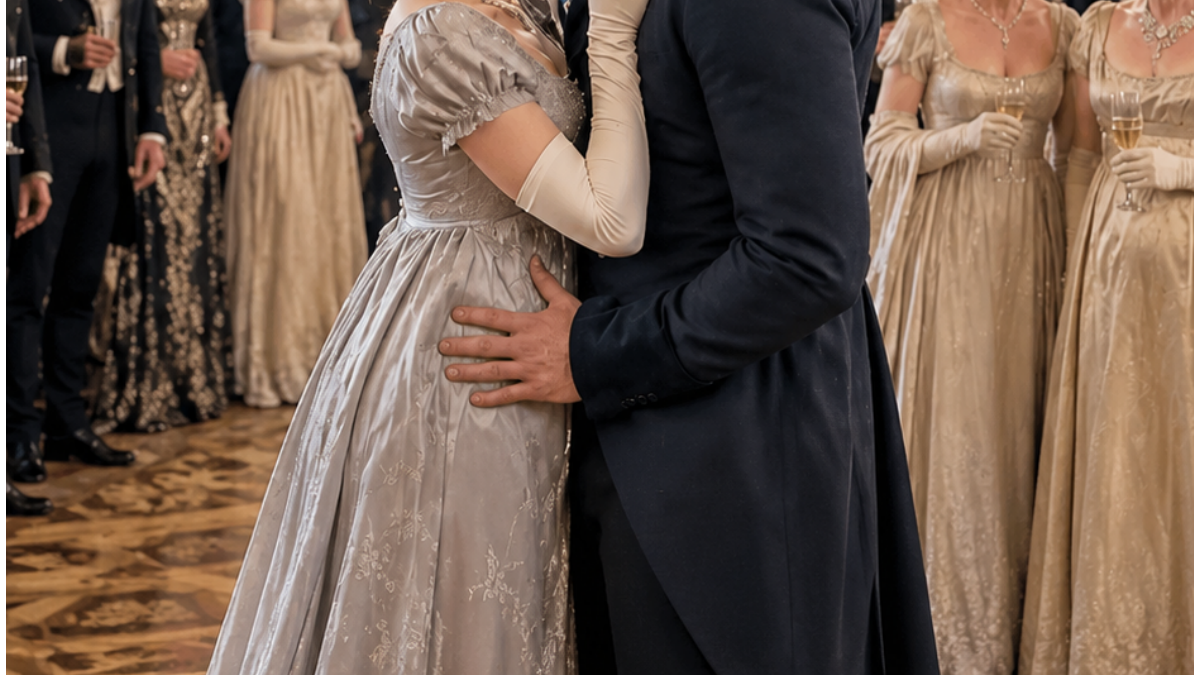
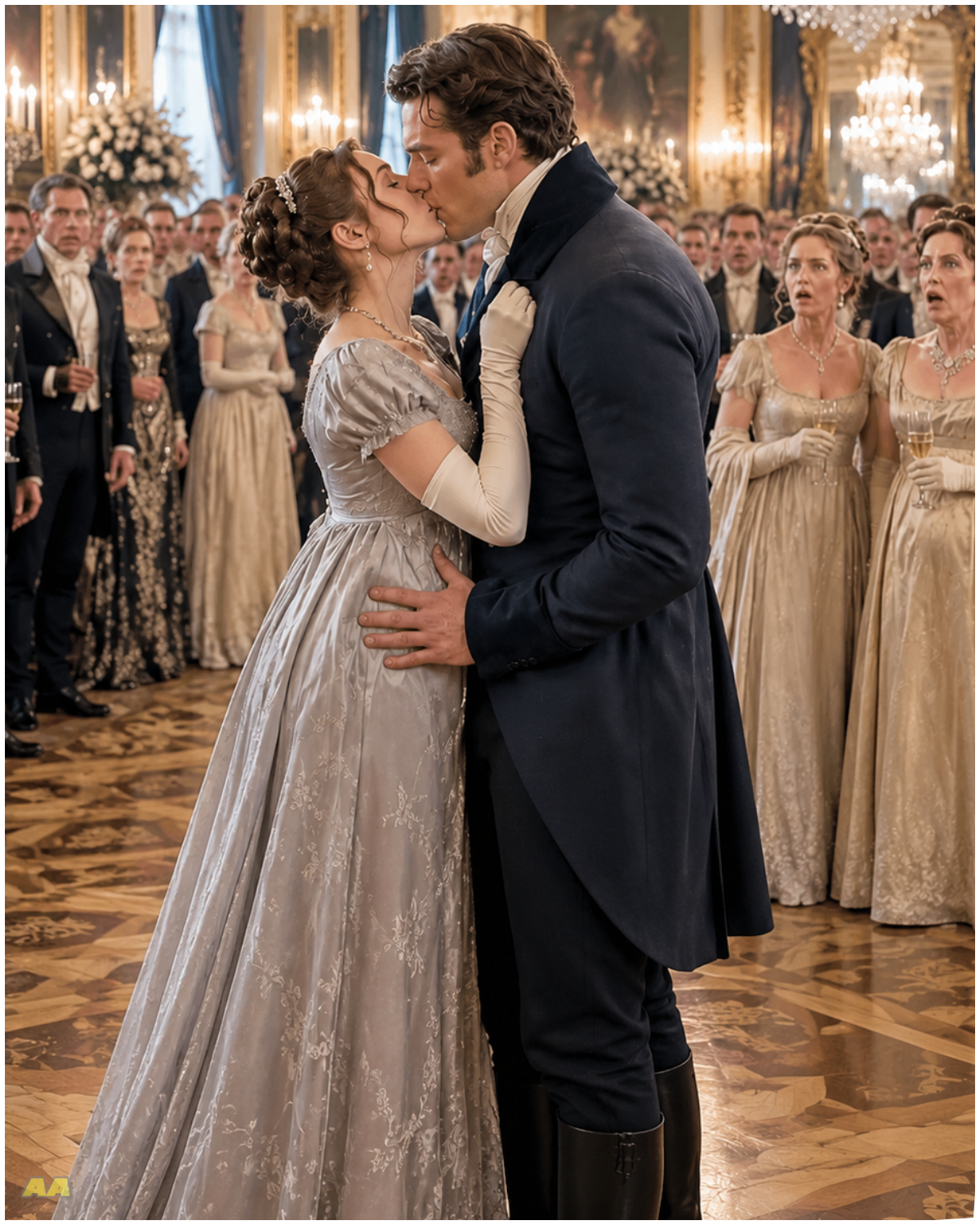
Clara Whitmore grabbed a stranger’s face and kissed him square on the mouth in front of 400 people.
No warning, no introduction.
The music stopped.
Every head in the Hard Grove ballroom turned.
Crystal glasses froze halfway to painted lips.
Someone gasped so hard it sounded like a wound.
The man she kissed went completely still, not pulling away, not pushing her off, just standing there like a man who had been struck by lightning and was still deciding whether he was dead.
And across the room, Victoria Langford’s carefully constructed trap collapsed into silence.
She did not plan it.
That was the thing Clara Witmore would turn over in her mind for weeks afterward.
The fact that she had not planned it, had not rehearsed it, had not walked into the Harrove Ballroom on the night of December the 14th with any intention beyond surviving the evening without embarrassing her cousin Margaret.
She had one goal. One, get through the night without saying anything sharp to anyone who didn’t deserve it.
Eat whatever small food was offered without looking hungry, and get back into the carriage before the cold became unbearable.
She had not planned to ruin herself before 10:00.
And yet, the ballroom was everything Clara was not warm, excessive, glittering with a particular brightness of people who had never once wondered if the candles would run out.
Chandeliers threw gold light across silk and diamonds and carefully arranged hair.
And the music was the kind that cost money just to hear, and every surface was polished to a shine that said, “This is success looks like, and you are standing at its edge.”
Clara knew exactly where she stood.
She had always known. You did not grow up the daughter of Thomas Whitmore, dead at 51, buried in a popper’s corner of St. Augustine’s churchyard under a stone so small you could walk past it three times without finding it, without understanding exactly where the line was drawn and which side of it you lived on.
She was on the wrong side. She had always been on the wrong side.
Tonight she was simply standing inside the right building, which was not the same thing at all.
Hold your chin up, Clara.
Her mother’s voice living permanently in the back of her throat.
Whatever they take, don’t let them see you look down.
She held her chin up. She stood near the tall window with a glass of champagne she wasn’t drinking, and she watched the room the way she always watched rooms carefully.
Without moving much, reading the currents the way her father had taught her to read weather before it arrived.
Her father had been good at reading weather, it hadn’t saved him.
She saw Nathaniel Carter at 11 minutes 9.
She did not know his name yet.
She only knew that he was standing alone at the far end of the room near the door to the east corridor.
And that standing alone at an event like this was either a disaster or a declaration, and everything about this man’s posture said the second thing.
His back was half turned to the room.
His jaw was set. He held a glass he hadn’t touched, and he looked out at the gathered wealth and social ambition of Boston’s finest winter ball.
The way a man looks at whether he didn’t choose and cannot leave.
Clara noticed him the way she noticed things quickly.
Filed away not dwelt upon. He was none of her business.
She noticed Victoria Langford 4 minutes later.
Victoria moved through rooms differently than other women moved through rooMs. She moved like an announcement.
Silk skirts, a laugh that turned heads.
Hair constructed into a tower of dark curls that Clara knew had cost 2 hours.
In someone else’s labor. Beautiful in the way of women who had been taught from birth that beauty was a weapon and had spent their whole lives sharpening it.
Margaret had told her in the carriage on the way over.
Voice low and gossip right. She’s been hunting Nathaniel Carter for two full seasons.
His lawyer stopped accepting her calls in October.
Clara had filed that away, too. Other people’s hunts were other people’s business.
But then she watched Victoria move through the room and something in Clara’s chest pulled tight.
It was the path, the specific deliberate geometry of it, Victoria stopped at three separate groups on the way across the floor touching a sleeve here.
Laughing at something there, turning to speak over her shoulder, not because she wanted to talk to any of them, but because she was being seen, building witnesses, laying groundwork the way a lawyer lays groundwork before the verdict is already decided.
Clara had seen that geometry before. She had seen it in the land agent who came to her father’s shop with a contract full of language Thomas Whitmore couldn’t parse.
She had seen it in the lawyer outside the courthouse who said there’s nothing to be done, Mrs. Whitmore.
Nothing at all and meant nothing that will help you.
She set down her champagne glass. Victoria reached Nathaniel Carter at the window.
He didn’t turn. His shoulders tightened slightly, the only acknowledgement.
And when Victoria placed a hand on his arm, he turned and said something short.
Clara was too far to hear the words, but she could read the shape of them.
Flat final, the particular brevity of a man who had said this before and was tired of saying it.
Victoria stepped back and smiled. It was not a defeated smile.
It was not a hurt smile or an embarrassed smile or any of the smiles a woman wears when she has been turned away.
It was the smile of someone who had just arrived at the moment they had been building toward patient.
Satisfied and already passed the point of return.
“Oh no,” Clara thought. Victoria’s hand went to her mouth, her eyes went wide, and she said clearly, carrying across the nearest 15 ft of polished floor with the precision of a woman who had practiced the exact volume.
Mister Carter, how heads turned? Not all of them.
Enough. The music did not stop, but the room shifted that particular social shift where conversation quits by half a degree and everyone pretends they aren’t listening while listening absolutely and Victoria’s hand was at her chest now and two women nearby position.
Clara, now understood, deliberately positioned, moved in closer, and a man in a gray coat, who had to be Victoria’s brother, began crossing the room with the unhurried certainty of someone who knew exactly what he was walking toward.
Nathaniel Carter stood completely still. His expression had done something.
Clara recognized it had gone flat and controlled and empty.
The face of a man who understood the trap had closed, and was now calculating whether any exit remained.
And arriving at the answer that none did.
That the geometry of witnesses and positioning and a woman’s tears was airtight in a way that the truth could not penetrate because truth was not the point.
Power was the point. And power was standing on the other side of this room and was already winning.
Clara knew that face. She had watched her father wear it.
She had watched him stand in a room full of people who had already voted and hold his hat in both hands and say yes.
Sir, I understand. And come home and sit at the kitchen table and eat his supper without tasting it.
And she had watched that moment hollow him out slowly over years until there was not enough of him left.
Thomas Whitmore had died 3 years after that room.
The doctor said his heart. Clara knew better.
Some things kill you slowly. Some things kill you in a single room on a single evening.
And the body just hasn’t gotten the news yet.
She was already moving. She did not decide.
The decision happened below the level of thought in the part of her that had stood at that too small headstone in the cold and made a promise to no one in particular.
In no formal language, just a thing that settled into her bones and stayed there.
Not again. Not while I’m standing here.
The room did not part for her.
She was nobody. She was Margaret’s poor cousin in a three-year-old dress, but something in the directness of her movement made people step aside without knowing why.
And she came through the edge of the small gathering circle, and she walked straight up to Nathaniel Carter, and she put her hand flat against his cheSt. He looked down at her, dark eyes, sharp, asking a question she had no time to answer.
She said, “Only for him, only inches away.
I’m sorry. I need you to trust me for 10 seconds.” and she kissed him.
Not soft, not tentative, not the hesitant brush of a woman uncertain of her welcome.
She kissed him like a woman making a statement, hand flat on his chest, eyes shut, the whole terrible weight of the room pressing against her back, her heart making so much noise, she was certain he could feel it through his coat.
3 seconds 4 5 She stepped back.
The room had gone silent the way rooms go silent when something irreversible has happened.
Not the quiet of surprise, the quiet that comes after surprise.
When everyone is absorbing what they have just witnessed and understanding that the story of this evening has been permanently altered.
Clara’s knees were not entirely reliable. She kept her hand on Nathaniel’s lapel because she needed to, and she looked at his face and tried to read what was there.
He was staring at her. His expression had traveled somewhere she could not map.
Across the circle, Victoria Langford had gone the color of old ash.
Her carefully assembled witnesses were looking between Clara and Nathaniel with expressions that had forgotten what they had been arranged to convey.
Clara did not look at Victoria. She kept her eyes on Nathaniel, and she kept her voice steady, and she said loud enough, exactly loud enough, forgive me for keeping you waiting.
I was held up at the door.
One breath of silence, then a murmur low, fast, moving through the room like fire through dry timber.
And Clara felt it shift. Felt the weight of the room tilt.
Not completely, not finally. But enough, Victoria said.
Tight, controlled, dangerous. I don’t believe we’ve been introduced.
Clara turned then and she looked at Victoria directly and she did not drop her gaze.
No, she said we haven’t. It was not enough.
She knew it wasn’t enough. One kiss and a claimed familiarity would not hold against Victoria’s connections and her brother’s deliberate approach and the two witnesses who were already looking at Clara with the flat attention of women who had scented blood and were adjusting their aim.
And then Nathaniel Carter’s hand covered hers warm, firm, certain.
He tucked her hand into the crook of his arm the way a man tucks in the arm of a woman he is publicly claiming.
And he turned to face the room all of it.
The witnesses and the brother in Victoria and every curious face angled toward the disturbance and he said with the complete and absolute calm of a man who had decided something and was finished deciding, “I apologize for the scene.
Miss Whitmore and I have not had the opportunity to make formal introductions to many of you yet.
I intend to correct that.” Victoria’s brother stopped walking.
Victoria herself stood motionless, her smile frozen in a shape that was no longer a smile and had not yet decided what it was going to become instead.
And Nathaniel, whom Clara had kissed without warning or introduction, whose lapel she was still gripping with fingers, she could not entirely steady, turned slightly toward her and said so quietly it was nearly breath.
“Thank you,” Clara said nothing. She was busy understanding that she had just set her own life on fire.
She would spend considerable time afterward deciding whether that had been a mistake.
He guided her out of the center of it, a hand at her elbow, a subtle redirection, and when they had reached a clear stretch of wall near the library corridor, he stopped and looked at her with a particular >> of a man reassessing everything, he thought he knew about the last four minutes.
“You don’t know who I am,” he said, not a question.
No, I know your name because you just said it.
Something moved through his face. Why did you do that?
Clara looked at him steadily. She was still shaking hands underneath the careful stillness she was maintaining.
And she was aware that her reputation was currently burning somewhere in the middle of that ballroom.
And she was aware that she had done this to herself.
And underneath all of that awareness was a simpler thing.
I know that smile, she said. The one that woman was wearing.
I’ve seen it before. I know what comes after it.
Nathaniel studied her. And your response was my response was to make it stop.
She kept her voice even. I wasn’t thinking about appropriate.
I was thinking about what was happening to you and the fact that it wasn’t fair.
Silence. I knew. She blinked. I’m sorry.
I knew what she was doing. I was watching her build it for 20 minutes.
He looked away briefly. I simply hadn’t found an exit that worked.
Then I was unnecessary. No flat. Immediate.
You were faster than anything I had.
The music had started again somewhere behind them.
And the party was reassembling itself around the disturbance the way parties did.
The way water closed over a stone.
And they stood in the relative quiet of the corridor and looked at each other like two people who have just survived something together and are not yet sure what to do with that.
I should find my cousin. Clara said yes.
A pause. Miss Whitmore. She had already turned.
She turned back. What you did tonight will cost you.
He said it without softening it. Considerably.
I know you had nothing to gain.
No. He looked at her for a long moment.
Something in his expression shifted. Not warming.
Exactly, but a degree. Half a degree.
The way a window opens in a house that has been shut a long time.
Why? Clara held his gaze. Because I’ve watched what happens when someone doesn’t.
Her voice was steady and her chin was up and her hands had finally stopped shaking.
I wasn’t willing to watch it again.
She found Margaret near the fireplace. White knuckled around her champagne glass and said simply, “I’d like to leave now, please.” And Margaret, who had seen the whole thing from across the room, said, “Yes, God.
Yes, Clara, right now in the carriage going home through streets that smelled of cold smoke and winter.” Margaret finally spoke.
Do you have any idea who that man is?
Nathaniel Carter, Clara said. He said his name.
He Margaret pressed her gloved hands together.
He owns the Carter Valley Railroad. He owns land in three counties.
He is, by almost anyone’s calculation, one of the most powerful men on the eastern seabboard.
Clara looked out the dark window. That’s not why I did it, she said quietly.
Margaret’s voice went soft. I know. That’s what worries me moSt. The morning came in cold and certain.
Clara was already awake when it arrived.
Had been awake for most of the night.
Lying in the narrow bed in the room she shared with cold air and her mother’s quiet worry.
Staring at the ceiling and making herself inventory every consequence clearly without flinching the way her father had taught her to face things she couldn’t change.
Look at it straight. He used to say looking away don’t make it smaller just means it gets to surprise you.
She looked at it straight. Her reputation, what careful thread, then reputation she had maintained, was gone.
The women in that ballroom had seen her kiss a man she had no business kissing.
In front of witnesses without explanation, the story would move through Boston social circles like a lit fuse.
And by the time it arrived anywhere, it would have accumulated details she hadn’t provided.
That was how these things worked. She knew how they worked.
The first message came before breakfaSt. Mrs. Hargrove, her handwriting precise and bloodless.
We feel it best that future invitations be extended to Miss Margaret Alcott alone.
We trust you understand the necessity. The second came from one of Margaret’s friends, shorter, less formal, and containing the word brazen twice.
The third was a silence, the sewing circle that had taken two years to build.
The small network of women who passed work between them when it was there to pass.
The fragile web of practical connection that kept the coal in and the rent paid gone quiet in a single morning.
The way a pond goes quiet when something large moves through it.
Clara sat at the kitchen table and read each one carefully and then set them face down in a stack and looked at the wall.
Her mother came in and saw the stack and sat down across from her and wrapped both hands around a cup of tea that wasn’t warm anymore.
“How bad?” her mother asked. “Bad,” Clara said.
“The work connections are the worst of it.” “The sewing circle?” “Yes,” her mother was quiet.
Her hands tightened on the cup, and her face did the thing it did when she was frightened and was refusing to show it a particular stillness.
A steadying, the expression of a woman who had already survived the worst thing that could happen to her and had discovered that survival was less comfort than people said it would be.
“Your father,” she started. “I know, mama.
He would have said, I know what he would have said.” Clara kept her voice gentle.
He would have said I was right.
And he would have said it didn’t matter.
Her mother looked at hers across the small table in the small kitchen in the cold house that was theirs only because they had fought for it in every quiet exhausting way available to them.
And she said, “Was it worth it?” Clara thought about Victoria Langford’s smile.
She thought about Nathaniel Carter’s face doing that thing going flat and controlled and empty.
And she thought about her father sitting at a kitchen table very much like this one and eating supper without tasting it.
Yes, she said. Her mother looked at her for a long moment.
Then she stood and took her cold cup to the window and stood there looking out at the gray December morning.
And she said very quietly, “And not to Clara, not quite more to the window or the sky or to Thomas Whitmore.” Wherever he had gone, “God help her.
She’s exactly like him.” The knock at the front door came at 10.
Clara heard her mother answer it. She heard the brief exchange of voices her mother’s uncertain and rising and then footsteps and her mother appeared in the kitchen doorway with an expression Claraara had never seen on her face.
A complicated layered thing partway between alarm and something that might have been awe.
Clara, she said carefully, there is a Mr.
Nathaniel Carter at the front door. He’s asking to speak with you.
Clara set down her cup. She was aware that her dress was old.
She was aware that her hair was not properly done.
And the kitchen smelled of weak tea and cold smoke and the specific damp cold of a house that couldn’t afford to be warmer.
She was aware that there was nothing about this moment or this setting that matched the ballroom of last night.
She stood up. She walked to the front door.
Nathaniel Carter stood on her step. Not a servant, not a messenger.
Him in a coat that cost more than she and her mother spent in a quarter year.
His hat in his hands, hat in his hands.
She noticed it, filed it, and he looked at her with those dark, unreadable eyes, and he said without greeting, without preamble, without any of the social formality the situation nominally required.
I have a proposal. I’d like 5 minutes to explain it.
Clara looked at him standing on her with his hat in his hands and the cold December air between them.
The parlor’s cold, she said. I don’t mind cold.
She stepped back from the door. Then come in.
He sat in her parlor, the one her mother had kept through every difficulty, through the loss of her husband and the loss of their savings and the slow grinding process of making something from almost nothing.
And he sat in it with the absolute stillness of a man who chose every word before he released it.
Clara sat across from him and waited.
She had learned patience from years of not having enough of anything else.
What happened last night will follow you?
He said, “Yes, specifically your connections, the network of work you’ve built.
It’s already gone or it will be by the end of the week.” Clara kept her face still.
You’ve heard already. I have people who listen.
Brief. I want to make it right.
You can’t make it right. She said, “Social damage is permanent, Mr.
Carter. You know that better than moSt. It can’t be undone.” He said, “But it can be replaced with something more durable.” He held her gaze with the directness of a man who did not soften things as a policy.
I’m proposing a marriage. The word dropped into the cold parlor and sat there between them.
Clara did not blink. A legal contract.
You would be protected financially, socially, completely.
Your mother would be provided for. Last night’s damage would be reframed entirely, not a scandal, but a courtship that had not yet been made public.
A pause. I understand that framing would be false.
I’m not asking you to believe it.
I’m asking you to let it be useful.
And what do you get? Clara asked.
He was quiet for 3 seconds. For margin, he said finally.
Margin, I am a wealthy man. That makes me a target in a way that has become exhausting.
He looked at his hands briefly. Then back at her, an unmarried man of means is an open door.
Every Victoria Langford in a three-state radius knows the door is open.
I want it closed. Clara studied him.
You want to shield. I want peace.
He said it without apology. There’s a difference, is there?
What I want, he said slowly, as though the words were being located one at a time, is to stop being approached by people who see only the money.
Last night, you saw something else. I don’t know what.
I don’t know you, but you saw a man in a bad situation and you moved.
Not for gain, not for advantage. He stopped.
I can’t explain why that matters to me more than it probably should.
Clara was silent. I have conditions, she said.
I expected you would. I am not an ornament.
I manage my own time, my own work, my own opinions.
Those remain mine. Agreed. I will not by directed in what I wear or say or who I speak to.
Agreed. If this arrangement becomes something I cannot live in, I will say so and we will find a different arrangement.
That is not a negotiation. That is the term.
Something moved across his face. Not irritation, not surprise, recognition.
The specific look of a man who has heard demands before and is registering that this one is different in kind.
Understood, he said. Clara looked at him across the parlor.
This man she didn’t know. This arrangement she hadn’t chosen and couldn’t entirely walk away from this strange morning that had arrived out of the wreckage of her own doing.
“All right,” she said. He stood, put his hat on, moved toward the door.
“Stop. I should tell you, he said, not turning all the way around.
That I won’t be easy to live with.
I have kept people at specific distance for a long time.
I don’t expect that changes quickly. Clara looked at the back of his coat.
Mr. Carter, she said, I grew up not knowing from one month to the next whether we’d have coal enough to last the winter.
I have spent my entire adult life managing things that were difficult and didn’t ask my permission firSt. He turned just enough to see her face.
I think she said that I can manage you a long moment.
Yes, he said quietly and it came out like something he hadn’t entirely planned to say.
Something that surprised even him. I think you probably can.
The door closed behind him. Clara stood in the cold parlor and listened to his footsteps on the front path and the sound of a carriage and then silence.
And she stood in that silence for a long time.
Then she pressed both hands flat against her sternum the way her mother did when something had happened that required a moment to absorb and she breathed in once slowly.
“All right,” she told herself. “All right, then.” Somewhere in the house, she heard her mother moving careful footsteps, the sound of someone waiting.
Clara straightened her spine, lifted her chin.
She went to find her. The wedding took place on a Thursday.
Not a Saturday, not a Sunday, not any day that carried the weight of ceremony or the expectation of celebration.
A Thursday in the office of a civil magistrate on Peton Square with Margaret as witness and Nathaniel’s lawyer a compact watchful man named Aldrich who smelled of pipe tobacco and said very little standing beside him.
Clara wore her second best dress because her best dress had a torn hem she hadn’t repaired yet.
And she had decided at 6:00 that morning that she was not going to repair it for this.
That if she was going to do this thing, she was going to do it as herself without performance, without pretending the morning was something it wasn’t.
Nathaniel wore black as he apparently always did.
He looked at her when she walked in and said quietly, “Not unkindly,” Clara said.
“Thank you.” And then, “Because she could not help herself, you look like a man attending his own execution.” Something shifted in his face.
“Not quite a smile. The ghost of one, maybe the place where a smile might have lived if it had been invited more often.
I’ve attended less comfortable things,” he said.
“That is either reassuring or deeply concerning,” Clara said.
I haven’t decided which. Aldrich cleared his throat.
They signed the papers. That was how Clara Whitmore became Clara Carter.
Not with music or flowers or the kind of ceremony her mother had quietly always hoped for, but with ink on a Thursday morning in a room that smelled of old paper and legal obligation.
While Margaret cried silently into a handkerchief, and Aldrich checked his pocket watch twice.
Her mother had not come. Clara had asked her to stay home.
And her mother had looked at her with the expression she wore when she was choosing not to say what she was thinking and had said, “All right, Clara,” and had squeezed her hand once hard and let her go.
On the carriage ride from Peton Square to Nathaniel Carter’s house on Beacon Hill, they did not speak for four blocks.
Then ClariS said, “I’d like to understand the household.” What staff schedules?
Who manages the accounts? A pause. Why?
Because I’ll be living in it. Clara said evenly.
“And I don’t like living in things I don’t understand.” Nathaniel looked at her with that particular expression.
And she was beginning to recognize the one that was not quite surprise, but was something adjacent to it.
Something in the territory of a man being shown a door he hadn’t noticed before.
Aldrich manages the household accounts. Mrs. Beal manages the staff.
There are 11 people on permanent payroll and four-day hires.
And who manages Aldrich? I do. And who checks your work?
The carriage went quiet again. No one, Nathaniel said.
That Clara said is going to change.
The house on Beacon Hill was large in the way that houses are when they are built to communicate something wealth.
Certainly, but also permanence. The specific message of a man who intends to stay.
Clara walked through the front door on the arm of her new husband and felt the weight of 11 pairs of eyes absorbing her, reading her dress and her posture and the careful way she held herself.
All of them doing the same calculation the ballroom had done three nights ago.
Who is she and does she belong here?
Mrs. Beal was a woman of 60some, iron spined and professionally unreadable with the expression of someone who had managed this household through considerable difficulty and was reserving judgment on whether this particular development constituted an improvement.
She curtsied precisely correctly without warmth. Clara looked at her directly and said, “I’d like to sit down with you this afternoon.
Mrs. Beal, I want to understand how things run.
I have no intention of changing what works.
Mrs. Beiel’s expression shifted a fraction. Of course, ma’am, and please call me pause.
That would be irregular, ma’am. I suspect a number of things about me will be irregular, Clara said.
We’ll manage. From 3 ft away, she heard Nathaniel make a sound that was not quite a cough.
By the end of the first week, Clara understood three things with clarity.
The first was that the house ran well on the surface and was quietly bleeding money underneath it.
Not dramatically, not the kind of bleeding that showed up immediately in ledgers, but the slow, steady kind.
Invoices paid twice supply orders that didn’t match delivery records, small discrepancies in amounts that were individually meaningless and collectively significant.
The second was that nobody wanted her to notice.
The third was that nobody had expected her to be looking.
She found the first anomaly on the fourth day, going through the household records with Mrs. Beal, who had produced them with the asserty of a woman who had nothing to hide, and the slightly too composed expression of a woman who was wondering exactly how much this new wife actually understood about accounting.
Clara understood quite a lot about accounting.
She had kept her mother’s books since she was 16.
When you lived close to the edge, numbers mattered in a way they did not.
When money was abstract, every figure had a consequence.
Every discrepancy had a name attached to it.
She ran her finger down a column of supply invoices and stopped.
This delivery, she said. November the 3rd, $42 for kitchen stores, Mrs. Beal looked at the page.
Yes, ma’am. And this one. November the 3rd again.
Same supplier, $28. Seasonal variation in pricing.
They’re the same items, Clara said. The same list, line for line, paid twice.
Silence. That may be an error in recordkeeping, Mrs. Beal said carefully.
It may be, Clara agreed. She kept her voice entirely pleasant.
Pull the last 6 months, please. All of them, Mrs. Beal pulled the last 6 months.
By the time Clara was finished, she had found 11 duplicate payments, three phantom deliveries, and a service contract with a plumbing firm that no one in the household could specifically recall hiring.
She did not go to Nathaniel that evening with the findings.
She sat with them for a day, turning them over, making sure she was right, making sure she had not made the error of seeing what she was looking for rather than what was there.
She had learned that from her father, too.
Check your own work twice before you accuse anyone else of not doing theirs.
She was right. She went to Nathaniel on the second evening.
He was in his study when she knocked a room that smelled of leather and old work, maps on the walls, the particular organized disorder of a man who thought in three directions simultaneously.
He looked up when she came in and she could see the reflex in him.
The slight bracing, the instinct to manage whatever was arriving.
I found something, she said. She set the ledger pages on his desk, the relevant ones, organized, annotated in her own hand.
I need you to look at these.
He looked at them. He was quiet for a long time.
Aldrich manages these accounts, he said. Finally.
His voice had gone careful, not angry.
Careful which Clara was learning was something different.
Yes, she said. He does another silence.
How long have you been going through the household records?
Since Wednesday, Clara, he stopped. She watched him stop, watched him take whatever he had been about to say and redirect it.
The way water redirects around Stone, this is 11 duplicate payments, she said.
Three phantom deliveries, a service contract no one can account for.
That’s what I’ve found in the household accounts alone.
I haven’t touched the business ledgers. The word yet sat between them.
Unsaid, Nathaniel looked at the pages. Then he looked at her.
Something in his face had moved to a place she hadn’t seen before.
Not anger. Not gratitude exactly, but something that was working through both and arriving somewhere more complicated.
Why didn’t you come to me when you found the first one?
He asked. Because one anomaly is an error, Clara said.
11 is a pattern. I needed to be certain before I brought it to you.
A long moment. Most people, Nathaniel said slowly, would have brought me the first one.
Made sure I knew immediately that they’d found something.
Made themselves useful as quickly as possible.
Most people would be trying to impress you, Clara said.
I’m trying to help you. There’s a difference.
He looked at her for what felt like a long time.
Then he looked back at the ledger pages.
I’ll speak to Aldrich tomorrow, he said.
Tonight, Clara said, “Speak to him tonight.
If he knows you’re looking, things will disappear.” Another redirect.
Another moment of Nathaniel Carter receiving information that surprised him and choosing what to do with it.
He stood. He picked up the annotated pages.
“Tonight,” he said. Yes, Aldrich was let go before the week was out.
Clara was not in the room when it happened.
She had not asked to be. She had given Nathaniel what she found and she had let him handle it because there was a difference between helping a man and managing him and she was still learning where that line was.
What she did not expect was the visit from Edward Whitmore.
Her father’s younger brother, her uncle, technically though she had not seen him in four years since the funeral since he had stood at the graveside in a coat that fit badly and a face that couldn’t quite arrange itself into the right expression and had shaken her hand and said, “If there’s anything you need, Clara anything at all and had meant nothing by it.” Which they had both understood.
He arrived on a Tuesday afternoon unannounced.
He stood in the Carter parlor with his hat in his hands and looked around at the room with an expression that moved through several things before settling on something he was trying to make look like warmth.
Clara, he said, “You’re looking well. This place is quite something, isn’t it?” Uncle Edclair said, “Sit down.” He sat.
He spent three minutes talking about his wife, his eldest son, who was doing well in commerce.
The cold weather, the state of the city, Clara waited.
I heard about the marriage, he said finally.
Quite sudden. Yes. And this Carter, he’s the railroad man.
He is remarkable. Edward turned his hat around in his hands.
Your father would have been well. He would have had thoughts.
My father Clara said evenly would have asked if I was all right, not whether the man was wealthy.
A pause. Of course. And are you all right?
I am good. Good. He looked at the hat back.
The thing is, Clara, the reason I’ve come, there’s a matter of the business.
Your father’s business. There are some debts that have come to light.
Some obligations that weren’t fully settled when he passed.
And with your mother’s situation being what it is, how much?
Clara said. He blinked. I’m sorry. How much do you need, Uncle Edward?
The hat went still in his hands.
He looked at her, really looked at her for the first time since he’d walked through the door.
“$300,” he said. “There’s a creditor who’s been very patient, but has indicated that I’ll need to see the diamondation.” Clara said the original debt records, the creditor’s name, correspondence, all of it.
Clara, surely you don’t think. I don’t think anything yet.
She said. I won’t think anything until I see the documentation.
Bring it by the end of the week and I’ll look at it.
She stood. Thank you for coming, Uncle Edward.
He left. Clara stood in the parlor afterward and thought about her father about his shop.
About the years after, about the careful way her mother had never said one bad word about Edward Whitmore, even when there were bad words to say.
She thought about documentation and about patterns and about the way people came through doors when they saw money on the other side.
The documentation, when Edward brought it 4 days later, did not hold up to examination.
The debt existed. The amount was inflated by a factor of three.
The creditor was a man who turned out upon inquiry to be Edward’s wife’s cousin.
Clara wrote Edward a check for the actual amount of the actual debt and included a note.
I hope this settles the matter. Please do not come back without calling firSt. She did not tell Nathaniel.
It was her family’s business. She handled it.
But Nathaniel found out anyway because as she was learning, Nathaniel Carter had people who heard things.
And apparently those people heard everything. He came to find her in the library that evening she had taken to spending evenings in the library because it had the best light and the most books and nobody bothered her there, which was becoming her primary criterion for comfort.
He stood in the doorway and looked at her for a moment before he spoke.
Your uncle came to see you, he said.
Yes. And you handled it. Yes. Without asking.
It was my family’s business. Clara said, not looking up from her page.
A pause. She heard him come into the room.
Not sitting, just standing somewhere near the fireplace.
He asked you for money. He asked me for an inflated amount based on a manufactured debt.
I paid the real amount and sent him home.
Now she looked up. Is this a conversation about trust or a conversation about money?
Neither, Nathaniel said. I’m trying to understand you, Clara held his gaze.
That’s going to take longer than 2 weeks, she said.
He looked at her for a long moment.
Yes, he said. I’m beginning to see that he left.
Clara went back to her book. But she sat with the words for a long time after the page had stopped making sense.
I’m trying to understand you. Not I’m watching you.
Not I’m measuring you. Trying to understand.
There was something in the specific word trying that she filed away without quite knowing why.
The first social event came at the end of the third week.
A dinner at the Caldwell House. 12 guests formal.
The kind of event where everything was a test and everyone knew it and no one acknowledged it.
Clara had been to events like this before.
On the outside of them, watching through the glass.
She had never been expected to perform in one.
She dressed carefully, not expensively. She did not yet have expensive things, and she had declined Nathaniel’s offer of an account at the dress makers, until she had more fully decided what she thought of accepting things from him.
But well, she had an eye for what worked and what didn’t, and she used it.
Nathaniel came to find her before they left and looked at her for a moment and said, “You’re going to be looked at tonight.
I know they’ll be unkind.” Possibly to your face.
“Certainly behind your back, mister Carter.” Clara said, “I have been poor in Spolston my entire I am very familiar with unkind.” He was quiet for a moment.
“Nathaniel,” he she blinked. “I’m sorry. We’re married.” He said it would be strange given that if you called me Mr.
Carter, a small pause, something in the air between them shifted not dramatically.
Not with any ceremony, just the small precise shift of something moving into a different position.
He nodded. Ready? No, she said honestly.
But let’s go anyway. The Caldwell dinner was everything Nathaniel had warned her it would be.
Mrs. Caldwell, a woman with the smile of someone who had spent 40 years perfecting social evisceration as an art form, welcomed Clara with exactly the warmth of a woman who had been told she must and had decided to do only what she must and not one degree more.
“What an interesting evening this is,” she said, which meant nothing and everything simultaneously.
“CL smiled.” “It is,” she agreed. At the table, she was placed between a railroad attorney named Fitch, who talked exclusively about himself, and a woman named Mrs. Prior, who had the particular energy of someone positioned to gather intelligence.
Clara ate her soup and answered questions with information.
She didn’t mind giving and deflected the rest so smoothly that Mrs. Prior, she suspected, did not entirely notice she had been deflected.
You must find this quite different, Mrs. Prior said.
Somewhere between the fish course and the meat from your previous circumstances.
Different. Clara agreed. Yes. The Carter household is quite grand it is.
And Carter Nathaniel he’s quite a pause full of implication.
Particular said so we manage from across the table.
She caught Nathaniel watching her. He looked away immediately, but not before she saw the expression that same almost not quite something.
The door opened a degree. The test came after dinner.
In the way tests always came at these things in the drawing room.
Women arranged in clusters, the conversation deceptively light and carefully aimed.
Victoria Langford was there. Clara had not known she would be.
She should have anticipated it. Of course she would be.
Of course this was the terrain Victoria would choose.
But she hadn’t. And when she turned from the fireplace and found Victoria 3 ft away.
She had exactly one second to arrange her face before it was too late.
She arranged it. Mrs. Carter, Victoria said with a smile that was not a smile.
How lovely, Miss Langford. Clara said, how are you?
A pause that was not a pause.
You’ve settled in quickly, I hear. To the house.
I’m a quick study, Clara said. I imagine you’d have to be.
Victoria’s voice was warm and light, and every syllable was a blade.
It must be quite the adjustment from your previous life to all of this.
Every life is an adjustment, Clara said.
Some require more imagination than others. A flicker in Victoria’s eyes.
Nathaniel is a complicated man, she said lower now, moving the conversation into the register of womanto-woman confidence.
As though they were allies, as though they had something in common.
He’s not easy. I imagine someone from your background finds that challenging.
Someone from my background, Clara said. Still pleasantly, still smiling.
Grew up managing things that were genuinely difficult.
Not complicated difficult. There’s a difference. She tilted her head slightly.
I find Mr. Carter entirely manageable. The flicker again.
Longer this time. How nice for you, Victoria said.
Isn’t it? Clara agreed and turned to speak to the woman on her other side.
Her hands underneath the pleasant smile and the steady voice were shaking.
Not from fear, from the sustained effort of not saying everything she actually wanted to say, which would have been accurate.
And satisfying and deeply unwise. She felt Nathaniel’s presence before she heard him a shift in the room, heads turning and then his hand at her elbow, warm and certain the way it had been in the ballroom.
And he said something general and social to the cluster of women and guided her gently toward the door to the corridor.
In the corridor, he let go of her elbow and stood beside her for a moment.
Both of them looking at nothing in particular.
“You all right?” he said. Fine. Victoria handled it.
I know. I was watching. You were.
He stopped. Clare looked at him. I was what?
Something in his face was doing that thing again.
The door. The degree the half-measured opening.
Impressive, he said. The word came out like something he hadn’t planned to release.
You were impressive. Clara looked at him for a moment.
I was terrified, she said. I know, he said quietly.
That’s what made it impressive. They stood in the corridor for another moment.
This man she had married on a Thursday and was slowly carefully learning this arrangement that had started as a shield and was becoming whether either of them had planned for it or not, something else, something that did not yet have a name, something that was putting down small, careful roots in the space between what was said and what wasn’t.
Then Clara straightened her spine the way she always did.
We should go back in, she said.
Nathaniel said they went back in. The letter arrived on a Friday morning.
3 weeks after the Caldwell dinner. It came addressed to Nathaniel, but Clara was at the desk when the post arrived and she saw the return address a law firm in Philadelphia.
Havford and Associates. And something in her stomach went quiet and still.
The way it went quiet and still when she saw something that mattered before she fully understood why it mattered.
She set it on Nathaniel’s desk and thought nothing more of it until that evening.
When she heard him in his study with the door closed, which he rarely did, and heard voices, and a second one she didn’t recognize.
Low and urgent, she did not put her ear to the door.
She walked past it and went to the library and picked up a book she didn’t read.
An hour later, Nathaniel found her. He came in and stood by the fireplace, and she could see it immediately something had happened.
Something that had shifted the careful, controlled surface of him, something that had gotten through whatever he had built around himself and was sitting inside it now.
“What’s wrong?” she said. He looked at her.
Then he sat down across from her, not beside her.
The careful distance he always kept and he said, “There’s a situation with the railroad.” What kind of situation?
Three of my senior managers men I have trusted for years have been diverting company funds.
He said it flatly. The way he said everything hard, not household account money, operating capital, significant amounts.
Clara was quiet for a moment. How long?
Two years, possibly three. How much? He told her.
She did not let her face show what the number did to her.
Not because she was hiding it from him, but because this was not the moment for her reaction.
This was his and it needed space.
The lawyer in Philadelphia. She said he was hired to investigate quietly.
A pause. The report is not good.
Who are the managers? He named three men.
Clara had met one of them, a tall, cordial man named Greer, who had come to the house for dinner in the second week, who had shaken her hand and said, “Lovely to meet you, Mrs. Carter,” and had spent the evening being extremely charming.
She thought about that now. “Do they know the investigation is complete?” she said.
“Not yet. Then you have time.” She leaned forward slightly.
“The documentation from the Philadelphia lawyer, how complete is it?
He says it will hold in court.
Have you spoken to your own lawyer?
Not yet. Tonight was stopped. It’s a great deal to receive in one evening.
Yes, she said. It is. She looked at him sitting in the chair across from her.
This man who had built an empire and a wall around himself in equal measure.
This man who had told her he did not trust easily and had then she was beginning to realize begun trusting her anyway.
In the small, careful, incremental way of someone who did not do it quickly or without coSt. He looked for the first time since she had known him.
Tired, not physically, something deeper. The tiredness of a man who had built something and found that the building had been used against him.
Nathaniel, she said. He looked at her.
You found it before they were finished.
She said that matters. Whatever they’ve taken, you know about it.
You have documentation. You have doesn’t. It doesn’t fix it.
She said, “I know, but it means you’re not behind them anymore.
You’re even.” And with good legal counsel and the documentation.
A long pause. Something in him settled.
Not fully. Not completely, but a degree.
The way a sail settles when the wind shifts.
How? He said slowly. Are you always so certain?
I’m not, Clara said. I’m just good at sounding certain when I need to be.
He looked at her for a long moment.
And then, for the first time, the very first time, since the cold parlor on that December morning, Nathaniel Carter almost smiled.
“Not quite the ghost of it. The shape of what it might be.” “If it arrived, “Yes, thank you,” she looked at him.
“You’re welcome,” she said simply. Outside the library windows, Boston was cold and dark and full of people who had already decided who Clara Carter was and what she was worth and what she had married into and why.
She had heard the stories coming back through Margaret through the careful intelligence of women who reported these things because they could not help themselves.
Married up lucky girl. Wonder how long it lasts.
Wonder what she promised him. She had listened to all of it and she had set it down and she had gone back to the ledgers because here in this room, in this house, something real was happening.
Something that did not have a name yet.
Something she had not planned for and could not entirely account for and was not sure what to do with.
Something that felt for the first time in a very long time, like it might be worth the coSt. The hearing was set for the 14th of February.
Clara learned this not from Nathaniel, but from Aldrich’s replacement, a younger lawyer named Croft, who had the nervous energy of a man trying very hard to prove he was not his predecessor, who came to the house on a Monday morning with a leather satchel full of papers and the expression of someone delivering news he wasn’t sure how to deliver.
She was in the study when he arrived.
Nathaniel had not yet come down. Croft looked at her sitting behind the desk with the railroad ledgers open in front of her and said, “Mrs. Carter, I wasn’t expecting I have an appointment with Mr.
Carter. He’ll be down shortly.” Clara said, “Sit down.” “Mr.
Croft, tell me about the hearing he sat.” He told her.
The hearing before the Massachusetts Railroad Commission had been filed by Greer, one of the three managers Nathaniel had let go in January.
The cordial one, the one who had shaken Clara’s hand and said, “Lovely to meet you.” Greer had retained a lawyer named Bowmont, who was, according to Croft’s carefully neutral tone, formidable.
The claim was wrongful termination. The counter claim, the fraud case Nathaniel’s Philadelphia lawyer had built was solid.
But Bowmont was known for procedural delays, for finding the technical weakness in any document chain, for making ironclad cases feel suddenly uncertain.
How uncertain? Clara asked. Croft shifted in his chair.
Bumont once had a theft conviction overturned on the basis of a single misdated invoice.
Clara looked at the ledgers in front of her.
Then we need to make sure every invoice in our chain is dated correctly.
She said, “Every single one. Pull them all.
I’ll go through them.” Mrs. Carter, that’s stopped.
Started again. They’re four years of records.
Yes. Clara said, “I can see that.” She turned a page.
You’d better get started. Nathaniel arrived 20 minutes later, took in the scene.
Croft pale and surrounded by stacked ledger books.
Clara working through the first of them with a pencil and a ruled notepad and said nothing for a moment.
Then he pulled a chair to the opposite side of the desk and sat down.
“What are we looking for?” he said.
Clara handed him the notepad. Anything Bowmont can use.
Dates, amounts, signatures. If it’s wrong by a singledigit market, he took the notepad.
He started looking. They worked for 6 hours.
Croft left twice to retrieve additional documents and came back both times to find them exactly where he’d left them.
Working through the stacks in a silence that had become somewhere in the third hour, something other than mere quiet.
At 4, Clara found it. He looked up.
She turned the ledger so he could see it.
November 7th, 1,884. This delivery receipt is signed by Greer, but the date on the corresponding invoice is November 9th.
2 days difference. Small enough that it looks like clerical error.
But but if you cross reference it against the freight log, she pulled a second document from the stack and set it beside the firSt. The freight log shows the delivery arrived on the 7th, which means the invoice was backdated, which means someone altered it after the fact.
And if Bowont is planning to use this invoice as part of Greer’s defense, he’s building on a document that proves the fraud instead of disproving it, Nathaniel said slowly.
Bumont doesn’t know we have the freight log, Clara said.
It wasn’t in the original discovery filing.
The room went very quiet. Croft, who had come back from his second errand and was standing in the doorway, said Mrs. Carter.
How did you My father kept a shop?
Clara said simply. Deliveries came. Invoices followed.
When the two didn’t match. Someone was lying.
I learned to check both before I was 17.
She looked at Nathaniel. He was looking at her with an expression she had not seen on his face before.
Not the almost smile. Not the door opening a degree.
Something more direct. Something that had stopped calculating and was simply seeing.
We need to file the freight log with Croft’s office today, she said.
Before Bumont has time to realize what he’s walking into.
Yes, Nathaniel said. He stood Croft already writing it up.
Croft said already at the side table with his pen out.
Clara closed the ledger. She was aware that her back achd from 6 hours of sitting and that she had missed both lunch and the cup of tea she’d been planning since 2:00.
She was also aware that something had shifted in the room in the study in the house in whatever this thing was that she and Nathaniel Carter were building between them without ever quite discussing it directly.
She stood up and stretched her back and did not make any comment about what had just happened.
Neither did Nathaniel, but as she moved past him toward the door, he said quietly for her alone Clara she stopped.
That was he paused. She could hear him finding the words the way he always did deliberately one at a time.
That was the most useful 6 hours anyone has ever spent in this study.
It was not a grand declaration. It was not romantic in any recognizable form.
But Clara felt it land somewhere in her chest, warm and specific and completely unexpected, and she had to look at the door frame for a moment before she trusted her face.
“Good,” she said. “Then I’ll keep using it,” she walked out.
She went to find tea. The social campaign against her escalated in February, 3 weeks before the hearing.
It did not arrive as one thing.
It arrived as many small things the way water finds every crack in stone.
Patient and comprehensive, an item in the society pages, unsigned, that described the Carter marriage as sudden and surprising to those who know Mr.
Carter. Well, an invitation to a charitable committee that was extended and then two days later quietly rescended with a note about overs subscription.
A morning call from two women Clara had begun to think of as tentative acquaintances who arrived together and sat stiffly and said nothing directly and left after 20 minutes.
After which Clara did not hear from either of them again.
She said nothing about any of it to Nathaniel.
She said plenty about it to Margaret who came on Thursdays and brought news the way some women brought pastries offered freely without being asked out of pure compulsion.
It’s Victoria Margaret said on the 3rd Thursday of February with the directness of a woman who had decided the time for gentle framing was passed.
She’s behind the society pages piece. Everyone knows it.
No one will say it. Of course it’s Victoria.
Clara said she’s telling people that the marriage is Margaret paused.
That it isn’t real that you made some kind of arrangement.
Clara looked at her tea. She’s not entirely wrong.
She said, “Clara, we did make an arrangement.” Clara said, “That’s how it started.
That’s true.” She set her cup down.
“What she doesn’t know, what she can’t know is what it’s become since.” Margaret looked at her with the particular attention of a woman who had known Clara her entire life and could hear the things she didn’t say.
“And what has it become?” Margaret asked carefully.
Clara was quiet for a long moment.
“I don’t know yet,” she said. “But it’s something.” Margaret reached across the table and squeezed her hand once hard and said nothing further.
She was wise enough sometimes to leave things where they fell.
But the campaign was not finished. The worst of it came on a Tuesday.
Clara was at the dress makers she had finally relented on the account.
Partly because appearing threadbear at the hearing would be used against Nathaniel and she was not willing to hand anyone that ammunition when she heard her name not spoken to her spoken about her in the next fitting room in voices that had not checked whether anyone was listening married him for the money obviously what else would she have no family to speak of no connections the father was nobody and she’s been going through his accounts I heard every ledger like she’s looking for her share before the whole thing falls apart.
Well, he’ll wake up eventually. Men like Nathaniel Carter always do.
Clara stood in the fitting room and listened to her dead father being called nobody.
She stood very still and she breathed very carefully and she did not make a sound.
She paid for her dress. She walked out.
She got into the carriage. And then on the way home, she put her face in her hands for exactly 60 seconds, not crying.
She was too angry to cry. Just sitting with the anger, feeling the full shape of it, letting it be what it was.
Because pretending it wasn’t there had never once worked for anyone.
60 seconds. Then she lifted her head.
Then she went home and went back to the ledgers.
The twist came 9 days before the hearing and it did not come from Bowmont or from Greer or from any of the directions Claraara had been watching.
It came from Nathaniel’s mother. Eleanor Carter arrived at the house on a Wednesday morning without announcement which Clara would later learn was how Eleanor Carter arrived everywhere.
On the principle that announcements gave people time to prepare, and she preferred to see what was actually there.
She was 71 years old, small and sharpeyed, with white hair, and the posture of a woman who had decided 50 years ago that the world could either meet her terms or get out of her way, and had found the world largely cooperative.
She walked into the front hall and looked at Clara, who had come from the study with ink on her right hand and hair that was not entirely managed and said, “So, you’re the girl who kissed my son in front of 400 people?” Clara looked at her.
“Yes, ma’am, I am.” “Hm.” Eleanor looked at the ink on her hand.
“What are you working on?” “Railroad ledgers,” Clara said.
“For the hearing.” Nathaniel’s letting you work on the railroad ledgers.
Nathaniel doesn’t always know what I’m working on until I’m finished.
Clara said, “It’s more efficient that way.” Elellanar looked at her for a long moment.
Then she said, “Is there tea?” “There is a” said.
“Come in.” They sat in the parlor and Eleanor drank her tea and looked at Clara the way Clara looked at ledgers carefully.
Methodically, checking every figure. My son, Elellanor said, has been alone for a long time.
Not alone as in unmarried. Alone as in she set her cup down.
He built that railroad himself. From 40 acres and alone he wasn’t sure he could repay and somewhere in the building of it he decided the building was safer than people.
Yes, Clara said I’ve noticed he trusts you.
Eleanor said it came out as a statement not a question and it landed with the weight of something Eleanor had assessed carefully and concluded.
I can tell because he let you near the ledgers.
Nathaniel does not let people near things he cares about.
Clara was quiet. He came to see you the morning after the ballroom.
Eleanor continued. He told me he doesn’t tell me things.
Hasn’t in years, but he told me that.
A pause. He said you didn’t ask him for anything.
I asked him for terMs. Clara said that’s not the same as asking for things.
Something moved through Eleanor Carter’s face. A shift.
A softening. The thing that happened when a woman who had been watching carefully finally saw what she’d been looking for.
“No,” Elellanar said. “It isn’t the same at all.” She stayed for two hours.
She talked about the railroad, its early years, the land negotiations.
The men who had tried to undercut it and failed, and Clara listened and asked questions and took in information that Nathaniel had never offered, the history of what he’d built and why and at what coSt. By the time Eleanor left, Clara understood her husband in three dimensions she hadn’t had before.
She was still sitting with that understanding when Nathaniel came home that evening and found her in the parlor.
“My mother came,” he said. “Not a question,” she did.
He stood in the doorway with his coat still on reading her face.
“Many things,” Clara said. She told me about the 40 acres and the loan.
Something crossed his face. A quick thing there and gone.
She had no business. She had every business, Clara said.
Not unkindly. She’s your mother. She was telling me who you are.
I think she decided I should know.
A long silence. Nathaniel took off his coat.
He sat down across from her, not across the room, but across from her, closer than he usually chose.
She noticed the distance. She always noticed the distance.
Did it? He stopped. Does it change anything?
Knowing. Clara looked at him. It explains things, she said.
Explaining isn’t the same as changing. What does it explain?
Why you keep people at a specific distance?
She said, “Why you said you wanted margin instead of companionship?
Why you were willing to make a contract with a stranger rather than trust someone who’d had time to learn your weak points?” She paused.
When you built the railroad, someone used the building against you.
So, you stopped letting people see what you were building.
He was very still. You’re still doing it, she said.
Mostly, but less than you were. Clara, I’m not asking you to stop, she said quickly.
I’m not asking for anything. I’m just telling you what I see.
Because I think you’re someone who needs to hear things directly, and I think you’re not used to people doing that.
The silence that followed was different from the usual ones.
Heavier, fuller, the kind of silence that had things in it.
No, Nathaniel said finally. I’m not used to it.
How does it feel? Clara asked. He looked at her for a long time.
Uncomfortable, he said. And necessary somehow. Good.
Clara said. Uncomfortable and necessary is usually the right direction.
The night before the hearing, Victoria Langford made her final move.
It came through a third party, a woman named Mrs. Hartley, who was connected to everyone and loyal to no one, who arrived at the Carter house at 7 in the evening and handed Clara a sealed envelope and said, “This comes from a friend who thought you should see it before tomorrow.” Clara opened the envelope.
Inside was a copy of a letter.
Nathaniel’s signature at the bottom. She recognized it immediately.
The letter was dated 4 months before the Hardrove Ballroom.
It was addressed to a business associate named Gould.
It discussed, in the careful language of men who knew how to say things without saying them, a potential arrangement with Victoria Langford’s family, a land deal, tied to a marriage negotiation that had apparently been under discussion before Nathaniel ended it.
The letter itself was not damning, but Victoria’s interpretation of it, the story she had been circulating.
Clara now understood for the past three weeks was Nathaniel Carter made promises to Victoria Langford.
He broke those promises when a nobody kissed him at a party and he saw an easier exit.
Mrs. Hartley stood in the hallway and said, “It’s going to the papers tonight if you don’t.
Thank you.” Mrs. Hartley, Clara said, that will be all.
She closed the door. She stood in the hallway with the letter in her hand and thought for approximately 30 seconds.
Then she went to find Nathaniel. He was in the study.
He read the letter in silence. When he looked up, his face was absolutely controlled.
This was in negotiation before. I know, Clara said.
I’m not asking about the letter. I’m asking if Victoria has enough connections at the papers to actually place this story tonight.
Yes, he said flatly. Hartley is her aunt’s closest friend.
If she’s the one who brought it, then we have about 3 hours.
Clara said, possibly less. He stood. This is about me.
About something I did before. I know what it’s about, she said.
And I know it’s going to be used to make tomorrow harder for you.
So, I need to know one thing.
What? Is there anything in that letter that isn’t true?
He looked at her. The negotiation existed.
I ended it. Was it because of the ballroom?
Clara said because of me. Partly, he said, but not in the way she’s framing it.
I had been looking for a reason to end it for months.
What happened at the Hard Grove ball was he stopped.
It clarified something. What did it clarify?
He looked at her directly in the way he rarely did without the management or the calculation that I had been making decisions based on what was convenient rather than what I actually wanted and that a woman I’d never met was willing to ruin herself for a stranger’s dignity and that I had never once met anyone willing to do that.
The room was very quiet. “All right,” Clara said after a moment.
Her voice was steady. She was working hard to keep it that way.
Then here is what we’re going to do.
She sat down. She picked up his pen.
She pulled a blank sheet of paper toward her.
We’re going to write a statement, she said.
Simple factual address to the papers. It confirms the negotiation existed.
It states clearly that you ended it because you had met someone else.
It names me. It says in language that leaves no room for Victoria’s version that the marriage was a choice and not a consequence.
Clara, you don’t have to. She looked at him.
Sit down. Help me write it. He sat down.
They wrote it together. Him pacing through the language.
Her writing it down and refining it.
Both of them working through a document that was at once a legal and a personal statement that said, “This is what happened.
This is what and we are not ashamed of any of it.
When it was done, Clara read it back aloud.
That Nathaniel was looking at the page.
That’s exactly right. I know. She said, “Send it tonight.” Before Hartley makes her call, he sent it within the hour.
The statement ran the next morning in two papers before Victoria’s version had time to find its footing.
By the time they arrived at the hearing, the story in circulation was theirs.
Factual, clean, unapologetic. The hearing lasted 4 hours.
Bumont was, as Croft had promised, formidable.
He was a large man with a quiet voice in the particular patience of a lawyer who had won by attrition before and was prepared to do it again.
He moved through his opening argument with a methodical confidence Greer wrongly terminated.
The fraud allegations and overreach, the documentation incomplete.
And then Croft introduced the freight log.
The shift in the room was immediate.
Bumont paused a small pause, barely visible, but Clara saw it from her seat in the gallery.
He looked at the document. He looked at Croft.
He looked at the commissioner. “I’d like to request a brief recess,” he said.
The commissioner allowed 15 minutes. During those 15 minutes, Greer leaned toward Bumont and said something that made Bowmont’s expression very briefly close.
It was the expression of a man recalculating.
When they resumed, the tone had changed.
Not defeated, Bumont was too skilled for defeat to look like anything so clear but adjusted.
He knew the freight log destroyed his central document.
He knew Croft knew it. He spent the remaining hours narrowing his argument, cutting away the parts that no longer worked, trying to salvage what he could from what was left.
What was left was not enough. The commissioner found in Nathaniel’s favor on all primary counts.
The fraud case was referred to the district court.
Greer and the two other managers faced civil and criminal proceedings.
Nathaniel said nothing for a long moment after the ruling.
He stood very still in the corridor outside the hearing room and Clara stood beside him and waited.
“The freight log,” he said finally. “Yes, if you hadn’t found it, but I did,” Clara said.
He turned to look at her in the corridor with the noise of the building around them and Croft already gathering papers 20 ft away and the full weight of what had just happened still settling.
Nathaniel Carter looked at Clara and she saw at the door.
Fully open now, not a degree or half a degree, but open.
And behind it something she recognized because she had been carefully not recognizing it for weeks now.
Clara, he said. His voice was different.
Lower. I need to tell you something.
Tell me, she said. When I came to your door in December, he said, I told you I wanted margin, peace, a shield, a pause.
Those things were true. But they were not.
They were not the complete truth. She waited.
The complete truth, he said, is that I sat in that ballroom and watched you walk across the room toward a situation that was none of your concern.
With nothing to gain and everything to lose, and I thought, he stopped, started again.
I thought, I want to know who that person is.
Clara looked at him. And then you kissed me, he said.
And I thought, I definitely want to know who that person is.
Something happened in Clara’s cheSt. Something warm and specific and completely disruptive to the composure she had been maintaining since December.
Nathaniel, she said, I know, he said.
I know the terMs. I know what we agreed.
I’m not I’m not asking you to change them.
His voice was very careful. I’m just telling you the truth because you told me once that you think I’m someone who needs to hear things directly and I think you might be someone who deserves to know things directly and the direct thing is this has not been for me only a contract for some time now the corridor was loud and busy and completely indifferent to what was happening in this particular corner of it.
Clara said how long is sometime since the parlor?
He said the cold parlor in December.
When you told me you could manage me, she looked at him.
That was our first real conversation. Yes.
He said, “I know.” She was quiet for a long moment, long enough that she saw something flicker across his face.
The beginning of retreat. The instinct to close the door he had just opened.
“Nathaniel, don’t.” She said quietly. “Don’t close it,” he looked at her.
She stopped, breathed, started again. I am not good at this either.
I have spent a very long time not trusting things that felt like they were worth wanting because things that were worth wanting had a way of not lasting.
He was very still. But she said, and her voice was steady, and her chin was up the way her mother had taught her.
I think you should know that when I found the freight log, my first thought was not about the hearing.
What was it? He said. She looked at him directly.
It was about how much I wanted to show you.
Something crossed his face. The ghost of the smile.
And then the smile itself. Arriving finally fully changing him entirely.
Come on, Clara said, and she held out her hand.
Croft is waiting. Take me home. He looked at her hand for a moment.
Then he took it. They walked out of the courthouse together.
And Clara did not let go and neither did he.
And somewhere in Boston, the papers were running their statement.
And Victoria Langford was reading it with a face no one would ever publicly describe.
And Eleanor Carter was at home on Marlboro Street already knowing how this would end because she had seen it in Zember.
In the particular way her son had said she didn’t ask me for anything and had known then.
Clara held his hand and walked into the cold February air.
She had come into this arrangement with terms and a borrowed dress and the memory of her father’s two small headstone.
She had not planned for this. She had not planned for any of it.
But she was learning slowly and with some difficulty and with the full complicated weight of her history that some of the best things did not ask your permission firSt. They simply arrived.
He held her hand all the way to the carriage.
Not loosely, not the careful managed contact of a man performing a public gesture.
Firmly, the way a man holds something he has decided he is not putting down.
Clara did not comment on it. She was busy managing what was happening in her chest, which was considerable and inconvenient and completely beyond her current capacity to address directly.
So she held his hand and walked and let the cold February air do what cold air did clarify things.
Strip away the unnecessary. Leave only what was actually there.
What was actually there she was finding was quite a lot.
In the carriage he let go. She told herself that was sensible.
The carriage was private. There was no audience.
The gesture was no longer required. And then she told herself to stop explaining things that hadn’t been asked for explanation.
The district court filing. She said Croft said it could take 6 months at minimum.
Nathaniel said Bowmont will file delays. Can he delay effectively now with the freight log in evidence he can delay?
He can’t win. A pause. Yes, Clara said.
There is. She looked out the window.
He looked at her looking out the window.
She knew he was looking. She could feel it.
Had learned the particular quality of his attention which was different from other people’s attention in that it did not perform itself.
He simply looked directly without pretending he wasn’t.
What are you thinking? He said she turned that I owe my mother a visit.
She’ll have heard about the ruling by now through Margaret.
And she’ll be she worries we could go today.
Nathaniel said Clare looked at him. You want to come?
I’ve never met your mother. He said, “We’ve been married 2 months.” She held his gaze.
“She’ll ask you difficult questions. I expect she will.
She won’t be impressed by the railroad or the house or any of it.” “Good,” he said.
“I’m tired of people being impressed by those things.” Clara looked at him for a moment longer.
Then she leaned forward and told the driver to change course.
Her mother opened the door and looked at Nathaniel Carter standing on her step and did exactly what Clara’s mother always did.
She looked at his face firSt. Not his coat, not his bearing, not the carriage visible at the end of the front path.
His face. Whatever she found there, she stepped back and said, “Come in out of the cold.
I’ll put water on.” In the small kitchen, her mother made tea with the focused economy of a woman who had made 10,000 pots of tea in this room and knew exactly how it went.
And Nathaniel sat at the kitchen table, the same kitchen table where Clara had sat the morning after the ballroom, reading damage reports, and he sat in it without any of the visible discomfort she might have expected from a man accustomed to rooms three times the size.
Her mother set cups down and sat across from him and said, “Chara tells me very little.” “She tells me quite a lot,” Nathaniel said.
“I suspect she distributes information strategically.” Her mother looked at him.
Then she looked at Clara. Then she almost smiled.
“Yes,” she said. “She does, Mama.” Clara said, “I’m allowed to agree with accurate statements,” her mother said mildly.
And poured the tea. They sat together in the small kitchen for an hour.
Her mother asked about the hearing directly, specifically not the social performance of interest, but actual questions about the documents and the freight log and what happened when Bowmont saw it.
Nathaniel answered her the same way he answered Clara without softening without simplifying, treating her as someone capable of understanding what she was asking about.
Clara watched her mother decide about him.
She had seen her mother do this before the quiet, unhurried assessment of a woman who had been given reasons to be careful about people.
She watched the assessment proceed and waited for its conclusion.
Her mother poured a second cup for Nathaniel without being asked, which was Clara knew the conclusion on the front step.
Leaving, Nathaniel shook her mother’s hand. Her mother held it for a moment and said very quietly.
Not quite to him and not quite to Clara.
She held her chin up her whole life.
I hope you know that. I do, Nathaniel said.
I’m beginning to understand exactly what that coSt. Her mother looked at him for a moment.
Then she nodded once and went inside in the carriage going home.
Neither of them spoke for four blocks.
Then Nathaniel said she raised you alone after my father died.
Yes, in that house. It’s a good house.
Clarissa said it kept us. It did.
She looked at him. There was something in his face, not pity, which she would have closed against immediately.
But something closer to understanding, the specific understanding of a man who had also built things under pressure, and knew what it felt like to have the building be the only thing standing between you and what you couldn’t afford to lose.
Your mother told me about the 40 acres.
Clara said the loan you weren’t sure you could repay.
She had no business telling you that.
She had every business. Clara said, which was what she had said the first time.
And Nathaniel almost smiled. The real one, the one that changed his face.
Yes, he said. All right, she did.
The letter from Bowmont’s office arrived on a Monday, 3 weeks after the hearing.
It was not a delay filing. It was not a procedural motion.
It was a settlement offer specific, significant, and accompanied by a confidentiality clause that would, if signed, prevent any public acknowledgement of the fraud.
Clara read it at the desk. She read it twice.
Then she set it down and went to find Nathaniel.
He was in the east corridor talking to a man she hadn’t seen before.
Broad-sh shouldered, weathered with the look of someone who worked outdoors and had come a long way.
They stopped talking when she appeared. The man looked at her with the assessing directness of someone who knew who she was and had not yet decided what he thought.
“This is Daniel Marsh. He manages the Weston rail operations.” Ma’am, Marsh said the word carried the particular weight of a man who used it correctly.
Meaning it, Mr. Marsh, Clara said. Then to Nathaniel, when you have a moment, the Bowmont letter.
Something shifted in Nathaniel’s expression. 5 minutes, he said.
She waited in the study. When he came in and read the letter, she watched his face go through three things in quick succession.
Recognition, calculation, and then something harder. He’s offering to settle, Nathaniel said.
Yes, with a confidentiality clause. Yes. Which means Greer walks away and nobody knows publicly what he did.
That’s what it means. Clara said the settlement amount is significant.
Croft will tell you to take it.
I know what Croft will tell me.
He set the letter down. What do you think?
She had been waiting for that question and had spent the wait being honest with herself about the answer.
I think she said that there are men who work on your railroad who had their wages docked last year because operating capital was short.
I think they don’t know why it was short.
I think they deserve to know. And I think she paused.
I think my father signed a document once with a confidentiality clause and then the rest of his life unable to warn anyone else about what had been done to him.
And the men who did it found three other people to do it to.
Nathaniel looked at her. Don’t take the settlement, she said.
Go to court. Make it public. Make it a record.
It will take another year, he said.
Possibly too. I the cost is worth it, she said.
Or it isn’t, and you decide that.
But I’ve told you a think. He was quiet for a long moment.
Looking at the letter, looking at her.
Write to Croft, he said. Tell him we’re declining.
Clara reached for the pen. The news that Nathaniel Carter had declined a significant settlement and was taking the fraud case to open court moved through Boston’s business community the way most significant news moved quickly with commentary.
The commentary divided sharply. Half of it said Nathaniel was a fool passing up a sure recovery for the uncertainty of a jury.
The other half said he was making a statement about how the Carter Railroad did business and that statement was worth more in the long run than the settlement figure.
Daniel Marsh, Clara learned, was in the second camp.
He came back to the house 2 days later not to see Nathaniel, but to see her.
She came to the front parlor and found him standing with his hat in his hands, which was becoming, she thought, a recurring feature of her life.
Men with hats in their hands in her parlors.
Mrs. Carter, he said, “I heard you advised against the settlement.
Who told you that?” She said, “Mr.
Carter did. He said it simply without apology.” He told the senior managers this morning.
All of them said it was his wife’s advice and he thought they should know it.
Clara was very still for a moment.
What did you come to tell me, Mr.
Marsh? She said that the men on the Western line heard about the fraud case.
He said some of them figured out why last year’s wages were short.
They wanted someone to know. They wanted Mr.
Carter to know that it matters. That someone not covering it up matters.
He paused. I drew the short straw for who came to say it.
Clara looked at him. Thank you, Mr.
Marsh. She said, I’ll make sure he hears it.
Marsh nodded. Put his hat on, got to the door, and stopped.
“Ma’am,” he said. “Wherever you came from, you fit here.
Just so you know,” he left. Clara stood in the parlor for a moment.
Then she sat down because her legs had decided they needed a moment, and she sat with Daniel Marsh’s words and what they did to the place in her chest that had spent 26 years being careful about what it led in.
She told Nathaniel that evening, told him everything.
Marsh coming what he’d said about the managers what he’d said at the door.
Nathaniel listened without interrupting. When she finished he said he told you that you fit.
Yes. Do you? He asked it directly.
The way he asked everything that mattered.
Do you feel that that you fit?
Clara thought about it honestly. More than I expected to.
She said less than I might eventually.
What would make the difference? He said between more than expected and eventually.
She looked at him. You know what would make the difference?
He held her gaze. Tell me anyway if she stopped, started again.
If what you said at the courthouse was true, if it stays true, if you don’t close the door again when things get difficult, Clara, his voice was very quiet.
I told you in a courthouse corridor in front of Croft and approximately 40 other people that I had feelings for my wife.
I think the door is fairly thoroughly open at this point.
Something happened in her face. She couldn’t prevent it.
The small undoing of the careful composure she had maintained since December.
The warm specific thing that moved through her when he said my wife in that voice.
You told me in front of Croft, she said.
Croft was 15 feet away and deeply interested in his papers.
He heard every word Nathaniel said. He congratulated me afterward.
Clara laughed. She had not laughed. Not really.
Not the full unguarded kind since December, and the sound of it surprised her almost as much as it seemed to surprise him.
He looked at her with an expression that was entirely new, entirely unmanaged, entirely his.
Softly. That’s she said. I’ve been waiting, he said, for 3 months to hear that.
Victoria Langford’s final move came on a Thursday in March.
Not a letter this time, not a whisper campaign or a Society pages item or a carefully positioned witness.
Victoria herself arriving at the Carter House in the middle of the afternoon, announced by a flustered housemmaid who clearly had not been trained for this particular contingency.
Clara was at the desk. She sat down her pen.
She straightened her spine. She said, “Show her to the parlor.
Tell I’ll be there in 5 minutes.” She took four.
Victoria was standing when Clara came in, not sitting.
Which was a choice which said, “I am not here as a gueSt. I am here as someone who intends to leave quickly.
She was perfectly dressed as always.” Her face was composed in the way of a woman who had decided exactly what this conversation was going to be before she arrived.
Mrs. Carter, she said, Miss Langford, Clara said.
Sit down. Victoria sat slowly the way people sit when they had not planned to and are recalculating.
I’ll be direct, Victoria said. Please, Clara said.
You know what Nathaniel and I had.
I know about the negotiation. Clara said it was more than a negotiation.
Clara looked at her. She did not rush the look.
She let it be what it was clear.
Unhurried, unintimidated. Miss Langford, she said, “I’m going to tell you something, and I’m going to tell it to you plainly.
Because I think plain is what this situation needs.” She leaned forward slightly.
Whatever existed between you and Nathaniel before December, I don’t know the full shape of it, and I’m not going to pretend I do.
If there was something real there. I’m sorry for the loss of it.
Genuinely, Victoria’s composure flickered just slightly. But Clara continued, “What I know with certainty is this.” Nathaniel ended it.
“He made that choice, and he made every choice since then as well, including the choice to come to my door and to sit in my cold parlor and to tell me things that I don’t think he had told anyone in a very long time.” She paused.
I didn’t take him from you, Miss Langford.
He chose to leave. He chose because you made it convenient, Victoria said.
The composure was thinner now. You were there at the right moment.
And you were unexpected, Clara said quietly.
Yes, I know, Clara said. I was unexpected to myself, too.
The silence that followed was different from the silence Clara had learned to manage.
This one had something human in it, something she had not expected from Victoria, which was the specific grief of a woman who had wanted something real and had gone about getting it in entirely the wrong way and now had to sit with the cost of that.
Clara did not exploit it. She looked at Victoria and felt something she had not anticipated feeling in this conversation.
A kind of tired compassion. What do you want from today?
She said, “What did you come here for?
Honestly, Victoria looked at her for the first time directly.
I don’t know, she said. It came out stripped down without performance.
I thought I thought if I saw you, I would understand what I missed.
What the difference was u you Clara said.
Victoria looked at her for a long moment.
Yes, she said quietly. Unfortunately, she left.
Clara heard the front door close and sat alone in the parlor for a long time.
When Nathaniel came home and found her there, he said, “What happened?” Victoria came, she said.
Every muscle in his body went still.
“What did she?” “Nothing terrible,” Clara said.
It was actually It was almost sad.
She paused. She wanted to understand. “I think she does now.” He studied her.
“Are you all right?” “Yes,” she said.
Then I told her, “You chose to leave.” “That I didn’t take you.” “That’s true.
I know it is.” He sat down beside her.
Not across from her beside her on the same sati close enough that she could feel the warmth of him.
He had never sat like that before, had always maintained the careful distance she had long stopped thinking about and had recently started noticing was gone.
Clara, he said, “I’d like to take you somewhere.” She looked at him.
“Where, Virginia?” he said. The western land where the railroad start before it became what it is now.
I want you to see it. He paused.
I want to show you where it came from.
She held his gaze. The 40 acres.
What’s left of them? There’s a house.
Not like this one. Small. My grandfather’s.
He was looking at her with the full open expression that had only arrived since the courthouse, since the door, since he had apparently decided that the distance was no longer doing what it used to do.
I want you to see it. I want to I want to show you something that isn’t the railroad or the house on Beacon Hill or any of the things people come to me for.
Clara understood what he was offering. Not a trip, a self, the actual thing underneath everything the world had built around it.
When she said, “If you’re willing, I’m willing,” she said.
He exhaled a small thing, barely perceptible, but she caught it.
The specific release of someone who had been holding something and had been given permission to put it down.
Good, he said. They sat together in the quiet parlor while the afternoon light moved through the room.
And Clara thought about Virginia and 40 acres and small houses and her father’s voice saying, “Look at it straight.
It don’t get smaller just because you look away.” She was looking She was looking directly at this at all of it, and it was not getting smaller.
It was getting larger, in fact, the way real things did when you stopped being afraid of their size.
The night before they left for Virginia, Mrs. Beal knocked on the study door.
Clara was alone. Nathaniel had gone to his club for a farewell dinner with Daniel Marsh, who was taking over Eastern operations while they were gone, and she looked up from the packing list she’d been organizing.
“Ma’am,” Mrs. Beiel said. Then, Clara, she had not used the name before.
Not once in 3 months despite Clara’s original invitation, Clara sat down her pen.
Yes, Mrs. Beal came in and stood in the particular way of a woman who has decided to say something she has been deciding about for some time.
I owe you an apology. She said, “For what specifically?” Clara said, “When you arrived, I thought, she stopped.
I thought you were temporary. I thought what most people thought, that you were a convenience and you would be gone inside a year and my job was to manage you until then without letting you disrupt anything that worked.
Clara looked at her. I was wrong, Mrs. Beiel said.
About all of it. Which part changed your mind?
Clara asked. Not confrontationally. She was genuinely curious, Mrs. Beal considered it.
The ledgers, she said. The first day you asked for them, I thought you were looking for leverage, something to use.
She paused. But you weren’t looking for leverage.
You were looking for the truth. And when you found something wrong, you fixed it instead of using it.
Another pause. I’ve worked in this house for 11 years.
Mr. Carter has not always had people around him who wanted to fix things rather than use them.
No, Clara said quietly. I don’t imagine he has.
You’re good for him, Mrs. Beal said.
She said it plainly without decoration. And you’re good for this house.
I should have said so sooner. Clara stood up.
Mrs. Beal, she said, I would very much like it if you’d call me Clara.
From now on, Mrs. Beal looked at her.
Something in her iron spined face did the thing it almost never did.
It softened. Just briefly. Yes, ma’am. She said.
Claraara, after she left, Clara stood at the desk for a moment.
She thought about December, about borrowed dresses and cold parlors and a Thursday wedding with no flowers.
And she thought about everything that had happened since.
All the things she had not planned for and could not have anticipated, all the ways this life had exceeded the careful limited terms she had entered it with.
She thought about her father, about the headstone so small you could walk past it three times.
About his voice saying, “Look at it straight.” She was looking.
“All right, papa,” she thought. “I’m looking.” The night before, Virginia.
Nathaniel came home from his dinner and found her in the library.
And he stood in the doorway for a moment with the expression that was now fully his open, direct, unmanaged.
And he said, “You’re still up. I was waiting, she said.
He came in. He sat beside her.
>> Beside. Always beside now. >> The distance gone so gradually she could not have named the day it left.
He looked at the book in her lap.
What are you reading? Nothing, she said.
Honestly. I was thinking about Virginia. About everything, she said.
About how this started. She paused. I had 3 seconds to decide, she said in the ballroom.
3 seconds and I chose and I did not know I could not have known Clara.
He said she looked at him. I’m glad you chose, he said.
Whatever it cost you. Whatever it cost both of us, I’m glad.
She held his gaze. The fire light was doing things to the room, to his face, to the particular expression he wore now that was nothing like the expression she had first seen at the ballroom window.
Nathaniel, she said, I need to tell you something.
Tell me, he said. When I walked across that ballroom, she said, I told myself I was doing it for a stranger.
Because it was right. Because I’d seen that smile before and I knew what came after it.
She paused. All of that was true.
But I also looked at you, she said.
Standing alone at that window with your back half turned to a room full of people.
And I thought, she stopped, breathed. I thought that man is very lonely and it made something hurt in a way that was not was not purely about justice.
He was looking at her. I don’t know what that was, she said.
3 seconds across a ballroom looking at a stranger.
I don’t know what to call it.
I do, Nathaniel said. She looked at him.
He reached up and touched her face carefully.
The way he did everything with full deliberate intention and he said it was the beginning.
Clara did not look away. She had spent three months learning to hold his gaze and she held it now.
Yes, she said. I think it was outside.
Boston was cold and dark and entirely indifferent to what was happening in the library on Beacon Hill.
To the woman who had walked into a ballroom with nothing and was sitting now in the life she had made out of a single three-se secondond choice, holding the gaze of a man who had been alone a very long time and had finally carefully let someone in.
Tomorrow they would go to Virginia to 40 acres and a small house and the beginning of things.
Tonight this was enough. This was more than enough.
Virginia arrived the way real things arrived without ceremony, without the softening that distance and imagination provided.
The train ride took 11 hours. They sat across from each other for the first three talking about the district court timeline and Croft’s latest filing and the western line expansion that Marsh had been pushing for.
And Clara was aware in the back of her mind that they were both doing it using the practical, the logistical, the manageable, because the other thing, the thing that had been said in the library the night before was too large to carry in an ordinary conversation and needed space before it could be looked at directly.
At the 4-hour mark, Nathaniel fell asleep.
He did it the way he did most things without preamble.
Without announcement, simply tipping his head back against the seat and going still.
Clara watched him sleep for approximately 30 seconds before she made herself look out the window.
Because watching a man sleep when you were still learning the full shape of your feelings for him was the kind of thing that led to conclusions you weren’t ready to announce.
She looked out the window instead. Virginia coming toward them.
Winter bare and wide, the land flattening and then rising again in the particular rhythm of a country that had been here long before anyone put a railroad through it.
When he woke 2 hours later, he looked at her immediately as though his eyes had known where she was even through sleep and said without preamble, “You should have woken me.
You needed the sleep.” Clara said, “You haven’t slept properly in a week.
How do you know that? Because I hear you in the study at 2:00 in the morning, she said.
The floor caks. He looked at her.
You never said anything. You weren’t ready to hear it, she said.
You are now. He was quiet for a moment.
You do that. He said, “You wait until someone is ready.
My father taught me.” She said. He said, “The truth told at the wrong time is just noise.” Nathaniel looked at her with the expression that was now fully his.
The one that had no management in it.
No distance, no calculation. Your father, he said.
Sounds like he was remarkable. Eclara said.
He was also terrible with money and trusted the wrong people and died too young.
She paused. Remarkable people aren’t always safe.
No. Nathaniel said they aren’t a beat.
Clara. Yes. I’m glad you’re not safe.
She looked at him. That may be the strangest compliment I’ve ever received.
It’s the most accurate one I’ve got.
He said the house on the 40 acres was exactly what he’d said.
Small her grandfather’s worn in the specific way of things that had been genuinely used.
It smelled of old wood and cold stone and something that might have been woodmoke from fires lit years ago and never entirely cleared.
Nathaniel stood in the doorway and looked at it for a long moment before he went in.
Clara went in firSt. She walked through the rooms, four of them, low ceiling, the furniture minimal and plain, and she could feel him behind her, not guiding, not explaining, just present, letting her see it on her own terMs. In the main room, she stopped.
On the wall, there was a map, handdrawn, the lines irregular and earnest with notations in a cramped script.
She had to lean close to read the original 40 acres the property lines and in one corner in different ink newer younger a rough sketch of what would become the railroad first routes speculative uncertain lines that had become over 20 years 300 m of working track.
She stood in front of it for a long time.
You drew this. She said the railroad part.
I was 22. Nathaniel said, “I didn’t know if any of it would work, but you drew it anyway.
You have to draw it before you build it,” he said.
“Otherwise, you’re just moving in the dark.” Clara turned to look at him.
He was standing in the middle of the room, his room.
His history, the thing underneath all the other things.
And he looked for the first time since she’d known him, younger, not less himself.
More the version of himself that had existed before the building had cost him the things it cost him.
“What was it like?” she said, “When you were 22 and you’d drawn the map, but the railroad didn’t exist yet.” He thought about it.
Really thought she could see the actual consideration.
The reaching back, he said, and completely alive.
Both at once. Yes, Clara said quietly.
I know that he looked at her.
When did you feel it? December 14th, she said.
3 seconds in a ballroom. He crossed the room.
He stopped in front of her close, the map at her back, the old house around them, and he looked at her face the way he had looked at it in the library fully without the management, without the distance that used to be his first language.
Clara, he said, I know, she said.
I haven’t said it. You’ve said it a dozen ways, she said.
But go ahead. I love you simply, directly.
The way he said everything that mattered without decoration, without performance, with the full weight of a man who did not use words carelessly.
I love you. I have been failing to say it clearly for approximately 3 months and I would like to stop failing.
Clara looked at him. The warm, specific, completely disruptive thing moved through her chest, not surprising this time.
Not something to be managed, just true.
I love you too, she said. I have been aware of it since approximately the freight log.
Something happened to his face. The real smile full unguarded the one that changed him entirely.
The freight log? He said don’t laugh.
She said it was a very significant freight log.
It was he agreed. It absolutely was.
He kissed her. Then not the ballroom kit, not the careful manage thing she had executed in 3 seconds out of sheer necessity, but something else entirely.
Something that had the full weight of 4 months behind it, of cold parlors and Thursday magistrates, and 6 hours of ledger work and courthouse corridors and a library at night where two people had finally told each other the truth.
When he stepped back, she kept her hand on his chest, the same place she had put it in the ballroom, and she could feel his heart, which was not entirely steady, which told her everything she needed to know.
“Well,” she said. “Yes,” he said. Well, they stayed in Virginia for 10 days.
On the second day, Nathaniel showed her the land walked her through the 40 acres, the original boundary lines, the places where his grandfather had cleared timber and built fence and made something from nothing, the same way Nathaniel had made something from nothing two generations later.
Clara walked beside him and listened and asked questions and watched him talk about this place with the specific ease of a man who had not talked about it to anyone in a very long time and had forgotten how much he needed to.
On the fourth day, she asked him about his father.
He was quiet for a moment. Then he said he left when I was 11.
The railroad was my grandfather’s idea firSt. My father didn’t have patience for long projects.
And your mother built it? My mother kept us.
He said, “There’s a difference.” He paused.
She’s the reason I understand what your mother did.
Keeping a house, it’s not small work.
No, Clara said. It isn’t. When I came to your door in December, he said, “And I saw the house, the specific house, the way it was, I understood immediately what it meant, what it had taken to keep it.” He paused.
“I should have said that then. You said enough,” Clara said.
You came yourself. You didn’t send Croft.
No, that said more than anything else.
He looked at her. You noticed. I noticed everything she said.
You know that by now? Yes, he said.
God help me. I do. On the seventh day, a letter arrived from Croft.
Clara was at the small table with the window when Nathaniel brought it in.
She could read the news in the way he was holding it, not tensely, but with the particular controlled expression he wore when something significant had shifted.
The district court, she said, “Tell me Bowmont withdrew,” Nathaniel said.
Greer’s codefendants turned both of them full testimony documented in exchange for reduced charges.
He set the letter on the table.
Greer has no defense left. He’s agreed to plead.
Clara was still for a moment. It’s over, she said.
The criminal case, yes. He sat down across from her.
The civil recovery will take another few months.
But Croft says the outcome is his word was certain.
Clara looked at the letter. She thought about the night Nathaniel had come to her in the library with the Philadelphia lawyer’s report.
The look on his face that she had recognized because she had seen it on her father’s face the specific exhaustion of a man who had been working hard to trust and had found the trust used against him.
That look was gone, had been gone for a long time now.
She realized she had been watching it leave degree by degree and had not marked the day it disappeared.
“How do you feel?” she said. He thought about it honestly, like something heavy has been set down, he said.
And I can’t entirely remember yet what it felt like to not be carrying it.
You’ll remember, she said. Give it a week.
He looked at her across the small table in his grandfather’s house with the Virginia winter outside and Croft’s letter between them.
And he said, “What would you like to do after this when the recovery is settled and the case is closed?
What do you want, Clara? She had not been asked that question.
Not in those specific words with that specific intention.
People had asked what she needed, what she required, what her terms were.
Nathaniel was asking what she wanted. I want to go back to Boston, she said.
I want to finish what I started with the household accounts and extend it to the full railroad ledger system because there are inefficiencies in three of the regional offices that are costing you money you could be investing in the western expansion.
He almost smiled and she paused. There’s a school in the neighborhood where I grew up.
It closed 2 years ago when the funding ran out.
The children there they go without or they go to overcrowded church schools that can’t serve them properly.
She looked at him. I want to fund it, reopen it, put it on a stable enough footing that it doesn’t close again.
He was quiet. That’s what I want, she said.
If you’re asking, I’m asking, he said, “Then that’s the answer.” He reached across the small table and took her hand.
Not the managed public gesture of the courthouse corridor, just his hand covering hers.
Warm and certain, the way it had been on the night, she’d told him she loved him.
“Done,” he said. “Just like that,” he said.
“You want to reopen a school? We’ll reopen a school.” Clara looked at him.
Nathaniel, I know what it will cost, he said.
“I also know what it cost your neighborhood to lose it, and I know what it would have meant.” He stopped.
“What it would have meant to you if it had been there when you were a child?” She held his gaze.
Something moved through her, not the warm, disruptive thing this time.
Something deeper, something that had roots. “Yes,” she said quietly.
“It would have meant a great deal.” “Then well do it,” he said.
“Your terms, your design, your school.” They went back to Boston on a Thursday which felt Clara thought appropriately symmetrical given that Thursdays had been doing significant work in her life lately.
The city looked different coming back into it.
She had left it 3 months ago in a borrowed dress with a torn hem with a stack of damage reports face down on the kitchen table with the specific weight of a woman who had done something irreversible and was still calculating the full coSt. She came back in the carriage with Nathaniel’s hand in hers and 10 days of Virginia in her chest, and the particular likeness of someone who had put things down and discovered the things underneath were worth keeping.
The first person she saw stepping out of the carriage on Beacon Hill, was Mrs. Beal, who had come to the door because that was what Mrs. Beal did appeared at doors, composed and watchful, ready to manage whatever arrived.
She looked at Clara. She looked at the way Nathaniel was standing.
She read the whole thing in approximately two seconds.
The way she read everything and her face did the thing it had done on the night before Virginia.
The softening. The brief genuine warmth underneath the iron.
Welcome home. She said to both of them.
Clara heard it. Home said in that voice with that intention to both of them at once.
Thank you, Mrs. Beal. She said, Clara, Mrs. Beiel said, the letter from Margaret arrived the next morning.
Written in Margaret’s particular style, dense information rich.
Approximately four things happening in every sentence.
Victoria Langford had announced her engagement. A man named Foresight from Philadelphia, old family, good name.
The announcement had come quietly without the usual social fanfare, which Margaret interpreted as evidence that Victoria had made peace with something and was moving forward.
Clara read it twice and set it down and felt without surprise, that she wished Victoria foresight a genuine good outcome.
Life was long. People could be more than their worst moments.
She believed that she had to believe it.
It was the only framework that made her own story make sense.
She wrote Margaret a short reply. I’m glad.
Come for dinner Thursday. Bring your husband.
Nathaniel wants to talk to him about the western land legislation.
She paused, added also, I have news.
Come early. She sealed it and gave it to the housemmaid and went back to the ledgers.
The school reopened in September. Not the original building that one had been sold and converted.
The neighborhood rearranged around its absence the way neighborhoods rearranged around every loss.
Smoothing over the gap until you had to know where to look to see it.
Clara found a better building three streets over larger with a room that could serve as a library and a yard that caught the afternoon light.
She spent 6 months on the details.
Curriculum staffing funding structure not a charity dependent on ongoing donation but an endowment self- sustaining built to outlast the people who built it.
She worked with a school administrator named Mrs. Cook, who had been running a church school on insufficient resources for 11 years, and who when Clara first explained what she was proposing, sat down very suddenly and said, “I’m sorry.
Say that again. A full endowment,” Clara said.
“Stable funding, proper staffing books,” she paused.
“Books are important. They are.” Mrs. Cook said.
Her voice had gone somewhere very quiet.
There are children in this neighborhood who have never owned a book.
I know. Clara said. I was nearly one of them.
Nathaniel came to the opening. He stood at the back of the room while Clara spoke to the gathered parents and children and teachers.
And he watched her with the expression that was entirely his open, direct, unmanaged.
And when it was over, and the room had gone from formal ceremony to the particular joyful noise of children released into a space that was meant for them, he came to find her.
Well, she said, “Your father would have.” Yes, she said.
I know. He put his arm around her.
Not the managed public gesture, the real one.
Warm and certain. His hand at her back.
She leaned into him the way she had learned she could.
The way that still occasionally surprised her with how natural it felt.
Mrs. Cook told me he said that you’re on the board of directors.
I am. She also told me, “You’ve been here every week for 6 months.
The details mattered, Clara said. They always do, he said.
She looked up at him. Is that a complaint?
It is the furthest possible thing from a complaint, he said.
The twist came in October, the way the deepest ones always did, not with violence or drama.
But with a quiet knock on the study door on a Tuesday afternoon, Clara looked up from the railroad accounts.
The full system now. Three regional offices reformed.
The inefficiencies she had identified in Virginia long correct and said come in.
Croft came in. He was carrying a document case and wearing the expression of a man who had good news and complicated news at the same time and was trying to work out how to deliver both.
The civil recovery is complete. He said good.
Clara said the full amount. The full amount plus court costs.
He set the case on the debt.
There’s something else. She waited. In the course of the recovery proceedings, Croft said carefully.
The court examined the full history of the fraud.
Not just the three managers we identified.
And Aldrich, Croft said. The original Aldrich.
He was not the household account irregularities were not independent of the railroad fraud.
They were connected. He was part of the same network.
Clara was still. How long? She said seven years, Croft said.
Possibly 8 7 years. The entire time Nathaniel had been building the railroad toward what it was now.
There had been people inside it taking from it.
People he had trusted. People he had kept close.
Does Nathaniel know? She said, “Not yet.
I came to you firSt.” Croft paused.
I wasn’t sure how I thought perhaps you would know the right way.
You thought I’d know how to tell him, Clara said.
Yes, Croft said. She sat with it for a moment, 7 years.
She thought about Nathaniel at 22 with his handdrawn map.
She thought about what it had cost him.
Not the money, but the thing underneath the money, the reason the money mattered, the building and the trust, and the daily decision to keep going.
Leave the documents, she said. I’ll talk to him.
She found him in the east corridor coming in from a meeting with Marsh still in his coat talking about the western expansion with the particular animation he reserved for the railroad when it was going well.
He looked at her face when she appeared and stopped mid-sentence.
What’s happened? He said come to the study.
She said I need to tell you something.
She told him directly completely without softening the parts that were hard.
She had learned from him actually from the way he received difficult information when she gave it to him straight.
That softening was not kindness. Clarity was kindness.
Clarity said, “I trust you to handle this.” He listened without interrupting.
When she finished, he was quiet for a long time.
7 years. He said, “Yes, he was here when my grandfather died.” He said, “Aldrich, he was at the funeral.
I know.” Clara said, “I trusted him because my grandfather trusted him.” I know.
He stood up and went to the window and stood with his back to her, which he had not done since December had not given her his back since the day he’d sat in her cold parlor, and told her he wanted margin.
She let him have it. Some things needed a moment of turned away before they could be faced.
When he turned back, his face was controlled but not closed.
The difference was one she had learned to read precisely controlled was managing something.
Closed was keeping her out. He was managing.
He was not closed. We go to court.
He said yes. She said you’ll go through the seven years of records already planning to.
He looked at her. Clara, you don’t have to, Nathaniel.
She stood up. She crossed the room and stood in front of him close.
The way she had learned she could.
Stop telling me what I don’t have to do.
I know what I don’t have to do.
I’m telling you what I’m going to do.
Something moved through his face. The grief of the news.
And underneath it, the other thing, the real thing, warm and unmanaged.
Good, she said. Now sit down. We have documents to go through.
He sat down. She sat beside him.
They worked through the afternoon and into the evening.
Side by side the documents between them, building the record that would take this to court and make it again.
A public accounting, a truth that could not be sealed away with a confidentiality clause and forgotten.
At some point, Mrs. Beal appeared with tea, set it down without comment, and withdrew.
At some point, the light changed. At some point, Clara reached the end of a page and looked up and found Nathaniel watching her, not the documents her with the full open expression of a man watching something he valued and was no longer afraid to value.
What? She said nothing, he said. I’m just he stopped.
I’m looking at you, he said simply.
Working at the desk that used to be mine alone.
Going through documents no one asked you to go through for a situation no one expected you to handle.
He paused. I’m looking at my wife and thinking that I did not remotely understand.
In December what I was getting. You were getting terMs. Clara said I was getting considerably more than terMs. He said she hell was I.
She said the second court case concluded in March.
Aldrich connection to the fraud network was established, documented, and entered into public record.
The full seven years, the full amount, named, recorded, permanent, the kind of truth that could not be quietly settled away, that stood in a courthouse record for anyone to read.
That said, this happened. These people did it, and it was not overlooked.
Clara was in the courthouse when the ruling came.
She was not in the gallery this time.
She was at the table beside Croft, having spent 6 months building a case from seven years of documents.
Having cross-referenced every invoice and freight log and delivery record with the same patience she had learned at 16.
Keeping her mother’s books in a house where every figure had a consequence.
When the commissioner read the ruling, Clara looked at Nathaniel across the room and he looked back and the thing that passed between them required no words at all.
Afterward, on the courthouse steps the same courthouse.
She realized where he had held her hand after the first hearing and told her the truth for the first time.
Nathaniel stood beside her in the March air and said nothing for a moment.
Then he said, “It’s done.” She agreed.
“All of it.” He turned to look at her.
The full morning light on his face, the real smile, the one that was entirely his and had taken four months to arrive and was now simply present.
Available. The face of a man who had stopped protecting himself from the thing he wanted.
I want to ask you something, he said.
Ask me, she said. I want to make new terms, he said.
Not the December ones. Not the contract, not because the contract was wrong, but because what we have now is different from what the contract described.
And I want I want something that names what it actually is.
Clara looked at him. I’m not asking you to give up anything, he said quickly.
Your terms, your independence, your work, the school, everything you’ve built, those aren’t negotiable, and I’m not suggesting they should be.
He paused. I’m asking for something else.
Something that isn’t in the original document.
What she said. He looked at her directly without management, without calculation.
With the full open, undefended face of a man who had spent his life keeping people at a specific distance and had finally entirely stopped.
A real marriage, he said. On your terms?
Everything on your terms? But real. Clara looked at him on the courthouse steps in the march light.
This man who had been alone in a ballroom and had stood very still while the trap closed around him.
This man who had come to her cold parlor with his hat in his hands.
This man who had given her a desk and a household and a school and seven years of documents and his grandfather’s 40 acres and the real smile in the words I love you in a room that smelled of old wood and old maps.
This man who had let her in, she thought about 3 seconds in a ballroom.
She thought about her father’s voice. Look at it straight.
She was looking. She had been looking for a year.
Yes, she said. Not just one word.
The whole answer in one word certain.
Clear, unhedged. The kind of answer you gave when you were done being afraid of the size of the thing you wanted.
Yes, she said again. On your terms, he agreed.
Which include she said the ledgers and the school board and the right to tell you when you’re wrong and the library in the evenings and Clara he said I know your terms he said I’ve known them since December that’s why I’m asking she looked at him then she held out her hand not the manage public gesture not the ballroom gesture her hand offered freely with the full weight of a woman who had walked across a ballroom for a stranger and ended up finding something she had not known she was looking for.
He took it. They stood on the courthouse steps in the march light, and around them Boston was going about its morning carriages and pedestrians, and the particular noise of a city that did not pause for private moments, and none of it touched them.
Not the city, or the cold, or the long complicated months between December and now.
Clara Whitmore had walked into a ballroom with nothing but a borrowed dress and three seconds of decision and a dead father’s voice in the back of her throat telling her to hold her chin up.
She had found a stranger worth saving.
She had built a life worth living.
She had opened a school for children who were nearly her and reformed a railroads accounting system from the ground up and stood in a courthouse twice and won and learned the full shape of a man’s loneliness and loved him anyway and been loved in return not for her silence or her appearance or her willingness to be convenient but for the precise specific irreplaceable thing she actually was.
She held Nathaniel Carter’s hand on the courthouse steps and her chin was up the way it had always been, the way it would always be.
And for the first time in her life, holding it up did not cost her anything at








