She Kept Hiding Money Beneath a Loose Floorboard – Then He Heard Her Whisper, ‘Almost Enough.’
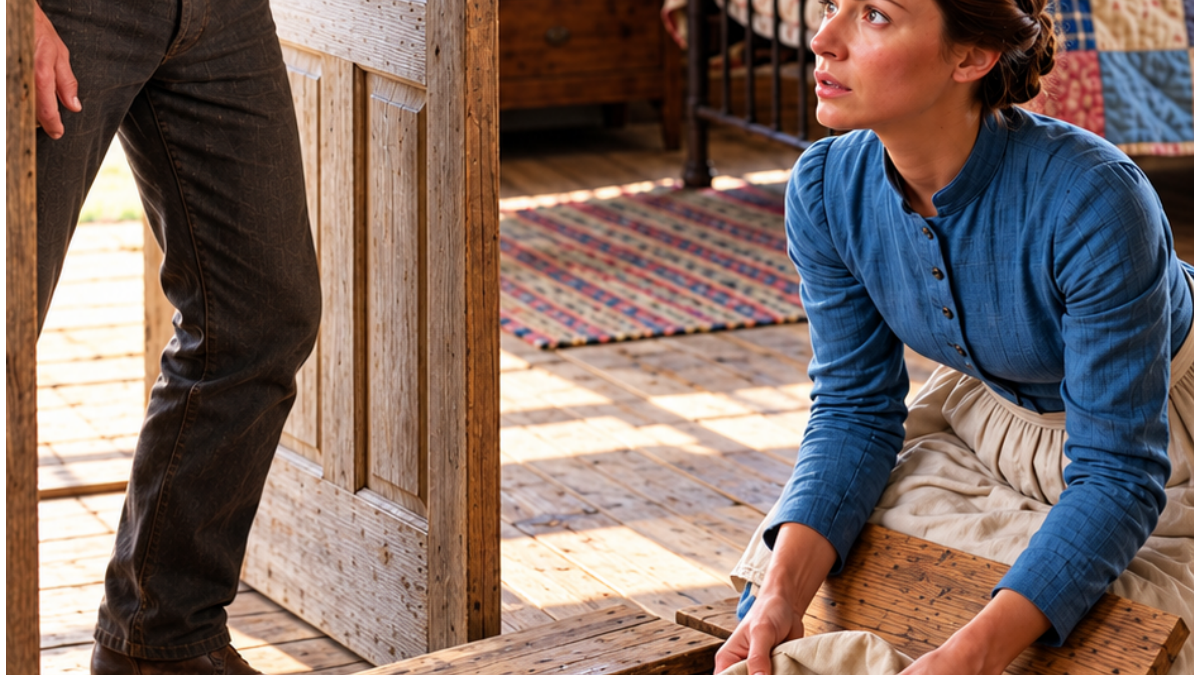
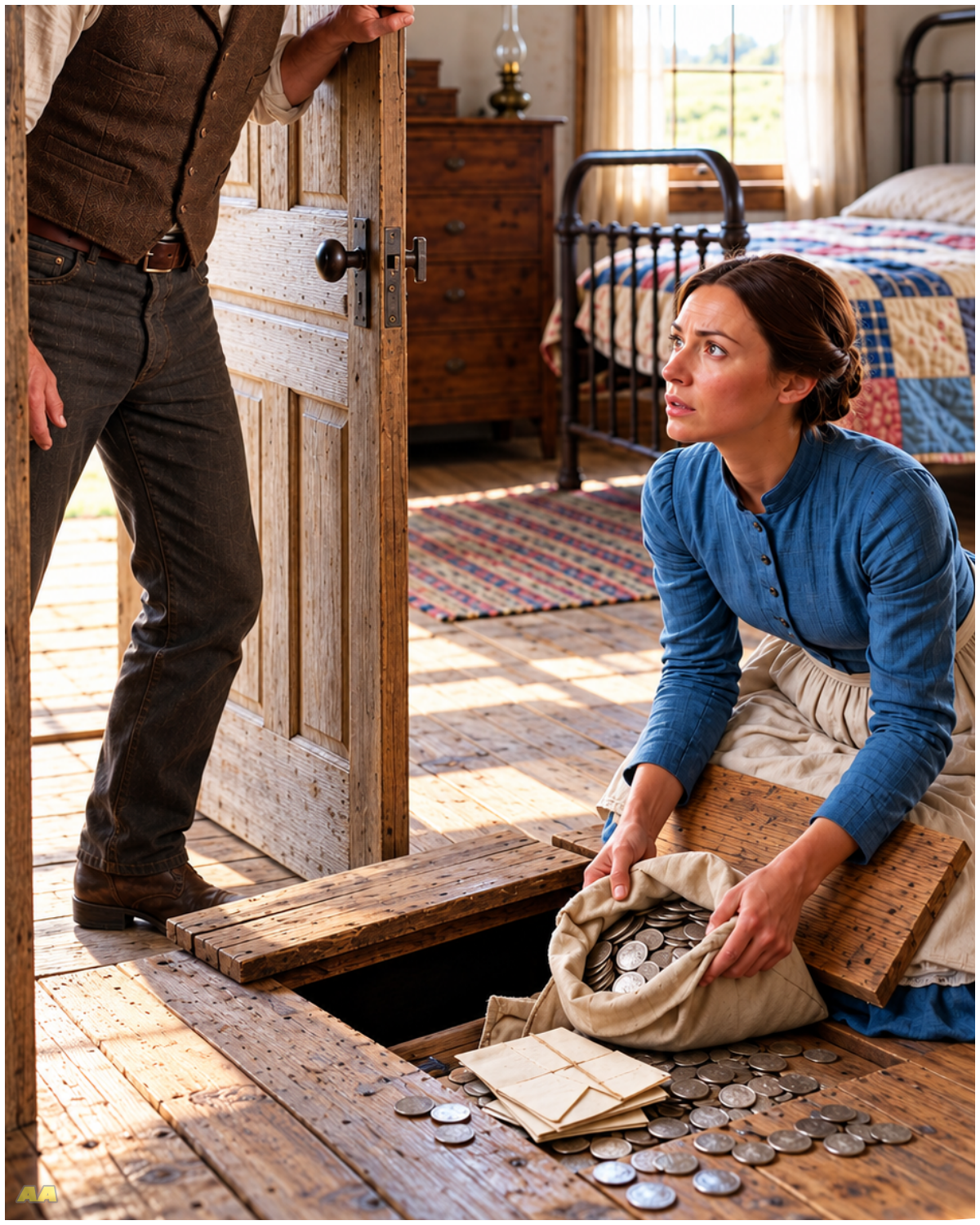
Kansas, 1889. Isaac Dawson had been married to Hannah nearly six years when he first noticed the loose floorboard in their bedroom corner had started without explanation, coming up more often than any ordinary house settling could account for.
He said nothing at firSt. A man didn’t pry into his wife’s private business over a floorboard.
But the pattern continued week after week.
Hannah always finding some reason to be alone in that corner of the room, always closing the board carefully back into place before he could see what lay beneath it.
One night, believing him asleep, Isaac heard her kneel by the board, heard the soft clink of coins being counted, and heard her whisper four words into the quiet dark.
Almost enough. The coins went silent beneath the floor.
The words did not. They followed him until morning.
Before the suspicion ever began, there had been six good years, ordinary in the way the best years generally are.
Hannah always saved the most golden corner of the cornbread for Isaac, without either of them ever once mentioning the habit aloud.
Isaac, in turn, had taken to warming a basin of water each evening for her hands, red and cracked from a full day’s wash and mending.
setting it by her chair without a word before she’d even asked.
There was a particular hen, illtempered and stubborn, that had taken to wandering into the kitchen at every opportunity.
And the two of them had developed an entire private joke around chasing the bird back out.
Isaac always losing the chase and Hannah always laughing at him for it.
“You’d think a grown man could outmaneuver one determined chicken,” she told him more than once, wiping tears of laughter from her eyes.
That hens got considerably more strategy than you’re giving her credit for, Isaac protested every single time, with no more success than the time before.
It was, by any honest measure, a marriage built on small, steady kindnesses rather than grand gestures.
The kind of ordinary tenderness that rarely announces itself and rarely gets remembered until it’s gone.
Isaac’s family had once owned a modest parcel of land bordering their current farm, 40 acres his grandfather had cleared with his own hands two generations before.
The first ground the family had ever properly owned after arriving in Kansas territory in the 1850s with little beyond a wagon and a hopeful plan.
A bad harvest followed by a worse one had forced Isaac’s father to mortgage the parcel to cover debts.
And when the note finally came due during a drought year neither man could have predicted, the bank had taken the land outright, later selling it to a merchant named Wickham, who lived two counties over, and had never once in the years since bothered farming it himself.
Isaac had been 12 years old when it happened, old enough to remember his father’s face the day the papers were signed.
A stillness in it that frightened Isaac more than any shouting could have.
He remembered, too, that his own mother, in the hardest months of that same debt, had once threatened, in a moment of exhausted despair, to take Isaac and simply leave for her sister’s home in Missouri, rather than watch the family lose everything piece by piece.
She’d never gone, but Isaac had never forgotten the sound of her saying it, nor the particular terror of believing for one long week as a boy of 11 that his family might simply come apart entirely under the weight of a debt he didn’t yet understand.
Isaac’s father still lived nearby on the remaining acreage, and Isaac made a habit of visiting most Sundays, Hannah generally joining him.
It was on one such Sunday visit, nearly 2 years before the floorboard business began, that Hannah first noticed something Isaac himself seemed entirely unaware of.
The three of them had walked the fence line together, and as they passed the boundary marking the old lost parcel, Isaac’s father had gone quiet mid-sentence, his eyes drifting toward the field beyond, his hand resting a long moment on the fence post, as though greeting something.
“Fine grazing land, that,” he said finally, his voice carrying a weight the plain words didn’t quite explain.
Then abruptly, he changed the subject entirely, asking after the price of feed corn, and the moment passed as though it had never happened at all.
Isaac hadn’t noticed. He’d already moved ahead, checking a section of wire.
Hannah had noticed everything. She found occasion to visit Isaac’s father alone more often after that.
Some afternoons bringing him a covered dish while Isaac worked the far fields, and the old man, comfortable in her company in a way he rarely managed with his own son, spoke more freely to her than he ever did to Isaac.
My own father broke that ground with a team of oxmen and considerable stubbornness.
He told her once, nodding toward the sameow field, never once suspecting why she’d asked.
Lost more to that bank than the deed alone.
Lost the knowing I’d built something my own son could stand on someday, same as I stood on my father’s work before me.
Hannah said nothing of her plan, though she carried his words with her carefully, understanding more precisely with each such visit exactly what she hoped to restore.
She began setting aside coins that same season, though she had no notion yet that the land might ever actually come up for sale.
She simply wanted, however impossible the notion seemed, to have something saved, if the chance ever came.
She hid the first coins beneath the loose floorboard the following week, choosing the spot precisely because the ill-tempered hen had recently taken to nosing through every basket and tin left in plain sight around the kitchen, and Hannah had no intention of losing her careful savings to a chicken’s curiosity.
For nearly 2 years, she added to it slowly.
A few coins from selling eggs on the side, small amounts skimmed carefully from the household budget without ever once shorting what the family actually needed.
She turned down a length of pretty blue calico at the merkantile one spring, telling Isaac simply that her old dress still had wear left in it, though the truth was she’d rather see the coin saved than spent on herself.
She had no plan beyond the saving itself.
No notion of a price or a timeline, only the quiet, patient certainty that the money might matter someday, if the opportunity ever arrived.
She came close to discovery only once in those two years.
The hen slipping into the bedroom itself one afternoon while Hannah knelt counting coins, pecking curiously at the rug’s edge, until Hannah managed to scoop the bird up and out the door moments before Isaac’s boots sounded on the porch steps.
“Something got you flustered?” he asked, finding her considerably out of breath for a woman who’d supposedly been simply tidying the bedroom.
That fool Han again,” Hannah said, which was true enough, though not the whole truth of what had actually flustered her.
She wrote to Whitam’s son that same week, careful and business-like, inquiring plainly whether the old Dawson parcel might be for sale, and at what price.
The response came a month later.
Witcom would sell, and at a fair enough price, though he intended to offer neighboring buyers first refusal, only until the first day of November, when the county’s autumn land auction would open the parcel to any buyer willing to pay more.
6 weeks, Hannah counted the coins she’d already gathered that same evening, 2 years of quiet saving laid out plainly across the kitchen table, and understood with a sinking clarity that the sum had brought her considerably closer than she’d expected, but not quite far enough.
She would need to move faster now, and more visibly than the quiet patience of the past 2 years had ever required.
She began taking in extra mending from two neighboring families that same week, work she’d never bothered with before, and started walking out twice monthly to deliver the finished pieces herself, rather than waiting for the families to collect them, using the errand as cover for the letters she carried alongside the mending.
Correspondence with Wickham’s son that she folded carefully into her apron pocket before Isaac ever saw the address.
The first time Isaac noticed anything unusual, he nearly dismissed it entirely.
Hannah had always kept a small tin of household savings, coins set aside for emergencies.
Nothing unusual about a farm wife managing money carefully.
But the tin she kept openly in the kitchen was different from whatever she was tending in the bedroom corner.
He noticed her checking that particular floorboard when she believed herself alone.
Noticed the careful way she smoothed the rug back over it afterward.
“You’re keeping busier than usual,” he observed once, watching her hunch over a stranger’s torn shirt by lamplight long after supper had been cleared.
“Extra hands never hurt,” Hannah said, not looking up from her needle.
“It wasn’t a lie exactly, but it wasn’t the whole truth, either.
And Isaac, watching her work considerably longer hours than the household strictly required, felt the first uneasy stirring of a fear that had, in truth, been waiting in him since he was 11 years old, listening to his own mother speak of leaving.
Isaac noticed the letters, too, folded away before he could properly see them, and noticed the walks that always seemed to carry Hannah in the direction of the Puit farm and beyond, though she never once told him where she’d actually been.
He didn’t know and couldn’t have known that those same walks carried finished mending to two grateful families and that the letters sealed carefully each time were addressed to a merchant son he’d never once heard of.
All he knew was that his wife had grown careful with him in a way she’d never been before, and the not knowing settled heavily in his chest, heavier than any honest explanation could have.
He finally voiced the fear to his neighbor and oldest friend, Ezra Coleman, one evening while the two mended a shared fence line.
“Hannah’s been keeping something from me,” Isaac admitted.
Not quite meeting Ezra’s eye.
“Money hidden away somewhere I’m not meant to find.
Letters she won’t let me see the address of walks that carry her off with no explanation.
Quiet in a way she’s never been quiet before.
Ezra set down his pliers and looked at Isaac squarely.
You spent 6 years learning exactly how your wife takes her coffee, he said.
And 3 weeks inventing reasons she might leave you over it.
Ask her, Isaac, plainly tonight if you can manage it.
Your imagination’s doing damage your hands won’t be able to mend.
You let it run much longer.
Might not like the answer.
Might not. Ezra agreed. Rather have an answer.
I don’t like than a marriage rotting quiet under a question neither of you will ask.
Isaac didn’t take Ezra’s advice that night, though he meant to.
It was that same week, lying awake in the dark, that he finally heard the whisper himself.
Hannah, believing him properly asleep as she knelt by the loose board and counted her hidden coins by touch alone.
Almost enough, she murmured, so quiet he nearly missed it entirely.
Hannah returned to bed a few minutes later, easing carefully under the quilt beside him, but Isaac kept his breathing slow and even, feigning the sleep he was nowhere close to finding.
Between them lay no more than the width of a pillow.
To him, lying rigid in the dark, it felt wider than the 40 lost acres beyond their fence.
And he understood that whatever fragile trust had carried him through six good years had finally cracked under the weight of four whispered words he still didn’t understand.
In the weeks that followed, the small warmth that had defined their marriage began quietly to disappear.
Isaac stopped warming water for her hands in the evenings, telling himself he simply forgot, though some part of him understood plainly it was withdrawal rather than forgetfulness.
Hannah stopped setting aside the golden corner of cornbread, noticing his distance and matching it with a careful distance of her own.
The stubborn hen wandered into the kitchen one evening, and neither of them so much as moved to chase it back out.
The private joke simply sitting there unused.
An absence considerably louder than the birds clucking.
“You’ve gone strange on me,” Hannah finally told him one evening, setting down her mending to study his face properly.
Quiet at supper. Won’t hardly look at me some mornings.
“Something’s troubling you, Isaac, and I’d rather you simply told me than let it fester between us.” “Nothing’s troubling me,” Isaac said.
The lie sitting poorly even as he said it.
Hannah didn’t press further, though the hurt in her expression told him she hadn’t believed a word of it.
There were nights Isaac nearly pried up that floorboard himself while Hannah slept, certain that whatever he found there would finally give shape to the fear he’d been carrying for weeks.
He never quite managed it.
Some stubborn scrap of trust holding him back each time his hand reached the rug’s edge.
6 years married, he told himself more than once, in the particular hollow logic of a man arguing against his own worst suspicions.
Woman’s earned better than a husband who goes digging through floorboards on nothing but a whisper and some letters he’s never actually read.
Before we go on, there’s something worth understanding about land loss on the frontier during this period.
For many 19th century farming families, land wasn’t simply a source of income.
It was home, inheritance, and proof that years of labor had built something lasting.
A single bad harvest might force a family to borrow against their property.
Two bad harvests running could make that debt genuinely difficult to repay, and a lender was not always willing or financially able to extend the repayment period once trouble set in.
That’s exactly the kind of loss that had shaped Isaac’s family for two full decades by the time this story takes place.
On this channel, our stories do more than entertain you.
They help us understand the world these people actually lived in.
Now, let’s get back to the Dawson farm because Isaac is about to discover that four words heard in the dark can mean something entirely different than what he spent weeks imagining.
The distance between them finally came to a head one evening when Isaac, exhausted and irritable after a hard day’s work, snapped at Hannah over some minor household matter that wouldn’t ordinarily have troubled him at all.
Hannah’s composure cracked in response, tears springing to her eyes despite her evident effort to hold them back.
“I don’t know what I’ve done to earn this coldness from you,” she said, her voice unsteady.
6 years, Isaac, and you’ve hardly looked at me proper in weeks.
You’ve stopped warming water for my hands.
Stopped chasing that fool hen out of the kitchen with me.
If something’s wrong between us, I deserve to know plainly what it is, rather than watching every small kindness between us simply disappear one at a time.
Isaac stood there a long moment.
The accumulated weeks of fear finally reaching a breaking point he could no longer hold silent.
The floorboard, he said finally.
I know you’ve been hiding money there.
Heard you counting it, whispering almost enough.
Seen the letters you won’t show me.
The walks you won’t explain.
Been turning it over for weeks now, wondering what exactly you’re planning that you couldn’t simply tell your own husband.
Hannah stared at him a long moment, understanding dawning slowly across her face.
You think I’ve been saving to leave you?
She said, not quite a question.
The realization hitting her harder than Isaac’s actual accusation had.
What else was I meant to think?
Hannah didn’t answer immediately. Instead, she crossed to the bedroom, knelt by the loose board, and pulled it free herself, retrieving a small cloth bag heavy with carefully saved coins, along with a folded letter she withdrew from her apron pocket.
“These weren’t letters to my family,” she said, setting both items on the table between them.
“I’ve been writing to Mr.
Wickham’s son, the man who owns your father’s old parcel.
He’s promised to hold the price for neighboring buyers until the first frost before he lists it open to anyone willing to pay more.
She unfolded the letter and set it plainly before him.
I’ve been saving nearly 2 years now, she continued.
Every spare coin from mending, from the eggs I sold on the side, from anything I could manage without you noticing the household accounts running short.
The walks were delivering finished sewing.
The letters were this. I wanted to buy it back and give it to you as something words alone could never properly say.
Isaac stared at the bag and the letter both.
Several long seconds passing before he could find his voice at all.
2 years, he said finally.
You’ve been doing this 2 years and never said a single word.
Wanted it to be a surprise.
Hannah said, “You never talk about that land directly, Isaac.” Not in 6 years of marriage.
But I watched your father’s face the day we walked that fence line together.
Watched him go quiet and change the subject the moment we passed that boundary marker.
You didn’t see it. I did.
Man doesn’t hide sorrow like that unless it still costs him something.
Even now, Isaac thought of every new dress Hannah had gone without these past 2 years, every small comfort she’d quietly declined, every extra hour of mending work he’d assumed was simply practical thrift rather than a carefully guarded sacrifice.
“You gave up considerably more than I ever noticed,” he said, shame settling heavy in his cheSt. “Wasn’t meant to be noticed,” Hannah said gently.
That was rather the whole point of a surprise.
“I thought you meant to leave,” Isaac admitted.
The words coming slowly, his eyes down at his own hands before he could finish.
Watched you save in secret, grow quiet, take extra work nobody asked for, and built the worst possible story out of it, rather than simply asking you plainly what was actually happening.
My own mother threatened to leave once during the worst of the debt years when I was 11.
Never forgot the sound of it.
Some part of me’s been afraid of hearing it again ever since, I expect.
Whether or not I ever properly admitted that to myself.
“You never told me that,” Hannah said quietly.
“Never told anyone,” Isaac admitted.
Didn’t seem the kind of fear a grown man ought to still be carrying.
Hannah reached across the table and took his hand.
“I understand the fear better now,” she said.
I don’t excuse the silence though, mine or yours.
I wanted to give you back something you lost, Isaac.
And somewhere along the way, I forgot that a marriage isn’t built from surprises alone.
It’s built from plans made at the same table.
I should have told you the moment I started, and let you carry part of the weight alongside me, rather than deciding alone that surprising you mattered more than trusting you.
We’re neither of us blameless in this, Isaac said.
I let suspicion do the talking instead of simply asking.
You let silence do the saving instead of simply telling.
Seems we’ve both got considerable practice yet, learning to trust each other plainly.
Hannah looked down at the coins still spread across the table and managed, despite everything, something close to a laugh.
You hid all this under our floor, Isaac said, shaking his head slowly.
The chickens were using every other place I considered, Hannah said.
I never knew our hens were such determined bankers.
They demand payment in corn, Hannah said.
And offer no interest whatsoever.
And the small joke landing exactly when it was needed eased something tight in both their chests that no amount of serious talk alone could have managed.
The letter made plain that Witam’s offer held only until the first day of November, now less than 6 weeks away, and Hannah’s careful savings, even combined with what Isaac could contribute, still fell some $40 short of the full price.
This won’t be finished by you alone anymore, Isaac said.
Nor by me stepping in to simply finish what you started without me.
This is the first thing we’ll properly build together, Hannah.
Start to finish, same table, same plan.
They spent those six weeks working the matter jointly, though the path proved harder than either had expected.
The buyer Isaac had lined up for the young horse backed out entirely in the third week, spooked by a rumor of illness moving through the county’s herds, and Isaac spent two anxious days searching for another buyer before finally finding one willing to pay only 2/3 of what he’d originally counted on.
“That leaves us further short than before,” Hannah said, studying the recalculated sum with a frown.
Leaves us short of the old plan, Isaac agreed.
Not short of a new one.
He sold a second horse he’d been less willing to part with, and Hannah took on a third mending contract, despite her hands already aching from the first two.
Both of them setting aside every spare dollar with an openness neither had managed before.
Checking the growing sum together each Sunday evening rather than Hannah counting it alone in secret.
They reached the full amount four days before the deadline and rode into town together the following morning.
The combined sum laid plainly on the bank counter between them.
40 acres, the banker confirmed, drawing up the paperwork.
Same parcel Witam’s son agreed to hold.
Deed transfers clean once this clears.
Same parcel. Isaac confirmed, his voice unsteady in a way he hadn’t intended.
They rode out to the parcel themselves first the morning after the papers cleared.
Isaac dismounting to open the old gate himself, its hinges stiff with years of disuse, rust flaking away beneath his hand as he worked it free.
“Been 20 years since a Dawson opened that gate as its rightful owner,” he said, stepping through.
They walked the boundary together that whole morning.
Hannah pointing out the section nearest their own land where the spring ran cleareSt. Isaac studying theow fields with the particular attention of a man already planning what might grow there come spring.
They spread a simple meal on a blanket near the old fence line at midday.
Bread and cheese and the last of the season’s apples, eating together on ground that had belonged to strangers only days before.
“Where would you build if it were up to you?” Isaac asked, watching her survey the gentle rise near the spring.
“There,” Hannah said without hesitation, pointing to the exact spot, close enough to the water, high enough to catch the evening light proper.
They brought Isaac’s father out to see it the following week, the old man walking the boundary slowly, his hand finally resting on that same fence post where he’d once gone quiet years before.
This time he didn’t change the subject.
“Your grandfather cleared this by hand,” he said, voice thick.
“Never thought I’d stand on it again as anything but a trespasser.” He looked at Hannah a long moment.
“You did this. We did it together,” Hannah said, though I’ll admit it started as my own foolish notion, keeping the whole plan secret far longer than I should have.
Foolish notions built half this territory,” the old man said, and pulled her into an embrace that told her no further explanation was needed.
They worked the reclaimed land together in the years that followed, folding it properly into the farm’s operation, planting the first new crop across ground that had sat idle for two full decades.
Isaac told the story often afterward to their own children as they grew old enough to understand it.
Always careful to give Hannah full credit for the sacrifice and equal credit to the six weeks they’d spent finishing the work together once the secret was finally out.
Your mother spent 2 years secretly saving every spare coin he’d tell them.
And I spent several foolish weeks nearly ruining everything by assuming the worst instead of simply asking her plainly what was happening.
Years later, on a warm evening on the porch of the reclaimed parcel’s own new farmhouse, Isaac’s father sat surrounded by his grandchildren, telling them some exaggerated version of the old fence line story that grew a little taller with each retelling.
When Isaac had built that new farmhouse, Hannah had insisted, with a firmness that brooked no argument, that one particular board from their old bedroom be carried over and worked into the porch flooring itself.
It had never fit quite right in its original spot, and it fit no better here, but neither of them had ever once asked the carpenter to plain it properly.
True. Hannah crossed the porchboards deliberately near that same loose one now, the familiar creek sounding beneath her step.
Exactly as it always had.
Isaac looked up, an easy smile crossing his face.
“Hiding money again?” he asked.
“No,” Hannah said. “I already bought everything I wanted.” Isaac looked at his children, at his father, at the land spread golden green in the evening light, and found he had nothing left to add to that at all.
Hannah Dawson spent two quiet years sacrificing comfort after comfort to buy back a piece of land her husband had never once asked her to reclaim and learned along the way that even the finest surprise cannot replace the trust a marriage is actually built from.
Isaac Dawson nearly let an old unspoken fear poison six good years of marriage until he finally understood that the answer to his worst suspicion had been sitting patiently beneath their own bedroom floor the entire time waiting only to be asked about honestly.
Sometimes the very things that frighten us most in the people we love are actually the clearest proof of how deeply they’ve been loving us all along.
If only we’re brave enough to ask instead of guessing at the worSt. May God bless each and every one of you who listen today.
Until next time, keep riding.
You saved a little here and there, a coin beneath the bedroom floor.
Passed on dresses, worked by lamp light.
Always finding one stitch more.
I heard you whisper almost enough and fear told me a different tale.
I should have asked you what you carried instead of letting no ghost prevail.
All those nights you counted quietly.
You weren’t planning to disappear.
You were buying back a piece of home my family had lost for 20 years.
You already bought everything you want.
But darling, you gave much more to me.
You brought back 40 acres and the man I nearly forgot to be.
It wasn’t just the land you saved or an old gate opening again.
You reminded me that love is trusting enough to let somebody in.
And after all the years we built together, there’s nowhere else I’d rather be.
You already bought everything you wanted, and somehow you gave the world to me.
We laid those coins out on the table.
>> >> No more secrets underneath.
Your tired hands beside my callous ones.
Both learning what it means to believe.
We sold what we could live without.
You sold until your fingers ache.
Every Sunday counted side by side.
Every dollar now a choice we made.
Then I pushed that rusted gate wide open.
Walk the ground my father knew.
And when he stood there by the fence line, I finally understood what you tried to do.
You already bought everything you want.
But darling, you gave much more to me.
You brought back 40 acres and the man I nearly forgot to be.
It wasn’t just the land you saved or an old gate opening again.
You reminded me that love is trusting enough to let somebody in.
And after all the years we’ve built together, there’s nowhere else I’d rather be.
You already bought. everything you want, and somehow you gave the world to me.
Love isn’t every perfect surprise.
Sometimes love is asking why.
Sometimes it’s sitting at the same old table and telling the truth before fear decides.
Maybe God lets broken ground wait longer than we’d ever choose.
Until two hearts can work together and grow something either one could lose.
You already bought everything you want.
That’s what you told me years from then with our children on that old front porch and my father telling stories once again.
That crooked board still caks beneath you.
The same one where the coins once lay.
I still smile. and ask you hide money and you still laugh the same old way.
You look around at all we’ve built here at the fields beneath the evening sun and say no I already bought everything I want and reach for me like I’m still the one.
Keep that old board slightly crooked.
Let it creep beneath our feet.
Some things never. need repairing when they remind us love underneath.








