She Hides Under A Stranger’s Table To Avoid Her Fiance Unaware He Was The Duke Who Falls For Her
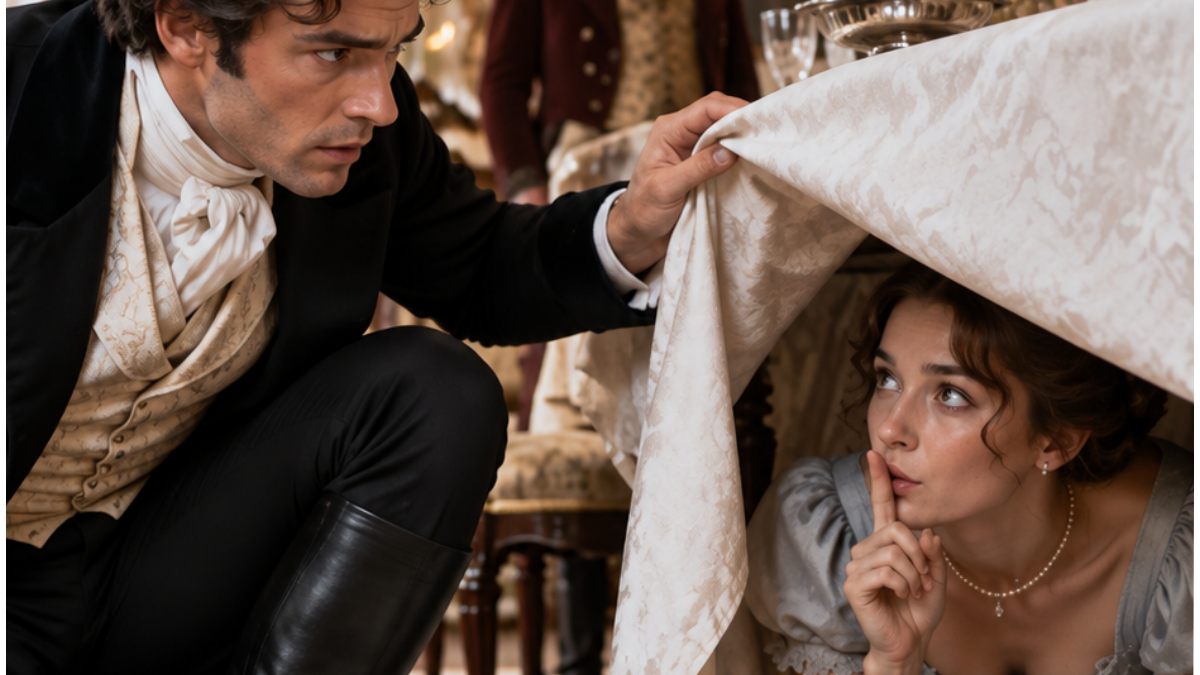
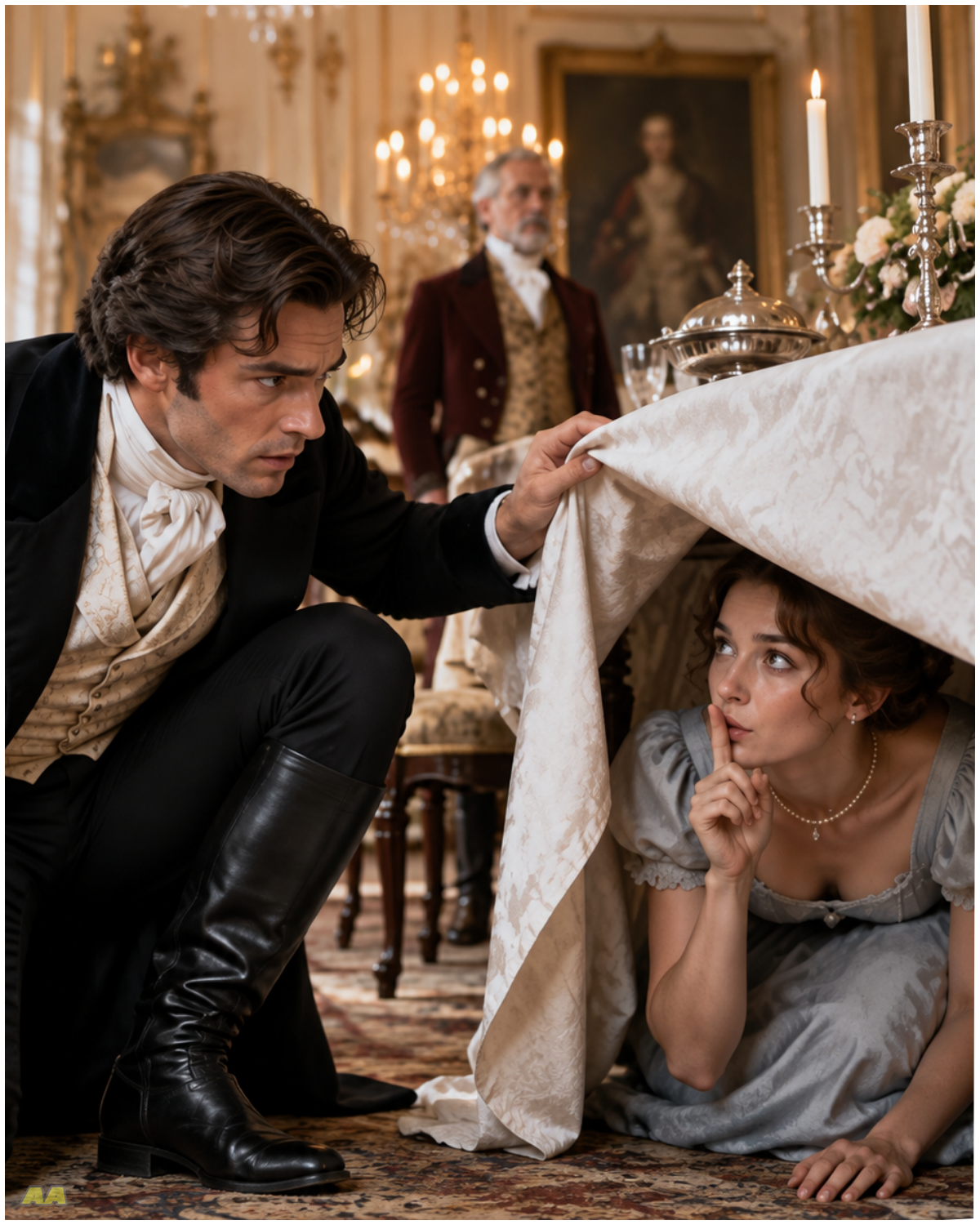
She ducked under a stranger’s table to hide from the gambler her stepmother wanted her to marry.
Just a desperate moment, nothing more.
What she didn’t know, the gentleman who shielded her was one of the richest, most reclusive dukes in all of England, and he hadn’t stopped searching for her since.
The candle flames trembled as Claraara Witmore pressed her back against the silk papered wall, listening to the heavy footfalls coming near her.
She had only a few breaths to decide.
Down the corridor, the ballroom of Lady Peton’s townhouse roared with music.
Violins climbed and dipped through a waltz.
Crystal glasses clinkedked, and a hundred voices laughed beneath the great chandeliers.
Yet here, in this narrow passage off the east salon, every sound felt muffled far away, as if she had already slipped out of the world that wished to swallow her whole.
The footfalls drew closer. She could smell the brandy on his breath before she could see him.
Miss Witmore, came Lord Vain’s voice, oiled and pleased with itself.
“Come now, my darling, a future husband ought to be granted a moment alone with his bride.”
Clara’s stomach turned.
She was not his bride.
She would never be his bride, no matter what papers her stepmother had been pressing into her father’s trembling hands all the week passed.
Lord Vain, who had wagered three fortunes at the Paul Maul Hells, who had bought up every penny her family owed, and now dangled their Hartfordshire estate above their heads like a hook above a fish.
Marry him, or lose everything.
She would sooner walk barefoot into the tempames.
Her satin slippers made no sound as she fled along the passage, her pale blue tulle skirts gathered in both hands.
A door stood a jar to her left, a card room by the look of it, draped in dim silk and lit by a single guttering candalab room.
She pushed through and shut it softly behind her.
The room was empty.
A round tea table stood in its center, covered to the floor in a heavy crimson velvet cloth.
She did not stop to think.
She lifted the velvet, ducked beneath, and let the fabric fall about her like a curtain.
Her knees pressed into the carpet, her heart drumed against the bones of her stays.
She pressed a gloved hand to her mouth, terrified that the very sound of breathing would give her away.
A second door opened. Bootsteps, slow and unhurried, crossed the room.
Polished riding boots, she saw through the narrow gap of the cloth, dark as ink, the leather soft and well-kept.
They paused, then drew out a chair.
A man sat down at the very table she was hiding beneath.
She nearly choked on her own breath.
Of all the cursed luck, of all the rooms in all of London.
She heard the rustle of paper, a letter perhaps, lifted from an inner pocket, the faint scratch of a fingernail beneath a wax seal.
He was reading. He had not noticed her, or if he had, he had not made a sound about it.
Then the door slammed open a second time.
“You there?” Lord Vain’s voice, no longer oiled, now sharp with temper.
“Sir, have you seen a young lady pass this way? Pale gown, dark curls, about so tall.”
A pause.
The man at the table did not rise.
He did not even seem to lift his eyes from his letter.
I am not in the habit, came a low, measured voice from above her, of cataloging the ladies who do or do not pass through other men’s drawing rooMs. The voice was cool as riverstone, cultured.
There was something in it that made Clara forget for one mad instant that she was crouched beneath a tea table like a frightened child.
I asked you a civil question, sir, and I gave you a civil answer.
Beneath the cloth, Claraara saw the gentleman’s boot shift.
It moved quite deliberately until it rested against the very edge of the velvet drape, blocking the small gap through which her pale skirt had threatened to peak.
He had seen her. He had known all along a second pause longer than the first.
“You may try the orangry,” the gentleman said evenly.
“I believe I heard voices that way some minutes ago.
A ladies perhaps, though I could not swear to it.
Lord Vain made a noise somewhere between a grunt and a curse.
Much obliged. The bootsteps retreated.
The door clicked shut. Silence.
Clara did not dare to move.
She was certain her own pulse must be audible to the man above her.
He did not speak at firSt. He simply turned a page of his letter as if nothing in the world had happened, as if a young woman were not hiding beneath his elbow in stolen silence.
Then, at last he said very quietly, “He is gone, madam, though I would not advise emerging just yet. Gentlemen of his temper have a habit of doubling back.”
Clara closed her eyes.
A hundred thoughts rushed through her at once.
Who was he? Why had he helped her?
Did he know who she was?
Had he known her stepmother?
Would he in a moment lift the cloth and laugh at her?
Or send for a footman or worse, send for Lord Vain himself?
“Thank you,” she whispered before she could stop herself.
There was the faintest sound above her, “Almost,” she thought, a smile.
“Do not thank me yet,” he said.
“We are not finished with the evening.”
She heard him fold his letter slow and unhurried and slip it back into his coat.
Then his boot shifted again, no longer barring the gap, but offering in its quiet movement a kind of invitation.
Come out, madam. The room is ours.
Clara lifted the edge of the velvet cloth and crawled out.
She had imagined in those few breathless moments beneath the table that the man above her might be elderly or stern, or perhaps the sort of gentleman who wore a pouted wig and a frown to match.
What she found instead, as she rose to her feet, and smoothed her crumpled skirts, was something else entirely.
He stood waiting beside the table, tall and broad through the shoulder, his dark hair brushed back from a high brow.
His coat was a fine black superfine wool cut close, and his crevat was tied with a quiet elegance that spoke of a valet who took his work seriously.
His eyes were gray, the color of a Yorkshire sky before rain, and they were fixed upon her with a curious, attentive warmth.
He was, she thought distantly, the handsomest man she had ever seen.
She curtsied. It was the only thing she could think to do.
Forgive me, sir. I have used your card room very ill.
On the contrary, he said, his voice in the candle light was warmer than it had been when speaking to Vain, lower and softer at the edges.
You have used it remarkably well.
I confess I have never seen a young lady vanish so cleverly beneath a tablecloth.
You ought to be on the stage at Drury Lane.
Clara laughed, a small, startled sound before she could stop herself.
I had not planned it, I assure you.
The best escapes never are.
She felt the warmth rise in her cheeks and turned her face slightly, hoping the dim light would hide it.
He noticed, of course. He noticed everything.
He stepped a half pace nearer and lifted a hand.
You have a smudge of dust, madam, just there upon your cheek.
She raised her gloved fingers to her face, but he was already drawing a folded handkerchief from his breast pocket.
The silk was fine, ivory white, with a small embroidered crest in one corner that her eye caught for only an instant before he turned the cloth in his hand.
“May I?” she nodded, not trusting her voice.
He brushed the smudge away with the lightest touch, his knuckles barely grazing her skin.
She held perfectly still. Somewhere in the great house, the orchestra had begun a new waltz, and the music came faint and sweet through the closed door.
There, he said quite restored.
I do not know how to thank you, she said.
If you had spoken a single word otherwise to him, I should be.
She could not finish the sentence.
She did not need to.
Something in his face had already understood.
Then we shall say no more of it, he said gently.
Although I will confess, madam, to a great deal of curiosity.
Whom have I just rescued?
She opened her mouth to tell him she wanted to.
She wanted it more than she had wanted anything in a long while.
To stand in this dim silk-draped room and tell this kind stranger her name, and to hear him say it back to her, and to know that somewhere in London there was at least one gentleman who had stood between her and ruin without asking a thing in return.
But before the words could come, a voice cut sharply through the corridor beyond.
Claraara, Claraara, where have you got to, you tiresome creature?
Her stepmother. Closer than Vain had been.
The color drained from Claraara’s face.
She turned at once, gathering her skirts.
I must go. Truly, I muSt. Forgive me.
Wait. He took a half step after her.
Your name, madam. At the very leaSt. I dare not, she breathed.
Forgive me. I will think of you with the greatest gratitude all my days, sir, but I dare not.
She slipped past him and out through the second door, the one that gave on to the terrace.
The cool night air struck her at once, sharp and welcome after the close warmth of the house.
Gas lamps glimmered along the brick paths of the small courtyard garden, and beyond the rot iron gates, she could hear the clatter of a brew being brought round, the snort of a tired carriage horse, the low call of a coachman to his fellow.
She fled down the steps with one hand pressed to the stitch in her side, the other clutching her shawl against her shoulders.
Her stepmother’s voice rose again behind her.
Clara. She did not stop.
She crossed the gravel and slipped through the side gate where the family’s hired carriage stood waiting in the lane.
She climbed inside, drew the small leather curtain across the window, and pressed her hands flat against her knees to still their trembling.
It was only then, in the swaying half dark of the carriage as it pulled away into the London streets, that she realized what she had done.
She lifted her wriSt. It was bare.
The little reticule of embroidered silk that had been looped about it, the one her late mother had stitched for her in the last winter of her life was gone.
She must have set it down beneath the table when she ducked, or perhaps it had slipped from her wrist when she crawled out.
Inside it she carried only a few small things.
A sixpence, a folded handkerchief of her own, and the four little landscape sketches she had been working upon all the spring, drawings of the Hartfordshire estate her family stood to lose, with her own name and direction written in pencil on the back of each.
She closed her eyes and let her head fall back against the squabs.
A perfect stranger, a man whose name she did not know, and in his hands now every clue to who she was and where she lived.
The carriage rolled on through the foggy streets, and the great gas-lit house behind her dwindled into the night.
Three mornings passed, and Claraara did not sleep through any of them.
She lay in her narrow bed in the Mayfair townhouse, listening to the milk cart rattle down Keren Street at first light, and waited for the knock at the door that would end her freedom.
Lord Vain would come. He would come with his solicitor and his marriage contracts and his oily smile, and her father, dear, gentle, ruined man that he was, would have no choice but to set his name beside hers upon the paper.
She had been over it a hundred times in her head.
There was no way out.
The debts were too large, the estate too encumbered, and her stepmother too determined.
On the third morning, she rose at last because she could not bear to lie still any longer.
She dressed in a plain morning gown of sprigged muslin, pinned her dark curls into a simple knot, and made her way down to the drawing room.
The drawing room was where it would happen.
She knew it would happen there.
Her stepmother had arranged the room expressly for it.
The good sea tea service had been set out upon the rosewood table, the heavy damisque curtains tied back to admit the morning light, and a small fire kept burning in the great, though the mayor scarcely required it.
Clara sat by the window with a book of poems open in her lap, and read not one word of it.
The lace curtains stirred faintly in the breeze.
Outside, a flower girl was crying violets down on the corner, and a handsome rattled past with its bell jingling.
Clara turned a page she had not read, footsteps in the hall, her hands tightened upon the book.
The door opened. Her father came in alone.
She rose at once. Mr.
Whitmore was a quiet, stooping man, with kind gray whiskers and a coat that had been brushed too many times.
He had not looked her in the eye for a fortnight, ever since Vain’s contracts had first been laid upon his desk.
But now, this morning, he was looking at her, and his eyes had a strange brightness in them, as if he had been weeping or laughing, or perhaps both.
My dear, he said, “Papa.” She set the book aside, “What is it?
What has happened?” He came forward, took her hands in his, and pressed them.
His own were trembling. It is over, my child.
The blood seemed to leave her head.
She thought for a wild instant that he meant the estate, that Vain had grown impatient and seized it outright.
Papa, I do not understand.
The debts, he said, Vain’s hold upon us.
It is gone, Claraara. It is all gone.
She stared at him. How can that be?
He drew her over to the small seti and made her sit, then sat himself beside her with the air of a man who has just walked five miles in the wrong shoes.
He pulled the letter from his coat pocket.
The paper was heavy, creamcoled, sealed in red wax with a crest she could not quite make out from where she sat.
This came at 7:00 this morning, he said, by private messenger.
It is from Koots. The bank?
The bank? Yes. They write to inform me that every outstanding obligation of this family, every promisory note, every mortgage upon Brierstone, every paper Lord Vain held against my name has been purchased in full by a third party.
The debts are settled, Claraara.
We owe Vain nothing. We owe no man in London a single farthing.
Claraara could not speak. She looked from his face to the letter and back again.
“But who?” she whispered. “Who would do such a thing?” “That is the strangest part of it.” Her father unfolded the letter with careful fingers.
The benefactor has insisted upon remaining anonymous.
Cuts will say nothing of his name, only that he is a gentleman of considerable means, that he wishes no acknowledgement, no thanks, no notice taken of the matter whatsoever, and that the entire arrangement is to be considered a private gift.
A gift? Clara repeated. A gift.
She rose from the seti.
She walked to the window, then back again.
Her hands had begun to tremble, too, and she pressed them together to make them stop.
And Vain. Vain has no claim upon us.
None. If he sets foot at this door, I am to send him from it.
The matter is finished. She felt as though the floor had tilted.
She put a hand to the back of the seti to steady herself.
And then, quite without warning, she began to laugh, and the laugh turned at once into something dangerously like a sob.
And her father, sensible, kind man that he was, simply rose and put his arm about her shoulders and let her stand a moment against his old worn coat.
“Who, Papa?” she said into his lapel.
“Who in the world?” “I do not know, my child.
I confess I do not know.
I have not such a friend in London, nor such a connection of any sort.
It is a mystery beyond my reading.
But Clara, as she stood there with her face against her father’s coat, had begun to wonder.
She thought of a velvet cloth, of a polished riding boot, of a low voice saying, “We are not finished with the evening.” Of four little sketches of Brierstone, each one signed in her own pencil, each one bearing her name and her direction, all of them sealed up inside a small silk reticule that she had left behind upon a cardroom floor.
She did not say a word of it to her father, but her hand, when she lifted it to wipe her cheek, was no longer trembling.
The freedom lasted four days.
On the fifth morning, the first whisper reached the breakfast table in the form of a folded note from Lady Peton, written in a hand so careful it was plainly meant to wound.
Dearest Mrs. Witmore, I write only out of the warmest concern.
There are certain reports circulating regarding your step-daughter’s conduct at my recent ball.
Reports which I am sure are entirely without foundation, but which a friend would be remiss not to pass along.
Her stepmother read it aloud at the breakfast table with a face like cold porridge.
By noon two more notes had arrived.
By evening a third. The story, it seemed, had grown legs in the way that London stories always did.
Claraara had been seen slipping into private rooms with gentlemen unknown.
Claraara had been overheard refusing Lord Vain in language no lady ought to use.
Claraara had been found in a state of disarray upon a terrace at 1:00 in the morning.
Each version was wilder than the last, and each Claraara understood at once had Lord Vain’s fingerprints upon it.
He could not have her.
He could not have her fortune nor her estate.
So he would have her name instead and tear it apart in the drawing rooms of Mayfair until nothing of it remained.
Her stepmother shut herself in her bed chamber for an entire afternoon and would not speak to anyone.
Her father walked the length of the library and back again, his hands clasped behind his coat, saying very little.
It was Claraara herself in the end who proposed the answer.
She came down to the library after dinner with a small advertisement she had cut from the back of the morning poSt. She laid it upon her father’s desk and waited while he read it through.
Wanted at Ravenhurst Hall in the West Riding of Yorkshire, a young gentlewoman of education and quiet habits to act as companion and assistant in the cataloging of a private library.
Good references required. Apply by letter to the steward, Ravenhurst Hall, Oakidge.
Her father looked up. Claraara, papa, only listen to me.
If I remain in London another fortnight, the talk will swallow us.
You know it as well as I do.
But if I go away quietly under a different name, and stay away until the season is over, and the gossips have found some fresher creature to devour.
The family is safe. You and Margaret can hold your heads up at church.
Brier Stone is ours again.
There is nothing for any of us to gain by my staying.
It is not seemly, he began.
It is more seemly than what they are saying of me already.
He could not answer that.
She wrote the letter that very night in a careful hand, signing it Miss Claraara Marsh, a name she chose because Marsh had been her mother’s name before she married.
She gave her age as 2 and 20, which was the truth, and her accomplishments as drawing, French, and a fair knowledge of botanical Latin, which were also the truth.
She gave as her reference a Mrs. Hallowell of Bath, who was in fact her old governness, and could be relied upon to write a glowing character without asking awkward questions.
The reply came inside a week.
The position was hers. She was to present herself at Ravenhurst Hall on the 15th of the month.
She packed two trunks. One held her plainest gowns, the gray wool and the dark blue marino, and two clean muslins for warmer days.
The other held her drawing things, her sketchbook, her box of watercolors, a small volume of kalpa, and the worn leather case in which her mother had kept her sewing silks.
The pretty ball gowns she left behind in their tissue hung in the wardrobe like the ghosts of a girl she was leaving in London.
She kissed her father goodbye at 4:00 in the morning before the household was about and stepped up into the public stage coach at the bull and mouth.
The journey north took two days and a night.
The coach jolted along the post road through Hertfordshire, then Bedfordshire, then up through the long flat counties of the Midlands, stopping every few hours at ins where the horses were changed, and the passengers stamped their feet in cold yards and drank weak tea.
Claraara sat in the corner by the window with her bonnet drawn low and a thick shawl about her shoulders and watched the country roll past in a gray green ribbon.
Headed rows in white flower, sheep upon hillsides, hay carts drawn aside to let the coach by.
Villages of gray stone with their church spires rising thin against the sky.
She had never been so far north in her life.
She slept badly at the coaching in at Doncaster, in a narrow bed under a sloping roof, and woke before dawn to the sound of a stable boy whistling in the yard.
By midday on the second day, the country had changed about her.
The hills had grown taller and barer, the stone walls darker, the cottages set further apart.
She passed a ruined abbey upon a hillside and a market square full of geese and a long stretch of moore where the heather was not yet in bloom.
Late in the afternoon the coach set her down in the village of Oakidge.
It was a small neat place with a single street of Greystone houses, an inn called the Black Bull, a church with a square Norman Tower, and a smithy where a great bay horse stood patient under the hammer.
A boy from the hall had been sent down with a gig to meet her.
“You’ll be Miss Marsh then,” he said.
“I shall,” said Claraara, and climbed up beside him.
Ravenhurst Hall rose into view at the top of the long drive like a thing out of an old painting.
It was built of pale honeycoled stone, gabled and many windowed, with two long wings stretching out from a tall central block and a great stone porch above the door.
Behind it, the ground fell away to a lake, and beyond the lake, the moors rolled blue and bare to the horizon.
Claraara, sitting beside the boy in the gig, found that she had stopped breathing for a moment, and had to remind herself to start again.
The boy chirped to the pony, the wheels crunched upon the gravel sweep.
A gray-haired woman in a black bombazine gown was waiting upon the porch step.
She introduced herself as Mrs. Hadley, the housekeeper, and led Claraara through a stone flagged hall hung with old portraits, and up a back stair to a small plain bed chamber upon the second floor.
The room had a sloping ceiling, a casement that looked over the kitchen garden, a deal wash stand, and a narrow bed neatly made with a patchwork coverlet.
You will take your meals in the steward’s parlor, Miss said Mrs. Hadley.
Breakfast at 8, dinner at 1:00, supper at 7:00.
The master is from home a great deal, so you will not often be troubled at your work.
Mr. Ravenhurst sees to most things in his absence.
He will receive you in the library at 10 tomorrow.
Thank you, Mrs. Hadley. The housekeeper paused at the door.
Her sharp eyes went over Clara once more, neither unkind nor warm, merely measuring.
You are very young, Miss Marsh.
I have been told so before.
Well, a small nod. We keep early hours here.
I hope you will sleep well.
Clara did sleep well, better than she had slept in weeks, with the moore wind sighing about the eaves and an owl calling somewhere down by the lake.
She woke at 6, washed in cold water, and dressed in her plainest gray wool.
She ate a slice of bread and butter in the steward’s parlor without seeing another soul.
And at 5 minutes before 10:00, she presented herself outside the library door.
It was a magnificent room, two stories high, lined floor to ceiling with oak shelves, a gallery running about the upper level with a rot iron railing and tall mullied windows that let the morning sun fall in long, bright bars across the carpet.
The air smelt of leather bindings and beeswax and old parchment.
A fire crackled quietly in a wide stone hearth.
There must have been 10,000 books in that room, perhaps more.
Clara stood for a moment, quite forgetting why she had come.
She walked slowly down between the shelves, her hand trailing along the spines, reading titles as she went.
Gibbon, Lanaeus, a folio of Buick, a row of small calfbound volumes of Cooper and Thompson and Goldsmith.
She climbed the spiral stair to the gallery and walked along, pausing here and there to draw a book half out and slide it back.
She was so deep in it that she did not at first hear the library door open below her.
She heard the footsteps only when they had reached the center of the carpet.
A man’s tread, unhurried, easy upon the boards.
Miss Marsh, I am told.
She stopped where she stood, her hand frozen upon the spine of a small green volume of herbal engravings.
She knew the voice. She knew it before her mind had any business knowing it, before she had even turned her head.
She knew it in her chest and in her hands, in the sudden, hot stillness that fell upon her between one breath and the next.
She turned very slowly upon the gallery and looked down.
He stood in the middle of the library carpet, looking up.
He was dressed quite differently now.
The fine black coat and the crevat tied by a London valet were gone.
He wore plain country tweeds the color of more heather, a soft linen shirt open at the throat, a pair of well-worn riding boots that had seen real mud.
He looked younger out of his evening clothes, and more at ease, and somehow, impossibly even more himself.
His gray eyes met hers, and a slow, astonished gladness passed across his face.
“You,” he said very quietly.
Clara’s fingers tightened upon the railing.
“It was the steward. It must be the steward.” Mrs. Mrs. Hadley had said the steward would receive her at 10:00.
And here he was, this man, this gentleman from the card room, standing in a country library in Yorkshire, as if he had every right to be there.
A second thought struck her harder than the firSt. He had found her.
By some miracle or some terrible design, he had found her, and she did not know yet which of the two it was.
She came down the spiral stair with her hand upon the rail.
Her cheeks were burning. She dropped a small curtsy at the foot.
“Sir, I had not expected nor I,” he said.
He took a step forward, and then, plainly, thinking better of it, he stopped.
He folded his hands behind his back.
She saw him gather himself, choose his words with some care.
“Forgive me, Miss Marsh. I am RavenhurSt. I have the management of the estate here when the Duke is from home.
I had not been told the name of the lady Mrs. Hwell recommended, only that she was to come up from Bath.
Mr. Ravenhurst, the steward, not the Duke himself.
A relation perhaps, or a cousin given a position out of family kindness?
She lifted her chin. Then we are strangers, sir, and I’m very glad to make your acquaintance.
A flicker of something passed behind his eyes.
Then he bowed. Strangers, Miss Marsh, as you wish.
The fortnight that followed was the happiest Claraara had known in all her two and 20 years.
They began their work in the library on the second morning.
Mr. Ravenhurst, as she carefully called him, set her at a long oak table beneath one of the south windows, and laid out beside her a great heap of folios, ledgers, herbals, and loose engravings that had been gathering upon the gallery shelves for the better part of a century.
Her task, he explained, was to sort them, to catalog each by author and date, and to mark those that wanted rebinding for the bookbinder’s next visit from York.
He worked at the other end of the table, copying out estate accounts in a small, clear hand.
For the first hour or two she scarcely dared lift her eyes.
Every time she did so, she found him already returned to his ledger, his dark head bent, his sleeve rolled back to the elbow as he wrote.
He did not press her with questions.
He did not ask why a young gentle woman of Bath was hiding herself in a Yorkshire library under what was plainly not her own name.
He simply offered her her work and her quiet and a kindness so unobtrusive that by the third day she had almost forgotten to be afraid.
He showed her that third afternoon the glass conservatory at the south end of the house.
It was a long lightfilled room full of potted ferns and orange trees in tubs with a great climbing rose trained up the iron framework of the roof.
The rose was just coming into bloom.
Small white flowers that smelt faintly of cloves.
He told her the name of every plant.
He told her where each had been brought from and by whom and in what year.
He spoke of Sir Joseph Banks and of the gardens at Q with the easy familiarity of a man who had visited them often.
A steward, Clara thought, did not usually keep such company, but she said nothing.
They walked out together along the lake path on the fourth day, because she had asked very shily whether the prospect from the boat house was as fine as the housekeeper claimed.
He fetched her shawl himself from the hall and walked beside her down through the lime avenue, his hands clasped behind his back, pointing out the king fisher’s nesting bank and the herinry in the far elMs. You have lived here long, Mr.
RavenhurSt. All my life in one way or another.
And the Duke, is he often at home?
A small pause. Not so often as he ought to be.
He finds London tiresome, I believe, and the country lonely.
He has not quite made up his mind which is the worse.
Clara smiled at the lake.
He sounds a difficult sort of gentleman.
He is, said Mr. Ravenhurst gravely.
I have known him all my life and I cannot answer for him at all.
She laughed. He looked at her sidelong and she thought just for a moment that he was looking at her as a man looks at something he has been waiting a long while to see again.
The days fell into a quiet pattern.
Mornings in the library, afternoons in the conservatory or the rose garden or upon the long mossy paths that wound between the roodendrrons down to the water.
He brought her a portfolio of botanical prints by a Dutchman whose name she could not pronounce, and they bent their heads over it together at the table, and she felt his shoulder near her shoulder, and once by accident his sleeve against her wriSt. She did not draw it away.
He noticed. She knew. He noticed.
He did not speak of it.
On the 11th afternoon, a sudden storm came up off the moore.
They had been walking back from the old U walk when the first heavy drops began to fall.
He caught her hand without ceremony, and they ran together along the gravel path, laughing, until they reached the little iron gazebo at the foot of the rose.
They ducked beneath its roof just as the rain came down in earnest, hissing upon the leaves, drumming upon the metal above their heads.
Claraara stood breathless, one hand pressed to her side, her bonnet a skew, her gloves quite spoiled with the wet.
He was laughing too, properly laughing, his head tipped back a little, and she had never yet seen him do so.
The sound of it made her ribs ache in a way that had nothing to do with running.
Your hands,” he said, recovering himself.
“You are soaked through.” He drew a handkerchief from his pocket.
She did not look at it at firSt. She held out her hand and let him take it, and let him turn it gently over and dry her palm with a soft cloth, his fingers careful upon her wriSt. The rain came down all about the gazebo in a gray curtain, the white roses bent and shook with it.
Then she looked down. The handkerchief was ivory silk, very fine.
In one corner, worked small in pale gray thread, was an embroidered crest, two ravens upon a wreath, the same crest, the same silk, the same hand that had, in a candle lit card room three counties to the south, brushed a smudge of dust from her cheek.
She lifted her eyes very slowly to his face.
He had gone quite still.
He was watching her, and there was no laughter left in him now, only a grave and gentle waiting, as if he had known for some time that this moment must come, and would not lift a finger to hurry it, nor turn it aside.
“Mr. Ravenhurst,” she said, and her voice was steadier than she had expected.
“Miss Marsh.” The rain drumed on.
I think, said Claraara, that you and I have met before.
He bowed his head a little, almost a nod, almost a confession.
He did not speak. She closed her hand about the handkerchief, and the rain kept falling.
Neither of them spoke of it on the walk back to the house.
He gave her his arm beneath the dripping branches of the lime avenue, and she took it, and they crossed the lawn in a silence that was neither cold nor angry, only careful, as if each of them carried something fragile between them, that a wrong word might shatter.
At the south door he handed her into the hall, bowed over her wet glove, and said only, “I shall send Mrs. Hadley up with hot water.
Pray rest this evening, Miss Marsh.” She climbed the back stair to her little chamber with her wet skirts heavy about her ankles and the silk handkerchief still folded inside her palm.
She did not sleep that night.
She sat at the window in her shawl and watched the moon come slowly out from behind the mo cloud and lay a long pale road across the lake.
She thought of all the small things now that she had failed to think of at the time, the way the village boy had named the place, RavenhurSt. The crest in the gazebo, two ravens upon a wreath, the very same that was set above the great stone porch downstairs, the way Mrs. Hadley had looked at her upon arrival, measuring, knowing, the way the steward had spoken of the Duke, as though answering for a man he had known all his life.
She did not know whether she had been the cleverest girl in the West riding or the greatest fool.
She suspected with a small painful smile that she was rather both at once.
She would speak to him tomorrow.
She would ask him plainly.
It was the only course left to a woman of any pride.
She did not get the chance.
The next morning passed quietly.
He did not come into the library at his usual hour.
Mrs. Tadley came instead with a small tray of tea and a brief careful word that Mr.
Ravenhurst had been called out upon estate business and begged Miss Marsh to continue with the cataloging until he should return.
Clara nodded and thanked her and bent her head over the folios and read not one word of them.
It was just after 3 when she heard the wheels upon the drive.
She lifted her head. The library windows looked out upon the south lawn, not the front sweep, and she could see nothing, but she heard very distinctly the crunch of a heavy carriage drawing up, the snort of tired horses, and then a voice in the front hall, loud and univil, demanding to see the master of the house.
She knew that voice. She knew it as a hair knows the bay of a hound.
Claraara rose so quickly that her chair scraped upon the boards.
She caught at the edge of the table to steady herself.
Her heart was beating in her throat.
She sat down her pen.
She gathered her skirts. She crossed to the library door, opened it the smallest crack, and listened.
Lord Vain’s voice came rolling up the corridor from the great hall, easy and pleased with that particular oily warmth he used when he meant to do mischief.
My good man, I will not be turned away from the door.
I am come upon a matter of the gravest urgency, and I will speak with your master, Duke or no Duke.
Tell him Lord Vain is here from London.
Tell him I am here upon a matter touching the honor of a lady presently under this roof, and that I shall not stir from this hall until I have had my hearing.” Clara closed her eyes.
A second voice answered. The butler, she thought, a thin, elderly man named Pierce, whom she had seen only twice in passing.
His tone was perfectly civil and entirely immovable.
His grace is engaged at present, my lord.
If you will be so good as to wait in the morning room, I shall convey your card.
I will wait nowhere. I have traveled three days upon worse roads than any Christian gentleman ought to suffer, and I tell you, I will be heard.
There is a young woman here who has been passing under a false name, Miss Clara Witmore of Mayfair.
She fled London under a cloud of the worst sort of scandal.
Her family is half mad with anxiety.
I am come as a friend of the family to restore her to those who have a right to her care, and I will not be put off by a footman in livery.
Clara pressed her hand against her mouth.
A friend of the family, a friend, the man who had hung the noose about her father’s neck, and called it a betroal, the man whose tongue had set every drawing room in London whispering her name.
He had come at last into this kind house to drag her out of it by main force and ruin her in the doing.
And he would. Oh, he would.
Even if Mr. Ravenhurst threw him from the door this very hour, the story would be in every coffee house in York by Monday.
The young companion at Ravenhurst Hall, the girl living under a false name, the gentleman of the house who had sheltered her, who had walked with her in the rose garden, who had been seen in a gazebo in the rain.
She could not allow it.
She could not allow any of it.
She would go down. She would walk out into the great hall and she would tell Lord Vain to his face that she came of her own free will and she would gather her trunks and she would leave Ravenhurst this very evening and she would carry the scandal with her wherever it must go.
She lifted her hand from the door and took one step back.
She heard somewhere beneath her in the house the unmistakable sound of a heavy door being opened, slow and deliberate, and a single firm tread upon stone.
She stopped. She listened. Claraara slipped through the library door and along the corridor to the gallery that ran above the great hall.
She kept to the shadow of the wall.
The carved oak ballastrade gave her cover.
She knelt behind it and laid her cheek against the cool wood and looked down through the spindles into the long stone flagged hall below.
Lord Vain stood in the middle of it.
He had not removed his great coat.
He was a tall, well-made man, somewhere past 40, with sandy whiskers and the high colored face of one who has lived rather too well for rather too long.
He held his hat against his hip and was tapping it with two impatient fingers.
Pierce the butler stood at a perfect distance from him, hands folded, saying nothing further.
Then the door at the foot of the great staircase opened.
Two footmen in dark green livery with white stockings and silver buckles stepped through it and took up positions on either side of the lower step.
They moved with the easy precision of men who had done such a thing a thousand times.
Behind them came an older man Clara had not seen before in plain black coat and breaches who bore upon a small silver salver a folded square of paper.
Pierce drew himself up. He spoke and his voice carried up the stone walls of the hall as clear as a bell tolling in a church tower.
His grace, Arthur Lynden Charterus, the Duke of RavenhurSt. Lord Vain’s hand stopped tapping his hat.
Clara forgot to breathe. He came down the great staircase without haste.
He wore a coat of dark blue superfine that fitted him as though it had been cut from the cloth upon his back and a crevat of fine white linen tied with a quiet exactness and dark trousers strapped beneath polished black boots.
There was a signate ring upon the little finger of his right hand that caught the light from the high window as he descended.
He carried himself, as he had carried himself in the card room in London, easy and unhurried, and it struck Clara only now, watching from the gallery, that she had always known.
Some part of her had always known.
She put her hand against her mouth and held it there.
Lord Vain recovered himself with the practiced speed of a gambler who has seen a bad card turn.
He bowed, “Your grace, forgive me.
I had not been told.
I had supposed I addressed only the steward of the house.
“You addressed my butler,” said Arthur, reaching the foot of the stair.
His voice was perfectly level.
“You addressed him univily. I have heard you, Lord Vain, from the south corridor.
The whole of my household has heard you.” “Your grace, if I have spoken with heat, it is only because the matter that brings me, the matter that brings you, is not your matter to bring.” There was a small, dreadful silence.
Arthur came forward across the stone flags, and the two footmen and the old man with the salver moved with him as quietly as shadows.
He stopped at a civil distance from Lord Vain, and clasped his hands lightly behind his back.
You have come a great way, my lord.
You have come upon roads that, as you have observed, are not fit for Christian gentlemen.
So I will be plain with you in the hope of sparing you a second such journey.
Lord Vainhain’s mouth opened. You will not speak yet, Arthur said mildly.
I have not finished. Lord Vain closed his mouth.
There is a lady at present under my roof, Arthur went on, whom you have named in this hall by a name that is hers.
You have spoken of her honor as though it were a thing in your keeping.
It is not in your keeping.
It has never been in your keeping.
It is in her own, where it has always been, and where, since her arrival in this county, it has been guarded by every member of this household, as though she were of my own family.
I am acquainted with the lady’s character.
I am acquainted with the circumstances under which she left London.
I am acquainted, my lord, with a great deal more besides.
He paused. The light from the high window fell across his face.
You are upon ducal ground.
You are upon it without invitation.
I am within my rights as a magistrate of this county to require your removal by my own people, and I shall do so within the quarter hour if you remain.
You will not approach this lady.
You will not write to her.
You will not name her in any drawing room in London, in York, in Bath, nor in any other place where her name may reach my hearing.
If you do, my lord, I shall have the matter before the magistrates of two counties before the week is out, and I will not stop there.
Do I make myself understood?” Lord Vainhain’s face had gone the color of cold tallow.
He attempted once to speak.
He thought better of it.
He bowed very low and very stiff and turned upon his heel and walked back across the stone flags toward the great door.
The two footmen moved with him in perfect silence, one at each elbow, neither touching him nor needing to.
Pierce opened the door. Lord Vain went out.
The door closed behind him with a sound that filled the hall and then died slowly away into the stones.
Arthur did not move at firSt. Then very slowly he lifted his eyes to the gallery above.
He found her at once, kneeling there behind the ballastrade, with her hand still pressed against her mouth.
He did not smile. He only looked at her and waited and let her see him.
Clara lowered her hand. She stood.
She did not go down to him that evening.
She returned instead to her little chamber under the eaves, and there she sat upon the edge of the bed for a long while, with her hands folded in her lap.
Mrs. Hadley came up once with a tray of supper, and went away again without troubling her.
The more wind rose against the window, the candle burned low.
At some hour past midnight, Clara rose and drew her two trunks from under the bed, and began very quietly to pack.
She folded her gray wool.
She folded her dark blue marino.
She laid the worn leather case of her mother’s sewing silks upon the top, and her sketchbook upon that, and her small volume of Cooper upon that.
She left out one clean muslin for the morning.
She did not weep. She had passed beyond weeping into a state of clear, still sorrow that felt almost like peace.
He had bought her family’s debts.
He had stood between her and Lord Vain in two counties.
He had walked beside her in the rose garden and dried her hands in the gazebo, and not once asked of her a thing she was not free to give.
And she had repaid him by living a fortnight in his house under a borrowed name, and by drawing scandal to his door, and by being the cause of Lord Vain’s voice ringing in his great hall like a stone thrown through a church window.
She could not stay. A lady of any honor could not stay.
She fell asleep at last in her chair by the cold grate, and the mo light woke her at 6.
She dressed and pinned her hair and carried her own port manto down the back stair because she did not wish to ring for a footman.
The morning was cool and fair.
The kitchen garden lay in long shadow.
She came out through the side door into the dew of the lawn, meaning to walk round to the front sweep and ask the stable boy to bring up the gig.
She did not get so far as the gig.
He was in the rose garden.
He stood at the far end of the gravel walk where the white climbing roses spilled over the old red brick of the south wall.
He had his back half to her, his hands clasped behind him, his head a little bent as a man stands who has been waiting and is willing to wait a great while longer.
He had on the plain country tweeds again.
Not the dark blue superfine, not the signate ring catching the light, only the tweeds and the open lemon and the well-worn boots.
She sat down her port manto upon the gravel.
He heard the small sound and turned.
For a long moment neither of them spoke.
The blackbirds sang in the lime trees.
A bee went heavy past her ear and into the roses.
You were leaving, he said.
I was without a word to me.
I had not the courage for the words.
He came along the gravel walk toward her.
He stopped at a proper distance, the distance a gentleman keeps from a lady to whom he has not yet any claim, and he looked at her with a grave attention.
Clara, he said, forgive me.
It was the first time he had ever used her name.
There is nothing to forgive.
There is a great deal.
I have practiced a deception upon you under my own roof for a fortnight.
I have let you call me steward when I am not steward.
I have let you believe yourself a stranger in this house when you were nothing of the kind.
He drew a breath. I bought your family’s debts, Claraara.
I bought them the day after the ball from your sketches and the address upon them.
I would have bought them had they been 10 times what they were.
I did not do it to put you in my obligation.
I did it because I could not bear that any other man should hold them.
And least of all that man.
I had begun to think it was you, she said.
I know. Why did you not tell me when I came here?
Because you came here under a name not your own, he said gently.
And a woman who hides her name is hiding from something.
I would not have you find upon top of all that you were fleeing a duke.
I wished you to be at peace in this house.
I wished you to know the man before you knew the title.
I wished, Claraara, if I am to be honest with you, to be loved a little for myself, if I was to be loved at all, because a man in my position is not always certain which of the two is being looked at.
She lowered her eyes to the gravel.
And were you, she said, loved a little for yourself?
I had hoped so. I had not dared to ask.
She lifted her face. You were, she said.
You are. He closed his eyes for the briefest instant as a man closes his eyes upon hearing a long awaited piece of good news.
When he opened them again, he was smiling, and it was the same smile she had seen in the gazebo and in the conservatory and across the long oak table in the library.
“I have written to your father this morning,” he said.
I have asked his permission to wait upon him in London at his earliest convenience.
I have asked him to consider me as a gentleman who wishes with his blessing and yours to begin a proper and an honorable courtship of his daughter.
I have made him no promises beyond that.
The rest, Clara, is in your hands.” She looked at him a long moment.
Then she bent and took up her port mento and set it back upon the gravel a little nearer the house.
I find she said that I am in no great hurry to leave.
Arthur held out his arm.
She took it.
The blackbirds went on singing in the lime trees, and the dew burned slowly away upon the lawn, and somewhere in the great hall behind them Pierce the butler, who had served three Dukes of Ravenhurst in his lifetime, glanced once through the long window, and quietly closed the door.








