She Found Her with Charles in the Party Basement — What Diana Did Next Shocked Everyone | Emotional Story
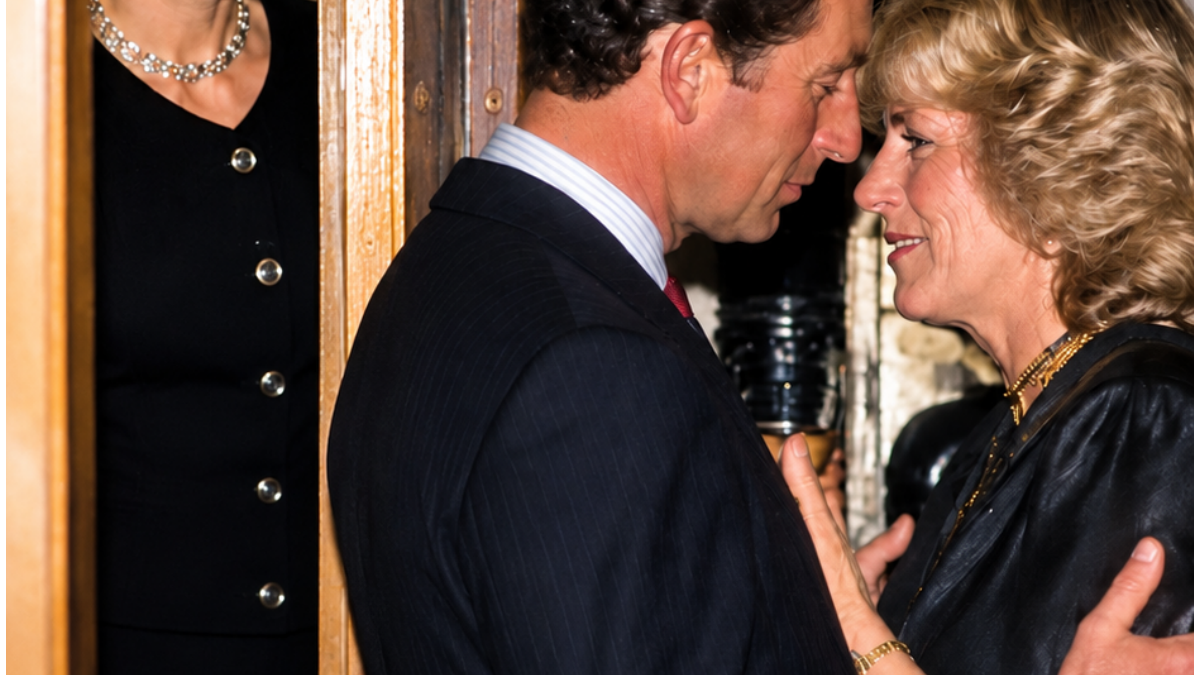
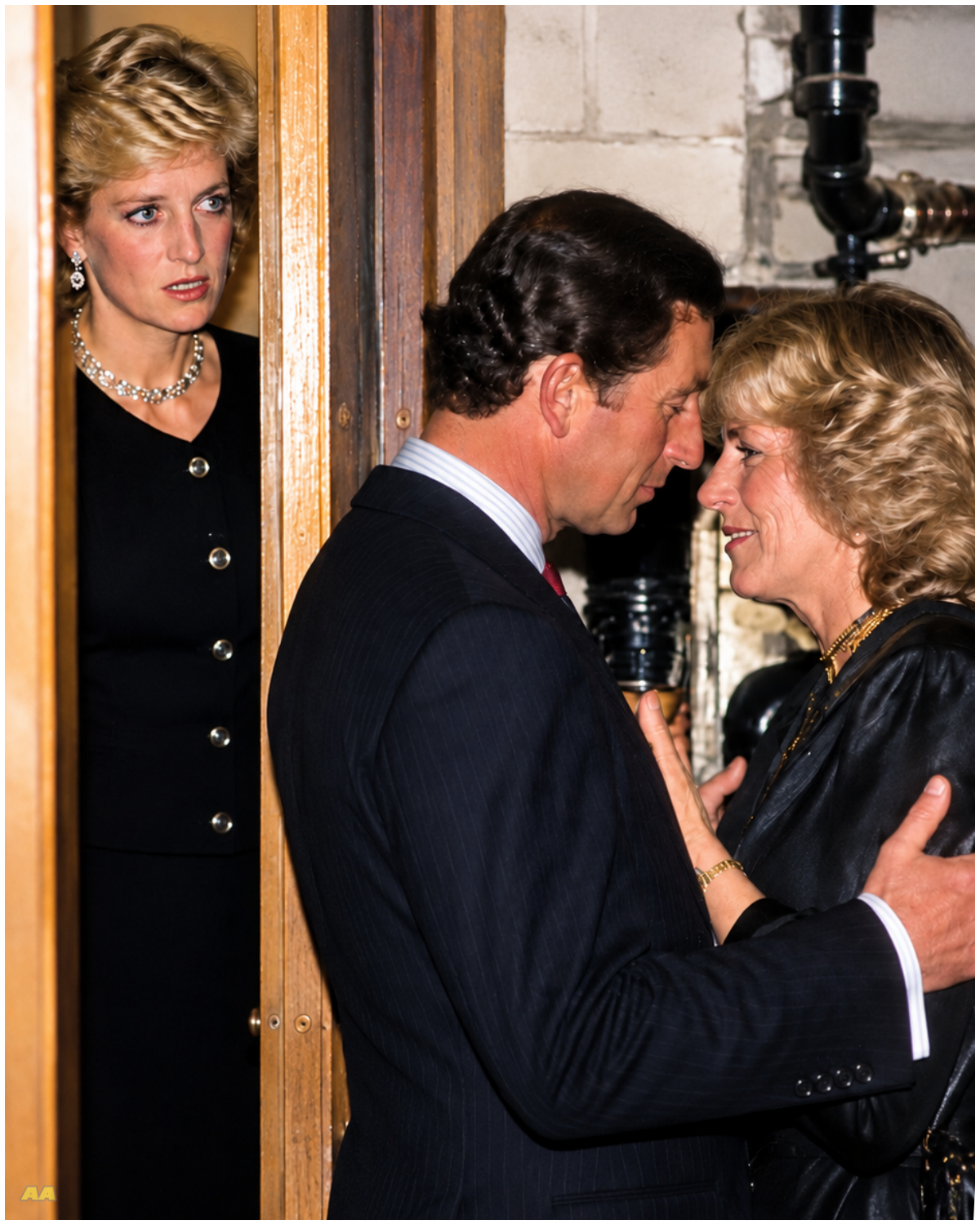
February 1989. A house in Surrey, on the outskirts of London.
Upstairs there is a party, glasses clinking, laughter, soft music, elegant people who have known each other for years.
Downstairs is a dimly lit staircase, and on that staircase a 27-year-old woman descends slowly.
One step, then another. She feels her heart pounding in her ears.
Upon reaching the bottom, she stops in front of a closed door.
On the other side, voices can be heard—low, calm, almost tender—and she recognizes one of them instantly.
It is her husband’s voice. The same man who, on the entire drive to this house, did not say a single word to her.
She is Diana, Princess of Wales, and she is about to open that door.
What she found on the other side and what she said in the minutes that followed, we do not know from a press rumor.
We know it because she told it herself in her own voice on secretly recorded tapes.
Tapes that were smuggled out of Kensington Palace one by one and ended up shaking the British monarchy.
Today you are going to hear what Diana said to Camilla face-to-face for the first time in her life.
You will hear Camilla’s reply, a sentence that is still hard to hear today without a lump in your throat, and you will hear the four words with which Diana answered her.
But that night didn’t start in Surrey; it started eight years earlier with a letter someone left on her bed, with a bracelet hidden in a palace office, with two photographs that fell out of a diary in the middle of her honeymoon.
Each of those little stories was a piece, and on that February night, all the pieces came together behind a closed door.
Perhaps you saw her walk toward the altar in the summer of 1981.
Perhaps you watched her grow up in front of the cameras year after year and noticed how her gaze began to change.
At first it was shyness, then something more weary, then a sadness that almost all of us perceived, even if no one at the palace wanted to admit it.
And I know you mourned her, not as one mourns a distant figure, but as one mourns someone you feel close to.
That is why we are not going to tell this story the way the newspapers told it.
We are going to tell it calmly, carefully, and only with what is truly known.
February 24, 1981.
In the gardens of Buckingham Palace, a couple poses for the cameras.
He is 32 years old, she is 19.
They have just announced their engagement.
Diana wears a blue suit and a ring with a huge sapphire surrounded by diamonds.
She smiles shyly, looks down, she can hardly believe what she is experiencing.
A reporter asks them a simple question; he asks if they are in love.
Diana replies immediately, “Of course.”
And then Charles adds a few words that the whole world heard and that, over time, became unforgettable.
“Whatever ‘in love’ means,” she laughs a little.
Maybe out of nerves, maybe because at 19 she still didn’t understand what she had just heard, but years later, when she looked back, that phrase didn’t seem like a clumsy comment anymore; it seemed like a warning.
Because in Charles’s life there was someone else: a woman he had known for almost 10 years, a close friend married to an army officer who was always present in his circle.
Her name was Camilla, and Diana was about to receive her first sign.
On the night of the engagement, Diana did not return to her small London apartment, the one she shared with her friends.
That stage had come to an end.
She moved to Clarence House, the residence of the Queen Mother.
She went up to the room they had prepared for her and found a letter on the bed.
It was from Camilla. According to Diana herself, the letter was dated two days earlier, meaning it had been written before the engagement was announced to the public.
It was friendly; she congratulated her on the news and suggested they have lunch together soon, taking advantage of the fact that Charles would be traveling to Australia and New Zealand.
Think about that detail. The whole country had just found out about the wedding, but Camilla already knew and had already written.
Diana accepted the invitation. She was young, she wanted to be liked, she wanted to make friends in that new world.
They had lunch together and, in the middle of the conversation, Camilla asked her a question that seemed innocent.
She asked her if she planned to go hunting when she lived at Highgrove, Charles’s country house.
Diana answered no, and Camilla said, more or less, she just wanted to know.
Diana didn’t think much of it at the time, but as the years went by, she understood why she had asked.
The house was one of the places where Charles and Camilla would cross paths.
And in that casual question, Camilla was measuring something.
She was measuring how much space would be left for her.
Diana was 19 years old. She didn’t know yet that the woman sitting across from her, smiling and asking about her plans, would take center stage in her marriage .
But soon, she found something she could no longer ignore.
The wedding was only a few days away.
Diana was at the palace offices in the study of one of Charles’s aides when she saw a package and opened it.
Inside was a bracelet, a gold chain with a blue enamel disc.
And engraved on the disc were two letters, G and F.
Diana knew what they meant. They were the initials of a private nickname between Charles and Camilla.
The bracelet was a gift for her.
According to Diana’s account , Charles was going to give it to Camilla in person that very week, days before their wedding; Diana confronted him.
There was an argument. He explained that it was a farewell gesture that meant nothing more.
But imagine being 19, days away from your wedding, and discovering that the man you’re about to marry is preparing a gift for another woman.
Diana seriously considered calling it off and said so out loud.
A few days before the wedding , while having lunch with her two older sisters, Sarah and Jane, Diana confessed that she didn’t want to get married, that she couldn’t do it.
Her sisters replied with a phrase she never forgot, a half-joking comment that told the truth of her situation.
Bad luck, Duch. Your face is already on the tea towels.
It’s too late to back out now .
Duch was the affectionate nickname her family called her, and they were right.
Shops across the country were already selling mugs, plates, and tea towels with her face on them.
The wedding was a national event.
Millions of people were waiting for it; there was no way out.
The night before the wedding, Charles sent her something: a signet ring with the Prince of Wales feathers and a note.
In that note, he told her he was very proud of her, that he would be waiting for her at the altar the next day, and gave her a piece of advice: to look everyone in the eye and dazzle them.
Diana said that note calmed her down because, in spite of everything, she loved him.
That is the part that many people forget.
Diana didn’t marry out of obligation or ambition.
She married in love, with doubts, with fear, with signs she didn’t want to see, but in love.
And the next day, walking toward the altar, she looked for only one person in the crowd.
July 29, 1981, St. Paul’s Cathedral, London.
Inside there are some 3,500 people, outside hundreds of thousands on the streets and in front of televisions, nearly 750 million worldwide.
Diana enters on her father’s arm.
Behind her stretches a train of over 25 feet of ivory silk.
And as she moves down the aisle, slowly , very slowly, there is something almost no one knew for years.
She was looking for Camilla, she said so in her tapes.
She said she knew Camilla would be there, that she looked for her as she walked and found her dressed in pale gray with a small veiled hat.
Think about that. The most important day of her life, the whole planet’s attention on her.
And amid the music, the emotion, the nerves, a part of her mind was busy locating the other woman.
And yet, Diana also said that she reached the altar full of hope, that she believed things would work out, that he would take care of her.
That hope lasted very little time.
The honeymoon was a Mediterranean cruise aboard the royal yacht Britannia, sun, sea, Greek islands, everything a newlywed could dream of.
One day, Charles was checking his diary and two photographs fell out from between the pages.
They were photographs of Camilla .
Diana told it with that very simple phrase.
They fell out. She didn’t look for them, she wasn’t checking anything, they simply fell in front of her.
Soon after, there was another detail.
One night, for dinner, Charles put on cufflinks she didn’t recognize.
They had two intertwined C’s. Diana asked him where he got them and he replied they were a gift from Camilla, and added something like, “What’s wrong with that?” It’s a gift from a friend, C for Charles and C for Camilla, on their honeymoon, around his wrists.
Diana was a newlywed on a ship in the middle of the sea, with no friends nearby, no family, no one to talk to, and she began to understand that the third person hadn’t stayed on land; she came with them.
The following years were years of contrasts.
In public, Diana became the most photographed woman in the world.
Her children were born, William in 1982, Harry in 1984.
The crowds adored her, magazines put her on the cover time and time again.
In private, the story was different.
Every time Diana mentioned Camilla, the response was the same: that it was jealousy, that she was tired, that she was imagining things, that she needed to rest—a letter on the bed, a question about the house, a bracelet, two photographs, a pair of cufflinks.
None of those things on its own proved anything, and that was exactly what drove her mad.
Everything was small, everything could be explained, everything could be denied.
And so, little by little, she was taught to distrust her own eyes until an invitation arrived that changed everything.
February 1989. London is going through one of those winters that seem never to end.
It gets dark early, it’s drizzling, the streets are glistening with dampness.
In the private calendar of high society, there is one date marked.
Annabel is turning 40. There will be a party.
To anyone on the outside, that name meant nothing.
To Diana, it meant a great deal, because Annabel Elliot was Camilla Parker Bowles’s sister, and the guest list would be full of people from Charles’s inner circle.
Friends of years, aristocrats. Owners of large country houses, couples who had moved in the same world since youth.
Many of them shared a secret.
They knew what was going on between Charles and Camilla.
And not only did they keep quiet, in many cases they made it possible.
They organized dinners where the two would coincide.
They offered their homes for quiet weekends, and those same people would meet Diana at official receptions.
They smiled at her , they bowed to her, they asked her about the children.
Imagine living like that, in rooms full of polite people, without knowing which smile is sincere and which one hides a mockery, without knowing who is consoling you and who is protecting the other woman.
And in that marriage, there was an unwritten rule.
On nights like that, Charles went, Diana stayed.
For years, she had respected that rule.
That night, she decided to break it.
It wasn’t a fit of rage; there was no shouting or slamming of doors at Kensington.
It was something quieter, a kind of clarity.
She had spent more than seven years being told that it was all in her head, and that night she decided she was no longer going to stay home imagining what was happening elsewhere.
She was going to go; she was going to see it.
Imagine her in front of the mirror in her dressing room.
She could have gone to bed.
No one would have blamed her, but she chose a dress, fixed her hair, applied her makeup with care, erasing any trace of exhaustion.
She wasn’t getting ready for a party, she was putting on armor, the only kind that world allowed her to wear: elegance, and she let Charles know she would be accompanying him that night.
They left together, the car started and began leaving the lights of London behind.
Entering roads that were growing darker .
Diana didn’t leave a detailed account of that trip there, but it doesn’t take much to imagine it.
A man who didn’t want her there and a woman who knew perfectly well where she was headed.
A house full of his friends, Camilla’s friends, people who considered her too young, too emotional, a nuisance.
At any moment, she could have asked them to turn around.
She didn’t. She was afraid, but she pressed on.
The car stopped in front of the house.
Warm light spilled out from the windows.
Voices and laughter could be heard.
Diana got out, smoothed her dress, breathed in the icy air, and went inside.
Imagine that entrance, a room full of people who knew every detail of what she had been suspecting for years.
And suddenly, the Princess of Wales appears at the door in the one place where no one expected her.
Diana did what she had learned to do.
She smiled, greeted everyone, accepted a drink, and held it like someone holding a shield.
She talked about the weather, the children, about nothing.
Time passed, dinner progressed, the conversations relaxed, and at some point, Diana looked around.
Charles wasn’t there. She looked for him by the fireplace, in the groups near the windows, on the sofas—nothing.
And then she noticed another absence.
Camilla wasn’t there either. Pause for a moment here: 27 years old, in someone else’s house, surrounded by people who didn’t want her there.
And the two people who had hurt her the most had just disappeared together, just a few meters away.
Most would have pretended not to notice, would have waited, and would have cried later on the way back.
That is what everyone expected. Diana, instead, went to look for them, went down the stairs, and here we return to where we began.
With each step, the party faded behind her.
The laughter grew distant, and so did the music.
And she wasn’t going down alone; she was going down with a letter on a bed, with a question about the house, with a blue enamel bracelet, with two photos that fell out of a diary, with cufflinks of two intertwined letters, 8 years of small signs, all denied, all explained away.
That staircase was the end of the explanations.
Outside the door, she heard voices, and heard Charles speaking with a gentleness he hadn’t used with her the entire trip.
He did know how to be warm, just not with her.
Diana opened the door. According to her own account, there they were: Camilla, Charles, and another man, sitting and talking.
What so many had denied to her was right before her eyes.
And here is what no one expected.
Diana didn’t scream, didn’t cry, didn’t cause the scene everyone thought she would.
With a calm that must have surprised everyone, she said, “Guys, I just want to have a word with Camilla for a moment.
I’ll be up in a minute.” The two men got up immediately, the future King of England and his friend.
Neither one stayed. Neither one tried to explain a thing.
Diana would later recall it with an image very much her own.
They ran upstairs like headless chickens and left her alone with Camilla.
Eight years after that letter on the bed, the two women were finally face to face, without powerful friends, without advisors, without protocol.
Diana looked her in the eye and told her, in her own words, “Camilla, I want you to know that I know what is going on between you and Charles.
I just want you to know that.” For the first time, the truth was spoken aloud between them .
And Camilla replied, “You have everything you ever wanted.
You have every man in the world falling in love with you, and you have two beautiful children.
What more do you want?” Listen to that last part again.
“What more do you want?” That answer denies nothing.
It doesn’t dispute the facts. It simply tells her she should be satisfied, as if the admiration of strangers could replace your husband’s love.
As if having beautiful children took away the right to suffer from a betrayal; anyone else would have broken down right there.
Diana didn’t waver and replied with four words: “I want my husband.” Nothing more.
She didn’t talk about the crown, or duty, or the press.
She didn’t try to compete or hurt.
She said the simplest truth she had, the same truth that had sustained her at the altar when she believed it would all work out.
And against that simplicity, there was no possible response.
But Diana wasn’t done yet. Before leaving, she said something more .
“I’m sorry I’m in the way.
It must be hell for both of you.
But I know what’s going on.
Don’t treat me like an idiot.
” There is compassion in those words.
She acknowledges that it’s difficult for them too, but there is also a limit .
For the first time, “Don’t treat me like an idiot.” For eight years, they had treated her exactly that way.
That night, that came to an end.
Diana turned around, left Camilla alone in the room, and walked up the stairs back into the light.
Many stories end here, but the most important part begins now, in the car back to London.
If you have ever confronted someone who hurt you for a long time, you know what happens next.
First, the adrenaline, that strange force that allows you to say what you never had said before.
And then, when the adrenaline fades, comes the crash.
The trip back was very different from the one there.
There was no more silence. According to Diana, in the car, Charles showered her with reproaches.
He was furious. She had appeared where she shouldn’t have.
She had said what no one would say.
And Diana cried. She cried in the car like she had never cried before.
When she got home, she didn’t sleep all night.
For years, Diana’s tears were used for the same thing: to show her as fragile, unstable, and unable to control herself.
But she herself explained what those tears were.
They weren’t just sadness; they were rage.
Years of pent-up anger coming out all at once.
Every denied sign, every forced smile, every time they told her she was imagining it.
They weren’t tears of defeat; they were the tears of someone who finally stops pretending.
And that night, Diana understood something she perhaps knew from the beginning.
Charles was not going to choose her, no matter how hard she tried, and she understood something even harder.
If she stayed quiet, no one was going to protect her.
She was alone. But that loneliness also set her free.
If no one was going to protect her, then she could start protecting herself.
That night was not Diana’s collapse; it was the beginning of something.
I want to pause here because I would like to know who is joining me tonight.
Write in the comments where you are watching this video from and what time it is there right now.
And tell me what you think of all this.
What would you have done in Diana’s place in front of that door?
Share your perspective with me. I read every comment and I am going to respond to you.
And if this story is touching your heart, leave me a like, because what comes next is something the palace never imagined would come to light.
And while she began to change in silence, in another place, something happened that no one in the palace could imagine .
10 months after that party, in December 1989, Charles and Camilla spoke on the phone one night.
A long, intimate conversation, carefree, like two people who feel completely secure speak, but someone was recording that call.
It was never known for certain who or how.
All that is known is that the recording existed and remained hidden for years.
In that conversation, there is a phrase from Charles that sums it all up.
Camilla tells him how proud she is of him, and he replies that her greatest achievement is loving him.
At that moment, no one outside that phone call knew those words, but one day the whole world would read them , and when that happened, no one could say Diana had imagined it.
Keep that call in your memory.
We will come back to it.
Because while that recording was sleeping in some drawer, Diana was preparing her own recording.
1991, Kensington Palace. There was a man Diana trusted completely.
His name was James ColthurSt. He was a doctor and had known her since before she was a princess.
He became the bridge to a journalist named Andrew Morton, who was preparing a book about her.
Morton could not enter the palace without raising suspicion, so the method was this.
Morton wrote the questions, Colthurst took them to Diana, and she answered aloud in front of a small recorder.
Imagine those sessions: the curtains drawn, the door locked, Diana pressing the record button, that sharp click in the middle of the silence, and then her voice—not her official speech voice, her true voice— sometimes trembling, sometimes firm, with pauses and nervous laughter.
On those tapes, she spoke of everything: her childhood, the engagement, the letter on the bed, the bracelet, the honeymoon, her loneliness in the palace , and that night in the basement.
When each session ended, Colthurst would take the tapes and, as the story goes, leave the palace by bicycle with the recordings hidden.
He passed through the guarded gates of Kensington like any other visitor.
No one suspected a thing. But before the book came out, the world received a clue, a single image that said it all without a word.
February 1992. Diana and Charles travel to India together on an official visit.
Twelve years earlier, on a trip to that same country, Charles had visited the Taj Mahal, the great monument to love an emperor built for his wife, and remarked that one day he would like to return there with his wife.
That day arrived, but Charles did not go.
He had other commitments in another city, so Diana went alone, and the photographers captured an image that went around the world.
Diana, sitting on a bench in front of the Taj Mahal, alone, dressed in red and purple, with a serious, slightly lost look.
Diana knew exactly what that photo was going to say.
She didn’t need to give an interview.
The world’s greatest monument to love, and a wife sitting alone in front of it .
Days later, in Jaipur, there was another scene.
Charles was playing a polo match and Diana was handing out the prizes.
It was February 14th, Valentine’s Day.
Charles leaned in to kiss her in front of the cameras, and Diana turned her face away.
The kiss landed somewhere between her cheek and her neck, awkward, cold, in front of everyone.
That woman was no longer the 19-year-old girl who lowered her eyes in the gardens of Buckingham.
She had learned to speak without words, and a few months later, she would speak with thousands of them.
June 1992, Andrew Morton’s book comes to light.
It is titled “Diana: Her True Story.” Diana, her true story.
A British newspaper begins to publish it in installments.
The impact is enormous. For the first time, the public reads from the inside what that marriage has been.
The loneliness, the lies. Camilla, there is bewilderment in the palace.
Who had spoken? Officially, the book was based on testimonies from Diana’s friends.
And Diana never publicly admitted to having participated, but she did something many understood as a sign.
In those days, she visited one of her closest friends, Carolyn Bartholomew, one of the people who had spoken for the book, and she did it knowing the photographers would be outside.
Without saying a word, she was telling everyone : “I am with those who told my story,” but that courage had a price.
Days later, during an official visit to a hospice in Southport, in northern England, Diana couldn’t take it anymore .
She burst into tears in front of the cameras.
And we must understand those tears just like those from that night in the car.
They weren’t weakness; they were the weight of telling the truth while an entire system tried to deny it , because the book told her version, but it was still her word against the palace’s until a date arrived: December 9, 1992.
Prime Minister John Major stands up in the House of Commons and announces that the Prince and Princess of Wales have decided to separate.
He says the separation is amicable, that there are no plans for divorce.
And he adds something that sounds almost impossible today: that there was no reason why the Princess of Wales could not be crowned queen one day.
That was the official end of a marriage that had begun with whatever being in love is supposed to mean.
And barely a month later, that call returned.
January 1993 , the recording from December 1989.
That late-night conversation between Charles and Camilla appeared in the press.
The full, word-for-word transcript; they were no longer just suspicions, no longer a wife’s jealousy , no longer Diana’s word against the palace’s—it was their own voices.
Ten months after that night in the basement , when Diana was still crying in silence, the two of them were talking on the phone with total ease, and now the entire country knew it.
Everything Diana had said that night in front of Camilla was confirmed.
I know what’s going on. She knew it.
She had always known it, but he still had to say it out loud.
June 29, 1994. British television airs a long documentary about Prince Charles.
Journalist Jonathan Dimbleby asks him the question the whole country is waiting for.
He asks if he was faithful to his wife, and Charles replies that yes, he was, until the marriage had broken down irretrievably, having both tried.
For the first time, Charles himself admitted to millions of people that he had been unfaithful.
And now, look at what Diana did that very same night.
She had an engagement at an art gallery in London, in Kensington Gardens, and she had a dress in her closet she hadn’t dared to wear for a long time: black, tight, off-the-shoulder, very different from what was expected of a princess.
That night, she put it on.
She stepped out of the car smiling, confident, radiant, walking toward the photographers with her head held high.
The next day, the newspaper front pages were divided.
On one side, Charles’s confession. On the other, Diana, splendid in that black dress.
The press dubbed it the “revenge dress.” But if you think of the woman in the basement, maybe it wasn’t revenge; it was a response.
The same one as that night: no shouting, no scenes, just dignity.
Do not treat me like an idiot.
And she still had one more response left.
The most famous of them all.
November 20, 1995. More than 20 million people in the United Kingdom turn on their televisions.
The BBC airs an interview with the Princess of Wales on the program Panorama.
Diana appears sitting in a dark suit, eyes lined, her voice soft.
The journalist asks her about Camilla, asks if she was a factor in the end of her marriage, and Diana responds with a sentence that became the most remembered of her life.
“There were three of us in this marriage, so it was a bit crowded.” A single sentence, almost humorous, and behind it, 14 years: the letter on the bed, the lunch, the bracelet, the woman in gray at the cathedral, the photographs that fell, the cufflinks, the basement; everything fit into that one sentence.
There is something we must say honestly .
Years later, in 2021, an independent investigation concluded that journalist Martin Bashir had used deception to secure that interview.
The BBC itself acknowledged it and apologized.
That does not change what Diana lived through.
But it does remind us of something very sad.
Even when she finally spoke in front of the world, there was someone manipulating her.
9 months later, in August 1996, the divorce became official, and there is one final revelation the world only knew after losing her.
Throughout all those years, Diana never admitted in public that the voice behind Morton’s book was hers.
It was after her death in 1997, when Andrew Morton revealed it .
He published a new edition with her exact words taken from those tapes, and the world finally understood that the book that had shaken the monarchy hadn’t been told by her friends; it had been told by her.
Let’s return one last time to that tape.
When we think about it now, we understand it was much more than testimony for a book.
It was a way to hold herself together.
For years, powerful people repeated to her that what she saw wasn’t real, that the problem was all in her head.
And every time she pressed that button, it was as if she were telling herself, “I was there.
I saw what I saw. What I feel is real and my voice matters.” Everything that came after.
The revealed call, the confession on television, the line about the three in the marriage, confirmed what she had said in a low voice in a basement at 27 years old.
She was always right, but I don’t want us to remember her only in that basement, or in the cold hallways of a palace, or at the ending we all know and that still hurts.
I want to leave you with another image.
There are photographs of Diana in those final years, far from the palaces, on vacation with her children.
In some, she is on a beach without a tiara, without jewelry, in simple clothes.
The sea breeze messes up her hair, and she doesn’t even try to fix it.
Nearby, William and Harry run by the water, soaked, happy, and she is laughing.
A laughter so open, without protocol, with no one telling her how she should look.
The laughter of a woman who went through the darkest part of her life and reached the other side with what matters most intact, the love for her children and her own voice.
That is the Diana I want us to remember today.
Not the girl who searched for Camilla with her gaze while walking to the altar, but the woman who one day walked down a staircase, opened a door and said, “Finally, what I knew.”








